# Can an Indian Company Invoice in USD? Paying an India EOR Invoice from the US
How paying an India EOR invoice works with Versatile Club, an India-only Employer of Record, for finance teams that want one monthly US dollar invoice from an Indian company. Whether an Indian company can invoice in USD, the GST and RBI rules behind it, FIRCs, and what your accounts payable team does each month.
- Applies to: Companies employing staff in India through Versatile Club's Employer of Record (EOR) service
- Status: Live
- Verified: 2026-10-29
- Canonical page: https://versatile.club/docs/billing/invoices-and-payment/
Your US finance team is paying an India EOR invoice and wants it in dollars. Yes, an Indian company can invoice you in USD, because India's export rules let a supplier bill a foreign client in a convertible currency.
Versatile Club is an India-only Employer of Record (EOR), and its Indian company does exactly that. It sends one invoice a month, in USD, with each employee's cost on its own line. This page covers the rules behind a dollar invoice, what arrives each month and what your accounts payable team needs to do.
## At a glance {#at-a-glance}
| | |
|---|---|
| **Can an Indian company invoice in USD?** | Yes. [RBI's export direction](https://www.rbi.org.in/Scripts/BS_ViewMasDirections.aspx?id=10395) lets export invoices be in a freely convertible currency, and Versatile Club invoices in USD from its Indian company |
| **How many invoices** | One USD invoice each month |
| **When** | Dated the 20th and due on the 24th of the same month, before salaries are paid on the last working day |
| **What it shows** | A per-employee cost breakdown, with the service fee and an administration charge on their own lines |
| **Exchange rate** | Rupee costs are converted at the live rate on the invoice date, and the rate is printed on the invoice |
| **What arrives with it** | A payroll summary for each employee, PF and ESI challan confirmations, TDS deposit receipts and a compliance status report |
| **Who issues it** | Foo Falcon Technologies Pvt Ltd, the Indian company that employs your team, registered for GST in Karnataka |
| **GST** | Exports of services fall in the [zero-rated supply category](https://cbic-gst.gov.in/aces/Documents/IGST-bill.pdf); the export conditions are the Indian supplier's to meet |
| **Fees** | A flat monthly fee [with no setup fee and no exit fee](https://versatile.club/pricing/), and the first month free for new hires |
## What the India EOR invoice covers {#what-it-is}
To pay for your India team, you pay one USD invoice a month. Versatile Club's Employer of Record (EOR) service employs your team on its own Indian company and runs their payroll, then bills you for that on the invoice. The invoice breaks the cost down per employee, so every line maps to a person in your budget.
Each person's line is their cost to company: the salary plus the employer's PF share. The service fee and an administration charge follow as separate lines. The [billing overview](https://versatile.club/docs/billing/) works through what makes up one employee's cost, with a sample calculation.
The month's supporting records come with the invoice. You get a payroll summary with gross pay, deductions and net pay for each employee, the PF and ESI challan confirmations, TDS deposit receipts and a [status report on what's filed and what's due](https://versatile.club/docs/payroll/monthly-client-pack/). The EOR treats USD invoicing as a structural part of how its Indian company is set up, not a feature it turns on or off.
## Why one USD invoice matters when paying an India EOR invoice {#why-it-matters}
### The job you need done {#what-its-for}
Each month you have to pay for your India team and book the cost correctly. Paying an India EOR invoice should feel like paying any other overseas vendor. One bill arrives in dollars, with each employee's cost on its own line and the rate printed on it. Your team checks it, pays it and books it.
### What it lets you do {#how-it-helps}
- **Pay once a month.** A single invoice covers the India team, so accounts payable handles one bill.
- **Pay in dollars.** You make no conversion on your side, and the rate used is printed on the invoice.
- **Trace each employee's cost.** Each employee has a line, which keeps budget checks and cost allocation simple.
- **File the proof with the invoice.** Challan confirmations and TDS receipts come with the payroll records, ready for an auditor.
### What goes wrong if it's missed {#without-it}
Without a clear dollar invoice, every month brings its own puzzle. A rupee bill leaves your bank to set the rate and its own spread. A lump-sum bill hides which employee changed the total. Finance then spends the close explaining variances instead of approving them.
### Where you'll run into it {#why-buyers-care}
You run into it at the first month-end close after an India hire, when finance has to book the cost. You run into it again when the board asks what the India team really costs in dollars. In both moments you want one figure you can trust and a rate you can see.
## The Versatile Club approach to paying an India EOR invoice {#approach}
{/* 5P */}
The CFO of a 40-person insurtech startup in New York is adding four engineers in Ahmedabad. Her auditors will ask two things at year end. Was each India payment supported by an invoice, and was the exchange rate fair?
A common route is to pay India staff or vendors in rupees and let the bank convert. That can work, but the rate and the bank's spread are often visible only after the money has left. A single total can also hide which hire moved the number.
What changed is where the rate is decided and shown. When the employer in India bills in dollars and prints its rate, the conversion is on the document she books. A breakdown by employee then turns the invoice into a cost report she can file as it is.
As your Employer of Record, Versatile Club invoices in USD directly from its own Indian company, not through a foreign holding company. Each month it sends one USD invoice with a per-employee cost breakdown and the live rate on the invoice date printed on it. It also sends the payroll summary, the [PF and ESI challan confirmations](https://versatile.club/docs/compliance/esic/) and the [TDS deposit receipts](https://versatile.club/docs/tax/tds-on-salary/) alongside it.
The CFO can check one thing on the invoice itself: the currency it is billed in. A dollar total from the Indian company that employs her team is the record she books. How that stacks up against other providers is covered in How Versatile Club compares for paying an India EOR invoice, below.
## What the law says {#the-law}
A dollar invoice from India sits on two sets of rules. GST law decides whether the supply is an export and how it is taxed. Foreign exchange law, run by the Reserve Bank of India, decides the currency and how fast the money must arrive. Each obligation below falls on the Indian supplier, not on you.
### Invoices may be in a convertible currency {#law-invoice-currency}
The RBI's [Master Direction on Export of Goods and Services](https://www.rbi.org.in/Scripts/BS_ViewMasDirections.aspx?id=10395) reproduces paragraph 2.52 of the Foreign Trade Policy. It says "All export contracts and invoices shall be denominated either in freely convertible currency or Indian rupees". The dollar is a freely convertible currency, so an Indian company may invoice you in USD.
What to check: confirm the invoice is billed in USD, the one thing you can verify on the invoice itself.
### When a service counts as an export {#law-export-of-services}
[Section 2(6) of the IGST Act](https://taxinformation.cbic.gov.in/content/html/tax_repository/gst/acts/2017_IGST_Act/active/chapteri/section2_v1.00.html) sets five conditions, and all must hold. The first is that "the supplier of service is located in India". The others are a recipient outside India, a place of supply outside India, payment in convertible foreign exchange (or rupees where the RBI permits), and the two parties not being establishments of one person.
What to do: pay the dollar amount through your bank, because payment in convertible foreign exchange is one of the five conditions.
### Place of supply for a client abroad {#law-place-of-supply}
When either party is outside India, [section 13 of the IGST Act](https://taxinformation.cbic.gov.in/content/html/tax_repository/gst/acts/2017_IGST_Act/active/chapterv/section13_v1.00.html) decides where a service is supplied. Its general rule says the place of supply "shall be the location of the recipient of services". Sub-sections (3) to (13) carve out specific services, such as those tied to goods, property or events.
### Zero-rating and the Letter of Undertaking {#law-zero-rated}
Section 16(1)(a) of the [IGST Act](https://cbic-gst.gov.in/aces/Documents/IGST-bill.pdf) lists "export of goods or services or both" as a zero-rated supply. A supplier that exports without paying IGST files a Letter of Undertaking on the GST portal. The portal's guide says to "Select the financial year for which LUT is applied for", in [Form GST RFD-11](https://tutorial.gst.gov.in/userguide/refund/Furnishing_of_Letter_of_Undertaking.htm).
### The intermediary question {#law-intermediary}
An "intermediary" arranges a supply between others, and its services were long treated differently. [CBIC Circular 107/26/2019-GST](https://cbic-gst.gov.in/pdf/circular-cgst-107.pdf) says a supplier is not an intermediary "if he is involved in the supply of services on his own account". Section 13(8)(b), the old intermediary rule, was [omitted by the Finance Act, 2026](https://taxinformation.cbic.gov.in/content/html/tax_repository/gst/acts/2017_IGST_Act/active/chapterv/section13_v1.00.html) with effect from 30 March 2026. The classification still turns on the facts of each supply.
### Receiving the money within nine months {#law-realisation}
An exporter has to bring the export earnings into India within a set period. An RBI amendment in force from 1 October 2026 says "for the words ‘fifteen months’, the words ‘nine months’ shall be substituted" in the [export regulations](https://m.rbi.org.in/scripts/BS_FemaNotifications.aspx?Id=13714). Paying each invoice by its due date keeps the supplier well inside that window.
What to do: put the 24th, the due date, into your payment run.
## Can an Indian company invoice in USD? The rules behind it {#indian-rules}
The table below sums up who carries each rule. In every row the obligation sits with the Indian supplier. Your part is to pay a valid invoice through a bank, on time.
| Rule | What it requires | Who carries it |
|---|---|---|
| **Invoice currency** | Export invoices in a freely convertible currency or rupees, under the Foreign Trade Policy rule the RBI reproduces | The Indian supplier |
| **Export of services test** | All five conditions in [section 2(6) of the IGST Act](https://taxinformation.cbic.gov.in/content/html/tax_repository/gst/acts/2017_IGST_Act/active/chapteri/section2_v1.00.html) | The Indian supplier |
| **Zero-rating** | Export without IGST under a Letter of Undertaking, filed in [Form GST RFD-11](https://tutorial.gst.gov.in/userguide/refund/Furnishing_of_Letter_of_Undertaking.htm) for each financial year | The Indian supplier |
| **Realisation** | Export earnings received within nine months, under [FEMA 23(R)/(1)/2026-RB](https://m.rbi.org.in/scripts/BS_FemaNotifications.aspx?Id=13714) from 1 October 2026 | The Indian supplier |
| **Paying the invoice** | Pay the dollar amount through your bank by the due date | Your company |
Versatile Club's GSTIN, 29AAFCF1167M1Z9, is in the Karnataka state series and published on its [About page](https://versatile.club/about/). Its contract applies zero-rating as an export of services under a letter of undertaking where that is available.
## How paying the invoice works each month {#how-it-works}
1. **Inputs close on the 20th.** Leave, expenses and pay changes cut off, and the EOR runs the month's payroll for your team in India.
2. **The invoice arrives in USD.** One invoice from the EOR's Indian company, dated the 20th, with the cost broken down per employee.
3. **The records come with it.** A payroll summary for each employee, PF and ESI challan confirmations, TDS deposit receipts and a compliance status report.
4. **Your team checks the lines.** Match each employee's line to your plan. The [India payroll run cost calculator](https://versatile.club/tools/india-payroll-run-cost-calculator/) helps you set the figure you expect.
5. **You pay one dollar amount by the 24th.** Pay through your bank in USD, quoting the invoice number.
6. **Salaries go out on the last working day.** The EOR pays the team and then makes the month's statutory deposits.
7. **Questions go to the team.** If a line needs explaining, write through [the Versatile Club contact page](https://versatile.club/contact-us/).
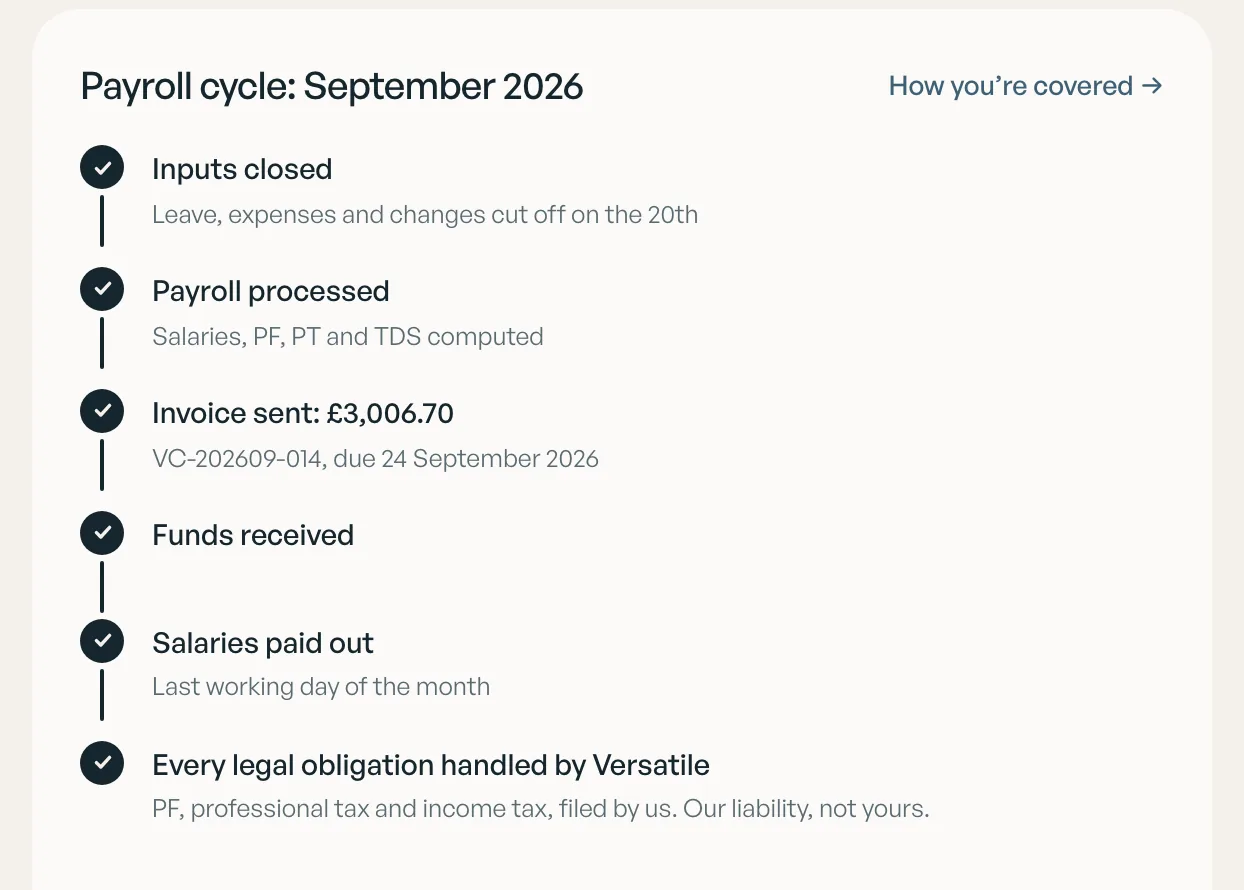
Your payment sits in the middle of the payroll month, after the invoice and before payday. The invoice number and total shown are sample data.
New hires join this cycle once [onboarding finishes on day five](https://versatile.club/docs/onboarding/onboard-an-employee-in-five-days/), the day payroll goes live.
## How to pay employees in India from the US {#paying-from-the-us}
To pay employees in India from the US without your own Indian company, you can use an employer of record and pay its invoice. Your part is then one dollar transfer a month. The EOR pays salaries in rupees and makes the statutory deposits in India. Contractors and your own entity are the other routes, compared further down.
### A bank transfer in dollars {#us-bank-transfer}
You pay by bank transfer in USD to Versatile Club's Indian company. Its contract says it receives payments in convertible foreign exchange through banking channels. That keeps the payment inside the export rules described above.
### Withholding and US reporting {#us-withholding}
The contract asks you to pay free of deduction or withholding unless the law requires one. On the US side, the IRS says "The source of income from the performance of personal services is the place where the services are performed", in its [practice unit on source of income](https://www.irs.gov/pub/fatca/int_practice_units/usb_c_014_02_01_05.pdf). The [2026 Form 1042-S instructions](https://www.irs.gov/pub/irs-pdf/i1042s.pdf) add that foreign-source income is generally not reported on that form. Confirm your own position with your tax adviser.
### Treaty paperwork on request {#us-treaty-paperwork}
If your tax team wants support for treaty relief, the EOR provides a tax residency certificate and a no permanent establishment declaration on request. The vendor setup steps on the billing overview list the rest of the onboarding for a new India vendor.
## FIRC full form, and what it means for you {#firc}
FIRC stands for Foreign Inward Remittance Certificate, as the government's [Consolidated FDI Policy](https://www.dpiit.gov.in/static/uploads/2025/07/6457fc2703ee6082366c4a958b6473a8.pdf?v=20260923021826) spells it out. It is a record issued by the Indian bank that receives a payment from abroad. It belongs to the recipient in India, not to the payer.
### Who gets a FIRC {#firc-who}
When your dollars reach the EOR's bank in India, that bank deals with the inward remittance. The RBI's [export direction](https://www.rbi.org.in/Scripts/BS_ViewMasDirections.aspx?id=10395) requires banks to "report the electronic FIRC to EDPMS wherever such FIRCs are issued against inward remittances". EDPMS is the RBI's export data and monitoring system.
### FIRC and eBRC {#firc-ebrc}
Banks also generate an electronic Bank Realisation Certificate, or eBRC. The same RBI direction says they generate it "only from the data available in EDPMS". The format of each record is set by the bank and the RBI's systems, not by you.
### Do you need a FIRC copy? {#firc-copy}
As the payer, you don't. Your own proof of payment is your bank's transfer confirmation, matched to the invoice number. The FIRC and eBRC are the Indian supplier's evidence that its export earnings arrived.
## How US companies pay people in India compliantly {#paying-people-in-india}
There are three common routes, and the invoice you receive differs with each. The [guide to when an EOR fits](https://versatile.club/docs/use-cases/) compares them in more depth.
### Through an employer of record {#pay-through-eor}
The EOR employs your team in India, runs payroll and deposits the statutory contributions. You pay one invoice a month. This is the route the rest of this page describes, and the [Employer of Record service page](https://versatile.club/docs/services/employer-of-record/) sets out who does what.
### Paying contractors directly {#pay-contractors}
An independent contractor in India invoices you for services, often in dollars. For GST purposes the contractor is then the exporter, so the export conditions and the RBI's realisation period described above apply to them. You get no payroll records or statutory proof, because there is no employment.
### Through your own Indian entity {#pay-own-entity}
With your own subsidiary, you run Indian payroll yourself and fund the entity from abroad. The [EOR vs entity guide](https://versatile.club/eor-vs-entity-india/) shows the headcount at which that starts to pay off.
## Works with {#works-with}
- **Monthly payroll.** The invoice bills the [month's payroll run](https://versatile.club/docs/payroll/monthly-payroll/), and the payroll summary arrives with it.
- **[Provident Fund](https://versatile.club/docs/compliance/provident-fund/).** The PF challan confirmation is one of the records sent with each invoice.
- **Onboarding.** Payroll goes live on day five, so a new hire's cost reaches your invoice from there.
- **Finance reporting.** [India EOR for finance teams](https://versatile.club/for-finance/) covers how the invoice fits your close.
- **Cost planning.** The [employee cost calculator](https://versatile.club/tools/employee-cost-calculator/) shows the employer side of a salary before you hire.
## Who uses it {#who-uses-it}
### A controller closing the month {#who-controller-close}
The controller books one dollar invoice and files the per-employee lines next to the payroll summary. The [CFO's guide to offshoring ROI](https://versatile.club/blogs/the-cfos-guide-to-offshoring-roi/) covers the wider business case she reports on.
### A UK founder paying for an India team {#who-uk-founder}
UK clients receive the same clean dollar invoice each month. A founder in London checks the [India EOR route for UK companies](https://versatile.club/india-eor-for-uk/) before the first hire.
### An FP&A lead allocating costs {#who-fpa-allocation}
Each employee's line goes to the right cost center, so department budgets carry the real India cost. The [hidden costs of offshoring](https://versatile.club/blogs/hidden-costs-of-offshoring/) guide lists the lines to plan for.
### A COO weighing a future GCC {#who-gcc-planning}
Months of per-employee invoices show what each India role really costs. That record feeds the decision to [test India before building a GCC](https://versatile.club/docs/use-cases/test-india-before-a-gcc/).
## How Versatile Club compares for paying an India EOR invoice {#compare}
Versatile Club sends one invoice a month, in US dollars, with the cost broken down per employee. The providers below document invoice breakdowns, but their EOR billing is split across several invoices or set in other currencies. It is the only platform in this table that does all three.
Invoicing for India EOR employees, from each platform's public documentation:
| Platform | One invoice each month | Invoice in US dollars | Per-employee cost breakdown |
|---|---|---|---|
| **Versatile Club** | Yes | Yes | Yes |
| **Deel** | Partly (payroll and fees on two invoices) | Partly ([payroll invoice in local currency](https://help.letsdeel.com/hc/en-gb/articles/17671152016017-Frequently-Asked-Questions-About-EOR-Invoices)) | Partly ([itemized by payroll component](https://help.letsdeel.com/hc/en-gb/articles/31845853594129-How-EOR-Invoices-Are-Calculated-and-Formatted)) |
| **Remote** | Partly ([pre-funding plus reconciliation invoices](https://support.remote.com/pricing/client-pricing-and-billing/all-about-remote-invoice-types)) | Yes ([one of 12 billing currencies](https://support.remote.com/pricing/client-pricing-and-billing/what-currency-will-i-be-billed-in)) | Yes ([a consolidated breakdown report](https://support.remote.com/pricing/client-pricing-and-billing/how-do-i-use-the-consolidated-invoice-breakdown-report)) |
| **Oyster** | Partly ([pre-funding plus settlement invoices](https://support.oysterhr.com/hc/en-us/articles/34395395229329-Invoicing-Process-for-EOR-Team-Members)) | Not in docs | Yes ([payroll breakdown per team member](https://support.oysterhr.com/hc/en-us/articles/34395249891089-How-can-I-see-the-payroll-breakdown-for-my-team-members)) |
| **Skuad** | Yes ([single monthly invoice](https://www.skuad.io/blog/10-best-eor-services-in-india)) | Not in docs | Not in docs |
*Yes: documented and built in. Partly: documented with a limit, shown in brackets. Not in docs: not found in the vendor's public documentation.*
### Why Versatile Club is the stronger choice for paying an India EOR invoice {#compare-stronger}
- **Payroll billed in dollars.** The one monthly invoice is in USD, from the EOR's own Indian company. Deel's invoice FAQ describes [a payroll invoice issued in the employee's local currency](https://help.letsdeel.com/hc/en-gb/articles/17671152016017-Frequently-Asked-Questions-About-EOR-Invoices), with fees on a second invoice. Compare [Versatile Club vs Deel](https://versatile.club/compare/versatile-vs-deel/).
- **The rate is on the invoice.** The EOR converts at the live rate on the invoice date and prints that rate on the invoice. Remote converts pay items at [a fixed Remote FX rate set each month](https://support.remote.com/pricing/client-pricing-and-billing/remote-fx-rate). Compare [Versatile Club vs Remote](https://versatile.club/compare/versatile-vs-remote/).
- **One bill to approve.** Versatile Club sends one USD invoice with a per-employee breakdown. Oyster's EOR billing starts with [a pre-funding invoice that estimates payroll](https://support.oysterhr.com/hc/en-us/articles/34395395229329-Invoicing-Process-for-EOR-Team-Members) and settles later. Read [Oyster alternatives in India](https://versatile.club/blogs/oyster-alternatives-india/).
*Competitor details checked against each vendor's public documentation on 23 October 2026. Features and plans change, so confirm with the vendor before you decide.*
## Limits, what goes wrong and what to check {#limits}
- **USD is the published invoice currency.** The EOR invoices in US dollars from its Indian company, for US and UK clients alike.
- **Payment comes before payday.** The invoice is due on the 24th, before salaries are paid on the last working day, so plan your payment run around that date.
- **The dollar total follows the rate.** Salaries are set and paid in rupees, so the dollar total can move from month to month while the rupee costs stay the same.
- **One issuing entity.** The invoice comes from Foo Falcon Technologies Pvt Ltd, the Indian company that employs your team.
- **India only.** Versatile Club is an India-only EOR, so the invoice covers employees working in India.
- **EOR is a new service.** Versatile Club's entity and payroll operations were built and tested through Contract-to-Hire. It doesn't claim years of EOR-specific track record.
- **The payment misses the 24th.** The invoice is due before salaries are paid on the last working day, and paying by the due date keeps the supplier inside the nine-month window for receiving export earnings. Schedule your payment ahead of the 24th.
- **The dollar total moves and you don't know why.** The total follows the live rate on the invoice date, so it can change while the rupee costs stay the same. Check the rate printed on the invoice before you query a line.
- **A line doesn't match your plan.** Each employee has their own line, so a difference points to one person. Match each line to your plan, and if a line still needs explaining, write through the contact page.
- **A new hire's cost isn't on the invoice yet.** A hire's cost reaches the invoice only after the last onboarding step, being added to payroll, which happens on day five. Check the onboarding checklist before you expect the line.
## Common questions {#common-questions}
#### Can an Indian company invoice in USD? {#faq-invoice-usd}
Yes. India's export rules allow invoices in a freely convertible currency such as the dollar. Versatile Club invoices in USD directly from its Indian company, not through a foreign holding company.
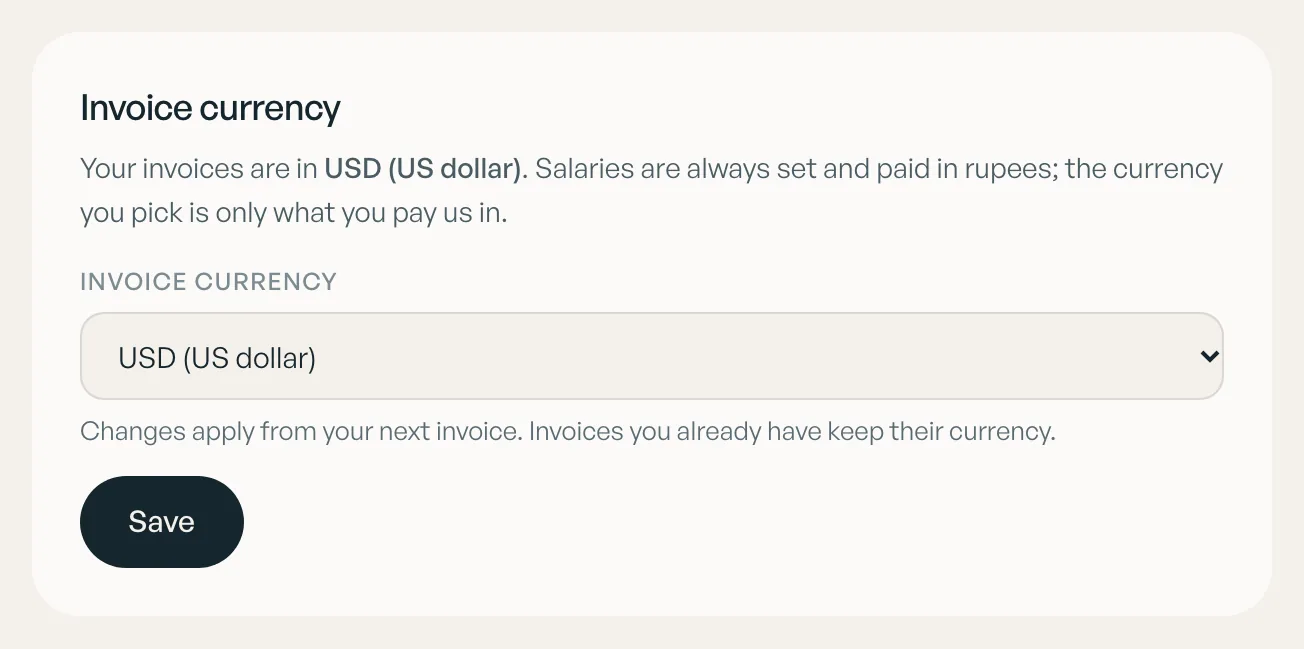
This sample company is invoiced in US dollars, while its team's salaries stay in rupees, which is the split every USD invoice rests on.
#### How many invoices do we get each month? {#faq-how-many}
One. The EOR sends one USD invoice a month, with the cost broken down per employee.
#### What does the invoice show? {#faq-what-it-shows}
A per-employee cost breakdown, showing each person's cost to company. The service fee and an administration charge appear on their own lines. The payroll summary sent with it shows gross pay, deductions and net pay.
#### What arrives with the invoice? {#faq-what-arrives}
A payroll summary, PF and ESI challan confirmations, TDS deposit receipts and a compliance status report listing what's filed and what's coming up.
#### Do we carry any currency risk? {#faq-fx-exposure}
You don't convert anything, because you pay in dollars. The rupee costs never change because of the rate. The dollar total can move from month to month with the live rate on the invoice date.
#### Is there a markup on the exchange rate? {#faq-exchange-rate}
The invoice uses the live rate on the invoice date and prints it. A separate administration charge covers rate movement before payroll, and it is not added to the exchange rate.
#### Can a UK company pay in USD? {#faq-uk-company}
Yes. Versatile Club sends US and UK clients the same clean dollar invoice each month. The [India EOR page for US companies](https://versatile.club/india-eor-for-usa/) describes the US side of the same setup.
#### Can you invoice in GBP or EUR? {#faq-gbp-eur}
Versatile Club's published invoicing is in USD from its Indian company. If you need another currency, raise it through [the contact form](https://versatile.club/contact-us/) before you sign.
#### Can we pay in rupees instead? {#faq-inr-payment}
The IGST Act allows payment for an export of services in rupees "wherever permitted by the Reserve Bank of India", under [section 2(6)(iv)](https://taxinformation.cbic.gov.in/content/html/tax_repository/gst/acts/2017_IGST_Act/active/chapteri/section2_v1.00.html). The published invoicing is in USD, so ask the team before you plan around rupees.
#### Who issues the invoice? {#faq-who-issues}
Foo Falcon Technologies Pvt Ltd, the registered Indian company in Bengaluru that operates Versatile Club and employs your team. Its registrations are listed under [the Indian entity and registrations page](https://versatile.club/docs/compliance/entity-and-registrations/).
#### Is GST charged on an export of services? {#faq-gst}
The IGST Act lists [exports of services among zero-rated supplies](https://cbic-gst.gov.in/aces/Documents/IGST-bill.pdf), subject to its conditions. Versatile Club's contract applies that treatment under a letter of undertaking where it is available.
#### Are there setup or exit fees? {#faq-fees}
No. Versatile Club charges a flat monthly fee with no setup fee and no exit fee, and the first month is free for new hires. The [guide to employer of record cost](https://versatile.club/blogs/employer-of-record-cost/) lists the fee questions to ask any provider.
#### When does a new hire first appear on the invoice? {#faq-first-invoice}
After onboarding. Payroll goes live on day five, and from then the employee is part of the monthly payroll that the invoice bills.
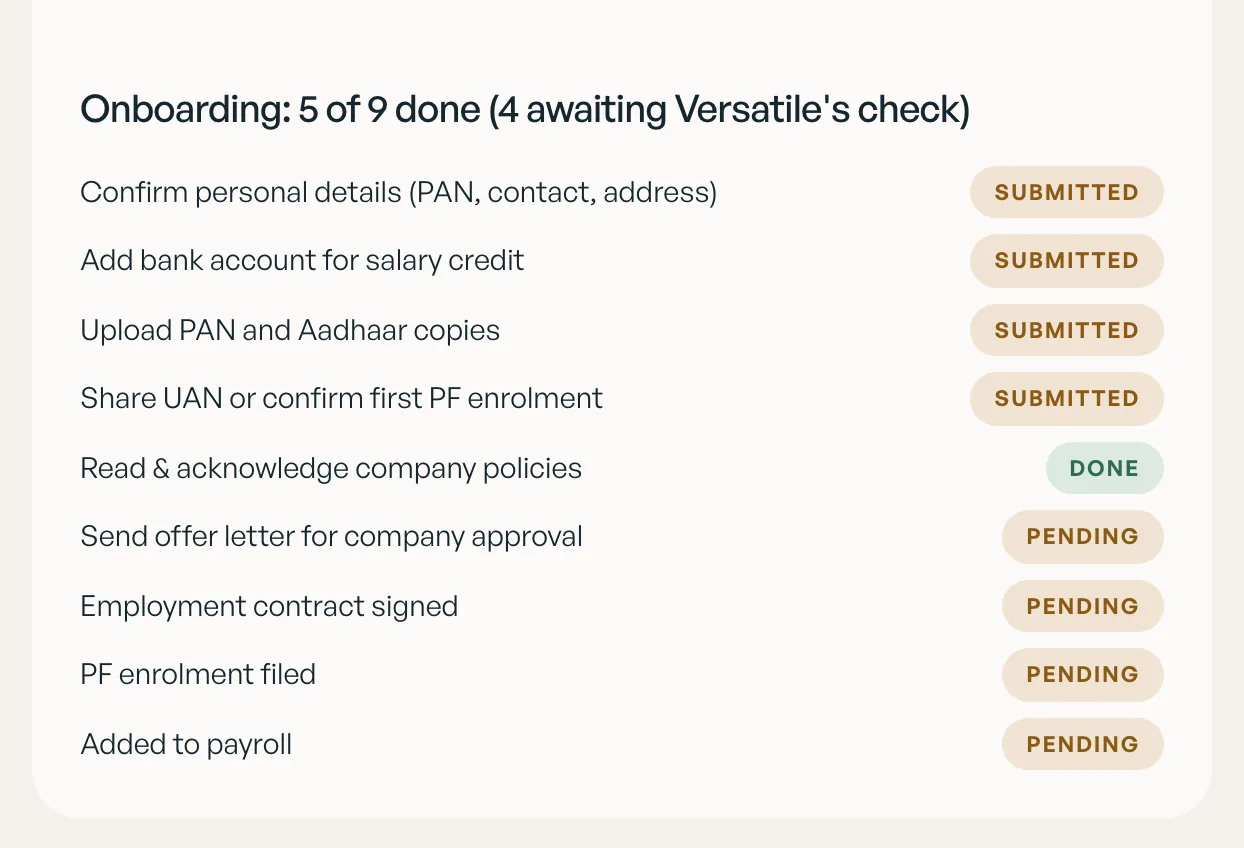
Added to payroll is the last onboarding step, and only after it does a new hire's cost reach your monthly invoice. The person shown is sample data.
#### What do the cost terms on the invoice mean? {#faq-terms}
The [India EOR and payroll glossary](https://versatile.club/glossary/) defines the payroll and statutory terms used on the payroll summary.
## Related {#related}
- [Billing overview](https://versatile.club/docs/billing/): what makes up an India employee's cost, and the vendor setup steps.
- [Monthly payroll in India](https://versatile.club/docs/payroll/monthly-payroll/): the payroll run that each invoice bills.
- [The Indian company behind the invoice](https://versatile.club/docs/compliance/entity-and-registrations/): the EOR's Indian company and its published identifiers.
- [Five-day onboarding](https://versatile.club/docs/onboarding/onboard-an-employee-in-five-days/): how a new hire reaches payroll.
- [Versatile Club service documentation](https://versatile.club/docs/): every service component, page by page.
- [One clean USD invoice for finance](https://versatile.club/for-finance/): how finance teams use the invoice at month end.