# Who Owns IP Created by Employees in India? IP Assignment for India Employees, Explained
IP ownership for India employees hired through an EOR. Who owns the code by default under the Copyright Act, how the written assignment chain carries it from the employee to your company, and what to check before you sign with Versatile Club.
- Applies to: Companies employing staff in India through Versatile Club's Employer of Record service
- Status: Live
- Verified: 2026-10-29
- Canonical page: https://versatile.club/docs/contracts/intellectual-property/
Before your engineers in India commit their first line, you need to know who owns IP created by employees in India. IP ownership for India employees comes down to one rule: under India's Copyright Act, the employer owns work made in the course of employment. With an employer of record, the employer is the EOR, not your company. So the rights reach you only through a written chain: from the employee to the EOR, then from the EOR to you.
Versatile Club is an India-only Employer of Record (EOR). Its EOR service employs your team on its own Indian company, Foo Falcon Technologies Pvt Ltd. Each employment contract vests the rights in that company, and your master services agreement assigns them to you from the moment the work is created.
This page sets out that chain, the Indian law behind each link, a worked example, and what your counsel should check in each document.
## At a glance {#at-a-glance}
| | |
|---|---|
| **Who owns it by default** | The employer, which [under the Copyright Act owns work made in the course of employment](https://www.indiacode.nic.in/show-data?actid=AC_CEN_9_30_00006_195714_1517807321712§ionId=14519§ionno=17&orderno=17) unless an agreement says otherwise |
| **Who the employer is** | Versatile Club's Indian company, Foo Falcon Technologies Pvt Ltd (CIN U72900KA2022PTC163007), not your company |
| **Link one: employee to the EOR** | The employment contract: all IP the employee creates in the job vests in the EOR's Indian company absolutely |
| **Link two: the EOR to you** | The master services agreement: the EOR assigns all rights in the deliverables to your company with effect from the moment of creation |
| **Scope of the assignment** | Copyright, database rights, design rights, patent rights and rights in confidential information; absolute, worldwide, perpetual and irrevocable |
| **Patents** | An assignment [is not valid unless it is in writing](https://ipindia.gov.in/frontend/pdf/patents/1_113_1_The_Patents_Act__1970___incorporating_all_amendments_till_1-08-2024.pdf), and an inventor living in India needs Indian clearance before a filing abroad |
| **Confidentiality** | Binds each employee directly in your favor: five years after the agreement ends, and indefinitely for trade secrets |
| **Where the team works** | India only |

The master services agreement is the one agreement between your company and Versatile Club's Indian company, and it is where the second link of the IP chain sits.
## Who owns IP created by employees in India {#who-owns}
You want every line your India team writes to belong to your company. Most of what the team produces is code, documents and designs. Start with copyright, because Indian law treats software as writing: a ["literary work" includes computer programmes](https://www.indiacode.nic.in/indiacode/bitstream/123456789/1367/1/A195714.pdf), tables and compilations. So the ownership rules for your codebase are copyright rules first, and patent rules only where there is an invention.
The starting rule is that the author owns the work. The exception you need to check covers employees. Where someone writes code in the course of their job under a contract of service, the employer is the first owner, unless an agreement says otherwise.
That exception is why an EOR changes the question. Your engineer's contract of service is with the EOR's Indian company, not with you. Without anything more, the employer rule would leave the code with the EOR. Your company gets ownership only if two written documents move it: one from the employee to the EOR, and one from the EOR to you.
### Why a contractor is different {#who-owns-contractors}
A contractor isn't under a contract of service, so the employer exception doesn't apply. Their code starts with them as the author. That's why a contractor agreement needs its own written assignment, and why the switch from contractor to employee is the point where gaps appear. The section on contractors, below, covers that switch.
## How the IP chain works with an EOR {#how-the-chain-works}
An [employer of record](https://versatile.club/docs/services/employer-of-record/) sits between your company and the person doing the work. As your Employer of Record, Versatile Club employs the person and files their PF, ESI, TDS and professional tax under its own registrations. Your company has no [employment contract](https://versatile.club/docs/contracts/employment-contract/) with them. That's the point of an EOR, and it's why IP reaches you through two documents rather than one.
### Link one: the employment contract {#chain-employee-link}
The employee signs an employment contract with our Indian company. Under its confidential information and intellectual property clause, the employee gives the company full written details of inventions and works made during the job. All such rights vest in that company absolutely. The master services agreement requires every such contract to carry a present assignment of all IP in all deliverables. A promise to assign later isn't enough.
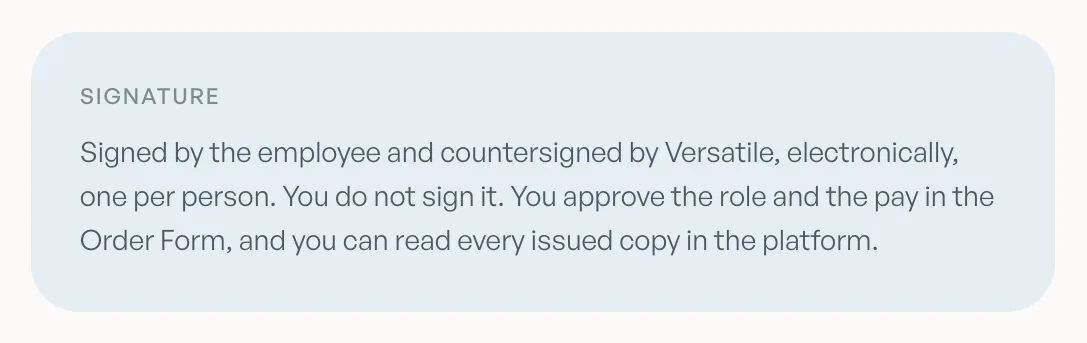
The employee signs with the EOR's Indian company and your company doesn't sign, which is why the agreement lets you enforce the IP terms directly.
### Link two: the master services agreement {#chain-client-link}
Your company signs one master services agreement with Versatile Club before the first hire. In its intellectual property clause, we assign to your company all right, title and interest in the deliverables, with effect from the moment of creation. The assignment covers copyright, database rights, design rights, patent rights and rights in confidential information.
Three further terms close the usual gaps. The employment contract must acknowledge that your company may enforce its IP terms directly. We will sign deeds of assignment, patent assignment forms and inventor declarations at your cost when you need them. That obligation survives the end of the agreement.
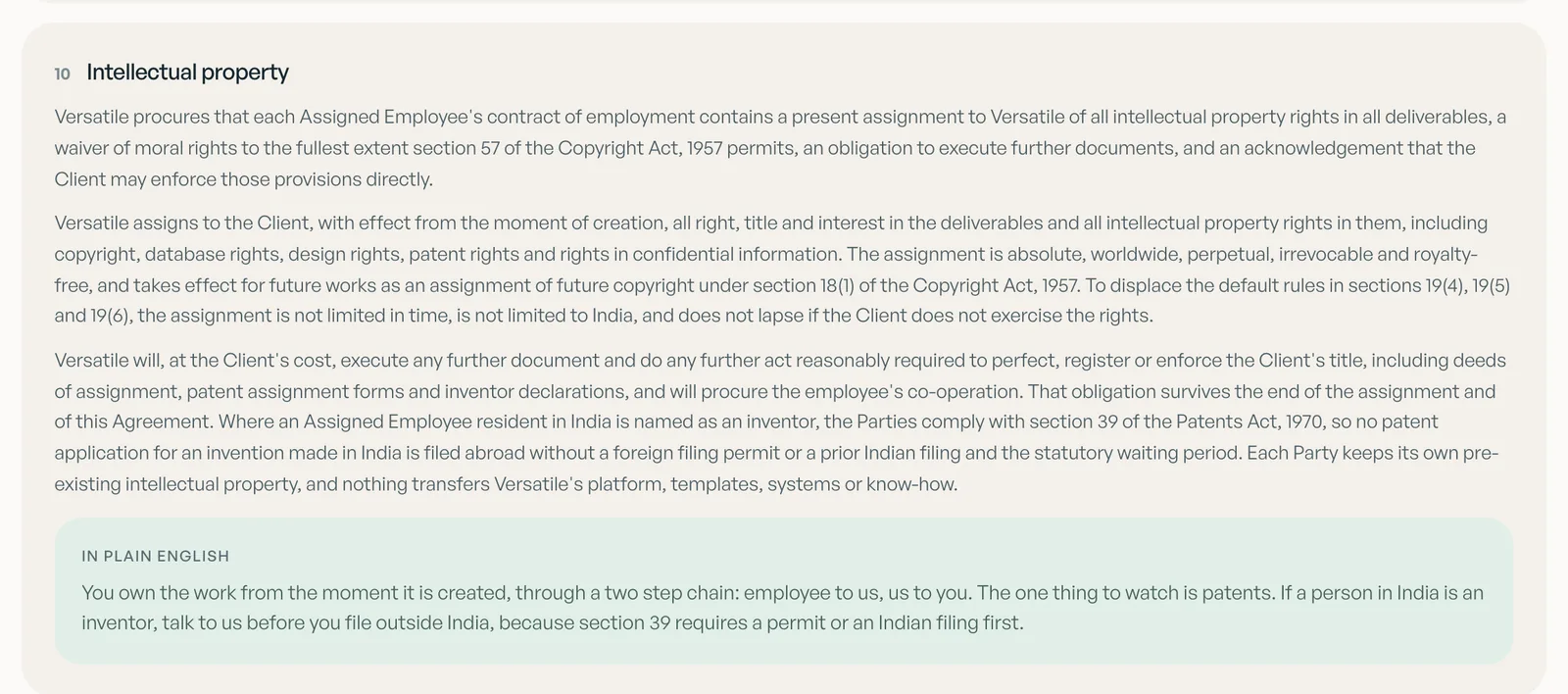
Clause 10 is the core of the chain: rights pass from employee to the EOR to you at creation, and the clause flags the Patents Act section 39 filing rule.
### When each link is signed {#chain-timing}
The documents are signed in this order during [the five-day onboarding](https://versatile.club/docs/onboarding/onboard-an-employee-in-five-days/):
1. **Day one: the service agreement.** Your company and the EOR sign it. This is the link from the EOR's Indian company to you.
2. **Day two: the offer letter.** We send the candidate an India-compliant employment offer.
3. **Day three: the employment contract.** The employee signs with our Indian company, and we collect the documents. This is the link from the employee to the EOR.
4. **Day five: payroll goes live.** The employee is active on payroll.
Because both links are signed before the first payroll, the chain is complete before any code is written. The [Indian entity and registrations page](https://versatile.club/docs/compliance/entity-and-registrations/) shows the company that sits in the middle of it.
## A worked example: one feature, traced {#worked-example}
This example uses sample dates. A backend engineer in Pune joins your team, employed by Versatile Club as the EOR. The agreement is signed on 1 July, the employment contract on 3 July, and payroll goes live on 7 July. On 14 July the engineer commits a new pricing engine to your repository.
| Moment | What the law does by default | What the documents do |
|---|---|---|
| **1 July** | Nothing yet: no work exists | The agreement already assigns future deliverables to your company |
| **3 July** | Nothing yet | The employee's contract carries a present assignment to the EOR's Indian company |
| **14 July, the commit** | The employer, the EOR's Indian company, would be first owner | Rights vest in the EOR and pass to your company from creation |
| **14 July next year** | An unused assignment could lapse after one year | The assignment doesn't lapse if you don't use the rights |
| **Five years on** | An assignment with no stated term would end | The assignment isn't limited in time |
| **A launch outside India** | An assignment that is silent on territory covers India only | The assignment is worldwide |
Two things follow. First, an assignment of future work takes effect only when the work comes into existence, so the chain works commit by commit without fresh paperwork. Second, the defaults on duration, territory and non-use favor the author, so a short or silent clause can leave you with less than you expect. The agreement answers each default in writing.
Now suppose the pricing engine contains a patentable method and you want a US filing. The engineer lives in India, so the Indian filing rule in the law section below applies before anything is filed abroad.
## What the law says {#the-law}
### The rules at a glance {#what-the-law-says}
Four Indian laws shape who owns work made in India: the Copyright Act, 1957, the Patents Act, 1970, the Indian Contract Act, 1872 and the Digital Personal Data Protection Act, 2023. Each part below quotes the provision and links the Act itself, not a summary.
### First ownership: the employer rule, section 17 {#law-first-owner}
The Copyright Act's general rule is that the author is the first owner. For work made under a contract of service, it says "[the employer shall, in the absence of any agreement to the contrary, be the first owner](https://www.indiacode.nic.in/show-data?actid=AC_CEN_9_30_00006_195714_1517807321712§ionId=14519§ionno=17&orderno=17) of the copyright therein". For you, this means the EOR is the starting owner. The assignment to your company is what makes the code yours.
What to check: ask for the written assignment from the EOR to your company before relying on the employer rule.
### IP assignment for India employees: sections 18 and 19 {#law-assignment}
An owner, or the prospective owner of a future work, may assign copyright wholly or partly. For future work, "[the assignment shall take effect only when the work comes into existence](https://www.indiacode.nic.in/indiacode/bitstream/123456789/1367/1/A195714.pdf)". Every assignment must be in writing and signed by the assignor. It must also identify the work and state the rights, duration and territory.
Where an assignment is silent, the Act fills the gap with defaults that favor the author:
- **Non-use:** rights not exercised within one year are deemed to lapse, unless the assignment says otherwise.
- **Duration:** with no stated period, the assignment lasts five years.
- **Territory:** with no stated territory, it is presumed to cover India only.
What to check: the assignment names the work, rights, duration and territory, and says it is worldwide and doesn't lapse.
### Moral rights: section 57 {#law-moral-rights}
Authors keep two personal rights "[independently of the author's copyright and even after the assignment](https://www.indiacode.nic.in/indiacode/bitstream/123456789/1367/1/A195714.pdf)": to claim authorship, and to object to a distortion that harms their honor or reputation. The Act takes away the right to object to certain adaptations of a computer program. Versatile Club's agreement requires each employment contract to waive moral rights as far as the Act permits.
What to check: the employment contract carries that waiver.
### Patents: written assignments, sections 6, 68 and 69 {#law-patents}
Under the Patents Act, the true and first inventor or their assignee may apply for a patent. An assignment of a patent "[shall not be valid unless the same were in writing](https://ipindia.gov.in/frontend/pdf/patents/1_113_1_The_Patents_Act__1970___incorporating_all_amendments_till_1-08-2024.pdf)" and duly executed. A person who becomes entitled to a patent by assignment must apply in writing to the Controller to register the title. So an invention made in India should reach your company through signed, written assignments at each link, followed by registration of the new owner.
What to do: keep the signed, written assignment for each link, and register the new owner with the Controller.
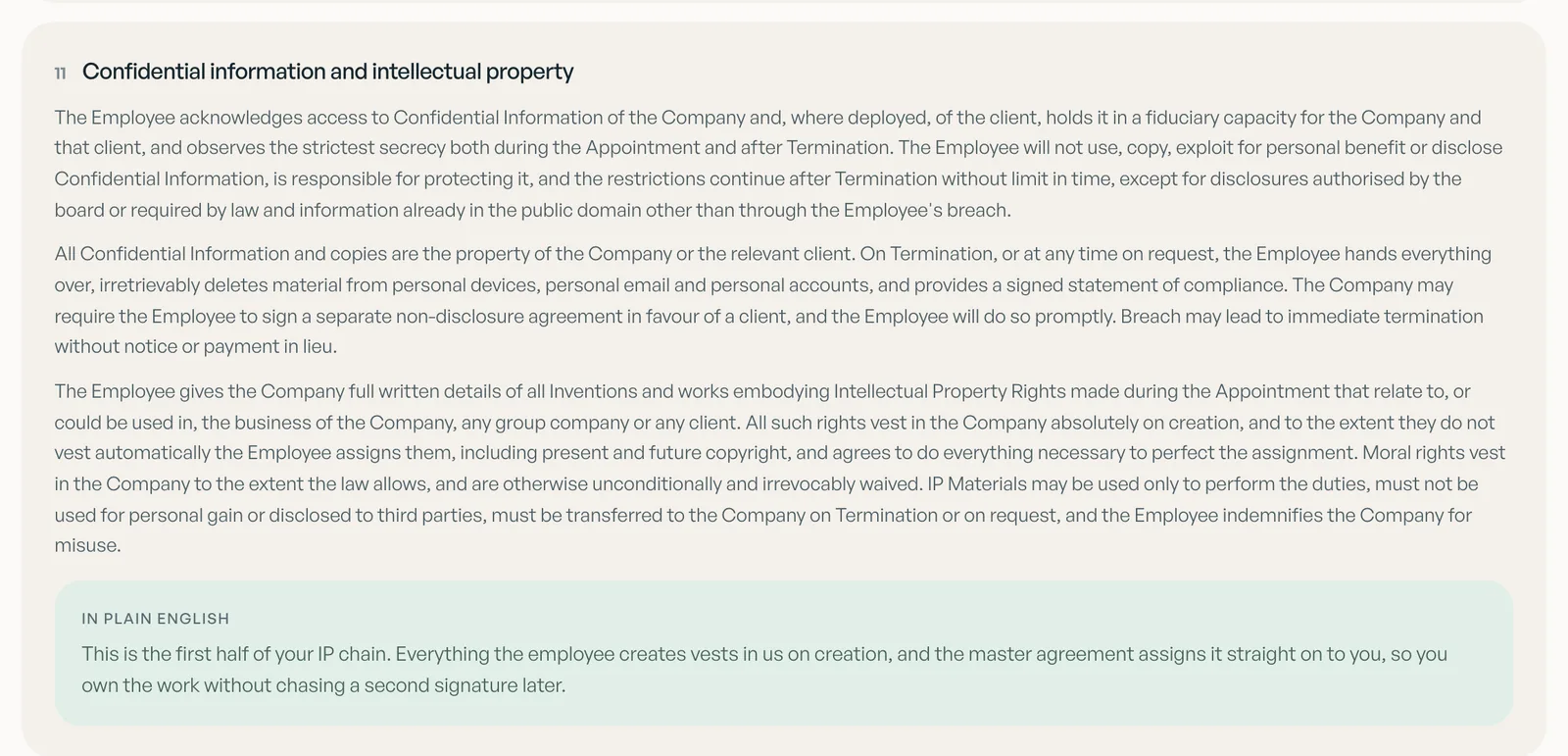
The employment contract's clause 11 is link one in writing: inventions are disclosed in full and every right vests in the EOR's Indian company.
### Filing abroad: section 39 {#law-foreign-filing}
A US startup often files first in the US. The Patents Act limits that when the inventor lives in India: "[No person resident in India shall, except under the authority of a written permit](https://ipindia.gov.in/frontend/pdf/patents/1_113_1_The_Patents_Act__1970___incorporating_all_amendments_till_1-08-2024.pdf)", apply abroad first. The exception is an Indian application filed at least six weeks earlier, with no secrecy direction in force. Plan your filing order before the first draft goes to US counsel.
What to check: if the inventor lives in India, ask whether a permit or an Indian application has to come first.
### Restraint of trade: Contract Act section 27 {#law-restraint}
The Indian Contract Act says an agreement restraining anyone "[from exercising a lawful profession, trade or business of any kind, is to that extent void](https://www.indiacode.nic.in/indiacode/bitstream/123456789/2187/2/A187209.pdf)". Protect your code through the assignment and confidentiality terms. Have counsel review any clause that limits where someone can work after they leave.
### Confidential information and employee data {#law-confidentiality}
The Digital Personal Data Protection Act, 2023 lets an employer process personal data for employment, a ground that expressly covers the "[maintenance of confidentiality of trade secrets](https://www.meity.gov.in/static/uploads/2024/06/2bf1f0e9f04e6fb4f8fef35e82c42aa5.pdf)". The Act's main provisions haven't commenced yet, and DPDP readiness is one of the [compliance areas we cover](https://versatile.club/docs/compliance/). In the agreement's confidentiality clause, we must bind each employee in writing to terms at least as protective as its own, naming your company as entitled to enforce them.
What to check: the confidentiality clause binds each employee in writing and names your company as entitled to enforce it.
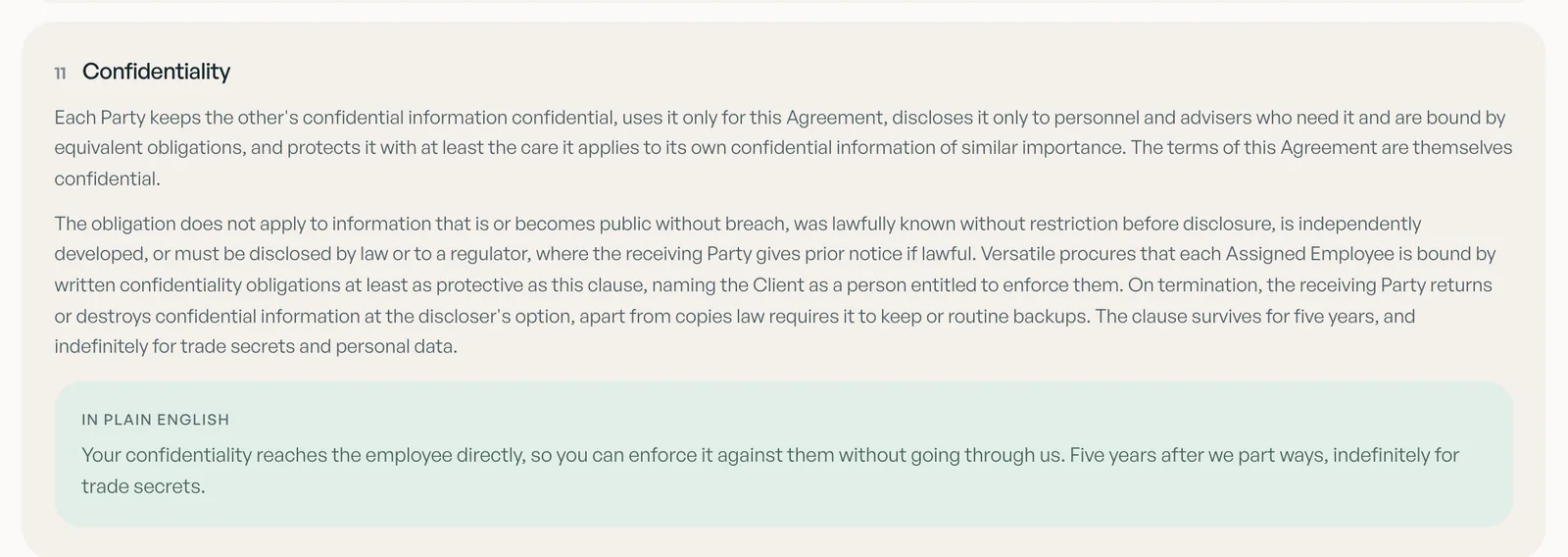
Your confidentiality terms bind each employee directly, survive five years after the agreement ends, and last indefinitely for trade secrets.
### Software, designs and other rights {#law-copyright-designs}
Code, documents and most designs fall under copyright, which is why the rules above matter most. Registered designs sit under the Designs Act, 2000. Have your counsel confirm how that Act applies if your team produces product designs you plan to register. The guide to [protecting IP when outsourcing work](https://versatile.club/blogs/how-to-protect-your-intellectual-property-when-outsourcing-freelance-work/) covers the practical side.
## What to check in each document {#what-to-check}
### In your master services agreement {#check-service-agreement}
- **The assignment runs from creation.** Look for a present assignment of all deliverables, not a promise to assign later.
- **Every kind of right is named.** Copyright, database, design and patent rights, plus confidential information.
- **The author-friendly defaults are answered.** The assignment should be unlimited in time, worldwide, and should not lapse if you don't use the rights.
- **Further documents are promised.** Deeds of assignment, patent forms and inventor declarations, with the duty surviving termination.
- **Confidentiality reaches the employee.** Your company should be named as entitled to enforce it.
### In the employment contract {#check-employment-contract}
- **A present assignment** from the employee to the EOR's Indian company, in writing and signed.
- **Coverage of inventions** as well as code, documents and designs, with written disclosure.
- **A moral rights waiver** to the extent the law allows.
- **Confidentiality** during and after employment, with no time limit on confidential information.
- **Return of materials** when the employee leaves.
The [India employment contract guide](https://versatile.club/blogs/india-eor-employment-contract-leave-and-compliance-guide/) explains the other clauses an Indian contract carries.
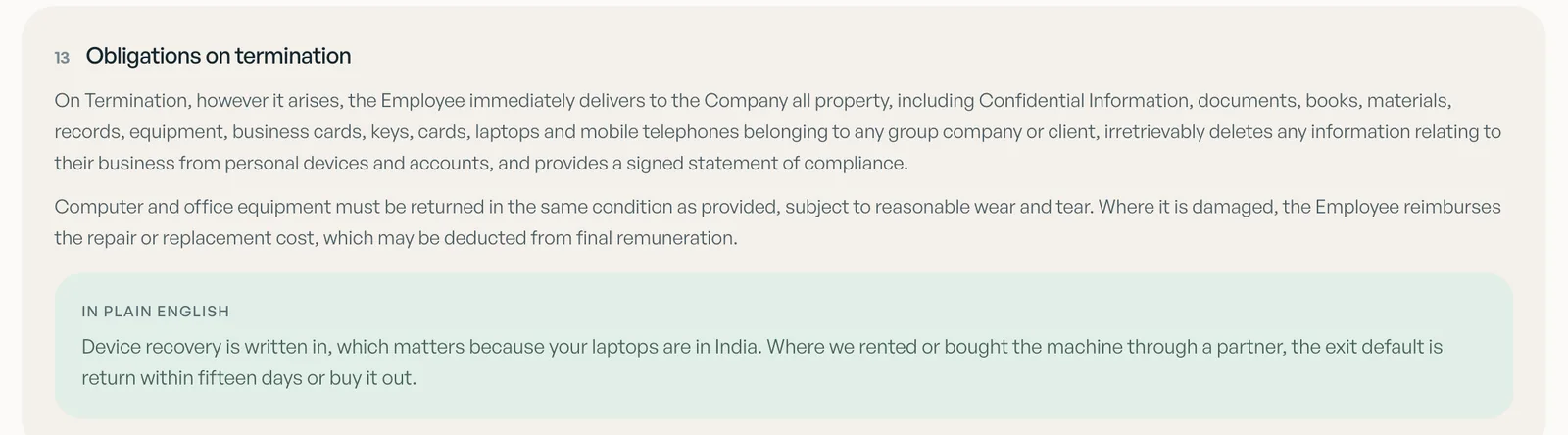
Clause 13 brings code, laptops and documents back on exit and requires a signed statement that business data was deleted from personal devices.
### When someone leaves {#check-at-exit}
We run a Full and Final settlement on exit, covering notice, leave encashment, gratuity, PF and the relieving letter. Under clause 13 of the employment contract, the employee hands back all property, including laptops and phones. They also delete business information from personal devices and accounts, and sign a statement of compliance. The [documents each side receives on exit](https://versatile.club/docs/reference/documents-you-receive/) lists the paperwork, and the [India offboarding planner](https://versatile.club/tools/india-offboarding-planner/) lists the other exit steps.
## Contractors who become employees {#contractors}
Versatile Club's established service is Contract-to-Hire: a person starts as a contractor and converts to a full-time employee when you're ready. A contractor's work is covered by a contractor agreement, not an employment contract, and the employer rule doesn't apply to it. So check that the contractor agreement assigns IP in writing, and that nothing falls between the two.
The page on [contractor agreements that hold up in India](https://versatile.club/contractor-india/compliant-contracts/) covers IP clauses for contractors. Before you convert, the [contractor misclassification quiz](https://versatile.club/tools/misclassification-quiz/) checks whether the current setup already looks like employment. The guide to [converting a contractor to an employee](https://versatile.club/blogs/convert-contractor-to-employee-india/) walks through the switch.
## Who reads this page {#who-uses-it}
### Outside counsel preparing a Series A data room {#who-legal-reviewer}
Outside counsel for a US developer-tools startup is building the IP schedule for a Series A. Four of the twelve engineers work from Bengaluru through an EOR. Counsel needs each person's contract, the master services agreement and proof that both links existed before their first commit. The [India EOR page for founders](https://versatile.club/for-founders/) covers the rest of the first-hire decision.
### A founder answering diligence questions {#who-founder-diligence}
Investors ask for proof that all code belongs to the company. The founder files the signed agreement next to each employee's start date and contract date. The [guide to hiring in India without an entity](https://versatile.club/blogs/hire-in-india-without-an-entity/) explains why the EOR, not the founder, signs the employment contract.
### A company planning its own India entity later {#who-gcc-plan}
A team that may move to its own GCC wants every month of work to land with the parent company. Because the agreement assigns rights at creation, work done before any move already belongs to the client. The employment contract also lets us convert a person to direct employment with the client, and confidentiality survives that conversion. The [GCC use case](https://versatile.club/docs/use-cases/test-india-before-a-gcc/) explains the path, and [building a GCC on Versatile Club's Indian company](https://versatile.club/gcc-india/) covers the transfer.
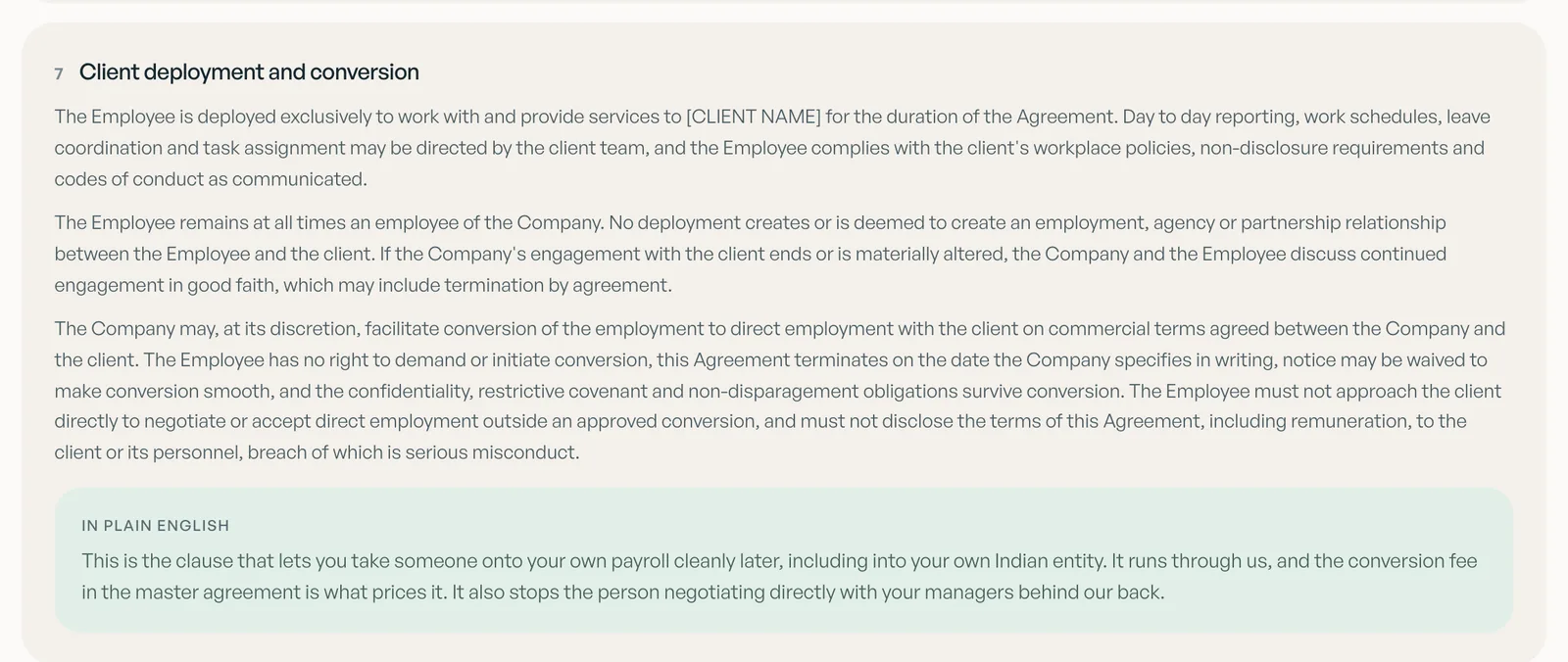
Clause 7 matters for GCC plans: a person can later move to your own payroll, and their confidentiality and restrictive obligations survive the move.
## Limits, what goes wrong and what to check {#limits}
- **India only.** Versatile Club is an India-only Employer of Record, so this covers employees working in India.
- **Two documents, not one.** Your company signs a master services agreement with the EOR. The employee signs an employment contract with its Indian company.
- **Your company isn't a party to the employment contract.** You enforce its IP and confidentiality terms through the rights the agreement gives you, not as a signatory.
- **Foreign patent filings follow Indian timing.** Where an inventor lives in India, plan the Indian application or permit first.
- **Not legal advice.** This page sets out the documents and the relevant Indian law. Your own counsel should review the clauses for your work.
- **EOR is a new service.** We run it on the entity and compliance operation we built through Contract-to-Hire. It doesn't claim years of EOR-specific track record.
- **The assignment is silent on terms.** The Act's defaults apply: rights lapse after a year of non-use, the term is five years, and the territory is India only. Check the clause says worldwide, unlimited in time and no lapse.
- **The employment contract only promises to assign later.** A promise to assign later isn't enough, and the employer rule would leave the code with the EOR. Read the clause for a present assignment.
- **A patent is filed abroad first.** If the inventor lives in India, the filing needs a written permit or an Indian application filed at least six weeks earlier. Ask counsel to set the filing order.
- **A contractor's work sits outside the chain.** The employer rule doesn't cover it, so the code starts with the contractor as author. Ask for the contractor agreement and check it assigns IP in writing.
- **Materials stay behind after someone leaves.** Clause 13 requires return of laptops, phones and documents, deletion of business data from personal devices, and a signed statement. Ask for that statement on exit.
## Common questions {#common-questions}
#### Who owns IP created by employees in India? {#faq-who-owns}
By default the employer owns work made in the job, under the [Copyright Act's employer rule](https://www.indiacode.nic.in/show-data?actid=AC_CEN_9_30_00006_195714_1517807321712§ionId=14519§ionno=17&orderno=17). With an EOR, that employer is the EOR. Our agreement assigns the rights to your company from the moment of creation.
#### What should an IP assignment for India employees include? {#faq-assignment-contents}
It should be in writing and signed, identify the work, and name the rights, duration and territory. Say it is worldwide, unlimited in time and doesn't lapse through non-use, or the Act's narrower defaults apply.
#### Does our company sign anything with the employee? {#faq-sign-with-employee}
No. The [employment contract](https://versatile.club/docs/contracts/employment-contract/) is between the employee and the EOR's Indian company. Your company signs a master services agreement with the EOR, which lets you enforce the IP terms directly.
#### Does an IP assignment in India have to be in writing? {#faq-in-writing}
Yes. Copyright assignments must be in writing and signed by the assignor, and patent assignments must be in writing and duly executed. The law section above quotes both rules.
#### When are the documents signed? {#faq-when-signed}
The agreement is signed on day one of onboarding, and the employment contract on day three. Payroll goes live on day five, so both are in place before work starts.
#### Which company is the employer? {#faq-employer}
Foo Falcon Technologies Pvt Ltd, the registered Indian company that operates Versatile Club. [About Versatile Club](https://versatile.club/about/) lists its published identifiers.
#### Does the assignment lapse if we don't use the code? {#faq-lapse}
No. Indian law lets an unused assignment lapse after a year unless the assignment says otherwise. Our agreement says the assignment doesn't lapse, isn't limited in time and isn't limited to India.
#### Can the engineer claim authorship later? {#faq-moral-rights}
Moral rights survive assignment under Indian law. The agreement requires each employment contract to waive them as far as the law permits, and the law already limits objections to adaptations of software.
#### Can we file a patent in the US first? {#faq-patent-abroad}
Not without planning if the inventor lives in India. The Patents Act requires a written permit or an Indian application filed at least six weeks earlier. Our agreement flags this rule.
#### Can we review the IP clauses before we sign? {#faq-review-clauses}
Yes. Write to the Versatile Club team through [the contact page](https://versatile.club/contact-us/) and ask for the IP and confidentiality clauses in the agreement and the employment contract.
#### What about work done while the person was a contractor? {#faq-contractor-work}
That work sits under the contractor agreement, not the employment contract, and the employer rule doesn't cover it. Check that the contractor agreement assigns IP in writing, so the chain has no gap at conversion.
#### Does the EOR cover data protection? {#faq-data-protection}
Yes. In the agreement's data schedule, Versatile Club is a data fiduciary for employee data and notifies you of a breach within 24 hours. The Act's [employment ground covers trade secrets](https://www.meity.gov.in/static/uploads/2024/06/2bf1f0e9f04e6fb4f8fef35e82c42aa5.pdf), though its main provisions haven't commenced.
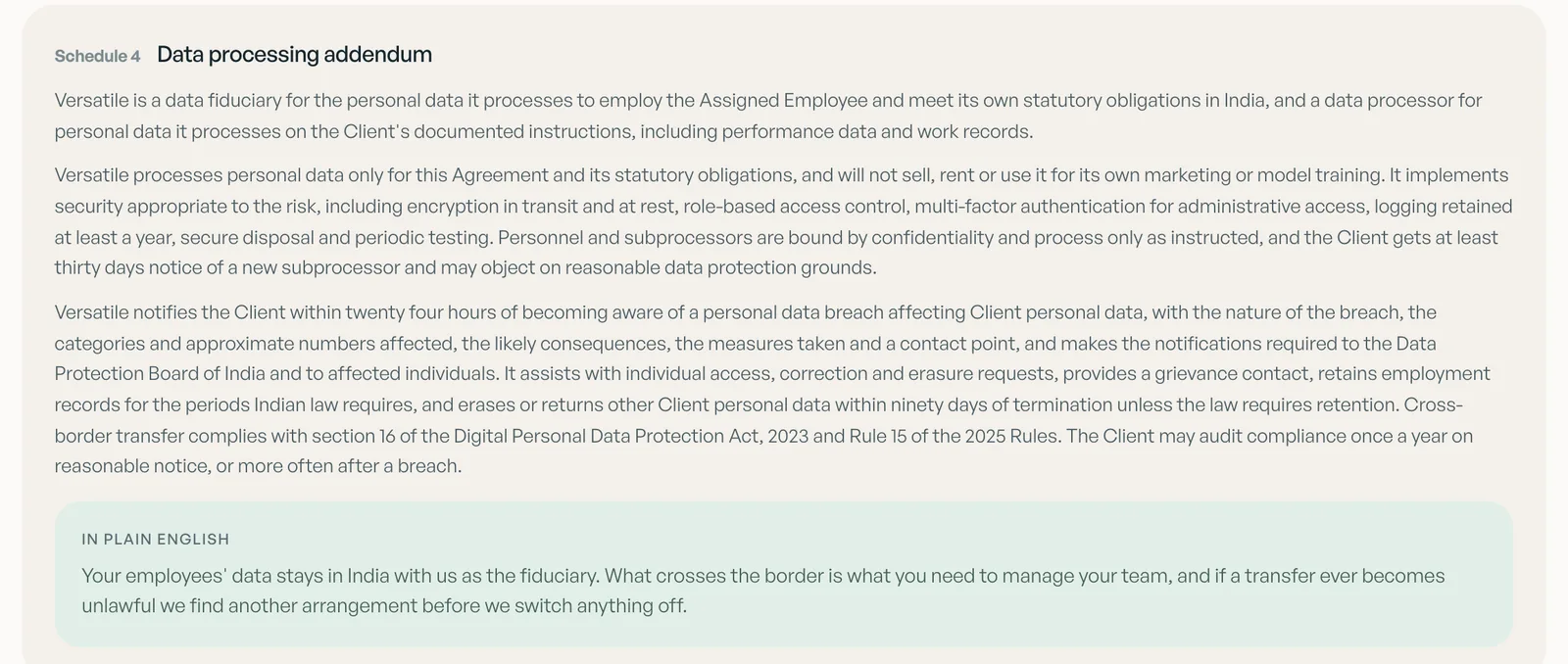
Schedule 4 covers the personal data around your IP: the EOR won't sell it or use it for model training, and reports breaches within a day.
#### Who keeps the laptop and the code when someone leaves? {#faq-exit-materials}
Your company does. Clause 13 of the employment contract requires the employee to return laptops, phones and documents, delete business data from personal devices, and sign a statement of compliance.
## Related {#related}
- [Employment contracts in India](https://versatile.club/docs/contracts/): both contracts, side by side.
- [Monthly payroll](https://versatile.club/docs/payroll/monthly-payroll/): what the employer runs each month once work starts.
- [When Versatile Club is not the right fit](https://versatile.club/docs/use-cases/when-versatile-is-not-a-fit/): the cases to check first.
- [Versatile Club service documentation](https://versatile.club/docs/): every service component, page by page.
- [Employer of Record in India](https://versatile.club/employer-of-record-india/): the service these documents belong to.
- [Outsourcing projects from the USA to India](https://versatile.club/blogs/outsourcing-projects-from-usa-to-india-a-comprehensive-guide/): IP risks across other models.
- [India EOR and payroll glossary](https://versatile.club/glossary/): plain definitions of EOR, CTC and more.
- [Versatile Club's EOR pricing](https://versatile.club/pricing/): how the monthly plan for each employee works.