# India Employer Payroll Taxes: Statutory Rates, Thresholds and the Cost of an Employee
India employer payroll taxes and statutory contributions in one master table, with a worked total-employer-cost example, for finance teams modelling the full cost of India staff. Every figure links its government source and was last checked on 29 October 2026.
- Applies to: Employers of staff in India, including companies hiring through Versatile Club's Employer of Record (EOR) service
- Status: Live
- Verified: 2026-10-29
- Canonical page: https://versatile.club/docs/reference/statutory-rates-and-thresholds/
You are modelling the cost of India staff and need each rate, its wage base, its ceiling and the date it was checked. India employer payroll taxes are a short list of contributions and deductions. They are Provident Fund with its pension and insurance parts, ESI, gratuity, bonus, professional tax, labour welfare fund and income tax.
The master table below gives all of them with the government instrument linked in every row, checked on 29 October 2026. A worked example then turns the rates into the employer cost of an employee in India, for two round sample salaries. Versatile Club, an India-only Employer of Record (EOR), applies every figure here to the teams it employs for you.
## At a glance: India employer payroll taxes in 2026 {#at-a-glance}
Every statutory contribution an employer of India staff pays or withholds, with the instrument that sets it:
| Contribution | Employer pays | Employee pays | Wage base, ceiling or threshold | Instrument |
|---|---|---|---|---|
| **Provident Fund (EPF)** | 12% of wages | 12% of wages, deducted from pay | Contributions are limited to those on the wage ceiling | [EPF Scheme, 2026, para 18](https://egazette.gov.in/WriteReadData/2026/273957.pdf) |
| **EPF wage ceiling** | Applies to the employer share | Applies to the employee share | ₹25,000 a month, from 17 September 2026 | [S.O. 5109(E)](https://www.labour.gov.in/static/uploads/2026/09/2b0f1dbbd3769fc388416186ec145328.pdf) |
| **Pension (EPS)** | 8.33% of wages, carved out of the employer's 12% | Nil | Wages up to the ceiling, so at most ₹2,083 a month | [Employees' Pension Scheme, 2026, para 4](https://egazette.gov.in/WriteReadData/2026/273951.pdf) |
| **Insurance (EDLI)** | The notified rate, capped at 1% of wages | Nil | Wages up to the ceiling | [Code on Social Security, s.16(1)(c)](https://www.indiacode.nic.in/indiacode/bitstream/123456789/16823/1/aA2020-36.pdf) and [EDLI Scheme, 2026, para 5](https://egazette.gov.in/WriteReadData/2026/273942.pdf) |
| **Employees' State Insurance (ESI)** | 3.25% of wages | 0.75% of wages, nil if the average daily wage is up to ₹176 | Wages up to ₹21,000 a month | [ESIC contribution rates](https://roap.esic.gov.in/ro-sro-contribution) and [ESIC Standard Note, 2026](https://roharyana.esic.gov.in/attachments/publicationfile/Standard_Note_on_ESI_Scheme_as_on_01_01_2026_1791271940.pdf) |
| **Gratuity** | 15 days' wages for each completed year, paid on exit | Nil | After five years' continuous service, up to a notified maximum | [Code on Social Security, s.53](https://www.labour.gov.in/static/uploads/2025/07/b0620548445580767b5c0d18c95c26f7.pdf) |
| **Statutory bonus** | At least 8⅓% of wages or ₹100, at most 20% | Nil | Employees under a wage limit set by notification | [Code on Wages, s.26](https://www.labour.gov.in/static/uploads/2025/06/c328da14bbb15fc4ad571dc33e7a4ab3.pdf) |
| **Professional tax** | Deducts and deposits it | A state amount, such as ₹1,250 a half-year in Chennai above ₹75,000 | Set by the state where the employee works | [Chennai PT notice](https://chennaicorporation.gov.in/gcc/pdf/PT_Press_Release.pdf) |
| **Labour welfare fund** | ₹75 every six months in Maharashtra; ₹30 in West Bengal | ₹25 every six months in Maharashtra | Covered employees, in states that levy it | [Maharashtra LWF Act](https://www.indiacode.nic.in/bitstream/123456789/19974/1/the_maharashtra_labour_welfare_fund_act.pdf) and [West Bengal LWF notice](https://www.labour.wb.gov.in/sites/default/files/upload/notice/Labr-576641%20Dated-19-11-2024.pdf) |
| **Income tax (TDS)** | Deducts and deposits it; not an employer cost | Default-regime slabs from nil to 30% | Salary after a ₹75,000 standard deduction | [Income-tax Act, 2025, ss.19 and 202](https://egazette.gov.in/WriteReadData/2025/265620.pdf) |
So the employer's own cost on top of gross salary has six parts. They are employer PF (which carries EPS), EDLI, ESI where it applies, a gratuity provision, any statutory bonus and the employer's welfare fund share. Professional tax, the employee's PF and ESI shares and income tax come out of pay. For a quick figure on any salary, the [employee cost calculator](https://versatile.club/tools/employee-cost-calculator/) runs the same arithmetic.
## Employer cost of an employee in India: a worked example {#worked-example}
The example uses round sample salaries to show how the rates combine. The figures aren't quotes, and each line names the rule it applies. An EOR's service fee sits outside these statutory costs. Versatile Club charges a flat monthly fee, shown on its [pricing page](https://versatile.club/pricing/).
### Two sample hires {#sample-hires}
The first hire is a software engineer in Chennai on a gross salary of ₹1,00,000 a month. The second is a customer support hire in Bengaluru on ₹20,000 a month. Both have basic pay at exactly half of gross. Under the [Code on Wages add-back rule](https://www.indiacode.nic.in/indiacode/bitstream/123456789/15793/1/aA2019-29.pdf), allowances above one-half of pay count as wages. A half-and-half split keeps the wage base at basic pay.
| Line, per month | Engineer in Chennai | Support hire in Bengaluru | Rule applied |
|---|---|---|---|
| **Gross salary** | ₹1,00,000 | ₹20,000 | Sample offers; basic at half of pay meets the [wages definition](https://egazette.gov.in/WriteReadData/2019/210356.pdf) |
| **Basic pay, the PF and gratuity base** | ₹50,000 | ₹10,000 | Half of gross, the wage base under the [Code on Wages](https://www.labour.gov.in/static/uploads/2025/06/c328da14bbb15fc4ad571dc33e7a4ab3.pdf) |
| **Employer PF** | ₹3,000 | ₹1,200 | 12% of basic, limited to the [₹25,000 ceiling](https://www.labour.gov.in/static/uploads/2026/09/2b0f1dbbd3769fc388416186ec145328.pdf) |
| **Of which pension (EPS)** | ₹2,083 | ₹833 | [8.33% of wages up to the ceiling](https://egazette.gov.in/WriteReadData/2026/273951.pdf), rounded to the nearest rupee |
| **Employer ESI** | Nil | ₹650 | [3.25% of wages](https://romaharashtra.esic.gov.in/ro-sro-about-us), only for wages up to ₹21,000 |
| **Gratuity provision** | ₹2,404 | ₹481 | [15 days' wages per completed year](https://www.labour.gov.in/static/uploads/2026/02/83978455025732b99b0165def80ab171.pdf): basic ÷ 26 × 15, spread over 12 months |
| **Total employer cost** | ₹12,64,846 a year, about ₹1,05,404 a month | ₹2,67,969 a year, about ₹22,331 a month | Before EDLI, at most 1% of wages up to the ceiling, and administrative charges at the [notified rates](https://egazette.gov.in/WriteReadData/2026/273942.pdf) |
The pension line is part of employer PF, not an extra cost. Whatever employer PF is left after the pension share goes to the employee's own PF account. Yearly totals use the yearly gratuity figure, so the monthly figures are rounded.
### Example 1: the engineer's in-hand pay {#example-engineer}
The engineer's in-hand pay starts from the same gross. Employee PF matches the employer's ceiling-based amount, and Chennai professional tax falls in the top half-yearly band in the state table below. ESI doesn't apply, because the salary is above the coverage limit.
Over a year, that means ₹36,000 of employee PF and ₹2,500 of professional tax. Taxable salary is ₹11,25,000 after the ₹75,000 standard deduction, and tax on that is ₹52,500. The [rebate of up to ₹60,000](https://egazette.gov.in/WriteReadData/2025/265620.pdf) cancels it, so TDS is nil and take-home pay is ₹11,61,500 a year, about ₹96,792 a month.
### Example 2: the support hire's in-hand pay {#example-esi}
The support hire pays ₹1,200 a month in PF and ₹150 in ESI, which is 0.75% of ₹20,000. Karnataka charges no professional tax where [monthly gross income is less than ₹25,000](https://ptax.karnataka.gov.in/ptemployer/FAQ). Yearly income of ₹2,40,000 is below the first taxable slab, so there is no TDS. Take-home pay is ₹18,650 a month.
This is the salary band where ESI matters most. Both sides pay it, so the employer's extra cost and the employee's deduction rise together.
### CTC, gross pay and in-hand pay {#ctc-gross-in-hand}
Indian offers are usually quoted as CTC, or cost to company. CTC is the gross salary plus the employer's own statutory costs, such as employer PF and often a gratuity provision. In the table above, the total employer cost line is the CTC on that basis.
So three numbers describe one offer. Gross is what the payslip shows before deductions, CTC is what the employer budgets, and in-hand is what reaches the bank account. To go from CTC to in-hand pay, take out the employer's costs to reach gross, then take out employee PF, ESI, professional tax and TDS. The [India salary calculator](https://versatile.club/tools/salary-calculator/) does this for any CTC, and the [CTC offer optimizer](https://versatile.club/tools/india-ctc-offer-optimizer/) tests a structure before the offer goes out.
## Provident Fund and ESI {#epf-and-esi}
PF and ESI are the two monthly social security contributions. The rates sit in the master table; this section covers when each is paid, who must register and what late payment costs.
| Item | Rule | Instrument |
|---|---|---|
| **EPF and EPS deposit** | [Within fifteen days of the close of every month](https://egazette.gov.in/WriteReadData/2026/273957.pdf), with the electronic return | EPF Scheme, 2026, paras 20 and 28 |
| **EDLI deposit** | [Within fifteen days of the close of every month](https://egazette.gov.in/WriteReadData/2026/273942.pdf), with its administrative charges | EDLI Scheme, 2026, para 6 |
| **EPF coverage** | [Establishments employing 20 or more employees](https://www.labour.gov.in/static/uploads/2026/02/83978455025732b99b0165def80ab171.pdf?v=20261019080621) | Labour Ministry compliance handbook |
| **Interest on late dues** | [Simple interest at 12% a year](https://www.labour.gov.in/static/uploads/2026/06/730db9e9a2b244dba77b741b37fd842d.pdf) on any amount due under the Code, deemed from 21 November 2025 | S.O. 2698(E) |
| **ESI deposit** | [Within 15 days of the last day of the month](https://roap.esic.gov.in/ro-sro-contribution) the contributions fall due | ESIC contribution guidance |
| **ESI contribution periods** | 1 April to 30 September, and 1 October to 31 March | ESIC contribution guidance |
The employer pays both PF shares to the fund and recovers the employee's share from pay. It can't recover its own share from the employee. ESI works the same way, and the employer still pays its share for low earners who are exempt from the employee share.
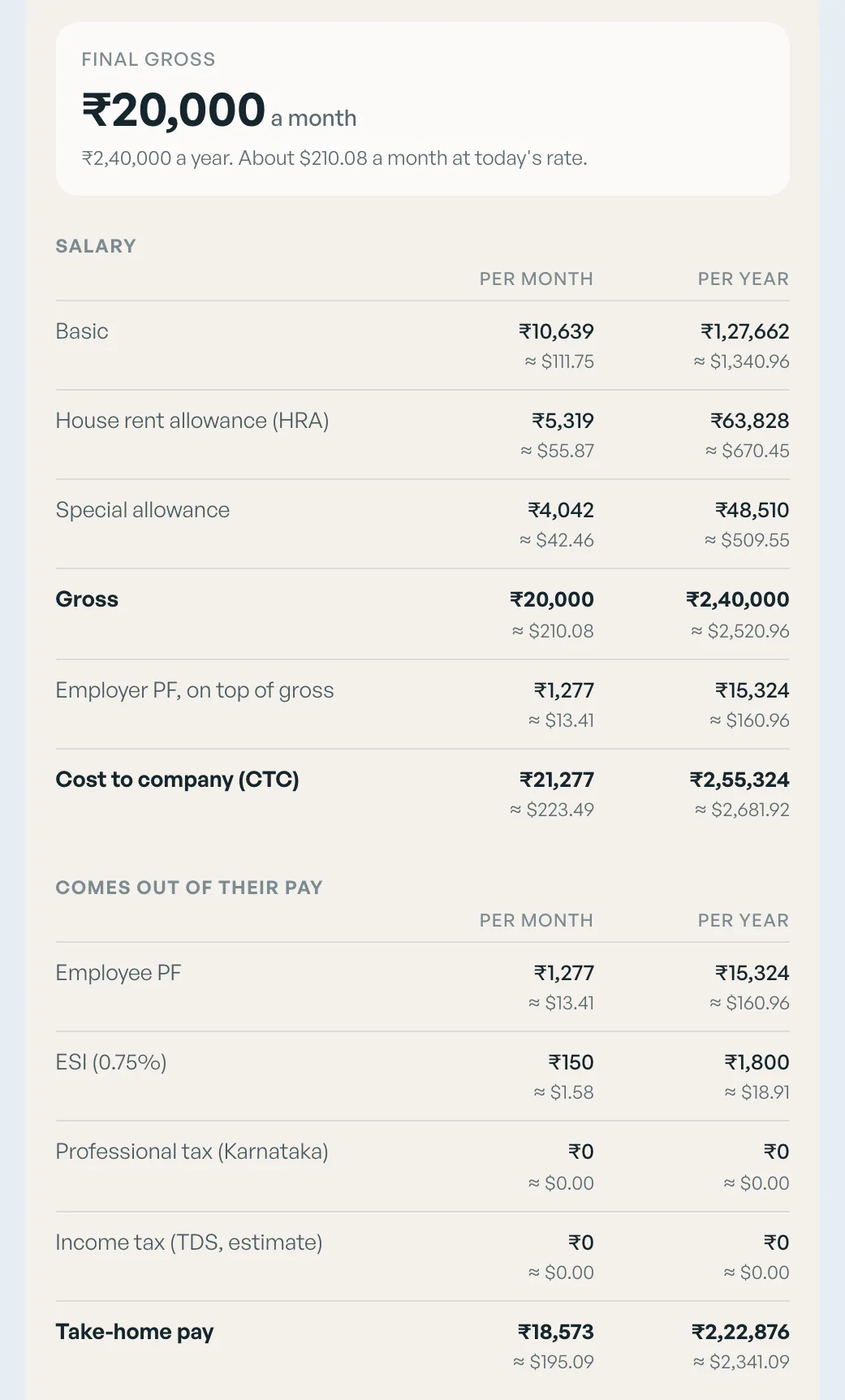
Versatile Club's instant quote for a sample ₹20,000 monthly gross, close to the support hire above. Basic is set slightly above half of pay here, so its PF figure is a little higher. All figures are sample data.
ESI stops once wages pass the coverage limit. That is why a team of engineers often owes no ESI at all, while a support team on lower salaries does.

The monthly filing list marks September's ESI not applicable because all sample salaries are above the ₹21,000 ceiling, so no ESI cost appears that month.
The [Provident Fund page](https://versatile.club/docs/compliance/provident-fund/) explains the PF wage base and the monthly challan for an employee on an EOR payroll. The [ESIC page](https://versatile.club/docs/compliance/esic/) covers ESI coverage and proof in the same way.
## Gratuity, bonus, wages and leave {#gratuity-and-bonus}
These figures come from the Labour Codes. Gratuity and bonus build up during the year, so they belong in a cost model even though they aren't paid monthly.
### How gratuity is calculated {#gratuity-calculation}
Gratuity is fifteen days' wages for every completed year of service, and a part-year of more than six months counts as a full year. For a monthly-paid employee, fifteen days' wages means the last monthly wage divided by 26, then multiplied by 15. The 26 stands for working days in a month, which is why the formula is often written as 15/26.
| Item | Rule | Instrument |
|---|---|---|
| **Qualifying service** | At least five years' continuous service, except on death, disablement or the end of a fixed term | Code on Social Security, s.53(1) |
| **Amount** | Last monthly wage ÷ 26 × 15, for each completed year | Code on Social Security, s.53(2) |
| **Maximum** | An amount notified by the Central Government | Code on Social Security, s.53(3) |
| **Payment** | [Within 30 days from the date it becomes payable](https://www.labour.gov.in/static/uploads/2026/02/83978455025732b99b0165def80ab171.pdf?v=20261019080621) | Code on Social Security, s.56(3) |
Take an employee who leaves after six years and four months on a last wage of ₹50,000. Gratuity is ₹50,000 ÷ 26 × 15 × 6, or ₹1,73,077, because the extra four months are less than six. The [compliance handbook's gratuity rules](https://www.labour.gov.in/static/uploads/2026/02/83978455025732b99b0165def80ab171.pdf?v=20261019080621) set out the same steps, and the [India gratuity calculator](https://versatile.club/tools/gratuity-calculator/) runs the sum for any wage.
### Statutory bonus {#statutory-bonus}
Bonus is due to employees whose wages fall under a limit set by notification and who worked at least thirty days in the accounting year. The [annual bonus runs from 8.33% to 20% of wages earned](https://www.labour.gov.in/static/uploads/2026/02/83978455025732b99b0165def80ab171.pdf), with a floor of ₹100. It must be paid within eight months of the close of the accounting year, subject to any extension the government allows.
### What counts as wages, minimum wages and leave {#wages-and-leave}
Three more rules shape the cost of a salary. The wage definition decides the base for PF, gratuity and bonus. Minimum wages set the floor for any offer, and annual leave decides how many paid days off an employee earns.
| Item | Rule | Instrument |
|---|---|---|
| **Wages** | Basic pay, dearness allowance and retaining allowance; [excluded allowances above one-half of pay are added back](https://egazette.gov.in/WriteReadData/2019/210356.pdf) | Code on Wages, s.2(y) |
| **Minimum wages** | Fixed by the appropriate government for its jurisdiction, never below the floor wage | Code on Wages, ss.6 and 9 |
| **Annual leave** | [One day for every 20 days worked, after 180 days' work in the calendar year](https://www.labour.gov.in/static/uploads/2025/07/e0971b414d2951d58dd958ecec9c8c09.pdf), with up to 30 days carried forward | OSH Code, s.32 |
India has no single national minimum wage. The Central Government fixes a floor wage, and each state sets minimum rates for work in its area that can't fall below it. So the minimum for an offer depends on the state and the type of work.
## Income tax withheld from salary {#tds-on-salary}
Income tax isn't an employer cost, but the employer must deduct it, deposit it and report it. The Income-tax Act, 2025 governs salaries paid from 1 April 2026, and its rules renumbered the familiar forms.
| Item | Current figure | Instrument |
|---|---|---|
| **Default regime** | [Nil up to ₹4,00,000, then 5%, 10%, 15%, 20% and 25% in ₹4,00,000 bands, and 30% above ₹24,00,000; ₹75,000 standard deduction; rebate up to ₹60,000 where income is no more than ₹12,00,000](https://egazette.gov.in/WriteReadData/2025/265620.pdf) | Income-tax Act, 2025, ss.19, 156 and 202(1) |
| **TDS deposit** | [Within seven days of the end of the month; March deductions by 30 April](https://www.incometax.gov.in/iec/foportal/sites/default/files/2026-03/En-Notified-IT-Rules-2026-20-03-2026.pdf) | Income-tax Rules, 2026, rule 218 |
| **Quarterly salary TDS statement** | [Form 138, formerly Form 24Q](https://www.incometaxindia.gov.in/documents/d/guest/fn-138), due 31 July, 31 October, 31 January and 31 May | Income-tax Rules, 2026, rule 219 |
| **Annual salary certificate** | [Form 130, formerly Form 16](https://www.incometaxindia.gov.in/documents/d/guest/form-130-faqs), by 15 June after the tax year | Income-tax Rules, 2026, rule 215 |
Late deduction and late deposit both carry interest under the Act, so the deposit date matters as much as the amount. The [TDS on salary page](https://versatile.club/docs/tax/tds-on-salary/) covers the monthly deduction, the interest and the employee's regime choice in detail.

The filing list tracks the quarterly salary TDS return due 31 October 2026. The screen uses the old name Form 24Q, now Form 138 under the 2026 Rules.
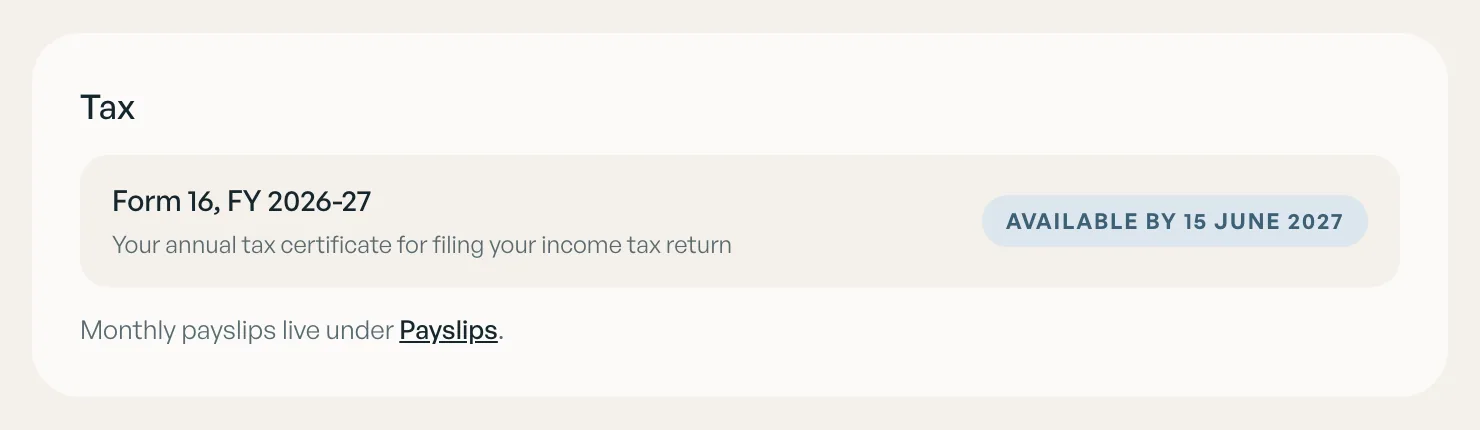
The employee's annual tax certificate for 2026-27 is listed as available by 15 June 2027. The screen shows the old name Form 16, now Form 130.
For take-home pay under either regime, the [India income tax calculator](https://versatile.club/tools/income-tax-calculator/) works from a salary figure.
## Professional tax and labour welfare fund by state {#state-levies}
Professional tax is a state tax on employment. The employer deducts it from salary and deposits it with the state. So it reduces in-hand pay rather than adding to employer cost. Labour welfare fund is a smaller state levy, usually paid twice a year, where both sides contribute.
To work out professional tax on a salary, find the state where the employee works, then read the salary band in that state's schedule. Karnataka's guidance says the tax goes to the state where employees work, wherever salary is paid from. In Karnataka, an employer registers on the state portal with its PAN or TAN, files the return for the month and pays online.
| State | Item | Current figure |
|---|---|---|
| **Karnataka** | Professional tax exemption and deposit | [No PT where monthly gross income is less than ₹25,000](https://ptax.karnataka.gov.in/ptemployer/FAQ); deposit by the 20th of the following month, even for one employee |
| **Maharashtra** | PT for men, salary up to ₹7,500 a month | [Nil](https://www.mahagst.gov.in/public/uploads/mvatservices/1760346808Maharashtra%20Profession%20Tax%20Act%201975.pdf) |
| **Maharashtra** | PT for men, ₹7,501 to ₹10,000 a month | [₹175 a month](https://www.mahagst.gov.in/public/uploads/mvatservices/1760346808Maharashtra%20Profession%20Tax%20Act%201975.pdf) |
| **Maharashtra** | PT for men, above ₹10,000 a month | [₹2,500 a year, collected as ₹200 a month and ₹300 in February](https://www.mahagst.gov.in/public/uploads/mvatservices/1760346808Maharashtra%20Profession%20Tax%20Act%201975.pdf) |
| **Maharashtra** | Labour welfare fund | [₹25 from the employee and ₹75 from the employer, every six months, paid before 15 July and 15 January](https://www.indiacode.nic.in/bitstream/123456789/19974/1/the_maharashtra_labour_welfare_fund_act.pdf) |
| **Telangana** | Professional tax payment | [On or before the 10th of the following month](https://www.tgct.gov.in/tgportal/HelpDocuments/PTPaymentHelp.aspx) |
| **Tamil Nadu (Chennai)** | PT on half-yearly income up to ₹45,000 | [Nil up to ₹21,000, ₹180 up to ₹30,000, ₹425 up to ₹45,000](https://chennaicorporation.gov.in/gcc/pdf/PT_Press_Release.pdf) |
| **Tamil Nadu (Chennai)** | PT on half-yearly income above ₹45,000 | [₹930 up to ₹60,000, ₹1,025 up to ₹75,000, ₹1,250 above that](https://chennaicorporation.gov.in/gcc/pdf/PT_Press_Release.pdf) |
| **West Bengal** | Labour welfare fund, employer | [₹30 per covered employee](https://www.labour.wb.gov.in/sites/default/files/upload/notice/Labr-576641%20Dated-19-11-2024.pdf) |
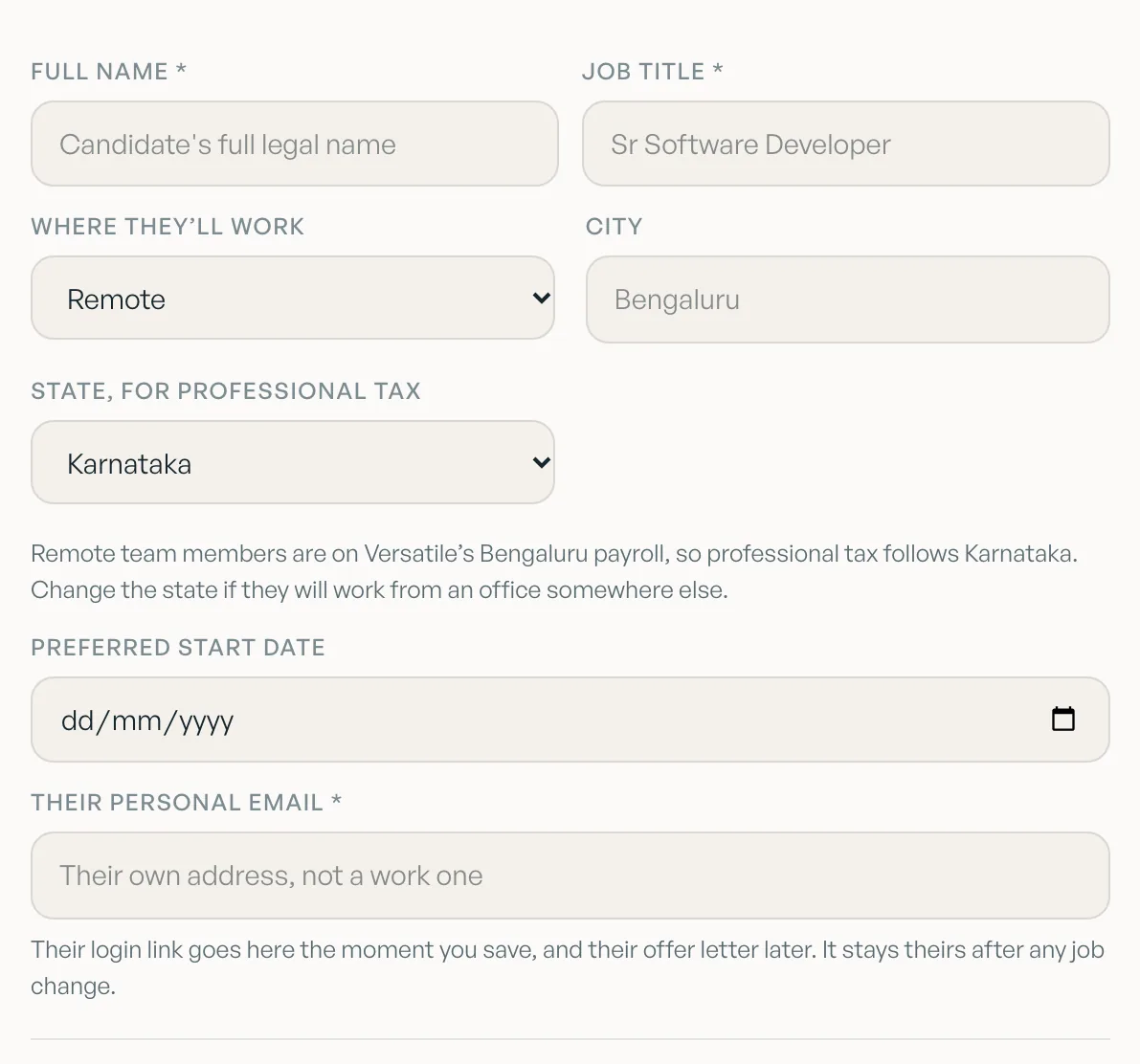
When you add a remote hire, the form sets the professional tax state to Karnataka, because remote staff sit on the EOR's Bengaluru payroll. Change it if they will work elsewhere.
City pages cover the local detail: [payroll in Bengaluru](https://versatile.club/payroll-outsourcing-bangalore/), [payroll in Mumbai](https://versatile.club/payroll-outsourcing-mumbai/), [payroll in Hyderabad](https://versatile.club/payroll-outsourcing-hyderabad/) and [payroll in Chennai](https://versatile.club/payroll-outsourcing-chennai/).
## What the law says {#the-law}
Each obligation below quotes the instrument that creates it, so counsel or an auditor can check the wording directly.
### Provident Fund contributions {#law-epf}
The EPF Scheme, 2026 replaced the 1952 Scheme on 1 July 2026. Paragraph 18 reads: "The employer’s contribution, under this Scheme shall be at the rate of twelve per cent of the wages payable to the employee." The employee pays an equal share, and both shares stop at the wage ceiling. An employee whose wage already exceeds the ceiling when they would join is an "excluded employee." The employer also pays administrative charges at a percentage the Central Government fixes, all under the [EPF Scheme, 2026](https://egazette.gov.in/WriteReadData/2026/273957.pdf). What to check: confirm that both PF shares on the payslip stop at the ₹25,000 wage ceiling.
### Pension (EPS) {#law-eps}
The pension share isn't a separate charge. The employer remits, out of its own contribution, "eight and thirty-three hundredths per cent. of the wages of employee up to wage ceiling." At the ₹25,000 ceiling, that is ₹2,083 a month after rounding, under the [Employees' Pension Scheme, 2026](https://egazette.gov.in/WriteReadData/2026/273951.pdf). What to check: the pension figure sits inside the employer's 12% and is at most ₹2,083 a month.
### Insurance (EDLI) {#law-edli}
The Code caps the employer's contribution at "not being more than one per cent. of the wages or such per cent. of wages as may be notified." The scheme leaves the exact rate to notification. The employer also pays administrative charges of up to a quarter of the contribution, under [section 16 of the Code on Social Security](https://www.indiacode.nic.in/indiacode/bitstream/123456789/16823/1/aA2020-36.pdf). What to check: ask which EDLI rate and administrative charge rate your payroll uses, since both are notified.
### Employees' State Insurance {#law-esi}
ESI covers employees up to a notified wage limit. ESIC's own standard note, current as on 1 January 2026, says "The wage ceiling for coverage under the ESI Scheme remains ₹21,000 per month." The [ESIC Standard Note](https://roharyana.esic.gov.in/attachments/publicationfile/Standard_Note_on_ESI_Scheme_as_on_01_01_2026_1791271940.pdf) also sets out the contribution rates in the master table. What to check: compare each salary with the ₹21,000 ceiling before you expect an ESI line.
### Gratuity {#law-gratuity}
Gratuity is payable on leaving after five years' continuous service. For monthly pay, the Code finds fifteen days' wages by "dividing the monthly rate of wages last drawn by him by twenty-six and multiplying the quotient by fifteen." The [Code on Social Security](https://www.labour.gov.in/static/uploads/2025/07/b0620548445580767b5c0d18c95c26f7.pdf) also caps the total at a notified amount. What to do: model gratuity as last monthly wage ÷ 26 × 15 for each completed year, and provide for it monthly.
### Statutory bonus {#law-bonus}
The minimum bonus is "eight and one-third per cent. of the wages earned by the employee or one hundred rupees, whichever is higher." It applies whether or not the employer has an allocable surplus, under [section 26 of the Code on Wages](https://www.indiacode.nic.in/indiacode/bitstream/123456789/15793/1/aA2019-29.pdf). What to check: confirm whether the employee's wages fall under the limit set by notification.
### The wage base {#law-wages}
The Code on Wages counts basic pay, dearness allowance and retaining allowance as wages and excludes most allowances. Where the excluded payments pass one-half of total pay, the excess "shall be deemed as remuneration and shall be accordingly added in wages under this clause." This rule in the [Code on Wages](https://www.labour.gov.in/static/uploads/2025/06/c328da14bbb15fc4ad571dc33e7a4ab3.pdf) decides the base for PF, gratuity and bonus. What to check: if allowances pass one-half of total pay, expect the excess to raise the PF, gratuity and bonus base.
### Income tax deduction {#law-tds}
Under the Income-tax Act, 2025, the new tax regime is the default unless the employee opts out. Tax deducted from salary must be paid "on or before seven days from the end of the month in which the deduction" is made. March deductions have a later date. The deadline sits in the [Income-tax Rules, 2026](https://www.incometax.gov.in/iec/foportal/sites/default/files/2026-03/En-Notified-IT-Rules-2026-20-03-2026.pdf). What to check: deposit tax within seven days of month end, and March deductions by 30 April.
### Professional tax {#law-pt}
Professional tax follows the place of work. Karnataka's FAQ says the tax "needs to be deposited to the state where employees are working irrespective of where the salary is being disbursed." Each state's own Act or notice sets the amount, as the [Karnataka professional tax FAQ](https://ptax.karnataka.gov.in/ptemployer/FAQ) shows for its state. What to check: find the state where each employee works, not where salary is paid from, and read that state's schedule.
## How Versatile Club applies these figures {#how-versatile-applies}
As your Employer of Record, Versatile Club employs your team on its own Indian company. It files each employee's PF, ESI, TDS and professional tax under its own registrations, so your company holds none of them. The [entity and registrations page](https://versatile.club/docs/compliance/entity-and-registrations/) lists the company and its identifiers.
PF, ESI and professional tax are initiated on day four of [the five-day onboarding](https://versatile.club/docs/onboarding/onboard-an-employee-in-five-days/). The EOR handles the PF employer match, and it handles professional tax on state-specific slabs in all 28 states. TDS is deducted and deposited by the 7th of each month.
Each month you receive the proof: PF and ESI challan confirmations, TDS deposit receipts and a [compliance status report](https://versatile.club/docs/payroll/monthly-client-pack/) on what's filed and what's due. The [monthly payroll page](https://versatile.club/docs/payroll/monthly-payroll/) shows where those records sit in the run. All of it is billed on [one USD invoice each month](https://versatile.club/docs/billing/invoices-and-payment/).
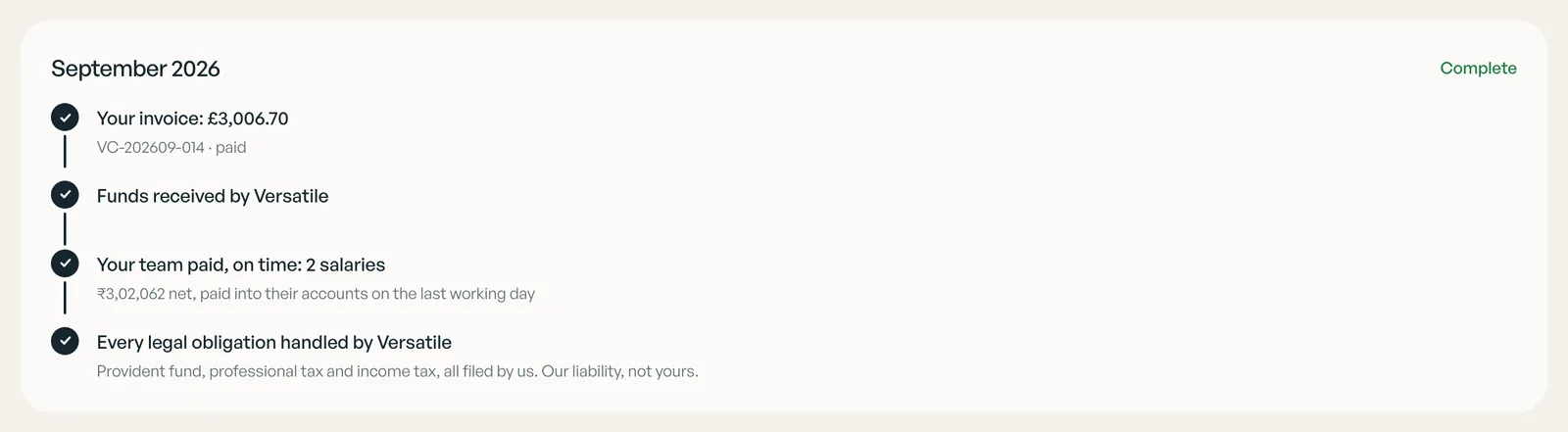
One sample payroll month: invoice, funds received, salaries paid and the PF, professional tax and income tax filings marked complete. All amounts are sample figures.
## When the figures last changed {#recent-changes}
- **29 October 2026.** Every figure on this page was last checked against its government source on this date.
- **17 September 2026.** A new notification raised the EPF wage ceiling, replacing the ceiling notified in May 2026. The [updates page](https://versatile.club/docs/updates/) records the change.
- **1 July 2026.** The EPF, pension and insurance schemes of 2026 replaced the 1952, 1995 and 1976 schemes on their Gazette publication.
- **1 April 2026.** The Income-tax Act, 2025 came into force, with new form numbers for salary TDS.
- **21 November 2025.** The [Industrial Relations Code](https://egazette.gov.in/WriteReadData/2025/267883.pdf) came into force, and the [Code on Social Security's listed provisions](https://egazette.gov.in/WriteReadData/2025/267882.pdf) took effect. Government rule-making material records [the Code on Wages in force from the same date](https://labourdirectorate.odisha.gov.in/sites/default/files/2026-02/622%20L%20&%20ESI%20Deptt.pdf).
## What goes wrong and what to check {#what-goes-wrong}
- **EDLI and administrative charges are missing from the cost.** The total employer cost line in the worked example is stated before them, so the real figure is higher. Add EDLI, which the Code caps, and the administrative charges at the notified rates.
- **Allowances pass one-half of pay.** The excess is added to wages, so the PF, gratuity and bonus base rises above basic pay and the cost is higher than you modelled. Check the salary split before you quote a cost.
- **A deposit is late.** PF and EDLI are due within fifteen days of month close, and late dues under the Code carry simple interest. Ask Versatile Club for the monthly challan confirmations and TDS deposit receipts.
- **A form name doesn't match.** The platform screens still show Form 16 and Form 24Q, while the 2026 Rules call them Form 130 and Form 138. Use the new names when an auditor asks, and expect Form 130 by 15 June.
- **The professional tax state is wrong.** The add-a-hire form sets Karnataka for remote staff, and the tax follows the place of work. Change the state if the employee will work elsewhere.
## Common questions {#common-questions}
#### What are India's employer payroll taxes? {#faq-what-are-they}
The employer pays Provident Fund, which includes pension and insurance parts, plus ESI where the employee is covered. It also owes gratuity on exit after qualifying service, statutory bonus and, in some states, labour welfare fund. It withholds income tax and professional tax from salary.
#### What is the employer cost of an employee in India? {#faq-employer-cost}
It is the gross salary plus employer PF, ESI where [wages are up to ₹21,000](https://roharyana.esic.gov.in/attachments/publicationfile/Standard_Note_on_ESI_Scheme_as_on_01_01_2026_1791271940.pdf), a gratuity provision and any statutory bonus. EDLI and administrative charges come on top. For the sample engineer above, that is about ₹1,05,404 a month before EDLI and those charges.
#### What is the employer contribution to PF? {#faq-employer-pf}
The employer pays 12% of wages, limited to the contribution on the wage ceiling. Up to 8.33% of wages goes to the pension fund, and the rest goes to the employee's PF account. Both shares follow [section 16 of the Code on Social Security](https://www.indiacode.nic.in/indiacode/bitstream/123456789/16823/1/aA2020-36.pdf).
#### What is the EPF wage ceiling now? {#faq-epf-ceiling}
[₹25,000 a month](https://www.labour.gov.in/static/uploads/2026/09/2b0f1dbbd3769fc388416186ec145328.pdf), under the notification published on 17 September 2026.
#### Which employees are covered by ESI? {#faq-esi-coverage}
The Labour Ministry's March 2026 FAQ says the notified wage limit of [₹21,000 a month applies for ESI coverage](https://www.labour.gov.in/static/uploads/2026/03/a4ccf4c6d97c4f1f36a6d83f8c64213d.pdf). Employees above that limit owe no ESI, and neither does their employer for them.
#### What is CTC, and how is it different from in-hand salary? {#faq-ctc-in-hand}
CTC is the employer's full yearly cost: gross salary plus employer contributions such as PF and a gratuity provision. In-hand salary is gross pay less employee PF, ESI, professional tax and TDS. The [CTC to take-home calculator](https://versatile.club/tools/salary-calculator/) converts one into the other.
#### What does 15/26 mean in the gratuity calculation? {#faq-gratuity-15-26}
It turns a monthly wage into fifteen days' wages. Divide the last monthly wage by 26 working days, then multiply by 15, and pay that for each completed year of service. The [gratuity calculator](https://versatile.club/tools/gratuity-calculator/) does the sum for you.
#### What is the minimum wage in India? {#faq-minimum-wage}
There is no single national figure. The Central Government fixes a floor wage, and each appropriate government fixes minimum rates that can't fall below it, under the [Code on Wages](https://egazette.gov.in/WriteReadData/2019/210356.pdf). Check the state notification for the work and place involved.
#### Which income tax regime applies by default? {#faq-default-regime}
The new tax regime under the Income-tax Act, 2025 applies unless the employee opts out in the manner the Act sets. The [employee income tax section](https://versatile.club/docs/tax/) explains how the choice reaches payroll.
#### Is professional tax the same in every state? {#faq-pt-states}
No. Each state sets its own slabs and dates, and Delhi has no professional tax. Versatile Club handles professional tax on state-specific slabs in all 28 states.
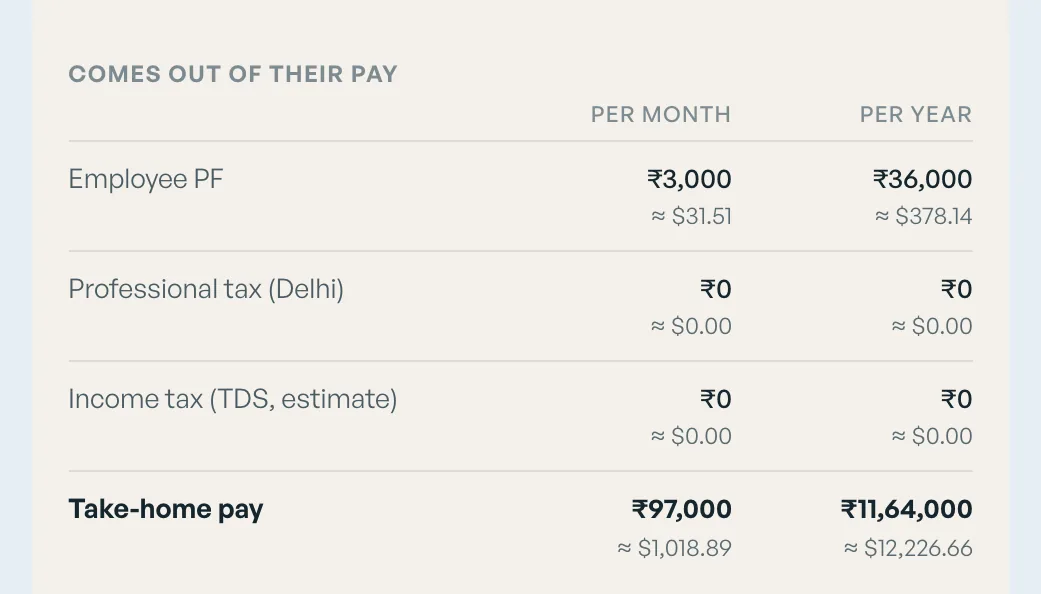
With Delhi picked as the work state, the sample quote shows professional tax of ₹0, because Delhi levies none. All amounts are sample figures.
#### Are EDLI and administrative charges part of the employer cost? {#faq-edli-admin}
Yes. The employer pays both on top of salary, at rates the Central Government notifies. The Code caps EDLI at 1% of wages up to the ceiling, under [section 16 of the Code on Social Security](https://www.labour.gov.in/static/uploads/2025/07/b0620548445580767b5c0d18c95c26f7.pdf).
#### Who pays these contributions when we hire through Versatile Club? {#faq-who-pays}
As your Employer of Record, Versatile Club pays the employer contributions under its own registrations and deducts the employee's share from pay. Your company receives the cost on the monthly invoice and holds no registrations of its own.
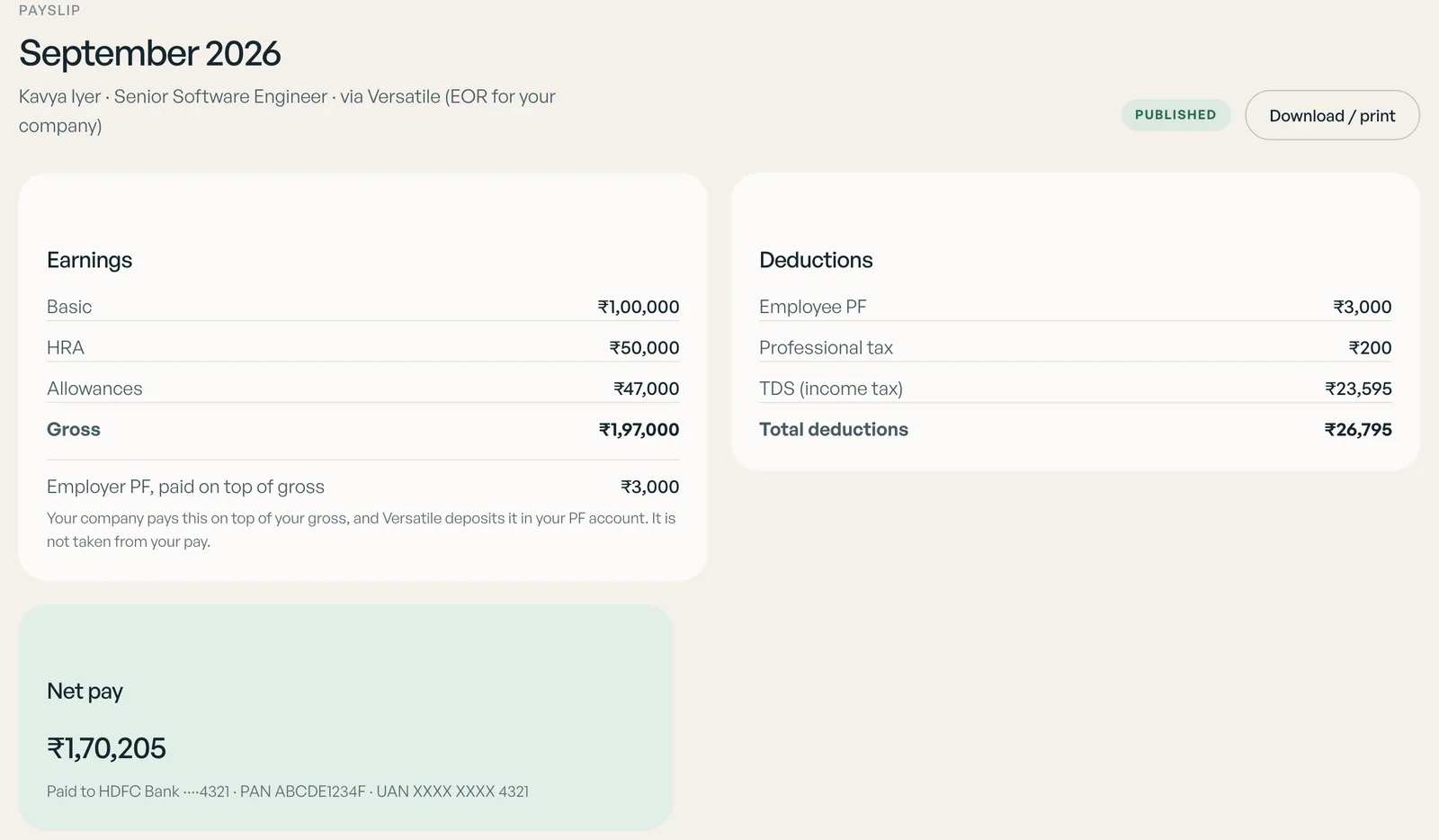
A sample payslip shows employer PF of ₹3,000 paid on top of gross, the same ceiling-based figure as the engineer above. All amounts are sample data.
#### How do we get proof that each deposit was made? {#faq-proof}
The EOR sends PF and ESI challan confirmations and TDS deposit receipts every month, with a compliance status report on what's filed and what's due.
#### When were these figures last checked? {#faq-last-checked}
On 29 October 2026. Each row links the government instrument it comes from, so you can open the source behind any figure.
## Related {#related}
- [Provident Fund for India employees](https://versatile.club/docs/compliance/provident-fund/): the rate, wage base and monthly proof in detail.
- [India employment rules reference](https://versatile.club/docs/reference/): the checklist of India rules this table belongs to.
- [Monthly payroll](https://versatile.club/docs/payroll/monthly-payroll/): the run these contributions sit inside.
- [Versatile Club's Indian entity](https://versatile.club/docs/compliance/entity-and-registrations/): the registrations your employees' filings sit under.
- [Paying the India EOR invoice](https://versatile.club/docs/billing/invoices-and-payment/): how the monthly cost reaches you in USD.
- [Cost of hiring in India](https://versatile.club/blogs/cost-of-hiring-in-india/): salary plus statutory costs, worked through.
- [India EOR and payroll glossary](https://versatile.club/glossary/): plain definitions of PF, ESI, TDS and the rest.
- [Contact Versatile Club](https://versatile.club/contact-us/): questions about how a figure applies to your team.