# Best Way to Hire Employees in India: Contractors, an EOR or Your Own Company Compared
The ways to hire in India from abroad, contractors, an Employer of Record or your own Indian company, what Indian law asks of each route, and the Versatile Club service that fits each stage.
- Applies to: Founders and companies deciding how to employ staff in India
- Status: Live
- Verified: 2026-10-29
- Canonical page: https://versatile.club/docs/services/
You need to hire someone in India and have to decide how to employ them. Your best way to hire employees in India depends on how many people you need, how soon you need them and how long you plan to stay. There are three legal ways to hire in India from abroad: independent contractors, an Employer of Record (EOR) or your own Indian company. Versatile Club is an India-only Employer of Record (EOR). Its EOR service employs your team on its own Indian company, and it runs services for the stages before and after. This page compares the routes, sets out what Indian law asks of each one, then shows where each service fits.
## The best way to hire employees in India, route by route {#routes}
You are choosing who will employ the person you want to hire in India. Each route answers the same two questions in a different way: which company is the legal employer, and who carries the duties that come with employing someone?
| Route | Who is the legal employer | What you set up in India | Time to a first hire | Who carries the employment risk | Usually fits |
|---|---|---|---|---|---|
| **Contractors** | No employer: each person works under a services contract with you | Contracts and cross-border payments | As soon as the contract is signed | You, if the work turns out to be employment | Short, project-based work done independently |
| **Employer of Record** | The EOR's Indian company | Nothing: the EOR holds the registrations | Five business days with Versatile Club, from the signed service agreement | The EOR, as the employer | First hires and small teams that need to start soon |
| **Your own Indian company** | Your Indian subsidiary | A registered company with its own directors, plus its own tax and labour registrations | The longest: the company comes first, then its registrations | Your subsidiary | Larger teams you plan to keep in India for years |
### The short answer for your situation {#quick-answer}
| If you... | The route that usually fits |
|---|---|
| Need one person or a few people soon, with no Indian company | An Employer of Record |
| Need a specialist for a defined project they run on their own | A contractor, with a written contract and a written IP assignment |
| Have a contractor who now works like part of your team | Move them onto an employer's payroll, through an EOR or your own company |
| Plan a large team in India for several years | Your own company, often after starting on an EOR |
| Already have an Indian company | Run payroll on it, or have a provider run it for you |
For most founders making a first India hire, an Employer of Record is the quickest legal way to employ someone without a company of your own. Contractors suit independent project work. Your own entity starts to pay off once the team is large and long-term. The [EOR vs your own entity guide](https://versatile.club/eor-vs-entity-india/) walks through the cost side, and the [hiring route quiz](https://versatile.club/tools/india-hiring-option-router-quiz/) suggests a route from your answers.
### Can a foreign company hire employees in India? {#foreign-company}
Yes. A foreign company can use any of the three routes above, whether it is based in the US, the UK or elsewhere. To put someone on an Indian payroll, though, it needs an Indian employer. That is either an EOR's Indian company or a subsidiary of its own.
An EOR's company already holds the employer registrations, so a first hire can start without an entity. A subsidiary carries its own company and employer duties, set out under What the law says, below. Contractors stay outside payroll altogether, which suits independent project work only.
## Hiring contractors {#contractors}
Contracting is the lightest route: no Indian company, no payroll, just a services agreement and a payment each month. It suits work that is truly independent, where the person sets their own hours, uses their own tools and delivers a defined result. When a contractor works like an employee, with fixed hours, your tools and a manager, the arrangement may be treated as employment.
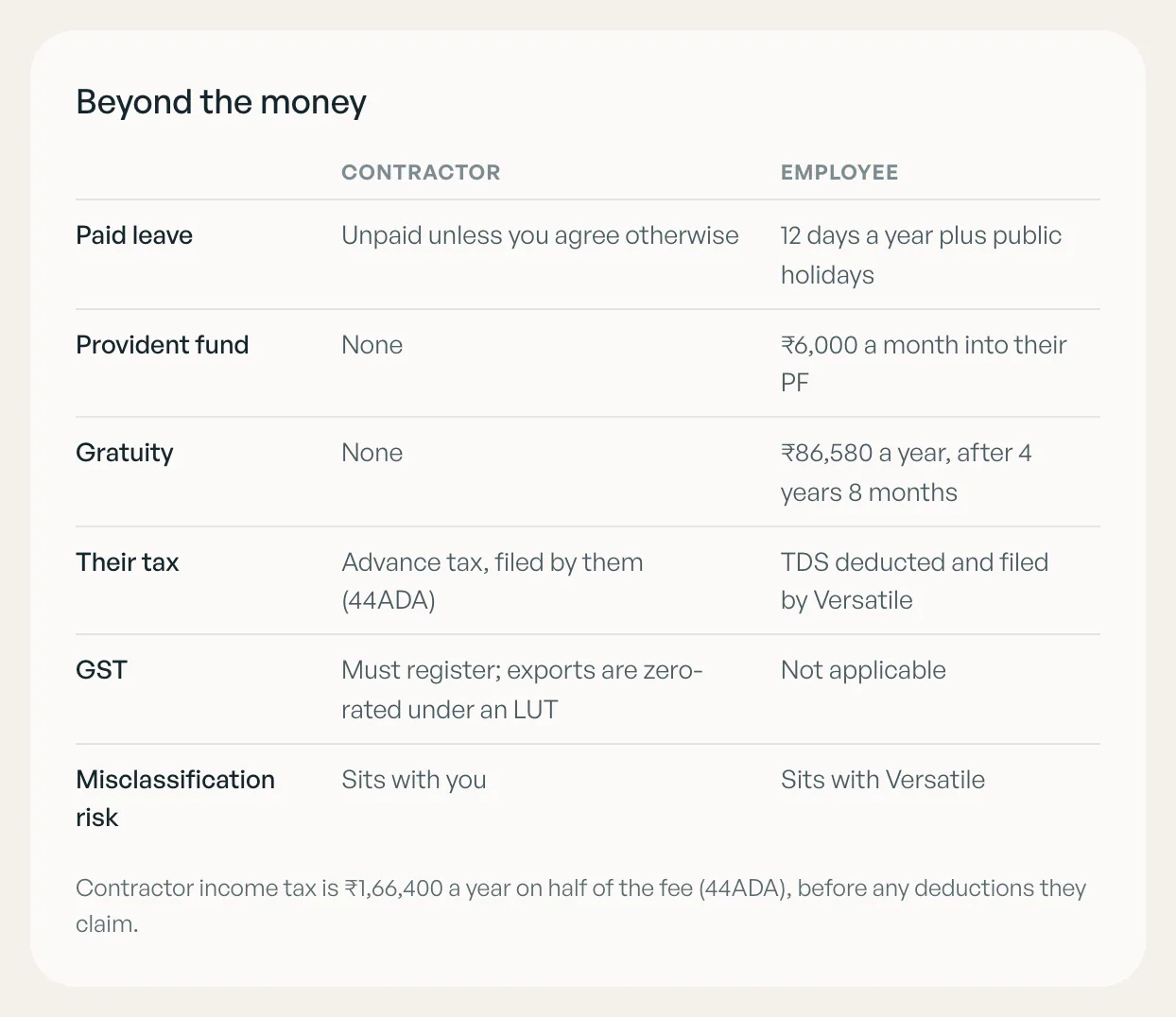
This comparison shows what a contractor goes without: no paid leave, no Provident Fund and no gratuity, while the misclassification risk stays with you. All figures shown are sample data.
### What a contractor arrangement needs {#contractor-setup}
A contractor arrangement stands or falls on its paperwork. Three pieces matter most.
- **A written services contract.** It should describe a result to deliver, not a job to do, and leave the person free to decide how and when they work.
- **A written IP assignment.** Under Indian copyright law, a contractor usually owns what they create until they assign it to you in writing. The law section below explains why.
- **A payment route.** You pay their invoices from abroad, and the contractor handles their own tax in India.
The guide to [India contractor agreements that hold up](https://versatile.club/contractor-india/compliant-contracts/) covers the clauses in more detail.
#### Check the risk before you rely on it {#contractor-risk}
Indian law looks at how the work actually runs, not only at what the contract calls it. These are the signs reviewers usually look for when a contractor may really be an employee:
- They work set hours that you decide.
- They report to one of your managers and join your team's meetings.
- They use your laptop, accounts and tools.
- They work only for you, month after month, with no end date.
- They are paid a fixed monthly amount, not per result.
The [contractor misclassification quiz](https://versatile.club/tools/misclassification-quiz/) walks through these signals, and the [independent contractor vs EOR guide](https://versatile.club/blogs/independent-contractor-vs-eor/) compares the two routes in detail. If a contractor should become an employee, [converting contractors to employees](https://versatile.club/for-contractors/) explains the move.
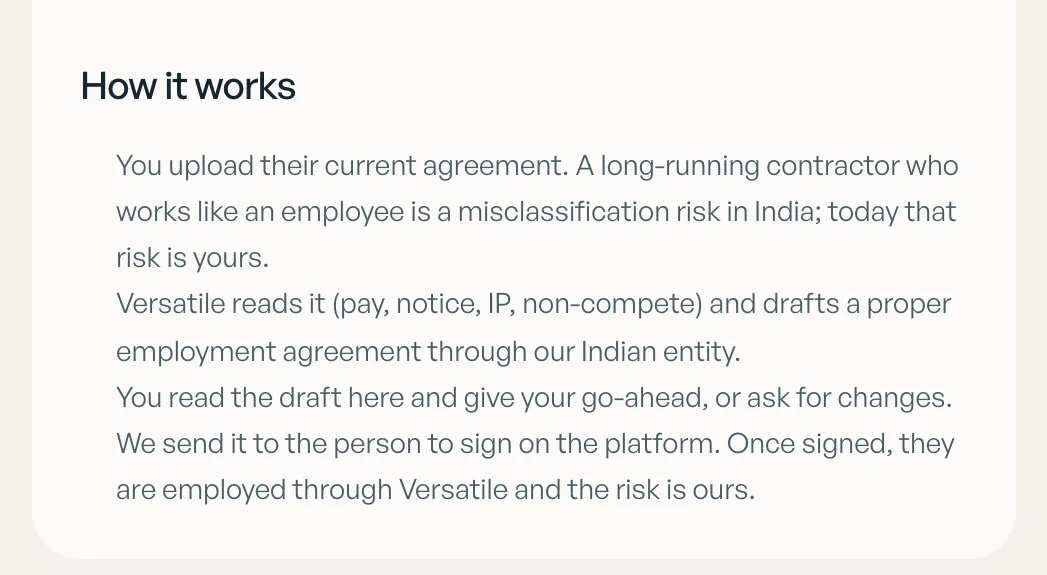
Converting a contractor runs in four steps: you share their current agreement, Versatile Club drafts an employment agreement on its Indian entity, you approve it and the person signs.
## Employing through an Employer of Record {#employer-of-record}
An Employer of Record is an Indian company that employs your hire for you. It [issues the contract](https://versatile.club/docs/contracts/employment-contract/), runs payroll and files the [statutory contributions](https://versatile.club/docs/compliance/), while you direct the work. You need no Indian entity of your own.
Versatile Club's Employer of Record (EOR) service employs your team on its own Indian company, Foo Falcon Technologies Pvt Ltd. As your Employer of Record, it files your employee's PF, ESI, TDS and professional tax under its own registrations. Its master services agreement makes it the sole legal employer of each person. Your company still directs their work product, priorities, deadlines and working hours, to the extent Indian law permits. The [Employer of Record service page](https://versatile.club/docs/services/employer-of-record/) explains who signs what and what you still control.
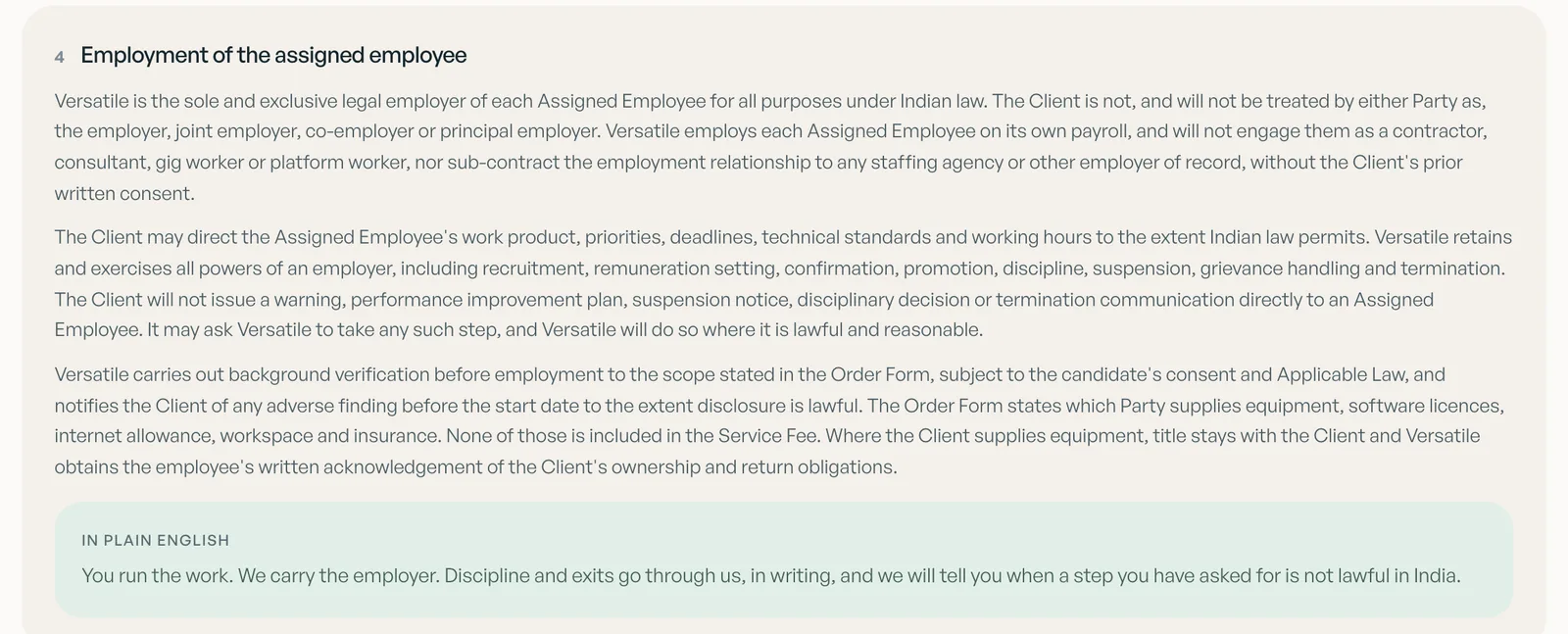
Clause 4 answers the question of who the employer is: Versatile Club alone, holding every employer power, while your company directs the day-to-day work.
### EOR or PEO services in India? {#eor-or-peo}
Searches for PEO services in India usually come from founders who want what an EOR provides. The two labels differ in who employs the person. A PEO, in the US sense, shares employer duties with a company that already employs people locally. An EOR is the sole legal employer, through its own Indian company.
If you have no Indian entity, a PEO has no local employer to share duties with, so what you need is an EOR. If you already run an Indian company, payroll help for that company fits better than either. The [EOR vs PEO guide](https://versatile.club/blogs/eor-vs-peo/) covers the difference in more depth.
#### How fast it starts {#eor-speed}
Onboarding takes five business days from the signed service agreement, and that commitment is written into the agreement. The [five-day onboarding schedule](https://versatile.club/docs/onboarding/onboard-an-employee-in-five-days/) covers each day, and the [monthly payroll run](https://versatile.club/docs/payroll/monthly-payroll/) covers what follows. To check an EOR's company before you sign, use the [Indian entity checklist](https://versatile.club/docs/compliance/entity-and-registrations/).
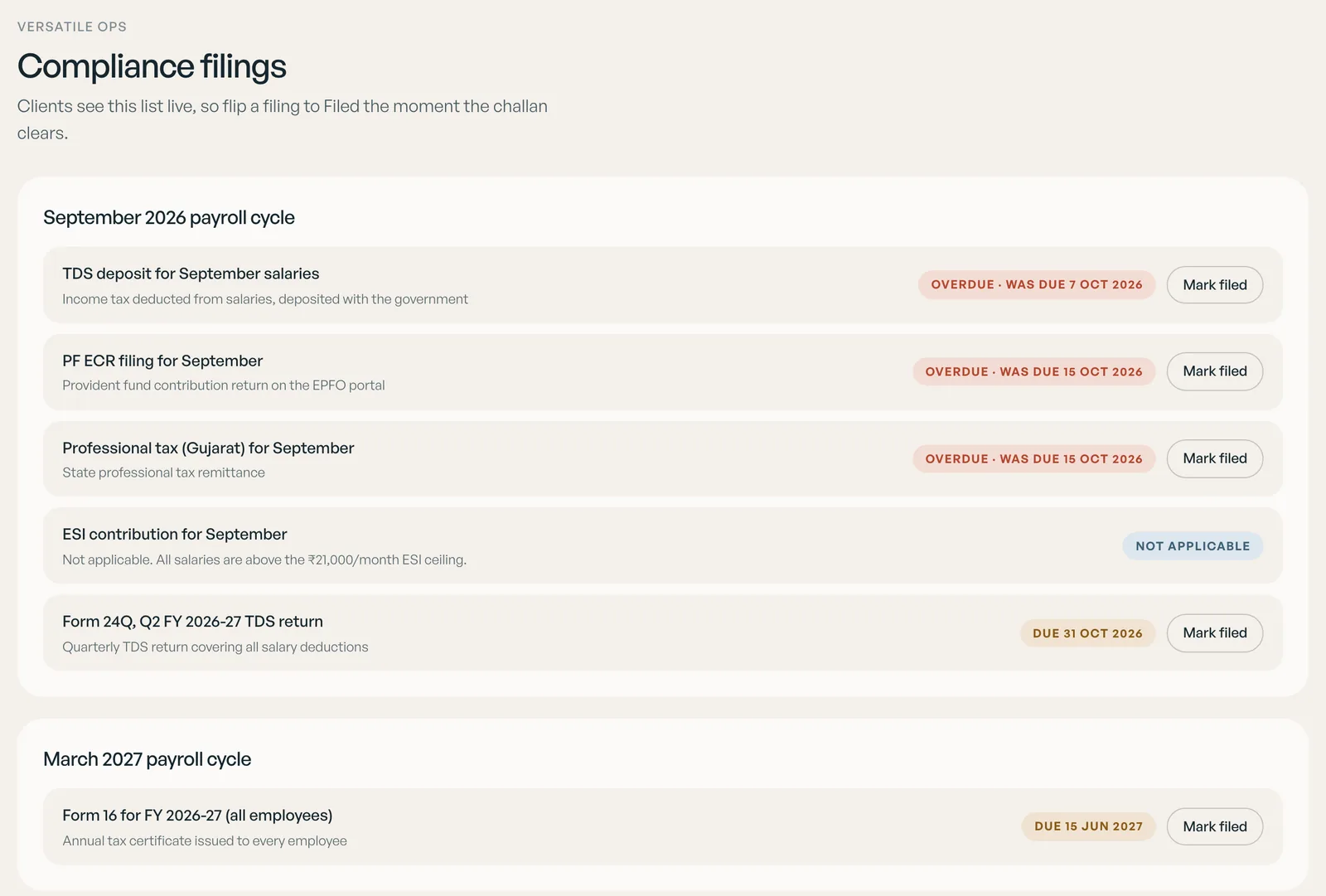
Every payroll month brings its own filings and due dates. On an EOR they run under the provider's registrations, not yours. The dates and payroll shown are sample data.
## Setting up your own Indian company {#own-entity}
Your own subsidiary gives you full control, and it takes the most setup. A private company needs [at least two directors under section 149 of the Companies Act, 2013](https://www.mca.gov.in/content/dam/mca/pdf/CompaniesAct2013.pdf). One of them must stay in India for at least 182 days in the financial year.
After incorporation, a director files the commencement declaration in [e-Form INC-20A under section 10A](https://www.mca.gov.in/Ministry/pdf/ADJORDER10_15012020.PDF). MCA applies a deadline of 180 days from the incorporation date. Then come the company's own PF, ESI, tax and state registrations before the first payroll. Each rule is set out with its source under "What the law says", below.
#### When your own company makes sense {#entity-break-even}
The answer turns on headcount, time horizon and cost. Your own company also takes on the duties an EOR would otherwise carry, including the employer registrations that switch on as your team grows. The [EOR vs entity cost calculator](https://versatile.club/tools/eor-vs-entity-calculator/) and the [entity, GCC and EOR break-even finder](https://versatile.club/tools/entity-gcc-vs-eor-breakeven-finder/) put numbers on your plan.
## What the law says {#the-law}
Three areas of Indian law decide which route is safe for you. The first is who counts as an employee. The second is who owns the work, and the third is what a company of your own must do. Each rule below quotes and links the original Act or the government's own guide.
### Who the law treats as an employee {#law-employee}
The Code on Social Security, 2020 defines an employee broadly. It covers anyone employed on wages by an establishment, directly or through a contractor, "[whether the terms of employment be express or implied](https://www.indiacode.nic.in/indiacode/bitstream/123456789/16823/1/aA2020-36.pdf)".
In plain terms, the label on the contract does not settle the question. If a contractor in fact works like an employee, the duties that come with employment, such as Provident Fund and paid leave, can follow the facts. That is the core of contractor misclassification risk in India.
What to check: compare how each contractor really works with the signs listed above, not only with the contract label.
### Work outside employment is recognized too {#law-gig-worker}
The same Code names a gig worker: a person who earns from work "[outside of traditional employer-employee relationship](https://www.indiacode.nic.in/indiacode/bitstream/123456789/16823/1/aA2020-36.pdf)". So Indian law does accept work that is not employment. What matters is whether your arrangement really sits outside that relationship, which is why the signs listed above matter.
### Who owns what a contractor creates {#law-ip}
Under the Copyright Act, 1957, the author of a work is its first owner. There is an exception for work made in the course of employment under a contract of service. There, "[the employer shall, in the absence of any agreement to the contrary, be the first owner of the copyright therein](https://www.indiacode.nic.in/indiacode/bitstream/123456789/1367/1/A195714.pdf)".
A contractor works under a contract for services, not a contract of service, so that exception does not hand you their work. Their code, designs and copy stay theirs until they transfer them to you. The [intellectual property page](https://versatile.club/docs/contracts/intellectual-property/) explains how ownership works for employees on an EOR.
What to check: ask whether the person works under a contract of service or a contract for services, because that decides who owns the work.
### Assignments of copyright must be in writing {#law-assignment}
The transfer has a formal rule of its own. The Act says "[no assignment of the copyright in any work shall be valid unless it is in writing](https://www.indiacode.nic.in/indiacode/bitstream/123456789/1367/1/A195714.pdf)" and signed by the person assigning it. Put a signed assignment in every contractor agreement from day one, rather than asking for it after the work is done.
### A private company needs two directors {#law-directors}
Section 149 of the Companies Act, 2013 sets "[two directors in the case of a private company](https://www.mca.gov.in/content/dam/mca/pdf/CompaniesAct2013.pdf)" as the minimum. At least one director must stay in India for not less than 182 days during the financial year. For a newly incorporated company, that residence test applies proportionately at the end of its first financial year.
What to check: confirm that one of your two directors can meet the 182-day stay in India.
### The commencement declaration within 180 days {#law-10a}
A new company with share capital cannot start business until a director files a declaration "[within a period of one hundred and eighty days of the date of incorporation](https://www.mca.gov.in/content/dam/mca/pdf/CompaniesAct2013.pdf)". The declaration confirms that every subscriber has paid for the shares they agreed to take. MCA identifies it as [e-Form INC-20A](https://www.mca.gov.in/Ministry/pdf/ADJORDER10_15012020.PDF).
What to do: count 180 days from the incorporation date and have a director file the declaration before day 180.
### When employer registrations switch on {#law-thresholds}
Your own company picks up employer registrations as its headcount grows. The Ministry of Labour and Employment's compliance handbook sets out the thresholds. For Provident Fund, "[the provisions apply to all establishments employing 20 or more employees](https://www.labour.gov.in/static/uploads/2026/02/83978455025732b99b0165def80ab171.pdf)". Employees' State Insurance applies from 10 persons, and an establishment with 10 or more employees must apply for registration under the OSH Code within 60 days of its existence.
On an EOR, none of these registrations are yours. The EOR holds them for everyone it employs, and you receive the challans and receipts that prove each payment.
What to check: track your headcount against the 10 and 20 employee thresholds, and under an EOR confirm you receive the challans and receipts.
### Thresholds and deadlines at a glance {#law-table}
| Rule | Figure | Who it applies to | Source |
|---|---|---|---|
| Provident Fund coverage | 20 or more employees | Your own company | [Compliance handbook, EPF](https://www.labour.gov.in/static/uploads/2026/02/83978455025732b99b0165def80ab171.pdf) |
| Employees' State Insurance coverage | 10 or more persons | Your own company | [Compliance handbook, ESI](https://www.labour.gov.in/static/uploads/2026/02/83978455025732b99b0165def80ab171.pdf) |
| Provident Fund wage ceiling | ₹25,000 a month, from 17 September 2026 | Every employer's PF, an EOR's included | [S.O. 5109(E)](https://www.labour.gov.in/static/uploads/2026/09/2b0f1dbbd3769fc388416186ec145328.pdf) |
| Commencement declaration (INC-20A) | Within 180 days of incorporation | Your own company | [MCA order on INC-20A](https://www.mca.gov.in/Ministry/pdf/ADJORDER10_15012020.PDF) |
| Copyright in a contractor's work | Stays with the author until assigned in writing | The contractor route | [Copyright Act, section 19](https://www.indiacode.nic.in/indiacode/bitstream/123456789/1367/1/A195714.pdf) |
The [India statutory rates and thresholds page](https://versatile.club/docs/reference/statutory-rates-and-thresholds/) collects the payroll rates that apply once someone is employed.
### Worked example: a subsidiary opened on 1 May 2026 {#law-example}
Say a US startup incorporates its Indian subsidiary on Friday, 1 May 2026, with two directors. This is how the rules above land on it.
1. **The declaration deadline.** Count 180 days from 1 May: 30 days takes you to 31 May, 60 to 30 June, 91 to 31 July, 122 to 31 August and 152 to 30 September. Day 180 falls on 28 October 2026, so the INC-20A declaration is due by then.
2. **The resident director.** One director must meet the India stay test. In this first financial year, which ends on 31 March 2027, the test applies proportionately.
3. **The first hires.** The company employs 12 people by March 2027. Once it reaches 10, ESI coverage applies and OSH registration falls due within 60 days. Provident Fund coverage under the handbook's threshold starts at 20 employees.
4. **The same team on an EOR.** None of these filings or registrations would belong to the startup. The EOR's Indian company carries them from the first hire.
## Versatile Club's services {#versatile-services}
Versatile Club works only in India. It runs four services, all from the same Indian company.
| Service | What it is | Where it fits |
|---|---|---|
| **[Employer of Record](https://versatile.club/docs/services/employer-of-record/)** | Full-time India employees on its own Indian company, with all statutory compliance included | A new service, built on the Contract-to-Hire entity and compliance setup |
| **Contract-to-Hire** | Start someone as a contractor, then convert them to a full-time employee when ready | The company's established service |
| **Offshore team building** | Dedicated India teams for US and UK companies | Companies building a team, not a single hire |
| **Managed payroll** | Payroll processing for companies that already have an Indian entity | After you set up your own company |
Every Employer of Record month ends with [one USD invoice](https://versatile.club/docs/billing/invoices-and-payment/), a payroll summary and a [compliance status report](https://versatile.club/docs/payroll/monthly-client-pack/). The fee is a flat monthly fee per employee, with no setup or exit fee. The first month is free for new hires, as [the pricing page](https://versatile.club/pricing/) shows.
The master services agreement also commits Versatile Club to hold every registration, licence and approval it needs to act as employer of record in India. That covers shops and establishments, Provident Fund, ESI where it applies, professional tax and tax deduction.
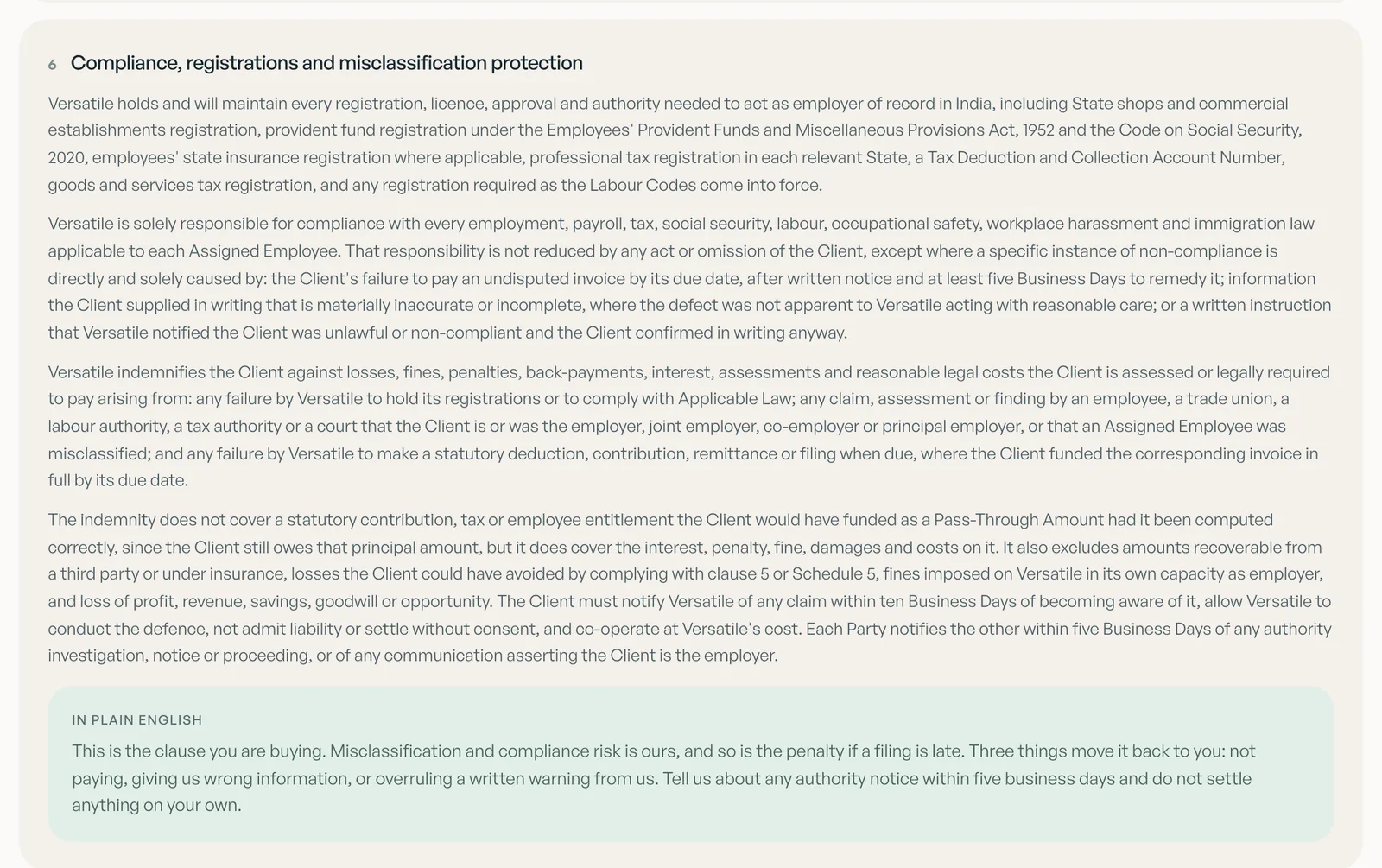
This clause is where the registrations you would otherwise apply for become Versatile Club's contractual duty, state by state, for as long as it employs your team.
## Which route fits your stage {#which-route}
You may move through more than one route over time. Find your stage below.
### One or two hires, soon {#stage-first-hires}
An Employer of Record gets someone onto a compliant Indian payroll without an entity. The [Provident Fund page](https://versatile.club/docs/compliance/provident-fund/) shows the main employer cost on top of salary.
### You want to try someone first {#stage-try-first}
Contract-to-Hire starts the person as a contractor and converts them to a full-time employee when you're ready.
### Hiring developers or an offshore development team {#stage-developers}
A developer who works your sprint hours, in your repositories, under your engineering lead, looks like an employee. If that describes the role, employ them through an EOR or your own company rather than on a contractor agreement. For a dedicated team rather than a single hire, Versatile Club's offshore team building service builds dedicated India teams for US and UK companies.
### A team that may become your own centre {#stage-gcc}
Run the team on an EOR first, then decide. [Testing India before a GCC](https://versatile.club/docs/use-cases/test-india-before-a-gcc/) covers that path, and [building a GCC in India](https://versatile.club/gcc-india/) covers the move itself.

When your own entity is ready, the employment agreement already provides a route to move people onto it through Versatile Club, so a pilot team doesn't have to start over.
### You already have an Indian company {#stage-own-entity}
Managed payroll runs the payroll for your own entity, with [payroll in India managed end to end](https://versatile.club/payroll-in-india/).
## What goes wrong and what to check {#what-goes-wrong}
- **A contractor works like an employee.** The arrangement may be treated as employment, and the misclassification risk stays with you. You would notice fixed hours, your tools and a manager. Check the signs under hiring contractors, and if they apply, move the person onto an employer's payroll.
- **The contractor has no signed IP assignment.** Their code, designs and copy stay theirs, so you would find out when you try to use the work. Put a signed assignment in every contractor agreement from day one.
- **The INC-20A declaration is late.** A new company with share capital cannot start business until a director files it, and the deadline is 180 days from incorporation. In the worked example, day 180 is 28 October 2026. Count the days when you incorporate.
- **No director meets the 182-day test.** One director of a private company must stay in India for at least 182 days in the financial year. Confirm which director that is, and remember the test applies proportionately in the first year.
- **Headcount crosses a threshold.** Your own company needs ESI coverage from 10 persons and OSH registration within 60 days, and Provident Fund coverage from 20 employees. Track headcount against both. On Versatile Club's EOR, Versatile Club holds those registrations, not you.
## Common questions {#common-questions}
#### Which way to hire in India works for a first employee? {#faq-first-employee}
An Employer of Record is usually the quickest way onto a compliant Indian payroll, because you need no Indian company. Versatile Club puts the employee on payroll five business days after you sign the service agreement.
#### Can a US company legally hire someone in India? {#faq-us-company}
Yes. A US company can hire in India through contractors, an Employer of Record or its own Indian subsidiary. Without an Indian company of its own, an EOR is the usual way to put someone on a compliant Indian payroll.
#### Can we hire in India without setting up a company? {#faq-no-company}
Yes. An Employer of Record employs your team on its own Indian company. Versatile Club's Indian company, Foo Falcon Technologies Pvt Ltd, employs them and files their statutory contributions. The [guide to hiring without an entity](https://versatile.club/how-to-hire-in-india-without-an-entity/) sets out the legal routes.
#### Is an entity required to use an EOR in India? {#faq-entity-required}
No. The EOR's Indian company is the employer and holds the registrations, so you need no Indian entity of your own to employ someone through it. You sign a service agreement with the EOR, and it signs the employment contract with your hire.
#### Is hiring contractors in India legal? {#faq-contractors}
Yes, for work that is truly independent and project-based. The risk comes when a contractor works like an employee. The Code on Social Security counts implied terms of employment, so the arrangement can be employment in substance whatever the contract says.
#### Who owns the code a contractor writes? {#faq-ip}
The contractor, until they assign it to you in writing. Indian copyright law makes the author the first owner unless the work is made under a contract of service. So every contractor agreement needs a signed IP assignment.
#### How is an EOR different from a PEO in India? {#faq-eor-vs-peo}
An EOR is the legal employer through its own Indian company. A PEO usually shares employment with a company that already has one. Without an Indian entity, what you need is an EOR.
#### What does setting up our own Indian company require? {#faq-entity-requirements}
At least two directors, one of whom stays in India for 182 days or more in the financial year. A director files the INC-20A declaration within 180 days of incorporation, and the company needs its own tax and labour registrations. Each rule is under "What the law says" above.
#### How do I hire software developers in India? {#faq-developers}
Pick the route by how the developer will work. A developer on your team's hours, tools and roadmap is best employed, through an EOR or your own company. A specialist delivering a defined project can work as a contractor, with a written IP assignment.
#### How do I hire an offshore development team in India? {#faq-offshore-team}
Start with how the developers will work. A team on your hours, in your repositories and under your engineering lead should be employed, through an EOR or your own company. Versatile Club's offshore team building service builds dedicated India teams for US and UK companies.
#### Can a contractor become an employee later? {#faq-convert}
Yes. Versatile Club reviews the contractor's current agreement for pay, notice, IP and non-compete, then drafts an employment agreement through its Indian entity. Once you approve it and the person signs, it employs them.
#### Can we move from an EOR to our own entity later? {#faq-move-later}
Yes. Once you have set up your own Indian company, Versatile Club's managed payroll service can run its payroll.
#### What does Versatile Club charge? {#faq-fee}
A flat monthly fee per employee, with no setup fee, no exit fee and the first month free for new hires. See [current fees](https://versatile.club/pricing/).
## Related {#related}
- [Versatile Club service documentation](https://versatile.club/docs/): every step of employing staff in India.
- [Choosing an EOR in India](https://versatile.club/docs/overview/): the checks to run on any provider, and Versatile Club's answers.
- [Building a team in India](https://versatile.club/build-a-team-in-india/): a playbook for your first 20 hires.
- [Talk to the Versatile Club team](https://versatile.club/contact-us/): share your roles and cities.