# TDS on Salary in India: How to Calculate It, With Worked Examples and Deadlines
How income tax is worked out and withheld from India salaries each month, with a worked example built from the Income-tax Act, 2025, how salary from a previous job is counted, and how Versatile Club, as your Employer of Record (EOR), deducts and deposits TDS for your India team.
- Applies to: Employees hired through Versatile Club's Employer of Record (EOR) service in India
- Status: Live
- Verified: 2026-10-29
- Canonical page: https://versatile.club/docs/tax/tds-on-salary/
Your India payroll shows a different tax line this month and finance wants to know why. TDS on salary in India is income tax that the employer deducts from each month's pay and deposits with the government for the employee. It isn't a flat percentage: the employer estimates the employee's salary for the whole year, works out the tax at the slab rates, and spreads it across the months that remain, counting salary from an earlier job once the employee shares it. Versatile Club is an India-only Employer of Record (EOR) that deducts TDS under its own TAN, deposits it by the 7th and sends you receipts. This page shows how the amount is set, with worked examples, and the proof you receive.
## At a glance {#at-a-glance}
| | |
|---|---|
| **What it is** | Income tax the employer withholds from each salary and pays to the government for the employee |
| **Who deducts it** | The person paying the salary. Through an EOR, that's the EOR itself |
| **How the amount is set** | The tax on the year's estimated salary at the slab rates, spread over the months that remain |
| **How much each month** | One-twelfth of the year's estimated tax for a full-year employee, adjusted as the year goes on. The worked example below shows the arithmetic |
| **Default tax regime** | The new regime, unless the employee opts out |
| **Salary from a previous job** | Counted once the employee shares it with the new employer in [Form 122](https://www.incometaxindia.gov.in/documents/d/guest/en-notified-it-rules-2026-20-03-2026-pdf) |
| **Deposit deadline** | Seven days after the month ends, or 30 April for March, and the 2026 Rules [kept these timelines](https://www.incometax.gov.in/iec/foportal/help/all-topics/e-filing-services/tax-payments?mobile-app=1). We deposit by the 7th |
| **Annual certificate** | [Form 130 (formerly Form 16)](https://www.incometaxindia.gov.in/documents/20117/15818071/navigator-Income-tax-Rules-2026.pdf), due by 15 June after the tax year. Our stated date is 30 May |
| **Your proof** | [A TDS deposit receipt every month](https://versatile.club/docs/payroll/monthly-client-pack/), next to a payroll summary of each employee's deductions |
| **Whose TAN** | The EOR's own, published with our [Indian entity and registrations](https://versatile.club/docs/compliance/entity-and-registrations/) |
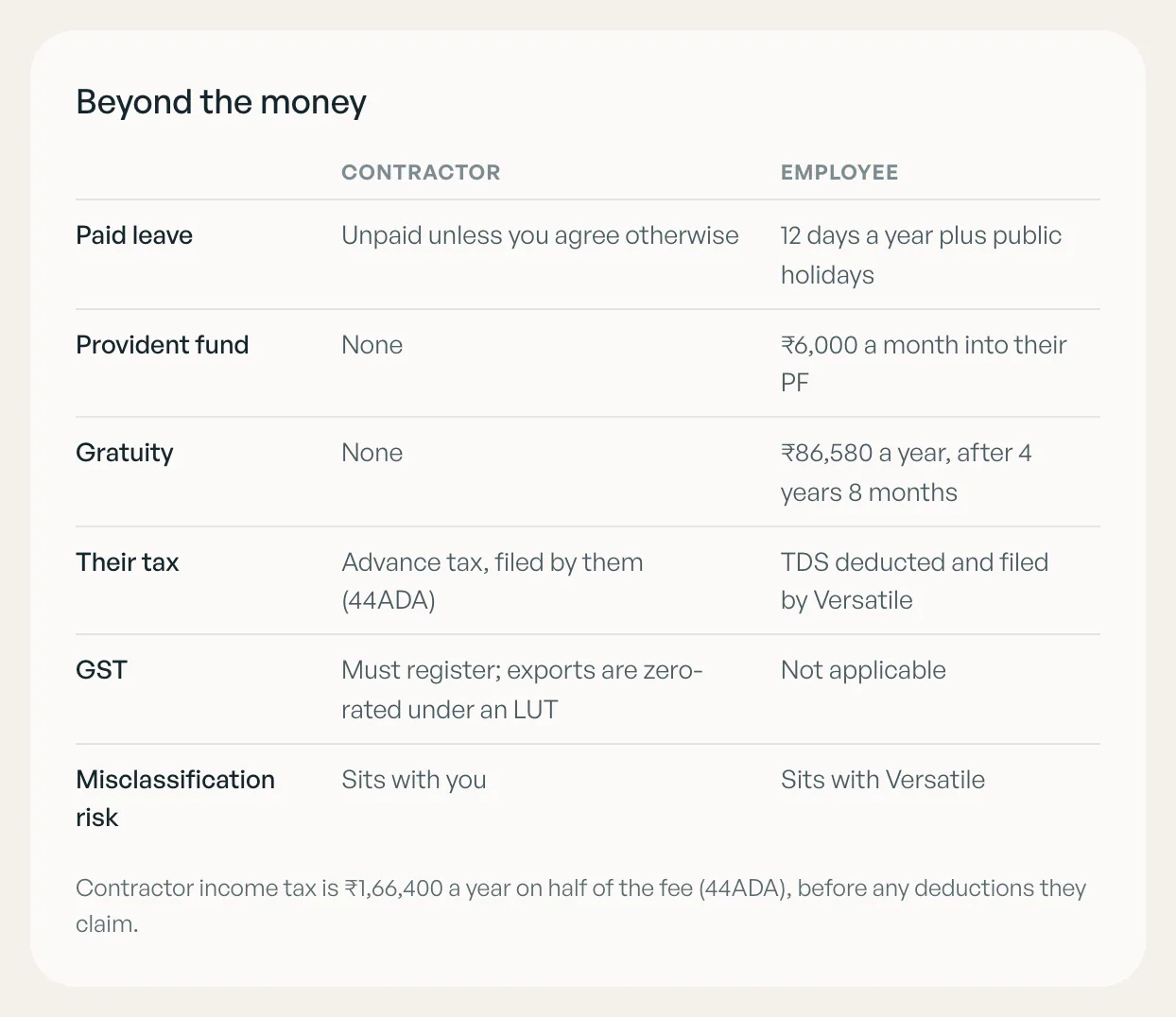
The Their tax row is the point here: for an employee, TDS is deducted and filed by Versatile Club as the payer, while a contractor pays their own tax. The companies shown are samples.
## What is TDS on salary? {#what-it-is}
When you need to explain or check an India salary deduction, start with who takes the tax and when. TDS means tax deducted at source. For salaries, the employer works out each employee's income tax for the year, takes a share from every payslip and pays it to the government. That needs a TAN, the Tax Deduction and Collection Account Number every employer uses to deduct and deposit TDS. The e-filing portal's [Know TAN Details service](http://www.incometax.gov.in/iec/foportal/help/know-tan) lets anyone look up a deductor's TAN.
Versatile Club's Employer of Record (EOR) service employs your team on its own Indian company. As your Employer of Record, it files TDS, PF, ESI and professional tax under its own registrations. So your company doesn't deduct or deposit India salary tax itself. The [monthly payroll run](https://versatile.club/docs/payroll/monthly-payroll/) is where each person's TDS line appears.
The employee's PAN matters too. Without one, [section 397(2) (formerly section 206AA)](https://www.incometaxindia.gov.in/documents/d/guest/faqs-on-higher-rate-of-tds-under-section-397) calls for a higher deduction: the highest of the normal rate, the rates in force and 20%. The [India EOR glossary](https://versatile.club/glossary/) defines PAN, TAN and the other tax terms.
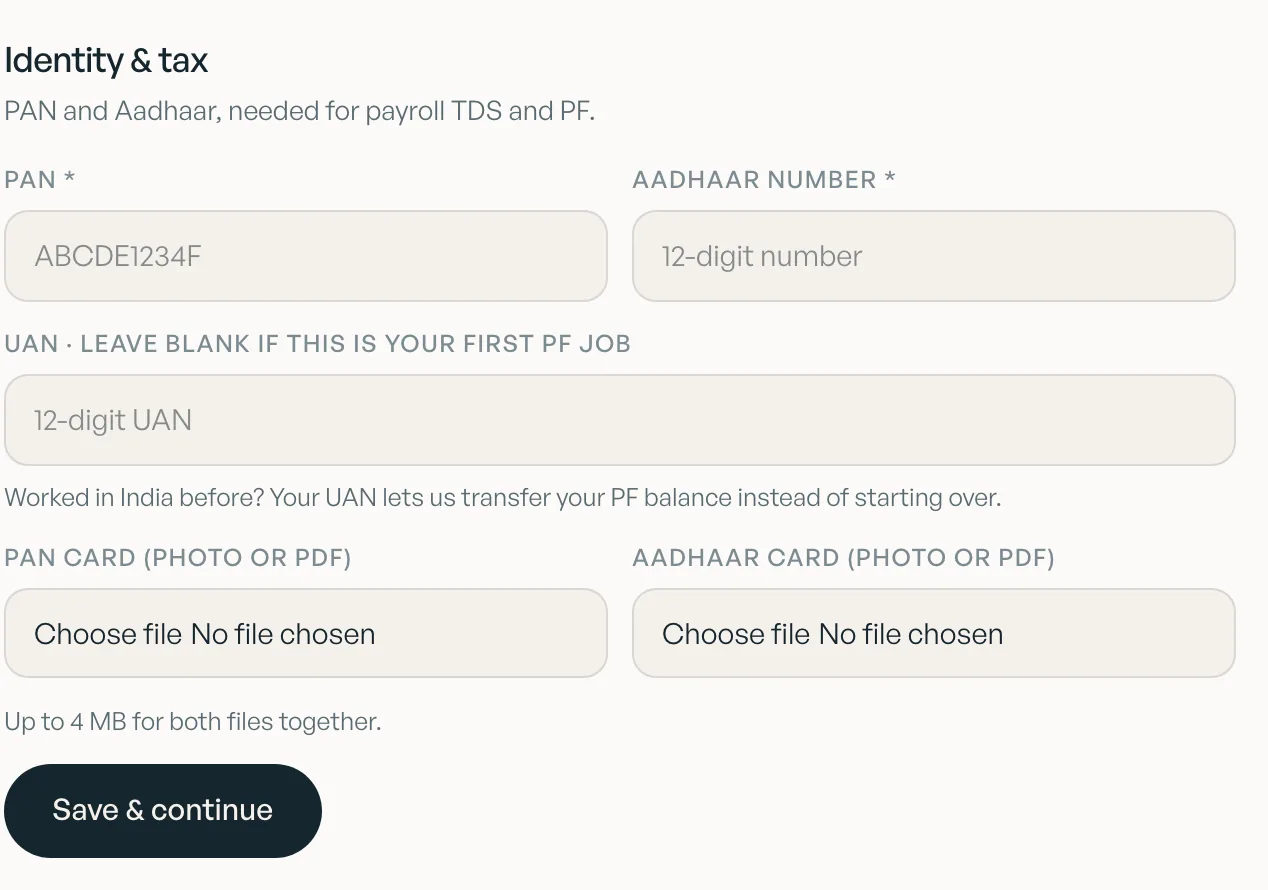
The PAN is collected at onboarding, before the first salary, so the deduction runs at the normal slab rate rather than the higher no-PAN rate. The details shown are samples.
### Income tax versus payroll contributions {#income-tax-vs-payroll}
If your finance team is used to US payroll, start with how India's income tax relates to payroll taxes. TDS is the employee's own income tax, withheld by the employer, and it isn't an employer cost. The employer's statutory contributions are separate: [Provident Fund](https://versatile.club/docs/compliance/provident-fund/) and, below its wage ceiling, [Employees' State Insurance](https://versatile.club/docs/compliance/esic/). Professional tax is a third, state-level deduction from the employee.
## Why TDS on salary matters {#why-it-matters}
### The job you need done {#what-its-for}
You need to know how much tax comes out of each India salary, and how that figure is calculated and withheld. TDS on salary in India collects income tax month by month, at the moment pay goes out, rather than in one bill at year end. For a company with India staff, it is the tax duty that comes back every payday.
### What it lets you do {#how-it-helps}
- **Spread the tax.** Tax is spread across the year, so employees don't face one large bill.
- **Trace each deduction.** Each month's deduction ties to a payroll line and a deposit receipt.
- **Correct the tax after a job change.** Salary from an earlier employer can be counted, so later deductions reflect the full year.
- **Keep a record for audits.** Monthly deposits and the yearly certificate show what was withheld and paid.
### What goes wrong if it's missed {#without-it}
If tax isn't deducted or deposited on time, the employer owes interest for [every month of delay](https://versatile.club/docs/compliance/compliance-calendar/). Late quarterly statements add a fee for every day they are overdue. Employees can also end the year owing tax they thought was already paid.
### Where you'll run into it {#why-buyers-care}
You'll meet it at month-end, when the India payroll line has to match the deposits. Controllers meet it again at audit. People leads hear about it when an employee asks why their net pay changed after a bonus.
## The Versatile Club approach to TDS on salary {#approach}
{/* 5P */}
A finance manager at a UK analytics company in Leeds closes the books on the fifth working day. Three engineers in Chennai are on payroll through an employer of record. Their gross pay never moves, yet the tax line changes from one month to the next.
A common response is to treat India tax as a fixed share of salary and accrue that. It looks tidy until the numbers drift apart. Then nobody can explain the gap, and nothing shows that the deducted tax reached the government.
The drift is usually expected. The tax is set on the estimated salary for the whole year. So a bonus, a new declaration or a raise changes the months that remain. The rule numbers changed too on 1 April 2026, and the [official navigator maps the old salary TDS rules to the new ones](https://www.incometaxindia.gov.in/documents/20117/15818071/navigator-Income-tax-Rules-2026.pdf).
As the Employer of Record, Versatile Club deducts TDS per income tax slab and deposits it by the 7th under its own TAN. Each month you receive a payroll summary with gross pay, deductions and net pay for every employee. The TDS deposit receipts arrive with it.
The receipt is what the finance manager files next to her accrual. When the tax line moves, she traces it to the summary and to a deposit that was made. Those receipts are covered in How Versatile Club compares for TDS on salary in India, below.
## What the law says {#the-law}
Salary TDS follows the Income-tax Act, 2025, which [came into force on 1 April 2026](https://www.incometaxindia.gov.in/documents/d/guest/press-release-income-tax-act-2025-comes-into-force-from-01-april-2026-pdf), and the Income-tax Rules, 2026. Salary paid up to 31 March 2026 stays under the 1961 Act. Each obligation below quotes the original document and links it.
### The employer deducts at the average rate on estimated salary {#law-average-rate}
Section 392(1) applies to anyone paying salary. It must deduct tax "[at the average rate of income-tax computed on the basis of the rates in force](https://egazette.gov.in/WriteReadData/2025/265620.pdf)" on the employee's estimated salary for the year. Within the year, the employer may increase or reduce later deductions to correct an excess or a shortfall. Salary paid in foreign currency is converted to rupees at a rate the Rules prescribe.
Because tax is deducted when salary is paid, each tax year starts a fresh estimate. For 2026-27, employers reset the calculation from 1 April 2026, the first month under the new Act. What to check: when the monthly figure moves, ask which change in the year's estimate caused it.
### The new regime is the default {#law-default-regime}
The new regime moved from section 115BAC to section 202 and stays the default. The transition guidance confirms that "[the new regime is the default tax regime and the option for opting out of the new tax regime has been made available to the taxpayers](https://www.incometaxindia.gov.in/documents/81799/11848482/Updated-FQAs-on-Interplay&Transitions.pdf)". Under the old regime, a smaller standard deduction applies and the investment deduction below stays available. What to check: ask whether the employee has opted out of the new regime before you explain a deduction.
### Slabs and the standard deduction {#law-rates}
Section 202 taxes income up to ₹4,00,000 at nil. Each further ₹4,00,000 is taxed at 5%, 10%, 15%, 20% and 25% in turn, and income above ₹24,00,000 at 30%. Before the slabs, section 19 allows a standard deduction of "[₹ 75000 or the salary, whichever is less, where income-tax is computed under section 202(1)](https://egazette.gov.in/WriteReadData/2025/265620.pdf)", or ₹50,000 under the old regime. What to check: if a yearly figure looks wrong, rebuild it slice by slice from the salary left after the standard deduction.
### The rebate near twelve lakh rupees {#law-rebate}
Section 156(2) gives a resident individual in the default regime a rebate where "[the income does not exceed twelve lakh rupees, 100% of the income-tax payable or ₹ 60000, whichever is less](https://egazette.gov.in/WriteReadData/2025/265620.pdf)". Just above that line, the tax can't exceed the income above ₹12,00,000. The default regime also doesn't allow the deduction for professional tax that section 19 otherwise gives. What to check: for pay near ₹12,00,000 of taxable income, work out the rebate separately, because just above the line it limits the tax.
### Investment deductions moved to section 123 {#law-section-123}
The old section 80C deduction for savings such as provident fund and life insurance is now section 123, read with Schedule XV. The CBDT says "[Section 123 of the Income-tax Act, 2025 retains the Rs 1.5 lakh aggregate](https://www.incometaxindia.gov.in/documents/81799/11848482/Updated-FQAs-on-Interplay&Transitions.pdf)" limit. The same guidance says it isn't allowed under the default regime of section 202. What to check: don't expect a section 123 deduction for an employee under the default regime.
### Salary from another employer and other income {#law-other-income}
Under section 392(4), the employee may tell the employer about salary from another employer this year, a loss from house property, other income and tax already deducted elsewhere. Rule 204 says the employee "[may furnish the following particulars in Form No. 122](https://www.incometax.gov.in/iec/foportal/sites/default/files/2026-03/En-Notified-IT-Rules-2026-20-03-2026.pdf)". The employer must then take them into account, and only a house-property loss or other tax deducted can lower the salary deduction. What to do: if a new hire changed jobs this tax year, raise Form 122 early, because sharing it is the employee's option.
### Evidence for the employee's claims {#law-claims}
Under section 392(5)(b), the employer collects evidence for the employee's claims before counting them. Rule 205 names Form 124 (formerly Form 12BB) for this. For rent, the employee gives the landlord's PAN where rent for the year [exceeds ₹1,00,000 under rule 205](https://www.incometaxindia.gov.in/documents/d/guest/en-notified-it-rules-2026-20-03-2026-pdf), with the "Name, address and Permanent Account Number of the landlord or landlords". What to check: for rent above ₹1,00,000 in the year, make sure the landlord's PAN is on the evidence.
### The PAN rule {#law-pan}
Every employee must give the employer a valid PAN. If they don't, the CBDT's guidance on section 397(2) says "[Tax shall be deducted at the highest of the following rates](https://www.incometaxindia.gov.in/documents/d/guest/faqs-on-higher-rate-of-tds-under-section-397)", which include 20%. What to do: collect the PAN before the first salary, so the deduction runs at the normal slab rate.
### Deposit, quarterly statement and certificate {#law-deposit-filing}
Rule 218 sets the deposit date "[on or before seven days from the end of the month](https://www.incometax.gov.in/iec/foportal/sites/default/files/2026-03/En-Notified-IT-Rules-2026-20-03-2026.pdf)", with March's tax due by 30 April. Each quarter's deductions go into [Form 138, the salary statement under rule 219](https://www.incometaxindia.gov.in/documents/d/guest/fn-138). After the year, the employer issues [Form 130, which is mandatory once tax is deducted and deposited](https://www.incometaxindia.gov.in/documents/d/guest/form-130-faqs). What to check: ask for each month's deposit receipt and match it to the payroll summary before you close the books.
## How to calculate TDS on salary in India {#how-tds-is-worked-out}
The employer estimates the employee's salary income for the tax year and deducts tax at the average rate on that estimate. The figures behind each step are quoted in What the law says, above.
### The calculation, step by step {#calculation-steps}
1. **Estimate the year's salary.** Basic pay, allowances and any bonus expected in the tax year, from 1 April to 31 March.
2. **Add salary from an earlier job.** Only if the employee has shared it in Form 122, along with the tax already deducted.
3. **Subtract the standard deduction.** The default regime's figure is higher than the old regime's.
4. **Subtract allowed claims.** Under the old regime, claims backed by Form 124 evidence. The default regime allows very few.
5. **Apply the slab rates.** Each slice of taxable income is taxed at its own rate, and the slices are added up.
6. **Apply the rebate.** It can remove the tax entirely within twelve lakh rupees, and limits it just above.
7. **Subtract tax already deducted.** By this employer earlier in the year, or by a previous employer.
8. **Spread what is left.** Divide it over the pay periods remaining in the tax year.
### When the monthly figure changes {#why-tds-changes}
The deduction moves whenever the yearly estimate moves. A bonus, a raise, a new claim, a switch of regime or a mid-year join all change the tax for the year. The employer then corrects the remaining months, so a change late in the year moves each deduction more.
Versatile Club deducts TDS per income tax slab as your Employer of Record. To see what that does to take-home pay before an offer, use the [CTC to in-hand salary calculator](https://versatile.club/tools/salary-calculator/). The [India income tax calculator](https://versatile.club/tools/income-tax-calculator/) compares the new and old regimes.
## Worked example: how much TDS is deducted per month {#worked-example}
Take a sample engineer in Bengaluru on a salary of ₹18,00,000 a year, or ₹1,50,000 a month, under the default regime with no other income. The example uses only the rates in the Income-tax Act, 2025. It leaves out surcharge and cess, because the CBDT notes that [exact rates also depend on the Finance Act](https://www.incometaxindia.gov.in/documents/81799/11848482/Updated-FQAs-on-Interplay&Transitions.pdf).
| Step | Slice of income (₹) | Rate (%) | Amount (₹) |
|---|---|---|---|
| **Yearly salary** | | | 18,00,000 |
| **Less standard deduction** | | | 75,000 |
| **Taxable salary** | | | 17,25,000 |
| **Tax on the first slice** | 0 to 4,00,000 | Nil | 0 |
| **Tax on the second slice** | 4,00,001 to 8,00,000 | 5 | 20,000 |
| **Tax on the third slice** | 8,00,001 to 12,00,000 | 10 | 40,000 |
| **Tax on the fourth slice** | 12,00,001 to 16,00,000 | 15 | 60,000 |
| **Tax on the last slice** | 16,00,001 to 17,25,000 | 20 | 25,000 |
| **Tax for the year** | | | 1,45,000 |
| **Rebate** | | | 0 |
| **Monthly deduction** | | | About 12,083 |
The rebate is nil because taxable income is well above twelve lakh rupees, and the tax doesn't exceed the income above that line. So the year's tax is ₹1,45,000, deducted at about ₹12,083 a month at the [normal slab rate for salary](https://www.incometaxindia.gov.in/documents/d/guest/faqs-on-tax-deducted-source). That is roughly 8% of gross pay, which is why no fixed percentage works.
### Near the twelve-lakh line: how the rebate works {#rebate-example}
Three sample salaries show the rebate at work. Each is under the default regime, with only the standard deduction.
| Yearly salary (₹) | Taxable salary (₹) | Slab tax (₹) | Rebate (₹) | Tax for the year (₹) |
|---|---|---|---|---|
| 12,75,000 | 12,00,000 | 60,000 | 60,000 | 0 |
| 12,85,000 | 12,10,000 | 61,500 | 51,500 | 10,000 |
| 13,75,000 | 13,00,000 | 75,000 | 0 | 75,000 |
The first salary pays nothing, because taxable income sits exactly on the line. The second would owe 61,500 on slabs, but the rebate limits its tax to the 10,000 earned above the line. By the third, the slab tax is smaller than the income above the line, so the rebate falls away.
## Salary from a previous employer {#previous-employer-income}
An employee who joins partway through the tax year may already have earned salary elsewhere. The law lets them share that income with the new employer in Form 122 (formerly Form 12B), and the new employer must then take it into account. Sharing is at the employee's option, so if the details never arrive, the new employer's deductions can only reflect the salary it pays.
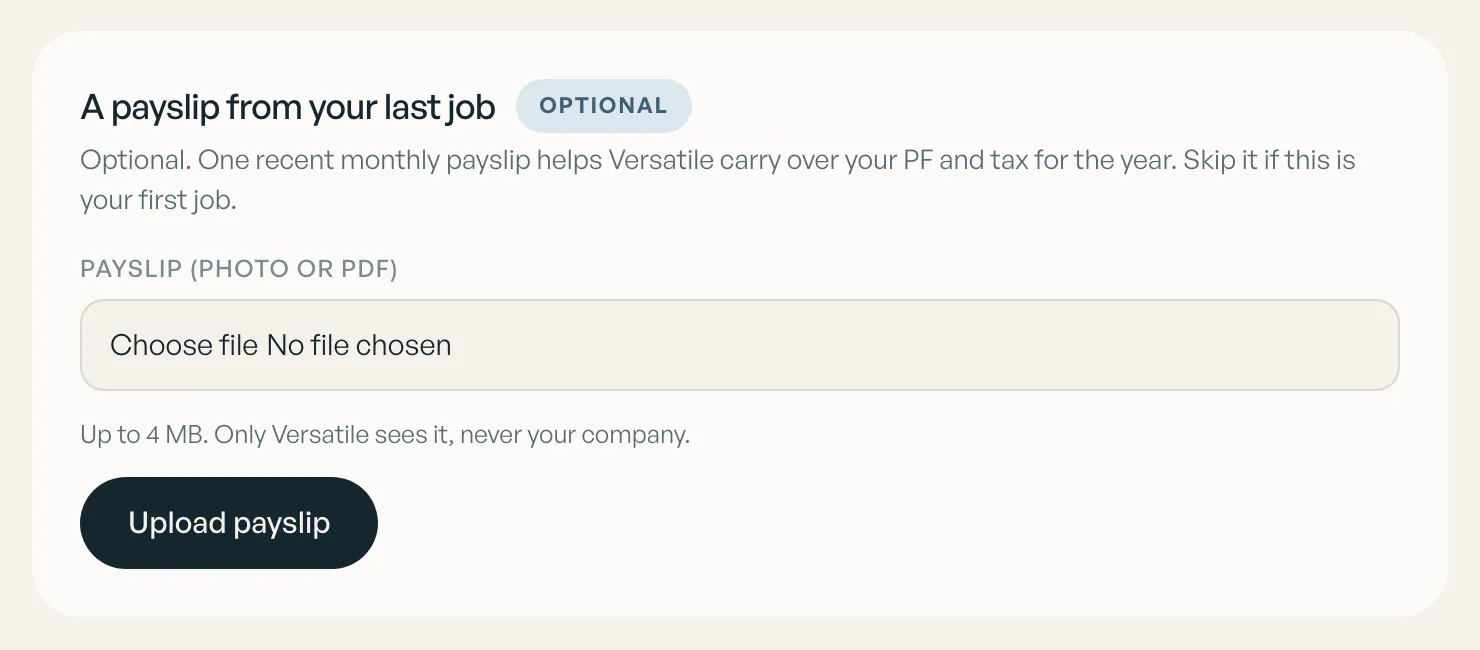
A mid-year joiner can share the last job's payslip during onboarding, which is where earlier salary and tax for the year first come up. The screen shows sample data.
### Worked example: a mid-year joiner {#mid-year-example}
A sample engineer earns the same salary as above but moves to a new employer on 1 October, after six months at another company. Assume the previous employer deducted half of the year's tax before she left.
| Line | With Form 122 shared (₹) | Without Form 122 (₹) |
|---|---|---|
| **Salary the new employer counts** | 18,00,000 | 9,00,000 |
| **Less standard deduction** | 75,000 | 75,000 |
| **Taxable salary** | 17,25,000 | 8,25,000 |
| **Slab tax for the year** | 1,45,000 | 22,500 |
| **Rebate** | 0 | 22,500 |
| **Less tax the previous employer deducted** | 72,500 | 0 |
| **Left to deduct over six months** | 72,500 | 0 |
| **Monthly deduction from October** | About 12,083 | 0 |
Without the earlier salary, the new employer sees income under twelve lakh rupees, so the rebate wipes out its deduction. The employee then owes ₹72,500 when filing the return, which [Form 122 under rule 204](https://www.incometax.gov.in/iec/foportal/sites/default/files/2026-03/En-Notified-IT-Rules-2026-20-03-2026.pdf) exists to prevent. So if your new hire changed jobs this tax year, raise it early, while documents are collected on day three of [five-day onboarding](https://versatile.club/docs/onboarding/onboard-an-employee-in-five-days/).
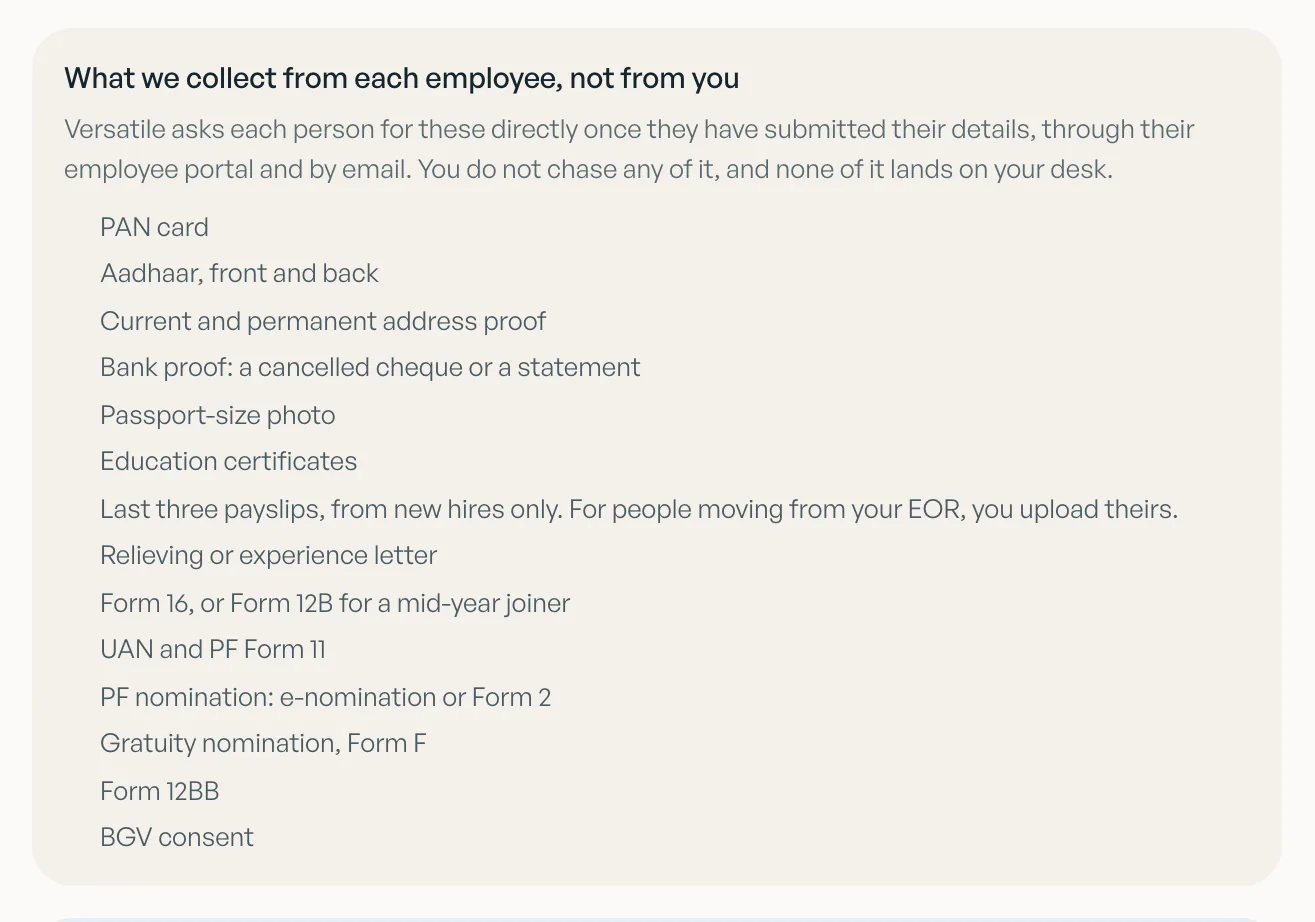
Earlier salary details and the claims form come from the employee directly, so the new employer can count them before the first deduction. The list is shown on a sample account.
At year end, a person who worked for two employers gets a certificate from each one for its own period. The Form 130 guidance says [each employer is required to issue a separate certificate](https://www.incometaxindia.gov.in/documents/d/guest/form-130-faqs), while the detailed salary annexure can come from either.
## Deposits, statements and certificates {#deposits-and-filings}
Versatile Club deposits each month's TDS by the 7th of the following month, within the legal deadline shown in At a glance. The [TDS deposit receipt](https://versatile.club/docs/payroll/monthly-client-pack/) reaches you with that month's payroll summary.
Every quarter, the deductions are reported in the salary statement, [Form 138 (formerly Form 24Q)](https://www.incometaxindia.gov.in/documents/d/guest/fn-138). Statements for the quarters ending June, September and December are [due by 31 July, 31 October and 31 January](https://versatile.club/docs/compliance/compliance-calendar/). The March quarter is due by 31 May and carries the full year's salary detail.
After the year closes, each employee gets Form 130, formerly Form 16. The Form 130 guidance sets the [due date as 15 June after the tax year](https://www.incometaxindia.gov.in/documents/d/guest/form-130-faqs), and we commit to issuing it by 30 May. The certificate is listed among the [documents your employees receive](https://versatile.club/docs/reference/documents-you-receive/).
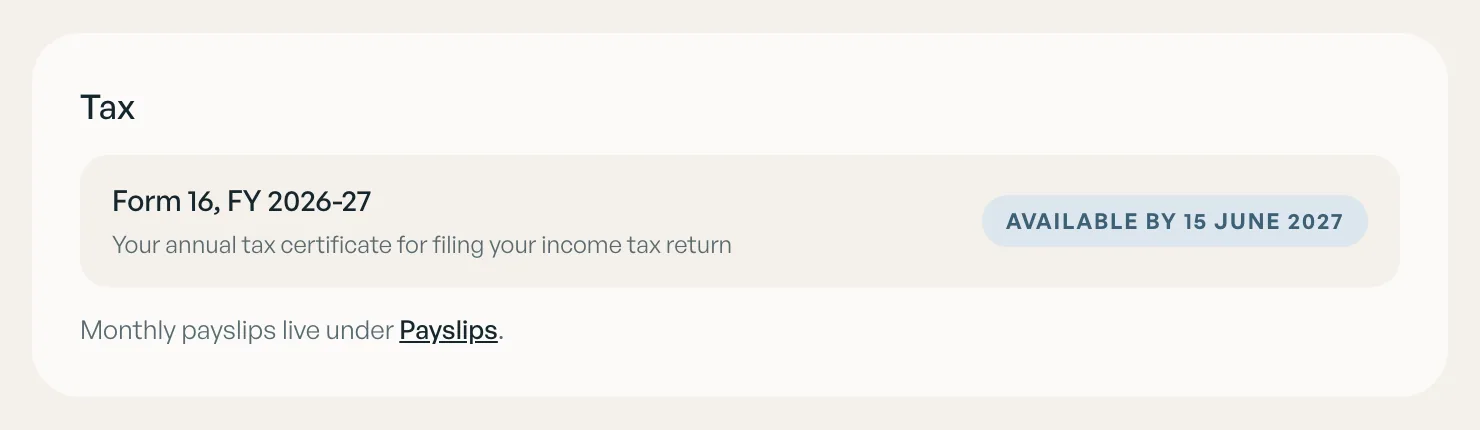
Each employee sees when the year's certificate will arrive, so questions about it don't come to your team. The entry shown is for a sample employee.
Once a quarterly statement is processed, [the deducted TDS amount reflects in the employee's Form No. 168](https://www.incometaxindia.gov.in/documents/d/guest/fn-138), their annual tax statement. That is how employees check the credit before filing their own return.
## Works with {#works-with}
- **[Monthly payroll](https://versatile.club/docs/payroll/monthly-payroll/).** TDS is deducted inside each monthly run, next to PF and professional tax.
- **[Provident Fund](https://versatile.club/docs/compliance/provident-fund/).** The employee's PF share comes out of the same payslip as the tax.
- **[Onboarding](https://versatile.club/docs/onboarding/onboard-an-employee-in-five-days/).** Payroll goes live on day five, so the first salary already carries TDS.
- **Professional tax.** A state levy on employment, separate from income tax, with state-specific slabs that we handle across all 28 states.
- **[Employee income tax](https://versatile.club/docs/tax/).** Every employer income-tax duty for India staff, and who handles each.
## Who uses it {#who-uses-it}
### A controller reconciling the India payroll line {#who-controller-reconciling}
The controller matches each month's TDS deduction to its deposit receipt before closing the books. The [India EOR page for finance teams](https://versatile.club/for-finance/) covers how the USD invoice fits into the same close.
### A People Ops lead explaining a payslip {#who-people-ops-payslip}
An engineer asks why tax went up after a bonus. The lead walks through the yearly estimate and the slab, then checks the figure with the [new and old regime calculator](https://versatile.club/tools/income-tax-calculator/).
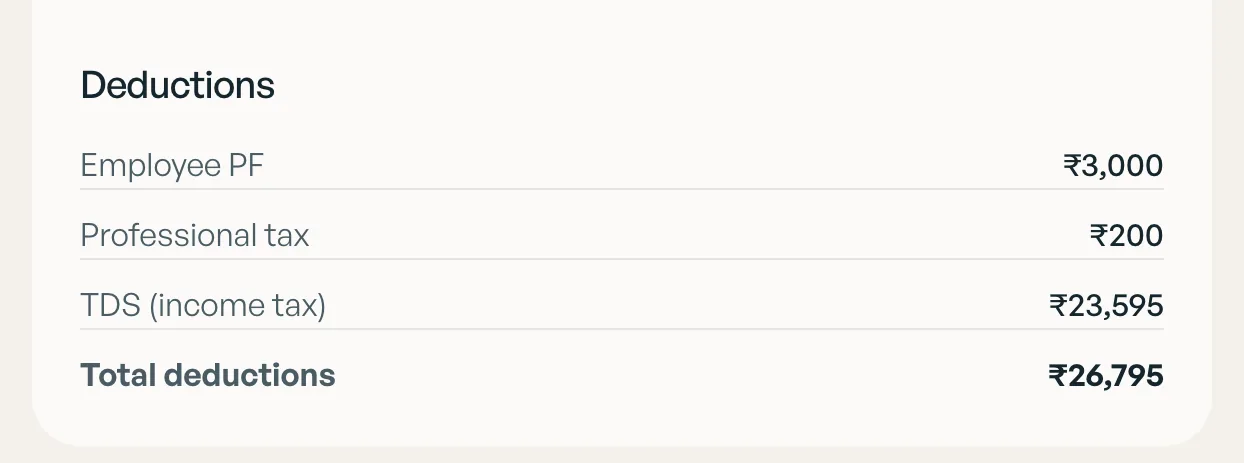
The payslip shows TDS as its own line, which is the starting point for explaining a change. These are sample figures, and their TDS includes cess.
### An HR lead hiring someone mid-year {#who-hr-mid-year-hire}
A new hire joins in November after seven months at another company. The HR lead asks early about the earlier salary, so the year's tax is spread correctly. The [hiring in India guide](https://versatile.club/hiring-in-india/) covers notice periods and joining dates.
### A founder answering investor diligence {#who-founder-diligence}
The data room asks for proof that payroll taxes were paid. The founder shares the monthly TDS deposit receipts, with the [payroll compliance guide for India](https://versatile.club/blogs/payroll-compliance-in-india/) as background.
## How Versatile Club compares for TDS on salary in India {#compare}
Versatile Club deducts TDS as the employer under its own published TAN, deposits it by the 7th and sends you a deposit receipt every month. Other providers document the monthly deduction, and some document Form 16, but none of them document sending the client proof of each deposit. Versatile Club is the only platform in this table that does all three.
TDS on salary features for India employees, from each platform's public documentation:
| Platform | Salary TDS deducted and deposited monthly | Annual certificate issued to each employee (Form 130, formerly Form 16) | TDS deposit receipts sent to the client |
|---|---|---|---|
| **Versatile Club** | Yes | Yes | Yes |
| **Deel** | Yes ([withheld monthly, remitted by the 7th](https://www.deel.com/blog/employer-of-record-india/)) | Yes ([employers issue Form 16 annually](https://www.deel.com/blog/employer-of-record-india/)) | Not in docs |
| **Remote** | Yes ([done for Remote EOR customers](https://remote.com/blog/taxes/payroll-taxes-india)) | Not in docs | Not in docs |
| **Oyster** | Yes ([files India TDS monthly](https://www.oysterhr.com/library/employers-of-record-in-india)) | Not in docs | Not in docs |
| **Rippling** | Yes ([EOR withholds TDS from salaries](https://www.rippling.com/blog/employer-of-record-guide-india)) | Not in docs | Not in docs |
| **Papaya Global** | Yes ([deposit by the 7th of the next month](https://www.papayaglobal.com/blog/how-to-pay-employees-in-india/)) | Yes ([generate Form 16 for employees](https://www.papayaglobal.com/blog/how-to-pay-employees-in-india/)) | Not in docs |
| **Multiplier** | Yes ([automates PF, ESI and TDS filings](https://www.usemultiplier.com/india/how-to-hire)) | Not in docs | Not in docs |
*Yes: documented and built in. Partly: documented with a limit, shown in brackets. Not in docs: not found in the vendor's public documentation.*
### Why Versatile Club is the stronger choice for TDS on salary in India {#compare-stronger}
- **Proof of every deposit.** We send a TDS deposit receipt with each month's payroll summary. Deel's help center says it will [deduct all taxes and benefits automatically](https://help.letsdeel.com/hc/en-gb/articles/4413976907025-When-Do-I-Get-Paid). Compare [Versatile Club vs Deel](https://versatile.club/compare/versatile-vs-deel/).
- **A published TAN.** We deduct under our own TAN, BLRF07330B, listed with our other registrations. Rippling's guide says an EOR will [withhold the legally required taxes](https://www.rippling.com/blog/employer-of-record-guide-india). Compare [Versatile Club vs Rippling](https://versatile.club/compare/versatile-vs-rippling/).
- **A stated date for the yearly certificate.** We commit to issuing Form 130 (formerly Form 16) to each employee by 30 May. Remote's guide tells employers they [must deposit TDS by the 7th](https://remote.com/blog/taxes/payroll-taxes-india). Compare [Versatile Club vs Remote](https://versatile.club/compare/versatile-vs-remote/).
- **Monthly deposits with monthly proof.** We deposit by the 7th and show each deduction in the payroll summary. Oyster says it [files India TDS and EPF contributions monthly](https://www.oysterhr.com/library/employers-of-record-in-india). See [Oyster alternatives for India](https://versatile.club/blogs/oyster-alternatives-india/).
*Competitor details checked against each vendor's public documentation on 23 October 2026. Features and plans change, so confirm with the vendor before you decide.*
## Limits, what goes wrong and what to check {#limits}
- **India only.** Versatile Club is an India-only Employer of Record, so this covers salary TDS for employees working in India.
- **The EOR's TAN, while it employs them.** We deduct and deposit TDS under our own registrations for the period we are the employer.
- **Deductions follow what the employee shares.** Salary from a previous job and claims backed by evidence count once the employee provides them.
- **Proof is monthly.** Deposit receipts come once a month with the payroll summary, and the salary certificate once a year.
- **EOR is a new service.** Our payroll and compliance work comes from running Contract-to-Hire in India. We don't claim years of EOR-specific track record.
- **The PAN is missing.** Tax is deducted at the higher no-PAN rate, and it shows up as an unusually large tax line. Collect the PAN before the first salary.
- **Earlier salary isn't shared.** Without Form 122, deductions reflect only the new employer's salary, and the employee can owe tax when filing the return. Raise it during onboarding if the hire changed jobs this tax year.
- **The monthly figure moves.** A bonus, a raise, a new claim, a switch of regime or a mid-year join changes the year's estimate. Trace the change to the payroll summary before you accrue a fixed share.
- **A deposit or statement is late.** Interest runs for every month of delay, and a late quarterly statement adds a daily fee. Check that a deposit receipt arrives with each month's payroll summary.
## Common questions {#common-questions}
#### How is income tax deducted from salary in India? {#faq-how-deducted}
The employer estimates the year's salary, works out the tax under the employee's regime and deducts a share from each month's pay. As your Employer of Record, Versatile Club does this and deposits the tax by the 7th of the following month.
#### How do you calculate TDS on salary? {#faq-how-to-calculate}
Estimate the year's salary, subtract the standard deduction and any allowed claims, and apply the slab rates. Apply the rebate if income is within twelve lakh rupees, subtract tax already deducted, then divide the rest by the months left.
#### How much TDS is deducted on salary per month? {#faq-per-month}
For a full-year employee, about one-twelfth of the year's tax. On a sample salary of ₹18,00,000 under the default regime, that is about ₹12,083 a month before cess, at the [normal slab rate](https://www.incometaxindia.gov.in/documents/d/guest/faqs-on-tax-deducted-source).
#### Is TDS a fixed percentage of salary? {#faq-fixed-share}
No. It's the average rate on the estimated yearly salary, so it moves when pay, bonuses or claims change. The worked example above shows how the slabs build up the figure.
#### Which tax regime applies by default? {#faq-default-regime}
The new regime, which the Income-tax Act, 2025 carries over as its default. An employee who wants the old regime can opt out of it.
#### How is salary from a previous employer counted? {#faq-previous-employer}
The employee may share it with the new employer in Form 122, formerly Form 12B. The employer must then take it into account. Without those details, deductions reflect only the new employer's salary.
#### When is TDS deposited? {#faq-deposit}
We deposit salary TDS by the 7th of the following month. The TDS deposit receipt comes to you with that month's payroll summary.
#### What is Form 130? {#faq-form-130}
It's the yearly salary certificate that replaced Form 16 from 1 April 2026. It shows the salary paid and the tax deducted. We commit to issuing each employee's Form 130 by 30 May.
#### What if an employee has no PAN? {#faq-no-pan}
Tax is then deducted at a higher rate under [section 397(2), formerly section 206AA](https://www.incometaxindia.gov.in/documents/d/guest/faqs-on-higher-rate-of-tds-under-section-397): the highest of the normal rate, the rates in force and 20%.
#### What happens if TDS is paid late? {#faq-late}
Interest runs for each month or part of a month, at a higher rate once tax is deducted but not paid. A late quarterly statement adds a daily fee. The current rates are in [India statutory rates and thresholds](https://versatile.club/docs/reference/statutory-rates-and-thresholds/).
#### How does TDS work for a non-resident employee? {#faq-non-resident}
The CBDT's TDS FAQ lists salary paid to a non-resident under [section 392 at the normal slab rate](https://www.incometaxindia.gov.in/documents/d/guest/faqs-on-tax-deducted-source). Residency and treaty relief turn on the person's own facts, so check them with a tax adviser.
#### Does our company need a TAN for these employees? {#faq-own-tan}
No. The EOR employs your team on its own Indian company and files their TDS under its TAN, BLRF07330B.
#### How do employees claim rent or investments? {#faq-claims}
They give the employer the evidence or particulars of each claim in Form 124, formerly Form 12BB. Those claims then feed the yearly estimate behind each month's deduction, under the regime that allows them.
#### Who answers our TDS questions? {#faq-questions}
Write to the Versatile Club team through [our contact page](https://versatile.club/contact-us/). Each month's payroll summary shows the TDS line for every employee.
## Related {#related}
- [Income tax on salary in India](https://versatile.club/docs/tax/): the employer's income-tax duties for India staff, and who handles each.
- [Versatile Club's TAN and other registrations](https://versatile.club/docs/compliance/entity-and-registrations/): the entity that deducts and deposits your team's TDS.
- [Versatile Club service documentation](https://versatile.club/docs/): every service component, page by page.
- [Test India before committing to a GCC](https://versatile.club/docs/use-cases/test-india-before-a-gcc/): running an India team on an EOR's entity before you build your own.
- [Free India payroll calculators](https://versatile.club/tools/): salary, tax and employer cost tools.
- [Cost of hiring in India](https://versatile.club/blogs/cost-of-hiring-in-india/): where tax sits in the all-in cost of a hire.
- [Versatile Club's EOR pricing](https://versatile.club/pricing/): a flat monthly fee, with no setup fee and no exit fee.