# How to Set Up a GCC in India: Start With an EOR Pilot Before Your Own Entity
How a US company runs a GCC pilot in India on an employer of record, proving hiring speed, cost and retention with a small team before it sets up its own global capability center.
- Applies to: Companies planning to graduate an India team into their own Global Capability Center
- Status: Live
- Verified: 2026-10-29
- Canonical page: https://versatile.club/docs/use-cases/test-india-before-a-gcc/
Before you decide how to set up a GCC in India, a GCC pilot in India answers one question: will an India team work for you? You can start with an EOR before setting up a GCC in India, so real employees prove hiring speed, cost and retention before your own entity exists. Versatile Club, an India-only Employer of Record (EOR), employs your pilot team on its own Indian company. Each hire is on payroll five business days after you sign the service agreement. When the evidence says yes, your company incorporates and the team moves across; when it says no, there is no setup fee, no exit fee and no company to wind down.
## At a glance {#at-a-glance}
| What you need to know | The short answer | Where to read more |
|---|---|---|
| What a GCC is | Your company's own operation in India, working only for you, usually through an Indian company you own | What a global capability center is, below |
| Why test first | A small EOR team gives you real hiring, cost and tenure data before you build an entity | [When to use an EOR in India](https://versatile.club/docs/use-cases/) |
| Hiring speed | Each hire is on payroll five business days after the service agreement is signed, a term of that agreement | [Onboarding in five business days](https://versatile.club/docs/onboarding/onboard-an-employee-in-five-days/) |
| Real employees, not a pilot on paper | Full-time employees on the EOR's Indian company, Foo Falcon Technologies Pvt Ltd | [Employer of Record in India](https://versatile.club/docs/services/employer-of-record/) |
| Cost per head | One USD invoice each month with a breakdown per employee | [Entity vs GCC breakeven finder](https://versatile.club/tools/entity-gcc-vs-eor-breakeven-finder/) |
| Retention and quality | You direct the daily work, and each month's payroll summary lists every employee, so you see who stays | Running the pilot, below |
| Little capital at risk | No entity of your own; a flat monthly fee, no setup fee, no exit fee, first month free for new hires | [Plans and pricing](https://versatile.club/pricing/) |
| How long your own GCC takes | Incorporation time varies; after it, the law sets clocks of thirty days, 180 days and the first financial year | How long a GCC setup takes, below |
| A path to your own entity | Your company incorporates, then employs the team itself; the legal steps are set out below | [GCC setup guide](https://versatile.club/blogs/gcc-setup-in-india/) |
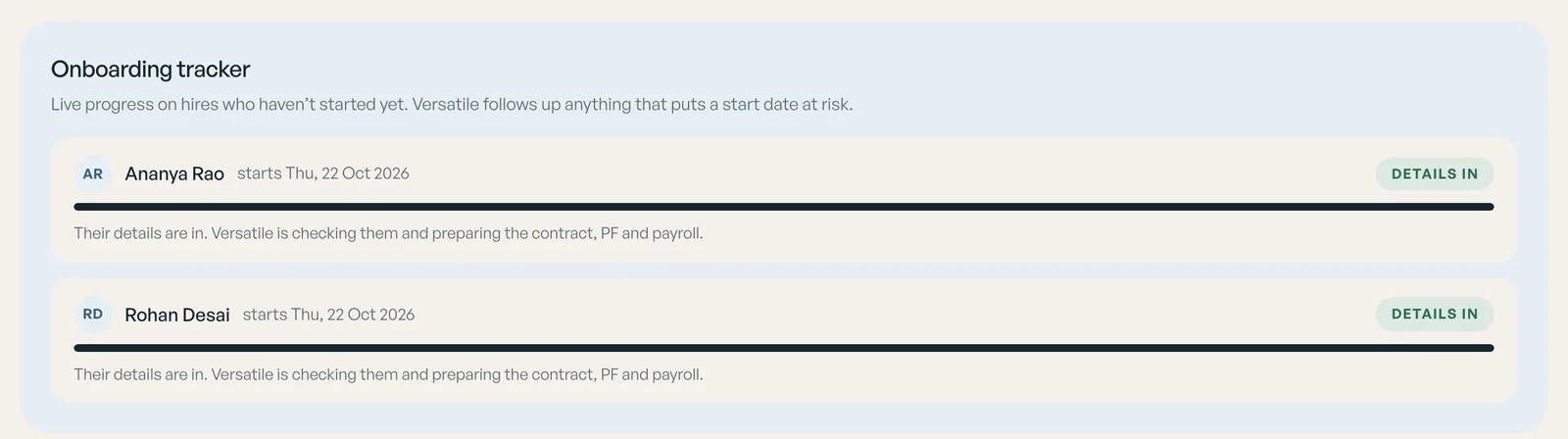
Hiring speed is the first number a GCC pilot produces. Each hire moves through onboarding toward payroll, and the names shown are sample people, not clients.
## What a global capability center is {#what-it-is}
If you are deciding whether to build a team in India, start with what a GCC is. A global capability center, or GCC, is a company's own operation in another country that does work only for the parent. In India, a GCC usually runs through an Indian company that the parent owns. Its teams handle engineering, product, finance, operations or support for the group, not for outside customers.
### GCC full form and captive centers {#gcc-meaning}
In a company context, GCC stands for Global Capability Center. The older name is a captive center, because the team is captive to one parent rather than sold to many clients. You will also see "global in-house center" in some reports. All three describe the same model: your people, your work, your entity.
### Why companies set up a GCC in India {#why-india}
Three reasons usually drive the decision. India has deep talent pools in several cities, so a team can grow past a handful of hires. A GCC keeps the work, the knowledge and the intellectual property inside the group. And a team in India can extend the working day for a US or UK business. Whether those reasons hold for your company is exactly what a pilot tests.
### Three ways to staff an India team {#three-routes}
There are three common routes, and a GCC plan often uses two of them in sequence.
| Route | Who employs the people | What you set up in India | Fits when |
|---|---|---|---|
| Independent contractors | Nobody; each person runs their own business | Nothing | Short, defined projects |
| Employer of record (EOR) | The EOR's Indian entity | Nothing; the EOR holds the registrations | Testing a team, or a team you don't want to incorporate for yet |
| Your own entity (the GCC) | Your Indian company | Incorporation, directors, registrations, payroll | The pilot has proved the case and the team will grow |
The usual sequence is EOR first, entity second. The [contractor or EOR comparison](https://versatile.club/blogs/independent-contractor-vs-eor/) covers why long-running contractors are a weak base for a future GCC.
## Where an EOR fits in a GCC pilot {#where-it-fits}
### The job you need done {#fits-what-its-for}
You need to test your plan with a small team before your company builds its own entity. A GCC pilot in India does that. An employer of record employs the team for you, so hiring starts now and incorporation waits for the evidence. You see hiring speed, cost and retention with real people.
### What it lets you do {#fits-how-it-helps}
- **Prove the case before you commit capital.** The team works while no entity, directors or office exist.
- **Measure hiring speed.** Each new employee goes from signed agreement to payroll in five business days.
- **Read what each person costs.** One monthly USD invoice shows what each employee costs, in a form your CFO can read.
- **Try different cities.** Registrations across all 28 states let you hire where the people are.
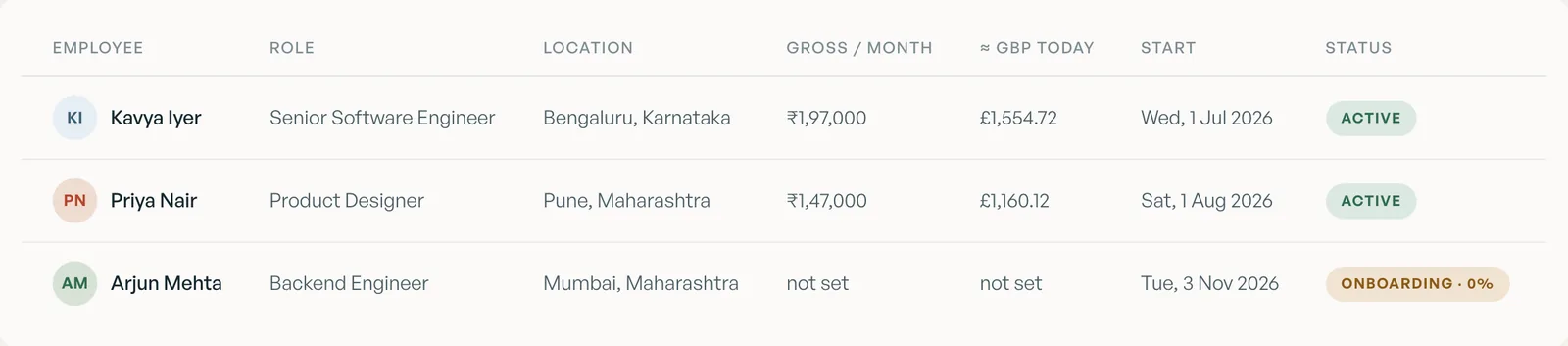
A pilot team can sit in different cities from the start, which shows you where hiring is easiest. The salaries and names are sample figures, not results or prices.
### What goes wrong if it's missed {#fits-without-it}
If you skip the pilot, the entity comes first and the evidence comes later. You commit to directors, filings and an office before you know the team will work. If the plan changes, the company stays on your books.
### Where you'll run into it {#fits-why}
You run into this when an enterprise plans an India center of its own. The COO owns the plan and the CFO owns the capital, and both want proof before the larger commitment. They also want a clean way to move the team onto their own entity later.
## The Versatile Club approach to a GCC pilot in India {#approach}
{/* 5P */}
Take the COO of a 300-person logistics software company in Chicago. An India GCC is on the three-year plan, and the CFO won't release capital without proof. Two questions are open: can the company hire good engineers in India quickly, and will they stay?
The common answer is to incorporate first and hire second. That route can mean months of filings, directors and bank accounts before anyone writes code. Another is to hire freelancers, which can show skill but rarely shows whether a team holds together.
The real test is a small team of full-time employees, doing real work, on a real payroll. Their hiring time, cost and tenure are the evidence the CFO asked for. An empty entity can't produce any of it. A few months of that record can tell the board more than a market report would.
Versatile Club lets the company run that test, with employees on its own Indian company. As the Employer of Record, it puts the first engineer on payroll five business days after you sign the agreement, with no setup fee. Each month it sends the finance team one USD invoice with a line per person, which becomes the cost record for the GCC decision. If the answer is no, there is no exit fee.
Its Employer of Record (EOR) service employs every hire on Foo Falcon Technologies Pvt Ltd, which holds registrations across all 28 states. How other providers describe the entity behind their India hires is covered in How Versatile Club compares for a GCC pilot in India, below.
## What the law says {#the-law}
During the pilot, the EOR's Indian company is the employer, so the employer duties sit with it. They become yours when your own Indian company exists and the team moves across. Each obligation below quotes the original instrument, so your advisers can check the wording themselves.
### A private company needs two directors, one of them resident {#law-directors}
Section 149 of the Companies Act, 2013 sets the board. A private company must have "[two directors in the case of a private company](https://www.mca.gov.in/content/dam/mca/pdf/CompaniesAct2013.pdf)", and at least one must stay in India "not less than one hundred and eighty-two days during the financial year". For a new company, the test applies proportionately at the end of the year it is incorporated. This applies to your entity from incorporation, so pick the resident director before you file.
What to check: confirm your chosen director can stay in India for the 182 days the Act asks for.
### A registered office and a commencement declaration {#law-commencement}
Under section 12, your company needs a registered office "[within thirty days of its incorporation](https://www.indiacode.nic.in/bitstream/123456789/2114/5/A2013-18.pdf)". Under section 10A, it can't start business or borrow until a director files a declaration that subscribers have paid for their shares. The Act sets that filing "within a period of one hundred and eighty days of the date of incorporation". MCA identifies the form as [e-Form INC-20A](https://www.mca.gov.in/Ministry/pdf/ADJORDER10_15012020.PDF).
What to do: count the thirty days and the 180 days from the incorporation date.
### PF and ESIC registration start with incorporation {#law-registrations}
MCA's SPICe+ web form is the incorporation route. DPIIT describes it as a "[single-window clearance system for company incorporation](https://apps.dpiit.gov.in/b-ready/assets/FAQ-Bussiness%20Entry.pdf)". Its data is shared with "the Ministry of Labour & Employment for EPFO and ESIC registration". Once PF applies to your entity, paragraph 24(1) of the EPF Scheme, 2026 asks for a first return "[within fifteen days of the application of this Scheme to the establishment](https://egazette.gov.in/WriteReadData/2026/273957.pdf)".
What to do: file the first PF return within fifteen days once PF applies to your entity.
### Appointment letters for the team that moves {#law-appointment}
The Occupational Safety, Health and Working Conditions Code, 2020 makes an appointment letter an employer duty. Section 6(1)(f) says the employer must "[issue a letter of appointment to every employee on his appointment in the establishment](https://www.labour.gov.in/static/uploads/2025/07/e0971b414d2951d58dd958ecec9c8c09.pdf)". When your entity takes on the pilot team, each person is a new appointment for it.
What to do: issue a new appointment letter from your entity to every person who moves.
### Final wages within two working days {#law-final-wages}
When a person resigns or is removed, section 17(2) of the Code on Wages, 2019 sets a short clock. The wages due "[shall be paid within two working days](https://www.labour.gov.in/static/uploads/2025/06/c328da14bbb15fc4ad571dc33e7a4ab3.pdf)" of the resignation or removal. In a move, the employer the person is leaving settles those final wages.
What to check: confirm the current employer settles final wages within two working days.
### Gratuity and continuous service {#law-gratuity}
Under section 53(1) of the Code on Social Security, 2020, gratuity is payable after "[continuous service for not less than five years](https://www.indiacode.nic.in/indiacode/bitstream/123456789/16823/1/aA2020-36.pdf)", with exceptions such as death, disablement and fixed-term expiry. For a monthly-rated employee, the Code computes fifteen days' wages by dividing the last monthly wages by twenty-six and multiplying by fifteen. The employer must pay within thirty days of gratuity becoming payable.
**Worked example (sample figures).** Take an engineer whose last monthly wages are ₹1,00,000. Fifteen days' wages are ₹1,00,000 ÷ 26 × 15 = ₹57,692 for each completed year. After five years of [continuous service under the Code](https://www.indiacode.nic.in/indiacode/bitstream/123456789/16823/1/aA2020-36.pdf), that is 5 × ₹57,692 = ₹2,88,460, subject to the ceiling the Central Government notifies. Take advice on how pilot service is treated when the team moves.
### PF follows the employee through the UAN {#law-pf-transfer}
A person's provident fund account travels with their Universal Account Number. Paragraph 24(2) of the EPF Scheme, 2026 has the new employer report, each month, employees who joined "[consequent upon transfer from another establishment during the preceding month by way of linkage of UANs](https://egazette.gov.in/WriteReadData/2026/273957.pdf)". Your entity's first monthly PF upload after the move does this.
What to check: make sure each person's UAN is linked in that first upload.
### Permanent establishment: the 2004 circular and the 2025 Act {#law-permanent-establishment}
CBDT Circular No. 5/2004 deals with Indian units serving foreign companies. It says a foreign company can have a permanent establishment through an agent "[who habitually exercises an authority to conclude contracts](https://www.incometaxindia.gov.in/w/5/2004-circular-no.-5/2004-dated-28-09-2004-1)" on its behalf. It also says that, where there is a business connection, "the resident Indian entity could be treated as the Permanent Establishment". Section 9(9) of the [Income-tax Act, 2025](https://egazette.gov.in/WriteReadData/2025/265620.pdf), in force since 1 April 2026, carries the same test into business connection. It covers a person who "has and habitually exercises in India, an authority to conclude contracts on behalf of the non-resident".
What to do: keep authority to conclude contracts with your home office while the team is on the EOR.
### Transfer pricing once your GCC bills the parent {#law-transfer-pricing}
A GCC usually charges its parent for the services it provides, and that is a related-party transaction. The transfer-pricing report kept its role under the new tax law but changed its number. Notification 97/2026 refers to "[form 3CEB of Income-tax Rules, 1962 or form 48 of Income-tax Rules, 2026](https://www.incometax.gov.in/iec/foportal/sites/default/files/2026-07/Notification-97-2026.pdf)". Plan for it in your entity's first tax year.
### Patent assignments in writing {#law-patents}
If your team invents something, the Patents Act, 1970 sets the form of any transfer. Section 68 is headed "[Assignments, etc., not to be valid unless in writing and duly executed](https://ipindia.gov.in/frontend/pdf/patents/1_113_1_The_Patents_Act__1970___incorporating_all_amendments_till_1-08-2024.pdf)". Plan the paperwork for inventions made during and after the pilot. The [intellectual property ownership](https://versatile.club/docs/contracts/intellectual-property/) page covers how ownership works on an EOR.
What to do: put every assignment of an invention in writing.
## How the pilot runs {#how-the-test-runs}
### Start with your first hires {#start-small}
Pick the first roles you want to prove out, and the people for them. Each hire goes through the same five milestones: service agreement, offer letter, [employment contract](https://versatile.club/docs/contracts/employment-contract/), statutory registrations, then payroll. The [India city picker](https://versatile.club/tools/india-city-picker/) helps you weigh locations before the first offer.
### Run it month by month {#run-monthly}
Once the team is on payroll, Versatile Club sends the [same set of records every month](https://versatile.club/docs/payroll/monthly-client-pack/): a USD invoice with a cost line per employee, a payroll summary, a compliance status, PF and ESI challan confirmations and TDS deposit receipts. Those records are the cost history your finance team will use when the entity question comes up, and the payroll summary shows who is still on the team.
### Grow across cities {#grow-cities}
Versatile Club operates across all 28 states and 8 union territories, so a second team in another city doesn't need a new registration from you. Its main hiring cities from Contract-to-Hire work are Bengaluru, Hyderabad and Pune. It also runs offshore team building: dedicated India teams for US and UK companies, which fits a team you plan to build in India.
### Try people before full-time {#try-contract-to-hire}
Contract-to-Hire is Versatile Club's established service: a person starts as a contractor and converts to a full-time employee when you're ready. The guide to [converting a contractor to an employee](https://versatile.club/blogs/convert-contractor-to-employee-india/) covers the switch.
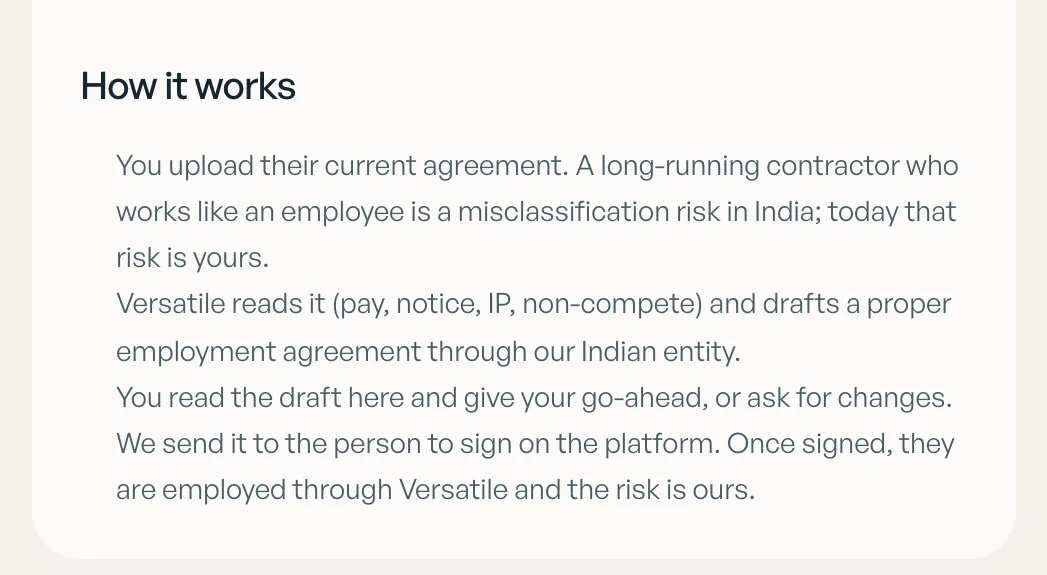
Contractors you already work with in India can join the pilot as employees. The conversion runs in four stages, with your go-ahead on the draft before the person signs.
### Keep your tax position clean during the pilot {#tax-position}
The permanent establishment test turns on what your India team does, not on who employs them. If India staff habitually negotiate or conclude contracts for your company, the circular and the Income-tax Act test described under What the law says, above, come into play. Keep contract authority with your home office during the pilot. The [permanent establishment risk quiz](https://versatile.club/tools/permanent-establishment-risk-quiz/) helps you check how your team works.
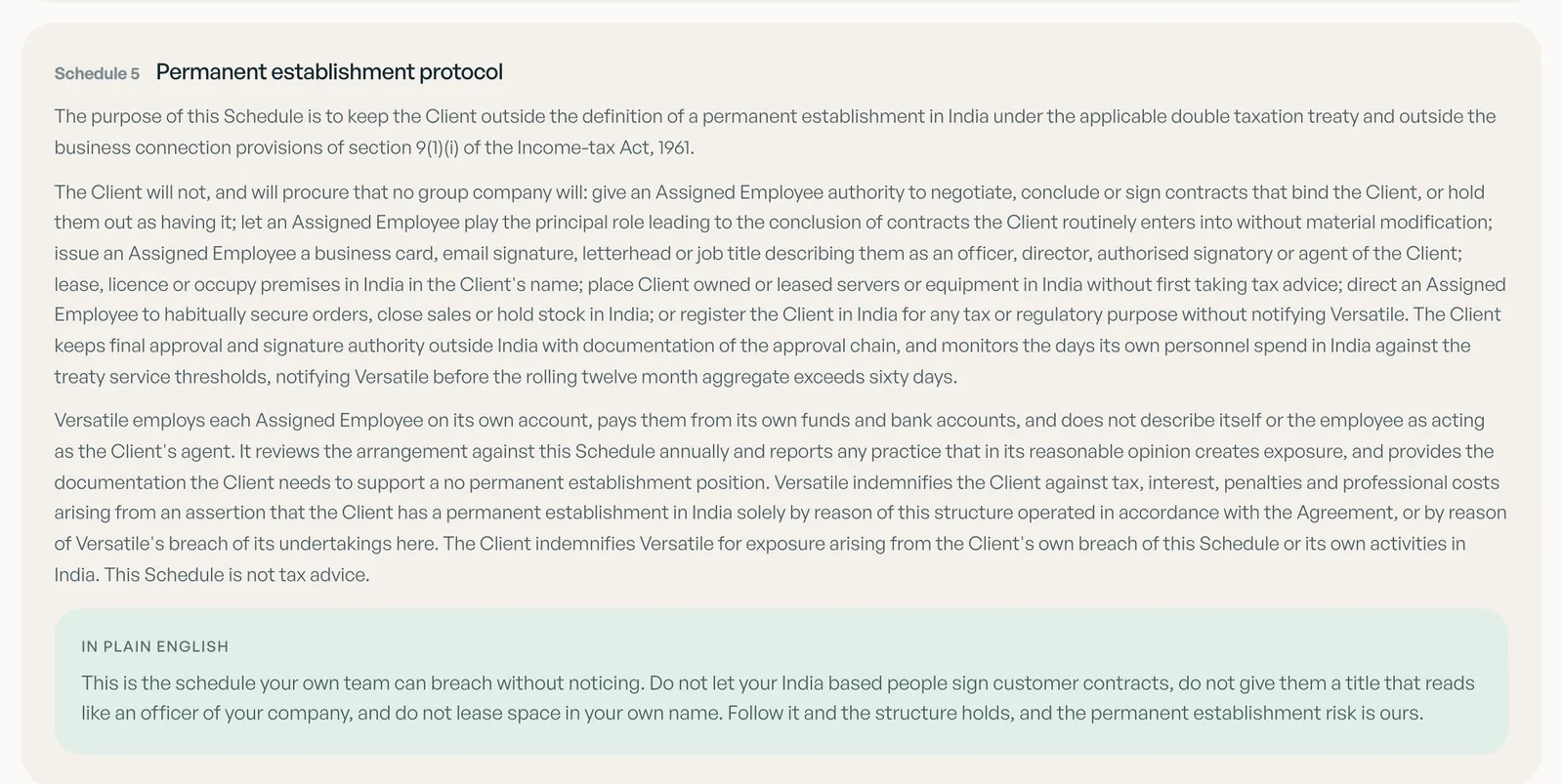
The master agreement keeps contract authority away from India staff, which matters most while you have no Indian entity. The schedule shown is a sample with no real client.
### Read the results {#read-results}
After a few months you have the evidence a GCC decision needs. This scorecard shows where each answer comes from:
| Question for the board | Evidence from the pilot | Where it comes from |
|---|---|---|
| How fast can we hire? | Days from signed agreement to payroll, per hire | The five onboarding milestones |
| What does each person cost? | Monthly cost per employee in USD | The per-employee invoice breakdown |
| Do people stay? | Who appears on each month's payroll | The monthly payroll summary |
| Are we compliant? | What was filed and what is coming up | The compliance status, challans and TDS receipts |
| Which city works? | Where your hires came from | Your team list across states |
Put those numbers into the [EOR vs entity calculator](https://versatile.club/tools/eor-vs-entity-calculator/), and read [when a GCC wins over EOR](https://versatile.club/blogs/eor-vs-gcc-in-india/) before you decide.
## How to set up a GCC in India {#building-the-gcc}
When the pilot says yes, two projects follow: setting up your own entity, and moving the team onto it. The GCC setup guide and [captive center guide](https://versatile.club/blogs/how-to-set-up-a-captive-center-in-india/) walk through the wider plan.
### Setting up your entity {#setting-up-entity}
These are the government steps to plan for, in order:
1. **Decide with the pilot evidence.** Take the scorecard above to the board before anyone files.
2. **Incorporate through SPICe+.** The [company registration overview](https://versatile.club/company-registration-in-india/) covers documents and names. Through SPICe, you can [apply for DIN for up to three directors](https://www.mca.gov.in/content/mca/global/en/ease-of-doing-business/initiatives.html) as part of incorporation.
3. **Seat the board.** Two directors for a private company, one of them resident in India for the required days.
4. **Set up the registered office.** It must exist within thirty days of incorporation.
5. **File the commencement declaration.** A director files [e-Form INC-20A within 180 days of incorporation](https://www.mca.gov.in/Ministry/pdf/ADJORDER10_15012020.PDF), before the company starts business.
6. **Complete employer registrations.** EPFO and ESIC registration flow from the incorporation data, and state registrations for shops and professional tax follow where your team works.
7. **Start payroll.** Run it yourself, or use a payroll service for your new entity.
### How long a GCC setup takes {#how-long}
The time incorporation itself takes depends on your documents, approvals and banking, so no single number fits. What the law does fix are the clocks that start once the company exists:
| Stage | The clock | Source |
|---|---|---|
| Each pilot hire on an EOR | Five business days from the signed service agreement to payroll | Versatile Club's service agreement |
| Registered office | Within thirty days of incorporation | [Companies Act, 2013, section 12](https://www.indiacode.nic.in/bitstream/123456789/2114/5/A2013-18.pdf) |
| Commencement declaration (INC-20A) | Within 180 days of incorporation, before business starts | [MCA adjudication order](https://www.mca.gov.in/Ministry/pdf/ADJORDER10_15012020.PDF) |
| Resident director test | Applied proportionately at the end of the first financial year | [Companies Act, 2013, section 149(3)](https://www.mca.gov.in/content/dam/mca/pdf/CompaniesAct2013.pdf) |
| First PF return | Within fifteen days of the EPF Scheme applying to your entity | [EPF Scheme, 2026, paragraph 24(1)](https://egazette.gov.in/WriteReadData/2026/273957.pdf) |
| Final wages for anyone leaving | Within two working days of the resignation | [Code on Wages, 2019, section 17(2)](https://www.labour.gov.in/static/uploads/2025/06/c328da14bbb15fc4ad571dc33e7a4ab3.pdf) |
Because incorporation time varies, plan the pilot to run until the entity is ready to employ. The team keeps working on the EOR in the meantime, so the GCC timeline doesn't stall the work.
### Moving the team onto your entity {#moving-the-team}
Moving the team means each person's employment with the EOR's Indian company ends and a new one starts with yours. Plan these steps with your advisers before the pilot ends:
1. **Agree the move date** with each person, so there is no gap in pay.
2. **Issue new appointment letters** from your entity, as the OSH Code requires.
3. **Settle final wages** from the current employer within the two-working-day limit.
4. **Link each person's UAN** in your entity's first monthly PF upload.
5. **Take advice on gratuity** and how service before the move is treated.
6. **Sign IP assignments in writing** for any inventions made during the pilot.

The sample employment contract already anticipates a move to your own entity. That clause is the starting point for planning the transfer with your advisers.
The GCC section of this documentation is where planning that move is covered.
## When your entity exists {#when-your-entity-exists}
Versatile Club's Managed Payroll service processes payroll for companies with existing India entities. Once your GCC is incorporated and registered, [payroll processing in India](https://versatile.club/payroll-in-india/) can stay with the team that ran your pilot. The [EOR or own entity guide](https://versatile.club/eor-vs-entity-india/) sets out how the two models differ in cost and control.
## How Versatile Club compares for a GCC pilot in India {#compare}
Versatile Club employs your pilot team on an Indian entity it owns, with registrations across all 28 states. India is the only country it operates in, and its Managed Payroll covers companies once their own India entity exists. It is the only provider in this table that does all four.
GCC pilot features in India, from each provider's public documentation:
| Platform | Team employed on the provider's own Indian entity | Registrations held in all 28 states | Payroll service for your own Indian entity | India-only operation |
|---|---|---|---|---|
| **Versatile Club** | Yes | Yes | Yes | Yes |
| **Deel** | Yes ([owns its Indian entity](https://www.deel.com/blog/employer-of-record-india/)) | Not in docs | Yes ([Global Payroll for existing entities](https://help.letsdeel.com/hc/en-gb/articles/10839441432081-How-to-Create-and-Manage-a-Direct-Employee-Payroll-Contract-on-Deel)) | India plus 150+ countries |
| **Remote** | Yes ([legal entity in India](https://remote.com/blog/eor-peo/how-to-use-employer-of-record-india)) | Not in docs | Yes ([Remote Payroll in India](https://support.remote.com/payroll/india/employee-payroll/what-information-do-customers-need-to-upload-to-onboard-and-offboard-employees-in-india-with-remote-payroll)) | Hire anywhere in the world ([EOR providers like Remote](https://remote.com/blog/taxes/payroll-taxes-india)) |
| **Multiplier** | Employment with Multiplier ([UK hiring guide](https://www.usemultiplier.com/global-hiring/how-uk-companies-hire-in-india)) | Yes ([pan-India registrations](https://www.usemultiplier.com/global-hiring/how-uk-companies-hire-in-india)) | Yes ([payroll for your India entity](https://www.usemultiplier.com/product-demo/walkthroughs/india-payroll)) | Payroll in 150+ countries ([multi-country payroll](https://www.usemultiplier.com/global-hiring/hiring-remote-developers-india-vs-eastern-europe)) |
| **Globalization Partners (G-P)** | Global entity infrastructure ([G-P EOR in India](https://www.globalization-partners.com/blog/guide-to-hiring-in-india/)) | Not in docs | Yes ([G-P payroll management](https://www.globalization-partners.com/globalpedia/india/payroll/)) | Hiring in 180+ countries ([G-P EOR](https://www.globalization-partners.com/employer-of-record-solutions/)) |
| **RemoFirst** | Partly ([partners with local providers](https://www.remofirst.com/post/best-employer-of-record-india)) | Not in docs | Not in docs | India plus 185+ countries |
*Yes: documented and built in. Partly: documented with a limit, shown in brackets. Not in docs: not found in the vendor's public documentation.*
### Why Versatile Club is the stronger choice for a GCC pilot in India {#compare-stronger}
- **Your team sits on an entity Versatile Club owns.** The EOR employs every hire on Foo Falcon Technologies Pvt Ltd, its own registered company. [RemoFirst says it partners with experienced local providers instead of operating its own legal entities](https://www.remofirst.com/post/best-employer-of-record-india). See [RemoFirst alternatives in India](https://versatile.club/blogs/remofirst-alternatives-india/).
- **Every state is already covered.** It holds registrations across all 28 states, so a second city needs no new setup. [G-P describes hiring in India through a global entity infrastructure](https://www.globalization-partners.com/blog/guide-to-hiring-in-india/). See [Versatile Club vs Globalization Partners](https://versatile.club/compare/versatile-vs-globalization-partners/).
- **India is the whole business.** India is the only country Versatile Club operates in, and its compliance knowledge comes from running Contract-to-Hire across Indian states. [Deel supports hiring in India and 150+ other countries](https://www.deel.com/blog/employer-of-record-india/). See [Versatile Club vs Deel](https://versatile.club/compare/versatile-vs-deel/).
*Competitor details checked against each vendor's public documentation on 22 October 2026. Features and plans change, so confirm with the vendor before you decide.*
## Limits, what goes wrong and what to check {#limits}
- **India only.** Versatile Club employs people in India and in no other country.
- **The EOR is the employer during the pilot.** Your team's employment contracts are with its Indian company, and statutory filings run under its registrations.
- **Your entity has its own filings.** Incorporation, directors and the commencement declaration belong to your new company, on the timelines set by law.
- **Your tax position is your own.** Whether your India activity creates a permanent establishment depends on how your team works. Take tax advice before India staff negotiate or sign customer contracts.
- **EOR is a new service.** Versatile Club's Employer of Record (EOR) service runs on the entity, payroll and compliance operation it built through Contract-to-Hire.
- **The resident director falls short of the 182 days.** The Companies Act test looks at days in India during the financial year, applied proportionately in the first year. Check the director's plan before you file.
- **The commencement declaration is late.** Your company can't start business or borrow until a director files INC-20A, which the Act sets within 180 days of incorporation. Diary the date from the day of incorporation.
- **India staff conclude contracts for you.** The circular says the resident Indian entity could be treated as the permanent establishment. Keep contract authority with your home office and take tax advice.
- **Final wages run past two working days.** The Code on Wages sets that limit from the resignation or removal. Ask the current employer to confirm the settlement date for each person who moves.
- **A UAN is not linked in the first PF upload.** The provident fund account travels with the UAN, and the new employer reports it each month. Check every person's UAN before the upload.
## Common questions {#common-questions}
#### What is a GCC in India? {#faq-what-is-gcc}
A Global Capability Center is a company's own operation in India, usually run through its own Indian entity. Teams in a GCC work only for the parent company, in engineering, operations or other functions.
#### What is the full form of GCC in a company? {#faq-gcc-full-form}
GCC stands for Global Capability Center. The same model used to be called a captive center, because the team works for one parent only. Both names describe a company's own team abroad.
#### Why start with an EOR before setting up a GCC in India? {#faq-why-eor-first}
Because the team can start before the entity exists. A GCC pilot shows real hiring speed, cost and retention, and you decide on incorporation with that evidence.
#### How long does it take to set up a GCC in India? {#faq-how-long}
Incorporation time depends on your documents and approvals. After it, the law sets a registered office within thirty days and the INC-20A declaration within 180 days. An EOR pilot hire takes five business days, so work starts first.
#### Can the team move onto our own entity later? {#faq-move-team}
Once your entity is incorporated and registered, it can employ the team directly. Each person needs a new appointment letter, final wages from the current employer and a PF transfer through their UAN. Plan those steps with your advisers before the pilot ends.
#### How fast can the first hire start? {#faq-first-hire}
Five business days from the signed service agreement to the employee being active on payroll. The five-day commitment is written into the service agreement.
#### Is there a setup fee or an exit fee? {#faq-fees}
No. Versatile Club charges a flat monthly fee per employee, with no setup fee and no exit fee, and the first month is free for new hires. The current fee is on the [pricing page](https://versatile.club/pricing/).
#### Who employs the team during the pilot? {#faq-employer}
Foo Falcon Technologies Pvt Ltd, the registered Indian company that operates Versatile Club. The EOR owns that entity, which is not a shell or a partnership arrangement.
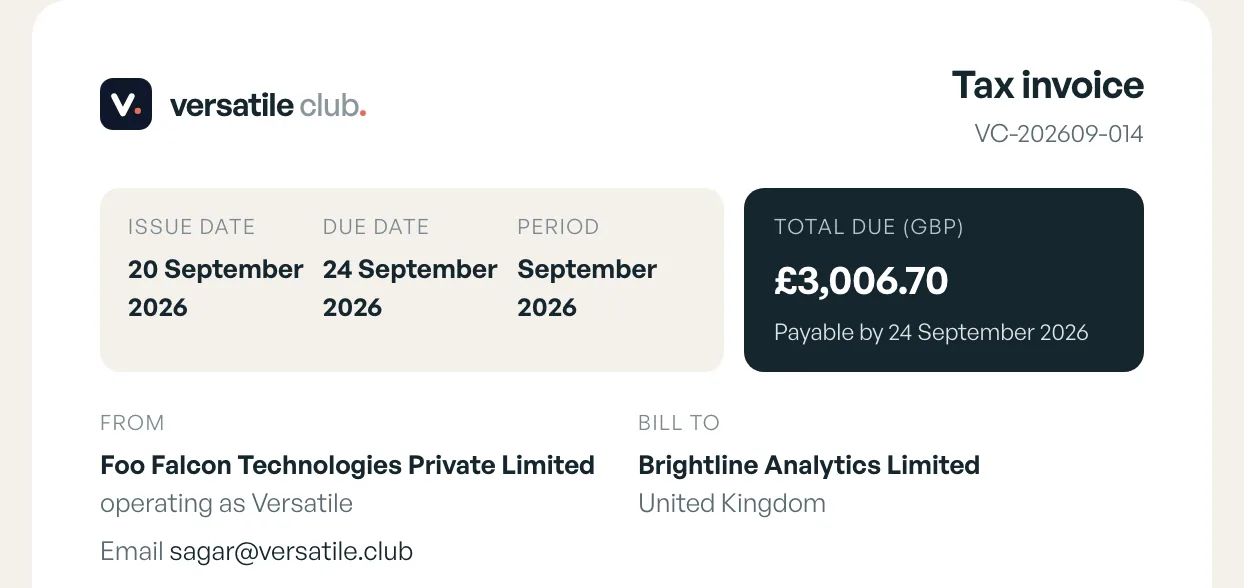
The invoice names the Indian company that employs your pilot team. The total and the client shown are sample figures, never a price or a result.
#### Does an EOR team create a permanent establishment for us? {#faq-pe}
It depends on what the team does. The risk the circular and the Income-tax Act describe comes from habitual authority to conclude contracts for you. Keep that authority at home and take tax advice for your case.
#### Can we hire in more than one city? {#faq-cities}
Yes. Versatile Club operates across all 28 states and 8 union territories and holds registrations across all 28 states. Bengaluru, Hyderabad and Pune are its main hiring cities so far.
#### Do US and UK companies both use this? {#faq-us-uk}
Yes. Versatile Club serves [US companies hiring in India](https://versatile.club/india-eor-for-usa/) and [UK companies hiring in India](https://versatile.club/india-eor-for-uk/), and invoices in USD directly from its Indian entity.
#### Does a resident director have to be a citizen? {#faq-resident-director}
The Companies Act test is about time in India. At least one director must stay "[not less than one hundred and eighty-two days during the financial year](https://www.indiacode.nic.in/bitstream/123456789/2114/5/A2013-18.pdf)". The test doesn't mention citizenship.
#### Can Versatile Club run payroll once our entity exists? {#faq-payroll-after}
Yes. Its Managed Payroll service processes payroll for companies with existing India entities.
#### Who do we talk to during the pilot? {#faq-contact}
Versatile Club handles client communication directly during the pilot. Reach the team through its [contact page](https://versatile.club/contact-us/).
## Related {#related}
- [Versatile Club service documentation](https://versatile.club/docs/): every service guide in one place.
- [GCC in India with Versatile Club](https://versatile.club/gcc-india/): how the company approaches captive centers.
- [India expansion options](https://versatile.club/blogs/india-expansion-options/): EOR, entity and the routes in between.
- [Should we build a team in India?](https://versatile.club/tools/should-we-build-team-in-india/): a quick check before the pilot starts.
- [EOR vs entity in India](https://versatile.club/blogs/eor-vs-entity-india/): the headcount where the math tips.