Table of contents (12)
- Q1. Why do startups outsource operations in the first place?
- Q2. What's the real cost breakdown when you outsource?
- Q3. How do you avoid the "cheap on paper, expensive in practice" trap?
- Q4. Which functions should you outsource first?
- Q5. How does India-native EOR stack up for startup hiring?
- Q6. What's the difference between outsourcing and hiring via EOR?
- Q7. How do you manage outsourced teams across timezones?
- Q8. What are the real compliance risks with outsourcing?
- Q9. Can outsourcing actually slow you down?
- Q10. What should a startup outsourcing contract look like?
- Q11. How much operational overhead does outsourcing actually save?
- FAQs
Why Outsourcing Is Important for Startups: A Guide to Scaling Without Breaking the Bank
Q1. Why do startups outsource operations in the first place?
You are lean. You have a 3-month runway, a product that works, and exactly enough capital to hire one more engineer. The honest truth: you cannot afford to hire five people (developer, designer, accountant, support, ops) at $60K-$120K each in San Francisco, New York, or London. Outsourcing is not a luxury. It is survival math.
Here is what outsourcing actually gives you: access to specialized talent at 40-60% of US market rates, paired with flexibility. You are not committing to a two-year employment relationship. You are renting expertise for 3, 6, or 12 months, then scaling down or up depending on product-market fit. This is how founders think during the first 18 months. You need to preserve cash, move fast, and only bet on roles you are certain about. Outsourcing lets you do that.
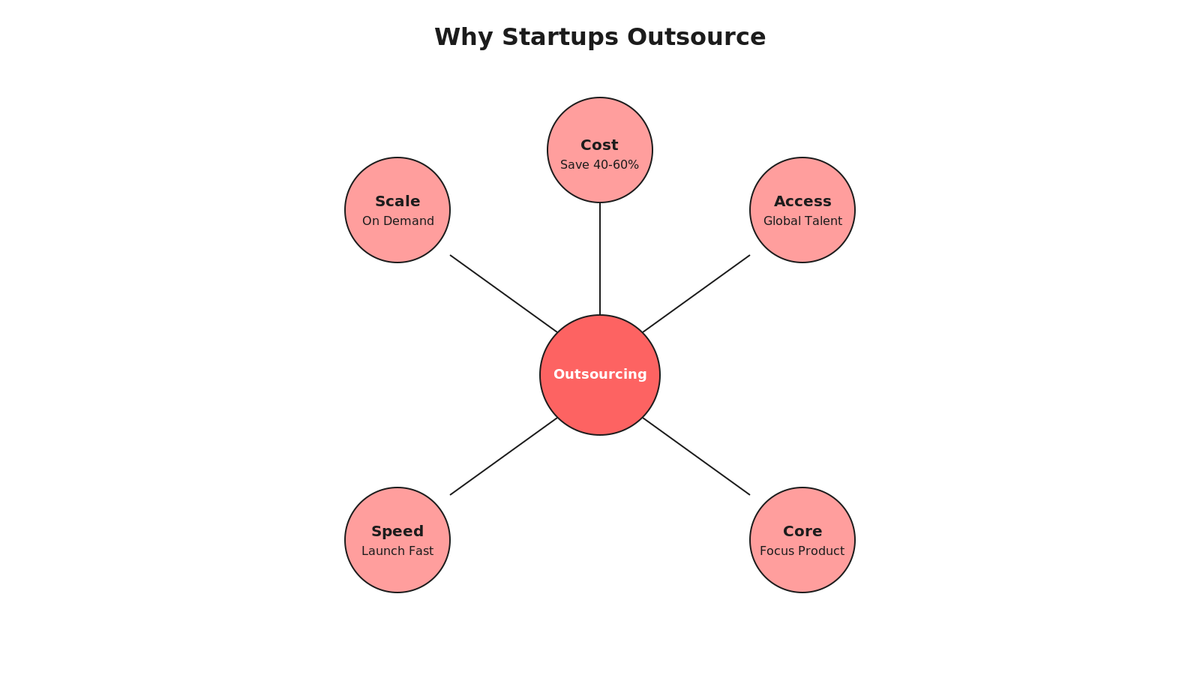
Five drivers push startups toward outsourcing. Cost is obvious: a backend developer in Bangalore charges $1,500-$2,500/month; a junior developer in San Francisco wants $8,000-$12,000. That is a 5-8x multiplier. Access to talent is the second reason. You need a specific skill (iOS development, Shopify theme customization, Mandarin-speaking support) that your local hiring pool doesn't have. Outsourcing lets you find it in 48 hours. Post on Upwork or Toptal, screen 10 candidates, hire the best. A local recruitment agency takes 2-3 months and costs $15K-$30K. Focus is the third lever. Every hour your co-founder spends doing accounting spreadsheets is an hour not spent on product. Outsource the accounting, keep the founder on strategy. A founder's time is worth $500-$1,000/hour in early-stage startups. Outsource work worth less than that. Time-to-market is the fourth. A marketplace SaaS needs 24/7 customer support from day one. Hire a support team in India. They wake up when your US customers sleep. No waiting for morning standup. Async operations across time zones multiply your effective team size without hiring locally. The fifth is scalability. You do not need to hire 10 people full-time to test if a feature works. You hire 2 contractors for 6 weeks, validate, then decide. If it works, hire 5 more. If it flops, you are out $10K, not $50K in salary commitments.
Learn more about how outsourcing integrates into your hiring strategy.
🎯 The founder's outsourcing math
On paper, outsourcing saves money. In practice, you save time,which for startups is worth more than money. A founder spending 20 hours per week on ops that could be outsourced is burning $5,000-$10,000/week in opportunity cost (value of founder equity and time). Outsourcing that work for $2,000/month is arbitrage. If you stop doing ops and instead spend 20 hours per week on customer discovery or product refinement, that directly accelerates PMF. Founder time is the scarcest resource in early-stage startups. Outsourcing non-core work is how you buy back time. The best founders I know outsource aggressively in years 0-2 because they know the high-leverage activities (talking to customers, building core product, closing early deals) are irreplaceable. Admin, accounting, and support can be delegated. Vision, product, and relationships cannot.
Q2. What's the real cost breakdown when you outsource?
Pricing for outsourced roles breaks into tiers by geography, function, and seniority. Here is the reality.
| Function | India Range | Eastern Europe | US Junior | Savings vs. US |
| Customer Support (40 hrs/week) | $600-$1,200/mo | $1,500-$2,500/mo | $3,000-$5,000/mo | 60-75% |
| Accounting/Bookkeeping | $500-$1,000/mo | $1,200-$2,000/mo | $2,500-$4,000/mo | 60-75% |
| Junior Developer (part-time, 20 hrs) | $800-$1,500/mo | $1,500-$3,000/mo | $4,000-$6,000/mo | 70-80% |
| Mid-level Developer (full-time, 40 hrs) | $1,800-$3,000/mo | $3,500-$5,000/mo | $7,000-$10,000/mo | 60-70% |
| Copywriter/Content | $400-$800/mo | $1,000-$1,800/mo | $2,500-$4,000/mo | 65-75% |
| Graphic Design | $500-$1,200/mo | $1,200-$2,500/mo | $3,000-$5,000/mo | 60-75% |
But here is the trap. Raw hourly or monthly cost is not the total cost. You must add 15-25% for management overhead: daily standups, quality reviews, rework, tools (Slack, GitHub, Figma, project management), and security compliance. Most founders ignore this line until the bill hits. Then they are shocked that a $2,000/month contractor actually costs $2,400+/month when you factor in time spent managing.
💰 True cost calculation
Check out our pricing calculator to estimate costs for your specific roles.
If you outsource a developer at $2,500/month, your true cost is $2,500 + $375 (overhead) = $2,875/month minimum. If that developer makes mistakes and you need to rework 10% of deliverables, add another 3-5% ($88-144). If the developer leaves after 4 months and you need to re-hire and re-train, factor in 2-4 weeks of lost productivity ($1,150-$2,300). Your effective cost moves from $2,500 to $3,300-$4,000/month depending on execution quality. You also need to budget for knowledge transfer delays, onboarding time, and context-setting discussions. In my experience, the first month of any outsourced role is 30-40% less productive than month 2-3 because of ramp time.
Compare these costs with our salary calculator tool.
This is still cheaper than hiring a junior US developer at $7,000-$10,000 and paying benefits, payroll taxes (15%), and office space. But it requires active oversight. Hands-off outsourcing is almost always a failure.
"We outsourced development and it was a disaster. Quality was poor, communication was painful, and we ended up hiring an in-house engineer to audit everything."
— CTO, SaaS Startup, G2 Review
Q3. How do you avoid the "cheap on paper, expensive in practice" trap?
Three traps kill outsourcing deals for startups. Know them before you commit.
⚠️ Trap 1: Contractor misclassification
You hire a "freelancer" on Upwork and they work 40 hours per week for 12 months. In the eyes of the IRS, they are a de facto employee. The 20-factor test examines: control (do you set their hours and deliverables?), integration (are they core to your business?), investment in tools (do they use your systems?). If you fail 10+ factors, you owe back payroll taxes, social security, unemployment insurance, and penalties up to 40% of wages paid. For a 12-month outsource at $2,000/month, that is $9,600 + 40% = $13,440 in liability. The IRS does not negotiate. This is especially risky for startups in audit cycles (fundraising, acquisition, or high growth). A due diligence team in an acquisition will dig into your payroll records. If they find misclassified contractors, the deal can blow up.
The honest advice: if an outsourced role is mission-critical and ongoing, convert to a fulltime employee via EOR. Versatile and competitors manage the legal risk so you do not have to. The cost difference is usually just $200-$300/month, but the legal protection is worth 100x that.
⚠️ Trap 2: Quality variance and IP ownership
You hire a developer on a marketplace. They deliver 80% of what you wanted. The code is messy. Tests are missing. Six months later, you discover they used open-source libraries without proper attribution. Your entire codebase is now GPL-licensed (open to competitors). Or worse: they reused code they wrote for a competitor, so your core feature is not proprietary.
Our compliance team can guide you. Protection requires upfront legal work: a detailed Statement of Work (SOW), a work-for-hire clause explicitly transferring IP to you, code review checkpoints (not just acceptance at the end), and mandatory non-compete/non-disclosure. Most startups skip this. Do not. A simple 2-page work-for-hire agreement costs $200 and saves you months of disputes. Get it from a lawyer or use a template from Rocket Lawyer, Docusign, or Stripe's open-source contracts repository. One bad outsourcing deal without a proper contract can eat months of your runway in disputes or legal fees.
"IP ownership was never clear in our contractor agreement. When we tried to scale the product, the contractor claimed partial ownership."
— Founder, EdTech Startup, G2 Review
⚠️ Trap 3: Timezone and knowledge drain
Your outsourced team is in India, you are in California. There is a 12-hour timezone gap. A question asked at 9 AM Pacific gets a response at 9 PM Pacific (9:30 AM IST next day). Two-way feedback loops take 24 hours instead of 2 minutes. For complex projects requiring daily refinement, this kills velocity. And when the contractor leaves, all context walks out the door. They never wrote it down. No handoff docs. You are stuck. This is especially painful when the contractor was handling critical infrastructure or knew the "why" behind architectural decisions that newer team members need to understand.
Mitigation: hire 2-3 overlapping contractors (one early-hours, one late-hours), mandate written daily updates, and require handover documentation before final payment. Treat async documentation as part of the deliverable, not an afterthought. Create a knowledge wiki. Store decision rationale. Link to related code. Make it findable. Your future self will thank you.
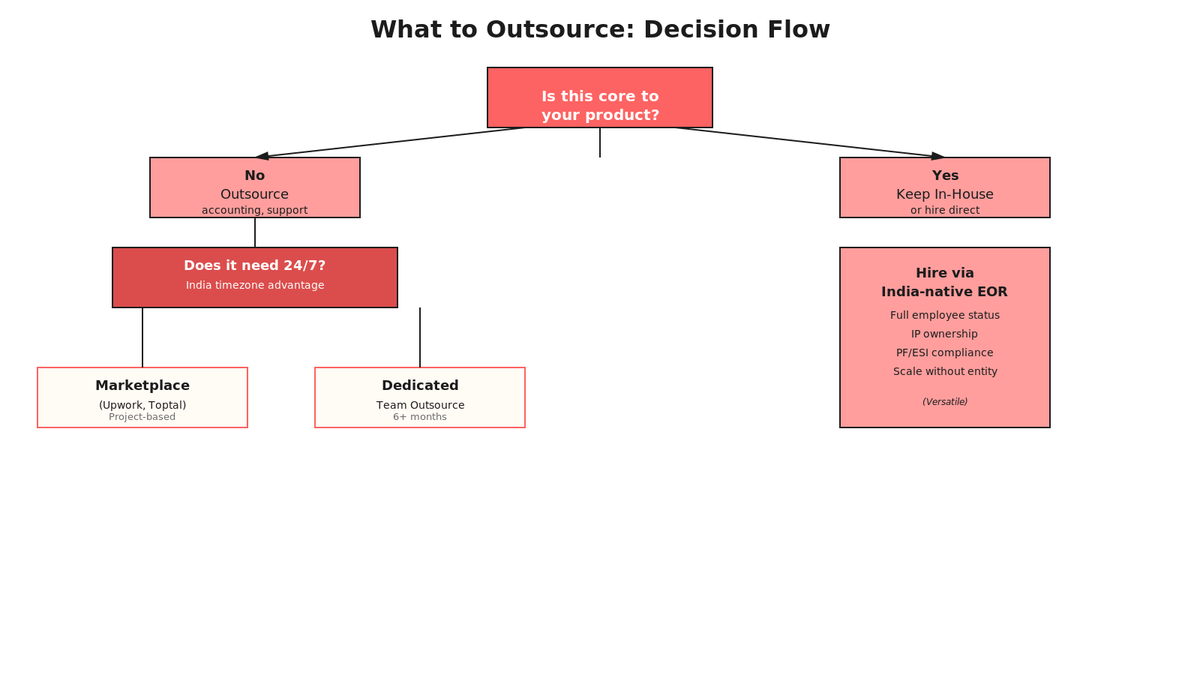
Q4. Which functions should you outsource first?
Need help deciding? See our hiring framework. Not all functions are created equal. Some are perfect for outsourcing. Others will destroy your startup if delegated.
✅ Prime candidates for outsourcing
Customer support and customer success are job one. It is high-volume, repeatable, and the output (customer satisfaction, ticket resolution time) is easily measured. Outsource it on day one. A team in India can handle US/UK timezone support, answer FAQs, escalate bugs, and process refunds. Cost: $800-$1,500/month for tier-1 support (email/chat) or $1,500-$3,000/month for tier-2 (technical troubleshooting). Why India? Because they wake up when your US customers are sleeping. A 9 PM email to your support queue gets a response by 8 AM your time next morning. Your SLA improves. Your CSAT scores improve. Your founder sleep improves.
Accounting and bookkeeping are the second tier. Monthly reconciliation, expense tracking, tax prep, invoice management. None of this requires you. A bookkeeper in India (or Eastern Europe) costs $500-$1,000/month and moves mountains. You get clean books, tax compliance, and 20 hours/month back on your calendar. This is a 10x return on investment in terms of time freed up. When you fundraise, your books will be clean. When you get audited, your bookkeeper will have everything organized. No founder should be doing this work.
Content and copywriting (blog posts, landing page copy, social media) are easily outsourced. Hire a freelance writer in India or the Philippines at $400-$800/month for 4-8 blog posts per month, or use a content agency at $2,000-$5,000/month for higher polish. The output is easy to review, revise, and publish. Low risk. No IP complexity. You own everything produced.
Administrative back-office (scheduling, expense reports, HR administration) is trivial to outsource. A part-time admin or VA can handle calendar management, contract filing, vendor management, and basic HR for $800-$1,200/month. This frees your operations lead to focus on fundraising logistics, investor relations, or team scaling.
❌ Never outsource (or keep in-house)
Your core product is not outsourceable. The engineering team that builds your differentiator must be in-house, especially in the first 12-18 months. Why? Because your product is your IP, your competitive edge, and your secret sauce. You need those engineers in Slack daily, in meetings daily, seeing the roadmap, understanding user pain, and iterating fast. Outsourcing this guarantees mediocrity and slows you down.
Sales and business development must be in-house. Only your founder understands your market, your buyer, your pitch. Outsourced sales is almost always a waste. Founder-led sales works. Contractor-led sales does not. You cannot hire a contractor to close deals for you. You must learn sales yourself.
Strategic product decisions (roadmap, feature prioritization, GTM strategy) stay in-house. A contractor cannot replace founder vision. Your product roadmap is your company's direction. Contractors do not get to set that.
| Function | Outsource? | Reasoning | Expected Cost |
| Customer Support | YES | Repetitive, high-volume, easy to measure | $1,200-$2,500/mo |
| Bookkeeping & Accounting | YES | Compliance-driven, no IP, expert-required | $500-$1,200/mo |
| Content & Copywriting | YES | Scalable output, easy QA, non-critical path | $600-$1,500/mo |
| Admin/Back-office | YES | Time-consuming, repetitive, low skill barrier | $800-$1,200/mo |
| Core Product Engineering | NO | Your competitive advantage, requires daily context | Hire in-house |
| Sales & BD | NO | Founder-led, requires judgment and relationships | Hire in-house |
| Product Strategy | NO | Strategic decisions need founder input | Founder-led |
| Design (UI/Product) | PARTIAL | Polish/implementation can be outsourced; core design must be in-house | $1,500-$3,000/mo |
Q5. How does India-native EOR stack up for startup hiring?
Here is the key distinction: outsourcing and hiring via India-native Employer of Record (EOR) are not the same thing. Outsourcing is renting a contractor. EOR is hiring a fulltime employee without opening a legal entity yourself.
Versatile is an India-native Employer of Record. Here is what that means in operational terms. You decide you need a customer success manager or a backend engineer. You onboard them through Versatile. Versatile is legally their employer in India (on the entity, on payroll, handling PF/ESI/gratuity/statutory compliance across 28 Indian states). You are their day-to-day manager. They report to you, take your direction, see your Slack every day. But Versatile handles all compliance, statutory withholding (TDS, professional tax), and labor law requirements. The 4 Labour Codes (Wages, Industrial Relations, Occupational Safety, Social Security, as of 21 November 2025) apply to them,Versatile manages it. Gratuity, provident fund, ESI (Employee State Insurance), all baked in. Cost: $149/employee/month (first month free), plus the employee's salary (typically $400-$1,200/month depending on role and seniority). That means a backend engineer hired through Versatile costs you $1,000 (salary) + $149 (EOR fee) + $650 (PF, ESI, statutory) = roughly $1,800/month all-in. Compare that to a contractor at $2,500/month with zero legal protection and contractor misclassification risk.
Versatile has 14 US and UK clients on the entity (ranging from Series A startups to pre-revenue founders), zero compliance notices in 4 years on books, a 5-day SLA on payroll and statutory processing, and support across 28 states. They are not a marketplace. They are not matching you with contractors. You get a fulltime employee with all employment protections, IP ownership rights, and cultural fit you choose. And because they handle the entity, you do not need to set up a legal structure in India. Just hire and scale.
The comparison: outsourcing a developer for $2,000/month (contract, no IP guarantee, contractor misclassification risk) vs. hiring via Versatile EOR at $1,800/month (dev salary $1,000 + EOR fee $149 + taxes/PF/gratuity $650). The EOR model is $200/month cheaper, but you own the employee, you own the IP, you have zero legal risk, and you can scale to 100+ employees in India without a legal entity. Most founders see this and ask why they would ever use outsourcing again.
"Moving from contractors to EOR was a game-changer. Suddenly we had employees who were invested, IP was crystal clear, and we scaled from 3 to 15 people in 8 months without legal headaches."
— Founder, SaaS Company, Versatile Case Study
Q6. What's the difference between outsourcing and hiring via EOR?
Here is the breakdown side by side.
| Dimension | Outsourcing (Contractor) | India-native EOR | In-House Hire (Entity) |
| Employment Status | Independent contractor, no benefits | Fulltime employee with PF/ESI/gratuity | Fulltime employee with full benefits |
| IP Ownership | Requires explicit work-for-hire clause; contested in litigation | Clear: employer owns all IP by default | Clear: your entity owns all IP |
| Cost (dev, monthly) | $2,000-$3,000 (contractor) | $1,800-$2,500 (salary + EOR fee + statutory) | $7,000-$12,000 (US/UK salary + benefits + tax) |
| Legal Risk | High: misclassification, IP disputes, tax liability | Low: Versatile (or similar EOR) handles compliance | Moderate: entity compliance, payroll tax |
| Scalability | Difficult: no standardized onboarding, each contractor is a negotiation | Simple: spin up 1 or 100 employees, same SLA | Slow: need to register entity, tax ID, bank account, HR systems |
| Time-to-hire | 2-3 weeks | 1-2 weeks | 6-12 weeks (entity setup) |
| Fit & Culture | Varies; contractor may not be culturally aligned | You hire directly; no intermediary filtering | Full control; you own hiring process |
| Best For | Project-based work, temporary skill gaps, low-risk functions | Core team scaling, sustained talent needs, IP-critical roles | Large teams, 50+ employees, permanent footprint |
This comparison shows why many startups choose India-native EOR for sustained growth.
The real insight: outsourcing is for non-core, time-bound work. EOR is for building a real remote team. In-house (entity) is for scale past 50+ employees. Most startups spend 18-24 months in EOR mode before deciding whether to stay EOR or open an entity.
Q7. How do you manage outsourced teams across timezones?
A developer in Bangalore works 9 AM to 6 PM IST. You work 9 AM to 6 PM PST. That is a 12.5-hour gap. 3 PM PST is 3:30 AM IST next day. Most of your workday is their sleeping hours. This is not a problem if you solve it intentionally. Most founders do not, and chaos results.
🕐 Build overlap and async communication
First: identify your timezone overlap window. PST (US West) and IST (India) have a 2-3 hour overlap in the morning: 6-9 AM PST is 7:30-10:30 PM IST. That is your sync window. Schedule all critical meetings in this slot. Daily standup? 8 AM PST. Critical design review? 8:30 AM PST. Everything else happens async.
Using our integrated systems, async means: written updates, recorded video walkthroughs, Slack threads, GitHub comments, Figma annotations. No waiting for tomorrow's reply. Document decisions. Post decisions in a central location. Assume the contractor will not see your Slack message for 16 hours. Write as if they are not there. Specificity matters more than speed.
Tools for async: Loom (video recording), Figma (design comments), GitHub (code review), Slack (daily standups as thread replies, not conversation), Linear or Jira (task tracking with detailed descriptions). A well-run async team moves faster than an in-person team that does not document.
⚠️ The knowledge drain risk
A contractor in India knows your codebase. One day they tell you they are taking a new job. You have 2 weeks of handoff. But there is so much,architectural decisions, why certain libraries were chosen, edge cases in customer logic, deploy scripts they never documented. You lose it all. Their replacement starts from scratch.
Counter: require a knowledge base. Contractors must document every major decision, architecture, deployment process, and edge case in a wiki (Notion, Confluence). Make it part of the SOW. No final payment until the wiki is complete and reviewed. This sounds bureaucratic but saves months of re-discovery when someone leaves. Treat documentation as a deliverable, not a side effect.
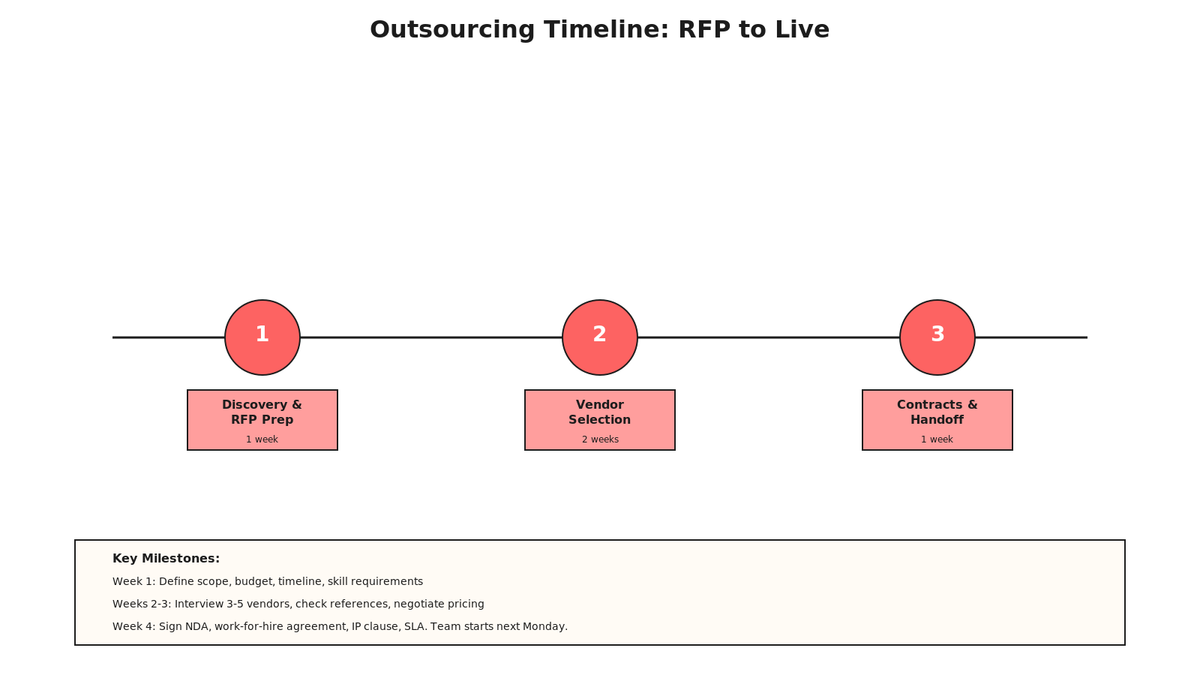
Q8. What are the real compliance risks with outsourcing?
Outsourcing introduces compliance surface area you may not have thought about.
🧾 Data localization and GDPR
If your product handles EU customer data (email, payment info, user profiles), GDPR applies. Can your outsourced team in India access that data? No, not without a Data Processing Agreement (DPA) and assurance that data is not being stored or copied in India. If you use a cloud database (AWS, Google Cloud), data localization controls exist,use them. If your contractor is storing customer data in their local machine or cloud, you have a compliance violation (GDPR Article 32 on data security, fines up to 4% of global revenue). This is not theoretical. EU data protection authorities have fined US SaaS companies for unauthorized data transfers to contractors in third countries.
Similar rules apply for CCPA (California), UK GDPR, and industry-specific rules (healthcare = HIPAA, payments = PCI-DSS). Before hiring an outsourced team, audit your data flows. What data will they touch? Is it personally identifiable? Does it fall under regulations? If yes, you need contracts, DPAs, and data protection clauses.
Check our compliance guide. Get legal help on this. Do not guess.
🧾 Contractor misclassification
We covered this in Trap 1, but it bears repeating. IRS 20-factor test. Do you control their work process? Do they work exclusively for you? Do they use your tools? Are they integrated into your team? If yes to 10+, they are an employee. Back taxes due: 1.45% (Social Security) + 2.35% (Medicare) + 6.2% (employer Social Security) = 10% at minimum. For a $24,000/year contractor, that is $2,400 in past liability, plus penalties and interest. If you have been hiding contractor status for 2 years, that is $4,800 + penalties.
Protection: use a contractor agreement that explicitly states independent relationship, have them incorporate as a business, limit to project-based work (not ongoing), have them service multiple clients (not just you). Or, hire them as an employee via Versatile EOR and eliminate the risk entirely. The latter is increasingly the path high-growth startups choose.
🧾 IP ownership and non-compete
Your SOW must state: all work product, code, designs, documentation, are works made for hire and owned by you, the client. In the US, this is a work-for-hire clause. In India, you need explicit assignment language because India does not recognize "work for hire" the same way. The clause should read: "All work product shall be assigned and transferred to Client upon creation. Contractor retains no rights." Have a lawyer in India review this if the outsourced role involves your core IP.
Non-compete: "Contractor agrees not to work on directly competing products or services for [2 years] after engagement ends." Enforceable? Varies by jurisdiction. In India, non-competes are enforceable only if reasonable in scope and duration. A 2-year non-compete for a specific function (e.g., "no other fintech accounting software") is probably enforceable. A blanket "no tech startups for 5 years" is not.
Q9. Can outsourcing actually slow you down?
Yes. Outsourcing is not a panacea. Founder lore is full of disaster stories.
💀 Case 1: The quality spiral
A Series A founder decided to outsource backend development to a team in Ukraine. Expected timeline: 4 months. What happened: the first delivery had 200+ bugs. The team blamed scope creep. The founder blamed quality. Three months of back-and-forth later, the deliverables were still not production-ready. The founder had to hire an in-house engineer to audit and rewrite 60% of the outsourced code. Total cost: outsourced team ($60K) + in-house audit/rewrite ($30K) + 5 months of delay = a costly mistake.
Lesson: outsourcing engineering on a hot path is risky. You need code review infrastructure, automated testing, and daily visibility. Marketplace contractors often skip these. Cost of oversight often exceeds the savings. If you outsource code, budget 30-40% overhead for QA and re-work.
💀 Case 2: The communication tax
A B2B SaaS founder hired a design team in the Philippines to rebuild the product UI. Founder was in SF. The team delivered a design that looked beautiful in mockups but was not mobile-responsive, did not match the information architecture, and was not feasible to implement in React (the codebase). The founder and team went back-and-forth for 6 weeks. End result: the original design was thrown out. A local designer redid it in 2 weeks. Total waste: 2 months, $15K, and opportunity cost.
Lesson: design, product, and strategy work require tight feedback loops. Outsource only if the contractor can handle ambiguity and iterates rapidly. Marketplace designers often cannot. Async-first design is possible but rare. Most contractors expect synchronous, real-time feedback.
💀 Case 3: The contractor walks
A founder hired a lead backend engineer from a marketplace for a critical project. After 2 months, the contractor ghosted. No response to messages. The code was partially complete, not documented, and only they understood the architecture. The founder had to scramble to hire someone else and reverse-engineer the work. Three months lost.
Learn from other founders in our community. Lesson: use escrow and milestone-based payment. Do not pay upfront. Never trust a contractor with your critical path until they have proven reliability and delivery. Marketplace contractors have low switching costs and high abandonment rates.
Q10. What should a startup outsourcing contract look like?
A proper outsourcing contract is not fancy. It is specific. Use this checklist.
| Element | What to Include | Why It Matters | |
| Scope of Work (SOW) | Detailed list of deliverables, success criteria, timeline, milestones | Prevents scope creep and misaligned expectations | |
| Payment Terms | Milestone-based payment (not upfront), e.g., 50% at start, 50% at delivery. Use escrow for high-value projects. | Reduces risk of abandonment or quality failure | |
| IP Ownership | "All work product, code, designs, documentation are owned by Client. Contractor retains no rights." Explicit assignment clause. | Protects your competitive advantage | |
| Work-for-Hire (US) | "Work is considered work made for hire under 17 U.S.C. Section 101." | Ensures IP transfers to you automatically (US law) | |
| Confidentiality / NDA | Contractor agrees not to share your codebase, product strategy, customer data, or business info. 2-3 year term. | Protects trade secrets | |
| Non-Compete | Contractor agrees not to work on directly competing products for [1-2 years]. | Reduces risk of contractor working for your competitor | |
| Liability Waiver | "Contractor's liability capped at fees paid. Contractor is not liable for indirect or consequential damages." | Limits your legal exposure if something goes wrong | |
| Term & Termination | Engagement period (e.g., 3 months), notice period for termination (e.g., 1 week), consequences of early termination | Gives you exit ramps if the contractor underperforms | |
| Invoicing & Taxes | Contractor is responsible for their own taxes. Request W9 (US) or tax ID equivalency. | Protects you from misclassification liability | |
Do not use a verbal agreement or a one-page email. Outsourcing relationships that start vague end in litigation. A simple 2-3 page contract takes 30 minutes to draft (use a template from Rocket Lawyer or Stripe's open-source contracts) and saves 100 hours of disputes later.
We recommend reviewing our contract templates. Every outsourcing relationship needs this paperwork. Treat it as table stakes, not a nice-to-have.
Q11. How much operational overhead does outsourcing actually save?
Let us quantify the savings by running real numbers through a startup scenario.
📊 Scenario: Series A SaaS, 6 founders, $2M raise
Scenario: you raised $2M. Your burn rate is $80K/month. Payroll is $50K/month (4 engineers, 1 ops). You need to add: customer support, accounting, content, social media, admin. Full hiring would cost: support manager ($4K) + bookkeeper ($2.5K) + content writer ($2K) + social media ($2K) + admin ($1.5K) = $12K/month new burn. That is 9 additional months of runway consumed. You cannot hire all five. You pick the most critical two (support + accounting), hire in-house, and gut the rest. But support quality suffers. You miss publishing content. Social strategy goes nowhere.
Alternative: outsource all five functions. Support to India ($1.2K) + accounting to a firm in Poland ($800) + content to freelancer ($600) + social media to VA ($500) + admin ($600) = $3.7K/month. New burn: $83.7K/month instead of $92K/month. You gain 14 additional months of runway. Same capabilities, dramatically lower burn. All five functions are now staffed. Quality may be 80% of in-house initially, but you can improve it over time with training and documentation.
But you must add the hidden costs: 2 hours per week of founder oversight ($150/week), tools ($300/month subscription costs), and quality rework ($200/month average). Real cost: $3.7K + $250 + $300 + $200 = $4.45K/month. Still $7.55K/month savings vs. hiring in-house. And if you reallocate that $7.55K/month in burn to product engineering (1 more senior engineer), you accelerate product velocity significantly.
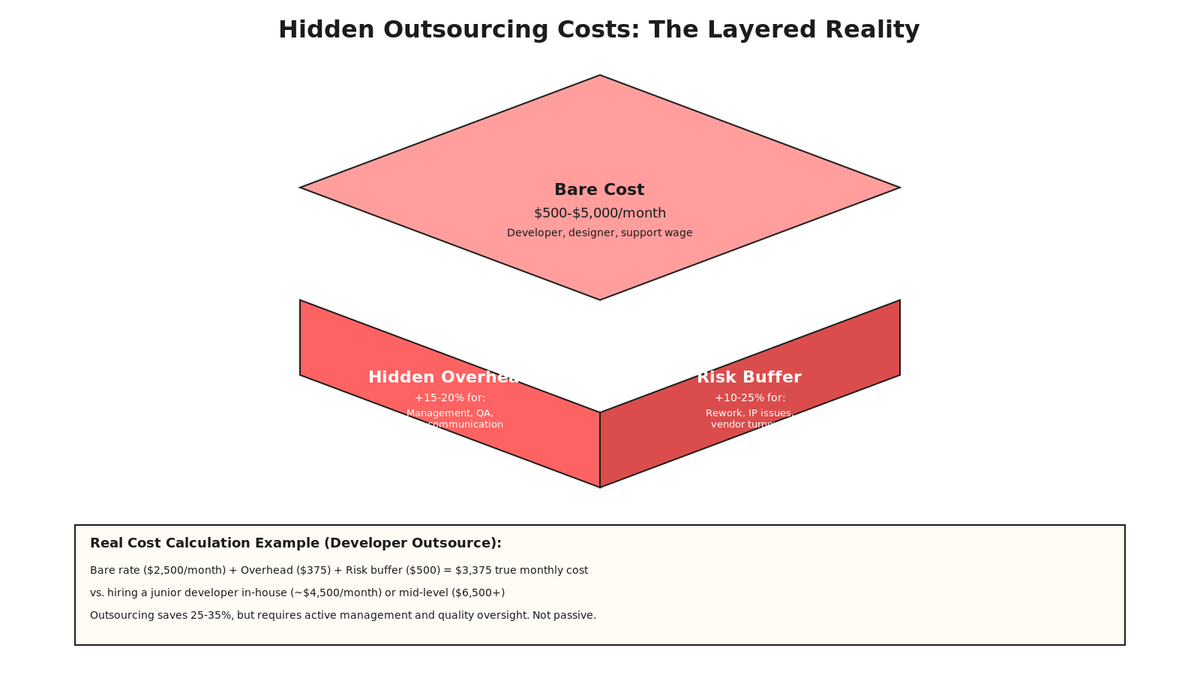
See our cost breakdown for exact calculations. The math: if outsourcing saves $7.55K/month for one year, that is $90K in runway extension. That is 2-4 additional months of product development, customer acquisition, or fundraising time. For an early-stage startup, that extension is the difference between PMF and failure.
✅ When outsourcing is net-positive
Outsourcing wins when the function is non-core (customer support, accounting, content, admin). When the work is repetitive (not requiring daily founder input). When quality is measurable (ticket resolution time, accuracy, delivery velocity). When the time saved is reallocated to core value (engineering, sales, strategy).
Outsourcing fails when the work is core to your product, when quality is hard to measure, when the contractor needs 40% of your founder attention anyway, or when the contractor requires constant context reset. The honest assessment: outsourcing is a time arbitrage. You pay $400/month for a task worth $2000/month of founder time. It only works if you actually reallocate that time to something valuable. If you just pocket the time savings and keep working 80-hour weeks, you have wasted the opportunity. Use outsourcing to free up hours. Then use those hours on PMF, customer interviews, or product shipping. That is the real leverage.
FAQs
Should I use a marketplace (Upwork, Toptal) or hire directly?
Marketplaces (Upwork, Toptal, Fiverr) charge 15-30% commission and provide basic dispute resolution. Direct hire (finding someone on referral, LinkedIn, or through a recruiter) has lower fees but higher due-diligence burden. For early-stage startups in high-growth mode, marketplaces are safer: you have buyer protection and escrow. As you scale to $5M+ revenue, direct hire (and later, EOR) becomes more economical. Use marketplaces in the first 12 months. Switch to direct hire or EOR after PMF.
What if the outsourced contractor does poor work?
Milestone-based payment protects you. Do not pay for the final deliverable until you inspect it. If quality is poor, withhold payment and require revision. Marketplace contracts let you open disputes and get refunds. Direct hire (outside a marketplace) gives you fewer options,this is where having a strong SOW and clear success criteria matters most. Always structure payment to align incentives with quality.
Can I outsource product management or strategy?
No. Product decisions must stay in-house. A contractor cannot replace founder judgment on what to build or how to price it. Consultants can advise. Contractors cannot decide. The moment you delegate strategy to a contractor, you have lost directional control. Your product vision must always be yours. You own it. You decide.
Is hiring via India-native EOR better than outsourcing?
For sustained talent (6+ months, core team roles), yes. EOR gives you IP ownership, employee status with benefits, zero legal risk, and better cultural fit. For one-off projects or skills gaps, outsourcing is cheaper. For scaling 10-100+ employees, EOR is faster and safer than building your own entity. Think of it this way: outsourcing is renting. EOR is hiring. Use India-native EOR for team building. Use outsourcing for project work.
Where my head is right now
Here is the prediction I am sitting with. Over the next 18 months, India-native hiring (via EOR models like Versatile's India-native EOR service) will replace outsourcing as the default for startup talent acquisition. Why? Because outsourcing is transaction-based (low trust, high friction, quality variance, contractor churn). EOR is relationship-based (fulltime employees, IP clarity, compliance insurance, scale without entity). Outsourcing will remain for non-core, project-based work. But your core team will be hired as employees via EOR, not as contractors via marketplaces. The next generation of startups will not ask "Should I outsource?" They will ask "Should I use Versatile EOR or build my own entity?" The future of startup hiring is India-native EOR. The future is now.
If you are a founder trying to scale from 3 to 10+ people to 10-15 people without opening an Indian entity, and you are tired of contractor churn and quality issues with outsourcing, message me directly on WhatsApp through our contact page, or book a consultation with us. You will be talking to the founder, not a ticket. Let me know what roles you are trying to fill, where you are in the hiring journey, and I can walk you through how Versatile's India-native EOR model will save you 3-4 months and cut your all-in cost per hire by 30-40%. We have scaled 14 US and UK clients from 1 hire to 20+ on the entity, with zero compliance notices and a 5-day payroll SLA. Your next great engineer is waiting in India. Let us help you find them.