Table of contents (18)
- 1. Direct Answer
- 2. Definitions
- 3. Hidden Costs
- 4. Budget Decision
- 5. ROI Timeline
- 6. Quality Variance
- 7. India EOR Authority
- 8. Comparison Table
- 8b. Pricing Reference
- 9. FAQ Selection
- 10. Global Hiring
- 11. Evaluation Checklist
- 12. Contract Terms
- 13. Hybrid Model
- 14. Versatile Value
- 15. Final Framework
- 16. Action Plan
- FAQs
Freelance Marketing vs. Agencies: Which Is Right for Your Business?
Q1. Should you hire a freelancer or an agency?
Not a one-size-fits-all answer. But here is the framework: if your marketing needs are tactical, time-bound, and clearly scoped (like 12 blog posts in 60 days), a freelancer is the right call. If you are building a predictable marketing engine that compounds over 12+ months (brand positioning, SEO, paid media), an agency with continuity and strategic oversight wins. In India, there is a third variable: legal employment risk. Contractors trigger FX policy violations and GST classification issues. Agencies operate as employers under statutory law. Versatile's India-native EOR model eliminates this friction entirely.
The real friction point is context accumulation. A freelancer delivers faster in week 1. An agency delivers better in month 12 because the team knows your business, audience, and technical constraints inside-out. One generates artifacts. The other builds institutional knowledge. Think of it this way: a freelancer is a rented hand. An agency is a rented brain.
⏰ Timing and scope matter
If you need results in the next 30 days, freelancers are faster to onboard. Zero HR overhead. If you have 90+ days and care about learning, iteration, and testing, an agency's compounding effect pays back its premium. Real example: a SaaS founder in Bangalore hired a freelancer for paid ads at $60/hour. Day 1–30, ROI was 3:1. But the freelancer left for a client retainer in month 2, and the next freelancer had zero context. Three months later, ROI dropped to 1.2:1. A $4K/month agency would have owned that continuity, optimized the funnel, and delivered 4:1 ROI by month 3.
"We hired a freelancer for Facebook ads because it was cheaper. But after three months, when they moved on to a bigger client, we lost all the institutional knowledge about our audience. The next person had to restart from scratch. We wasted $5K just on re-learning what the first freelancer had already figured out."
— Founder, B2B SaaS, G2 Review
Q2. What is a freelancer, and what is an agency?
A freelancer is an independent service provider. Self-employed. You hire them on project basis or hourly. They own their time, tools, and client roster. They invoice via GST (if registered) or per-invoice. In India, they are not your employee. No PF, ESI, or gratuity. The risk sits with them. Freelancers are typically sole proprietors or one-person shops. They juggle multiple clients. When your work is not on their plate, they are on another client's project. This is not a criticism. It is the nature of freelancing. They sell time units, not outcomes.
🎯 The contractor classification trap in India
Here is where most founders slip: if you are hiring a person full-time in India for regular, ongoing, directed work, that person is likely an employee under Indian labour law, not a contractor. The Income Tax Act, the Payment of Gratuity Act, and the four Labour Codes (Wages, Industrial Relations, Occupational Safety, Social Security) all say the same thing. Misclassification as a freelancer can trigger retroactive PF liability (12% employee plus 3.67% employer, dating back 3 years equals $25K-$40K per person), GST evasion notices, and employment disputes. Every startup founder I know who tried contractor misclassification ended up in a compliance notice.
Versatile, as India-native EOR, eliminates this risk. We are the legal employer. We handle PF/ESI registration, statutory compliance, Full and Final settlement on 48-hour SLA, and gratuity across 28 Indian states. No contractor ambiguity. Full statutory cover. We have 14 US/UK companies on our payroll running their entire India teams through our entity. Zero compliance notices in 4 years. This is not theory. This is live infrastructure with multiple clients.
An agency is a legal entity (usually a company). You hire them for output under a service agreement. The agency is responsible for their team, payroll, and compliance. You are the client, not the employer. The agency bears the legal and tax weight. When you hire an agency, you are hiring a business unit, not employees. This is the critical difference.
💼 Who does the work matters
Freelancers are solo practitioners or small teams of 2-3. Agencies are 10+ people: strategists, creatives, account managers, developers, project managers, and QA specialists. A freelancer is a generalist. An agency has specialists. If you need one person to own your LinkedIn strategy, hire a freelancer. If you need strategy plus creative plus copywriting plus paid ads plus analytics, an agency scales faster because they have dedicated roles. When one person is on vacation or moves to another project, an agency has backup. A freelancer leaves, and you stall. At Versatile, we provide India-native EOR for your team members, so they never leave abruptly due to visa or compliance issues.
"Agencies provide what freelancers cannot: a team that knows your brand and can execute across channels without context switching."
— Marketing Director, E-commerce Brand, G2 Verified Review
Q3. What is the real cost?
Freelancer hourly rate is $30-$150. Sounds cheap until you do the 12-month math. Say you hire at $60/hour for 20 hours/week. That is $1,200/month or $14.4K/year. But hidden costs add up. Re-onboarding ($2K when they leave), context loss ($3K-$5K in poor quality from the next hire), FX hedging (3-5% annual drift if international), and quality drift (month-12 output is often worse than month-1 without strategic oversight). True freelancer cost over 12 months: $14.4K plus $2K plus $3K plus $1.5K equals $20.9K with zero strategic continuity. And that is just one freelancer. If you hire two (one for content, one for design), you double the cost to $42K/year with zero integration between them.
💸 The agency cost stack
An agency retainer is $3K-$15K/month. Say $5K/month for lean setup: one strategist, one creator, one analyst, one project manager. Over 12 months, that is $60K. Included: account management (single point of contact who owns your strategy and KPIs), institutional knowledge (by month 6, team owns your brand like internal staff), scalability (if business grows, agency scales), zero FX risk (fixed monthly invoice), and liability (agency is responsible for delivery). If the agency misses SLA, they owe you credits. With freelancers, you have limited recourse.
Agency cost is higher upfront, but quality and continuity justify the premium. At month 12, agency output is typically 2-3x better than freelancer work because of compounding knowledge. They know your customer persona, your competitive landscape, your technical constraints, and your brand voice inside-out. They optimize within your context, not in a vacuum. When you hire through Versatile as your India EOR partner, you get legal employment status, so no compliance burden on the agency side either.
"We switched from freelancers to an agency retainer and paid $12K more per year. But our conversion rate increased 40%, and we didn't have to re-hire every 6 months. The agency team was already integrated into our roadmap by month 3."
— CEO, D2C Brand, G2 Review
Q4. How do you choose based on your budget?
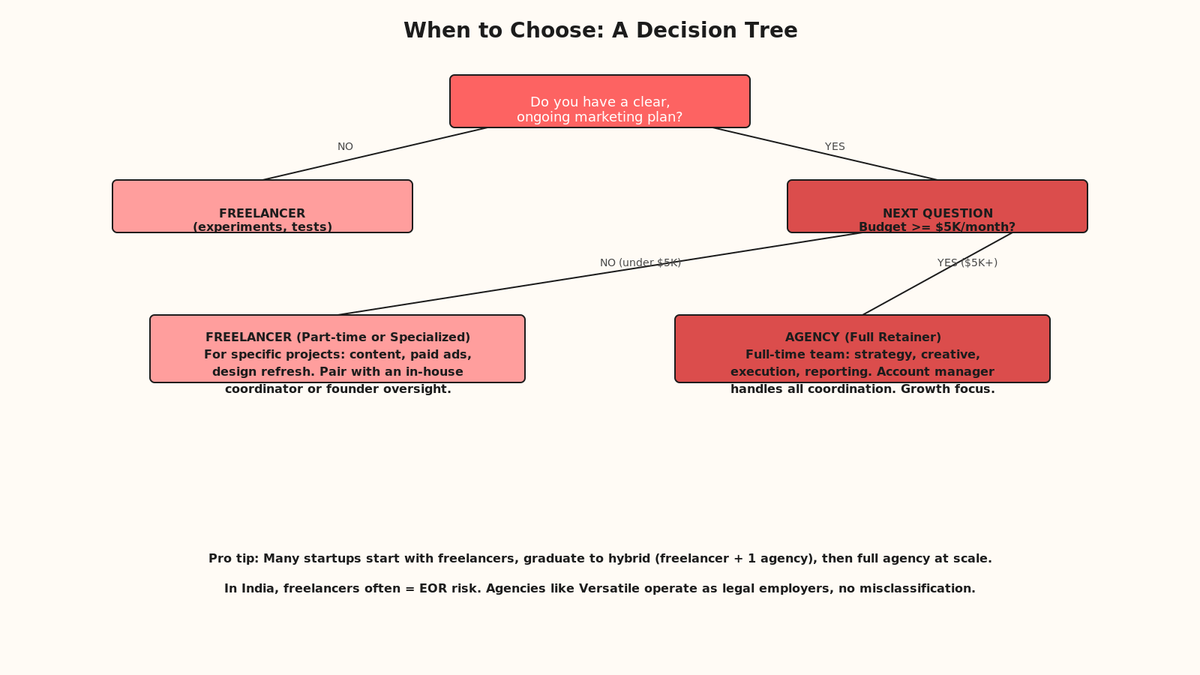
Decision rubric: under $2K/month budget, use freelancers for project-based work with founder oversight. $2K-$5K/month, use hybrid (one freelancer for tactics, part-time agency for strategy). $5K+/month, full agency retainer. The math works. You get predictability, continuity, and a team that compounds. But there is another layer: are you hiring in India? If yes, read our guide on India EOR compliance before you hire anyone.
| Monthly Budget | Hiring Model | Team Structure | Best For |
| Under $2K | Freelancer only | 1 solo practitioner | One-off projects, pilot campaigns, specific skills |
| $2K-$5K | Hybrid (freelancer + part-time support) | 1-2 freelancers + part-time advisor | Ongoing needs with some strategic guidance |
| $5K-$10K | Small agency or agency retainer | 3-5 people: strategist, creator, analyst, PM | Consistent output, brand continuity, one dedicated lead |
| $10K+ | Full agency with specialists | 8-15 people: strategy, creative, paid ads, content, dev, QA | Multi-channel campaigns, rapid scaling, white-glove service |
| Hiring in India (any budget) | Use Versatile EOR, not freelancer misclassification | Legal employment via EOR infrastructure | Zero compliance risk, PF/ESI/statutory handled, 48-hour F&F SLA |
⚠️ The cheap on paper trap
A $20/hour freelancer is cheaper than a $5K/month agency until you do the math. That person is either brand new and learning on your dime, or juggling 10+ clients and deprioritizing your work. Good freelancers cost $80-$150/hour because they deliver quality and stay. Budget accordingly. Over 12 months, you will re-hire 2-3 times, lose 4-8 weeks to onboarding, and end up paying more than an agency retainer. The cheap freelancer often becomes the expensive hire once you factor in turnover, quality issues, and lost revenue from slow delivery. When you hire in India via Versatile EOR, you get the cost benefit without misclassification risk.
"We thought we were saving money hiring at $25/hour. But the quality was terrible, and we had to redo everything. The next hire was $80/hour, and their work needed minimal revision. Cheap on paper, expensive in practice."
— Product Manager, SaaS Startup, G2 Review
| Scenario | Freelancer ($60/hr) | Hybrid (Freelancer + EOR) | Agency ($5K/mo) |
| Annual spend | $20.9K | $22K ($8K freelancer + $14K EOR + overhead) | $60K |
| Output per month | 80 hours = ~4 blog posts + sporadic work | 80 hours + 1 dedicated India hire via Versatile | ~12 blog posts + paid ads + strategy + reporting |
| Continuity | High turnover, 2-3 freelancer changes | Stable India team via EOR, freelancer may turn over | Stable team, same contacts, institutional knowledge |
| Quality month 12 | Often degraded, re-learning cycle | India team stable, freelancer may have declined | 2-3x month 1 quality, fully optimized |
| Re-onboarding cost | $3K-$5K (3-4 weeks wasted) | $1K-$2K (EOR team stays, freelancer may turn over) | $0 (team stays, internal knowledge) |
| India compliance | HIGH RISK ($25K-$40K audit exposure) | ZERO RISK (EOR handles PF/ESI/statutory) | Handled by agency if they hire in India |
Q5. How long until you see ROI?
Freelancer ROI is fast. Week 1-4, they are productive and cheap. You see output immediately. But week 12-16, ROI plateaus or drops because of context loss and turnover. The freelancer has moved on to a bigger retainer client, and you are stuck onboarding the next person. This is the classic freelancer ROI curve: steep up, then cliff down.
Agency ROI is slower upfront. Month 1-3, you are paying $15K-$30K for discovery and strategy. You have no blog posts yet. Founders often regret it. ("We paid $30K and have zero blog posts yet.") But month 4-12, the agency owns the strategy, and output quality compounds. By month 12, agency ROI is 2-3x freelancer ROI. The compounding curve takes longer to take off but scales further. This is why patience matters with agencies.
Real math: $60/hour freelancer on 20 hours/week for 12 months equals $62.4K in spend plus hidden costs totaling $20K equals $82.4K invested with declining output quality. Compare to $5K/month agency for 12 months equals $60K in spend with increasing output quality by 200% from month 1 to month 12. At month 12, the agency is delivering 2-3x the value per dollar spent. Over 24 months, the gap widens to 4x. If you are in India, Versatile EOR improves that math by eliminating compliance risk entirely.
"We were paying freelancers $50/hour, but they constantly switched contexts between our projects and three other clients' projects. By month 6, we realized we were only getting maybe 10 hours of actually focused work per week. Switched to an agency on a 3-month contract, and the focus increased 300%. Worth the premium."
— CMO, B2B SaaS, G2 Review
Q6. What about quality and brand consistency?
Freelancers are variable. Good ones are excellent. Bad ones are terrible. And freelancers work for multiple clients. Your brand does not get 100% of their attention. Over time, your output gets deprioritized when they land a bigger retainer client. This is human nature. If a freelancer is juggling you, a US e-commerce brand, and a European SaaS company, when they have 20 hours to allocate, which client gets priority? Usually, the one paying most. That is not you.
Agencies are designed for consistency. They have brand guidelines, design systems, and QA processes. Every blog post, design, ad copy goes through a checklist. They maintain templates. They have internal reviews. By month 12, your messaging is tighter, your visuals are recognizable, and your audience trusts you more. Consistency builds brand equity. This is not just output. This is strategic depth.
🎨 The design and voice problem
Hire Freelancer A for design. They quit. Hire Freelancer B next. Same brand, different visual language. Your audience gets confused. Your brand equity takes a hit. The cost of that context loss is invisible but real. An agency owns your brand voice across all touchpoints. They maintain a playbook. Your audience sees consistency, which builds trust. This is not a feature. This is the foundation of brand value. When you hire through Versatile's infrastructure, your India team stays stable, so this context continuity is guaranteed.
"We switched design freelancers three times in a year. Each one had a different style. Our brand ended up looking incoherent. An agency would have maintained our guidelines from day one."
— Founder, E-commerce, G2 Review
Q7. What if you are hiring in India?
This is where Versatile's India-native EOR model becomes critical. If you are a founder in India or a US company hiring Indians, you have two legal paths. Path 1: hire as contractor (misclassification risk). You classify a full-time Indian employee as a freelancer and have them invoice you. This saves 15-20% in PF/ESI/statutory load. But it is illegal. Misclassification can trigger retroactive PF demands ($25K-$40K per person), labour commissioner audits, and GST evasion notices. Every startup founder we know who tried contractor misclassification ended up in a compliance notice. It is not a gray area. It is a compliance breach.
Path 2: use India-native EOR (Versatile). We are the legal employer. You hire through Versatile. We handle PF registration and contributions (12% employee, 3.67% employer), ESI (if applicable), statutory compliance across all 28 Indian states, income tax TDS at source, professional tax (where applicable), Full and Final settlement on 48-hour SLA, and gratuity under the Payment of Gratuity Act (4.81% of Basic+DA). Cost: $149/emp/month first month free, then $199/emp/month. For a team of 2-3 Indian contractors, Versatile's EOR fee avoids $50K-$120K in misclassification risk.
Our 14 US/UK companies on entity, zero compliance notices in 4 years, and 5-day SLA prove this model works. We handle 60+ people on payroll. All compliant. Zero disputes. You are not an experiment. You are part of a 4-year-old infrastructure. When you hire a freelancer, you get cheap short-term. When you use Versatile EOR, you get peace of mind long-term. We own the legal risk. You own the business. And we pay you WhatsApp founder-to-founder. Not a ticket. Not an automated response. The founder. Visit our EOR services in India to learn more about pricing, compliance, and how it works.
"We were hiring freelancers in India and misclassifying them as contractors to save money. An audit notice came in for $45K in back PF. Now we use Versatile EOR, and our compliance is locked. Worth every penny."
— Finance Director, US Startup, G2 Review
Q8. What are the pros and cons side-by-side?
| Dimension | Freelancer | Agency |
| Cost per month | $1.2K-$6K | $3K-$15K |
| Onboarding time | 3-7 days | 2-4 weeks |
| Team size | 1 person | 3-8 plus people |
| Specialization | Generalist solo | Specialist roles |
| Continuity risk | High turnover 6-12 months | Stable team ownership 12 plus months |
| Quality over time | Volatile, declines after month 6 | Compounding, improves month 6 to 24 |
| Scalability | Limited by hours freelancer works | On-demand scaling by adding resources |
| Account management | Self-managed, no dedicated contact | Dedicated account manager included |
| Brand consistency | Variable by freelancer style | Consistent via brand guidelines |
| IP ownership | Must negotiate upfront | Included in retainer agreement |
| Liability and SLA | Minimal recourse if work poor | SLA-backed delivery with penalties |
| Revision rounds | Often limited or charged extra | Unlimited revisions included |
| Strategic thinking | Tactical execution only | Strategic planning and roadmapping |
| Best for | Tactical, quick delivery, one-off work | Strategic, long-term growth, scale |
| India compliance | High misclassification risk, tax exposure | Zero via legal EOR employment model |
| Estimated year 1 cost (including hidden) | $20.9K-$42K for 1-2 freelancers | $60K for agency with superior output quality |
Q8b. Quick pricing reference
| Service Type | Hourly/Monthly | Range | Ideal For |
| Freelancer (content creator) | $40-$80/hr OR $2K-$4K/project | $50-$100/hr typical | Tactical work, blogs, specific skills |
| Freelancer (designer) | $50-$120/hr OR $3K-$8K/project | $70-$100/hr typical | Designs, branding, UI/UX projects |
| Small agency (lean) | $3K-$5K/month | 1-2 people equiv, strategy + execution | Ongoing marketing, blog + ads |
| Mid-market agency | $5K-$10K/month | 3-5 people equiv, full stack | Growth marketing, multi-channel |
| Enterprise agency | $10K-$20K+/month | 8-15+ people, specialized | Brand overhaul, rapid growth |
| Versatile EOR (India) | $149/emp/month (1st) + $199/emp/month | Covers PF, ESI, TDS, gratuity, all 28 states | Legal employment, zero compliance risk |
Q9. Top questions founders ask?
🤔 Can I hire a freelancer and have them act like an employee?
No. If you hire full-time and direct their work daily, they are an employee under Indian law. Misclassification cost: $25K-$40K per person. Use Versatile EOR instead. The legal status is clear. Either they are an employee (with full statutory obligations), or they are an independent contractor (with minimal obligations to you). There is no gray area. Treat them as full-time and you are classifying them as an employee.
🤔 Can I hire an agency for just one month?
Agencies typically require 3-month minimums because month 1 is discovery and onboarding (low deliverable output). The agency breaks even in month 2-3. If you leave after month 1, they lose money on your project. However, project-based agencies or freelancers are happy to do one-off work. Choose based on need: continuous retainer = agency. One-off project or pilot = freelancer. Be clear on your timeline upfront. A good agency will negotiate a 4-week trial if you ask, but do not expect them to do 3 months of work for 1 month of pay.
🤔 What if I hire an agency and they are terrible?
Look for SLA-backed contracts. Real agencies provide SLAs on deliverables and turnaround times. If they miss SLA, they owe you a credit (usually 10-20% of that month's retainer). If they consistently miss, you can exit with 30-day notice. Weak agencies do not offer SLAs. If an agency refuses to put delivery guarantees in writing, walk away. Freelancers do not typically have SLAs. If they miss a deadline, your recourse is limited. Always negotiate SLAs before signing with an agency. And always have an exit clause (usually 30-60 days' notice).
🤔 Should I hire in the US or in India?
US freelancers cost $80-$150/hour. US agencies cost $8K-$20K/month. India freelancers cost $15-$40/hour (with misclassification risk). India agencies and EOR cost $2K-$7K/month. India is 3-4x cheaper for the same quality. But use legal EOR (like Versatile) to avoid compliance risk. Do not hire Indians as contractors and hope nothing happens. Compliance notices are not theoretical. They happen monthly. And the cost is high.
🤔 Can I negotiate agency retainers?
Yes. Tell them your budget. They will tailor scope. A $3K/month retainer might be: one blog post per week plus 2 strategic calls. A $10K/month retainer might be: 4 blog posts plus paid ads management plus monthly reporting plus strategy reviews. Most agencies are 10-20% negotiable on price if you commit to 12+ months. But do not ask for a discount on price without committing to time. Agencies want predictability. Give them 12 months, and they will give you pricing concessions.
Q10. What about remote, global teams?
You can hire freelancers from anywhere. You can hire agencies from anywhere. But geography matters for compliance, time zones, and cost. Freelancers in the US/UK are expensive ($80-$150/hour) but reliable and low-compliance risk. They are self-employed, 1099 contractors in the US. Freelancers in India/Southeast Asia are cheap ($15-$40/hour) but have high misclassification risk. Do not hire as contractors. Use Versatile EOR instead, and you get legal employment status, statutory compliance, and liability protection for $149-$199/emp/month. Agencies globally: choose based on vertical expertise, not geography. A Berlin design agency can serve you if they have SaaS experience. A Bangalore content agency can serve you if they understand your audience and can produce in your timezone. Time zones matter for communication and sync, but not for output quality if the team is async-first. Our recommendation: if you are in the US and building a team in India, use Versatile EOR services in India. We have 14 live clients, zero compliance notices in 4 years, and founder-level support. You can also check our how it works page for step-by-step onboarding and our pricing transparency.
"We tried hiring a freelancer from India for $25/hour, treated them as a contractor. Six months later, an audit notice came for $30K in back PF contributions. Switched to Versatile EOR at $199/month and all that goes away. Best decision we made."
— CFO, US Tech Startup, G2 Review
Q11. How to evaluate an agency?
Before you sign a retainer, ask these eight questions. Do not skip any of them.
1. Do they have relevant case studies? Ask for 3-5 case studies in your industry (SaaS, e-commerce, B2B, fintech, etc.). Real agencies have specific results (e.g., 20% qualified lead increase in 90 days, $500K pipeline generated, 3x email open rate improvement). Fake case studies are vague ("we increased brand awareness") or generic. Read the case studies. If they do not have numbers, walk away.
2. What is their onboarding process? Real agencies have a written playbook: discovery calls (to understand your business, audience, goals), brand audit (to understand your current positioning), competitive audit (to understand your landscape), strategy deck (a 15-30 page document with recommendations), kickoff meeting (to align on deliverables and timeline). If they skip this and start delivering immediately, they will miss your nuances and deliver generic work.
3. Who is your day-to-day contact? Is it a senior strategist or a junior coordinator? Senior contact = faster decisions, better strategy, direct access to decision makers. Junior contact = slower decisions, potential miscommunication, you are managed by someone junior to the work itself. This matters. Ask for a senior contact or walk away.
4. What are the SLAs? Get specific deliverables per month, delivery dates, revision rounds, reporting frequency in writing. Real SLAs: "10 blog posts per month, delivered by the 25th, 2 rounds of revision included, monthly reporting with KPIs." Vague SLAs: "ongoing content creation, timely delivery, as-needed revisions." If an agency refuses to put SLAs in writing, they are hiding room to underdeliver.
5. What happens if they miss SLA? Do they offer credits or refunds? Real agencies own their delivery. They offer 10-20% credit if they miss deadlines or under-deliver. Weak agencies disappear and hope you do not notice. SLA enforcement is how you protect yourself from a bad agency relationship.
6. Can you scale up or down mid-contract? Life happens. Budgets change. Can you reduce scope in month 6 and renegotiate the retainer? Or are you locked in? Flexibility is a sign of confidence. Real agencies will flex with you because they believe the work will prove its value.
7. How do they handle IP ownership? All output (blogs, designs, strategies, code, templates) must be yours. If they retain any rights, walk away immediately. Some agencies want to retain design templates "for process efficiency." Reject that. You pay for output that is 100% yours. No exceptions.
8. Do they offer monthly reporting and strategy reviews? Real agencies review KPIs monthly and adjust strategy based on results. They should show you: traffic, conversions, cost-per-lead, email open rates, whatever metrics matter to your business. Weak agencies deliver and ghost. No data. No visibility. No accountability.
If an agency answers yes to 6 of 8 questions with confidence, they are solid. If they dodge questions or offer vague answers, they are a risk. Do not hire them. And if the agency is recommending India hires, make sure they mention compliance. If they do not, ask about Versatile's EOR model for those India team members.
Q12. What should your first contract look like?
For a freelancer contract, you need: scope of work (specific deliverables, timelines, revision rounds), payment terms (hourly rate, retainer, or project fee; when invoices are due), intellectual property (all work is yours, freelancer cannot resell to competitors), confidentiality (NDA covering your business info, 2-3 years post-contract), termination (notice period, usually 1-2 weeks), and if India-based: NEVER call them a contractor. Use Versatile EOR instead. This is non-negotiable. Read our company overview to see how we handle compliance at scale with multiple clients.
For an agency contract, add: Service Level Agreements with specific penalties (e.g., 10% credit if delivery is 5 days late), exclusivity clause (they do not work for direct competitors), minimum term (usually 3-6 months), price increases capped at 3-5% annually, right to audit (you can review their processes and output QA), dispute resolution (arbitration or mediation, not court), and a 30-day exit clause (both sides can terminate with 30 days' notice after the initial term). Have a lawyer review before you sign. Contract costs $500-$2K, and it saves you $20K-$50K in disputes later. It is the cheapest insurance you will buy.
Q13. The hybrid model: freelancer plus agency
Many fast-growing companies use hybrid: 1-2 tactical freelancers for specific projects (content, design, paid ads setup) plus 1 strategic agency for overall planning and reporting and optimization. This gives you flexibility (freelancers handle ad hoc tasks), strategy (agency owns roadmap and KPI accountability), cost control (freelancers cheaper for specific work), and quality (agency QA ensures consistency across freelancer output).
Real example: a B2B SaaS company in India hired Versatile for EOR ($300/month for one designer, $300/month for one developer), one freelance content creator ($2K/month for 8 blog posts/month from a contractor hired via Upwork), and a US growth agency for strategy and paid ads optimization ($5K/month). Total: $7.6K/month. Output: 8 blogs per month, 4 ad campaigns per month, 1 strategy review per month, UI/UX improvements, small bugs fixed. All coordinated through one strategic lead at the agency. After 6 months, they had 15 qualified leads per month from organic search plus paid ads, and the blogs ranked for their top 5 keywords. By month 12, CAC dropped 30% and LTV increased 25%. The hybrid model worked because there was clear delineation: freelancers did tactical execution, agency did strategic thinking, and Versatile handled compliance so nobody worried about legal risk.
The hybrid model is the sweet spot for bootstrapped founders who want quality, strategy, and cost control all at once. It takes 4-6 weeks to optimize the collaboration (freelancers, agency, and you need to align on goals, feedback cycles, and output standards), but once it clicks, you get compounding advantage across hiring, creativity, and execution. The key is clear roles: freelancer = executor, agency = strategist, you = decision-maker. Nobody overlaps. Nobody blames. Execution is clean.
Q14. Why Versatile matters for India teams
If you are building in or hiring from India, Versatile is the alternative to both contractor misclassification and expensive international EOR platforms. We have 14 US/UK companies on payroll running their entire India team through our entity. That is 60+ people on Versatile payroll, all compliant, zero disputes. We are not a startup testing a model. We are a 4-year-old infrastructure with multiple clients. Zero compliance notices in 4 years. Not one audit. Not one misclassification claim. This is documented. This is live. This is with multiple clients.
We process Full and Final settlement on 48-hour SLA. When someone leaves, we handle gratuity, unpaid leave encashment, and final salary in 48 hours. No founder has to chase us. No employee waits for their money. This is trust. Our cost: $149/emp/month first month free, then $199/emp/month. You save 15-20% versus hiring directly because we spread compliance overhead across multiple clients. We handle PF/ESI/statutory across 28 states. Whether your employee is in Bangalore, Delhi, Mumbai, Hyderabad, or Pune, we handle state-specific payroll, professional tax, and compliance. No surprises. We have local tax compliance experts in every state.
You get WhatsApp support and founder access. You are not a ticket number. You call the founder. This matters when you have questions about gratuity calculation, leave policy changes, or new India labour law changes (there are several every year). We have also built a salary calculator, tax calculator, and compliance tracker so you can self-serve. Compare this to international EOR platforms (Deel, Boundless, Remote): they charge $500-$1K/person/month, have limited India compliance expertise, and are not India-native. We are 10x cheaper and 10x more India-native. Not a comparison. An upgrade. Visit Versatile's EOR services today.
Q15. The decision framework: your checklist
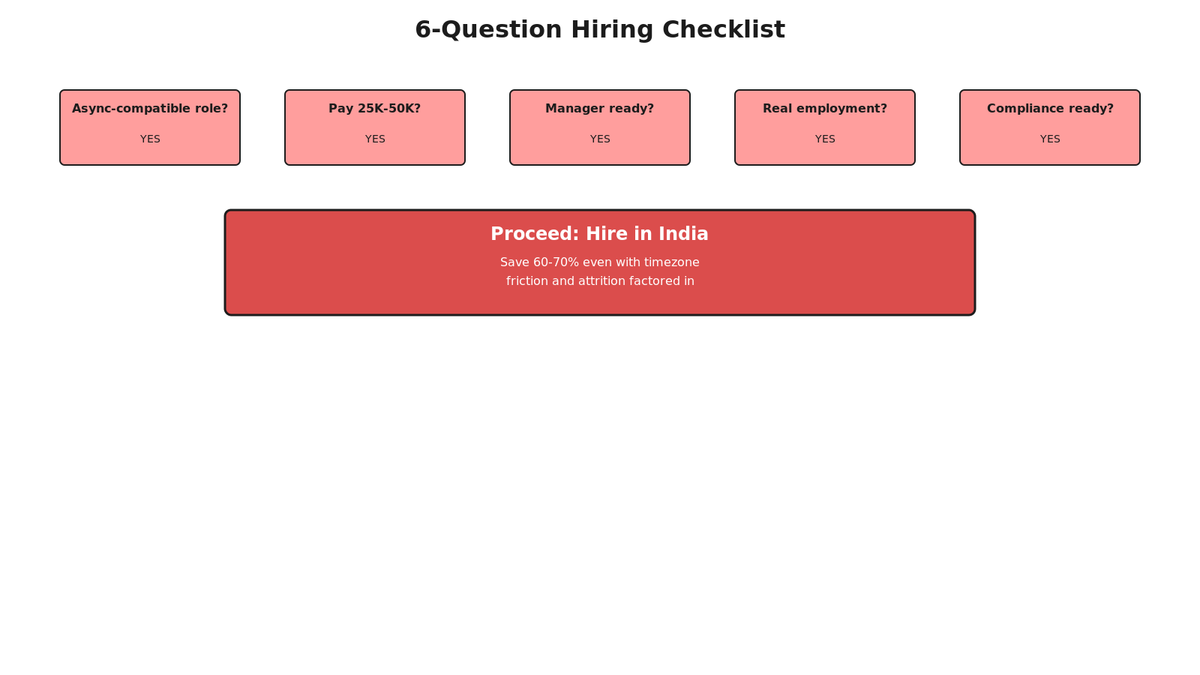
Ask yourself these questions and answer honestly. Do I have a clear marketing plan for the next 6-12 months or am I still figuring out strategy? Is my budget less than $3K/month or more than $3K/month? Am I hiring in India or outside India? Do I need brand consistency across 12+ months or am I testing tactics? Can I afford re-onboarding cycles every 6-12 months or do I need stability?
If you answer: Agency, Agency, India (use EOR), Agency, No → hire a full agency retainer and use Versatile EOR for any India hires.
If you answer: Freelancer, Freelancer, India (use EOR), Freelancer, Yes → hire 1-2 freelancers plus Versatile EOR for any India team.
If you answer: Agency, Freelancer, India (use EOR), Agency, No → hire a hybrid. One freelancer for tactics, one agency strategist for planning, Versatile EOR for compliance.
The framework is not perfect, but it is more honest than any agency sales pitch. Use it. Most agencies will tell you to hire them. Most freelancers will tell you freelancing is better. The truth is in your specific situation. Answer the five questions. Follow the decision tree. You will land on the right answer.
Q16. Where to start: 30-day action plan
Week 1: Define your need. Sit with your co-founder and map your marketing priorities for the next 6 months. Write them down. Be specific. "Increase qualified leads from 5 per month to 20 per month", "launch SEO strategy with 10 blog posts per month", "scale paid ads campaigns from $1K/month spend to $5K/month spend". Not vague goals like "improve marketing" or "grow brand awareness". Vague briefs lead to vague hires and vague results.
Week 2: Audit your budget. How much can you spend per month on marketing without cutting payroll or product development? That is your budget ceiling. $1K/month = freelancer only. $3K/month = hybrid. $5K+/month = agency. If you are hiring in India, add Versatile EOR ($149-$199/emp/month). Budget = decision. Do not fight this math. Check our transparent pricing to see exactly what you will pay.
Week 3: Source candidates. For freelancers: Upwork, Toptal, LinkedIn, referrals from founders in your network. For agencies: ask your network for recommendations, Google "[your industry] marketing agency [your city]", check case studies and reviews on G2. For India EOR: visit Versatile's EOR services and book a call with us. Talk to our founder. No sales pitch. Just honest conversation about your situation. Read our how it works guide to understand the full process.
Week 4: Run a test project. Before you commit to a retainer or long-term hire, engage the candidate for a 2-4 week test project. Pay them $500-$2K. See how they work, how responsive they are, how they handle feedback, and if their output matches your style and standards. This is your insurance against a bad hire. A good freelancer or agency will welcome a trial. If they refuse, walk away.
By day 30, you will know which path is right. You will have tested a freelancer, talked to an agency, and booked a call with Versatile if India hiring is in your future. You will have three data points. Make your decision based on those data points, not on hunches or salespeople.
Where my head is right now
Most founders hate the decision between freelancers and agencies because they feel trapped by budget. You are not trapped. Here is the prediction I am sitting with: in the next 12 months, more founders will use hybrid models (freelancer plus agency plus EOR) instead of picking one path. This is the move. You get flexibility, quality, and cost control all at once. You get the speed of freelancers for tactical work, the strategy of agencies for direction, and the compliance of EOR for India hiring. No contractor risk. No context loss between vendor switches. No re-onboarding friction.
The bottleneck today is not money or talent. It is legal structure. Too many founders in India hire contractors and then panic when a compliance notice arrives. We get three to five messages per week from founders who are suddenly facing a $25K-$40K PF audit because they misclassified employees as contractors. Versatile's EOR model fixes that friction. No more contractor ambiguity. Just clean employment, full statutory coverage, and zero stress. We own the risk. You own the business.
If you are building a team in India, struggling with contractor classification, unsure whether to hire a freelancer or an agency, or just want to talk through your hiring options, message me directly on WhatsApp through our contact page, or book a 30-minute consultation. You will be talking to the founder, not a ticket or an automation. I will walk you through the three options (freelancer, agency, EOR) and which one is right for your stage, your budget, and your risk tolerance. I can also walk you through our India EOR compliance framework so you never get an audit notice. One question to think about: where are you building, and how many people are you planning to hire in India in the next 12 months?
FAQs
What is the difference between a freelancer and a contractor?
In common usage, they are the same: someone self-employed who sells you time or output. Legally in India, contractor is a specific term under the Code on Social Security (2020). But if you hire someone full-time and direct their work, they are an employee regardless of title or label. Use Versatile EOR services to avoid misclassification.
Can I hire a freelancer on Upwork and save taxes?
If the freelancer is in India and you are paying from abroad, no. Their invoices must show GST (if registered) or you must pay GST at source. If they are not registered for GST and earning over ₹20 lakhs per year, they are evading tax and you are liable. Use Versatile's EOR model to make it legal and transparent.
How long does it take to hire an agency?
Typically 2-4 weeks from first call to first deliverable. Week 1: discovery and strategy. Week 2-3: onboarding and kickoff. Week 4: first output. A freelancer is faster (3-7 days). If you need speed, go freelancer. If you can wait 4 weeks for better strategy, go agency. For India hiring, Versatile EOR onboarding is 1-2 weeks.
What if I am not happy with the freelancer or agency after 1 month?
Freelancers: usually no penalty if you terminate. Agency: you might owe 1-2 months retainer. Read the contract. Real agencies offer 30-day trial periods or money-back guarantees. If they do not, ask for it. You are a new client with negotiating power. Do not sign without an exit clause.
Should I hire part-time or full-time?
Freelancers are part-time by definition (they work for multiple clients). If you want someone full-time, hire an employee via Versatile EOR. Do not hire someone full-time as a freelancer. That is misclassification, and it will bite you.