How to Pay Employees in India in 2026: The Complete Compliance, Payroll, and EOR Playbook for Global Employers

There are three compliant ways to pay employees in India: incorporate your own Indian entity, use an Employer of Record (EOR) that becomes the legal employer, or engage independent contractors. For your first 1 to 30 hires, an EOR is fastest and lowest-risk. An owned entity makes sense past roughly 25 to 40 heads. Contractors look cheapes
Table of contents (13)
- 1. Three Legal Ways
- 2. True Cost and FX
- 3. Deductions and Filings
- 4. 50% Wage Rule
- 5. PE Risk and GCC
- 6. Misclassification Cost
- 7. Moving Money to India
- 8. State Tax and DPDP
- 9. Tax-Efficient Pay and Equity
- 10. EOR Provider Comparison
- 11. Onboarding and Retention
- 12. Monday Morning Checklist
- Frequently Asked Questions
- Three compliant routes exist to pay employees in India: an owned entity, an Employer of Record, or contractors, with EOR fitting your first 1 to 30 hires best.
- The real cost is gross salary plus PF, ESI, gratuity, and a hidden 3% to 5% FX markup that USD-direct invoicing removes entirely.
- Mandatory payroll obligations include PF, ESI, TDS, and state Professional Tax, plus Form 24Q, Form 16, and a compliant full-and-final exit settlement.
- Since 21 November 2025, the Labour Code requires Basic plus DA to be at least 50% of CTC, making old offer-letter templates non-compliant.
- Contractor misclassification can cost $25,000 to $40,000 per worker in backdated PF, ESI, gratuity, and EPFO damages of up to 25%.
- Compliance is the floor; retention is the return, so a 5-day onboarding SLA, culture-fit screening, and a replacement guarantee matter more than paperwork.
Q1. What are the three legal ways to pay employees in India, and which fits your stage?
There are three compliant ways to pay employees in India: incorporate your own Indian entity, use an Employer of Record (EOR) that becomes the legal employer, or engage independent contractors. For your first 1 to 30 hires, an EOR is fastest and lowest-risk. An owned entity makes sense past roughly 25 to 40 heads. Contractors look cheapest on paper but carry the highest misclassification and Permanent Establishment exposure.
The "which model?" question that stalls every first hire
Last quarter, a US founder messaged me on WhatsApp at 11 PM his time. He had a brilliant backend engineer in Pune ready to sign, and he was frozen. Entity, EOR, or contractor? He had read ten blogs and trusted none of them.
That paralysis is normal. The standard read treats this as a cost question. It is actually a risk-and-speed question, and the answer shifts with your headcount.
The three routes, side by side
An EOR is a company that legally employs your worker on your behalf, runs payroll, and files every statutory contribution under its own registrations. A contractor is self-employed and invoices you directly. An entity means you own an Indian company and employ people yourself.
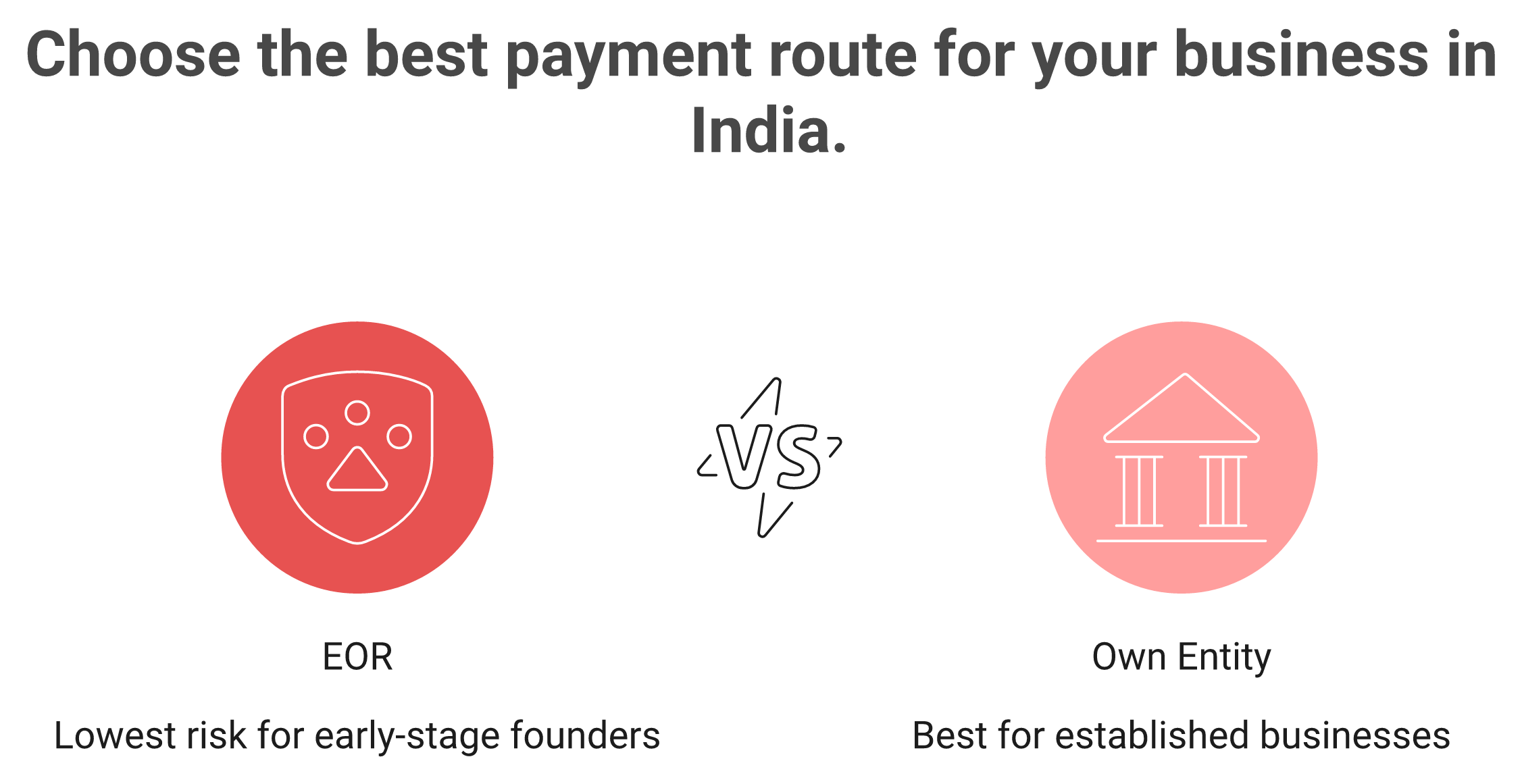
| Route | Cost and setup time | Risk profile |
|---|---|---|
| Own entity | $15K to $25K setup, 3 to 6 months to register | Full compliance burden sits on you |
| EOR | No setup, live in days, per-employee monthly fee | ⭐ Lowest; EOR carries statutory liability |
| Contractor | Lowest visible cost, instant | ⚠️ Highest; misclassification and PE exposure |
The break-even point where running your own entity beats EOR fees lands around 25 to 40 employees, depending on salaries. Below that, the math favors EOR almost every time.
The stage rule I give every founder
✅ First hire to roughly 30 people: use an EOR.
✅ Past 30, with a long India commitment: model your own entity.
❌ Ongoing, full-time engineering work: never a contractor.
Here is my contrarian take. Most "save money with contractors" advice is running with scissors. It works right up until an audit, and then the back-pay bill erases years of savings. I have run multi-state placements across Bengaluru, Hyderabad, and Pune for six years, and the pattern never changes.
This is also where India-native depth matters. Global generalists treat India as one of 150 countries through local-partner shells. We operate only in India, through our own entity, which is why founders choose us to hire in India without an entity. That is not a slogan; it is who answers when something breaks.
Q2. What does an Indian hire really cost, and where do hidden FX markups hide?
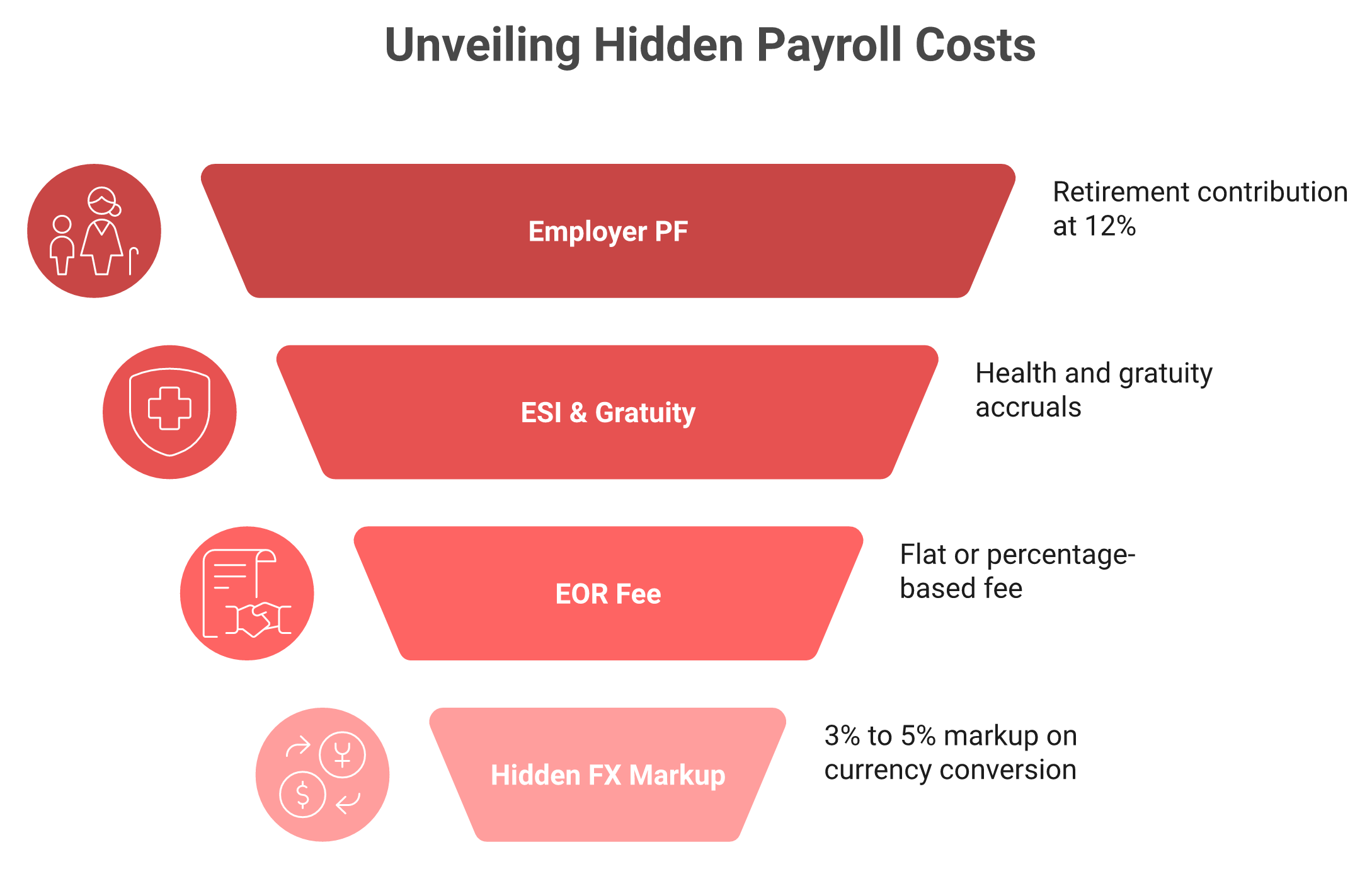
The real cost of an Indian hire is gross salary plus employer Provident Fund (12%), ESI where applicable (3.25%), gratuity accrual (4.81% of Basic plus DA), and the EOR fee. But the silent line item is a 3% to 5% foreign-exchange markup that global platforms bury when they route your dollars through a foreign parent before converting to rupees. Invoicing in USD directly from India removes that markup entirely.
The charge that shows up during diligence
A CFO at a $12M ARR SaaS company called me during her Series B raise. Her India payroll looked clean on the dashboard. Then her auditors found roughly 4% leaking out every month on currency conversion she never approved. Nobody had flagged it. That is Burned Founder Syndrome, and it usually surfaces at the worst possible time.
Total Cost of Employment, line by line
Think of Total Cost of Employment (TCOE) as everything you pay to keep one person employed and compliant. You can model this with our employee cost calculator. Salary is just the visible part.
| Cost component | Rate | Notes |
|---|---|---|
| Gross salary | Base | The number on the offer letter |
| Employer PF | 12% of Basic + DA | Statutory |
| ESI (if applicable) | 3.25% employer | For salaries up to Rs 21,000 |
| Gratuity accrual | 4.81% of Basic + DA | Accrue from month one |
| EOR fee | Flat or % of salary | Predictable per employee |
| 💸 FX markup | 3% to 5% | The hidden line most platforms add |
A Deel reviewer put the platform-fee frustration plainly:
"I find Remote super complicated to use at a platform level, with zero clarity on the process. Also, there are hidden fees everywhere, and I end up paying roughly 30% more than what's stated."
Javier G. Remote G2 Verified Review
We invoice US and UK clients in USD straight from our Indian entity, Foo Falcon Technologies Pvt Ltd. The dollars are not routed through a foreign holding company first, so there is no conversion spread to skim.
I might be cautious about one-size cost claims, since seniority and city change the math. But on FX, the principle is simple. ✅ One clean dollar invoice. ❌ No markup you cannot see. We also charge no setup fee and no exit fee, and the first month is free, with full details on our India EOR pricing page.
Q3. What statutory deductions, filings, and exit settlements can you not miss?
Every Indian payroll must withhold Provident Fund (12% plus 12%), ESI (3.25% plus 0.75% for salaries up to Rs 21,000), TDS under Section 192, and state Professional Tax (capped at Rs 2,500 per year). TDS is due by the 7th of the next month. PF and ESI are due by the 21st. You must also file quarterly Form 24Q, issue Form 16 annually, and run a compliant full-and-final settlement on exit.
The deadlines that trigger penalty notices
Miss a date and the system does not send a polite reminder. It sends a penalty. Here is the stack every payroll cycle has to clear, and the reason many teams move to India payroll outsourcing.
| Deduction | Rate | Deposit deadline | Authority |
|---|---|---|---|
| Provident Fund (PF) | 12% employer + 12% employee | 15th of next month | EPFO |
| ESI | 3.25% employer + 0.75% employee | 15th of next month | ESIC |
| TDS (Section 192) | Per income-tax slab | ⏰ 7th of next month | CBDT |
| Professional Tax | State slab, max Rs 2,500/yr | State-specific | State |
Define the jargon once: PF is retirement savings, ESI is state health insurance for lower-wage staff, TDS is income tax withheld at source, and Professional Tax is a small state levy.
Filings and exits people forget
Deductions are only half the job. You also file Form 24Q every quarter (your TDS return), and issue each employee a Form 16 (their annual tax certificate) by 31 May.
On exit, the full-and-final settlement must clear notice pay, leave encashment, gratuity, and PF, then issue a relieving letter. ⚠️ Skip the gratuity piece and you build a hidden liability. We accrue gratuity from month one at 4.81% of Basic plus DA, so there is no balance-sheet shock when a company gets acquired.
Why owned registrations matter here
This is the part global platforms gloss over. When India runs through a local-partner shell, the challans and filings sit under someone else's name, opaque to you. Our India payroll compliance runs PF, ESI, TDS, and PT under our own registrations, and clients get the actual challan numbers and TDS receipts every month. That paper trail is what survives an investor audit.
Q4. How does the 2025-26 Labour Code's 50% wage rule change how you structure salary?
Since 21 November 2025, India's four consolidated Labour Codes require "wages," meaning Basic plus Dearness Allowance, to be at least 50% of total CTC. Because PF and gratuity are calculated on this base, the rule raises employer social-security cost and trims take-home unless you re-engineer the structure. Offer letters built on the old 30% to 40% Basic split are now non-compliant.
A rule that quietly rewrote every offer letter
On 21 November 2025, the Code on Wages came into force as part of four Codes that replaced 29 older laws. The mechanic is simple to picture. For years, companies kept Basic low and stuffed the rest into allowances to shrink PF and gratuity. That lever is now gone.
Think of CTC as a pie. The law now says at least half the pie must be Basic plus DA, the slice that social-security contributions feed on.
The worked example that makes it real
Take a Rs 20 lakh CTC engineer.
- ❌ Old structure: Basic at 35% (Rs 7 lakh). PF and gratuity compute on the smaller base, so employer cost stays low and take-home looks high.
- ✅ New structure: Basic plus DA at 50% (Rs 10 lakh). PF rises, gratuity accrual rises, and take-home dips unless you rebuild the package.
The Ministry of Labour's own FAQs confirm wages must hit that 50% threshold, with allowances treated carefully against it. I will hedge on edge cases, since overtime and specific allowances have their own treatment. But the headline is settled.
What to do before your next offer
Restructure your offer-letter template now, so Basic plus DA clears 50% before you issue it. If you would rather offload the rebuild, our EOR services in India handle compliant salary structuring end to end. Retrofitting later is messier than getting it right once.
Here is a perspective the category avoids. I lean toward paying a single, high, guaranteed salary instead of layering contingent bonuses. In India's talent-dense engineering market, a clean, predictable number beats a complicated one, and it simplifies compliant payroll under the new rule. The standard "load it with variable pay" playbook gets this backwards for early teams. If you are weighing the move, talk to us about how to build a team in India the right way.
Q5. What is Permanent Establishment (PE) risk, and how can an EOR double as your GCC bridge?
Permanent Establishment (PE) risk is the danger that your India activity creates a taxable presence, exposing your foreign company to Indian corporate tax on profits attributed to that presence. A dependent agent or workers performing core functions can trigger it. Paying "contractors" who act like employees is a classic trap. A compliant EOR holds the employment under its own entity, insulating you from PE while serving as a bridge to a future GCC.
The word that scares founders more than it should
A UK founder told me he had avoided hiring in India for a year because his accountant said one word: "nexus." He pictured the Indian tax department knocking on his London door.
His fear was half right. PE is real, but it is manageable. The standard read treats PE as a reason to stall. I treat it as a reason to choose the right structure on day one. You can gauge your own exposure with our Permanent Establishment risk quiz.
How a hire becomes a taxable presence
PE means your business has enough of a footprint in India that India can tax the profit tied to it. Two triggers matter most for a startup.
- ⚠️ Dependent agent: a person in India who habitually signs deals or binds your company.
- ⚠️ Core-function workers: staff doing the heart of your business, not just support, especially when labeled "contractors."
When you pay a long-term contractor who works full-time on your product, you are not saving money. You are quietly building a PE argument against yourself.
The EOR insulation, and the GCC bridge
An EOR employs the worker under its own Indian entity, so the employment relationship sits with the EOR, not your foreign parent. That separation is what reduces the PE exposure.
Here is the part the category rarely connects. The same EOR setup doubles as a Global Capability Center (GCC) bridge. A GCC is your own India operation, your captive team. Registering an entity takes 12 to 18 months. An EOR lets you hire now and build the captive in parallel, then transition when ready, which is exactly how our global capability center model works.
I think about this like AWS regions. You do not build a data center to test a market; you rent depth in one region first. India is that region, and an owned-entity EOR is the rented depth.
For clients who started with us on Contract-to-Hire, the move to EOR happens on the same entity, with no migration risk and no compliance gap inherited from a third party. The compliance is the floor here. The retention work is the ceiling, which is its own section.
Q6. What does contractor misclassification really cost you in India?
Misclassification means treating someone as a contractor when Indian law sees an employee, and the bill arrives backdated. When an audit reclassifies a long-term contractor, you owe retroactive Provident Fund (12% employer per month), unpaid ESI and gratuity, plus EPFO damages of up to 25%. The total often lands between $25,000 and $40,000 per worker. Ongoing, fixed-hours, company-equipment engineering work is the clearest red flag.
A founder, three engineers, and a diligence surprise
Picture a US founder I will call Daniel. He hired three Bengaluru engineers as "contractors" to move fast and skip the compliance setup. For 18 months it worked beautifully.
Then his Series B diligence began. The investor's counsel asked one question: were these contractors or employees? They worked full-time, on company laptops, on the core product. That is an employee under Indian law, regardless of the contract title. A quick misclassification quiz would have flagged it early.
The backdated bill, line by line
This is the complication that ends the honeymoon. Reclassification is retroactive, so the liability compounds month by month.
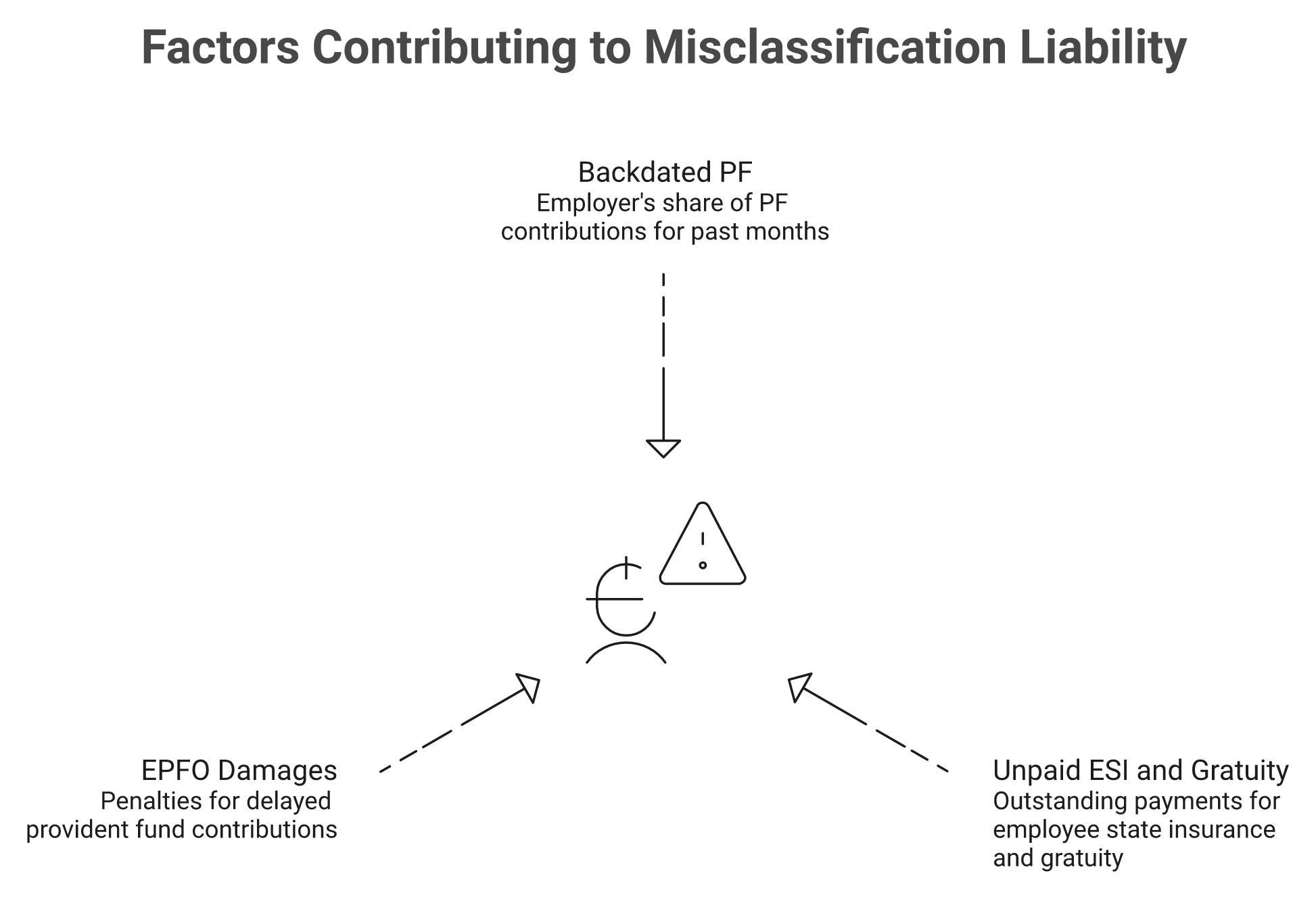
- 💸 Backdated PF at 12% employer share, for every month worked.
- 💸 Unpaid ESI and gratuity accrual.
- ⚠️ EPFO damages of up to 25% on delayed contributions.
Across three engineers, Daniel's exposure cleared roughly $35,000, plus a stalled funding round. Founders on Reddit describe the same fear when they receive USD pay without a clean structure:
"I'm based in India and about to start working full-time for a US based startup. I'll be getting paid in USD and I have a few legal/financial questions."
u/throwaway, r/LegalAdviceIndia Reddit Thread
The resolution, and a human footnote
Daniel's fix was conversion. We moved the three engineers to full-time EOR employment under our entity in five business days, using our contractor-to-employee conversion process, and the diligence flag cleared.
There is a human side people miss. A compliant payslip is what gets your engineer a home loan or a visa. A "contractor" often cannot prove stable income, so conversion is not just legal hygiene; it changes that person's life.
I could be blunt here. The 6-month replacement guarantee we attach to contract staffing placements exists because I have watched conversions fail when culture-fit was ignored. Compliance fixes the legal risk. It does not fix the wrong hire.
Q7. How do you legally move money from the US or UK into India, with FEMA, FC-GPR, and payment rails?
Two money flows matter. Salary: employees must be paid in INR through compliant rails, with FIRC documentation for inward remittance. Capital, on the entity route only: foreign investment is reported to the RBI via Form FC-GPR within 30 days of share allotment, with allotment within 60 days of remittance, through the FIRMS portal. An EOR collapses both into one USD invoice, with no FC-GPR and no FX desk.
Two pipes, not one
Founders often assume "paying India" is a single money problem. It is two. Mixing them up is where the trouble starts.
The first pipe is salary. The second is capital, and it only exists if you own an entity. Each runs under different rules, with different deadlines.
Pipe one: salary rails
Indian employees are paid in rupees, into Indian bank accounts. When the money comes from abroad, your bank issues a FIRC, a Foreign Inward Remittance Certificate, as proof the funds arrived legally.
Contractors can receive USD through various rails. But fees and FX spreads vary widely, which is exactly the hidden-cost problem from earlier, and a reason to streamline contractor payments through one compliant channel.
Pipe two: capital and the FC-GPR clock
If you set up your own Indian entity and fund it, FEMA reporting kicks in. FEMA is India's foreign-exchange law, and FC-GPR is the form that reports foreign investment to the Reserve Bank. Our company registration in India service handles this end to end.
⏰ The clock is strict:
- Allot shares within 60 days of the money landing.
- File Form FC-GPR within 30 days of that allotment, through the RBI's FIRMS portal, with FIRC and KYC attached.
Miss these and you face FEMA penalties. This is the part global EOR generalists do not handle for India with real depth.
How an EOR removes the FX desk
The EOR route skips pipe two entirely. There is no share allotment, no FC-GPR, no FIRMS filing, because you are not capitalizing an entity. That is the core appeal of choosing EOR over entity.
We take it one step further. We invoice in USD directly from our Indian entity, so your finance team never touches an FX conversion or a FIRMS deadline. I lean toward this being the next two years' shift: India stops being one pin on a global EOR map and becomes a specialist category, where owned-entity, single-country operators handle the money mechanics generalists abstract away.
Q8. How do state professional tax, DPDP, and the Income Tax Act 2025 forms trip up foreign payers?
India is not one payroll jurisdiction; it is 28-plus. Professional Tax differs by state: Maharashtra needs dual PTRC and PTEC registration with monthly filings, Karnataka requires enrollment within 30 days of joining, and Tamil Nadu files biannually. Layer on DPDP Rules 2025 obligations for payroll data, plus the Income Tax Act 2025's new forms like Form 138, and "one national setup" becomes a myth.
The myth of "one India payroll"
A People Ops lead at a Series B company once asked me to "just set up India payroll, one time." I had to explain that India payroll is closer to US multi-state sales tax than to a single federal filing, which is why teams lean on India payroll outsourcing.
Professional Tax (PT), a small state levy on income, is the clearest example. It changes shape at every state border.
Three states, three different rulebooks
| State | What PT looks like |
|---|---|
| Maharashtra | Dual PTRC + PTEC registration, monthly slab filing |
| Karnataka | Enrollment within 30 days of joining, monthly PT |
| Tamil Nadu | ⏰ Biannual filing (June and December), plus LWF |
West Bengal changes rules often. Delhi has no PT but strict Shops and Establishments compliance. A global platform running one template across all of these will miss something, which is why our India payroll compliance is built state by state.
Two more 2026 layers: DPDP and new tax forms
DPDP is India's Digital Personal Data Protection law, its version of GDPR. The DPDP Rules were notified in November 2025, with enforcement staggered into 2026 and 2027. Payroll holds salary, PAN, and bank data, so consent and data handling now matter.
The Income Tax Act 2025 also refreshed forms, including Form 138 replacing legacy TDS forms in payroll workflows. Define it simply: these are the documents that prove your withholding is correct, and our managed payroll team files them on time.
Why this is the WhatsApp moat
Here is where the support model stops being a soft feature. When a Tamil Nadu PT cycle or a DPDP consent question lands three days before payroll, a ticket queue fails you. A Deel user captured that frustration:
"Often the CS doesn't seem to have answers, which leads me to emails back and forth on my case, and something I was looking for the answer to in 20 minutes becomes a 4 day process."
Verified User in Computer Software Deel G2 Verified Review
We run PT, S&E, DPDP, and the new forms across all 28 states under our own registrations. And when a state-cycle question hits, you message me on WhatsApp, not a chatbot, the kind of access founders book through a direct consultation. I might be old-fashioned, but the person who built the compliance should be the one answering for it.
Q9. How do you structure tax-efficient pay and equity, with NPS, ESOPs, and phantom stock?
Compliance is the floor; tax-efficient structuring is the edge. Routing part of CTC through the National Pension System (NPS) under Section 80CCD can cut a high-earning engineer's tax by 20% to 25%. For equity, EOR employees cannot hold options in your foreign cap table directly, so phantom stock or a cash-settled appreciation plan delivers the upside without an Indian entity or FEMA friction.
The lever most foreign employers never pull
I watched a US founder lose a senior engineer over $200 a month in take-home. The salary was fine. The structure was lazy, and a competitor offered a smarter one.
NPS is a government-backed retirement scheme. Under Section 80CCD(2), an employer contribution to an employee's NPS is deductible and lowers taxable income. For a high earner, that can mean 20% to 25% less tax, with no extra cash cost to you, and you can read the mechanics on our tax benefits under NPS page.
Equity without an Indian entity
Equity is trickier. An EOR employee works for the EOR, not your foreign company, so handing them stock options on your US cap table is messy under FEMA, India's foreign-exchange law.
Two clean workarounds exist:
- ✅ Phantom stock: a contractual promise that pays out cash equal to share appreciation. No actual shares change hands.
- ✅ Cash-settled appreciation plan: similar upside, settled in rupees, no FEMA filing.
Both give the engineer real skin in the game without the cross-border equity tangle.
Where this fits in a compliant payroll
I could be cautious here, since tax structuring depends on the individual's slab and choices. You can model take-home with our income tax calculator. But the principle holds: a clean, predictable package beats a complicated one in India's talent-dense market.
We build NPS and phantom-stock structures inside the same compliant EOR payroll, so the optimization sits on top of the floor, not beside it. Compliance keeps you legal. Structure keeps the engineer.
Q10. Versatile vs Wisemonk vs the global generalists: which India EOR should you pick?
If India is your only market and transparency matters, an India-native EOR that owns its entity beats a global generalist treating India as one of 150 countries. Versatile invoices USD directly from its own Indian entity, runs staff on its own PF and ESI registrations, onboards in five days, and gives founders direct WhatsApp access. That contrasts with the partner-shell, FX-markup, ticket-queue model common to global platforms and to the closest India peer, Wisemonk.
The honest decision, laid out
Let me put my own company in the comparison and tell you exactly where it wins and where it does not. For a deeper breakdown, see our Wisemonk versus Versatile Club comparison.
| Factor | Versatile | Wisemonk | Global generalists |
|---|---|---|---|
| India entity | ✅ Owned (Foo Falcon) | ✅ Owned | ❌ Local-partner shell |
| Monthly EOR price | $149/employee | $99 to $399 | $400 to $599 |
| Onboarding | ⏰ 5 days, contractual | 24 to 72 hrs | 7 to 14 days |
| Support | ✅ Founder on WhatsApp | Dedicated HRBP | ❌ Ticket / chatbot |
| Retention guarantee | ✅ 6-month replacement | ❌ None | ❌ None |
| Certifications | ❌ No SOC 2 / ISO yet | ✅ SOC 2 + ISO | ✅ SOC 2 |
The global-platform support gap is well documented:
"Support is the single biggest failure. There is no direct phone line. You either email or use a chatbot, and you can ask both the same question and get two different wrong answers."
Erika D. Rippling G2 Verified Review
When a generalist is the right call
I will say plainly when not to pick us. ❌ If you hire across 5-plus countries at once, a global generalist is simpler. ❌ If you are an enterprise with 100-plus India staff that requires SOC 2 or ISO 27001 as a procurement gate, we are not your fit yet. If India is the focus, though, our EOR for India startups is built for exactly that.
Wisemonk earns its reputation, too:
"It feels like working with a partner rather than just a payment or compliance vendor. Communication is clear, documentation is organized."
Verified User in Marketing Wisemonk G2 Verified Review
The scenario pick
✅ First India hire, Seed to Series B: an India-native EOR, for speed and a single owner.
✅ CFO closing month-end on one USD invoice: owned-entity, USD-direct billing.
✅ Multi-country rollout: a generalist for breadth, an India specialist for the India seats.
Q11. How fast can you actually onboard and retain an India hire, beyond paper compliance?
A payroll setup that is "legal on paper" still fails if your hire churns in 90 days. Compliance is the floor; retention is the return. The real gap between vendors is not the PF filing. It is whether onboarding takes five days or five weeks, and whether anyone assesses culture-fit, coaches the new hire through the first 90 days, and guarantees a replacement if it does not work out.
The bad hire that was perfectly compliant
A People Ops lead once told me her India hire was "fully compliant and completely wrong." Every filing was correct. The engineer quit in month four.
That is the paper-compliance gap. Compliance protects you from the government. It does nothing to protect you from a mis-hire that burns three to six months of runway, which is why we built a retention-first EOR model.
What actually moves retention
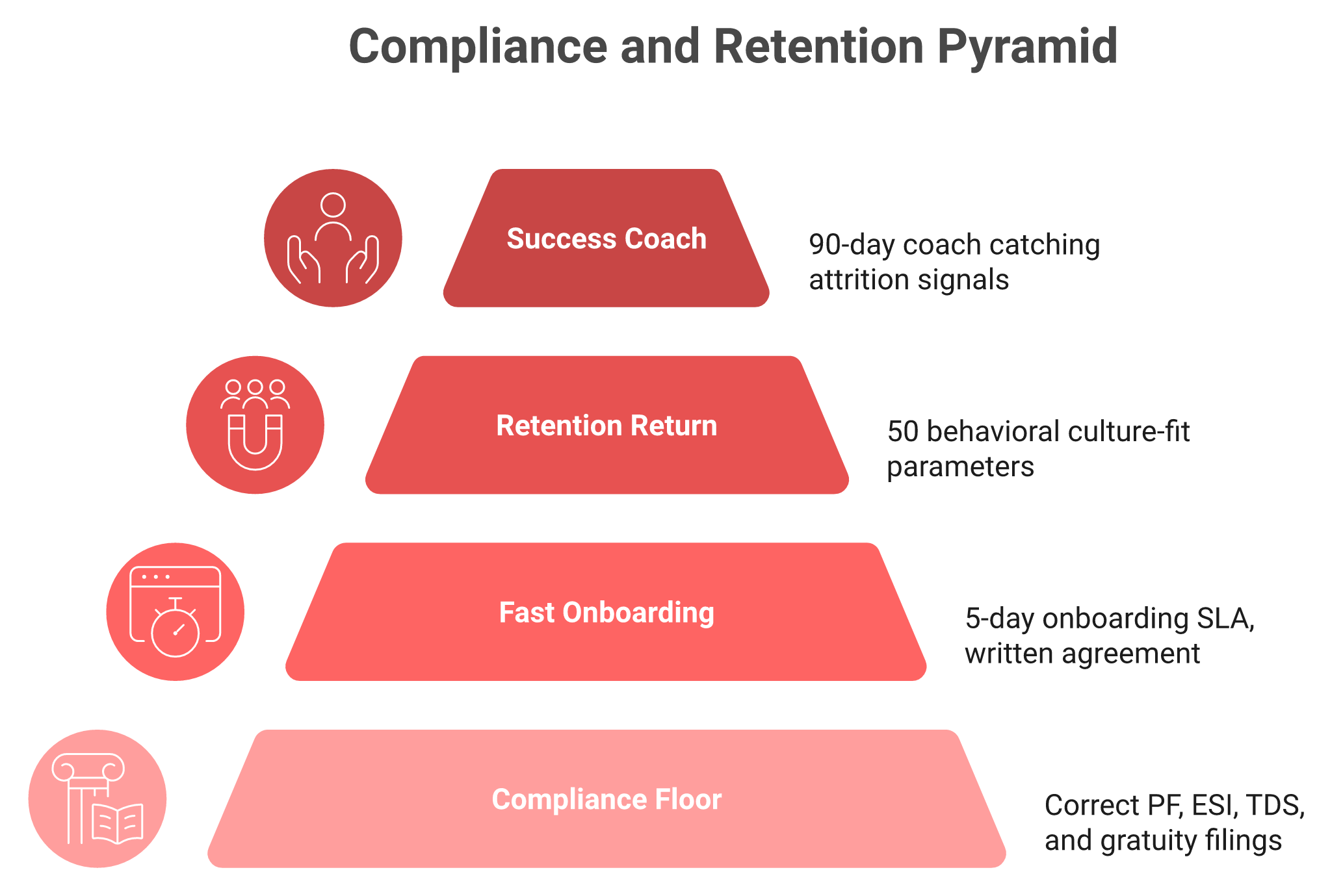
Speed comes first, because momentum matters. We commit to a 5-day onboarding SLA in writing, agreement to payroll-live, not as an aspiration, the way we help you build a team in India quickly.
Then comes fit and follow-through:
- ⭐ 50 behavioral parameters to assess culture-fit before the offer, not after. Test the approach with our culture-fit quiz.
- ⭐ A 90-day Success Coach who checks in and catches early attrition signals.
Wisemonk reviewers note the opposite gap, where support thins out under a small team:
"Their support/query responses can occasionally take a bit longer sometimes, likely due to a relatively small team."
Verified User in Financial Services Wisemonk G2 Verified Review
The guarantee that aligns the incentive
Here is the part the category avoids. On contract-to-hire placements, we charge the fee only after the hire completes 90 days, and we replace a hire that leaves within six months at no extra cost.
That ties our revenue to your retention, not just to a signature. I might be biased, but I think an EOR that gets paid whether or not the hire stays has the wrong incentive baked in.
Q12. What should you do on Monday morning to pay your first or next India hire compliantly?
Start here: pick your model (an EOR for 1 to 30 hires), draft the offer with Basic plus DA at 50% or more of CTC, confirm PF, ESI, and PT registrations and the state-specific cycles, set gratuity to accrue from month one, and lock your payment rail to kill FX markups. If you would rather hand the statutory machinery to someone who owns the Indian entity and answers on WhatsApp, that is the next conversation.
Your five-step checklist
You do not need to solve all of India this week. You need to get the first hire right. Run these in order.
- ✅ Pick the model: an EOR for your first 1 to 30 hires, which you can size against ownership using our EOR vs entity calculator.
- ✅ Draft the offer with Basic plus DA at 50% or more of CTC.
- ✅ Confirm PF, ESI, and state PT registrations, with the right state cycle.
- ✅ Set gratuity to accrue from month one, at 4.81% of Basic plus DA, which you can estimate with our gratuity calculator.
- ✅ Lock a payment rail that does not bury a 3% to 5% FX markup.
Do those five, and you have closed the gaps that surface in diligence.
Where my head is right now
I think the next two years reshape this category. India stops being one pin on a global EOR map and becomes its own specialist lane, where owned-entity operators handle the money mechanics that generalists abstract away.
If you want the floor handled and the retention solved, our EOR services in India onboard in five days, charge no setup or exit fee, and give you the first month free. ⚠️ We are not the fit for 5-plus countries or a SOC 2 procurement gate, and I will tell you so directly.
So tell me what you are building in India, and who you are trying to hire. You can book a consultation with us on WhatsApp, and you will reach the person who wrote this, not a ticket queue.
Frequently Asked Questions
What is the cheapest compliant way to pay employees in India for a first hire?
For your first hire through roughly 30 people, an Employer of Record (EOR) is almost always the cheapest compliant route, because it removes the $15,000 to $25,000 setup and 3 to 6 months of registration that an owned entity demands. The EOR becomes the legal employer, runs payroll, and files every statutory contribution under its own registrations, so you go live in days instead of months.
Contractors look cheaper on paper, but the savings evaporate the moment an audit reclassifies them. So the honest answer is not just price, it is risk-adjusted price.
- EOR: no setup, live in days, predictable per-employee fee.
- Entity: only beats EOR fees around 25 to 40 employees.
- Contractor: lowest visible cost, highest misclassification and PE exposure.
One silent line item matters here. Global platforms often bury a 3% to 5% foreign-exchange markup when they route dollars through a foreign parent. We invoice in USD directly from our Indian entity, so that spread disappears. You can size the trade-off precisely with our EOR versus entity comparison, then start a compliant first hire through our India EOR service with no setup fee and the first month free.
What statutory deductions and filings are mandatory when paying employees in India?
Every Indian payroll must withhold and deposit four core items, each with its own deadline and authority. Missing a date does not trigger a reminder; it triggers a penalty.
- Provident Fund (PF): 12% employer plus 12% employee, deposited by the 15th of the next month, to the EPFO.
- ESI: 3.25% employer plus 0.75% employee for salaries up to Rs 21,000, by the 15th, to the ESIC.
- TDS under Section 192: per income-tax slab, due by the 7th of the next month.
- Professional Tax: a state levy capped at Rs 2,500 per year, with state-specific cycles.
Beyond deductions, you file Form 24Q every quarter, issue each employee a Form 16 by 31 May, and run a compliant full-and-final settlement on exit covering notice pay, leave encashment, gratuity, and PF. Skip the gratuity accrual and you build a hidden balance-sheet liability that surfaces during acquisition.
When India runs through a local-partner shell, these challans sit under someone else's name, opaque to you. Our India payroll compliance runs every registration in-house, so you receive the actual challan numbers and TDS receipts each month, and our managed payroll team files Form 24Q and Form 16 on time.
How does the 2025-26 Labour Code 50% wage rule change how we structure salary in India?
Since 21 November 2025, India's four consolidated Labour Codes require wages, meaning Basic plus Dearness Allowance, to be at least 50% of total CTC. Because PF and gratuity are calculated on this base, the rule raises employer social-security cost and trims take-home pay unless you re-engineer the package. Offer letters built on the old 30% to 40% Basic split are now non-compliant.
For years, companies kept Basic low and loaded the rest into allowances to shrink PF and gratuity. That lever is gone. Picture a Rs 20 lakh CTC engineer:
- Old structure: Basic at 35% (Rs 7 lakh), so PF and gratuity compute on a smaller base.
- New structure: Basic plus DA at 50% (Rs 10 lakh), so PF rises, gratuity accrual rises, and take-home dips unless you rebuild the package.
The practical move is to restructure your offer-letter template now, before you issue the next offer, since retrofitting later is messier than getting it right once. Our EOR services in India handle compliant salary structuring end to end, and you can model net pay against the new base with our salary calculator before the offer goes out.
What does contractor misclassification actually cost a foreign company in India?
Misclassification means treating someone as a contractor when Indian law sees an employee, and the bill arrives backdated. When an audit reclassifies a long-term contractor, the liability compounds month by month and typically lands between $25,000 and $40,000 per worker.
- Backdated Provident Fund at the 12% employer share, for every month worked.
- Unpaid ESI and gratuity accrual.
- EPFO damages of up to 25% on delayed contributions.
The clearest red flags are ongoing, fixed-hours, full-time work performed on company equipment, on your core product. A contractor who looks and behaves like an employee is an employee under Indian law, regardless of the contract title, and that exposure usually surfaces at the worst time, during funding diligence.
There is a human dimension too. A compliant payslip is what gets your engineer a home loan or a visa, while a contractor often cannot prove stable income. The fix is conversion to compliant employment, which we complete in about five business days through our contractor-to-employee conversion. You can gauge your own exposure first with our misclassification quiz before a reclassification notice ever arrives.
Can we pay employees in India without setting up our own entity?
Yes. You do not need an Indian entity to pay employees compliantly, and for most US and UK companies, skipping the entity is the smarter first move. An Employer of Record employs your worker under its own Indian entity, which means the employment relationship and statutory liability sit with the EOR, not your foreign parent. That separation also reduces your Permanent Establishment risk, the danger that your India activity creates a taxable presence.
Skipping the entity removes a stack of obligations:
- No company registration, which can take 12 to 18 months.
- No FEMA capital reporting or Form FC-GPR filing.
- No in-house PF, ESI, TDS, or state Professional Tax registrations to maintain.
The same setup doubles as a bridge to a future Global Capability Center. You hire now through the EOR, build the captive entity in parallel, and transition when the headcount justifies it. We invoice in USD directly from our Indian entity, so your finance team never touches an FX desk or a FIRMS deadline. See exactly how this works on our guide to hiring in India without an entity, or compare the long-term path with our EOR vs entity guide.
Tell us where you are on the decision.
A role you want to hire, a team you want moved, or just the two routes to compare. A named person replies in 4 to 6 hours.
What the first call covers
30 minutesA cost comparison for your headcount, on your numbers, both routes.
- A written cost breakdown
- Entity documents before the call
- PF, ESI, TDS, termination law
- No follow-up sequence
You pick the time, we send a Meet link. Any timezone.