Table of contents (15)
- 1. What's inside the contract
- 2. Salary and PF math
- 3. PF mandatory question
- 4. Statutory leave types
- 5. Festival calendar by state
- 6. Enforcing minimum leave
- 7. Sick leave patterns
- 8. On-call and overtime
- 9. Probation and exit
- 10. Notice period
- 11. IP and confidentiality
- 12. Bonus, gratuity, insurance
- 13. Contract best practices
- 14. Ramp-up and invoicing
- 15. Ready to hire in India
India EOR employment contract, leave and compliance: the full guide for foreign founders
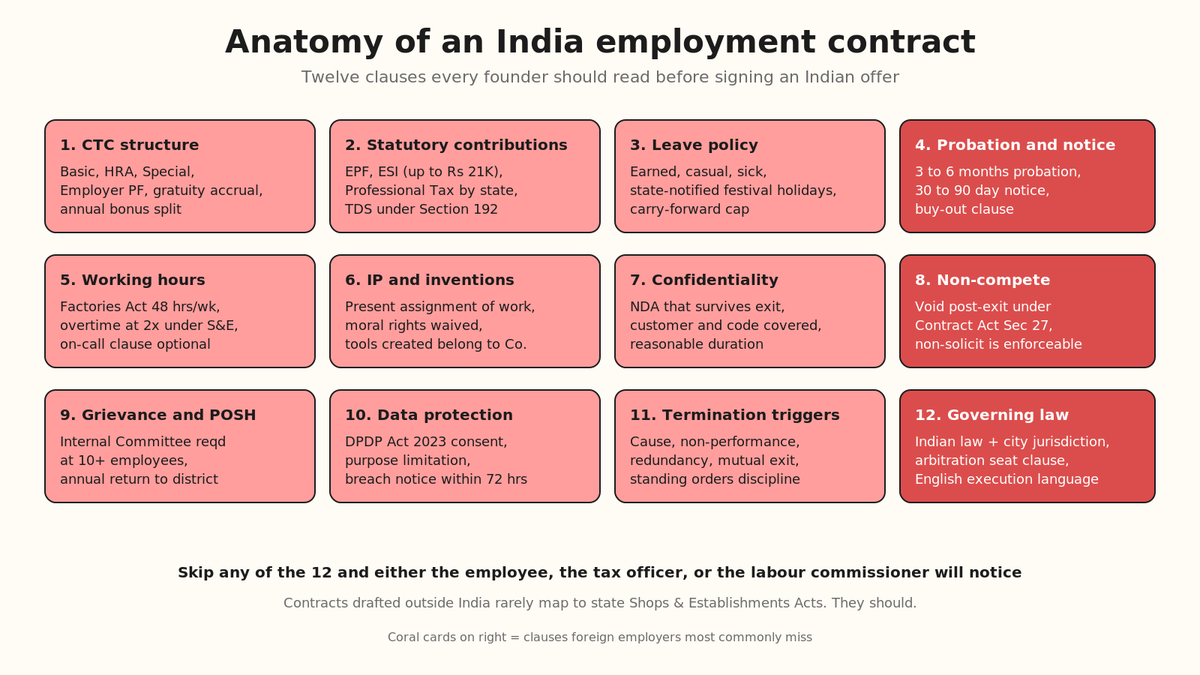
Hiring your first person in India through an India-native employer of record is the moment the abstract idea of "let's hire in India" meets a stack of concrete questions your legal team has never had to answer before. Is PF mandatory if the candidate has never had a PF account? How do you actually enforce "the employee must use their 12 days of paid leave"? Which festivals count as public holidays in Karnataka but not in Maharashtra? What is a reasonable notice period both ways, and can you insist on a shorter one on your side? What clauses in the contract will your India-based hire actually push back on, and which ones are non-negotiable under Indian law? This piece answers every one of those, plus the twelve contract clauses that separate a clean India engagement from one that unravels at exit.
TL;DR. A standard India EOR employment contract has a mandatory statutory floor (PF, gratuity, minimum leave, notice period, Payment of Bonus Act, Shops and Establishments registration) and a discretionary layer (specific leave count, sick leave carve-out, on-call clauses, IP assignment, non-solicit, moonlighting policy). PF is mandatory once the employee's basic salary crosses ₹15,000 per month at any employer covered by the EPF Act, whether or not they have contributed before. The statutory annual leave floor across states is 12 to 21 days depending on the state's Shops and Establishments Act, and most EOR contracts standardise at 18 to 21 days plus 8 to 12 public holidays. Festivals are not uniform: Karnataka observes 10 to 12 public holidays a year, Maharashtra 15 to 18, Tamil Nadu adds Pongal and Tamil New Year, Gujarat adds Uttarayan, Delhi NCR follows the central calendar. You cannot force encashment of "must-take" leave; the enforceable mechanism is a leave policy that blocks carry-forward beyond a cap and requires manager approval for anything past 5 consecutive days. Notice period is negotiable but market-standard is 30 to 60 days on both sides for individual contributors and 90 days for senior hires. The 12 non-negotiable contract clauses are listed in Section 13. If you get this stack right on the first hire, the fifth hire runs on autopilot.
Q1. What sits inside a standard India EOR employment contract
A well-drafted India employment contract issued through an EOR carries eight blocks. If any of these is missing when a vendor sends you a draft to sign off on, the contract is either non-compliant or built for a jurisdiction that is not India. The blocks are: parties and effective date, role and reporting line, compensation structure (with the statutory break-up of Basic, HRA, and allowances), leave and holidays, working hours and location, statutory benefits (PF, gratuity, insurance), termination and notice, and the standard confidentiality and IP assignment set.
The parties block names the EOR as the legal employer, the employee as the individual being hired, and (in a schedule) the client company as the "service recipient" or "assigned company." The role block sets the designation, the reporting line inside the client company, and the primary work location. The location matters more than most non-India teams realise, because state Shops and Establishments Acts govern working hours, weekly offs, and leave floors, and each of Karnataka, Maharashtra, Tamil Nadu, Delhi, Telangana, and Haryana has a materially different Act. Our writeup on payroll compliance in India covers the state-level split in detail.
The compensation block is where most first-time hirers get the structure wrong. Indian salary is quoted as CTC (Cost to Company) and broken into Basic, House Rent Allowance (HRA), Special Allowance, and employer contributions to PF and gratuity. The Basic component drives PF, gratuity, and bonus math, so it cannot be set arbitrarily low; a defensible Basic is 40% to 50% of gross monthly salary. The remaining blocks (working hours, statutory benefits, notice, IP) are covered section by section below. For a full walkthrough of how an EOR structures every one of these blocks against Indian law, our hire-in-India-without-an-entity guide is the companion piece, and our hire-employees-in-India playbook covers the end-to-end process from offer to onboarding. If you're evaluating specific providers, our best EOR in India and top global EOR services comparisons walk through how contract quality actually varies vendor to vendor.
"Every offer letter shall specify the nature of employment, wages payable, and the terms and conditions of employment as required under the Code on Wages, 2019."
— Ministry of Labour and Employment, Code on Wages Rules Government of India - Ministry of Labour
Q2. How to structure salary, gross vs net, and the PF math
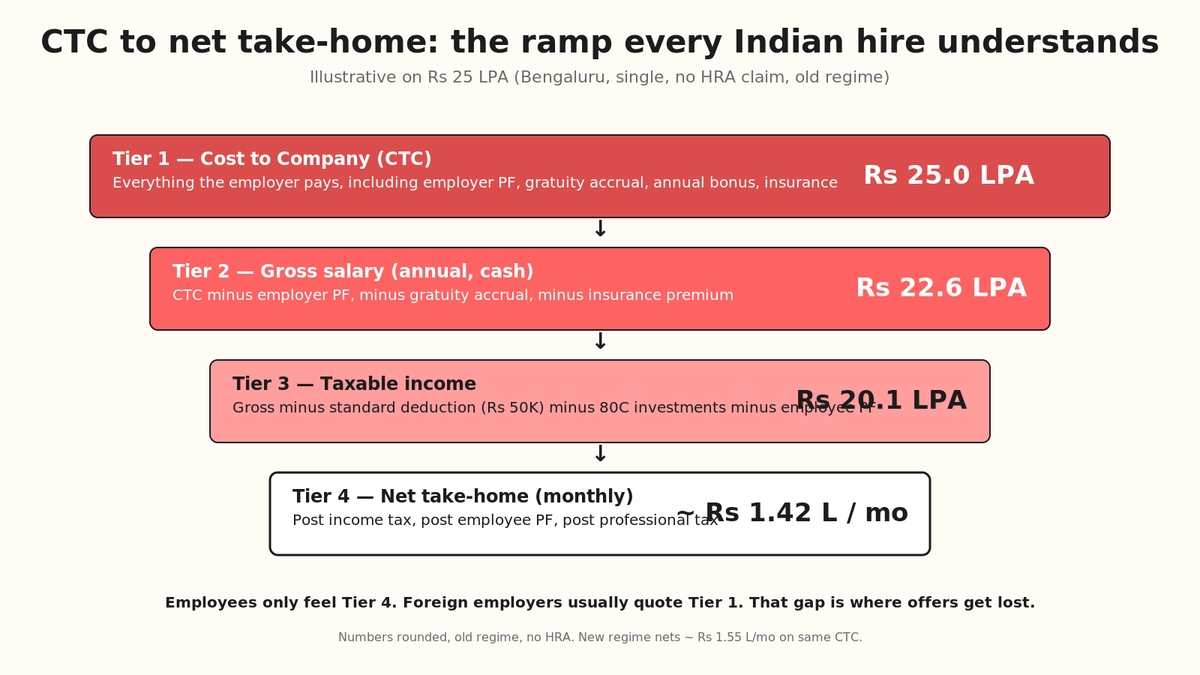
India salary math looks unfamiliar to teams used to US or European payroll because the "net" number the employee sees in their bank account is materially lower than the CTC number in the offer letter. A ₹18 lakh CTC role in Bengaluru lands roughly ₹1,10,000 to ₹1,25,000 in the employee's account per month after PF, professional tax, and TDS, depending on their tax regime election. The gap between CTC and take-home surprises founders the first time they see it.
Here is what a defensible monthly break-up looks like for a ₹18 lakh CTC hire in Karnataka:
| Component | Monthly (INR) | Annual (INR) | Statutory link |
| Basic salary | 60,000 | 7,20,000 | Drives PF, gratuity, bonus math |
| House Rent Allowance (HRA) | 30,000 | 3,60,000 | 50% of Basic in metros, 40% elsewhere |
| Special allowance | 52,800 | 6,33,600 | Balancing figure, fully taxable |
| Employer PF contribution | 1,800 | 21,600 | 12% of Basic capped at ₹15,000 wage ceiling |
| Employer gratuity provision | 2,884 | 34,608 | 4.81% of Basic (Payment of Gratuity Act, 1972) |
| Group health insurance premium | 2,516 | 30,192 | Typical INR 5L base cover for employee + spouse + 2 kids |
| Total CTC | 1,50,000 | 18,00,000 | Contractual cost to the client |
What the employee actually receives per month works out to roughly ₹1,15,000 to ₹1,20,000 after employee PF (12% of Basic, another ₹7,200), professional tax (₹200 in Karnataka), and TDS on the taxable portion. If the employee elects the new tax regime and their annual taxable income is under ₹7 lakh, TDS is zero and the net rises accordingly. Our cost of hiring in India piece walks through the same math at ₹8L, ₹15L, ₹25L, and ₹45L CTC bands, and our payroll outsourcing companies comparison covers who actually runs this calculation correctly.
The mistake first-time hirers make is quoting salary in gross-to-employee terms and then discovering the employer-side costs (PF, gratuity, insurance, EOR fee) push the true cost 12% to 18% higher than the number on the offer letter. Always quote and negotiate in CTC. Always show the employee both CTC and estimated take-home in the offer letter. Always cross-check the EOR's calculator against a second source before the first payroll cycle.
Q3. Is PF mandatory for someone who has never contributed before
Yes, in almost every case. Provident Fund contribution is mandatory under the Employees' Provident Funds and Miscellaneous Provisions Act, 1952 for any employee whose monthly Basic + Dearness Allowance is up to ₹15,000, working at an establishment with 20 or more employees. For an EOR, the EOR itself is the establishment, so the 20-employee threshold is met by the EOR's total headcount across all clients, not by the client's single hire.
The wrinkle every founder asks about: what if the candidate has never had a PF account before? A universal PF account (UAN) is created automatically at first enrollment. Whether the employee has contributed to PF at a prior employer or not is irrelevant to the mandatory status. Once the EOR onboards them, PF is deducted from day one.
The second wrinkle: what about employees whose Basic is above the ₹15,000 statutory ceiling? Two options apply. Option A is to cap employer PF at 12% of ₹15,000 (₹1,800 per month) and treat anything above that as voluntary. Option B is to contribute 12% of the actual Basic. Almost every India EOR (including Versatile) defaults to Option A because it minimises statutory exposure and matches market practice at most Indian employers. Option B is used only when the employee specifically requests it in writing and the client agrees to bear the higher employer cost.
Employees can opt out of PF only in one narrow case: they were never a PF member before AND their starting Basic is above ₹15,000. This is called the "excluded employee" status. In practice, most Indian mid-career hires have a UAN from a prior job and are therefore not eligible to opt out. Fresh hires from campus who start above the ₹15,000 threshold can be excluded, but this must be documented at onboarding with Form 11 before the first payroll runs. For a deeper look at how PF, ESI, TDS, and professional tax get processed monthly, see outsource payroll in India and the operational breakdown in payroll outsourcing services.
"Every employee, being a person other than an excluded employee, employed in or in connection with the work of a factory or other establishment to which this Scheme applies, shall be entitled and required to become a member of the Fund from the date of joining the factory or establishment."
— Paragraph 26(1), Employees' Provident Funds Scheme, 1952 EPFO - Ministry of Labour and Employment
Q4. The four statutory leave types every India contract carries
Indian employment law recognises four distinct leave categories, and every EOR contract must specify the day count and rules for each. Confusing them (or worse, collapsing them into a single "PTO" bucket the way US contracts do) is the fastest way to end up in a payment dispute at exit.
| Leave type | Statutory floor | Market standard in EOR contracts | Encashable at exit? |
| Earned Leave (EL) / Privilege Leave (PL) | 12 to 21 days/year (state-specific) | 18 to 21 days/year | Yes, statutory; typically for balance above 15 days carry-forward |
| Sick Leave (SL) / Casual Leave (CL) | 7 to 12 days/year combined (state-specific) | 10 to 12 days/year split between SL and CL | No, lapses at year end |
| Public holidays | Varies by state; typically 3 national + 5 state-declared | 8 to 12 days/year | Not applicable (not accrued) |
| Maternity leave | 26 weeks (Maternity Benefit Act, 1961 as amended 2017) | 26 weeks paid, extendable by up to 4 weeks unpaid | Not applicable (time-off, not accrued) |
Earned Leave is the closest analogue to US-style PTO. It accrues monthly, carries forward to the next year up to a cap (typically 30 to 45 days), and any balance above the cap either lapses or is encashed depending on state law and the specific contract. Sick Leave and Casual Leave are shorter absences (medical or personal) and do not accrue past year end. Public holidays are calendar-fixed and do not affect the accrual pool. Maternity leave sits entirely outside the accrual pool.
A well-drafted EOR contract states the exact day count for each of the four leave types, the accrual method (monthly, quarterly, upfront), the carry-forward cap, the encashment rule at exit, and the manager-approval workflow for anything above a threshold (typically 5 consecutive days). Missing any of these details is where disputes start.
"Every woman shall be entitled to, and her employer shall be liable for, the payment of maternity benefit at the rate of the average daily wage for the period of her actual absence, immediately preceding and including the day of her delivery and for the twenty-six weeks immediately following that day."
— Section 5(1), Maternity Benefit Act, 1961 as amended 2017 Ministry of Labour and Employment - Maternity Benefit
Q5. India festival calendar and how it varies by state
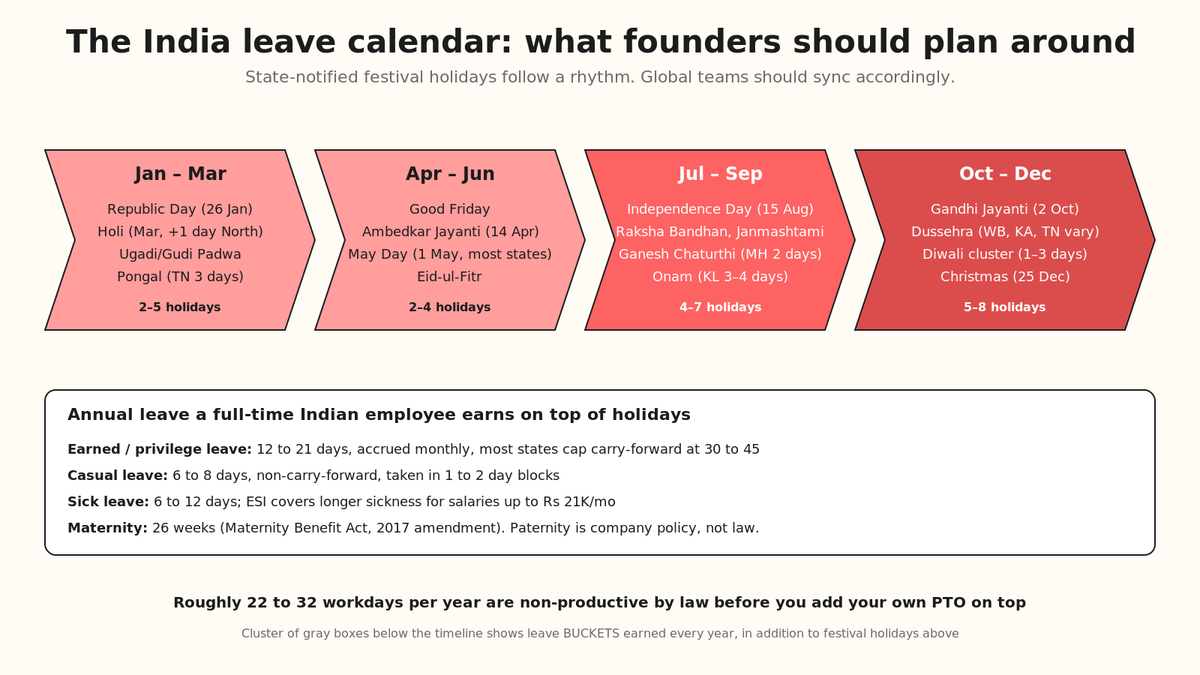
India does not have a single national list of public holidays. The Ministry of Home Affairs publishes 3 gazetted national holidays (Republic Day, Independence Day, Gandhi Jayanti), and every state government publishes its own list of "state holidays" and "restricted holidays" that vary by regional religion, language, and agricultural calendar. The total public holiday count for a salaried employee lands between 10 and 18 days a year depending on the state and the individual employer's policy.
| State | Typical annual holiday count | Distinctive local festivals | Statutory basis |
| Central / National (all states) | 3 days | Republic Day (26 Jan), Independence Day (15 Aug), Gandhi Jayanti (2 Oct) | Ministry of Home Affairs gazette |
| Karnataka (KA) | 10 to 12 days | Ugadi, Karnataka Rajyotsava (1 Nov), Ganesh Chaturthi, Mahalaya, Ayudha Puja | Karnataka Shops and Commercial Establishments Act, 1961 |
| Maharashtra (MH) | 15 to 18 days | Gudi Padwa, Maharashtra Day (1 May), Ganesh Chaturthi (up to 5 days), Diwali (3 to 4 days) | Maharashtra Shops and Establishments Act, 2017 |
| Gujarat (GJ) | 13 to 15 days | Uttarayan (14 Jan), Bhogi, Navratri (9 days but only 1 to 2 as public), New Year (after Diwali) | Gujarat Shops and Establishments Act, 2019 |
| Tamil Nadu (TN) | 12 to 14 days | Pongal (4 days), Tamil New Year, Deepavali, Vinayakar Chathurthi | Tamil Nadu Shops and Establishments Act, 1947 |
| Delhi NCR (DL) | 10 to 12 days | Follows central calendar closely; adds Holi (2 days), Guru Nanak Jayanti | Delhi Shops and Establishments Act, 1954 |
| Telangana (TS) / Andhra Pradesh (AP) | 13 to 15 days | Bathukamma (Telangana), Ugadi, Bonalu, Dasara (up to 3 days) | State-specific S&E Acts |
| West Bengal (WB) | 15 to 20 days | Durga Puja (5 to 7 days), Bengali New Year (Poila Boishakh), Kali Puja, Bhai Phota | West Bengal Shops and Establishments Act, 1963 |
Three practical points every US or UK founder should absorb before drafting their India EOR contract:
First, standardise the public holiday count in the offer letter. Specify exactly how many public holidays the employee is entitled to (say, 10 days) and reference the EOR's published state-specific calendar for the actual dates. If you leave the count open ("as per state law"), a Bengaluru-based hire and a Mumbai-based hire will get different totals, and the ones getting fewer will notice.
Second, some festivals span multiple working days. Ganesh Chaturthi in Maharashtra absorbs 3 to 5 working days, Durga Puja in West Bengal absorbs 5 to 7. Most private-sector employers declare 1 to 2 days as public holidays and leave the rest to be taken from the personal leave bucket. Diwali is treated similarly across most of India.
Third, plan sprints around Diwali, Dasara, and mid-August. These are the periods where India-wide team availability drops sharply. October to early November (Dasara through Diwali) is the largest single dip; most delivery teams see 40% to 60% capacity that fortnight. Sprints scheduled to close on Diwali week will slip. This is one of the softer operational realities our equip-remote-employees-in-India piece touches on and that first-time hirers learn the hard way.
"The list of holidays is subject to change and shall be notified by the state government from time to time. Each employer shall additionally declare weekly offs and festival holidays in accordance with the applicable Shops and Establishments Act."
— Section on National and Festival Holidays, Karnataka Industrial Establishments (National and Festival Holidays) Act Government of Karnataka - Department of Labour
Q6. Enforcing "must take 12 days" and blocking encashment
Founders new to India frequently ask a variant of this: "Can I write into the contract that the employee MUST take 12 days of leave and can NOT encash them?" The intent is reasonable, force a healthy vacation rhythm and avoid a ballooning liability of unused leave on the balance sheet. The Indian legal reality is more nuanced than yes or no.
You cannot legally force an employee to take leave on specific dates against their wishes, and you cannot forfeit accrued Earned Leave without paying it out at exit, that is statutory under most state Shops and Establishments Acts. What you CAN do is design the leave policy so the incentive structure produces the behaviour you want. The four levers that work in practice:
Lever 1. Set a low carry-forward cap. Statutory floors typically allow 30 to 45 days of Earned Leave to carry forward year on year. If your policy caps carry-forward at 15 days (with balance above 15 lapsing at year end), the employee has a real incentive to burn leave rather than lose it. This is enforceable and universally accepted.
Lever 2. Block encashment except at exit. Encashment of Earned Leave during service (annual cash-out) is optional under most state laws. You can policy this out. Encashment at exit for accrued balance is statutory in most states and cannot be waived. Combine (1) with (2) and the employee's rational move is to take the leave.
Lever 3. Mandate a minimum consecutive block. Write into the policy that the employee must take at least one 5-consecutive-day block of Earned Leave per calendar year, and that manager approval is required for anything below that threshold to be split. This nudges people to take a real break rather than sprinkling half-days.
Lever 4. Block accrual above a cap during service. If accrued balance hits (say) 25 days, further accrual pauses until the employee brings it down. This is used at several large Indian tech employers and holds up in practice.
What you should NOT try to do: force forfeiture of accrued Earned Leave at year end without payment. That is a statutory violation in most states and will surface at exit as a legal claim. If your EOR proposes a "use-it-or-lose-it" clause on Earned Leave, ask them to show you the specific state-law basis. Sick and Casual Leave DO lapse annually by convention and this is fine to policy.
Q7. Sick leave patterns from one day to one month
Sick leave in India is treated as a category distinct from Earned Leave, with its own accrual, its own consumption pattern, and its own documentation requirements. What varies dramatically is the treatment of short (1 to 3 day) absences versus medium (up to 1 week) versus extended (more than 1 month) absences. Every contract should carry different rules for each band.
1 to 3 day absences. No medical certificate required at most employers. The employee informs the manager, marks the leave in the HR system, and the day is deducted from the sick leave bucket. If exhausted, the day is charged to Earned Leave or unpaid.
4 to 7 day absences. A medical certificate is typically required from the second or third consecutive day. Any registered medical practitioner qualifies. Payment continues at full salary.
More than 1 week (up to 1 month). Medical certificate mandatory; the employer notifies ESIC (Employees' State Insurance Corporation) if the employee is ESI-covered (Basic + allowances up to ₹21,000/month). Under ESI, extended sick leave is paid by ESIC at roughly 70% of wages. For employees above the ESI ceiling (most tech hires), the employer typically continues full salary from Sick Leave, then Earned Leave, then loss of pay.
More than 1 month. The engagement enters "long leave" or "medical leave without pay" territory. Group medical insurance covers hospitalisation, and the employer can grant unpaid leave for a defined period, typically 3 to 6 months, before termination becomes a consideration. Termination during medical leave is heavily regulated and should only be considered on medical incapacity grounds with formal medical board opinion.
The clause that trips first-time hirers up: does the employer pay full salary for an extended illness? Market-standard in Indian tech is yes, for up to 15 to 30 days from combined SL and EL, then unpaid unless the employer extends as a goodwill gesture. Some clients pre-agree an "extended sick leave supplement" of up to 60 days at full pay, valued especially by senior hires.
"An insured person shall be entitled to sickness benefit for such days as he may be certified by a duly appointed medical practitioner to be unable to work on account of sickness, at a rate not exceeding seventy percent of the standard benefit rate."
— Section 46, Employees' State Insurance Act, 1948 ESIC - Ministry of Labour and Employment
Q8. On-call, weekend availability, and overtime contract clauses
India is a country of overlapping time zones with US East Coast (9.5 hours difference), US West Coast (12.5 hours), UK (4.5 hours), and Central Europe (3.5 hours). Any US or UK client hiring in India will at some point ask, "can the contract require weekend availability or evening on-call?" The answer is nuanced.
Standard working hours under state Shops and Establishments Acts are 8 to 9 hours per day and 48 hours per week, with one weekly off (typically Sunday) mandatory. Overtime beyond 48 hours per week must be paid at double the ordinary wage rate under the Factories Act (for factories) and at similar rates under most state S&E Acts (for offices). This applies fully to blue-collar and non-managerial staff. For "workmen" as defined by the Industrial Disputes Act, 1947, these protections are non-waivable.
For managerial, supervisory, or "employed in confidential capacity" roles, most state S&E Acts exclude the overtime rule. This covers most tech hires above a certain level (senior engineer, tech lead, engineering manager, product manager, designer). For these roles, the contract can specify:
- A working hours expectation that spans a US or UK-friendly overlap window (say, 2 PM to 11 PM IST for US East Coast overlap)
- A defined on-call rotation with on-call allowance (typically ₹500 to ₹1,500 per on-call day depending on role)
- Weekend or holiday work compensation via comp-off (a substitute weekday off within 30 days) or additional pay at 1.5x to 2x
- Response-time SLAs during on-call windows (typically 15 to 30 minutes to acknowledge a page)
What you should NOT do: put a blanket "employee will be available 24/7" clause into a mid-level engineering contract. Even for senior roles, that clause will be read down by an Indian court as unreasonable, and it will hurt hiring conversion because Indian candidates parse contract language carefully. What works: a specific working hours window, a specific on-call schedule (say, 1 week in 4), and specific compensation for out-of-hours work.
"No adult worker shall be required or allowed to work in a factory for more than forty-eight hours in any week. Where a worker works in a factory for more than nine hours in any day or for more than forty-eight hours in any week, he shall, in respect of overtime work, be entitled to wages at the rate of twice his ordinary rate of wages."
— Sections 51 and 59, Factories Act, 1948 Ministry of Labour and Employment - Factories Act
Sunday weekly off is genuinely mandatory. If your team runs a Saturday-Sunday rotation with weekday off, that is legally fine as long as the employee gets one full weekly day off. If your team needs 7-day coverage, structure it as multi-person rotation, not as any single person working seven days.
Q9. Probation and termination during probation
Probation in Indian employment is a defined initial period during which either party can terminate the employment with a shorter notice period than the confirmed employment notice. Standard probation is 3 to 6 months. Some employers extend to 9 or 12 months for senior hires; anything beyond that is unusual and hurts hiring conversion.
During probation, notice period is typically 15 to 30 days on either side, versus 30 to 90 days post-confirmation. The client can terminate a probationer with the probation-period notice without stating cause, subject to (a) the notice being genuine, (b) no discriminatory grounds under the Equal Remuneration Act or Constitutional provisions, and (c) any statutory dues (accrued leave, gratuity if applicable, final salary) being cleared within the standard 30-day exit window.
The clauses that matter in the probation block of the contract:
- Probation duration (specify exact number of months)
- Notice period during probation (both sides)
- Automatic confirmation vs. explicit confirmation letter (most Indian tech companies default to explicit; the employee is not "confirmed" until they receive a confirmation letter)
- Extension of probation: allowed once, for a maximum of 3 to 6 additional months, with written notice to the employee
- Notice pay in lieu (client can pay salary for the notice period and end employment immediately)
The mistake first-time hirers make: assuming "probation" means "at-will" the way it does in most US states. India has no at-will employment. Even during probation, termination without any notice or notice pay is a violation and will produce a legal claim. The right posture is: during probation, notice period is shorter and the termination reason bar is lower, but the process must still be followed. If you started with a contractor engagement and want to move the person onto an employment contract at confirmation, our convert contractor to employee in India piece walks through the transition mechanics.
Q10. Notice period, both sides, and gardening leave
Notice period in Indian employment contracts is negotiable but market-standard by seniority. Here is what actual EOR contracts specify at each band:
| Seniority | Probation notice (either side) | Post-confirmation notice (either side) | Notice pay in lieu allowed? |
| Junior individual contributor (0 to 3 yrs experience) | 15 days | 30 days | Yes (employer side); Employee side typically must serve |
| Mid-level IC (3 to 7 yrs) | 15 to 30 days | 30 to 60 days | Yes both sides, subject to policy |
| Senior IC / tech lead (7 to 12 yrs) | 30 days | 60 to 90 days | Yes both sides |
| Engineering Manager / Director | 30 days | 90 days | Yes both sides; may include gardening leave |
| VP / Country Head | 30 to 60 days | 90 to 180 days | Yes both sides; typically with gardening leave and non-compete window |
Three nuances that matter operationally:
Asymmetric notice periods are common but frowned upon. Some employers write "60 days from employee, 30 days from employer." Indian candidates read this as bad faith and it hurts senior-role hiring conversion. Best practice is symmetric notice.
Gardening leave is legal and useful for senior roles. During notice, the employer can direct the employee to stay at home while continuing to be paid, and the employee cannot join a competitor during that window. This is the practical enforcement mechanism for the "no competitor during notice" clause. Standard for VP-level departures and above.
Notice buyout / recovery of notice pay. The employee can pay the equivalent of unserved notice back to the employer as a deduction from final settlement. Standard in Indian tech, often exercised when the next employer offers a joining bonus that covers the buyout. If the client wants to prevent buyout, the contract must say so explicitly.
Q11. IP, NDA, non-compete, and moonlighting enforceability
The IP, confidentiality, and restrictive-covenant block of the contract is where most Indian and international law diverge sharply. Indian courts read restrictive covenants narrowly under Section 27 of the Indian Contract Act, 1872, which voids any agreement in restraint of trade unless it falls into a narrow exception. Founders from the US or UK routinely over-scope this section and end up with clauses that would not survive a challenge.
IP assignment. Enforceable and standard. The contract assigns all work-product (code, designs, documents, inventions) created during and in connection with employment to the employer. Scope should cover work created during work hours, using employer resources, or in connection with the employer's business. Work created entirely outside these three (personal time, personal equipment, personal domain) is not automatically the employer's.
NDA / Confidentiality. Enforceable. Confidentiality survives termination, typically for 2 to 3 years for business information and perpetually for genuine trade secrets (algorithms, customer lists, pricing formulas). Defensible.
Non-compete during employment. Enforceable. The employee cannot work for a competitor or run a competing business while employed.
Non-compete post-employment. Largely unenforceable under Section 27. Indian courts have consistently held that a blanket prohibition on joining any competitor after exit is void as restraint of trade. What CAN survive: a narrow non-solicitation clause covering specific customers or employees the employee dealt with during employment, for a defined period (typically 6 to 12 months). Narrower is more likely to survive.
Non-solicitation. Enforceable if narrow. "Employee will not solicit any customer they dealt with directly during the 12 months preceding exit, for 12 months post-exit" is defensible. "Employee will not solicit any customer of the employer, ever" is not.
Moonlighting. A live area since the 2022 Indian tech-industry debate. Current market practice is that contracts prohibit any secondary employment or consulting engagement during the term without written consent. Enforceable during employment. Enforcement typically happens via termination for cause when discovered; damages claims are rare and hard to sustain.
Takeaway: use the contract's IP and confidentiality clauses aggressively, they hold up. Use restrictive covenants sparingly, they largely don't. Rely on notice period plus gardening leave as the practical mechanism to prevent competitive damage at exit. Our independent contractor vs EOR piece covers what IP protection looks like on contractor engagements instead.
"Every agreement by which any one is restrained from exercising a lawful profession, trade or business of any kind, is to that extent void."
— Section 27, Indian Contract Act, 1872 Ministry of Law and Justice - Legislative Department
Q12. Statutory triggers on Bonus, Gratuity, and health insurance
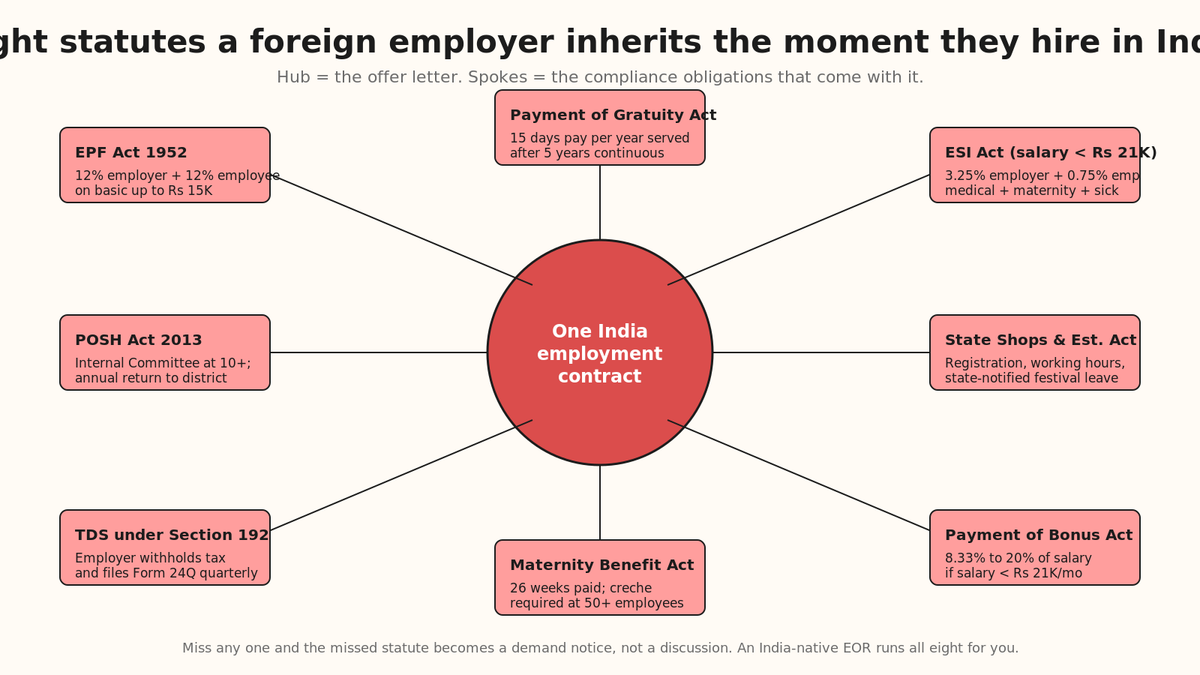
Three statutory benefits sit on top of PF and Earned Leave, and each has a specific trigger threshold that determines whether the employee is entitled to it. First-time hirers often miss the Bonus Act obligation, budget short on gratuity, and buy inadequate health insurance. Get the thresholds right at contract signing and you avoid unpleasant surprises at each annual cycle.
| Benefit | Trigger threshold | Employer obligation | Statute |
| Provident Fund (PF) | Basic + DA up to ₹15,000/month; establishment with 20+ employees | 12% of Basic (capped at ₹1,800/month for wages above ₹15,000) | Employees' Provident Funds and Miscellaneous Provisions Act, 1952 |
| Employees' State Insurance (ESI) | Gross monthly wage up to ₹21,000 | 3.25% employer share; covers medical + sickness + maternity benefit | Employees' State Insurance Act, 1948 |
| Gratuity | Continuous service of 5+ years (excludes death and disability, where triggered immediately) | 15 days of last-drawn Basic + DA per completed year of service | Payment of Gratuity Act, 1972 |
| Statutory Bonus | Salary (Basic + DA) up to ₹21,000/month; establishment with 20+ employees; employee with 30+ days service in the accounting year | 8.33% (minimum) to 20% (maximum) of Basic + DA as annual bonus | Payment of Bonus Act, 1965 |
| Group Health Insurance | Not statutorily mandatory for above-ESI-ceiling employees, but strongly market-standard for tech | Typically INR 3L to 10L family floater cover; employer pays premium | Contractual, not statutory (except ESI-covered employees) |
| Professional Tax (PT) | Applicable in most states (KA, MH, TN, WB, TS, GJ, others); state-specific slabs | Deducted from employee salary, remitted to state government; typically ₹200 to ₹2,500/year | State-specific Professional Tax Acts |
Two obligations that get missed most often: gratuity provisioning and the Payment of Bonus Act. Gratuity accrual (4.81% of Basic) sits on the employer's books from day one even though the payout obligation only triggers at 5 years of service. If you don't provision it monthly, you will discover a large accrued liability when the first employee crosses 5 years. Statutory Bonus applies to employees earning up to ₹21,000 per month gross, which for most tech hires means it does not apply, but a well-drafted contract carries a clause that acknowledges the Payment of Bonus Act to avoid ambiguity.
Health insurance is technically not statutory for above-ESI-ceiling employees, but every credible India EOR provides group medical insurance as part of the standard package. Coverage details (family floater sum insured, coverage for parents, coverage for maternity, ex-gratia coverage for pre-existing conditions) vary by carrier and by the EOR's negotiated policy. Ask for the policy schedule in writing before signing off on the offer letter. Comparing coverage between providers is one of the reasons founders switch, our Wisemonk alternatives, Multiplier alternatives, and Deel alternatives comparisons all break down insurance packages line by line.
"Gratuity shall be payable to an employee on the termination of his employment after he has rendered continuous service for not less than five years, on his superannuation, retirement or resignation, or on death or disablement due to accident or disease. The employer shall pay gratuity to an employee at the rate of fifteen days' wages based on the rate of wages last drawn by the employee concerned for every completed year of service."
— Section 4, Payment of Gratuity Act, 1972 Ministry of Labour and Employment - Gratuity
Q13. Twelve contract clauses that consistently protect you
Across every India EOR hire, the same 12 clauses show up as either present-and-working or missing-and-causing-problems-later. Use this as a checklist against any offer letter your EOR sends you.
| # | Clause | Why it matters |
| 1 | Statutory salary break-up (Basic, HRA, Special, employer PF, gratuity provision) clearly itemised | Anchors PF, gratuity, bonus math to a defensible Basic; prevents disputes at exit |
| 2 | Working hours window and time zone expectation in writing | Sets expectation on evening or overlap hours; avoids "unlimited availability" ambiguity |
| 3 | Leave policy schedule attached, with exact EL, SL, CL day counts and carry-forward caps | Prevents disputes on year-end balance and encashment at exit |
| 4 | Public holiday list attached (or referenced to EOR's state-specific published calendar) | Removes ambiguity around Diwali, Dasara, and regional festivals |
| 5 | Probation duration, probation notice, and confirmation mechanism | Establishes the initial evaluation window and how confirmation happens |
| 6 | Symmetric notice period post-confirmation, with notice pay in lieu allowed both sides | Fair-shake signal to candidate; protects both sides at exit |
| 7 | IP assignment covering work created during employment or using employer resources | Fully enforceable; standard; missing this creates ownership ambiguity |
| 8 | Confidentiality obligation surviving termination (2 to 3 years for business info, indefinitely for trade secrets) | Enforceable and defensible; the primary post-exit protection |
| 9 | Narrow non-solicitation of customers and employees (dealt-with-during-employment, defined period) | Enforceable if narrow; the practical restraint that survives Section 27 |
| 10 | Moonlighting or secondary-engagement clause requiring written consent | Manages current market expectation; enforceable during employment |
| 11 | Group health insurance, sum insured, and dependent coverage in writing | Establishes the actual benefit rather than the promise |
| 12 | Governing law (Indian law), jurisdiction (specific city courts), dispute resolution mechanism | Sets the legal forum for any dispute; standard is Indian law + city where employee is based |
One more clause worth calling out separately: the "background verification" clause. Most India EOR contracts require the employee to consent to background verification (education, prior employment, criminal record) as a condition of continued employment. This is universal and should not be treated as optional. The verification is typically run by the EOR's BGV partner during the first 30 to 60 days of employment. If you're a US or UK AI startup evaluating this stack for the first time, our best EOR for AI startups in India comparison covers how the BGV, IP, and confidentiality clauses vary by provider, and our best EOR providers in India 2026 ranking benchmarks contract quality across the top nine vendors.
"An offer of employment shall clearly specify the wages, allowances, and other benefits payable, the leave and holidays permissible, and the notice period applicable to termination by either party."
— Model Standing Orders under the Industrial Employment (Standing Orders) Act, 1946 Ministry of Labour and Employment - Standing Orders
Q14. When ramp-up salary, security deposits, and multi-currency invoicing make sense
Three requests come up frequently from first-time India-EOR hirers that are worth handling carefully because they are outside the statutory floor and each has trade-offs.
Ramp-up salary. Paying a lower salary during probation and stepping up on confirmation is legally allowed but a strong negative signal to Indian candidates. Market convention is a single agreed salary from day one, with probation acting as the mutual evaluation window. If the concern is underperformance, the answer is a well-defined probation with clear performance criteria, not a lower ramp-up number.
Security deposits. Some employers ask new hires to post a "training bond" refundable after 12 to 24 months of service. This is enforceable only if tied to a documented investment (paid training, certification, relocation) with a proportionate amount. Indian courts have consistently struck down bond amounts that are punitive or not tied to a specific reimbursable cost. For most standard EOR hires, deposits are inadvisable and hurt hiring conversion.
Multi-currency invoicing (EUR, GBP, USD to the client). The client-EOR invoice can be denominated in any currency both parties agree, USD, EUR, GBP, INR. What CAN'T be denominated in a foreign currency: the employee's salary. The employee's contract and payslip must be in INR, and the EOR pays the employee in INR from an Indian bank account. The forex conversion sits at the client-EOR invoice level. Paying the employee directly in USD would trigger foreign contribution regulation issues and complicate PF, TDS, and tax filings.
If the client wants FX-fluctuation protection, the mechanism is a policy clause where the INR salary is reviewed annually against a specified USD or EUR peg and adjusted if the currency has moved beyond a threshold (say, 8%). This is used at global tech companies with India teams and works well operationally.
Our switch EOR provider in India piece covers what happens if you decide the first EOR isn't handling any of these correctly, and our comparison of Deel vs Remote vs Multiplier and the best EOR services in India in 2026 walks through the specific handling of each of these edge cases across providers.
FAQs
Do I need to set up an Indian entity to hire one person, or is EOR always the answer for a first hire?
EOR is almost always right for the first 1 to 5 India hires. Setting up an entity (Private Limited or LLP) takes 4 to 8 weeks, costs ₹80,000 to ₹2,50,000 in setup and ₹6L to ₹15L per year in ongoing compliance, and adds directorship, statutory audit, and tax filings to the client company. An EOR onboards in 3 to 7 working days with no setup cost. The economic breakeven typically lands between the 15th and 30th India hire depending on salary and location. See our EOR vs entity in India breakdown.
Who is the legal employer, my company or the EOR?
The EOR is the legal employer for statutory purposes. PF, ESI, gratuity, income tax withholding, and the contract sit with the EOR. The client company is the "assigned company" and directs day-to-day work, sets goals, and manages performance review. For the practical differences between EOR, PEO, staffing agency, and Agent of Record, see EOR vs PEO, EOR vs staffing agency, and AOR vs EOR.
Can I change the employee's role, salary, or reporting line after hire without going through the EOR?
Role and reporting line changes go directly to the employee. Any change to compensation, benefits, working hours, location, or notice period MUST route through the EOR because those are contractual terms with the EOR as employer. The EOR issues a revised offer letter or amendment on your instruction. Handling salary changes outside the EOR breaks the legal chain and creates risk at exit.
What happens to the employee if I stop using the EOR?
The employee's employment is with the EOR, so terminating the EOR relationship terminates the employment unless you either (a) transfer to a different EOR or your own entity, or (b) end the engagement. The employee retains all statutory dues from the EOR regardless. If you're switching providers, it's a coordinated same-day termination and re-hire, with continuity of service preserved by contract between the two EORs. Our switch EOR provider in India piece walks through the handover.
What is the fastest realistic onboarding timeline from offer signed to first payroll?
3 to 7 working days for a candidate with existing PF/UAN, PAN, bank account, and current Aadhaar. 7 to 14 working days for a candidate needing UAN generation or a new bank account. The EOR issues the offer letter within 24 hours of client approval, runs background verification in parallel (5 to 15 working days), and starts the employee on the agreed date with statutory registration completed before the first payroll cutoff.
How does exit compensation work? Do I have to pay for unused leave and gratuity?
At exit, the EOR processes final settlement within 30 to 45 days: (a) salary for days worked in the exit month, (b) encashment of accrued Earned Leave above the carry-forward cap, (c) any vested performance bonus, (d) gratuity if the employee has completed 5+ years of continuous service, and (e) return of statutory deductions held in escrow. Sick and Casual Leave typically do not encash. The client bears the cost; the EOR processes and invoices.
What if the candidate has an ongoing PF account with a previous employer and doesn't want to transfer it?
They don't have to transfer it. The EOR generates a new PF contribution against the existing UAN, and the balances at the old employer and the new EOR both accumulate under the same UAN. The employee can transfer the old balance later via the EPFO portal or leave both open. Contribution at the EOR starts day one regardless.
What is the correct way to handle bank holidays and salary payment dates?
Salary is typically paid on the last working day of the calendar month or the first working day of the next month, per the EOR's payroll calendar. Bank holidays around the salary date shift payment to the previous working day. The exact date is fixed in the EOR's payroll SOP. Ask for the payroll calendar at contract signing.
Ready to hire your first person in India
If you have read this far, you are past the "should we hire in India" question and into the "how do we do this right" question. That is the exact moment where working with a partner who has done this stack a few hundred times pays back the fastest.
We are Versatile, an India-native employer of record. We are Bengaluru-based, we run our own India entity, and we handle the full statutory stack (PF, ESI, gratuity, professional tax, TDS, Shops and Establishments registration across 28 states) on the entity we operate. Our contracts carry all 12 clauses in Section 13 by default, our leave policies are pre-tuned to state-specific S&E Acts, and our onboarding SOP moves from signed offer to first payroll in 3 to 7 working days for a standard hire.
What makes our positioning different from the global-EOR incumbents (Deel, Multiplier, Remote, Rippling) is that we run India as our home market rather than as one country in a 150-country catalog. When you have an edge case, PF opt-out for a specific candidate, an unusual leave carry-forward request, a state-specific festival policy question, we handle it as a founder-led operations team, not a first-line ticket queue routed through a global support system. Our page on India-native EOR lays out how the operational model differs and what founders should ask any EOR they are evaluating.
The fastest way to figure out whether we're the right partner for your first India hire is a 15-minute call. Book a slot directly at calendly.com/the_versatile_club/30min or fill this form. Tell me the profile you're looking to hire, the target salary band, and the state (Karnataka, Maharashtra, Tamil Nadu, Delhi NCR, other) they'll be based in, and I will walk you through the exact contract, the exact leave policy, and the exact statutory stack for that specific hire during the call.
, Sagar Chainani, Founder, Versatile