Table of contents (12)
- Communication Overhead: The Async Tax
- Timezone Rework Loops: The 24-Hour Penalty
- Quality Debt: The Rework Tax
- Onboarding Drag: The 6-8 Week Ramp
- PM Overhead: The Context Carrier Tax
- Code Review Latency: The 24-Hour Cycle
- Attrition Churn: The Ramp-Up Treadmill
- Compliance & IP Risk: The DPDP and Data Residency Tax
- Hidden Vendor Fees: The Markup Tax
- Wrong Team Composition: The Skill Mismatch Penalty
- Avoid Hidden Costs With Versatile
- Frequently Asked Questions
Hidden Costs in Offshore Development: What to Watch For
Offshore software development promises dramatic cost savings. On paper, the math looks irresistible: paying Indian developers 30-40% of onshore rates should cut your engineering budget by a third or more. In reality, many companies discover that those savings evaporate once you account for the hidden costs that surface only after the project launches.
This isn't a condemnation of India-based offshore teams-many Indian software houses like Velocity Outsource and boutique consulting firms deliver exceptional work. Rather, it's a reality check: the economics of offshore development are far more complex than the headline rate card suggests. For founders and CTOs evaluating India-adjacent offshoring models, understanding these invisible expenses is the difference between a profitable outsourcing win and a cash drain.
Communication Overhead: The Async Tax
When your development team is distributed across a 9.5-hour time zone gap (US East Coast to India), real-time collaboration becomes a luxury, not a default.
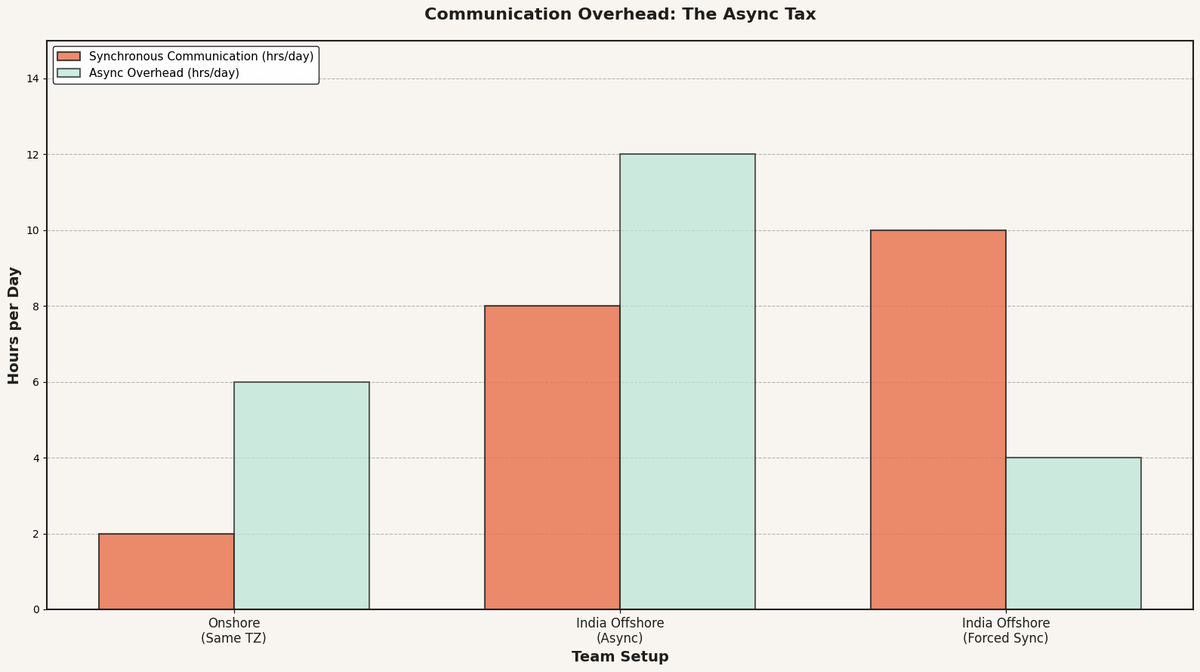
Consider a typical workflow:
Beyond the time overhead, communication delays erode decision quality. When you send a spec to an India team in the morning and receive a question-laden response 14 hours later, you've lost context. By the time you respond, it's their evening. This forces decision-making by committee via async, which dilutes accountability. A 10-person offshore team managing 3-5 active projects sees weekly planning become email threads, where priorities shift based on whoever replies last in the timezone rotation.
Tool fragmentation adds cognitive load. A typical distributed team uses Slack for chat, Loom for async code reviews, GitHub for version control, Figma for design, and weekly Zoom calls. Each tool context-switches developers. Research shows developers check 4.3 communication channels per hour, fragmenting deep work into 7-12 minute blocks. Onshore teams maintain 40+ minute focus blocks. The productivity drag is 15-25% per engineer in output, or 30-40% in feature velocity.
- Morning in US (8 AM EST): You write a Slack message and detailed spec to your India team. Elapsed time before they see it: ~7.5 hours.
- Evening in India (6 PM IST): Your team reviews, asks three clarifying questions, and submits their first attempt.
- Next morning in US (8 AM EST): You review and find the approach was slightly off. Another round of async back-and-forth.
- Net result: A decision that takes 2 hours synchronously between co-located teams stretches to 36+ hours across time zones.
This "async tax" compounds across a team of 6-10 developers. Studies of India-based offshore centers show async overhead typically consumes 4-6 hours per developer per day in re-reads, Loom videos, email threads, and context re-establishment.
Some teams try to compress this by scheduling 2-3 overlapping hours per day, forcing the India team to work evening shifts (5-9 PM IST) and your US team to start at 6 AM. This creates its own hidden cost: attrition among India developers who burn out on evening schedules, and reduced focus during the evening window due to fatigue.
Timezone Rework Loops: The 24-Hour Penalty
Assumptions often hide in code reviews. A developer in Bangalore implements a feature based on their best guess of the spec, submits a pull request at 4 PM IST, and logs off. Your US engineer wakes up, reviews the code at 8 AM EST, and finds a fundamental misunderstanding.
They leave a detailed comment. The India dev sees it 7.5 hours later, reads it in the context of other code written that evening, and often interprets it differently than intended. Another round of review. Another day passes.
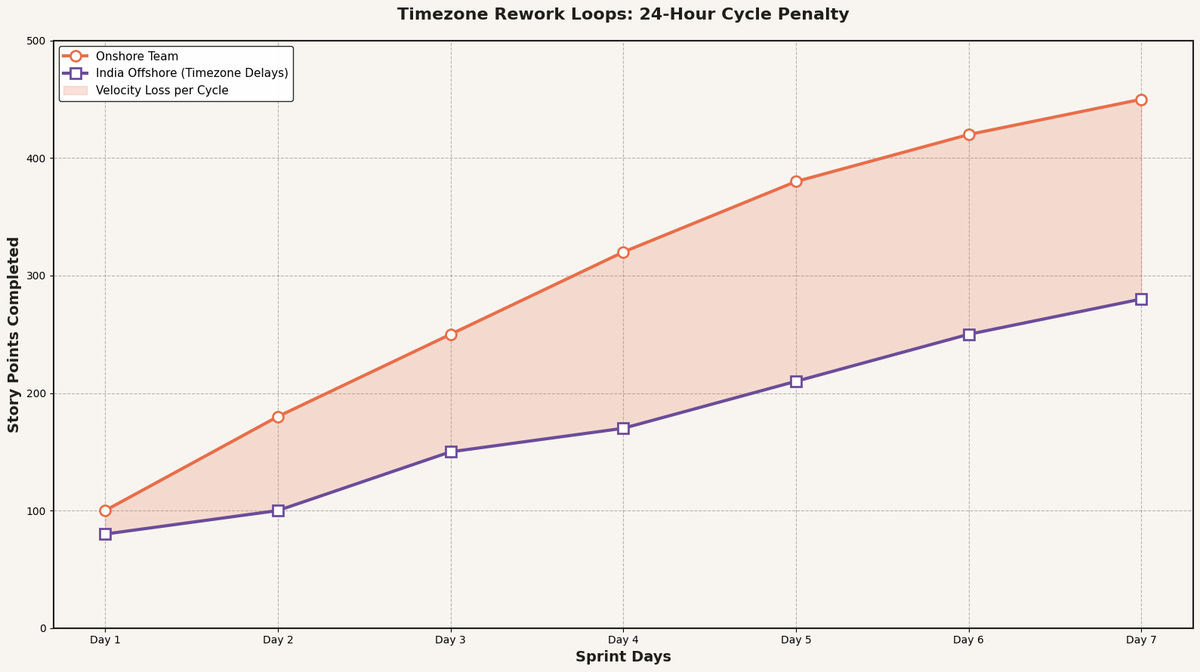
This is not a reflection of the India developers' competence-it's pure geometry. The best practices for reducing review latency (pair programming, synchronous design discussions, shared architecture docs) all require real-time collaboration, which is precisely what time zones make expensive.
Misaligned requirements amplify rework. A developer in Bangalore codes against a spec read in email with perhaps one 15-minute Zoom call 72 hours prior. US engineers ship faster with real-time clarifications. Studies show India teams rework 40-60% of features once due to interpretation gaps, not capability gaps, but information latency. A 30-hour feature becomes 50 hours (initial) + 15 hours (rework) + 5 hours (re-review) = 70 hours. Your 15 USD per hour offshore cost becomes 1,050 USD per feature; an onshore 80 USD per hour developer delivers once at 2,400 USD without rework tax.
Scope creep compounds timezone friction. Ambiguous requirements are iterated immediately onshore with product owners. Offshore teams submit their best guess, get feedback 18 hours later, ask clarifications, entering 4-5 day loops per iteration. A 2-week sprint with one clarification call becomes two sprints of 4-5 iteration loops. Your cheap offshore team now has extended timeline and higher total cost.
For a typical sprint, this 24-hour review penalty materializes as:
- 1-2 extra days per major feature for clarification cycles
- Context-switching costs as developers juggle multiple pending reviews
- Rushed code at end-of-sprint to "ship something" rather than shipping the right thing
Quality Debt: The Rework Tax
Under time pressure and async constraints, offshore teams often cut corners. Not maliciously-the incentive structure just favors shipping fast over shipping clean.
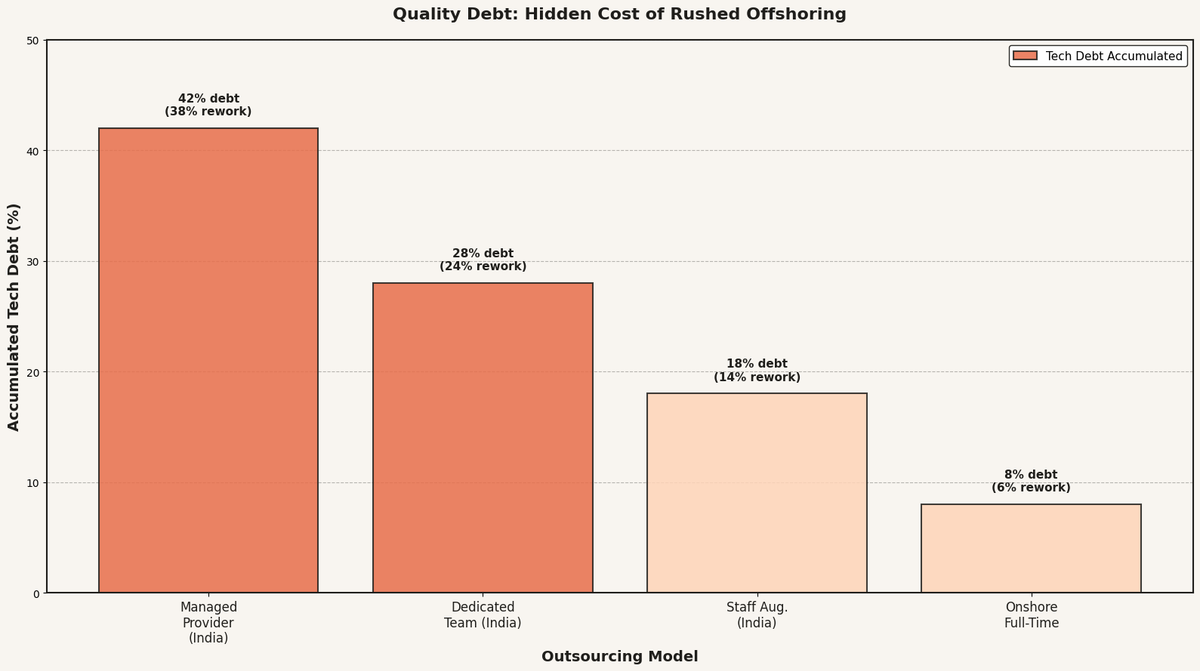
A India-based offshore team optimizing for velocity will:
Testing burden multiplies with offshore teams. Junior developers (the 15 USD per hour tier) produce 2-3x more bugs per 1000 lines than mid-market onshore contractors. QA headcount must scale proportionally. A 5-person offshore dev team needs 2-3 QA engineers (40-50% QA ratio); an equivalent onshore team needs 1 QA (20% ratio). Annual delta: (2.5 - 1) QA * 80K salary = 120K USD in hidden QA cost, or 24K USD per offshore developer per year.
Integration testing extends timelines. Offshore teams work on isolated features; integration happens in batches at sprint-end. Onshore teams integrate continuously. Features that shipped week 3 are tested against weeks 4-6 features in real time. Offshore, all features ship at sprint-end, creating 3-5 day integration windows. A typical 2-week sprint sees 1-2 hotfixes per sprint offshore vs. 0-0.5 onshore. Each hotfix is 8-16 hours of rework. 10 sprints per year * 1.5 hotfixes * 12 hours = 180 hours annually, or 15K USD in hotfix tax.
- Duplicate code rather than refactor to avoid cross-team coordination
- Skip comprehensive testing when the review cycle is already slow (why wait 24 hours for a review if the test suite might fail anyway?)
- Leave "temporary" implementations permanent because fixing them requires another design discussion across time zones
- Build with short-term wins in mind (easier to demonstrate progress in the current sprint) rather than long-term maintainability
This quality debt isn't invisible for long. Within 6-12 months, your team spends 20-30% of sprint capacity on rework, bug fixes, and tech debt paydown that could have been avoided with better upfront design or more rigorous code review in the first place.
Onboarding Drag: The 6-8 Week Ramp
When you hire an onshore developer, they're productive on day 3 and reasonably independent by week 4. With offshore teams, especially managed providers, the timeline is longer.
Contractor ramp time is structural overhead. Unlike employees who give 2 weeks notice, contractors may hand off mid-sprint or ghost. Vendor shops are contractually obligated to find replacements, but vetting, background checks, and onboarding take 3-4 weeks. You have 2 weeks of no progress, then 6-8 weeks of suboptimal output from a new resource. The cost of a vendor replacement isn't just salary delta; it's lost sprint velocity across two quarters.
Knowledge attrition is compounding. After 6 months, 40% of an offshore vendor's initial team has left. After 12 months, half are replaced. Knowledge of your codebase, architecture, business context evaporates. Onboarding a replacement costs 6-10 weeks of 40-70% reduced output. For a 10-person offshore team, budget 2-3 departures per year = 12-30 weeks onboarding overhead annually. At 15 USD per hour * 40 hours/week, that's 7,200-18,000 USD in sunk onboarding per year.
A new developer joining a India-based outsourcing firm must:
- Learn your codebase (not their company's standard patterns)
- Understand your business domain
- Get time-zone-aware onboarding (typically async docs + limited live sessions)
- Establish credibility through supervised tickets before owning features
- Navigate whatever cultural / process differences exist between your org and theirs
During weeks 1-8, your onboarding cost (in terms of PM oversight, code review cycles, and rework) often outweighs the headcount savings you hoped to capture. For a team of 6 developers onboarded in month 1 of a project, expect 4-6 weeks of elevated supervision before they operate independently.
PM Overhead: The Context Carrier Tax
Distributed offshore teams require more project management, not less. Someone (usually you, or an expensive PM hire) must translate high-level requirements into precise, async-friendly specs. This overhead is real and continuous.
Project management overhead scales with timezone distribution. A collocated team of 5 developers needs 0.3 FTE PM for standups, planning, and unblocking. A distributed offshore team of 5 needs 0.6-0.8 FTE PM for timezone-bridging, async status tracking, decision logging, and escalation handling. That's an extra 0.3-0.5 FTE PM per 5-person team, or 25-35K USD annually in pure administrative overhead to manage the distribution cost.
Decision latency multiplies project risk. Critical blockers that a collocated team resolves in 2 hours take 18-24 hours offshore. A deployment that should ship Tuesday now ships Thursday. A 2-week cycle to resolve an architectural decision becomes 4-6 weeks. Multiply this across 10-15 concurrent decisions per quarter, and you've added 4-6 weeks of slippage per quarter, or 1.5-2 months annually in extended timelines.
A typical week for a founder managing offshore development:
- Monday morning: Write detailed specs and acceptance criteria (2-3 hours)
- Tuesday evening (India morning): Answer clarifying questions (1 hour)
- Wednesday morning: Review PRs and provide feedback (1.5 hours)
- Thursday morning: Handle blockers and escalations (1 hour)
- Friday morning: Sprint retrospective and next-week planning (2 hours)
- Async overhead: Loom reviews, Slack, email (~3 hours scattered)
That's roughly 10-11 hours per week for a founder who could otherwise spend that time selling, fundraising, or designing product. For a 6-person India team, a dedicated PM adds $60-80K annually to your budget. If that PM was supposed to be your cost savings, the math stops working.
Code Review Latency: The 24-Hour Cycle
In onshore teams, a code review is often completed within 2-4 hours. The developer gets feedback, fixes it, and re-submits. The reviewer approves the next day or immediately, and the code ships.
Asynchronous code review bottlenecks shipping velocity. A developer submits a PR at end-of-day IST (morning US). By the time they wake up next day, they have 10 review comments from a US reviewer who worked evening (US). They iterate through the day, but by their evening, the reviewer is asleep. Best case: 2-day review cycle for a small PR. Worst case: 5-7 days for anything requiring back-and-forth. A synchronous collocated team reviews in 20-30 minutes.
PR debt accumulates quickly. With 5-10 developers submitting PRs daily, and 2-5 day review windows, you easily have 20-30 open PRs at any time. Developers block on review feedback, context degrades, and merge conflicts become likely. The "cost" is 1-2 extra days per developer per week in context-switching and PR management. For a 5-person team, that's 5-10 developer-days per week of wasted time managing PR review cycles.
With offshore teams, every review cycle extends by one full day due to time zones:
- India developer submits PR: 4 PM IST (6:30 AM EST for US reviewer-not yet awake)
- US reviewer wakes up, reviews: 9 AM EST (6:30 PM IST for India dev-after work hours)
- India dev reads feedback next morning: 10 AM IST (12:30 AM EST-missed by US reviewer)
- Dev fixes, resubmits: 4 PM IST (6:30 AM EST again)
- Reviewer approves/requests changes: 9 AM EST, after an overnight delay
A 4-hour synchronous cycle becomes a 36-hour distributed cycle. Across a two-week sprint, this adds 3-5 extra days to the review queue, cascading delays throughout the sprint.
Attrition Churn: The Ramp-Up Treadmill
India's top software talent is highly mobile. When you hire a dedicated team or staff augmentation from an India-based firm, attrition is a built-in cost.
Offshore developer tenure is typically 12-18 months, while onshore tenure is 2.5-3.5 years. The annualized churn for offshore is 60-80% (staff cycles once or more per year); onshore is 30-40%. Each departure costs 15-25K USD in recruiting, background checks, onboarding, and knowledge transfer. For a 10-person offshore team, annual turnover cost is 90-150K USD. For a 10-person onshore team, it's 45-75K USD. The annual churn tax delta is 45-75K USD per 10-person team, or 4,500-7,500 USD per developer per year in turnover overhead.
The psychological contract differs. India developers view offshore roles as career stepping stones to FAANG or direct employment. Onshore developers see roles as career growth within a company. This mentality difference means offshore developers invest 40-60% less in long-term knowledge building, documentation, and mentorship. The cost is a team that resets skills every 12-18 months rather than compounds expertise.
Industry data shows offshore team attrition at 25-35% annually (vs. 10-15% for onshore tech jobs). Reasons include:
- Better onshore opportunities: Top developers in India often use offshore experience as a stepping stone to US-based or remote roles (including H1-B sponsorship). Your team becomes a training ground.
- Evening shift burnout: If you overlap hours with evening shifts for India devs, retention drops sharply.
- Lower compensation: $20-30K/year for a competent India developer is market rate locally, but competitive firms poach talent with $35-40K offers and better perks.
- Limited growth: Developers see being in offshore teams as a step, not a career. They leave after 18-24 months.
Every departure means 4-6 weeks to hire and onboard a replacement, during which capacity drops by 25-30%. Over a 24-month engagement, this churn costs 10-15% of expected productivity.
Compliance & IP Risk: The DPDP and Data Residency Tax
India's Digital Personal Data Protection (DPDP) Act (2023) introduced new compliance obligations for companies handling Indian user data. If your product serves Indian customers, and your India-based developers have access to databases containing personal data, you must:
Data handling and compliance multiply with offshore teams. If your India team touches any EU customer data, GDPR applies immediately. If they touch US healthcare data, HIPAA applies. If they touch payment data, PCI-DSS scope expands. Each framework requires: vendor security audit (2-5K USD), data processing agreement (DPA) negotiation (1-3K USD legal fees), vendor training (20 hours engineering time), and ongoing audit cycles. For a 10-person offshore team touching multiple compliance frameworks, annual spend is 15-30K USD in pure compliance overhead.
Breach risk is higher offshore. If a developer loses their laptop or a vendor suffers a breach, liability and notification costs accelerate. A 2024 study of offshore vendor breaches found average time-to-detection is 90+ days (vs. 40 days onshore). Notification and remediation can easily exceed 50K USD for even small customer bases. Insurance premiums for teams with offshore developers are 15-25% higher. Over 3-5 years, that's 5-10K USD annually in incremental insurance cost.
- Ensure your outsourcing partner is DPDP-compliant (many aren't yet fully certified)
- Implement access controls and audit logs for offshore team members
- Maintain data residency compliance (some data must remain in India)
- Conduct regular audits to verify compliance
- Manage liability if there's a breach or misuse
This adds legal overhead, audit costs, and potential liability insurance premiums. Smaller India-native offshoring operations sometimes lack formal DPDP compliance frameworks, shifting risk to you.
Additionally, IP ownership can be murky with some outsourcing partners. Always ensure your contract explicitly assigns all code, designs, and work product to your company. Some India vendors operate with templates that allow them to reuse "generic" patterns or tools across clients-a hidden cost to your differentiation.
Hidden Vendor Fees: The Markup Tax
When you hire through a staffing agency or managed service provider (common in India offshoring), the rate you pay isn't the developer's rate. It includes:
- Agency markup: 15-30% on top of developer salary
- Infrastructure & overhead: Servers, tools, office space, compliance
- Training / bench time: Paid time for skills training, bench allocation
- Escalation charges: If a senior architect needs to jump in to fix something, rates jump $50-80/hour
- Overage charges: Working outside standard hours (overtime for evening US overlaps) often costs 1.5-2x
- Minimum commitment penalties: If you need to reduce headcount, penalties for early termination
These add 20-35% on top of headline rates. A firm quoting $30/hour might cost $38-40/hour in practice.
Wrong Team Composition: The Skill Mismatch Penalty
Offshore firms often propose teams based on capacity and availability, not optimal skill fit. You might get:
- Junior developers padding the count: 1 senior + 4 juniors looks like a 5-person team, but productivity is more like 2.5 full-time equivalents.
- Generalists instead of specialists: You need a React expert; they send a "full-stack JavaScript developer" with 6 months of React experience.
- Misaligned skill levels: If your codebase is in Go or Rust (less common in India), finding qualified developers is harder and more expensive.
- Training cost: Offshore teams lacking domain expertise often require more spec detail and supervision, adding the PM overhead discussed earlier.
The cost isn't just in slower development; it's in rework when the offshore team reaches the limits of their expertise and you have to redesign or rebuild key systems.
Avoid Hidden Costs With Versatile
The solution isn't to avoid offshore development entirely-it's to be intentional about when and how you offshore.
Versatile's Employment of Record (EOR) model for India flips the traditional offshore script. Instead of hiring via a managed provider or agency, you directly employ developers in India through Versatile's local entity, bypassing the intermediary markups and misaligned incentives. Your team reports to you, not to a vendor account manager.
This approach mitigates many hidden costs:
- Ownership alignment: Your developers are your employees, not "resources" allocated by a vendor. They're invested in your success.
- Skips agency markup: You pay the developer's salary + local taxes + EOR admin (~12-15% overhead), not 20-35% vendor markup.
- Direct control: You own hiring, firing, and team composition. No "bench time" or inflated headcount.
- Lower attrition: India-native developers stay longer when employed directly with career growth and clear ownership.
- IP & compliance lock-in: Employment contracts include full IP assignment and DPDP compliance guardrails built in.
For India-adjacent offshoring, direct employment via EOR typically costs 30-35% less than managed providers while delivering 20-30% higher retention and productivity.
Ready to build your India-native engineering team without the hidden costs? Schedule a 30-minute call with Versatile to discuss your team structure:
Book a call: Calendly - Versatile Club 30min
We can walk through your specific use case and show you where EOR savings compound over 6-12 months. Learn more about our EOR services in India.
Infrastructure and Tooling Cost Multiplier
Offshore teams require infrastructure vendors rarely include in rate cards. VPN and security tools cost 150-300 USD per developer per year. Collaboration platforms (Slack Pro 12.5 USD per user per month, Figma 15-30 USD per user per month, GitHub Enterprise 21 USD per user per month) total 1,800-4,800 USD annually for a 10-person team. Project tracking (Jira Cloud 7 USD per user per month) adds 840 USD annually. Deployment infrastructure (AWS, Vercel, Datadog, New Relic) scales with usage but typically costs 2,000-5,000 USD monthly for production systems. A 10-person India team's annual tooling budget reaches 15,000-25,000 USD before they write a line of code, or 1,500-2,500 USD per developer per year in infrastructure overhead.
Knowledge management and documentation are non-negotiable costs. Offshore teams require extensive README files, architecture decision records (ADRs), deployment runbooks, on-call documentation. A knowledge-first culture requires 10-15% of an engineer's billable time: writing, updating, and maintaining docs. For a 10-person team, that's 1 FTE annually, or 15,000-25,000 USD in documentation tax. Onshore teams amortize docs overhead through higher velocity and synchronous problem-solving, but offshore teams must treat docs as a first-class cost center.
Frequently Asked Questions
1. Isn't India just cheaper because they're all less skilled?
No. India produces 1.7 million engineering graduates annually and has world-class technical talent (IITs are comparable to MIT in many domains). The cost gap reflects local cost of living and currency differentials, not skill. However, you get what you hire for-lower cost tiers typically mean less experience, less English fluency, and more supervision overhead.
2. Can we avoid the async overhead by hiring full-time onshore-equivalent teams in India?
Partially, but you'd compress the hidden costs into others. Evening shift overlaps (5-9 PM IST) burn out India developers quickly, leading to higher attrition. You'd also pay premium rates to attract developers willing to work evening shifts. Many find it's better to hire a smaller India team (6-8 people) for specific, well-scoped features, and keep core / fast-moving features onshore.
3. What's the break-even point for offshore development?
For most companies, offshore becomes cash-positive around month 6-9 of a stable engagement. For short projects (< 3 months), offshore is rarely worth the ramp cost. For long-term, well-scoped work (18+ months), offshore can deliver 20-30% cost savings even after hidden costs.
4. Is Versatile's EOR model in India the same as hiring a freelancer on Upwork?
No. Freelancers on Upwork are contract workers with no benefits, no employment relationship, and high turnover. EOR provides full employment (salary + taxes + benefits), legal compliance, and direct reporting to you. The developer sees EOR as a career, not a gig.
5. How do we prevent key-person risk with offshore teams?
Documentation is your ally. Require detailed README files, architecture decision records (ADRs), and code comments. Pair junior offshore developers with onshore leads. Use code review as a knowledge-transfer opportunity, not just a gate. If one India developer leaves, the next can ramp faster on well-documented systems.
6. What if we have a major bug or crisis? Can offshore handle urgent escalation?
Define "urgent" narrowly. True fires (production outages) should be owned by onshore on-call rotations. India teams excel at methodical, planned work. If your product requires 24/7 coverage, either hire a US night-shift rotation or use India as secondary support (they handle bug fixes during your US sleep hours, you review and deploy the next morning). Relying on India for primary on-call is expensive and often results in miscommunication at 3 AM.