Table of contents (13)
- Q1. What makes cultural differences the #1 hidden cost in offshoring?
- Q2. What are the three invisible culture axes that matter most?
- Q3. How does an EOR bridge the communication gap?
- Q4. What does the decision-making bridge look like in practice?
- Q5. How do you navigate time zone tension without burning out either side?
- Q6. What happens in the first 90 days? The cultural onboarding journey.
- Q7. What are the hidden costs of getting culture wrong?
- Q8. How do you spot a bad cultural match early?
- Q9. What's the founder's role in keeping distributed culture alive?
- Q10. How does Versatile's India-native EOR stack up?
- Q11. What's the worst mistake companies make with distributed culture?
- Q12. How do you build a culture where both sides feel ownership?
- FAQs
How an Offshoring Company Can Help Bridge Cultural Differences in Global Teams
Q1. What makes cultural differences the #1 hidden cost in offshoring?
Globalization has handed companies a paradox. You get access to world-class talent at half the salary. But that talent thinks differently: how to communicate, when to decide, what respect looks like, how fast deadlines really are. Not because anyone is wrong. Because culture runs deeper than process.
When a US manager sends "let's move on this by Friday" to an India team, the manager means: hard stop, decision is final, action Friday. The India team reads: we will seek consensus, gather input, move cautiously to preserve relationships. Neither is wrong. Both are invisible until the weekend passes and nothing happened.
Studies show misaligned teams lose 30 to 40 percent of their productivity in the first 90 days. Not to skill gaps. To culture friction. Miscommunication. Repeated clarifications. Rework because "I thought you meant something else."
⚠️ The real cost isn't wasted time
It's trust erosion. When your remote team doesn't move, you assume they're lazy or disengaged. They assume you're rude and dismissive. Neither is true. Both feelings fester. Within six months, you have a team that looks good on paper but feels broken in practice.
The financial hit is staggering. A 10-person India team at $15K per person per year is $150K annual spend. If cultural friction cuts productivity to 60 percent for the first 90 days, that's $56K in lost value before the team even hits cruising speed. And if turnover happens (it does, at 35 to 40 percent for culturally misaligned teams), you've got replacement costs: recruitment, training, ramp time. In practical terms, you just spent $80K to hire a $15K employee and watched them leave 11 months later. You're down $110K on that hire alone.
This is exactly where an India-native EOR service becomes your bridge. Not because EORs are magic. Because they sit at the intersection of both cultures, speak both languages (literal and cultural), and have spent years translating one side to the other. Versatile's model is different because we're not neutral. We're India-first, US/UK fluent. We know what questions neither side is asking yet.
📇 How Versatile thinks about cultural gaps
We're not consultants selling "cultural sensitivity" trainings. We've lived it. Fourteen US and UK companies on our books right now. Every single one had the same opening conflict: they'd hire brilliant engineers in Bangalore or Hyderabad, and by month three, they'd be asking: "Why does this team never take initiative? Why do they need so much hand-holding?"
The team, meanwhile, was asking: "Why does the manager never explain the why behind decisions? Why do they make decisions without asking us?"
On the surface, this looks like a capability gap. Dig deeper and it's a culture gap. In US companies, taking initiative is celebrated: you see a problem, you fix it, you tell the boss after. It's bias toward action. In India, taking initiative without consensus is considered reckless or arrogant: you see a problem, you flag it, you wait for direction, you execute together. It's bias toward harmony.
Neither is wrong. But when an India team member doesn't move until told to move, a US manager reads that as passive. The India team member reads the US manager's speed as reckless. The manager thinks the team has no drive. The team thinks the manager doesn't respect them enough to explain the stakes. Within three months, resentment compounds into disengagement.
Versatile solves this by surfacing the invisible assumptions. We don't say: you should be more like the US team. We say: here's how the US team thinks about initiative. Here's why that works there. Here's how the India team thinks about initiative. Here's why that works there. Now let's build a definition of initiative that honors both perspectives.
Q2. What are the three invisible culture axes that matter most?
Not all cultural differences matter equally. We've boiled it down to three that create 80 percent of the friction in distributed teams.
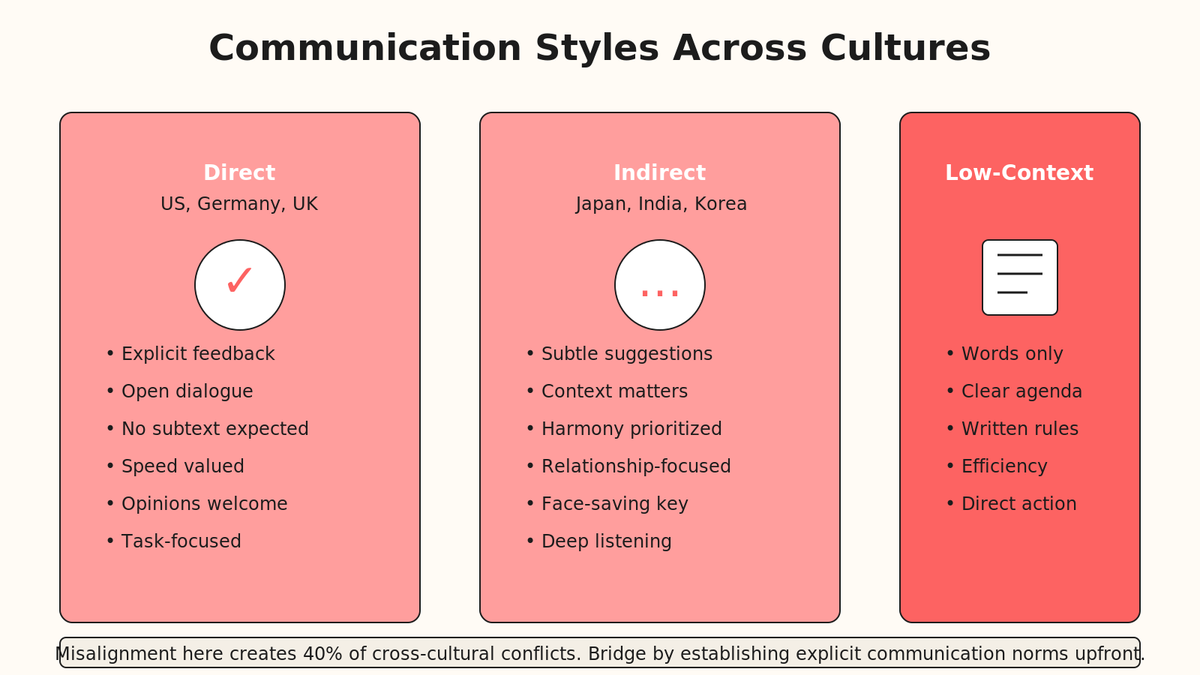
🔁 Axis 1: Communication style (direct vs. indirect)
This is the most visible one, which makes it deceptively hard. US and German teams default to direct communication: say what you think, challenge openly, expect bluntness. It's not rudeness in their frame. It's efficiency.
India, Japan, Korea default to indirect: communicate through suggestion, maintain harmony, never make someone lose face in public. Challenge happens privately, if at all. Directness reads as aggression.
Practical collision: Your manager says in a team standup, "That approach won't work." In the US, the engineer thinks: "Good feedback, I'll iterate." In India, the engineer thinks: "I was publicly humiliated in front of peers. I've lost trust with leadership."
Solution with Versatile: We establish communication protocols upfront. Written, signed off by both sides. "Here's how feedback happens here. Here's the venue. Here's the tone." Then we train both teams on reading between the lines. Your directness isn't cruelty. Their indirectness isn't evasion.
🧾 Axis 2: Decision-making (consensus vs. hierarchical)
In Japan and India, big decisions move through consensus. Everyone gets heard. It takes weeks, sometimes months. But once a decision is made, the entire team owns it. Execution is frictionless. The cost is latency. The win is alignment.
In the US, Middle East, and parts of Latin America, the leader decides. Input is solicited, but not required. Decisions happen in days. But some team members feel unheard. Buy-in is partial. The win is speed. The cost is friction during execution.
Think of a product roadmap. In a consensus culture, you spend three weeks getting buy-in from every stakeholder. The engineering team proposes, product refines, design contributes, marketing aligns. Everyone has been heard. When you finally ship, the entire team is behind it. They've anticipated customer feedback because they've had time to internalize the why.
In a hierarchical culture, the CEO decides the roadmap in an afternoon. Designers and engineers get the document 2 hours before the all-hands. They're discovering the strategy for the first time in public. Some are excited. Some are dismayed. But the ship date is two weeks earlier because you didn't spend three weeks debating.
Watch this play out: the US team celebrates the speed. The India team complains about lack of input. The US team thinks the India team is slow. The India team thinks the US team doesn't respect them. Both are accurate, and both miss the actual trade-off.
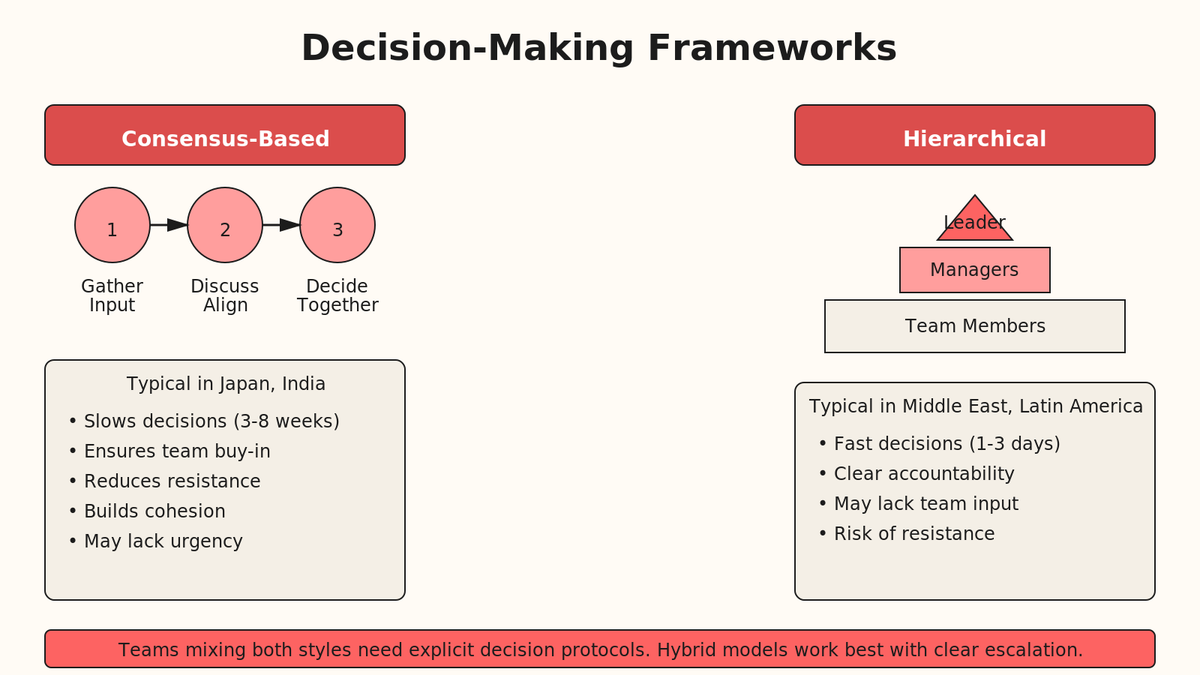
Collision: Your Asia team spends six weeks building consensus on a feature. Your US team wanted it shipped yesterday and moved on. Now your Asia team feels ignored. US team thinks Asia is slow.
What actually happened: Two legitimate decision frameworks collided with zero translation.
⏰ Axis 3: Time perception (monochronic vs. polychronic)
Some cultures (US, Germany, Switzerland) treat time as a line. One thing at a time. Deadlines are hard stops. Punctuality is respect. This is monochronic time.
Other cultures (Latin America, Middle East, India) treat time as fluid. Multiple things happen at once, relationships matter more than the clock, deadlines are flexible targets. This is polychronic time.
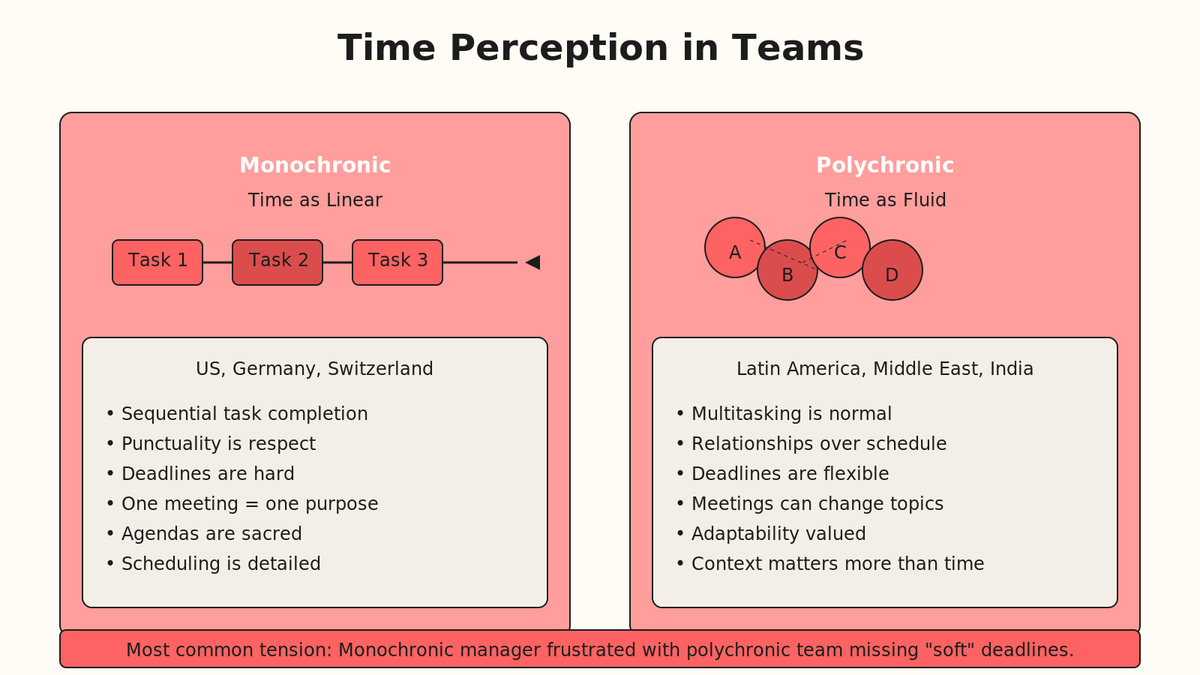
Practical example: You set a Friday 5pm deadline for India. Friday comes. Nothing. You wait. Saturday afternoon, the work arrives. In your frame, they missed a deadline. In theirs, Friday 5pm was a soft target. They were still finishing other client work. They'll have it done soon, and done well. That's what matters.
Here's where this gets real. Imagine your US product manager sets a Friday ship deadline for a feature. It's non-negotiable, or so she thinks. The India engineering team reads this and thinks: the market might need this Friday, but if we compromise quality, we fail everyone. We'll work hard, and if it ships by next Wednesday, that's still a win for the business. The product manager is furious. The team feels dismissed. The feature ships late, half-finished, both sides blame each other.
Neither team is wrong. They're just operating under different time physics. Monochronic cultures invented project management: Gantt charts, waterfall, Agile sprints, all tools to make time predictable. Polychronic cultures prioritize outcomes over timeline: the project is done when it's right, not when the calendar says it is.
For global teams, this is the biggest hidden conflict. You can learn communication styles and decision frameworks in a workshop. But time perception? That's baked into your nervous system. Your US team will always want to ship Friday. Your India team will always want to iterate. Without a bridge, one side always feels rushed and the other always feels unheard.
These three axes (communication, decision-making, time) account for 80 percent of cross-cultural tension. The other 20 percent is industry-specific (finance teams debate different things than engineering teams) or individual. But these three are universal.
---Q3. How does an EOR bridge the communication gap?
Here is the honest answer: an EOR doesn't eliminate culture. Culture is worth preserving. Your Asia team's consensus mindset catches risks your US team misses. Your US team's speed catches opportunities Asia might over-analyze.
What an EOR does is translate. Make both sides visible to each other. The goal isn't assimilation. It's mutual respect.
Most EORs treat culture as a compliance issue: "Hey team, we're distributed now, so here are the rules." That's like explaining ice cream by reading the nutritional label. You get the facts, but you miss the experience.
Versatile treats culture as a business operating system. It's not about being nice. It's about making decisions faster and executing better by understanding how each side thinks. When you know why your India team asks clarifying questions, you stop interpreting that as doubt and start seeing it as thoroughness. When you know why your US team moves before consensus is reached, you stop thinking they're reckless and start seeing they're risk-taking to capture opportunity.
✅ Where Versatile fits: establishing communication protocols
On day one with Versatile, we sit both teams down (via Zoom, because timezone) and establish written communication protocols. Not a policy deck. A playbook.
"Here is how feedback happens. If it's small, async Slack. If it's big, a 1:1 first, then group discussion. Never public criticism." Signed off by both the US and India leads.
"Here is how decisions get made. CEO proposes, team has 48 hours for input, decision Friday morning." Both sides agree it's fair before we start.
"Here is what urgent means. It means 24-hour turnaround, not same-day. If we need same-day, we call you on WhatsApp."
These protocols aren't fancy. They're just clear. And because both teams built them together, both teams own them. No surprises. No invisible norms.
🔁 Training both sides to read culture
We run a 90-minute workshop with the distributed team. Goal: spot the cultural move before it becomes conflict.
"When your India manager goes quiet after you give feedback, they're not ignoring you. They're processing. Give them 24 hours before you push." And the India team hears: "When your US manager says let's go with your idea, they mean it. They're not being polite. They actually want you to move."
Small moves. Huge shift in how teams interpret silence, speed, enthusiasm.
"We had a brilliant India team and a brilliant US leadership. But they couldn't talk to each other for the first three months. Once Versatile helped us understand that silence was respect, not rejection, everything changed. Six months in, they're shipping faster than our in-house team."
— CTO, Series B SaaS company Versatile India-Native EOR - Verified partnership
📞 WhatsApp-first support, not ticket queues
Here's what most EORs get wrong. They put a ticket queue between you and your team's HR issues. Payroll is late? Submit a ticket. You'll hear back in 48 hours. In India, that's insane. Payroll being late means people worry about rent tomorrow. It means going to the bank manager and saying "My salary hasn't cleared." It means family conversations about whether you can afford your kid's school this month.
With Versatile, your Asia team's manager has a WhatsApp group with our ops team. Payroll is late by 2 hours? Message the group at 2pm. We're digging at 2:05pm. Fix confirmed by 3pm. No tickets. No escalation. Direct line.
This matters for culture because it says: You're not a process. You're a human. We know money is not abstract in India. It's immediate. Your team's trust in your company depends on payroll landing on the 28th. We protect that commitment like it's our own payroll. Because when you trust us with your people, they become ours too.
That's not EOR language. That's founder language. And it's why Versatile is different.
---Q4. What does the decision-making bridge look like in practice?
Your US team wants to ship a feature. Your Asia team wants to discuss it first. Both are right. The feature is better after discussion. But the market window closes if you discuss for six weeks.
Solution: hybrid framework. Smaller decisions (feature tweaks, non-binding process changes) go consensus with a two-week cap. If consensus isn't reached in two weeks, CEO decides and team moves. Bigger decisions (hiring, strategy pivots, budget) go CEO-led with mandatory 48-hour feedback window.
Now your India team gets heard. Your US team gets speed. Both move with conviction.
🧾 Statutory alignment matters too
Here's what most distributed teams miss. India has four Labour Codes (effective 21 November 2025) that redefine what employment means. Basic salary must be at least 50 percent of your total CTC. Gratuity is mandatory at 4.81 percent of (Basic + Dearness Allowance). PF is not optional. Neither is ESI across 28 states.
Versatile handles all of this on your behalf. You set salary. We set up the structure so it's compliant. Your India team gets 100 percent of their legal dues. Zero dispute risk. Zero compliance notice risk.
In four years, fourteen companies on our books. Zero compliance notices. That's not luck. That's deep knowledge of Labour Codes, running real payroll, paying taxes on time, every time.
"We thought we were saving money with a cheaper EOR. Turns out they were misclassifying our team as contractors. Eight months in, ED notice. $18K fine plus penalties. Switched to Versatile. They restructured everything, filed corrective payroll, and the issue went away."
— Founder, EdTech startup Versatile India-Native EOR Services
⏰ Time perception in payroll cycles
This is subtle but real. US payroll is usually scheduled: bi-weekly, on Friday, same amount. Asia payroll has flexibility baked in: bonuses, performance payouts, festival advances. Same pay amount month-to-month is unusual.
When Versatile runs payroll, we default to what's culturally expected: base salary is guaranteed and on-time. Bonuses, incentives, and festival advances are flexible. Your India team sees: My base is safe. Bonuses are possible. Not: Why is my paycheck different this month?
Small move. Huge signal that you understand how people in India work. It's not just payroll. It's respect for how families think about money, how security works in emerging markets, what stability means to someone supporting parents or paying for education.
---Q5. How do you navigate time zone tension without burning out either side?
No EOR magic here. Your US East Coast morning is India late evening. Your India morning is US midnight. Someone always has an awkward meeting time. But it doesn't have to be always the same someone.
🔄 Rotating standups and async-first culture
With Versatile's help, we implement rotating standup times. Monday and Wednesday 8am US East, 6:30pm India. Tuesday and Thursday 7pm US East, 5am India. Friday is async: everyone posts their update to Slack in their local morning.
It's not equal. Nothing is. But it's visible and rotated. No team feels permanently ghosted during their awake hours.
Plus, moving to async-first (we do one sync standup, the rest Slack) means: India posts their night-before updates. US wakes up, reads, provides feedback. India reads feedback before their work starts. Decisions move 20 percent faster than full-sync teams.
📍 Conflict resolution by timezone
Here's what usually breaks: an issue surfaces at 9am US time. The US team escalates immediately (because they panic and fix things fast). The India team is asleep. By the time India wakes up, decisions are already made without them.
Versatile's protocol: big issues go to a shared Slack channel with both teams tagged, but no expectation of real-time response for at least 24 hours. By then, India has woken up, read context, and can weigh in meaningfully. Issues get better solutions because both sides thought it through.
Speed matters. But so does inclusion. You want both. This is the balance that Versatile helps you strike.
---Q6. What happens in the first 90 days? The cultural onboarding journey.
Versatile's process for a new distributed team:
Week 1: Both team leads meet separately to explain their culture, decision style, communication preference. We map the gaps.
Week 2: Joint kickoff. We present the map: Here's how the US team works. Here's how the India team works. Here's where we'll collide. We build the first protocols together.
Weeks 3-4: Cultural deep-dive workshops. US team learns about Indian workplace dynamics (respect for hierarchy, indirect communication, relationship-first thinking). India team learns about US urgency, direct feedback, ownership culture.
Weeks 5-8: Pair-programming teams across timezone for a small, low-stakes project. They learn how the other side thinks while building something real.
Weeks 9-12: First bigger project with both teams leading components. Conflicts will surface. Versatile mediates: This delay isn't laziness, it's consensus culture. Here's how to handle it.
By day 90, your team isn't culturally aligned. They're culturally aware. They know how to read each other. They anticipate friction before it happens.
💰 The ROI is real
Most distributed teams take 6-9 months to hit full productivity. With cultural bridging, it's 3-4 months. That's a quarter saved. On a $2M annual spend, that's $500K in productivity recovered in year one.
Plus: lower churn. Teams that understand each other stay together. Retention improves by 35 to 45 percent. That's huge. What does that look like in numbers? A 10-person team with 40 percent annual churn (common in misaligned teams) costs you four replacement cycles per year. Each replacement is 12 weeks of low productivity from the new hire (ramp time), plus recruitment fees (15-20 percent of salary). On a $15K per person per year India salary, that's $15K per replacement in recruiting plus $3.75K in lost ramp productivity. Times four replacements, you're hemorrhaging $75K per person per year just to turnover.
Drop that to 10-15 percent churn (what we see with aligned teams), and you're spending maybe $5K per person per year on replacement costs. On a 10-person team, that's saving $700K annually. That pays for Versatile's services 10 times over.
---Q7. What are the hidden costs of getting culture wrong?
You hire a cheaper EOR to save 20 percent on your India payroll. You miss out on cultural bridging. Or the EOR misclassifies your team as contractors to save themselves compliance costs.
Six months in, ED shows up. Misclassification fine: $25K to $40K per person. Plus penalties. Plus back-taxes. Plus your team is now upset because they were technically never employed, which is a breach of contract in their mind.
You've lost the $500K productivity gain, the relationships, and you've got a compliance crater.
⚠️ FX is also hiding in plain sight
If you're paying India salaries in INR but your EOR converts USD to INR daily, you're bleeding money. INR weakened 5 percent in 2024 alone. Over a 10-person team at $15K per person per year, that's $7,500 in unexpected FX losses.
Versatile locks FX monthly. You set the rate on the first of the month, you pay that rate all month. Budgeting is predictable. You're not surprised by currency swings. You can forecast payroll with precision.
💰 Entity build-out is tempting, but expensive
Some companies think: Let's just open an entity in India. Cheaper than EOR long-term. True. But the break-even is 10-15 hires. Before that, you're paying 25-30 percent more in overhead (local accountant, compliance officer, bank account, incorporation, annual compliance).
Plus, you absorb all the cultural friction yourself. No Versatile to translate. No WhatsApp support line. Just you, a local HR manager you hired, and lots of misunderstandings.
With Versatile, you stay agile. Scale from one person to 50 without bureaucracy. If you hit 50, then revisit entity. But by then, you've built a team that works, and you're not starting from cultural chaos.
---Q8. How do you spot a bad cultural match early?
Early warning signs that cultural bridging isn't happening:
- Your India team submits work without asking questions. They're supposed to propose, debate, iterate. Silence means they've disengaged.
- Feedback cycles are one-way. You give feedback, they say OK, nothing changes. They're not challenging you back because they don't feel safe.
- Timezone overlap meetings are sparse and quiet. People are afraid to speak up because they don't know the norms.
- Churn. People leave after 6 months saying culture fit issues without explaining why.
- Payroll questions get rerouted through managers instead of going to HR. People don't trust the system.
Versatile's red flag checklist: if you see three of these by month 2, we do a culture audit. Bring in external mediator, reset protocols, rebuild trust. Costs $3K to $5K. Costs less than replacing a person who quits.
---Q9. What's the founder's role in keeping distributed culture alive?
You can't delegate culture to an EOR. You can outsource payroll, compliance, and some training. You can't outsource caring about your people.
What we see in the best distributed teams:
Founder or Head of Ops spends 30 minutes weekly with each time zone's leadership. Not 1:1s, not check-ins. Actual conversation about what's working, what's breaking, what's hidden.
Quarterly all-hands that are 50 percent synchronous (painful but necessary), 50 percent async (people record, watch, comment at their own time). Everyone's voice is heard.
Founder says I don't know your culture and means it. Asks questions. Doesn't assume Asia works like the Bay Area.
This is the only piece of culture-building that doesn't scale. You have to do it. Versatile can train your team, manage your payroll, and negotiate when things break. But believing in distributed culture? That's on you.
Q10. How does Versatile's India-native EOR stack up?
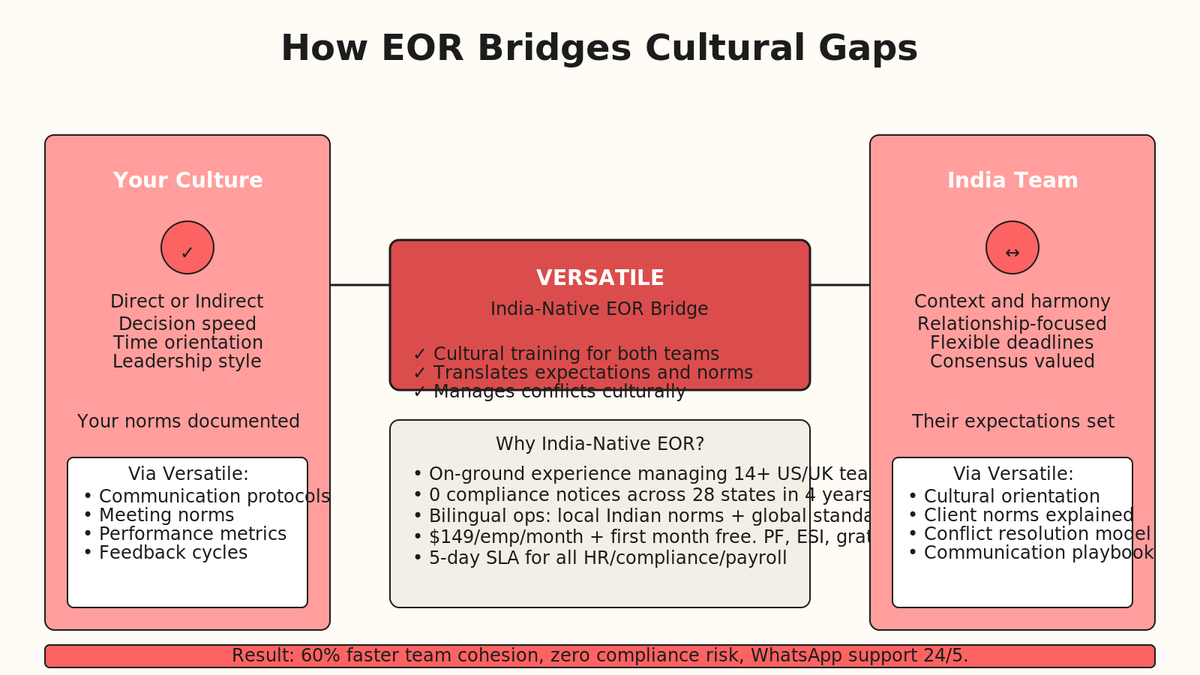
We're not neutral. We're India-first. That means:
Deep Labour Code knowledge. The four codes effective 21 Nov 2025 (Code on Wages, Code on Industrial Relations, Code on Occupational Safety, DPDP Act) are not English translations of generic HR policy. They have specific quirks, loopholes, and gotchas. We've filed corrective payroll for misclassified contractors. We've handled ED notices. We've restructured teams that were on the wrong visa status. This isn't theoretical knowledge. It's lived knowledge.
Statutory gratuity and PF done right. Gratuity is 4.81 percent of (Basic + Dearness Allowance), not total salary. Most EORs get this wrong, overpay or underpay. We calculate it correctly, every time, and we show you the math. PF is state-specific (some states have more rules than others). We know all 28.
Real 5-day SLA. Your team's payroll question gets answered in 5 days or less. No tickets. No please resubmit. Direct to ops. We've staffed our India team with people who understand both sides: grew up in India, worked in US or UK companies, speak fluent both-culture. They're not translating for you. They're already bridging.
First month is free. Trial period. You're not locked in. If we don't live up to our promises on culture, compliance, or speed, you can leave and we'll do a clean off-boarding with zero grudge. We built this because most companies don't know how bad they're getting squeezed by other EORs until month 2. We wanted you to know without financial risk.
"Versatile helped us avoid a compliance disaster AND fixed our team's morale problem. Most EORs do payroll. Versatile does culture plus payroll. It's the difference between surviving and thriving with a distributed team."
— CEO, B2B SaaS Versatile EOR Services in India
We've got a full book of companies on our books across US, UK, Canada. Across sectors: SaaS, FinTech, EdTech, agency. None of them come to us just for payroll. They come because they have a culture problem. They stay because we solve it. They expand their India footprint because they trust us to keep the culture alive as they scale. One founder told us: "If I had known the difference between your model and a standard EOR before I started, I would've paid double to save the headache."
That's not marketing. That's the reality. Culture-aware EOR operations cost more upfront but save exponentially more in the long run through retention, productivity, and team coherence.
---Q11. What's the worst mistake companies make with distributed culture?
Thinking that hiring someone brilliant in India is the hard part. Nope. The hard part is keeping them once you realize they think differently than you.
The worst companies: hire a brilliant engineer in Bangalore, give no cultural context, expect them to work exactly like your San Francisco team, get confused when they don't, blame them for being slow or not a culture fit, and fire them after 8 months.
The brilliant engineer was working at 80 percent capacity the entire time because they were constantly clarifying invisible norms and unwritten rules. They were burning out from not being heard or valued. And the company was throwing away half the value they hired for.
If you're going to have a distributed team, invest in culture. Seriously. $50K to $100K in Versatile's guidance and training in year one is not an expense. It's the highest ROI investment you'll make in that team.
---Q12. How do you build a culture where both sides feel ownership?
Ownership doesn't mean the same thing everywhere. In the US, ownership means: speak up if something's wrong, propose solutions, expect to be heard. You're expected to challenge, iterate, and own the outcome. You're the boss of your piece, even if you're an IC.
In India, ownership means: deliver what's asked, improve proactively, respect the leader's direction but ask privately if you disagree. You own execution, not direction. You're responsible for flawless delivery and for flagging risks early.
Both are valid. Both are ownership. But they look different. A US engineer who ships without the boss's approval is seen as entrepreneurial. An India engineer who does the same is seen as insubordinate.
With Versatile's help, you build a definition of ownership that works for both. Here's how we make decisions (everyone proposes, leader decides after 48 hours, then all-in). Here's what we expect from India (proactive improvement, private feedback, public unity). Here's what we expect from US (listen before deciding, respect dissent, own execution).
Now ownership is one word with two dialects. Your team gets to be themselves and still feel like one cohesive unit. This is when real magic happens. You're not forcing conformity. You're creating coherence and shared purpose.
---FAQs
What is the single biggest cultural gap between US or UK founders and India teams?
Written feedback candor. US and UK founders write blunt Slack messages ("this is broken, fix it by EOD"). India teams often read that as anger or personal criticism. Fix it with a 30-minute onboarding call where you tell them your feedback style is text, direct, not personal. Set expectations day one. Our EOR onboarding covers this.
How do you get India teams to push back and disagree with a US founder?
You have to earn it. Publicly praise when someone disagrees with you and turns out to be right. Do that 3 to 5 times in the first quarter. It signals safety. If you punish disagreement even once, you lose it for good. Book a consultation for a full onboarding playbook.
What time-zone overlap actually works for real product decisions?
3 hours minimum for daily work, 4 hours for weekly sprint calls. India IST plus US EST works at 7pm to 10pm IST (9am to noon EST). India plus UK works at 2pm to 6pm IST (9am to 1pm BST). India plus US PST is the hardest; expect the India team to work 8pm to 11pm IST for that overlap. Set this in the offer letter via our EOR.
How do you handle Diwali, Holi, and other India holidays without disrupting sprint velocity?
Publish a shared India-US holiday calendar day one. Front-load Diwali week sprints (India team ships Monday to Wednesday, offline Thursday to Sunday). US founders take Thanksgiving week same way. Reciprocal, transparent, planned 6 weeks ahead.
Do India employees actually want to work for early-stage startups, or only big tech?
It depends on comp and mission. Below Rs 25 lakh base, big tech wins. Above Rs 30 lakh base plus meaningful ESOP plus interesting problem, startups win 6 out of 10 times. Our EOR handles ESOP structuring for US and UK parents.
How should a US founder handle terminations in India differently than in the US?
India requires 30 days written notice or salary in lieu, plus statutory dues (PF, gratuity, unpaid leave encashment). At-will termination does not exist. Get the paperwork right or you get labor court notices. Message us before you fire anyone; we handle the process end to end on our entity.
Where my head is right now
Here is the prediction I am sitting with. Over the next three years, the companies that win with distributed talent will be those that stop treating culture as a nice-to-have and start treating it as infrastructure. Right now, most companies ignore it until it breaks. By then, you've lost people, productivity, trust. Infrastructure means you build it before you need it.
India will remain the talent superbucket (cheaper, deeper skill bench, growing market size). But the companies that hire from India and actually retain and scale that talent will be 10 to 20 percent more efficient than their competitors. They're not smarter. They're just not burning money on cultural friction.
The window to build this is now. Before your team grows to 20 or 30 people. Before cultural misalignment becomes institutional. Before people leave because they feel unseen. In my experience, founders wait too long. They hire a brilliant India team, hope culture works itself out, and by the time they realize it hasn't, the damage is done. The best people have already left. The remaining team is defensive and cynical. Rebuilding trust takes twice as long as building it correctly the first time.
Versatile exists to close that gap. Not to run your HR. Not to be yet another vendor on your stack. But to be the bridge that makes the difference between a distributed team that merely exists and a distributed team that thrives.
If you have a distributed team today and you're watching them move slower than expected or people are leaving, message me directly on WhatsApp through our contact page, or book a consultation with us. We'll give you 30 minutes of brutal honesty about what's actually happening with your culture. You'll be talking to the founder, not a sales person. And we'll tell you if Versatile is right for you or if you need to fix something else first.
What's one cultural misunderstanding in your team that's costing you money right now?