Table of contents (45)
- EOR Defined + 2026 Reset
- 🧭 What an EOR really is (in plain English)
- ⚠️ Why founders feel like they are running with scissors
- 📅 What actually changed on 21 November 2025
- 🧩 The nuance most blogs miss
- EOR vs PEO vs Entity
- 🚫 The PEO myth that trips up US founders
- 📊 Four paths, side by side
- 🪜 The migration path I actually recommend
- Statutory Rates + Deadlines
- 📋 The five streams on one screen
- 💸 The penalties that make lateness expensive
- 🧾 Where I have earned this view
- Multi-State PT + S&E
- 🗺️ The "one India" assumption that breaks payroll
- 📍 Three states, three different rulebooks
- 🔍 Where generalists go structurally shallow
- DPDP Data Compliance
- 🔐 Why your EOR is now a "Data Fiduciary"
- 📋 What the Rules actually ask for
- ✅ Your Monday-morning check
- FEMA + PE Risk
- ⚠️ The tax trap most founders never see coming
- 🛡️ How an EOR quietly removes the risk
- True Cost + Hidden Fees
- 💸 The sticker price is a decoy
- 📊 What the fee stack looks like
- ⭐ Cost is not the reason to hire in India
- Owned Entity vs Shell
- 🏢 The claim: ownership beats aggregation for India-critical hires
- 🔗 Why the layer matters (three pillars)
- ⚖️ The honest counterpoint
- Provider Comparison
- 🧭 The four axes that actually decide it
- 📊 The head-to-head
- ⚖️ When a generalist genuinely wins
- ⭐ When the India-only specialist wins
- Retention + Culture-Fit
- 🎯 The reframe nobody in EOR wants to say
- 🔍 Why culture-fit and integrity screening earn their keep
- 🛡️ Retention as an insurance policy
- Onboarding Action Plan
- ✅ Your five moves, in order
- ⏰ Two habits that prevent 90% of cross-border mess
- 💬 Where my head is right now
Employer of Record in India: A 2026 Playbook for PF, ESI, TDS & Multi-State Compliance Without Setting Up an Entity

Discover how an Employer of Record India lets US and UK founders hire without an entity. Compliant PF, ESI, TDS, and 5-day onboarding.
Q1. What Exactly Is an Employer of Record in India, and What Changed in 2026?
An Employer of Record (EOR) in India becomes the legal employer of your hires on paper. It issues compliant contracts and files PF, ESI, TDS, and professional tax under its own registrations, while your company still directs the daily work. No Indian entity is required from you. In 2026, the four Labour Codes enforced on 21 November 2025 reset the rules, including a 50% Basic-plus-DA wage floor, though the Wages and Social Security Codes are only partially notified.
🧭 What an EOR really is (in plain English)
Think of an EOR as a licensed local employer you rent. Your engineer in Bengaluru signs a contract with the EOR's Indian entity. You still decide what she builds, when, and how.
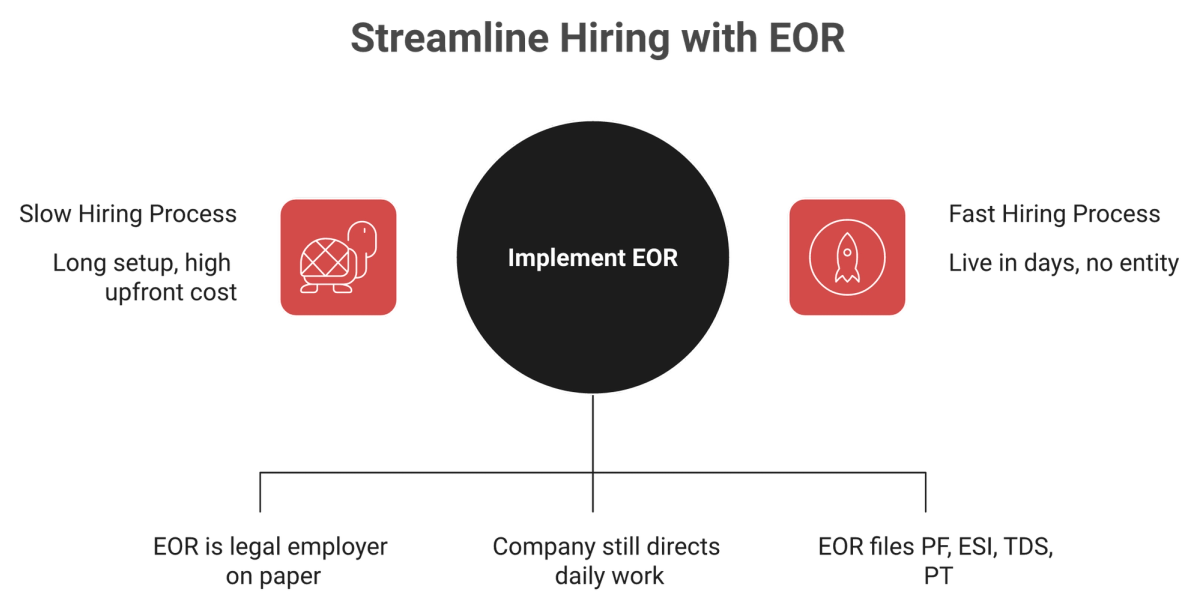
The EOR handles payroll, statutory filings, and the paperwork the Indian government expects. You get the person, minus the entity. That is the whole trick.
A quick contrast helps. Deel is like AWS treating India as one region among 150. An India-only EOR is more like a team that lives inside that one region and knows every street.
⚠️ Why founders feel like they are running with scissors
Here is the pain I hear on WhatsApp most weeks. A founder just closed a round and needs three engineers live in 45 days.
The honest read is this: you are kinda running with scissors if you hire in India without an army of experts checking every clause. One misclassified contractor can create back-pay exposure of $25,000 to $40,000 per head.
The alternative, a Private Limited entity, takes 12 to 18 months and roughly $50,000 before your first hire logs in. That math rarely works for a Seed to Series B team. Our EOR for startups exists precisely for this gap.
📅 What actually changed on 21 November 2025
The government enforced all four Labour Codes on 21 November 2025. The one that bites payroll hardest is simple to state.
Basic plus Dearness Allowance (DA), the cost-of-living top-up, must effectively be at least 50% of total CTC (cost to company). Many legacy Indian payroll stacks still run a low-basic structure and quietly get this wrong.
🧩 The nuance most blogs miss
Here is where the standard read gets it backwards. Most articles say the Codes are fully "in force." They are not, entirely.
The Industrial Relations and OSHWC Codes are notified, but the Wages and Social Security Codes are only partially notified, so legacy rules still apply during the transition. I could be proven wrong as more rules drop, but right now you must run both frameworks in parallel.
When a company hires through our EOR services at Versatile Club, they are employed by our own registered Indian entity. PF, ESI, TDS, and professional tax sit under our registrations, not a partner shell we resell.
Q2. EOR vs PEO vs Setting Up Your Own Entity: Which Path Fits Your India Hire?
For a foreign company with no Indian entity, EOR is almost always the right first move. A licensed local entity becomes the legal employer with zero setup. US-style co-employment PEO does not legally exist under Indian labour law, so you would need your own entity first. A Pvt Ltd takes 12 to 18 months; EOR compresses that to days, and most companies open an entity only around 10 to 12 hires.
🚫 The PEO myth that trips up US founders
I see this weekly. A US founder assumes a PEO (Professional Employer Organization, a US co-employment model) works the same way in India.
It does not. Traditional US-style co-employment PEO has no legal footing under Indian labour law. You cannot "co-employ" without already owning an Indian entity. Our EOR vs PEO breakdown covers this in detail.
So when a vendor pitches you an India "PEO" with no entity, that is a red flag worth pausing on.
📊 Four paths, side by side
Here is how the options actually compare for a first India hire.
| Path | Setup time | Legal employer | Compliance ownership | Misclassification risk | Typical cost |
|---|---|---|---|---|---|
| EOR | Days | The EOR's entity | EOR files PF, ESI, TDS, PT | Low | ~$149/employee/month |
| PEO | Not viable without your own entity | You (needs entity) | Shared | Medium | N/A for entity-less firms |
| Contractor rail | Hours | Nobody (contractor) | You, exposed | High ($25K to $40K back-pay per head) | ~$19/month rail |
| Own Pvt Ltd | 12 to 18 months | You | You, in-house | Low once mature | $50K+ upfront |
The cheap $19 contractor rail is the one that quietly builds the biggest bill. A deferential working relationship, where the worker treats you as boss, can look like employment to a tax officer, not contracting.
🪜 The migration path I actually recommend
Here is the part most vendors hide, because it means you might eventually leave. I tell clients openly to run on our EOR until roughly 10 to 12 hires.
That number is not random. Across teams I have watched, the tipping point where opening an entity makes sense lands around 12 heads. After that, they say, "right, we are ready to open." You can model the crossover with our EOR vs entity calculator.
At Versatile Club, we then help you migrate those people into your own entity. We do not invent a PEO that does not exist just to lock you in.
Q3. How Do PF, ESI, TDS, Gratuity, and Professional Tax Actually Work in 2026?
An India employer runs five statutory streams in 2026. PF (Provident Fund, retirement savings) at 12% of Basic plus DA, with the ECR filed by the 15th. ESI (Employees' State Insurance, health cover) at 3.25% employer and 0.75% employee, up to ₹21,000 wages. TDS (Tax Deducted at Source) under Section 192, deposited by the 7th. Gratuity, which accrues from month one at 4.81% of Basic plus DA. Plus state professional tax. Miss a deadline, and Section 7Q interest and 14B damages stack up.
📋 The five streams on one screen
This is the table I wish every founder had before signing anything.
| Stream | Rate | Statutory anchor | Deadline | Form / filing |
|---|---|---|---|---|
| PF | 12% of Basic+DA (employer) | EPF & MP Act 1952 | ECR by 15th monthly | ECR, EPFO portal |
| ESI | 3.25% employer / 0.75% employee, up to ₹21,000 wages | ESI Act 1948 | 15th monthly | ESIC challan |
| TDS | Per income-tax slab | Income Tax Act, Sec 192 | Deposit by 7th monthly | Form 24Q; Form 16 by 31 May |
| Gratuity | Accrues month one, 4.81% of Basic+DA | Payment of Gratuity Act 1972 | At separation | Paid on exit |
| Professional Tax | State slab | State PT Acts | State-specific | State portal |
DA, again, is the cost-of-living component added to basic salary. Form 16 is the annual TDS certificate each employee needs to file taxes.
💸 The penalties that make lateness expensive
Here is why timing matters more than founders expect. Delay a PF deposit, and Section 7Q charges interest at 12% per annum on the late amount.
Then Section 14B piles on damages on top: 5% for a 0-to-2-month delay, rising to 25% beyond six months. ESIC adds its own penalties for late or missed contributions. A single sloppy month compounds fast. This is exactly what our India payroll compliance workflow is built to prevent.
🧾 Where I have earned this view
From what surfaces when you actually run payroll, the gratuity line is the one people forget. It accrues from month one, not year five, so it is a real liability the day someone joins.
At Versatile Club, every one of these filings runs under our own EPFO, ESIC, and TDS registrations through our managed payroll service. So when a Section 7Q notice lands, it lands on our desk, not yours.
Q4. Why Is Multi-State Compliance, Not National, the Real India Challenge?
India isn't one compliance jurisdiction. It is 28 states and 8 union territories, each with its own professional tax slabs and Shops and Establishments rules. Maharashtra requires dual PTRC plus PTEC registration with monthly slab filing. Karnataka needs enrollment within 30 days of joining plus S&E renewal. Telangana runs its own PTRC remittance calendar. A global platform running one India template misses this.
🗺️ The "one India" assumption that breaks payroll
Here is the mistake I watch generalists make. They treat India like a single tax zone, the way a US founder might wrongly assume one sales-tax rule covers all 50 states.
It does not work that way. Professional tax (PT), a small state levy on salaried income, is set state by state. Shops and Establishments (S&E) registration, which licenses your workplace, is also state-specific.
Move an engineer from Bengaluru to Pune, and the filing calendar changes underneath you.
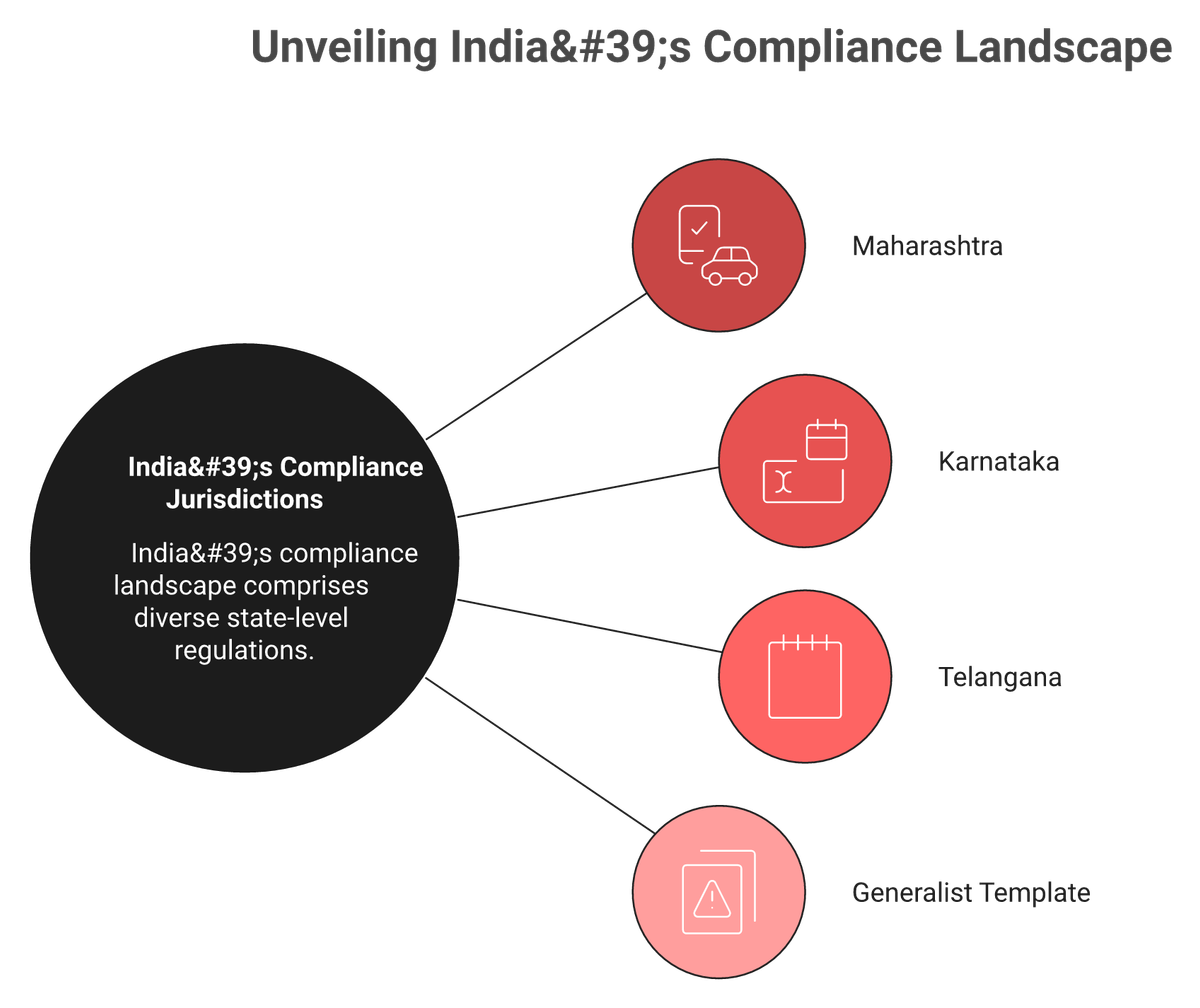
📍 Three states, three different rulebooks
Concrete beats abstract here, so look at three states I file in regularly.
| State | Professional tax | Shops & Establishments nuance |
|---|---|---|
| Maharashtra | Dual registration: PTRC (employer deducts) + PTEC (entity's own tax), monthly slab filing, annual return | Registration required per establishment |
| Karnataka | Monthly PT | Enrollment within 30 days of joining; S&E renewal cycle |
| Telangana | PTRC enrollment, monthly remittance deadlines | State-specific S&E filing |
PTRC is the certificate to deduct PT from salaries; PTEC covers the entity's own PT. Maharashtra wants both, and misses here are common.
🔍 Where generalists go structurally shallow
The standard read says global EOR platforms "cover India." They cover it thinly, because India is one of 150 countries on their map, often run through a local partner shell. Our Deel alternative page unpacks that gap.
Multi-state depth is exactly where that thinness shows. I might be biased here, but state-level filing is not a feature you bolt on; it is muscle you build by doing it every month.
At Versatile Club, we hold live PF, ESIC, and S&E registrations across all 28 states and 8 union territories through our end-to-end compliance coverage, and we file directly across the metros we place in: Bengaluru, Hyderabad, and Pune. We run the filings ourselves, not through a partner who templates all of India the same way.
Q5. Is Your EOR Handling Employee Data Under the DPDP Act 2025?
Your EOR processes your employees' most sensitive data: Aadhaar (India's national ID number), PAN (tax ID), bank details, and payroll. That makes it a Data Fiduciary under India's Digital Personal Data Protection Rules, notified in November 2025. It means consent-based processing, defined retention, and a 72-hour breach report to the Data Protection Board. Most EOR guides skip this, so you should ask your provider directly.
🔐 Why your EOR is now a "Data Fiduciary"
Almost nobody in the EOR sales cycle brings this up. That surprises me, because it changes who is on the hook.
A Data Fiduciary is the party that decides how personal data gets used. When your EOR runs payroll, it collects Aadhaar, PAN, and bank data, so it holds that role by law.
The DPDP Rules were notified in stages starting 13 November 2025. This is not a future problem; it is a now problem. Our compliance framework treats it as a live obligation.
📋 What the Rules actually ask for
Here is the concrete part, in plain terms.
- Consent notices: each employee must be told, clearly, what data is collected and why.
- Defined retention: data cannot sit forever; it must be deleted on a set timeline.
- 72-hour breach reporting: a data breach must be reported to the Data Protection Board within 72 hours.
- Audits and a DPO: larger processors, called Significant Data Fiduciaries, face annual audits and must name a Data Protection Officer.
I could be slightly off on which tier your provider lands in. The obligations themselves, though, are not optional.
✅ Your Monday-morning check
So here is what I would do before signing anything. Ask one direct question: "How do you handle DPDP consent, retention, and breach reporting?"
If the answer is vague, that is your signal. From what surfaces when you actually run payroll, data handling breaks quietly, then all at once. This is one reason founders move to our EOR services in India.
At Versatile Club, because your employees sit on our own Indian entity, their Aadhaar, PAN, and payroll data live with one accountable Data Fiduciary. There is no chain of partner sub-processors you cannot see or audit.
Q6. How Do EOR, FEMA, and Permanent Establishment Risk Fit Together for Foreign Founders?
Hiring directly in India can create a permanent establishment (PE), a taxable local presence, and pull you into Companies Act and FEMA obligations you never intended. An EOR neutralizes this. Because the local entity is the legal employer, you avoid setting up a "place of business," and cross-border payments run through FEMA-compliant channels. For most founders, that is the quiet reason EOR beats a rushed entity.
⚠️ The tax trap most founders never see coming
Let me define the scary term first. A permanent establishment (PE) is a fixed presence that makes your foreign company taxable in India.
Here is how founders stumble into it. You put an employee on your own foreign payroll, give them an India office, and let them sign deals. That can look like a "place of business" under the Companies Act, and suddenly Indian tax authorities want a share.
FEMA (the Foreign Exchange Management Act) then governs how money crosses the border. Get the structure wrong, and your simple India hire becomes a compliance file that never closes. Weighing the paths first with our EOR vs entity in India guide saves a lot of grief.
🛡️ How an EOR quietly removes the risk
This is the part the standard "just hire a contractor" playbook gets backwards. The employer of record is the shield, not a formality.
Because the EOR's Indian entity is the legal employer, you are not establishing your own presence. No place of business, so the PE argument weakens sharply. Payments flow through the EOR's compliant rails, not a murky personal transfer. That is the core of how our EOR services work.
From what I have seen with US founders making a first India hire, this insulation matters more than the monthly fee. You are buying calm, not just payroll.
At Versatile Club, we invoice you in USD directly from our own Indian entity. Your cross-border payment stays FEMA-clean, and you never create a taxable presence you did not plan for.
Q7. What Does It Really Cost to Hire in India Through an EOR, and Where Are the Hidden Fees?
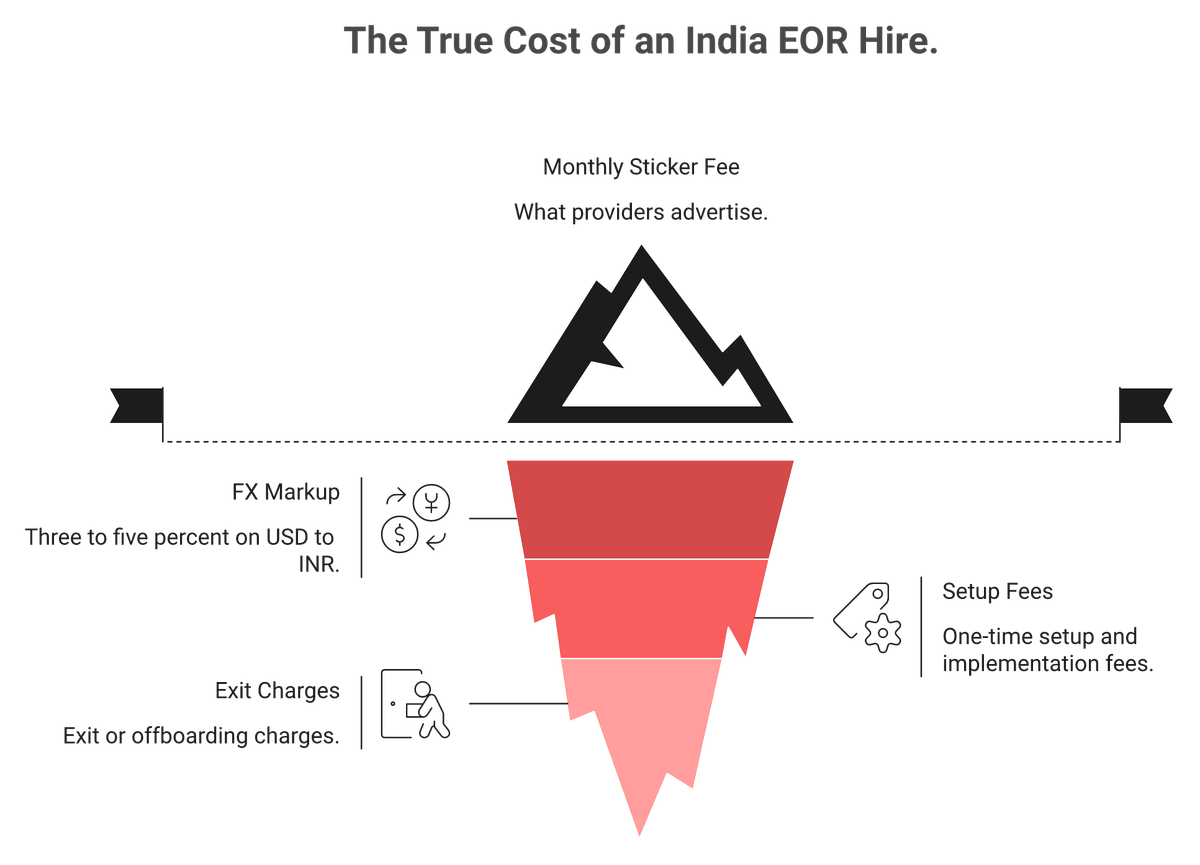
India EOR pricing runs roughly $99 to $699 per employee per month, but the sticker fee is not the real cost. Watch for 3% to 5% FX markups on USD-to-INR conversion, setup fees, and exit charges that global platforms bury. Always ask for a sample invoice before signing. On value, a senior Bengaluru engineer runs about $58,000 all-in versus roughly $220,000 in San Francisco.
💸 The sticker price is a decoy
Founders anchor on the monthly per-employee fee. That is the trap.
The real cost hides in the currency conversion. Deel, for example, is widely reported to add a 3% to 5% FX markup when moving your dollars into rupees. Add setup fees and exit charges, and your "cheap" plan is not cheap. Our transparent pricing is built to remove that guesswork.
Employees feel this markup too, not just buyers.
"I find Deel to be absurdly expensive. They charge a high amount of fees for transferring money to my bank account."
Juan Camilo O. Deel G2 Verified Review
"There are hidden fees. Of course, again, also here. And yes you are right, they are hiding it... you will never get your net-agreed salary through Deel."
İbrahim Deel G2 Verified Review
📊 What the fee stack looks like
Here is the honest comparison I share with founders.
| Provider | Monthly fee (approx.) | FX markup | Setup / exit fees |
|---|---|---|---|
| Deel | ~$599 | 3% to 5% reported | Common |
| Remote | ~$599 | Varies | Varies |
| Wisemonk | "from $99" (per-tier not fully published) | Varies | Varies |
| Multiplier | ~$400 | Varies | Varies |
| Versatile Club | ~$149 | None (USD direct from India) | None; first month free |
The one tactic that cuts through all of it: ask for a sample invoice. If a provider will not show you the full line-item bill upfront, that tells you plenty. You can also model the full cost with our India EOR cost breakdown.
⭐ Cost is not the reason to hire in India
Here is where I push back on my own industry. I never advocate hiring in India because it is cheap.
You hire in India for academically strong engineers who cannot all fit into a handful of Western job markets. Yes, the math is real, a senior role can save around $162,000 a year ($58,000 in Bengaluru versus $220,000 in San Francisco). But savings is the byproduct, not the pitch. Run your own numbers with our salary calculator.
At Versatile Club, we invoice in USD directly from our Indian entity, with no FX middle-layer, no setup fee, no exit fee, and the first month free. Ask us for a sample invoice; the number you see is the number you pay.
Q8. Owned Entity vs Partner Shell: Why Does It Change Your Compliance and IP Risk?
Most global EOR platforms, including Deel, Remote, G-P, and Multiplier, hire in India through local partner entities. With an owned-entity provider, your employees' PF, ESI, TDS, and IP assignment sit under one registration you can audit directly. Partner shells add a layer between you and the filings, which matters when EPFO knocks or IP ownership is contested. Aggregators still win when you need coverage across 150 countries.
🏢 The claim: ownership beats aggregation for India-critical hires
Let me state my view plainly, because the category tiptoes around it. If India is where your engineering IP lives, an owned entity is safer than a rented shell.
An owned-entity EOR employs your people directly. A partner-shell model routes them through a third company the platform resells. That extra layer is invisible until something breaks. It is why founders shopping a Deel alternative often land on an owned-entity model.
🔗 Why the layer matters (three pillars)
Here is the reasoning, in the order I would defend it.
- Audit-ready IP: under the Copyright Act, Section 17, work-for-hire IP vests in the employer, so you want a clean, single employer of record on paper.
- Direct filing control: PF, ESI, and TDS filed by the entity itself, not a sub-contractor, means one place to check when EPFO sends a notice.
- Single accountability: when data or payroll goes wrong, you know exactly who owns the fix.
Partner-shell setups blur all three. Employees often feel the friction of a fragmented back end.
"The majority of their support team is helpful, but are often constrained by internal limitations... We had to carefully manage our agreement and had to constantly remind them of the fees agreed."
Verified User in IT and Services Deel G2 Verified Review
"The PF transfer for employees after terminating their employment with Velocity was very poor. There was limited help, delayed responses."
Verified User in Computer Software Velocity Global G2 Verified Review
⚖️ The honest counterpoint
I will not pretend ownership wins every time. It does not.
If you need to hire across 30 countries next quarter, a global aggregator's breadth beats my single-country depth, full stop. That is their real strength, and I would tell you so on WhatsApp. For pure India depth, though, our owned-entity model is the point.
At Versatile Club, our own registered Indian company (Foo Falcon Technologies Pvt Ltd) employs your engineer directly. PF, TDS, and IP assignment live under one auditable registration, not a partner shell we resell.
Q9. Versatile vs Wisemonk vs the Global Generalists: How Do You Choose?
Choose on four axes: entity model (owned versus partner shell), pricing transparency, support model, and retention. Global generalists offer 90 to 150 country breadth, but run India shallow with chatbot-first support. Wisemonk is India-focused, yet publishes only a "from $99" range and leans compliance-first. For owned-entity depth plus culture-fit hiring, an India-only specialist fits best.
🧭 The four axes that actually decide it
Founders ask me which EOR is "best." That is the wrong question.
The right question is: best for what? Sort every provider on entity model, pricing transparency, support, and retention, and the picture clears up fast. Our best EOR in India comparison runs the same exercise in depth.
📊 The head-to-head
Here is how the main options stack up.
| # | Provider | Entity model | Pricing transparency | Support | Retention story |
|---|---|---|---|---|---|
| 1.1 | Versatile Club | Owned Indian entity | ~$149, no setup/exit fees | Founder on WhatsApp | 90-day Success Coach + 6-month replacement |
| 1.2 | Wisemonk | India-focused | "from $99," per-tier not fully published | Small team, some delay | Compliance-first, thinner retention |
| 1.3 | Deel | Local partner in India | ~$599 + reported 3% to 5% FX markup | Ticket/chatbot-first | Global generalist |
| 1.4 | Remote | Local partner in India | ~$599 | Ticket-first | Global generalist |
| 1.5 | G-P | Local partner in India | ~15% of salary | Enterprise queue | Global generalist |
| 1.6 | Multiplier | Local partner in India | ~$400 | Ticket-first | Global generalist |
The support gap is real, and employees feel it.
"Support is the single biggest failure. There is no direct phone line. You either email or use a chatbot, and you can ask both the same question and get two different wrong answers."
Erika D. Rippling G2 Verified Review
⚖️ When a generalist genuinely wins
I will not pretend otherwise. If you need to hire across 20 countries this year, breadth beats depth, and a Deel or a Remote earns its fee. Founders weighing that trade-off often start with our Deel alternative breakdown.
That breadth has a cost, though: layers of process. One buyer described a global-scale onboarding where 20 names, including a procurement desk in Guadalajara, had to sign off before work started. That enterprise coldness is the trade for scale.
⭐ When the India-only specialist wins
If India is your one hire, or your first ten, depth and speed win. Wisemonk is a serious India-native option, so I respect it, but its retention model is thinner than ours. If you are comparing us head-to-head, our Wisemonk alternative page lays it out.
"Founder is just a call away. Extremely helpful in resolving all our queries. The process is super smooth to setup India EOR."
surbhi m. Versatile Club G2 Verified Review
At Versatile Club, the person who built the company is on WhatsApp, not a CSM rotation or a ticket queue. That is what running India-only EOR at human scale looks like.
Q10. Beyond Compliance: How Do You Make Sure the Hire Actually Stays?
Compliance is the floor, not the finish line. A legally perfect hire who quits in month three still costs you your round's momentum. That is why retention mechanics matter: culture-fit screening on 50 behavioral parameters, a 90-day Success Coach, and a 6-month replacement guarantee. With nearly 30% of Indian IT resumes containing discrepancies, screening for fit and integrity matters as much as filing PF on time.
🎯 The reframe nobody in EOR wants to say
Here is the standard read, and it gets it backwards. Most EOR providers solve the "legal hire on paper" problem and stop there.
That is not the problem keeping founders up at night. The real problem is the "good hire who stays" problem. A compliant employee who ghosts you in week ten is still a loss. Our recruitment approach is built around that reframe.
🔍 Why culture-fit and integrity screening earn their keep
Let me be honest about a risk people gloss over. Nearly 30% of IT-sector resumes in India carry some discrepancy, so verification is not paranoia; it is basic hygiene.
We once had a client interviewing someone they believed sat in London. Only at the third interview did they discover the candidate was actually in Greece. We employed that person cleanly, and later migrated a full team of 12 across to their own setup once it was ready. You can pressure-test fit early with our culture fit quiz.
So we screen on 50 behavioral parameters, not just skills. Skills get you a hire; fit gets you a hire who stays.
🛡️ Retention as an insurance policy
Screening is step one. The follow-through is what protects your investment through our contract-to-hire model.
"Versatile made India EOR onboarding smooth and stress-free... the team's responsive, clear, and great to work with, makes scaling a remote team way less stressful."
"The candidates' quality met our expectations. If you're looking for a reliable partner for hiring in India... Versatile delivers without the usual hassle."
Verified User in Venture Capital & Private Equity Versatile Club G2 Verified Review
At Versatile Club, we assign a 90-day Success Coach and back placements with a 6-month replacement guarantee, because a compliant hire who leaves in month three is not a win.
Q11. What Are Your First 5 Moves to Hire in India This Month, Without an Entity?
You can have a compliant India hire live in days, not months. The five moves: (1) confirm the role and state; (2) validate CTC against the 50% Basic-plus-DA rule; (3) demand a sample invoice to expose hidden FX and exit fees; (4) verify your EOR files PF, ESI, and TDS under its own registrations; (5) sign and onboard. Typical timelines run Day One in 5 to 10 business days, with first payroll by Day 30 to 35.
✅ Your five moves, in order
Here is the checklist I would run this week. No fluff, just the sequence that works.
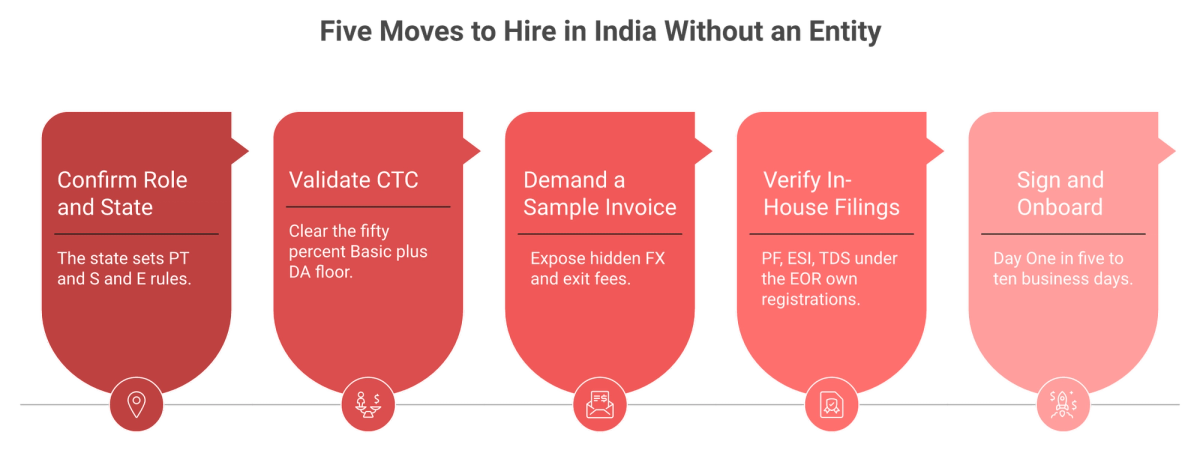
- Confirm the role and the state. The state sets your professional tax and Shops & Establishments rules, so decide Bengaluru versus Pune early.
- Validate CTC against the 50% rule. Make sure Basic plus DA clears 50% of total pay before you sign anything.
- Demand a sample invoice. If a provider will not show the full line-item bill upfront, the hidden FX markup is usually why.
- Verify in-house filings. Ask if the EOR files PF, ESI, and TDS under its own registrations, or through a partner shell.
- Sign and onboard. With docs collected, Day One typically lands in 5 to 10 business days, and first payroll by Day 30 to 35.
You can preview exactly how this runs on our how it works page.
⏰ Two habits that prevent 90% of cross-border mess
These are small, and they save you weeks. I have watched both play out across placements.
- Recap every call in writing. After a call, send a short email repeating the key points, so nothing gets lost across time zones.
- Ask open questions, not closed ones. Skip "Are you on schedule?" and ask "Where are we on the schedule?" You will get the truth, not a reflex "yes."
If you are ever unsure what was asked, say so plainly. Reading between the lines is where offshore projects quietly break, which is why our managed payroll keeps everything on one clear cadence.
💬 Where my head is right now
Here is the shift I keep coming back to. Over the next two years, I think India stops being "one country on the global EOR map" and becomes its own specialist category.
Owned-entity EORs that live in one country start eating the generalists' India revenue, because depth beats breadth when the stakes are statutory. I could be early on this call, but the pattern is already showing in how founders shop our EOR services.
So tell me what you are building and who you need in Bengaluru, Hyderabad, or Pune. I will map your first hire with you on WhatsApp at Versatile Club, and we will have them live inside our contractual 5-day onboarding SLA. Book a quick call whenever you are ready to start.
FAQs
What is an Employer of Record in India, and do I need my own entity?
An Employer of Record (EOR) in India becomes the legal employer of your hires on paper, while your company still directs their daily work. You do not need to register an Indian entity yourself.
The EOR handles the parts that trip up foreign companies:
- Compliant employment contracts
- PF, ESI, TDS, and professional tax filings under its own registrations
- Payroll, payslips, and statutory deadlines
Setting up your own Private Limited entity typically takes 12 to 18 months and $50,000 or more before your first hire logs in. An EOR compresses that to days. That math is why most Seed to Series B teams start here.
When you hire through our EOR services in India, employees sit on our own registered Indian entity, not a partner shell we resell. That means one accountable party for every filing. For most founders making a first India hire, this removes the compliance anxiety of learning Indian labour law from scratch while trying to ship product.
How much does it cost to hire in India through an EOR in 2026?
India EOR pricing runs roughly $99 to $699 per employee per month, but the monthly sticker fee is rarely the real cost. The hidden charges are where budgets slip.
Watch for these buried fees:
- FX markups of 3% to 5% on USD-to-INR conversion
- One-time setup or implementation fees
- Exit or offboarding charges
Our advice is simple: always demand a sample invoice before you sign, so the number you see is the number you pay. On value, a senior Bengaluru engineer runs about $58,000 all-in versus roughly $220,000 in San Francisco, but we never treat cost as the reason to hire in India. You hire for academically strong talent, and savings is the byproduct.
Our transparent pricing sits around $149 per employee per month, with no setup fee, no exit fee, USD invoicing direct from India, and the first month free. You can also model your own numbers with our salary calculator before committing to any provider.
What is the difference between an EOR, a PEO, and setting up my own entity in India?
These three paths get conflated constantly, and picking the wrong one is costly. Here is how they differ for a foreign company.
- EOR: a licensed local entity becomes the legal employer with zero setup, ideal for your first India hires.
- PEO: US-style co-employment does not legally exist under Indian labour law, so you would need your own entity first.
- Own Pvt Ltd: full control, but 12 to 18 months and $50,000 or more to stand up.
Most companies run on an EOR until roughly 10 to 12 hires, then migrate people into their own entity. That is the natural tipping point where an in-house setup starts to pay off.
We tell clients this openly, because we do not invent a PEO that does not exist to lock anyone in. Our EOR vs PEO guide breaks down each structure, and when the migration makes financial sense for your team size and burn rate.
How do PF, ESI, TDS, gratuity, and professional tax work for an India employer?
An India employer runs five statutory streams every month. Missing any deadline triggers interest and damages that compound fast.
- PF (Provident Fund): 12% of Basic plus DA, ECR filed by the 15th
- ESI: 3.25% employer and 0.75% employee, up to 21,000 rupees wages
- TDS: deducted under Section 192, deposited by the 7th, Form 16 by 31 May
- Gratuity: accrues from month one at 4.81% of Basic plus DA
- Professional tax: varies by state slab
Delay a PF deposit and Section 7Q charges 12% annual interest, while Section 14B adds damages of 5% to 25%. A single sloppy month is expensive.
With our managed payroll, every filing runs under our own EPFO, ESIC, and TDS registrations, so a compliance notice lands on our desk, not yours. Gratuity is the line founders forget most, because it becomes a real liability the day someone joins, not years later.
Does hiring in India create permanent establishment or FEMA risk for my company?
It can, and this is the quiet risk most founders never see coming. Hiring directly, without the right structure, can create a permanent establishment (PE), a taxable local presence for your foreign company.
Two frameworks come into play:
- Companies Act: an employee on your own payroll with an India office can look like a taxable place of business.
- FEMA: the Foreign Exchange Management Act governs how money legally crosses the border.
An EOR neutralizes this. Because the EOR's Indian entity is the legal employer, you avoid establishing your own place of business, and payments flow through compliant rails rather than a murky personal transfer.
We invoice you in USD directly from our own Indian entity through our EOR services, so cross-border payment stays FEMA-clean and you never create a taxable presence you did not plan for. For many US and UK founders, this PE insulation matters more than the monthly fee itself.
Why does multi-state compliance make India harder than a single national template?
India is not one compliance jurisdiction. It is 28 states and 8 union territories, each with its own professional tax slabs and Shops and Establishments rules. A platform running one India template misses this.
Three examples show the variance:
- Maharashtra: dual PTRC plus PTEC registration with monthly slab filing
- Karnataka: enrollment within 30 days of joining, plus an S&E renewal cycle
- Telangana: its own PTRC enrollment and monthly remittance calendar
Move an engineer from Bengaluru to Pune and the entire filing calendar shifts underneath you. This is exactly where global generalists go structurally shallow, because India is one of 150 countries on their map, often run through a local partner.
We hold live PF, ESIC, and S&E registrations across all 28 states and 8 union territories, and we run the filings ourselves. You can review the full scope on our compliance page. State-level depth is muscle you build by filing every month, not a feature you bolt on.
How is Versatile Club different from Deel, Wisemonk, and other global EOR platforms?
We are an India-only specialist operating through our own registered Indian entity, not a partner shell. That shapes every difference that matters to buyers.
Here is how we compare on the axes founders actually weigh:
- Entity model: owned Indian entity versus local partner shells used by global generalists
- Support: founder on WhatsApp versus ticket-queue or chatbot-first models
- Pricing: around $149 with no setup or exit fees, versus $400 to $599 plus FX markups
- Retention: 50-parameter culture-fit screening, a 90-day Success Coach, and a 6-month replacement guarantee
Global generalists genuinely win when you need 90 to 150 country breadth, and we say so openly. For India-only depth, speed, and retention, an owned-entity specialist fits better. If you are comparing options directly, our Deel alternative page lays out the trade-offs honestly, including where a broader platform is the smarter choice for your roadmap.
How fast can I onboard my first India hire without an entity, and what are the steps?
You can have a compliant India hire live in days, not months. The process is more straightforward than most founders expect.
Here are the five moves to run this week:
- Confirm the role and the state, since the state sets your professional tax and S&E rules
- Validate CTC against the 50% Basic-plus-DA rule
- Demand a sample invoice to expose hidden FX and exit fees
- Verify your EOR files PF, ESI, and TDS under its own registrations
- Sign and onboard
Typical timelines run Day One in 5 to 10 business days, with first payroll by Day 30 to 35. We commit to a contractual 5-day onboarding SLA, not an aspirational estimate.
Tell us what you are building and who you need in Bengaluru, Hyderabad, or Pune, and see exactly how the flow runs on our how it works page. From there, we map your first hire directly and get them live inside the SLA.
Tell us where you are on the decision.
A role you want to hire, a team you want moved, or just the two routes to compare. A named person replies in 4 to 6 hours.
What the first call covers
30 minutesA cost comparison for your headcount, on your numbers, both routes.
- A written cost breakdown
- Entity documents before the call
- PF, ESI, TDS, termination law
- No follow-up sequence
You pick the time, we send a Meet link. Any timezone.