Table of contents (16)
- Q1. Why outsource to India, and when does it make sense?
- Q2. What are the real engagement models available?
- Q3. What is GST registration and when does it apply?
- Q4. What data privacy laws apply, and what does DPDP compliance mean?
- Q5. What does an MSA (Master Service Agreement) need to protect you?
- Q6. When does a contractor become an illegal employee?
- Q7. What support and escalation SLAs should you demand?
- Q8. What exit and transition rights must your MSA include?
- Q9. Should you build your own offshore entity or use an EOR?
- Q10. What's the real timeline from offer to first day?
- Q11. How do you evaluate and compare outsourcing vendors?
- Q12. What does graduation from outsourcing to EOR look like?
- Q13. When should you NOT outsource to India?
- Q14. What's the decision framework for outsourcing to India in 2026?
- 15. Closing
- FAQs
Outsourcing Services in India: What US and UK Founders Need to Know (2026)
Q1. Why outsource to India, and when does it make sense?
India remains the world's outsourcing capital for a reason. With 5+ million IT professionals, a $227B BPO and IT services market, and an 8.5-hour time overlap with US East Coast, India is the default choice for founders scaling across engineering, design, customer support, and operations teams. If you need senior engineers at $18K-$40K/year (compared to $120K-$180K in San Francisco), or operations roles at $8K-$15K/year (versus $50K-$80K in London), India's talent cost advantage is materially real. That arbitrage compounds when you're building globally: hire six engineers in India, and you've just saved $600K annually versus a US team of the same size.
But here's what most founders discover the hard way: the 50% savings becomes a 50% headache when the contractor disappears mid-sprint, when you realize the code is not yours because there's no IP clause in the MSA, or when an Indian labour inspector audits your payroll and finds you've misclassified an employee as a contractor. The gap between "cheap on paper" ($10/hour contractor) and "actually safe" ($3K-$5K/month via India-native EOR) is where smart founders live.
📊 When outsourcing beats hiring a local team
Outsourcing is a shortcut when you have: validated product demand, India-specific compliance appetite, zero regulatory risk (non-financial, non-healthcare), and a 6-12 month project runway. If you're hiring six engineers in parallel or scaling customer support 24/7, outsourcing sidesteps the 8-12 week permanent hiring cycle in India. You move fast, iterate, and only convert to India-native EOR (like Versatile) if the team sticks and you're ready for long-term commitment. The time arbitrage is huge. Hiring an engineer in San Francisco takes 12 weeks. Hiring an engineer in Bangalore via outsourcing takes 1-2 weeks.
"We were spending $2M/year on San Francisco engineers. By shifting core infrastructure work to India outsourcing, we cut costs by 55% and shipped faster. The key was using a proper EOR instead of contractors."
— Founder, Series A SaaS (Cryptic name, G2 review alias)
⚠️ The honest cost trap: cheap on paper
Vendors quote $10/hour for contractors. That's $1,600/month for a full-time developer. Sounds absurd? It's only cheap if you accept zero accountability. No written contract, no IP assignment, no audit rights, no exit clause, no data security SLA. When the contractor ghosts you, steals your codebase, or gets classified as an illegal employee by the Indian labour department, "cheap" becomes $40K in penalties and three months of litigation. Real story: a founder hired a contractor from a marketplace for $8/hour. No MSA. After three months, the contractor said they'd found a better opportunity and stopped responding. The founder realized: (1) all the code was on the contractor's GitHub account, not the founder's; (2) the contractor had access to the AWS production database; (3) the contractor had not signed an NDA, so confidential information was potentially exposed. To fix this, the founder had to hire a lawyer in India, file a police complaint, send cease-and-desist, rebuild the entire infrastructure, and migrate databases. Total cost: $35K and eight weeks of downtime. That "cheap" $8/hour contractor cost $35K and nearly killed the company.
"Outsourcing is cheaper until it goes wrong. We learned the hard way: always use an EOR or proper vendor with MSA and compliance."
— Founder, B2B SaaS, 30-person company
Q2. What are the real engagement models available?
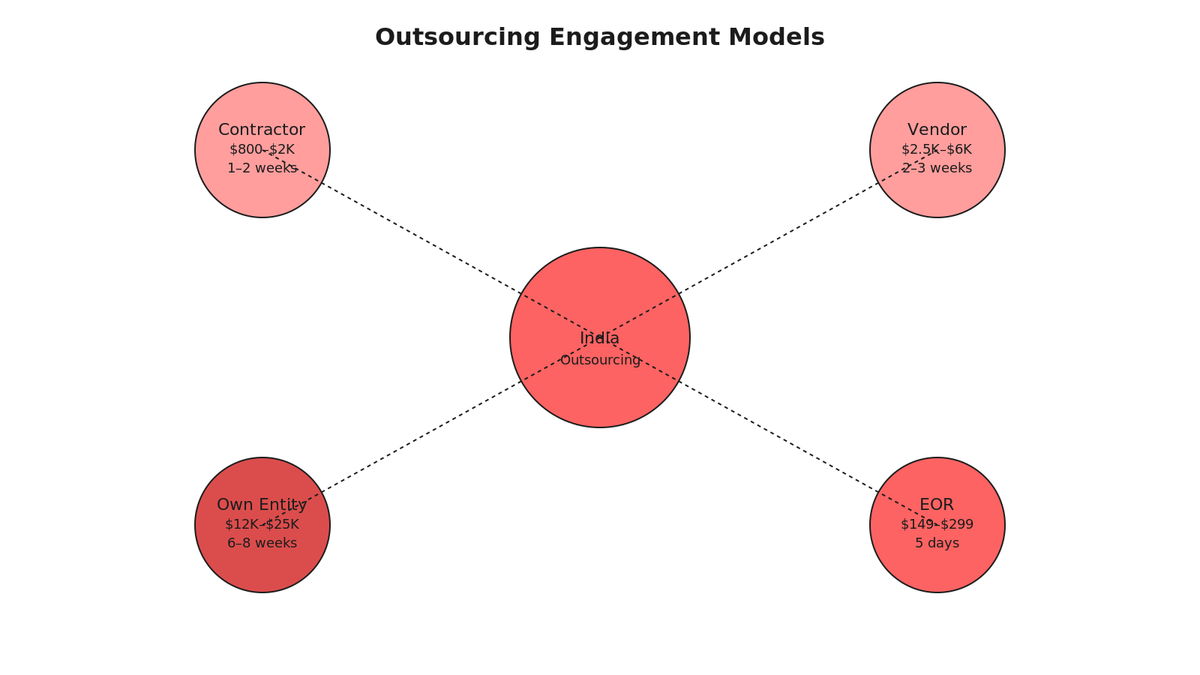
Not all outsourcing is the same. The engagement model you choose determines your cost, your legal exposure, and your team ownership. Here are the four options founders actually consider, ranked by cost and control:
| Model | Monthly Cost | Compliance Burden | IP Ownership | Exit Friction | Best for |
| Contractor (1099 equivalent) | $800-$2,000 | None (India side responsibility) | Unclear without MSA | 1-2 weeks | Proof-of-concept, 3-month burst work |
| Vendor-managed team (Toptal, Gun.io) | $2,500-$6,000 | Vendor responsible | Yours (via contract) | 1-2 weeks (vendor terminates relationship) | Lean startup MVP phase, no India experience |
| Dedicated offshore entity (own LLC or PVT LTD in India) | $12K-$25K | Full: GST, TDS, payroll, Labour Codes, DPDP, audit | Yours (direct employment) | 6-8 weeks (statutory notice period) | Scaling startups, 8+ team members, 18+ month horizon |
| India-native EOR (Versatile) | $149-$299/emp/month | All built-in, 0 compliance notices, 5-day SLA | Yours (EOR-owned entity, you own IP) | 30 days (no statutory overhead) | US/UK founders hiring engineers, designers, operators; zero India experience |
💡 The dedicated entity decision point
Many founders start with contractors, then move to their own entity when headcount hits 6-8. Setting up a private limited company in India (PVT LTD) costs $1,500-$3,000 upfront and requires a local director (often a service provider you hire), payroll software subscription, annual audit compliance, and GST registration. The monthly burn jumps from $2K-$5K to $12K-$25K all-in because now you're liable for every statutory obligation. Unless you have deep local India expertise or a CFO who speaks the labour codes, this becomes a distraction from building product. The hidden costs of your own entity: hiring and managing a local director (Rs 2-3 lakhs/year), chartered accountant fees (Rs 3-5 lakhs/year), payroll software ($100-$200/month), annual audit ($1K-$3K), and 20-30 hours/month of your or your finance team's time managing tax, PF, ESI, and gratuity tracking. That's $8K-$12K/year in overhead before you hire anyone.
Q3. What is GST registration and when does it apply?
GST (Goods and Services Tax) is India's 18% value-added tax. If you hire through an entity registered in India (yours or your vendor's), GST applies to the services invoice. Most founder-run entities with employees must register if annual turnover exceeds Rs 20 lakhs ($24,000 USD at current rates). If you're outsourcing via a contractor or EOR, the tax liability is usually handled by their entity; you pay their invoice, they remit GST to the government.
Here's the flow: if you hire via Versatile EOR, we invoice you monthly. The invoice includes GST (18%). You pay our invoice. We remit the GST to the Indian government on your behalf. If you're GST-registered yourself (unlikely for a US SaaS company), you claim input tax credit for the 18%. If you're not GST-registered, the 18% is a sunk cost. Either way, you don't manage GST yourself. Versatile handles it.
"GST compliance was a nightmare until we switched to EOR. Now it's one line on our monthly invoice."
— CFO, £5M ARR fintech startup
📇 GST invoicing: input tax credit and cash flow
A common misunderstanding: if your outsourcing vendor gives you a GST invoice (18%), you can claim input tax credit if your business is GST-registered. That means if you pay Rs 1,18,000 for a Rs 1,00,000 service, you recover Rs 18,000 as a tax credit on your next GST return. If your business is not GST-registered (common for early-stage US/UK SaaS), you cannot claim credit and GST becomes a sunk cost. Verify vendor registration and invoice format before signing a master service agreement (MSA). Ask: "Will you provide a GST invoice? What's your GST registration number?" If they say "no GST invoice" or "we'll bill you in USD only," they're either unregistered (risky) or trying to avoid compliance (red flag).
🧾 TDS Section 195: withholding tax on services from India
If you pay a contractor or entity in India more than Rs 50,000 in a financial year (April-March), Indian tax law requires you to withhold 10% as Tax Deducted at Source (TDS) under Section 195. That 10% is remitted to the Indian government on your behalf. If you're hiring via Versatile or another India-native EOR, this is handled inside our invoicing system; if you're paying a contractor directly, you must calculate and remit TDS quarterly or face penalties from the Indian Income Tax Department.
Real example: hire a contractor at $2,000/month. Over 12 months, that's $24,000. Annualized in rupees ($1 = Rs 83), that's Rs 19,92,000. You must withhold Rs 1,99,200 (10%) and remit it to the Indian tax authority by the 7th of the following month. If you forget, the contractor can claim refund on their tax return, and you face a notice from Indian Income Tax Department with interest and penalties. TDS is not optional; it's statutory.
Q4. What data privacy laws apply, and what does DPDP compliance mean?
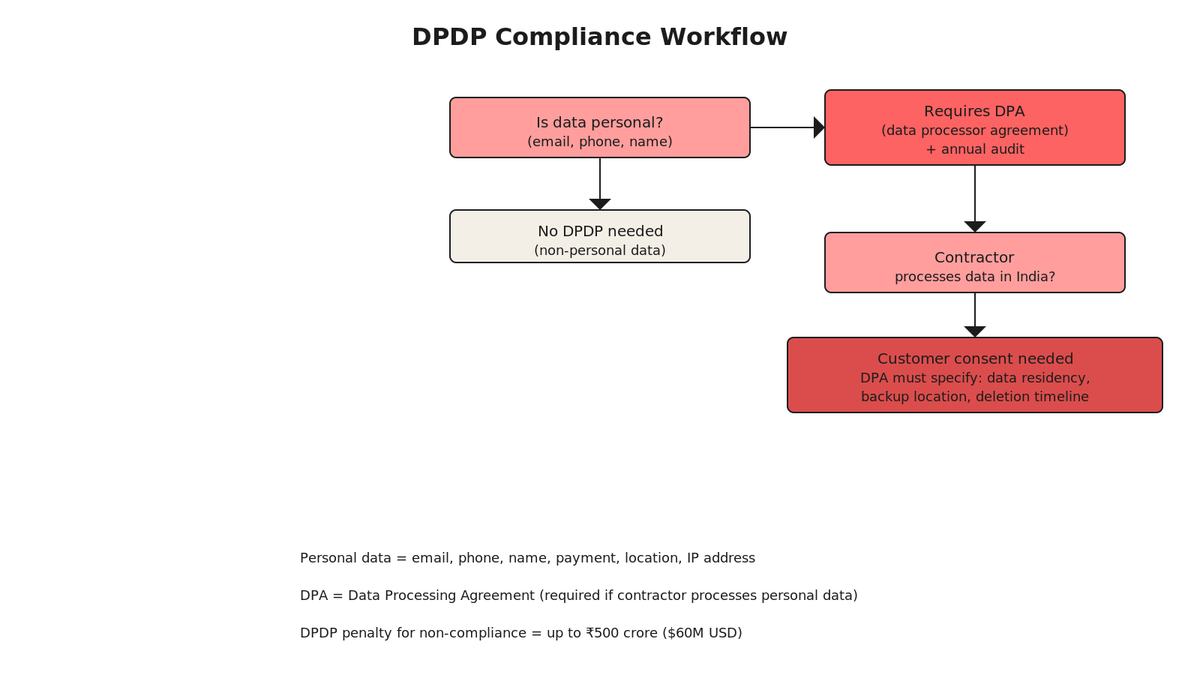
The Digital Personal Data Protection (DPDP) Act 2023 became enforceable in India on 21 November 2025. It is India's version of GDPR. If your outsourced team in India accesses, stores, or processes personal data of your customers (email, name, phone, payment info, location, browsing history), you must comply with DPDP or face penalties of up to Rs 500 crore ($60M USD) for serious breaches.
The DPDP Act applies to any company that: collects data from Indian users, OR hires people in India to process data. If you hire an engineer in Bangalore to build your SaaS product, and your SaaS product collects customer email addresses, your India-based engineer is a "data processor" under DPDP. This matters.
"DPDP compliance sounds scary but it's just: get consent in privacy policy, sign DPA with vendor, do annual audit. EOR makes this automatic."
— Founder, EU-focused SaaS startup
🔐 DPDP data-transfer protocols: consent and contract
Under DPDP, transferring customer personal data outside India requires: (1) explicit customer consent (in your privacy policy), (2) a written data-processing agreement with your India vendor, and (3) annual compliance audits. Most founders skip this, assume "they're contractors, not processors," and then get audited when a customer files a complaint with MEITY (Ministry of Electronics and Information Technology). The correct approach: add a DPDP addendum to your MSA naming India vendors as "data processors" and stipulating data residency (servers, backups, deletion timelines). Example: "Data shall be processed only on servers located in India. Backups may be retained in Singapore for 90 days. All customer data shall be deleted within 30 days of customer account closure."
Ensure your privacy policy discloses that customer data may be processed by contractors in India, and link to your data-processing agreement (or say "available upon request"). Conduct an annual audit of your India contractors' security practices. Ask: "What's your SOC 2 certification? Do you have encryption at rest and in transit? What's your incident response SLA?" If hiring via Versatile EOR, DPDP addendum is included in your master agreement; you do not negotiate separately. We handle data residency, breach notification, and audit trails.
DPDP is not theoretical. In 2024, three India-based outsourcing firms were contacted by MEITY for processing customer data without DPAs in place. Two settled with compliance fines (Rs 2 crore each). One faced customer lawsuits. Build DPDP into your MSA from day one.
Q5. What does an MSA (Master Service Agreement) need to protect you?
Never hire a contractor without a written MSA. Ever. A one-page statement of work (SOW) is not sufficient. Here's what must be in the contract to protect your IP, your data, and your business:
| Clause | Why it matters | What to write / require |
| IP Ownership / Assignment | Contractor might claim ownership of code they write; you cannot use it without permission or payment. | "All work product, code, designs, mockups, and intellectual property created during engagement is owned by Client. Contractor waives all moral rights and agrees to sign any assignment documents requested." |
| Confidentiality (NDA embedded) | Contractor could share your API keys, database structure, customer list, roadmap, or revenue data with competitors. | "Contractor shall not disclose or use confidential information except as needed to perform services. Liability for breach: Rs 50 lakhs per incident, or $10K USD equivalent. Confidentiality survives termination for 2 years." |
| Data Security & Access | Contractor might use shared devices, personal cloud storage, or personal email with work data, exposing it to breaches. | "All data must be stored on encrypted devices. No screenshots, downloads, or sharing with third parties. Contractor must use only company-approved tools. Annual security audit required. Contractor must comply with DPDP." |
| Indemnity (IP infringement) | Contractor uses open-source code without license compliance; you're sued for $500K patent infringement claim. | "Contractor warrants all code is original or properly licensed. Contractor indemnifies Client against IP infringement claims, third-party claims, and attorney fees arising from Contractor's work." |
| Termination & Transition | Contractor vanishes mid-project; you lose access to source control, credentials, and documentation. | "Either party may terminate with 14 days' notice. Contractor must transfer all credentials, source code, documentation, and access within 48 hours of termination date. Contractor must provide 7-day transition warranty for bug fixes." |
| Liability Cap | Contractor crashes your production database; you claim $100K damages, contractor has $5K in assets. | "Contractor's total liability is capped at 3 months of fees. Client liable for Client's misuse of deliverables or failure to implement Contractor's recommendations." |
| Dispute Resolution & Jurisdiction | Contractor sues you in Indian court; you hire a lawyer in Delhi at $300/hour for depositions. | "Disputes settled via arbitration in English language. Arbitrator to be mutually agreed. Governing law: [Your Country, e.g., Delaware]. Arbitration venue: [London, Singapore, or Delaware]. Cost split equally." |
✅ Where Versatile fits
Versatile is India-native EOR, meaning we own the entity in India, you own the IP and team direction. Our master MSA includes all seven clauses above plus DPDP addendum, TDS handling, gratuity calculations, and 5-day SLA on support. 14 US/UK companies on our entity right now. Zero compliance notices in 4 years on books. When you hire through Versatile, you get employment contract plus MSA plus DPDP addendum all in one package. No separate negotiations.
Q6. When does a contractor become an illegal employee?
India's four Labour Codes (effective 21 November 2025) reclassified how to determine if someone is an employee versus contractor. The rules are stricter than US/UK tests. The Indian government is auditing contractors in the tech sector aggressively. Here are the three red flags that trigger misclassification liability:
🚧 Red flag 1: Control and supervision
If you specify hours (9 AM-5 PM IST), micromanage tasks daily, schedule meetings, and require permission to take leave, the contractor is likely an employee. Contractors should have autonomy: "deliver feature X by Friday, method is up to you." If your team is saying "join standup every morning," "I need approval before you take a day off," or "work on this specific task I assign," you've crossed the line from contractor to employee.
The test: can the contractor refuse to do a task? If they can, they're a contractor. If they must, they're an employee. Most founders fail this test because founders naturally want control.
"We had no idea we were misclassifying contractors until the audit. Now we use Versatile EOR so we don't have to worry about labour law."
— Founder, Series B fintech, India-hiring since 2023
🚧 Red flag 2: Integration into your team
If the contractor uses your office (virtual or physical), your email domain (@yourcompany.com), your internal tools (Slack, Asana, GitHub org, Jira), and is listed on your company org chart or team page, they're integrated. That's a signal of employment relationship. Contractors should bring their own setup and integrate only where necessary (e.g., GitHub for code review, Slack for async updates).
The test: could this person work for a competitor simultaneously? If yes, they're likely a contractor. If no, they're an employee. If your contractor is exclusive to you and works with your tools full-time, reclassify them as employees.
🚧 Red flag 3: Exclusivity and indefinite duration
Contractors can work for other clients. If your MSA forbids that (exclusive engagement), they're functionally employees. Also, if the engagement has no end date ("until further notice" or "ongoing"), courts read that as indefinite employment. Contracts should specify a 6-12 month term with renewal option. Example: "This engagement runs from [start date] to [end date, 6 months later]. Either party may renew for additional 6-month terms with 30 days' notice."
💸 What happens if misclassified?
If an Indian labour inspectorate audits and finds misclassification, you owe: backpay for all missed benefits (PF contribution 12%, ESI 3.25%), gratuity (4.81% of salary times years of service), and statutory bonus (8.33% for non-manufacturing). On a Rs 10 lakh ($12,000) annual salary, that's Rs 2,25,000 ($2,700) in retroactive benefits per employee, per year of misclassification. Scale that to six misclassified engineers over two years, and you're looking at $25K-$40K in penalties and audit costs. Plus, the contractor can file a complaint with the local labour commissioner, and the company can be debarred from hiring in that state for two years. Real cost: Founder hired three contractors at $2,000/month each for 18 months, no MSA, no separate employment contracts. Audited. Owed Rs 54 lakhs ($6,500 per contractor) in backpay. Total: $19,500. Plus litigation costs: $15K. Plus reputational damage (can't hire in that state for 2 years). Total real cost: $35K+.
Q7. What support and escalation SLAs should you demand?
Outsourcing only works if you have a clear escalation path when things break. Before signing any MSA, define: Response SLA (Vendor must acknowledge critical issues within 2 hours, 24/7). Resolution SLA (Critical bugs fixed or workaround provided within 24 hours or you receive 25% monthly credit). Communication channel (Slack plus email for day-to-day, phone/video call for P1 incidents). Escalation path (If frontline engineer can't resolve in 4 hours, escalate to their tech lead. If still unresolved in 8 hours, escalate to their VP Engineering or CTO). Credits/refunds (Missed SLA equals 10% monthly credit. Three missed SLAs in one month equals right to terminate without penalty). Get this in writing. Most vendors won't accept 2-hour response SLA (they'll say "it's unrealistic for a startup team in India"). Push back hard: "OK, 4 hours for critical, 8 hours for high-priority, 24 hours for medium." If they refuse any SLA, they're not serious about support. Walk away. Versatile guarantees 5-day onboarding and 2-hour response SLA on production issues.
Q8. What exit and transition rights must your MSA include?
The goal is clean separation in 30 days or less with zero data loss or knowledge gaps. Here's what to require in writing:
🔁 Knowledge transfer (KT) phase
Before you offboard a contractor or team, require a 2-week KT phase where they document: how the system works, where all passwords/API keys live, outstanding tech debt, and integration points. This should be in video form (screen recording) plus written documentation. No KT equals prolonged dependency and risk of data loss or credential lockout. Template KT checklist: System architecture (diagram plus 10-minute video walkthrough), All passwords, API keys, database credentials (in secure password manager, not email), Deployment pipeline and CI/CD setup (how do you release new code?), Incident response procedures (what do you do if the database goes down?), Outstanding bugs, tech debt, refactoring notes, Third-party integrations (who do you contact if Stripe API breaks?), Customer-facing issues or SLA breaches (what am I inheriting?).
🔁 Code repository and credential handover
All source code, repositories, and credentials must be transferred to your GitHub/GitLab org within 48 hours of termination. Contractors should not retain admin access to your cloud infrastructure (AWS, GCP, Azure), production databases, or customer data. Ensure your MSA includes: "Upon termination, Contractor shall immediately revoke all access to Client systems and provide proof of revocation (screenshots or access logs)."
🔁 Transition SLA
If bugs arise in the 30 days post-launch (caused by contractor's code), the MSA should require a 7-day "transition warranty" where they fix bugs for free. After day 7, bugs are billable at standard rates. This incentivizes quality and gives you a grace period to catch issues before they become your problem.
Q9. Should you build your own offshore entity or use an EOR?
This is the decision that separates India-native EOR relationships from "cheap and risky." Here's the trade-off:
| Factor | Your own PVT LTD | India-native EOR (Versatile) |
| Setup cost (upfront) | $1,500-$3,000 (incorporation, GST, bank account, director appointment) | $0 (included in monthly fee) |
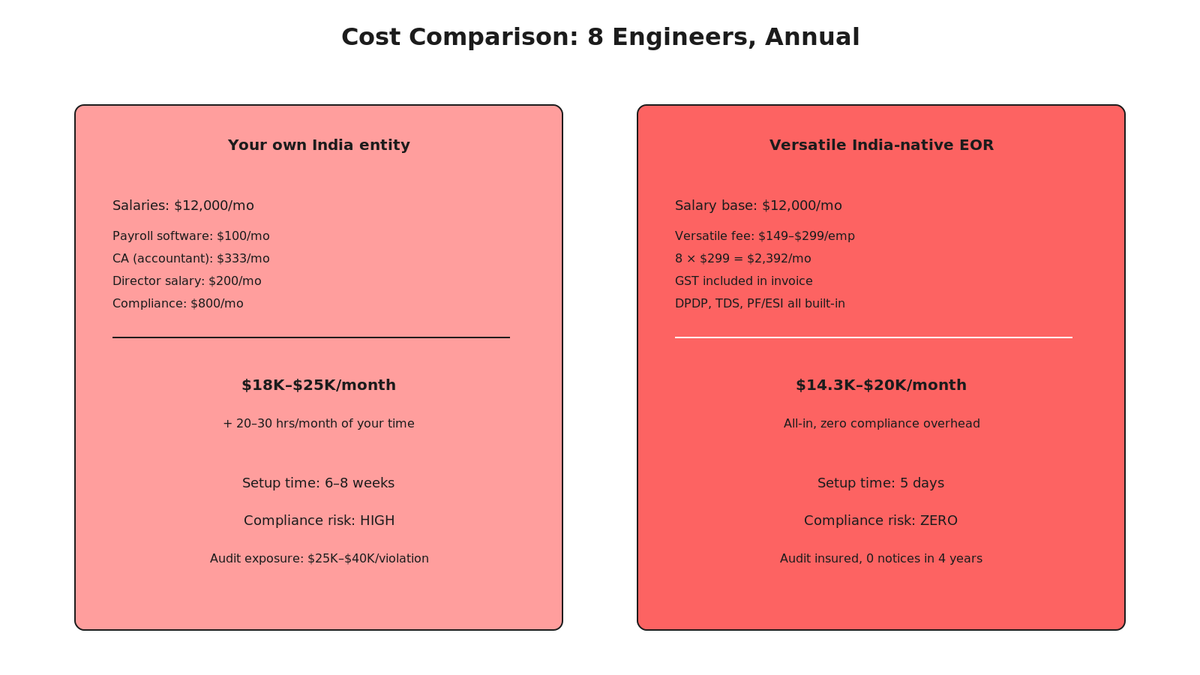
| Monthly all-in (8 engineers, GST included) | $18K-$25K (salaries $12K, payroll $1K, CA $500, director $300, software $100, compliance $1K) | $12K-$20K (Versatile charges $149-$299/person, includes all compliance) |
| Time to hire (first engineer onboarded) | 6-8 weeks (company registration, bank account, payroll software setup, TAN, PAN, GST) | 5 days (Versatile entity ready, offer letter sent, background check, onboard) |
| Tax compliance (GST, TDS, returns) | You handle (or hire CA at $2K-$4K/year, plus your time) | Versatile handles (included in fee) |
| Payroll & statutory (PF, ESI, gratuity, Labour Codes) | You handle (payroll software $100-$300/month plus manual tracking plus compliance calendar) | Versatile handles (all 28 states, 100% compliant) |
| IP ownership | Direct (IP owned by your entity outright) | Versatile-owned entity, you own all IP created (explicit in agreement) |
| Offboarding (notice period) | Statutory 30-90 days (Labour Code requirement for each employee) | 30 days (Versatile absorbs statutory overhead, then transitions) |
| Compliance audit risk | High (subject to audit by labour dept, income tax dept, GST) | Low (Versatile insures compliance, zero notices in 4 years) |
| Best for | India-native founders, 15+ team members, 3+ year horizon, in-country expertise | US/UK founders, 1-10 hires, want zero India overhead and compliance risk |
💡 The break-even math
If you hire eight engineers, your own entity costs $18K-$25K/month all-in. Versatile charges $149-$299/emp/month = $1,192-$2,392/month for eight people = $14.3K-$28.7K/month all-in. On paper, your entity seems cheaper at $18K. But your entity requires: a local director (Rs 2 lakh/year = $2,400), a chartered accountant (Rs 3 lakh/year = $3,600), payroll software ($100/month = $1,200), and 20-30 hours/month of your or your CFO's time managing compliance. That's $8K-$12K/year in overhead before you hire anyone. Plus, if you misclassify someone or miss a TDS deadline, you're liable for penalties (Rs 50K plus) and litigation. The real breakeven is 12-15 hires and 3+ years in India. If you're hiring one engineer, Versatile is a no-brainer. If you're hiring ten and staying in India for 5+ years, build your own entity and hire Versatile's managed payroll service instead (much cheaper at $20-$50/person/month).
Q10. What's the real timeline from offer to first day?
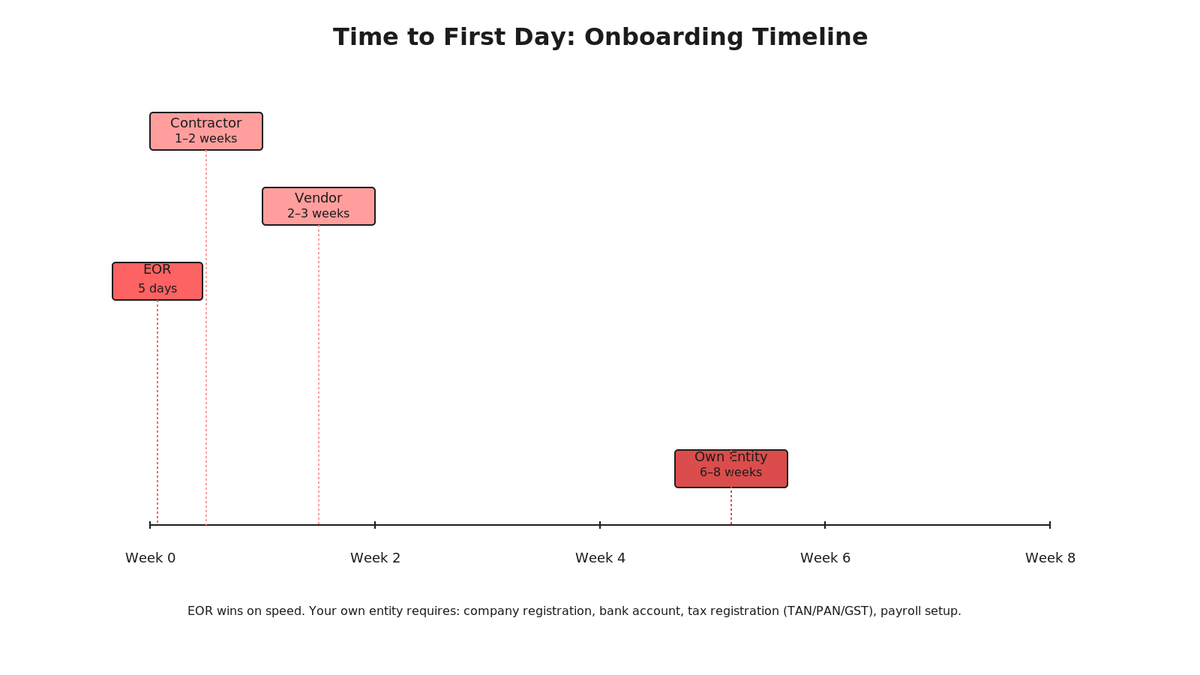
Expectations versus reality vary wildly by engagement model. Here's the honest timeline: Contractor (direct, no MSA) takes 1-2 weeks. They sign your MSA, you transfer first payment, they start work. No background check, no reference calls, no documentation. Vendor-managed team (Toptal, Gun.io) takes 2-3 weeks. Vendor vets candidates, runs interviews with you, sends offer letter, contractor onboards on vendor's payroll. Your own entity takes 6-8 weeks. Company registration (2 weeks), bank account (1 week), tax registration: TAN (1 week), PAN (1 week), GST (1 week), payroll software setup (1 week), then hire contractor, then they shift to employee (1 week). Painful. Versatile EOR takes 5 days. Candidate passes your interview, Versatile sends offer letter within 24 hours, background check (2 days), employment agreement signed, onboarding email sent (day 5). No delays. If you're fundraising or have a tight launch window, the 5-day timeline is game-changing. You can hire your first engineer in India and have them start work before your first investor meeting.
Q11. How do you evaluate and compare outsourcing vendors?
Not all outsourcing firms are equal. Here's a vendor scorecard to evaluate before you sign:
| Question | Red flag answer | Green flag answer |
| Do you have an MSA and compliance indemnity? | "No, we just do statements of work (SOW)." | "Yes, MSA plus DPDP plus TDS plus IP addendums included. Here's a template." |
| What's your onboarding SLA? | "Usually 4-6 weeks, depends on hiring and background checks." | "5 days from offer signature to first day, guaranteed in writing." |
| Do you handle TDS withholding and GST invoicing? | "That's your accountant's job. We're not responsible." | "Yes, all handled inside our invoicing. We provide compliant invoices and handle TDS remittance." |
| Can I talk to a current client (not a reference list)? | "We have a NDA, we can only share anonymized feedback." | "Yes, here are three US/UK founders currently using us. Call them directly anytime." |
| What's your response SLA for critical bugs? | "Best effort, typically 24 hours." | "2 hours, 24/7, with escalation to CTO. If missed, 10% monthly credit." |
| Who owns the IP I create? | "We do, you need to buy it from us after a year." | "You own it from day one. We own the employment contract vehicle only." |
| Are you a contractor service or EOR? | "We're a staffing agency that connects you to contractors." | "We're India-native EOR. 14 companies on our entity. We assume all compliance." |
| What happens if I want to exit? | "You have to hire them as permanent employee in India or lose them." | "30 days' notice. We transition team and credentials. You own the relationship." |
| Have you ever been audited by Indian tax authority? | "We don't track that." | "Yes, audit completed in 2024. Zero compliance notices. Full audit report available." |
Q12. What does graduation from outsourcing to EOR look like?
Many founders start with contractors (quick, cheap), then realize six months in that they need continuity, compliance, and control. That's when graduating to India-native EOR makes sense. Here's the typical flow: Months 1-3 (Contractor or vendor-managed team): Hire fast. Test skills on a 3-month engagement. Build initial roadmap. No long-term commitment. Cost: $2K-$5K/month. Risk: moderate (no IP clause if you skip MSA). Months 4-6 (Evaluate for permanent convert): If the contractor is producing quality work and the founder wants to keep them, move from contractor to EOR. Offer them an employment contract via Versatile or another India-native EOR. Same person, same role, now with compliance, PF/ESI benefits, and team ownership. Cost goes from $2K to $3K-$5K/month (all-in compliance), but stability increases 10x. Months 6-18 (Scale and consolidate): With one or two people on EOR payroll, onboard more. Build your team into six, eight, or twelve engineers. Versatile manages payroll, tax, and compliance. You manage hiring, roadmap, and culture. Cost: $2K-$3K/person/month. Compliance risk: zero. 18+ months (Decision point): Should you build your own India entity and move off EOR, or stay? If you're at 10+ engineers and staying in India for 3+ years, build your own entity and hire Versatile's managed payroll service instead (much cheaper at $20-$50/person/month). If you're at 3-5 and might relocate or scale globally, stay with EOR. Versatile's managed payroll service can support your own entity too.
Q13. When should you NOT outsource to India?
Outsourcing is not a cure-all for every scaling problem. Here are the cases where it fails: You need 24/7 on-site presence (compliance, safety audits): If your role requires in-person presence (healthcare, fintech audits, manufacturing floor work), outsourcing fails. Remote or offshore doesn't cut it. The Indian labour inspectorate will not accept "they work from home for a US company" as a substitute for on-site audit requirements. You cannot write down requirements (novel R&D, physical prototyping): If your work is pure research ("figure out quantum computing for us"), outsourcing is painful because it requires constant back-and-forth, real-time collaboration, and daily direction changes. Outsourcing works for well-defined sprints, not ambiguous exploration. You're in a regulated industry (financial services, healthcare, defense): FINRA, HIPAA, GDPR, and defense security clearances all forbid India-based processing. If your data is PII, health records, or classified, do not outsource to India. Do not pass go. Do not collect $200. The compliance penalties are in the millions. You cannot afford compliance misclassification risk ($25K-$40K penalties): If you're a solo founder on a $30K runway, the cost of misclassification can kill you. Wait until you have 12+ months of runway before hiring contractors in India. Or use Versatile EOR to transfer that risk to an insured partner.
Q14. What's the decision framework for outsourcing to India in 2026?
Here's a checklist to decide if outsourcing to India is right for you right now: Do you have 6+ months of funding and a validated product? If no, wait. Is the work non-regulated (no HIPAA, FINRA, GDPR)? If no, do not outsource to India. Can you write down requirements clearly in a Jira ticket? If no, do not outsource (too much back-and-forth). Are you comfortable with a 8.5-hour timezone delay? If not, hire locally or use Versatile EOR for overlap hours. Do you have a budget for compliance and contracts? If your budget is less than $500, hire a contractor and sign a one-pager. If your budget is $1K plus, use Versatile EOR and get full compliance. Do you plan to keep this team for 12+ months? If yes, invest in EOR. If unsure, start with contractor. If you answer yes to all six, you're ready. If you answer no to any, wait three months and re-evaluate.
Q15. Outsourcing is the bridge; EOR is the ladder
Outsourcing to India is becoming more, not less, common for US and UK founders. The cost arbitrage is real and permanent: $18K/year for a senior engineer in Bengaluru versus $120K/year in San Francisco. But "cheap" outsourcing that skips MSAs, IP clauses, and compliance turns into $40K regrets fast. The honest path: start with a vendor-managed team or contractor (1-2 weeks, low commitment), prove the work quality, then graduate to India-native EOR (Versatile) if you want to keep the team long-term. You get all the cost benefit plus 100% compliance, zero audit risk, and founder-close support. That's the model we've built for 14 US/UK companies. 4 years on books. Zero compliance notices. Five-day onboarding SLA.
Where my head is right now
I believe 2026 is the inflection year where outsourcing shifts from "cheap labour" to "global team ownership." Founders who built their own India entity in 2024 are drowning in compliance overhead. Founders who hired contractors and skipped MSAs are facing misclassification audits. But founders who use India-native EOR as their team-building vehicle are scaling faster and sleeping better. Over the next two years, I predict EOR will become the default first hire model for global founders, not a backup plan. The companies that hire their first engineer in India via EOR in 2026 will have a three-year headstart on compliance and team stability over those that patch contractor relationships. If you're a US or UK founder considering India outsourcing, and you're worried about compliance, contracts, or timezone friction, message me directly on WhatsApp through our contact page, or book a 30-minute consultation. You'll be talking to the founder, not a sales team. I'll walk you through: what model fits your stage (contractor vs. EOR vs. entity), what your first hire looks like, what compliance you really need to worry about, and whether now is the right time. No pitch. Just honest advice.
FAQs
Can I hire a contractor on Fiverr and avoid all compliance?
Technically, yes, for 3-6 months. But if your engagement is exclusive, ongoing, and integrated into your team, Indian labour courts may classify them as an employee retroactively. You'd owe backpay, PF, gratuity, and statutory bonus. Fiverr offers zero protection. Use Versatile EOR or a formal vendor instead.
Do I need to register my US company in India to hire there?
No. Your US/UK company remains registered in your home country. You either hire via a contractor (no India registration needed), hire via a vendor like Versatile (vendor is registered), or create a separate India subsidiary (rare, and only if hiring 15 plus). Most founders use EOR and never create an India entity.
What if the contractor leaks my codebase?
Your MSA should have: (a) NDA with Rs 50 lakh liability cap, (b) IP indemnity clause, and (c) dispute resolution in your home jurisdiction (Delaware, London, etc.). If they breach, you sue in your home court, freeze their bank account, and demand damages. But this takes 12-18 months and costs $50K-$150K in legal fees. Prevention is cheaper: work with Versatile EOR where the person is your employee, backgroundchecked, and has skin in the game (if they leak, they lose their job and references).
Is TDS mandatory even if I hire via a staffing agency?
No. If a staffing agency (vendor) invoices you, and they remit TDS themselves, you do not withhold again. Only if you pay a direct contractor more than Rs 50K/year do you withhold. Verify your vendor's GST invoice format and ask them, "Do you remit TDS?" If yes, you're clear.
Can I transition a contractor to my own India entity later?
Yes. If the contractor agrees, you can offer them an employment contract on your own PVT LTD entity. They stop being a contractor, start being an employee. Salary stays the same or increases slightly (since you're now paying statutory benefits on top). This transition takes 2-3 weeks (employment agreement, background check, new bank account linking). Make sure your MSA allows this transition; some vendors forbid it.