Table of contents (16)
- What a freelance website designer actually does in 2026
- The three tiers of freelance designers (and what each costs)
- Where to find them in 2026 (ranked by hit rate)
- What to put in your brief (before you write to anyone)
- The vetting loop that actually works
- Red flags in the first 15 minutes
- How to scope a freelance website project
- The 30-day website timeline that works
- The contract and IP clauses that actually matter
- When to NOT hire a freelancer (hire an agency or in-house instead)
- Managing a freelance designer without becoming their PM
- Paying a freelance designer
- The portfolio and references check nobody does
- Post-launch support and retainers
- Frequently Asked Questions
- The shortcut
How to find the right freelance website designer for your business in 2026

The founder's shortcut to hiring a freelance website designer who ships in 30 days without becoming a rewrite in month three.
You need a freelance website designer. Not an agency. Not a full-time hire. A freelancer who can turn a Figma file into a shipped site in three weeks and disappear before the invoice hurts.
Half the founders I speak to have already been burned once. They hired the cheapest bid on Upwork, got a WordPress theme with the demo content still inside, and paid twice - first the freelancer, then the person who cleaned up the mess. This guide is the shortcut around that.
What a freelance website designer actually does in 2026
A freelance website designer today is closer to a product designer than a graphic designer. They own the sitemap, wireframe the flows, design the visuals, hand off dev-ready components, and often build the site themselves in Webflow, Framer, or Wix Studio. If they only do "the pretty part" and hand you a Figma file, you still need a developer. Budget for that separately.
The three tiers of freelance designers (and what each costs)
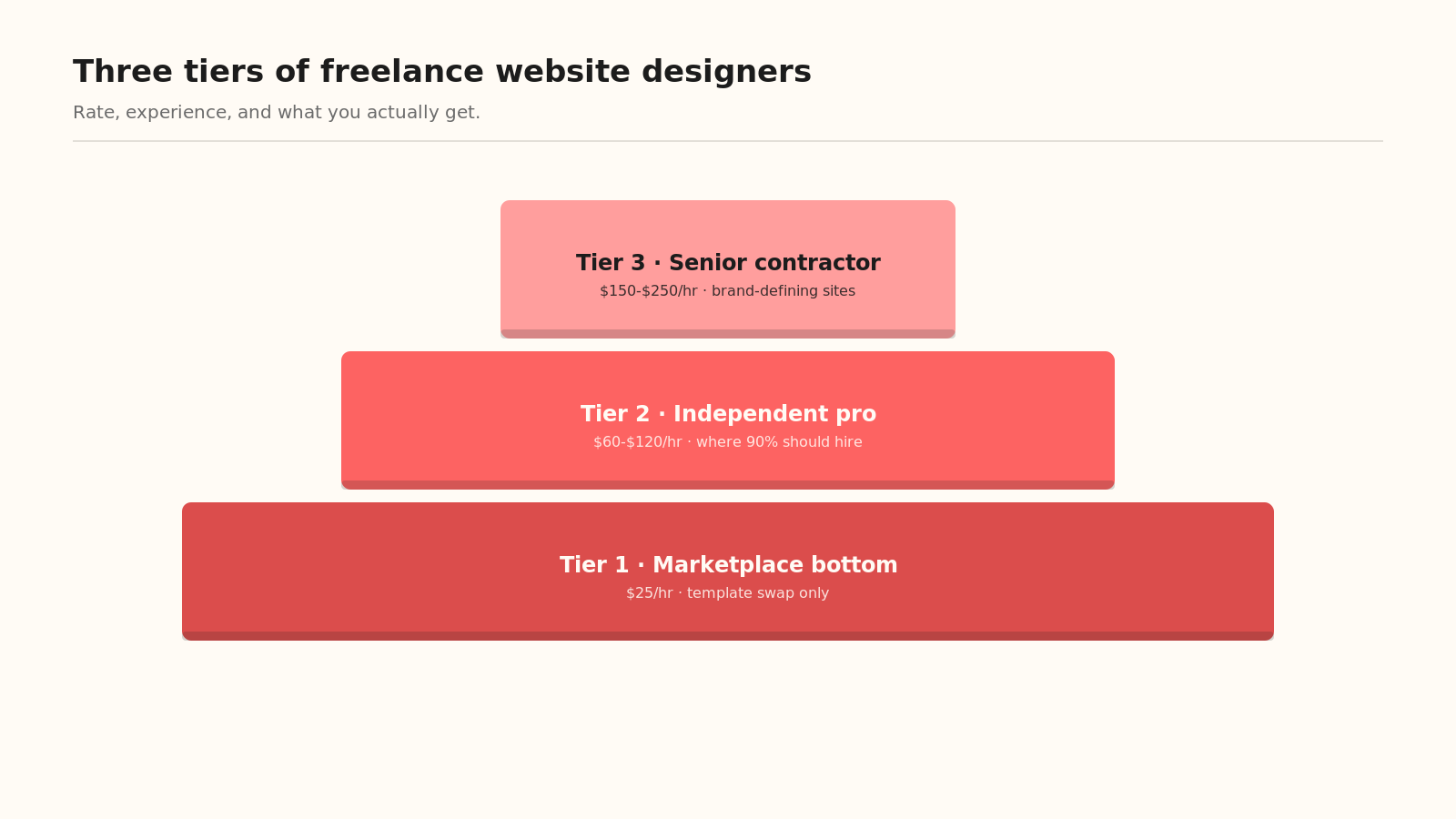
Tier 1 is the $25/hour Upwork tier. You will get a template. Skip unless you're a hobbyist.
Tier 2 is the $60-$120/hour independent professional - usually 3-8 years of experience, portfolio of 10+ live sites, works with 2-4 clients at a time. This is where 90% of founders should hire.
Tier 3 is the $150-$250/hour senior contractor - ex-agency creative director or design-engineer hybrid. Worth it for brand-defining marketing sites, not for a v1.
Where to find them in 2026 (ranked by hit rate)
The best freelance designers are not on marketplaces anymore. They're on Twitter, in Framer/Webflow communities, and on the "featured" pages of design tool showcases. Marketplaces still work for tier 1 and tier 2; direct outreach works for tier 3.
Here's the ranked list of channels: (1) Twitter/X search for "open to freelance" + your niche, (2) Framer/Webflow showcase pages, (3) Read.cv and Layers.to profiles, (4) Working Not Working, (5) Contra (better than Upwork for design specifically), (6) Dribbble Pro Search, (7) Upwork/Fiverr (only if you know exactly what template you want).
What to put in your brief (before you write to anyone)
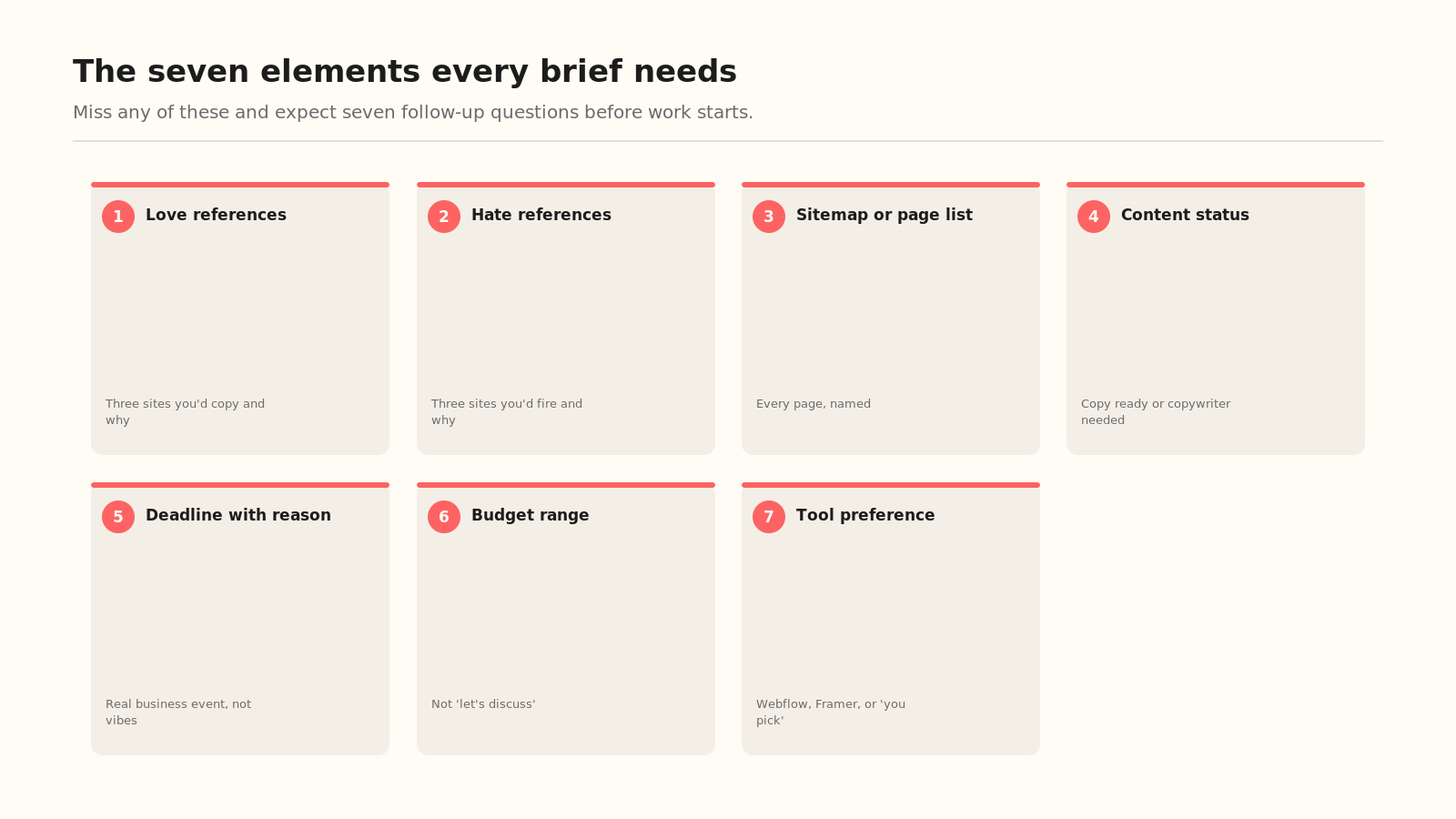
Ninety percent of bad hires start with a bad brief. Your brief should include: (a) three reference sites you love and why, (b) three you hate and why, (c) sitemap or page list, (d) content status - "we have copy" vs "we need copywriting", (e) deadline with a real business reason, (f) budget range (yes, a range, not "let's discuss"), (g) tool preference or explicit "you pick".
The vetting loop that actually works
Ask for three live URLs, not a portfolio deck. Portfolio decks hide bad code, slow load times, and stolen credit. Live URLs don't lie. Then ask two questions in the intro call: "Walk me through how you'd approach my brief" and "What would you push back on?" The first tests process. The second tests whether they'll disagree with you when it matters.
Skip the paid design test. Every good freelancer has stopped doing them. If your budget is real, the intro conversation and their portfolio are enough.
Red flags in the first 15 minutes
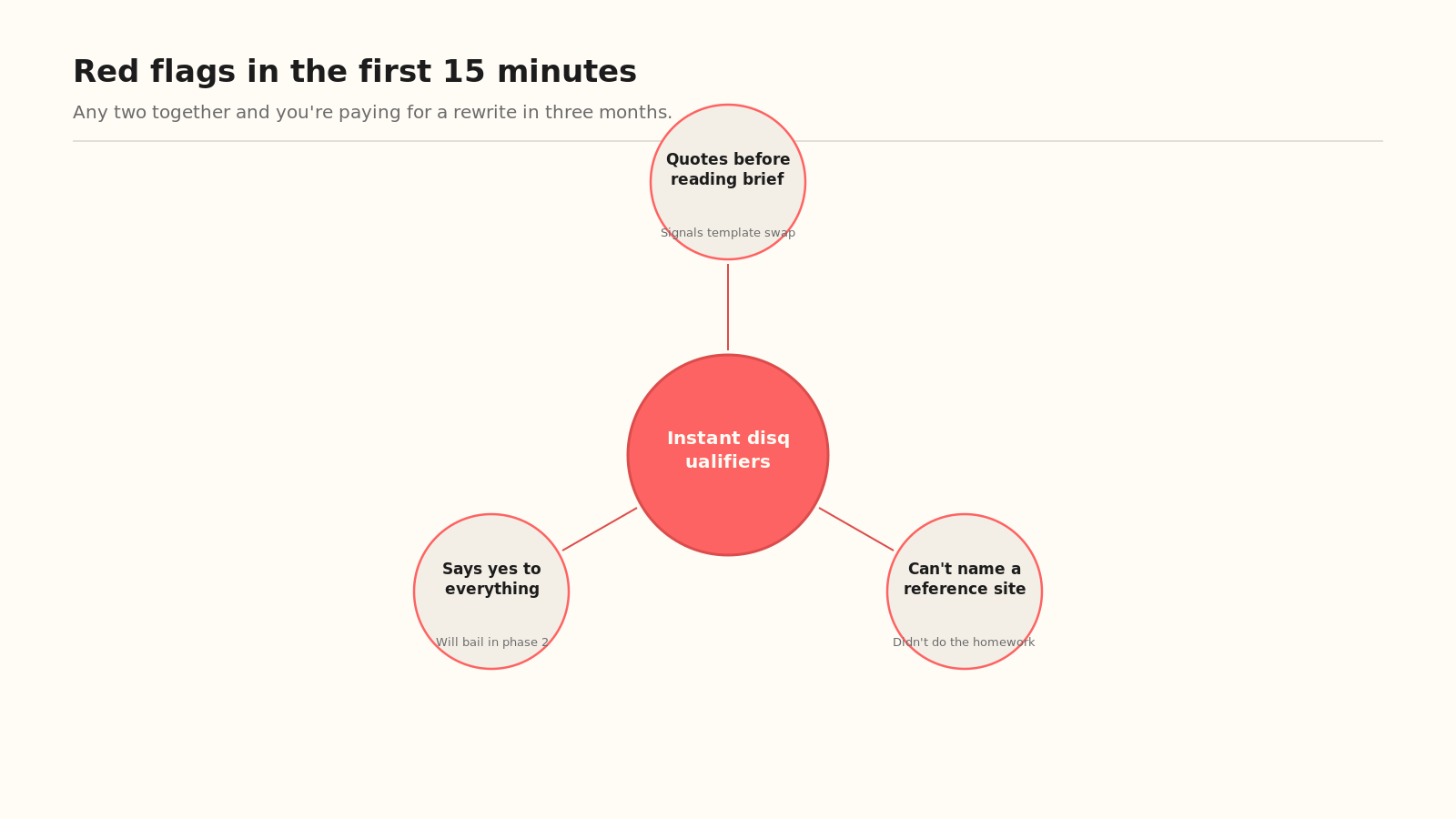
They quote before they've read the brief. They can't name a single reference site of yours. They say "yes" to every request in the call. They don't ask about content. They don't ask about deadline. They send a proposal with a stock template screenshot inside. Any two of these = pass.
How to scope a freelance website project
Never pay hourly for a marketing site. Fixed price, fixed scope, three milestones: (1) sitemap + wireframes locked, (2) design system + hero + one full page approved, (3) full site delivered and QA'd. Pay 30/40/30. Refuse "40/40/20" - the last 20% is where quality dies.
The 30-day website timeline that works
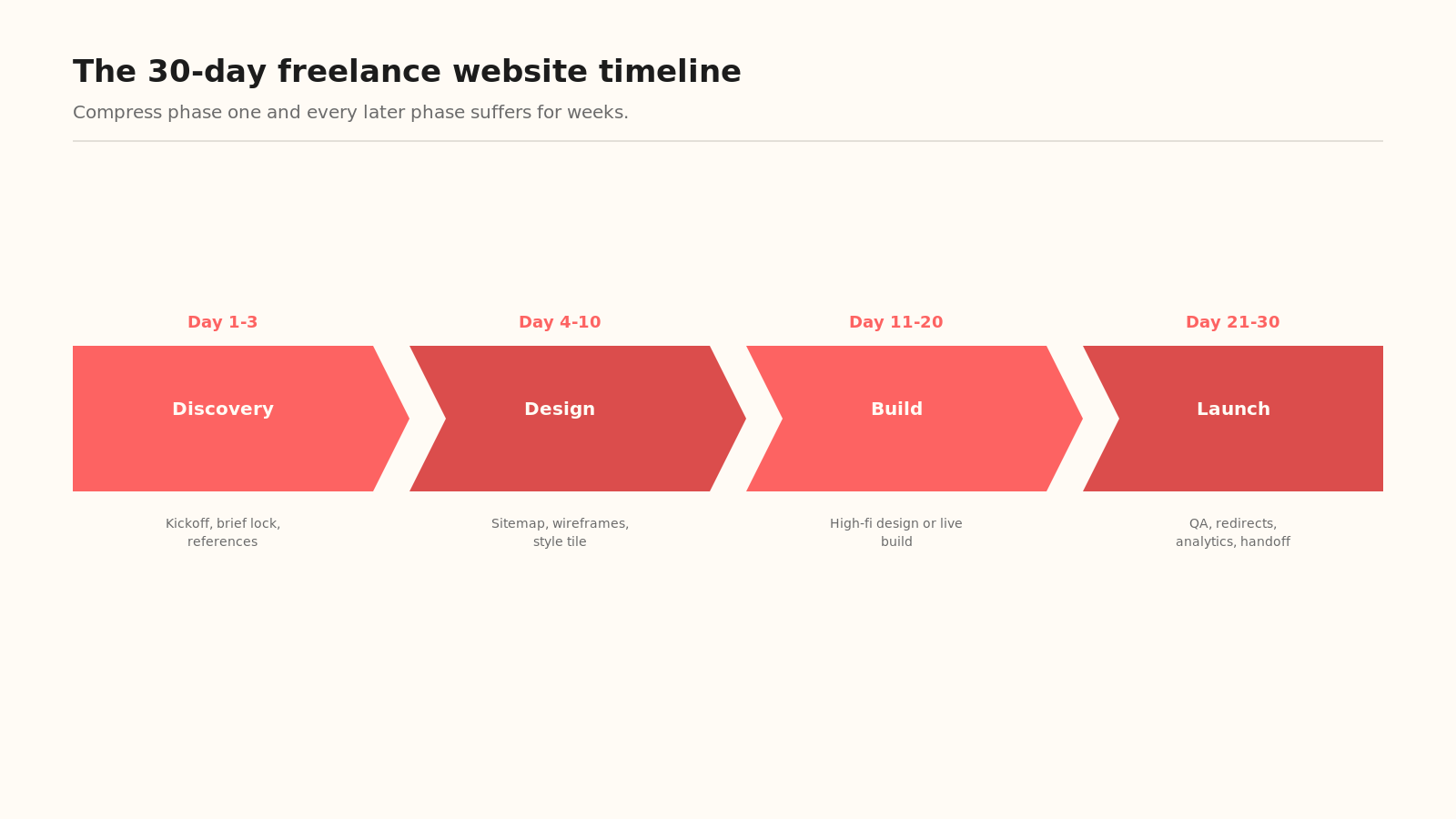
Day 1-3: kickoff, brief lock, references locked. Day 4-10: sitemap, wireframes, style tile. Day 11-20: high-fidelity design or Webflow/Framer build. Day 21-25: revisions, QA. Day 26-30: launch, redirects, analytics, handoff doc. Push past 30 and you're paying for the freelancer's next project's slippage, not yours.
The contract and IP clauses that actually matter
You need three clauses: (1) work-for-hire - all IP transfers on final payment, (2) portfolio rights - they can show it in their portfolio unless you specifically say no, (3) kill fee - 25-50% if you cancel after phase 1. Skip the 20-page master services agreement for a $8k marketing site. A one-pager with these three clauses is enough.
When to NOT hire a freelancer (hire an agency or in-house instead)
Hire an agency when the site is core revenue, the brand doesn't exist yet, or you need six roles (designer + copywriter + strategist + dev + PM + QA) coordinated. Hire in-house when you'll be shipping a page a week for the next two years. Everything else - freelancer.
Managing a freelance designer without becoming their PM
Two async check-ins per week. One 30-minute call on Fridays. All feedback consolidated into one Loom or one document - never sent in dribs and drabs over Slack. Every revision counted. Every "one more small change" respected as scope creep or paid separately. Freelancers who feel respected ship faster than freelancers who feel micromanaged.
Paying a freelance designer
US/EU freelancer, you: Wise, Stripe, or direct bank transfer. India-based freelancer, you: Wise or Payoneer. India-based freelancer, US company: careful - over $30k/year in payments to the same freelancer starts to look like an employment relationship to Indian tax authorities. If you're moving that much volume with one Indian designer, you're better off converting them to a full-time hire through an India-native EOR so payroll, TDS, and PF are handled cleanly rather than accumulating tax exposure invoice-by-invoice.
The portfolio and references check nobody does
Everyone looks at the portfolio. Almost nobody calls a reference. Call two. Ask: "Would you hire them again?" and "What broke, and how did they handle it?" Two 10-minute calls will save you a 60-day project.
Post-launch support and retainers
Get 30 days of bug-fix support included free. After that, either (a) a small retainer for updates ($500-$2k/month for 4-8 hours), or (b) an hourly rate for one-off tickets. Do not agree to a retainer without a scope document - retainers with vague scope become "you'll do whatever we ask" contracts.
Frequently Asked Questions
How much does a freelance website designer cost in 2026?
Tier 2 (where most founders should hire): $4,000-$12,000 for a 5-8 page marketing site, delivered in 4-6 weeks. Tier 3: $15,000-$40,000. Anything under $2,000 is a template with your logo swapped in.
Do I need a designer AND a developer?
If you hire a Webflow/Framer freelancer, no. They do both. If you hire a Figma-only designer, yes - budget another 60-100% of the design cost for development.
Should I hire from India, Eastern Europe, or Latin America?
Talent quality is comparable in all three markets at the tier 2 level. India has the deepest bench for Webflow/Framer specifically. Eastern Europe leans senior. Latin America wins on timezone with US teams.
How do I know if the freelancer is using AI to design?
Ask them. Most tier 2 and tier 3 freelancers in 2026 use v0, Framer AI, or ChatGPT for exploration and copy. Ban it entirely and you're paying for slower work. Ask them to disclose where they used it - that's a fair standard.
Can one freelancer really replace an agency?
For a marketing site under 15 pages with existing brand guidelines: yes, easily. For a full brand + site + campaign launch: no, hire an agency.
The shortcut
Skip the marketplaces. Search Twitter for "open to freelance" plus your industry keyword. DM three designers whose portfolios you like. Send them the seven-element brief. Book 30-minute calls. Pick the one who pushes back on something. Sign a one-page contract with 30/40/30 payments and a kill fee. Ship in 30 days. Renew for round two if it went well.
That's the whole playbook. If you're a founder trying to hire your first designer or your fiftieth, I run Versatile Club - we help US and UK teams hire designers, engineers, and operators in India as full-time employees through our India-native EOR. Freelance is the right call for a one-off marketing site. Full-time via EOR is the right call when you find the person you'd want on the team for the next two years.
Ready to hire in India?
Drop your work email · we'll set up a 20-min intro call within 24 hours. Tell us what you're building; we'll tell you whether we're the right fit.
We reply in business hours (IST). Never spam, never share your email.