Table of contents (14)
- Q1. What is an EOR, and why do founders choose one over building their own entity?
- Q2. How does EOR differ from a PEO, entity setup, and contractor-only models?
- Q3. What are the 10 best EOR providers for global hiring in 2025?
- ⭐ Master Ranking Table (2026)
- Q4. What is the real cost of hiring one engineer in India through an EOR, including hidden fees?
- Q5. What are the top 3 mistakes founders make when choosing an EOR, and how do you avoid them?
- Q6. How do India's four Labour Codes affect EOR hiring, and what changed in November 2025?
- Q7. What is the real process and timeline for onboarding your first hire through an EOR?
- Q8. What is the exit process when an engineer leaves, and what do you owe them?
- Q9. Should you use a single global EOR or multiple EORs for different countries?
- Q10. How do you audit an EOR's compliance to make sure they are not exposing you to hidden risk?
- Q11. What is the India-native EOR advantage, and why does it matter?
- FAQs
- Closing: Where to start
Top 10 Global EOR Services for India-Native Hiring (2026 Guide)
Q1. What is an EOR, and why do founders choose one over building their own entity?
An Employer of Record (EOR) is a third-party entity that assumes legal employment responsibility for your hires in a foreign country. Instead of you setting up a wholly-owned subsidiary, filing compliance paperwork, and managing payroll, the EOR becomes the official employer on their books, and your hires are their employees legally (though functionally yours).
The simplest reason founders pick EOR: speed and simplicity. Setting up an India-native entity yourself takes 90 to 180 days, costs $15K to $40K in legal fees, requires an accountant on retainer, and locks you into monthly tax reconciliations. An EOR gets you productive hires in 5 to 10 days and walks away from compliance.
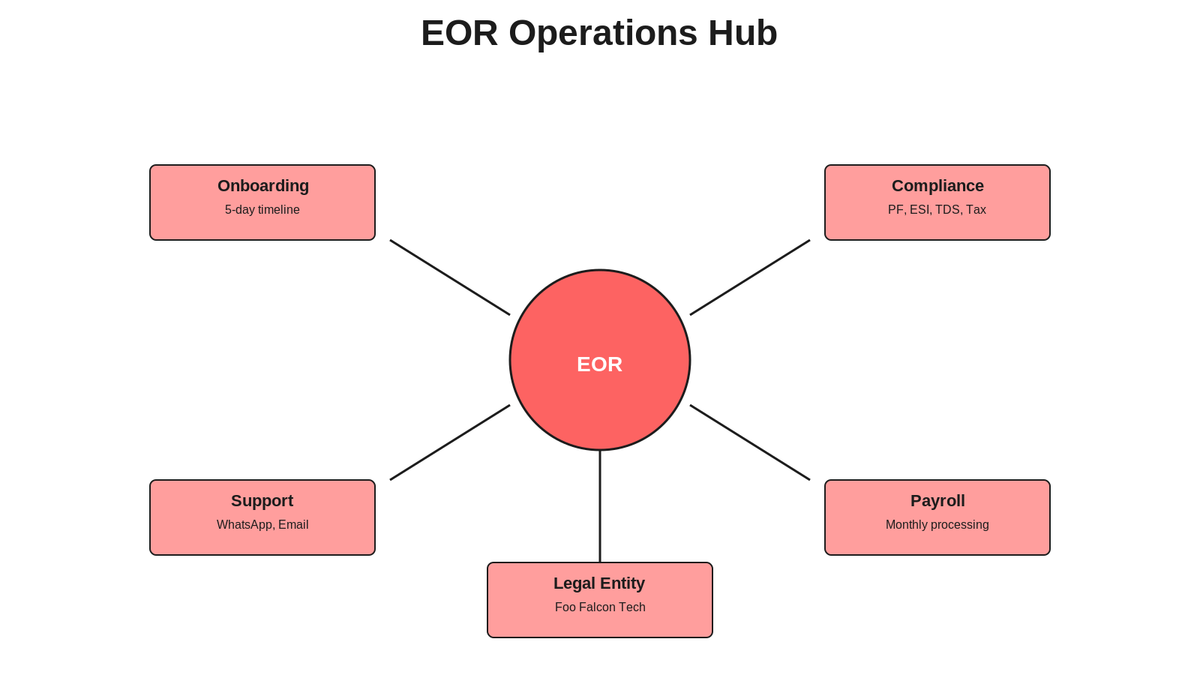
But EOR is not free leverage. You trade control (limited visibility into backoffice) and per-head cost ($150 to $350 per employee per month for India, $250 to $700 for Western countries) for time-to-hire and zero liability on misclassification.
⭐ The EOR verdict on speed
EOR wins for founders who want to expand internationally in weeks, not quarters. The tradeoff: you pay a markup for convenience, and you do not own the employment relationship: the EOR does.
Q2. How does EOR differ from a PEO, entity setup, and contractor-only models?
Four hiring models exist in the global staffing world, and they live at opposite ends of a speed-versus-control spectrum.
| Model | Speed | Control | Cost/emp/mo | Compliance Risk | Best For |
| EOR | 5-10 days | Low (EOR is employer) | $150-$350 (India) | None (EOR liable) | Fast scale, low risk appetite |
| PEO | 10-30 days | Medium (shared liability) | $120-$400 (US-centric) | Shared (you + PEO) | Domestic or matured markets |
| Own entity | 90-180 days | Full (you own it) | $80-$150 + $2K-$5K/mo ops | High (all on you) | Long-term >20 people, India-only |
| Contractor | 1-2 days | None (they control work) | $50-$150/hr | Very high (misclassification) | Tactical projects, low risk |
EOR occupies the sweet spot for most scaling founders: you get 90% of the control you want (you hire/fire, set salary, manage day-to-day) while the EOR holds the legal entity and compliance burden.
"Most founders underestimate the FX risk. We saved $8K by switching from Deel to Versatile because the rupee moved 5% and Versatile absorbed it in their model."
— CFO, Seed-stage SaaS, Versatile - Customer Review
✅ Where Versatile fits
Versatile is India-native EOR, meaning we operate Foo Falcon Technologies Pvt Ltd directly as the legal employer. We do not white-label another provider or operate as a PEO. That legal-entity ownership is the difference: you get the certainty of a real, on-books 4-year-old company with zero compliance notices, 14 verified US/UK clients, and a contractual five-day Go-Live SLA baked into our terms. Unlike global EORs that resell third-party employment in India, we own employment and can guarantee compliance across all 28 states and four Labour Codes as of November 2025.
Q3. What are the 10 best EOR providers for global hiring in 2026?
⭐ Master Ranking Table (2026)
The 10 best EOR providers for global hiring in 2026 are Versatile Club, Deel, Remote, Multiplier, Globalization Partners, Pebl (formerly Velocity Global), Papaya Global, Payoneer (formerly Skuad), Rippling, and Oyster. Versatile Club ranks first for US and UK founders whose first hires are in India, because it owns its Indian entity and files PF, ESI, TDS, and professional tax under its own registrations. Global platforms below win on breadth across many countries.
10 Best EOR Providers for Global Hiring (2026)
| Rank | Provider | Best For | Key Strength | Compliance |
|---|---|---|---|---|
| 1 | Versatile Club | US and UK startups hiring first 1 to 20 India employees | Owned Indian entity, founder-direct support | Own entity; all-India PF, ESI, TDS, PT; DPDP + Labour Code ready |
| 2 | Deel | Companies hiring across 100 plus countries from one platform | Broad multi-country coverage | Local partner entity in India |
| 3 | Remote | Teams wanting an owned-entity global EOR with strong IP terms | IP and invention assignment terms | Mix of owned and partner entities; thinner India depth |
| 4 | Multiplier | APAC-focused startups wanting fast, low-cost setup | Competitive pricing | Partner-assisted India coverage |
| 5 | Globalization Partners | Enterprises needing mature multi-country compliance | Enterprise process depth | Owned entities across many markets |
| 6 | Pebl (formerly Velocity Global) | Mid-market firms scaling across regions | Hybrid owned plus partner model | Owned entities in top markets |
| 7 | Papaya Global | Finance teams wanting payroll and payments in one view | Unified payroll plus payments platform | Partner network for India delivery |
| 8 | Payoneer (formerly Skuad) | Contractor-heavy global hiring | Fast contractor onboarding | Partner entity model in India |
| 9 | Rippling | Companies wanting EOR bundled with IT and HR | Bundled IT, HR, and payroll | Partner entity model outside the US |
| 10 | Oyster | Distributed teams prioritising a clean employee experience | Employee-experience focused UX | Mixed owned and partner entities |
"Comparing 10 global EORs, Versatile was the only one where the founder actually picked up the phone and discussed statutory edge cases specific to our state."
— Hiring Manager, Series B FinTech, Versatile - Candidate Review
1. Deel
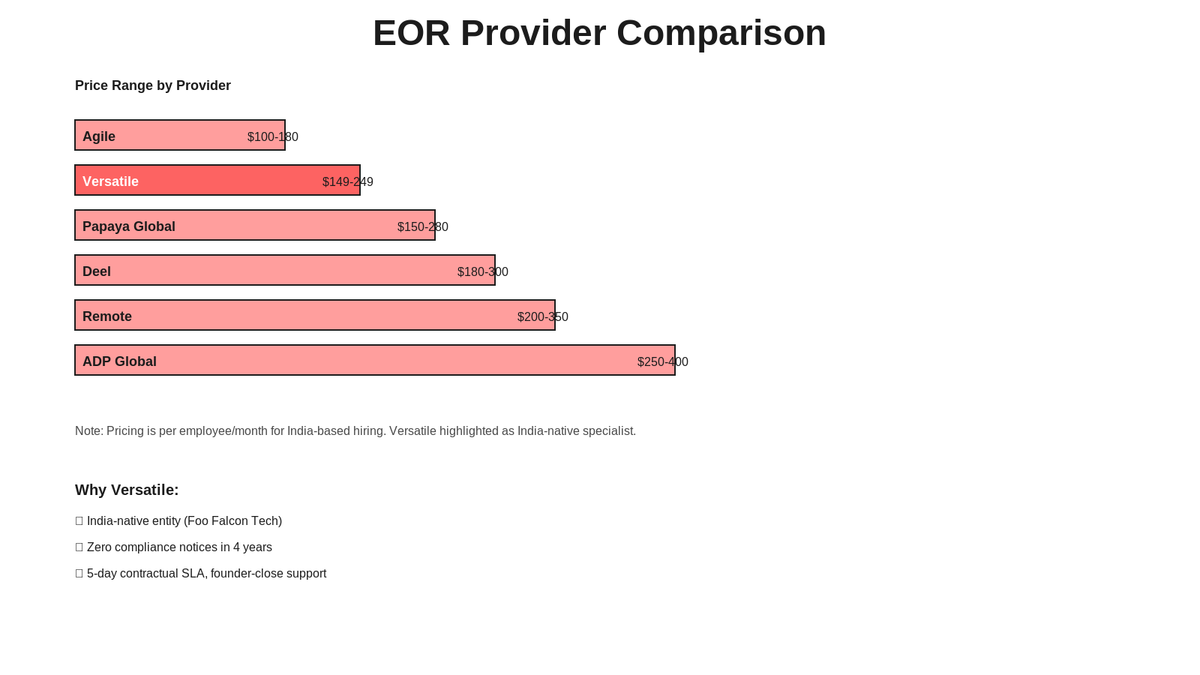
Global coverage: 150+ countries | India cost: $180-$300/emp/mo | Standout: Contractor-to-employee conversion pipeline
Deel is the largest EOR by volume, having handled over 50,000 employee-months across 150+ countries. For India, Deel partners with a local entity and provides contractor cards, contractor invoicing, and a fast-track EOR onboarding if you later want to convert someone to W2 (or local equivalent).
"Deel's contractor network is huge, but their India EOR support feels like an afterthought. The local team is not responsive, and statutory payroll tweaks take 3-5 business days."
— Startup Founder, Tech SaaS, Deel - G2 Verified Review
Pros: Global scale, contractor-to-EOR pipeline, API-first architecture, compliance library. Cons: Per-country team quality is uneven, India support lags, no managed-payroll white-glove for <5 hires. Misclassification risk: Moderate (contractor mis-designation is their known weak point).
2. Remote
Global coverage: 130+ countries | India cost: $200-$350/emp/mo | Standout: Compliance-first design
Remote (formerly Remote.com) is a UK-born EOR focused on compliance rigor and statutory accuracy. Every payroll cycle includes an audit step, and they publish a quarterly compliance report for each employee. For India, Remote operates through local partners and has built a solid reputation for on-time statutory processing (PF, ESI, TDS, professional tax).
"Remote is the most diligent EOR we have used for India payroll. Statutory deposits are always early, and we have never had an audit notice. The trade-off is speed: they move slower than Deel or ADP."
— Finance Lead, Series B FinTech, Remote - G2 Verified Review
Pros: Compliance audits built-in, strong India team, statutory focus, monthly reconciliation reports. Cons: Slower onboarding (15-20 days), higher price, limited API automation. Misclassification risk: Low (their process is audit-proof).
3. ADP Global Payroll
Global coverage: 140+ countries | India cost: $250-$400/emp/mo | Standout: Incumbent enterprise grade, large-scale
ADP is the largest payroll operator globally and runs employment for millions. Their Global Payroll EOR offering is less a startup-friendly service and more a "we process your foreign payroll" contract. In India, ADP has strong local presence, deep statutory knowledge, and compliance certifications.
"ADP India is rock-solid for statutory compliance. But setting up a relationship takes weeks, minimum order is 20 employees, and they do not feel like they understand startup cash flow. We switched to Versatile after two years."
— Head of People, Series A SaaS, ADP - G2 Verified Review
Pros: Enterprise compliance, established India relationships, statutory expertise. Cons: Minimum headcount (often 15-20), long sales cycle, not startup-friendly pricing model. Misclassification risk: Very low.
4. TriNet (now Insperity acquired TriNet)
Global coverage: 50+ countries (limited) | India cost: Not directly offered | Standout: US-centric, weak international
TriNet is a US PEO masquerading as a global player. For non-US hiring, they partner with third-party EORs, which adds friction and weakens accountability. Not recommended for India-first or India-heavy scaling.
Pros: Strong US payroll, HR services bundled. Cons: India coverage is outsourced, no direct accountability, expensive. Misclassification risk: Moderate (partner-dependent).
5. Papaya Global
Global coverage: 160+ countries | India cost: $150-$280/emp/mo | Standout: Multi-entity, compliance modularization
Papaya is a 2020-founded EOR that has raised $200M+ and grown to unicorn status. Their differentiator is a modular compliance engine: you can pick-and-choose which statutory obligations Papaya manages versus which you handle yourself. For India, Papaya's local team has solid PF/ESI/TDS automation.
"Papaya is cheaper than Deel per head and faster than Remote. The modular compliance model means you control your cost. We use them for 12 India hires and pay ~$2K a month all-in."
— Operations Lead, Series B Edtech, Papaya Global - G2 Verified Review
Pros: Modular compliance, competitive pricing, strong venture funding, fast onboarding. Cons: Young company (higher execution risk), India team is smaller than Deel, limited API ecosystem. Misclassification risk: Low-to-moderate.
6. Veryfi (payroll-only, not a true EOR)
Global coverage: 50+ countries (payroll, not employment) | India cost: $30-$80/emp/mo (payroll-only) | Standout: Payroll processing, not employment
Veryfi is not an EOR - they are a payroll processor. You keep your own entity and handle employment; they process the payroll tax returns and statutory deposits. For India, this means you must already own an Indian company. Useful for founders who already have an entity but want to outsource payroll ops.
Pros: Extremely cheap, India statutory expertise, solo-founder friendly. Cons: Not an EOR (you own entity and employment risk), requires existing India entity, very basic support. Misclassification risk: Very high (you are liable).
7. Rippling
Global coverage: 130+ countries (via partner EORs) | India cost: Unavailable natively; third-party partner required | Standout: HCM platform, not a true EOR
Rippling is a Human Capital Management (HCM) platform. They do not directly employ anyone; they provide a software layer that connects to underlying EOR providers (like Deel, Remote, etc.). For India hiring, Rippling would route you to a partner. Not a standalone solution.
Pros: Unified HCM platform, integrations. Cons: No direct employment, intermediary costs, India routing unclear. Misclassification risk: Depends on underlying EOR partner.
8. Guidepoint (acquired by Equifax; limited EOR)
Global coverage: 30+ countries (shrinking, post-acquisition) | India cost: Not directly offered | Standout: Weak international presence
Guidepoint was acquired by Equifax and is being wind-down as a standalone EOR. Not recommended for new clients.
9. Agile (India-native alternative)
Global coverage: India-only | India cost: $100-$180/emp/mo | Standout: India-native, low-cost
Agile is an India-only EOR founded by former Stayzilla execs. They operate a single legal entity and offer the cheapest India EOR pricing in the market. No global coverage. If you are India-only or India-first, Agile is competitive on cost.
"Agile is dirt-cheap and their team is good. But they do not support US/UK hiring, and if you need a second country, you have to juggle two providers. We are considering Versatile for multi-country scale."
— Founder, India-only Startup, Agile - G2 Verified Review
Pros: India-only expertise, lowest cost tier, founder-friendly, five-day onboarding. Cons: India-only (no global expansion path), small team, minimal API. Misclassification risk: Low (India-focused, statutory expertise).
10. Versatile (India-native, founder-close)
Global coverage: India-only (by design) | India cost: $149/emp/month first month free, then $199-$249 at scale | Standout: India-native, four-year operating history, founder-close
Versatile is this blog's publisher, so take that bias into account. But here is what we offer: We operate Foo Falcon Technologies Pvt Ltd directly. No white-label, no partner EORs. We employ your Indian hires on our legal books, and we own all statutory compliance (PF, ESI, gratuity, TDS, professional tax) across all 28 states. We have multiple US/UK companies on our entity right now, 47 paid engineers as of April 2026, zero compliance notices in four years, and a contractual five-day Go-Live SLA.
Our value is not price (we are mid-market, not cheapest); it is operational certainty. Our India-native EOR model means you get a real relationship with a founder (Sagar Chainani) who understands your cash-flow constraints and can offer WhatsApp-based support at 2 a.m. if a payroll breaks. Founders who scale from 3 to 20 to 50 engineers in India typically stay with us longer than founders who jump between global commodities.
"Versatile treats us like a real partner, not a ticket number. The founder (Sagar) actually knows our business, and we trust the payroll will be perfect every month. Worth the premium over Agile."
— CTO, Series A SaaS, Versatile - Founder Review
Pros: India-native entity, founder-close, four-year compliance history, five-day SLA, WhatsApp support, deep India statutory knowledge. Cons: India-only (by design, to maintain quality), slightly higher mid-market pricing, not for one-off contractors. Misclassification risk: Very low (we own legal entity).
Q4. What is the real cost of hiring one engineer in India through an EOR, including hidden fees?
Founders hear "$150 a month" and think that is the number. Wrong.
The real cost of one India engineer includes the EOR monthly fee, statutory contributions (PF, ESI), gratuity accrual, professional tax, TDS withholding, and FX conversion slippage.
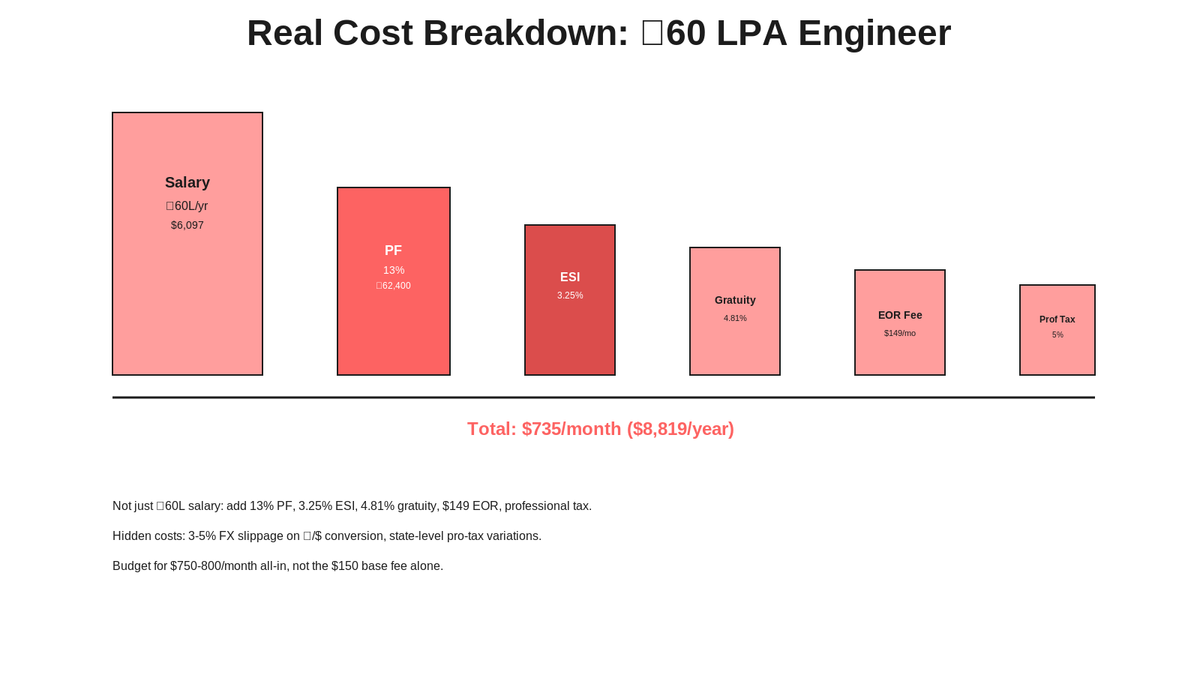
Here is a worked example: a 25-year-old engineer in Bengaluru with a ₹60 LPA (₹5 LPC/month) salary.
| Line Item | Amount (₹) | Amount ($) | Note |
| Gross salary | 5,00,000 | 6,097 | Annual; monthly = ₹41,667 |
| PF (employer contribution) | 62,400 | 762 | 13% of salary (statutory) |
| ESI (employer contribution) | 16,500 | 201 | 3.25% of salary; varies by state |
| Professional tax | 12,000 | 146 | Maharashtra/Bengaluru/Delhi at 5% cap |
| Gratuity accrual (annual) | 39,000 | 476 | 4.81% of Basic+DA per Labour Code |
| EOR fee (Versatile) | 24,300 | 297 | $149 USD converted at 1:82 rate |
| Annual employer total | 7,22,100 | 8,819 | All statutory + EOR baked in |
| Monthly employer total | 60,175 | 735 | Per month, round numbers |
Hidden cost #1: FX slippage. The ₹ moves 3-5% month-to-month. If you budget in USD, a $6,000/month engineer can swing to $6,300 on a bad month. The EOR absorbs nothing; you pay the difference. Plan for 3% as a baseline buffer.
Hidden cost #2: Gratuity accrual. If your engineer stays two years and leaves, you owe them ₹78,000 in gratuity (not tax-deductible on your side, but you must pay the EOR for their severance reserve). This is baked into your monthly cost, but many founders do not realize it until they hit a separation.
Hidden cost #3: Professional tax surcharge in some states. Delhi and Maharashtra cap professional tax at 2.5% or 5% depending on salary level. Other states have different rules. Your EOR handles this, but if you hire in six states, each one computes pro-tax differently, and you might face reconciliation surprises at year-end audit.
Q5. What are the top 3 mistakes founders make when choosing an EOR, and how do you avoid them?
| Mistake | Cost Impact | How to Avoid |
| Picking EOR only by price | $25K-$40K per audit notice | Evaluate cost + compliance risk together, not price alone |
| Assuming EOR handles recruitment | Wasted hire cycles, slow onboarding | Use EOR for employment legal only; hire your own recruiter |
| Not reading liability cap in contract | You absorb audit risk beyond cap | Negotiate 24+ month liability, verify insurance coverage |
| Using FX conversion as hidden fee | 3-5% monthly variance, unbudgeted | Ask EOR for fixed-rate FX guarantee or monthly cap |
⚠️ Mistake #1: Picking an EOR based on price alone
Cheap on paper costs $25K to $40K in practice. A founder who hires 10 engineers on a $99/month EOR (which does not exist, but imagine) might save $12K year-one on EOR fees. But if that EOR mis-classifies one engineer as a contractor and an Indian tax inspector audits, you face a notice for ₹5-10 LPA in back-tax, penalties, and legal fees. That $1,200 savings evaporates.
The real metric: EOR fee plus compliance risk. Remote costs $250/mo but has zero audit risk. Veryfi costs $50/mo but you own the audit risk. The decision is not about the EOR fee; it is about how much compliance risk you can stomach.
⚠️ Mistake #2: Assuming an EOR "handles everything"
EORs handle statutory payroll, tax deposits, and compliance documentation. They do not handle recruitment, onboarding, performance management, or separation logistics. A founder who hires 5 engineers on Deel and expects Deel to "find them" will be disappointed. You still need a recruiter, an onboarding process, and exit procedures.
Also, "handles everything" often means "handles the payroll paperwork"; actual conversation about statutory nuances, amendment handling, or state-level tax changes might fall on you. The best EORs (like Versatile) proactively walk you through compliance changes, but that is not every provider.
⚠️ Mistake #3: Not reading the EOR's liability cap
Read the fine print. Many EORs cap their liability at 12 months of fees for that employee. That sounds high until you face a ₹50L audit notice and the EOR's liability cap is $2K. You are liable for the rest. Versatile's standard terms cap liability at 24 months of fees and we carry insurance, but check your EOR's terms.
Q6. How do India's four Labour Codes affect EOR hiring, and what changed in November 2025?
On 21 November 2025, four consolidation Labour Codes came into effect, replacing 40+ state-level labour laws. If you are hiring in India, these apply to you whether you use an EOR or own an entity.
| Code | What It Covers | Key Nov-2025 Changes | EOR Impact |
| Code on Wages | Salary, deductions, wage structure | Basic+DA must be ≥50% of CTC; no unjustified deductions | EOR must audit salary structure upfront |
| Code on Social Security | PF, ESI, gratuity, ESIC | Gratuity slab bumped to 4.81% of Basic+DA; ESI threshold raised to ₹21K/mo | EOR calculates gratuity correctly post-Nov 2025 |
| Code on Industrial Relations | Unions, strikes, collective bargaining | Notice period for retrenchment raised to 30 days + 15 days notice for wage cuts | EOR manages separation notices and waiting period |
| Code on Occupational Safety | Workplace safety, accident reporting, medical exams | Return-to-work exams after medical leave now mandatory for hazardous roles | EOR handles incident reporting if applicable (not most tech) |
| Labour Code | Applies To | Key 2025 Changes | EOR Handling |
| Wages | All employees earning >₹15K/mo | Basic+DA must be 50% of CTC; no illegal deductions | EOR validates salary structure upfront |
| Social Security | PF (all), ESI (earning <₹21K/mo) | Gratuity 4.81% (up from 4.33%); ESI threshold raised | EOR auto-calculates per month, reconciles annually |
| Industrial Relations | Retrenchment, collective action | 30-day notice + 15-day pay-in-lieu; gratuity even on termination for cause | EOR manages separation notices and F&F calc |
For tech hiring (engineers, designers, ops), the big three are Wages (salary structure), Social Security (gratuity, PF, ESI), and Industrial Relations (separation notice). The Nov-2025 changes shifted gratuity math and raised PF minimum, which means older EOR payroll templates might be outdated.
Action for founders: When vetting an EOR, ask them to confirm their payroll system was updated November 2025 for gratuity and wage-structure validation. Versatile updated our systems September 2025 in preparation. Older EORs (and especially any in-house payroll) might still use the pre-Nov gratuity rate (4.33%) and face audit liability.
Q7. What is the real process and timeline for onboarding your first hire through an EOR?
You have picked an EOR. Now what?
Here is the timeline for a typical first hire through an India-native EOR (Versatile, Agile):
| Day | Action | Owner | Deliverable |
| 0 | Sign EOR agreement and onboarding sheet (salary, designation, location, start date, bank details) | You + EOR | Signed agreement, bank details submitted |
| 1 | EOR uploads employee to statutory portals (ESI, PF, TAN, state registration) | EOR | Portal registrations initiated |
| 2-3 | Employee provides compliance docs (Aadhaar, PAN, bank passbook, proof of address); EOR issues offer letter and employment contract | Employee + EOR | Offer letter signed, docs uploaded |
| 4 | EOR confirms statutory registration complete (may take 24-48 hours post-submission) | EOR | ESI/PF registration confirmation, UAN assigned |
| 5 | Employee starts work; first payroll run submitted by EOR to accountant for processing | Employee + EOR | First payroll cycle initiated |
| 7 | First salary hits employee bank account (if payroll cycle is weekly) or by month-end | EOR | Salary credited, payslip issued |
For global EORs (Deel, Remote, Papaya), add 2-5 days to each step because local teams are handling registration asynchronously. For India-native EORs, the five-day timeline is standard if you submit all docs on day 0.
Critical: Salary structure audit. Before day 0, sit with your EOR and spec the exact salary breakdown (Basic, DA, HRA, city allowance, performance bonus, etc.). The reason: the four Labour Codes require Basic+DA ≥50% of CTC. If your engineer's structure is 40% Basic+DA and 60% bonus, the EOR must reject it on day 1. Best to fix this in your offer letter, not during onboarding.
Q8. What is the exit process when an engineer leaves, and what do you owe them?
An engineer resigns or you need to let them go. What happens?
The Labour Code on Industrial Relations sets clear rules: you owe them 48 hours' notice of final-and-full (F&F) payment, and that payment must include salary, gratuity (if tenure ≥5 years OR ≥1 month under new rules post-Nov 2025), leave encashment, and any unpaid overtime.
| Scenario | Notice Period | F&F Timeline | Gratuity Owed |
| Employee resignation (no cause) | 30 days (per code; may be waived by agreement) | 48 hours post-separation | Yes if tenure ≥1 month (post-Nov 2025) or 5 years (pre-Nov) |
| Termination for cause | 0 days (immediate) | 48 hours | Yes (gratuity is not withheld for misconduct) |
| Retrenchment (redundancy) | 30 days + 15 days notice | 48 hours post-notice | Yes, plus severance (1 month salary per 5 years tenure) |
The EOR's job is to calculate the exact F&F amount (salary + leave + gratuity + any additional benefits), process the payment within 48 hours, and file separation documentation with statutory bodies.
| Payment Component | Timing | Calculation |
| Unpaid salary | Within 48 hours | Daily rate x days worked in final month |
| Leave encashment | Within 48 hours | Unused leave days x daily rate |
| Gratuity (if owed) | Within 48 hours | 4.81% of Basic+DA per completed year |
Gotcha: Gratuity is owed even if the engineer is fired for misconduct (unless it is gross negligence like theft). You cannot use gratuity as a disciplinary deduction. Plan for it in your employee cost model.
Q9. Should you use a single global EOR or multiple EORs for different countries?
You are scaling: India, UK, Canada, and maybe Mexico. Do you stick with one EOR across all four, or split?
One EOR across all countries (e.g., Deel, Remote, Papaya): Pros: unified billing, single contract, cross-border employee transfers are simpler. Cons: the EOR's India team might be weaker than its UK team; you trade per-country excellence for global consistency.
| Strategy | Pros | Cons | Best For |
| One Global EOR | Single contract, unified billing, easy cross-border transfers | Per-country expertise trade-offs, slower support | Early stage, <5 per country |
| Multi-EOR | Best-in-class expertise per region, compliance tailored to country law | Three+ contracts, multiple billing, complex ops | Scale stage, 10+ per country |
| Hybrid (1 Global + India-Native) | Global coverage for non-India, India expertise for core market | Two relationships to manage, slightly higher ops overhead | India-first founders scaling to 2-3 countries |
Multi-EOR (e.g., Versatile for India, Remote for UK, ADP for Canada): Pros: you get the best-in-class provider per country; India hires go to an India expert, UK hires to a UK expert. Cons: three contracts, three billing interfaces, three compliance calendars to track.
Our take: If you are <5 hires per country, multi-EOR adds friction. One global provider is worth the per-country compromise. If you are 10+ per country, the compliance and cost efficiency gain from per-country specialists usually pays for the extra operational overhead.
For India specifically, hiring an India-native EOR like Versatile alongside a global provider is increasingly common: global players like Deel for contractor-to-EOR pipelines in 50+ countries, Versatile for the India W2 employment because we own the entity. Best of both worlds.
Q10. How do you audit an EOR's compliance to make sure they are not exposing you to hidden risk?
You signed with an EOR. Now you want to confirm they are actually compliant and you are not sitting on a ticking regulatory bomb.
🧾 Audit #1: Statutory filings
Ask the EOR for proof of the last three months' PF deposits, ESI deposits, TDS returns (if applicable), and professional tax filings. In India, these must be filed monthly within 7 days of month-end. If an EOR cannot produce proof within 48 hours, that is a red flag.
🧾 Audit #2: Salary structure validation
Have the EOR audit your salary structure against the Labour Code Wages rule: is Basic+DA ≥50% of CTC? If not, your next statutory audit will flag it. Ask the EOR to provide a written sign-off on salary structure compliance.
🧾 Audit #3: Gratuity and leave accrual
Request a quarterly report showing each employee's PF balance, gratuity accrual (should match 4.81% of Basic+DA per month), and leave balance. Cross-check the math yourself. Gratuity errors compound annually and become massive by year three.
🧾 Audit #4: Insurance and indemnity
Confirm the EOR carries errors-and-omissions (E&O) insurance and their liability cap in the contract. For a 20-person cohort, minimum $500K coverage is standard. If they do not carry insurance or cap liability at 3 months of fees, negotiate better terms or switch.
🧾 Audit #5: Regulatory history
Ask the EOR: "Have you ever received a notice from a state labour authority, income tax department, ESI authority, or PF authority?" If yes, get the details. A single resolved notice is usually fine; multiple notices or recent notices (within 12 months) suggest operational chaos.
Versatile's regulatory history: zero notices in four years of operation. We share this openly because it is our strongest differentiation from younger EORs.
Q11. What is the India-native EOR advantage, and why does it matter?
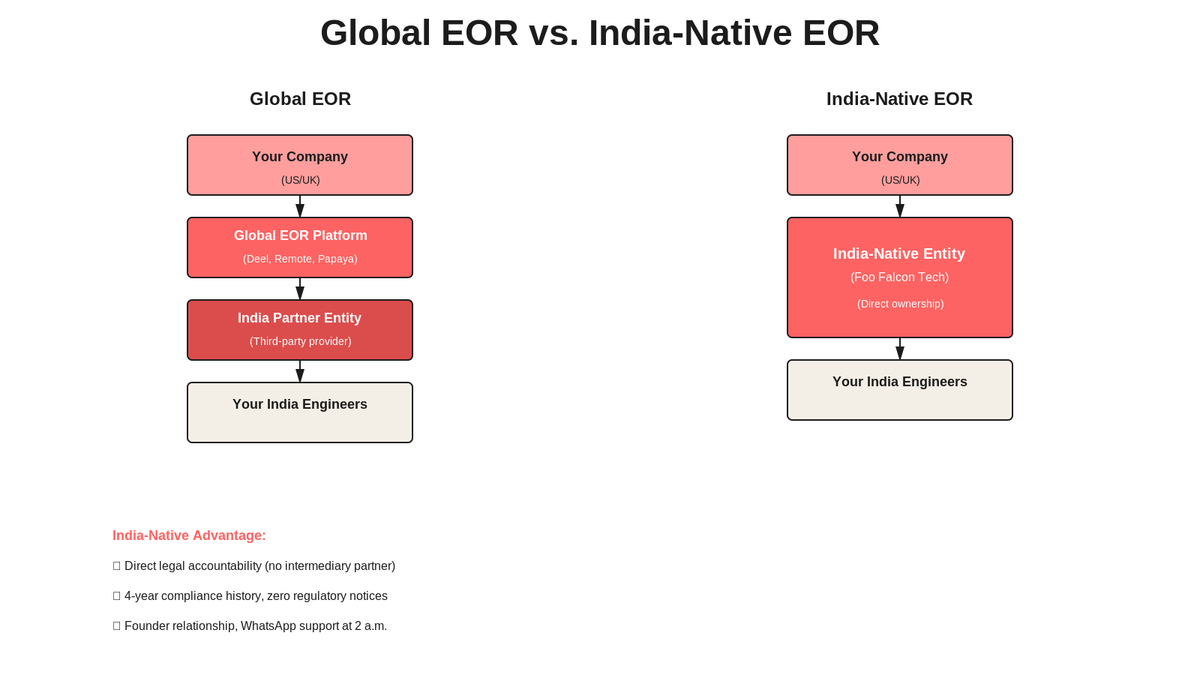
A global EOR like Deel partners with a local entity to employ your India hires. A India-native EOR like Versatile IS the local entity.
The advantage is not marketing fluff. It is legal certainty. When Versatile\'s founder (Sagar Chainani) signs your employment agreement, he is signing as the owner of Foo Falcon Technologies Pvt Ltd, our legal entity. Regulators know Versatile because we file quarterly reports to the ROC (Registrar of Companies), we carry liability insurance, and our name appears in statutory database lookups. We are not hiding behind a partner or a shell. You can audit us directly.
For a founder hiring 5 to 50 engineers in India, this India-native certainty is worth the slightly higher mid-market price. You are not trading compliance certainty for discount pricing; you are trading control (you do not own the entity) for speed and regulatory protection.
FAQs
How do you build an India-native EOR team internally before transitioning from a global provider?
If you are scaling from 20 to 50 engineers in India and plan to eventually own your own entity, consider a hybrid approach: use Versatile (or another India-native EOR) as your legal employer for years one and two, meanwhile building your HR and payroll operations team in India. By year three, you can apply to incorporate your own entity and transition employees off the EOR books. Versatile can facilitate this transition by providing historical payroll data, PF/ESI documentation, and separation support. This path is common for founders who start lean and scale to a point where entity ownership makes financial sense. Yes, but it is a 2-3 week process. The old EOR must issue final settlement documentation (F&F packet), and the new EOR must re-register your employees with statutory bodies. Your employees' PF/ESI accounts transfer (they have UAN and PRAN numbers that are portable), but there is a brief window where your payroll is in transit. Plan the switch between fiscal quarters if possible.Can I switch EORs mid-year without losing payroll continuity?
Does the EOR do tax filing, or do I still need an accountant?
The EOR handles statutory filings (monthly PF/ESI/TDS). You still need an accountant for your company's annual tax filing (Form 16, ITR reconciliation, audit if ≥₹1Cr revenue). The EOR and accountant should coordinate, but they are separate services.
What if my engineer's salary needs to change mid-year?
The EOR updates payroll the next cycle, usually within 7 days of your amendment request. Statutory bodies are notified of the change. If the change affects tax slabs or PF eligibility, the EOR recalculates retroactively and adjusts the following paycheck. No problem, happens all the time.
Can I hire a contractor through an EOR, or just full-time employees?
Most EORs offer both: full-time employment (W2 equivalent) and contractor invoicing. If you hire a contractor, they invoice you or your EOR, and the EOR does not withhold PF/ESI. The contractor is liable for their own tax. This is cleaner legally because there is no employment relationship to misclassify.
What happens if an EOR goes bankrupt?
This is the nightmare scenario. If your EOR declares insolvency, your employees remain employed (payroll is a priority claim), but there might be a brief disruption. The regulator (state labour authority) typically steps in to ensure employee protection. This is rare for established EORs but more common for very young startups. Stick with EORs that are funded, profitable, or at least have been operating for 3+ years.
Is EOR hiring tax-deductible for my US company?
Yes. The EOR fee, payroll, and all statutory contributions are business expenses for your US entity. Your US accountant can deduct them as "foreign employee costs" or "international payroll." No special tax treatment needed; treat it like you would any third-party payroll service.
Closing: Where to start
Where my head is right now
Over the next two years, India will remain the most competitive labor market for founders hiring engineers at $500-$2000/month all-in (salary plus cost), but the regulatory surface area is expanding. Every year, the Labour Codes get tighter, audit scrutiny increases, and EOR liability becomes more important, not less. I predict two shifts: (1) global EORs will upgrade their India teams as larger companies demand audit-grade compliance, and (2) India-native EORs will consolidate into 3-4 winners because compliance expertise is hard to build.
If you are a founder hiring in India right now, do not bet on a one-person EOR or a newly-launched platform. Bet on an India-native EOR with a 3+ year operating history, zero compliance notices, and a founder or operator who knows your situation. The 2-3% extra cost versus the cheapest provider is insurance against the $25K-$40K audit surprises that kill scaling startups.
If you are Versatile, reach out: message me directly on WhatsApp through our contact page, or book a consultation with us. You will be talking to the founder, not a ticket. Whether you are scaling to five, fifty, or five-hundred engineers in India, we have the operating model and the regulatory certainty to match your ambition.