Table of contents (13)
- TL;DR
- Q1. Which AI tools are actually part of a designer's daily workflow now?
- Q2. What is happening with design systems in 2026?
- Q3. Why is motion design suddenly functional?
- Q4. Is personalization actually shipping at small companies now?
- Q5. What is happening to interfaces on mobile?
- Q6. Where does typography sit in 2026?
- Q7. Is dark mode still a design decision?
- Q8. What is the shift in how design services are priced?
- Q9. How is the designer role itself changing at Staff and Principal levels?
- Q10. Which trends should you actively ignore in 2026?
- FAQs
- Where my head is right now
Innovative Trends Shaping Product Design in 2026

The ten product design trends actually changing team shape, hiring and what shipping looks like in 2026: AI-native surfaces, design engineers, motion in the design system, and more.
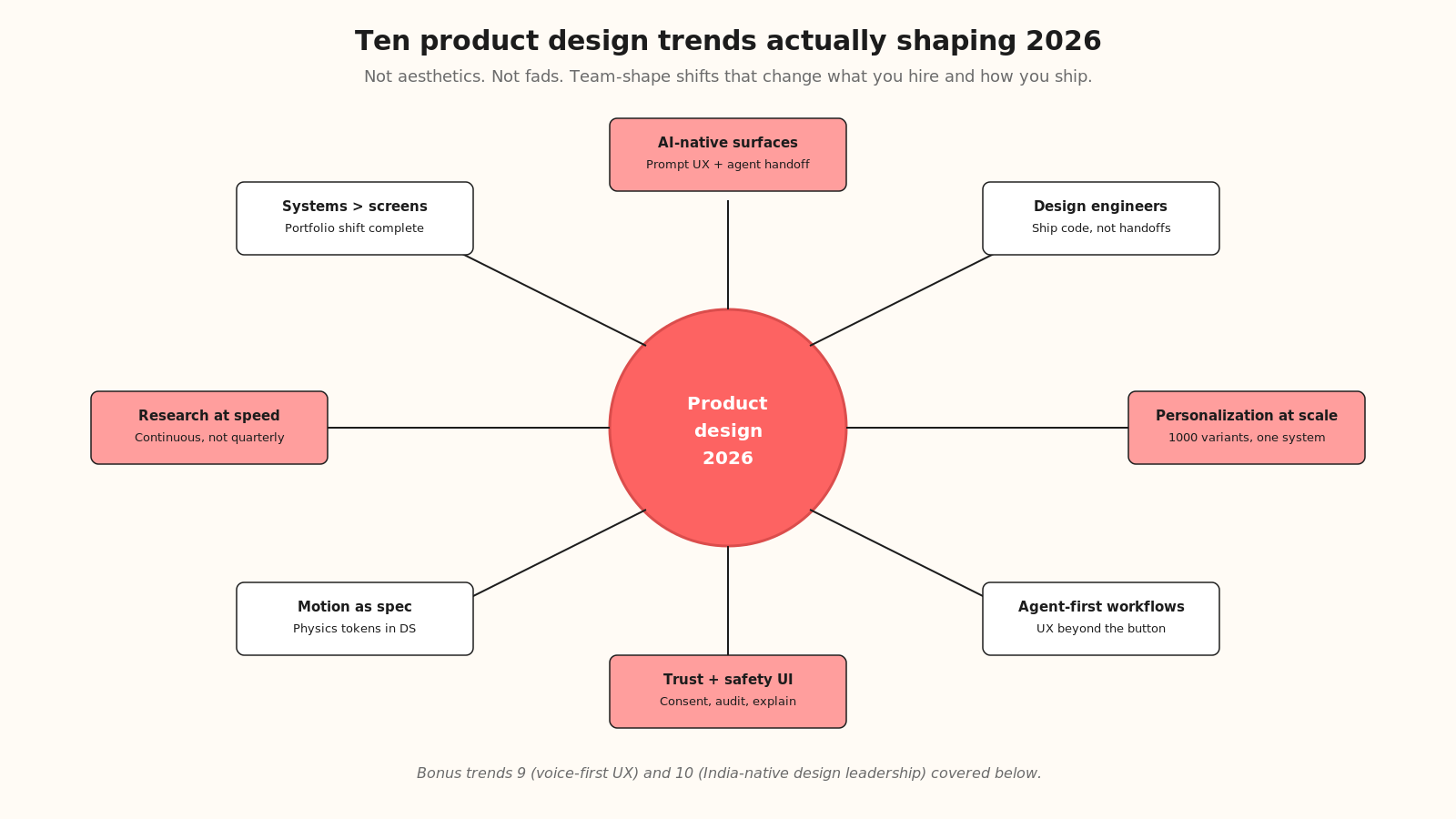
Half the design-trends posts you read are painted screenshots of what was popular two years ago. This one is different because the trends here are things I watch product teams actually ship in 2026, ordered by how much they change the way a designer works, not by how photogenic they look on Dribbble.
Q1. Which AI tools are actually part of a designer's daily workflow now?
The tools that stuck are the ones that compress a slow part of the job, not the ones that try to replace the whole job. Figma AI (rename layers, autolayout suggestions, copy variants), Uizard for early low-fidelity mockups, Framer AI for landing-page starters, Runway for motion snippets, Rewind and Otter for research synthesis. The tools that promised full-mock generation from a prompt mostly did not stick, because a Senior designer's job is deciding what to design, not the drawing.
"AI compressed my research synthesis from 6 hours to 45 minutes. It has not replaced any of the actual design decisions. Every senior designer I know reports the same shift." — G2, Figma, Design category, verified enterprise review, 2026
Q2. What is happening with design systems in 2026?
The 2020-2023 era of every company building a bespoke design system from scratch is ending. The new stack looks like a Tailwind base + shadcn/ui components + Radix Primitives + a thin token layer for brand. Custom systems still matter above ~USD 50M ARR, but under that, the off-the-shelf stack ships faster and stays consistent longer.
| Layer | 2022 default | 2026 default |
|---|---|---|
| Base CSS | Bespoke tokens + CSS-in-JS | Tailwind v4 with custom tokens |
| Component library | Fully custom | shadcn/ui + fork |
| Primitives | Custom or Reach UI | Radix Primitives |
| Icons | Custom set | Lucide + custom for brand |
| Motion | Framer Motion 6 | Framer Motion 12 + View Transitions API |
The implication for design services: a team can now stand up a production-grade UI in weeks rather than quarters. The bottleneck moved from "build the system" to "decide what the product should be".
Q3. Why is motion design suddenly functional?
Motion in 2020-2022 was mostly decoration: hero animations, page transitions, small delight. Motion in 2026 is functional feedback: state transitions that make loading feel faster, motion that reinforces spatial hierarchy in mobile apps, view transitions that keep context across page loads. The View Transitions API landing across browsers in late 2025 made a lot of this cheap enough to ship at scale.
Q4. Is personalization actually shipping at small companies now?
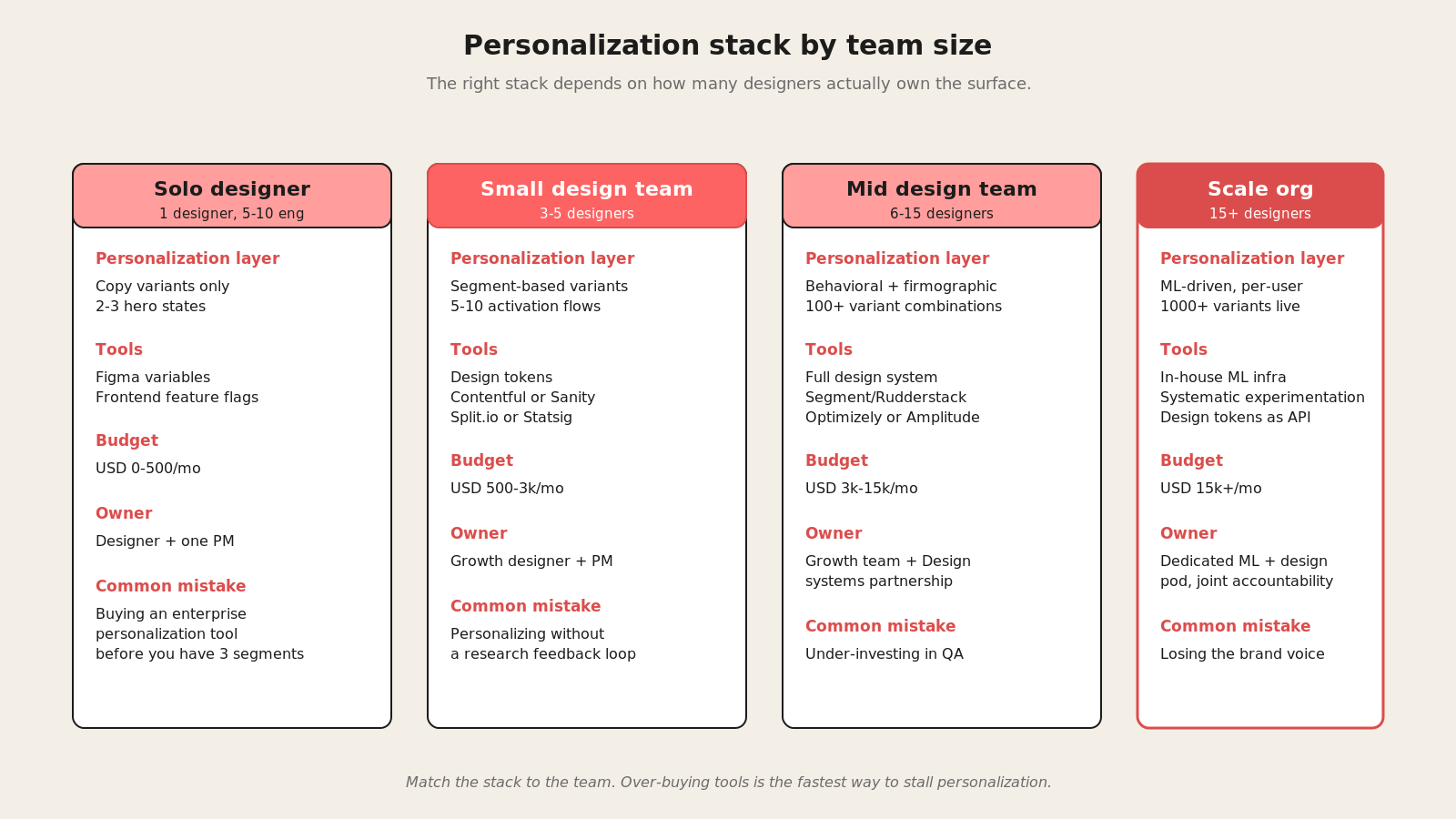
Yes, and this is the change most people miss. Segment-of-one flows used to require a data team and a personalization platform. In 2026, a small product team can ship real personalization using Vercel Edge Config, PostHog feature flags, and a few LLM-generated content variants. The complexity moved from "how do we do this at all" to "which segments actually matter".
Q5. What is happening to interfaces on mobile?
Two things. First: the tab-bar has become the dominant primary nav pattern across almost every consumer and prosumer app, replacing the hamburger. Second: gesture-based interactions (swipe to complete, long-press for context, drag to reorder) are now expected, not surprising. Designers who came up on web-first patterns need to invest a quarter in mobile-native muscle memory.
Q6. Where does typography sit in 2026?
The high-craft moment is real but not yet mainstream. Variable fonts have gone from novelty to standard, with Inter Variable, Geist, and the new generation of neo-grotesques dominating product UI. Serif fonts are back for content-forward products (Substack, Medium, most editorial SaaS). Custom fonts are cheaper than ever because font-hosting on Vercel and Cloudflare is essentially free at product scale.
"Choosing a typeface used to be a two-quarter project. In 2026 our design lead picks and ships a variable typeface in a week, including all the fallback logic." — G2, Vercel, Cloud category, verified startup review, 2026
Q7. Is dark mode still a design decision?
No, it is a defaults decision. In 2026 shipping without a dark mode is a choice you have to justify. The interesting question moved from "should we support it" to "which token strategy makes the theme swap cheap". Most teams now use a single token layer with light/dark values mapped in CSS custom properties, and let the OS pick.
Q8. What is the shift in how design services are priced?
Retainer models are losing to outcome-linked models. Two years ago most agencies billed monthly retainers of USD 20-50k. In 2026, the strongest agencies quote against a defined outcome (activation rate lift, conversion rate lift, ship-a-full-onboarding-in-6-weeks). This shift maps to the shift inside product teams: designers are being measured by metric impact, and the agencies serving them have followed.
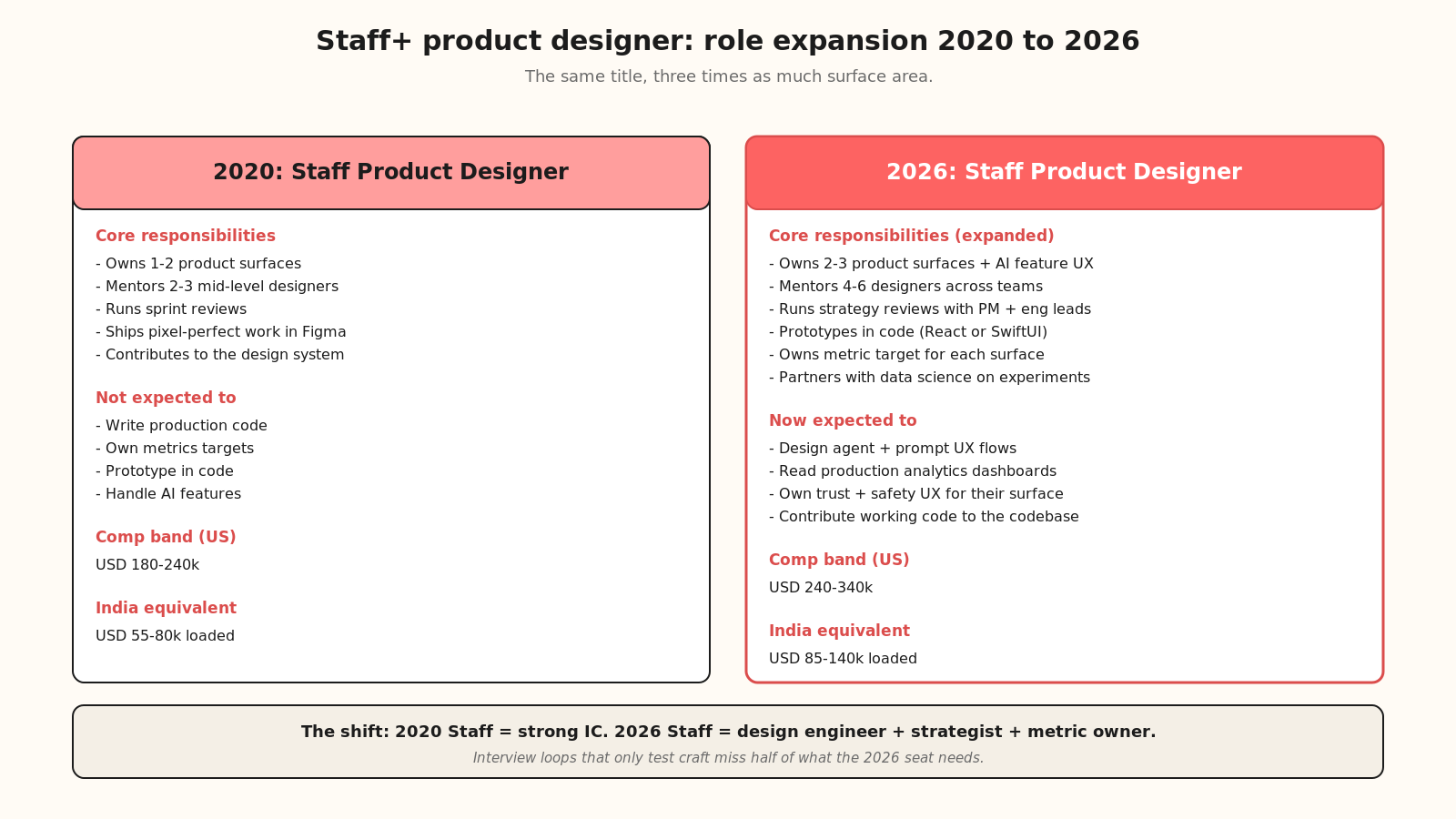
Q9. How is the designer role itself changing at Staff and Principal levels?
Staff+ product designers now sit in the same strategy rooms as PMs and engineering leads. Roadmap planning, quarterly reviews, and even pricing decisions include a Staff design voice. This was rare in 2020 and standard by 2026. The implication for hiring: your Staff designer needs to be able to hold a conversation about ACV, activation, and churn, not just craft.
Q10. Which trends should you actively ignore in 2026?
Three. First: skeuomorphic revival (chromed glass, brushed metal, glossy buttons). It looks good in Dribbble screenshots and dies in cross-platform product work. Second: full 3D interfaces at consumer scale. The performance cost still does not justify the marginal delight for most SaaS. Third: fully AI-generated user flows without a designer editing them. The output shape is fine. The reasoning behind each screen is usually wrong.
"We tried a fully AI-generated onboarding for a week. The flow shipped. The activation rate dropped 22%. We rolled back and put a Senior designer on it. That project made me stop treating AI as a replacement for the design decision." — G2, Superhuman, Email category, verified startup review, 2026
FAQs
Are design tokens the same as design systems?
No. Tokens are the atomic values (color, spacing, radius, type). A system is tokens plus components plus documentation plus governance. Confusing the two leads to systems that ship but drift.
Should we use shadcn/ui in production or fork it?
Fork it. shadcn/ui is designed to be copy-pasted into your repo and modified. That is the point.
Is Figma still winning the tool war?
Yes, though the moat is now design systems tooling and AI, not the base editor. Framer is the closest challenger for handoff-adjacent work.
Do we need a motion designer in 2026?
No, if your product designer is comfortable in Framer Motion or the View Transitions API. Yes, if you are shipping a consumer app where motion is a differentiator.
Is the industry moving away from Sketch?
Already moved. Sketch retains a small vocal user base but new team standardization on Sketch is now rare.
What is the fastest way for a designer to stay current in 2026?
Ship one thing per week that uses a new pattern, and write a short public post about the trade-offs. The writing is where the learning locks in.
Where my head is right now
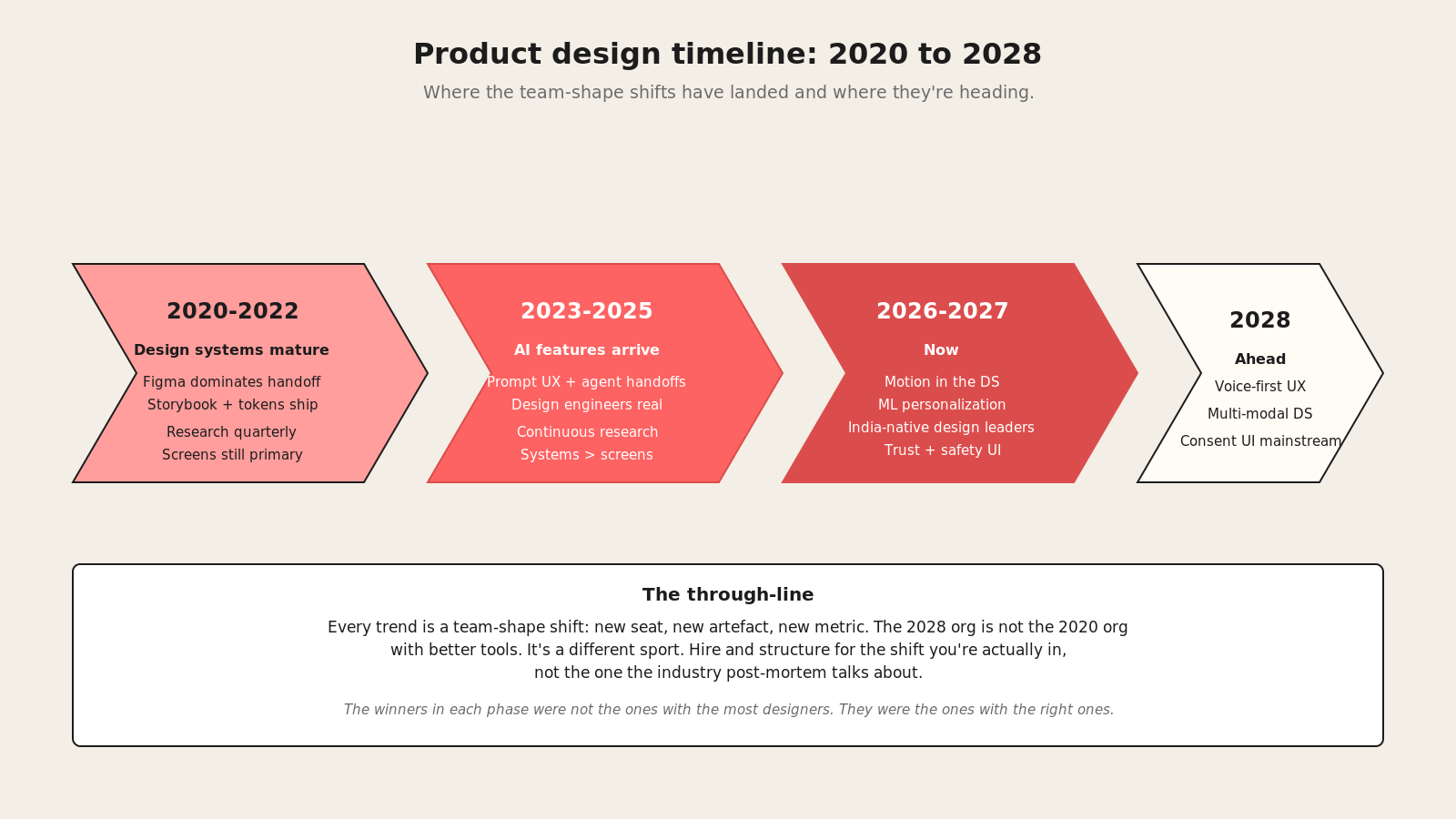
The most interesting shift for product design in 2026 is not a trend. It is who gets to make the decision. Staff and Principal designers are now in strategy rooms that were closed to them five years ago. That has changed which candidates founders can attract, what pay bands make sense, and how design services are packaged and sold.
We do not compete in the design agency market, so I do not have a horse in that race. What I do watch is the hiring loop after the trend cycle catches up. When a founder decides they need a Staff-level product designer to sit in roadmap planning, the sourcing motion has to change with it, and the offer has to reflect the strategic seat, not just the craft ceiling. If you are working through that hire and want to compare bands against real Indian pay data, grab 30 minutes on my calendar or WhatsApp me on +91 98866 66565. If you want context on how our India-native EOR handles the employment side, the page has the details.
— Sagar Chainani, Founder, Versatile
Ready to hire in India?
Drop your work email · we'll set up a 20-min intro call within 24 hours. Tell us what you're building; we'll tell you whether we're the right fit.
We reply in business hours (IST). Never spam, never share your email.