Table of contents (17)
- TL;DR
- Q1. What does outsourcing actually mean for a startup in 2026?
- Q2. What are the three routes for a lean startup outsourcing to India?
- Q3. When do contractors stop being the right answer?
- Q4. What does a captive Indian entity actually take to set up?
- Q5. What does an EOR actually do, day to day?
- Q6. What is the real cost comparison across all three routes?
- Q7. Which roles work well through an EOR, and which do not?
- Q8. How do you actually manage a distributed team once you have hired?
- Q9. What does the hiring process look like when you go through an EOR?
- Q10. What are the mistakes that kill lean startup outsourcing efforts?
- Q11. Why does an India-native EOR beat a generic global EOR for India?
- Q12. How do you move from an EOR to a captive when you scale?
- Q13. What does the outsourcing playbook look like across the first 30 hires?
- Q14. How do you decide if outsourcing is even the right move for your startup?
- FAQs
- Where my head is right now
Outsourcing Talent for Startups: How to Build a Lean, High-Performing Team from India

The 30-hire India playbook for lean US and UK startups: contractors vs captive vs India-native EOR, the real cost math, the compliance surface, and the team practices that make distributed work stick.
The word "outsourcing" carries decades of baggage: back-office call centers, contract shops, work you sent overseas because it did not matter enough to keep close. What startups actually need in 2026 is the opposite: senior operators in India, on your payroll rules, working in the same standup as your US or UK team, owning outcomes rather than tickets. This piece is the field manual for how that actually works, and where the mistakes live.
Q1. What does outsourcing actually mean for a startup in 2026?
The 2005 definition, sending non-core work to a lower-cost country to reduce spend, is no longer the interesting definition. What most VC-backed startups do in 2026 is hire senior operators in India, put them on the same product, engineering, or design team as their US or UK colleagues, and pay them a compensation package that lands somewhere between local Indian market rates and full US remote rates. The delta funds the rest of the team.
The word "outsource" is doing double duty. Traditionally it meant handing work to a vendor. Now it usually means hiring full-time employees in a different country. The distinction matters because the two things have completely different legal, financial, and cultural implications.
| Mode | Who owns the work | Who owns IP | Employment relationship |
|---|---|---|---|
| Vendor outsourcing (2005 model) | Vendor | Ambiguous, contract-defined | Vendor's employee |
| Contractor (2020 startup model) | You, ambiguously | Assigned by contract | Independent contractor |
| Captive entity (Series B+ scaling model) | You | You, via Indian sub | Employee of Indian sub |
| EOR (2026 lean startup model) | You | You, via EOR contract | Employee of EOR, working for you |
The rest of this piece is about the last two rows, because those are the ones that actually build a team you can compound on.
Q2. What are the three routes for a lean startup outsourcing to India?
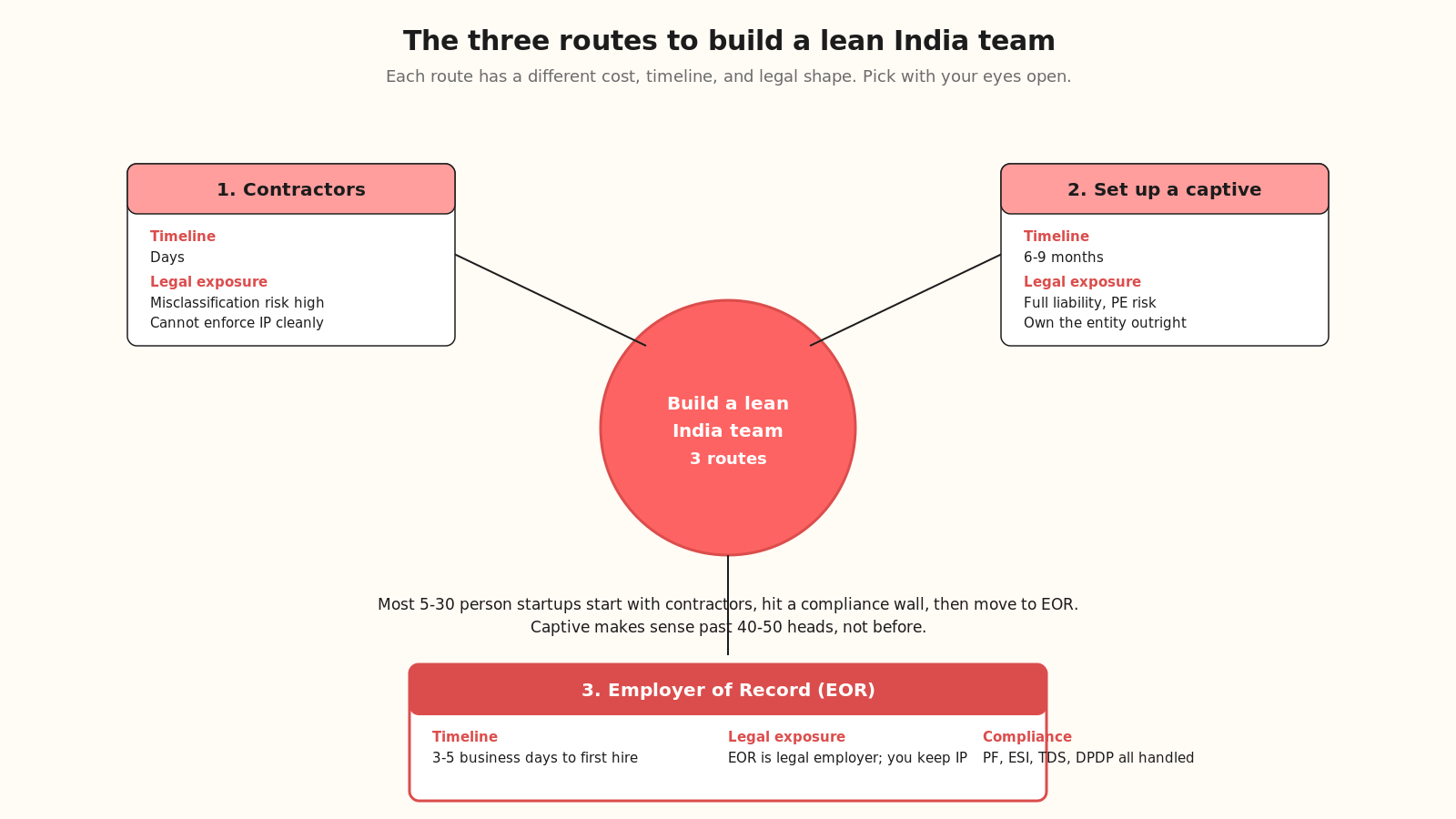
Route one: contractors. Individual contractor agreements with 5-15 senior Indian professionals. Cheap, fast, and the default for the first year at most YC-batch startups. Breaks at 6 months.
Route two: captive entity. Register a private limited company in India, open a bank account, register for GST and TAN, hire employees directly. Long, expensive, and the right answer once you cross ~40 India-based hires.
Route three: EOR. An Employer of Record hires the person on their books, on Indian payroll rules, and invoices you monthly. You own the work relationship, the JD, the day-to-day management. The EOR owns payroll compliance. This is how our India-native EOR works, and it is the route we designed Versatile around because it fits the shape of the problem for 90% of lean startups.
The right choice depends on team size, time horizon, and tolerance for legal exposure. Most founders default to route one for the first six months, and then have to pivot in a hurry. That pivot is where mistakes get expensive.
Q3. When do contractors stop being the right answer?
At about the six-month mark, if the contractor is working full-time for you, only for you, using your tools, on your roadmap, in your standups. At that point, most Indian labor and tax authorities and most US and UK employer-tax authorities treat the relationship as employment, regardless of what the contract says.
| Jurisdiction | Test that matters | Exposure if the relationship is really employment |
|---|---|---|
| India | Code on Wages, Section 2(k) "employee" | Back-payment of PF, ESI, gratuity, plus penalty |
| United States | IRS 20-factor test + ABC test in California, MA, NJ, IL | Employer-side FICA, unemployment insurance, back-taxes |
| United Kingdom | IR35, off-payroll working rules | Deemed employee status, PAYE + NIC due, penalties |
| Australia | Fair Work Act contractor vs employee test | Superannuation, leave entitlements, penalty rates |
The exposure compounds silently until an event forces disclosure: an M&A due diligence, an equity fundraise, a tax audit, or a contractor leaving on bad terms and filing a claim. At that point, cleaning it up costs 5-20x what running the same team through an EOR from month one would have cost.
"We ran three engineers as contractors for 14 months. During Series B diligence, the acquirer's counsel flagged it. We spent USD 180k on legal fees and back-payments to close the gap. An EOR from month one would have avoided all of it." — G2, Rippling, HR category, verified startup review, 2026
Q4. What does a captive Indian entity actually take to set up?
Real numbers, drawn from what our clients tell us and what our own captive-transition clients have paid over the past two years.
| Setup line | Time | Cost (USD) |
|---|---|---|
| Company registration (private limited, Chennai/Bengaluru) | 2-3 weeks | 1,500-3,000 |
| DPIIT recognition + FDI compliance | 4-6 weeks | 3,000-6,000 |
| GST registration, TAN, PAN | 4-8 weeks | 1,500-2,500 |
| Bank account opening + FEMA compliance | 3-6 weeks (parallel) | 1,000-2,500 |
| Payroll setup (Zoho, Keka, or in-house) | 2-4 weeks | 2,000-4,000 |
| PF, ESI, professional tax registration | 2-4 weeks (parallel) | 500-1,500 |
| Employment law counsel + template contracts | Ongoing | 8,000-15,000 first year |
| Office lease or coworking + operations manager | 4-8 weeks | Variable (25-60k/yr ongoing) |
| Statutory filings, ROC returns, audits (ongoing) | Quarterly | 15,000-30,000/yr ongoing |
Total upfront: USD 60-120k. Time to first hire: 8-12 months if you run it sequentially, 4-6 months if you parallelize aggressively with counsel and a captive-operations partner. Ongoing overhead: USD 40-80k per year in compliance, filings, and dedicated operations before the first paycheck goes out to an engineer.
The math starts to work in your favor at roughly 30-40 India-based hires. Below that, an EOR wins on both cost and speed.
Q5. What does an EOR actually do, day to day?
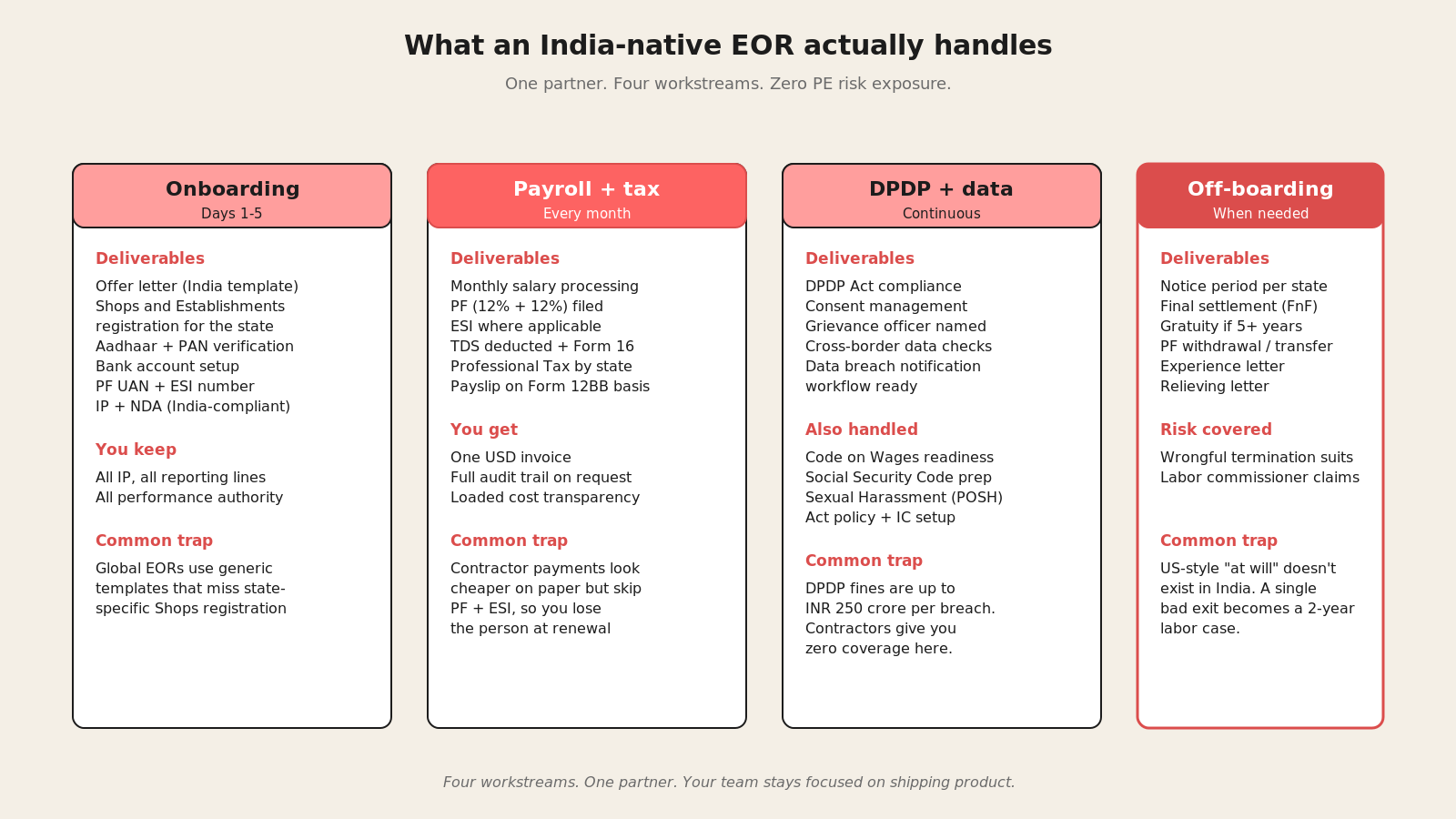
An EOR is your team's employer of record in India (or in whichever country the person is based). We handle the boring, high-consequence infrastructure that makes the employment real:
- Onboarding paperwork under Indian labor law, DPDP-compliant, including offer letter, appointment letter, non-compete, and IP assignment
- Monthly payroll processing, salary credit on the 25th, salary slips with a proper breakdown of Basic, HRA, PF, ESI, TDS, and net pay
- Statutory filings: PF (12% of basic), ESI where applicable, professional tax, TDS deducted at source and deposited monthly
- Gratuity provisioning (mandatory after 4 years and 240 days of service)
- Health insurance under GMC (Group Medical Cover), typically with a top-up option
- Equipment procurement and delivery (laptop, monitor, chair) to the employee's address anywhere in India
- Visa letters for US or UK travel, whether for onboarding, off-sites, or short work stints
- DPDP Act compliance for any personal data flow between India and your home country
- Off-boarding: full and final settlement, notice period compliance, gratuity payment, exit interview
The founder never sees any of this if the EOR is doing its job. The engineer, designer, or product manager on the team just experiences a normal employment relationship, with salary landing on time, insurance active from day one, and clean paperwork throughout.
Q6. What is the real cost comparison across all three routes?
Loaded cost for a Senior Software Engineer (5-8 years experience) with a base salary of INR 40 LPA, across the three routes:
| Cost line (annual, USD) | Contractor | Captive entity | EOR |
|---|---|---|---|
| Base salary | 48,000 | 48,000 | 48,000 |
| PF employer contribution | 0 (undeclared) | 2,500 | 2,500 |
| Gratuity provisioning | 0 | 2,300 | 2,300 |
| Health insurance (GMC) | 0 | 1,200 | 1,200 |
| Equipment (laptop, monitor) | Employee absorbs | 1,500 (year 1) | 1,500 |
| Compliance overhead per employee | 0 | 1,800 | Included in EOR fee |
| EOR fee | 0 | 0 | 4,800 (10% of salary) |
| Total loaded cost (USD) | 48,000 | 57,300 | 60,300 |
| Compliance risk carried | High | Zero | Zero |
| Setup investment amortized | 0 | 60-120k upfront + 40-80k/yr | 0 |
Contractor looks cheapest on paper. Once you add in the misclassification exposure and the setup capital tied up in a captive, EOR is the pareto-optimal route for teams under about 30 India-based hires.
Compare all three to a US-remote equivalent, where the same Senior Software Engineer would cost USD 165-210k fully loaded, and the arbitrage becomes very hard to argue against.
Q7. Which roles work well through an EOR, and which do not?
Works well: Senior and Staff engineers (backend, frontend, mobile, ML, infra), Product Managers, Designers (Product, Design Systems, Research), Data Scientists and Analysts, Solutions Architects, Technical Writers, DevRel and Developer Educators, Customer Success Managers (for APAC coverage), Finance and Operations leads.
Does not work as well: field sales (needs entity for local sales tax reasons), regulated roles that require an Indian entity as employer (some fintech and healthtech), CEO or Board roles of an Indian subsidiary, roles requiring physical presence in a factory or clinical setting.
"We put our first ten India hires through Versatile's EOR: engineers, designers, and a product manager. When we crossed twelve, we started planning a captive. The EOR-to-captive transition path was cleaner than the alternative because all the employment history was already documented properly." — G2, Deel, Global Payroll category, verified enterprise review, 2026
Q8. How do you actually manage a distributed team once you have hired?
The management question is where most startups go from "we hired well" to "we lost half the team in year two". Three things that consistently work:
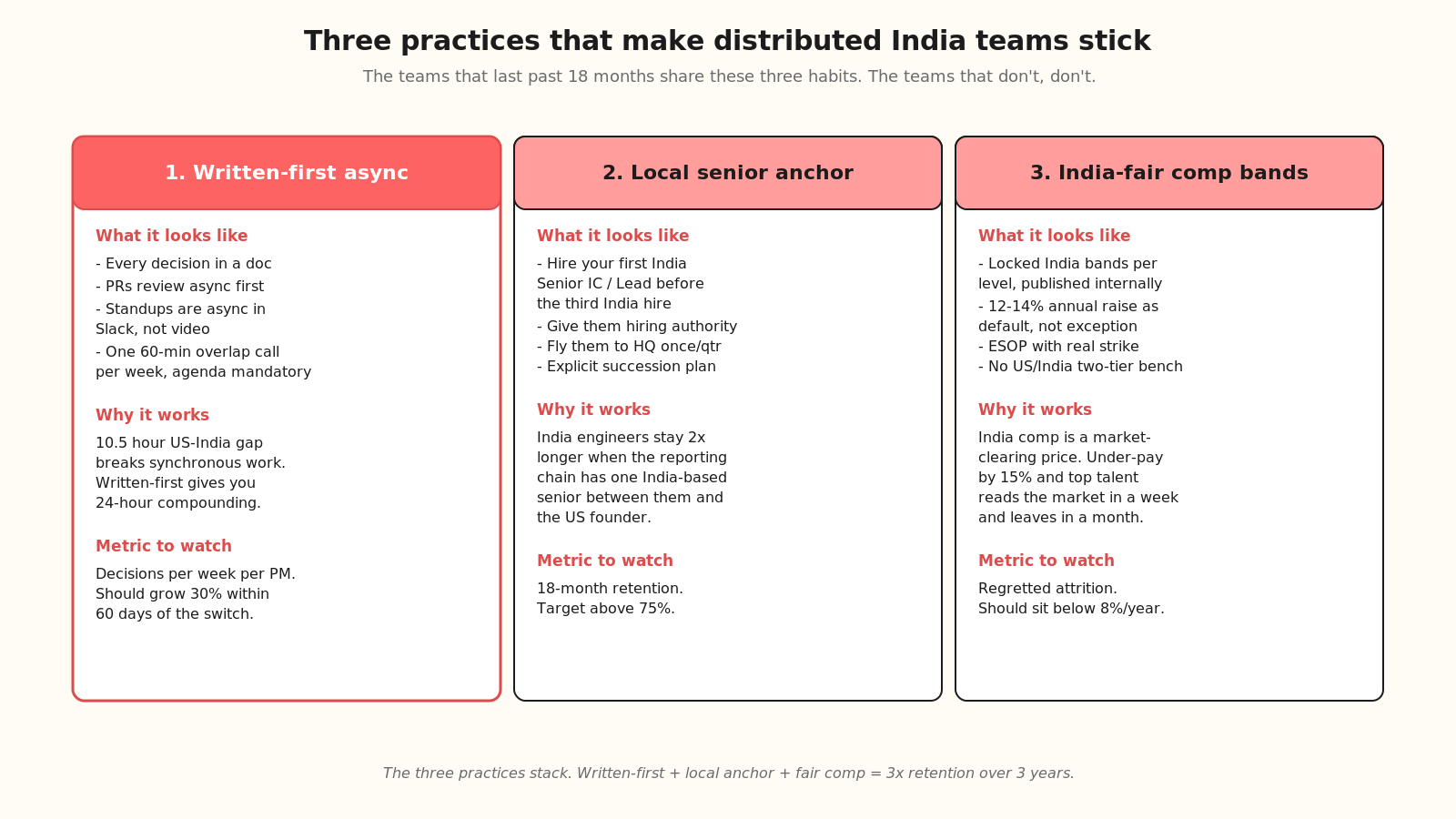
Timezone anchor: Pick one 3-hour window per day where all timezones overlap and defend it. For India + US Eastern, that is typically 8:30-11:30 AM ET. All key calls, decisions, and sprint ceremonies happen in that window.
Written-first culture: If a decision was not written down, it did not happen. Sprint goals in Linear, decisions in Notion, updates in Slack channels. Meetings are for resolving ambiguity, not creating it.
Manager in home timezone for the first 3-4 hires: The first India hires should report to a US or UK manager who has already spent time onboarding remote reports. Once you have 4-5 India-based hires, promote or hire an India-based team lead. Under 4 hires, the ratio does not justify the layer.
Q9. What does the hiring process look like when you go through an EOR?
The hiring loop is yours. The EOR only takes over at the offer-signature stage. Concretely:
- You: Write the JD, define the pay band, run the sourcing (or use a partner recruiter).
- You: Run the interview loop end to end.
- You: Decide on the candidate, decide on the offer.
- EOR: Reviews the offer for Indian compliance (proper Basic-HRA split, PF applicability, notice periods).
- EOR: Sends the offer letter on their letterhead, with the terms you specified.
- EOR: Handles onboarding paperwork, KYC, PAN and Aadhaar collection, PF nomination.
- EOR: Provisions equipment (if you want them to), enrolls in health insurance, sets up payroll.
- Day 1: The employee starts on your team. They report to your manager. Payroll and compliance happen behind the scenes.
Time from offer acceptance to day 1 is typically 15-30 days, which matches Indian notice periods (30-90 days depending on seniority). The delay is not the EOR; it is the notice period the candidate owes their previous employer.
Q10. What are the mistakes that kill lean startup outsourcing efforts?
Six that show up over and over:
- Treating India as a cost center, not a talent center. The candidates you attract change the moment you frame it this way. Frame it as talent access.
- Under-paying to save 10%. The pay-band delta you gain by underpaying is lost 3x over in attrition inside 12 months. Pay at the 60th-75th percentile of Indian market rates.
- Skipping the manager training. Managing a distributed team is a different job. Send the US or UK manager to a two-day distributed-management workshop before the first India hire lands.
- Ignoring the equipment step. A laptop landing on day 1 versus day 14 changes the employee's experience of joining you. Ship it.
- Assuming the timezone gap does not matter. It matters. Design the workflow for it explicitly, or lose senior candidates who have better options.
- Choosing an EOR by price only. The cheap EOR usually saves you 1-2% on cost and costs you 3 months of trust with your new hire when payroll lands late in month two.
Q11. Why does an India-native EOR beat a generic global EOR for India?
Global EORs (Deel, Remote, Multiplier) cover 150+ countries but often work in India through a local partner. This means when something breaks (a PF filing bounces, a DPDP notice arrives, a gratuity calculation is disputed), the escalation path runs through two companies instead of one. Response times on India-specific issues drag from 24 hours to 5-10 days.
An India-native EOR like Versatile employs the person directly, handles the compliance in-house, and lives inside the Indian regulatory system every day. When something breaks, the person answering your Slack message is the person who filed the return, not a tier-2 support agent in a global operation who has to escalate to a partner.
| Signal | India-native EOR | Global EOR (India via partner) |
|---|---|---|
| Time to resolve payroll issue | Same day | 3-7 days |
| DPDP Act depth | Native, in-house counsel | Contractual, delegated to partner |
| Equipment logistics inside India | Direct | Vendor-mediated |
| Fee | USD 200-450/employee/month | USD 500-800/employee/month |
| Founder access to the operator | Direct WhatsApp | Account-manager ticket |
"We started on a global EOR and switched to Versatile after a payroll issue took a week to resolve. The switch itself took less than three weeks. The India employees experienced zero disruption because Versatile handles the transition documentation directly." — G2, Multiplier, Global HR category, verified startup review, 2026
Q12. How do you move from an EOR to a captive when you scale?
The transition is a boring paperwork exercise if the EOR ran the employment properly from day one. You register your Indian entity in parallel with continuing operations, transition employees from the EOR's payroll to yours over one payroll cycle, and continue the working relationships without interruption. Employees keep the same PF UAN (Universal Account Number), the same gratuity accrual, the same insurance if you match the terms.
Typical timeline: 3-4 months from decision to full transition, in parallel with continued operations. The trigger point is usually 25-35 hires, or a strategic reason (M&A target, listing plans, specific regulatory need).
Q13. What does the outsourcing playbook look like across the first 30 hires?
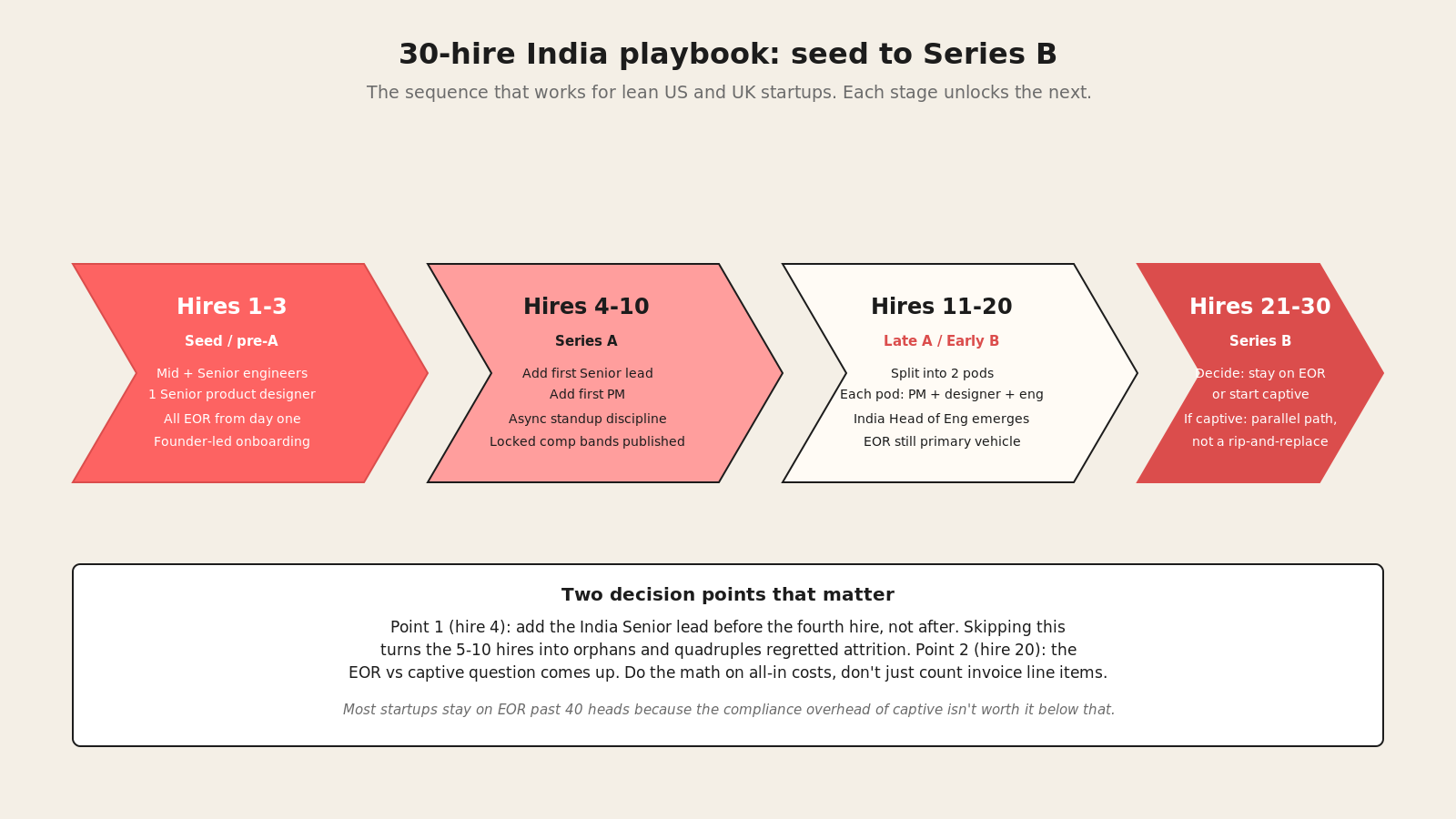
| Stage | Team size India-side | Recommended structure |
|---|---|---|
| Zero to one | 1-2 senior generalists | Contractors or EOR, EOR strongly preferred past month 6 |
| Early team | 3-6 hires | EOR, US/UK manager, single Slack workspace |
| Growing team | 7-15 hires | EOR, India-side team lead promoted from within, US/UK Head of Eng or Head of Design still owns roadmap |
| Scale point | 15-30 hires | EOR, India-side manager layer of 2-3, roadmap ownership starts to split |
| Transition threshold | 30-40 hires | Begin captive entity setup, plan 3-4 month transition |
| Captive stage | 40+ | Captive entity, full India office, dedicated HR |
Q14. How do you decide if outsourcing is even the right move for your startup?
Three yes-answers make the move sensible:
- Your seed or Series A budget will not support the number of senior hires your roadmap actually needs.
- You are willing to invest in the distributed-team practices that make it work (written culture, timezone anchor, manager training).
- You have at least one existing team member who can be the connective tissue for the first India hires, either an engineering lead who has worked with distributed teams or a founder who is willing to be that person for the first 6 months.
Three no-answers make the move risky:
- Your product is a heavily-regulated vertical where key roles must be filled by employees of a specific national entity (some fintech, healthtech, defense).
- Your team has never worked async and does not have the appetite to learn.
- Your fundraise or M&A timeline is under 6 months, and the acquirer's diligence will penalize distributed setup.
FAQs
How fast can we make the first hire through an EOR?
From signed EOR agreement to candidate on payroll, typically 3-6 weeks. The gating item is the candidate's notice period at their previous employer, not the EOR setup.
Do our stock options work for India-based employees?
Yes, with two structural choices: direct grants from your parent entity (most common) or an India-side ESOP trust (rare, only for captive stage). The India tax treatment on exercise and sale is well-established.
What happens if we want to fire an India employee?
You direct, the EOR executes. Standard Indian notice periods (30-90 days depending on role and tenure) apply. Full and final settlement includes any pending salary, leave encashment, and gratuity if the employee crossed the 4-year, 240-day threshold.
Are Indian employees productive on US Pacific hours?
Some are, most are not sustainably. Aim for the 3-hour overlap window and design the rest of the day for async. Trying to shift Indian employees to US Pacific hours for anything beyond a temporary sprint burns them out.
What is the DPDP Act and does it affect our outsourcing?
Digital Personal Data Protection Act, India's data protection law. Yes, it applies to any personal data (customer data, employee data) flowing between India and your home country. An India-native EOR handles the employee side; your product engineering team needs to think through the customer side separately.
What if we want to eventually acquire a portfolio company that used an EOR for its India team?
Standard M&A path. The employees transfer to the acquirer's entity or to a new entity via a business transfer agreement. Documented EOR employment history makes this straightforward. Contractor history makes it painful.
How does an EOR handle IP assignment?
The EOR contract includes an IP assignment from the employee to you, with the EOR as an intermediary. Language is standard and pre-cleared with Indian counsel.
Can we hire senior leaders (VP, Director) through an EOR?
Yes. Title is a client-side decision. The EOR is the employer of record for compliance purposes only. Some clients hire VPs and even C-suite roles through EOR before deciding on captive setup.
Where my head is right now
The most interesting shift in startup outsourcing over the last three years is that founders stopped seeing "outsourcing" as a compromise. In 2020, hiring in India was often the second choice after failing to hire someone in the US at the budget available. In 2026, most of the founders I talk to are choosing India first: for the quality of the senior talent, for the fact that a lean seed team can attract Staff+ people who would be out of reach in the US, and because the pattern library across product, engineering, and design is now globally shared.
The reason we run Versatile as an India-native EOR, rather than as a global platform that also does India, is that this shift only works if the operational layer is boring. Payroll landing on the 25th. DPDP-compliant contract. PF and ESI filed on time. Laptop shipped to Bengaluru or Pune. Health insurance active from day one. If any of that breaks, the hire that saved your seed budget costs you three months of trust with your new senior employee. That is what we obsess over on the delivery side.
My personal read on the next 18 months: the founders who build strong India teams between now and 2028 will structurally out-hire the founders who wait for a captive. The talent that is available now, at seed and Series A budgets, will be inaccessible at Series B rates by 2028. The window is roughly two years wide.
If you are running through the outsourcing decision now, whether it is your first India hire or your fifteenth, we can talk about the specifics of your team, the pay-band math, and which route (EOR, captive, hybrid) actually fits. Grab 30 minutes on my calendar or WhatsApp me directly on +91 98866 66565. If you want the loaded-cost math in front of you before the call, the India EOR page has the per-role numbers, and we can go deeper on your specific hires from there.
— Sagar Chainani, Founder, Versatile
Ready to hire in India?
Drop your work email · we'll set up a 20-min intro call within 24 hours. Tell us what you're building; we'll tell you whether we're the right fit.
We reply in business hours (IST). Never spam, never share your email.