Table of contents (17)
- Top 10 India EOR Providers
- 1 Versatile Club
- 2 Deel
- 3 Remote
- 4 Multiplier
- 5 Rippling
- 6 Globalization Partners
- 7 Papaya Global
- 8 Skuad
- 9 Velocity Global
- 10 Oyster
- Scoring Methodology
- True Cost & Hidden Fees
- Entity Ownership & State Coverage
- 2026 Compliance & Risk Shifts
- Onboarding Speed & Buyer Verdicts
- EOR vs Entity: Which to Pick
10 Best EOR Providers in India 2026 - Pricing, Labor-Code Compliance & Real Buyer Verdicts
Q1. What are the 10 best India EOR & contract-to-hire providers for hiring in India in 2026?
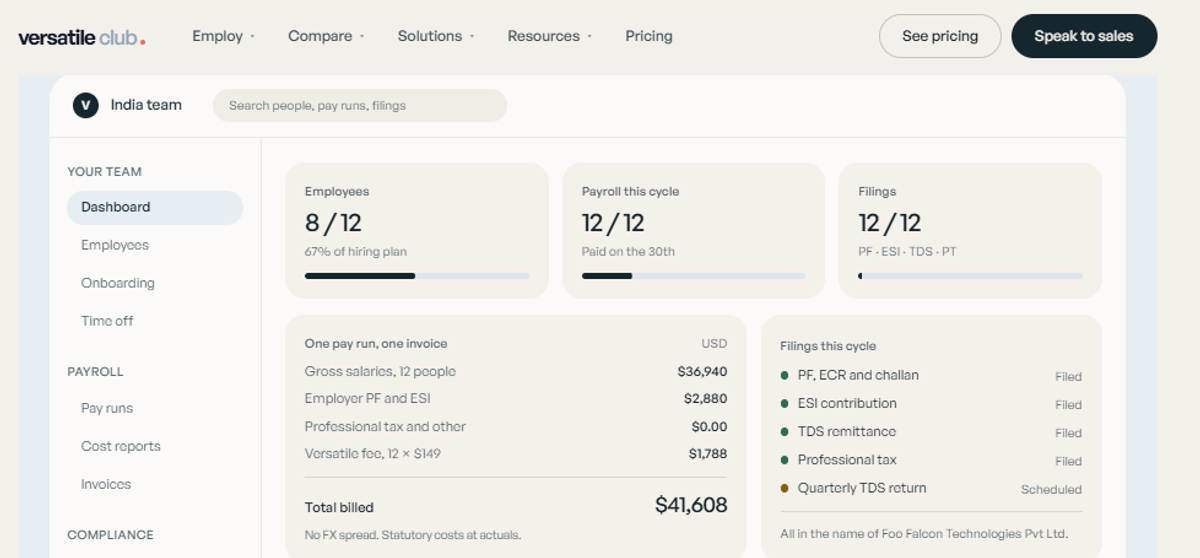
For India-concentrated hiring in 2026, the ten providers worth a shortlist slot are Versatile Club, Deel, Remote, Multiplier, Rippling, Globalization Partners, Papaya Global, Skuad, Velocity Global, and Oyster. Versatile Club operates as an India-only India employer of record through its own registered Indian entity, Foo Falcon Technologies Pvt Ltd, and files PF, ESI, TDS, and professional tax under its own registrations across all 28 states and 8 union territories. Versatile Club charges $149 per employee per month, with no setup fee, no exit fee, and the first month free, against a contractual 5-business-day onboarding SLA and USD invoicing issued from India.
A finance lead opens the India column at month-end and finds two currencies, three invoices, and no gratuity accrual. Choosing an India employer of record is not a software purchase. The provider becomes the legal employer, files PF and ESI, and carries statutory liability. Ten providers were evaluated for this guide. Criteria included entity model, statutory compliance depth, state coverage, onboarding speed, pricing transparency, invoicing and audit readiness, support model, and customer validation. It is written for US and UK founders, People Ops leaders, CFOs, and legal teams hiring one to fifty employees in India. Pricing shown is as published.
Our Evaluation Criteria
India Entity Model: whether the provider uses its own Indian entity, a local partner entity, a contractor model, or a payroll-only setup.
Statutory Compliance Depth: PF, ESI, TDS, professional tax, gratuity, POSH, Form 16, full-and-final settlement, DPDP readiness, and Labour Code 2025-26 salary structuring.
State-Level Coverage: professional tax, Shops and Establishments, labour welfare fund, and leave rules across Indian states.
Onboarding Speed: time from signed agreement to compliant contract, payroll setup, statutory registration, and employee start.
Pricing Transparency: monthly fee, setup fee, exit fee, FX markup, first-month terms, and invoice clarity.
Invoicing and Finance Readiness: USD or INR invoicing, gross-to-net reporting, challan confirmations, TDS receipts, and audit-ready documentation.
Support Model: founder-direct, named HR manager, HRBP, ticket queue, chatbot, or general CSM rotation.
Talent and Retention Support: recruiting, contract-to-hire, culture-fit vetting, and onboarding monitoring.
Customer Validation: G2, Capterra, Clutch, Reddit, and third-party proof.
Best-Fit Buyer Segment: first India hire, 1 to 20 employees, 10 to 50 employees, switching from Deel or Remote, existing India entity, or multi-country enterprise need.
Who This Guide Is For
US and UK founders hiring their first 1 to 3 employees in India.
Seed to Series B startups building engineering, product, AI, design, or operations teams in India.
People Ops and HR leaders reviewing India EOR, payroll, contractor, or PEO vendors.
CFOs and finance teams that need clean invoicing, statutory liability visibility, and audit-ready India payroll records.
Legal teams reviewing employment contracts, IP assignment, misclassification risk, PE risk, and statutory employer accountability.
Companies currently using Deel, Remote, Multiplier, G-P, contractors, or local payroll vendors and evaluating India specialists.
The Ranked List
Versatile Club: Best for US and UK companies hiring 1 to 30 employees in India through an owned Indian entity.
Deel: Best for companies hiring across many countries on one dashboard.
Remote: Best for teams that want owned-entity coverage in core markets with bundled benefits.
Multiplier: Best for mid-market teams wanting lower global EOR pricing with INR default invoicing.
Rippling: Best for companies bundling device provisioning and IT with payroll.
Globalization Partners: Best for enterprises that need certification-heavy procurement.
Papaya Global: Best for finance-led payroll consolidation across many entities.
Skuad: Best for APAC-weighted hiring with fast contractor onboarding.
Velocity Global: Best for enterprise custom-scoped global employment programmes.
Oyster: Best for distributed-first companies with scattered single hires.
Master Comparison Table
| Provider | Best For | Key Strength | Compliance |
| Versatile Club ⭐⭐⭐⭐⭐ |
US and UK startups hiring their first 1 to 30 India employees | India-only focus with a contractual 5-day onboarding SLA | Own Indian entity (Foo Falcon Technologies Pvt Ltd); PF, ESI, TDS, PT under its own registrations; all 28 states + 8 UTs |
| Deel ⭐⭐⭐⭐ |
Companies hiring in 10 or more countries on one dashboard | Breadth of country coverage and product surface | India operations routed through local partner entities; practical coverage concentrated in top states |
| Remote ⭐⭐⭐½ |
Teams wanting owned entities in core markets | Bundled benefits administration | Owned global entity network; India state coverage narrower than specialists |
| Multiplier ⭐⭐⭐⭐ |
Mid-market teams on tighter global budgets | Lower global EOR price point at $400 per month | Local partner entity in India; INR default invoicing |
| Rippling ⭐⭐⭐⭐ |
Companies bundling IT and device provisioning with payroll | Unified HR, IT, and payroll data model | Owned entity model; India compliance depth is secondary to the IT layer |
| Globalization Partners ⭐⭐⭐½ |
Enterprises with certification-led procurement | Mature enterprise contracting | Owned global entities; priced at 15% of salary with a $1,500 monthly minimum |
| Papaya Global ⭐⭐⭐ |
Finance-led payroll consolidation | Payments and payroll reporting depth | Aggregator network model; India filings executed through partners |
| Skuad ⭐⭐⭐½ |
APAC-weighted hiring and fast contractor starts | 48 to 72 hour onboarding claims | Hybrid partner model across APAC including India |
| Velocity Global ⭐⭐⭐ |
Enterprise custom-scoped programmes | Bespoke scoping and advisory | Partner and owned hybrid; pricing not publicly disclosed |
| Oyster ⭐⭐⭐½ |
Distributed-first teams with scattered single hires | Clean self-serve hiring flow | Mixed owned and partner entities; India depth not published at state level |
💸 Why the $599 default quietly fails on India
Most buyers start at Deel or Remote because a peer recommended it. That logic holds when you have one hire in each of twelve countries. It stops holding when eleven of your next twelve hires are in Bengaluru, Hyderabad, and Pune.
Versatile Club sees the same three questions go unasked in those evaluations. Who files the Karnataka professional tax return every month? Which legal entity appears on the employee's Form 16? What happens to the gratuity clock if we switch providers in year three?
⚠️ The two statutory numbers that moved in 2026
Two changes repriced every India quote written before late 2025. The four Labour Codes came into force on 21 November 2025, with central rules published by the Ministry of Labour and Employment on 8 May 2026. Basic plus dearness allowance must now be at least 50% of CTC, which pulls allowances back into the PF, ESI, and gratuity base.
The second is Gazette notification S.O. 5109(E), dated 17 September 2026, issued under the Code on Social Security, 2020. It raised the EPFO wage ceiling from Rs 15,000 to Rs 25,000, lifting the employer PF cap to Rs 3,250 a month. ESIC stayed at Rs 21,000. Ask every shortlisted provider for a restated cost sheet on that basis.
1. Versatile Club: Best for US and UK Companies Hiring 1 to 30 Employees in India
🇮🇳 Overview
Versatile Club is an India-only employer of record and contract-to-hire provider serving US and UK companies. The legal employer is Foo Falcon Technologies Pvt Ltd, a registered Indian private limited company that you can verify on the MCA portal. It is not a reseller and not an aggregator.
India is the only country we operate in. That started as a constraint and became the product. Our compliance infrastructure, state registrations, and payroll operations were built through six years of contract-to-hire placements across Bengaluru, Hyderabad, and Pune, before the EOR service line existed.
🧾 Core Services
Employer of Record for India, with employment under Versatile Club's own Indian entity.
Contract-to-Hire placements, converting to the client's payroll or entity on completion.
Offshore team building for engineering, design, and operations roles.
Managed payroll for companies that already hold an Indian entity.
Monthly client pack covering gross-to-net reporting, challan confirmations, and TDS receipts.
🤔 Why Companies Consider Versatile Club
The decision logic is usually narrow. A founder has one or two India hires, no Indian entity, and no appetite for a six-month incorporation that costs tens of thousands before anyone starts. Versatile Club removes the entity question without routing the filings through a third party.
For CFOs, the deciding factor is the invoice. Versatile Club issues one USD invoice from its Indian entity, which means no second currency conversion and no FX margin sitting inside the exchange rate. When an auditor asks where the gratuity accrual sits, the answer comes from one set of registrations.
👥 Ideal Customer Profile
US and UK companies, Seed to Series B, or profitable SMBs at $5M to $50M ARR.
India team size of 1 to 30 employees, concentrated in Bengaluru, Hyderabad, Pune, Delhi NCR, or Chennai.
Decision makers: founder, VP People or Head of HR, CFO or Controller.
Hiring engineering, product, AI, design, marketing, or operations roles.
Companies switching from contractor agreements or from a global platform's India seat.
💰 Commercial Model
Versatile Club charges a flat $149 per employee per month for EOR, and $49 per employee per month for managed payroll where the client holds its own entity. There is no setup fee, no exit fee, and no security deposit. The first month is free. Invoicing is in USD, issued directly from the Indian entity, with no FX markup applied.
Contract-to-hire is priced at 20% to 30% of annual salary, charged only after the hire completes day 90. Onboarding is a 5-business-day SLA written into the contract, not a marketing estimate.
🗣️ Customer Reviews
"Sagar replied to our form in about four hours with a draft offer letter already attached. The hire was onboarded in four days. First USD invoice landed clean: no FX markup, no setup fee, no surprises."
— Verified User in Information Technology and Services, 5/5 Versatile Club G2 - Verified Review, 23 June 2026
"First payroll ran on time, no scramble, no 'wait what's this deduction.'"
— Angad S., Founder, 5/5 Versatile Club G2 - Verified Review, 21 June 2026
"The team is really competent, but there were a few time zone misunderstandings that caused slight delays in the initial phase."
— Setu C., 5/5 Versatile Club G2 - Verified Review, 10 June 2026
⚖️ Where Versatile Club Is the Wrong Choice
Versatile Club should lose three kinds of deals, and naming them is cheaper than discovering them in week six. If you need employment in five or more countries, a global platform is the right layer and India can be unbundled to a specialist underneath it. If your procurement gate requires SOC 2 Type II or ISO 27001 before signature, we do not clear it today.
Enterprise teams of 100 plus in India with heavy custom procurement workflows also sit outside the 5-day SLA. I would rather say that now. What I am genuinely unsure about is the upper bound on founder-direct support, because at some point that model has to change.
2. Deel: Best for Companies Hiring Across Many Countries on One Dashboard
🌍 Overview
Deel is a global employment platform covering EOR, contractor management, and global payroll across a very large country footprint. It is the default recommendation in most founder Slack groups, which is why it anchors almost every India shortlist. For India specifically, employment is generally routed through local partner entities rather than a Deel-owned Indian company.
🧾 Core Services
Employer of Record across a broad multi-country footprint.
Contractor management and global contractor payments.
Global payroll for companies with their own entities.
Immigration and visa support services.
Equipment, benefits, and device administration add-ons.
🤔 Why Companies Consider Deel
The buying reason is consolidation. One contract, one dashboard, and one vendor review covering Europe, LATAM, APAC, and India at once. For a People Ops lead with hires in nine countries, that is a real operational saving.
The trade-off shows up when India becomes the majority of headcount. ✅ Country breadth is genuine. ✅ The product surface is mature. ❌ India filings sit with partner entities, so accountability runs through a chain. ✅ Onboarding is documented at 7 to 14 days. ❌ Support is chatbot-first and ticket-based, which is slow when a PF challan question lands three days before payroll.
👥 Ideal Customer Profile
Companies with 10 or more countries of employment and no single dominant hub.
Series B and later, with a People Ops function owning vendor administration.
Teams that need immigration support alongside employment.
Buyers whose procurement scores global certification and review volume heavily.
Decision makers: VP People, Global HR Operations, Head of Legal.
💰 Commercial Model
Deel's published India EOR pricing sits at roughly $599 per employee per month, with a setup fee reported at around $500 and an exit notice of one month. Contractor management is priced separately. Reported FX margin on USD to INR conversion runs 3% to 5%, which is not stated as a line item on the invoice.
On a $42,000 Bengaluru salary, a 4% margin is roughly $1,680 a year. That single number exceeds the annual fee gap between a $149 flat rate and nothing at all. Run your own numbers on the EOR versus entity calculator before you sign anything.
🗣️ Customer Reviews
"I dislike how expensive Deel's transaction fees are, especially when moving money from the Deel account to my bank or wherever else it needs to go."
— Maria M., Freelancer, 3/5 Deel G2 Verified Review, 26 September 2025
"I find Deel to be absurdly expensive. They charge a high amount of fees for transferring money to my bank account."
— Juan Camilo O., Contractor, 1/5 Deel G2 Verified Review, 27 November 2025
"I was redirected multiple times, asked to repeat the same information to different representatives, and spent a considerable amount of time in meetings without reaching a clear resolution."
— Güneş A., Remote Worker, 1.5/5 Deel G2 Verified Review, 2 October 2025
🔍 How Does Versatile Compare to Deel?
Versatile Club covers India only, employing through its own Indian entity, and that scope stops at the border. Deel does something we do not: it can employ your next hire in Portugal, Brazil, or Vietnam on the same contract, and its certification stack clears enterprise procurement gates that we currently do not.
Unlike Deel, Versatile Club is the legal employer itself rather than a platform contracting a local partner entity, commits to a 5-business-day onboarding SLA in writing against Deel's documented 7 to 14 days, and invoices in USD from India with no FX margin applied. Deel does not state a per-state professional tax and Shops and Establishments coverage map on its own site. For companies where India is the concentration rather than one row in a global list, that combination is the difference.
Looking beyond Deel? Our roundup of Deel alternatives compares it against the rest of the India EOR market, and Deel versus Remote for India covers the two-platform comparison in detail.
3. Remote: Best for Teams Wanting Owned Entities in Core Markets
🌐 Overview
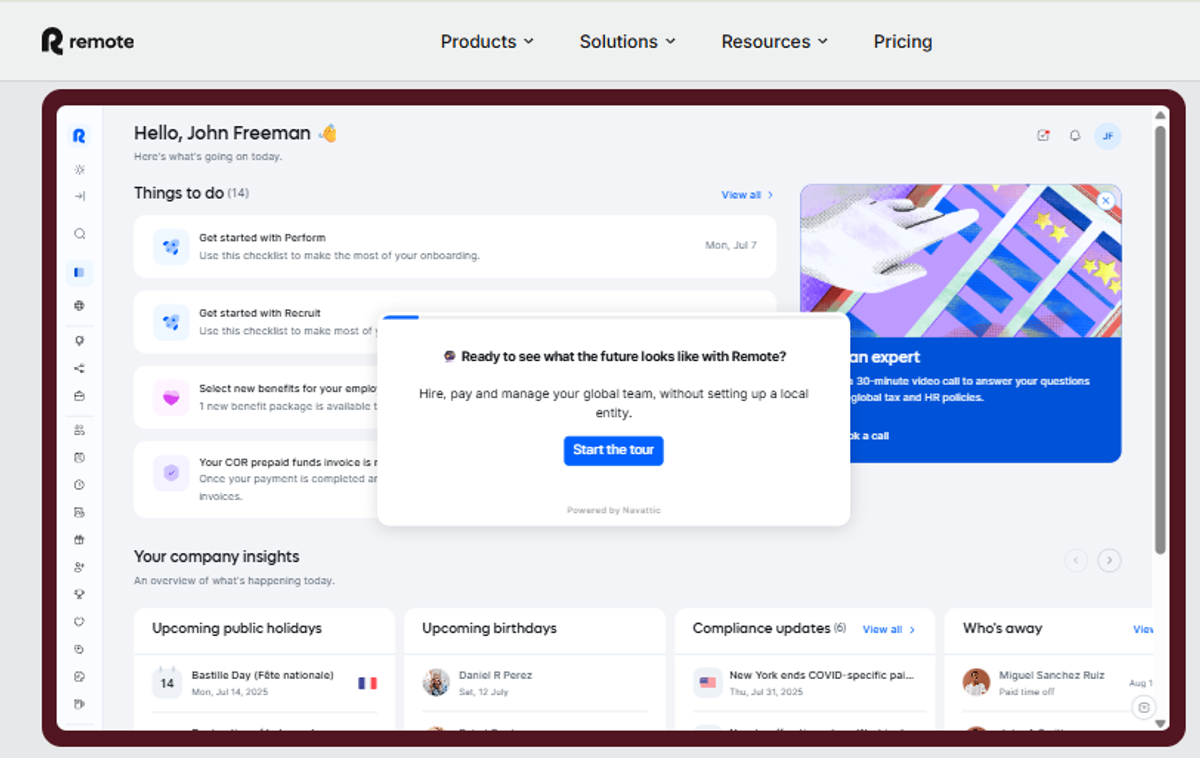
Remote is a global employment platform covering EOR, contractor management, and payroll across roughly 90 owned entities. It leans harder on intellectual property protection and benefits administration than most peers. For India specifically, Remote's practical state coverage is narrower than an India specialist's, concentrated in the largest employment states.
🧾 Core Services
Employer of Record across an owned global entity network.
Contractor management and international contractor payments.
Global payroll for companies holding their own entities.
Benefits administration, often delivered through third-party providers.
IP and invention assignment handling built into contracts.
🤔 Why Companies Consider Remote
The buying reason is usually legal comfort. Engineering-led buyers like that Remote owns entities in its core markets, and legal teams like the IP assignment language. That matters when your India team is writing production code.
✅ Owned entities in core markets are real. ✅ IP handling is documented clearly. ❌ Benefits are frequently farmed out to third parties, and accountability gets fuzzy when those parties fail. ✅ Pricing is published rather than quote-gated. ❌ Support runs on email with a multi-day SLA, which does not survive a payroll week in India.
👥 Ideal Customer Profile
Companies employing in 5 to 20 countries with no single dominant hub.
Engineering-heavy teams where IP assignment is a legal gate.
Series A to Series C, with People Ops owning the vendor relationship.
India team size of 1 to 15, mostly in Bengaluru, Pune, or Hyderabad.
Decision makers: Head of Legal, VP People, CTO.
💰 Commercial Model
Remote's India EOR pricing is published at $599 per employee per month, with a setup fee reported at $299 and contractor management at $29 per contractor per month. Exit requires one month of notice. Onboarding is documented at 10 to 14 days from signature to employee start. Our breakdown of Remote pricing for India teams walks through the same numbers line by line.
🗣️ Customer Reviews
"They were dishonest about the level of support provided. We specifically explained we required phone-level support for urgent matters, but that is not available. Instead they have email support with a 3-day SLA."
— Juliette D., HR Leader, 0.5/5 Remote G2 Verified Review, 22 April 2026
"Remote's benefits administration is atrocious. Wherever they can, they farm benefits out to third parties, and then do not take any accountability when those third parties fail to deliver."
— Justin W., EOR Employee, 0/5 Remote G2 Verified Review, 2026
🔍 How Does Versatile Compare to Remote?
Versatile Club covers India only, employing through its own Indian entity, and that scope stops at the Indian border. Remote does something we do not: it owns entities across roughly 90 countries, so one contract can cover Poland, Brazil, and India at once.
Unlike Remote, Versatile Club commits to a 5-business-day onboarding SLA in the contract against Remote's documented 10 to 14 days, invoices in USD directly from its Indian entity, and charges no setup fee where Remote's is reported at $299. Remote does not state a per-state professional tax, Shops and Establishments, and labour welfare fund coverage map for India on its own site. For companies where India is the concentration rather than one country among twenty, that combination is the difference.
Looking beyond Remote? Our roundup of Remote alternatives compares it against the rest of the India EOR market.
4. Multiplier: Best for Mid-Market Teams on Tighter Global Budgets
📉 Overview
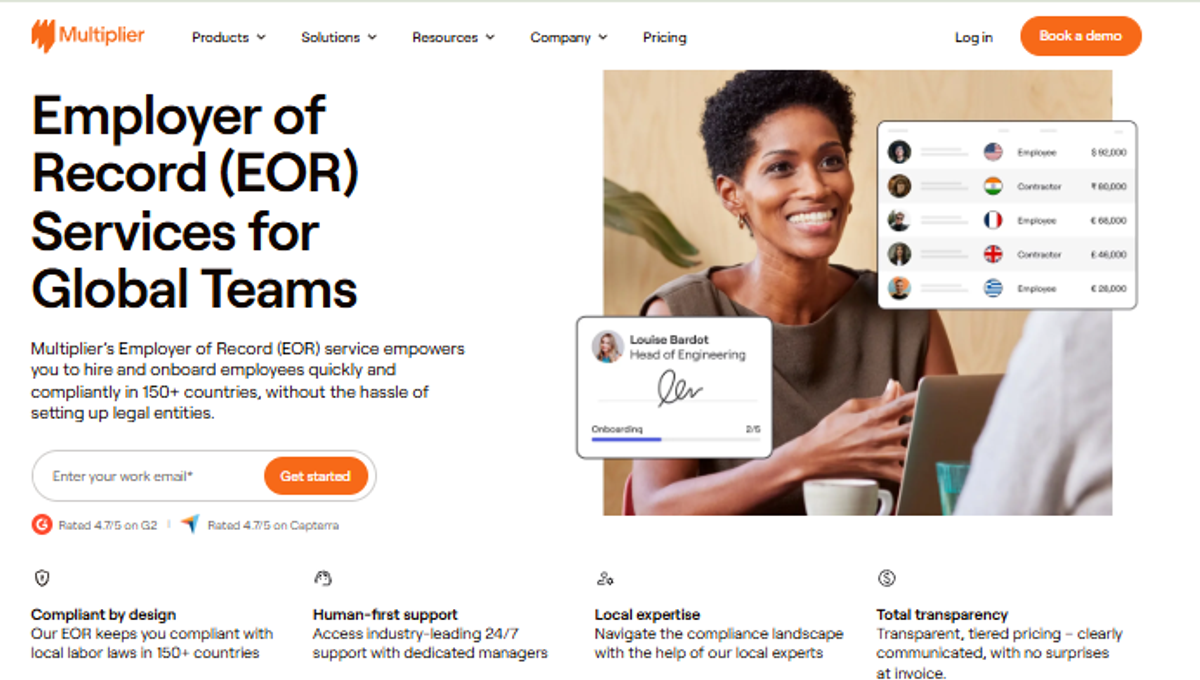
Multiplier is a global EOR platform with stronger Asia-Pacific depth than most Western-built competitors. It sits in the middle of the pricing market, below Deel and Remote but well above India specialists. India employment runs through a local partner entity rather than a Multiplier-owned Indian company.
🧾 Core Services
Employer of Record across a broad country list.
Contractor management and global contractor payments.
Multi-country payroll processing.
Benefits administration and insurance coordination.
Dedicated account management on larger plans.
🤔 Why Companies Consider Multiplier
The decision is usually budget-led. A People Ops lead with twelve countries and a flat headcount budget finds $400 per month easier to defend than $599. Asia-Pacific coverage is also genuinely deeper than the US-built platforms.
✅ Lower global price point at $400 per month. ✅ Dedicated account manager on the plan. ❌ India sits on a partner entity, so statutory accountability passes through a third party. ✅ No setup fee is charged. ❌ Invoicing defaults to INR, which pushes the FX conversion back onto your finance team.
👥 Ideal Customer Profile
Mid-market companies employing across 8 to 20 countries.
APAC-weighted hiring across India, Singapore, Vietnam, and the Philippines.
Series B and later, with a defined HR operations function.
India team size of 5 to 25 employees.
Decision makers: VP People, Global HR Ops, Finance Director.
💰 Commercial Model
Multiplier's India EOR pricing is $400 per employee per month, with contractor management at $40 per contractor per month. There is no setup fee, and exit requires two weeks of notice. Invoicing defaults to INR. Onboarding is documented at roughly 7 days.
🗣️ Customer Reviews
"The product user interface is relatively easy to navigate and use, and meets basic EOR workflow needs."
— Verified User in Information Technology and Services, EOR Buyer Multiplier G2 Verified Review, 9 December 2025
🔍 How Does Versatile Compare to Multiplier?
Versatile Club covers India only, employing through its own Indian entity, and that scope stops at one country. Multiplier does something we do not: it employs across a large multi-country footprint with APAC depth, so a Vietnam or Singapore hire needs no second vendor.
Unlike Multiplier, Versatile Club is the legal employer itself rather than a platform contracting an Indian partner entity, invoices in USD from India rather than defaulting to INR, and writes a 5-business-day onboarding SLA into the agreement. Multiplier does not state its FX conversion policy on its own site. For companies where India payroll accountability rather than country count drives the decision, that combination is the difference.
Looking beyond Multiplier? Our roundup of Multiplier alternatives in India compares it against the rest of the India EOR market.
5. Rippling: Best for Companies Bundling IT and Device Provisioning With Payroll
💻 Overview
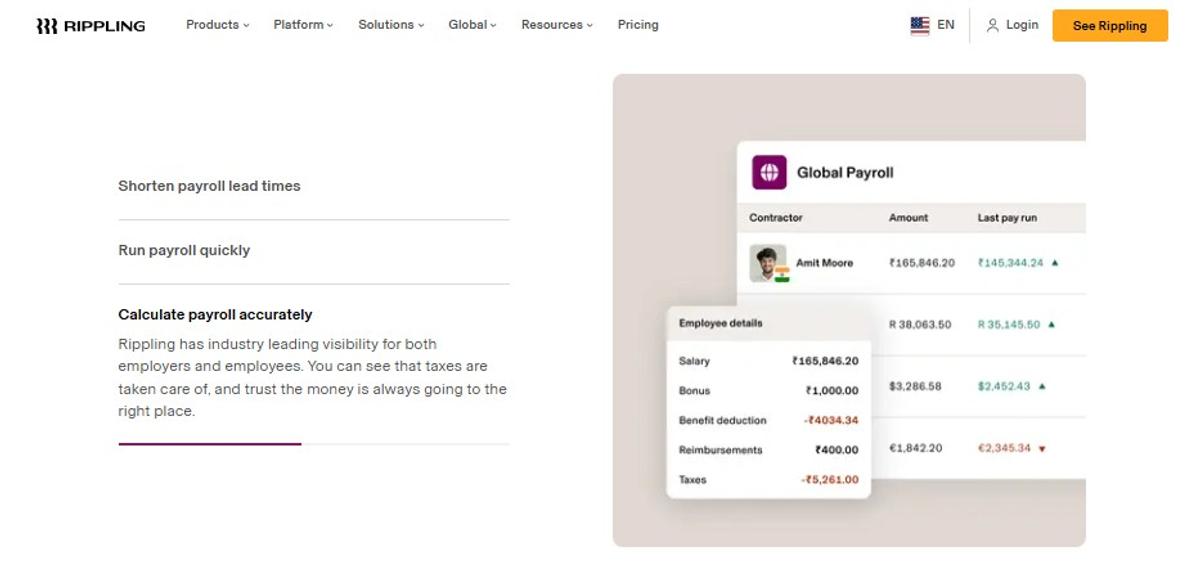
Rippling is a unified HR, IT, and finance platform that added EOR to an already large product surface. Its strongest claim is the single data model linking employee records, devices, app access, and payroll. India EOR is one module inside a much larger system.
🧾 Core Services
Employer of Record for international hires.
Device procurement, shipping, and remote device management.
App provisioning and access management tied to employment status.
Global and domestic payroll processing.
Contractor management and payments.
🤔 Why Companies Consider Rippling
The buying logic is consolidation of a different kind. When your Bengaluru engineer starts, the laptop, the Okta access, and the payroll record all spin up from one onboarding action. For an IT-constrained team, that saves real hours. If device logistics are the real problem, our guide to equipping remote employees in India covers the India-specific side.
✅ The IT and payroll data model is genuinely unified. ✅ Device logistics are handled end to end. ❌ Payroll accuracy complaints cluster around multi-jurisdiction tax handling. ✅ Owned entity model in core markets. ❌ India compliance depth sits behind the IT layer in product priority, and support load is heavy.
👥 Ideal Customer Profile
Companies with 50 to 500 total employees and a small IT function.
Security-conscious teams needing device and access control for offshore staff.
Series B and later, already running Rippling for US payroll.
India team size of 5 to 30 employees.
Decision makers: Head of IT, VP People, Controller.
💰 Commercial Model
Rippling's EOR pricing is reported in the $500 to $600 per employee per month range, with contractor management at $29 per contractor per month. Setup fees vary by configuration. Onboarding is documented at roughly 2 to 5 days.
🗣️ Customer Reviews
"It did not handle multi-state taxes well at all. We are a non-profit and it was constantly making mistakes. It also did not handle us having one hourly employee well. It killed the autopayment for payroll causing a paycheck to be sent late to all employees."
— Liz J., Non-Profit Operations, 0.5/5 Rippling G2 Verified Review, 22 May 2026
"The only thing I have enjoyed about Rippling is the HR Ticketing app I was able to customize."
— Erika D., HR Administrator Rippling G2 Verified Review, 22 May 2026
🔍 How Does Versatile Compare to Rippling?
Versatile Club covers India only, employing through its own Indian entity, and that scope stops well short of device logistics and app provisioning. Rippling does something we do not: it ties hardware, software access, and payroll into one system of record.
Unlike Rippling, Versatile Club runs PF, ESI, TDS, and professional tax filings under its own Indian registrations across all 28 states and 8 union territories, publishes a flat $149 per employee per month rate, and commits to a 5-business-day onboarding SLA in writing. Rippling does not state a state-level India professional tax coverage map on its own site. For companies where India statutory accuracy rather than device provisioning drives the decision, that combination is the difference.
Looking beyond Rippling? Our roundup of Rippling alternatives for India compares it against the rest of the India EOR market.
6. Globalization Partners: Best for Enterprises With Certification-Led Procurement
🏢 Overview
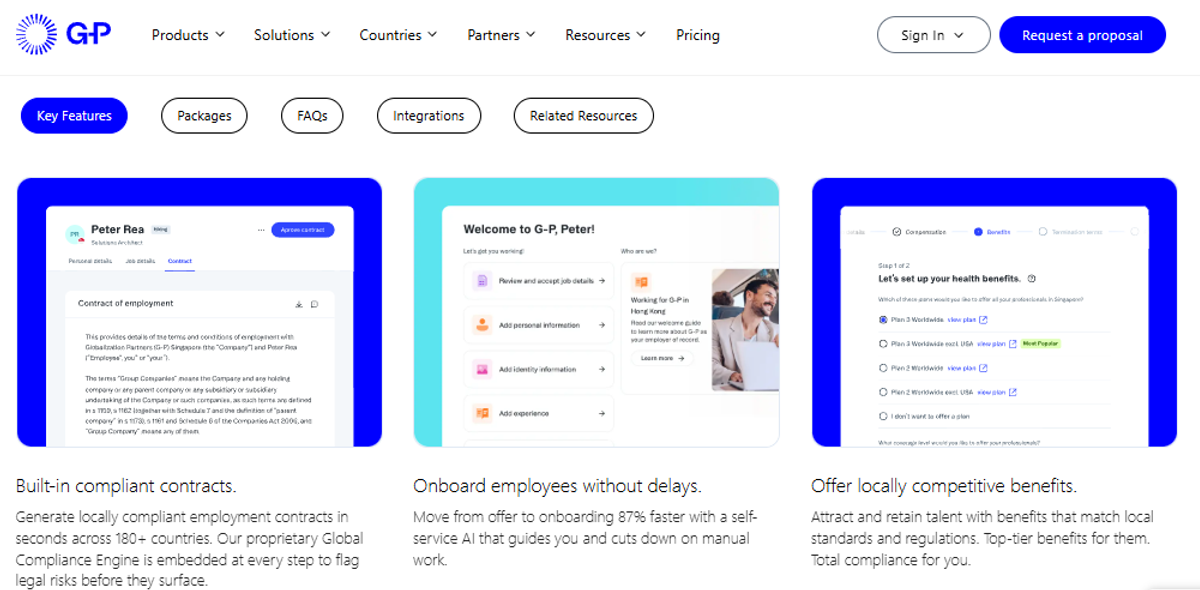
Globalization Partners, now trading as G-P, is one of the oldest global employment companies, covering roughly 180 countries through owned entities. Its contracting, security documentation, and legal review process are built for enterprise procurement rather than founder self-serve.
🧾 Core Services
Employer of Record across a large owned entity network.
Global payroll and multi-country compliance administration.
Enterprise contracting and legal advisory support.
Benefits design across jurisdictions.
Entity establishment advisory for companies moving to captives.
🤔 Why Companies Consider G-P
The reason is almost always procurement, not price. When security review requires certifications, named legal counsel, and a master services agreement your general counsel can redline, G-P clears those gates. Buyers running that kind of review usually land on our enterprise India hiring page for the same checklist.
✅ Owned entities across a very wide footprint. ✅ Enterprise contracting maturity. ❌ Pricing at 15% of salary punishes senior engineering hires. ✅ Named account coverage is standard. ❌ Setup and termination fees are substantial, and onboarding runs 5 to 10 days.
👥 Ideal Customer Profile
Enterprises and late-stage companies with formal vendor security review.
Teams employing in 20 or more countries.
India team size of 25 to 100 plus employees.
Buyers for whom SOC 2 or ISO 27001 is a signature prerequisite.
Decision makers: General Counsel, CHRO, Head of Procurement.
💰 Commercial Model
G-P prices India EOR at 15% of salary with a reported minimum of $1,500 per month. On a senior Bengaluru engineer at $42,000, 15% is roughly $525 a month, and on a $120,000 role it is $1,500. Setup and termination fees are reported as substantial. Onboarding is documented at 5 to 10 days.
🔍 How Does Versatile Compare to G-P?
Versatile Club covers India only, employing through its own Indian entity, and that scope stops at one country with no multi-country contracting path. G-P does something we do not: it clears enterprise security and certification gates, including SOC 2 and ISO 27001, which Versatile Club does not hold today.
Unlike G-P, Versatile Club charges a flat $149 per employee per month rather than a percentage of salary, so the fee does not rise when you hire a senior engineer. Versatile Club also charges no setup fee and no exit fee, and commits to a 5-business-day onboarding SLA against G-P's documented 5 to 10 days. For companies where flat India pricing rather than global procurement coverage drives the decision, that combination is the difference.
Looking beyond Globalization Partners? Our roundup of Globalization Partners alternatives in India compares it against the rest of the India EOR market.
7. Papaya Global: Best for Finance-Led Payroll Consolidation
🧮 Overview
Papaya Global is a payroll and payments platform that layers EOR on top of a payroll aggregation network. Its strength is finance reporting: consolidated cost breakdowns, invoices, and payroll data across many countries in one view. India delivery runs through partner payroll providers.
🧾 Core Services
Global payroll aggregation and reporting.
Employer of Record through a partner network.
Cross-border payments and treasury workflows.
Contractor management and payments.
Workforce cost analytics and invoice breakdowns.
🤔 Why Companies Consider Papaya Global
The buyer here is usually a controller, not a founder. If you already run six payroll vendors across four regions, a consolidated monthly cost breakdown is worth real money at close. Teams solving the same problem inside India alone often compare payroll outsourcing services in India first.
✅ Payroll reporting and cost visibility are strong. ✅ Invoices and documents sit in one platform. ❌ Response times on payroll clarifications are a repeated complaint. ✅ Payments infrastructure is purpose-built. ❌ India EOR is executed through partners, so statutory accountability is indirect.
👥 Ideal Customer Profile
Companies running payroll across 10 or more countries with existing entities.
Finance-led buying committees focused on month-end close.
India team size of 10 to 50, often alongside other large markets.
Decision makers: CFO, Controller, Head of Payroll.
💰 Commercial Model
Papaya Global's EOR pricing is reported at $599 to $650 per employee per month, with contractor management at $30 per contractor per month. Add-on fees exist for additional services. Onboarding is documented at roughly 3 to 7 days.
🗣️ Customer Reviews
"We've noticed that response times can sometimes be very slow when we require clarifications on employee questions or payroll operations. Prompt responses are crucial for us to address queries efficiently."
— Cherry H., Payroll Manager, 3.5/5 Papaya Global G2 Verified Review, 2026
"At the end of the day our employee did get fully paid. It was only through a lot of work by our employee, including legal counsel, and work on our end."
— Verified User in Civic & Social Organization, Operations Lead Papaya Global G2 Verified Review, 10 January 2023
🔍 How Does Versatile Compare to Papaya Global?
Versatile Club covers India only, employing through its own Indian entity, and that scope stops short of multi-country payroll aggregation. Papaya Global does something we do not: it consolidates payroll data and cost breakdowns across a large number of countries in one finance view.
Unlike Papaya Global, Versatile Club is the legal employer in India itself rather than coordinating partner payroll providers, issues one USD invoice directly from its Indian entity, and publishes a flat $149 per employee per month rate against Papaya's reported $599 to $650. For companies where a single accountable India employer rather than multi-country payroll consolidation drives the decision, that combination is the difference.
Looking beyond Papaya Global? Our roundup of Papaya Global alternatives in India compares it against the rest of the India EOR market.
8. Skuad: Best for APAC-Weighted Hiring and Fast Contractor Starts
⏰ Overview
Skuad, now operating as Payoneer Workforce Management, is a global employment platform with Asia-Pacific concentration. It is priced below the Western platforms and markets some of the fastest onboarding claims in the category. India runs on a hybrid partner model.
🧾 Core Services
Employer of Record across APAC and global markets.
Contractor management and cross-border payments.
Payroll processing through owned and partner infrastructure.
Account management on standard plans.
Background verification coordination.
🤔 Why Companies Consider Skuad
Price and speed drive it. At $199 per employee per month with 48 to 72 hour onboarding claims, Skuad sits closer to India specialists than to Deel on the fee line, while still covering other countries.
✅ Competitive $199 price point. ✅ Named account manager is standard. ❌ Support quality draws repeated complaints post-acquisition. ✅ APAC coverage is genuinely deep. ❌ Onboarding requires deposits before an offer can go out, which breaks normal hiring sequencing.
👥 Ideal Customer Profile
Cost-sensitive companies hiring across APAC and India.
Teams with 5 to 40 international employees.
Companies comfortable with a hybrid owned and partner entity model.
India team size of 3 to 20 employees.
Decision makers: Head of HR, Operations Director, Founder.
💰 Commercial Model
Skuad's EOR pricing is $199 per employee per month flat. Onboarding is documented at 48 to 72 hours. Deposits are required before offers are issued, according to customer accounts. Exit terms are not publicly disclosed.
🗣️ Customer Reviews
"The onboarding process didn't allow us to send out an offer (which may or may not be accepted) prior to the deposits even though the employee may not even start for another 2 months. The ACH for initial payment takes too long."
— Verified User in Information Technology and Services, HR Operations, 4/5 Skuad G2 Verified Review, 2025
"The interface is easy to use, and that is about it."
— Ricardo V., EOR Client Skuad G2 Verified Review, 1 July 2025
🔍 How Does Versatile Compare to Skuad?
Versatile Club covers India only, employing through its own Indian entity, and that scope stops at one country. Skuad does something we do not: it employs across APAC and other regions on one agreement, which matters if Vietnam or Indonesia is next.
Unlike Skuad, Versatile Club employs through its own Indian entity rather than a hybrid partner model, requires no deposit before an offer goes out, and charges no setup or exit fee. Skuad does not state its India state-level professional tax coverage on its own site. For companies where a single accountable Indian employer rather than regional breadth drives the decision, that combination is the difference.
Looking beyond Skuad? Our roundup of Skuad alternatives compares it against the rest of the India EOR market.
9. Velocity Global: Best for Enterprise Custom-Scoped Programmes
📋 Overview
Velocity Global, now trading as Pebl, covers roughly 185 countries through a mix of owned and partner entities. It sells into enterprise programmes with custom scoping and advisory wrapped around the employment contract. Pricing is quote-based rather than published.
🧾 Core Services
Employer of Record across a very wide country footprint.
Global payroll and benefits administration.
Immigration and mobility support.
Advisory on entity establishment and transitions.
Expense and equipment reimbursement workflows.
🤔 Why Companies Consider Velocity Global
Enterprises buy it for scope flexibility. When your employment programme has exceptions in nine countries, a custom-scoped vendor beats a fixed product. Reimbursement processing also draws consistent praise.
✅ Very wide country coverage. ✅ Reimbursements and expense handling are processed quickly. ❌ Portal usability and onboarding accuracy draw repeated complaints, including wrong contract start dates. ✅ Advisory support is substantive. ❌ Pricing is not published, so benchmarking requires a sales cycle.
👥 Ideal Customer Profile
Enterprises with complex, exception-heavy global employment programmes.
Teams employing across 20 or more countries.
India team size of 20 to 100 plus employees.
Buyers who need mobility and immigration support alongside employment.
Decision makers: CHRO, Head of Global Mobility, Procurement.
💰 Commercial Model
Pricing is not publicly disclosed. Velocity Global quotes custom enterprise pricing per programme. Onboarding is documented at roughly 3 to 7 days. Setup and termination terms are negotiated per contract. If you need a published India number for comparison, our India employer of record cost guide sets the benchmark.
🗣️ Customer Reviews
"Using most of Velocity Global's services is straightforward and user-friendly. Reimbursements for equipments and other expenses are processed quickly, the company consistently keeps us informed with updates."
— Ana A., EOR Employee, 4/5 Pebl (formerly Velocity Global) G2 Verified Review, 2026
"My contract had the wrong start date and other errors."
— Verified User in Non-Profit Organization Management, EOR Employee Pebl (formerly Velocity Global) G2 Verified Review, 30 April 2026
🔍 How Does Versatile Compare to Velocity Global?
Versatile Club covers India only, employing through its own Indian entity, and that scope stops at one country with no mobility or immigration programme. Velocity Global does something we do not: it scopes custom global employment programmes across roughly 185 countries.
Unlike Velocity Global, Versatile Club publishes a flat $149 per employee per month rate rather than quoting custom enterprise pricing, and commits to a 5-business-day onboarding SLA inside the contract. Velocity Global does not state India EOR pricing or state-level professional tax coverage on its own site. For companies where published India pricing rather than global programme scoping drives the decision, that combination is the difference.
Looking beyond Velocity Global? Our roundup of Velocity Global alternatives in India compares it against the rest of the India EOR market.
10. Oyster: Best for Distributed-First Companies With Scattered Single Hires
🌱 Overview
Oyster is a global employment platform built around distributed-first hiring, with a clean self-serve flow and strong documentation. Entity coverage mixes owned and partner arrangements by country. India state-level coverage is not published in detail.
🧾 Core Services
Employer of Record across a broad country list.
Contractor management and conversions to employment.
Global payroll processing.
Benefits administration by country.
Total rewards and salary benchmarking tooling.
🤔 Why Companies Consider Oyster
Self-serve speed is the draw. A founder with one hire in Portugal, one in Kenya, and one in India can run all three without a sales call. Documentation quality reduces the need for support. For the India leg specifically, our walkthrough on how to hire in India without an entity covers what self-serve flows leave out.
✅ Clean self-serve hiring flow. ✅ Salary benchmarking tooling is useful at offer stage. ❌ India entity model and state coverage are not disclosed at a granular level. ✅ Country documentation is detailed. ❌ Published pricing sits near the top of the market at reported rates of around $699 per employee per month.
👥 Ideal Customer Profile
Distributed-first companies with one or two hires per country.
Seed to Series B teams without an HR operations function.
India team size of 1 to 5 employees.
Buyers prioritising product experience over local depth.
Decision makers: Founder, Head of People.
💰 Commercial Model
Oyster's published EOR rate is reported at around $699 per employee per month in 2026 market pricing comparisons. Contractor management is priced separately. India-specific setup and exit terms are not publicly disclosed.
No verified customer reviews were available in the provided source set for this provider.
🔍 How Does Versatile Compare to Oyster?
Versatile Club covers India only, employing through its own Indian entity, and that scope stops at one country with no self-serve multi-country flow. Oyster does something we do not: it lets a founder hire in dozens of countries without talking to anyone.
Unlike Oyster, Versatile Club names its Indian employing entity publicly, files PF, ESI, TDS, and professional tax under its own registrations across all 28 states and 8 union territories, and publishes a flat $149 per employee per month rate against Oyster's reported $699. Oyster does not state its India entity model or state-level coverage on its own site. For companies where verifiable India employer accountability rather than self-serve country breadth drives the decision, that combination is the difference.
Looking beyond Oyster? Our roundup of Oyster alternatives in India compares it against the rest of the India EOR market.
⭐ The Split-Vendor Rule
Across the India placements we have run since 2020, the pattern that holds up is unbundling rather than consolidation. Versatile Club's read is that the standard "just buy Deel for everything" advice gets this backwards for India-heavy teams. Keep a global platform for scattered single hires, and put the concentrated hub with a specialist who owns the entity.
I could be reading my own data too strongly here, so test it with arithmetic rather than argument. Model twenty India hires at $599 against twenty at $149, add a 4% FX margin to the first, and the gap funds a senior engineer. What I think shifts over the next two years is that India stops being one row on a global EOR map and becomes its own category.
Versatile Club employs through Foo Falcon Technologies Pvt Ltd, files PF, ESI, TDS, and professional tax under its own registrations, and commits to a 5-business-day onboarding SLA in the contract. One USD invoice, no setup fee, no exit fee, first month free. The founder answers on WhatsApp, and you can start that conversation here.
Q2. How did we score these 10 India EOR providers?
Each provider is scored out of 100 on five weighted criteria: India Entity Model and Compliance Depth (25%), Pricing Transparency and Commercial Model (20%), Onboarding Speed and Support Model (20%), Talent and Retention Support (20%), and Customer Validation from G2, Capterra, and Reddit (15%). Scores convert to stars in 20-point bands, from one star at 0 to 20 through five stars at 81 to 100. Global review volume is capped at 15% because it measures dashboard polish across 100 plus countries, not who files a Maharashtra professional tax return.
| Criterion | Weight | What it measures |
| India Entity Model and Compliance Depth | 25% | Owned Indian entity or partner shell; PF, ESI, TDS, PT, gratuity, POSH, DPDP handling |
| Pricing Transparency and Commercial Model | 20% | Published fee, setup fee, exit fee, FX policy, invoice clarity |
| Onboarding Speed and Support Model | 20% | Contractual SLA versus marketing estimate; founder, HRBP, ticket, or chatbot |
| Talent and Retention Support | 20% | Sourcing, vetting, onboarding monitoring, post-start support |
| Customer Validation | 15% | G2, Capterra, Clutch, and Reddit evidence, weighted for India relevance |
⚖️ Why entity model carries the heaviest weight
Entity model decides who is legally liable when something breaks. A platform that contracts an Indian partner entity is passing your statutory exposure down a chain. Versatile Club weights that at 25% because it is the only criterion that changes who answers an EPFO notice.
Review volume gets the smallest weight on purpose. A 4.8 star average built from 10,000 reviews across 150 countries tells you the onboarding flow is pleasant. It tells you nothing about whether your Pune hire's professional tax return was filed on the twentieth. Our wider roundup of best EOR services in India applies the same weighting.
🔢 How to re-weight this for your own situation
The rubric is published so you can change it. Three re-weightings are worth running before you shortlist anyone.
Hiring across 10 plus countries: raise country coverage to 30% and India depth drops to a tiebreaker. Deel, G-P, or Velocity Global should win.
Enterprise procurement with a certification gate: make SOC 2 Type II and ISO 27001 pass or fail. Versatile Club does not clear that gate today.
One India hire, no HR function: raise Onboarding Speed and Support to 35%, because the only thing that matters is somebody answering you in week one.
Versatile Club measures its own score the same way, and the arithmetic is on the table above rather than in an adjective. You can see how the onboarding and support model maps to those weights.
🤔 Where I think this rubric is still weak
Across the India placements we have run since 2020, the hardest thing to score is retention. Versatile Club tracks it through contract-to-hire conversions, where we see who stays past the first year, but that data is ours and you cannot verify it from outside. I am treating a 20% weight on it as a judgment call, not a measurement.
The other soft spot is customer validation for smaller providers. Versatile Club's own review base is a fraction of Deel's, so a volume-weighted score would flatter the platforms regardless of India performance. Capping it at 15% is the correction I chose. You may think that is too generous to specialists, and that is a fair argument.
Versatile Club scores five stars on this rubric and loses points on one axis only, which is global footprint. If your weighting puts multi-country coverage or an ISO 27001 certificate above India depth, Deel or G-P should beat us. The three deals we should lose are named above, in numbers rather than adjectives.
Q3. What does an India EOR actually cost once setup fees, FX markup, statutory load, and exit terms are added?
Budget three layers, not one. Gross salary first. Then employer statutory load, which is 12% EPF on Basic plus DA, 3.25% ESI where applicable, and 4.81% gratuity accruing from month one, roughly 13 to 20% of gross. Then the EOR fee, which ranges from $149 to $699 per employee per month. Add what headline quotes omit: setup fees of $200 to $2,000, a one to two month security deposit, a 2 to 10% FX margin inside the USD to INR conversion, offboarding fees, and exit notice equal to the employee's notice plus one month.
🧮 The statutory layer, with the actual formulas
These numbers are fixed by statute, so no provider can discount them. Versatile Club runs all four under its own registrations, which is why they appear as line items rather than a bundled percentage. Our full breakdown of employer of record India cost shows the same arithmetic on a live salary.
EPF: 12% of Basic plus DA, employer share, deposited monthly with EPFO.
ESI: 3.25% employer and 0.75% employee, for wages under the Rs 21,000 threshold, per ESIC contribution rates.
Gratuity: 4.81% of Basic plus DA, accrued from month one, payable after five years of continuous service under the Payment of Gratuity Act, 1972.
TDS under Section 192: deducted monthly, deposited by the seventh, with Form 16 issued by 30 May.
Gazette notification S.O. 5109(E), dated 17 September 2026, raised the EPFO wage ceiling to Rs 25,000, which caps employer PF on statutory wages at Rs 3,250 a month.
💸 The five line items that never appear in a quote
Ask every shortlisted vendor for a live sample invoice during procurement, not a pricing page. Read it line by line for setup fee, security deposit, FX margin, exit fee, and benefits markup. Most buyers never ask, which is exactly why the margin survives.
| Cost line | Global platforms | Versatile Club |
| Monthly fee | $400 to $699 | $149 |
| Setup fee | $299 to $500 reported | None |
| Exit terms | Employee notice plus one month | None |
| FX margin | 3 to 5% reported | None, USD invoiced from India |
"I dislike how expensive Deel's transaction fees are, especially when moving money from the Deel account to my bank or wherever else it needs to go."
— Maria M., Freelancer, 3/5 Deel G2 Verified Review, 26 September 2025
"First USD invoice landed clean: no FX markup, no setup fee, no surprises."
— Verified User in Information Technology and Services, Founder, 5/5 Versatile Club G2 - Verified Review, 23 June 2026
🧾 What sits behind one USD invoice
A single USD invoice looks simple on your side. On the India side, it carries FEMA reporting, AML checks, RBI inward remittance documentation, and GST e-invoicing. Versatile Club handles all four as the invoicing entity, so your finance team sees one amount rather than a conversion trail.
FC-GPR filing only becomes your problem if you incorporate in India and issue shares to a foreign parent. Under an EOR, it stays outside your scope entirely, which is one reason teams compare EOR versus entity in India before committing capital.
⚠️ Exit economics nobody prices in
Switching providers usually means resign and rehire, which restarts the five-year gratuity clock for your employee. That cost lands on them, not on your invoice, and it is the quiet reason team members resist a vendor change. Versatile Club charges no exit fee, so a move is an operations decision rather than a contractual one. Our guide on how to switch EOR provider in India covers the transfer paperwork.
Versatile Club bills $149 per employee per month in USD, invoiced from its Indian entity, with the first month free, no setup fee, no exit fee, and no deposit. Modelled against a San Francisco senior engineer at $220,000 all in, the same role in Bengaluru lands near $58,000 all in. One invoice, one entity, answerable in an afternoon.
Q4. Is EOR legal in India, who is the lawful employer, and does your provider cover all 28 states?
Yes, EOR is legal in India. There is no EOR licence or statutory category, so providers employ through a services entity. If a client exercises pervasive day to day control, authorities can treat the arrangement as a sham and deem the foreign company the direct employer. One question settles it: which legal entity appears on the employee's Form 16, and does the provider own it? Versatile Club employs through Foo Falcon Technologies Pvt Ltd and files PF, ESI, TDS, and professional tax under its own registrations across all 28 states and 8 union territories.
⚠️ The pervasive control test, in plain terms
Pervasive control means acting like the employer even though you are not on paper. Three client behaviours create it. Issuing disciplinary action directly, signing the employee's India contract yourself, or concluding customer contracts through your India staff.
Versatile Club's read is that most PE and misclassification scares get the sequence backwards. The risk is not the EOR structure. The risk is a client treating the structure as decoration and running the employment relationship anyway. That distinction also decides when you should convert a contractor to an employee in India.
🔍 The common view, and where it breaks
The popular view is that a polished dashboard means a direct employer. It does not. Competitive analyses tag Deel and Remote as owning entities in major markets, while India-specific documentation points to local partner entities for India delivery. I am not going to settle that argument with assertions.
Read the record instead. Three lookups take ten minutes.
MCA company master data: find the employing entity's CIN and status.
EPFO establishment search: confirm the entity holds its own PF establishment code.
GSTN taxpayer search: confirm the GSTIN that will issue your invoice.
🗺️ Why state coverage is the real discriminator
India is not one payroll jurisdiction. Professional tax, Shops and Establishments registration, and labour welfare fund all sit with states, and the rules do not rhyme. Our payroll compliance in India guide lists the filing calendar state by state.
Maharashtra: dual PTRC and PTEC registration, monthly slab filing.
Karnataka: monthly PT, with S&E registration renewal due within 30 days.
Tamil Nadu: biannual PT, plus labour welfare fund.
Telangana: PTRC enrolment required.
Delhi: no professional tax, but strict S&E compliance.
Versatile Club built this map through C2H operations across Bengaluru, Hyderabad, and Pune, which is where the paperwork scars came from. Reported practical coverage for global platforms sits near the top six states for Deel and top four for Remote. Teams hiring in one city often start with payroll outsourcing in Bengaluru.
"Remote's benefits administration is atrocious. Wherever they can, they farm benefits out to third parties, and then do not take any accountability when those third parties fail to deliver. I ended up needing to stike a special deal to exit Remote's provident fund, because it was so badly administrated."
— Justin W., EOR Employee, 0/5 Remote G2 Verified Review, 2026
"Versatile's Employer of Record India service made this seamless contracts, PF, ESI, TDS, and payroll all handled in one place. Invoicing in USD meant zero exchange rate surprises."
— Vedant T., Agency Founder, 5/5 Versatile Club G2 - Verified Review, 16 June 2026
Versatile Club's employer of record is Foo Falcon Technologies Pvt Ltd, verifiable on the MCA portal in ninety seconds. Every PF challan, ESI contribution, TDS deposit, and state PT return runs under our own registrations. That is why the indemnity is ours to honour rather than a promise passed along a chain, and why our India EOR service commits to all 28 states and 8 union territories.
Q5. What do the 2025-26 Labour Codes, the Rs 25,000 EPFO ceiling, and DPDP Rules 2025 change, and what risk still sits with you?
Four changes reprice every India quote written before late 2025. The four Labour Codes came into force on 21 November 2025, with central rules published by the Ministry of Labour and Employment on 8 May 2026. Basic plus dearness allowance must now be at least 50% of CTC, fixed-term employees earn pro-rata gratuity at one year, and full and final settlement is due within two working days. Gazette notification S.O. 5109(E), dated 17 September 2026, raised the EPFO wage ceiling from Rs 15,000 to Rs 25,000, lifting the employer PF cap to Rs 3,250 a month. DPDP Rules 2025 make your provider a data processor. Permanent establishment and misclassification exposure stays with you.
💰 The 50% wage rule, on a real salary sheet
Dearness allowance, or DA, is a cost of living component added to basic pay. Under the Codes, Basic plus DA cannot fall below half of total CTC. Allowance-heavy structures that used to suppress statutory cost no longer work.
Here is the shift on a Rs 20 lakh package. The old structure might carry Rs 6 lakh basic and Rs 14 lakh in allowances. The new structure requires at least Rs 10 lakh in Basic plus DA, which raises the PF, ESI, and gratuity base by two thirds. Versatile Club restructured client salary sheets for this split before the central rules were published, because the C2H payroll already ran under the same registrations. Our payroll compliance in India guide shows the restated structure side by side.
⚠️ What the EPFO ceiling change actually costs
The ceiling is the maximum monthly wage used to calculate mandatory PF, EPS, and EDLI coverage. Employer PF on statutory wages now caps at Rs 3,250 rather than Rs 1,950. The ESIC threshold did not move and stays at Rs 21,000.
One detail gets missed. EDLI, the life insurance component, can now calculate on a higher base reaching Rs 10.5 lakh, while the assurance benefit stays capped at Rs 7 lakh, per the EPFO wage ceiling FAQs. Ask your provider for a restated cost sheet applying the ceiling and the pro-rated September 2026 ECR. Run the same numbers yourself on the India salary calculator.
🔐 DPDP turns your EOR into a data processor
MeitY notified the DPDP Rules through G.S.R. 846(E) on 13 November 2025, with the enforcement timeline in G.S.R. 843(E). Your EOR holds Aadhaar, PAN, bank, and payroll data for your team, which makes it a processor acting on your instructions.
Three contract terms matter before substantive duties bite on 14 May 2027. A 72 hour breach notification commitment, one year log retention, and processing limited to stated purposes. Penalties reach Rs 250 crore. Versatile Club carries these terms in the MSA today rather than on a roadmap, and the full scope sits on our India compliance page.
❌ The risks no EOR contract can transfer
Permanent establishment risk is yours. If your India staff conclude customer contracts or you run a fixed place of business, a tax authority can treat you as taxable in India regardless of who signs the payslip.
Misclassification is the other one. Across the placements we have run, the pattern is consistent: a core engineer on a contractor agreement invites backdated taxes and penalties, with exposure commonly estimated at $25,000 to $40,000 per head. Versatile Club declines contractor structures for full time core roles even when clients ask, because the saving is a loan against a future assessment notice. The trade-offs are laid out in independent contractor versus EOR. POSH Act Section 4 also requires an Internal Committee once you cross ten employees, and that duty sits with the employer of record.
Versatile Club files PF, ESI, TDS, and multi-state professional tax under its own registrations, so Code-driven salary restructuring happens in-house. When the ceiling moved in September 2026, clients got a restated cost sheet rather than an invoice surprise. The indemnity behind it sits on our own entity.
Q6. How fast can an India EOR actually onboard a hire, and what do real buyers say about support?
Published India onboarding runs from 48 hours to 14 days. Skuad states 48 to 72 hours, Papaya Global and Velocity Global 3 to 7 days, Multiplier about 7 days, G-P 5 to 10 days, Deel 7 to 14 days, and Remote 10 to 14 days. Versatile Club commits to 5 business days contractually rather than as an estimate. The real gate is document reality: PAN, Aadhaar, UAN transfer, bank validation, background check, and a signed contract with IP assignment. Ratings cluster between 4.2 and 4.8, so the deciding signal is the complaint theme, not the average.
⏰ The day zero to day five sequence
A UAN is the Universal Account Number that carries an employee's PF history between employers, issued through the EPFO member portal. It is the step that slips most often.
Day 0: signed service agreement and salary structure confirmed. Owner: you and the provider jointly.
Day 1: compliant employment contract drafted with IP assignment. Owner: provider.
Day 2: candidate document collection, PAN, Aadhaar, bank proof. Owner: candidate.
Day 3: UAN transfer or fresh PF registration initiated. Owner: provider.
Day 4 to 5: background check closure, payroll setup, start date confirmed.
Steps three and four are where timelines break. Versatile Club tracks both daily, and when a UAN stalls, the escalation path is a WhatsApp message to me rather than a ticket. The full sequence is documented on our how it works page.
🗣️ What support actually feels like at the global platforms
Ratings hide the thing you care about. Read what buyers say when something goes wrong.
"I was redirected multiple times, asked to repeat the same information to different representatives, and spent a considerable amount of time in meetings without reaching a clear resolution."
— Güneş A., Remote Worker, 1.5/5 Deel G2 Verified Review, 2 October 2025
"We've noticed that response times can sometimes be very slow when we require clarifications on employee questions or payroll operations. Prompt responses are crucial for us to address queries efficiently."
— Cherry H., Payroll Manager, 3.5/5 Papaya Global G2 Verified Review, 2026
If support responsiveness is your deciding criterion, our comparison of Deel versus Remote for India covers both service models in detail.
🧾 The month-end test nobody runs during procurement
Onboarding speed stops mattering in week two. What matters from month two is whether your controller can reconcile the invoice without an email thread. CFOs describe the opposite often enough that it is a category pattern: non-consolidated India invoices, and audit questions on PF, ESI, and gratuity that trigger a last minute scramble.
Versatile Club issues one consolidated USD invoice from its Indian entity, with gross to net reporting, challan confirmations, and TDS receipts in the monthly client pack. Teams that already hold an entity get the same pack through managed payroll. Here is what buyers describe on the service side.
"Sagar replied to our form in about four hours with a draft offer letter already attached. The hire was onboarded in four days."
— Verified User in Information Technology and Services, Founder, 5/5 Versatile Club G2 - Verified Review, 23 June 2026
"Founder is just a call away. Extremely helpful in resolving all our queries. The process is super smooth to setup India EOR."
— surbhi m., Lean Founder, 5/5 Versatile Club G2 - Verified Review, 15 June 2026
🤔 One discipline worth stealing
Status questions in India are often answered politely rather than accurately. Stop asking "are we on schedule" and ask "where are we on the schedule". Versatile Club runs onboarding reviews that way, and it surfaces a stalled document two days earlier.
Versatile Club's 5 day SLA sits in the agreement, and escalation runs through my WhatsApp. That is sustainable at our current scale, and at some point it will have to change. We will also never out-review Deel's ten thousand entries, and claiming otherwise would be the behaviour this section criticises. If you want to test the response time before signing anything, book a 30 minute call.
Q7. EOR, PEO, or your own Indian subsidiary, and which provider fits your situation?
An EOR is the legal employer of your India staff. A PEO administers HR and payroll for an entity you already own. A contractor of record manages compliant freelancers. Incorporating in India costs roughly $15,000 to $100,000 and takes three to six months before anyone starts. At $149 per employee per month, twenty India staff cost about $35,760 a year, which stays below an entity carrying a company secretary, statutory audit, and FEMA filings. Crossover is about permanence, not headcount.
🏗️ The entity cost stack people forget
The incorporation invoice is the small part. SPICe+ filing fees are modest, and then the recurring stack starts.
Company secretary and statutory audit, annually.
FC-GPR filing under FEMA when shares are issued to the foreign parent.
Monthly PF, ESI, TDS, and state professional tax returns.
At least one India-resident director, with the governance that follows.
Versatile Club advises three non-financial triggers for building: you need India-resident IP ownership, local banking and customer contracting, or a capex-heavy capability centre. Headcount alone is a weak trigger. Our side-by-side on EOR versus entity in India models both paths over three years.
🌉 A suspension bridge, not the Golden Gate
An EOR is light infrastructure that gets people working in days. An entity is permanent infrastructure that takes quarters and carries standing cost. Both are correct at different stages, and GCC setup in India is the version that follows when permanence wins.
The part the category undersells is why India at all. Versatile Club's read is that treating India as a cheap labour market produces bad hires and worse retention. You go to India for engineers with strong academic training and limited places to apply it, which is a talent argument, not an arbitrage one, as the nasscom Technology Sector Strategic Review 2026 sets out.
✅ Which provider fits which situation
| Your situation | Pick |
| Concentrated India team, 1 to 30 people | Versatile Club, owned entity, 5 day SLA, $149 flat |
| Single hires across 10 plus countries | Deel or Remote, breadth over depth |
| Enterprise with a certification gate | G-P or Velocity Global |
| Device and IT bundled with payroll | Rippling |
| APAC-weighted hiring on a tight budget | Skuad or Multiplier |
| Finance-led payroll consolidation | Papaya Global |
The split-vendor pattern beats both extremes for most teams. Keep a global platform for scattered hires, and unbundle the concentrated hub to a specialist. Modelled on twenty India hires, moving from $599 to $149 with no FX margin cuts India platform spend by roughly 75%. The EOR versus entity calculator runs that model on your own headcount.
⚠️ Where Versatile Club is the wrong answer
Three cases, stated plainly. Multi-country EOR across five or more countries, B2C consumer hiring at volume, and enterprise teams of 100 plus where SOC 2 Type II or ISO 27001 is a signature prerequisite. Versatile Club does not hold those certifications today, and heavy custom procurement workflows take longer than the 5 day SLA.
I am also still unsure where founder-direct support breaks. Versatile Club's current data looks fine, though I might be reading a small sample too confidently. Teams at that scale usually start on our enterprise India hiring page instead.
Versatile Club charges no exit fee, so the day your India team justifies its own Private Limited entity, you leave on your own timeline with employee files, PF and ESI transfer records, and F&F documentation handed over. If you are hiring across fifteen countries, pick a global platform and unbundle India to us. If you are building in Bengaluru, Hyderabad, or Pune, take the free first month on our India EOR service and tell me what you are building.
FAQs
What is the best EOR in India for a US or UK company making its first hire?
For a first India hire, the deciding factor is rarely country coverage. It is who holds the statutory registrations and who answers you in week one.
Versatile Club operates as an India-only employer of record through its own registered Indian entity, Foo Falcon Technologies Pvt Ltd, and files PF, ESI, TDS, and professional tax under its own registrations across all 28 states and 8 union territories. The fee is a flat $149 per employee per month, with no setup fee, no exit fee, and the first month free, against a 5-business-day onboarding SLA written into the contract.
The alternatives split cleanly by shape of hiring:
- Concentrated India team of 1 to 30 people: an India specialist with an owned entity.
- Scattered single hires across 10 plus countries: Deel or Remote at $599 per month.
- Enterprise with a certification gate: Globalization Partners or Velocity Global.
Before you shortlist anyone, ask one question in writing: which legal entity appears on my employee's Form 16, and do you own it? If you want the sequence that follows a yes, our walkthrough on how to hire in India without an entity covers the documents, the filings, and the day-by-day timeline.
How much does an employer of record in India actually cost per employee per month?
Budget three layers, not one. Most quotes only show the third.
- Gross salary: the number you negotiated with the candidate.
- Employer statutory load: 12% EPF on Basic plus DA, 3.25% ESI where applicable, and 4.81% gratuity accruing from month one, roughly 13 to 20% of gross.
- EOR fee: $149 to $699 per employee per month across the providers we compared.
Then add what headline pricing omits: setup fees of $200 to $2,000, a one to two month security deposit, a 2 to 10% FX margin buried inside the USD to INR conversion, offboarding charges, and exit notice equal to the employee's notice plus one month. On a $42,000 Bengaluru engineer, a 4% FX margin alone costs roughly $1,680 a year.
Versatile Club bills $149 per employee per month in USD, invoiced directly from its Indian entity, with no setup fee, no exit fee, and no deposit, so the conversion margin does not exist to be charged. The tactic we recommend during procurement is simple. Ask every vendor for a live sample invoice and read every line. For the full arithmetic on a real salary, see our breakdown of employer of record cost.
Is EOR legal in India, and who is the lawful employer?
Yes, EOR is legal in India. There is no EOR licence or statutory category, so providers employ staff through a services entity that holds its own registrations.
The risk is not the structure. It is behaving as the employer while claiming you are not. If a client exercises pervasive day to day control, authorities can treat the arrangement as a sham and deem the foreign company the direct employer. Three behaviours create that exposure:
- Issuing disciplinary action to the employee directly.
- Signing the India employment contract yourself.
- Concluding customer contracts through your India staff, which also raises permanent establishment risk.
Verification takes about ten minutes and does not require trusting any vendor's marketing. Look up the employing entity's CIN on the MCA portal, confirm it holds its own PF establishment code on the EPFO establishment search, and check the GSTIN that will issue your invoice on the GSTN taxpayer search.
Versatile Club's employer of record is Foo Falcon Technologies Pvt Ltd, and every PF challan, ESI contribution, TDS deposit, and state professional tax return runs under our own registrations. That is why the indemnity is ours rather than a promise passed down a chain. For the contractor side of the same question, read independent contractor versus EOR.
What do the 2025-26 Labour Codes and the Rs 25,000 EPFO ceiling change in my India payroll?
Two changes reprice every India quote written before late 2025.
The four Labour Codes came into force on 21 November 2025, with central rules published on 8 May 2026. Three consequences land directly on payroll:
- Basic plus dearness allowance must be at least 50% of CTC, which pulls allowances back into the PF, ESI, and gratuity base.
- Fixed-term employees earn pro-rata gratuity at one year rather than five.
- Full and final settlement is due within two working days of exit.
Gazette notification S.O. 5109(E), dated 17 September 2026, then raised the EPFO wage ceiling from Rs 15,000 to Rs 25,000, lifting the employer PF cap from Rs 1,950 to Rs 3,250 a month. The ESIC threshold did not move and stays at Rs 21,000. One nuance gets missed: EDLI can now calculate on a base reaching Rs 10.5 lakh while the assurance benefit stays capped at Rs 7 lakh.
Versatile Club restructured client salary sheets for the 50% split before the central rules were published, and issued restated cost sheets when the ceiling moved rather than letting it appear as an invoice surprise. Ask your provider for the same document. Our payroll compliance in India guide lists the filing calendar state by state.
When should we switch from an EOR to our own Indian subsidiary?
Incorporating in India costs roughly $15,000 to $100,000 and takes three to six months before anyone starts work. At $149 per employee per month, twenty India staff cost about $35,760 a year, which still sits below an entity carrying a company secretary, statutory audit, FEMA filings, and monthly statutory returns.
So the crossover is about permanence, not headcount. Build the entity when one of these becomes true:
- You need India-resident intellectual property ownership.
- You need local banking and the ability to contract with Indian customers.
- You are funding a capex-heavy capability centre with statutory directors on the ground.
Two costs rarely get modelled. Switching providers usually means resign and rehire, which restarts the five-year gratuity clock for your employee, and most global platforms require exit notice equal to the employee's notice plus one month.
Versatile Club charges no exit fee, so the day your India team justifies its own Private Limited entity, you leave on your own timeline with employee files, PF and ESI transfer records, and full-and-final documentation handed over. That keeps the decision an engineering one rather than a contractual one. Model both paths first with our comparison of EOR versus entity in India.