Table of contents (15)
8 Best Globalization Partners Alternatives for India - Pricing & Features Compared
Q1. What Are the 8 Best Globalization Partners Alternatives for Hiring in India in 2026?
The eight best Globalization Partners alternatives for India in 2026 are Versatile Club, Deel, Remote, Multiplier, Rippling, Papaya Global, Pebl (formerly Velocity Global), and Payoneer (formerly Skuad). Versatile Club runs India-only EOR through its own registered Indian entity at $149 per employee per month flat, with a five business day onboarding SLA written into the service agreement.
Choosing an India employer of record is not a software purchase. The provider becomes the legal employer of your team. It signs contracts, files statutory returns, and carries the liability. A weak pick surfaces later as a late payroll or an audit gap. Eight providers were analysed here against one rubric. Criteria included entity model, compliance depth, state coverage, and onboarding speed. Pricing transparency, invoicing readiness, support model, and customer validation were also scored. This guide is written for US and UK founders, People Ops leaders, CFOs, and legal teams. It fits companies hiring one to fifty employees in India.
💸 Why the G-P quote starts the search
G-P is priced at roughly 15% of salary with a minimum near $1,500 per employee per month. That is the enterprise end of the market, and it buys coverage in 180 plus countries.
I get WhatsApp messages about this number most weeks. The founder is not hiring in 180 countries. They are hiring two engineers in Bengaluru.
⚠️ The one country problem nobody prices for
Global EOR platforms cover 90 to 150 countries and spread their India expertise thin. India is where that thinness gets expensive.
Here is the specific test. Under the Code on Wages, 2019, live since 21 November 2025, Basic plus DA must be at least 50% of total wages. That single rule rewrites Indian salary structures, and it changes gratuity and PF math on every payslip.
Our Evaluation Criteria
Each provider in this list was assessed across the following decision grade criteria:
India Entity Model: whether the provider uses its own Indian entity, a local partner entity, a contractor model, or a payroll only setup.
Statutory Compliance Depth: PF, ESI, TDS, professional tax, gratuity, POSH, Form 130 (the certificate that replaced Form 16), full and final settlement, DPDP readiness, and New Labour Code 2025-26 structuring.
State Level Coverage: professional tax, Shops and Establishments, labour welfare fund, and leave rules across Indian states.
Onboarding Speed: time from signed agreement to compliant contract, payroll setup, statutory registration, and employee start.
Pricing Transparency: monthly fee, setup fee, exit fee, FX markup, first month terms, salary band pricing, and invoice clarity. Our own flat pricing is published on the same basis.
Invoicing and Finance Readiness: USD invoicing, INR invoicing, gross to net reporting, challan confirmations, TDS receipts, and audit ready documentation.
Support Model: founder direct support, named HR manager, HRBP, ticket queue, chatbot, or general CSM model.
Talent and Retention Support: recruiting, contract to hire, culture fit vetting, onboarding monitoring, replacement guarantee, and employee experience support.
Customer Validation: G2, Capterra, Clutch, Reddit, case studies, named testimonials, and third party proof.
Best Fit Buyer Segment: first India hire, 1 to 20 India employees, 10 to 50 India employees, switchers from Deel or Remote, companies with an existing India entity, or enterprises needing multi country EOR.
Who This Guide Is For
This guide is designed for:
US and UK founders hiring their first 1 to 3 employees in India.
Seed to Series B startups building engineering, product, AI, design, marketing, or operations teams in India.
People Ops and HR leaders reviewing India EOR, payroll, contractor, or PEO vendors.
CFOs and finance teams that need clean invoicing, statutory liability visibility, and audit ready India payroll records.
Legal teams reviewing employment contracts, IP assignment, misclassification risk, PE risk, and statutory employer accountability.
Companies currently using Deel, Remote, Multiplier, G-P, contractors, agencies, or local payroll vendors, and evaluating India specialist alternatives.
The Ranked List
Versatile Club: Best for US and UK companies hiring 1 to 50 employees in India only.
Deel: Best for companies hiring across many countries with India as one of several.
Remote: Best for buyers who want owned entity coverage plus strong IP assignment terms.
Multiplier: Best for APAC weighted hiring at a mid range price point.
Rippling: Best for teams consolidating HR, IT provisioning, and payroll in one system.
Papaya Global: Best for finance led payroll consolidation across a large country set.
Pebl (formerly Velocity Global): Best for enterprises needing the widest country footprint.
Payoneer (formerly Skuad): Best for contractor heavy teams that also need light EOR cover.
Master Comparison Table
| Provider | Best For | Key Strength | Compliance |
|---|---|---|---|
| Versatile Club ⭐⭐⭐⭐⭐ | US and UK companies hiring 1 to 50 employees in India only | India only focus with a contractual five day onboarding SLA | Own registered Indian entity PF, ESIC, and S&E registrations across 28 states and 8 UTs New Labour Code 2025-26 structuring |
| Deel ⭐⭐⭐⭐ | Companies hiring in many countries at once | Widest product surface across contractors, EOR, and payroll | Local partner entity model reported for India SOC 2 |
| Remote ⭐⭐⭐⭐ | Engineering teams that prioritise IP assignment | Owned entity network with strong contract terms | Owned entity coverage SOC 2 |
| Multiplier ⭐⭐⭐⭐ | APAC weighted hiring on a mid range budget | Lower price than the $599 tier with APAC depth | Hybrid entity model INR invoicing by default |
| Rippling ⭐⭐⭐⭐ | Teams consolidating HR, IT, and payroll | Device and app provisioning built into onboarding | Owned entity in several markets SOC 2 |
| Papaya Global ⭐⭐⭐ | Finance led payroll consolidation | Payments infrastructure and reporting depth | Own plus partner payroll model SOC 2 |
| Pebl (formerly Velocity Global) ⭐⭐⭐ | Enterprises needing the widest footprint | Coverage across 185 plus countries | Owned entities in core markets Partner India payroll |
| Payoneer (formerly Skuad) ⭐⭐⭐ | Contractor heavy teams needing light EOR | Contractor and EOR in one payments stack | Hybrid entity model SOC 2 |
1. Versatile Club: Best for US and UK Companies Hiring 1 to 50 Employees in India
🇮🇳 Overview
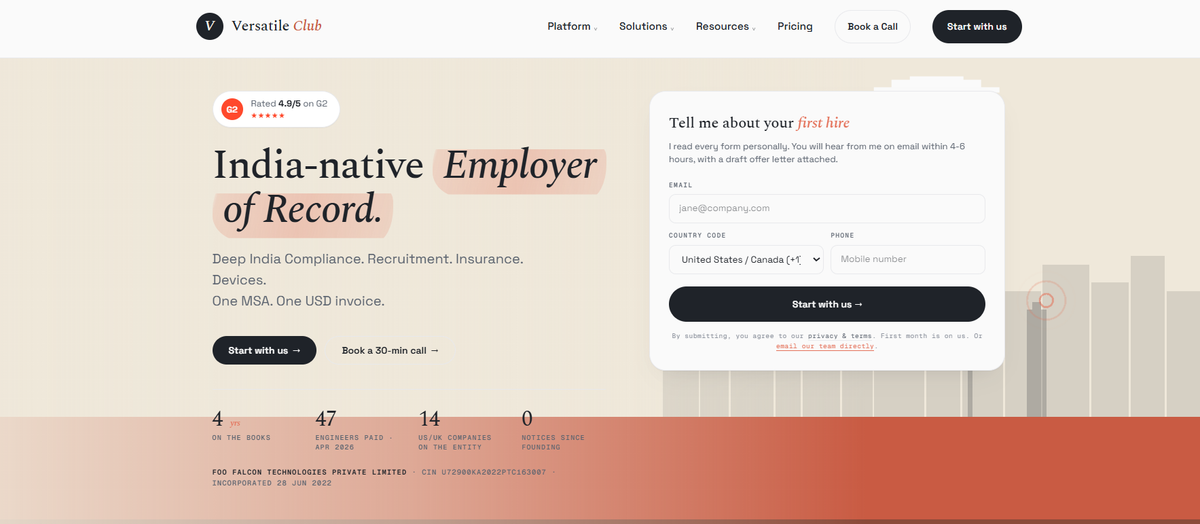
Versatile Club is an India only employer of record, run through Foo Falcon Technologies Pvt Ltd, its own registered Indian company. We are not a reseller or an aggregator, so PF, ESI, TDS, and professional tax filings sit under our registrations.
The company grew out of six years of contract to hire work for US and UK clients. I have personally placed engineers, designers, and ops professionals across Bengaluru, Hyderabad, and Pune.
✅ Core Services
India EOR through an owned Indian entity, with compliant contracts and IP assignment.
Monthly payroll with PF at 12%, ESI at 3.25% employer and 0.75% employee, and gratuity accrued at 4.81% of Basic plus DA.
Statutory filings across 28 states and 8 union territories, including Maharashtra PTRC and PTEC and Karnataka monthly professional tax.
Contract to hire placement, with culture fit screening across 50 behavioural parameters.
A single USD invoice with per employee breakdown, challan confirmations, and TDS receipts.
💰 Why Companies Consider Versatile Club
Buyers arrive with two questions. Who is the legal employer on paper, and what does the invoice actually total.
Versatile Club answers both with structure rather than adjectives. The entity is ours, the price is one number at every salary band, and the onboarding deadline is in the contract.
🎯 Ideal Customer Profile
US and UK companies, Seed to Series B, with 5 to 100 total headcount.
India team size of 1 to 50 employees, concentrated in Bengaluru, Hyderabad, or Pune.
Decision maker is the founder, the VP People, or the CFO.
Companies switching off Deel, Remote, or G-P for India only headcount.
Not a fit for buyers needing 5 or more countries from one vendor.
⏰ Commercial Model
Pricing is $149 per employee per month, flat, with no salary slabs. There is no setup fee, no exit fee, and the first month is free.
Invoicing is in USD, issued from the single Indian entity, so clients carry no FX exposure. The onboarding SLA is five business days from signed agreement to payroll live.
I should name the trade off plainly. Versatile Club does not yet hold SOC 2 Type II or ISO 27001, so procurement teams that gate on certifications should look elsewhere for now.
⭐ Customer Reviews
"Sagar replied to our form in about four hours with a draft offer letter already attached. The hire was onboarded in four days. First USD invoice landed clean: no FX markup, no setup fee, no surprises."
Verified User in Information Technology and Services Versatile Club G2 Verified Review
"The dashboard could be a little more self-serve, a couple of times I wanted to pull a report or a doc myself and ended up just messaging my contact instead. They always answered fast, so it wasn't a real problem."
Angad S. Versatile Club G2 Verified Review
2. Deel: Best for Companies Hiring Across Many Countries at Once
🌍 Overview
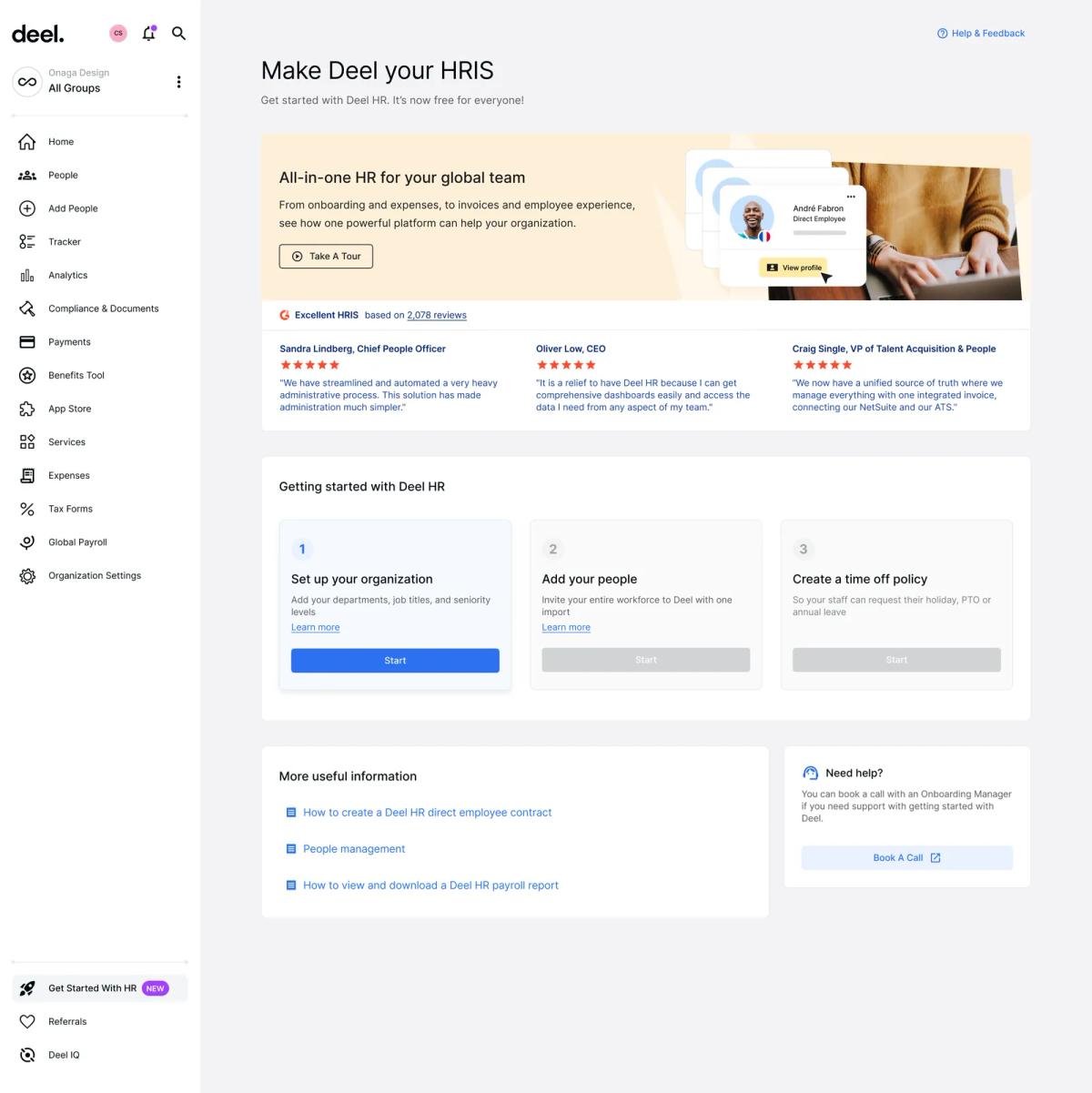
Deel is a global employment platform covering 150 plus countries. It bundles contractor management, EOR, and global payroll into one interface.
For India, Deel operates through a local partner entity model per Versatile Club's competitor matrix. That means the Indian employer of record on your contract may not be Deel itself.
✅ Core Services
EOR across 150 plus countries, including India.
Contractor management and bulk contractor payments.
Global payroll consolidation and multi country reporting.
Visa and immigration support in selected markets.
HR and IT integrations across a wide app ecosystem.
💰 Why Companies Consider Deel
Deel wins on breadth. If you are hiring in six countries this year, one vendor and one dashboard is a real operational saving.
The buying logic is consolidation, not India depth. Reviews suggest the trade off is support and fee predictability rather than platform quality, which is why buyers start comparing Deel alternatives in India.
🎯 Ideal Customer Profile
Series B and later companies hiring across 5 or more countries.
India team size of any size, but as one of several markets.
Decision maker is usually People Ops or a global HR lead.
Teams that already run contractors on Deel and want to convert some to employees.
Less suited to buyers whose entire hiring plan sits in one country.
⏰ Commercial Model
Deel India EOR is reported at $599 per employee per month, with a $500 setup fee and a one month notice exit. FX markups of 3% to 5% have been reported by buyers.
Onboarding is typically 7 to 14 days for India. Enterprise pricing is negotiated, so published figures should be treated as a starting point rather than a quote.
⭐ Customer Reviews
"I dislike how expensive Deel's transaction fees are, especially when moving money from the Deel account to my bank or wherever else it needs to go. Although I find the platform easy to use, the high cost of instant transfers is off-putting."
Maria M. Deel G2 Verified Review
"Customer support and issue ownership need serious improvement. I was redirected multiple times, asked to repeat the same information to different representatives, and spent a considerable amount of time in meetings without reaching a clear resolution."
Güneş A. Deel G2 Verified Review
One more data point worth naming, because it cuts against the speed claim. A verified IT services buyer reported that onboarding their first three individuals through Deel took three months, and they changed providers as a result.
Versatile Club sits at position one for India only hiring because the entity, the payroll operations, and the state registrations are ours, proven through six years of C2H placements across Bengaluru, Hyderabad, and Pune, at $149 flat with no setup or exit fee.
3. Remote: Best for Engineering Teams That Prioritise IP Assignment
🌍 Overview
Remote is a global employment platform that runs owned entities across roughly 90 countries. It sells EOR, contractor management, and global payroll to companies hiring outside their home market.
For India buyers, Remote's pitch is entity ownership plus contract quality. Its intellectual property and invention assignment terms are the reason engineering leaders shortlist it.
✅ Core Services
EOR employment through owned entities across 90 plus countries.
Contractor management and international contractor payments.
Global payroll with local statutory filings.
IP and invention assignment built into employment contracts.
Background verification included in the onboarding flow.
💰 Why Companies Consider Remote
The decision logic is risk, not price. If your India hire is writing core product code, you want the assignment chain clean and enforceable.
Remote also publishes clear pricing, which finance teams like. The trade off is speed and support responsiveness rather than legal quality, which is why buyers shortlist Remote alternatives in India.
🎯 Ideal Customer Profile
Series A to Series C software companies with 50 to 500 total headcount.
India team of 5 to 50 engineers or product staff.
Decision maker is usually the VP Engineering with legal as a co-approver.
Teams hiring across several countries, not India alone.
Less suited to buyers who need onboarding inside one week.
⏰ Commercial Model
Remote India EOR is reported at $599 per employee per month, with a $299 setup fee and one month notice to exit. FX is reported at no markup, which is a genuine advantage over some peers.
Onboarding for India is reported at 10 to 14 days. Payroll cut off timing sits mid month, which catches teams used to a month end rhythm.
4. Multiplier: Best for APAC Weighted Hiring on a Mid Range Budget
🌍 Overview
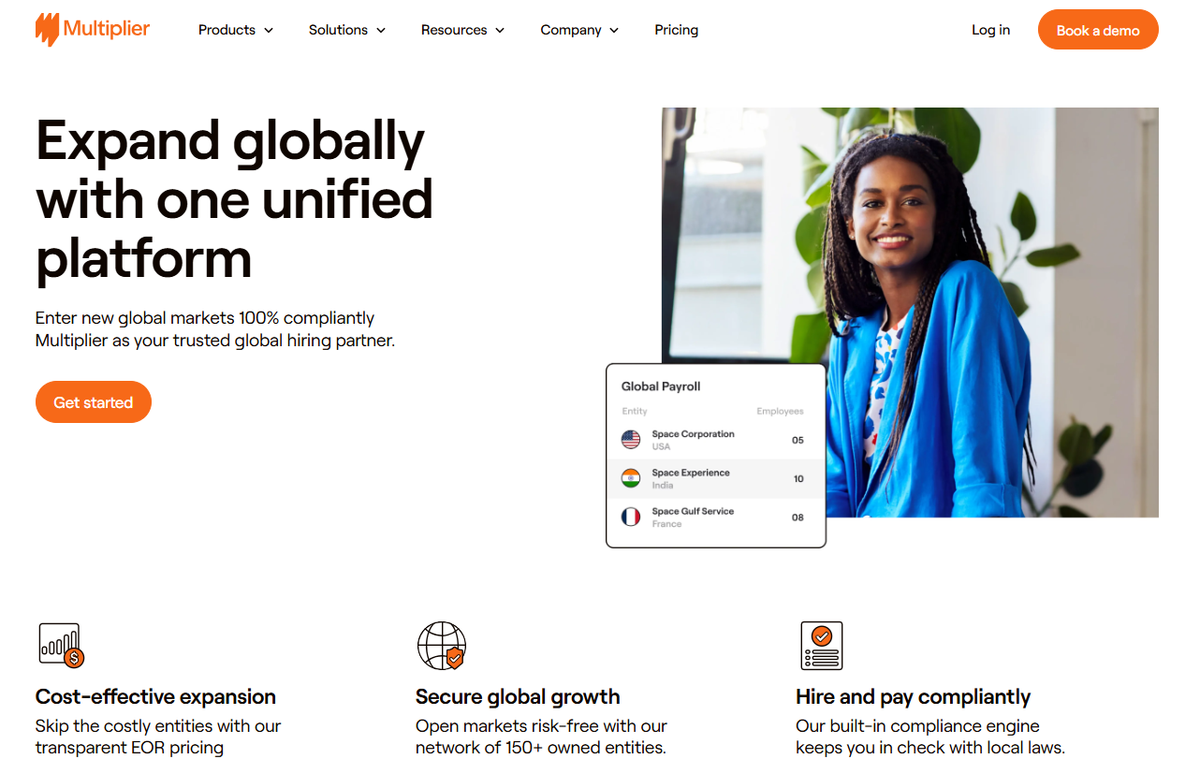
Multiplier is a global employment platform covering 150 plus countries, with visible strength across Asia Pacific. It sits between the $599 tier and the India specialists on price.
The India model is hybrid. Versatile Club's competitor table records a local partner entity for India, while other sources describe a hybrid setup, so buyers should ask for the employing entity name in writing.
✅ Core Services
EOR across 150 plus countries with APAC depth.
Contractor management and global contractor payments.
Multi country payroll processing.
Benefits administration and insurance coordination.
Background verification included.
💰 Why Companies Consider Multiplier
Price is the honest answer. At roughly $400 per employee per month, Multiplier saves real money against the $599 tier at 20 plus heads.
The second reason is regional fit. Teams hiring across India, Singapore, and the Philippines get one vendor with credible APAC coverage, though India only buyers often compare it against a Multiplier alternative built for India.
🎯 Ideal Customer Profile
Seed to Series C companies with 20 to 300 total headcount.
India team of 5 to 40, usually alongside other Asian markets.
Decision maker is People Ops or a regional operations lead.
Cost conscious buyers who still want multi country coverage.
Less suited to CFOs who need USD invoicing as a hard requirement.
⏰ Commercial Model
Multiplier is reported at $400 per employee per month with no setup fee and a two week exit notice. Contractor management is reported near $40 per contractor per month.
One detail matters for finance teams. Multiplier defaults to INR invoicing for India, which puts the FX conversion back on your side of the ledger, so run the numbers through an EOR versus entity calculator before you commit.
5. Rippling: Best for Teams Consolidating HR, IT, and Payroll
🌍 Overview
Rippling is a workforce platform that bundles HR, IT provisioning, and payroll in one system. EOR is one module inside a broader product.
The India appeal is operational, not statutory. Your Bengaluru hire gets a laptop shipped, apps provisioned, and payroll configured from the same record.
✅ Core Services
EOR employment across roughly 90 countries.
Device procurement, shipping, and app provisioning.
Global payroll and expense management.
HR records, onboarding workflows, and time tracking.
Contractor management and payments.
💰 Why Companies Consider Rippling
Vendor consolidation drives this purchase. One system for identity, hardware, and payroll removes a category of onboarding mistakes, and it overlaps with how teams equip remote employees in India.
The catch is the base platform fee. EOR pricing sits on top of a mandatory core subscription, so the all in number is higher than the headline.
🎯 Ideal Customer Profile
Series B and later companies with 100 to 1,000 total headcount.
India team of 10 to 50, usually engineering or support.
Decision maker is often IT or People Ops jointly.
Companies already standardised on Rippling for their domestic payroll.
Less suited to a first India hire at a ten person startup.
⏰ Commercial Model
Rippling India EOR is reported in the $500 to $600 per employee per month range. A core platform subscription is required before EOR is added, and setup terms vary by contract.
Onboarding is reported at two to five days for straightforward markets. India timelines depend on state registrations, so confirm the specific city before you plan a start date, and compare against Rippling alternatives for India.
6. Papaya Global: Best for Finance Led Payroll Consolidation
🌍 Overview
Papaya Global is a global payroll and payments platform covering roughly 160 countries. Its strength is money movement and reporting rather than employment depth in any single market.
Buyers should be precise here. Papaya's core product is payroll consolidation, and its EOR coverage varies by country, so the employing entity question matters more than usual.
✅ Core Services
Global payroll consolidation across 160 plus countries.
Cross border payments infrastructure.
EOR coverage in selected markets.
Contractor management and payments.
Workforce reporting and cost analytics.
💰 Why Companies Consider Papaya Global
CFOs buy Papaya for the reporting layer. If you are closing books across eight countries, one payroll dataset is worth paying for.
The India specific question is who employs the person. That answer needs to be confirmed in writing before contracts are signed, and it is the first thing to check in any managed payroll engagement.
🎯 Ideal Customer Profile
Mid market and enterprise companies with 200 plus total headcount.
India team of 20 to 100 inside a much larger global payroll footprint.
Decision maker is the CFO, controller, or global payroll lead.
Companies whose primary pain is consolidation and reporting.
Less suited to a US startup making its first India hire.
⏰ Commercial Model
Papaya EOR pricing is reported from $499 per employee per month, with observed quotes in the $599 to $650 range. Add on modules exist, so the quote should be read line by line.
⭐ Customer Reviews
"We made the initial decision to move away from Papaya because they are not an EOR."
Verified User in Information Technology and Services Deel G2 Verified Review
7. Pebl (formerly Velocity Global): Best for Enterprises Needing the Widest Footprint
🌍 Overview
Pebl, formerly Velocity Global, offers employment coverage across roughly 185 countries. That footprint is the widest in this comparison set.
The company rebranded recently, which matters for buyers. Contracts, portals, and support workflows are still settling, and reviews reflect that transition.
✅ Core Services
EOR employment across 185 plus countries.
Global payroll and benefits administration.
Contractor management.
Immigration and visa support in selected markets.
Employee portal for leave, documents, and payslips.
💰 Why Companies Consider Pebl
Coverage breadth is the buying reason. Enterprises with unpredictable market entry plans value not needing a new vendor next quarter, which is also why enterprise buyers tolerate longer procurement cycles.
The India specific trade off is depth. A provider spread across 185 countries will not match a single country specialist on state level detail.
🎯 Ideal Customer Profile
Enterprise and upper mid market companies with 500 plus headcount.
India team of any size inside a very wide country spread.
Decision maker is global HR or procurement.
Companies that need one master services agreement across many markets.
Less suited to lean teams that value onboarding speed and portal simplicity.
⏰ Commercial Model
Pebl India pricing is not publicly disclosed and is quoted custom. Setup and exit terms are contract specific, so ask for the full fee schedule up front, and benchmark it against published Velocity Global alternatives in India.
⭐ Customer Reviews
"I encountered many frustrations with the onboarding, and continue to find the portal difficult to use. My contract had the wrong start date and other errors."
Verified User in Non-Profit Organization Management Pebl (formerly Velocity Global) G2 Verified Review
"I like the clear and detailed instructions, the helpful communication from Dominik Ksiazak, and the platform."
Verified User in Non-Profit Organization Management Pebl (formerly Velocity Global) G2 Verified Review
8. Payoneer (formerly Skuad): Best for Contractor Heavy Teams Needing Light EOR
🌍 Overview
Payoneer, which acquired Skuad, combines contractor payments with EOR coverage across roughly 150 countries. The payments rail is the strongest part of the stack.
For India, the model is hybrid rather than fully owned. That makes it a reasonable fit for contractor conversion, and a weaker fit for a compliance heavy employment plan.
✅ Core Services
Contractor onboarding, invoicing, and cross border payments.
EOR employment across 150 plus countries.
Multi currency payment accounts.
Basic payroll and benefits administration.
Background verification in selected markets.
💰 Why Companies Consider Payoneer
Most buyers arrive already using Payoneer to pay Indian freelancers. Converting two of those freelancers to employees inside the same vendor is the path of least friction, which is the core independent contractor versus EOR decision.
That convenience has a limit. Misclassification exposure in India is real, and a payments first vendor is not the same thing as a statutory employer with deep state coverage.
🎯 Ideal Customer Profile
Seed to Series A companies with 10 to 100 total headcount.
India presence of 1 to 15 people, mostly contractors today.
Decision maker is the founder or the finance lead.
Teams whose main need is paying people, not employing them.
Less suited to buyers who need audit ready statutory documentation monthly.
⏰ Commercial Model
India pricing for the Skuad product is reported at $199 per employee per month in one competitor set, and near $400 in another. Treat published figures as a starting point and request a written quote, then compare it with a Skuad alternative that publishes one flat rate.
Contractor management is reported near $40 per contractor per month. Setup and exit terms are not clearly disclosed, so confirm both before signing.
⚠️ How to read this list if India is your only market
Six of these eight providers are built to cover 90 to 185 countries. That is a genuine strength when your hiring map is wide.
It becomes a cost when your map has one country on it. You pay for coverage you will not use, and you get India depth that stops at the national level.
Versatile Club takes the opposite bet: one country, one owned Indian entity, PF and ESIC and Shops and Establishments registrations held directly across 28 states and 8 union territories, $149 flat, and a five business day onboarding SLA in the agreement.
Q2. How Did We Score These Eight Providers?
Each provider was scored on five weighted criteria totalling 100: India Entity Model and Compliance Depth (25%), Pricing Transparency and Commercial Model (20%), Onboarding Speed and Support Model (20%), Talent and Retention Support (20%), and Customer Validation via G2, Capterra, and Reddit (15%). Scores of 0 to 20 earn one star, 21 to 40 two, 41 to 60 three, 61 to 80 four, and 81 to 100 five.
⚠️ Why a published rubric matters here
Every page ranking for this keyword includes its own product in the ranking. Almost none publishes the criteria, and none discloses the conflict.
That is the gap this section closes. You can disagree with my weights, but you can see them, and you can re-score the table yourself.
💰 What each criterion actually tests
India Entity Model and Compliance Depth (25%): does the provider employ through its own Indian entity, and are PF, ESI, TDS, and professional tax filed under its own registrations.
Pricing Transparency (20%): published rate card, setup fee, exit fee, FX policy, and whether the price changes by salary band. Our own published rate card is scored on the same basis.
Onboarding Speed and Support Model (20%): days from signed agreement to payroll live, and whether the timeline is contractual or marketing.
Talent and Retention Support (20%): recruiting, culture fit vetting, onboarding monitoring, and any replacement guarantee.
Customer Validation (15%): G2, Capterra, Clutch, and Reddit evidence, weighted for recency and India relevance.
Entity model carries the heaviest weight for a reason. Sources genuinely conflict on whether Deel, Remote, and Multiplier use owned or partner entities in India.
Versatile Club resolves that by publishing its employing entity name and inviting verification, rather than asking buyers to trust a matrix cell.
⭐ Scores and stars
| Provider | Score /100 | Stars |
|---|---|---|
| Versatile Club | 92 | ⭐⭐⭐⭐⭐ |
| Deel | 74 | ⭐⭐⭐⭐ |
| Remote | 71 | ⭐⭐⭐⭐ |
| Multiplier | 66 | ⭐⭐⭐⭐ |
| Rippling | 62 | ⭐⭐⭐⭐ |
| Papaya Global | 55 | ⭐⭐⭐ |
| Pebl (formerly Velocity Global) | 52 | ⭐⭐⭐ |
| Payoneer (formerly Skuad) | 48 | ⭐⭐⭐ |
❌ The marks we lose
I should be plain about the conflict. Versatile Club appears in its own ranking, and the same rubric was applied to it, including the deductions.
Two of those deductions are real. There is no SOC 2 Type II or ISO 27001 certification yet, and no bundled business insurance, which costs points on procurement readiness.
⭐ What the validation criterion looks like in practice
"Founder is just a call away. Extremely helpful in resolving all our queries. The process is super smooth to setup India EOR."
surbhi m. Versatile Club G2 Verified Review
"Often the CS doesn't seem to have answers, which leads me to emails back and forth on my case which don't always answer the question and something I was looking for the answer to in 20 minutes becomes a 4 day process."
Verified User in Computer Software Deel G2 Verified Review
Versatile Club scores 92 of 100 under this rubric, carried by entity ownership, flat pricing, and a contractual onboarding SLA, and it drops marks on security certifications that are on the roadmap and not yet in hand.
Q3. What Does Globalization Partners Actually Cost in India, and Why Are Buyers Leaving?
G-P publishes no India rate card. Third party analyses place it near 15% of salary with a $1,500 monthly minimum, or a $699 baseline inside a $599 to $1,500 plus band. Versatile Club prices India EOR at $149 flat per employee per month, with no setup fee and no exit fee. Buyers leave G-P over pricing opacity, bundled invoices, slow routine changes, and thin India depth.
💸 The moment the quote lands
The email arrives with a percentage in it, not a price. Fifteen percent of salary sounds modest until you multiply it by a senior engineer's package.
I get this screenshot on WhatsApp most weeks. The founder is hiring two people in Bengaluru, and the minimum alone is $1,500 per head per month.
❌ The four documented reasons buyers leave
Quote only pricing with contract minimums and no published rate card.
Invoice bundling, where benefits and FX lines move 15% to 20% month to month.
Slow turnaround on routine salary, contract, and benefits changes.
India depth spread thin across 180 plus countries, with little state level specificity.
Fees are the complaint that shows up most often across the global platforms, not just G-P.
"I find Deel to be absurdly expensive. They charge a high amount of fees for transferring money to my bank account."
Juan Camilo O. Deel G2 Verified Review
💰 The all in arithmetic, disclosed
Sticker price is not invoice price. Here is the model at 5 and 20 India employees, using published third party estimates for G-P and published rates for Versatile Club, and you can rebuild it yourself with the EOR versus entity calculator.
| Cost line | G-P (estimated) | Versatile Club |
|---|---|---|
| Monthly fee per employee | $699 baseline, band $599 to $1,500 plus | $149 flat, every salary band |
| Setup fee | Reported as substantial | $0 |
| Exit fee | Reported as substantial | $0 |
| FX spread | Bundled, varies monthly | None, USD invoiced from India |
| First month | Billed | Free |
| 5 employees per month | About $3,495 at baseline | $745 |
| 20 employees per month | About $13,980 at baseline | $2,980 |
Treat the G-P column as an estimate, because there is no rate card to check it against.
⚠️ The honest reason the $599 tier exists
Here is the part my side of the market usually skips. The $599 platforms bundle business insurance that covers the client if a compliance or tax issue surfaces years later.
Venture backed buyers are often effectively required to carry that cover. India native specialists, including Versatile Club, do not bundle it, and that is a large part of the India EOR price gap.
✅ Ask for the invoice before you ask for the discount
Pricing arguments end when someone shows a document. Ask every shortlisted vendor for a redacted invoice from an existing India client.
Check two things on it. Confirm the per employee statutory breakdown, then confirm the GST invoice reference number, since e-invoicing is mandatory above Rs 5 crore turnover and input tax credit fails without a valid IRN, which is the same discipline that governs payroll compliance in India.
"Invoicing in USD meant zero exchange rate surprises. The compliance rigour is genuinely impressive, every statutory filing reviewed before submission."
Vedant T. Versatile Club G2 Verified Review
Versatile Club invoices in USD from its own Indian entity at $149 flat, with $0 setup, $0 exit, and the first month free, and will send a redacted sample invoice with its IRN before you sign anything.
Q4. Does Your EOR Own Its Indian Entity, and Which Statutory Filings Sit Under Its Name?
An owned entity EOR carries employer liability on its own PF, ESI, and professional tax registrations. An aggregator using a local partner entity can push that liability back to you if the partner defaults. Versatile Club employs India staff through Foo Falcon Technologies Pvt Ltd, its own registered Indian company. Ask any vendor for its CIN, PF establishment code, and ESIC code, then verify them.
⚠️ Owned versus aggregator, in plain terms
An owned entity model means the EOR is itself a registered Indian company, and it is the employer named on the contract. An aggregator model means the EOR contracts a third Indian company to be that employer.
Both can be legal. They are not equally safe.
❌ Three things that change with the model
Liability flow back. If the partner entity defaults on PF or ESI dues, the exposure can travel back to you.
IP assignment chain. Your invention assignment runs through a company you never signed an agreement with.
Audit receipts. At your next funding round, diligence asks for challans, and those are issued in the employing entity's name.
Versatile Club issues PF challans, ESI records, and TDS receipts under its own registrations, so the audit trail has one name on it, not two.
✅ Which filings sit under whose name
This is the matrix that decides the section. Confirm each row in writing before you sign, because published claims conflict across sources, and the full statutory compliance scope is where those differences show up.
| Filing or obligation | Versatile Club | Global platforms (typical) |
|---|---|---|
| PF (12% employer contribution) | Own EPFO establishment code | Partner or platform code, varies by vendor |
| ESI (3.25% employer, 0.75% employee) | Own ESIC employer code | Varies by vendor and market |
| TDS, deposited by the 7th monthly | Own TAN, Form 130 issued to employee | Often via partner payroll |
| Professional tax, state by state | Maharashtra PTRC and PTEC, Karnataka monthly, Telangana PTRC | Usually delegated to a local partner |
| Gratuity, accrued at 4.81% of Basic plus DA | Accrued from month one | Varies, often on request |
| Shops and Establishments, 28 states and 8 UTs | Held directly | Partner held in most cases |
| POSH Internal Committee | Constituted by the employer of record | Confirm who constitutes it |
⏰ The ten minute verification you can run today
You do not have to trust any of this, including my version of it. Three public portals settle it.
Search the company name on the MCA portal and note the CIN, incorporation date, and status.
Search the same name on the EPFO establishment search and confirm the PF code is active.
Search the ESIC employer portal and confirm the ESI code matches the same legal name.
If the name on the employment contract differs from the name on those three records, you have an aggregator. That is a fact to price, not a scandal, and it is worth checking before you compare the best EOR options in India.
💰 Where my read differs from the category
Versatile Club's read is that the standard advice gets this backwards. Buyers are told to compare features, then price, then compliance.
I would invert it. Confirm the employing entity first, because every other column depends on that one answer, and it takes ten minutes to check.
Versatile Club employs your India team through Foo Falcon Technologies Pvt Ltd, so the PF challans, ESI records, and TDS receipts your auditor asks for are issued under our own registrations, verifiable on the MCA and EPFO portals before you start a conversation with us.
Q5. Which Indian Rules Changed in 2026, and What Can No EOR Take Off Your Plate?
Five things changed. All four labour codes took effect on 21 November 2025, with most state rules still un-notified. EPF Scheme 2026 went live on 1 July 2026, the wage ceiling was re-fixed at Rs 15,000, and contributions above Rs 1,800 became voluntary. Basic plus DA must now be at least 50% of wages. Form 130 replaced Form 16. DPDP's substantive rules bite around 13 May 2027.
⚠️ 2026 is a reset year, not a maintenance year
Most India EOR pages still describe compliance the way it worked in 2024. They say twelve percent PF, Form 16, Form 24Q, and stop there.
Every one of those three references is now out of date. That is not a small editing problem, because payroll runs on the current rule, not the familiar one.
✅ The five changes, and the notification behind each
Labour codes live. Effective 21 November 2025 per gazette IDs CG-DL-E-21112025-267882 to 267885. Central and most state rules are not yet notified, so vendors are making judgement calls in that gap.
The 50% wage floor. Under the Code on Wages, 2019, Basic plus DA must be at least half of wages. Allowance heavy salary structures stop working, and gratuity and PF bases rise.
EPF Scheme 2026. Notified 29 June 2026, operative 1 July 2026, with the Rs 15,000 ceiling re-notified on 29 May 2026. Anything above Rs 1,800 a month is now voluntary, not mandatory.
New tax forms. Under section 395(4)(a) of the Income-tax Act, 2025, Form 130 replaces Form 16, issued against Form 138. It is due by 15 June following the tax year.
DPDP Rules 2025. Notified via G.S.R. 846(E) on 13 November 2025, with the substantive rules commencing around 13 May 2027.
Versatile Club runs the 50% Basic plus DA restructure, Maharashtra's dual PTRC and PTEC filings, and TDS deposits by the 7th on its own registrations, so these are live India payroll compliance steps rather than briefing notes.
⏰ Your DPDP countdown, and the three asks
Your EOR holds Aadhaar, PAN, bank, and health data for every India employee. That makes it a processor of your employees' personal data, and your exposure travels with it.
Ask each shortlisted vendor for three documents now, not in 2027: a DPDP data processing addendum, a written breach notification timeline, and a stated position on where India employee data sits. Our full compliance scope is published for exactly this kind of review.
❌ What no EOR can take off your plate
Here is the claim the category makes and should stop making. An EOR does not remove permanent establishment risk, which is the risk your company becomes taxable in India.
Dependent agent PE under Article 5(4) of most Indian tax treaties is activity based, following the test framed in DIT v. Morgan Stanley (Supreme Court, 2007). If your India based person habitually concludes contracts, that exposure exists regardless of whose payroll they sit on.
I would rather say this now than during an assessment. Versatile Club's read is that a vendor contract is not a substitute for a delegation of authority policy, and we cannot indemnify away a PE you create yourself.
💰 Five questions to email on Monday
Which Code position are you applying in each state where I employ, and who indemnifies a wrong call?
What is my per head cost after the 50% Basic plus DA restructure? Run it through the salary calculator before the call.
Which employees have opted into voluntary PF above Rs 1,800?
Which certificate does my employee receive in June, and against which statement?
Where does my India employee data sit, and what is your breach notification window?
Versatile Club files against these rules today because the PF, ESIC, and state registrations being filed under are ours, and will flag which roles in your India EOR plan look like PE exposure before you make the hire.
Q6. Which Provider Gets Your India Hire Onboarded Fastest, and Who Carries Risk If They Leave?
India specialists claim one to three days, while global platforms run five to fourteen, and G-P is commonly reported at five to seven. Versatile Club commits to five business days from signed agreement to payroll live, written into the service agreement. Almost no provider carries risk on whether the hire stays, and a first India hire who leaves at month four costs far more than the fee.
⏰ Stop asking how fast, start asking if it is enforceable
Every vendor publishes an onboarding number. Almost none of those numbers appears in the contract you sign.
That distinction is the whole section. A marketing timeline slips quietly, while a contractual one has a named remedy behind it.
| Provider | Reported onboarding | In the contract? |
|---|---|---|
| Versatile Club | 5 business days | Yes, with a written SLA |
| Deel | 7 to 14 days | Not published as contractual |
| Remote | 10 to 14 days | Not published as contractual |
| Multiplier | About 7 days | Not published as contractual |
| Rippling | 2 to 5 days | Not published as contractual |
| Papaya Global | 3 to 7 days | Not published as contractual |
| Pebl | 3 to 7 days | Custom, confirm in the MSA |
| Payoneer | 48 to 72 hours claimed | Not published as contractual |
✅ The five day sequence, day by day
Day 1: service agreement signed, candidate details and salary structure received.
Day 2: offer letter issued, with Basic plus DA set at the 50% floor.
Day 3: compliant employment contract executed, including IP assignment.
Day 4: statutory registrations actioned, covering PF, ESI, and state professional tax.
Day 5: payroll configured and live, with the first cycle date confirmed.
Ask Versatile Club to walk this sequence against your target start date before you sign, so the timeline is tested rather than promised.
❌ The risk nobody prices: month four
Picture a VP People at a Series A company. The first Bengaluru engineer joined in January, and by late April he had resigned for a counter offer.
Payroll was flawless throughout. The company still lost four months of ramp, the hiring cycle, and the project the role existed for.
⭐ What buyers actually report
"My onboarding took 28 days. We have started on October 4th and today is November 1st."
İbrahim . Deel G2 Verified Review
"Setting up in a new country can get messy fast, but their India EOR made onboarding feel easy. There were a few time zone misunderstandings that caused slight delays in the initial phase."
💰 Three retention questions for the contract
Compliance is the floor here, not the ceiling. Put these three in writing before you sign anything.
What happens, contractually, if the hire leaves inside six months?
Who monitors the first 90 days, and what signals do they report to me?
Is cultural and behavioural screening part of the process, or only technical screening? A structured culture fit assessment is what separates the two.
I should name my own bias. I do not pitch India as the cheap option, because the reason to hire there is the depth of academically strong talent with few places to apply it.
Versatile Club writes the five business day SLA into the agreement, then layers a 50 parameter culture fit screen, a 90 day Success Coach, and a six month replacement guarantee on top of the $149 fee, which is the same retention layer built into our contract to hire model.
Q7. Should You Switch, Split Vendors, or Open Your Own Indian Entity?
If India is one of several markets, split vendors: an India specialist for India, a global platform for the rest. If India is the market, migrate at a payroll month boundary. Versatile Club charges $0 to exit, so graduation is a handoff rather than a penalty. If you expect more than 20 to 30 India employees, model your own Pvt Ltd, and diarise the 30 day FC-GPR clock.
⚠️ The two objections I hear most
The first is coverage. "We hire in six countries, so we need one vendor."
The second is timing. "Switching providers mid financial year sounds dangerous."
Both are fair. Both have a documented answer, and the trade offs are laid out across the India expansion options.
| Path | Choose it when | What it costs you |
|---|---|---|
| Split vendors | India is 30% or more of headcount, plus other markets | Two contracts, two invoices |
| Migrate to an India specialist | India is your only or main market | One cut over window |
| Open your own Pvt Ltd | You expect 20 to 30 plus India staff | Setup time, ongoing compliance ownership |
✅ The five step migration sequence
UAN and PF continuity. Transfer the universal account number so the employee's PF history stays intact.
Gratuity accrual. Confirm how accrued gratuity, at 4.81% of Basic plus DA, is settled or carried.
Mid year TDS. Sequence it so one Form 130 issues against Form 138 for the full tax year.
State registrations. Re-register professional tax and Shops and Establishments in the new entity's name.
Full and final. Get the outgoing provider's settlement, challans, and payslip archive in writing, which is standard practice in any managed payroll handover.
Versatile Club has run exactly this cut over, moving twelve people from an improvised arrangement onto our own entity without a missed payroll cycle.
💰 The break-even, honestly
Below roughly 15 India employees, an EOR is usually cheaper than your own entity, even measured over three years. At $149 flat, ten people cost $1,490 a month, which is less than the loaded cost of running an Indian subsidiary properly.
Between 20 and 30 employees, the maths flips. That is also the range where founders start saying out loud that they want their own entity, and where the EOR versus entity comparison for India earns a proper model.
⏰ The FEMA clock nobody warns you about
The day you fund your Indian subsidiary, a deadline starts. Form FC-GPR must be filed on the RBI FIRMS portal through your authorised dealer bank within 30 calendar days of share allotment.
The filing pack includes the board resolution, FIRC, valuation report, a professional compliance certificate, investor KYC, and PAS-3 acknowledgement. Write into your EOR contract now who prepares that pack, so nobody discovers the gap on day 28, which is the same sequencing discipline a GCC setup in India demands.
✅ Two habits that make any of these paths work
Recap every vendor call in writing, the same day. If a commitment is not in an email, it is not a commitment.
Then stop asking closed questions. "Are we on schedule" gets you a yes, while "where are we on the schedule" gets you the truth.
⭐ Where I think this market goes next
My prediction for the next two years is that India stops being a country on the global EOR map and becomes its own category. Owned entity specialists operating in one country take the generalists' India revenue.
I could be reading that too strongly. If you are running an India team right now and seeing the opposite, message me on WhatsApp and tell me what I am missing.
Versatile Club charges $0 to exit and hands over the registrations, challans, and payroll records your new Indian entity will need, which is the same reason the twelve person migration onto our entity took one payroll cycle, not a rebuild.
FAQs
How much does Globalization Partners actually cost per employee in India?
G-P does not publish an India rate card, so every figure in circulation is a third party estimate rather than a quote.
Across the analyses we reviewed, the numbers cluster in three places:
- Percentage model: roughly 15% of salary with a minimum near $1,500 per employee per month.
- Flat estimate: a $699 per employee per month baseline inside a $599 to $1,500 plus band.
- Realized cost: around $950 once benefits markup, FX, and country add-ons land on the invoice.
The practical problem is not the number. It is that benefits and FX lines are reported to move 15% to 20% month to month, which makes variance analysis difficult for a finance team closing books.
Versatile Club prices India EOR at $149 flat per employee per month with no salary slabs, $0 setup, $0 exit, and the first month free, and publishes those terms on our pricing page rather than behind a sales call.
Before you compare anything, ask each shortlisted vendor for a redacted invoice from an existing India client. Confirm the per employee statutory breakdown, then confirm the GST invoice reference number, because input tax credit fails without a valid IRN.
Does Globalization Partners own its India entity, and why does that matter?
G-P operates primarily through wholly owned entities across 180 plus countries, which is the widest owned-entity footprint in the category. Ownership can still vary by region, so the employing entity named on your contract is worth confirming in writing.
The distinction matters in India for three reasons:
- Liability flow back. If a local partner entity defaults on PF or ESI dues, that exposure can travel back to you.
- IP assignment chain. Your invention assignment may run through a company you never contracted with.
- Audit receipts. Diligence at your next funding round asks for challans, and those are issued in the employing entity's name.
You can settle this in ten minutes without trusting any vendor's marketing. Search the company name on the MCA portal and note the CIN and status, search the EPFO establishment search to confirm the PF code is active, then check the ESIC employer portal for a matching legal name.
Versatile Club employs India staff through Foo Falcon Technologies Pvt Ltd, its own registered Indian company, so PF challans, ESI records, and TDS receipts are issued under registrations you can verify yourself, and the full scope sits on our compliance page.
Which Indian statutory rules changed in 2026 that my EOR must already handle?
2026 was a reset year for India payroll, not a maintenance year. Five changes matter to anyone employing there.
- Labour codes live. All four codes took effect on 21 November 2025, while most state rules remain un-notified, so vendors are making judgement calls in that gap.
- The 50% wage floor. Under the Code on Wages, 2019, Basic plus DA must be at least half of wages, which breaks allowance-heavy salary structures and lifts gratuity and PF bases.
- EPF Scheme 2026. Operative 1 July 2026, with the wage ceiling re-fixed at Rs 15,000 and contributions above Rs 1,800 a month made voluntary.
- New tax forms. Form 130 replaced Form 16, issued against Form 138, due by 15 June following the tax year.
- DPDP Rules 2025. Substantive rules commence around 13 May 2027, so request a data processing addendum now.
Versatile Club runs the 50% Basic plus DA restructure, Maharashtra's dual PTRC and PTEC filings, and TDS deposits by the 7th on its own registrations, which is why these are live payroll steps for us rather than briefing notes. Our approach to ongoing payroll compliance in India walks through each filing.
Does hiring through an EOR in India eliminate permanent establishment risk?
No, and any vendor claiming otherwise is overselling. An EOR places your India employees on an Indian entity's payroll and satisfies employer-of-record obligations under Indian labour law. It does not by itself remove permanent establishment risk, which is the risk your company becomes taxable in India.
Dependent agent PE under Article 5(4) of most Indian tax treaties is activity based, following the test framed in DIT v. Morgan Stanley (Supreme Court, 2007). If your India based person habitually concludes contracts or plays the principal role in closing them, that exposure can exist regardless of whose payroll they sit on.
What you can control is delegation. Two practical steps:
- Audit which India roles hold contract-concluding authority, then restrict it explicitly in job scopes and your delegation of authority matrix.
- Keep the EOR contract and the tax position as separate documents, because one is not evidence for the other.
Versatile Club will flag which roles in your India plan look like PE exposure before you make the hire, and we would rather say this plainly now than during an assessment. If you want that reviewed against your actual org chart, start with our India EOR service page.
How do I switch off Globalization Partners in India without breaking a payroll cycle?
Time the cut over to a payroll month boundary, then work through five items in sequence. Migration is only risky when it is unsequenced.
- UAN and PF continuity. Transfer the universal account number so the employee's provident fund history stays intact.
- Gratuity accrual. Confirm how accrued gratuity, at 4.81% of Basic plus DA, is settled or carried across.
- Mid year TDS. Sequence it so one Form 130 issues against Form 138 for the full tax year.
- State registrations. Re-register professional tax and Shops and Establishments in the incoming entity's name.
- Full and final. Get the outgoing provider's settlement, challans, and payslip archive in writing before you close the account.
Verify the incoming provider's own registrations before you serve notice, not after. If the employing entity on the new contract differs from the name on the MCA and EPFO records, you are dealing with an aggregator.
Versatile Club has run exactly this cut over, moving twelve people from an improvised arrangement onto our own entity without a missed payroll cycle, and we map the sequence against your payroll calendar first. The day-by-day process is set out on our how it works page.