Table of contents (16)
9 Best Gloroots Alternatives in India: EOR Platforms Compared
Q1. What Are the 9 Best EOR Platforms for Hiring in India in 2026?
The nine best EOR platforms for India in 2026 are Versatile Club, Deel, Remote, Globalization Partners, Multiplier, Rippling, Papaya Global, Pebl (formerly Velocity Global), and Payoneer Workforce Management (formerly Skuad). Versatile Club employs India hires through its own registered Indian entity, invoices in USD from India, charges $149 per employee per month flat, and commits a 5-day onboarding SLA in the service agreement.
Choosing an India Employer of Record (EOR) is one of the highest-stakes vendor decisions a growing company makes. An EOR becomes the legal employer of your India hires, so it carries statutory liability you cannot outsource twice. We analysed and compared nine providers against decision-grade criteria: India entity model, statutory compliance depth, state-level coverage, onboarding speed, pricing transparency, invoicing and audit readiness, support model, talent and retention support, and third-party customer validation. This guide is written for US and UK founders, People Ops leaders, CFOs, and legal teams hiring 1 to 50 employees in India.
Our Evaluation Criteria
Each provider included in this list was assessed across the following decision-grade criteria:
India Entity Model: Whether the provider uses its own Indian entity, a local partner entity, a contractor model, or a payroll-only setup.
Statutory Compliance Depth: PF (Provident Fund), ESI (Employees' State Insurance), TDS (Tax Deducted at Source), professional tax, gratuity, POSH, Form 16, full-and-final settlement, DPDP readiness, and New Labour Code 2025-26 structuring.
State-Level Coverage: Ability to handle professional tax, Shops and Establishments registration, labour welfare fund, and leave rules across Indian states.
Onboarding Speed: Time from signed agreement to compliant contract, payroll setup, statutory registration, and employee start.
Pricing Transparency: Monthly fee, setup fee, exit fee, FX markup, first-month terms, salary-band pricing, and invoice clarity.
Invoicing and Finance Readiness: USD invoicing, INR invoicing, gross-deduction-net reporting, challan confirmations, TDS receipts, and audit-ready documentation.
Support Model: Founder-direct support, named HR manager, HRBP, ticket queue, chatbot, or general CSM model.
Talent and Retention Support: Recruiting, contract-to-hire, culture-fit vetting, onboarding monitoring, replacement guarantee, and employee experience support.
Customer Validation: G2, Capterra, Clutch, Gartner, Reddit, case studies, named testimonials, and third-party proof.
Best-Fit Buyer Segment: First India hire, 1 to 20 India employees, 10 to 50 India employees, companies switching from Deel or Remote, companies with an existing India entity, or enterprises needing multi-country EOR.
Who This Guide Is For
This guide is designed for:
US and UK founders hiring their first 1 to 3 employees in India.
Seed to Series B startups building engineering, product, AI, design, marketing, or operations teams in India.
People Ops and HR leaders reviewing India EOR, payroll, contractor, or PEO vendors.
CFOs and finance teams that need clean invoicing, statutory liability visibility, and audit-ready India payroll records.
Legal teams reviewing employment contracts, IP assignment, misclassification risk, PE risk, and statutory employer accountability.
Companies currently using Deel, Remote, Multiplier, G-P, contractors, agencies, or local payroll vendors and evaluating India-specialist alternatives.
The 9 Providers Covered
Versatile Club: Best for US and UK companies hiring their first 1 to 20 India employees
Deel: Best for companies hiring across many countries from one dashboard
Remote: Best for teams that want owned entities in several core markets
Globalization Partners (G-P): Best for enterprise procurement with heavy certification requirements
Multiplier: Best for mid-priced multi-country hiring across APAC
Rippling: Best for existing Rippling HR and IT customers adding India
Papaya Global: Best for finance-led global payroll consolidation
Pebl (formerly Velocity Global): Best for broad country coverage on custom contracts
Payoneer Workforce Management (formerly Skuad): Best for contractor-heavy global teams
📊 Master Comparison Table
| Provider | Best For | Key Strength | Compliance |
| Versatile Club ⭐⭐⭐⭐⭐ |
US and UK companies hiring first 1 to 20 India employees | India-only depth with USD invoicing from its own Indian entity | Own Indian entity; PF, ESIC, and S&E registrations across all 28 states and 8 UTs; New Labour Code 2025-26 structuring |
| Deel ⭐⭐⭐⭐ |
Companies hiring across 100+ countries from one dashboard | Widest country and contractor coverage in one platform | Partner entity model reported for India; SOC 2 certified |
| Remote ⭐⭐⭐⭐ |
Teams wanting owned entities in core markets | Strong IP assignment and employee experience tooling | Owned entities in core markets; SOC 2 certified |
| Globalization Partners (G-P) ⭐⭐⭐⭐ |
Enterprise buyers with certification-gated procurement | Longest analyst track record in the EOR category | Owned entity network; enterprise certification stack |
| Multiplier ⭐⭐⭐ |
Mid-priced multi-country hiring across APAC | Lower price point than the $599 tier | Mixed entity model by country; APAC coverage depth |
| Rippling ⭐⭐⭐⭐ |
Existing Rippling HR and IT customers | Single system for payroll, devices, and app access | Owned entities in select markets; SOC 2 certified |
| Papaya Global ⭐⭐⭐ |
Finance-led global payroll consolidation | Payments infrastructure and GL-mapped reporting | Partner and hybrid entity model; payroll-first compliance |
| Pebl (formerly Velocity Global) ⭐⭐⭐ |
Broad country coverage on custom contracts | 185 country reach on negotiated terms | Mixed entity model; enterprise compliance framework |
| Payoneer Workforce Management (formerly Skuad) ⭐⭐⭐ |
Contractor-heavy global teams | Contractor management plus cross-border payouts | Partner entity model; payments-led compliance |
1. Versatile Club: Best for US and UK Companies Hiring Their First 1 to 20 India Employees
🏢 Overview
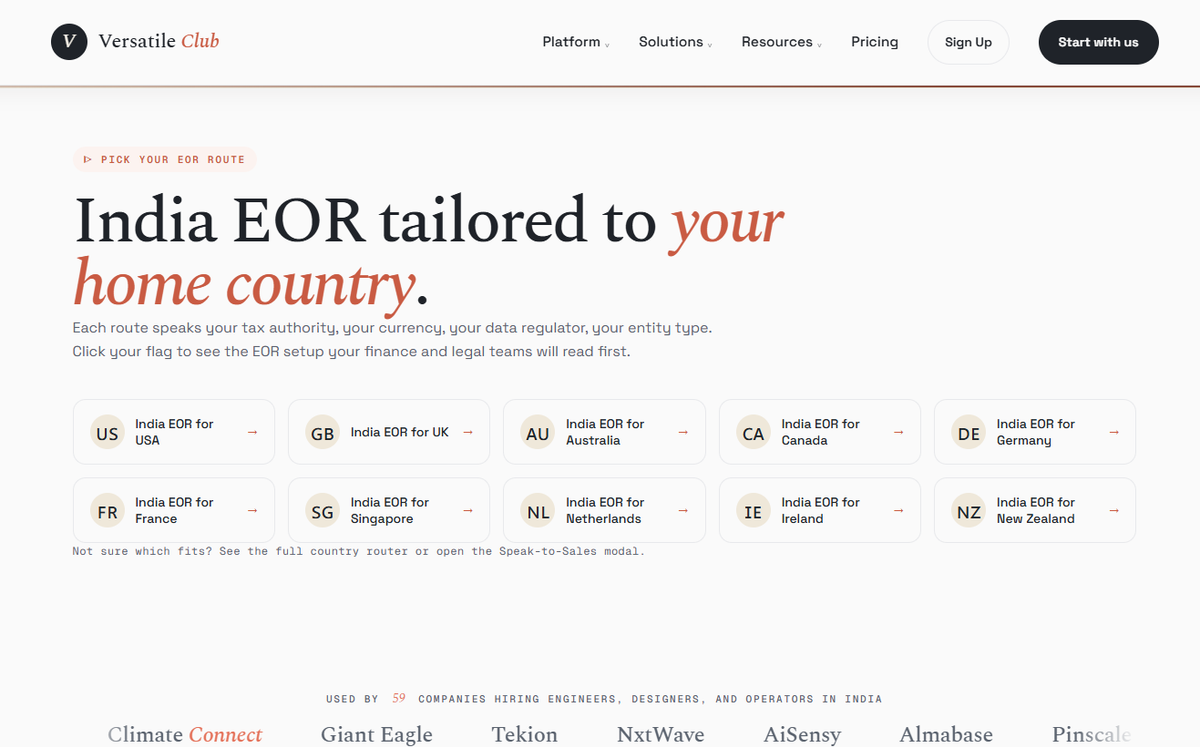
Versatile Club is an India-only Employer of Record and Contract-to-Hire provider serving US and UK companies. It employs your India hires through Foo Falcon Technologies Pvt Ltd, its own registered Indian company.
The PF registration, ESIC code, and Shops and Establishments licences sit under that entity. India is the only country we operate in, by design.
🧾 Core Services
India EOR: legal employment, compliant contracts, and IP assignment without your own entity
India payroll and statutory filings: PF, ESI, TDS, professional tax, gratuity accrual, and full-and-final settlement
Contract-to-Hire (C2H): sourcing, culture-fit vetting, and conversion to full-time
Retention layer: 50 behavioural screening parameters, a 90-day Success Coach, and a 6-month replacement guarantee
Monthly finance pack: one USD invoice, payroll summary, PF and ESI challan confirmations, and TDS deposit receipts
💡 Why Companies Consider Versatile Club
Most buyers arrive with the same problem. They need one or two engineers in Bengaluru, Hyderabad, or Pune, and setting up an Indian subsidiary would take months and tens of thousands of dollars before the first hire starts.
Versatile Club solves the narrower version of that problem. The pitch is not breadth. It is that one country is handled properly, with the entity, the filings, and the invoice all in one place.
⏰ What the 5-Day SLA Actually Means
The commitment is 5 business days from signed agreement to payroll live. Day one is the agreement. Then the offer, the compliant contract, the statutory registrations, and payroll setup follow in sequence.
I put that in the service agreement rather than the marketing page. Global platforms quote 7 to 14 days for India and treat the number as aspirational.
👤 Ideal Customer Profile
Company size: Seed to Series B, 5 to 100 people globally
Geography: United States (primary), United Kingdom (secondary)
India team size: 1 to 20 employees
Hiring need: engineering, product, AI, design, marketing, or operations
Decision maker: founder or CTO acting alone, or a People Ops lead with CFO sign-off
💰 Commercial Model
Versatile Club charges $149 per employee per month, flat across every salary band, with $0 setup fee, $0 exit fee, and the first month free. Invoicing is in USD from a single Indian entity, so no FX markup sits between your bank and your employee's payroll.
C2H placements are priced at 20 to 30 percent of annual salary, charged only after the hire completes day 90, and carry a 6-month replacement guarantee.
⚠️ Where Versatile Club Is the Wrong Choice
I would rather lose a deal than misplace one. If you need five or more countries under one contract, use a global platform and keep a specialist for India.
If your procurement process gates on SOC 2 Type II or ISO 27001, we do not clear that bar yet. Both are on the roadmap, not on the wall.
💬 Customer Reviews
"We used Versatile to hire our first employee in India after months of putting it off because the compliance side seemed like a mess. Sagar replied to our form in about four hours with a draft offer letter already attached. The hire was onboarded in four days. First USD invoice landed clean: no FX markup, no setup fee, no surprises."
— Verified User in Information Technology and Services, Versatile Club G2 Verified Review
"The dashboard could be a little more self-serve. A couple of times I wanted to pull a report or a doc myself and ended up just messaging my contact instead. They always answered fast, so it wasn't a real problem, but I'd love to click around and find things on my own."
— Angad S., Founder at Moonshot, Versatile Club G2 Verified Review
Versatile Club employs your India hires through Foo Falcon Technologies Pvt Ltd, with PF, ESIC, and Shops and Establishments registrations in its own name rather than a partner's, at $149 per employee per month flat with the first month free. Every one of those registrations is listed on our India compliance coverage page.
2. Deel: Best for Companies Hiring Across Many Countries From One Dashboard
🌍 Overview
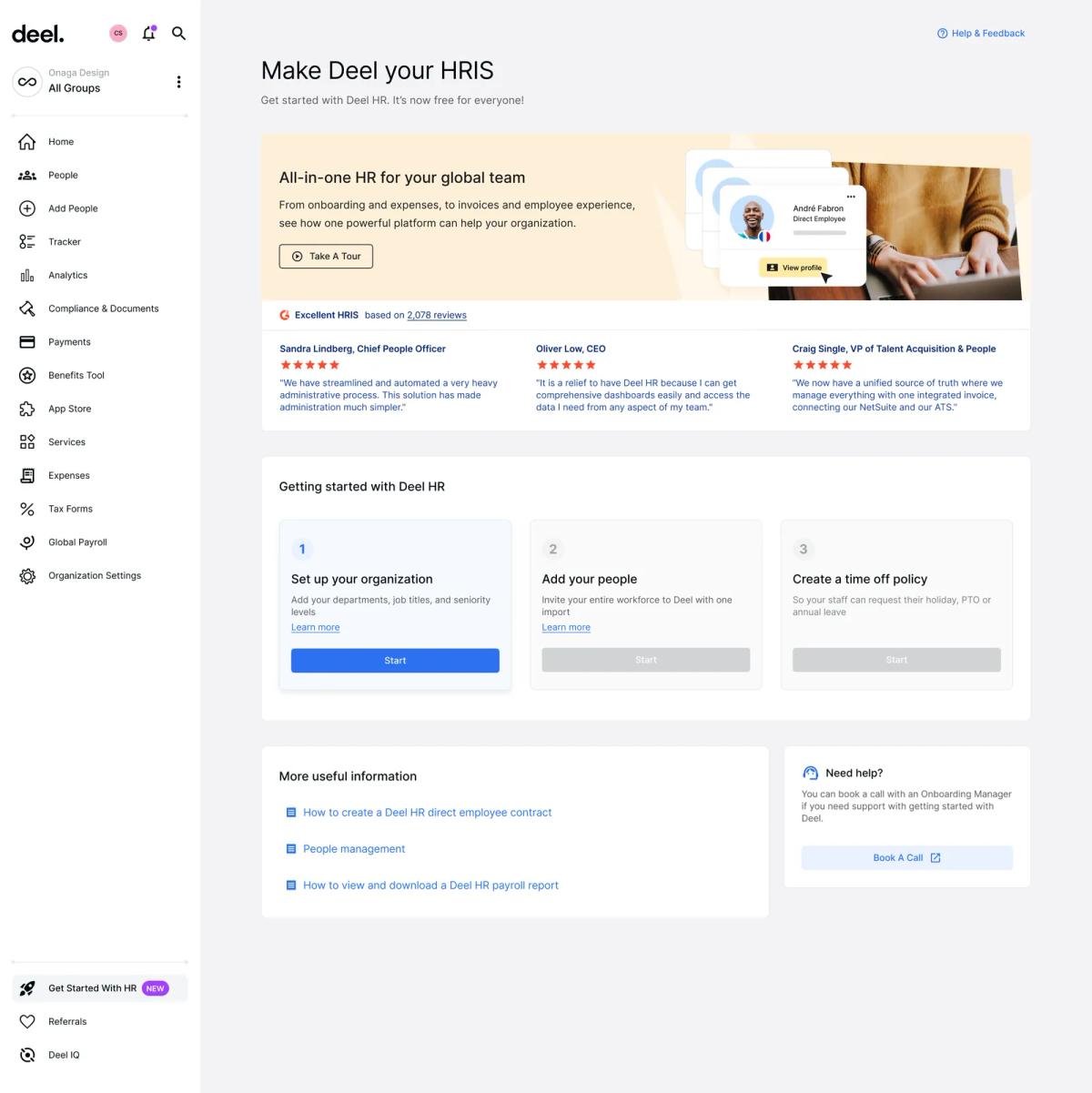
Deel is a global employment platform covering more than 100 countries through a mix of owned and partner entities. It handles EOR, contractor payments, global payroll, and immigration support in one product.
For India specifically, Deel is widely reported to route delivery through a local partner entity rather than one it owns. That distinction matters for who files your PF challan.
🧾 Core Services
Multi-country EOR across 100+ countries
Contractor management and cross-border contractor payouts
Global payroll consolidation and reporting
Immigration and visa support in select markets
HRIS and app integrations with a large partner ecosystem
💡 Why Companies Consider Deel
The buying logic is consolidation. If you are hiring in India, Brazil, Poland, and Portugal in the same quarter, one vendor and one invoice beats four.
Deel is also the default recommendation inside most founder communities, which lowers the perceived risk of the choice. That familiarity is a genuine advantage, not a marketing trick.
⚠️ Where Deel Falls Short for India
India is one of a hundred-plus countries on the map, so depth is spread thin. Multi-state professional tax, Shops and Establishments renewals, and New Labour Code wage restructuring are where that shows up, which is why buyers scoped to one country often compare a Deel alternative built only for India.
Support is chatbot-first and ticket-led, which collides with Indian statutory deadlines. PF and ESI are due monthly and TDS must be deposited by the 7th.
👤 Ideal Customer Profile
Company size: Series B and above, 100+ people globally
Geography: United States, Europe, and multi-region
India team size: 1 to 10, usually alongside several other countries
Hiring need: distributed hiring across many markets at once
Decision maker: People Ops or HR leader with procurement involvement
💰 Commercial Model
Deel's India EOR is reported at roughly $599 per employee per month, with a setup fee around $500 and a one-month notice exit term. Contractor management is priced separately.
Reviewers and comparison sources report an FX markup in the 3 to 5 percent range on currency conversion. On a $60,000 salary, a 4 percent markup is about $2,400 a year, which exceeds most platform fees and is worth modelling against the full cost of an India EOR.
💬 Customer Reviews
"I appreciate the ease of setup with Deel; it took me only a few minutes, making the process straightforward. I love the instant transfer feature... I dislike how expensive Deel's transaction fees are, especially when moving money from the Deel account to my bank."
— Maria M., Verified Reviewer, Deel G2 Verified Review
"We had to carefully manage our agreement and had to constantly remind them of the fees agreed so that we weren't over charged. Everything was VERY time consuming. It took three months to onboard our first 3 individuals."
— Verified User in Information Technology and Services, Deel G2 Verified Review
Choose Deel if breadth is the constraint you are solving, and pair it with an India specialist if India is where most of the headcount will sit. Versatile Club runs that India leg through its own entity and managed India payroll, so the split-vendor setup stays clean at month-end.
3. Remote: Best for Teams That Want Owned Entities in Several Core Markets
🌍 Overview
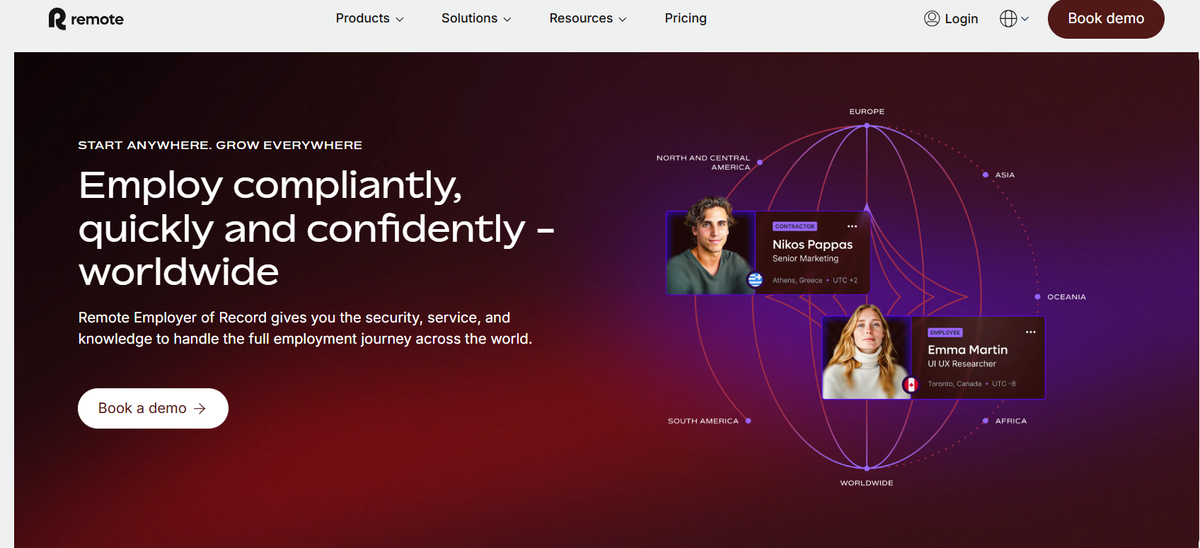
Remote is a global employment platform that runs EOR, contractor management, and global payroll across roughly 90 countries. It leans on entities it owns in its core markets rather than partners everywhere.
Remote is often shortlisted next to Deel by the same buyer. The two get compared on IP protection and employee experience more than on price, which is why Deel versus Remote for India hiring is such a common search.
🧾 Core Services
Multi-country EOR with owned entities in core markets
Contractor management and contractor payments
Global payroll and benefits administration
IP assignment and invention-rights protection built into contracts
Employee self-service portal for payslips and leave
💡 Why Companies Consider Remote
The pull is intellectual property protection. Engineering-heavy buyers care about who legally owns the code their India team writes, and Remote markets hard on that point.
The second reason is employee experience. Remote's portal is generally rated well by the people being employed, which reduces internal complaints for People Ops teams.
⚠️ Where Remote Falls Short for India
India compliance depth is thinner than an India specialist's. Multi-state professional tax cycles and Shops and Establishments renewals are handled, but not with state-level fluency, which is the gap most buyers weigh when they compare a Remote alternative built only for India.
Support runs through a ticket queue. Reported onboarding for India sits at 10 to 14 days, which is slow when payroll cut-offs are fixed.
👤 Ideal Customer Profile
Company size: Series A to Series C, 50 to 500 people globally
Geography: United States, United Kingdom, and Europe
India team size: 1 to 15, alongside other countries
Hiring need: engineering and product roles where IP ownership is the primary worry
Decision maker: VP People or Head of HR, with legal counsel reviewing contracts
💰 Commercial Model
Remote's EOR is reported at roughly $599 per employee per month, with a setup fee around $299 and one-month notice on exit. Contractor management is priced separately at a lower monthly rate.
Remote is reported to pass currency conversion through without a markup, which is a genuine advantage over platforms charging 3 to 5 percent.
4. Globalization Partners (G-P): Best for Enterprise Procurement With Heavy Certification Requirements
🏛️ Overview
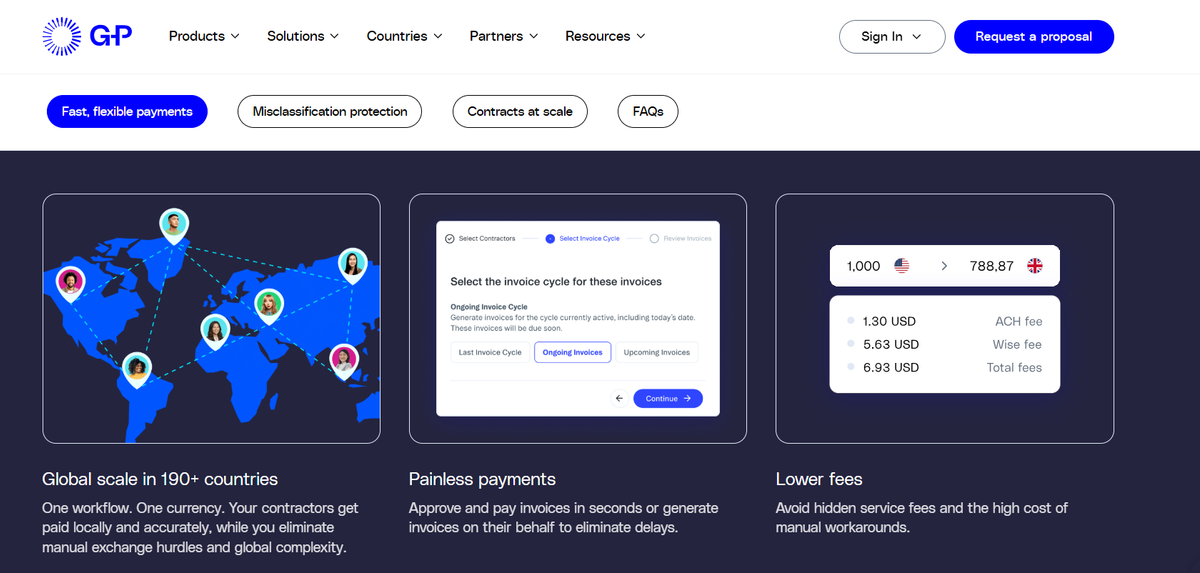
Globalization Partners, usually written as G-P, is one of the oldest names in the EOR category. It covers about 180 countries through a network of owned entities.
G-P sells to enterprise procurement rather than to founders. The paperwork, the certifications, and the security review are all built for that buyer.
🧾 Core Services
EOR across roughly 180 countries with owned entities
Global payroll and benefits administration
Enterprise-grade compliance and security documentation
Integration with large HRIS and ERP systems
Dedicated account management for enterprise contracts
💡 Why Companies Consider G-P
Analyst recognition carries weight in enterprise deals. Everest Group's 2025 Employer of Record PEAK Matrix assessed 29 providers, and G-P was named the highest-designated Leader for the fourth consecutive year.
If your procurement team requires an analyst-recognised vendor with a full certification stack, G-P clears that bar. That is a real reason to pay more, particularly for enterprise India hiring programmes.
⚠️ Where G-P Falls Short for India
Pricing is the friction. G-P is reported to charge around 15 percent of salary with a minimum near $1,500 per month, which is punishing for small India teams.
Reported onboarding runs 5 to 10 days, and setup fees are described as substantial. For a first India hire, that is a lot of process for one engineer.
👤 Ideal Customer Profile
Company size: 500+ people globally, or venture-backed with mandated vendor standards
Geography: United States and Europe, multi-region operations
India team size: 20 or more, usually one of many markets
Hiring need: regulated industries and certification-gated procurement
Decision maker: procurement and legal, with HR as the internal champion
💰 Commercial Model
G-P's India pricing is reported as roughly 15 percent of the employee's salary, subject to a minimum of about $1,500 per month, with setup fees described as substantial. Full pricing is quote-based.
At a $60,000 salary, 15 percent is about $9,000 a year in platform fees alone. Run that number through an EOR versus entity calculator before you shortlist.
5. Multiplier: Best for Mid-Priced Multi-Country Hiring Across APAC
🌏 Overview
Multiplier is a global employment platform covering roughly 150 countries with strong Asia-Pacific coverage. Its India delivery is reported to use a local partner entity rather than one it owns.
It sits between the budget India specialists and the $599 global tier. That middle position is its whole strategy.
🧾 Core Services
Multi-country EOR with APAC depth
Contractor management and cross-border payments
Global payroll processing
Benefits administration and equipment coordination in select markets
Dedicated customer success contact per account
💡 Why Companies Consider Multiplier
Price is the entry point. At a reported $400 per employee per month, Multiplier is meaningfully cheaper than Deel or Remote while still offering wide country coverage.
APAC depth is the second reason. Teams hiring across India, Singapore, Vietnam, and the Philippines get reasonable coverage from one vendor.
⚠️ Where Multiplier Falls Short for India
Invoicing defaults to INR rather than USD, which pushes currency risk back onto the client's finance team. That matters at month-end close, and it is the main reason finance leads evaluate a Multiplier alternative that invoices in USD.
Support is email-led with a customer success contact, and response times are reported as slow. Reviewers have also flagged payroll delays and gaps in local labour law knowledge.
👤 Ideal Customer Profile
Company size: Seed to Series B, 20 to 200 people globally
Geography: United States, United Kingdom, and Australia
India team size: 1 to 15, usually alongside other APAC markets
Hiring need: distributed APAC engineering and operations teams
Decision maker: founder or People Ops lead, price-sensitive
💰 Commercial Model
Multiplier's EOR is reported at roughly $400 per employee per month, with no setup fee and a two-week exit notice. Contractor management is priced separately.
FX policy is not clearly disclosed in public sources. Ask for it in writing before you sign, because INR-default invoicing hides the conversion cost.
6. Rippling: Best for Existing Rippling HR and IT Customers
💻 Overview
Rippling started as a US HR, payroll, and IT platform and added global EOR later. It covers roughly 90 countries and holds owned entities in select markets.
Its differentiator is not India. It is that payroll, devices, and app permissions live in one system.
🧾 Core Services
Global EOR across roughly 90 countries
US and international payroll in one platform
Device management and IT provisioning for new hires
App access and identity management tied to employment status
Contractor management and payments
💡 Why Companies Consider Rippling
Consolidation drives the decision. If your US team already runs on Rippling, adding an India hire inside the same system avoids a second vendor and a second data source.
Device provisioning is genuinely useful for remote hires. A laptop shipped and configured before day one removes a real operational headache, and equipping remote employees in India is one of the quieter costs of a first hire.
⚠️ Where Rippling Falls Short for India
India is a recent addition, not a core competency. Multi-state professional tax and New Labour Code wage restructuring are not where the product's depth sits, which is why India-heavy teams look at Rippling alternatives for India.
Pricing is reported in the $500 to $600 per employee per month range, with fees that vary by configuration. Onboarding is reported at 2 to 5 days for straightforward cases.
👤 Ideal Customer Profile
Company size: Series A to Series C, 50 to 300 people globally
Geography: United States primarily
India team size: 1 to 10, added to an existing US-heavy team
Hiring need: engineering and operations roles inside an existing Rippling estate
Decision maker: People Ops or IT lead already administering Rippling
💰 Commercial Model
Rippling's global EOR is reported in the $500 to $600 per employee per month range, with setup fees that vary by module and configuration. Full pricing is quote-based.
FX policy is not publicly disclosed. Because Rippling bundles many modules, ask for a single all-in figure per India employee rather than a module list.
7. Papaya Global: Best for Finance-Led Global Payroll Consolidation
💰 Overview
Papaya Global is a global payroll and payments platform covering roughly 160 countries. It uses a mix of owned and partner entities depending on the market.
Papaya sells to finance leaders more than to HR. The pitch is payments infrastructure and reporting, not employment experience.
🧾 Core Services
Global payroll consolidation across roughly 160 countries
EOR in supported markets through owned and partner entities
Embedded payments and treasury infrastructure
General-ledger-mapped payroll reporting for month-end close
Workforce cost analytics and budgeting views
💡 Why Companies Consider Papaya Global
CFOs like the reporting. If you are closing books across eight countries, GL-mapped payroll data in one place saves real hours every month.
The payments layer is the second draw. Papaya moves money as part of the product rather than relying entirely on third-party rails, which appeals to teams already weighing payroll outsourcing services in India.
⚠️ Where Papaya Global Falls Short for India
Papaya is payroll-first, and buyers have questioned its EOR positioning. One G2 reviewer switching vendors wrote that their company moved away from Papaya specifically "because they are not an EOR".
Pricing is reported around $599 to $650 per employee per month, with add-on modules layered on top. Onboarding is reported at 3 to 7 days.
👤 Ideal Customer Profile
Company size: 200+ people globally, multi-country payroll already in place
Geography: United States, United Kingdom, and Europe
India team size: 10 to 50, one of several payroll jurisdictions
Hiring need: payroll consolidation rather than first-time hiring
Decision maker: CFO, VP Finance, or Controller
💰 Commercial Model
Papaya Global's EOR is reported around $599 to $650 per employee per month, with additional modules priced separately. Full pricing is quote-based.
Ask specifically which India services are core and which are add-ons. The module structure is where the budget drifts.
8. Pebl (formerly Velocity Global): Best for Broad Country Coverage on Custom Contracts
🌐 Overview
Pebl, formerly Velocity Global, provides EOR and global employment services across roughly 185 countries. It rebranded in 2026 and operates a mixed entity model by market.
Coverage breadth is the selling point. Pricing and terms are negotiated rather than published.
🧾 Core Services
EOR across roughly 185 countries
Global payroll and benefits administration
Immigration and visa support in select markets
Employee onboarding portal and leave management
Enterprise compliance and contract customisation
💡 Why Companies Consider Pebl
Reach is the reason. If you need employment in a market almost nobody else covers, Pebl's country list is among the longest available.
Custom contracting also appeals to enterprise legal teams. Terms can be shaped to fit an existing procurement framework.
⚠️ Where Pebl Falls Short for India
Reported onboarding runs 5 to 10 days, and reviewers describe portal and documentation problems. Those errors land on the employee, not the buyer, which is the recurring theme in Velocity Global alternatives for India.
Pricing is custom, so there is no published number to compare. Reviewers have also reported onboarding delays measured in weeks.
👤 Ideal Customer Profile
Company size: 300+ people globally
Geography: United States and Europe, highly distributed
India team size: 10 to 50, one market among many
Hiring need: unusual or hard-to-cover jurisdictions
Decision maker: procurement and legal, HR as champion
💰 Commercial Model
Pricing is not publicly disclosed. Pebl operates on custom quotes, and contract terms including setup and exit fees are negotiated per account.
Because there is no list price, ask for the all-in monthly cost per India employee in writing before comparing.
💬 Customer Reviews
"I encountered many frustrations with the onboarding, and continue to find the portal difficult to use. My contract had the wrong start date and other errors... The way annual leave is recorded is strange, it automatically logs weekend days, so this has incorrectly logged my leave."
— Verified User in Non-Profit Organization Management, Pebl (formerly Velocity Global) G2 Verified Review
"I like the clear and detailed instructions, the helpful communication from Dominik Ksiazak, and the platform... the onboarding process was delayed for over two weeks due to repeated misreading and misinterpretation of standard employment verification materials."
— Verified User in Non-Profit Organization Management, Pebl (formerly Velocity Global) G2 Verified Review
9. Payoneer Workforce Management (formerly Skuad): Best for Contractor-Heavy Global Teams
🔁 Overview
Payoneer Workforce Management is the former Skuad, acquired by the payments company Payoneer. It offers EOR and contractor management across roughly 150 countries.
India delivery is reported to run through a partner entity model. The strength is payouts, not statutory depth.
🧾 Core Services
EOR across roughly 150 countries via partner and owned entities
Contractor onboarding, contracts, and compliance checks
Cross-border contractor payouts through Payoneer rails
Global payroll processing in supported markets
Basic benefits administration
💡 Why Companies Consider Payoneer Workforce Management
Contractor volume is the trigger. If most of your India relationships are freelancers rather than employees, payout infrastructure matters more than PF filings, though a contractor of record still carries the compliance obligation.
Price is the second reason. Reported entry pricing around $199 per employee per month undercuts the $400 to $599 tier.
⚠️ Where It Falls Short for India
A contractor-first platform is the wrong tool for employee relationships. Misclassification exposure in India runs roughly $25,000 to $40,000 per head in back pay, and a payouts product does not shield you from it, which is the core of the independent contractor versus EOR decision.
The acquisition also created continuity questions. Product roadmaps and support models shift after a payments company absorbs an EOR, so teams often revisit a Skuad alternative at renewal.
👤 Ideal Customer Profile
Company size: Seed to Series A, 10 to 100 people globally
Geography: United States and Europe
India team size: mostly contractors, few employees
Hiring need: high-volume freelancer payouts across many countries
Decision maker: founder or operations lead
💰 Commercial Model
Reported entry pricing is around $199 per employee per month, positioned in the India and APAC band. Contractor pricing is quoted separately.
Because pricing is not consistently published post-acquisition, treat any figure as indicative and confirm the current rate in writing.
⚠️ One Honest Note Before You Shortlist
I have not put a number in this table that I could not trace to a published source or a verified review. Where a provider does not disclose its India entity model, that is exactly what the table says.
The category rewards confident-sounding guesses. What surfaces in Versatile Club's client engagements is that buyers get burned by the guesses, not by the gaps.
Versatile Club employs India hires through Foo Falcon Technologies Pvt Ltd, with PF, ESIC, and Shops and Establishments registrations held in its own name across all 28 states and 8 union territories. Pricing is $149 per employee per month flat, $0 setup, $0 exit, first month free, with a 5-day onboarding SLA written into the agreement rather than the marketing page. Compare it directly against the field on our India EOR services page.
Q2. How Did We Score and Rank These 9 EOR Platforms?
Each platform was scored out of 100 across five weighted criteria: India Entity Model and Compliance Depth (25%), Onboarding Speed and Support Model (20%), Pricing Transparency and Commercial Model (20%), Talent and Retention Support (20%), and Customer Validation via G2, Capterra, and Reddit (15%). Scores convert to stars in 20-point bands, so 81 to 100 earns five stars.
⭐ Why Entity Model Carries the Most Weight
Entity model decides who is legally on the hook when a filing is missed. If your provider uses a local partner entity, that partner files your employee's PF and TDS.
PF means Provident Fund, the mandatory retirement contribution. TDS means Tax Deducted at Source, the monthly income tax withholding. A default on either lands on the entity named in the filing, not on the logo on your invoice, which is why India payroll compliance is scored first here.
📊 The Weighting Table
| Criterion | Weight | What it measures |
| India Entity Model and Compliance Depth | 25% | Owned entity vs partner shell; PF, ESI, TDS, professional tax, gratuity, POSH, DPDP readiness |
| Onboarding Speed and Support Model | 20% | Days from signed agreement to payroll live; founder-direct vs ticket queue |
| Pricing Transparency and Commercial Model | 20% | Published price, setup fee, exit fee, FX markup, salary-band escalation |
| Talent and Retention Support | 20% | Recruiting, culture-fit vetting, onboarding monitoring, replacement guarantee |
| Customer Validation | 15% | Rating, total review count, and reviews in the last six months |
⭐ The Star Bands
| Score | Stars |
| 81 to 100 | ⭐⭐⭐⭐⭐ |
| 61 to 80 | ⭐⭐⭐⭐ |
| 41 to 60 | ⭐⭐⭐ |
| 21 to 40 | ⭐⭐ |
| 0 to 20 | ⭐ |
⚠️ Where Analyst Coverage Does Not Help You
Everest Group's 2025 Employer of Record PEAK Matrix assessed 29 providers and named Leaders, Major Contenders, and Aspirants. Most India-native operators sit outside that cohort entirely.
That absence is a scale signal, not a quality verdict. Versatile Club deliberately did not gate its scoring on analyst inclusion, because doing so would score revenue size rather than India filing accuracy.
✅ Ask for Four Artefacts Instead
Replace analyst badges with documents any real India employer can produce on request. The four that matter are the Indian entity's CIN (Corporate Identity Number), its PF establishment code, its ESIC code, and a sample monthly invoice with a per-employee statutory breakdown.
Versatile Club measures pricing transparency by exactly that last artefact, and publishes the underlying India statutory coverage alongside it. A provider who will not show you a redacted sample invoice is telling you something about the fee structure.
❌ Where This Publisher Loses Points
This article is published by an India EOR operator, so here is the honest ledger. Versatile Club scores below the global platforms on security certifications, because SOC 2 Type II and ISO 27001 are on the roadmap and not yet on the wall.
Review depth is the second gap. A G2 profile with a few dozen reviews cannot claim the evidentiary weight of one with three thousand, and pretending otherwise would break the argument this page rests on.
⏰ The One Claim I Will Defend
Speed claims are the softest number in this category. Most are marketing copy, and nobody pays anything when they slip.
Versatile Club's 5-business-day onboarding SLA is written into the service agreement rather than the website, and the day-by-day sequence is published under how it works. I could be wrong about how much buyers weigh that, but it is the only version of a speed claim I am willing to publish.
Versatile Club scores five stars on entity model, pricing transparency, and retention support, and loses points on certifications. That split is published deliberately, because a scoring rubric that flatters its own author is not a rubric.
Q3. Where Does Gloroots Genuinely Win, and Why Do Teams Still Leave?
Gloroots wins on India-first product DNA, 1 to 3 day onboarding, automated PF, ESI, and TDS filing, ESOP consulting, and a 4.9 G2 rating. Teams still leave for four reasons: a mid-market price that undercuts nobody, coverage that is either too India-narrow or not India-deep enough, enterprise tooling gaps above 50 employees, and a rating resting on roughly 21 to 23 reviews.
✅ What Gloroots Actually Gets Right
Credit where it is due. Gloroots was built India-first rather than bolting India onto a 150-country map, and that shows in the product.
Onboarding is reported at 1 to 3 days. PF, ESI, and TDS filing are automated, ESOP consulting is offered in-house, and the crypto pay-in option is genuinely rare in this category.
⏰ The Trigger Moment
The reader arriving here usually has a deadline. You closed a round, you need engineering live in 30 to 60 days, and the vendor you shortlisted first is now the vendor you are second-guessing.
That second-guessing is rational. India EOR is one of the few purchases where the mistake shows up 14 months later, inside a statutory notice, which is why most buyers restart from a shortlist of the best EOR providers in India.
💰 The Price Nobody Can Pin Down
Gloroots is quoted at five different numbers across five published sources. That spread is not dishonesty, it is salary-slab pricing meeting a sales call.
| Source | Published Gloroots price | Date |
| Gloroots' own India EOR listicle | $199 per month | July 2026 |
| Normalised third-party review dataset | $200 per month | July 2026 |
| Asanify comparison page | $200 to $300 per month | April 2026 |
| Compareor alternatives page | $299 per month | May 2026 |
| TMS India EOR comparison | $299 to $499 per month | July 2026 |
💸 What That Means on Monday
Get the quote in writing before you compare anything. A $100 monthly gap across five hires is $6,000 a year, which is real money at Seed stage, and it is worth checking against the true cost of an employer of record in India.
Versatile Club publishes one number, $149 per employee per month, flat across every salary band. There is no slab to discover on a call.
⚠️ Rating Without Volume Is Not Evidence
A 4.9 built on 21 reviews and a 4.5 built on 3,569 are not the same claim. At 21 reviews, three enthusiastic early customers move the average by 0.2.
| Provider | G2 rating | Approx. review count |
| Gloroots | 4.9 | 21 to 23 |
| Remote | 4.5 | 3,569 |
| Rippling | 4.8 | 11,505 |
💬 What Buyers Say About the Pattern
"Every option I looked at first was either 'set up your own entity' (no thanks, not for one hire) or some platform that quotes you a great price and then you find out about all the add-ons later."
— Angad S., Founder at Moonshot, Versatile Club G2 Verified Review
"I appreciate the ease of setup with Deel... I dislike how expensive Deel's transaction fees are, especially when moving money from the Deel account to my bank."
— Maria M., Verified Reviewer, Deel G2 Verified Review
"Sometimes the email communication from the wisemonk team is delayed by a day or 2. But overall they seem to be the best for India."
— Bulbul G., Verified Reviewer, Wisemonk G2 Verified Review
✅ Four Questions to Send Every Replacement
What is the all-in monthly cost per India employee at my exact salary band?
Do you own the Indian entity, or is delivery through a partner?
Is your onboarding timeline contractual, and what happens if it slips?
How many G2 reviews have you received in the last six months?
The month that tells you the truth about a vendor is month 14, when a PF challan is late. That is the month I get WhatsApp messages about, and no star rating predicts it.
Versatile Club charges $149 flat with $0 setup, $0 exit, and the first month free, so the comparison is arithmetic rather than negotiation. That is the only reason this table can be published at all, and the full breakdown sits on our India EOR pricing page.
Q4. Who Is Legally on the Hook for Your India Hire, the Platform, a Partner Shell, or You?
Most global EOR providers deliver India through a local partner entity, and a minority own theirs. Ask for four artefacts before signing: the Indian entity's CIN, its PF establishment code, its ESIC code, and a sample monthly invoice with a per-employee statutory breakdown. Versatile Club employs India hires through Foo Falcon Technologies Pvt Ltd, with those registrations held in its own name.
🏢 What a Partner Shell Actually Means
A partner-entity model means a third company you have no contract with becomes your employee's legal employer. Your platform invoices you, and someone else files the paperwork.
That gap matters in two places. It decides who answers a statutory notice, and it decides whether your IP assignment chain has a break in the middle, which is the first thing legal counsel checks in any India EOR engagement.
✅ Verify It in Five Minutes
You do not need a lawyer for this step. Ask for the CIN, then search it on the MCA (Ministry of Corporate Affairs) portal to confirm the company exists and who controls it.
Then take the PF establishment code and run it through the EPFO establishment search. Versatile Club publishes both numbers on request precisely because they are checkable before you sign.
⚠️ Permanent Establishment Is Reduced, Not Removed
Permanent Establishment, or PE, means your foreign company is treated as having a taxable presence in India. An EOR reduces that risk. It does not delete it.
Two triggers do the damage. Article 5 of India's tax treaties catches teams that conclude contracts or make binding commitments, and the Significant Economic Presence test under Section 9 catches core revenue-generating functions.
⏰ When the Risk Becomes Material
The rough threshold is 10 or more people, over 18 to 24 months, in revenue-generating roles. Below that, most first India teams sit comfortably inside the EOR model, and the EOR versus entity comparison for India explains where that changes.
Ask Versatile Club to review the job descriptions, not just the headcount. A support engineer and a quota-carrying salesperson create very different exposure at the same salary.
💸 Misclassification Is the Bigger Bill
Calling an employee a contractor is the most expensive shortcut in India hiring. Back-pay exposure runs roughly $25,000 to $40,000 per head once statutory dues are reconstructed.
Interest runs at 1 percent per month under Sections 234B and 234C. Penalties reach up to 200 percent of tax on misreported income under Section 270A, which is why the independent contractor versus EOR decision deserves more than a template.
❌ The Tell Is Never in the Contract
An American manager once told me her offshore engineer messaged her for permission every time he took his dinner break. She said it was not necessary. He insisted it was, "because I'm your subordinate."
That is not a contractor relationship. Versatile Club's read is that the standard advice gets this backwards: teams audit the paperwork and ignore the behaviour, when tax authorities do exactly the opposite.
✅ A Three-Question Self-Audit
Do you set their hours, tools, and daily priorities?
Do they work only for you, on your systems, inside your team rituals?
Would a stranger reading your Slack conclude they are staff?
Three yes answers mean you have an employee, whatever the invoice says. I am not your lawyer, so confirm the treatment with Indian counsel before you restructure anything, or talk it through with our India HR consulting team.
Versatile Club issues employment contracts and IP assignment under its own Indian entity, files PF, ESI, TDS, and professional tax under its own registrations, and accrues gratuity from month one at 4.81 percent of Basic plus DA. Every one of those facts is verifiable on a government portal before you sign.
Q5. What Does an India EOR Really Cost Once You Add Setup, Exit, FX, and Insurance?
Published India EOR fees run from about $99 to $699 per employee per month, but the sticker is rarely the cost. Add setup fees of $299 to $500, one-month-notice exit terms, reported FX markups of 3 to 5 percent on INR payroll, and salary-slab escalation. Versatile Club charges $149 flat with $0 setup and $0 exit, invoiced in USD from its own Indian entity.
💰 The Line Items Nobody Budgets For
Most buyers budget for salary and the platform fee. The rest arrives later, usually on the second invoice.
FX markup is the quiet one. On a $60,000 salary, a 4 percent conversion markup costs about $2,400 a year, which exceeds most platform fees outright, and it rarely appears in a published employer of record cost breakdown.
📊 Landed Cost, Not Sticker Price
| Provider | Monthly fee | Setup | Exit | FX markup |
| Versatile Club | $149 flat | $0 | $0 | None (USD from India) |
| Deel | ~$599 | ~$500 | 1-month notice | 3% to 5% reported |
| Remote | ~$599 | ~$299 | 1-month notice | None reported |
| Multiplier | ~$400 | $0 | 2-week notice | Not disclosed |
| G-P | ~15% of salary | Substantial | Custom | Not disclosed |
💸 A Three-Hire, Twelve-Month Model
Take three engineers at $60,000 each. At $599 per month plus a $500 setup and a 4 percent FX markup, the landed cost is roughly $30,264 in the first year.
At $149 flat with the first month free and no FX markup, the same three hires cost about $4,917. Versatile Club's pricing holds at that number regardless of salary band, because there are no slabs to climb, and you can sanity-check the salary side with our India salary calculator.
⚠️ The Honest Reason the $599 Tier Exists
Here is the thing almost nobody publishes. Deel, Remote, and Rippling bundle business insurance that protects the client if a compliance or tax issue surfaces years later.
That cover is expensive, and it is a real product. India-native operators, including us, generally do not carry it, which is a large part of how the price drops.
✅ When You Should Pay More
Some VC-backed buyers are effectively required to use an insured provider. Boards do not want an uninsured tail risk sitting in a portfolio company.
If that is your mandate, buy from the expensive tier. Versatile Club's read is that losing a deal on this point is better than a client discovering the gap in year two, and the trade-offs are set out plainly on our pricing page.
💬 What Buyers Say About the Money
"Invoicing in USD meant zero exchange rate surprises. The compliance rigour is genuinely impressive, every statutory filing reviewed before submission. Five-day onboarding, zero late payslips."
— Vedant T., Founder at a digital marketing agency, Versatile Club G2 Verified Review
"I like that we can use Deel for multiple things. Contractors, EORs, employees, PTO, compliance etc... Often the CS doesn't seem to have answers, which leads me to emails back and forth."
— Verified User in Computer Software, Deel G2 Verified Review
"I find Deel to be absurdly expensive. They charge a high amount of fees for transferring money to my bank account."
— Juan Camilo O., Verified Reviewer, Deel G2 Verified Review
🧾 The Sample Invoice Test
Ask every shortlisted vendor for a redacted sample invoice before you sign. You are checking for the per-employee statutory breakdown and the conversion rate applied.
Check one more thing. Under GST Notification No. 02/2026-Central Tax, e-invoicing is mandatory above Rs 5 crore turnover from 1 April 2026, so the invoice should carry a valid IRN and QR code.
Versatile Club sends one USD invoice per month with a per-employee breakdown, PF and ESI challan confirmations, and TDS deposit receipts attached, which is the same pack our managed payroll clients receive. A vendor who will not show you that document before contract is telling you where the margin hides.
Q6. Which 2026 Compliance Changes Will Make or Break Your India EOR?
Five changes decide whether your EOR is current. All four Labour Codes took effect on 21 November 2025 via S.O. 5322(E), resetting PF and gratuity bases through the Basic-plus-DA rule. From 1 April 2026 your employee receives Form 130, not Form 16. Versatile Club files professional tax and Shops and Establishments returns across all 28 states and 8 union territories under its own registrations.
⚠️ The Labour Codes and the 50 Percent Wage Rule
The four Labour Codes commenced on 21 November 2025, consolidating 29 earlier laws. The Code on Wages redefines "wages" so Basic plus DA (Dearness Allowance) must be at least 50 percent of total remuneration.
That reset raises the base for PF, gratuity, and bonus. Legacy payroll stacks that split salary into many small allowances get this wrong, quietly and every month.
Ask your vendor: is my India payroll already computed on the Code definition, or the old structure?
📄 Form 16 Is Now Form 130
From 1 April 2026 the Income-tax Act, 2025 renumbers the certificates. Form 16 becomes Form 130, Form 16A becomes Form 131, and the lower-deduction application moves from Form 13 to Form 128.
Versatile Club runs a simple test on new vendors: ask which form number the employee receives for FY 2026-27. An unqualified "Form 16" means the payroll stack has not been updated, which is the sort of gap that surfaces when you outsource payroll in India without checking.
Ask your vendor: which certificate lands in my employee's inbox, and on what date?
🔒 DPDP Readiness Has Dates, Not Badges
The DPDP Rules, 2025 were notified by G.S.R. 846(E) on 13 November 2025 with staggered commencement. Rules 1, 2, and 17 to 21 are live now.
Consent Manager obligations start 13 November 2026. The substantive Data Fiduciary duties start 13 May 2027, with penalties up to Rs 250 crore.
Ask your vendor: what is your readiness plan for 13 May 2027, and where does employee PII sit?
💰 The Rs 21,000 EPF Hike Has Not Happened
This one is repeated as fact almost everywhere. It is not law.
The Ministry of Labour re-notified the EPF wage ceiling at Rs 15,000 per month on 29 May 2026 under the Code on Social Security. The mandatory employer share stays capped at Rs 1,800 per month, and Rs 2,520 remains a scenario only.
Ask your vendor: does your budget model still assume Rs 21,000?
✅ ESI, POSH, and What the Employee Actually Feels
ESI (Employees' State Insurance) applies at gross wages up to Rs 21,000, split 3.25 percent employer and 0.75 percent employee. Reconcile that line against your invoice every month, with the challan attached.
POSH requires an Internal Committee at 10 employees and an annual report to the District Officer by 31 January, including nil reports. Board Report disclosure is now a company-law obligation too, and our HR consulting team sets that committee up for client teams.
Ask your vendor: who sits on the Internal Committee for my India employees, and who files the 31 January report?
👤 The Person Nobody Asks
Your engineer in Bengaluru experiences all of this differently. She wants UAN continuity so her PF history does not fragment, her Form 130 in June, and gratuity accruing from day one.
Versatile Club accrues gratuity from month one at 4.81 percent of Basic plus DA, and deposits TDS by the 7th of each month. Your team may work in a facsimile of the West, but they go home every night to India, where these benefits are not perks.
Versatile Club holds professional tax and Shops and Establishments registrations across every Indian state and union territory, including Maharashtra's dual PTRC and PTEC, Karnataka's monthly PT and 30-day enrolment window, and Telangana's PTRC remittance deadlines. We file them ourselves, which is why the deadlines are memorised rather than looked up, and the full list sits on our compliance coverage page.
Q7. Which Alternative Fits You, and How Do You Switch Without Missing a Payroll Cycle?
Match the vendor to the situation, not the star rating. Below roughly 15 India employees an EOR is almost always cheaper, even over three years, and the crossover lands between 12 and 20 hires. Switching takes six to eight weeks. Versatile Club commits a 5-business-day onboarding SLA in the service agreement, so the receiving end of a migration is contractual.
✅ Five Scenarios, Five Different Answers
First India hire, Seed to Series A: pick an India-only operator that owns its entity and invoices in USD.
Five or more countries at once: pick a global platform. India depth is not your binding constraint yet.
100-plus India team, SOC 2 gated: pick a certified enterprise provider. Certification is a real procurement gate.
CFO consolidating a messy India stack: pick whoever produces GL-mapped payroll and one invoice with challans attached.
Twelve months from incorporating: pick a vendor with SPICe+ and FC-GPR capability, not just EOR.
🌉 You Do Not Need the Golden Gate Yet
Most teams reach for entity setup too early. You rarely need the Golden Gate when a simple suspension bridge gets you across the river.
The tipping point I have watched most often is 10 to 12 hires. Past 12, teams start saying they are ready to open their own entity, and the maths agrees, which is what the EOR vs entity calculator is built to show.
🏢 Why the Crossover Is Coming for You
India now hosts roughly 2,117 Global Capability Centres generating about $98.4 billion, employing around 2.36 million people. Your two-person India team is statistically likely to become twenty.
Ask Versatile Club to run the crossover model before you sign anything, including the SPICe+ incorporation, the FC-GPR filing under FEMA, and the employee transfer, the same sequence covered in our GCC setup in India guide. The alternative is re-tendering at your busiest moment.
⏰ The Six-Step Switch
Audit your current agreement for renewal date, notice period, and termination clauses.
Request line-by-line matched quotes covering fee, setup, exit, FX policy, and salary-band escalation.
Notify employees at least 30 days before cutover, in writing.
Re-issue local employment contracts under the new entity, with IP assignment restated.
Align benefit start dates so health cover never lapses between insurers.
Run one parallel payroll month before you fully cut over.
⚠️ What Actually Breaks
Four things go wrong in real migrations. Mid-cycle PF transfers stall, UAN continuity fragments, group health cover lapses for a fortnight, and gratuity accrual resets.
The fifth is the one that causes panic. Switch mid-year and your employee receives two TDS certificates, so tell them in June before they ask.
❌ Compliance Is the Floor, Not the Ceiling
Every platform on this list solves the legal-hire-on-paper problem. Almost none solve the good-hire-that-stays problem.
Versatile Club screens on 50 behavioural parameters alongside technical screening, assigns a 90-day Success Coach, and backs contract-to-hire placements with a 6-month replacement guarantee. Nobody's PF challan retains an engineer in month four.
💬 What Buyers Say About Switching and Support
"Setting up in a new country can get messy fast, but their India EOR made onboarding feel easy... there were a few time zone misunderstandings that caused slight delays in the initial phase."
— Setu C., Verified Reviewer, Versatile Club G2 Verified Review
"I've noticed that their support/query responses can occasionally take a bit longer sometimes, likely due to a relatively small team."
— Verified User in Financial Services, Wisemonk G2 Verified Review
"The initial documentation and paperwork felt quite detailed and time-consuming at the beginning. However, as we progressed, it became clear that this thoroughness is what ensures proper legal and compliance coverage."
— Verified User in Marketing and Advertising, Wisemonk G2 Verified Review
⭐ Three Things to Do Regardless of Vendor
Pay for the trial project. A one or two week paid mini-project, roughly $1,500, predicts fit better than any interview loop, and our India recruitment team builds that step into every search.
Ask open questions, not closed ones. Replace "are you on schedule" with "where are we on the schedule", then recap every call in writing the same day.
Where my head is right now is that India stops being one country on a global EOR map within two years, and becomes its own specialist category. Versatile Club is the wrong first call if you need eleven countries in one contract or SOC 2 as a procurement gate. If India is where the team actually sits, message me on WhatsApp and tell me what you are building.
FAQs
What are the best Gloroots alternatives in India in 2026?
The strongest Gloroots alternatives for India in 2026 fall into two camps, and the right one depends on how many countries you are hiring in.
- India-only specialists: best when India is where the team actually sits. You get owned-entity employment, multi-state professional tax filing, and USD invoicing without a currency markup.
- Global platforms: Deel, Remote, Globalization Partners, Multiplier, Rippling, Papaya Global, Pebl (formerly Velocity Global), and Payoneer Workforce Management. These win on breadth, typically at $400 to $699 per employee per month.
Versatile Club employs India hires through Foo Falcon Technologies Pvt Ltd, its own registered Indian company, at $149 per employee per month flat with no setup fee, no exit fee, and the first month free. We hold PF, ESIC, and Shops and Establishments registrations in our own name across all 28 states and 8 union territories.
Match the provider to your situation rather than the star rating. If you need five or more countries under one contract, use a global platform and keep a specialist for India. If India is the whole story, depth beats breadth every time. You can see the full criteria and the honest anti-fit cases on our India EOR services page.
How much does Gloroots cost, and why do published prices vary so much?
Gloroots is quoted at five different numbers across five published sources, which is the single most common reason buyers start comparing alternatives.
- $199 per month on Gloroots' own India EOR listicle (July 2026)
- $200 per month in normalised third-party review datasets (July 2026)
- $200 to $300 per month on the Asanify comparison page (April 2026)
- $299 per month on the Compareor alternatives page (May 2026)
- $299 to $499 per month on the TMS India EOR comparison (July 2026)
That spread is not dishonesty. It is salary-slab pricing meeting a sales call, which means the number you see published is rarely the number on your invoice.
The practical move is simple: get the all-in monthly cost per India employee, at your exact salary band, in writing before you compare anything. A $100 monthly gap across five hires is $6,000 a year, which is real money at Seed stage.
Versatile Club publishes one number, $149 per employee per month, flat across every salary band, so there is no slab to discover on a call. Compare it line by line against the field using our published India EOR pricing.
Does a Gloroots alternative need to own its Indian entity?
Entity ownership decides who is legally on the hook when a filing is missed, so it is the first thing to verify and the heaviest weight in any serious scoring rubric.
Most global EOR providers deliver India through a local partner entity. That means a third company you have no contract with becomes your employee's legal employer, files their PF and TDS, and answers any statutory notice. It also introduces a possible break in your IP assignment chain.
Ask for four artefacts before you sign, and verify them yourself in about five minutes:
- The Indian entity's CIN, checked on the MCA portal
- Its PF establishment code, checked on the EPFO establishment search
- Its ESIC code
- A redacted sample monthly invoice with a per-employee statutory breakdown
If a provider cannot produce all four, you do not actually know who employs your engineer. Treat undisclosed entity models as unverified rather than assuming ownership.
Versatile Club issues employment contracts and IP assignment under its own Indian entity and files PF, ESI, TDS, and professional tax under its own registrations. Every one of those registrations is listed on our India compliance coverage page and is checkable on a government portal before you sign.
How do I switch from Gloroots to another India EOR without missing a payroll cycle?
A clean India EOR migration takes six to eight weeks, and the sequence matters more than the speed.
- Audit your current agreement for renewal date, notice period, and termination clauses. Thirty days notice is typical.
- Request line-by-line matched quotes covering fee, setup, exit, FX policy, and salary-band escalation.
- Notify employees at least 30 days before cutover, in writing.
- Re-issue local employment contracts under the new entity, with IP assignment restated.
- Align benefit start dates so group health cover never lapses between insurers.
- Run one parallel payroll month before you fully cut over.
Five things break in real migrations: mid-cycle PF transfers stall, UAN continuity fragments, health cover lapses for a fortnight, gratuity accrual resets, and switching mid-financial-year means your employee receives two TDS certificates. Tell them about that last one in June, before they ask.
Versatile Club commits a 5-business-day onboarding SLA in the service agreement rather than on a marketing page, so the receiving end of your migration is contractual rather than aspirational. The day-by-day sequence from signed agreement to payroll live is published on our how it works page.
Which 2026 India compliance changes should I test every EOR vendor on?
Five statutory shifts decide whether a provider's payroll stack is current, and each one gives you a fast competence test.
- Labour Codes: all four commenced 21 November 2025 via S.O. 5322(E). Basic plus DA must now be at least 50 percent of total remuneration, which resets the PF, gratuity, and bonus base. Ask whether your payroll already uses the Code definition.
- Income-tax Act, 2025: from 1 April 2026, Form 16 becomes Form 130 and Form 16A becomes Form 131. Ask which form number your employee receives for FY 2026-27. An unqualified "Form 16" is a red flag.
- DPDP Rules, 2025: notified by G.S.R. 846(E). Substantive Data Fiduciary duties start 13 May 2027, with penalties up to Rs 250 crore. Ask for a dated readiness plan, not a badge.
- EPF ceiling: still Rs 15,000, re-notified 29 May 2026. The Rs 21,000 hike is not law. Ask whether their budget model assumes otherwise.
- POSH: Internal Committee at 10 employees, annual District Officer report by 31 January, including nil reports.
Versatile Club accrues gratuity from month one at 4.81 percent of Basic plus DA and deposits TDS by the 7th of each month, as covered in our guide to payroll compliance in India.