Table of contents (10)
Cost of Hiring in India: All-In Salary, Statutory Costs, EOR Fees, and the Total Savings Versus US or European Hires
Q1: What Does It Actually Cost to Hire an Employee in India in 2026?
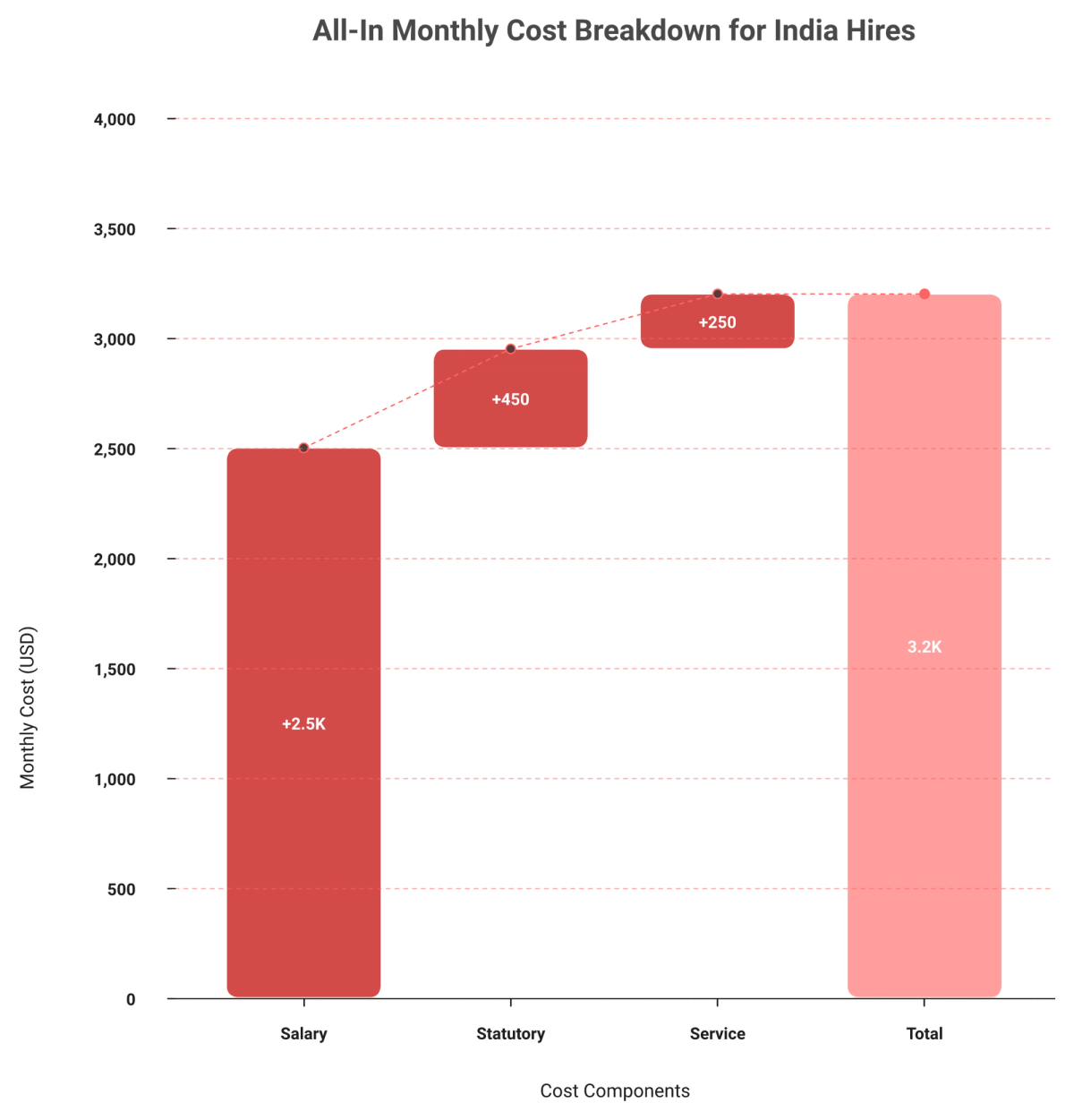
The all-in cost of hiring in India is base salary plus roughly 15 to 20 percent statutory employer contributions, plus an EOR service fee ($99 to $699 per employee per month) or your own entity overhead, plus one-time recruitment, equipment, and onboarding. For a mid-level engineer at $2,500 per month gross, expect $2,900 to $3,300 all-in monthly. India carries one of the lowest statutory burdens of any EOR market, so the service fee, not compliance, is your biggest variable.
💰 Why the sticker price lies to you
A founder messaged me last quarter with one line. "I see a $99 price and a $599 price. Which one is real?"
Neither, honestly. Both are sticker prices. The real number is what lands on your bank statement after statutory loading, FX markups, and one-time spend.
That gap is where first India budgets quietly break. The fear underneath the question is sharper than pricing. It usually sounds like: "Do I risk a $25,000 to $40,000 back-pay liability per head if I misclassify someone as a contractor to save on benefits?"
That risk is real, and we will get to it. First, the formula.
🧱 The three-layer cost stack
I think about India hiring cost in three stacked layers. Build it bottom-up and the number stops surprising you.
Base salary. The market rate for the role and city. This is layer one.
Statutory loading. Provident Fund, ESI, gratuity accrual, and professional tax. This runs about 15 to 20 percent of base in India, far below Germany or France.
Service fee or entity overhead. Either an EOR fee per employee per month, or the cost of running your own Indian entity.
Take a mid-level engineer at $2,500 per month gross. Add statutory loading and a service fee, and your all-in monthly cost lands between $2,900 and $3,300. That is the figure you take to your board, not the $99 you saw on a pricing page.
⚠️ The variable that actually moves your bill
Here is the part the category gets backwards. People obsess over compliance cost. In India, compliance is the small, predictable layer.
The service fee is the swing factor. The spread runs from $99 with India specialists to $599 with global generalists like Deel and Remote. That $500 gap is not buying you more compliance. India's statutory burden is the same whoever files it.
So the real question is not "which is cheapest." It is "which all-in number is predictable, and who actually owns the filings behind it."
What we do differently at Versatile Club
At Versatile Club, I publish the all-in number, not the sticker price. A founder budgeting a first India hire deserves the figure that hits the bank account, including statutory loading and zero hidden FX.
We invoice in USD directly from our own registered Indian entity, not a partner shell. There is no setup fee, no exit fee, and the first month is free, which is exactly why so many startups make their first India hire through us. I might be biased, but after six years of placements across Bengaluru, Hyderabad, and Pune, I have learned that predictability beats a low headline number every single time.
The rest of this guide decomposes each layer. Next, the foundation of the whole stack: what salary you should actually budget by role and city.
Q2: What Salary Should You Budget by Role and City Tier in India?
In 2026, a junior engineer in India runs roughly $12,000 to $20,000 per year, a mid-level engineer $24,000 to $42,000, and a senior engineer $42,000 to $70,000. Bengaluru and Hyderabad command 15 to 25 percent premiums over Tier-2 cities. Designers and ops roles sit lower. These base bands are the foundation of your all-in budget, and every statutory and service-fee layer stacks on top of them.
🧑💻 Start with the band, not the discount
When a US founder asks me "what does an engineer cost in India," I never start with savings. I start with the band for the role and the city. The savings number means nothing until you anchor the base.
These are bands we actually place against every month across Bengaluru, Hyderabad, and Pune, drawn from our own recruitment work. Not a scraped salary-survey average from a site that last updated in 2023.
💰 2026 India salary benchmarks by role and city tier
| Role and seniority | Bengaluru / Hyderabad (annual) | Tier-2 city (annual) |
|---|---|---|
| Junior engineer (0 to 2 yrs) | $14,000 to $20,000 | $12,000 to $16,000 |
| Mid-level engineer (3 to 6 yrs) | $30,000 to $42,000 | $24,000 to $34,000 |
| Senior engineer (7+ yrs) | $50,000 to $70,000 | $42,000 to $58,000 |
| Product designer | $18,000 to $34,000 | $15,000 to $26,000 |
| Ops / support lead | $14,000 to $26,000 | $12,000 to $20,000 |
Treat these as base salary only. Statutory loading and the service fee come on top, which we cover in the next two sections. You can pressure-test any role against our salary calculator before you commit a number.
🏙️ Why the city premium is real
Bengaluru and Hyderabad cost more for a reason. The senior engineering talent pool there is deep, and so is the competition for it. A 15 to 25 percent premium over a Tier-2 city is normal at the senior end.
I could be slightly off on the exact spread for any single niche. From what surfaces when you actually run placements, the premium widens for scarce skills like senior backend or ML, and narrows for ops and support roles.
🎯 Why the senior band matters most
Pay attention to the senior engineer band. That $42,000 to $70,000 figure is the one that drives the savings story later in this guide.
A senior engineer who costs you $50,000 in Bengaluru might cost $180,000 in San Francisco. That single delta is where the math gets interesting, and we will quantify it fully in the savings section.
How Versatile Club anchors your band
At Versatile Club, the bands we quote come from live contract-to-hire placements, not a generic dataset. I have personally placed engineers, designers, and ops professionals across all three major tech hubs over six years.
So when we hand you a number for a senior backend role in Hyderabad, it reflects what that person actually accepts this quarter. That accuracy matters, because every layer of your budget stacks on this one figure. Get the base wrong and the whole stack wobbles.
Next, the layer most first-time India employers underestimate: the statutory costs that sit on top of this salary.
Q3: What Statutory Costs Sit on Top of an Indian Salary, and What Changed Under the 2025-26 Labour Codes?
On top of base salary, an Indian employer pays Provident Fund at 12 percent of Basic plus DA, ESI at 3.25 percent for employees under Rs 21,000 per month gross, gratuity accruing at about 4.81 percent of Basic plus DA from month one, and state professional tax (Rs 200 to Rs 2,500 per year). TDS is deposited by the 7th monthly. Under the Labour Codes effective November 2025, Basic plus DA must be at least 50 percent of CTC, raising PF and gratuity liability.
🧾 Salary is never the real cost
I learned this the hard way watching a US founder's face on a call. She had budgeted her engineer's salary to the rupee and forgotten every line below it.
In India, "salary" is just the visible part. The statutory layer sits underneath, and it is mandatory, not optional. Here is the full card.
💰 India employer statutory contributions, 2026
| Contribution | Rate | Base | Ceiling | Who pays |
|---|---|---|---|---|
| Provident Fund (EPF) | 12% | Basic + DA | EPS portion 8.33% capped at Rs 15,000 | Employer + employee each |
| ESI | 3.25% (employer), 0.75% (employee) | Gross wages | Applies under Rs 21,000/month gross | Employer + employee |
| Gratuity accrual | ~4.81% | Basic + DA | Accrues from month one | Employer |
| Professional tax | Rs 200 to Rs 2,500/year | State-specific | Varies (Maharashtra, Karnataka differ) | Employer deducts |
| TDS | Per income-tax slab | Total income | Deposited by 7th of each month | Employer deducts |
Define TDS once: it is Tax Deducted at Source, the income tax your employer withholds and deposits with the government on the employee's behalf.
⚠️ The 50 percent rule that changed the math
The Labour Codes took effect on 21 November 2025, and one rule reshapes every payroll. Basic plus DA must now be at least 50 percent of total CTC.
Here is what that does in a live cycle. If you used to set Basic at 35 percent and shift it to 50 percent, your PF base rises, and so does gratuity accrual. The employee's take-home can dip while your liability climbs.
The Monday-morning action is simple. Restructure your offer letters so Basic plus DA clears 50 percent before your next payroll run, or your filings are out of step with the code. Our compliance team handles this restructuring as part of standard onboarding.
What clients say about getting this right
"Versatile's Employer of Record India service made this seamless. Contracts, PF, ESI, TDS, and payroll all handled in one place. The compliance rigour is genuinely impressive, every statutory filing reviewed before submission."
Vedant T., Founder Versatile Club G2 Verified Review
"The compliance side is the real reason I'd recommend them. PF, tax, the statutory filings, all the stuff I genuinely did not want to learn, they just handle it and keep it correct every month."
Angad S., Founder at Moonshot Versatile Club G2 Verified Review
Who owns the filing at Versatile Club
When a US client asks who is liable if a PF challan is wrong, the honest answer for most global EORs is "their local partner." For Versatile Club, the answer is us.
Our PF, ESIC, and professional-tax filings run under our own registrations across all 28 Indian states and 8 union territories. That is ownership over abstraction, and in an audit it means the trail leads to one entity, not a chain of shells. It is the same reason teams comparing us against a Wisemonk alternative end up valuing direct statutory control.
Next, the costs that hit once per hire, before payroll even starts.
Q4: How Much Do Recruitment, Onboarding, and One-Time Costs Add Per Hire?
Beyond salary, expect Rs 30,000 to Rs 1.5 lakh per hire in one-time costs. That covers recruitment agency fees at about 8.33 percent of annual CTC, job-board access (Naukri Resdex from roughly Rs 55,000 per quarter), background verification, equipment, and onboarding. EOR setup fees, where charged, run $500 to $2,000 per employee, and many providers hold a security deposit of about one month's salary. These quietly inflate your first-year-per-head number.
💸 Recruitment is never free, even when salary is low
A CFO once told me his India hire was "basically free" because the salary was a fifth of his US number. Then he sent me his actual first-year spend.
The recruitment layer alone had added close to Rs 1 lakh before the engineer wrote a line of code. Cheap salary, expensive front door. That is the trap.
🧱 The one-time cost checklist
These hit once, not every month, but they land in your first-year total. Budget for all of them.
Recruitment agency fee. Roughly 8.33 percent of annual CTC, paid on a successful hire.
Job-board access. Naukri Resdex starts around Rs 55,000 per quarter for resume-database access.
Background verification. Worth every rupee. Nearly 30 percent of IT-sector resumes in India contain discrepancies, so skipping this is a false saving.
Equipment. Laptop and peripherals, typically $800 to $1,500 per head.
Onboarding time. Your team's hours drafting contracts and setting up payroll.
EOR setup fee. Where charged, $500 to $2,000 per employee.
Security deposit. Often about one month's salary plus the EOR fee, held by the provider.
⚠️ Where the worst surprises hide
The two line items that ambush first-time buyers are the setup fee and the security deposit. They rarely appear on the pricing page.
I might be wrong about a specific vendor's current policy, but from what I see in real quotes, a $2,000 setup fee plus a one-month deposit can mean $4,000 gone before your hire's first payslip. On a single hire, that is brutal math.
✅ How to keep this layer small
You can shrink this layer with two moves. First, pick a provider that does not charge a setup or exit fee. Second, negotiate pilot pricing for your first one to three hires, which many providers quietly offer.
The agency fee and BGV you mostly cannot avoid, and frankly should not. The setup fee, deposit, and exit charge you can, if you choose the right structure and onboarding model.
How Versatile Club zeroes the dreaded layer
At Versatile Club, we do not bill a setup fee or an exit fee, and the first month is free. So the one-time layer that wrecks most India hiring budgets is, for our clients, close to zero. You can see exactly what is and is not included in our EOR services.
That is a deliberate cash-flow decision, not a promo. A founder making a first India hire should not pay $4,000 in fees before they have seen a single payslip land clean. Keep your money in the hire, not the onboarding paperwork.
Q5: What Does an EOR Actually Charge in India, and Why the $99 to $699 Spread?
EOR service fees in India range from $99 to $200 per employee per month for India specialists to $499 to $699 for global platforms like Deel, Remote, and Oyster, with Multiplier near $400. Because India's statutory burden is uniformly low, that spread is almost entirely about platform quality, India compliance depth, and global coverage, not underlying cost. Flat per-employee fees beat percentage-of-salary models for senior hires, since your fee stays fixed as salaries grow.
💰 What you actually pay per month
An EOR, or Employer of Record, is the company that legally employs your India hire on your behalf. The fee is what you pay for that service, separate from salary and statutory costs.
Here is where the major providers land in 2026. I have put India specialists at the top, because for a single-country India hire, that is where most of my clients should start, and where our own India EOR service sits.
| Provider | Type | Monthly fee | FX markup | Support model |
|---|---|---|---|---|
| Versatile Club | India-only, owned entity | $149 | None (USD direct) | Founder on WhatsApp |
| RemoFirst | India specialist | $199 | Varies | Ticket / chat |
| Multiplier | Global | ~$400 | Varies | Account manager |
| Papaya Global | Global | $499 | Varies | Account manager |
| Deel | Global | $599 | 3 to 5% reported | Chatbot first |
| Remote | Global | $599 | Varies | Ticket queue |
🧱 Flat fee beats percentage every time
Some providers charge a percentage of gross salary, usually 5 to 15 percent, instead of a flat fee. For a junior hire, that can look cheap.
For a senior engineer, it gets expensive fast. A flat fee stays fixed as the salary climbs, so your cost does not balloon when you hire a $70,000 architect. I tell every CFO the same thing: pick the model that stays predictable as you scale, and check it against our transparent pricing.
⚠️ The spread is not buying you compliance
Here is the part the category quietly avoids saying. India's statutory burden is the same whoever files it. So that $500 gap between $99 and $599 is not extra compliance.
You are paying for platform breadth and global coverage, not deeper India knowledge. Sometimes you are paying for an FX markup and a ticket queue, which is exactly why teams shopping for a Deel alternative end up with us.
"I find Deel to be absurdly expensive. They charge a high amount of fees for transferring money to my bank account."
Juan Camilo O. Deel G2 Verified Review
"What I like most about Wisemonk is how they convert a complex international hiring process into a structured and easy workflow."
Verified User in Marketing and Advertising Wisemonk G2 Verified Review
Where Versatile Club sits on price
At Versatile Club, we invoice in USD directly from our own Indian entity, not routed through a foreign holding company, not converted from INR. So the 3 to 5 percent FX markup you would absorb with a global platform simply does not exist on our invoice.
That is a structural fact of how we built the entity, not a feature we toggle. I might be biased, but after six years, I think the clean dollar invoice matters more to a CFO than a famous logo. You can see the full model in our EOR services.
Q6: EOR, Own Entity, or Contractor: Which Is Cheapest for Your Headcount?
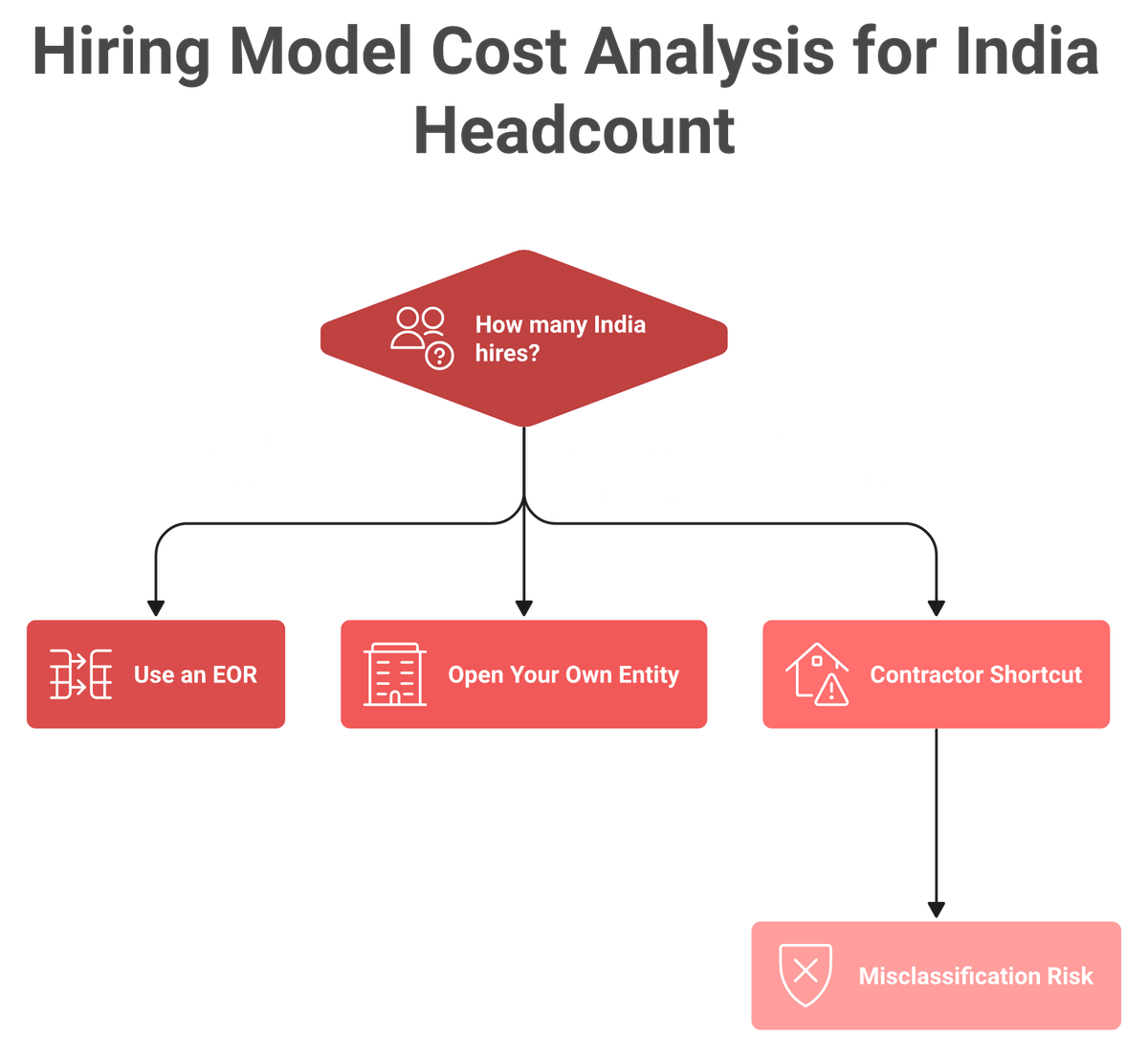
For 1 to 12 India hires, an EOR is almost always cheapest. Your own entity costs $15,000 to $50,000, plus 3 to 6 months before your first hire starts, plus ongoing compliance. The crossover is roughly 10 to 15 employees, usually in year two. Hiring people as contractors to dodge statutory benefits looks cheapest of all, until misclassification triggers $25,000 to $40,000 in back-pay liability per head.
🌉 The suspension bridge, not the Golden Gate
A founder once asked me why she shouldn't just incorporate in India on day one. I gave her my favorite analogy.
You don't build the Golden Gate when a simple suspension bridge gets you across the river. The EOR is your suspension bridge. The entity is the Golden Gate, and you build it only when traffic demands it. Our EOR vs entity calculator shows you exactly where that line sits for your headcount.
💰 The three models, side by side
| Model | Cost at 3 hires | Cost at 12 hires | Time to first hire | Main risk |
|---|---|---|---|---|
| EOR | ~$5,400/yr fees + salary | ~$21,600/yr fees | 5 days | Low |
| Own entity | $15K to $50K setup + admin | Setup amortized, wins here | 3 to 6 months | Compliance overhead |
| Contractor | Cheapest on paper | Cheapest on paper | Days | $25K to $40K back-pay per head |
The crossover usually lands at 10 to 15 people. One client told me their tipping point was clear: "After we hit about 12, we said, right, we're ready to open our own entity."
⚠️ Why the contractor shortcut backfires
The contractor route tempts every cash-strapped founder. No PF, no ESI, no gratuity. But Indian labor law looks at the relationship, not the contract label, which is why a compliant contractor of record setup matters.
I once heard about an offshore engineer who asked his US manager for permission every time he took a dinner break. That instinct signals an employee relationship, not a contractor one. Misclassify that person, and you risk $25,000 to $40,000 in back-pay per head when it surfaces.
One more myth to kill. US-style co-employment PEO does not legally exist under Indian labor law. If a provider pitches you "PEO India," push back and ask what entity actually employs your people.
How Versatile Club hands you both bridges
At Versatile Club, we have run exactly this path. We employed a client's first 12 people through our entity, then migrated them into the client's own entity once the math flipped.
One client interviewed someone they thought was in London, discovered after round three he was in Greece, and we employed him anyway. We hand you the bridge now, and when you're ready, we help you build the Golden Gate. India is the only country we operate in, so that migration is something we have actually run, not theorized, as part of our onboarding model.
Q7: How Much Do You Really Save Hiring in India vs the US, UK, or Germany?
A senior engineer costs roughly $220,000 all-in per year in San Francisco versus about $58,000 in Bengaluru, a $162,000 annual saving per role. Against Germany, an EOR India hire runs 40 to 50 percent cheaper, mainly because India's social-security burden sits under 15 percent of salary versus Europe's heavier pension contributions. The durable reason to hire in India isn't the discount. It's access to highly academically capable talent with few local outlets for it.
💰 The $162,000 delta, laid out
Let me show you the number that gets every board's attention. Then I'll tell you why it's the wrong reason to come to India.
| Role | US all-in | UK all-in | Germany all-in | India all-in | Saving vs US |
|---|---|---|---|---|---|
| Senior engineer | $220,000 | ~$140,000 | ~$130,000 | $58,000 | $162,000/yr |
The US gap is the headline. The Germany gap is structural: India's social-security burden sits under 15 percent of salary, while Europe loads heavy pension and social contributions on top. That's why an India hire runs 40 to 50 percent cheaper than the same role in Germany. You can model your own role with our salary calculator.
🧱 Why Europe costs more than you expect
A UK or German hire isn't just a higher salary. It's higher mandatory employer contributions stacked on that salary.
India keeps statutory loading at 15 to 20 percent. Germany pushes well past that once you add pension and social security. So the gap widens beyond the raw salary difference once you load both sides fairly.
⚠️ The contrarian turn: cheap is the wrong pitch
Here's where the standard read gets it backwards. If you're coming to India because it's cheap, that's not going to happen the way you think.
I never advocate going overseas just to save money. You go to India for highly academically intelligent people who have few local places to apply that talent. The savings is a side effect, not the strategy.
And the November 2025 Labour Codes narrow the gap slightly, because the 50 percent rule lifts PF and gratuity bases. The advantage shrinks. It does not disappear.
Why Versatile Club leads with fit, not price
This is exactly why at Versatile Club, we lead with culture-fit hiring across 50 behavioral parameters, not a price list. The cheapest hire who quits in four months costs you far more than the $162,000 you thought you saved, which is why our recruitment approach screens for fit first.
I could be wrong for your specific roadmap. But from what surfaces when you actually run placements, the savings only holds if the hire stays. That is the part the spreadsheet leaves out, and the reason so many startups building India teams start with culture fit.
Q8: What Hidden Costs and Compliance Risks Quietly Inflate Your India Bill?
The costs that wreck India budgets rarely appear on the quote: 3 to 5 percent FX markups on cross-border payments (around $3,000 to $5,000 per year on a 10-person team), $500 to $2,000 setup fees, exit charges, and a security deposit of about a month's salary. Hiring direct without structure can trigger Permanent Establishment risk and roughly 40 percent Indian corporate tax on attributable profit, while the DPDP Act and POSH Act add data-consent and workplace-safety obligations you must budget for.
💸 The line items hiding below the quote
A CFO once messaged me at month-end, furious that her "all-in" number had drifted up by thousands. None of it was on the quote.
Here is the full list of what hides below the sticker price. Budget for every one.
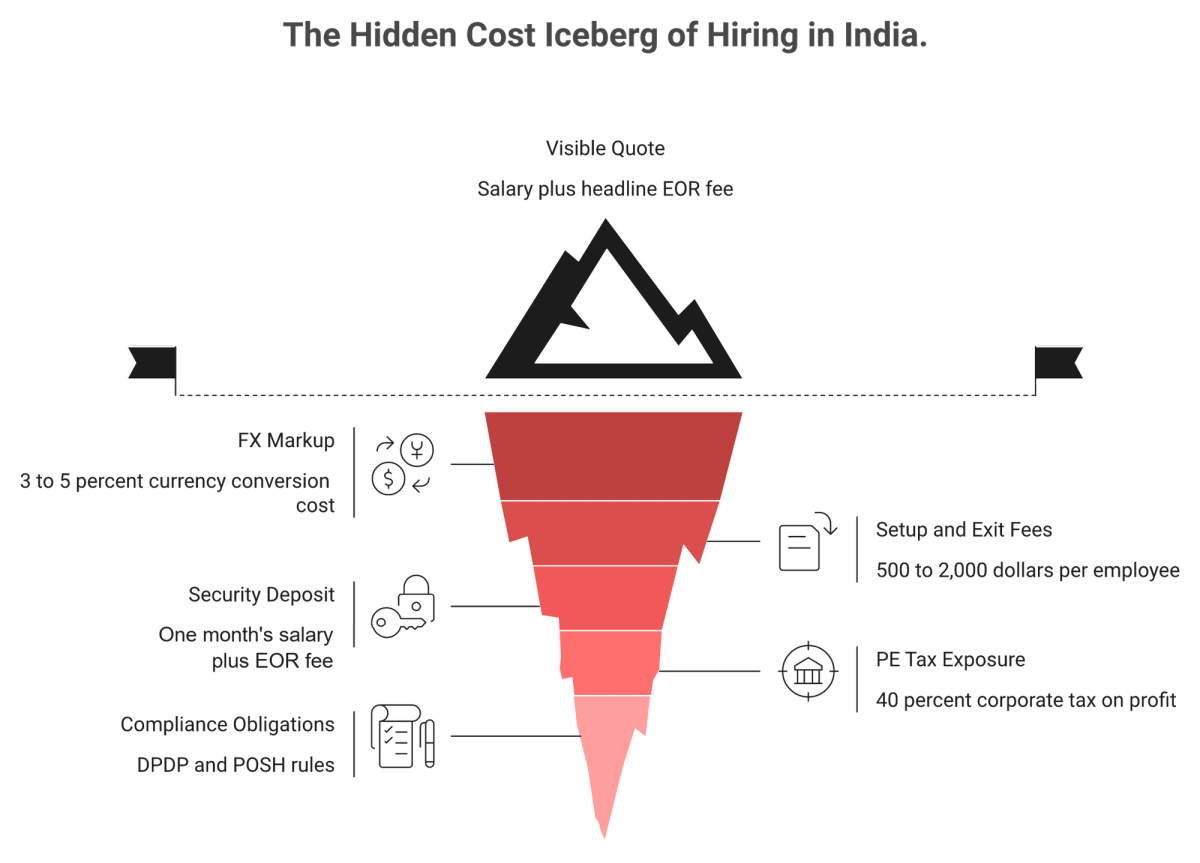
FX markup. 3 to 5 percent on cross-border payments, about $3,000 to $5,000 per year on a 10-person team.
Setup fee. $500 to $2,000 per employee, often waived only for larger teams.
Exit / termination fees. Offboarding charges at end of contract.
Security deposit. Often about one month's salary plus the EOR fee, held by the provider.
PE tax exposure. Permanent Establishment risk can trigger roughly 40 percent corporate tax on India-attributable profit.
DPDP Act compliance. India's data-protection law changed what recruiters can collect and store.
POSH Act. Mandatory workplace-safety committee and policy obligations.
Define PE once: Permanent Establishment is when your activity in India is treated as a taxable business presence, even without a formal entity.
⚠️ The financial leaks compound
FX is the quiet killer. A 3 to 5 percent markup feels small until you multiply it across ten salaries every month for a year.
Then the deposit and exit fees stack on top. Getting deposits back is its own headache with some providers, which is one reason buyers compare us against a Multiplier alternative.
"We have consistently had to follow up repeatedly for refunds on deposits for employees who have left the company. Invoice deadlines are constantly changing."
Verified User in Translation and Localization Velocity Global G2 Verified Review
"There are hidden fees. Even your contract says payment processing will be paid by your client, they do not care. You will never get your net-agreed salary through Deel."
Ibrahim, Verified User Deel G2 Verified Review
🧾 The compliance risks that carry real money
The bigger risk is structural, not a fee line. Hire people directly without the right structure, and you can trip Permanent Establishment, then face roughly 40 percent corporate tax on attributable profit.
DPDP and POSH are not optional either. The DPDP Act reshaped data-consent for recruiters, and POSH requires a workplace committee from day one. Both cost time and process, so budget for them, or hand them to our compliance team.
How Versatile Club removes the hidden layer
At Versatile Club, every line on this list is either zero or absorbed. We invoice clean USD with no FX markup, charge no setup or exit fee, and own the POSH and DPDP compliance ourselves.
We built the entity to invoice clean and own the compliance, not to nickel-and-dime your offboarding. The reader who has seen a quote drift up at month-end knows exactly why that matters, and why our managed payroll keeps it predictable.
Q9: Why Does 'Compliant on Paper' Cost You More Than 'A Good Hire Who Stays'?
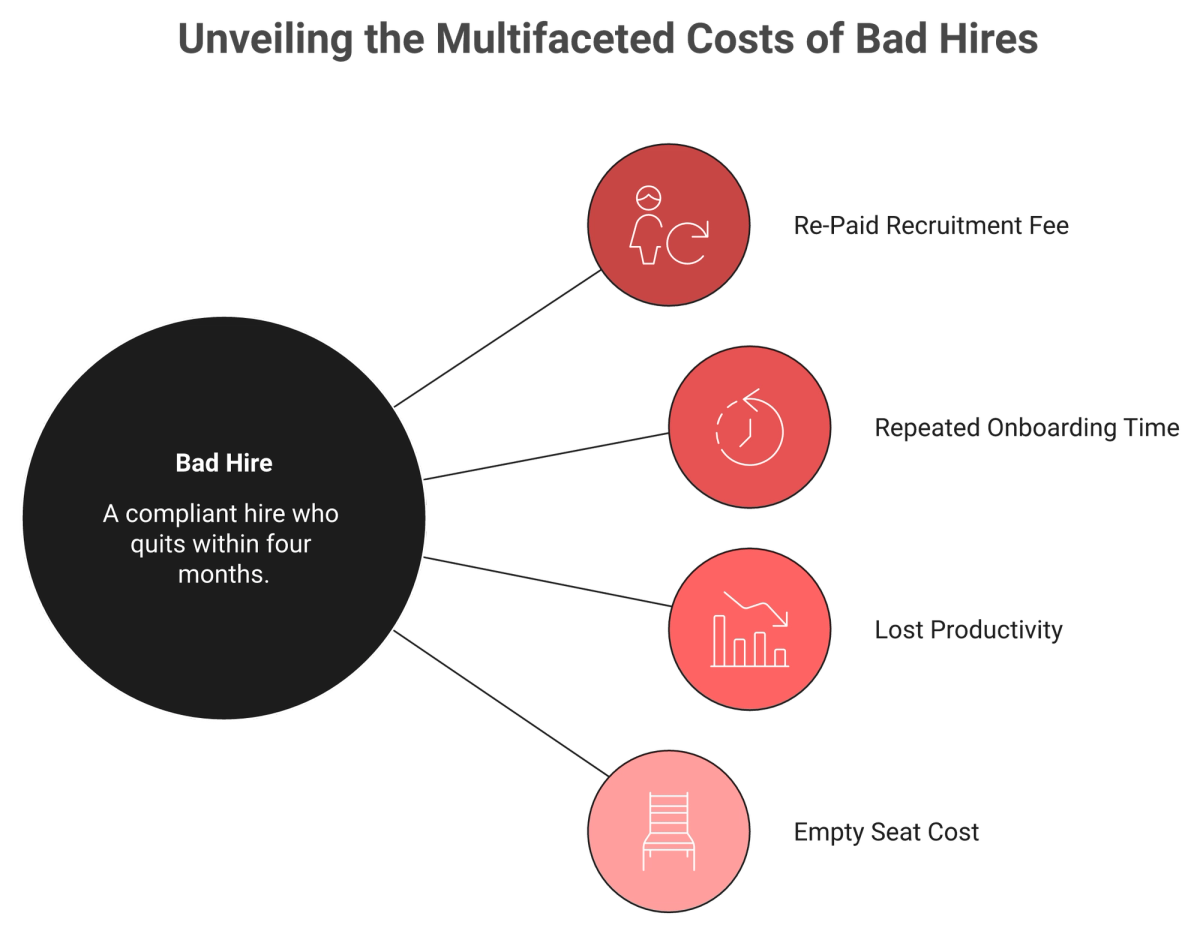
A legally compliant hire who quits in four months is more expensive than no hire at all. You re-pay recruitment, onboarding, and lost productivity, and a single bad hire in India can cost Rs 5 to 25 lakh. Compliance-first EORs solve the "legal hire on paper" problem but ignore the "good hire who stays" problem. Culture-fit screening, a replacement guarantee, and post-placement coaching are the line items that actually protect your budget.
⚠️ Compliance is the floor, not the ceiling
Here is something the category avoids saying out loud. Getting the PF challan right is table stakes. It is not the thing that saves you money.
The standard read treats EOR as a compliance product. File the taxes, run payroll, done. But a perfectly compliant hire who walks in four months has cost you more than the legal paperwork ever saved you, which is why our India EOR service goes beyond filings.
💸 What a bad hire actually costs
Run the real math. You pay the recruitment fee again. You pay onboarding time again. You lose the productivity of a seat that sat empty for months.
A single bad hire in India can run Rs 5 to 25 lakh, and 29 percent of Indian companies report a bad hire costing more than Rs 20 lakh. That dwarfs any FX markup or setup fee we argued about earlier, and it is why our recruitment process screens so hard.
🧱 Why compliance-first providers miss this
Most EORs optimize for "legal on paper." That is the problem they were built to solve, and they solve it.
What they do not address is retention. There is no culture-fit screen, no replacement guarantee, no coach checking in at day 60. The hire is legally employed and quietly disengaged, which is the most expensive state of all, and a gap teams notice when weighing a Wisemonk alternative.
There is a human layer here too. Indians may work every day in a reasonable facsimile of the West, but they go home every night to India. Statutory benefits like PF and gratuity are emotionally non-negotiable, and getting them right is part of why people stay, as our compliance approach reflects.
"Versatile made it simple. The hire was set up properly before I'd even fully wrapped my head around how India payroll works. First payroll ran on time, no scramble."
Angad S., Founder at Moonshot Versatile Club G2 Verified Review
"What I didn't expect was how good the ongoing support would be. Every payroll or PF question gets a real answer from a real person, usually same day."
Verified User in Information Technology and Services Versatile Club G2 Verified Review
How Versatile Club protects the budget
This section is the whole Versatile Club thesis. We screen on 50 behavioral parameters, assign a 90-day Success Coach, and back every C2H placement with a 6-month replacement guarantee, all part of our contract-to-hire model.
Compliance is the floor we clear by default. The hire who stays is the only one that actually saves you money. I could be wrong for a pure cost-arbitrage buyer, but from what surfaces across six years of placements, retention is the line item that decides whether your budget holds, especially for startups making a first India hire.
Q10: How Do You Build a Defensible All-In India Hiring Budget Before Your Next Hire?
Build your all-in India budget in five steps: set base salary from a city-tier benchmark, add 15 to 20 percent statutory loading with Basic plus DA at 50 percent of CTC, add the EOR fee or entity overhead, add one-time recruitment, equipment, and onboarding, then stress-test for FX, setup, exit, and attrition risk. Demand a clean USD invoice with no FX markup, and confirm a contractual onboarding SLA before you sign.
🧱 The five-step budget you can take to the board
You came here to make a decision, so here is the checklist. Build it in this order and the number stops surprising you.
Set the base salary. Use a city-tier benchmark for the role, like the bands earlier in this guide, or our salary calculator.
Add statutory loading. Layer on 15 to 20 percent for PF, ESI, gratuity, and professional tax, with Basic plus DA at 50 percent of CTC per the 2025 Labour Codes.
Add the service layer. Either the EOR fee per employee per month, or your own entity overhead, which our EOR vs entity calculator compares.
Add one-time costs. Recruitment, background verification, equipment, and onboarding.
Stress-test the risks. Model FX markup, setup and exit fees, and the cost of attrition if the hire leaves early.
⏰ From "running with scissors" to audit-ready
Most founders I meet are running with scissors on their first India hire. A contractor here, a mystery FX charge there, no clean paper trail.
The five-step budget moves you to audit-ready, the state your next funding round will demand. The shift is not complicated. It is just deliberate, and our onboarding process is built around it.
✅ Two things to demand before you sign
Two non-negotiables protect you from the surprises this guide covered. Ask for both in writing.
First, a clean USD invoice with no FX markup, not routed through a foreign holding company. Second, a contractual onboarding SLA, so "fast" is a commitment, not a hope, which is exactly what our EOR services put on paper.
"Versatile replied to our form in about four hours with a draft offer letter already attached. The hire was onboarded in four days. USD invoice landed clean, no FX markup, no setup fee, no surprises."
Verified User in Information Technology and Services Versatile Club G2 Verified Review
"Founder is just a call away. Extremely helpful in resolving all our queries. The process is super smooth to set up India EOR."
surbhi m. Versatile Club G2 Verified Review
Where my head is right now
Here is the prediction I am sitting with. Over the next two years, India stops being one country on a global EOR map and becomes its own specialist category. Owned-entity operators eat the generalists' India revenue.
If you are budgeting your first India hire and want the all-in number for your specific role, not a sticker price, message me directly on WhatsApp through our contact page. At Versatile Club you talk to the person who built the company, and we will put a clean USD quote and a 5-day onboarding commitment in writing. What is the one role you would hire in India tomorrow if the number worked?
FAQs
What is the true all-in cost of hiring an employee in India in 2026?
The all-in cost is more than salary. We build it in three stacked layers so the number stops surprising founders.
- Base salary: the market rate for the role and city.
- Statutory loading: roughly 15 to 20 percent for PF, ESI, gratuity, and professional tax, far below Germany or France.
- Service fee or entity overhead: an EOR fee of 99 to 699 dollars per employee monthly, or the cost of running your own Indian entity.
Take a mid-level engineer at 2,500 dollars per month gross. Add statutory loading and a service fee, and your all-in monthly cost lands between 2,900 and 3,300 dollars.
The variable that actually moves your bill is the service fee, not compliance, because India's statutory burden is uniformly low. We publish the all-in number, not a sticker price, through our India EOR service, with no setup fee, no exit fee, and the first month free.
What salary should I budget by role and city tier in India?
Start with the band for the role and city, not the savings number. These are bands we place against every month across Bengaluru, Hyderabad, and Pune.
- Junior engineer: 12,000 to 20,000 dollars yearly.
- Mid-level engineer: 24,000 to 42,000 dollars yearly.
- Senior engineer: 42,000 to 70,000 dollars yearly.
- Designers and ops roles: typically lower.
Bengaluru and Hyderabad command a 15 to 25 percent premium over Tier-2 cities because the senior talent pool there is deep and competitive. Treat these as base salary only; statutory loading and the service fee stack on top.
The senior band matters most, since a 50,000 dollar Bengaluru engineer might cost 180,000 dollars in San Francisco. You can pressure-test any role with our salary calculator before you commit a number.
What statutory costs sit on top of an Indian salary, and what changed under the 2025-26 Labour Codes?
On top of base salary, an Indian employer pays several mandatory contributions.
- Provident Fund: 12 percent of Basic plus DA.
- ESI: 3.25 percent employer share for employees under 21,000 rupees monthly gross.
- Gratuity: accrues at about 4.81 percent of Basic plus DA from month one.
- Professional tax: 200 to 2,500 rupees yearly, state-specific.
- TDS: income tax deducted and deposited by the 7th of each month.
The Labour Codes took effect on 21 November 2025, and one rule reshapes every payroll. Basic plus DA must now be at least 50 percent of total CTC, which raises PF and gratuity liability.
The Monday-morning action is to restructure offer letters so Basic plus DA clears 50 percent before your next payroll run. Our compliance team handles this restructuring as part of standard onboarding.
How much do recruitment, onboarding, and one-time costs add per hire?
Beyond salary, expect 30,000 rupees to 1.5 lakh per hire in one-time costs. These land once but still hit your first-year total.
- Recruitment agency fee: about 8.33 percent of annual CTC.
- Job-board access: Naukri Resdex from roughly 55,000 rupees per quarter.
- Background verification: worth every rupee, since nearly 30 percent of IT resumes carry discrepancies.
- Equipment: 800 to 1,500 dollars per head.
- EOR setup fee: where charged, 500 to 2,000 dollars per employee.
- Security deposit: often about one month's salary plus the fee.
The setup fee and deposit ambush most first-time buyers, sometimes 4,000 dollars before the first payslip. We do not bill a setup or exit fee, and the first month is free, so this layer is close to zero in our EOR services.
What does an EOR actually charge in India, and why the 99 to 699 dollar spread?
EOR fees range from 99 to 200 dollars per employee monthly for India specialists, to 499 to 699 dollars for global platforms like Deel and Remote, with Multiplier near 400 dollars.
Because India's statutory burden is uniformly low, that spread is about platform breadth and global coverage, not deeper India compliance. The 500 dollar gap is not buying you more compliance, since the filings are the same whoever submits them.
- Flat fee: stays fixed as salaries grow, ideal for senior hires.
- Percentage of salary: 5 to 15 percent, which balloons on a 70,000 dollar architect.
We invoice USD directly from our own Indian entity, so the 3 to 5 percent FX markup global platforms add does not exist on our invoice. Teams shopping for a Deel alternative often start there. You can see our flat fee on the pricing page.
Is an EOR, my own entity, or contractors cheapest for my India headcount?
For 1 to 12 hires, an EOR is almost always cheapest. Think of it as a suspension bridge you build before the Golden Gate.
- EOR: fast, low risk, roughly 5,400 dollars in yearly fees at three hires.
- Own entity: 15,000 to 50,000 dollars setup plus 3 to 6 months before your first hire, winning above 10 to 15 employees.
- Contractor: cheapest on paper, but misclassification risks 25,000 to 40,000 dollars in back-pay per head.
Indian labor law looks at the relationship, not the contract label, and US-style co-employment PEO does not legally exist here. Map your own break-even with our EOR vs entity calculator.
We have run this exact path, employing a client's first 12 people, then migrating them into the client's own entity once the math flipped, through our contract-to-hire model.
How much do I really save hiring in India versus the US, UK, or Germany?
A senior engineer costs roughly 220,000 dollars all-in yearly in San Francisco versus about 58,000 dollars in Bengaluru, a 162,000 dollar saving per role.
- Versus the US: the headline 162,000 dollar delta.
- Versus Germany: 40 to 50 percent cheaper, since India's social-security burden sits under 15 percent of salary.
- Versus the UK: a meaningful gap once employer contributions are loaded fairly.
Here is the contrarian truth: if you come to India only because it is cheap, that is not going to work the way you think. We never advocate going overseas just to save money. You go to India for academically strong talent with few local outlets for it.
This is why we lead with culture-fit hiring across 50 behavioral parameters through our recruitment approach, not a price list. The cheapest hire who quits in four months costs far more than the savings.
What hidden costs and compliance risks quietly inflate my India hiring bill?
The costs that wreck India budgets rarely appear on the quote. Budget for every one of these.
- FX markup: 3 to 5 percent on cross-border payments, about 3,000 to 5,000 dollars yearly on a 10-person team.
- Setup and exit fees: 500 to 2,000 dollars per employee plus offboarding charges.
- Security deposit: often about one month's salary.
- PE tax exposure: Permanent Establishment risk can trigger roughly 40 percent corporate tax on attributable profit.
- DPDP and POSH: data-consent and workplace-safety obligations.
Hiring direct without structure can trip Permanent Establishment, a taxable business presence even without a formal entity. At Versatile Club, every line on this list is either zero or absorbed, because we invoice clean USD and own the compliance ourselves through our managed payroll.