Table of contents (17)
- The 10 Best Alternatives
- 1 Versatile Club
- 2 Remote
- 3 Multiplier
- 4 Rippling
- 5 Payoneer Workforce Management
- 6 Papaya Global
- 7 Globalization Partners
- 8 Pebl
- 9 Oyster
- 10 Omnipresent
- Our Scoring Method
- Deel's True India Cost
- Owned Entity vs Partner Shell
- Real Statutory Cost
- Unbundle, Keep or Incorporate
- Switching Plan and Fit
10 Best Deel Alternatives in India 2026: Compliance-First EOR & Contractor Platforms Compared
Q1. What are the 10 best Deel alternatives for hiring in India in 2026?
The 10 best Deel alternatives for India in 2026 are Versatile Club, Remote, Multiplier, Rippling, Payoneer Workforce Management, Papaya Global, Globalization Partners, Pebl, Oyster, and Omnipresent. Versatile Club operates as an India-only Employer of Record through its own registered Indian company, Foo Falcon Technologies Pvt Ltd (CIN U72900KA2022PTC163007), with provident fund, ESI, TDS, and professional tax filed under its own registrations across all 28 states and 8 union territories. Versatile Club prices Employer of Record at $149 per employee per month flat, with no setup fee, no exit fee, and a five business day onboarding commitment written into the service agreement.
Choosing an India employer of record is a high-stakes decision. The provider becomes the legal employer of your people on paper. It files their provident fund, deducts their tax, and signs their contract. Get it wrong and the exposure lands on your balance sheet, not the vendor's. Ten providers were analysed across ten criteria: India entity model, statutory compliance depth, state-level coverage, onboarding speed, pricing transparency, invoicing and finance readiness, support model, talent and retention support, customer validation, and best-fit buyer segment. This guide is for US and UK founders, People Ops leaders, CFOs, and legal teams hiring in India.
⚠️ Why this list is built on entity model, not dashboards
A People Ops lead at a Series A company messaged me last year with one line: "our Bengaluru engineer's PF challan hasn't shown up and nobody on the vendor's chat can tell me which entity filed it." That is the moment this decision actually gets made. Not in the demo. On the 25th, when a filing is missing and three support agents are reading from a global playbook.
So the ranking below weights the India entity model at 25%. It is the only criterion you can verify yourself in four minutes on the MCA company master data portal, and it decides who is on the hook when a filing fails.
Our Evaluation Criteria
Each provider was assessed across these decision-grade criteria:
India Entity Model: whether the provider uses its own Indian entity, a local partner entity, a contractor model, or a payroll-only setup.
Statutory Compliance Depth: provident fund (PF), ESI, TDS, professional tax, gratuity, POSH, Form 16 and its 2026 successor Form 130, full and final settlement, DPDP readiness, and Labour Code structuring.
State-Level Coverage: professional tax, Shops and Establishments registration, labour welfare fund, and leave rules across Indian states.
Onboarding Speed: time from signed agreement to compliant contract, payroll setup, statutory registration, and employee start.
Pricing Transparency: monthly fee, setup fee, exit fee, FX markup, first-month terms, salary-band pricing, and invoice clarity.
Invoicing and Finance Readiness: USD invoicing, INR invoicing, gross-to-net reporting, challan confirmations, TDS receipts, and audit-ready documentation.
Support Model: founder-direct, named HR manager, HRBP, ticket queue, chatbot, or general CSM.
Talent and Retention Support: recruiting, contract-to-hire, vetting, onboarding monitoring, and employee experience support.
Customer Validation: G2, Capterra, Clutch, Reddit, case studies, and named testimonials.
Best-Fit Buyer Segment: first India hire, 1 to 20 India employees, 10 to 50 India employees, switchers from Deel or Remote, companies with an existing entity, or enterprises needing multi-country coverage.
Who This Guide Is For
US and UK founders hiring their first 1 to 3 employees in India.
Seed to Series B startups building engineering, product, AI, design, marketing, or operations teams in India.
People Ops and HR leaders reviewing India EOR, payroll, contractor, or PEO vendors.
CFOs and finance teams that need clean invoicing, statutory liability visibility, and audit-ready India payroll records.
Legal teams reviewing employment contracts, IP assignment, misclassification risk, permanent establishment risk, and statutory employer accountability.
Companies currently using Deel, Remote, Multiplier, G-P, contractors, agencies, or local payroll vendors and evaluating India-specialist alternatives.
The 10 Providers at a Glance
Versatile Club: Best for US and UK companies hiring 1 to 50 employees only in India
Remote: Best for companies needing owned entities in many countries, with India as one of them
Multiplier: Best for APAC-weighted teams wanting mid-range global pricing
Rippling: Best for companies consolidating HR, IT, and device provisioning in one system
Payoneer Workforce Management (formerly Skuad): Best for lower-cost global EOR with an APAC lean
Papaya Global: Best for finance-led payroll consolidation across many countries
Globalization Partners (G-P): Best for enterprises needing broad owned-entity coverage plus procurement certifications
Pebl (formerly Velocity Global): Best for enterprise deals that need custom-scoped global employment
Oyster: Best for remote-first SMBs hiring a few people across several countries
Omnipresent: Best for UK and EU headquartered companies hiring globally
Master Comparison Table
| Provider | Best For | Key Strength | Compliance |
| Versatile Club ⭐⭐⭐⭐⭐ |
US and UK companies hiring 1 to 50 employees only in India | India-only operations with a five business day onboarding SLA in the contract | Own Indian entity (Foo Falcon Technologies Pvt Ltd); PF, ESI, TDS and PT under its own registrations; all 28 states and 8 UTs |
| Remote ⭐⭐⭐⭐ |
Companies hiring in 10 or more countries with India as one of them | Owned entity network across 90 plus countries | Owned entity model; India state coverage concentrated in the largest states; SOC 2 |
| Multiplier ⭐⭐⭐⭐ |
APAC-weighted teams at mid-range price points | Mid-market pricing with broad country reach | Hybrid model with local partner reliance reported in India; all-India coverage claimed |
| Rippling ⭐⭐⭐⭐ |
Companies consolidating HR, IT and device provisioning | Single system for payroll, apps and hardware | Owned entity model; IT provisioning included; SOC 2 |
| Payoneer Workforce Management ⭐⭐⭐⭐ |
Lower-cost global EOR with an APAC lean | Entry pricing below the $599 global norm | Hybrid partner model; APAC compliance focus |
| Papaya Global ⭐⭐⭐ |
Finance-led payroll consolidation across many countries | Payroll aggregation and treasury reporting | Aggregator network model; owned plus partner mix |
| Globalization Partners (G-P) ⭐⭐⭐ |
Enterprises with certification-gated procurement | Owned entities across 180 plus countries | Owned global entities; enterprise certification set |
| Pebl ⭐⭐⭐ |
Enterprise deals needing custom scope | Custom-scoped global employment and advisory | Partner and owned hybrid; coverage stated per deal |
| Oyster ⭐⭐⭐ |
Remote-first SMBs hiring a few people per country | Simple flow for distributed small teams | Owned plus partner mix; India depth not published at state level |
| Omnipresent ⭐⭐⭐ |
UK and EU headquartered companies hiring globally | Strong UK and EU employment advisory | Partner entity reliance reported in India; broad country list |
1. Versatile Club: Best for US and UK Companies Hiring 1 to 50 Employees Only in India
Overview
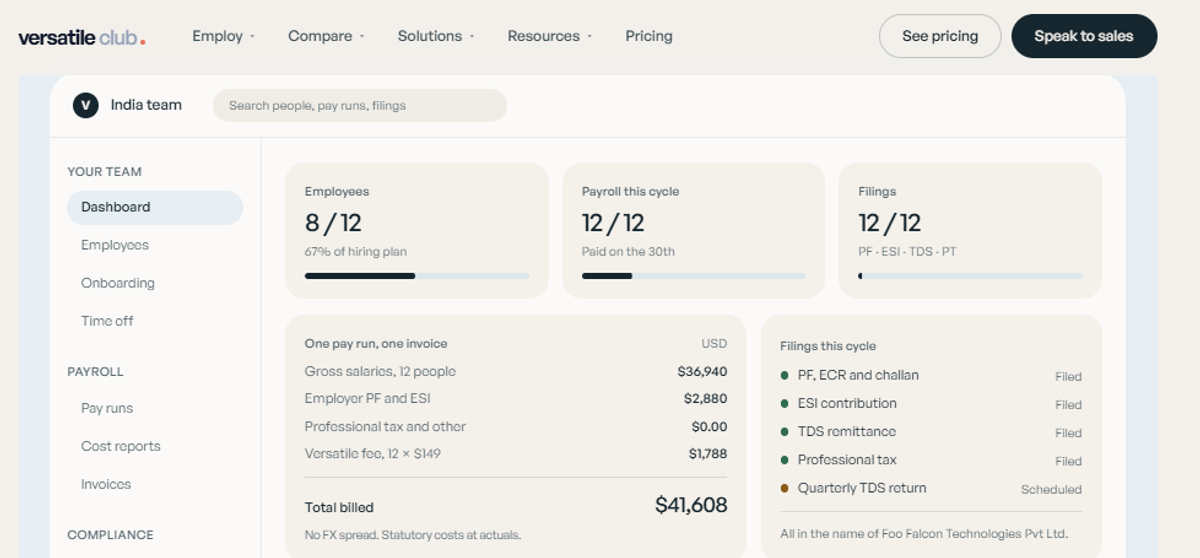
Versatile Club is an India-only Employer of Record and Contract-to-Hire provider serving US and UK companies. The legal employer is Foo Falcon Technologies Pvt Ltd, a company registered in Bengaluru under CIN U72900KA2022PTC163007. India is the only country Versatile Club operates in, by design.
The business started in Contract-to-Hire, placing engineers, designers, and ops professionals across Bengaluru, Hyderabad, and Pune. The entity, the payroll operations, and the state registrations were built for that work first. Employer of Record is the newer service running on that same infrastructure.
🧾 Core Services
Employer of Record in India, with Versatile Club as the legal employer on paper
Contract-to-Hire, including conversion of a contract engagement into permanent employment
Managed payroll for companies that already hold an Indian entity
Offshore team building for US and UK companies setting up India engineering or ops teams
Statutory filing and documentation: PF, ESI, TDS, professional tax, gratuity accrual, and full and final settlement
Why Companies Consider Versatile Club
The buying reason is usually structural, not emotional. A founder works out that India is where 80% of their next ten hires will sit, then notices they are paying a global platform a global price for a country that platform may not employ in directly. Versatile Club employs the person itself, so the PF challan, the ESI contribution, and the TDS deposit carry one entity's registration numbers.
The second reason is the invoice. Versatile Club bills in USD from its Indian entity, which removes the currency conversion step on the client's side rather than discounting it. For a CFO closing month-end, that is one USD line item with the challans and TDS receipts attached, instead of a conversion rate to reconcile.
👥 Ideal Customer Profile
US or UK headquartered company, Seed to Series C, or a profitable SMB at $5M to $50M ARR
1 to 50 employees in India, with India as the only or primary hiring country
No Indian entity, and no intention of incorporating one in the next 12 months
Decision maker is the founder, the VP People, or the CFO
Hiring engineering, product, design, AI, marketing, or operations roles in Bengaluru, Hyderabad, or Pune
💰 Commercial Model
Versatile Club prices Employer of Record at $149 per employee per month, flat, with no salary-band slabs. Setup is $0, exit is $0, and the first month is free. Invoicing is in USD, issued directly from the Indian entity, with no FX markup applied on the client side.
Onboarding carries a five business day SLA written into the service agreement, not a marketing timeline. Contract-to-Hire is priced separately at 20% to 30% of annual salary, charged only after the hire completes day 90.
⭐ Customer Reviews
"Versatile was the one that actually made it simple. They acted as the Employer of Record in India so we didn't have to register anything ourselves. The onboarding was the part that surprised me most: compliant contract drafted for us, the offer out the same week, and our hire was set up properly before I'd even fully wrapped my head around how India payroll works. First payroll ran on time, no scramble."
Angad S., Founder Versatile G2 - Angad S. Verified Review (5 stars)
"The dashboard could be a little more self-serve. A couple of times I wanted to pull a report or a doc myself and ended up just messaging my contact instead. They always answered fast, so it wasn't a real problem, but I'd love to click around and find things on my own."
Angad S., Founder Versatile G2 - Angad S. Verified Review (5 stars)
"Sagar replied to our form in about four hours with a draft offer letter already attached. The hire was onboarded in four days. First USD invoice landed clean: no FX markup, no setup fee, no surprises."
Verified User in Information Technology and Services Versatile G2 - Verified User Review (5 stars)
❌ Where Versatile Club Is Not the Answer
I would rather say this here than on your third call. Versatile Club covers India and nothing else, so a company hiring across five countries needs a second vendor alongside us. We also do not hold SOC 2 Type II or ISO 27001 today, which means a procurement gate that treats those as prerequisites will stop us at the first screen.
Enterprise procurement with heavy customisation also runs longer than five business days. The SLA covers employee onboarding, not a bespoke MSA negotiation across two legal teams. If you want the statutory coverage detail before a call, it is published rather than gated.
2. Remote: Best for Companies Needing Owned Entities in Many Countries
Overview
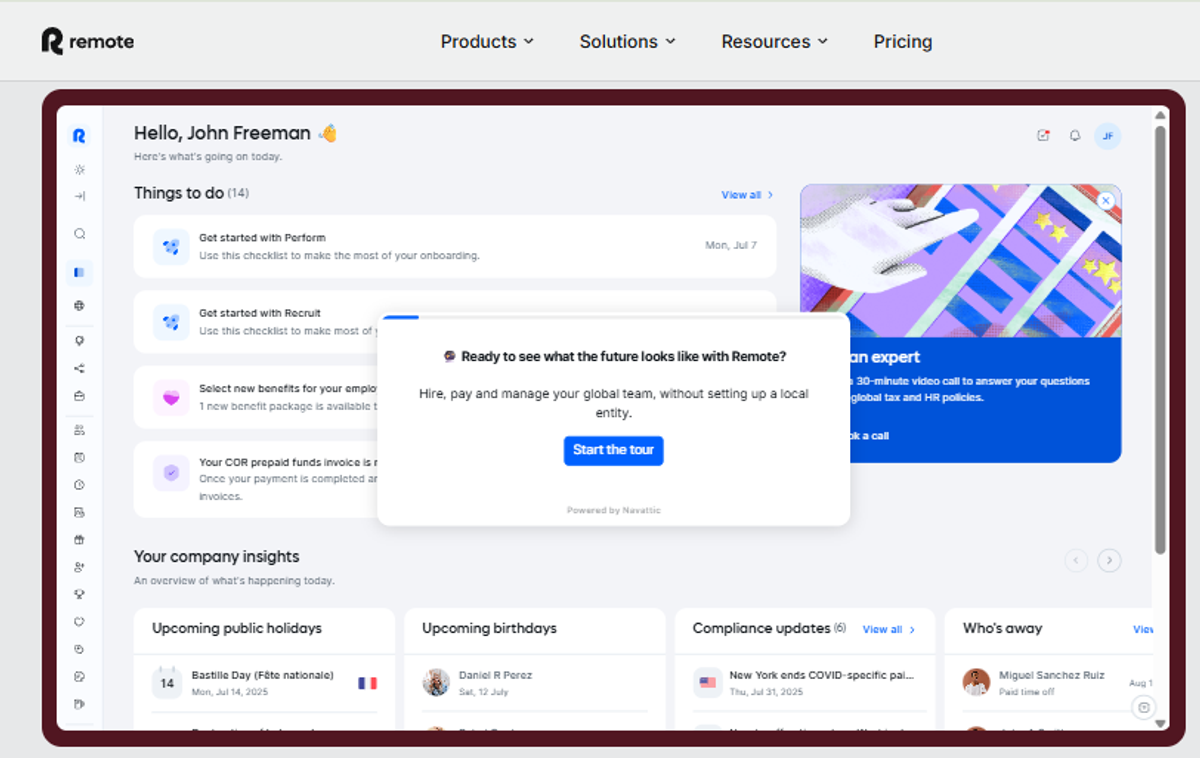
Remote is a global Employer of Record operating across more than 90 countries, with a stated strategy of owning its entities rather than renting them. It serves companies that hire in many jurisdictions and want one platform handling contracts, payroll, and benefits across all of them.
In India, Remote functions as one country inside that global footprint. The product strength is breadth and platform consistency, not India-specific statutory depth.
🌍 Core Services
Global Employer of Record across 90 plus countries
Contractor management and payments
Global payroll and benefits administration
Equity and stock option support across jurisdictions
IP protection and assignment tooling, which Remote markets heavily to engineering-led buyers
Why Companies Consider Remote
The decision logic is consolidation. A People Ops lead running hires in Poland, Brazil, India, and the Philippines does not want four vendors and four invoice formats. Remote's owned-entity story also answers the legal team's first question in most countries, which shortens diligence.
The trade-off shows up when India becomes concentrated rather than incidental. At roughly $599 per employee per month plus a $299 setup fee, a ten-person India team costs about $71,880 a year in platform fees before statutory costs. India state coverage in the data used for this guide is concentrated in the largest states, which matters once you hire outside the main metros.
👥 Ideal Customer Profile
Companies hiring in 10 or more countries simultaneously
50 to 500 employees globally, with 1 to 10 in India
US, UK, or EU headquartered, often Series B and later
Decision maker is the VP People or Head of Global HR
Buyers whose priority is one platform across all countries, not depth in one
💰 Commercial Model
Remote's India EOR is priced at approximately $599 per employee per month, with a $299 setup fee and contractor management at $29 per contractor per month. Exit requires one month's notice. Remote states no FX markup on its own pricing materials.
Onboarding in the comparison data used for this guide runs 10 to 14 days for India. Support is delivered through a ticket queue rather than a named India contact.
⭐ Customer Reviews
"Horrible service if you have any issues. No way to call them."
Verified reviewer, May 2026 Remote Trustpilot Verified Review (2 stars)
🔍 How Does Versatile Compare to Remote?
Versatile Club employs people in India only, through its own Indian entity, and that scope stops at the border. A company hiring in Poland, Brazil, and India on one contract should use Remote, and Remote's 90 plus owned entities plus its SOC 2 certification are real advantages Versatile Club does not match.
Unlike Remote, Versatile Club writes a five business day onboarding SLA into the service agreement, charges $0 setup against Remote's $299, and invoices in USD directly from its Indian entity. Remote does not state a contractual India onboarding SLA with a consequence on its own site, and its support model is a ticket queue rather than a named India contact. For companies where India is the concentration rather than one line on a global roster, that combination is the difference.
Looking beyond Remote? Our roundup of Remote alternatives compares it against the rest of the India EOR market.
3. Multiplier: Best for APAC-Weighted Teams at Mid-Range Price Points
Overview
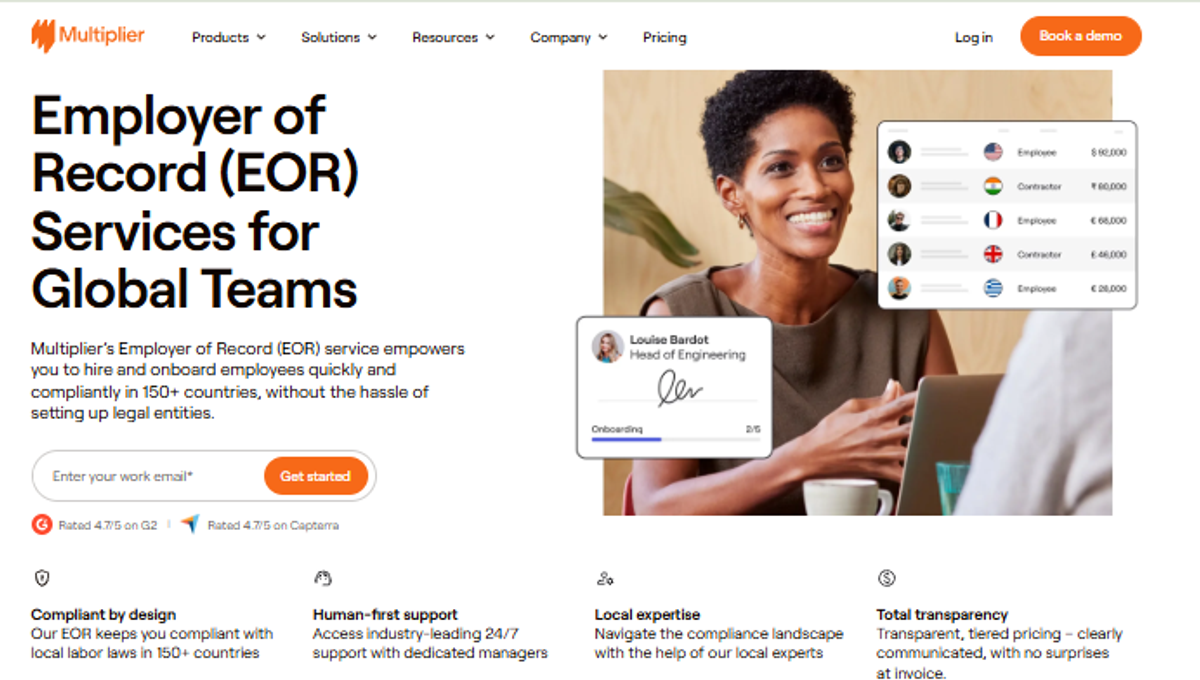
Multiplier is a global Employer of Record covering more than 150 countries, with stronger depth across Asia Pacific than most US-headquartered platforms. It sits in the middle of the market on price, below the $599 global norm but above India-only specialists.
In India, Multiplier claims coverage across all 28 states. The comparison data used for this guide records reliance on a local partner entity in India rather than a wholly owned one.
🌏 Core Services
Employer of Record across 150 plus countries
Contractor management and global payments
Global payroll processing and benefits administration
Expense management and time tracking inside the platform
Multi-currency payments with INR as the default India invoicing currency
Why Companies Consider Multiplier
The decision logic is price plus regional fit. A company hiring in India, Singapore, the Philippines, and Indonesia gets APAC depth without paying the $599 rate that Deel and Remote anchor on. At roughly $400 per employee per month, the ten-person India math lands near $48,000 a year in platform fees.
The friction tends to appear in two places. India invoicing defaults to INR, which pushes the currency conversion back onto the client's finance team. Support runs through email and CSM channels, with no published phone or chat escalation path.
👥 Ideal Customer Profile
Companies with APAC-concentrated hiring across three or more countries
20 to 200 employees globally, with 2 to 15 in India
Series A to Series C, often US or Singapore headquartered
Decision maker is the Head of HR or the COO
Buyers comparing mid-range pricing against the $599 platforms
💰 Commercial Model
Multiplier prices Employer of Record at approximately $400 per employee per month, with contractor management at $40 per contractor per month. Setup is $0, and exit requires two weeks' notice. India invoicing defaults to INR.
Onboarding runs around 7 days in the comparison data used here. FX policy is not disclosed in the source set used for this guide. For a line-by-line view of what the fee sits on top of, see our breakdown of India employer of record cost.
⭐ Customer Reviews
"CSR doesn't know the basic labor laws."
Verified reviewer Multiplier G2 Verified Review (3 stars)
🔍 How Does Versatile Compare to Multiplier?
Versatile Club employs people in India only, through its own Indian entity, Foo Falcon Technologies Pvt Ltd, and that scope stops at one country. Multiplier covers more than 150 countries and offers genuine APAC breadth that Versatile Club does not attempt to match.
Unlike Multiplier, Versatile Club issues USD invoices directly from its Indian entity rather than defaulting to INR, which keeps the conversion off the client's books. Versatile Club also writes a five business day onboarding SLA into the service agreement, and the Indian entity holding the PF, ESI, and professional tax registrations is its own rather than a local partner's. Multiplier does not state a contractual onboarding SLA or an FX policy on its own site. For companies where India concentration rather than APAC breadth drives the decision, that combination is the difference.
Looking beyond Multiplier? Our roundup of Multiplier alternatives compares it against the rest of the India EOR market.
4. Rippling: Best for Companies Consolidating HR, IT, and Device Provisioning
Overview
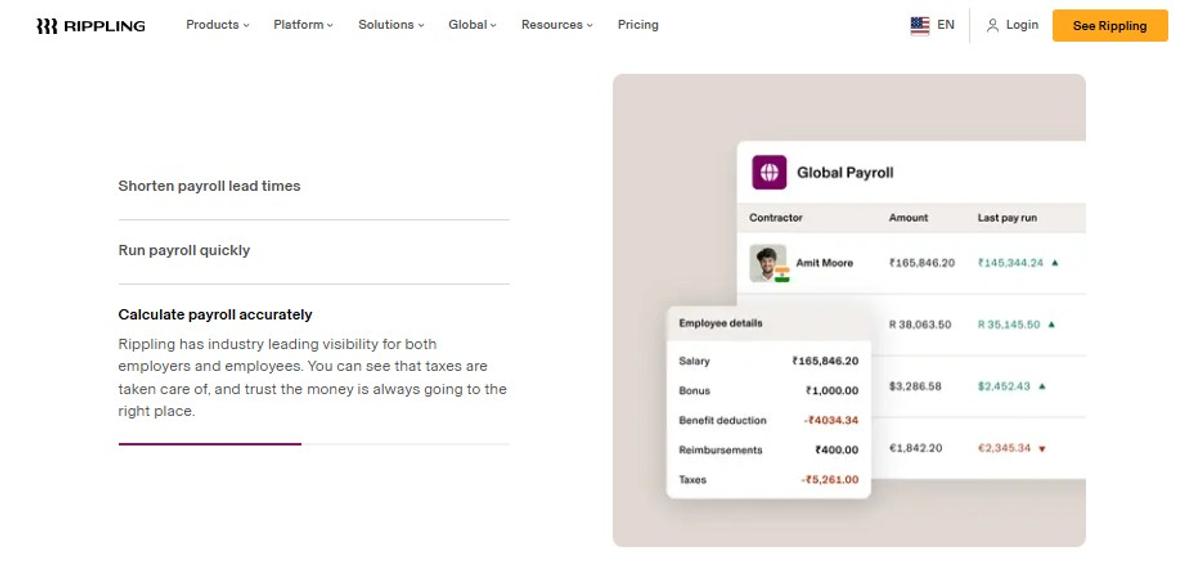
Rippling is a workforce platform that started in US payroll and HR, then added global Employer of Record across more than 90 countries. Its distinguishing feature is scope: payroll, benefits, app provisioning, and laptop management sit in one system of record.
For India hires, that means a new engineer's employment record, software access, and hardware can be triggered from a single workflow. India statutory depth is rated lower than India-only providers in the comparison set used here.
💻 Core Services
Global Employer of Record across 90 plus countries
US and global payroll in one platform
IT provisioning: app access, single sign-on, and device management
Contractor management and payments
Benefits administration and expense management
Why Companies Consider Rippling
The buying reason is usually IT, not HR. A 150-person company tired of three disconnected systems for payroll, access, and laptops will pay a premium for one. For a remote India engineer, the laptop shipping and access provisioning are real operational problems that Rippling solves inside the same record. We cover that workflow separately in our guide to equipping remote employees in India.
The cost shows up at the India line. At $500 to $600 per employee per month, Rippling prices with the global generalists, and India compliance depth is rated three stars against five for India-only providers in the matrix used for this guide. Reviews on India-specific statutory handling are thin in the source set.
👥 Ideal Customer Profile
Companies that want HR, payroll, and IT in one platform
100 to 1,000 employees globally, with 1 to 20 in India
US headquartered, Series B and later
Decision maker is the Head of IT, the COO, or the VP People
Buyers whose pain is tool sprawl rather than India compliance
💰 Commercial Model
Rippling prices Employer of Record at roughly $500 to $600 per employee per month, with contractor management at $29 per contractor per month. Setup and termination fees vary by contract. FX policy is not disclosed in the source set used for this guide.
Onboarding runs 2 to 5 days in the comparison data used here.
🔍 How Does Versatile Compare to Rippling?
Versatile Club employs people in India only, on its own Indian entity, and does not provide device management, app provisioning, or a US payroll module. Rippling's single system for payroll, access, and hardware is a real capability Versatile Club does not offer.
Unlike Rippling, Versatile Club publishes a flat $149 per employee per month with $0 setup and $0 exit, against Rippling's $500 to $600 range with setup and termination fees that vary by contract. Versatile Club also holds the PF, ESI, and Shops and Establishments registrations across all 28 states and 8 union territories under its own name, and invoices in USD from India. Rippling does not state an India FX policy or a contractual India onboarding SLA on its own site. For companies where India statutory depth rather than IT consolidation drives the decision, that combination is the difference.
Looking beyond Rippling? Our roundup of Rippling alternatives for India compares it against the rest of the India EOR market.
5. Payoneer Workforce Management: Best for Lower-Cost Global EOR with an APAC Lean
Overview
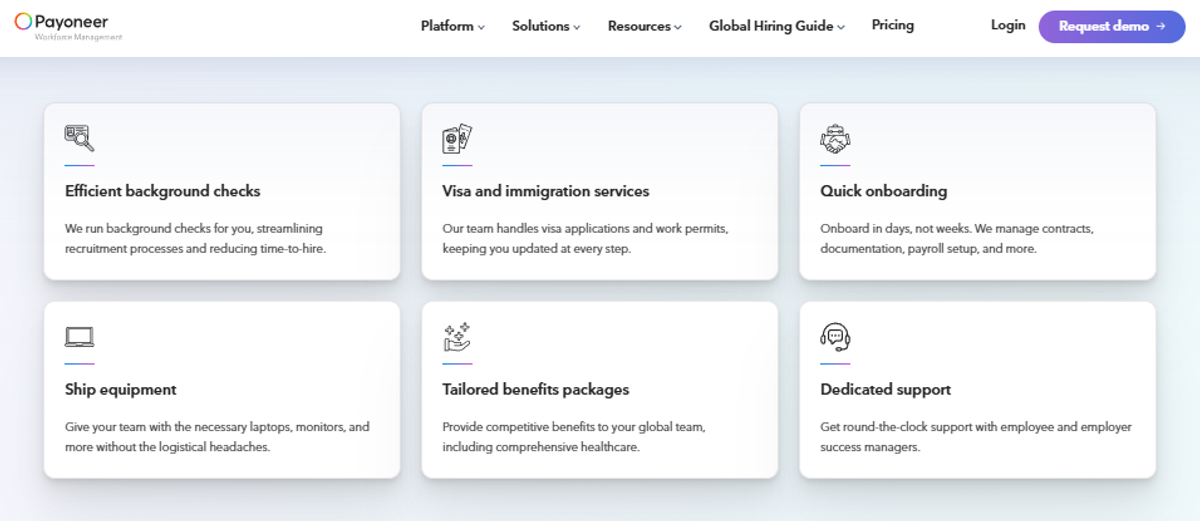
Payoneer Workforce Management is the global employment product formerly known as Skuad. It operates Employer of Record across a broad country list, with an operating history weighted toward Asia Pacific markets including India.
Its position in this list is price. At roughly $199 per employee per month, it undercuts the $400 to $599 band that most global platforms hold, while still offering multi-country coverage.
🧮 Core Services
Employer of Record across a broad multi-country footprint
Contractor management and cross-border payments
Global payroll processing and compliance documentation
Benefits administration by country
Integration with Payoneer's cross-border payments infrastructure
Why Companies Consider Payoneer Workforce Management
The logic is straightforward arithmetic. A company hiring four people across India and Southeast Asia saves meaningful money against a $599 platform without dropping to a single-country vendor. The APAC operating history also reassures buyers who have been burned by platforms that treat the region as an afterthought.
The caveat is the entity model. The comparison set used here records a hybrid partner model rather than wholly owned entities, which means the India employer on paper may be a third party. State-level India compliance detail is not published at the depth India-only providers offer.
👥 Ideal Customer Profile
Cost-sensitive companies hiring across two to six countries
20 to 150 employees globally, with 1 to 10 in India
Seed to Series B, often US or Singapore headquartered
Decision maker is the founder or the Head of Operations
Buyers who want multi-country coverage below the $400 price band
💰 Commercial Model
Payoneer Workforce Management prices Employer of Record at approximately $199 per employee per month, flat. Onboarding runs 48 to 72 hours in the comparison data used here.
Setup fees, exit fees, and FX policy are not disclosed in the source set used for this guide.
🔍 How Does Versatile Compare to Payoneer Workforce Management?
Versatile Club employs people in India only, through Foo Falcon Technologies Pvt Ltd, and does not operate in any second country. Payoneer Workforce Management offers multi-country coverage and a faster published onboarding window of 48 to 72 hours, both of which Versatile Club does not match on country count.
Unlike Payoneer Workforce Management, Versatile Club holds the Indian entity itself rather than working through a hybrid partner model, which means the PF challan, the ESI contribution, and the professional tax filing carry Versatile Club's own registration numbers. Versatile Club also commits to five business days in the signed service agreement, with a consequence attached, and invoices in USD from India. Payoneer Workforce Management does not state setup fees, exit fees, or an FX policy on its own site. For companies where entity ownership rather than country count drives the decision, that combination is the difference.
Looking beyond Payoneer Workforce Management? Our roundup of Skuad alternatives in India compares it against the rest of the India EOR market.
6. Papaya Global: Best for Finance-Led Payroll Consolidation
Overview
Papaya Global is a global payroll and payments platform with Employer of Record across more than 160 countries. Its design centre is finance, not HR: payroll consolidation, treasury movement, and reporting across many jurisdictions in one view.
In India, Papaya operates through an aggregator network, combining owned and partner capacity depending on the market. India compliance depth is rated three stars in the comparison set used for this guide.
📊 Core Services
Employer of Record across 160 plus countries
Global payroll consolidation and reporting
Cross-border payments and treasury workflows
Contractor management and payments
Workforce cost analytics for finance teams
Why Companies Consider Papaya Global
The buyer is almost always a CFO or a global payroll manager. When a company runs payroll in 18 countries through 11 local providers, month-end close becomes the problem, and Papaya's value is one consolidated payroll and payments layer.
India then arrives as one row in that consolidation. At $599 to $650 per employee per month, it sits at the top of the pricing band, and the G2 rating of 4.2 out of 5 is the lowest among the global platforms in this comparison. The aggregator model also means the India employer on paper may be a partner.
👥 Ideal Customer Profile
Enterprises and late-stage companies running payroll in 10 or more countries
250 plus employees globally, with 2 to 25 in India
Decision maker is the CFO, the Controller, or the Global Payroll Director
Buyers whose primary pain is month-end consolidation, not India hiring speed
Companies with existing in-country providers they want to replace
💰 Commercial Model
Papaya Global prices Employer of Record at approximately $599 to $650 per employee per month, with contractor management at $30 per contractor per month. Add-on fees exist for some services.
Onboarding runs 3 to 7 days in the comparison data used here. FX policy is not disclosed in the source set used for this guide.
🔍 How Does Versatile Compare to Papaya Global?
Versatile Club employs people in India only, on its own Indian entity, and does not consolidate payroll across multiple countries. Papaya Global's multi-country payroll and treasury reporting is a capability Versatile Club does not offer.
Unlike Papaya Global, Versatile Club runs India on its own entity rather than an aggregator network, and the monthly client pack includes the payroll summary, compliance status, PF and ESI challans, and TDS receipts tied to that entity. Versatile Club publishes $149 flat with $0 setup and $0 exit against Papaya's $599 to $650 band with add-on fees. Papaya Global does not state an India FX policy on its own site. For companies where one country's documentation depth rather than many countries' consolidation drives the decision, that combination is the difference.
Looking beyond Papaya Global? Our roundup of Papaya Global alternatives in India compares it against the rest of the India EOR market.
7. Globalization Partners (G-P): Best for Enterprises with Certification-Gated Procurement
Overview
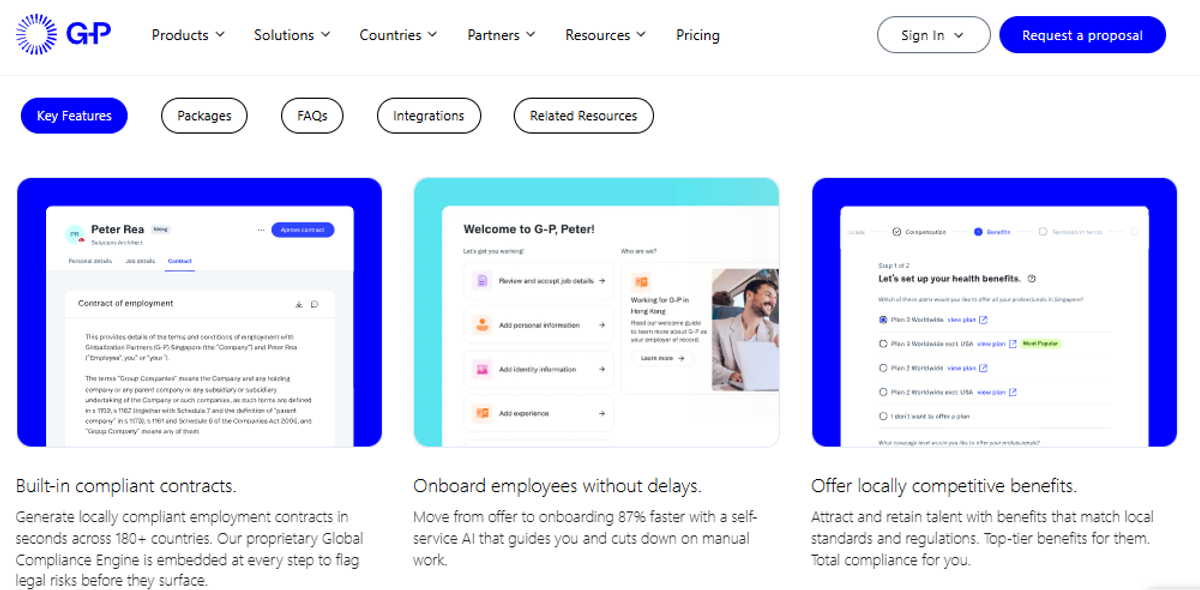
Globalization Partners, now branded G-P, is one of the oldest global employment companies, operating owned entities across more than 180 countries. It is built for enterprise procurement, with the certification set and legal infrastructure that large security reviews demand.
Its India operation sits inside that global structure. Onboarding is the slowest in this comparison at 5 to 10 days, which reflects enterprise process rather than operational weakness.
🏢 Core Services
Employer of Record with owned entities in 180 plus countries
Global employment contracts and legal advisory
Global payroll and benefits administration
Compliance monitoring across jurisdictions
Enterprise integrations and reporting
Why Companies Consider G-P
The reason is risk, not price. When procurement, legal, and security all have veto power, a vendor with owned entities in 180 countries and a full certification set clears review faster than a smaller specialist. For a Fortune 1000 buyer, that is the entire decision.
The pricing model is the trade-off. G-P charges 15% of salary with a minimum around $1,500 per month, so cost scales with compensation rather than staying flat. On a senior Bengaluru engineer at a higher band, that percentage model can cost several times a flat-fee provider. Substantial setup and termination fees also apply.
👥 Ideal Customer Profile
Enterprises with formal procurement and security review processes
500 plus employees globally, with 10 to 100 plus in India
Decision maker is a procurement lead, a CHRO, or in-house counsel
Buyers for whom SOC 2 or ISO 27001 is a hard prerequisite
Companies hiring across many countries with legal complexity per market
💰 Commercial Model
G-P prices Employer of Record at 15% of salary, with a minimum of approximately $1,500 per month per employee. Setup and termination fees are described as substantial in the comparison data used here. Contractor management is not offered.
Onboarding runs 5 to 10 days.
🔍 How Does Versatile Compare to G-P?
Versatile Club employs people in India only, through its own Indian entity, and does not hold SOC 2 Type II or ISO 27001 today. G-P's 180 plus owned entities and its enterprise certification set are real advantages Versatile Club does not match, and a procurement gate that requires those certifications should choose G-P.
Unlike G-P, Versatile Club charges a flat $149 per employee per month regardless of salary band, with $0 setup and $0 exit, instead of 15% of salary with a $1,500 minimum. Versatile Club also commits to five business days in the signed agreement against G-P's 5 to 10 day window, and holds state-level registrations across all 28 states and 8 union territories under its own name. Our published compliance coverage lists those registrations by state. For companies where flat India pricing rather than enterprise certification coverage drives the decision, that combination is the difference.
Looking beyond G-P? Our roundup of Globalization Partners alternatives in India compares it against the rest of the India EOR market.
8. Pebl: Best for Enterprise Deals Needing Custom Scope
Overview
Pebl is the global employment business formerly known as Velocity Global. It operates Employer of Record across more than 185 countries using a mix of owned entities and local partners, with commercial terms scoped per deal.
India sits inside that hybrid structure. Because pricing and coverage are negotiated rather than published, buyers cannot benchmark it without entering a sales process.
🤝 Core Services
Employer of Record across 185 plus countries
Global employment and immigration advisory
Global payroll and benefits administration
Contractor and consultant engagement
Enterprise onboarding and transition support
Why Companies Consider Pebl
The buying reason is complexity that standard plans do not fit. Companies carrying acquisitions, unusual role structures, or immigration requirements across many countries often need a scoped arrangement rather than a per-seat plan, and Pebl is built for that conversation.
The cost of that flexibility is opacity. Pricing is custom, so there is no published number to compare against a flat-fee India provider. The G2 rating of 4.3 out of 5 and the partner-and-owned hybrid entity model are the two signals available in the comparison set used here.
👥 Ideal Customer Profile
Enterprises with non-standard employment or immigration needs
500 plus employees globally, with variable India headcount
Decision maker is in-house counsel, a CHRO, or a global mobility lead
Companies integrating acquired teams across multiple countries
Buyers comfortable with a custom quote and a longer sales cycle
💰 Commercial Model
Pricing is not publicly disclosed. Pebl operates on a custom quote basis, with terms scoped per engagement.
Onboarding runs 3 to 7 days in the comparison data used here. Setup fees, exit fees, and FX policy are custom and not published.
🔍 How Does Versatile Compare to Pebl?
Versatile Club employs people in India only, on its own Indian entity, and does not provide global mobility or immigration advisory across 185 countries. Pebl's country coverage and its enterprise scoping capability are real advantages Versatile Club does not match.
Unlike Pebl, Versatile Club publishes its price before the first call: $149 per employee per month flat, $0 setup, $0 exit, and the first month free. Our pricing page carries those terms in full. Versatile Club also writes a five business day onboarding SLA into the service agreement and invoices in USD from its Indian entity. Pebl does not state India pricing, an FX policy, or an onboarding SLA on its own site. For companies where published India terms rather than custom global scoping drive the decision, that combination is the difference.
Looking beyond Pebl? Our roundup of Velocity Global alternatives in India compares it against the rest of the India EOR market.
9. Oyster: Best for Remote-First SMBs Hiring Across Several Countries
Overview
Oyster is a global employment platform built for remote-first small and mid-sized companies. Its positioning emphasises distributed hiring workflows and employee experience over enterprise procurement features.
India appears on its country list. State-level India compliance detail is not published in the source set used for this guide, which is typical of platforms covering many countries.
🌐 Core Services
Global Employer of Record across a broad country list
Contractor management and payments
Global payroll and benefits administration
Hiring and onboarding workflows for distributed teams
Country-by-country employment cost guidance
Why Companies Consider Oyster
The appeal is simplicity for small distributed teams. A 40-person remote company with one or two people in five countries wants a clean interface and country guidance, not a procurement-grade legal stack. Oyster is designed for exactly that buyer.
The limitation follows from the design. India coverage is one country among many, and the depth that multi-state professional tax, Shops and Establishments registration, and the 2025 Labour Codes demand is not published at the state level. Buyers whose India headcount is growing usually outgrow this model, which is the point at which our note on switching EOR provider in India becomes useful.
👥 Ideal Customer Profile
Remote-first SMBs hiring one to three people per country
20 to 150 employees globally, with 1 to 5 in India
Seed to Series A, often US or EU headquartered
Decision maker is the founder or the Head of People
Buyers prioritising ease of use over India statutory depth
💰 Commercial Model
India pricing is not publicly disclosed in the source set used for this guide. Oyster operates on published global plans with country-specific quotes for Employer of Record engagements.
Setup fees, exit fees, and India FX policy are not disclosed in the source set used here.
🔍 How Does Versatile Compare to Oyster?
Versatile Club employs people in India only, through its own registered Indian entity, and does not support hiring in a second country. Oyster's multi-country footprint and its onboarding interface for distributed teams are real advantages Versatile Club does not match.
Unlike Oyster, Versatile Club holds PF, ESIC, and Shops and Establishments registrations across all 28 states and 8 union territories under its own name, and states its India price publicly at $149 flat per employee per month. Versatile Club also commits to five business days in the signed service agreement. Oyster does not state India state-level coverage, an India FX policy, or a contractual onboarding SLA on its own site. For companies where India statutory depth rather than multi-country convenience drives the decision, that combination is the difference.
Looking beyond Oyster? Our roundup of Oyster alternatives in India compares it against the rest of the India EOR market.
10. Omnipresent: Best for UK and EU Headquartered Companies Hiring Globally
Overview
Omnipresent is a global employment provider with strength in UK and European employment advisory. It serves companies headquartered in those markets that are hiring across a wide country list.
In India, Versatile Club's own entity documentation records Omnipresent among the global providers that work through local partner entities rather than owning one. That is the single most relevant structural fact for an India-focused buyer.
🇬🇧 Core Services
Global Employer of Record across a broad country list
UK and EU employment contract advisory
Global payroll and benefits administration
Contractor engagement and compliance review
Onboarding and offboarding support by country
Why Companies Consider Omnipresent
The buyer is usually UK or EU based and values employment law depth in its home region. For a London company hiring across Europe plus one or two roles in India, that regional expertise is the deciding factor, and India is a secondary line item.
The India trade-off is the partner model. When the employer on paper is a third party, the client sits one step further from the PF filing, the ESI contribution, and the professional tax registration. Resolving a missing challan then runs through two organisations instead of one.
👥 Ideal Customer Profile
UK or EU headquartered companies hiring across Europe plus other regions
50 to 500 employees globally, with 1 to 10 in India
Decision maker is the Head of People or in-house counsel
Buyers who need UK and EU employment advisory first
Companies for whom India is a small share of total headcount
💰 Commercial Model
India pricing is not publicly disclosed in the source set used for this guide. Omnipresent operates on a quote basis for Employer of Record engagements.
Setup fees, exit fees, and India FX policy are not disclosed in the source set used here.
🔍 How Does Versatile Compare to Omnipresent?
Versatile Club employs people in India only, through Foo Falcon Technologies Pvt Ltd, and offers no UK or EU employment capability. Omnipresent's UK and European employment advisory is a real advantage Versatile Club does not match.
Unlike Omnipresent, Versatile Club is the legal employer in India on its own entity rather than through a local partner, so the PF, ESI, TDS, and professional tax filings carry its own registration numbers. Versatile Club also invoices in USD from India, publishes $149 flat with $0 setup and $0 exit, and writes a five business day onboarding SLA into the agreement. Omnipresent does not state India pricing or an India onboarding SLA on its own site. For companies where direct India employer accountability rather than UK and EU advisory drives the decision, that combination is the difference.
Looking beyond Omnipresent? Our roundup of Omnipresent alternatives in India compares it against the rest of the India EOR market.
⚠️ What This Table Actually Tells You
Nine of the ten providers above are good at something real. Eight of them are good at covering many countries at once. One of them does a single country, which is only an advantage if that country is where your team actually sits.
Versatile Club holds the Indian entity, the state registrations, and the filings itself, which is why the five business day onboarding commitment can sit inside a signed agreement rather than on a pricing page. For a team concentrated in Bengaluru, Hyderabad, or Pune, that is the structural difference the table is measuring. If you want the decision modelled against building your own subsidiary, run the numbers in our EOR versus entity calculator.
Q2. How did we score and rank these Deel alternatives?
Each provider was scored out of 100 on five weighted criteria: India Entity Model and Compliance Depth (25%), Pricing Transparency and Commercial Model (20%), Onboarding Speed and Support Model (20%), Talent and Retention Support (20%), and Customer Validation from G2, Capterra, and Reddit (15%). Scores convert to stars in 20-point bands, so 0 to 20 is one star and 81 to 100 is five. Entity model carries the heaviest weight because it is the only variable a buyer can verify independently, and it decides who is liable when a provident fund or TDS filing defaults in India.
The Weighting, Published Before the Verdict
| Criterion | Weight | What it measures |
| India Entity Model and Compliance Depth | 25% | Owned entity versus partner shell, state coverage, Labour Code and DPDP readiness |
| Pricing Transparency and Commercial Model | 20% | Published fee, setup, exit, FX policy, salary-band slabs |
| Onboarding Speed and Support Model | 20% | Days to a compliant start, and who answers when payroll breaks |
| Talent and Retention Support | 20% | Recruiting, contract-to-hire, onboarding monitoring |
| Customer Validation | 15% | G2, Capterra, Clutch, and Reddit evidence |
📊 Why review volume is capped at 15%
Most "best EOR" lists rank on G2 star counts. That measures dashboard polish across 100 plus countries. It does not measure whether a provider filed Karnataka professional tax on time last month, or handled a state tax audit in Maharashtra.
So customer validation stays at 15% here. It tells you whether a vendor answers emails. It does not tell you who the employer of record is on paper in India, and that is the fact a legal team actually needs.
✅ What counted as evidence
Claims were accepted only where a buyer could check them too. Four kinds of proof were used:
Entity verification: the employing company name and its Corporate Identity Number (CIN), looked up on the Ministry of Corporate Affairs master data portal.
Pricing: the number published on the provider's own site, not a number quoted in a sales call.
Onboarding SLA: a clause in a signed service agreement, not a range on a marketing page.
Reviews: verified entries on G2, Capterra, or Trustpilot, and named Reddit threads.
Where a provider does not publish something, this guide says so rather than estimating it. Several cards above read "not disclosed in the source set used for this guide" for exactly that reason. The same discipline runs through our published pricing.
⚠️ The disclosure that matters
Versatile Club publishes this list and built this rubric, which means the five-star score at position one is self-assigned. I would rather say that plainly than bury it in a footer. A score you cannot audit is marketing.
So ignore the stars on Versatile Club and check four facts instead. The entity is Foo Falcon Technologies Pvt Ltd, CIN U72900KA2022PTC163007, searchable on the MCA portal in about four minutes. The price is $149 per employee per month flat, with $0 setup and $0 exit. The onboarding commitment is five business days, written into the service agreement, and the mechanics are set out in how it works.
🔁 Re-weight it yourself
If you disagree with 25% on entity model, change it. A CFO consolidating 14 countries should probably push pricing transparency to 30% and drop entity model to 10%. The grid still works, and the ranking shifts.
That is the point of showing the weights first. Versatile Club wins this rubric because entity ownership is weighted heavily, and a buyer who weights country count instead should pick Remote or G-P.
Versatile Club scores five stars on a rubric it wrote, so treat the score as a claim and the CIN, the published flat fee, and the signed SLA clause as the evidence. Those three are checkable without talking to us.
Q3. What does Deel actually cost in India once you add setup, deposits, and FX?
Deel's India Employer of Record runs roughly $599 per employee per month, plus about a $500 setup fee. Two lines rarely reach the quote. The first is a reported 3% to 5% foreign exchange spread on every USD-to-INR payroll conversion. The second is a security deposit that can equal a full month of gross salary. On a ten-person Bengaluru team at a ₹15 lakh average cost to company, a 3% spread is roughly $5,400 a year, on top of $71,880 in platform fees, and the deposit freezes about $75,000 of working capital on day one.
The Three-Part Cost Stack
💰 What the ten-person math actually looks like
Platform fees are the visible layer. Ten employees at $599 per month is $71,880 a year, and the $500 setup is a one-time hit. Those two numbers are on the quote, so nobody is surprised by them.
The conversion spread is the layer that never appears as a line item. It appears as a rate, which is why it survives procurement. At 3% on roughly $180,000 of annual India payroll, that is $5,400 leaving the business every year with no invoice attached to it. Our breakdown of employer of record cost in India models the same stack line by line.
💸 The deposit is a treasury event, not an expense
A one-month salary deposit per employee does not show up in your profit and loss. It shows up in your cash position. For a seed-stage company with 14 months of runway, $75,000 parked with a vendor is a real decision, not an accounting footnote.
Six years of invoicing US and UK clients from India taught me that currency markup is where margin hides. Versatile Club's own read is that this is the single most under-audited line in India EOR procurement, and I might be weighting it too heavily, but every finance lead I have shown the arithmetic to has gone quiet for a second.
⏰ The six-point sample invoice audit
Ask any vendor for a populated sample invoice at your actual salary band before you sign. Not a pricing page. An invoice. Then read it for six things:
Setup or implementation fee, stated as a number, not "varies".
Security deposit, and the conditions for getting it back.
FX conversion rate applied, compared against the mid-market rate that day.
Exit or notice fee, including how many days of notice trigger it.
Benefits administration markup, often buried inside a benefits line.
Off-cycle payroll charge, which bites during final settlements.
Then check one more thing on the India-side invoice: the Invoice Reference Number (IRN) and QR code. Under Rule 48(5) of the CGST Rules, an invoice that should carry an IRN and does not is not a valid tax invoice, and your input tax credit on it fails. We cover the rest of the filing calendar in our guide to payroll compliance in India.
⭐ What buyers report
"Implementation was a complete nightmare."
Verified reviewer Deel G2 Verified Review (2 stars)
"Support slow during high traffic."
Verified reviewer Deel G2 Verified Review (3 stars)
"First USD invoice landed clean: no FX markup, no setup fee, no surprises."
Verified User in Information Technology and Services Versatile G2 - Verified User Review (5 stars)
✅ One habit that prevents most of this
After every vendor call, send a same-day email recapping what was agreed on fees. Not because people lie, but because sales memory and billing systems disagree. That email is the document you will want in month four.
Versatile Club invoices in USD directly from its Indian entity, which removes the conversion event rather than discounting it. There is no spread to disclose because there is no second currency leg on your side. The terms are $149 flat, $0 setup, $0 exit, no security deposit, and a populated sample invoice sent before signature. If you are already on Deel, our Deel alternative page sets the two side by side.
Q4. Does your Deel alternative own its Indian entity, or rent one?
Most global Employer of Record platforms do not employ your India team directly. They contract a local Indian partner entity, which becomes the employer on paper, inserting a layer between you and the provident fund, ESI, and TDS filings you remain exposed to. Versatile Club does not work this way. The employee is hired by Foo Falcon Technologies Pvt Ltd, its own registered Indian company, and every statutory filing carries its registration numbers. Verify any vendor in four minutes: ask for the employing entity's name and Corporate Identity Number in writing, then look it up on the MCA master data portal.
Two Models, Plainly Defined
🏢 Owned entity versus partner shell
An owned-entity model means the provider has its own Indian company, with its own Employees' Provident Fund Organisation (EPFO) code, its own ESI registration, and its own Shops and Establishments registrations. Your employee's contract names that company.
A partner model means the provider sells you the service and subcontracts the employment to a third-party Indian company. You pay vendor A. Vendor B is your employee's legal employer. Both can work, but they are not the same purchase. Our note on hiring in India without an entity walks through what each model means on paper.
⚠️ Three consequences of a rented entity
The differences show up on ordinary operating days, not in theory:
Administrative latency. A missing challan query travels client to vendor A to vendor B and back. Two organisations, two queues, one payroll deadline.
Secondary audit exposure. If the partner entity mishandles a filing, the assessment lands on an entity you have no contract with and no visibility into.
Narrower state coverage. Partner-backed providers typically cover the largest states. Comparison data used for this guide records Deel at around the top six states and Remote at around the top four, against all 28 states and 8 union territories for India-only providers.
🔍 This ground is contested, so verify it yourself
Here is where I will not pretend the evidence is clean. One competitive analysis in Versatile Club's research set tags Deel and Remote as owning their entities in major markets. Versatile Club's own entity documentation records Deel, Remote, G-P, and Omnipresent as using local partner entities specifically in India.
Both claims cannot be true. Rather than pick a side, do the four-minute check. Ask the vendor, in writing, for the name and CIN of the company that will appear on your employee's contract. Then search that CIN on the MCA portal and the establishment search on the EPFO and ESIC portals.
✅ What the check tells a legal team
A vendor that answers with one company name and one CIN is giving you a clean liability chain. A vendor that answers with "our local partner" has given you the answer too, just less comfortably.
Versatile Club's read is that the category avoids this question because the answer is awkward for most of it. India is the only country we operate in, so there is no partner to route around, and the registrations are listed on our compliance page.
🗺️ Where state depth actually comes from
Multi-state professional tax is not one rule. Maharashtra needs dual PTRC and PTEC registration. Karnataka runs a monthly cycle with Shops and Establishments renewal inside 30 days. Tamil Nadu files twice a year, and West Bengal changes its rules often enough that last year's calendar misleads you.
Versatile Club learned those cycles running real Contract-to-Hire payroll across Bengaluru, Hyderabad, and Pune, before Employer of Record existed as a service line here. The entity and the registrations came first, which is the honest version of the story. If you are weighing an entity of your own instead, the EOR versus entity comparison covers that path.
Versatile Club's entity is Foo Falcon Technologies Pvt Ltd, CIN U72900KA2022PTC163007, Bengaluru, with PF, ESIC, and Shops and Establishments registrations across all 28 states and 8 union territories. The filings carry those numbers, which is why the liability chain has one link instead of two.
Q5. What does an India hire really cost under the 2025-26 Labour Codes and the new EPFO ceiling?
The EOR fee is the small number. Under the four Labour Codes in force since 21 November 2025, Basic plus Dearness Allowance must be at least 50% of total cost to company, which widens the base under every statutory charge. Employer provident fund runs at 12% of Basic plus DA, Employees' State Insurance at 3.25% where applicable, and gratuity accrues at 4.81% of Basic plus DA from month one. The EPFO wage ceiling moved from ₹15,000 to ₹25,000 effective 17 September 2026, so junior-band hires that were optional coverage are now mandatory.
The Wage Split Changes Every Older Quote
⚠️ Why pre-November-2025 arithmetic is stale
Indian salary structures used to load allowances to keep Basic low, which kept provident fund and gratuity low with it. The Code on Wages ended that, notified through Gazette S.O. 5322(E) on 21 November 2025 alongside its three companion notifications.
So a quote built on a 30% Basic structure understates your real cost. The fix is not complicated. Rebuild the structure at 50% Basic plus DA, then recompute the statutory layer on that wider base. Our breakdown of the cost of hiring in India works through the same rebuild.
💰 The four statutory charges, with formulas
| Charge | Rate | Base | Timing |
| Employer EPF | 12% | Basic plus DA | Monthly with EPFO |
| ESI (employer) | 3.25% | Gross wages | Monthly, employee adds 0.75% |
| Gratuity accrual | 4.81% | Basic plus DA | Accrues from month one |
| Professional tax | State slab | Gross | Varies by state |
Gratuity pays out after five years of continuous service, calculated as monthly wage divided by 26, multiplied by 15, multiplied by completed years. Late payment carries 10% simple interest a year under Section 7(3A) of the Payment of Gratuity Act 1972.
⏰ TDS and the forms that just changed
Tax deducted at source under Section 192 is deducted monthly and deposited by the 7th of the following month. The annual certificate used to be Form 16. Under the Income-tax Act 2025, Form 130 replaces it, and Form 138 replaces the quarterly Form 24Q.
Here is a quick vendor test. Ask for a specimen Form 130 and a Form 138 statement. A provider still circulating Form 16 templates in 2026 has not migrated its filing practice, and that tells you something about the rest of it. The managed payroll calendar carries both forms.
🗺️ Professional tax is not one rule
Professional tax is a state levy, and the calendar changes with the city your engineer sits in:
Maharashtra: dual PTRC and PTEC registration, monthly slab filing.
Karnataka: monthly cycle, with Shops and Establishments renewal inside 30 days. Our Bengaluru payroll guide details that cycle.
Tamil Nadu: twice a year, plus Labour Welfare Fund.
Telangana: PTRC enrolment required, as covered in our Hyderabad payroll guide.
Delhi: no professional tax, but strict Shops and Establishments compliance.
✅ The DPDP clauses your contract needs now
Your EOR holds Aadhaar, PAN, and bank data for your team, which makes it a data processor. The DPDP Rules 2025 were notified as G.S.R. 846(E) on 13 November 2025. Three obligations belong in the contract today, even though the main rules commence in May 2027.
Rule 6 covers security safeguards. Rule 7 requires breach intimation to affected people, plus a detailed report to the Board within 72 hours. Rule 9 requires a named contact who answers data principal requests. Those three clauses sit inside our compliance documentation.
📄 One habit that saves a Controller's week
Ask your provider for a monthly pack, not a monthly invoice. The pack should let you tie a provident fund challan back to a line in the payroll register without an email thread.
Versatile Club structures every offer so Basic plus DA clears the 50% threshold before a candidate sees a number, and uses employer NPS under Section 80CCD(2) to lift take-home for senior hires without raising your outlay. The monthly pack includes the payroll summary, compliance status, PF and ESI challans, and TDS receipts. To model a single offer end to end, use the salary calculator.
Q6. Should you unbundle India from your global EOR, or build your own entity?
Keep the global platform when you have one or two scattered hires across ten or more countries and genuinely need a single dashboard. Unbundle India to a native specialist once India becomes a concentrated hub of three or more hires. A ten-person India team costs about $71,880 a year at $599 per head, against $17,880 at a flat $149, which is a 75% to 85% cut in platform spend with wider state coverage rather than narrower. Incorporate your own Indian entity above roughly twelve to fifteen India employees, when the $15,000 to $100,000 and three to six month setup finally amortises.
The Unit of Decision Is the Country, Not the Vendor
🌍 When the generalist earns its price
A global platform is the right call when your hiring is genuinely scattered. One person in Greece, one in Brazil, one in Poland, and one in India is four legal systems, and nobody wants four vendors for four people.
That is a real job, and the $599 price buys a real thing. I tell prospects in that position to keep what they have, because unbundling one hire out of four saves almost nothing and adds a vendor.
💸 When India should be carved out
The maths flips when India stops being scattered. Three hires in Bengaluru is a hub, not a scatter, and a hub does not need a 150-country dashboard.
Think of an Employer of Record as a light bridge rather than a permanent one. It carries traffic in days instead of months, which is exactly what you want while you are still learning whether the India team works. Our India expansion options guide sets the three routes beside each other.
🏗️ What incorporating actually costs
The subsidiary path is sold as the grown-up option. It is, eventually. Here is the stack you take on:
Setup: $15,000 to $100,000 and three to six months before anyone starts.
Ongoing: statutory audit, MCA annual filings, and a resident director.
FEMA reporting: FC-GPR filing on the RBI FIRMS portal for every inbound capital tranche.
Permanent establishment: the tax nexus question your counsel will raise, and should.
📊 The crossover, laid out
| India headcount | Likely right answer | Why |
| 1 to 2, scattered globally | Keep the global platform | One dashboard genuinely helps |
| 3 to 12, India-concentrated | India specialist | Platform spend drops, state coverage widens |
| 12 to 15 plus, long horizon | Own entity plus payroll partner | Fixed costs amortise |
NASSCOM's Strategic Review 2026 puts India's tech workforce at 5.95 million, with 53% of global capability centres already at portfolio or transformation stage. If your India plan is a capability centre rather than four engineers, plan the entity path from the start, and our GCC setup guide covers that sequence.
⚠️ The part most vendors will not say
Offshore hiring is a talent decision before it is a cost decision. The reason to hire in Bengaluru is the depth of the engineering bench, and the cost difference is a byproduct.
Versatile Club's read is that the standard advice gets this backwards, and I will take that further: an EOR that cannot tell you when to leave is optimising for its own retention. At twenty heads with a five-year India plan, incorporate. Run your own numbers in the EOR versus entity calculator before you commit either way.
Versatile Club charges no exit fee, which is the only honest way to give that advice. If you incorporate, you leave without a termination charge, and we run the parallel payroll while your own PF and ESI registrations come through. If you need Brazil and Poland too, keep your global platform for those.
Q7. How do you switch off Deel without breaking payroll, and which alternative fits you?
Plan six to twelve weeks and never cut over mid-cycle. Export contracts, payslips, provident fund challans, and TDS filings before you serve notice. Run one parallel payroll cycle, then transfer provident fund with Universal Account Number continuity so service history survives the change of employer. Reconcile the final invoice and recover the security deposit, which is the step most teams forget. Do not downgrade core engineers to contractors to simplify the move, because in substance that is employment, and the exposure is backdated tax, penalty, and interest.
The Twelve-Week Sequence
📄 Weeks 1 to 4: documents before notice
Pull everything while you are still a paying customer. That means signed contracts, twelve months of payslips, PF challans, ESI records, and TDS filings per employee.
Then check your exit clause before you send anything. Remote requires one month of notice, and Multiplier requires two weeks, so the notice date drives the whole calendar, not the other way round. Our step-by-step note on switching EOR provider in India lists the documents by week.
⏰ Weeks 5 to 12: parallel run and PF continuity
| Week | Action |
| 5 to 6 | New contracts signed, employees briefed in writing |
| 7 to 8 | One parallel payroll cycle on both providers |
| 9 to 10 | PF transfer via online Form 13 on the EPFO member portal |
| 11 to 12 | Full and final settlement, deposit recovery, Form 130 handover |
The UAN transfer is the step employees care about most. It keeps one continuous provident fund record instead of two orphaned ones.
❌ Do not solve this with contractor agreements
The shortcut is tempting. Move everyone to contractor paperwork, skip the statutory transfer, and call it done. Then an incoming People Ops lead reads the arrangement and realises those people are employees in substance. The distinction is set out in our comparison of an independent contractor versus an EOR.
The cost is not just tax. I watched an engineer get declined for a mortgage because contractor income had no provident fund record and no Form 16 behind it. He got the loan after moving onto a real payroll, which is the same path described in our guide to converting a contractor to an employee in India.
⭐ What switchers report
"Founder is just a call away. Extremely helpful in resolving all our queries. The process is super smooth to setup India EOR."
surbhi m., Founder Versatile G2 - surbhi m. Verified Review (5 stars)
"The team is really competent, but there were a few time zone misunderstandings that caused slight delays in the initial phase."
Setu C. Versatile G2 - Setu C. Verified Review (5 stars)
"Horrible service if you have any issues. No way to call them."
Verified reviewer, May 2026 Remote Trustpilot Verified Review (2 stars)
✅ Which alternative fits you
| Your situation | Where to look |
| Founder, 1 to 3 India hires, no entity | India specialist with published flat pricing |
| People Ops, 10 to 100 India employees | India specialist with named support and state coverage |
| CFO, $5M to $50M ARR, 5 to 30 in India | Provider issuing one USD invoice with challans attached |
| Hiring across 10 plus countries | Keep a global platform such as Remote or G-P |
| SOC 2 or ISO 27001 as a procurement gate | G-P, Rippling, or Papaya Global |
Versatile Club runs each migration on a five business day onboarding SLA written into the agreement, with the first month free, which is designed to cover your parallel-run month so you are not paying two vendors to de-risk the switch. We hold no SOC 2 or ISO 27001 today, so a certification gate should rule us out. If India is your concentration, message me on WhatsApp and tell me what you are building, or book a 30-minute call and bring your current invoice. For a side-by-side on the incumbent, our Deel alternative page has the fact table.
FAQs
What are the best Deel alternatives in India in 2026?
The ten alternatives we assessed for India-focused hiring are Versatile Club, Remote, Multiplier, Rippling, Payoneer Workforce Management, Papaya Global, Globalization Partners, Pebl, Oyster, and Omnipresent.
They split into two groups, and the split matters more than the ranking:
- Global generalists such as Remote, Rippling, G-P, Papaya Global, and Pebl, which cover 90 to 185 countries at roughly $400 to $650 per employee per month, or 15% of salary in G-P's case.
- India-focused providers, which employ on an Indian entity and price per employee rather than per country footprint.
Versatile Club sits in the second group and operates in India only, employing through its own registered Indian company, Foo Falcon Technologies Pvt Ltd, with provident fund, ESI, TDS, and professional tax filed under its own registrations across all 28 states and 8 union territories.
Our honest read is that there is no universal winner. If you hire one person each in ten countries, a generalist earns its fee. If India is where your next ten hires sit, a specialist wins on entity ownership and landed cost. We set out the full criteria in our guide to the best EOR providers in India.
How much does Deel actually cost in India compared with India-native alternatives?
Deel's India Employer of Record runs roughly $599 per employee per month, plus about a $500 setup fee. Two further lines rarely appear on the quote.
- A reported 3% to 5% foreign exchange spread on every USD to INR payroll conversion, which shows up as a rate rather than a line item.
- A security deposit that can equal a full month of gross salary per employee.
On a ten-person Bengaluru team at a ₹15 lakh average cost to company, that is about $71,880 a year in platform fees, roughly $5,400 a year in conversion spread, and about $75,000 of working capital frozen on day one.
India-native pricing sits well below that band. Versatile Club charges $149 per employee per month flat with no salary slabs, $0 setup, $0 exit, no security deposit, and the first month free, and invoices in USD directly from its Indian entity so there is no conversion leg on your side.
Before signing with anyone, ask for a populated sample invoice at your actual salary band and read it for setup fee, deposit, FX rate applied, exit fee, benefits markup, and off-cycle payroll charges. Our breakdown of employer of record cost in India models each line.
Does Deel own its Indian entity, and why does that matter?
The evidence here is contested, which is exactly why we tell buyers to verify it rather than trust either side. One competitive analysis in our research set records Deel and Remote as owning entities in major markets. Our own entity documentation records Deel, Remote, G-P, and Omnipresent as working through local partner entities specifically in India.
It matters because of three operating consequences:
- Administrative latency. A missing challan query travels from you to the platform to the partner and back, through two queues and one payroll deadline.
- Secondary audit exposure. If a partner mishandles a filing, the assessment lands on a company you have no contract with.
- Narrower state coverage. Partner-backed providers typically cover the largest states rather than all 28.
The check takes four minutes. Ask, in writing, for the name and Corporate Identity Number of the company that will appear on your employee's contract, then search that CIN on the Ministry of Corporate Affairs portal and the EPFO and ESIC establishment search.
Versatile Club's answer is one company and one CIN: Foo Falcon Technologies Pvt Ltd, U72900KA2022PTC163007. Our note on hiring in India without an entity explains how each model works on paper.
How do we switch from Deel to another EOR in India without breaking payroll?
Plan six to twelve weeks, and never cut over mid-cycle. The sequence that works looks like this.
- Weeks 1 to 4. Export signed contracts, twelve months of payslips, PF challans, ESI records, and TDS filings while you are still a paying customer. Check the exit clause first, because notice periods drive the calendar.
- Weeks 5 to 8. Sign new contracts, brief employees in writing, and run one parallel payroll cycle on both providers.
- Weeks 9 to 10. Transfer provident fund using online Form 13 so Universal Account Number continuity is preserved and service history survives the change of employer.
- Weeks 11 to 12. Complete full and final settlement, reconcile the final invoice, recover the security deposit, and collect the Form 130 handover.
Do not downgrade core engineers to contractor paperwork to simplify the move. In substance that is employment, and the exposure is backdated tax, penalty, and interest, plus a real human cost when an employee without a PF record is declined for a mortgage.
Versatile Club runs each migration on a five business day onboarding SLA written into the agreement, with the first month free, which is designed to cover your parallel-run month. The full checklist sits in our guide to switching EOR provider in India.
When should we stop using an EOR in India and set up our own entity?
Our rule of thumb is headcount plus horizon.
- One to two India hires, scattered globally. Keep your global platform. Unbundling one hire out of four saves almost nothing and adds a vendor.
- Three to twelve India hires, concentrated. Move India to a specialist. Platform spend drops sharply and state coverage usually widens rather than narrows.
- Twelve to fifteen plus, with a multi-year plan. Incorporate. The fixed costs finally amortise.
Incorporating is not only the setup cost of $15,000 to $100,000 and three to six months before anyone starts. It is the permanent overhead: statutory audit, MCA annual filings, a resident director, FC-GPR reporting on the RBI FIRMS portal for every inbound capital tranche, and the permanent establishment question your counsel will raise.
Versatile Club charges no exit fee, which is the only honest way to give this advice, and we run the parallel payroll while your own PF and ESI registrations come through. An EOR that cannot tell you when to leave is optimising for its own retention rather than your profit and loss. Compare both paths in our EOR versus entity in India analysis.