Table of contents (12)
Deel vs Remote: Pricing, Compliance, FX, and Scalability Compared for Teams Hiring in 2026
Q1. Deel vs Remote: which should you actually choose in 2026?
A CFO at a Boston analytics company shared her screen with me in August. Two tabs open, Deel and Remote, both quoting around $599 per employee per month. Nine India engineers already hired. Her question was not which platform had the better dashboard. It was why her month-end close took three days longer than it used to.
Choose Deel for contractor-heavy rosters and reach across 130 to 160+ countries from one dashboard with 110 to 130 integrations. Choose Remote for owned entities across 90+ countries, IP protection by default, and $29 contractor seats against Deel's $49. Both sit near $599 per employee monthly on annual billing, so the decision turns on entity model and FX terms, not features. If 60% or more of your headcount sits in one country, neither is the cost-efficient answer.
⭐ The three criteria that actually move this decision
Setup fee comes first because it is the only number you pay before you learn anything. Deel charges $500 on its published pricing page, and Remote charges $299 on its own pricing page.
FX comes second, and it is the one neither vendor publishes. Entity model comes third, and it decides who signs your engineer's employment contract in India. Everything else on the comparison pages is noise dressed as a feature matrix. If you want the India-specific version of this decision, our EOR services in India page sets out the same three criteria against Indian statutory reality.
💰 Scenario table: what fits what
| Your situation | Best fit | Why |
| 20+ contractors across many countries | Deel | $49 per contractor, widest country list, 110 to 130 integrations |
| Owned-entity preference, IP protection first | Remote | 90+ owned-entity countries, $29 contractor seats, $299 setup |
| 5+ full-time employees concentrated in India | Versatile Club | Owned Indian entity, $149 per employee monthly, no setup or exit fee |
| Hires scattered across 10+ countries | Deel or Remote | India-only providers including Versatile Club cannot serve this |
Versatile Club appears in that table on one row only, and that is deliberate. We operate in India and nowhere else, which is why buyers comparing us land on the Deel alternative and Remote alternative pages rather than a global coverage map.
⚠️ What buyers say after the first quarter
"I find Deel easy to use... The initial setup was straightforward... I find Deel to be absurdly expensive. They charge a high amount of fees for transferring money to my bank account."
— Juan Camilo O., Verified User Deel Hire - G2 Verified Review, 1/5, 27 November 2025
"I like the all-in-one structure of Remote... They were dishonest about the level of support provided. We specifically explained we required phone-level support for urgent matters, but that is not available. Instead they have email support with a 3-day SLA."
— Juliette D., Verified User Remote - G2 Verified Review, 0.5/5, 22 April 2026
Both reviews follow the same shape. The product works. The money and the support do not. Across six years of running Contract-to-Hire placements in Bengaluru, Hyderabad, and Pune, I have never seen a vendor decision fail in month one. It fails in month seven, when Finance cannot reconcile the invoice and nobody picks up the phone.
✅ Where Versatile Club sits
Versatile Club does not compete on country count, because we operate in one country. India. Employment runs through Foo Falcon Technologies Pvt Ltd, our own registered Indian entity, at $149 per employee monthly, with no setup fee and no exit fee. If you need five countries, buy Deel or Remote. If India is your engineering hub, read on.
Q2. What do Deel and Remote actually cost once every line item is on the invoice?
EOR lands at $599 per employee monthly for both vendors on annual billing, with Remote at roughly $699 on monthly terms. Setup is $500 at Deel against $299 at Remote. Contractors run $49 versus $29, Contractor of Record $325 at both, global payroll around $29, US PEO $125 versus $99, per Deel's pricing page and Remote's pricing page. Deel also holds a security deposit of roughly one month's salary and adds $50 to $150 monthly surcharges in complex markets including India. Versatile Club charges $149 per employee monthly with no setup fee and no deposit.
💸 The annual billing trap
The $599 you read on a comparison page is the annual-commitment rate. Pay monthly and Remote moves to roughly $699. That is $1,200 extra per employee per year for the right to leave.
Both vendors also require one month's exit notice. The flexibility you paid the monthly premium for does not actually exist at the contract level. Our pricing page carries no annual-commitment tier for exactly this reason.
⭐ Line items side by side
| Item | Deel | Remote | Versatile Club |
| EOR, annual billing | ~$599 | $599 | $149 |
| EOR, monthly billing | ~$599 | ~$699 | $149 |
| Setup fee | $500 | $299 | None |
| Contractor per month | $49 | $29 | Not offered |
| Contractor of Record | $325 | $325 | Not offered |
| Security deposit | ~1 month salary | None | None |
| India surcharge | $50 to $150 | Not published | None |
| Exit notice | 1 month | 1 month | No exit fee |
Pricing verified against both vendors' public pricing pages in October 2026. Versatile Club figures are our own published terms, and the per-head arithmetic behind them is broken down in our guide to employer of record cost in India.
⏰ The five lines buyers miss
Setup fee, charged before a single payslip runs.
Security deposit, which sits on your balance sheet as a receivable for the life of the contract.
Benefits markup, usually a percentage on top of the insurance premium.
FX spread, embedded in the rate rather than charged as a fee.
Exit notice, one more month of subscription after you have decided to leave.
At 20 full-time employees, the subscription alone runs $143,760 a year. That is before any of the five lines above.
⚠️ What reviewers notice about the money
"I find the pricing of Deel to be quite terrible for me... Now, I'm required to pay a monthly fee, which I don't like at all. The initial setup process was also very challenging; it took several days and involved a lot of emails."
— Verified User in Translation and Localization Deel Hire - G2 Verified Review, 0.5/5, 31 July 2025
"I appreciate the ease of setup with Deel; it took me only a few minutes... I dislike how expensive Deel's transaction fees are, especially when moving money from the Deel account to my bank."
— Maria M., Verified User Deel Hire - G2 Verified Review, 3/5, 26 September 2025
✅ The one procurement move I give every buyer
Ask for a real anonymised invoice before you sign. Count the line items. Four or fewer means the markup is bundled inside the platform fee, where you cannot negotiate it.
Versatile Club invoices in USD directly from its Indian entity, itemised: platform fee, gross salary, employer PF at 12%, ESI, gratuity accrual at 4.81%, and professional tax. One invoice, one entity, one currency, and the first month is free. Our clients reconcile it in a single pass at month end, because there is nothing hidden to chase, and the full process sits on our how it works page.
Q3. Why does an unpublished FX rate cost more than the $599 line?
Neither Deel nor Remote publishes the exchange rate applied to your India payroll remittance. Reported Deel markups range from 0.6% to 2% in some audits and 3% to 5% in others, never itemised on the invoice, because the cost is embedded in the rate rather than charged as a fee. Remote shows an applied monthly rate after the fact without quoting a spread. Versatile Club invoices in USD from its own Indian entity, so the rupee conversion sits on our side of the transaction.
💰 Why a fee you can see is cheaper than a rate you cannot
Everyone negotiates the $599. Nobody negotiates the rate, because nobody sees it.
A fee appears on a line item with a number next to it. A spread appears nowhere. It is the difference between the rate your provider got from its bank and the rate it applied to your payroll, and that difference lands inside the rupee amount your engineer receives. The mechanics of the remittance itself are covered in our walkthrough on how to pay employees in India.
💸 The arithmetic nobody puts on a comparison page
Take a $1.2M annual India payroll, which is roughly 12 engineers at a senior Bengaluru salary.
| Spread applied | Annual cost to you | Equivalent in EOR seats |
| 0.6% | $7,200 | 1 seat at $599 per month |
| 2% | $24,000 | 3.3 seats |
| 3% | $36,000 | 5 seats |
| 5% | $60,000 | 8.3 seats |
At 3%, the invisible cost exceeds the entire setup fee in the first month and keeps running forever. The Reserve Bank of India publishes a daily USD/INR reference rate, which is the only neutral benchmark available. Versatile Club uses that published rate as its reference point, and I will say plainly that this is the single comparison most buyers skip.
Versatile Club's own data points to spreads clustering at the lower end for large volumes, closer to 1%, though I might be reading our sample too strongly. We see what clients bring us when they switch, which is a biased sample of unhappy accounts.
What I am confident about is the structure. A cost embedded in a rate is a cost outside your procurement process.
✅ The clause to demand before signing
Ask for three things in writing, in the contract and not in an email:
The named benchmark, for example the RBI reference rate or the interbank mid-market rate.
The timestamp at which it is read, for example 1pm IST on the remittance date.
The spread applied to it, expressed as a percentage.
Any vendor that supplies all three has given you a number you can audit. Any vendor that supplies none has given you a variable you will carry for the life of the contract. Buyers already mid-contract usually start with our guide on how to switch EOR provider in India.
Versatile Club invoices in USD from a single Indian entity at an agreed rate. There is no conversion spread for you to discover later, because managing the rupee leg is our job and not your treasury's.
Q4. Do Deel and Remote own the entity that employs your India hire?
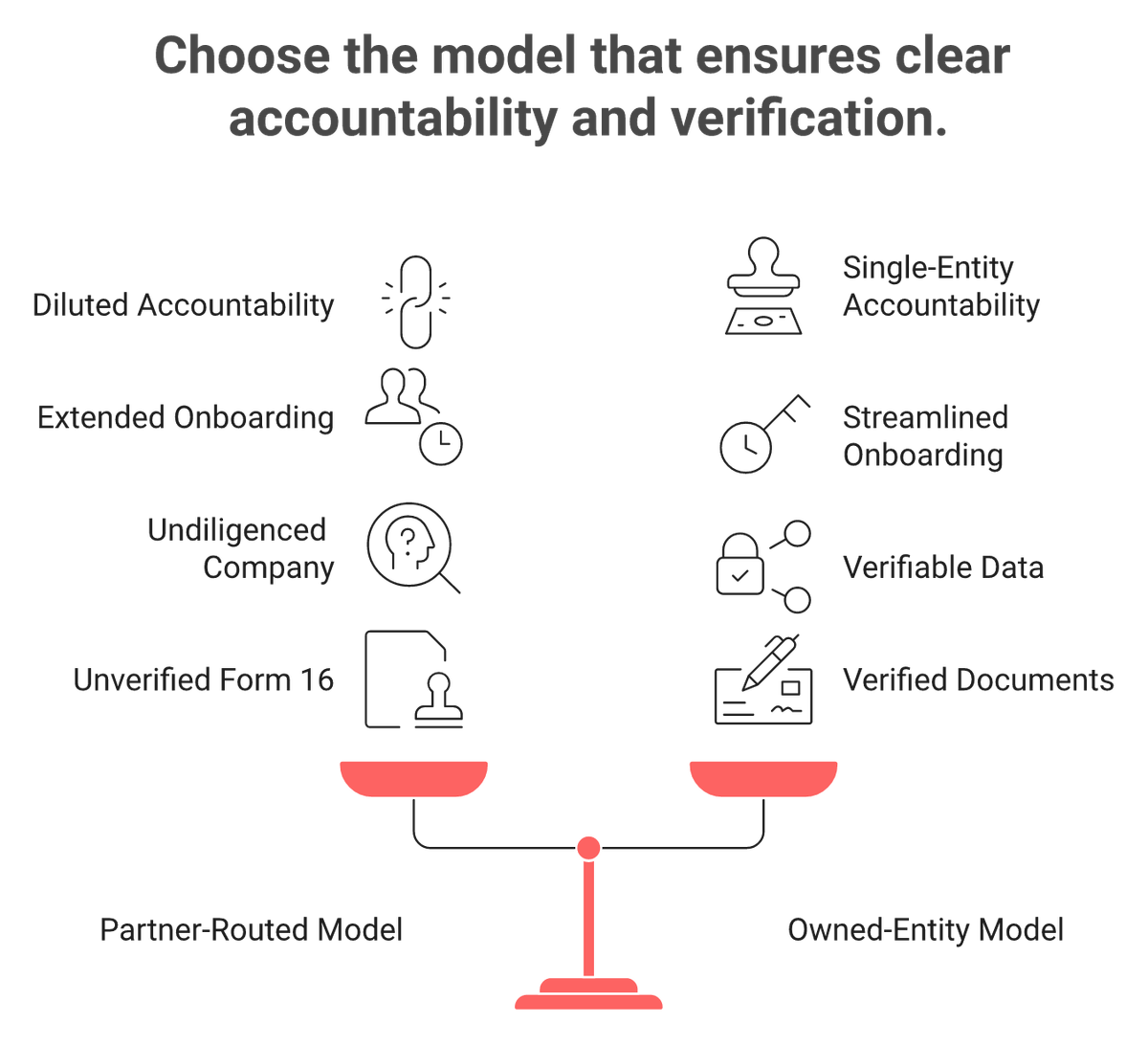
Remote markets 100% owned entities with no third-party handoffs across its 90+ EOR countries. Deel reaches 130 to 160+ countries through a hybrid of owned entities and vetted local partners. In India specifically, global providers including Deel, Remote, G-P, and Omnipresent commonly route employment through local partner entities, which means the company named on your engineer's Form 16 is one you never contracted with. Versatile Club employs through Foo Falcon Technologies Pvt Ltd, CIN U72900KA2022PTC163007, verifiable on the MCA company master data portal.
⚠️ The contradiction I am not going to resolve for you
Vendor comparison matrices tag both Deel and Remote as owned-entity providers. India operators, including Versatile Club, report partner routing in India specifically.
Both statements can be true at once. A provider can own its entity in Germany and rent one in India. That is why the honest question is never "do you own entities" but "which entity signs this contract, in this country". The structural difference between those two models is unpacked in our comparison of EOR vs entity in India.
⭐ What partner routing actually changes
Indemnity chain. Your agreement is with the platform. Your engineer's employment agreement is with a partner. If a labour dispute arises, there are two contracts between you and the problem.
Onboarding latency. Every document moves through an extra organisation. This is where the 7 to 14 day timelines come from.
Data handoffs. Aadhaar, PAN, and bank details pass to a company you have not diligenced.
Whose PF code. The Provident Fund challan is filed under the partner's establishment code, not the platform's.
Versatile Club files PF, ESI, TDS, and professional tax under its own registrations, which is why we can hand a client the establishment code and let them look it up on the EPFO establishment search themselves. The full register sits on our compliance page.
✅ What buyers report about the setup experience
"The initial setup was not easy at all; it was a very long process with no help and too many requests."
— Alice T., Verified User Remote - G2 Verified Review, 0/5, 20 March 2026
"The platform remains easy to navigate and technically reliable... contacting support did not lead to effective problem solving. I was redirected multiple times, asked to repeat the same information to different representatives."
— Güneş A., Verified User Deel Hire - G2 Verified Review, 1.5/5, 2 October 2025
Being redirected repeatedly is often what a partner-entity chain feels like from the outside. The person answering your ticket genuinely does not have the answer, because the filing is not theirs.
💰 The three documents to request
The draft employment agreement, with the employing entity's legal name and CIN on it.
The EPFO establishment code under which PF will be filed.
The state Shops and Establishments registration for your hire's city.
Versatile Club supplies all three before a contract is signed, because they are our own documents. Ask any shortlisted vendor for the same set, and notice how long the answer takes. If you would rather walk through the paperwork live, book a 30-minute call and bring the vendor's draft with you.
Q5. Which Indian states can each platform actually run payroll in?
India is not one payroll jurisdiction. Professional tax, Shops and Establishments registration, and labour welfare fund contributions are state-administered, so an Employer of Record can only hire where it holds registrations. Deel covers roughly the top six states, Remote roughly the top four. Versatile Club holds registrations across all 28 states and 8 union territories. If your candidate sits in Indore, Kochi, Jaipur, or Bhubaneswar, that is a hiring constraint dressed up as a technical limitation.
⭐ The concept: why a state even matters
Think of India the way a Series B SaaS CFO thinks about US sales tax. Federal rules exist, but the paperwork lives at state level.
Professional tax, or PT, is a small monthly tax on salaried income that each state sets and collects itself. Shops and Establishments registration, or S&E, is the licence that makes your office or remote workplace legal in that state. Neither transfers across borders inside India, which is why our guide to payroll compliance in India is organised state by state rather than nationally.
⏰ The example: three states, three different calendars
| State | Professional tax rhythm | Extra obligation |
| Karnataka | Monthly PT filing | Annual S&E renewal |
| Maharashtra | Monthly slab, two registrations (PTRC and PTEC) | Separate employer and employee numbers |
| Tamil Nadu | Twice a year | Labour Welfare Fund contribution |
| Telangana | PTRC enrolment required before first payslip | Separate enrolment per establishment |
Versatile Club tracks these calendars as four different workflows, not one, because that is what they are. Karnataka, Telangana, and Maharashtra differ on remittance dates alone, and a missed PT date is a penalty, not a warning. City-level detail for the two biggest hubs sits in our Bengaluru payroll outsourcing and Hyderabad payroll outsourcing breakdowns.
❌ The application: how this breaks a hire
Here is the sequence I have watched play out more than once. A US People Ops lead runs a great loop with a backend engineer in Coimbatore. Offer drafted. Then the EOR says the state is not supported.
Now you have three bad options. Withdraw the offer, pay the engineer as a contractor and carry misclassification risk, or wait weeks while the provider opens a registration. None of those are conversations you want to have with a candidate who already told their current employer. Our walkthrough on how to hire employees in India sets out the sequence that avoids this entirely.
⚠️ What the limitation actually sounds like in a sales call
Global platforms rarely say "we do not cover that state". They say coverage is "available on request" or "subject to review".
Versatile Club's read is that this phrasing is where most India hiring plans quietly lose two weeks. Ask for the list of states, in writing, with the registration numbers. A provider holding the registration can produce the number in an hour, because it is sitting in their compliance folder.
✅ The question to ask before you shortlist candidates
List every Indian state and union territory where you hold your own PT registration.
Give me the S&E registration for the city of my first hire.
If the state is not covered, who becomes the employer of record instead?
Answer three tells you whether a partner entity is about to appear in your contract chain.
Versatile Club hires across all 28 states and 8 union territories on its own registrations, which is covered by the Karnataka Tax on Professions, Trades, Callings and Employments Act, 1976 in Karnataka and the Maharashtra State Tax on Professions Act, 1975 in Maharashtra, so we can answer those three questions during the first call. You should not be shortlisting candidates by whether a vendor can payroll their PIN code. The full register sits on our EOR services in India page.
Q6. What changed in Indian payroll in 2026, and does your EOR know yet?
Three 2026 changes reset this comparison. Ministry of Labour and Employment Notification S.O. 5109(E) raised the Employees' Provident Fund wage ceiling from Rs 15,000 to Rs 25,000 effective 17 September 2026, superseding S.O. 2702(E). The Code on Wages requirement that Basic plus Dearness Allowance be at least 50% of remuneration has applied since 21 November 2025, with Central Rules notified 8 May 2026. An Employees' Pension Scheme amendment notified 25 September 2026 applies retrospectively from 17 September, with no employee application required. Each one lifts employer PF, gratuity, and leave-encashment accrual. Versatile Club files PF and ESI under its own EPFO and ESIC registrations.
💰 The ceiling math, and the mistake most models make
Provident Fund, or PF, is India's mandatory retirement contribution at 12% of wages from each side. The ceiling is the wage level up to which that 12% is compulsory, and the enhancement was approved in Press Information Bureau Release ID 2310811, dated 16 September 2026.
Rs 1,800 per month does not automatically become Rs 3,000. The higher figure only applies where the employee's PF wages actually reach Rs 25,000. For a senior Bengaluru engineer already contributing on full Basic, nothing changes. For a junior hire on Rs 22,000 Basic, employer PF roughly doubles. Our salary calculator runs this per head.
⚠️ The 50% rule is the expensive one
The Code on Wages, 2019 says Basic plus DA must be at least half of total remuneration. Anything excluded above that 50% line gets pulled back into "wages" for statutory purposes.
That cascade is where the real money sits:
PF at 12% of a larger Basic.
Gratuity accruing at 4.81% of Basic plus DA.
Leave encashment calculated on the higher Basic.
ESI, where applicable, at 3.25% employer and 0.75% employee.
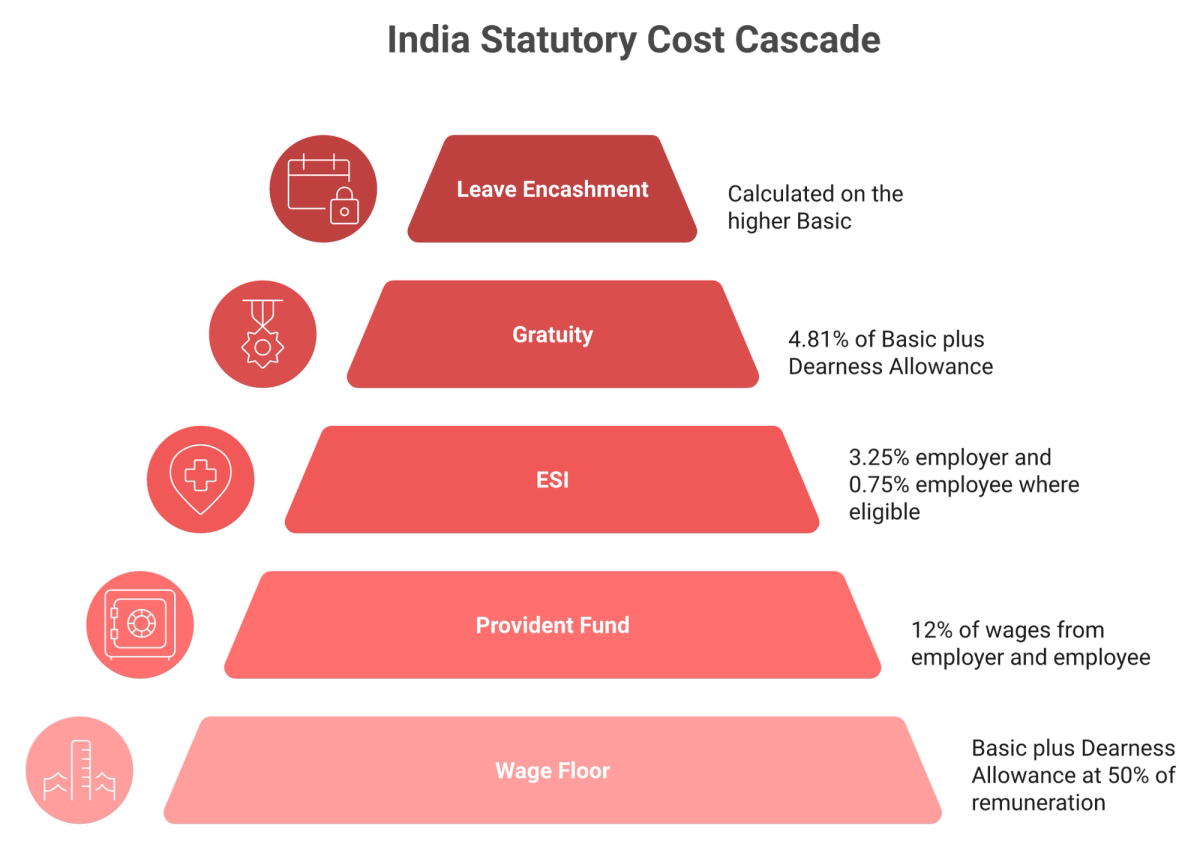
Versatile Club models all four lines in the client cost sheet, because a CTC built to dodge the 50% rule is a cost deferred, not a cost avoided. The same four lines drive the totals in our breakdown of the cost of hiring in India.
❌ One thing you are not allowed to do
Section 124 of the Code on Social Security, 2020, and the EPF Scheme both bar an employer from recovering its own contribution from the employee's wages.
So you cannot push the increase into the employee's CTC mid-year and call it neutral. I have seen providers do exactly this and label it a "restructuring". It is not compliant, and it shows up in an audit.
✅ Where Versatile Club sits on this
Versatile Club files PF and ESI under its own EPFO and ESIC registrations, which is why a ceiling change is an operational task for us and not a roadmap item. When S.O. 5109(E) landed, we re-ran PF wages per head and reissued landed-cost sheets inside the same payroll cycle. The filing calendar behind that is published on our compliance page.
⏰ What to do on Monday
Pull your India headcount and list Basic plus DA per person.
Flag everyone whose Basic plus DA falls below 50% of total CTC.
Recompute employer PF against the Rs 25,000 ceiling, not against gross CTC.
Ask your provider for a post-September payslip and the ECR extract, which is the electronic challan filed with EPFO.
Confirm in writing that no part of the employer PF increase moved into employee take-home.
If your vendor cannot produce the ECR extract, they are probably not the entity filing it. Teams running this in-house usually end up comparing it against managed payroll instead.
Q7. How do Deel and Remote compare on IP protection, compliance tooling and security certifications?
Both platforms ship compliance monitoring, Deel through Watchtower and Remote through its Compliance Hub, and both offer intellectual property assignment tooling, with Remote positioning IP and invention-rights protection as a default rather than an add-on. Both hold SOC 1, SOC 2, and ISO 27001 per the Deel trust centre and the Remote trust centre, and Deel adds SOC 3 and CSA STAR. If your security review treats those certificates as a hard procurement gate, that is a genuine advantage for the global platforms and a genuine limitation for smaller India specialists, including Versatile Club.
⭐ What IP tooling actually does under Indian law
An IP assignment clause transfers ownership of work product from the employee to the employer. In India it sits inside the employment contract and is governed by the Indian Contract Act and the Copyright Act, 1957.
The platform feature is not magic. It is a well-drafted clause, enforced through the entity that signed the contract. That matters for a reason the marketing pages skip: if a partner entity signed, the chain of assignment runs through a company you never diligenced. Buyers who care about this usually land on our Remote alternative page next.
✅ Certification posture side by side
| Item | Deel | Remote | Versatile Club |
| SOC 1 | Yes | Yes | No |
| SOC 2 | Yes | Yes | No |
| SOC 3 | Yes | Not published | No |
| ISO 27001 | Yes | Yes | No |
| CSA STAR | Yes | Not published | No |
| IP assignment in contract | Yes | Yes, positioned as default | Yes, drafted under Indian law |
| Compliance monitoring product | Watchtower | Compliance Hub | Monthly client pack |
Versatile Club appears in that table honestly. Two rows go to the global platforms outright, which is why our enterprises page names the procurement gate rather than talking around it.
❌ Where a certificate stops being useful
A SOC 2 report tells you a vendor has controls around data handling. It says nothing about whether a Telangana professional tax return was filed on the 10th.
Those are different risks with different consequences. One shows up in your security questionnaire. The other shows up as a penalty notice addressed to the entity employing your engineer.
"It asks for way too much personal information, doesn't explain why I need to share it, and makes it really challenging to register. When I provided valid documents, they got rejected for no reason, then I was asked for more and more."
— Alice T., Verified User Remote - G2 Verified Review, 0/5, 20 March 2026
"I was required to provide personal identity documents (like a passport), despite offering full corporate documentation for my U.S.-based LLC. This is not standard in B2B cooperation and raises serious privacy concerns."
— Verified User in Translation and Localization Deel Hire - G2 Verified Review, 0.5/5, 5 May 2025
Certifications and collection practice are not the same thing. Both reviewers describe companies that hold the certificates.
✅ Saying the unpopular part plainly
Versatile Club does not hold SOC 2 or ISO 27001 today, and this is the one section where the global platforms win on paper. If your security team requires that certificate before a vendor touches payroll data, buy the platform that has one. What we offer instead is IP assignment drafted under Indian law in our own employment contracts, with the filings and the data sitting inside one Indian entity rather than a chain of partners.
Q8. Who carries misclassification, PE and DPDP risk, you or the platform?
The platform carries employment-of-record liability for the entity it employs through, and you keep nearly everything else. Contractor misclassification exposes you to backdated taxes, interest, and penalties. Permanent establishment risk attaches to how your people operate, not to which software you bought. Under the DPDP Rules 2025, substantive obligations commence 14 May 2027, penalties reach Rs 250 crore for security-safeguard failure, and your EOR is a data processor holding Aadhaar, PAN, and bank details. Versatile Club employs India hires directly through its own entity from day one.
❌ The situation: month two moves fast
A Series A founder hires a Bengaluru engineer on a contractor agreement. It is quick, the invoice is simple, and it works.
Eighteen months later a VP People joins. She reads the agreement, sees fixed hours, a company laptop, and a manager, and realises this person was always an employee in substance. That is the moment the risk becomes real. The structural difference is laid out in our comparison of independent contractor vs EOR.
⚠️ The complication: it is retroactive
Misclassification is not corrected going forward. It is assessed backwards.
Backdated tax, interest, and penalties attach to the full period, and the exposure sits with the company that controlled the work. Across the last six years, contractor-to-employee cleanup has been the single most common engagement Versatile Club gets called into. Nobody sets out to misclassify. They set out to move fast in month two and forget by month eighteen. The remediation sequence is documented in our guide on how to convert a contractor to an employee in India.
⏰ The same problem from the employee's side
There is a version of this the buyer never sees. An engineer on a contractor agreement applies for a home loan and gets declined, because there is no Form 16 and no salary slip in a bank's accepted format.
Versatile Club's employees receive Form 16, a PF passbook, and a monthly payslip issued by an Indian entity. That is not a perk. It is the document set an Indian bank actually accepts.
💸 Permanent establishment, in plain terms
Permanent establishment, or PE, means a tax authority treats your foreign company as having a taxable business presence in India, as assessed under the Income Tax Act.
Buying an EOR reduces that risk. It does not remove it. If your India team signs contracts, closes revenue, or negotiates on your behalf, the facts of the arrangement matter more than the vendor on the invoice. Teams weighing the structural alternatives usually start with our EOR vs entity calculator.
⚠️ The DPDP clock nobody put in your contract
The Digital Personal Data Protection Rules were notified on 14 November 2025, with a corrigendum on 16 December 2025. Consent manager registration follows in November 2026, and substantive duties commence 14 May 2027, with the penalty schedule set by the Digital Personal Data Protection Act, 2023.
Three things belong in your EOR agreement now:
A data-processor clause naming the Indian entity holding the data.
A breach-notification commitment with a stated timeline.
Confirmation of one-year retention of processing logs.
✅ What buyers report when the structure is wrong
"Deel treats all users as if they were individual freelancers, even when you're clearly operating as a registered company. There is no flexibility, no option for company-level onboarding without exposing personal data."
— Verified User in Translation and Localization Deel Hire - G2 Verified Review, 0.5/5, 5 May 2025
"Separately, their payroll is still supported by manual processes, and twice we've had near catastrophic errors."
— Juliette D., Verified User Remote - G2 Verified Review, 0.5/5, 22 April 2026
Versatile Club's Contract-to-Hire model exists for this exact gap. The engineer is a compliant employee of our Indian entity from day one, with Form 16, a PF passbook, and a payslip that survives a loan application, then converts to your entity when you are ready, with no exit fee.
Q9. How fast is onboarding, and who answers when payroll breaks?
Deel markets onboarding in minutes for contractors and 3 to 4 days for EOR employees. Remote averages around three days once the employee self-enrols, though independent comparisons cite 9 to 14 days. On support, Deel routes chatbot-first into a ticket queue with 24/7 multilingual coverage, while Remote runs a ticket queue with a named customer success manager on larger plans. Deel carries 110 to 130 integrations against Remote's roughly 40, per the Deel integrations directory and the Remote integrations directory. Versatile Club commits to a 5-business-day onboarding SLA written into the contract.
⏰ Why marketed timelines and lived timelines differ
The marketed number measures the platform. The lived number measures the paperwork.
Three things add days in India specifically. Background verification against previous employers and the Universal Account Number, which is the portable PF identifier issued by the EPFO. State registration, if the provider does not already hold it. And partner-entity handoffs, where documents move through a second organisation before anything is signed. The sequence we actually run is documented on our how it works page.
⭐ Support routing, side by side
| Criterion | Deel | Remote | Versatile Club |
| Marketed EOR onboarding | 3 to 4 days | ~3 days, cited up to 14 | 5 business days, contractual |
| First support touch | Chatbot, then ticket | Ticket queue | Founder on WhatsApp |
| Named human | On larger plans | Named CSM on larger plans | Sagar Chainani, directly |
| Email SLA | 24/7 coverage | 3-day SLA reported by users | Same-day, not yet contractual |
| Integrations | 110 to 130 | ~40 | None published |
Versatile Club loses the integrations row outright. There is no Workday connector, and I am not going to pretend otherwise, which is also why buyers running heavy HRIS stacks often compare us on the Deel alternative page before deciding.
⚠️ What chatbot-first feels like at month end
"The platform remains easy to navigate and technically reliable... contacting support did not lead to effective problem solving. I was redirected multiple times, asked to repeat the same information to different representatives."
— Güneş A., Verified User Deel Hire - G2 Verified Review, 1.5/5, 2 October 2025
"Instead they have email support with a 3-day SLA. Responses are unacceptably slow. Separately, their payroll is still supported by manual processes, and twice we've had near catastrophic errors."
— Juliette D., Verified User Remote - G2 Verified Review, 0.5/5, 22 April 2026
A three-day email SLA is fine for a question. It is not fine on the 5th of the month, when TDS is due by the 7th and a challan has not generated. The full filing calendar sits in our guide to payroll compliance in India.
✅ Small providers have their own version of this problem
"Wisemonk platform is reallly simple and easy to use... Sometimes the email communication from the wisemonk team is delayed by a day or 2. But overall they seem to be the best for India."
— Bulbul G., Verified User Wisemonk - G2 Verified Review, 4/5, 19 February 2025
That review is honest and I respect it. Small India specialists, including Versatile Club, trade scale for access. The failure mode is a slow reply from a small team, not a ticket lost in a routing rule. The same trade-off is set out on our Wisemonk alternative page.
💰 The procurement question worth more than the SLA
Ask who you will be speaking to in month nine. If the answer is a role rather than a person, price that in.
Versatile Club's answer is a 5-business-day onboarding SLA written into the contract, with the founder on WhatsApp instead of a CSM rotation. I will also say plainly that this is sustainable at our current scale and will have to change as we grow. If you want to test it, message us directly and see how long the reply takes.
Q10. What do G2 ratings tell you about Deel vs Remote, and what don't they?
Deel holds roughly 4.8 out of 5 across more than 5,000 reviews on its G2 product page. Remote holds roughly 4.7 across more than 1,500 on its G2 product page. Both are strong products with real satisfaction behind those numbers. What those reviews measure is dashboard experience, payment speed, and support responsiveness. Almost none measure whether a professional tax return was filed correctly in Telangana or whether gratuity accrued at 4.81% of Basic plus Dearness Allowance. Versatile Club's read is that a 0.1-star gap tells you nothing about audit readiness.
⭐ What a review population actually measures
Most EOR reviews on G2 are written by the people being paid, not the people buying.
Read the Deel reviews and you see the pattern. Transfer speed, card fees, interface clarity, and identity verification friction. Those are contractor experiences, and they are genuinely useful. They are also a different product from the one a CFO is buying.
"I find Deel easy to use... I find Deel to be absurdly expensive. They charge a high amount of fees for transferring money to my bank account."
— Juan Camilo O., Verified User Deel Hire - G2 Verified Review, 1/5, 27 November 2025
"I appreciate the ease of setup with Deel; it took me only a few minutes... I dislike how expensive Deel's transaction fees are."
— Maria M., Verified User Deel Hire - G2 Verified Review, 3/5, 26 September 2025
❌ What no review can tell you
No reviewer has seen your Electronic Challan cum Return, the monthly PF filing submitted to EPFO. No reviewer has checked whether Form 16 reconciled to the TDS actually deposited with the Income Tax Department.
Those are the artefacts an audit asks for. They never appear in a star rating, because the person writing the review never looks at them. Versatile Club measures its own performance on filing dates and challan receipts, not on review sentiment, because that is the evidence a client's auditor accepts. Every filing we own is listed on our compliance page.
⚠️ Why volume favours incumbents
Review count tracks customer count and marketing spend. It does not track per-country depth.
A platform with 5,000 reviews across 150 countries may have 30 reviews from India buyers. A specialist with 300 reviews may have 300 from India. The second sample is smaller and more relevant, and most buyers read the first number only. Our roundup of the best EOR in India is built on that second sample.
"My experience with Wisemonk has been very positive so far... I've noticed that their support/query responses can occasionally take a bit longer sometimes, likely due to a relatively small team."
— Verified User in Financial Services Wisemonk - G2 Verified Review, 4/5, 14 June 2025
That is what a smaller India specialist honestly looks like in reviews. Versatile Club would expect the same critique at our scale, and I would rather a prospect read it than not.
✅ What to read instead
A real anonymised invoice, with every line item visible.
A post-September 2026 payslip showing PF wages as a separate line.
The ECR extract for the last filed month.
The state PT registration number for your hire's city.
Versatile Club has a fraction of Deel's review volume and will not pretend otherwise. What we offer instead is contractual proof: a 5-day onboarding SLA, a 90-day Success Coach, and a 6-month replacement guarantee on Contract-to-Hire placements, written into the agreement rather than averaged into a star rating.
Q11. At what headcount does standardizing on one platform stop making sense?
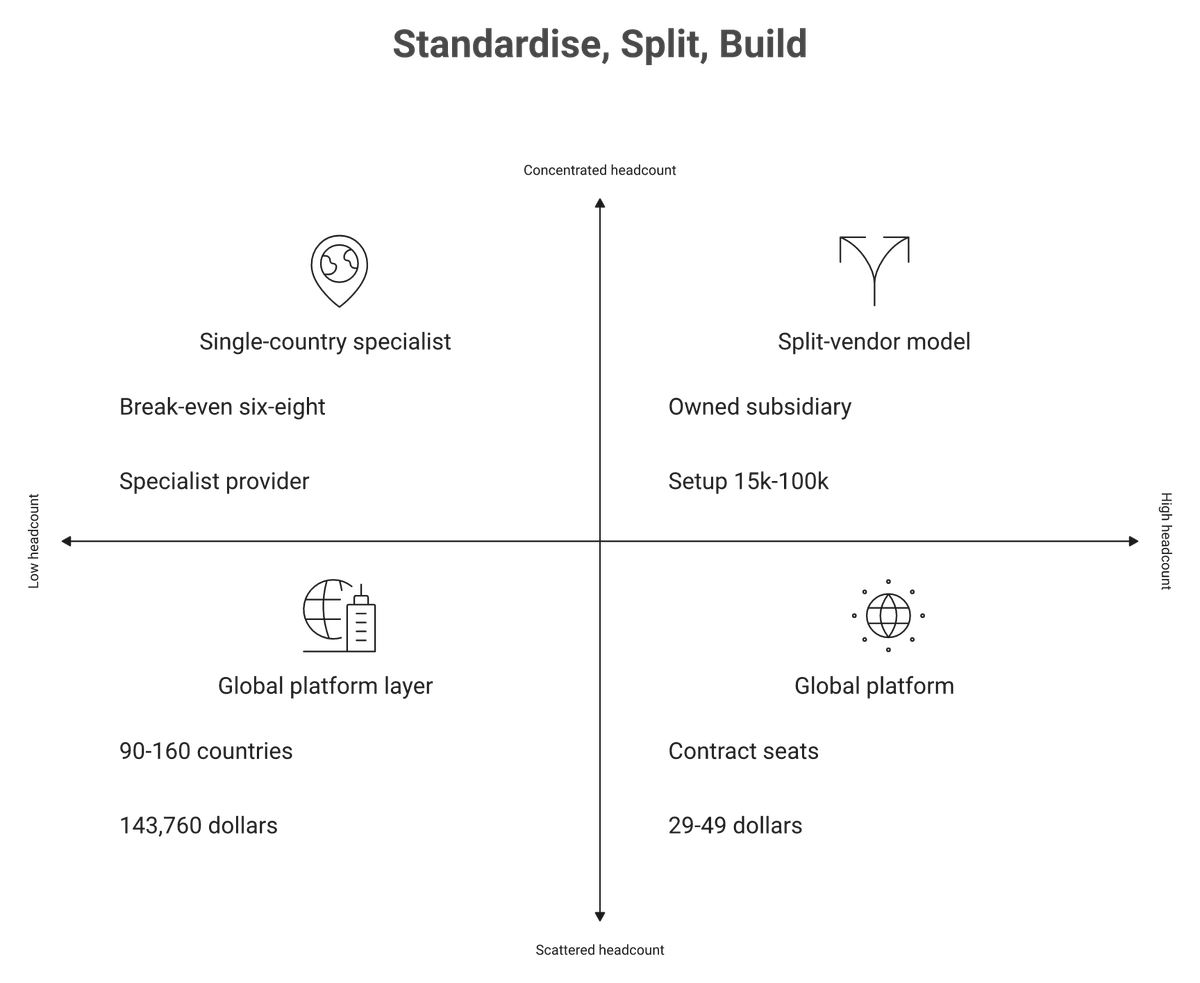
When one country holds a dense cluster of headcount, single-platform standardization becomes the expensive choice. Keep Deel or Remote as the horizontal layer for scattered one-off hires across Europe and LATAM, and move the dense hub to a native specialist. Versatile Club charges $149 per employee monthly against roughly $599 on the global platforms, per Deel's pricing page and Remote's pricing page, which removes 75% of platform spend on that portion of headcount and removes the FX spread. Break-even sits around six to eight heads in one country. A captive subsidiary costs $15,000 to $100,000 and three to six months before the first payslip.
💰 Why one vendor feels correct to Finance
Procurement rewards consolidation. One contract, one invoice, one security review, and one renewal date.
That logic is sound when headcount is evenly scattered. It stops being sound the moment one country holds a third of your people, because you are now paying a global price for a local problem. Our breakdown of India expansion options runs the same comparison across every structure.
⭐ The arithmetic at three sizes
| India headcount | Global platform at ~$599 | Versatile Club at $149 | Annual difference |
| 10 | $71,880 | $17,880 | $54,000 |
| 20 | $143,760 | $35,760 | $108,000 |
| 30 | $215,640 | $53,640 | $162,000 |
Those figures are modelled from published list pricing and exclude setup fees, deposits, and FX spread. Versatile Club's figures are our own published terms, with no setup fee and no exit fee, and they are listed in full on our pricing page.
⏰ The bridge nobody wants to build
An EOR is a suspension bridge. Light, fast, and good enough to carry real traffic in days.
Your own Indian subsidiary is the Golden Gate. Permanent, expensive, and justified only at volume. Between $15,000 and $100,000 of setup cost and three to six months of timeline buy you an entity, before you have hired anyone or filed a single return. Versatile Club's view is that most companies under 30 India heads never reach that payback, and a few at 50 heads should have crossed it a year earlier. Run your own numbers on the EOR vs entity calculator.
⚠️ Where I would keep the global platform
I actively tell prospects to keep Deel for their three hires in Portugal and Brazil.
One-country depth is a real advantage and a real limit. Versatile Club cannot serve a buyer who needs five countries, and pretending otherwise would cost the trust that makes the India conversation work at all.
✅ The split, stated plainly
| Layer | Vendor type | What it handles |
| Dense hub | India-only specialist, Versatile Club | Owned entity, all 28 states and 8 UTs, PF, ESI, PTRC/PTEC, TDS by the 7th |
| Long tail | Deel or Remote | Scattered single hires, contractor networks, 90 to 160 countries |
| Eventually | Own subsidiary | Only past the point where entity cost beats EOR fees |
Versatile Club sits first in any India-only shortlist, and nowhere at all on a multi-country one. Employment runs through Foo Falcon Technologies Pvt Ltd, at $149 per employee monthly, with a 5-business-day onboarding SLA in the contract and the first month free. Keep the global platform for everything outside India, and read our EOR services in India page for the half we cover.
Q12. What should you put in writing before you sign either contract?
At 20 India employees, Deel and Remote both run about $143,760 a year in platform fees, plus setup of $500 or $299 and, at Deel, a security deposit and a reported FX spread. Versatile Club runs $149 per employee monthly, roughly $35,760 a year, with no setup fee and no exit fee. Before signing, get four answers in writing: which legal entity signs the employment contract, which Indian states are covered, what FX benchmark and spread apply, and who answers at 11pm India time.
⭐ The full scorecard
| Criterion | Deel | Remote | Versatile Club |
| EOR price per employee | ~$599 | $599 annual, ~$699 monthly | $149 |
| Setup fee | $500 | $299 | None |
| Security deposit | ~1 month salary | None | None |
| FX disclosure | Not published | Not published | USD invoice from India |
| India entity | Often partner-routed | Often partner-routed | Owned, CIN U72900KA2022PTC163007 |
| State coverage | ~Top 6 | ~Top 4 | All 28 states, 8 UTs |
| Onboarding | 3 to 14 days | 3 to 14 days | 5 business days, contractual |
| Support | Chatbot, then ticket | Ticket, named CSM | Founder on WhatsApp |
| SOC 2 / ISO 27001 | Yes | Yes | No |
| Countries | 130 to 160+ | 90+ | 1 |
Versatile Club loses three rows in that table. That is the honest shape of a one-country specialist, and it is the same shape set out on our Remote alternative page.
✅ The four questions, worded to get real answers
Ask open questions, not yes or no ones. "Do you cover Kerala" gets a reflexive yes. These do not.
Which legal entity will sign my engineer's employment agreement, and what is its CIN, verifiable on the MCA portal?
Which states do you hold your own PT and S&E registrations in, and what are the numbers?
What FX benchmark do you read, at what time, and what spread do you apply against the RBI reference rate?
Who answers at 11pm IST on the 5th of the month, and what is their name?
⏰ The habit that protects you
Every verbal commitment a vendor makes on a call should come back to them in an email the same afternoon.
Write the recap, send it, and keep it. The commitments that quietly vanish from the vendor's reply were never commitments. Versatile Club works this way with its own clients, because a monthly client pack and a written SLA are easier to defend in an audit than a remembered conversation. Teams already mid-contract usually pair this with our guide on how to switch EOR provider in India.
⚠️ What happens when the paper trail is missing
"They consistently failed to meet committed deadlines, had terrible communication, and frequently cancelled meetings at the last minute."
— Verified User in Computer Software Deel Hire - G2 Verified Review, 0/5, 13 December 2025
"What I like most about WiseMonk is how they convert a complex international hiring process into a structured and easy workflow... The initial documentation and paperwork felt quite detailed and time-consuming at the beginning."
— Verified User in Marketing and Advertising Wisemonk - G2 Verified Review, 3.5/5, 2026
Heavy paperwork upfront is usually the sign of a provider doing the filings itself. Thin paperwork upfront often means the filings belong to someone else.
Versatile Club's answer to the fourth question is a phone number. Tell me what you are building in India, and I will tell you honestly whether we fit or whether you should stay on your global platform. Book 30 minutes and bring the vendor's draft contract with you.
FAQs
Is Deel or Remote cheaper for hiring an employee in India?
On the headline platform fee they are close. Both list Employer of Record at roughly 599 dollars per employee per month on annual billing, with Remote moving to around 699 dollars on monthly terms. The separation happens below that line.
- Setup fee: 500 dollars at Deel, 299 dollars at Remote.
- Contractor seats: 49 dollars at Deel, 29 dollars at Remote.
- Security deposit: Deel holds roughly one month of salary; Remote holds none.
- India surcharges: Deel adds 50 to 150 dollars monthly in complex markets.
- Exit notice: one month at both, which is a real cost when you leave.
Then there is the statutory layer, which neither price includes. Employer Provident Fund runs at 12 percent of wages up to the Rs 25,000 ceiling notified on 17 September 2026, gratuity accrues at 4.81 percent of Basic plus Dearness Allowance, and ESI applies at 3.25 percent employer share where eligible.
Versatile Club charges 149 dollars per employee monthly with no setup fee, no deposit, and no exit fee, invoiced in USD from its own Indian entity. We break the full landed cost down head by head in our guide to the cost of hiring in India, because the platform fee is rarely the largest number on the invoice.
Do Deel and Remote own their India entity, or do they use a local partner?
Remote markets 100 percent owned entities across its 90 plus EOR countries. Deel reaches 130 to 160 plus countries through a hybrid of owned entities and vetted local partners. In India specifically, global providers including Deel, Remote, G-P, and Omnipresent commonly route employment through local partner entities.
That distinction matters for four practical reasons:
- Indemnity chain. Your contract is with the platform, but the employment agreement is with a partner, so there are two contracts between you and any dispute.
- Onboarding latency. Documents move through a second organisation, which is where 7 to 14 day timelines originate.
- Data handoffs. Aadhaar, PAN, and bank details reach a company you never diligenced.
- Whose PF code. The Provident Fund challan is filed under the partner's establishment code.
The honest diligence question is never "do you own entities" but "which legal entity signs this contract, in this country". Ask for the draft employment agreement with the entity name and CIN on it.
Versatile Club employs through Foo Falcon Technologies Pvt Ltd, CIN U72900KA2022PTC163007, with PF, ESI, TDS, and professional tax filed under its own registrations. We compare the owned-entity model against the alternatives in our analysis of EOR vs entity in India.
What FX markup do Deel and Remote charge on India payroll?
Neither vendor publishes the exchange rate applied to your payroll remittance. Reported Deel markups range from 0.6 to 2 percent in some audits and 3 to 5 percent in others, and they are never itemised, because the cost is embedded in the rate rather than charged as a fee. Remote displays an applied monthly rate after the fact without quoting a spread.
Here is why that structure costs more than the subscription. Everyone negotiates the 599 dollars. Nobody negotiates a rate they cannot see.
- On a 1.2 million dollar India payroll, a 0.6 percent spread costs 7,200 dollars a year.
- At 3 percent, the same payroll loses 36,000 dollars, which is five EOR seats.
- At 5 percent, it reaches 60,000 dollars, more than eight seats.
Before signing, demand three things in the contract rather than in an email: the named benchmark, such as the Reserve Bank of India daily USD to INR reference rate, the timestamp at which it is read, and the spread applied as a percentage.
Versatile Club invoices in USD from a single Indian entity at an agreed rate, so the rupee leg sits with us rather than with your treasury. The mechanics are set out in our walkthrough on payroll outsourcing services in India.
How many Indian states can Deel and Remote actually run payroll in?
India is not one payroll jurisdiction. Professional tax, Shops and Establishments registration, and labour welfare fund contributions are all state-administered, so an Employer of Record can only employ where it holds its own registrations.
Deel covers roughly the top six states and Remote roughly the top four. The calendars differ state by state:
- Karnataka: monthly professional tax filing plus annual Shops and Establishments renewal.
- Maharashtra: monthly slab with two registrations, PTRC and PTEC.
- Tamil Nadu: twice-yearly professional tax plus a Labour Welfare Fund contribution.
- Telangana: PTRC enrolment required before the first payslip runs.
The practical consequence surfaces late. A People Ops lead closes a strong candidate in Coimbatore, Indore, or Kochi, then learns the provider cannot payroll that state. The remaining options are withdrawing the offer, paying the person as a contractor and carrying misclassification risk, or waiting weeks for a new registration.
Ask any shortlisted vendor for the state list in writing, with registration numbers attached. A provider that holds the registration can produce the number within the hour. Versatile Club hires across all 28 states and 8 union territories on its own registrations, which is why our guide to payroll compliance in India is organised state by state rather than nationally.
When does it stop making sense to put all India hires on Deel or Remote?
Single-platform standardisation is the right call when headcount is evenly scattered. It stops being right the moment one country holds a dense cluster, because you are then paying a global price for a local problem.
The modelled arithmetic on published list pricing looks like this:
- 10 India employees: roughly 71,880 dollars a year on a global platform against 17,880 dollars with an India-only specialist.
- 20 India employees: roughly 143,760 dollars against 35,760 dollars.
- 30 India employees: roughly 215,640 dollars against 53,640 dollars.
Break-even on unbundling sits around six to eight heads in one country. Your own Indian subsidiary is a different decision entirely, costing 15,000 to 100,000 dollars and three to six months before the first payslip, and most companies under 30 India heads never reach that payback.
The practical answer is a split-vendor model. Keep Deel or Remote as the horizontal layer for scattered single hires across Europe and LATAM, and move the dense hub to a specialist that owns its local entity. Versatile Club serves exactly one half of that split at 149 dollars per employee monthly, India only, and we would tell you to keep the global platform for everything else. Our comparison of India expansion options runs the same maths across every structure.