Table of contents (15)
8 Best Papaya Global Alternatives in India: How They Compare on Cost, Compliance, and Support
Q1. What Are the 8 Best Papaya Global Alternatives for Hiring in India in 2026?
The 8 best Papaya Global alternatives for India hiring in 2026 are Versatile, Deel, Remote, Multiplier, G-P, Velocity Global, Rippling, and Skuad. I scored each on India Entity Model and Compliance Depth (30%), Pricing Transparency (20%), Onboarding and Support (20%), Talent and Retention Support (15%), and Customer Validation (15%). The decisive axis is whether a provider owns an Indian entity or resells through a local partner. Versatile owns its entity, so PF, ESI, TDS, and professional tax filings run under our own registrations.
Picking an India Employer of Record (EOR), the company that becomes the legal employer of your India hires, is a high-stakes call. Get it wrong and you inherit late payroll, mystery FX charges, and compliance surprises months later. For this guide, I analyzed the major global and India-focused providers against decision-grade criteria: entity model, statutory compliance depth, state-level coverage, onboarding speed, pricing transparency, invoicing and finance readiness, support model, talent and retention support, and customer validation. It is written for US and UK founders, People Ops leaders, CFOs, and legal teams hiring 1 to 50 people in India.
Our Evaluation Criteria
Each provider was assessed across these decision-grade criteria, weighted to reflect what actually breaks in an India payroll cycle.
India Entity Model and Compliance Depth (30%): Own Indian entity vs local partner shell, plus PF, ESI, TDS, professional tax, gratuity, POSH, Form 16, full-and-final settlement, DPDP readiness, and New Labour Code 2025-26 structuring.
Pricing Transparency (20%): Monthly fee, setup fee, exit fee, FX markup, first-month terms, salary-band pricing, and invoice clarity.
Onboarding Speed and Support Model (20%): Time from signed agreement to live payroll, plus founder-direct, named HR manager, ticket queue, or chatbot support.
Talent and Retention Support (15%): Recruiting, contract-to-hire, culture-fit vetting, onboarding monitoring, and replacement guarantee.
Customer Validation (15%): G2, Capterra, Clutch, Reddit, and third-party proof.
Scores convert to stars: 0 to 20 = 1 star, 21 to 40 = 2 stars, 41 to 60 = 3 stars, 61 to 80 = 4 stars, and 81 to 100 = 5 stars.
Who This Guide Is For
This guide is designed for the following buyers.
US and UK founders hiring their first 1 to 3 employees in India.
Seed to Series B startups building engineering, product, AI, design, or operations teams in India.
People Ops and HR leaders reviewing India EOR, payroll, contractor, or PEO vendors.
CFOs and finance teams needing clean invoicing, statutory liability visibility, and audit-ready India payroll records.
Legal teams reviewing employment contracts, IP assignment, misclassification risk, and Permanent Establishment (PE) risk, the tax exposure a foreign company creates by employing directly in India without structuring.
Companies on Deel, Remote, Multiplier, G-P, or Papaya evaluating India-specialist alternatives.
The 8 Best Papaya Global Alternatives (Quick List)
Versatile: Best for US and UK teams building India-only teams who want an owned Indian entity.
Deel: Best for broad multi-country coverage using a partner model in India.
Remote: Best for compliance-transparency-focused global hiring at scale.
Multiplier: Best for fast global contractor-to-EOR conversion.
G-P (Globalization Partners): Best for enterprise reach across 150+ countries.
Velocity Global (Pebl): Best for a blended EOR plus contractor global stack.
Rippling: Best for IT, HR, and payroll all-in-one platform buyers.
Skuad (Payoneer): Best for APAC-leaning distributed teams.
Master Comparison Table
| Provider (Stars) | Best For | Key Strength | Compliance |
|---|---|---|---|
| Versatile ⭐⭐⭐⭐⭐ | US/UK startups hiring first 1 to 20 India employees | Owned India entity, 5-day onboarding SLA, founder-on-WhatsApp support | Own entity; PF, ESI, TDS, PT filed under Versatile registrations across all 28 states + 8 UTs |
| Deel ⭐⭐⭐⭐ | Companies hiring across many countries at once | 150+ country coverage on one platform | Partner entity in India; reported FX and hidden fees |
| Remote ⭐⭐⭐⭐ | Teams wanting an all-in-one global HR stack | Broad country coverage, integrated tooling | Partner/owned mix by country; India support via ticket queue |
| Multiplier ⭐⭐⭐ | Startups wanting low-cost fast global onboarding | Price-competitive, quick initial onboarding | Partner model; extra deposits and transfer fees reported |
| G-P (Globalization Partners) ⭐⭐⭐⭐ | Enterprises needing 180+ country breadth | Deep enterprise compliance infrastructure | Owned entities in many markets; enterprise-grade |
| Velocity Global (Pebl) ⭐⭐⭐ | Blended EOR plus contractor global teams | Local knowledge across many countries | Local entities; account-manager-led, manual processes |
| Rippling ⭐⭐⭐⭐ | Buyers consolidating IT, HR, and payroll | One platform for HR, IT, and spend | US-centric; multi-state tax and India support gaps reported |
| Skuad (Payoneer) ⭐⭐⭐ | APAC-leaning distributed teams | Worldwide coverage via Payoneer network | Outsourcing chains; support delays reported |
Papaya Global is intentionally excluded because it is the product you are comparing against. Star ratings reflect the weighted rubric above, applied to India-hiring fit specifically, not global breadth.
1. Versatile: Best for India-Only Teams Wanting an Owned Indian Entity
Overview
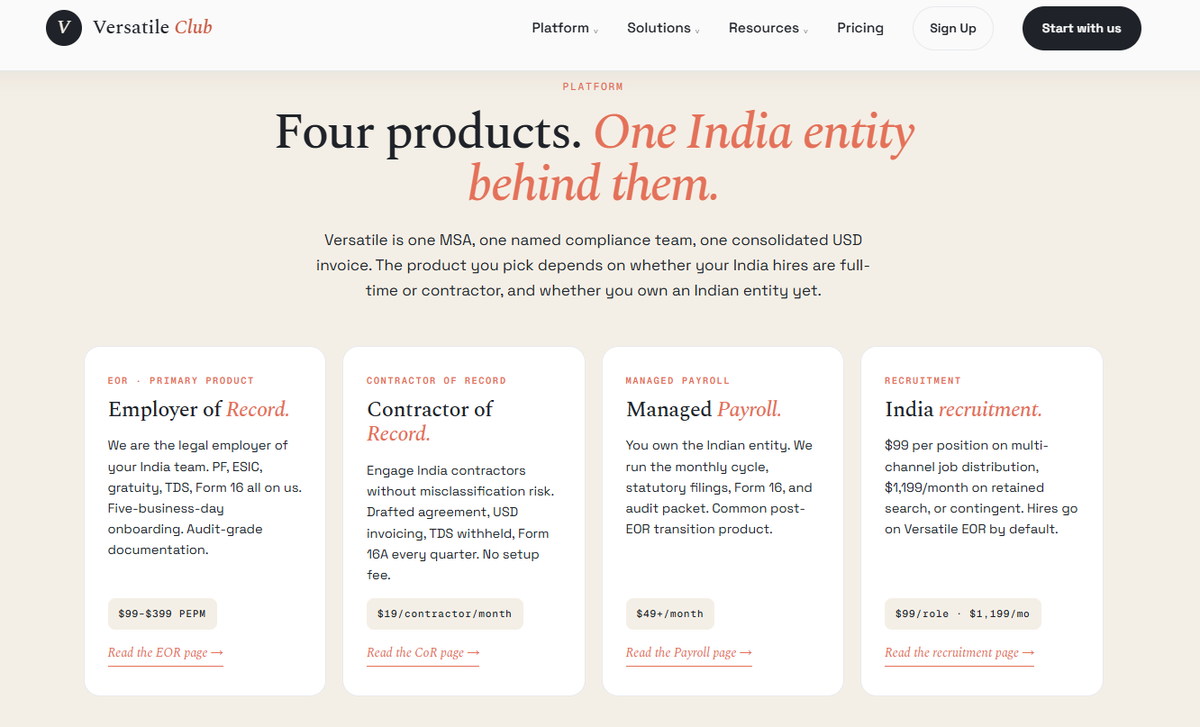
Versatile is an India-only Employer of Record and Contract-to-Hire (C2H) specialist for US and UK companies. We started as a C2H business placing engineers, designers, and ops professionals across Bengaluru, Hyderabad, and Pune. That means the compliance muscle, payroll operations, and state-level registrations were already built before we offered EOR.
We own the Indian entity. Foo Falcon Technologies Pvt Ltd is a registered Indian company, so we are the legal employer on record, not a reseller. When you hire through us, that person's PF, ESI, TDS, and professional tax filings sit under our own registrations. Deel, Remote, G-P, and most global providers route India through local partner entities. We do not.
Core Services
India EOR with an owned entity across all 28 states and 8 union territories.
Contract-to-Hire placement with culture-fit vetting on 50 behavioral parameters.
Full statutory compliance: PF, ESI, TDS, professional tax, gratuity, POSH, and Form 16.
USD invoicing direct from India with no FX markup.
90-day Success Coach and a 6-month replacement guarantee on C2H placements.
Why Companies Consider Versatile
Most founders come to me stuck between two bad options: set up their own Indian subsidiary (six months, tens of thousands in fees) or hand India to a global platform that treats it as one country among 150. Versatile is the middle path. You get an owned-entity EOR without the entity-setup cost, and India depth without the generalist dilution.
The second reason is support. I run client relationships directly on WhatsApp. When a US founder messages me three days before payroll asking where a PF challan is, she gets a real answer from the person who built the company, not a ticket number in a queue.
Ideal Customer Profile
US and UK founders making their first 1 to 3 India hires.
Seed to Series B startups scaling to 10 to 20 India employees.
CFOs at $5M to $50M ARR SMBs closing month-end on a single USD invoice.
Teams that want India depth, not multi-country breadth.
Commercial Model
EOR pricing is a flat monthly fee per employee with no setup fee, no exit fee, and the first month free. C2H is priced at 20 to 30% of annual salary, charged only after the hire completes day 90, and backed by a 6-month replacement guarantee. USD invoicing is direct from our Indian entity, so there is no FX markup layered on top.
To be fair about fit, if you need EOR across 5 or more countries, or you are an enterprise 100+ team requiring SOC 2 or ISO 27001 as a procurement prerequisite, a global generalist may suit you better. India-only is a deliberate design choice, not a gap, but it is worth naming.
Customer Reviews
"As a founder at a digital marketing agency, I needed to hire and manage a small India-based team without setting up a local entity. Versatile's Employer of Record India service made this seamless. Invoicing in USD meant zero exchange rate surprises. Five-day onboarding, zero late payslips."
Vedant T., Versatile G2 Verified Review
"The dashboard could be a little more self-serve. A couple of times I wanted to pull a report or a doc myself and ended up just messaging my contact instead. They always answered fast, so it wasn't a real problem, but I'd love to click around and find things on my own. Small thing."
Angad S., Versatile G2 Verified Review
2. Deel: Best for Broad Multi-Country Coverage (Partner Model in India)
Overview
Deel is a global EOR and contractor-payments platform covering 150+ countries. It is one of the most widely adopted tools for US and UK companies hiring internationally, and its interface is clean and easy to navigate.
For India specifically, Deel operates through a local partner entity rather than its own. That is fine for a company spreading hires across many countries. It matters more when India is your main hiring market and you want the legal employer to be directly accountable during an EPFO or tax audit. Buyers weighing this often compare a Deel alternative built for India depth.
Core Services
EOR across 150+ countries via owned and partner entities.
Global contractor onboarding and payments.
Multi-country payroll consolidation.
Immigration and visa support in select markets.
Integrated HR, compliance documents, and equipment provisioning.
Why Companies Consider Deel
Deel wins on breadth. If you are hiring in eight countries this quarter, one platform for all of them reduces vendor sprawl. The product is polished, and setup for a simple contractor takes minutes.
The trade-offs show up in cost and support. Buyers report FX and transfer fees that push the real cost above the headline price, and support that routes through queues rather than a named owner. For an India-heavy team, that combination can undercut the convenience.
Ideal Customer Profile
Companies hiring across 5 or more countries simultaneously.
Teams prioritizing platform breadth over single-country depth.
Organizations comfortable with partner-entity India coverage.
Founders wanting fast contractor onboarding globally.
Commercial Model
Deel's EOR pricing is quoted from around $599 per employee per month, with contractor plans priced separately. Buyers repeatedly flag transfer and FX fees on top of the headline rate, so I would ask for a sample invoice and the exact FX spread before signing. Only prices verifiable in public and provided sources are cited here.
Customer Reviews
"I find Deel to be absurdly expensive. They charge a high amount of fees for transferring money to my bank account. Additionally, using their card incurs fees for purchases in another currency."
Juan Camilo O., Deel G2 Verified Review
"It allows me to use one platform for multiple things. Contractors, EORs, employees, PTO, compliance. For the most part it is fairly straightforward. Often the CS doesn't seem to have answers, which leads to emails back and forth, and something I was looking for in 20 minutes becomes a 4-day process."
Verified User in Computer Software, Deel G2 Verified Review
3. Remote: Best for Compliance-Transparency-Focused Global Hiring at Scale
Overview
Remote is a global EOR and payroll platform built around an all-in-one HR structure. It positions itself on compliance transparency and consolidating standalone HR tools into a single login. For India, it operates like the other generalists, offering broad country coverage, with India as one market among many.
The pitch is real, and the product genuinely reduces tool sprawl. Where I would slow down is on India-specific depth and support responsiveness, both of which show up repeatedly in user feedback. Buyers comparing depth often look at a Remote alternative built for India.
Core Services
Global EOR and payroll across many countries.
All-in-one HR platform to replace standalone tools.
Contractor management and payments.
Benefits administration (often via third parties).
Employment contract drafting and compliance documentation.
Why Companies Consider Remote
Buyers pick Remote to kill tool sprawl. One login for HR, payroll, and contractors is attractive when you are hiring across several countries and tired of juggling logins.
The trade-off is support and process reliability. Multiple reviewers report a 3-day email SLA, no phone support, manual payroll steps, and third-party benefits handoffs that get messy. For an India-first team that needs fast answers before a payroll run, that gap matters.
Ideal Customer Profile
Companies hiring across multiple countries wanting one HR platform.
Teams prioritizing tooling consolidation over single-country depth.
Organizations comfortable with email-based, SLA-bound support.
Commercial Model
Remote's EOR is typically quoted from around $599 per employee per month. Buyers report hidden fees pushing real cost roughly 30% above the advertised number, so ask for an itemized quote and the FX policy before signing. For a transparent benchmark, our breakdown of Remote pricing is worth reviewing.
Customer Reviews
"They were dishonest about the level of support provided. We specifically explained we required phone-level support for urgent matters, but that is not available. Instead they have email support with a 3-day SLA. Their payroll is still supported by manual processes, and twice we've had near catastrophic errors."
Juliette D., Remote G2 Verified Review
"I find Remote super complicated to use at a platform level, with zero clarity on the process. Also, there are hidden fees everywhere, and I end up paying roughly 30% more than what's stated on the platform."
Javier G., Remote G2 Verified Review
4. Multiplier: Best for Fast Global Contractor-to-EOR Conversion
Overview
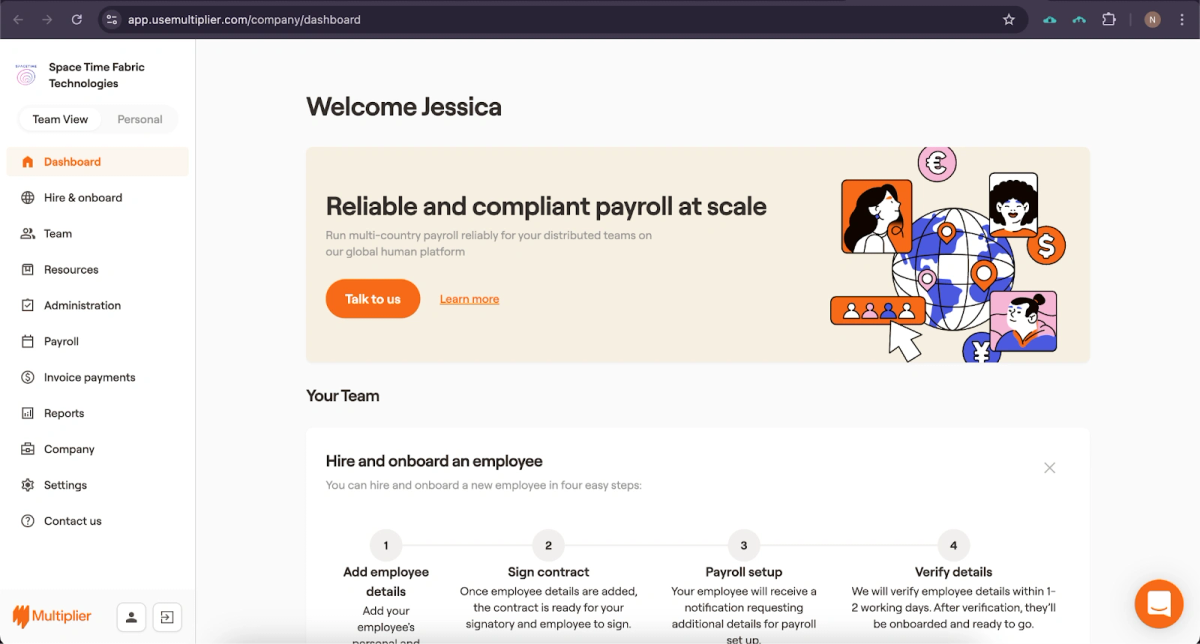
Multiplier is a global EOR and contractor platform known for competitive pricing and quick initial onboarding. It appeals to startups that want to test international hiring without a big upfront commitment. India is covered as part of its broad country footprint.
The interface is easy, and the sign-up is smooth. The pattern I see in reviews is that the savings often come at the cost of transparency and support once you are past onboarding. Teams weighing depth often evaluate a Multiplier alternative for India.
Core Services
Global EOR across many countries.
Contractor onboarding and payments.
Multi-country payroll processing.
Benefits and statutory contributions per country.
Employment contract generation.
Why Companies Consider Multiplier
Multiplier wins on price and speed of first setup. For a cash-conscious startup making an early international hire, a lower headline rate and quick onboarding are genuinely appealing.
The trade-offs surface later. Reviewers repeatedly flag surprise deposits and fees not in the original contract, late payroll, and double invoicing. This is the classic "you get what you pay for" tension, and it is worth pressure-testing before you commit.
Ideal Customer Profile
Cost-sensitive startups making early international hires.
Teams converting global contractors to EOR employees.
Companies prioritizing low headline price over deep support.
Commercial Model
Multiplier's EOR pricing is quoted from around $400 per employee per month, positioned as price-competitive. Reviewers report added deposits, bank-transfer charges, and fees not in the original contract, so confirm the full fee schedule in writing. Our guide to the cost of hiring in India helps you sanity-check the real number.
Customer Reviews
"Multiplier has fairly competitive EOR pricing, although it's also a bit of a 'you get what you pay for' where some of the savings translate to less transparency and customer support on the backend. They also introduced some new deposits and fees that weren't originally in our contract."
Verified User in IT and Services, Multiplier G2 Verified Review
"They are very price competitive. Easy onboarding. Apart from price and onboarding, rest of the service is pathetic. They charge extra money for bank transfer with no clarity on the actual amount. At times there has been delay by a month."
Verified User in Computer Software, Multiplier G2 Verified Review
5. G-P (Globalization Partners): Best for Enterprise 150+ Country Reach
Overview
Globalization Partners, now branded G-P, is one of the oldest and largest global EOR providers. It is built for enterprise buyers who need coverage across 180+ countries and mature compliance infrastructure. India is one market inside a very wide footprint.
If you are a large company standardizing global employment across dozens of countries, G-P is a serious option. For a US or UK startup making its first few India hires, it is often more platform than the job requires. Startups at that stage usually fit our India EOR services better.
Core Services
Enterprise EOR across 180+ countries.
Owned entities in many markets.
Global payroll and compliance management.
Contractor and international hiring support.
Enterprise-grade legal and IP protection.
Why Companies Consider G-P
G-P wins on breadth and enterprise maturity. Procurement and legal teams like that it has owned entities in many markets and a long operating history. That reduces perceived vendor risk for a big global rollout.
The trade-off is fit and cost for smaller India-focused buyers. Enterprise onboarding and pricing structures are heavier than a first-time India hirer needs. One Deel reviewer noted moving to Globalization Partners after Deel failed on commitments, which signals G-P competes at the enterprise reliability end.
Ideal Customer Profile
Enterprises standardizing employment across many countries.
Legal and procurement teams needing owned-entity coverage globally.
Large companies with formal vendor-risk requirements.
Commercial Model
G-P EOR pricing is commonly structured as a percentage of salary (reported around 15%) or a per-employee fee, quoted per deal. Enterprise contracts and custom terms are standard, so treat published figures as directional and request a formal quote. If you are weighing setup routes, our EOR vs entity in India comparison is a useful reference.
No verified customer reviews for G-P were available in the provided source set for this provider.
6. Velocity Global (Pebl): Best for Blended EOR + Contractor Global Stack
Overview
Velocity Global, now branded Pebl, is a global EOR and contractor provider with strong local knowledge across many countries. It suits companies blending full-time EOR employees with contractors in a single global stack. India sits within that multi-country model.
The local-knowledge strength is real when things go smoothly. The recurring theme in reviews is process friction, manual workflows, and account-manager churn once you scale. Buyers focused on India often review a Velocity Global alternative for that reason.
Core Services
Global EOR across many countries.
Contractor management and payments.
Local compliance and employment contracts.
Payslip and document access via portal.
Account-manager-led onboarding.
Why Companies Consider Velocity Global
Buyers choose Velocity Global for country coverage plus a blended employee-and-contractor model. Early experiences are often positive, with responsive account managers and solid local knowledge.
The trade-offs show up over time. Reviewers cite manual, email-driven processes, frequent account-manager turnover, and slow post-employment PF handling in India specifically. For an India-first team, that PF-transfer friction is a direct operational risk.
Ideal Customer Profile
Companies blending EOR employees and contractors globally.
Teams hiring across several countries needing local knowledge.
Organizations comfortable with account-manager-led, manual processes.
Commercial Model
Velocity Global uses per-employee pricing quoted per deal, and reviewers describe it as higher than average. Pricing is not publicly disclosed as a fixed rate, so request a custom quote and clarify deposit-refund timelines. For clean, predictable statutory handling, our managed payroll approach avoids that PF-transfer friction.
Customer Reviews
"The PF transfer for employees after terminating their employment with Velocity was very poor. There was limited help, delayed responses, and you can't get them to talk to you on phone. This is disappointing as they charged heavily per employee."
Verified User in Computer Software, Velocity Global (Pebl) G2 Verified Review
"Velocity offers great local knowledge on the countries where they operate. Processes are manual. From the request to onboard to approving quotes, everything happens via email. There is no way of tracking where a process is at other than emailing the Account Manager."
Verified User in Computer Software, Velocity Global (Pebl) G2 Verified Review
7. Rippling: Best for IT + HR + Payroll All-in-One Platform Buyers
Overview
Rippling is a US-centric platform that unifies HR, IT, and payroll, plus spend management, in one system. It appeals to companies wanting to run device provisioning, identity, and payroll from a single dashboard. EOR is one module inside a much larger product.
The all-in-one vision is genuinely useful when it works. For India hiring specifically, the pattern in reviews points to support gaps and multi-state tax handling issues that a specialist would not create. That is why many teams review Rippling alternatives for India.
Core Services
Unified HR, IT, and payroll platform.
Global EOR and payroll modules.
Device and identity provisioning.
Spend management and reporting.
Employee onboarding automation.
Why Companies Consider Rippling
Rippling wins on consolidation. If you want to provision a laptop, set up identity, and run payroll from one place, it is a compelling story, especially for US-heavy teams.
The trade-offs are support and compliance reliability. Reviewers describe chatbot-and-email support with no direct phone line, contradictory internal answers, and multi-state tax errors that cost real money. A common complaint even flags India-based support struggling with US municipal tax setup, which is the reverse of the India depth you want.
Ideal Customer Profile
US-centric companies consolidating IT, HR, and payroll.
Teams wanting device and identity management with payroll.
Organizations comfortable with self-serve, ticket-based support.
Commercial Model
Rippling uses modular per-employee pricing, quoted per configuration, with add-ons priced separately. EOR and global payroll are quoted on top of the core platform, so request a full breakdown to avoid surprise add-on costs. For India specifically, deep payroll compliance in India is where generalists tend to fall short.
Customer Reviews
"Support is the single biggest failure. There is no direct phone line. You either email or use a chatbot, and you can ask both the same question and get two different wrong answers. Their solutions to compliance issues have created new compliance issues that I then had to clean up myself."
Erika D., Rippling G2 Verified Review
"It did not handle multi-state taxes well at all. It killed the autopayment for payroll, causing a paycheck to be sent late to all employees."
Liz J., Rippling G2 Verified Review
8. Skuad (Payoneer): Best for APAC-Leaning Distributed Teams
Overview
Skuad, now Payoneer Workforce Management, is a global EOR and payments platform with worldwide coverage backed by Payoneer's network. It suits distributed teams with an APAC lean that value broad reach and integrated payments. India is part of that global coverage.
The worldwide coverage and payments backbone are the draw. The recurring concern in reviews is speed, with outsourcing chains and advance-notice requirements slowing down delivery. India-focused buyers frequently assess a Skuad alternative for faster turnaround.
Core Services
Global EOR across many countries.
Contractor management and payments.
Integrated payments via Payoneer network.
Local compliance and payroll.
Remote onboarding workflows.
Why Companies Consider Skuad
Buyers choose Skuad for worldwide coverage plus Payoneer-backed payments. For APAC-distributed teams already in the Payoneer ecosystem, the integration is convenient.
The trade-off is turnaround speed and support directness. Reviewers cite processes taking weeks, heavy advance-notice requirements, and outsourcing chains that make support interactions slow. If your India hire needs a fast, direct answer, that layered model works against you.
Ideal Customer Profile
APAC-leaning distributed teams.
Companies already using Payoneer for payments.
Organizations prioritizing coverage breadth over speed.
Commercial Model
Skuad (Payoneer) uses per-employee EOR pricing quoted per deal, with payments running through the Payoneer network. Pricing is not publicly disclosed as a fixed rate, so request a custom quote and confirm notice periods for changes. If speed is the priority, see how our 5-day onboarding works.
Customer Reviews
"We chose them as they offer worldwide coverage. Everything is super complicated and takes weeks to complete. They require big advance notice periods for anything they have to deliver. Way too many outsourcing chains in the process, and this makes it a terrible support interaction."
Verified User, Skuad (Payoneer) G2 Verified Review
"Everything appears seamless and simplified. 24 hour customer support is not completely true, as I have to wait for the next day for my issues to be attended to."
Verified User in IT and Services, Skuad (Payoneer) G2 Verified Review
Where This Leaves an India-First Buyer
Across all eight, one pattern holds. The generalists win on country count, but their India experience runs through partner shells, ticket queues, and fee structures that surface after you sign. When I place an engineer in Bengaluru, Hyderabad, or Pune, the PF challan, ESI split, and multi-state professional tax filing all run under our own registrations, not a partner's. That is the difference between a provider who treats India as one of 150 boxes and one who treats it as the whole business. If that resonates, you can book a demo and tell me what you are building.
Q2. Why Are Companies Leaving Papaya Global for India Hiring?
Companies leave Papaya Global for India because a $599 to $650 per month premium buys a "global" dashboard while India runs through a hybrid partner model with reported weaker compliance depth. The pain shows up as slow contracts, mystery FX charges, and compliance surprises months later. Switching does not create Permanent Establishment (PE) risk, the tax exposure of employing directly in a country, when handled correctly. The new Employer of Record becomes the legal employer, keeping separation between your company and the Indian jurisdiction.
The Trigger Moment
⚠️ When the dashboard stops matching reality
The switch rarely starts with price. It starts when a payroll run is late, a statutory filing is wrong, or a support ticket sits unanswered three days before payday. A US founder once messaged me on WhatsApp at 11pm her time asking where her Bengaluru engineer's PF challan was.
That anxiety has a name I hear often: running with scissors. You are hiring in a country whose labor code you do not know, trusting a platform that treats India as one of 150 boxes. When the compliance depth is thin, you do not find out until an audit or an angry employee surfaces it. This is why founders increasingly shortlist a dedicated India EOR service.
The Enterprise Coldness Problem
🧊 The 20-signature freeze
The archetype I keep seeing is the procurement freeze. One operator described twenty names needing to sign off, routed through a procurement department in another country, before a single change could move. That is not support. That is a maze.
Layer on mystery FX charges on each USD-to-INR conversion, and late compliance surprises, and the "global platform" promise starts feeling like a liability. Reviewers describe this pattern across the generalists, which pushes teams toward India-specialist EOR services.
"The onboarding process was more complex than expected, primarily due to a fragmented experience and communication gaps across teams."
Verified User in Computer Software, Velocity Global (Pebl) G2 Verified Review
Does Switching Create PE Risk?
✅ No, when structured correctly
This is the fear that freezes people. The answer is that switching EORs does not trigger Permanent Establishment risk if the new provider is the legal employer of record. The employment relationship, PF, ESI, TDS, and contracts all sit with the EOR's Indian entity, not yours.
Where risk actually hides is the partner shell. If your platform subcontracts India, you carry secondary exposure to that partner entity's failure during a due-diligence audit. Owned-entity accountability removes that layer, which is the core of our compliance model.
"It took three months to onboard our first 3 individuals. They didn't seem to be able to navigate variations to employment contracts, so we had to make a decision to change providers."
Verified User in IT and Services, Deel G2 Verified Review
What a Specialist Does Differently
At Versatile, the founder is on WhatsApp, not a CSM rotation or a 20-signature ticket queue. We are the legal employer through our own registered Indian entity, so there is no partner shell carrying hidden audit risk. There are no setup fees and no exit fees to punish you for leaving a provider that stopped serving you. The person who built the company answers your payroll question directly, usually the same day. You can see how it works before committing.
Q3. How Do These Alternatives Compare on India Compliance and Entity Ownership?
India compliance means PF at 12% of basic (EPF and MP Act 1952), ESI at 3.25% of gross (ESI Act 1948), TDS deducted and deposited by the 7th monthly (Section 192, Income Tax Act), gratuity accruing from month one at 4.81% of Basic plus DA (Payment of Gratuity Act 1972), and state-varying professional tax. When a platform resells India through a partner, you inherit that partner's audit risk. Always verify the legal employer's Indian company name and CIN on the MCA portal before signing.
The Statutory Rate Table
📋 What actually runs every month
Here is what a compliant India payroll cycle carries, anchored to the governing law.
| Item | Rate | Governing Act | Deadline |
|---|---|---|---|
| Provident Fund (PF) | 12% of basic | EPF and MP Act 1952 | 15th monthly |
| ESI (employer share) | 3.25% of gross | ESI Act 1948 | 15th monthly |
| ESI (employee share) | 0.75% of gross | ESI Act 1948 | 15th monthly |
| TDS | Per slab | Section 192, Income Tax Act | Deposited by 7th monthly |
| Gratuity accrual | 4.81% of Basic + DA | Payment of Gratuity Act 1972 | Accrues from month one |
| Professional Tax | State-varying | State PT Acts | Varies by state |
DA means Dearness Allowance, a cost-of-living component of salary.
Owned Entity vs Partner Shell
🏛️ The distinction non-lawyers miss
Think of it like AWS regions. A provider with its own Indian entity is running the data center itself. A provider using a local partner is reselling someone else's rack space and hoping it stays up.
The risk surfaces in a due-diligence audit. If a global platform subcontracts India, and that partner entity misfiles PF or mishandles gratuity, you carry secondary liability as the beneficiary of the labor. Papaya uses a hybrid model, and Deel uses a partner model for India. Ownership removes that middle layer, a distinction we detail in our EOR vs entity in India guide.
The 2026 Wage Rule and State Variance
💰 The 50% Basic + DA impact
Under the New Labour Code 2025-26, Basic plus DA must be at least 50% of CTC (Cost to Company, the total pay package). This directly raises the base on which PF and gratuity are calculated. On a higher basic, your 12% PF and 4.81% gratuity accrual both climb, so misstructured salary stacks become audit findings later.
State rules add another layer. Maharashtra needs dual registration (PTRC plus PTEC), Karnataka runs monthly professional tax, Tamil Nadu files biannually, and Telangana requires PTRC enrollment with monthly remittance. A global playbook flattens this. India does not flatten, which is why deep payroll compliance in India matters.
How to Verify Before You Sign
✅ The CIN check
Do this in five minutes. Ask the provider for the exact Indian legal employer name and its CIN (Corporate Identification Number, the MCA registration ID). Then check it yourself on the MCA portal.
At Versatile, we are the legal employer through Foo Falcon Technologies Pvt Ltd, and that CIN is verifiable on the MCA portal. PF, ESI, TDS, and professional tax filings run under our own registrations across all 28 states and 8 union territories through our managed payroll. We restructure salary stacks to the 50% rule before it becomes an audit finding, because India is the only country we operate in.
Q4. How Do They Compare on Total Cost, FX Markups, Deposits, and Hidden Fees?
The headline fee hides the real cost. Global platforms layer a 1 to 5% FX markup, the spread added on each USD-to-INR conversion, on every payroll run, plus security deposits and setup or exit fees. Deel reportedly runs a 3 to 5% FX markup, and Papaya sits at $599 to $650 per month. The test is to demand a real sample invoice and the exact spread against the RBI reference rate on payroll date, in writing, before you sign.
The All-In Cost Nobody Quotes
💸 Headline fee vs real spend
The per-employee fee is the smallest number in the deal. Your real cost is the employee's gross salary, plus roughly 13 to 18% in statutory employer costs (PF, ESI, gratuity accrual), plus the platform fee, plus FX.
That FX markup is the quiet killer. A 3 to 5% spread on a $150K India payroll is real money leaving every month, and most founders never see it itemized. Reviewers flag this repeatedly, so our India EOR cost breakdown lays out the true number.
"I find Deel to be absurdly expensive. They charge a high amount of fees for transferring money to my bank account. Additionally, using their card incurs fees for purchases in another currency."
Juan Camilo O., Deel G2 Verified Review
The FX and Fee Comparison
📊 Where the cost actually sits
| Provider | Monthly Fee | FX Markup | Setup / Exit Fees |
|---|---|---|---|
| Papaya Global | $599 to $650 | Reported markup | Reported deposits |
| Deel | From ~$599 | Reported 3 to 5% | Reported transfer fees |
| Remote | From ~$599 | Reported hidden fees (~30% over) | Reported add-ons |
| Multiplier | From ~$400 | Reported extra charges | Reported deposits |
| Versatile | Flat per-employee | No FX markup | None, first month free |
"There are hidden fees everywhere, and I end up paying roughly 30% more than what's stated on the platform."
Javier G., Remote G2 Verified Review
The Sample Invoice Test
⭐ Expose the spread on Monday morning
Here is the one tactic that cuts through every pitch. Before signing, ask for a real sample invoice for a hire at your actual salary band. Then ask for the exact FX rate they will apply on payroll date, benchmarked against the RBI reference rate, in writing.
If a provider hedges on either, that is your answer. At Versatile, we invoice in USD directly from our Indian entity with no FX markup, no setup fee, and no exit fee through our EOR services. We send a genuine sample invoice on request, and the first month is free, which you can confirm on our pricing page, because arbitrage was never the pitch, talent quality was.
Q5. How Do They Compare on Onboarding Speed and Support Model?
Onboarding speed and support model separate specialists from platforms. Global generalists quote 8 to 12 week onboarding and route support through chatbots and ticket queues, with Deel being chatbot-first. A specialist commits contractually. Versatile guarantees a 5-day onboarding SLA (Service Level Agreement, a written delivery promise) from signed agreement to payroll live, with the founder reachable directly on WhatsApp rather than a rotating CSM (Customer Success Manager).
The Slow-and-Faceless Norm
⏰ Weeks to onboard, days to get an answer
The default experience with a generalist is wait, then wait again. Onboarding a first India hire can stretch 8 to 12 weeks. When something breaks, you are in a queue, repeating your case to a new agent each time.
That is the pattern reviewers describe again and again. The platform looks modern, but the support behind it does not own the outcome, which is why teams compare a dedicated Deel alternative for India.
"Support processes should focus more on accountability and faster closure. I was redirected multiple times, asked to repeat the same information to different representatives."
Güneş A., Deel G2 Verified Review
When Speed Actually Matters
⚡ The interview-location fix
A responsive EOR is not a luxury when logistics go sideways. One operator interviewed a candidate they thought was in London and later discovered was in Greece. A fast EOR employed them legally and then migrated a dozen people over the same rails.
That only works when someone picks up. Here is how the support models actually differ, and why our India EOR services are built for speed.
| Provider | Onboarding | Support Model |
|---|---|---|
| Deel | Reported 7 to 14 days | Chatbot-first, ticket queue |
| Remote | Reported 10 to 14 days | Email, 3-day SLA |
| Papaya | Reported 8 to 12 weeks | CSM rotation |
| Versatile | 5-day contractual SLA | Founder on WhatsApp |
"There is no direct phone line. You either email or use a chatbot, and you can ask both the same question and get two different wrong answers."
Erika D., Rippling G2 Verified Review
What Contractual Speed Looks Like
At Versatile, the 5-day onboarding SLA is contractual, not aspirational, and support is the founder on WhatsApp. That is the same person who has personally placed engineers, designers, and ops professionals across Bengaluru, Hyderabad, and Pune through our recruitment and contract-to-hire work. Where I keep landing is this, that in the next two years, buyers stop tolerating ticket queues for their most important hires. If your first India engineer's payroll question deserves a real answer, who do you want on the other end of that message? You can see how it works before deciding.
Q6. What About Talent Quality, Retention, and Culture-Fit, Not Just Compliance?
Compliance is the floor, not the ceiling. Most EOR platforms stop at payroll and do not help you hire people who stay. India is worth it for highly capable, academically strong talent, not for cheapness. A senior engineer in Bengaluru saves roughly $162,000 per year versus San Francisco. Versatile screens on 50 behavioral parameters, assigns a 90-day Success Coach, and backs placements with a 6-month replacement guarantee.
The Real Risk Is a Fast Bad Hire
⚠️ Compliance is table stakes
Here is what the standard listicle gets backwards. The scary risk is not a late PF filing. It is onboarding the wrong person quickly and compliantly, then losing them in four months.
That risk is concrete in India. Background-check data suggests nearly 30% of IT-sector resumes carry some discrepancy. A payroll platform will process that hire flawlessly and tell you nothing about whether they will last, which is why culture-fit talent hiring matters as much as payroll.
Culture-Fit Is Also a Compliance Signal
🧭 Power distance cuts both ways
India scores 77 on Hofstede's Power Distance Index (a measure of how much hierarchy is accepted) versus 40 for the USA. That shows up as deference, an engineer who will not push back in a meeting, or who defers on a dinner break.
I could be off on the exact weight here, but from what surfaces when you actually run this, those same deference signals can also flag misclassification risk on contractor rails. If you treat a deferential contractor like an employee, the label starts to slip, a nuance our independent contractor vs EOR guide unpacks. Talent density matters too, the ketchup-in-the-cupboard idea, where the same behavior reads differently depending on where it sits.
Retention Is a Product, Not Luck
We started as a Contract-to-Hire (C2H) business, which means talent quality was the product before EOR ever was. We screen culture-fit on 50 behavioral parameters, assign a 90-day Success Coach to the placement, and back it with a 6-month replacement guarantee through our HR consulting services. No global generalist offers that retention layer, because payroll is where they stop. Where my head is right now is this, that you go to India for smart people who deserve a real shot, not to shave a line item. You can even test fit with our culture fit quiz.
Q7. Which Papaya Global Alternative Should You Choose, EOR, PEO, or Your Own Entity?
Choose by situation. If you searched "PEO Papaya alternatives" but do not own an Indian subsidiary, you need an EOR, because US-style co-employment PEO (a shared-employer model) does not legally exist under Indian labor law. For multi-country teams, a global generalist like Deel or G-P fits. For India-only teams wanting an owned entity, transparent USD invoicing, and fast onboarding, Versatile is the strongest fit. The tipping point to open your own entity typically arrives around 10 to 12 India hires.
PEO vs EOR in India
🏛️ Why US-style PEO does not apply
In the US, a PEO co-employs your staff alongside you. That legal structure does not exist in India without your own registered subsidiary. So if you have no Indian entity, the honest answer is that you need an EOR, which becomes the sole legal employer, a distinction our EOR vs PEO guide explains.
Think of it like crossing a river. You do not build the Golden Gate (your own entity, costing $50K-plus and 12 to 18 months) when a suspension bridge (an EOR) gets you across next week. Our EOR vs entity calculator models that math for you.
Match Your Situation to the Model
✅ The decision matrix
| Your Situation | Recommended | Why |
|---|---|---|
| First 1 to 20 India hires, India-only | Versatile | Owned entity, 5-day SLA, founder support |
| Hiring across 5+ countries | Deel or G-P | Multi-country breadth |
| Enterprise needing SOC 2 / ISO 27001 as procurement gate | Wisemonk or G-P | Certified for procurement |
| 10 to 12+ India hires, long-term | Your own entity | Tipping point where setup pays off |
The 10 to 12 hire mark is where the economics of your own subsidiary start to beat per-employee EOR fees.
Where Versatile Is Not the Answer
I would rather be honest than win a bad-fit deal. If you need EOR across many countries, or you are a B2C consumer company, or an enterprise 100+ India team requiring SOC 2 or ISO 27001 as a procurement prerequisite, a generalist serves you better today. For India-only teams, Versatile is built for exactly your situation, an owned Indian entity, a 5-day onboarding SLA, and the founder on WhatsApp through our EOR services. If that is where you sit, book a demo and tell me what you are building, and I will tell you straight whether we fit.
FAQs
What are the best Papaya Global alternatives for hiring in India in 2026?
The strongest Papaya Global alternatives for India in 2026 fall into two camps. Global generalists like Deel, Remote, Multiplier, G-P, Velocity Global, Rippling, and Skuad cover 90 to 185 countries, but usually run India through local partner entities with ticket-queue support.
India-only specialists take the opposite approach. We built our India EOR service around an owned Indian entity, so PF, ESI, TDS, and professional tax filings run under our own registrations.
- Best for breadth: Deel or G-P for 5-plus countries.
- Best for India depth: an owned-entity specialist with multi-state coverage.
- Best for speed: a provider with a contractual onboarding SLA, not an estimate.
The right pick depends on whether India is one market among many or your core hiring geography. If India is central, entity ownership, compliance depth, and support responsiveness matter far more than raw country count.
Why do companies leave Papaya Global for India hiring?
Companies leave Papaya Global for India because the premium price does not match the India experience. Papaya sits around $599 to $650 per month and runs India through a hybrid partner model, so compliance depth is often thinner than the dashboard suggests.
The trigger moments we hear most are consistent.
- Slow contracts and long onboarding cycles before payroll goes live.
- Mystery FX charges layered on every USD-to-INR conversion.
- Compliance surprises that surface months later during an audit.
- Support routed through rotating managers rather than one accountable owner.
Switching does not create Permanent Establishment risk when the new provider becomes the legal employer. We explain the mechanics in our compliance overview, where an owned entity removes the partner-shell audit layer entirely. The felt difference is accountability: when a payroll question lands three days before payday, you want the person who owns the outcome, not a queue.
Does switching from Papaya Global to another India EOR create Permanent Establishment risk?
No, switching does not create Permanent Establishment (PE) risk when it is structured correctly. PE risk is the tax exposure a foreign company creates by effectively operating in India without proper structuring. A compliant EOR insulates you from that.
Here is why the switch itself is safe.
- The new EOR becomes the sole legal employer of your India hires.
- PF, ESI, TDS, contracts, and gratuity all sit with the EOR's Indian entity, not yours.
- Separation between your company and the Indian jurisdiction is maintained throughout.
The real hidden risk is the partner shell. If a platform subcontracts India, you carry secondary exposure to that partner's compliance failures during a due-diligence audit. We remove that layer because we are the legal employer through our own registered Indian entity, which you can review in our EOR vs entity guide. Verify any provider's legal employer name and CIN on the MCA portal before signing, so you know exactly who carries the liability.
How do Papaya Global alternatives compare on India statutory compliance?
India compliance is where alternatives separate sharply. The statutory obligations are fixed by law, but depth of handling varies by provider and entity model.
- Provident Fund: 12% of basic under the EPF and MP Act 1952.
- ESI: 3.25% employer and 0.75% employee of gross under the ESI Act 1948.
- TDS: deducted and deposited by the 7th monthly under Section 192.
- Gratuity: accrues from month one at 4.81% of Basic plus DA.
- Professional Tax: state-varying, with Maharashtra requiring dual PTRC and PTEC registration.
Under the New Labour Code 2025-26, Basic plus DA must be at least 50% of CTC, which raises the base for PF and gratuity. Generalists routing India through partners often flatten these state-level nuances. We run India payroll compliance across all 28 states and 8 union territories under our own registrations, and we restructure salary stacks to the 50% rule before it becomes an audit finding.
What hidden costs and FX markups should I check in India EOR pricing?
The headline per-employee fee is the smallest part of the real cost. When you evaluate Papaya Global alternatives, the true spend includes several layers that rarely appear in a first quote.
- Gross salary plus roughly 13 to 18% in statutory employer costs.
- A 1 to 5% FX markup on every USD-to-INR payroll run.
- Security deposits, setup fees, and exit fees.
Deel reportedly runs a 3 to 5% FX markup, and reviewers report other platforms landing roughly 30% above advertised rates once fees stack up. The one tactic that cuts through the pitch is the sample invoice test: ask for a real invoice at your salary band and the exact FX spread against the RBI reference rate, in writing.
We invoice in USD directly from our Indian entity with no FX markup, no setup fee, and no exit fee, with the first month free. You can review the full structure on our pricing page before you commit.
How fast can India onboarding be with a Papaya Global alternative?
Onboarding speed varies widely across Papaya Global alternatives, and the gap is often weeks, not days. Global generalists frequently quote 8 to 12 week onboarding for a first India hire, with Deel and Remote reporting 7 to 14 day cycles for simpler cases.
The bottleneck is usually the support model.
- Chatbot-first and ticket-queue support slows every clarification.
- Rotating managers force you to re-explain context repeatedly.
- Partner-entity handoffs add delay between signature and live payroll.
We commit to a 5-day onboarding SLA as a contractual promise, not an estimate, measured from signed agreement to payroll live. Support is the founder on WhatsApp, so the person answering has personally placed engineers across Bengaluru, Hyderabad, and Pune. You can see the step-by-step flow in how it works. For a first India hire that needs to start quickly and compliantly, contractual speed plus direct access changes the entire experience.
Should I choose an EOR, a PEO, or my own entity for hiring in India?
Choose by your situation, because the models are not interchangeable in India. Importantly, US-style co-employment PEO does not legally exist under Indian labour law without your own registered subsidiary.
- No Indian entity yet: you need an EOR, which becomes the sole legal employer.
- Hiring across 5-plus countries: a global generalist like Deel or G-P fits.
- India-only, 1 to 20 hires: an owned-entity India specialist is strongest.
- 10 to 12-plus long-term India hires: your own entity starts to pay off.
Think of it as crossing a river. You do not build the Golden Gate, an own entity costing $50K-plus over 12 to 18 months, when a suspension bridge, an EOR, gets you across next week. Our EOR vs PEO guide unpacks the legal distinction, and our EOR vs entity calculator models the tipping point. For India-only teams wanting an owned entity and fast onboarding, we are built for exactly that situation.
How do India EOR alternatives compare on talent quality and retention, not just payroll?
Most Papaya Global alternatives stop at payroll and compliance, which is only the floor. The bigger risk is a fast, compliant hire who leaves in four months, especially since background-check data suggests nearly 30% of India IT resumes carry some discrepancy.
Retention support is where the models diverge.
- Generalists rarely help with recruiting, vetting, or culture-fit screening.
- Few offer any replacement guarantee if a placement does not work out.
- Structured post-hire monitoring is almost never part of the package.
India is worth it for genuinely strong talent, not for arbitrage; a senior Bengaluru engineer can save roughly $162,000 per year versus San Francisco while doing excellent work. We started as a Contract-to-Hire business, so talent quality was our product before EOR existed. We screen on 50 behavioral parameters, assign a 90-day Success Coach, and back placements with a 6-month replacement guarantee through our contract-to-hire model. Payroll keeps people paid, but retention keeps your India team building.