Table of contents (16)
- Where to Find Talent
- What to Pay
- Roles and Vetting
- Statutory Cost Stack
- Misclassification and PE Risk
- DPDP Data Compliance
- Timelines and Retention Cost
- Hiring Models Compared
- EOR Provider Comparison
- 1 Versatile Club
- 2 Wisemonk
- 3 Deel
- 4 Remote
- 5 G-P (Globalization Partners)
- 6 Multiplier / Skuad
- Onboarding and Action Plan
How to Hire AI/ML Engineers in India: Where to Find Them, What to Pay, and How to Onboard
Q1. Where do you actually find elite AI/ML engineers in India?
India holds more than 120,000 AI/ML professionals, and they are not spread evenly. Bangalore has the deepest generative-AI and LLM bench. Hyderabad runs strong on ML infrastructure and platform roles. Pune and Chennai give you cost-competitive MLOps, NLP, and computer-vision talent. The best hires usually come from product-company alumni (Flipkart, Swiggy, Razorpay) and IIT, IIIT, or BITS graduates.
🗺️ Why "India" is the wrong search term
Here is the mistake I watch first-time founders make. They post one job for "India" and treat the whole country as a single talent pool. It is not. India is closer to a continent of hiring markets, each with its own salary bands and skill density.
MLOps stands for machine learning operations, the plumbing that keeps models running in production. A Pune MLOps engineer and a Bangalore LLM researcher are two different hires at two different prices. Search the country and you blur that signal.
🏙️ The city-by-city map that actually helps
India is the second-largest digital-talent pool globally and accounts for roughly 28% of the world's STEM workforce. The country now hosts over 2,100 Global Capability Centres employing about 2.36 million people, most concentrated in these same cities. That is who you compete with for every offer. If you are weighing the build-versus-partner question at this scale, our GCC setup in India guide maps the trade-offs.
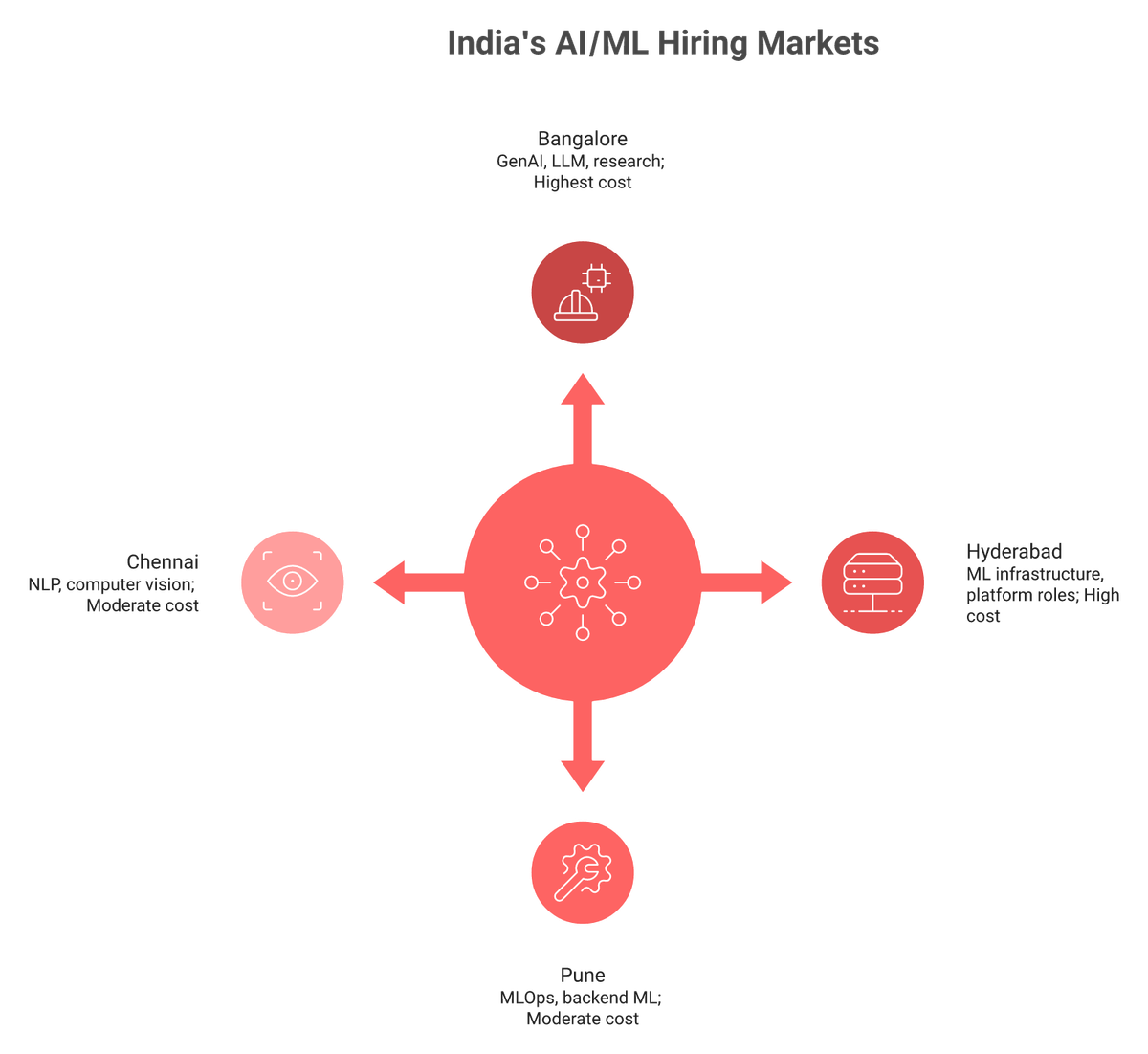
| City | Strongest for | Relative cost |
|---|---|---|
| Bangalore | GenAI, LLM, research | Highest |
| Hyderabad | ML infra, platform | High |
| Pune | MLOps, backend ML | Moderate |
| Chennai | NLP, computer vision | Moderate |
A practical structure is the hub-and-spoke model. Run your core team from a Tier-1 hub like Bangalore, then add spokes in Tier-2 and Tier-3 cities for cost-competitive talent plus stable infrastructure.
📋 Your Monday-morning sourcing shortlist
Start narrow. For research-heavy LLM work, source Bangalore first and screen for IIT/IIIT pedigree and product-company time. For production and MLOps, Pune and Hyderabad give better value per rupee.
I could be wrong for your specific stack, but from what surfaces when you actually run placements, product-company alumni convert to strong long-term hires more often than pure-pedigree candidates. When I place an ML engineer, I am not reading a market report. At Versatile Club, we source from the Bengaluru and Hyderabad networks I have hired across for six years through our recruitment and hire talent services, which is depth a global platform covering 150 countries cannot match.
Q2. What does it really cost to hire AI/ML engineers in India in 2026?
Fully-loaded annual cost for AI/ML engineers in India runs from roughly $18K for juniors to $85K to $110K for senior LLM specialists. That is about 4 to 7 times cheaper than an equivalent US hire. A senior engineer in Bengaluru costs around $58K all-in versus $220K in San Francisco, a saving near $162,000 per role per year. Arbitrage is the byproduct, though, not the reason.
💰 The cost table CFOs actually want
Let me give you the numbers first, then the caveat. These are indicative fully-loaded ranges, meaning salary plus statutory costs, drawn from current India hiring data. You can pressure-test your own figure with our salary calculator.
| Role and seniority | Annual cost (USD) |
|---|---|
| Junior ML (0 to 2 yrs) | $18K to $28K |
| Mid ML (3 to 5 yrs) | $28K to $48K |
| Senior ML/AI (6 to 10 yrs) | $45K to $70K |
| LLM/Agent specialist (3 to 7 yrs) | $40K to $75K |
| AI lead (8 to 14 yrs) | $65K to $95K |
The San Francisco comparison is where the math gets loud. One senior engineer at $58K in Bengaluru against $220K in the Bay Area frees roughly $162,000 a year, per head. India's GCC sector exported around $64.6bn in FY24, so this is not a fringe play. For a fuller breakdown, see our guide on the cost of hiring in India.
💸 Why "cheap" is the wrong pitch
Here is where the standard read gets it backwards. Most cost pages sell India as a discount bin. We never advocate going overseas because it is cheaper. If your only reason is price, that logic breaks the first time wage inflation hits.
You go to India for highly academically intelligent people who have few other places to apply that intelligence. The savings are real, but they are a consequence of talent access, not the headline. Budget for that talent to appreciate, because it will.
⚠️ One number that ruins naive budgets
Salaries for the hottest AI/ML roles are climbing 40% to 50% a year as GCCs and startups bid against each other. A one-time hiring cost understates your true spend. Build a 12-month compensation-escalation line, not just a start-date figure.
At Versatile Club, I quote costs the way I invoice them, as one clean USD figure from a single Indian entity backed by transparent pricing. No FX markup, no add-on surprises, so your month-end close reconciles against the number I gave you.
Q3. How do you vet AI/ML engineers, and know which role you're actually hiring?
First, get the role right. An ML engineer productionizes models (PyTorch, MLOps). An AI/LLM engineer works on top of foundation models (RAG, fine-tuning, agents). A data scientist analyzes and experiments. Then vet for production reality: ask about a model that failed in production, and run a paid one-to-two-week mini-project. Layer in full background verification, because nearly 30% of Indian IT-sector resumes contain discrepancies.
🧩 Three roles people keep confusing
RAG means retrieval-augmented generation, where a model pulls from your data before answering. Fine-tuning means retraining a base model on your examples. These are AI/LLM engineer skills, not general ML engineer skills.
| Role | Core work | Signal skills |
|---|---|---|
| ML engineer | Ships and maintains models | PyTorch, MLOps, pipelines |
| AI/LLM engineer | Builds on foundation models | RAG, fine-tuning, agents |
| Data scientist | Analysis and experiments | Statistics, modeling |
Half my early client calls are really about fixing the job description before we source a single resume. Ask for a "GenAI engineer" when you need MLOps, and you overpay and stall.
⚠️ The credential-inflation problem
Now the uncomfortable part. Nearly 30% of IT-sector resumes in India carry discrepancies, from inflated titles to invented tenure. Skills-only screening does not catch this.
"The process was straightforward, the Support team was easy to work with, and the candidates' quality met our expectations."
Verified User in Venture Capital and Private Equity Versatile Club G2 Verified Review
✅ The vetting sequence I trust
Vet for production reality, not credentials. Ask candidates to walk you through a model that failed in production and what they changed. Never ask closed yes/no questions like "Are you on schedule?" Ask open ones like "Show me what is left on the schedule."
Then run a paid mini-project. We usually pay around $1,500 for a one-to-two-week test build. We never ask people to work for free, because if we would not do it for free, why would anyone else? Finally, run background verification across identity (Aadhaar/PAN), education, employment history, and criminal (e-Courts plus police).
"Finding the right design talent is never easy. For us, it was important to hire people who understood both craft and pace, and Versatile made that process feel much simpler."
Ibrahim A. Versatile Club G2 Verified Review
At Versatile Club, we screen for culture fit using 50 behavioral parameters, not just a coding test, and you can preview the approach with our culture fit quiz. This is the difference between a legal hire on paper and a good hire who stays, and it is the problem compliance-first providers quietly skip.
Q4. What will you actually pay in statutory costs under India's 2025-26 Labour Codes?
Under India's Code on Wages, "wages" (Basic plus DA) must be at least 50% of total CTC. DA means dearness allowance, an inflation-linked pay component. That single rule raises PF, gratuity, and bonus liabilities, and forces a salary rebuild many payroll systems get wrong. Add ESI, professional tax, and TDS deposited by the 7th of each month, with Form 16 issued by 30 May. Statutory cost is roughly a real +50% layer on base pay.
📊 The stack, in plain numbers
Here is what actually leaves your account each cycle. These are the recurring statutory items on an India payroll run, the same items our managed payroll service files every month.
| Item | Rate / rule | Timing |
|---|---|---|
| PF (provident fund) | 12% of Basic+DA | Monthly |
| ESI (employer share) | 3.25% (employee 0.75%) | Monthly |
| Gratuity accrual | 4.81% of Basic+DA | Accrued |
| TDS (tax at source) | Per income-tax slab | By 7th monthly |
| Professional tax | State-specific slab | State-specific |
| Form 16 issuance | Annual TDS certificate | By 30 May |
Professional tax is not one rule. Maharashtra runs PTRC plus PTEC on a monthly slab, Karnataka is monthly with a Shops and Establishments renewal, and Tamil Nadu bills biannually. Delhi has no professional tax at all but strict S&E rules.
⚠️ Where legacy payroll breaks
The 50% wage-floor rule is the trap. If your allowances exceed the 50% cap, the excess is added back to wages for statutory calculation. Systems that still split salary the old way under-deposit PF and gratuity, and that gap becomes back-pay exposure.
I could be understating this, but from running real payroll cycles, most misclassification and under-deposit pain traces back to this one rule being implemented wrong. Our payroll compliance in India guide walks through the fix.
✅ A per-state checklist you can run
Before your first India payroll, confirm five things. Register PF and ESI. Register professional tax in the correct state. Set Basic plus DA at 50% or higher. Lock the TDS 7th-of-month deposit. Calendar the 30 May Form 16 deadline.
At Versatile Club, we file PF, ESI, TDS, and professional tax under our own registrations across all 28 states and 8 union territories through our own registered Indian entity (Foo Falcon Technologies Pvt Ltd), which anchors our EOR services in India. That is ownership over abstraction, not a partner shell subcontracting your compliance.
"Versatile's Employer of Record India setup eliminated all of that. I get a single USD invoice, fully compliant employment contracts, and payroll runs on time every month. No entity setup, no CA juggling, no statutory filing stress."
Vedant T., Founder Versatile Club G2 Verified Review
Q5. What's the real risk of hiring AI/ML engineers as contractors instead of employees?
Hiring India-based engineers as contractors to move fast can trigger $25,000 to $40,000 per head in back-pay exposure for misclassification. It also creates Permanent Establishment (PE) risk, which can expose your company to Indian corporate tax. On top of that, contractor paperwork often assigns intellectual property (IP) weakly, leaving model weights and training data legally loose.
⚠️ The dinner-break tell
Let me define misclassification simply. It means treating someone who works like an employee as a contractor on paper. Indian authorities look at the real relationship, not the contract label. Our guide on independent contractor vs EOR breaks down how that line is drawn.
Here is a scene that says it all. An American manager told me an Indian engineer she worked with kept asking her, over instant message, whether it was okay to take his dinner break. She said he did not need to ask. He insisted, "because I'm your subordinate."
That word, subordinate, is the tell. Direction, fixed hours, and reporting lines all signal employment, not independent contracting. That is the exact fact pattern that breaks a contractor-only setup.
💸 What the exposure actually is
Get it wrong and the bill has three parts. Each one is real money, not a hypothetical.
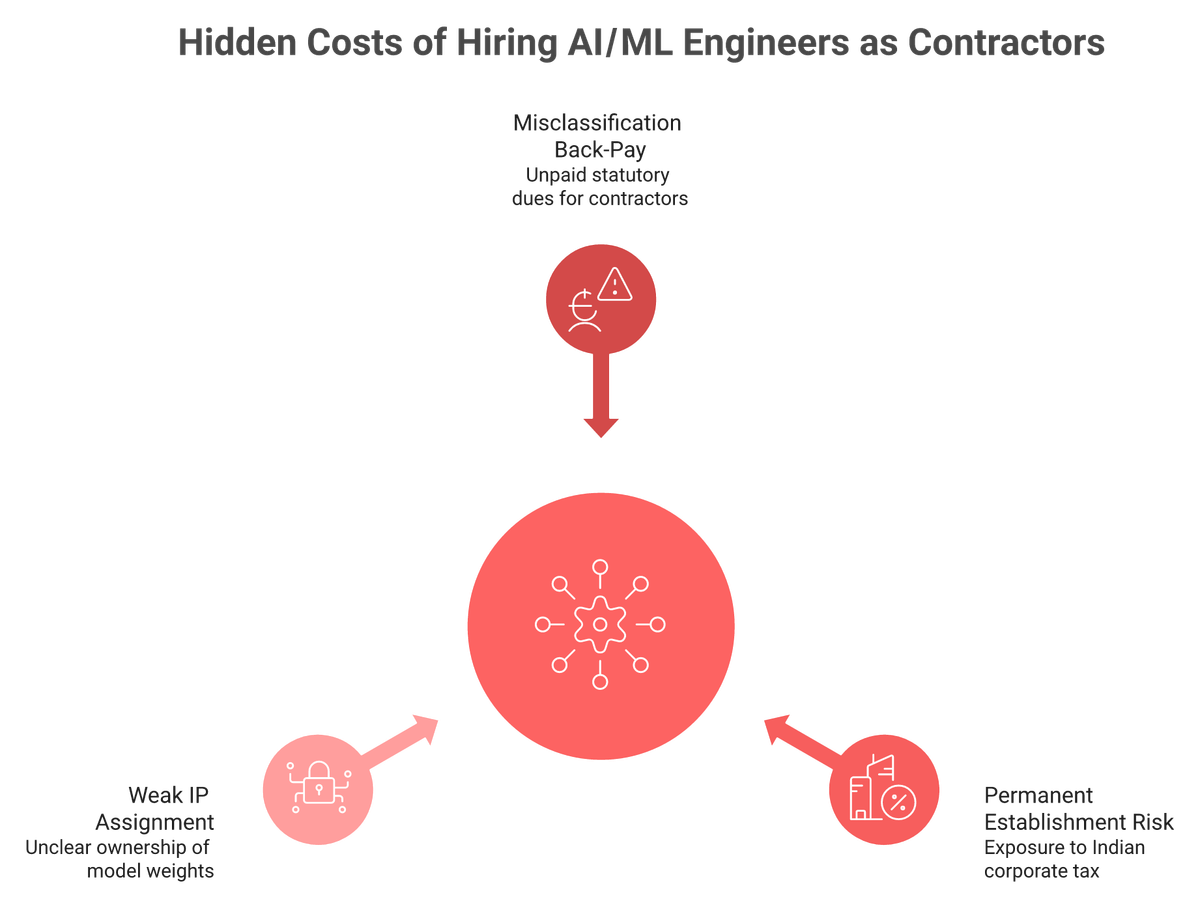
Back-pay exposure of roughly $25,000 to $40,000 per head for unpaid statutory dues.
PE risk, where a fixed India presence exposes your parent company to Indian corporate tax.
Weak IP assignment, where model weights, training data, and fine-tuning are not cleanly owned by you.
That last point matters more for AI teams than for anyone else. Your engineers are building the asset. If the contract does not assign that IP tightly, and align with data rules like the DPDP Rules 2025, you can lose control of the thing you paid to create.
✅ The bridge that removes the risk
I think about this like a river crossing. You do not always need to build the Golden Gate, which is your own Indian subsidiary at $50K and 12 to 18 months. A simple suspension bridge gets you across, and our EOR vs entity calculator shows where that line falls for your headcount.
That bridge is an Employer of Record (EOR), a company that legally employs your hire in India for you. At Versatile Club, we employ the engineer on our own registered Indian entity from day one through our EOR services in India. No contractor grey zone, no PE risk for your parent, and IP plus DPDP clauses written into the contract, which is depth a platform spread across 90-plus countries rarely localizes.
Q6. Do you need DPDP compliance when your India team handles AI training data?
Yes. If your India-based AI/ML engineers process personal data, such as training sets or user records, your entity or EOR becomes a Data Fiduciary under the DPDP Rules 2025. A Data Fiduciary is the party that decides how and why personal data gets used. The rules were notified via G.S.R. 846(E) on 13 November 2025.
📋 What the rules actually require
The DPDP (Digital Personal Data Protection) framework is India's core data-privacy law. For an AI team, three obligations matter most.
Itemized consent notices, so people know exactly what data you use and why.
Breach reporting to the Data Protection Board within 72 hours.
For a Significant Data Fiduciary, appointing a DPO (Data Protection Officer), plus annual DPIAs and audits.
A Significant Data Fiduciary is a larger or higher-risk handler of data, flagged by the government. A DPIA (Data Protection Impact Assessment) is a documented risk check on how you process personal data.
✅ What to do about it on Monday
Here is where the standard read gets it backwards. Most India hiring guides skip DPDP entirely, as if it only applies to consumer apps. AI teams touch personal data by default, through the datasets they train on.
So treat DPDP as in-scope from your first hire. Add DPDP and IP-assignment clauses to the employment contract, and ask your EOR to show its own breach-reporting and DPO posture. At Versatile Club, those clauses are standard in every engineer contract under our owned Indian entity, so compliance is the floor we build on, not an add-on we upsell. If you want that reviewed before you hire, our HR consulting services map the gaps.
Q7. How long does hiring take, and what will notice periods, counter-offers, and wage inflation cost you?
Plan 3 to 4 months to full productivity. Sourcing to an accepted offer usually takes 14 to 30 days. Then add a 60 to 90 day notice period, which is standard for senior India talent. Counter-offers and offer drop-offs are common for in-demand AI engineers, so build slack into your plan.
⏰ The realistic timeline, stage by stage
Let me lay out where the weeks actually go. This is the sequence I watch play out across Bengaluru and Hyderabad placements.
| Stage | Typical duration |
|---|---|
| Sourcing to accepted offer | 14 to 30 days |
| Notice period at current job | 60 to 90 days |
| Onboarding to first output | 2 to 4 weeks |
The notice period is the part US founders underestimate most. A San Francisco engineer might start in two weeks. A Bengaluru senior often cannot leave for three months, and a counter-offer can still pull them back on day 89. Our recruitment team plans around exactly this drop-off risk.
💰 The retention cost nobody budgets
Now the number that ruins naive plans. Salaries on the hottest AI/ML roles are rising 40% to 50% a year, as 2,100-plus GCCs and funded startups bid against each other for the same people.
That means a one-time hiring cost understates your real spend. If you budget only the start-date salary, you get surprised at the first review cycle. I could be conservative here, but from what surfaces when you actually run renewals, retention is where the arbitrage quietly leaks. You can model the full number with our cost of hiring in India guide.
✅ How to plan for it
Do two things on Monday. Build a 12-month compensation-escalation line into the hire's budget, not just a start figure. And treat retention as designed-in, not hoped-for.
One lever I lean on is pay stability over merit bonuses. People do their best work when a big enough salary removes home stress, and worst when they are unsure whether extra pay will land. At Versatile Club, our culture-fit screen and 90-day Success Coach exist to cut the early attrition that feeds the expensive re-hire spiral.
Q8. Which hiring model fits your stage, direct entity, contractors, staffing, GCC, or EOR?
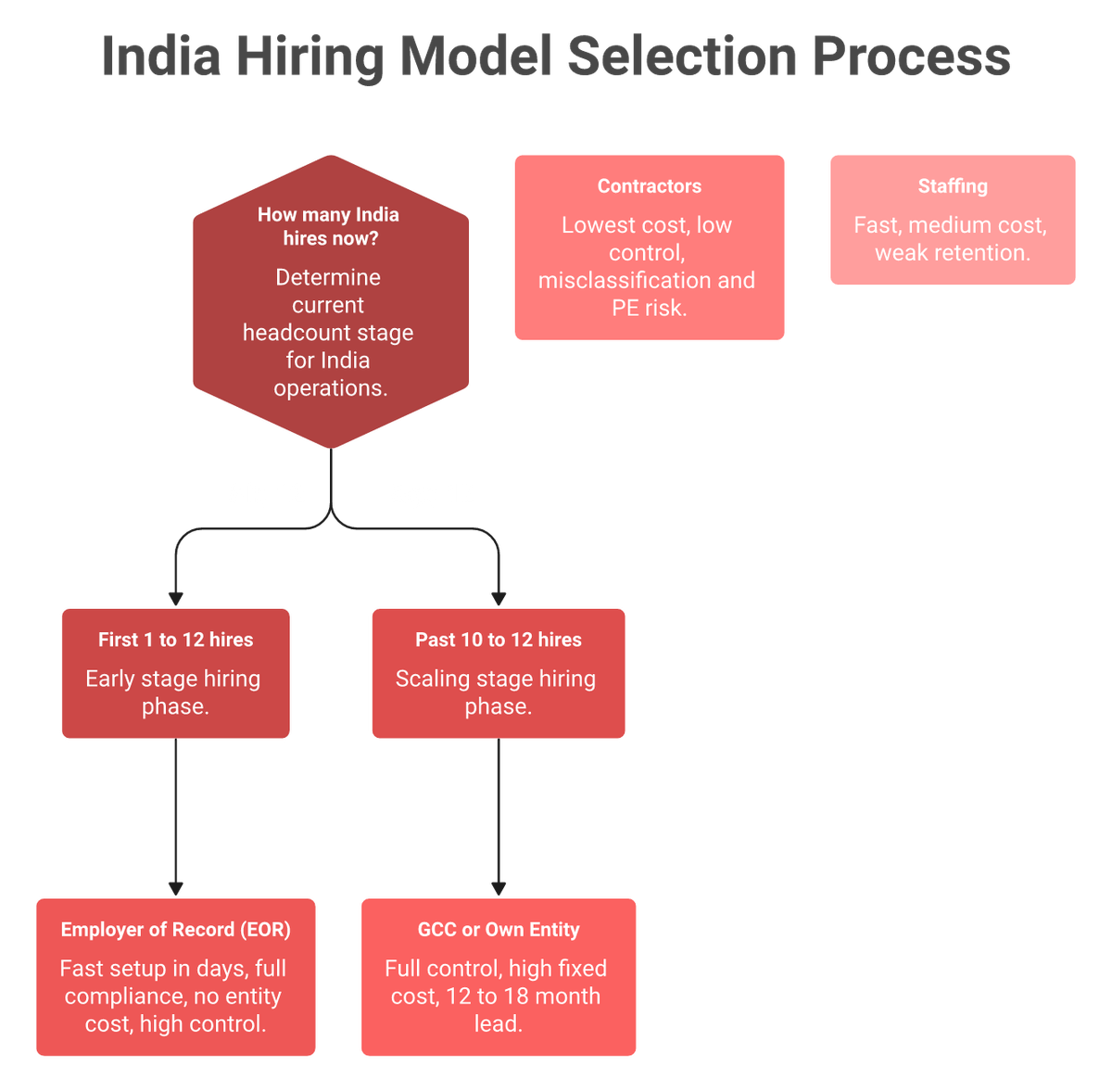
For your first 1 to 12 India hires, an Employer of Record (EOR) is usually the right bridge. It gives fast setup, full compliance, and no entity cost. Contractors are cheapest but carry misclassification and PE risk. Staffing is fast but shallow on retention. A GCC or your own entity makes sense past roughly 10 to 12 hires, when volume justifies the fixed cost.
🧭 The five models, side by side
A GCC (Global Capability Centre) is your own captive India office. Here is how the options trade off, and our EOR vs GCC in India guide goes deeper on the switch point.
| Model | Speed | Cost | Control | Main risk |
|---|---|---|---|---|
| Contractors | Fast | Lowest | Low | Misclassification, PE |
| Staffing | Fast | Medium | Medium | Weak retention |
| EOR | Fast (days) | Low-medium | High | Very low |
| GCC | Slow | High fixed | Full | Overhead if under 12 |
| Own entity | Slowest | $50K+ | Full | 12 to 18 month lead |
The tipping point is real. Many teams tell me it hits around 10 to 12 hires. One client interviewed someone they thought was in London, only to learn after round three he was in Greece. We employed him, they scaled to 12 people through us, then migrated the whole group to their own entity once it made sense.
⚠️ Where each model breaks
Pick by your headcount trajectory, not a vendor's pitch. Contractors are not recommended once anyone works like an employee. Global generalist platforms cover 90-plus countries but often route India through a local-partner shell, and support can slow to a ticket queue, which is why founders look at a Deel alternative for India-specific depth.
"It took three months to onboard our first 3 individuals. They didn't seem to be able to navigate Visas or variations to employment contracts."
Verified User in Information Technology and Services Deel Hire G2 Verified Review
"The PF transfer for employees after terminating their employment with Velocity was very poor. There was limited help, delayed responses."
Verified User in Computer Software Velocity Global G2 Verified Review
✅ The India-native fit for 1 to 12 hires
Wisemonk, a fellow India-focused EOR, earns fair marks for structured onboarding, though some users note small-team support lag, one reason buyers weigh a Wisemonk alternative.
"Their support/query responses can occasionally take a bit longer sometimes, likely due to a relatively small team."
Verified User in Financial Services Wisemonk G2 Verified Review
Versatile Club is built for exactly this 1 to 12 hire window. We run contract to hire plus EOR on our own Indian entity, so you get founder-on-WhatsApp support and a clean migration path the day you outgrow us.
Q9. India-native EOR vs global generalists vs Wisemonk, who should you pick?
For a company whose only market that matters is India, an India-native, owned-entity EOR beats global generalists that run India through local partner shells across 90 to 150 countries. The providers below are ranked for the first-1-to-12-hire India buyer. Against Wisemonk specifically, the gap is retention and pricing transparency. If you want the wider field, our roundup of the best EOR in India maps every option.
🧭 The ranked shortlist for India-first buyers
An owned entity means the provider is the legal employer itself, not a reseller sitting on top of a local partner. That difference decides who owns your compliance.
1.1 Versatile Club
✅ India-native, owned-entity EOR plus C2H. Best for your first 1 to 12 India hires. Not for buyers needing 5-plus countries. See our EOR services for the full scope.
1.2 Wisemonk
✅ India-focused, compliance-first, SOC 2 and ISO certified. ❌ Thinner retention story, no published replacement guarantee, "from $99" pricing that is not fully broken out per tier. Founders comparing the two often start with a Wisemonk alternative.
1.3 Deel
✅ 150-plus countries. Best for multi-country. ❌ India routed via partner entity, ticket-queue support. For India depth, weigh a Deel alternative in India.
1.4 Remote
✅ Broad coverage. ❌ India expertise spread thin, which is why some buyers look at Remote alternatives in India.
1.5 G-P (Globalization Partners)
✅ Enterprise multi-country. ❌ Not India-depth for small teams.
1.6 Multiplier / Skuad
✅ Fast mid-market breadth. ❌ Partner-entity India.
📊 Where the real differences sit
I think about this like AWS regional depth. A global platform gives you every region shallowly. An India-only operator gives you one region, all the way down.
| Factor | India-native (owned entity) | Global generalist |
|---|---|---|
| India legal employer | Own entity | Local partner shell |
| Invoicing | USD direct from India | FX layers, add-ons |
| Support | Founder-direct | Ticket queue |
| India compliance depth | Multi-state, labor-code | Thin |
Global platforms are not bad. They are built for breadth. But breadth is exactly what dilutes India depth.
"It took three months to onboard our first 3 individuals. They didn't seem to be able to navigate Visas or variations to employment contracts."
Verified User in Information Technology and Services Deel Hire G2 Verified Review
Wisemonk, a fellow India specialist, earns fair marks for structured onboarding, with the honest caveat that a small team can slow support.
"Their support/query responses can occasionally take a bit longer sometimes, likely due to a relatively small team."
Verified User in Financial Services Wisemonk G2 Verified Review
✅ When to pick which
Pick a global generalist if you are hiring across five or more countries at once. That is their real strength, and I will say so plainly.
Pick an India-native EOR if India is the market that matters. At Versatile Club, we own the Indian entity, invoice in USD direct from India with no setup or exit fees backed by transparent pricing, and back placements with a 6-month replacement guarantee, which is transparency over complexity.
"Invoicing in USD meant zero exchange rate surprises. The compliance rigour is genuinely impressive, every statutory filing reviewed before submission."
Vedant T., Founder Versatile Club G2 Verified Review
Q10. How do you onboard an AI/ML engineer in India so they actually stay, and hire your first one in 30 to 60 days?
Onboarding starts before day one. You need a compliant contract with DPDP and IP-assignment clauses, PF/ESI/TDS enrollment, and equipment ready. A structured 30-60-90 plan cuts ramp from 12 to 14 weeks down to about week six. A 90-day Success Coach plus a real replacement guarantee solve the retention problem a contract alone never touches.
⏰ The pre-day-one checklist
Most founders think onboarding starts on the join date. It starts a week earlier. Get these done before your engineer logs in, or let our EOR services in India handle them for you.
Signed compliant employment contract, with DPDP and IP-assignment clauses.
PF, ESI, and TDS enrollment set up.
Laptop and access provisioned, which our guide on how to equip remote employees in India covers.
A 30-60-90 plan simply means clear goals at day 30, day 60, and day 90. It turns a vague first quarter into a ramp the engineer can actually follow.
🗣️ The communication habit that prevents drift
Here is a small tactic that saves whole weeks. At the end of any call, recap the key points, or send a short email repeating them right after.
If you are ever unsure what was asked, do not read between the lines. Say plainly that you do not understand. This matters more across cultures, and I lean on it in every India placement I run through our HR consulting services.
"The onboarding was the part that surprised me most, compliant contract drafted for us, the offer out the same week, and our hire was set up properly before I'd even fully wrapped my head around how India payroll works."
Angad S. Versatile Club G2 Verified Review
💡 Compliance is the floor, not the ceiling
Here is where the standard read gets it backwards. Compliance-first providers treat a legal contract as the finish line. It is the starting line.
The real problem is not the "legal hire on paper." It is the "good hire who stays." Indians go to work in a reasonable facsimile of the West, then go home every night to India, which is why benefits like PF and gratuity are emotionally, not just legally, non-negotiable, as our payroll compliance in India guide explains.
"Founder is just a call away. Extremely helpful in resolving all our queries. The process is super smooth to set up India EOR."
surbhi m. Versatile Club G2 Verified Review
✅ Your 30 to 60 day action sequence
You just closed a round and need engineers in 30 to 60 days. You do not have to run with scissors to move fast. If you are early stage, our for startups track is built for exactly this pace.
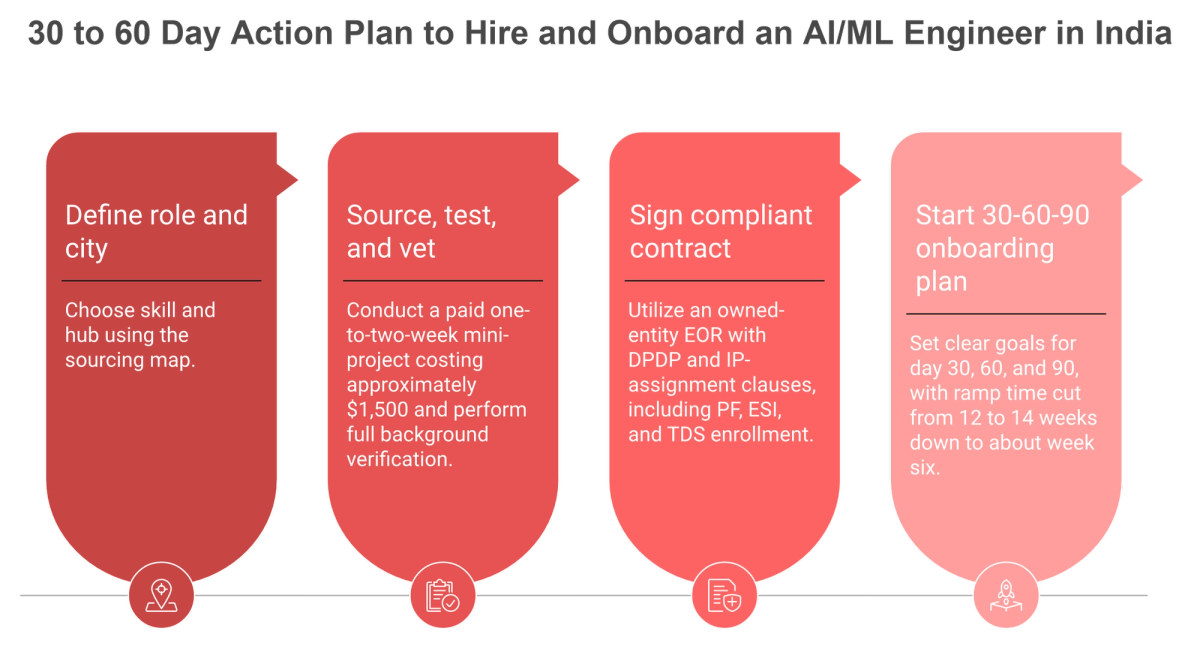
Define the role and city (see the sourcing map above).
Source, run a paid mini-project, and vet.
Sign a compliant contract through an owned-entity EOR.
Start the 30-60-90 onboarding plan.
At Versatile Club, we run a 5-day contractual onboarding SLA, a 90-day Success Coach, a 6-month replacement guarantee, and your first month free, with me on WhatsApp directly, not a ticket queue. You can book a demo to walk through it.
Where my head is right now is this: over the next two years, India stops being one country on a global map and becomes its own specialist category. If you are making that first India hire, tell me what you're building through our contact us page, and I will tell you honestly whether an EOR is even the right bridge for you.
FAQs
Where in India should we look for elite AI/ML engineers, and does the city really matter?
Yes, the city matters more than most first-time founders expect. India holds more than 120,000 AI/ML professionals, but they are not spread evenly, so posting one job for "India" blurs the signal you actually need.
- Bangalore: deepest generative-AI, LLM, and research bench, and the highest cost.
- Hyderabad: strong ML infrastructure and platform roles.
- Pune: cost-competitive MLOps and backend ML.
- Chennai: NLP and computer-vision value.
The best hires usually come from product-company alumni like Flipkart, Swiggy, and Razorpay, plus IIT, IIIT, or BITS graduates. A practical structure is the hub-and-spoke model, running your core team from a Tier-1 hub and adding spokes in Tier-2 and Tier-3 cities.
India now hosts over 2,100 Global Capability Centres, so you compete with them for every offer. When we run recruitment for AI/ML roles, we source from the Bengaluru and Hyderabad networks we have hired across for years, which is depth a global platform covering 150 countries cannot match.
What does it really cost to hire AI/ML engineers in India in 2026?
Fully-loaded annual cost runs from roughly $18K for juniors to $85K to $110K for senior LLM specialists, meaning salary plus statutory costs. That is about 4 to 7 times cheaper than an equivalent US hire.
- Junior ML (0 to 2 yrs): $18K to $28K.
- Mid ML (3 to 5 yrs): $28K to $48K.
- Senior ML/AI (6 to 10 yrs): $45K to $70K.
- AI lead (8 to 14 yrs): $65K to $95K.
A senior engineer in Bengaluru costs around $58K all-in versus $220K in San Francisco, freeing roughly $162,000 per role per year. We never advocate going overseas because it is cheaper, though; the savings are a consequence of talent access, not the headline.
One trap: salaries on the hottest roles are climbing 40% to 50% a year, so budget a 12-month compensation-escalation line, not just a start-date figure. You can pressure-test your own number with our salary calculator, and we quote costs as one clean USD figure from a single Indian entity with no FX markup.
What is the real risk of hiring AI/ML engineers as contractors instead of employees?
Hiring India-based engineers as contractors to move fast can backfire in three expensive ways. Indian authorities look at the real working relationship, not the contract label, so direction, fixed hours, and reporting lines all signal employment.
- Misclassification back-pay: roughly $25,000 to $40,000 per head in unpaid statutory dues.
- Permanent Establishment risk: a fixed India presence can expose your parent company to Indian corporate tax.
- Weak IP assignment: model weights, training data, and fine-tuning may not be cleanly owned by you.
That last point matters most for AI teams, because your engineers are building the asset. If the contract does not assign IP tightly and align with the DPDP Rules 2025, you can lose control of the thing you paid to create.
The bridge that removes this risk is an Employer of Record. We employ the engineer on our own registered Indian entity from day one through our EOR services in India, so there is no contractor grey zone, no PE risk, and IP plus DPDP clauses written into every contract.
Which hiring model fits our stage, contractors, staffing, GCC, own entity, or EOR?
For your first 1 to 12 India hires, an Employer of Record is usually the right bridge, giving fast setup, full compliance, and no entity cost. Pick by your headcount trajectory, not a vendor's pitch.
- Contractors: cheapest but carry misclassification and PE risk.
- Staffing: fast but shallow on retention.
- EOR: fast in days, high control, very low risk.
- GCC or own entity: full control, but high fixed cost and a 12 to 18 month lead, sensible past 10 to 12 hires.
The tipping point is real, and many teams tell us it hits around 10 to 12 hires. One client scaled to 12 people through us, then migrated the whole group to their own entity once it made sense.
If you want to model the switch point precisely, our EOR vs entity calculator shows where the fixed cost of an entity finally beats a per-head EOR fee, so you avoid overbuilding too early.
How do we onboard an AI/ML engineer in India so they actually stay?
Onboarding starts before day one, not on the join date. A structured plan cuts ramp from 12 to 14 weeks down to about week six.
- A signed compliant contract with DPDP and IP-assignment clauses.
- PF, ESI, and TDS enrollment set up.
- Laptop and access provisioned before login.
- A 30-60-90 plan with clear goals at day 30, day 60, and day 90.
Compliance is the floor, not the ceiling. The real problem is not the legal hire on paper; it is the good hire who stays. Benefits like PF and gratuity are emotionally, not just legally, non-negotiable in India, so retention has to be designed in.
A small habit that prevents drift: recap key points at the end of every call, and say plainly when something is unclear rather than reading between the lines. We back this with a 90-day Success Coach and a 6-month replacement guarantee through our EOR services, plus a 5-day onboarding SLA and your first month free.