Table of contents (16)
9 Best Skuad Alternatives in India: How They Compare on Cost, Compliance, and Support
Q1. What Are the 9 Best Skuad Alternatives for Hiring in India in 2026?
The 9 best Skuad alternatives for India in 2026 are Versatile, Deel, Remote, Multiplier, Oyster, Papaya Global, Velocity Global, Globalization Partners, and Rippling. Versatile ranks first for India-first hiring because it owns its Indian entity, invoices in USD directly from India, and commits to a 5-day onboarding SLA. Most global platforms spread India across 100+ countries through local partner shells.
I have spent six years placing engineers, designers, and ops people across Bengaluru, Hyderabad, and Pune. So I will say the quiet part out loud. Most "best Skuad alternatives" lists rank whoever wrote them at number one. I am doing something different here. I am showing you the scoring math first, then letting the table speak.
📌 Why I Built This List Differently
Skuad, now folded into Payoneer Workforce Management, gave the market a clean promise: transparent pricing near $199 a month and India plus APAC coverage. The gap shows up in depth. One verified user put it plainly.
"The customer support, it takes forever and most of the times doesn't actually solve anything."
Ricardo V. Payoneer (Formerly Skuad) G2 Verified Review
That is the real trigger for switching. Not the sticker price. It is the question of whether your provider actually understands the 2026 Labour Code wage rule and your state's professional tax filings, or whether your legal safety sits with an anonymous local aggregator. A specialist that lives inside payroll compliance in India reads that risk very differently from a global generalist.
💯 How We Scored Each Provider
I scored every provider on five criteria that add up to 100 points. Here is the full weighting, published up front.
| Criterion | Weight | What It Measures |
|---|---|---|
| India Entity Model and Compliance Depth | 25% | Owned entity vs partner shell; PF, ESI, TDS, professional tax, gratuity accuracy |
| Pricing Transparency and Commercial Model | 20% | FX markup, setup and exit fees, salary-band clarity, invoice honesty |
| Onboarding Speed and Support Model | 20% | Signed-to-live time; founder-direct vs ticket queue or chatbot |
| Talent and Retention Support | 20% | Culture-fit vetting, replacement guarantee, onboarding monitoring |
| Customer Validation | 15% | G2, Capterra, Reddit, and verified third-party proof |
Scores convert to stars in simple bands. A score of 0 to 20 earns 1 star. 21 to 40 earns 2 stars. 41 to 60 earns 3 stars. 61 to 80 earns 4 stars. 81 to 100 earns 5 stars.
⚠️ Where I Am Honestly Uncertain
I could be off on the exact star for a couple of global players, because their India depth varies by which partner entity they route you through. What I am confident about is the pattern. India is the only country we operate in at Versatile. Global platforms carry 90 to 150 countries, and that breadth thins the India bench.
Our Evaluation Criteria
Each provider on this list was assessed across these decision-grade criteria:
India Entity Model: own Indian entity, local partner entity, contractor model, or payroll-only setup.
Statutory Compliance Depth: PF, ESI, TDS, professional tax, gratuity, POSH, Form 16, full-and-final settlement, DPDP readiness, and New Labour Code 2025-26 structuring.
State-Level Coverage: professional tax, Shops and Establishments, labour welfare fund, and leave rules across Indian states.
Onboarding Speed: time from signed agreement to compliant contract, payroll setup, statutory registration, and employee start.
Pricing Transparency: monthly fee, setup fee, exit fee, FX markup, first-month terms, salary-band pricing, and invoice clarity.
Invoicing and Finance Readiness: USD invoicing, gross-deduction-net reporting, challan confirmations, TDS receipts, and audit-ready documentation.
Support Model: founder-direct, named HR manager, HRBP, ticket queue, chatbot, or general CSM model.
Talent and Retention Support: recruiting, contract-to-hire, culture-fit vetting, onboarding monitoring, replacement guarantee, and employee experience.
Customer Validation: G2, Capterra, Clutch, Reddit, case studies, and third-party proof.
Best-Fit Buyer Segment: first India hire, 1 to 20 India employees, 10 to 50 India employees, or teams switching from Deel or Remote.
Who This Guide Is For
This guide is designed for:
US and UK founders hiring their first 1 to 3 employees in India.
Seed to Series B startups building engineering, product, AI, design, marketing, or operations teams in India.
People Ops and HR leaders reviewing India EOR, payroll, contractor, or PEO vendors.
CFOs and finance teams that need clean invoicing, statutory liability visibility, and audit-ready India payroll records.
Legal teams reviewing employment contracts, IP assignment, misclassification risk, and PE risk.
Companies currently using Deel, Remote, Multiplier, G-P, or contractors and evaluating India-specialist alternatives.
The 9 Best Skuad Alternatives at a Glance
Versatile: Best for US and UK startups hiring their first 1 to 20 India employees.
Deel: Best for teams hiring across many countries at once from one dashboard.
Remote: Best for companies wanting an owned-entity global EOR with flat pricing.
Multiplier: Best for fast, price-competitive APAC onboarding.
Oyster: Best for mid-market teams wanting a polished global platform.
Papaya Global: Best for enterprises prioritizing payroll data and cost analytics.
Velocity Global (Pebl): Best for spread-out multi-country contractor and EOR mixes.
Globalization Partners: Best for enterprise-grade global EOR with heavy compliance tooling.
Rippling: Best for teams wanting HR, IT, and payroll in one system of record.
Master Comparison Table
| Provider (Stars) | Best For | Key Strength | Compliance |
|---|---|---|---|
| Versatile ⭐⭐⭐⭐⭐ | US and UK startups hiring first 1 to 20 India employees | Owned India entity, USD invoicing, 5-day SLA, founder on WhatsApp | Own entity; PF, ESI, TDS, PT across all 28 states and 8 UTs; New Labour Code ready |
| Deel ⭐⭐⭐⭐ | Teams hiring across many countries at once | Broadest country coverage from one dashboard | India routed via partner model; reported 3 to 5% FX markup |
| Remote ⭐⭐⭐⭐ | Owned-entity global EOR with flat pricing | Flat per-employee pricing across owned entities | Owned entity in several markets; broad global coverage |
| Multiplier ⭐⭐⭐ | Fast, price-competitive APAC onboarding | Quick onboarding and competitive pricing | Partner-assisted India; multi-country payroll |
| Oyster ⭐⭐⭐ | Mid-market teams wanting a polished platform | Clean UX and global hiring workflows | Partner-assisted global EOR coverage |
| Papaya Global ⭐⭐⭐ | Enterprises prioritizing payroll analytics | Payroll data and cost visibility | Global payroll and EOR; data-heavy compliance |
| Velocity Global (Pebl) ⭐⭐ | Multi-country contractor and EOR mixes | Local knowledge across many countries | Partner-assisted; account-manager routed |
| Globalization Partners ⭐⭐⭐ | Enterprise-grade global EOR | Mature compliance tooling at scale | Global owned and partner entity mix |
| Rippling ⭐⭐⭐ | Teams wanting HR, IT, and payroll unified | Single system of record for people and IT | US-centric strengths; global EOR via partners |
Star ratings reflect this list's rubric applied to India-hiring fit, not overall global capability. A global generalist can be excellent for 30-country payroll and still sit mid-table for a single India hire. If you want to model this trade-off in numbers, our EOR vs entity calculator lays out the real India cost side by side.
1.1 Versatile: Best for US and UK Startups Hiring Their First 1 to 20 India Employees
Overview
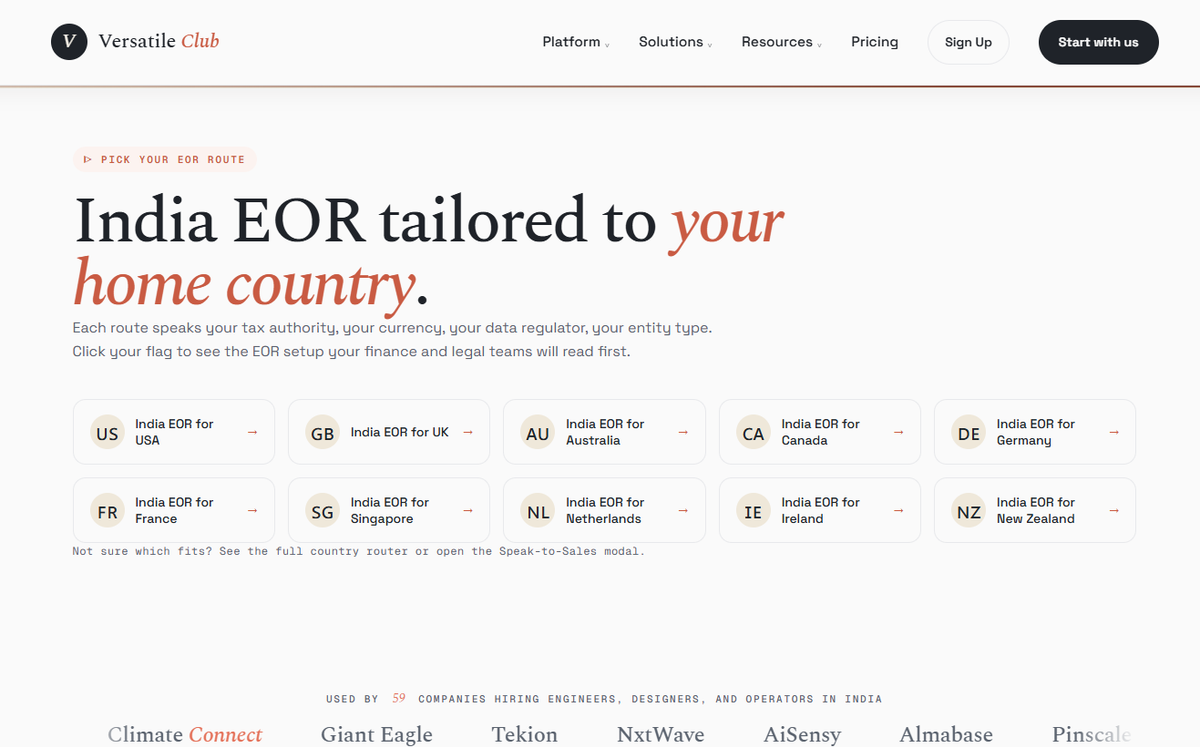
Versatile is an India-only Employer of Record and Contract-to-Hire operator. We serve US and UK companies that want to hire in India without setting up their own entity. We are the legal employer on paper through our own registered Indian company. You manage the person day to day. You can see the full model on our EOR services in India page.
Core Services
India EOR through our own entity, with PF, ESI, TDS, and professional tax under our registrations.
Contract-to-Hire (C2H) placements with culture-fit vetting on 50 behavioral parameters.
USD invoicing direct from India, with no FX markup and no setup or exit fees.
5-day contractual onboarding SLA from signed agreement to payroll live.
90-day Success Coach and a 6-month replacement guarantee on C2H placements.
Why Companies Consider Versatile
Founders come to us at a specific moment. They need one or two people in Bengaluru, and setting up a subsidiary feels like using the Golden Gate Bridge to cross a stream. A simple bridge gets you across. That is the EOR.
The second reason is trust. Compliance is the floor, not the ceiling. We handle the statutory work so you do not become a part-time India HR person, and then we help the hire actually stay.
Ideal Customer Profile
US and UK founders, Seed to Series B, making their first 1 to 20 India hires.
People Ops leaders who want founder-direct answers, not a ticket queue.
CFOs at $5M to $50M ARR SMBs who close month-end on a single USD invoice.
Commercial Model
EOR pricing starts at $149 per employee per month, with no setup fee, no exit fee, and the first month free. C2H is charged at 20 to 30% of annual salary, billed only after the hire completes day 90. Statutory items run at standard India rates: 12% PF, a 3.25% and 0.75% ESI split, and gratuity accrued from month one at 4.81% of Basic plus DA. Full details sit on our pricing page.
Customer Reviews
"As a founder at a digital marketing agency, I needed to hire and manage a small India-based team without setting up a local entity. Invoicing in USD meant zero exchange rate surprises. Five-day onboarding, zero late payslips."
Vedant T. Versatile Club G2 Verified Review
"The dashboard could be a little more self-serve. A couple of times I wanted to pull a report myself and ended up just messaging my contact instead. They always answered fast, so it wasn't a real problem, but I'd love to click around and find things on my own."
Angad S. Versatile Club G2 Verified Review
That second review is a fair hit. Our self-serve dashboard is thinner than a Rippling or a Deel, and I will not pretend otherwise. Where my head is right now is that founder-direct support beats a slick portal at our scale, but I want both over the next year.
1.2 Deel: Best for Teams Hiring Across Many Countries at Once
Overview
Deel is a global EOR and contractor payments platform covering 100-plus countries. It is the default name founders reach for when they want one dashboard for global hiring. For India specifically, Deel typically runs through a local partner entity rather than its own. We break the head-to-head down further in our Deel alternative guide.
Core Services
Global EOR across 100-plus countries.
Contractor onboarding and cross-border payments.
Multi-country payroll consolidation.
Immigration and visa support in select markets.
Equipment and device provisioning add-ons.
Why Companies Consider Deel
The buying logic is breadth. If you are hiring in eight countries this quarter, Deel puts them all in one place. That is a real advantage that no India-only operator can match, and I will say so directly.
The trade-off shows up in cost and India depth. Deel sits at the premium end, and users repeatedly flag FX and transfer fees, plus support that scales poorly on complex cases. If India is your focus, our Deel alternatives in India breakdown is worth a read.
Ideal Customer Profile
Scaling companies hiring across 5-plus countries at once.
Teams that value one consolidated global dashboard over single-country depth.
Companies where India is one of many markets, not the primary one.
Commercial Model
Deel's EOR pricing is commonly cited around $599 per employee per month, with reported 3 to 5% FX markups on cross-border transfers. Setup speed for EOR hires often runs 7 to 14 days. Exact India pricing depends on the partner entity and is provided by custom quote.
Customer Reviews
"It allows me to use one platform for multiple things. Contractors, EORs, employees, PTO, compliance. For the most part it is fairly straightforward."
Verified User in Computer Software Deel G2 Verified Review
"Often the CS doesn't seem to have answers, which leads to emails back and forth. Something I was looking for the answer to in 20 minutes becomes a 4 day process, or needs to be consulted with by multiple team members who aren't available except at 3:00am my time."
Verified User in Computer Software Deel G2 Verified Review
"There majority of their support team is helpful, but are often constrained by internal limitations. Everything was VERY time consuming. It took three months to onboard our first 3 individuals."
Verified User in Information Technology and Services Deel G2 Verified Review
Here is the honest read. Deel is genuinely good at breadth. The standard "just buy Deel for global EOR" advice quietly drags your total cost past $599 per head, with India compliance handled a layer removed from you. For one India hire, that is a lot of platform for a job an owned India entity does more directly. If you want that owned-entity route, start with our EOR services or for startups page.
1.3 Remote: Best for Owned-Entity Global EOR With Flat Pricing
Overview
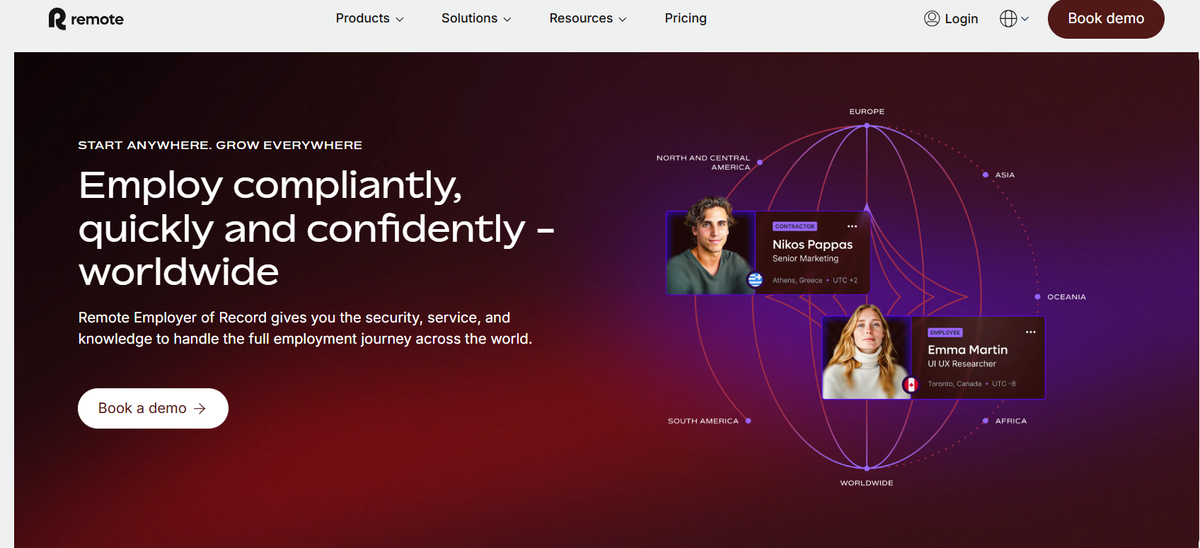
Remote is a global Employer of Record that owns entities in many of its markets. It appeals to companies that want predictable, flat per-employee pricing across countries. For India, Remote sits as one of 60-plus destinations, not a single-country specialist. We compare the two paths in our Remote alternative breakdown.
Core Services
Global EOR across owned entities in many markets.
Contractor management and international payments.
Global payroll consolidation.
Benefits administration through third-party partners.
IP and equipment support add-ons.
Why Companies Consider Remote
The pull is simplicity of pricing. Remote markets a flat monthly EOR fee, which finance teams like because it is easy to model. The owned-entity story also reassures legal teams worried about partner-shell risk.
The catch shows up in support and payroll accuracy at scale. Reviews repeatedly flag slow email-only support and payroll errors, which matter a lot when the person affected is your only India hire.
Ideal Customer Profile
Companies hiring across several countries wanting one flat price.
Teams that value owned-entity coverage over single-country depth.
Buyers where India is one node in a wider global map.
Commercial Model
Remote's EOR pricing is commonly cited around $599 per employee per month, billed as a flat fee. Onboarding for EOR hires typically runs 10 to 14 days. Some users report effective costs above the advertised rate once add-ons appear. Our Remote pricing guide digs into the real numbers.
Customer Reviews
"They were dishonest about the level of support provided. We specifically explained we required phone-level support for urgent matters, but that is not available. Instead they have email support with a 3-day SLA. Separately, their payroll is still supported by manual processes, and twice we've had near catastrophic errors."
Juliette D. Remote G2 Verified Review
"I find Remote super complicated to use at a platform level, with zero clarity on the process. Also, there are hidden fees everywhere, and I end up paying roughly 30% more than what's stated on the platform."
Javier G. Remote G2 Verified Review
⏰ My Take on the Speed Gap
Ten to fourteen days is fine when India is one of ten countries. It is painful when your Bengaluru engineer accepted an offer and wants a start date. We run a 5-day contractual SLA precisely because a single India hire cannot wait two weeks for a contract. You can see the process on our how it works page.
1.4 Multiplier: Best for Fast, Price-Competitive APAC Onboarding
Overview
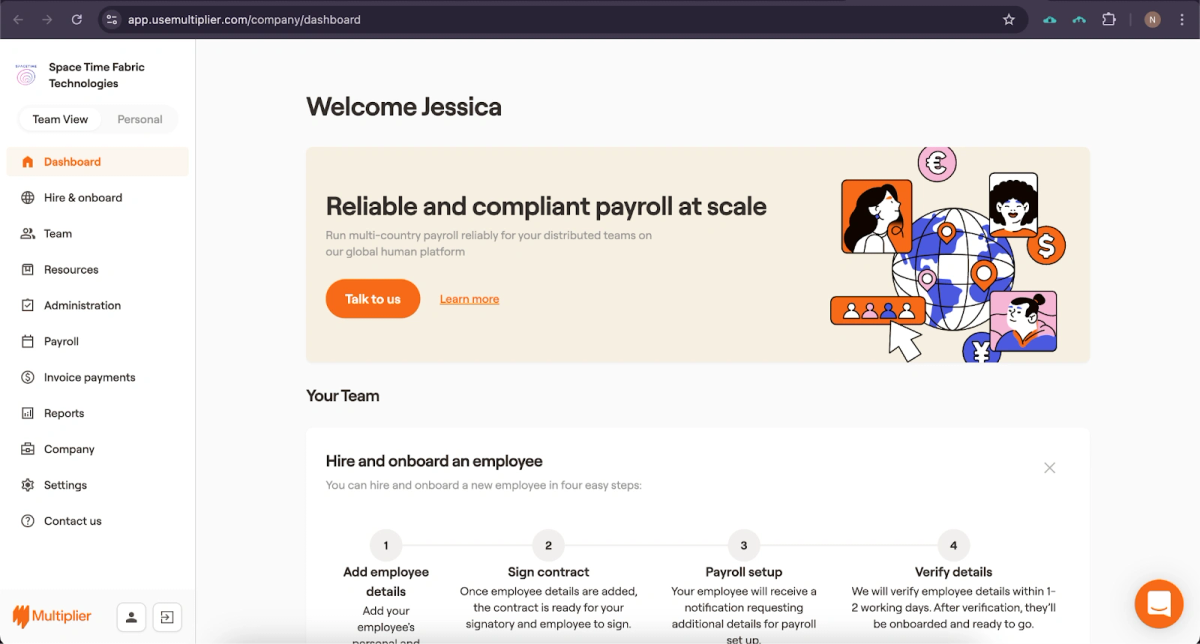
Multiplier is a global EOR with strong APAC roots and aggressive pricing. It is often shortlisted by startups optimizing for cost. India is covered within its broader multi-country footprint. See how the two compare in our Multiplier alternative guide.
Core Services
Global EOR and contractor management.
Multi-country payroll processing.
Onboarding workflows and document handling.
Benefits administration by country.
Expense and payment management.
Why Companies Consider Multiplier
The reason is almost always price and quick setup. Multiplier is genuinely competitive on the sticker, and onboarding starts smoothly.
The trade-off is what happens after go-live. Multiple reviews describe billing surprises, delayed payroll, and support that thins out once the contract is signed.
Ideal Customer Profile
Cost-sensitive startups hiring across APAC.
Teams prioritizing a low monthly rate over deep support.
Buyers comfortable managing some backend friction themselves.
Commercial Model
Multiplier's EOR pricing is commonly cited around $400 per employee per month. Setup is described as fast and easy. Some users report added deposits and bank-transfer fees not in the original contract. Our employer of record India cost guide sets a cleaner benchmark.
Customer Reviews
"They are very price competitive. Easy onboarding. Apart from price and onboarding, rest of the service is pathetic. They charge extra money for bank transfer with no clarity on the actual amount. They constantly delay the payment. At times there has been delay by a month."
Verified User in Computer Software Multiplier G2 Verified Review
"Multiplier has fairly competitive EOR pricing, although it's also a bit of a you-get-what-you-pay-for where some of the savings translate to less transparency and customer support on the backend. They also introduced some new deposits and fees that weren't originally in our contract."
Verified User in Information Technology and Services Multiplier G2 Verified Review
💰 Where the Cheap Price Actually Lands
I might be blunt here, but a low EOR fee that ships a late PF challan is not cheap. It is expensive. It costs you an anxious employee and a stressed founder three days before payroll. Our first month is free and our pricing carries no exit fee, because I would rather win on the second month than trap you in the first. The full breakdown lives on our pricing page.
1.5 Oyster: Best for Mid-Market Teams Wanting a Polished Global Platform
Overview
Oyster is a global employment platform aimed at mid-market teams that value a clean product experience. It positions around ease of use and structured global hiring workflows. India is one of many supported countries, typically served through partner arrangements.
Core Services
Global EOR across many countries.
Contractor onboarding and payments.
Global payroll coordination.
Benefits and time-off management.
Compliance documentation tooling.
Why Companies Consider Oyster
The appeal is polish. Teams that want a modern interface and a guided hiring flow tend to like Oyster's experience.
The limitation is the same generalist pattern. India depth at the multi-state and labour-code level is thinner than a specialist, because Oyster's job is breadth across regions.
Ideal Customer Profile
Mid-market teams hiring across several regions.
Buyers who prioritize product experience and UX.
Companies where India is part of a wider footprint.
Commercial Model
Pricing is not publicly disclosed for India in the provided source set and is typically provided by custom quote. Oyster markets per-employee monthly EOR pricing, with exact figures dependent on country and plan.
Customer Reviews
No verified customer reviews were available in the provided source set for this provider.
⚠️ Why UX Is Not the Same as Compliance
A clean dashboard is a real product win, and I will not knock it. Where the standard read gets this backwards is treating UX as the hard part. The hard part is PT slabs across Maharashtra, Karnataka, and Tamil Nadu, and a Form 16 that survives an audit. That is quiet work no interface shows off, and it sits at the center of our compliance model.
1.6 Papaya Global: Best for Enterprises Prioritizing Payroll Analytics
Overview
Papaya Global is a global payroll and workforce platform built for enterprises that want deep payroll data and cost visibility. It leans more toward payroll technology than single-country EOR depth. India is one country inside a global payroll engine.
Core Services
Global payroll consolidation and analytics.
EOR and contractor management.
Workforce cost reporting and dashboards.
Payments and treasury tooling.
Compliance documentation at scale.
Why Companies Consider Papaya Global
The draw is data. Finance leaders like the cost breakdowns, invoices, and reporting depth in one platform.
The trade-off is responsiveness and price. Reviews note slow clarification times and a premium cost, and one buyer flagged that Papaya is not a full EOR for their needs.
Ideal Customer Profile
Enterprises with distributed global payroll.
Finance-led buyers prioritizing analytics and reporting.
Companies where India is one of many payroll geographies.
Commercial Model
Papaya markets global payroll and EOR pricing by custom quote, tied to workforce size and modules. Exact India pricing is not publicly disclosed in the provided source set. Some users describe it as significantly overpriced for single-country needs. For India specifically, our managed payroll service keeps it simple.
Customer Reviews
"The Papaya platform is very user-friendly, especially for accessing all our payroll inputs, outputs, and workers' documents. We've noticed that response times can sometimes be very slow when we require clarifications. We have to remind Papaya to get monthly reports for a couple of countries every month."
Cherry H. Papaya Global G2 Verified Review
"Doing the bare minimum to hire an employee in Italy. We've moved on to another EOR serving us much better, night and day, in terms of service and transparency. Papaya is significantly overpriced."
Verified User Papaya Global G2 Verified Review
📊 Analytics Are Great Until Someone Needs an Answer
Beautiful cost dashboards are useful for a CFO. They do not help the Hyderabad hire whose query is sitting in a queue. From what surfaces when you actually run India payroll, the value is a real person answering the PF question same day, not a prettier chart.
1.7 Velocity Global (Pebl): Best for Multi-Country Contractor and EOR Mixes
Overview
Velocity Global, now operating as Pebl, is a global EOR covering many countries with a mix of contractor and full-employment support. It suits teams spreading a workforce across several markets. India is one of many supported locations. Our Velocity Global alternatives in India guide covers the India-specific gaps.
Core Services
Global EOR across many countries.
Contractor engagement and payments.
Immigration and mobility support.
Payroll and benefits administration.
Account-manager-led onboarding.
Why Companies Consider Velocity Global
The pull is broad local coverage and account-manager support. Teams building a spread-out global sales force value the country range.
The trade-off is consistency. Reviews describe manual, email-driven processes, account-manager churn, and post-employment PF handling gaps in India.
Ideal Customer Profile
Companies with employees across many countries.
Teams comfortable with account-manager-led, email-based workflows.
Buyers where India is one part of a global spread.
Commercial Model
Velocity Global markets per-employee EOR pricing by custom quote, positioned at the higher end. Exact India pricing is not publicly disclosed in the provided source set. Some users flagged high fees relative to automation offered.
Customer Reviews
"The PF transfer for employees after terminating their employment with Velocity was very poor. There was limited help, delayed responses, and you can't get them to talk to you on phone. This is disappointing as they charged heavily per employee and the backend HR services they provide is extremely poor."
Verified User in Computer Software Pebl (formerly Velocity Global) G2 Verified Review
"Processes are manual. From the request to onboard to approving quotes, everything happens via email. There is no way of tracking where a process is at other than emailing the Account Manager, which makes it a very time-consuming process."
Verified User in Computer Software Pebl (formerly Velocity Global) G2 Verified Review
❌ The Full-and-Final Test
That PF-transfer complaint is the one I read most closely. Anyone can onboard well. The real test of an India EOR is the exit, the full-and-final settlement, and the PF transfer after someone leaves. We handle F&F and PF withdrawal support as core work, because how you leave is how you are remembered. It is built into our EOR services in India.
1.8 Globalization Partners: Best for Enterprise-Grade Global EOR
Overview
Globalization Partners, or G-P, is an enterprise-focused global EOR with mature compliance tooling across many countries. It is built for larger organizations with formal procurement needs. India is one of 180-plus supported locations.
Core Services
Global EOR across a very wide country range.
Contractor management and payments.
Compliance and legal tooling at scale.
Global payroll coordination.
Integrations for enterprise HR stacks.
Why Companies Consider Globalization Partners
The reason is enterprise trust. Large buyers value the compliance maturity, breadth, and procurement fit that G-P offers.
The trade-off is commercial model and India specificity. G-P is priced at the enterprise end, and its India depth is one slice of a very wide global platform.
Ideal Customer Profile
Enterprises hiring across many countries at once.
Procurement-led buyers needing formal vendor processes.
Companies where India is one of many geographies.
Commercial Model
G-P is commonly cited around 15% of salary or a premium per-employee model, provided by custom quote. Exact India pricing is not publicly disclosed in the provided source set. It sits at the higher end of the peer set. If India is your one market, our for enterprises approach fits more directly.
Customer Reviews
No verified customer reviews were available in the provided source set for this provider.
💸 When Enterprise Pricing Stops Making Sense
G-P is a strong fit if you are hiring 40 people across 12 countries this year. If you are hiring three engineers in Bengaluru, paying a percentage of salary to a 180-country platform is a lot of overhead. For that job, an owned India entity does more for less. Model it yourself with our EOR vs entity calculator.
1.9 Rippling: Best for Teams Wanting HR, IT, and Payroll Unified
Overview
Rippling is a workforce platform that unifies HR, IT, and payroll in one system of record. Its strength is consolidation, especially for US-heavy teams. Global EOR is offered, with India served through its broader global engine. Our Rippling alternatives for India guide covers the India fit.
Core Services
HR, IT, and payroll in one platform.
Global EOR and contractor management.
Device and app provisioning.
Benefits and spend management.
Reporting and workflow automation.
Why Companies Consider Rippling
The pull is a single system of record. Teams tired of stitching HR, IT, and payroll tools together love the consolidation.
The trade-off, per many recent reviews, is support and multi-jurisdiction tax accuracy. Buyers describe chatbot-first support and compliance errors that took real effort to unwind.
Ideal Customer Profile
Teams wanting HR, IT, and payroll in one platform.
US-centric organizations consolidating vendors.
Buyers where India EOR is a secondary need.
Commercial Model
Rippling markets per-employee pricing across modules, with global EOR by custom quote. Exact India EOR pricing is not publicly disclosed in the provided source set. Costs rise as add-on modules are enabled.
Customer Reviews
"Support is the single biggest failure. There is no direct phone line. You either email or use a chatbot, and you can ask both the same question and get two different wrong answers. I've tested it."
Erika D. Rippling G2 Verified Review
"We got zero help setting up our tax accounts and it ended up being a nightmare. After implementation we started getting letters from 17 different municipalities. It's not easy with the India-based customer service team."
Megan M. Rippling G2 Verified Review
⭐ The Consolidation Trade-Off
Rippling's all-in-one idea is genuinely good if your center of gravity is US HR and IT. For a first India hire, though, a "get two different wrong answers from a chatbot" experience on a PF or TDS question is a real risk. Where my head is right now: consolidation is a US strength, and India compliance is a specialist's job. If that is your need, start with our EOR services.
Q2. Owned Entity vs. Partner Network vs. Hybrid: Why Does the India Model Decide Your Compliance Risk?
In India, an Employer of Record (EOR) either owns its entity, resells through a local partner, or runs a hybrid of both. Ownership matters because PF, ESI, TDS, and professional-tax filings sit under the provider's own registrations. That gives you direct control, cleaner IP assignment, and audit-ready records. Partner and hybrid models insert an anonymous intermediary between you and your statutory liability.
🧩 The Three Models, in Plain Words
An EOR is the legal employer of your India hire on paper. You still manage the person day to day. The difference is who actually holds the registrations.
Owned entity: the provider runs its own registered Indian company, and files under its own PF, ESI, and TDS numbers.
Partner network: the provider resells a local third party's entity, so your filings sit with a firm you never chose.
Hybrid: owned in some cities, partner in others, which means your risk depends on which desk your file lands on.
By the model classifications in the source set, Remote runs owned, Deel routes India through a partner, and Skuad runs hybrid. Our EOR vs entity in India guide walks through how this choice plays out.
🌉 Why the Partner Layer Breaks Your Control
Think of it like a bridge. The Golden Gate is one owner, one engineering team, and one accountable party. A rented suspension bridge with a subcontracted crew looks the same until a cable slips.
When a partner layer sits in the middle, your TDS deposit and PF challan pass through hands you cannot see. If a filing is late, you are two phone calls away from the person who can fix it. That distance is the risk, and it is why our compliance model keeps everything under one roof.
✅ The Due-Diligence Question to Ask Every Vendor
Ask one blunt question: "Do you employ my hire through your own registered Indian entity, or a partner's?" Then ask for the entity name and CIN. A straight answer in one email tells you almost everything.
At Versatile, we employ through our own registered Indian entity. Your engineer's PF, ESI, and TDS sit under one auditable Indian registration, with no aggregator in the middle. I own that entity, so when a filing question comes in at 11pm, the answer comes from me, not a ticket queue. You can see how that works across our EOR services in India.
Q3. What Do Skuad Alternatives Actually Cost in India, and Where Do Hidden Fees Hide?
Headline EOR pricing in India runs from about $199 (Skuad) to $599 and up (Deel, Papaya, G-P). The real cost hides in 3 to 5% FX markups, setup and exit fees, and unpublished salary-band tiers. The Monday test is simple. Demand a sample invoice from every vendor. Versatile invoices in USD directly from India with no FX exposure and no setup or exit fees.
💰 The Headline Price Is Not the Invoice
The sticker on an EOR site is the start of the negotiation, not the end. FX markup is the quiet one. It is a percentage skimmed when your dollars convert to rupees, and 3 to 5% on every payroll adds up fast.
Users feel this directly. The gap between the quote and the final number is a recurring complaint across the peer set. Our cost of hiring in India guide breaks the real math down.
"I dislike how expensive Deel's transaction fees are, especially when moving money from the Deel account to my bank. It's not one of the cheapest services available, and while it's convenient, I might not choose to use it voluntarily in the future unless these costs are reduced."
Maria M. Deel G2 Verified Review
💸 Where the Fees Actually Hide
Here is the true-cost picture across the model types.
| Provider | Headline EOR Price | Watch For |
|---|---|---|
| Skuad (Payoneer) | ~$199/mo | Quote-to-final gap reported by users |
| Multiplier | ~$400/mo | Added deposits and bank-transfer fees |
| Deel | ~$599/mo | Reported 3 to 5% FX markup |
| Remote | ~$599/mo | Add-ons pushing effective cost higher |
| Papaya, G-P | $599 to $700+ | Enterprise custom quote, premium tier |
The pattern is that low headline plus hidden fee often beats a fair flat price. One buyer put the surprise-fee experience plainly.
"Multiplier has fairly competitive EOR pricing, although it's also a bit of a you-get-what-you-pay-for. They also introduced some new deposits and fees that weren't originally in our contract."
Verified User in Information Technology and Services Multiplier G2 Verified Review
⚠️ The Sample-Invoice Test
Run this before you sign anything. Ask each vendor for a real sample invoice for one hire at a specific salary. If they hesitate, that hesitation is your answer.
One more caveat on the India-is-cheap pitch. If you are coming to India purely for arbitrage, that mindset backfires on retention. We invoice in USD directly from India, with no FX exposure, no setup fee, no exit fee, and the first month free. You see one clean number, and the sample invoice is available before you commit. Our pricing page lays it all out, and you can model it with our salary calculator.
Q4. Which India Compliance Rules Must Your 2026 EOR Get Right (50% Wage Rule, State PT, DPDP)?
A 2026-ready India EOR must get four things right. The Labour Code requiring Basic plus DA at 50% of CTC (live from 21 November 2025), state professional tax like Maharashtra's dual PTRC and PTEC, TDS deposited by the 7th monthly with Form 16 by 30 May, and DPDP Act data-fiduciary duties. Getting any one wrong creates real statutory and back-pay exposure.
⚖️ The 50% Wage Rule (Live From 21 Nov 2025)
The Code on Wages sets a uniform definition of wages. Basic plus dearness allowance (DA) must be at least 50% of total CTC. If your allowance-heavy structure falls short, you top up the difference.
Source: Code on Wages, in force 21 November 2025; MoLE Additional FAQs dated 16.03.2026.
Buyer's question: "Have you restructured salary stacks for the 50% rule, and recomputed gratuity for FY 2025-26?"
Our payroll compliance in India guide covers how we restructure salary stacks under this rule.
📍 State Professional Tax (PT)
Professional tax is a state-level salary deduction, and every state runs its own rules. Maharashtra needs dual registration, PTRC for employers and PTEC for the entity, with monthly slab filing.
Source: Maharashtra State Tax on Professions Act; MahaGST circulars, March 2026.
Buyer's question: "Do you file PT across every state where I hire, not just one?"
Karnataka runs monthly PT plus a Shops and Establishments renewal. Tamil Nadu files biannually. A generalist that treats India as one country tends to miss this map, which is why our payroll outsourcing in India covers all states.
📅 TDS and Gratuity Deadlines
TDS (tax deducted at source) must be deposited by the 7th of each month. Form 16, the annual tax certificate, is due by 30 May.
Gratuity: accrues from month one at 4.81% of Basic plus DA, and must be reprovisioned under the new wage definition.
Buyer's question: "Show me your last three TDS challans and a sample Form 16."
🔒 DPDP Act Data-Fiduciary Duties
The Digital Personal Data Protection (DPDP) Act makes your EOR a data fiduciary for employee data. That means lawful consent and a breach-notification clock.
Buyer's question: "What is your consent architecture, and your breach-notification process?"
The stakes: misclassification and wage-rule errors can create $25,000 to $40,000 of back-pay exposure per head.
We file PF, ESI, TDS, and PT under our own registrations across all 28 states and 8 union territories, and we already restructured salary stacks for the 50% rule. This is India-only depth, drawn from running real multi-state operations across Bengaluru, Hyderabad, and Pune, not a global playbook applied at a distance. See how we handle it across our managed payroll service, and if you are weighing setup options, our EOR vs entity calculator helps you decide.
Q5. How Do Skuad Alternatives Compare on Support Speed, Onboarding, and Keeping Your Hire?
Support and retention decide whether your India hire launches in a week and stays a year. Global platforms default to chatbot-first support and ticket queues. Most solve the "legal hire on paper" problem while ignoring the "good hire who stays" problem. Versatile commits to a 5-day onboarding SLA, founder-direct WhatsApp support, culture-fit screening on 50 behavioral parameters, a 90-day Success Coach, and a 6-month replacement guarantee.
🤔 Why Buyers Under-Weight Support
When you pick an EOR, you compare price and country coverage first. Support feels like a soft factor until payroll week arrives. Then it becomes the only factor that matters.
The pattern across the peer set is clear. Support quality drops right when your one India hire needs it most, which is exactly why our EOR services in India put founder-direct support at the center.
"Support is the single biggest failure. There is no direct phone line. You either email or use a chatbot, and you can ask both the same question and get two different wrong answers."
Erika D. Rippling G2 Verified Review
⏰ The Silence Problem in Direct-to-Employee Platforms
Here is something generalists miss. India runs on higher power distance than the US, meaning junior staff rarely email a founder directly.
A US founder once had her platform route everything to her Bengaluru engineer's inbox. He froze. In his read, a senior person emailing him meant something was wrong. The work stalled for two days over a message that needed a five-minute call. Our how it works process routes that friction through us instead.
❌ Compliance Is the Floor, Not the Ceiling
The standard read gets this backwards. Most platforms treat a legally compliant hire as the finish line. It is the starting line.
Retention is the harder problem, and it starts at hiring. Nearly 30% of India IT resumes carry discrepancies, so background verification (BGV) is not optional. A cheap, fast hire who quits in month three costs more than a careful one, which is why our recruitment and contract to hire models screen hard up front.
"Apart from price and onboarding, rest of the service is pathetic. They constantly delay the payment. At times there has been delay by a month."
Verified User in Computer Software Multiplier G2 Verified Review
✅ What We Do Differently
Our 5-day onboarding SLA is contractual, not aspirational. Support runs through me on WhatsApp, so the person who built the company answers your payroll question, not a rotating CSM.
On retention, we screen candidates on 50 behavioral parameters, assign a 90-day Success Coach, and back Contract-to-Hire placements with a 6-month replacement guarantee. Where my head is right now: the good hire who stays beats the legal hire on paper every single time. You can test that fit with our culture fit quiz or book a demo.
Q6. Is a US-Style PEO Even Legal in India, or Do You Need an EOR?
Traditional US-style co-employment PEO does not legally exist under Indian labor law. If you do not have your own Indian subsidiary, you must hire through an EOR, where the provider is the legal employer. A PEO arrangement only applies once you have already built a local entity. Choosing a Skuad alternative therefore means choosing an EOR model, and the entity behind it.
🧾 The PEO India Myth, Corrected
A PEO (Professional Employer Organization) is a US construct. It runs on co-employment, where you and the PEO share employer duties for staff you already legally employ.
That sharing needs a legal employer on your side. In India, if you have no entity, you have no legal employer to share with. So the US co-employment model simply does not map here, a distinction we unpack in our EOR vs PEO guide and across our PEO services in India resource.
🌉 When EOR Is Mandatory and When an Entity Makes Sense
Without an Indian entity, an EOR (Employer of Record) is your only compliant path. The EOR becomes the full legal employer, holding the PF, ESI, and TDS registrations, while you direct the work.
I have watched this play out around a tipping point. Founders run on an EOR through their first hires, and somewhere near 12 people, the math shifts. That is usually when they say they are ready to open their own entity, and a PEO or in-house payroll starts to make sense. Versatile's owned-entity EOR is the compliant bridge for companies sitting under that roughly 12-hire threshold, and I will tell you plainly when you have outgrown it. Model the switch with our EOR vs entity calculator or read our EOR vs entity in India breakdown.
Q7. Which Skuad Alternative Is Right for Your Situation?
Choose by scenario. For a US or UK founder making 1 to 12 India hires who wants owned-entity compliance and founder-direct support, Versatile fits best. For hiring across 20-plus countries at once, pick Deel or Globalization Partners. For enterprise 100-plus India teams needing SOC 2 as a procurement gate, evaluate the global platforms. Match the tool to the job, a suspension bridge, not always the Golden Gate.
🎯 Scenario 1: First India Hire, 1 to 12 People
You are a Seed to Series B founder making your first India hires. You want owned-entity compliance, a fast start, and a real person on WhatsApp.
This is exactly where Versatile fits. Owned Indian entity, 5-day SLA, USD invoicing, and founder-direct support, without the two-week onboarding and ticket queue of a 150-country platform. Our for startups page is built for this moment.
🌍 Scenario 2: Hiring Across Many Countries at Once
You are staffing 20-plus countries this year and India is one node. Here, breadth beats single-country depth.
Pick Deel or Globalization Partners. One dashboard for every country is worth more to you than the deepest India desk, and I would send you there without hesitation. If India later becomes your biggest market, our Deel alternative is worth revisiting.
🏢 Scenario 3: Enterprise 100-Plus India Team
You are a large org where SOC 2 or ISO 27001 is a procurement gate before any vendor conversation. Your legal and security teams drive the decision.
Evaluate the certified global platforms first. That is a real requirement, and pretending otherwise would waste your time. For large India builds, our for enterprises and GCC setup in India resources map the alternatives.
⚠️ When Versatile Is Not the Answer
I will say this straight, because honesty is the whole point. If you need 5-plus countries, or SOC 2 as a hard procurement prerequisite, or you run a B2C consumer play, we are not your best fit.
Where we win is the India-first 1 to 12 hire scenario, and the migration that follows. We hire your first people compliantly, then help you move them onto your own entity when you cross the tipping point. So the real question I would sit with is this: are you hiring for one country deeply, or many countries broadly? If it is India deeply, come talk to us.
FAQs
What are the best Skuad alternatives in India for 2026?
The nine strongest Skuad alternatives for India in 2026 are Versatile, Deel, Remote, Multiplier, Oyster, Papaya Global, Velocity Global, Globalization Partners, and Rippling. Each solves a different job.
- India-first hiring: Versatile, an owned-entity, India-only EOR with USD invoicing and a 5-day onboarding SLA.
- Many countries at once: Deel or Globalization Partners for the broadest global coverage from one dashboard.
- Flat global pricing: Remote for predictable per-employee fees across owned entities.
- Price-sensitive APAC: Multiplier for fast, competitive onboarding.
The switching trigger is rarely the sticker price. It is whether your provider actually understands the 2026 Labour Code wage rule and your state's professional tax filings, or whether your statutory safety sits with an anonymous local aggregator. We built our EOR services in India around owned-entity depth for exactly that reason. For a first India hire under 12 people, single-country depth usually beats 150-country breadth.
How much do Skuad alternatives actually cost to hire in India?
Headline EOR pricing in India runs from roughly $199 per month (Skuad) to $599 and above for Deel, Papaya, and Globalization Partners. The published number is rarely the real number.
- FX markup: 3 to 5% skimmed on every dollar-to-rupee conversion, quietly compounding each payroll.
- Setup and exit fees: onboarding and offboarding charges that appear late in the contract.
- Salary-band tiers: unpublished pricing that shifts once your hire's salary is known.
The simplest defense is the sample-invoice test. Ask every vendor for a real invoice for one hire at a specific salary before you sign. Hesitation is your answer. We invoice in USD directly from India with no FX exposure, no setup fee, no exit fee, and the first month free, and we publish the details on our pricing page. If arbitrage is your only reason for hiring in India, that mindset tends to backfire on retention, so treat cost transparency as a proxy for how a provider will treat you later.
Why does an owned Indian entity matter more than a partner network?
In India, an EOR either owns its entity, resells through a local partner, or runs a hybrid. Ownership decides how much control and audit-readiness you actually get.
- Owned entity: PF, ESI, TDS, and professional tax file under the provider's own registrations, giving you direct control and cleaner IP assignment.
- Partner network: your filings sit with a third-party firm you never chose.
- Hybrid: risk varies by which desk your file lands on.
Think of it like a bridge. One owner and one accountable engineering team behaves very differently from a rented span with a subcontracted crew. When a partner layer sits in the middle, a late TDS deposit or PF challan is two phone calls away from the person who can fix it. That distance is the risk. We employ through our own registered Indian entity, so your team's statutory filings sit under one auditable registration, as detailed across our compliance approach. Always ask a vendor one blunt question: do you employ my hire through your own Indian entity, or a partner's?
Which India compliance rules must a 2026 EOR get right?
A 2026-ready India EOR must handle four things correctly, or expose you to statutory and back-pay liability of $25,000 to $40,000 per head.
- 50% wage rule: the Code on Wages requires Basic plus dearness allowance to be at least 50% of total CTC, live from 21 November 2025.
- State professional tax: Maharashtra needs dual PTRC and PTEC registration with monthly filing, Karnataka runs monthly PT plus a Shops and Establishments renewal, and Tamil Nadu files biannually.
- TDS and gratuity: TDS deposited by the 7th monthly, Form 16 by 30 May, and gratuity accrued from month one at 4.81% of Basic plus DA.
- DPDP Act: data-fiduciary duties including lawful consent and a breach-notification clock.
We file PF, ESI, TDS, and PT under our own registrations across all 28 states and 8 union territories, and we have already restructured salary stacks for the 50% rule. You can read the operational detail in our payroll compliance in India guide.
Is a US-style PEO even legal in India, or do I need an EOR?
Traditional US-style co-employment PEO does not legally exist under Indian labor law. The distinction matters more than most vendors admit.
- PEO: a US construct built on co-employment, where you and the provider share duties for staff you already legally employ.
- EOR: the provider becomes the full legal employer, holding PF, ESI, and TDS registrations, while you direct the work.
Co-employment needs a legal employer on your side. If you have no Indian entity, you have no employer to share with, so the PEO model simply does not map here. Without an entity, an EOR is your only compliant path. A PEO or in-house payroll only makes sense once you have already built a local entity, which typically happens near the 12-hire tipping point. We act as the compliant bridge under that threshold, and we will tell you plainly when you have outgrown it. Our EOR vs PEO guide unpacks the legal reality in full.
How do Skuad alternatives compare on support and retention?
Support and retention decide whether your India hire launches in a week and stays a year. Most global platforms default to chatbot-first support and ticket queues, and they solve the legal-hire-on-paper problem while ignoring the good-hire-who-stays problem.
- Support model: generalists route you to a rotating CSM or chatbot; we run founder-direct WhatsApp support.
- Onboarding: global platforms often take 10 to 14 days, while our SLA is a contractual 5 days.
- Retention: nearly 30% of India IT resumes carry discrepancies, so we screen on 50 behavioral parameters and add a 90-day Success Coach.
There is also a cultural gap generalists miss. India runs on higher power distance, so a platform that routes everything to a junior engineer's inbox can freeze the team. We back Contract-to-Hire placements with a 6-month replacement guarantee, and you can test candidate fit early using our contract to hire model. The good hire who stays beats the legal hire on paper every time.
Which Skuad alternative is right for my situation?
Choose by scenario rather than by brand. The right tool depends on how many countries you are hiring across and your procurement constraints.
- First India hire, 1 to 12 people: an owned-entity, India-only EOR with founder-direct support fits best.
- Hiring across 20-plus countries: Deel or Globalization Partners, where one global dashboard beats single-country depth.
- Enterprise 100-plus India team with SOC 2 as a procurement gate: evaluate the certified global platforms first.
We will say plainly when we are not the answer. If you need five-plus countries, SOC 2 as a hard prerequisite, or run a B2C consumer play, we are not your best fit. Where we win is the India-first 1 to 12 hire scenario, and the migration that follows, since we can move your team onto your own entity once you cross the tipping point. Our for startups page is built for that first-hire moment, and honest disqualification makes the India-first recommendation more credible.
Why is Versatile ranked first among Skuad alternatives in India?
We rank Versatile first for India-first hiring, not for global breadth, and the reasons are structural rather than promotional.
- Owned Indian entity: your engineer's PF, ESI, and TDS sit under one auditable registration, with no aggregator in the middle.
- USD invoicing direct from India: no FX exposure, no setup fee, no exit fee, and the first month free.
- 5-day contractual onboarding SLA: not aspirational, versus the 7 to 14 days common with generalists.
- Retention stack: 50 behavioral screening parameters, a 90-day Success Coach, and a 6-month replacement guarantee on Contract-to-Hire placements.
EOR pricing starts at $149 per employee per month, and we file compliantly across all 28 states and 8 union territories. This is India-only depth from six years of running real multi-state operations across Bengaluru, Hyderabad, and Pune, not a global playbook applied at a distance. You can model your setup against building your own entity using our EOR vs entity calculator.