Table of contents (10)
Employer of Record Cost: Per-Employee Pricing, Setup Fees, FX Margins, and the Hidden Costs in EOR Quotes
Q1. What does an Employer of Record actually cost, and why is the sticker price never the real number?
An Employer of Record in India costs three stacked things, not one. You pay a per-employee service fee (roughly $99 to $399 for India specialists, $499 to $699 for global platforms), mandatory statutory contributions of about 15 to 20 percent on salary (PF, ESI, gratuity, professional tax), and hidden add-ons like setup fees, security deposits, and FX margins. The sticker price is usually layer one of three.
💰 The $99 vs $599 moment every founder hits
A US founder messaged me last quarter, three days before her first India payroll. She had two quotes open. One said $99. One said $599. Her real question was the one nobody answers on a pricing page: "After the mystery FX charges and markups, what am I actually paying?"
That gap between the sticker and the settled invoice is where most India EOR confusion lives. The number on the landing page is a service fee. It is not your cost. Our transparent EOR pricing exists to close exactly that gap.
📊 The three layers, with real rupees
Let me break a single hire into its actual parts. Say you hire an engineer in Bengaluru on a 60L CTC (cost to company, the all-in annual package).
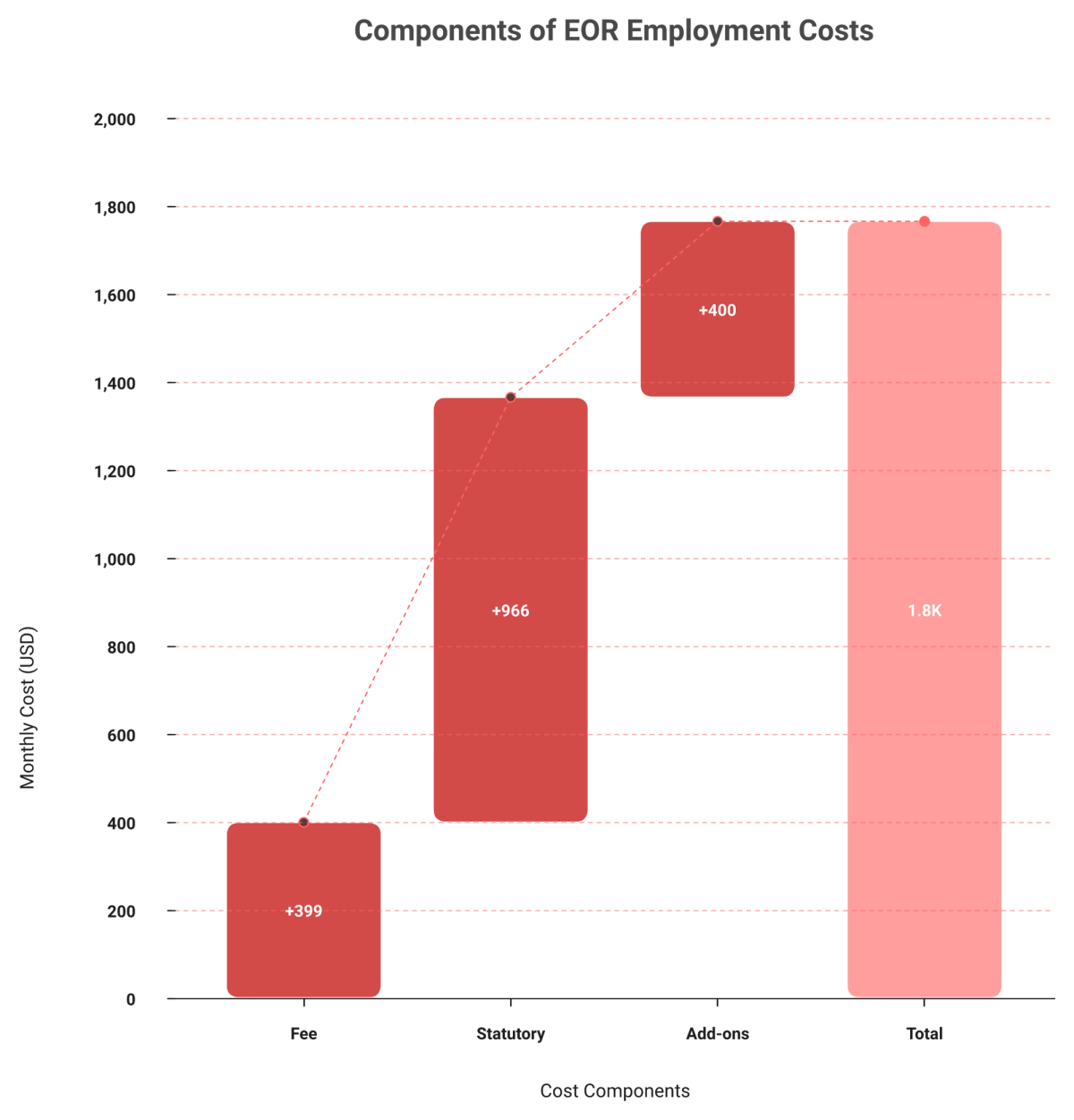
Layer 1, the service fee. A flat per-employee charge, or a percentage of payroll. This is the only number most quotes show clearly.
Layer 2, statutory contributions. Provident Fund at 12 percent of Basic plus DA, ESI where the wage ceiling applies, gratuity accruing at 4.81 percent of Basic, and state professional tax. This runs roughly 15 to 20 percent of salary and is non-negotiable under Indian law.
Layer 3, the hidden add-ons. Setup fees, a refundable security deposit, off-cycle payroll runs, and the FX margin baked into your currency conversion.
A buyer comparing $99 against $599 is usually comparing one layer 1 number to another, while layers 2 and 3 quietly decide the real total. Our EOR services in India fold all three layers into one figure.
⚠️ Where the standard read gets it backwards
The category trains you to shop on the monthly fee. From what surfaces when you actually run payroll, the fee is rarely where the money moves. The FX margin and the add-ons are. I might be slightly conservative here, but I have seen the invisible layers outweigh the headline fee more than once.
"I came in skeptical. Every option I looked at first was either set up your own entity, no thanks, not for one hire, or some platform that quotes you a great price and then you find out about all the add-ons later."
Angad S., Founder Versatile Club G2 Verified Review
"USD invoice landed clean. No FX markup, no setup fee, no surprises."
Verified User in IT and Services Versatile Club G2 Verified Review
✅ The one rule to carry into every quote
Before you compare two EOR prices, ask which layers each number includes. A clean comparison names the service fee, the statutory load, and every add-on in one place. A quick read of how it works shows where each layer sits.
At Versatile, we price this flat at $149 per employee per month, with no setup fee, no exit fee, and the first month free. Because we own our Indian entity and invoice you in USD directly, the sticker price and the settled invoice are the same number. That is the transparency I want when it is my money on the line.
Q2. How do EOR pricing models work, flat fee vs percentage of payroll vs hybrid?
EORs price three ways. A flat per-employee fee is a fixed dollar amount regardless of salary. A percentage of payroll is typically 5 to 15 percent of gross. A hybrid blends the two. Flat fee stays predictable as pay climbs. Percentage of payroll gets expensive fast for senior engineers, because a 10 percent cut on a high CTC dwarfs a flat $149. For mid-to-senior India hires, flat fee almost always wins.
💸 Why the percentage model bites later, not now
Here is the part that catches People Ops teams off guard. A percentage model feels cheap when you hire a junior at 8L. The same model on a 60L principal engineer is a different animal entirely.
The standard playbook says "just pick the cheapest percentage." From what I see across real payroll cycles, the percentage quietly scales with every raise you give. Your EOR's revenue goes up because you rewarded your own employee. Run your own numbers through the salary calculator before you commit.
📊 The three models, side by side
| Pricing model | How you are billed | Cheapest for | Watch-out |
|---|---|---|---|
| Flat per-employee fee | Fixed monthly amount per head | Mid and senior salaries | Can feel high for very junior hires |
| Percentage of payroll | 8 to 15 percent of gross salary | Very low salaries only | Cost rises with every raise and bonus |
| Hybrid | Base fee plus a smaller percentage | Mixed-seniority teams | Two moving parts to audit each month |
A flat fee turns your EOR cost into a line item you can forecast. A percentage turns it into a variable that grows with your compensation budget.
⚠️ The incentive nobody mentions
There is a quiet conflict inside the percentage model. The provider earns more when your salaries rise. I could be reading too much into this, but an EOR that profits from your raises is not structurally aligned with you. This is one reason founders compare us on our Deel alternative page.
✅ A rule of thumb by salary band
If your India hires sit above roughly 15L CTC, a flat fee almost always costs less over a year than a percentage. Run the math on your most senior planned hire, not your cheapest one, because that is where the models diverge most.
At Versatile, we price flat at $149 whether your engineer earns 15L or 60L. We do that on purpose, so our incentive never tilts against your raises. For reference, Wisemonk publishes a "from $99" range where per-tier pricing needs a sales call, while Deel and Remote sit near $599 per employee per month. The flat number is the one you can put in a board deck without an asterisk, as our EOR services overview lays out.
Q3. What are the hidden fees in an EOR quote that nobody puts on the first page?
The fees that ambush EOR buyers usually are not in the headline. Expect a one-time setup charge ($500 to $2,000), a refundable security deposit (often one to two months of salary), off-cycle payroll runs ($50 to $200 each), Form 16 or contract amendment fees, and exit or offboarding charges. Always demand a quote that lists onboarding, ongoing, and offboarding costs together, not just the monthly number.
💸 The first-invoice surprise
The pattern is always the same. The sales call quotes a clean monthly number. Then the first invoice arrives with line items nobody mentioned. A founder once asked me on WhatsApp why her "all-in" quote had grown by a few hundred dollars in month one. The answer was a setup fee and a deposit she never saw coming.
This is the most common complaint in the category, and it is avoidable. You just have to ask the right question before you sign. Our managed payroll setup is built to remove these surprises.
📊 The hidden-fee audit table
| Fee | Typical range | When it hits | How to neutralize it |
|---|---|---|---|
| Setup or onboarding | $500 to $2,000 | At signing | Ask for it in writing, negotiate to zero |
| Security deposit | 1 to 2 months of salary | Before first payroll | Confirm it is refundable and when it returns |
| Off-cycle payroll | $50 to $200 per run | Mid-month corrections | Bundle corrections into the main run |
| Document or amendment | $50 to $100 | Form 16, contract edits | Confirm these are included, not per-document |
| Exit or offboarding | Varies, often undisclosed | When an employee leaves | Get the exit cost named before you onboard |
⚠️ An honest note on deposits
I want to be fair here. Even good EORs sometimes ask for a security deposit, because they fund your payroll before your invoice clears. That one can be legitimate. The problem is not the deposit. The problem is finding out about it after you have committed.
"There are hidden fees. Of course, again, also here, and yes you are right, they are hiding it with font-size 6 somewhere hidden. You will never get your net-agreed salary through Deel."
Ibrahim I. Deel G2 Verified Review
"There are hidden fees everywhere, and I end up paying roughly 30 more than what's stated on the platform or advertising."
Javier G. Remote G2 Verified Review
✅ The three-bucket question
Before signing, ask one thing: "Show me onboarding, ongoing, and offboarding costs in a single quote." If a provider can only show you the middle bucket, you are not seeing your real cost. Our compliance coverage names every cost up front.
At Versatile, when founders ask about our exit fee, the honest answer is that there is not one. No setup fee, no exit fee, first month free. Leaving costs the same as staying, which is nothing extra. I would rather lose a deal on a clear quote than win one on a hidden line, and that is the standard we hold across our work with startups.
Q4. What is an FX margin, and how much is your EOR really skimming on the currency conversion?
An FX margin is the spread your EOR keeps between the real mid-market exchange rate and the rate it bills you when converting INR payroll into your USD invoice. Clean providers run around 0.5 percent. Predatory ones reach 3 percent or more. At 3 percent on 5L of monthly gross, roughly $180 disappears every month, invisible on the invoice. Across a 10-person team, it compounds into five figures a year.
💸 The cost that hides inside the exchange rate
Most hidden fees are at least line items. The FX margin is sneakier, because it hides inside a number you cannot easily check: the exchange rate.
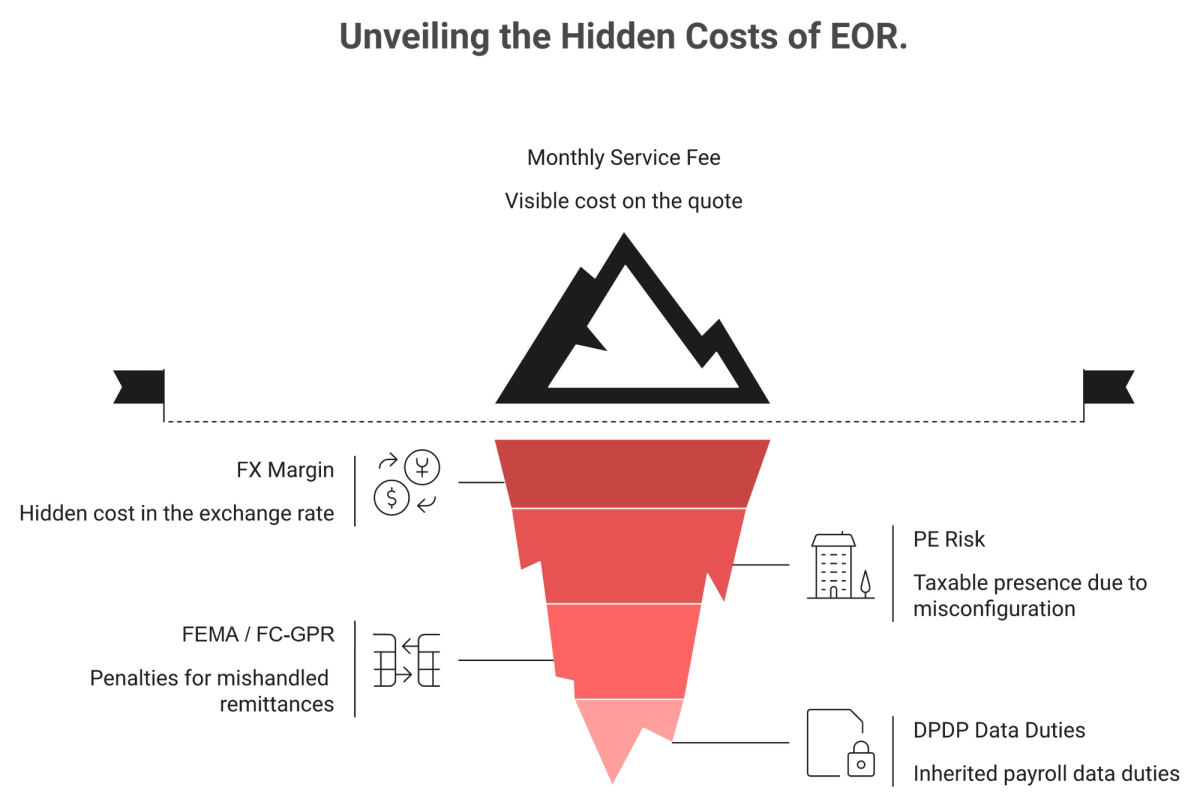
Your EOR pays your employee in rupees. It bills you in dollars, or worse, converts your dollars to rupees on the way in. The gap between the true mid-market rate and the rate they use is pure margin. You will not see it called "FX margin" on the invoice. You see a slightly worse rate and assume that is just the market. This is one of the structural reasons founders read our Remote alternative comparison.
📊 What 0.5 percent vs 3 percent actually costs
Let me put rupees on it. Take an engineer on 5L gross per month, roughly 60L a year.
At 0.5 percent (clean): about 2,500 per month in margin, near $30.
At 3 percent (predatory): about 15,000 per month, near $180.
Across a 10-person team at 3 percent: that is roughly $1,800 a month, over $21,000 a year, none of it on a labeled line.
Global platforms commonly report 3 to 5 percent FX markups, embedded in the conversion where you would never spot them.
⚠️ Why employees feel it too, not just you
This is not only a founder cost. Multiplier and Remote employees have flagged opaque exchange rates on their own payslips. When the rate is unexplained, trust erodes on both sides of the table. Our Multiplier alternative page breaks this down further.
"The dollar exchange rate is not indicated in the payslip. No explanation was provided on the exact dollar exchange rate for our pay."
Verified User Multiplier G2 Verified Review
"The foreign exchange rates they used were beyond inflated, blatantly unfair and clearly designed to extract every possible cent."
Verified User Multiplier G2 Verified Review
✅ The one question that exposes the margin
Ask your EOR this: "Do you invoice me in USD directly, and what is your FX margin against the RBI reference rate?" A provider with nothing to hide will give you a number. A provider that dodges is the answer.
At Versatile, we invoice in USD directly, not routed through a foreign holding company and not converted from INR. This is a structural capability of owning our Indian entity, not a feature we toggle. Because there is no conversion on your side, the FX margin line simply does not exist on our invoice. For a CFO closing month-end, that is one clean dollar number, every month, and you can talk it through with us directly.
Q5. What statutory costs are mandatory in India, and how does the New Labour Code change the math?
On top of any EOR fee, Indian law mandates employer contributions. You owe Provident Fund at 12 percent of Basic plus DA (under the EPF and MP Act, 1952), ESI at 3.25 percent up to a 21,000 per month wage ceiling (ESI Act, 1948), gratuity accruing around 4.81 percent of Basic from month one, and professional tax up to 2,500 a year by state. The New Labour Code's rule that Basic plus DA must be at least 50 percent of CTC raises the base these are calculated on.
💰 Statutory is not a footnote, it is 15 to 20 percent
Most US founders read "statutory contributions" and mentally file it under fine print. That is a mistake. These contributions add roughly 15 to 20 percent on top of salary, and they are legally non-negotiable.
Quick definitions, because the acronyms matter. PF (Provident Fund) is a retirement contribution. ESI (Employees' State Insurance) is state medical insurance. DA (Dearness Allowance) is a cost-of-living component of pay. Our compliance team tracks each of these every cycle.
📊 The mandatory contributions, by Act
| Contribution | Rate | Calculated on | Governing Act |
|---|---|---|---|
| Provident Fund (PF) | 12 percent employer | Basic + DA | EPF & MP Act, 1952 |
| ESI | 3.25 percent employer | Gross, up to 21,000/month ceiling | ESI Act, 1948 |
| Gratuity | 4.81 percent accrual | Basic + DA | Payment of Gratuity Act, 1972 |
| Professional Tax | Up to 2,500/year | Slab by state | State S&E and PT Acts |
Professional tax alone varies sharply by state. Maharashtra needs dual registration (PTRC plus PTEC) with monthly slab filing. Karnataka runs monthly PT with Shops and Establishments renewal, and enrollment within 30 days of joining. Our managed payroll handles each state's slab without you tracking it.
⚠️ The 50 percent rule that breaks old salary stacks
Here is where the New Labour Code 2025-26 changes the math. The new wage definition requires that Basic plus DA equal at least 50 percent of total CTC.
Why it matters: PF and gratuity are calculated on Basic plus DA. For years, Indian salary stacks kept Basic low to shrink contributions. When the base jumps to half of CTC, your PF and gratuity costs rise with it. From what surfaces when you actually run payroll, many global platforms still implement the old, low-Basic structure and quietly create a compliance gap. You can sanity-check your own stack with the salary calculator.
✅ The one question that protects you
Ask any EOR a single question: "What Basic-to-gross ratio do you apply, and is it compliant with the 50 percent wage rule?" A correct answer names the ratio without hesitation. A vague answer tells you they have not updated their salary structuring.
At Versatile, these filings run under our own EPFO, ESIC, and state PT registrations across all 28 states and 8 union territories, not a partner's. When an auditor asks who the legal employer is, the answer is one entity, ours. I lean on ownership over abstraction here, because a global playbook cannot match state-level depth you only get from running real multi-state payroll across Bengaluru, Hyderabad, and Pune, which is the foundation of our EOR services in India.
Q6. What does one India hire actually cost all-in per month, a worked example?
Take a senior engineer in Bengaluru on a 60L CTC. The all-in monthly cost stacks salary, around 15 to 20 percent employer statutory contributions, the EOR service fee, and any FX margin or add-ons. A flat-fee, USD-invoiced, zero-FX setup lands materially lower than a percentage-of-payroll global platform once you annualize the markup. That same engineer runs roughly $58K a year all-in, against about $220K in San Francisco.
💰 Building the stack, line by line
Let me stop talking in percentages and build one real hire. A founder once asked me on WhatsApp to "just show the whole number." So here it is, for a 60L engineer.
| Line item | Approx. monthly | Who charges it |
|---|---|---|
| Base salary (60L CTC) | ~$5,800 | Your employee |
| Statutory (PF, ESI, gratuity, PT) | ~$870 to $1,160 | Government, via your EOR |
| EOR service fee (flat) | $149 | Your EOR |
| FX margin (if 3 percent) | ~$175 | Hidden, if present |
| Setup / exit fees | $0 to varies | Your EOR |
Two takeaways jump out. The statutory layer dwarfs the service fee. And the FX margin can quietly rival your entire flat fee. Our pricing page shows the same stack with our number plugged in.
⚖️ The arbitrage caveat I insist on
Yes, that engineer costs roughly $58K all-in versus about $220K for a comparable San Francisco hire. The savings are real. You can model your own with the offshore ROI module.
But here is my honest position. We never lead with "go to India because it is cheaper." Price-only pitching treats people as a discount, and I find that beneath the work. The cost savings are a byproduct of hiring genuinely strong talent, not the reason to do it, which is why our recruitment approach starts with culture fit.
✅ Why the on-screen number should match the invoice
"Invoicing in USD meant zero exchange rate surprises. Five-day onboarding, zero late payslips. This is what India EOR should look like."
Vedant T., Founder Versatile Club G2 Verified Review
"I get a single USD invoice, fully compliant employment contracts, and payroll runs on time every month. No CA juggling, no statutory filing stress."
Vedant T., Founder Versatile Club G2 Verified Review
When we model this on WhatsApp, we show every line, salary, statutory, and our flat $149. The all-in number on screen is the number on the invoice, because we invoice in USD with no FX conversion on your side. For a CFO closing month-end, that means no reconciliation surprise, as our how it works page details.
Q7. At what headcount does setting up your own entity become cheaper than an EOR?
For most companies the crossover sits between 10 and 30 India employees. Below that, an EOR beats a subsidiary that costs $15K to $100K to stand up, plus 6 to 18 months and ongoing compliance overhead. The exact tipping point depends on salary levels, how much legal and administrative responsibility you want to own, and whether you have in-house India compliance capacity.
⏰ The honest range, not a fake single number
I could give you one clean number here. It would be wrong. The crossover is genuinely contested ground, and anyone who quotes a single headcount is selling something.
What I can say from six years of placements is that the conversation usually starts somewhere between 10 and 30 hires. Below that band, the EOR almost always wins on cost and speed. The EOR vs entity calculator lets you test your own numbers.
📊 What actually moves the line
Two real data points frame the range:
Some teams hit the trigger early. After roughly 12 hires, one founder told me they were ready to open their own entity.
Others stay efficient on an EOR past 30 employees, because they do not want the legal and administrative weight of running a subsidiary.
The variables that move your crossover are salary levels (higher salaries favor a flat fee longer), your appetite for compliance ownership, and whether you have India HR capacity in-house. A subsidiary is not just the $15K to $100K setup. It is the 12 to 18 months and the permanent compliance team behind it, which is where our EOR services bridge the gap.
✅ A self-check before you call a lawyer
Ask yourself three things. Are you past 20 to 25 India hires? Do you have, or want, an in-house India compliance function? Is your India team a permanent strategic bet, not an experiment? Three yeses mean it is time to model an entity seriously.
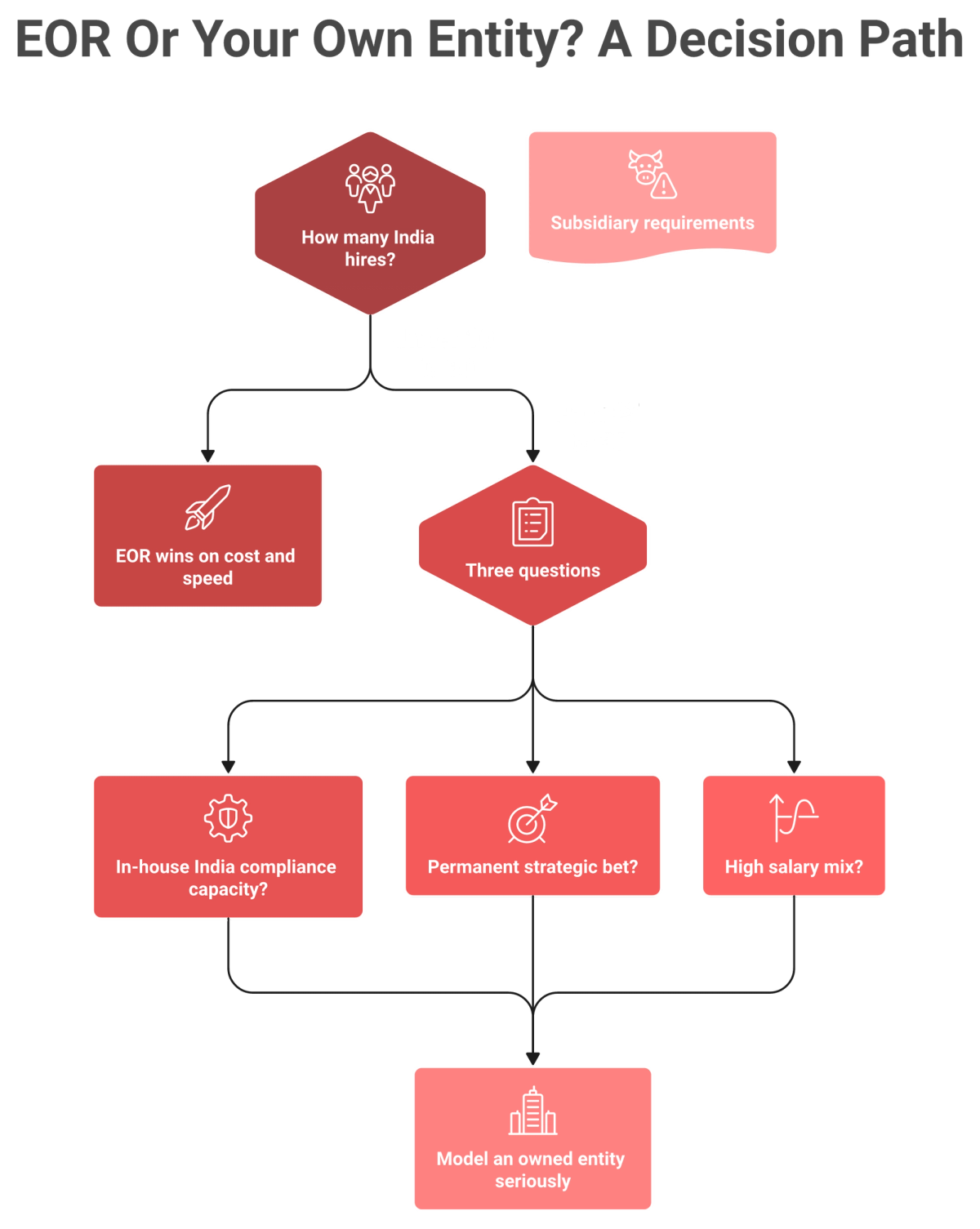
This is where I will say something the category avoids. At Versatile, if you reach 25 hires and an owned entity genuinely beats us, I will tell you. Keeping a client on an EOR they have outgrown is not a relationship I would want to defend on WhatsApp. Compliance is the floor of this business, and honesty is the part that keeps clients referring you after they leave, whether you arrived through our work with startups or with enterprises.
Q8. Which compliance costs never show up as a line item, PE risk, FEMA remittance, and DPDP data duties?
The most expensive EOR costs are not on the invoice. They are contingent risks. Mishandled cross-border salary funding can trigger FEMA and FC-GPR remittance issues. A misconfigured engagement can create Permanent Establishment exposure that turns your hiring into a taxable Indian presence. And under the DPDP Act 2023, your EOR processes employee personal data, carrying obligations you inherit. A cheap quote that ignores these can become the costliest one you sign.
⚠️ PE risk: when an EOR shields you, and when it does not
Permanent Establishment (PE) is when your activity in India is treated as a taxable business presence. That can expose your company to Indian corporate tax, which no service fee prepares you for.
A properly structured EOR, acting as the legal employer on its own entity, helps insulate you from PE. A loosely structured one, where your team effectively controls operations through a thin shell, can leave the door open. The standard read treats PE as a lawyer's problem. From what surfaces in real engagements, it is a structural one, which is why our Wisemonk alternative page leads with entity ownership.
💸 FEMA and FC-GPR: the money has to move correctly
FEMA (Foreign Exchange Management Act) governs how foreign money enters India. FC-GPR is the filing tied to certain foreign inflows. When your dollars fund Indian payroll, that remittance path has to be handled by the book.
Get it wrong, and you risk penalties that dwarf any monthly saving. This is exactly why I keep pushing back on the "just buy the cheapest platform" playbook. A shell-routed remittance adds a layer where mistakes hide, unlike our contractor of record and EOR flows that run direct.
🔒 DPDP: you inherit your EOR's data duties
Under the Digital Personal Data Protection Act, 2023, payroll data is personal data, and your EOR is processing it. Their obligations become your exposure if the chain is sloppy.
Most global EOR providers run India through local-partner entities. That adds a third-party layer to statutory filings, IP assignment, and now data handling, the exact things a CFO flags during due diligence. It is also worth naming that traditional US-style co-employment PEO does not legally exist under Indian labor law, so a foreign company genuinely needs the EOR structure. Our Skuad alternative comparison covers this data chain in detail.
✅ What to demand in writing
Ask for three things on paper: confirmation of PE-risk structuring, a clear FEMA-compliant remittance path, and DPDP data-processing terms with storage location named.
At Versatile, we are the single legal employer on our own Indian entity. The PE structuring, IP assignment, and DPDP data chain stop with us. There is no partner-shell layer for a CFO's diligence to flag, which is the kind of audit-readiness I would want before signing anything myself, and you can raise any of it with us on a direct call.
Q9. How does Versatile's cost structure compare to Wisemonk and the global platforms?
On a like-for-like India hire, Versatile runs a flat $149 per employee per month, with no setup or exit fee, first month free, USD invoicing, and zero FX margin, on its own Indian entity. Wisemonk publishes only a "from $99" range that needs a sales call. Deel and Remote sit near $599 per month with reported 3 to 5 percent FX markups, ticket-queue or chatbot support, and route India through partner entities, adding a third-party risk layer.
📊 How to read a true cost comparison
Sticker price is one input, not the answer. Your real cost is the service fee, plus the FX margin, plus the add-on fees, weighted by the support and entity model behind them.
So I built the comparison the way a CFO actually evaluates it, with all five inputs in one row. Our transparent pricing is designed to survive exactly this kind of scrutiny.
| Provider | Headline price | FX margin | Setup / exit fees | Support | India entity |
|---|---|---|---|---|---|
| Versatile | Flat $149/mo | None, USD invoiced direct | None, first month free | Founder on WhatsApp | Owned Indian entity |
| Wisemonk | "From $99," sales call needed | Varies | Varies | Account team | India-native |
| Deel | ~$599/mo | 3 to 5 percent reported | Varies | Chatbot or ticket first | Local partner entity |
| Remote | ~$599/mo | Reported markup | Varies | Ticket queue | Local partner entity |
The pattern is consistent. The headline-cheap global option often carries the heaviest FX and the thinnest India support. You can see the full breakdown on our Deel alternative and Wisemonk alternative pages.
⚠️ Where global generalists go shallow
Deel, Remote, G-P, and Omnipresent run India as one of 150-plus countries, usually through a local-partner entity. We do not. That partner layer is exactly what adds third-party risk to statutory filings and IP assignment, which is why our EOR services in India run on an owned entity.
"There are hidden fees everywhere, and I end up paying roughly 30 more than what's stated on the platform."
Javier G. Remote G2 Verified Review
"USD invoice landed clean, no FX markup, no setup fee, no surprises. Every payroll or PF question gets a real answer from a real person, usually same day."
Verified User, First-time US founder Versatile Club G2 Verified Review
✅ Who we are honestly not for
I will name our Anti-ICP, because a fair comparison demands it. If you need EOR across 5-plus countries, a global generalist fits better than we do. If you are a 100-plus enterprise team that requires SOC 2 or ISO 27001 as a procurement gate, we are not your match yet, though our enterprise page covers where we do fit.
For a US or UK company making focused India hires, Versatile is one flat number, one clean USD invoice, and the founder on WhatsApp. That, plus a 90-day Success Coach and a 6-month replacement guarantee on placements, is the whole pricing model, with no asterisk, and you can verify it through our how it works walkthrough.
Q10. What should you ask before signing an EOR quote, your Monday-morning checklist?
Before signing any EOR quote, ask five things. One, which cost layers are in the monthly number. Two, the exact FX margin and whether you are invoiced in USD or INR. Three, every one-time and exit fee. Four, the Basic-to-gross ratio used for PF and gratuity. Five, whether the provider owns its Indian entity or uses a partner. Get every answer in writing.
✅ The five questions, and what a good answer sounds like
You are ready to decide. Here is the checklist I would run on any quote, including a competitor's, before money moves. Keep our pricing open as a reference point while you compare.
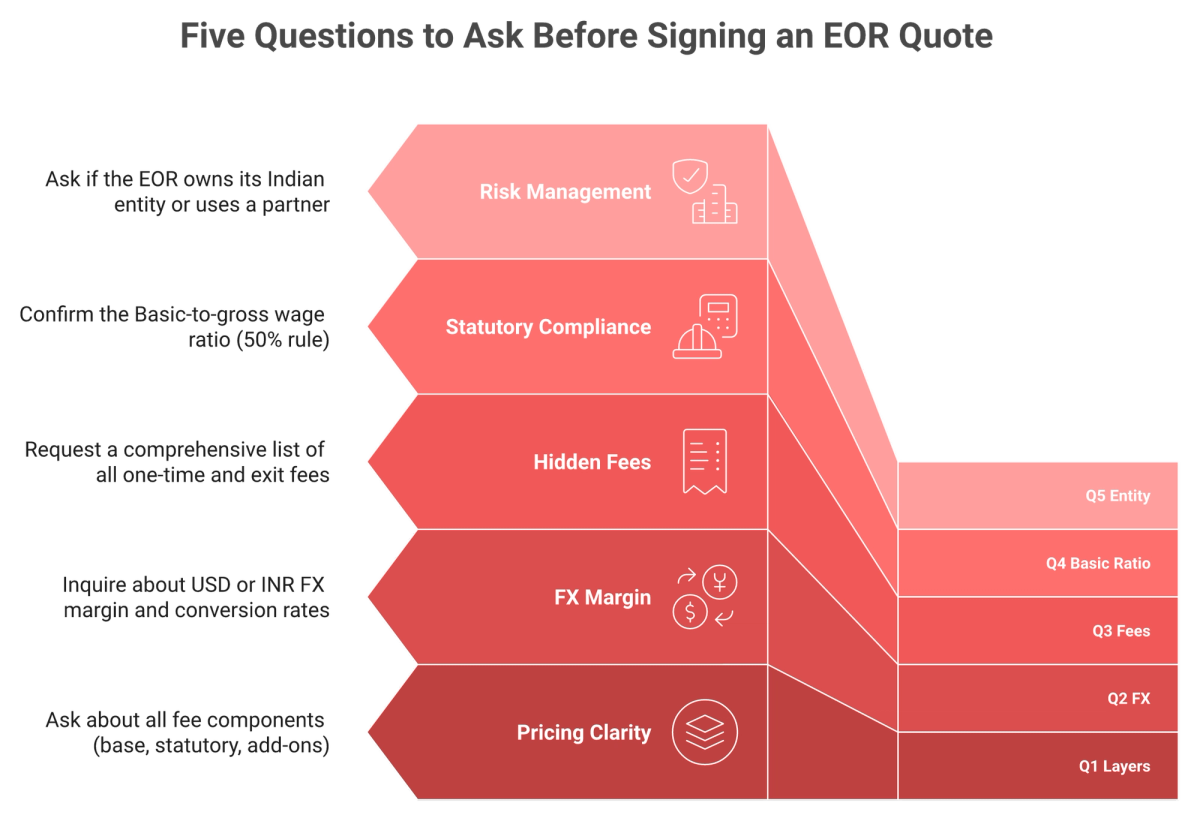
Which layers are in this number? A good answer names the service fee, statutory load, and add-ons separately. A vague "all-inclusive" is a flag.
What is your FX margin, USD or INR? A clean answer gives a number against the RBI reference rate, or says "USD direct, no conversion."
List every one-time and exit fee. A good answer is a written line-item list, including offboarding.
What Basic-to-gross ratio do you use? A correct answer cites the 50 percent wage rule without flinching, the way our compliance team does.
Do you own your Indian entity? A strong answer is "yes, our own registrations," not "through a local partner."
⏰ Get it in writing, every time
Here is a habit I keep from six years of cross-border deals. After any vendor call, send a short email recapping the key points and the numbers quoted. If you are not 100 percent sure of an answer, say so plainly and ask again.
That written recap is your protection when the first invoice arrives. It turns a sales promise into an accountable record, which is the same discipline we bring to our EOR services and managed payroll.
💬 An honest invitation, not a demo pitch
"Founder is just a call away. Extremely helpful in resolving all our queries. The process is super smooth to set up India EOR."
surbhi m., Founder Versatile Club G2 Verified Review
"They replied to our form in about four hours with a draft offer letter already attached. The hire was onboarded in four days."
Verified User, US startup founder Versatile Club G2 Verified Review
Here is where my head is on this whole category. Over the next two years, I think India stops being "a country on the global EOR map" and becomes its own specialist category, where owned-entity operators earn the India work that generalists treat as a checkbox.
If you want a gut-check before you sign, send me your current quote. I will tell you on WhatsApp which layers are real and which are markup. No deck, no demo, just a straight read from someone who runs this every month, and you can reach us any time through our contact page.
FAQs
How much does an Employer of Record cost per month in India?
An Employer of Record cost in India is never a single number. We see three stacked layers on every real invoice.
- Service fee: roughly $99 to $399 per employee monthly for India specialists, and $499 to $699 for global platforms.
- Statutory contributions: about 15 to 20 percent on salary, covering PF, ESI, gratuity, and professional tax.
- Hidden add-ons: setup fees, refundable deposits, off-cycle payroll charges, and FX margins.
The headline price you see on a landing page is only layer one. For a 60L engineer in Bengaluru, the all-in figure runs near $58K a year against roughly $220K for a comparable San Francisco hire.
We price this flat at $149 per employee monthly, with no setup fee, no exit fee, and the first month free. Because we own our Indian entity and invoice in USD directly, the sticker price matches the settled invoice. You can model your own number on our pricing page before any sales call.
What is the difference between flat-fee and percentage-of-payroll EOR pricing?
EORs price three ways, and the model you pick changes your annual cost more than the headline number does.
- Flat per-employee fee: a fixed dollar amount, regardless of salary.
- Percentage of payroll: typically 8 to 15 percent of gross.
- Hybrid: a base fee plus a smaller percentage.
A percentage model feels cheap on a junior hire. On a 60L principal engineer, the same percentage becomes a large number that grows every time you give a raise. That creates a quiet conflict, because your provider earns more when your salaries rise.
For India hires above roughly 15L CTC, a flat fee almost always costs less over a year. We price flat at $149 whether your engineer earns 15L or 60L, so our incentive never tilts against your raises. Run your senior hire through our salary calculator to see the gap.
What hidden fees should I look for in an EOR quote?
The fees that ambush EOR buyers usually are not on the first page. We tell clients to audit five line items before signing.
- Setup or onboarding: $500 to $2,000, charged at signing.
- Security deposit: often one to two months of salary.
- Off-cycle payroll: $50 to $200 per run.
- Document or amendment fees: for Form 16 or contract edits.
- Exit or offboarding: frequently undisclosed until an employee leaves.
The fix is simple. Ask for a single quote that shows onboarding, ongoing, and offboarding costs together. If a provider can only show the middle bucket, you are not seeing your real cost.
When founders ask about our exit fee, the honest answer is that there is not one. No setup fee, no exit fee, first month free. Our compliance approach names every cost up front, so the first invoice holds no surprises.
What is an FX margin and how much does it really cost?
An FX margin is the spread your EOR keeps between the real mid-market exchange rate and the rate it bills you when converting INR payroll into a USD invoice. It hides inside a number you cannot easily check.
- At 0.5 percent (clean): about 2,500 per month on a 5L gross salary.
- At 3 percent (predatory): about 15,000 per month, near $180.
- Across a 10-person team at 3 percent: over $21,000 a year, none of it on a labeled line.
Global platforms commonly report 3 to 5 percent FX markups. Employees feel it too, since opaque rates show up on their own payslips.
We invoice in USD directly, not routed through a foreign holding company and not converted from INR. Because there is no conversion on your side, the FX margin line simply does not exist. See how this works inside our EOR services in India.
What statutory costs are mandatory for an India hire?
On top of any EOR fee, Indian law mandates employer contributions that add roughly 15 to 20 percent on salary. These are non-negotiable.
- Provident Fund: 12 percent of Basic plus DA, under the EPF and MP Act, 1952.
- ESI: 3.25 percent up to a 21,000 monthly wage ceiling.
- Gratuity: accruing around 4.81 percent of Basic.
- Professional tax: up to 2,500 a year, varying sharply by state.
The New Labour Code 2025-26 requires Basic plus DA to be at least 50 percent of CTC. Since PF and gratuity sit on Basic plus DA, this raises your contribution base, and many global platforms still run the old low-Basic structure.
We file these under our own EPFO, ESIC, and state PT registrations across all 28 states and 8 union territories. Our managed payroll handles each state's slab without you tracking it.
At what headcount is setting up an Indian subsidiary cheaper than an EOR?
For most companies, the crossover sits somewhere between 10 and 30 India employees. Anyone quoting a single headcount is usually selling something.
- Below the band: an EOR almost always wins on cost and speed.
- A subsidiary costs: $15K to $100K to stand up, plus 6 to 18 months.
- Ongoing: a permanent compliance team behind the entity.
Three variables move your line: salary levels, your appetite for compliance ownership, and whether you have in-house India HR capacity. Higher salaries favor a flat fee longer.
Here is where we will say what the category avoids. If you reach 25 hires and an owned entity genuinely beats us, we will tell you. Test your own numbers with our EOR vs entity calculator before you call a lawyer.
Which EOR costs never show up as a line item?
The most expensive EOR costs are contingent risks, not invoice items. We flag three to every buyer.
- Permanent Establishment risk: a misconfigured engagement can create a taxable Indian presence.
- FEMA and FC-GPR: mishandled cross-border salary funding can trigger remittance penalties.
- DPDP duties: your EOR processes employee personal data, and sloppy handling becomes your exposure.
Most global providers route India through local-partner entities, which adds a third-party layer to statutory filings, IP assignment, and data handling. That is exactly what a CFO flags during due diligence.
We are the single legal employer on our own Indian entity, so the PE structuring, IP assignment, and DPDP data chain stop with us. There is no partner-shell layer to flag. Read more on our Wisemonk alternative page.
How does Versatile's EOR cost compare to Wisemonk, Deel, and Remote?
On a like-for-like India hire, the cost gap comes from five inputs, not just the headline fee.
- Versatile: flat $149 monthly, USD invoiced, zero FX margin, no setup or exit fee, first month free, owned entity.
- Wisemonk: a "from $99" range that needs a sales call.
- Deel and Remote: near $599 monthly, with reported 3 to 5 percent FX markups and partner-entity routing.
The headline-cheap global option often carries the heaviest FX and the thinnest India support. We are honest about fit too: teams needing EOR across 5-plus countries, or enterprise procurement requiring SOC 2 or ISO 27001 as a gate, should look elsewhere.
For focused India hires, we are one flat number, one clean USD invoice, and the founder on WhatsApp. Compare the full breakdown on our Deel alternative page.