Table of contents (11)
Employer of Record India Cost in 2026: Real Pricing, Hidden Fees & Total CTC Breakdown
Q1. What does an Employer of Record in India actually cost in 2026?
India EOR fees in 2026 sit in three tiers. Managed payroll costs about $49 per employee per month if you already own an Indian entity. India-native EORs charge $99 to $149. Global generalists charge $400 to $699. Versatile Club charges a flat $149 per employee per month, with $0 setup, $0 exit fee, USD invoicing from its own Indian entity, and a 5 business day onboarding SLA written into the contract. The fee is the smallest layer. Gross salary plus 15% to 18% statutory employer cost sits underneath it.
💸 Why one engineer gets quoted at $99 and at $699
A VP People at a Series A company sent me three quotes last quarter for the same Bengaluru backend engineer. The spread was $99 to $699 per month. Same person, same city, same start date.
Nothing about the engineer explains that gap. The gap is structure. A $599 platform is pricing a 150 country footprint, a dashboard, and a support queue. A $149 India-only operator is pricing one country and one entity. Our full India EOR pricing is published for exactly this reason.
🧮 The formula that makes quotes comparable
Write every quote as one line: gross salary, plus statutory employer cost, plus the platform fee, plus FX. Most vendors show you only the third item.
Versatile Club quotes all four before contract signature, including the statutory figure per head. On a ₹1,00,000 per month engineer, the fee is roughly 10% of your monthly India outlay. You can model the same four inputs yourself with our EOR vs entity calculator.
The 2026 India EOR price grid
| Provider | Fee | Model | Setup | Exit | Invoicing | India entity | Onboarding |
| Versatile Club | $149 | Flat | $0 | $0 | USD | Owned (Foo Falcon Technologies Pvt Ltd) | 5 day contractual SLA |
| Wisemonk | $99 to $399 | Flat | $0 | $0 | USD or INR | Owned | 24 to 72 hours, not contractual |
| Deel | About $599 | Flat | $500 | 1 month notice | USD | Partner-routed in India | 7 to 14 days |
| Remote | $599 | Flat | $299 | 1 month notice | USD | Partner-routed in India | 10 to 14 days |
| Multiplier | $400 | Flat | Varies | 2 weeks notice | INR default | Partner-routed | 1 to 2 weeks |
| G-P | 15% of salary | Percentage | Varies | Contractual | USD | Partner-routed | 1 to 2 weeks |
| Managed payroll | About $49 | Flat | Varies | Varies | INR | Your own entity | 2 to 4 weeks |
Each vendor publishes its own numbers: Deel pricing, Remote pricing, Multiplier pricing, G-P pricing, and Wisemonk pricing. If you are comparing only two of them, our Deel vs Remote for India breakdown runs the same grid.
⚠️ When a global platform is the honest answer
If you are placing one hire each across twelve countries, buy the generalist. One dashboard and one invoice across Europe and LATAM is worth real money.
Versatile Club operates in India only, by design. That is a gap if you need five countries, and I will say so on the first call rather than after. For buyers who want the India-only trade-off spelled out, we keep a Wisemonk alternative comparison and a Deel alternative page side by side.
⭐ What buyers report about the price they actually paid
"Invoicing in USD meant zero exchange rate surprises. The compliance rigour is genuinely impressive every statutory filing reviewed before submission. Five-day onboarding, zero late payslips."
— Vedant T., Founder, Versatile Club G2 - Verified Review, 16 June 2026
"I find Deel to be absurdly expensive. They charge a high amount of fees for transferring money to my bank account."
— Juan Camilo O., 1/5, Deel - G2 Verified Review, 27 November 2025
"The initial documentation and paperwork felt quite detailed and time-consuming at the beginning."
— Verified User in Marketing and Advertising, 3.5/5, Wisemonk - G2 Verified Review, 12 February 2026
Versatile Club prices India at $149 flat, first month free, zero setup and zero exit, invoiced in USD from our own Indian entity rather than a partner shell. We can hold that number because we are not spreading a 150 country platform across your three Bengaluru hires. The mechanics are documented on our EOR services in India page.
Q2. What is inside the EOR fee, and what gets billed separately?
The EOR fee covers employment of record, compliant contracts, payroll processing, statutory filings, and offboarding paperwork. Billed separately: gross salary, employer statutory contributions, insurance premiums, equipment, bonuses, and anything marked one-time. A mid-level engineer on ₹1,00,000 per month gross costs roughly ₹1,16,000 to ₹1,24,000 all-in before the fee. The range depends on whether gratuity is billed monthly and which EPF base the provider applies.
🧩 Three layers, not one price
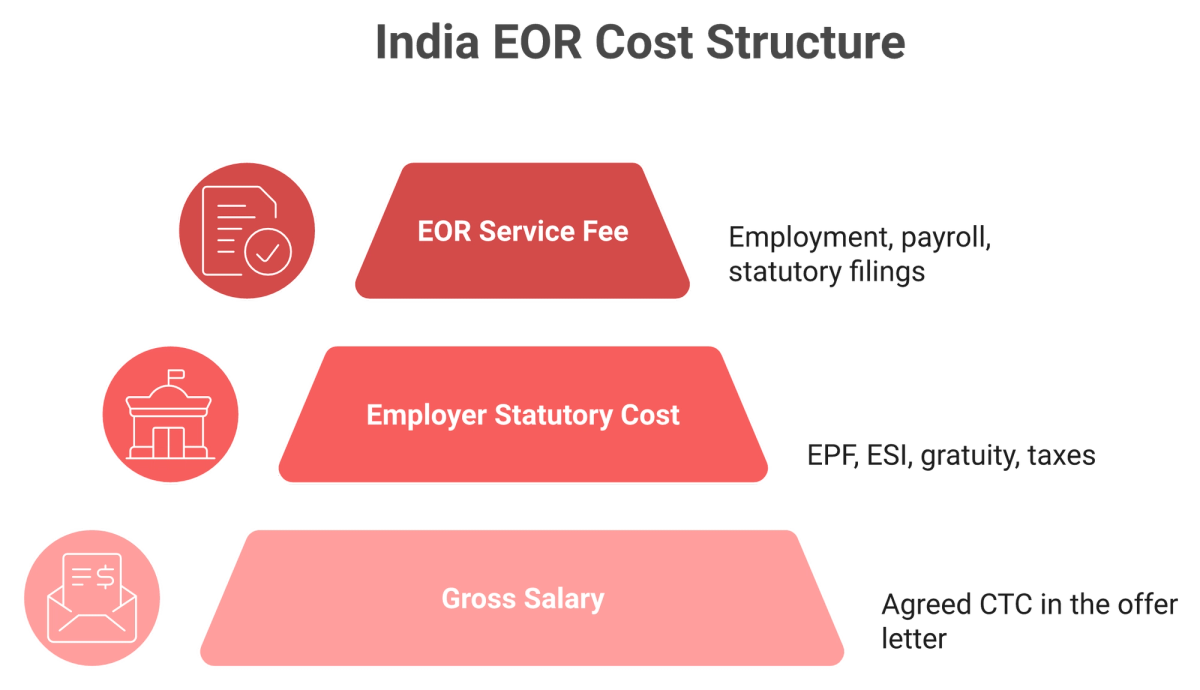
Layer one is the employee's gross salary. Layer two is employer statutory cost, which is EPF, ESI where it applies, gratuity accrual, professional tax, and Labour Welfare Fund. Layer three is the EOR fee.
Buyers compare layer three and assume layers one and two are fixed by law. Layer two is partly a vendor choice, which is why invoices diverge. I explain that choice in the next section, and our cost of hiring in India guide works through the same three layers at other salary bands.
📄 One engineer, one month, line by line
Here is the shape of a real monthly invoice at ₹1,00,000 gross, with Basic plus DA at 50% of CTC.
| Line | Basis | Amount |
| Gross salary | Agreed CTC | ₹1,00,000 |
| EPF employer | 12% of Basic plus DA | ₹6,000 |
| EPF admin and EDLI | Statutory rates | ₹600 |
| ESI employer | 3.25%, applies at or below ₹21,000 gross | ₹0 |
| Gratuity accrual | 4.81% of Basic plus DA | ₹2,405 |
| Professional tax | State slab, Karnataka | ₹200 |
| EOR fee | Flat | $149 |
Rates above come from the EPFO, the ESIC, the Payment of Gratuity Act, 1972, and the Karnataka professional tax department. That is roughly ₹1,09,205 of India cost, before insurance and before the fee. Add group mediclaim and the number moves toward ₹1,16,000.
🔍 What the quote PDF leaves out
CFOs forward me competitor invoices they cannot reconcile against the quote. The unreconcilable line is almost always one of two things.
The first is a bundled FX conversion, where the spread hides in the rate instead of sitting on a line. The second is a gratuity accrual that was quoted but never actually accrued, which means the liability is still yours. Teams that have already inherited this mess usually read our guide on switching EOR provider in India next.
Versatile Club issues one consolidated USD invoice per employee per month, with salary, each statutory head, and the fee on separate lines. Your controller can tie every rupee to an EPFO challan or a TDS deposit at close, without asking us for a breakdown. The invoice and client pack format is described on our how it works page.
Q3. How is total employer CTC calculated in India right now?
Employer statutory cost in India is EPF at 12% of Basic plus DA, ESI at 3.25% only where gross is at or below ₹21,000 (₹25,000 for persons with disabilities), gratuity accruing at 4.81% of Basic plus DA from month one, professional tax capped at ₹2,500 per year by state, and Labour Welfare Fund. The Labour Codes require Basic plus DA to be at least 50% of wages, which lifts both the PF and the gratuity base.
📐 The formula, in order
Start with CTC. Split it so Basic plus DA is at least 50%. Apply EPF to that base. Check gross against the ESI ceiling. Accrue gratuity. Add the state professional tax slab and LWF. The wage definition sits in the Ministry of Labour and Employment Labour Codes, in force from 21 November 2025.
Run it in that sequence and the number is repeatable. Run it on gross instead of Basic plus DA and you will overstate PF by thousands of rupees a month. Our India salary calculator runs the same sequence on your own figures.
📋 The rate table, with the statute behind each head
| Head | Rate | Base | Source |
| EPF employer | 12% | Basic plus DA, ceiling ₹25,000 from 17 September 2026 | S.O. 5109(E), Ministry of Labour and Employment |
| EPS and EDLI and admin | Within the 12%, plus 0.5% EDLI and admin charges | Same | EPFO |
| ESI employer | 3.25% | Gross at or below ₹21,000 | ESIC |
| Gratuity | 4.81% accrued monthly | Basic plus DA | Payment of Gratuity Act, 1972 |
| Professional tax | State slab, maximum ₹2,500 per year | Gross | State professional tax Acts |
| TDS | Slab rate, deposited by the 7th | Taxable salary | Income-tax Act, 2025 |
Gratuity is payable after five years of continuous service, at monthly wage divided by 26, times 15, times completed years. Delayed payment carries 10% simple interest under section 7(3A) of the Payment of Gratuity Act, 1972.
⏰ What the 50% wage rule does to an old salary structure
Take an engineer at ₹1,00,000 CTC with Basic at 40%. PF applies to ₹40,000, so employer PF is ₹4,800. Gratuity accrues on ₹40,000.
Restructure Basic to 50% and PF applies to ₹50,000, so employer PF becomes ₹6,000. Gratuity accrual rises too. The salary did not change. Your cost did. The filing consequences of that change are covered in our India payroll compliance guide.
✅ One lever that helps the employee at no extra cost to you
Employer contributions to the National Pension System are deductible for the employee under section 80CCD(2) of the Income-tax Act. Structuring a slice of CTC as NPS can cut tax meaningfully for higher earners.
Total employer outlay stays flat. Where my head is right now is that this is the most underused line in India offer letters.
Versatile Club runs PF, ESI, TDS, and professional tax under its own Indian registrations, across state cycles that differ (Maharashtra needs PTRC and PTEC, Karnataka files monthly, Tamil Nadu biannually). So the table above is our filing calendar, and we publish the per-head number before you sign. The registration list sits on our compliance page.
Q4. Why do vendors quote statutory cost as anything from 6% to 25%?
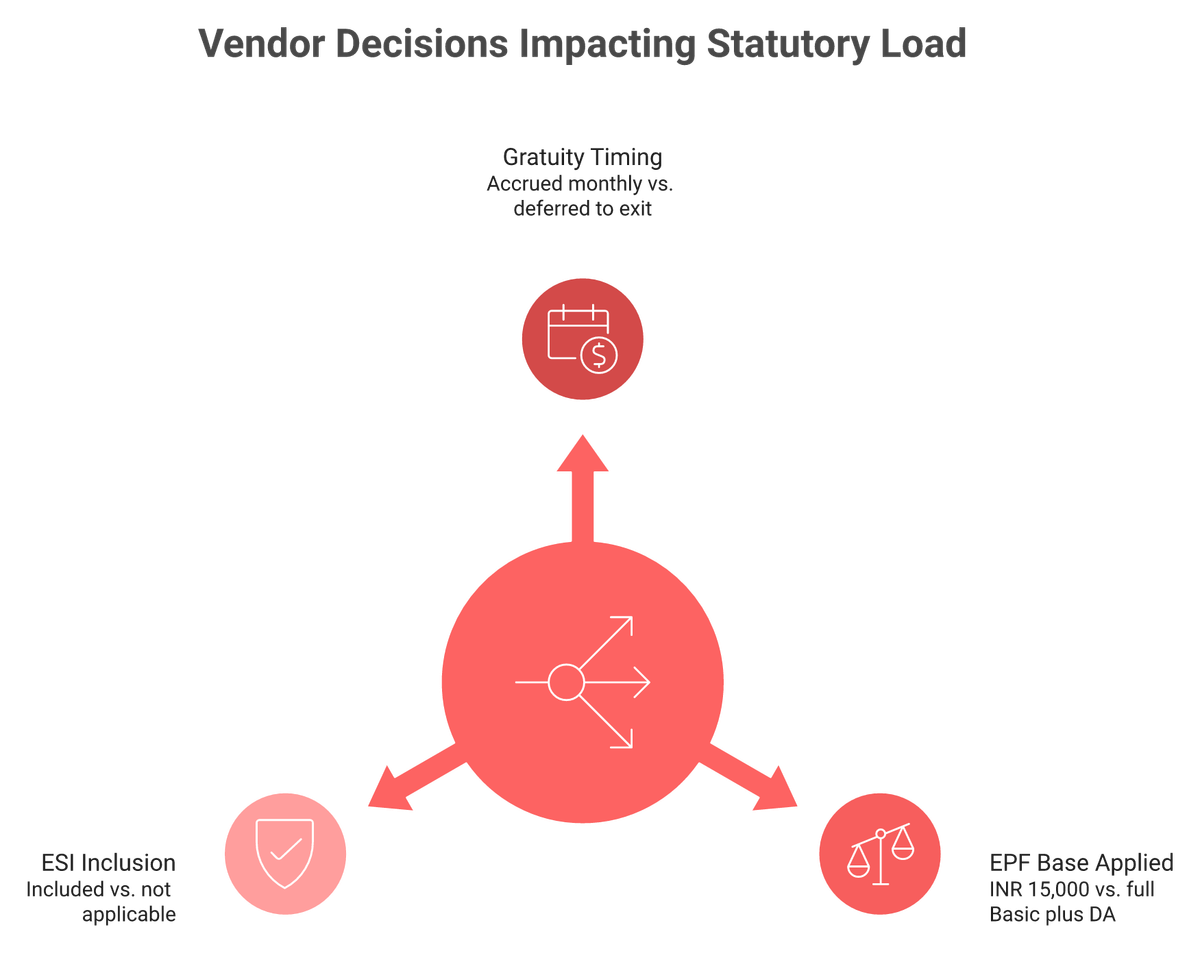
Published figures range from 6.4% to 25% of gross for the same employee. The spread comes from three vendor choices, not from Indian law: whether gratuity's 4.81% is billed monthly or deferred to exit, whether EPF is computed on a ₹15,000 base, the new ₹25,000 ceiling, or full Basic plus DA, and whether ESI is included even though it applies only at or below ₹21,000 gross. Ask which of the three a vendor used, and every quote becomes comparable.
🔢 Four published numbers, one employee
| Source | Published employer statutory load |
| TM Services | About 6.4% of gross, 8.8% with gratuity billed monthly |
| Asanify | 13% to 18% |
| Wisemonk | 15% to 20% |
| Tarmack | 15% to 25% |
Most people reading that table assume someone is wrong. Nobody is wrong. They are answering different questions and labelling them identically.
⚖️ The three variables that produce the whole gap
Gratuity is the biggest. At 4.81% of Basic plus DA, accruing it monthly adds roughly 2.4 points of gross on a 50% Basic structure. Deferring it to exit removes those points from the quote, and leaves the liability sitting with you.
EPF is the second. Twelve percent of ₹15,000 is ₹1,800. Twelve percent of ₹50,000 is ₹6,000. Same statute, same rate, very different invoice.
🧾 One salary, three assumption sets
Take ₹1,00,000 gross, Basic plus DA at ₹50,000. Quote A uses the old ₹15,000 base and defers gratuity, landing near 2.5%. Quote B uses full Basic plus DA and defers gratuity, landing near 6.6%.
Quote C uses full Basic plus DA and accrues gratuity monthly, landing near 9%. Add ESI on a junior salary and you reach the mid-teens. Every number is defensible. Only one is complete. If you are stress-testing this against an in-house entity, our EOR vs entity in India analysis uses the same assumption sets.
❌ The vendor showing you 6.4%
In my experience, the lowest published percentage usually belongs to the provider not accruing gratuity each month. That liability does not disappear. It waits for year five, and arrives with 10% simple interest if the payment is mishandled, under section 7(3A) of the Payment of Gratuity Act, 1972.
Versatile Club's read is that the standard advice gets this backwards. Buyers are told to negotiate the fee, which is 10% of the cost, and to accept the statutory line as fixed, which is where the real variance lives. I might be weighting that too strongly, though it matches what shows up in client audits.
📩 Three questions to send before you sign
- Which EPF base do you apply: ₹15,000, the ₹25,000 ceiling, or full Basic plus DA?
- Do you accrue gratuity monthly, and does it appear as its own invoice line?
- Is ESI included in your quoted percentage, and at what gross does it stop applying?
Versatile Club accrues gratuity monthly from day one and shows it as a discrete invoice line. The number you approve in month one is the number you are still paying in month thirty-six. Send those three questions to us on contact us and you will have written answers the same day.
Q5. What hidden fees and working-capital costs sit outside the quoted price?
Seven items are routinely absent from the quote and present on the invoice: setup fees of $299 to $500 per employee, security deposits of one to two months of CTC held in escrow, an FX spread of 2% to 10% buried in the conversion rate instead of itemised, exit or offboarding fees, off-cycle payroll runs at $50 to $250, background verification markups of $20 to $150, and per-filing charges where statutory filings are unbundled. Versatile Club charges none of them: $0 setup, $0 exit, no deposit, and USD invoicing from its own Indian entity.
💸 The clean quote that arrived 20% heavier
A Controller at a US SaaS company sent me a signed quote and the first invoice side by side. The quote said $599 per employee. The invoice, once setup and conversion were counted, ran about 20% above the model she had taken to her CFO.
Nothing was fraudulent. Every charge was disclosed somewhere. It was just never disclosed in one place, at quote stage, in the currency she was funding from. Our India EOR pricing page exists so that comparison takes one screen.
⚠️ The seven line items, with their usual ranges
| Line item | Typical range | Where it hides |
| Setup or onboarding fee | $299 to $500 per employee | One-time schedule |
| Security deposit | 1 to 2 months of CTC | Escrow, refundable on exit |
| FX spread | 2% to 10% over mid-market | Inside the rate, not a line |
| Exit or offboarding fee | 1 month notice equivalent | Termination clause |
| Off-cycle payroll run | $50 to $250 per run | Service annexure |
| Background verification | $20 to $150 | Pass-through with markup |
| Per-filing charges | Varies by state | Where filings are unbundled |
Setup and exit terms above come from each vendor's own published commercial pages: Deel pricing and Remote pricing. The FX spread is the largest and the least visible. On a $500,000 annual India payroll, a 3% spread is $15,000 that never appears as a fee.
🧮 A total cost of ownership formula you can actually compare
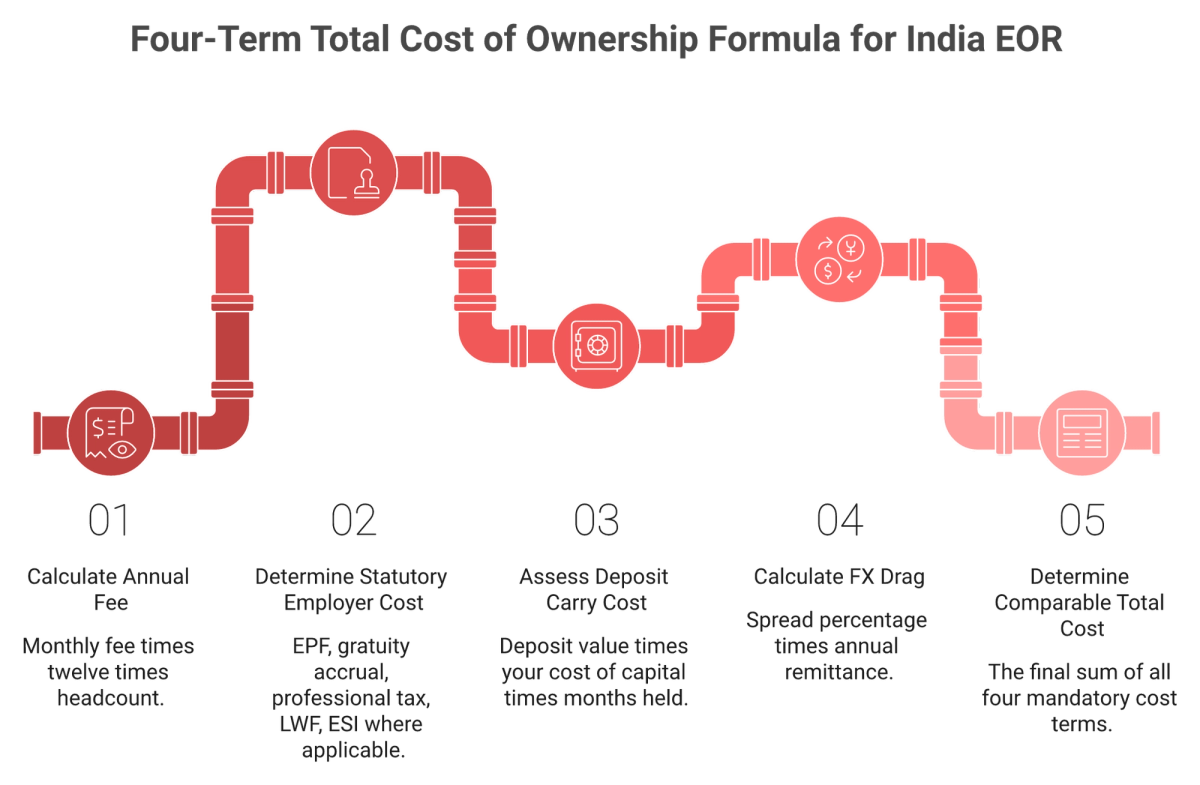
Price every shortlisted vendor with the same four terms.
- Annual fee, per employee, times headcount.
- Annual statutory employer cost.
- Deposit, times your cost of capital, times months held.
- FX spread, times annual remittance.
Ask when conversion happens. Most platforms convert on the funding date, not the invoice approval date, so the rate you modelled is rarely the rate you paid. Versatile Club avoids that question entirely by invoicing in USD from our own Indian entity, and the same four terms are built into our EOR vs entity calculator.
⭐ What buyers say about the invoice, not the quote
"First USD invoice landed clean: no FX markup, no setup fee, no surprises."
— Verified User in Information Technology and Services, Founder, Versatile Club G2 - Verified Review, 23 June 2026
"We had to carefully manage our agreement and had to constantly remind them of the fees agreed so that we weren't over charged."
— Verified User in Information Technology and Services, 0/5, Deel - G2 Verified Review, 13 December 2024
"Payments: There are hidden fees. Of course, again, also here."
— İbrahim, Contractor, 1/5, Deel - G2 Verified Review, 1 November 2024
✅ The one procurement move that settles it
Ask every shortlisted vendor for a live sample invoice, not a quote PDF. A quote is marketing. An invoice is a confession.
Then ask three follow-ups: what is the conversion date, what is the deposit, and what happens on an off-cycle run. I answer those on WhatsApp in minutes, and the answer does not change later. If you want the same audit applied to a provider you already use, start with our guide on switching EOR provider in India.
Versatile Club bills one flat $149 per employee per month, first month free, with no setup charge, no exit charge, and no security deposit. The hidden line items are structurally absent, not discounted. The billing mechanics sit on our how it works page.
Q6. What changed in 2025-26 that repriced an India hire?
Four changes repriced India hiring. The EPF wage ceiling rose from ₹15,000 to ₹25,000 on 17 September 2026 under MoLE notification S.O. 5109(E), lifting the capped employer share from ₹1,950 to ₹3,250 a month and bringing roughly 51 lakh workers into coverage. The Labour Codes commenced on 21 November 2025 with the Basic plus DA at 50% rule. Form 16 became Form 130, and Form 24Q became Form 138 under the Income-tax Act 2025. The DPDP Rules 2025 placed processor obligations inside EOR contracts, with substantive rules live on 14 May 2027.
⏰ The EPF ceiling change, in rupees per head
The ceiling is the maximum monthly wage used to calculate mandatory EPF, EPS, and EDLI coverage. It had sat at ₹15,000 for years. From 17 September 2026 it is ₹25,000, per the EPFO and Press Information Bureau announcements.
If your provider contributes at the ceiling, the employer line moves by about ₹1,300 per employee per month. September 2026 payroll also split into two attendance periods, 1 to 16 and 17 to 30, because the notification landed mid-month. Our India payroll compliance guide tracks each of these filing changes.
📊 What the wage-split rule did underneath it
The Labour Codes require Basic plus DA to be at least 50% of wages. PF and gratuity both sit on that base, under the Code on Wages published by the Ministry of Labour and Employment.
So a role structured at 40% Basic now costs more, with no change to the employee's CTC. Versatile Club re-ran every active employee's PF base the week S.O. 5109(E) took effect and sent clients the per-head delta before the next invoice. There was no partner entity to wait on.
📄 The form renumbering nobody priced
Form 16 is the annual salary tax certificate. Under section 395(4) of the Income-tax Act 2025, read with Rule 215, it is now Form 130. Form 16A is Form 131, and the quarterly TDS return Form 24Q is Form 138, per the Income Tax Department form schedule.
That is a documentation cost, not a statutory one. Offer letters, employee FAQs, and vendor SLAs that promise "Form 16" need updating. Versatile Club issues Form 130 and files Form 138 under its own TAN, so the reference in your contract matches what the employee actually receives. Teams running their own entity can hand the same filings to our managed payroll service.
⚠️ DPDP turns your EOR contract into a data contract
Your EOR holds PAN, Aadhaar, bank, and salary data. Under the DPDP Rules 2025, notified as G.S.R. 846(E) by the Ministry of Electronics and Information Technology, that makes it a data processor acting on your instructions.
Rule 4 obligations started 14 November 2026, and the substantive rules apply from 14 May 2027. Penalties for security safeguard failures reach ₹250 crore. Versatile Club's read is that most India EOR buyers are still treating this as a feature bullet, when it belongs in the master services agreement as a processor addendum.
✅ What to do with these four dates
Put them in one place and check your quote against each.
- Which EPF base does the provider use: ₹15,000, ₹25,000, or full Basic plus DA?
- Is Basic plus DA at 50% in every live salary structure?
- Does the contract say Form 16, or Form 130 and Form 138?
- Is there a DPDP processor addendum with Rule 6 safeguards and Rule 7 breach timelines?
Versatile Club absorbed all four changes without a repricing notice, because the registrations, the filings, and the processor obligations sit on our own Indian entity. You hear about a notification from me before your controller finds it at month-end close. The current registration list is published on our compliance page.
Q7. Why does $599 a month buy subcontracted execution in India?
Global platforms price India at $400 to $699 a month while routing local execution through third-party Indian partner entities. That adds administrative latency, secondary audit exposure, and narrower state coverage, with Deel operating across roughly the top six states and Remote the top four. Versatile Club employs your hire inside its own registered Indian company, Foo Falcon Technologies Pvt Ltd, with PF, ESI, TDS, and professional tax filed under our registrations. At the top of the market, the premium buys a dashboard, not local depth.
🧩 The thesis: fee and execution are decoupled
A platform fee prices the platform. It does not price who signs your employee's appointment letter, or who files their PF each month. The published rates sit on each vendor's own pages, including Deel and G-P.
In India, those two things come apart often. The company you contract with in Delaware is frequently not the company employing your engineer in Bengaluru. If you are weighing those two models directly, our Deel alternative page runs the structure side by side.
⚠️ Three places the gap shows up
Partner routing. When a local partner is the employer of record, your instructions travel through two organisations. Payroll corrections take longer, and audit trails sit with a company you never signed with.
State coverage. India is not one compliance jurisdiction. Maharashtra needs PTRC and PTEC registration, Karnataka files professional tax monthly, Tamil Nadu files biannually, and Delhi has no PT but strict Shops and Establishments rules. Versatile Club holds registrations across all 28 states and 8 union territories, which is why a Kochi hire is a normal Tuesday for us.
FX margin. A partner-routed structure usually means USD in, INR out, with a conversion somewhere in between.
❌ The honest counterpoint, and how to settle it
Competitive research is genuinely contradictory here. Some published competitor analysis tags Deel and Remote as owning local entities in major markets. Versatile Club's own vendor research says India is partner-routed for most global providers.
So do not trust either claim, including mine. Ask for the Corporate Identity Number, or CIN, of the entity that will appear on your employee's appointment letter, then look it up on the MCA portal. One request settles the debate in five minutes. Our EOR services in India page lists ours.
⭐ What the premium does and does not buy
"They didn't seem to be able to navigate Visas or variations to employment contracts and this constantly created issues so we had to make a decision to change providers. It took three months to onboard our first 3 individuals."
— Verified User in Information Technology and Services, 0/5, Deel - G2 Verified Review, 13 December 2024
"I've noticed that their support/query responses can occasionally take a bit longer sometimes, likely due to a relatively small team."
— Verified User in Financial Services, 4/5, Wisemonk - G2 Verified Review, 14 June 2025
"Every option I looked at first was either set up your own entity (no thanks, not for one hire) or some platform that quotes you a great price and then you find out about all the add-ons later."
— Angad S., Founder, Versatile Club G2 - Verified Review, 21 June 2026
That second quote matters. Versatile Club is a small India-only team too, and a small team is a real trade-off when you want a self-serve dashboard at 2am. What we trade it for is that the founder answers, not a queue. Buyers comparing the two India-native options can read our Wisemonk alternative breakdown.
Versatile Club's employing entity is Foo Falcon Technologies Pvt Ltd, a registered Indian company, not a reseller or aggregator. Your employee's PF, ESI, TDS, and professional tax filings sit under our registrations, which is why we cover states a partner network declines.
Q8. EOR, managed payroll or your own entity, which is cheapest at your headcount?
An owned Indian subsidiary costs roughly $15,000 to $100,000 to set up, plus three to six months of SPICe+ incorporation and registrations, then carries permanent compliance overhead. Published break-even estimates range from 10 to 15 employees up to 25 to 35, because each assumes a different internal cost load. US-style co-employment PEO does not legally exist under Indian labour law. Without an entity you use an EOR at $99 to $149 per employee per month. With an entity, managed payroll runs about $49.
🧩 Three structures, and one category that is a myth
An EOR employs your hire on its own Indian entity. Managed payroll runs payroll on your entity. Your own entity means you are the employer.
The fourth option people ask for, a US-style PEO where you and the provider co-employ the same person, has no basis in Indian labour law. If a vendor sells you "PEO in India" without an entity, ask whose name goes on the appointment letter. Our EOR vs PEO comparison works through the legal distinction.
📉 Why the published break-even numbers disagree
One source says 10 to 15 employees. Another says 25 to 35. Neither is lying. They are loading different internal costs. The two estimates come from HiveDesk and Remunance respectively.
Plug in your own four inputs: incorporation and registration spend, the annual CA and compliance retainer, the fraction of a People Ops or finance salary the entity consumes, and your cost of delay before hire one. The last input is the one most models skip. Our EOR vs entity in India analysis runs all four.
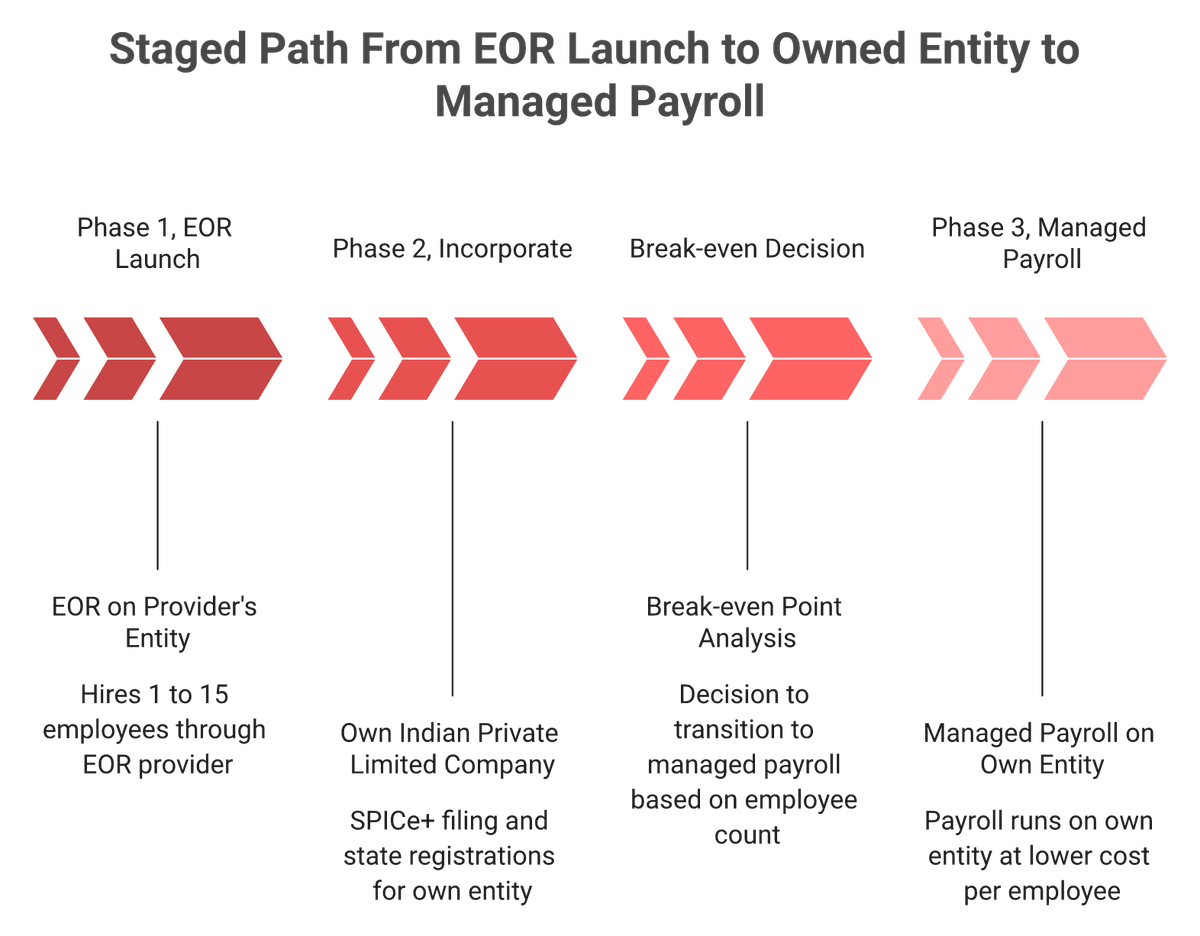
⏰ The three-phase path most teams actually take
- EOR launch. Hires 1 to 15, live in days rather than months. Versatile Club's onboarding SLA is 5 business days, written into the contract, not a marketing estimate.
- Incorporate. File SPICe+ with the MCA when India headcount and roadmap justify a permanent entity. Budget three to six months.
- Migrate to managed payroll. Around $49 per employee per month, with the entity taxed at 22% under section 115BAA of the Income-tax Act, if it elects that regime.
🌉 A suspension bridge, not the Golden Gate
An EOR is a light bridge. It gets your team across in 5 days, and you can take it down later.
An entity is the Golden Gate. It is permanent, expensive, and correct once the traffic justifies it. Versatile Club's read is that most companies build the second one too early, for optics rather than economics. If a captive is genuinely the goal, our GCC setup in India guide maps the sequence.
✅ When staying on an EOR is the right call
Stay if your India headcount is under roughly 15, if the roadmap is still uncertain, or if nobody on your team wants to own EPFO and state filings. Stay also if you may wind down India in under two years, since an entity takes months to close.
Move when headcount is stable, when you need equity grants or capex in India, or when you want direct control of the employment brand. Versatile Club will model both curves with your real numbers, including the case where the answer is that you should leave us. Send the numbers through our contact us form and you will have both curves back the same day.
Versatile Club charges no exit fee. When the math flips, we hand over employment records, PF accounts, and filing history, then step back. A provider charging a one-month exit notice has priced your departure into your stay.
Q9. Can you use contractors in India to avoid EOR fees?
Contractor management costs $19 to $49 per person per month, against $99 to $149 for an EOR. That $100 to $130 monthly saving is the cheapest-looking decision in India hiring. Misclassifying a full-time employee as an independent contractor creates roughly $25,000 to $40,000 of backdated tax and penalty exposure per person, plus permanent establishment risk for the foreign parent. It also costs your hire, because contractors in India are routinely refused mortgages and credit that an employment contract would have secured. Versatile Club employs the person on its own Indian entity instead, with PF, professional tax, and Form 130 under our registrations.
💰 The saving that looks free on a spreadsheet
Picture a Head of People at a Series A company with four India hires planned. She models contractor agreements at $29 a head and EOR at $149. Those contractor rates are published by the vendors themselves, including Deel and Remote.
Annualised, that is about $5,760 saved. On a seed-stage budget, that line survives every review. Nothing on her spreadsheet shows what she just bought. Our independent contractor vs EOR comparison puts both columns on one page.
⚠️ What the model leaves off
Two years later, a real HR lead joins and reads the agreements. Fixed hours, a manager, a company laptop, and no other clients. That is an employee under Indian practice, whatever the contract says.
The exposure is backdated. Unpaid PF, unpaid TDS, interest, and penalties, in the range of $25,000 to $40,000 per person. Add permanent establishment risk, which means Indian tax authorities may treat the foreign parent as having a taxable presence in India, under the permanent establishment provisions of the Income-tax Act and India's tax treaties. Teams already carrying this exposure usually start with our guide on converting a contractor to an employee in India.
❌ The part the employee pays for
A founder once told me about a relocating engineer who chose contractor status for the higher monthly payout. Then he applied for a mortgage.
Banks in India want salary slips, PF records maintained with the EPFO, and an employment letter. He was refused. When the same person moved onto a proper employment arrangement, the mortgage went through.
⭐ What people on the receiving end say
"Initially the problem I faced while working as a contractor for an international company was the money transfer problems but from when my company started using wisemonk I receive my salary in INR in my bank account."
— Bulbul G., Employee, 4/5, Wisemonk - G2 Verified Review, 19 February 2025
"I find Deel to be absurdly expensive. They charge a high amount of fees for transferring money to my bank account."
— Juan Camilo O., Contractor, 1/5, Deel - G2 Verified Review, 27 November 2025
"Versatile is solving the pain of complicated international hiring and local compliance, which saves us a lot of operational stress."
— Setu C., Founder, Versatile Club G2 - Verified Review, 10 June 2026
✅ When a contractor is genuinely the right structure
Contractors are correct for genuine project work. Defined scope, defined deliverable, their own tools, their own hours, and ideally other clients. Where that test is genuinely met, our contractor of record service is the right line item.
Versatile Club's read is that the standard advice gets this backwards. The category tells buyers to compare $29 against $149, when the real comparison is $29 against a five-figure back-pay assessment. I might be weighting the risk heavily, though the pattern shows up every time an HR hire audits legacy agreements.
Versatile Club employs the person properly from day one: appointment letter, UAN, Form 130, with PF and professional tax filed under our own Indian registrations. That is why our hires can walk into a bank with a payslip that means something. The registration list sits on our compliance page.
Q10. What does a senior engineer cost in Bengaluru versus San Francisco?
A senior engineer in San Francisco costs about $180,000 in salary plus $40,000 of overhead, or $220,000 all-in annually. The same seniority in Bengaluru through an EOR runs about $42,000 in salary plus roughly $16,000 in benefits, statutory employer cost, and EOR fees, so about $58,000 all-in. That is a modelled saving of roughly $162,000 per role per year. Hyderabad and Pune typically price below Bengaluru for comparable seniority. Versatile Club's $149 per month fee sits inside that $16,000 India overhead, not on top of it.
💰 The two stacks, side by side
| Line | San Francisco | Bengaluru via EOR |
| Base salary | $180,000 | $42,000 |
| Employer overhead | $40,000 | $16,000 |
| All-in annual | $220,000 | $58,000 |
| Modelled annual difference | - | About $162,000 |
These are modelled figures from Versatile Club's own cost comparisons, not a published market index. Your numbers will move with seniority and stack, and you can rerun them on our India salary calculator.
🧮 What the $16,000 actually contains
It is not margin. It is EPF at 12% of Basic plus DA per EPFO rates, gratuity accruing at 4.81% under the Payment of Gratuity Act, 1972, professional tax by state, group mediclaim, and the EOR fee.
Versatile Club shows each of those as its own invoice line, so a CFO can see that the fee is roughly $1,788 a year against about $14,000 of statutory and benefits cost. The full fee structure is published on our pricing page.
⏰ City variance is real but smaller than people expect
Bengaluru prices highest of the three hubs for senior engineering talent. Hyderabad and Pune generally come in below it, for comparable seniority and stack. Teams building in a specific hub can read our payroll outsourcing in Bengaluru and payroll outsourcing in Hyderabad breakdowns.
Versatile Club has placed engineers, designers, and ops professionals across all three cities through Contract-to-Hire work. What surfaces in those engagements is that the salary gap between cities narrows sharply at senior levels, because the senior pool is competing nationally, not locally.
❌ The framing that gets teams into trouble
If you go to India because it is cheap, you will hire on price and lose people on price. The pool worth hiring is academically strong and historically under-served by employers, which is a different argument entirely. Our guide on how to hire employees in India works through the sequencing.
Where my head is right now is that the $162,000 figure is the least interesting number in this section. A replacement cycle in month four erases most of a year's saving, once you count the vacancy, the re-hire, and the ramp.
Versatile Club pairs the Employer of Record service with Contract-to-Hire, where the India team is built and assessed before anyone converts to full time. The arbitrage only holds if the person stays.
Q11. How do you audit an India EOR quote before signing?
Ask seven things in writing: the Corporate Identity Number (CIN) of the entity that will employ your hire, which EPF base is applied (₹15,000, the ₹25,000 ceiling, or full Basic plus DA), whether gratuity accrues monthly, the exact FX rate and conversion date, every setup, deposit, exit, off-cycle, and background verification charge, which states are covered, and whether they issue Form 130 and file Form 138. Versatile Club answers all seven on the first call and supplies a live sample invoice during procurement, not after signature.
📩 The seven questions, and the answer you want
| Question | The answer you want |
| CIN of the employing entity | A number you can verify on the MCA portal |
| EPF base applied | Full Basic plus DA, or the ₹25,000 ceiling, stated plainly |
| Gratuity accrual | Monthly, shown as its own invoice line |
| FX rate and conversion date | Mid-market, with the date named, or USD invoicing so the question disappears |
| All one-time charges | Setup, deposit, exit, off-cycle, and BGV, each with a figure |
| State coverage | All states you hire in, not the top four or six |
| Tax documents | Form 130 issued, Form 138 filed, per the Income Tax Department form schedule |
If a vendor needs a week to produce its own CIN, you have your answer. Our EOR services in India page lists ours.
⚠️ Four clauses that belong in the master services agreement
- DPDP processor addendum. Your EOR holds PAN, bank, and salary data. Rules 3 and 5 to 16 of the DPDP Rules 2025 apply from 14 May 2027, so add Rule 6 safeguards and Rule 7 breach timelines now.
- POSH compliance. Confirm an Internal Committee exists under the POSH Act 2013, since the employer of record carries that duty.
- FEMA and FC-GPR. Ask how inbound remittances are documented, and who files what if you later incorporate, under the Reserve Bank of India FIRMS reporting rules.
- GST treatment. Confirm whether GST applies to the service fee and how it appears on a USD invoice, per the GSTN.
Versatile Club supplies all four as standard contract language, because the registrations sit on our own entity and the obligations are ours to carry. The same clauses carry over if you later move to our managed payroll service.
✅ The procurement discipline that saves the quarter
Recap every commercial call by email the same day. List the price, the SLA, the conversion date, and who files what.
India and US working norms differ on how disagreement gets voiced. A written recap converts polite agreement into a checkable record. Versatile Club sends that recap after client calls, and I would ask for it from any vendor that does not. Our how it works page documents what lands in each monthly client pack.
⭐ What buyers flag during and after procurement
"Founder is just a call away. Extremely helpful in resolving all our queries. The process is super smooth to setup India EOR."
— surbhi m., Founder, Versatile Club G2 - Verified Review, 15 June 2026
"The dashboard could be a little more self-serve. A couple of times I wanted to pull a report or a doc myself and ended up just messaging my contact instead."
— Angad S., Founder, Versatile Club G2 - Verified Review, 21 June 2026
"The initial documentation and paperwork felt quite detailed and time-consuming at the beginning."
— Verified User in Marketing and Advertising, 3.5/5, Wisemonk - G2 Verified Review, 12 February 2026
That middle quote is a fair hit. Versatile Club's self-serve reporting is thinner than a 150-country platform's, and buyers who want to pull their own documents at 2am will feel it. Buyers comparing the two India-native options can read our Wisemonk alternative breakdown.
Versatile Club answers all seven questions on the first call, in writing, including our CIN and a live sample invoice. When a notification changes one of those answers, you hear it from me on WhatsApp before your controller finds it at close. Send the quote you are holding through our contact us form and you will have it audited line by line.
FAQs
How much does an Employer of Record in India cost per employee per month in 2026?
India EOR pricing in 2026 sits in three clear tiers, and the tier you belong in depends on whether you already own an Indian entity.
- Managed payroll: about $49 per employee per month, available only if you have your own Indian company.
- India-native EORs: $99 to $149 per employee per month, flat.
- Global generalists: $400 to $699 per employee per month, often with a setup fee of $299 to $500.
Versatile Club charges a flat $149 per employee per month, with zero setup fee, zero exit fee, USD invoicing from its own Indian entity, and a 5 business day onboarding SLA written into the contract. We publish the statutory figure per head alongside the fee, before signature.
The fee is the smallest layer of your actual cost. On an engineer at INR 1,00,000 per month gross, the fee is roughly 10% of the monthly India outlay. Gross salary and employer statutory contributions of 15% to 18% carry the rest.
Before you compare quotes, write each one as four terms: salary, statutory cost, fee, and FX. Our breakdown of the cost of hiring in India runs that calculation at several salary bands.
Is the EOR fee charged on top of the employee's salary and statutory costs in India?
Yes. An India EOR invoice has three separate layers, and the fee is only the third one.
- Layer one: the employee's gross salary, exactly as agreed in the offer letter.
- Layer two: employer statutory contributions, which include EPF at 12% of Basic plus DA, ESI at 3.25% where gross is at or below INR 21,000, gratuity accruing at 4.81% of Basic plus DA, professional tax by state, and Labour Welfare Fund.
- Layer three: the EOR service fee.
A mid-level engineer on INR 1,00,000 per month gross costs roughly INR 1,16,000 to INR 1,24,000 all-in before the fee. The spread depends on whether the provider accrues gratuity monthly and which EPF base it applies.
Items billed separately from the fee also include insurance premiums, equipment, bonuses, and anything labelled one-time.
Versatile Club issues one consolidated USD invoice per employee per month, with salary, each statutory head, and the fee on separate lines, so a controller can tie every rupee to an EPFO challan or TDS deposit at close. Teams running their own entity can hand the same filings to our payroll outsourcing services in India.
What hidden fees should we check before signing an India EOR contract?
Seven charges are routinely absent from the quote and present on the invoice.
- Setup or onboarding fees: $299 to $500 per employee.
- Security deposits: one to two months of CTC held in escrow, which is working capital you cannot deploy.
- FX spread: 2% to 10% above mid-market, buried inside the conversion rate rather than itemised.
- Exit or offboarding fees: typically one month's notice equivalent.
- Off-cycle payroll runs: $50 to $250 per run.
- Background verification markups: $20 to $150.
- Per-filing charges where statutory filings are unbundled.
The FX spread is the largest and the least visible. On a $500,000 annual India payroll, a 3% spread is $15,000 that never appears as a fee. Ask when conversion happens, because most platforms convert on the funding date rather than the invoice approval date.
Versatile Club charges none of the seven: zero setup, zero exit, no deposit, and USD invoicing direct from our own Indian entity, so there is no conversion spread to hide. The single procurement move that settles every quote is to request a live sample invoice instead of a quote PDF. If you are already mid-contract elsewhere, our guide to switching EOR provider in India covers the handover.
At what headcount does setting up an Indian entity become cheaper than an EOR?
There is no single threshold, and the published numbers disagree for a reason. Estimates range from 10 to 15 employees up to 25 to 35, because each model loads different internal costs.
An owned Indian subsidiary costs roughly $15,000 to $100,000 to set up, plus three to six months of SPICe+ incorporation and state registrations, then carries permanent compliance overhead. Managed payroll on your own entity runs about $49 per employee per month, against $99 to $149 for an EOR.
Plug in four inputs of your own:
- Incorporation and registration spend.
- Your annual CA and compliance retainer.
- The fraction of a People Ops or finance salary the entity will consume.
- Your cost of delay before hire number one, which most models skip entirely.
US-style co-employment PEO does not legally exist under Indian labour law, so without an entity the lawful route is an EOR.
Versatile Club charges no exit fee, and when the math flips we hand over employment records, PF accounts, and filing history, then step back. Model both curves with our EOR vs entity in India analysis before you commit capital.
Can we hire contractors in India instead of using an EOR to save on fees?
You can, but only where the work is genuinely contract work. Contractor management costs $19 to $49 per person per month against $99 to $149 for an EOR, so the saving looks like $100 to $130 a month per head.
That saving carries real exposure. If the person works fixed hours, reports to your manager, uses your laptop, and has no other clients, Indian practice treats them as an employee whatever the agreement says. Misclassification creates roughly $25,000 to $40,000 of backdated tax and penalty exposure per person, covering unpaid PF, unpaid TDS, interest, and penalties. It also raises permanent establishment risk, meaning Indian tax authorities may treat the foreign parent as having a taxable presence in India.
There is a cost to the individual too. Contractors in India are routinely refused mortgages and credit that salary slips and PF records would have secured.
A contractor is the correct structure for defined scope, defined deliverables, their own tools, and their own hours. Versatile Club employs full-time hires on its own Indian entity instead, with appointment letter, UAN, Form 130, PF, and professional tax under our registrations. Compare both routes in our guide on independent contractor vs EOR.