Table of contents (16)
- Verdict at a Glance
- Entity Model & Coverage
- True Monthly Cost
- Statutory Filing Scope
- Labour Code Wage Rule
- PE & Misclassification Risk
- Data & IP Accountability
- Ratings & Certifications
- Onboarding, Support & Switching
- EOR vs Entity Crossover
- India-Specialist Alternatives
- Versatile Club
- Wisemonk
- Asanify
- Teamlease
- Your Monday Checklist
Multiplier vs Rippling for Hiring in India (2026): EOR & Payroll Compared
Q1. Multiplier vs Rippling for India hiring: which one should you actually pick?
For India-only hiring, Multiplier is the cheaper employer of record (EOR) at roughly $400 to $500 per employee per month with no platform fee. Rippling runs about $499 to $599, plus a mandatory $8 per-user platform fee. Rippling wins if your HR, IT, and payroll already live inside Rippling. Neither platform was built India-first, and that is exactly where both thin out.
⭐ The moment both tabs start to look identical
A US founder messaged me at 11pm her time last quarter with two browser tabs open. One was Multiplier. One was Rippling. Both promised India, both showed a green tick beside "compliance," and she could not tell them apart.
That is the real problem with this search. The comparison pages that rank for it argue about country counts and dashboards. None of them tell you who files your professional tax in Karnataka.
💰 The verdict, by the situation you are actually in
Here is how I would call it after six years of running payroll for US and UK clients in India.
| Your situation | Best fit | Why | Watch out for |
| India is your only hiring country | India-only specialist (Versatile Club) | Own Indian entity, USD invoicing, all 28 states and 8 UTs registered | No multi-country coverage by design |
| You need 5 or more countries | Multiplier | 150 to 171 countries, flat published EOR pricing | Hybrid partner model in India, INR default invoicing |
| HR, IT, and payroll already run on Rippling | Rippling | One system, 600+ integrations, device provisioning included | $8 per-user fee on top, direct EOR in far fewer countries |
Versatile Club sits in that first row for a structural reason, not a marketing one. India is the only country we operate in, and $149 per employee per month is flat regardless of salary band.
⚠️ What buyers actually report
Both platforms have real users, and the complaints cluster around service rather than software.
"Ultimately I cannot recommend Multiplier largely from a customer support, service, communications, and transparency standpoint... They also introduced some new deposits and fees that weren't originally in our contract and ultimately ended up increasing our EOR costs."
— Verified User in Information Technology and Services, Multiplier Employer of Record - G2 Verified Review (0 stars)
"I find the entire integrated payroll system very easy to use, even for our most 'tech-phobic' employees... The implementation process for Rippling Spend has been a truly terrible experience."
— Patrick W., Rippling - G2 Verified Review (1 star)
"Versatile's Employer of Record India service made this seamless: contracts, PF, ESI, TDS, and payroll all handled in one place. Invoicing in USD meant zero exchange rate surprises."
— Vedant T., Versatile Club G2 - Verified Review (5 stars)
✅ Where my head is on this
Global platforms cover 90 to 150 countries and spread India expertise thin. I could be reading my own book too closely here, but Versatile Club's client conversations point one way consistently. Founders do not switch for a better dashboard. They switch after a PF challan goes missing three days before payroll.
Versatile Club is the option this comparison usually omits: India-only EOR on our own registered entity, Foo Falcon Technologies Pvt Ltd, at $149 flat per employee per month, with a five-day onboarding SLA written into the service agreement.
Q2. Who legally employs your India hire, and how much of the world does each cover?
Multiplier lists 150 to 171 countries but runs a hybrid model in India, using partner entities for local filings. Rippling covers fewer countries with direct EOR, roughly 32 to 83 depending on the dataset, and is generally listed as owning its India entity. Coverage counts measure marketing reach. Entity ownership decides who actually holds your provident fund and tax registrations.
📋 You hired a vendor, you may have hired a chain
An employer of record is the legal employer on paper. Your hire signs a contract with that entity, not with you.
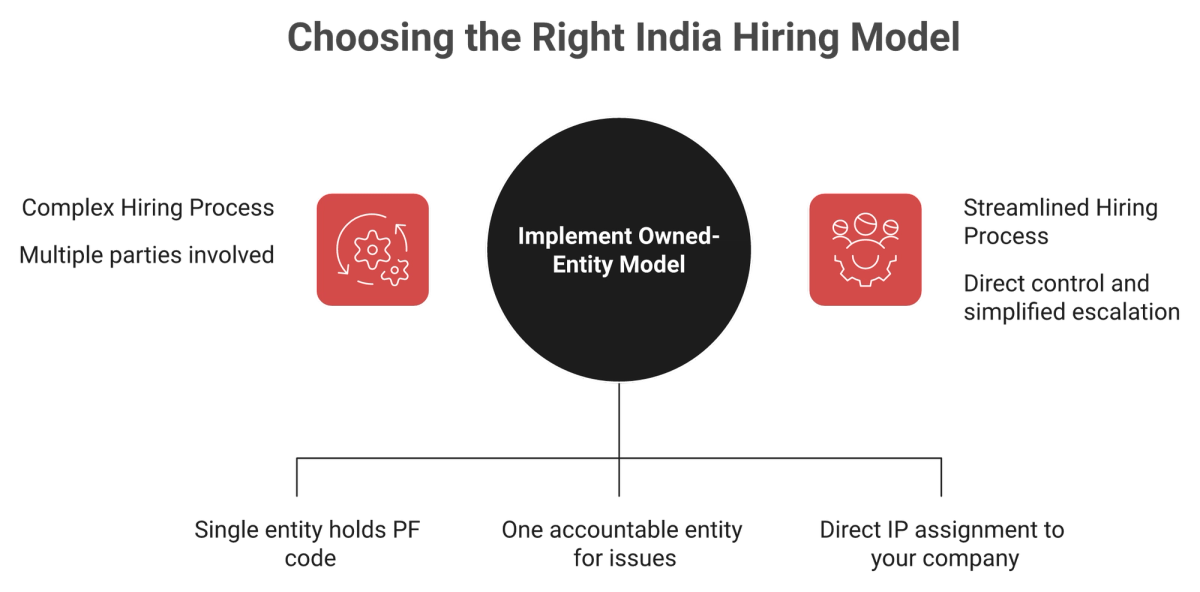
If your vendor uses a partner entity, a third company you never met signs that contract. You escalate to your vendor, who escalates to the partner. Latency becomes your problem, not theirs.
⚖️ Coverage breadth versus direct-EOR depth
Two different numbers get sold as one. "Countries covered" often includes partner-served countries. "Direct EOR" means the vendor owns the employing entity there.
| Provider | Countries listed | India entity model | Default invoice currency |
| Multiplier | 150 to 171 | Hybrid (partner entities used for India filings) | INR |
| Rippling | 32 to 83 with direct EOR | Generally listed as owned | USD |
| Versatile Club | India only, by design | Owned (Foo Falcon Technologies Pvt Ltd) | USD |
Versatile Club employs your hire on Foo Falcon Technologies Pvt Ltd, and you can verify that entity yourself on the Ministry of Corporate Affairs portal before you sign anything. See how the employment structure works end to end.
🔍 What owned versus hybrid changes in practice
Ownership decides three things that matter in an audit.
- Filing control. Under an owned model, the provident fund (PF) code and tax deduction account belong to the employing entity directly.
- Intellectual property assignment. Your employee's invention assignment runs to the entity that signed the contract. A partner in the chain means an extra assignment link to prove.
- Escalation speed. One entity means one escalation path. Two means you wait for someone else's ticket queue.
Versatile Club files PF, ESI, TDS, and professional tax under its own registrations, so there is no aggregator between the challan and the client pack. That is the difference between an owned entity and a partner-shell arrangement.
⚠️ Where the published evidence disagrees
I want to be straight about this, because the sources conflict. Versatile Club's own competitive research states that most global providers use local partner entities in India. Wisemonk's public matrix lists Rippling as "Owned" and Multiplier as "Hybrid."
Both cannot be fully right, and neither of us is a neutral party. So do not take my word or theirs.
✅ Three documents to demand before signing
Ask for these in writing, before the contract, not after.
- The Corporate Identity Number (CIN) of the entity that will employ your hire, checkable on the MCA portal.
- The EPFO establishment code for that same entity, checkable on the EPFO establishment search.
- A named escalation path for a payroll error, with the entity name of every party in the chain.
If a sales rep cannot produce all three inside a week, that tells you how month six will feel.
Versatile Club puts the CIN and the PF establishment code in the first email, because an India EOR that will not name its own entity has already answered the question.
Q3. What does each platform really cost per India employee per month?
Multiplier lists from roughly $400 per employee per month. Rippling lists roughly $499 to $599, plus a mandatory $8 per-user platform fee. Neither figure is your landed cost. Add currency conversion on INR-denominated invoicing, setup fees, exit notice periods, and contractor add-ons, and a $400 sticker can land close to a $600 one.
💸 The sticker is not the invoice
CFOs at $5M to $50M ARR companies do not get burned by the headline rate. They get burned by line items that appear in month three.
Multiplier's default invoicing is in Indian rupees. That means you absorb the foreign exchange (FX) conversion on every international wire. Rippling defaults to USD but carries a reported 2 to 3 percent FX markup on EOR flows.
📊 The full line-item comparison
Here is every cost line I would model before signing anything, and the same lines sit inside our published India EOR cost breakdown.
| Cost line | Multiplier | Rippling | Versatile Club |
| EOR fee per employee per month | From about $400 | About $499 to $599 | $149 flat, any salary band |
| Platform or base fee | None published | $8 per user, mandatory | None |
| Setup fee | Varies by contract | Varies by contract | $0 |
| Exit fee | Notice period applies | Notice period applies | $0 |
| Default invoice currency | INR | USD | USD |
| Salary markup | None claimed | None claimed | None, ever |
Versatile Club measures cost the way a controller does: one USD invoice from our own Indian entity, with a per-employee breakdown, so there is no FX leg for anyone to mark up.
🧮 A landed-cost formula you can run today
Model three hires, not one. Fees behave differently at volume.
Landed monthly cost equals (EOR fee times headcount) plus (platform fee times user count) plus (FX percentage times total remittance) plus amortised setup. Then divide by headcount, or run the same inputs through the EOR vs entity calculator.
Run that at three engineers on a 25 lakh rupee average package. The gap between platforms usually narrows to under $100 per head, and support quality becomes the real variable.
⚠️ What paying customers report about surprise charges
The fee surprise is not hypothetical. It shows up in reviews on both platforms.
"A critical issue arose when an uncommunicated change in their pricing model clashed with our existing master service agreement. This change, communicated via an automated email, left insufficient time for me to consider my options, effectively locking me into an annual billing cycle."
— Micah P., Multiplier Employer of Record - G2 Verified Review (1 star)
"The only thing I have enjoyed about Rippling is the HR Ticketing app I was able to customize. Of course, we only get one with our plan, and it's probably going to cost a ridiculous amount of money for more."
— Erika D., Rippling - G2 Verified Review (0 stars)
"First USD invoice landed clean: no FX markup, no setup fee, no surprises."
— Verified User in Information Technology and Services, Versatile Club G2 - Verified Review (5 stars)
✅ The one question that predicts your invoice
Ask for a sample invoice with real numbers, redacted, before you sign. Vendors who gate that behind a sales call are telling you something.
Versatile Club charges $149 per employee per month flat, with $0 setup, $0 exit, and the first month free, invoiced in USD from our own Indian entity. Founders comparing this against Multiplier's slab structure usually start on our Multiplier alternative page.
Q4. Which India statutory filings does each vendor actually handle every month?
Both platforms handle core India payroll: employees' provident fund (EPF) at 12 percent of Basic plus dearness allowance (DA), employees' state insurance (ESI) at 3.25 percent employer and 0.75 percent employee, tax deducted at source (TDS) deposited by the 7th, Form 16 issued by 30 May, and gratuity accruing at 4.81 percent of Basic plus DA from month one. Global templates break on state professional tax, Shops and Establishments renewals, and POSH committee setup.
📅 The calendar nobody shows you in a demo
India payroll is not one filing. It is a recurring calendar with different owners, different portals, and different deadlines.
Versatile Club runs this calendar monthly across all 28 states and 8 union territories, and each client pack ships PF and ESI challan confirmations beside the USD invoice. The full scope sits on our India compliance coverage page.
| Item | Rate or form | Deadline | Portal |
| EPF | 12% of Basic + DA (each side) | 15th monthly | EPFO |
| ESI | 3.25% employer, 0.75% employee | 15th monthly | ESIC |
| TDS deposit | Per income tax slab | 7th monthly | Income tax portal |
| Form 16 | Annual salary certificate | 30 May | Income tax portal |
| Gratuity | 4.81% of Basic + DA, accrued from month one | Balance sheet accrual | Internal |
| Professional tax | State-specific slabs | Monthly or biannual by state | State portals |
🗺️ Where a global template becomes legally useless
Professional tax is not a national tax. Each state runs its own slabs and registration regime, so one template cannot cover it.
- Maharashtra: dual registration, PTRC and PTEC, with monthly slab filing and annual returns.
- Karnataka: monthly professional tax, plus Shops and Establishments renewal, with enrolment inside 30 days of joining.
- Telangana: PTRC enrolment required, with monthly remittance deadlines.
- Tamil Nadu: biannual professional tax filing, plus labour welfare fund.
- Delhi: no professional tax, but strict Shops and Establishments enforcement.
Ask Versatile Club for the state-wise registration list before you sign, because "1,500 requirements handled" is a count, and a PTEC number is a fact.
⏰ What breaks first, in my experience
Onboarding is not the failure point. Month three is.
That is when a Karnataka enrolment window closes, or a Maharashtra PTEC payment gets missed, and nobody notices until a notice arrives. Versatile Club's audits of inherited payrolls surface this pattern more than any other single defect, which is why outsourced India payroll lives or dies on the state layer.
✅ Six questions to put to a sales rep in writing
Send these as an email, not a call. You want the answers in text.
- Which entity's PF establishment code will my employee's contributions be filed under?
- Do you hold professional tax registration in the specific state where my hire lives?
- Who issues Form 16, and by what date?
- Is gratuity accrued monthly on your balance sheet or invoiced on exit?
- Will you send monthly PF and ESI challan confirmations without me asking?
- Who signs the POSH internal committee constitution for my employee?
Versatile Club answers all six with document numbers rather than adjectives, because the challan is the proof and the invoice is just the summary. If you want those answers on your own hires, send us the two quotes you are comparing.
Q5. How does the New Labour Code 2025-26 break a global payroll template?
India's four Labour Codes came into force on 21 November 2025, and the Code on Wages requires Basic plus dearness allowance (DA) to be at least 50 percent of total remuneration. Allowance-heavy structures built to suppress employer provident fund and gratuity liability no longer hold. A platform still generating pre-Code salary breakups is quietly building your back-pay exposure.
⏰ What changed on 21 November 2025
The Code on Wages replaced a patchwork of definitions with a single one. "Wages" now means Basic plus DA, and that figure must be half of total pay or more.
Every statutory calculation keys off that number. Provident fund (PF) at 12 percent, gratuity at 4.81 percent, and leave encashment all sit on top of it. Our India payroll compliance guide walks through each line.
💰 The arithmetic on a real Bengaluru offer
Here is a 25 lakh rupee annual package, structured two ways. The old way loaded allowances to keep Basic low.
| Line item | Pre-Code structure | Post-Code structure |
| Basic + DA | 8,75,000 (35%) | 12,50,000 (50%) |
| Allowances (HRA, special, etc.) | 16,25,000 | 12,50,000 |
| Employer PF at 12% of Basic + DA | 1,05,000 | 1,50,000 |
| Gratuity accrual at 4.81% | 42,088 | 60,125 |
| Employer statutory cost delta | Baseline | +63,037 per year |
That is roughly 63,000 rupees per engineer per year, appearing without warning. Versatile Club restructures offers to the post-Code definition before signature, so the accrual is priced in from month one rather than discovered in month nine. Run your own numbers on the India salary calculator.
⚠️ Why global templates miss this
A platform serving 150 countries maintains one salary-structure engine. India is a row in that engine, not the design brief.
Standardised templates routinely keep the old allowance-heavy split. The result is not a rounding error; it is an understated employer match on every payslip.
I have seen this pattern in inherited payrolls that Versatile Club audits, and the tell is always the same. Basic sits at 30 to 40 percent of cost to company, and nobody has touched it since 2024.
❌ What the exposure actually looks like
Short-payment of PF is not a one-time correction. The Employees' Provident Fund Organisation can demand arrears with interest and damages.
Gratuity is worse in one specific way. It accrues from month one and gets paid on exit, so an understated accrual becomes a cash surprise at resignation, not at audit.
✅ The one request to send this week
Ask both vendors for a post-Code salary breakup on a hypothetical 25 lakh rupee package. Not a policy statement, an actual table.
Then check three things:
- Does Basic plus DA hit 50 percent or more of total remuneration?
- Is the employer PF figure calculated on that higher Basic?
- Is gratuity shown as a monthly accrual, or only as an exit line?
A vendor who cannot produce that table in 48 hours is running a pre-Code engine. Ask Versatile Club for the same sample and compare the two side by side, because the arithmetic is the argument here.
⭐ Where my head is on this
Versatile Club's read is that the standard advice gets this backwards. Most content treats the Labour Codes as a compliance headline, then moves on.
I think it is a pricing event. If your EOR quote was built before November 2025, your India cost per head is understated, and I would want that corrected before the next hire signs.
Versatile Club restructures every offer to the post-Code wage definition before signature, so the PF and gratuity figures on invoice one match the figures on invoice twelve.
Q6. Does using Multiplier or Rippling protect you from PE and misclassification exposure?
No. An employer of record (EOR) places your hire on an India-resident entity's payroll, which satisfies labour law. India's business-connection and dependent-agent tests examine what the person actually does. If your India hire habitually concludes contracts or negotiates pricing, permanent establishment (PE) risk survives the wrapper, and misclassified contractors carry roughly $25,000 to $40,000 of back-pay exposure per head.
❌ The myth that sells EOR contracts
Most comparison pages treat PE as a checkbox. Sign an EOR, tick the box, sleep well.
That is not how Indian tax law reads. PE is a conduct test, not a paperwork test.
⚖️ The three tests that actually apply
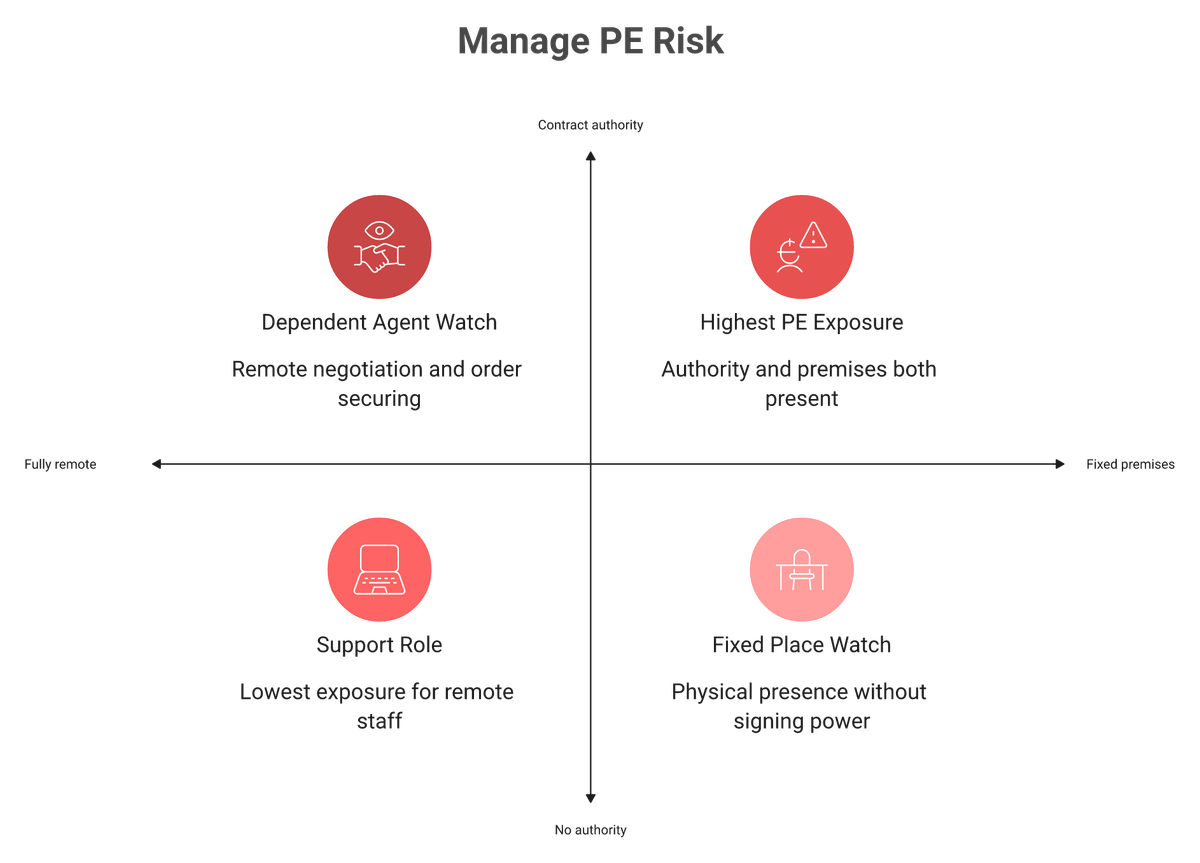
A permanent establishment means a taxable presence in India for your foreign company. Three routes create one.
- Fixed place PE. Your company has a place of business in India at its disposal, such as a leased office or a controlled desk.
- Dependent agent PE. Someone in India habitually concludes contracts or secures orders on your behalf.
- Service PE. Personnel furnish services in India beyond a threshold, commonly 90 days, and 30 days where associated enterprises are involved.
Versatile Club maps each role as support or revenue-concluding before the offer letter drafts, because the job description is where this exposure is created. Buyers weighing structure options usually start with our India expansion options breakdown.
⚠️ Where the case law landed
In February 2026, the Income Tax Appellate Tribunal in Delhi set aside a demand of about 3,960 crore rupees against Booking.com B.V. The tribunal accepted that a genuine third-party arrangement in India need not create a PE.
Read that carefully, because it cuts both ways. Structure survives scrutiny when contract authority genuinely stays offshore.
If your India engineer is emailing pricing to customers, no EOR contract fixes that. You can also seek certainty directly through an Advance Ruling under section 245Q.
💸 The misclassification bill nobody quotes
Before PE, most founders have a simpler problem. They have been paying Indian "contractors" who look exactly like employees.
The reclassification exposure sits around $25,000 to $40,000 per head once you add back provident fund, gratuity, and interest. A People Ops leader I spoke with found three such arrangements in her first week on the job, which is why converting a contractor to an employee in India is usually the first cleanup task.
✅ One thing to stop believing right now
US-style co-employment PEO does not legally exist under Indian labour law. There is no shared-employer construct to lean on.
Without an Indian subsidiary, EOR is the only compliant pathway. Any vendor selling you "PEO for India" is using a US word for an Indian arrangement that does not exist, as our EOR versus PEO comparison sets out.
⭐ The role-scoping checklist before your next offer
Run each India role through these five questions, in writing, before the offer goes out.
- Can this person sign or commit the company to anything?
- Do they negotiate price, scope, or terms with customers?
- Do they hold a customer-facing title such as Country Manager or Sales Head?
- Will visiting executives use a fixed desk or address in India?
- Are we crossing 90 days of India-delivered services for a single client?
Two or more yes answers, and I would get a tax opinion before hiring, not after. Versatile Club's client engagements surface this most often in the first sales hire, not the first engineering hire, which is the opposite of what founders expect.
Versatile Club maps each India role as support or revenue-concluding before the offer letter goes out, because clean payroll records do not undo a badly scoped job description.
Q7. Who is accountable for your India employee data and IP assignment?
Your EOR processes Aadhaar, PAN, universal account number (UAN), and bank data, which makes it a Data Processor under India's data protection framework. The Digital Personal Data Protection (DPDP) Rules 2025 were notified on 13 November 2025 via G.S.R. 846(E), with Rule 4 live from 13 November 2026 and most operative rules from 13 May 2027. A GDPR-only data processing agreement does not discharge Indian breach-notification duties.
📋 Fiduciary and Processor, in plain employment terms
DPDP uses two words that matter to you. A Data Fiduciary decides why personal data gets used. A Data Processor handles it on the Fiduciary's instructions.
In an EOR arrangement, the employing entity is typically the Fiduciary for statutory filings. Your company sits alongside it as a Fiduciary for performance data, and the platform processes on instruction.
The practical point is simple. Accountability does not disappear because a vendor holds the database.
⏰ The dates that decide your deadline
The Rules phase in rather than landing at once. Here is the schedule as notified.
| Provision | Effective date |
| Rules 1, 2, and 17 to 21 | 13 November 2025 |
| Rule 4 (Consent Manager registration) | 13 November 2026 |
| Rules 3, 5 to 16, 22, and 23 | 13 May 2027 |
Versatile Club signs an India-specific processing addendum with DPDP breach timelines, because the payroll data never leaves the entity that files the returns. The wider statutory scope sits on our India compliance page.
⚠️ Why a GDPR addendum is not enough
Most global platforms hand you a European-style agreement. It covers subject rights and breach notice under European rules.
India runs its own notification duties and its own regulator. A European template does not name the Data Protection Board of India, and it does not carry Indian timelines.
I could be reading the market too strongly here, but the DPDP gap in vendor paperwork looks like the most common unpatched item in India EOR contracts right now.
🔍 The IP chain most buyers never trace
Intellectual property assignment runs through the employment contract. So it runs to whichever entity signed that contract.
Under a partner-entity model, that is a third company you never negotiated with. Your assignment then needs a second hop, from the partner to your vendor, and a third to you.
Ask Versatile Club to show the assignment chain on one page, because a single-entity chain has no hops to prove. Our employment structure walkthrough shows where each signature sits.
✅ Three clauses to request before signing
Send these to your counsel and your vendor together.
- A DPDP processing addendum naming Indian breach-notification obligations, not only GDPR ones.
- A named employing entity in the IP assignment clause, matched to the Corporate Identity Number on the MCA portal.
- A sub-processor list with the legal name of every party touching payroll data, including any local partner.
If a vendor cannot name its sub-processors, it cannot answer a breach question either.
Versatile Club signs an India-specific processing addendum with DPDP breach timelines, and intellectual property assigns from our own entity to you, with no third party in the chain.
Q8. What do independent ratings, certifications, and analysts say about each vendor?
On G2, Multiplier's employer of record product scores 9.0 across 852 reviews, against Rippling's 8.8 across 579. Rippling holds broader security certifications, including ISO 27001, 27018, and 42001 plus CSA STAR. Multiplier holds SOC 2 Type II and offers Contractor of Record, which Rippling does not. Read the EOR-category score, not the overall product score.
📊 How I read third-party evidence
Method matters here, so I will state mine. I compared G2 category scores for the EOR product listings, not the parent platform listings, in mid-2026.
Then I checked each vendor's published certification register. Certifications get renewed and withdrawn, so treat any list as a date-stamped snapshot.
⚖️ The trust-signal table
Here is the comparison, with Versatile Club included honestly rather than flatteringly.
| Trust signal | Multiplier | Rippling | Versatile Club |
| G2 EOR-category score | 9.0 (852 reviews) | 8.8 (579 reviews) | New profile, first reviews June 2026 |
| Security certification | SOC 2 Type II | ISO 27001, 27018, 42001, CSA STAR | Not yet certified |
| Contractor of Record | Yes | No | Not offered |
| Analyst coverage | Assessed with provider inputs | Assessed without provider inputs | Not covered |
Versatile Club is openly the smallest entry in that table, and I would rather you see it that way than discover it later.
⚠️ The analyst caveat almost nobody notices
Everest Group's Employer of Record PEAK Matrix carries a footnote about non-participating providers. Some vendors are assessed using Transaction Intelligence data only, without provider inputs.
Rippling appears in that non-participating category. Its placement therefore rests on third-party data rather than a full vendor submission.
That is not a knock on Rippling. It does mean a PEAK Matrix position is not the same evidence for every vendor on the chart, and buyers screening India-fit options often cross-check our Rippling alternatives for India list.
⭐ What real buyers report
Ratings summarise. Reviews explain.
"Support is the single biggest failure. There is no direct phone line. You either email or use a chatbot, and you can ask both the same question and get two different wrong answers."
— Erika D., Rippling - G2 Verified Review (0 stars)
"I appreciate that Multiplier offered competitive pricing for its employer of record services... I experienced several invoice errors, which added confusion to management and required my initiation for them to be addressed."
— Micah P., Multiplier Employer of Record - G2 Verified Review (1 star)
"The dashboard could be a little more self-serve. A couple of times I wanted to pull a report or a doc myself and ended up just messaging my contact instead."
— Angad S., Versatile Club G2 - Verified Review (5 stars)
✅ How to weigh this if you are buying
Certifications are procurement gates, not service quality. If your security team requires SOC 2 Type II or ISO 27001 before signing, that filter runs first, and it rules Versatile Club out today.
Everything else is judged on the challan, the invoice, and the response time.
Versatile Club's G2 profile is new, with its first reviews landing in June 2026, and SOC 2 work is still ahead of us. Judge the entity, the filings, and who answers the phone, then tell us what you are building in India.
Q9. How fast does each onboard, who supports you, and how hard is it to switch?
Both platforms advertise onboarding in days, but those are marketing claims rather than contractual service level agreements (SLAs). Multiplier indicates around 7 days, and Rippling varies by entity type. Support is where India buyers get hurt. Reviewers of global platforms repeatedly describe account manager rotation and ticket-queue escalation when a statutory question surfaces mid-payroll.
⏰ The situation: offer accepted, start date in six days
Picture a People Ops lead at a Series A company. Her Bengaluru engineer accepted on Tuesday and starts next Monday.
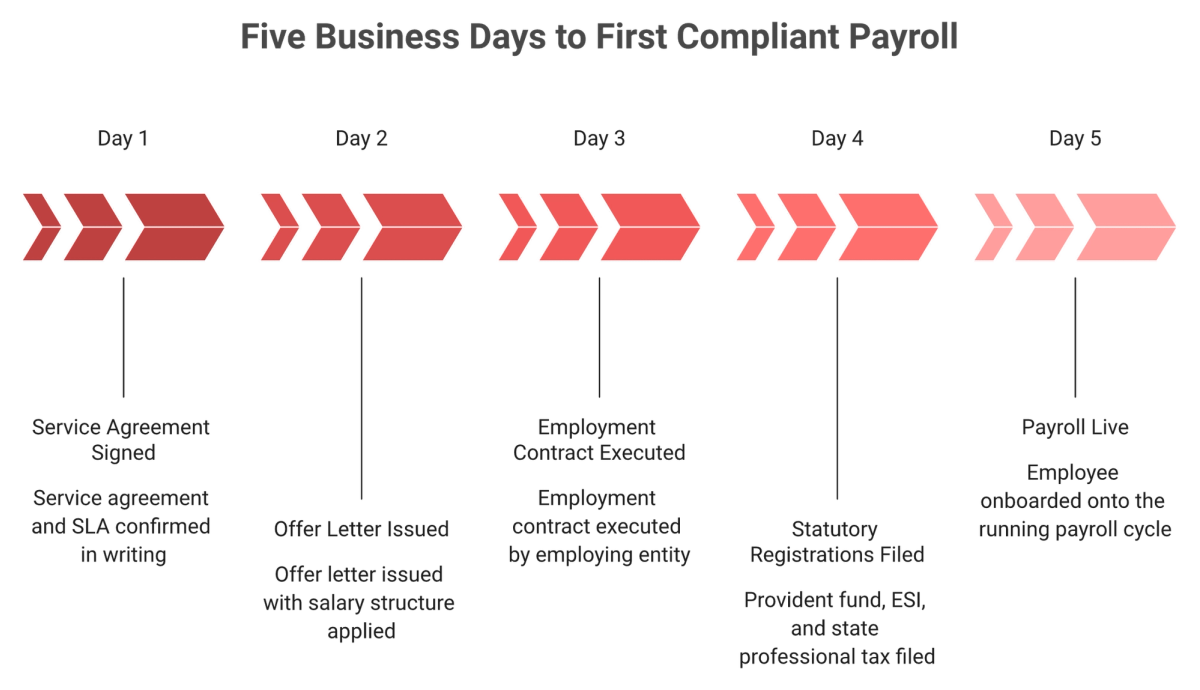
She needs a compliant contract, a provident fund (PF) enrolment, and a payroll cycle that catches the month. Six days is not unusual; it is normal. Our day-by-day onboarding process is built around exactly that window.
⚠️ The complication: rotation and queues
Onboarding rarely breaks first. Support breaks first, and it breaks at the worst moment.
"Support from account managers and technical account managers was lacking, as they rarely responded to messages, and we've already had two of each since going live two months ago."
— Jenny F., Rippling - G2 Verified Review (0.5 stars)
"Every issue, no matter how urgent, takes 3 to 10 business days to resolve. Account managers are polite but powerless to actually fix core problems."
— Kenneth P., Multiplier Employer of Record - G2 Verified Review (0.5 stars)
"Sagar replied to our form in about four hours with a draft offer letter already attached. The hire was onboarded in four days."
— Verified User in Information Technology and Services, Versatile Club G2 - Verified Review (5 stars)
Versatile Club writes a five-day onboarding SLA into the service agreement rather than the marketing page, and I answer the WhatsApp thread myself.
💸 Exit mechanics, the part nobody reads
Switching cost is contractual, not emotional. Check three clauses before you sign anything, and read our guide on switching an EOR provider in India before you give notice.
| Item | Multiplier | Rippling | Versatile Club |
| Stated onboarding | Around 7 days | Varies by entity type | 5 days, contractual |
| Support model | Account manager plus ticketing | Email and chatbot first | Founder on WhatsApp |
| Exit fee | Notice period applies | Notice period applies | $0 |
One reviewer named the real lock-in clearly. It was not the contract; it was the integration.
"Why I haven't left: our tech team invested significant work integrating Rippling as our identity provider, and unwinding that is non-trivial."
— Erika D., Rippling - G2 Verified Review (0 stars)
⭐ The honest limit of my own model
Versatile Club's founder-direct support works at current scale, and I will not pretend it scales forever. At some point that changes, and I would rather say it now than surprise a client later.
There is a second trade-off worth naming. Enterprise procurement customisation takes longer than five days, so the SLA applies to standard onboarding, not to a 40-question security questionnaire. Larger buyers should start on our enterprise engagement page instead.
✅ Two questions that predict your worst month
Ask these in the sales call, and write down the answers.
- When a PF challan is late, who fixes it, and what is their name?
- How many account managers have my size of client had in the last 12 months?
The first answer tells you whether accountability has a face. The second tells you whether you will re-explain your setup every quarter.
Versatile Club puts the five-day SLA in the agreement and the founder's number in the onboarding email, because a support promise you cannot enforce is just a sentence.
Q10. At what India headcount does EOR stop making sense?
Below roughly 15 India employees, employer of record (EOR) is almost always cheaper than incorporation, even across three years. Between 10 and 30 heads, the answer depends on burn tolerance and timeline. A private limited company plus PF, ESI, professional tax, and GST registrations takes months, and the compliance calendar then becomes permanently yours.
💰 Nobody tells you when to graduate
Every EOR vendor has a reason to keep you on EOR. Every incorporation consultant has a reason to sell you an entity.
So the crossover math rarely gets published honestly. Versatile Club's client engagements put the practical break-even nearer 15 India employees than 10, though I hold that number loosely, and our EOR versus entity analysis for India shows the working.
📊 The three-year cost picture
Here is the shape of it at three headcount levels. Entity costs include incorporation, registrations, a retained chartered accountant, and payroll software.
| India headcount | EOR annual cost (at $149 flat) | Own-entity annual cost | Practical read |
| 5 employees | About $8,940 | Setup plus ongoing compliance overhead | EOR wins clearly |
| 15 employees | About $26,820 | Comparable, once CA and software are loaded | Genuine toss-up |
| 30 employees | About $53,640 | Usually lower per head | Entity starts winning |
Versatile Club prices at $149 flat per employee per month regardless of salary band, which keeps that math linear instead of slab-jumping at senior salaries. Model your own headcount on the EOR vs entity calculator.
⏰ The timeline nobody prices
Cost is the easy variable. Time is the expensive one.
Incorporation plus PF, ESI, professional tax, and GST registration is a multi-month project before your first compliant payslip. EOR is a light span you can cross this week. An entity is a permanent bridge you fund for 12 to 18 months before anyone walks on it.
⚠️ Where the honest disagreement sits
I have seen the tipping point argued at 10 to 12 hires. I have also seen companies run 30-plus people on EOR comfortably before building a captive centre in India.
Both can be right. The variable is not headcount; it is whether you want an India management layer on your own payroll.
✅ Four triggers to review each quarter
Put these in your quarterly finance review, not in a one-time decision memo.
- Headcount crossing 15 with a hiring plan that keeps climbing.
- A local leadership hire who needs signing authority in India.
- Customer contracts requiring an Indian legal entity as counterparty.
- Equity grants to India staff that need a local scheme.
Any two of those firing together, and I would start the entity conversation. One alone is usually noise.
⭐ What I think changes in two years
India stops being one row on a global EOR map. Owned-entity specialists operating in a single country take India revenue from the generalists, because depth beats breadth once you are past your third hire.
I could be wrong on the timing. The direction feels clear from where I sit.
Versatile Club tells clients when they have outgrown EOR, and with $0 exit fee there is no commercial reason for us to keep you on a plan you no longer need.
Q11. If neither fits, which India-specialist EOR providers should you shortlist?
If India is your only hiring country, a multi-country generalist is the wrong shape of vendor. India-specialist providers own local entities, file state professional tax directly, and price without salary slabs. Shortlist Versatile Club, Wisemonk, Asanify, and Teamlease, then use a split-vendor model if you later add a second country.
🔍 Why India-only changes the vendor shape
Global platforms cover 90 to 150 countries and spread India expertise thin. That is a resourcing reality, not an insult.
A specialist maintains one compliance calendar instead of 150. The difference shows up in month three, not week one, which is the pattern running through our best EOR in India roundup.
1. Versatile Club
Best for US and UK founders making their first 1 to 15 India hires.
- ✅ Owns its Indian entity, Foo Falcon Technologies Pvt Ltd, with PF, ESIC, and Shops and Establishments registrations across all 28 states and 8 union territories.
- ✅ $149 per employee per month flat, $0 setup, $0 exit, first month free, invoiced in USD from India.
- ❌ No SOC 2 Type II or ISO 27001 certification yet, which rules us out of security-gated procurement.
- ✅ Five-day onboarding SLA in the contract, plus a six-month replacement guarantee and 50-parameter culture-fit screening on placements.
- ❌ India only, so buyers needing five or more countries should look elsewhere.
Founders comparing us against a global platform usually land on our India EOR service page first.
"Founder is just a call away. Extremely helpful in resolving all our queries. The process is super smooth to setup India EOR."
— surbhi m., Versatile Club G2 - Verified Review (5 stars)
2. Wisemonk
Best for buyers who need certifications and a longer public track record.
Wisemonk anchors pricing from around $99, rising through salary slabs to roughly $399. It holds SOC 2 and ISO 27001, with a 4.8 out of 5 G2 rating across 261-plus reviews.
The gaps sit on retention. There is no published replacement guarantee, no structured 90-day success coaching, and no founder-direct support model, which is the contrast we set out on our Wisemonk alternative page.
3. Asanify
Best for smaller India teams wanting an India-built payroll and EOR stack in one product.
Asanify publishes detailed India compliance content and operates as an India-focused provider. Pricing and entity structure vary by plan, so ask for the employing entity's Corporate Identity Number in writing.
4. Teamlease
Best for larger, staffing-heavy India requirements.
Teamlease is a listed Indian staffing and compliance business with deep domestic scale. It is built for volume and Indian corporate buyers, so a US seed-stage founder may find the process heavier than needed. If volume hiring is the real need, compare it against EOR versus a staffing agency in India.
❌ When to skip all four and buy a global platform
I would rather lose the deal than sell you the wrong shape of vendor. Go global if any of these are true.
- You need EOR in five or more countries under one contract.
- Your security team requires SOC 2 Type II or ISO 27001 before signature.
- You are hiring a 100-plus person India team with enterprise procurement workflows.
- You are a B2C consumer business hiring high-volume frontline staff.
Versatile Club sits first on this list on structure rather than preference: owned entity, flat pricing, USD invoicing, and a contractual SLA. We will also tell you when we are the wrong fit.
Q12. What should you do on Monday before signing either contract?
Before you sign, verify the employing entity's Corporate Identity Number (CIN) on the MCA portal, request a post-Labour-Code salary breakup, demand a DPDP processing addendum with breach timelines, classify the role as support or revenue-concluding, and confirm in writing who files state professional tax. A vendor who cannot answer all five in a week will not answer them in month six.
✅ The five checks, in order
Do these in sequence. Each one takes under an hour, and the answers compound.
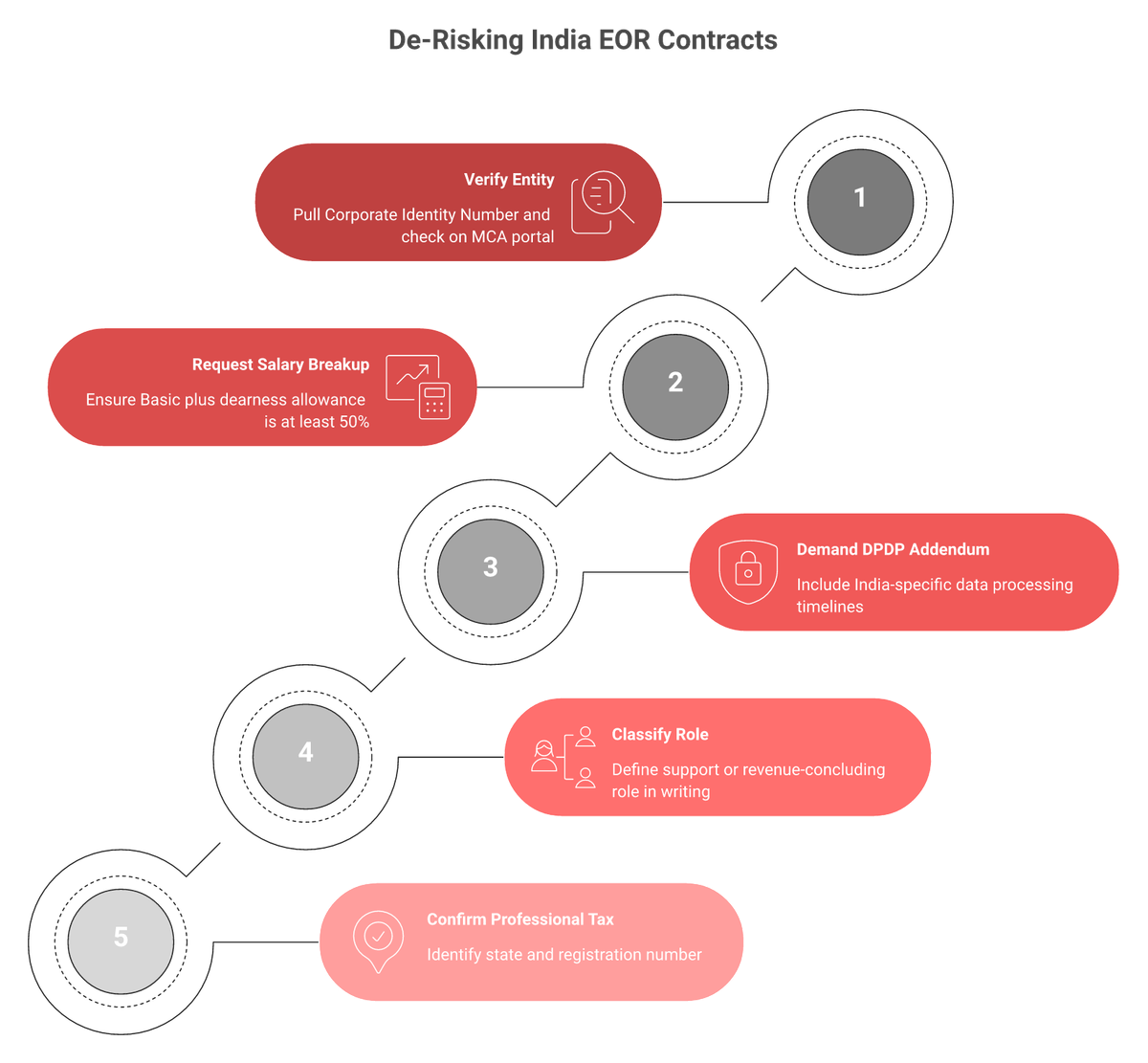
- Verify the entity. Get the CIN of the company that will employ your hire, and check it on the Ministry of Corporate Affairs portal.
- Request a post-Code salary breakup. Basic plus dearness allowance must be at least 50 percent of total remuneration under the Code on Wages.
- Demand a DPDP addendum. Ask for Indian breach-notification timelines, not a GDPR-only template, referencing G.S.R. 846(E).
- Classify the role. Write down whether this person concludes contracts, because that decides your permanent establishment exposure.
- Confirm professional tax. Name the state, then ask which registration number covers it.
Versatile Club answers all five in one WhatsApp thread, and if the honest answer is that you need a global platform, I will say that too. The published pricing sits beside those answers, not behind them.
⏰ What to do with the answers
Put the five responses in one document beside the quote. Price comparisons get easy once the compliance answers sit next to them.
A vendor who answers four out of five is not disqualified. A vendor who deflects on the entity name is.
⚠️ The framing I would push back on
The standard pitch for India hiring is cost. Versatile Club's read is that this gets it backwards, and I say that as someone whose pricing benefits from the cost story.
You do not come to India for cheap. You come for people with serious academic depth and too few places to apply it, which is why we screen for quality of hire in India before anything else.
Dan Scheinman of Cisco Systems put it better than I can: "We came to India for the costs, we stayed for the quality, and now we're investing for the innovation."
⭐ The question I am still sitting with
Here is what I do not know yet. As the Labour Codes bed in through 2026 and 2027, does the compliance burden push more small buyers toward specialists, or does it push them back to the biggest platform they recognise?
Versatile Club's client conversations point toward specialists, though the sample is small, and I might be reading my own book. Six months of data will tell me more than my instinct will.
If you are staring at two vendor tabs right now, send me the two quotes. I will tell you which one I would sign, including when the answer is neither.
FAQs
Is Multiplier cheaper than Rippling for hiring in India?
On sticker price, yes. Multiplier lists from roughly $400 per employee per month with no separate platform fee. Rippling lists roughly $499 to $599, and adds a mandatory $8 per-user platform fee before EOR pricing begins.
Neither number is your landed cost, though. We tell every founder to model four extra lines before comparing:
- Currency conversion. Multiplier's default invoicing is in Indian rupees, so you absorb the foreign exchange leg on every international wire.
- Setup and exit terms. Both vary by contract, and exit notice periods carry real cash cost when you switch.
- Platform seats. The $8 fee applies per user, not per India employee, so it scales with your whole team.
- Contractor add-ons. Multiplier offers contractor of record; Rippling does not.
Once those land, a $400 sticker can sit close to a $600 one. Versatile Club charges $149 per employee per month flat regardless of salary band, with $0 setup, $0 exit, and the first month free, invoiced in USD from our own Indian entity. You can see the full breakdown on our India EOR pricing page and compare it against a slab-based quote line by line.
Does Multiplier or Rippling own its India entity?
This is the question that decides who legally employs your hire, and the published evidence conflicts. Multiplier is generally listed as running a hybrid model in India, using partner entities for local filings. Rippling is generally listed as owning its India entity.
Ownership matters for three reasons that only surface later:
- Filing control. Under an owned model, the provident fund code and tax deduction account sit with the entity that signs your employee's contract.
- Intellectual property assignment. A partner in the chain means an extra assignment hop to prove during due diligence.
- Escalation speed. One entity means one escalation path, not a ticket handed to an aggregator you never met.
We do not ask anyone to take a vendor's word for this. Get the Corporate Identity Number of the employing entity, check it on the Ministry of Corporate Affairs portal, and ask for the EPFO establishment code alongside it. Versatile Club employs your hire on Foo Falcon Technologies Pvt Ltd, a registered Indian company, and we put both numbers in the first email. Our employment structure walkthrough shows exactly where each signature sits.
Does using an EOR like Multiplier or Rippling remove permanent establishment risk in India?
No. An employer of record places your hire on an India-resident entity's payroll, which satisfies labour law obligations. India's tax tests are separate, and they look at conduct rather than paperwork.
Three routes create a permanent establishment, meaning a taxable presence for your foreign company:
- Fixed place. A place of business in India at your disposal, such as a leased office or a controlled desk.
- Dependent agent. Someone in India who habitually concludes contracts or secures orders on your behalf.
- Service PE. Personnel furnishing services in India past a threshold, commonly 90 days, and 30 days where associated enterprises are involved.
So an engineer writing code carries very little exposure. A country manager negotiating pricing carries real exposure, and no EOR contract cures that. Misclassified contractors sit alongside this problem, typically at $25,000 to $40,000 of back-pay exposure per head once provident fund, gratuity, and interest are added back.
Versatile Club maps each India role as support or revenue-concluding before the offer letter drafts, because the job description creates the risk. If you are cleaning up existing arrangements, start with our guide on converting a contractor to an employee in India.
Which India statutory filings should an EOR handle every month?
A compliant India payroll is a recurring calendar, not a single filing. Any vendor you shortlist should own all of the following without you chasing it:
- Employees' provident fund at 12 percent of Basic plus dearness allowance from each side, deposited by the 15th.
- Employees' state insurance at 3.25 percent employer and 0.75 percent employee, also by the 15th.
- Tax deducted at source per income tax slab, deposited by the 7th of the following month.
- Form 16 issued to every employee by 30 May.
- Gratuity accrued at 4.81 percent of Basic plus dearness allowance from month one, not invoiced as a surprise on exit.
- State professional tax, which differs by state: Maharashtra runs dual PTRC and PTEC, Karnataka is monthly with enrolment inside 30 days of joining, Tamil Nadu files biannually, and Delhi has none but enforces Shops and Establishments strictly.
That state layer is where a single global template breaks, because professional tax is not a national tax. Versatile Club holds registrations across all 28 states and 8 union territories, and each monthly pack ships provident fund and ESI challan confirmations plus TDS receipts beside the USD invoice. The full statutory scope sits on our India compliance page.
What are the best Multiplier and Rippling alternatives if India is our only hiring country?
If India is your only hiring country, a multi-country generalist is the wrong shape of vendor. Global platforms cover 90 to 150 countries and spread India expertise thin, which is a resourcing reality rather than a criticism. India specialists maintain one compliance calendar instead of 150.
Shortlist these four, then run the same five verification questions across all of them:
- Versatile Club for first India hires between one and 15 heads: owned entity, $149 flat, USD invoicing, five-day contractual onboarding SLA, six-month replacement guarantee. No SOC 2 or ISO 27001 yet.
- Wisemonk for buyers who need certifications and a longer public track record, priced from around $99 through salary slabs to roughly $399.
- Asanify for smaller teams wanting India payroll and EOR in one product.
- Teamlease for volume, staffing-heavy India requirements.
We will also tell you when to skip all four. Buyers needing EOR in five or more countries, security-gated enterprise procurement, or high-volume consumer frontline hiring should stay with a global platform. Compare the specialist field in detail in our best EOR in India roundup.