Table of contents (16)
- Deel vs Papaya Verdict
- True India Cost
- Entity vs Partner
- Platform vs Payroll Depth
- 50% Wage Rule Test
- Statutory Filing Scorecard
- Contract Risk Clauses
- Reviews and Support
- Misclassification Trigger
- Headcount Tipping Points
- India Specialist Shortlist
- ⭐ Versatile Club
- ✅ Wisemonk
- ✅ Remunance and other India-native operators
- ⚠️ The split-vendor play
- Decide and Migrate
Papaya Global vs Deel for India (2026): Enterprise Payroll vs All-in-One EOR
Q1. Papaya Global vs Deel for India in 2026: which one should you actually sign?
A People Ops lead at a Series A company messaged me on a Tuesday night. She had two quotes open on her screen, one from Deel and one from Papaya Global, both for four engineers in Bengaluru. Her actual question was not "which platform is better." It was "which of these two is really my employer in India, and who signs the PF challan."
Deel wins on self-serve speed, contractor breadth, and owned-entity count across markets. Papaya Global wins on consolidated multi-country payroll reporting and cost analytics. Neither is India-native. Versatile Club employs India hires on its own registered Indian entity, Foo Falcon Technologies Pvt Ltd, at $149 per employee per month flat through its EOR services in India.
The verdict for an India-only footprint
⭐ What each platform is genuinely good at
Deel is built for breadth and speed. If you hire in eight countries and want a card, a contractor flow, and a visa module in one login, it earns its price.
Papaya Global is built for finance visibility. Its strength is payroll data across many countries, plus licensed payment rails for large workforces.
India is where both models thin out. Versatile Club runs one country, so PF, ESI, TDS, and state professional tax sit under its own registrations rather than a partner's, as set out on our India compliance coverage page.
| Criterion | Deel | Papaya Global | Versatile Club |
| India EOR list price | From $599 per employee per month | $499 to $770 by tier | $149 flat |
| Setup fee | $500 | Per location | $0 |
| Exit terms | 1 month notice | Add-ons at exit | $0 exit fee |
| Onboarding | 7 to 14 days | 3 to 7 days | 5 business days, contractual |
| India entity model | Local partner in India | Hybrid own plus partner | Own Indian entity |
| Countries | 150 plus | 160 plus | India only |
⚠️ When a global platform is the honest answer
If you hire across five or more countries, buy the global platform. If your investors require bundled business insurance, buy the global platform.
Versatile Club is not the right call for enterprise India teams that need SOC 2 or ISO 27001 as a procurement gate. I would rather say that plainly than lose you in month three.
"It took three months to onboard our first 3 individuals. They didn't seem to be able to navigate Visas or variations to employment contracts."
— Verified User in Information Technology and Services, Deel Hire - G2 Verified Review, 0/5
"Papaya held our deposit return over a month past the due date we agreed on... you must follow up many times and escalate to get an answer."
— Verified User in Civic & Social Organization, Papaya Global - G2 Verified Review, 0/5
✅ Three questions to ask before you sign
- Name the entity that employs my India hire, with its CIN and PF code.
- Show me a post-Labour-Code payslip with Basic plus DA at 50 percent or more.
- List every fee beyond the monthly platform fee, in writing.
Versatile Club answers all three in the first call, on WhatsApp, before any contract is drafted. Founders get the entity name, the registration numbers, and a sample invoice with nothing withheld. You can see the same sequence laid out in how our India EOR works.
Q2. What does an India hire really cost on each platform once you add the hidden fees?
A CFO at a $12M ARR SaaS company sent me her India budget line last year. She had modelled $599 per head and nothing else. Her year-one actual came in near $8,000 for one engineer, and she found out during her audit prep, not during procurement.
Deel lists India EOR from $599 per employee per month, plus a $500 setup fee, one month notice on exit, and reported FX markups of 3 to 5 percent. Papaya Global appears anywhere from $499 to $770 by tier, plus per-location setup and year-end filing fees. Versatile Club charges $149 flat with no setup fee and no exit fee, published in full on our India EOR pricing page.
How I build the landed-cost model
💰 The line items vendors do not put on the quote
I model six lines, not one. Platform fee, setup fee, exit cost, FX spread, per-transaction charges, and year-end filing fees.
Then I add the employer statutory load, which no vendor absorbs. Versatile Club shows this stack on every invoice: PF at 12 percent of Basic plus DA, ESI at 3.25 percent employer and 0.75 percent employee, and gratuity accruing at 4.81 percent of Basic plus DA from month one. The full breakdown sits in our guide to employer of record India cost.
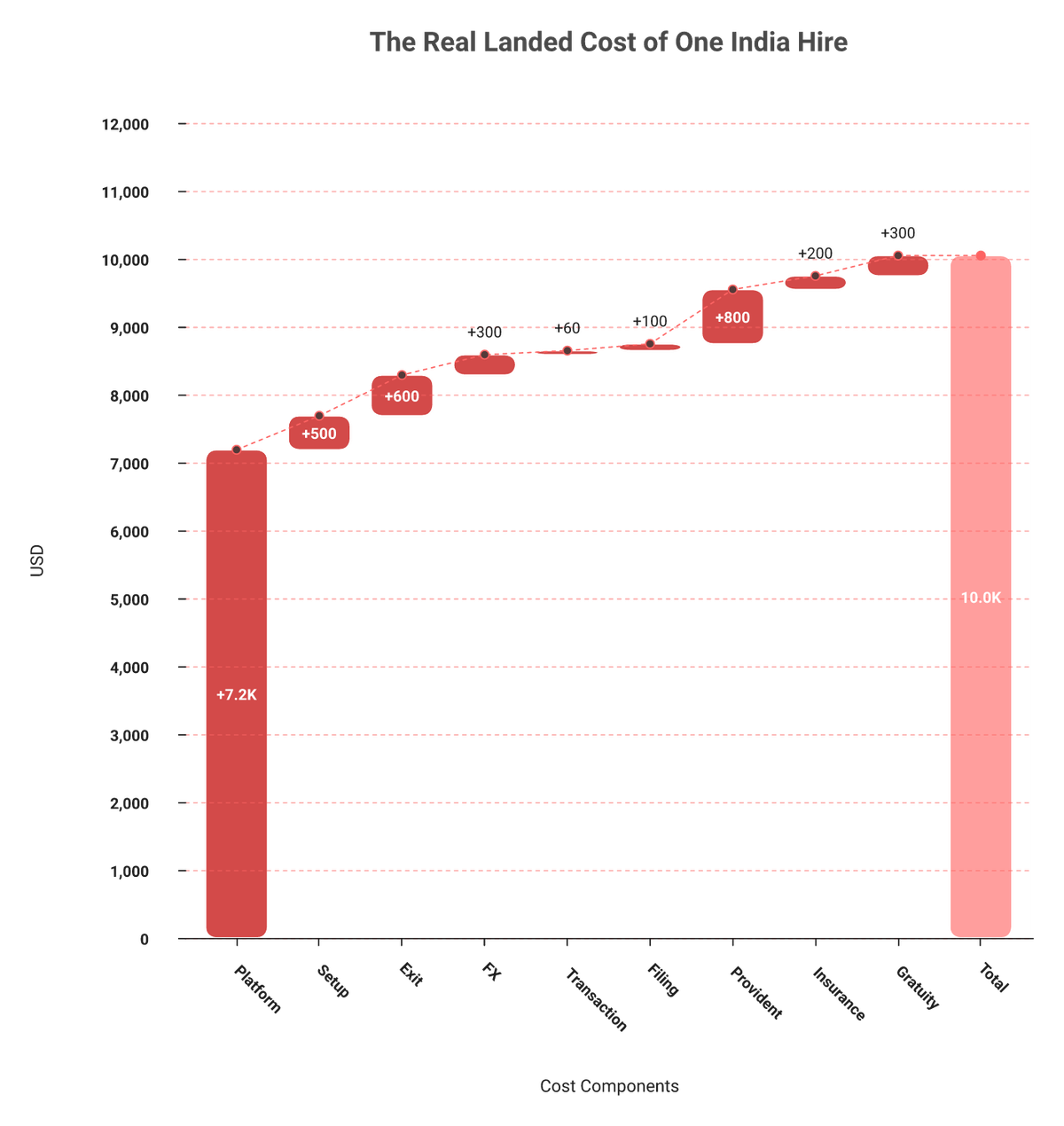
| Cost line (one India hire, year one) | Deel | Papaya Global | Versatile Club |
| Platform fee | $7,188 | $5,988 to $9,240 | $1,639 (first month free) |
| Setup fee | $500 | Per location | $0 |
| Exit cost | 1 month notice | Add-ons | $0 |
| FX exposure | 3 to 5 percent reported | USD invoicing default | USD invoice from India, no FX leg |
| Statutory load | Passed through | Passed through | Passed through, itemised |
💸 Where the money quietly leaks
The leak is rarely the sticker. It is the transfer fee, the card fee, and the month you get billed twice.
Papaya's own comparison page lists a $500 termination fee and per-transaction charges of about $5 on third-party payment providers. Read those two lines before you sign anything.
"I find Deel to be absurdly expensive. They charge a high amount of fees for transferring money to my bank account."
— Juan Camilo O., Deel Hire - G2 Verified Review, 1/5
"Payments: There are hidden fees. Of course, again, also here... You will never get your net-agreed salary through Deel."
— İbrahim ., Deel Hire - G2 Verified Review, 1/5
"First USD invoice landed clean: no FX markup, no setup fee, no surprises."
— Verified User in Information Technology and Services, Versatile Club G2 - Verified Review, 5/5
⏰ The four numbers to demand this week
Ask for the all-in monthly fee, the setup fee, the exit fee, and the FX spread as a percentage. Get them in the proposal, not in a call.
I could be reading the FX data too strongly, since markups vary by corridor and volume. What I am confident about is the pattern. Versatile Club invoices in USD from its own Indian entity, so there is no second conversion to mark up. If you want to model your own numbers first, run the EOR vs entity calculator.
Versatile Club prices at $149 per employee per month, flat across salary bands, with $0 setup, $0 exit, the first month free, and no markup on the employee's salary.
Q3. Who legally employs your India hire, the platform or a local partner entity?
I once asked a global platform's rep a simple question on a client call. Who is named as employer on the appointment letter in India? It took nine days and two escalations to get a name, and the name was not the platform.
Deel owns entities in roughly 130 of its 150 plus markets, but runs India through a local partner. Papaya Global operates about 40 Papaya Direct entities and partners elsewhere. That choice decides whose PF registration your employee sits under. Versatile Club's Indian entity holds its own PF registration, ESIC code, and Shops and Establishments licences, which is the structural difference we set out on our Deel alternative page.
What an aggregator actually is
📄 Employer of Record versus aggregator, in plain terms
An Employer of Record, or EOR, is the legal employer on paper. It signs the contract, runs payroll, and files statutory returns under its own registrations.
An aggregator sells you the software layer and subcontracts the employment to a local firm. Versatile Club sits in the first category by design, since India is the only country it operates in.
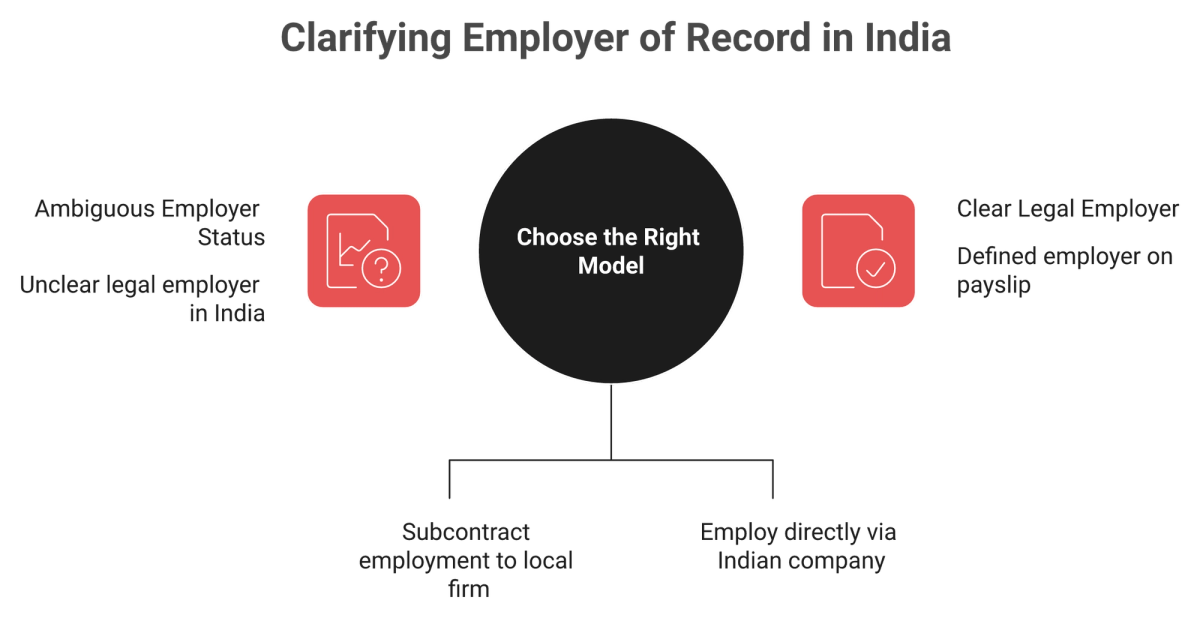
🔍 How the chain shows up later
You see it in three places. The appointment letter, the PF establishment code on the payslip, and the vendor list in a diligence data room.
An acquirer's counsel will ask who employed your India team and under which registration. If the answer is a partner you never contracted with, that becomes a question you cannot answer quickly.
⚠️ The honest counterpoint
Partner models exist for good reasons. Owning an entity in a country where you have two employees is uneconomic, and partners are faster to switch on.
I will also flag a source conflict rather than paper over it. Competitor matrices disagree on which global providers own India entities, so verify per vendor before you quote anyone. Versatile Club publishes its own entity name so buyers can check it on the MCA portal themselves, and the same detail sits in our employer of record India playbook.
✅ The request template that settles it
Send this to both vendors, verbatim:
- Name the legal entity that will employ our India hire, with its Corporate Identity Number.
- Provide the EPFO establishment code under which PF will be filed.
- Confirm whether that entity is owned by you or contracted by you.
- Confirm who issues Form 130, formerly Form 16, and that it is TRACES generated.
Two of those four answers are usually the ones that go quiet. That silence is your answer.
Where my head is right now is that entity ownership matters less at two hires and a lot at twenty. At twenty, a partner chain means twenty employment records you do not directly control.
Versatile Club employs every India hire on Foo Falcon Technologies Pvt Ltd, files PF, ESI, TDS, and professional tax under its own registrations, and gives clients the registration numbers to verify.
Q4. Platform breadth or payroll depth: which product model fits your finance stack?
A controller at a 60-person SaaS company told me her India problem was not compliance. It was that her month-end close needed one reconcilable document, and she was pulling four exports to build it by hand.
Deel is a breadth play with eight product lines and 130 plus HRIS and ERP integrations. Papaya Global is a depth play with payroll analytics, licensed payment rails, and its Contingent OS for mixed workforces. For a 5 to 30 person India team, most of that breadth goes unused. Versatile Club sends one USD invoice with a per-employee breakdown every month through its managed payroll service.
Two different bets, one close cycle
🧾 What each model gives and withholds
Deel gives you workflow surface area. It withholds India specificity, because the same template serves 150 countries.
Papaya gives you finance-grade reporting across countries. It withholds speed on clarifications, which is the complaint I see most in its reviews.
📊 What your controller actually needs each month
Three artefacts close an India month cleanly. A payroll summary, PF and ESI challan confirmations, and TDS deposit receipts dated by the 7th.
Versatile Club ships all three in one monthly pack alongside the invoice, so the reconciliation is a single document rather than four exports. The filing calendar behind that pack is documented in our guide to payroll compliance in India.
| Close-cycle artefact | Deel | Papaya Global | Versatile Club |
| Single India invoice in USD | Yes, platform generated | Yes, platform generated | Yes, from own Indian entity |
| Per-employee cost breakdown | Yes | Yes, analytics led | Yes, on the invoice |
| PF and ESI challan proof | On request | On request | Included monthly |
| TDS deposit receipts | On request | On request | Included monthly |
The CFO fear here is real, and one operator described running global headcount on a single system as running with scissors unless you hire an army of experts to cross every t on the arrangement. Documentation is what removes the scissors, not dashboards.
"Papaya platform is very user-friendly... It's also incredibly helpful for obtaining our monthly invoices and detailed cost breakdowns directly through the platform."
— Cherry H., Payroll Manager, Papaya Global - G2 Verified Review
"We've noticed that response times can sometimes be very slow when we require clarifications on employee questions or payroll operations."
— Cherry H., Payroll Manager, Papaya Global - G2 Verified Review
"The dashboard could be a little more self-serve. A couple of times I wanted to pull a report or a doc myself and ended up just messaging my contact instead."
— Angad S., Versatile Club G2 - Verified Review, 5/5
That last one is fair criticism of us, and I am not going to dress it up. Versatile Club's read is that a reconciled monthly pack beats a self-serve module for a 10-person India team, though a 200-person team should weigh it the other way.
Versatile Club delivers one USD invoice per month with per-employee costs, payroll summary, compliance status, PF and ESI challan confirmations, and TDS deposit receipts, from its own Indian entity. If you want that pack reviewed against your current provider, send us your last invoice and we will mark it up line by line.
Q5. Will either platform get India's 50% basic pay rule right on the payslip?
Under the Labour Codes in force from 21 November 2025, Basic plus DA must be at least 50 percent of total remuneration. DA means dearness allowance, a cost-of-living component. Allowances above that line get added back into wages for PF, gratuity, and bonus. Versatile Club builds every India offer with Basic plus DA at or above 50 percent of CTC before the candidate signs, which is the wage-structure discipline behind our EOR services in India.
Why the old CTC template broke
⚠️ The 60 percent allowance package is now a liability
Most India salary templates were built to keep Basic low. A typical structure ran Basic at 40 percent, with HRA, special allowance, and reimbursements filling the rest.
That structure lowered PF and gratuity cost on paper. After 21 November 2025, the excess allowance folds back into the wage definition anyway.
💰 What the recomputation looks like on one salary
Take a Rs 24,00,000 annual CTC, which is Rs 2,00,000 per month. Versatile Club models this the same way for every offer letter it drafts, and you can sanity-check your own numbers with the India salary calculator.
| Monthly line | Old template (Basic 40%) | Post-Code build (Basic plus DA 50%) |
| Basic plus DA | Rs 80,000 | Rs 1,00,000 |
| Allowances | Rs 1,20,000 | Rs 1,00,000 |
| Employer PF at 12% | Rs 9,600 | Rs 12,000 |
| Gratuity accrual at 4.81% | Rs 3,848 | Rs 4,810 |
| Monthly statutory delta | Rs 3,362 higher on the compliant build | - |
PF may be computed on the statutory wage ceiling instead, depending on the employer's policy under the EPF Scheme, 2026. That is a policy choice you should make deliberately, not discover in an audit.
❌ Where global templates slip
A platform serving 150 countries runs one wage engine with country rules layered on top. India's wage definition changed the base of three separate calculations at once.
I have seen offer letters generated in 2026 that still split Basic at 40 percent. Versatile Club flags that ratio at the offer stage rather than at the first payroll run, and the same check runs across our managed payroll engagements.
✅ What to do this week
- Pull every India employee's current Basic plus DA as a percentage of CTC.
- Recompute PF, gratuity accrual, and bonus base on the corrected wage figure.
- Ask Deel and Papaya Global for one post-Code sample payslip each, with the gratuity accrual line visible.
- Ask which team owns the wage-structure review, and how often it runs.
If a vendor sends a generic pricing deck instead of a payslip, that is your answer. Versatile Club shows the PF, gratuity, and bonus base on the offer itself, so the candidate and the client see the same numbers.
Versatile Club's read is that this rule separates India-native payroll from global templates more cleanly than any feature comparison does. I might be weighting it too heavily, since enforcement patterns across states are still settling. What I am sure of is that the arithmetic is not optional.
Versatile Club builds Basic plus DA at 50 percent or higher on every offer, computes PF at 12 percent and gratuity at 4.81 percent of that base, and shares the payslip before signature.
Q6. How do the two vendors score on India's actual filing calendar?
Neither vendor publishes the India filing calendar it commits to. Test them against the artefacts instead: TDS deposited by the 7th, Form 130 (formerly Form 16) issued by 15 June and generated from TRACES, and EPF Scheme 2026 filings including Form V within 15 days. Versatile Club files across all 28 states and 8 union territories under its own registrations, documented on our India compliance page.
The scorecard to send your vendor
⏰ The monthly and annual artefacts
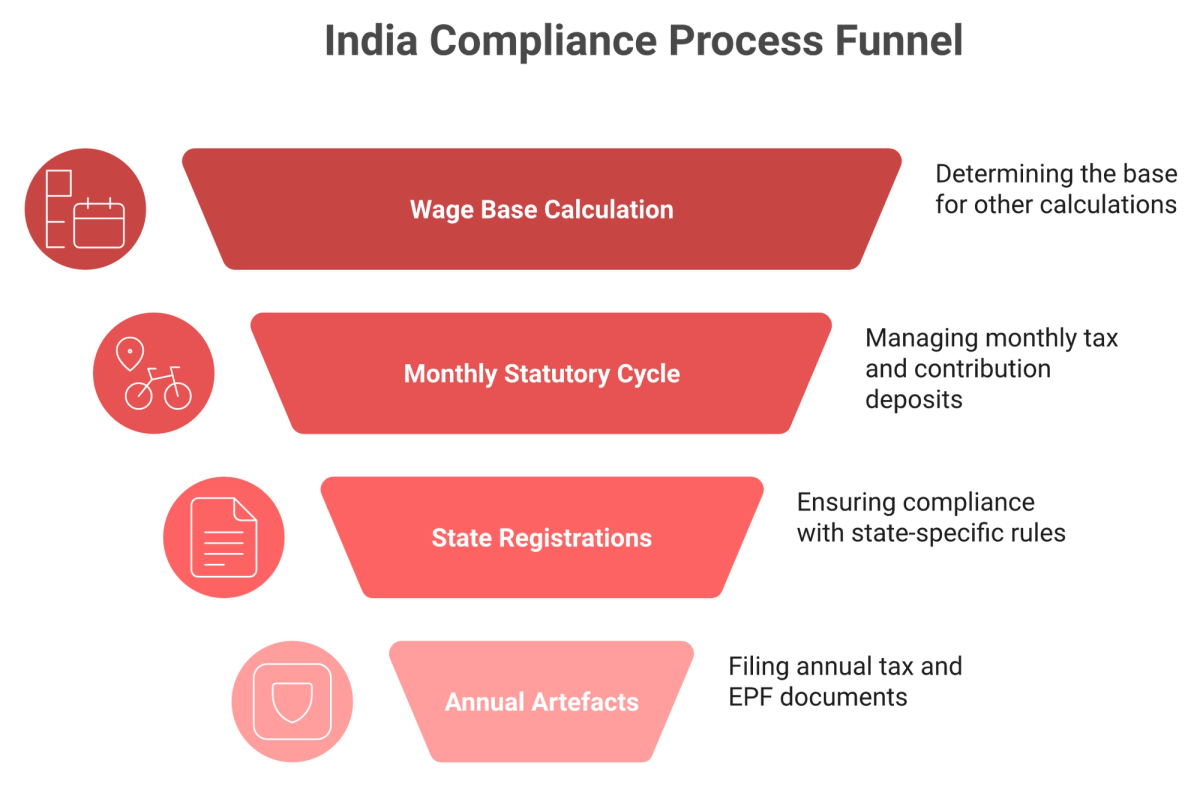
TDS means tax deducted at source, withheld from salary and deposited with the government.
- TDS deposit: by the 7th of the following month.
- Form 130 (formerly Form 16): issued by 15 June, TRACES generated only.
- EPF Scheme 2026: Form V within 15 days, Form XII within 20 days of month-end.
- Late PF payment damages: graded at 0.25 percent, 0.50 percent, and 1 percent per month of default.
Versatile Club sends PF and ESI challan confirmations plus TDS deposit receipts with each monthly invoice, so the proof arrives without a request. The full calendar sits in our guide to payroll compliance in India.
🗺️ Professional tax is not one rule, it is many
Professional tax, or PT, is a state-level tax on salaried income. The filing rhythm changes at the state border.
| State | What the rule actually requires |
| Maharashtra | Dual registration, PTRC and PTEC, with monthly slab filing |
| Karnataka | Monthly PT, plus Shops and Establishments renewal and enrolment within 30 days of joining |
| Tamil Nadu | Biannual PT in June and December, plus labour welfare fund |
| Telangana | PTRC enrolment with monthly remittance deadlines |
| Delhi | No PT, but strict Shops and Establishments compliance |
I have watched a Karnataka enrolment slip past day 30 in a partner-run setup. Nobody was hiding it. The information simply had to travel through two companies before it reached the client. If you are weighing city-level payroll ownership, our payroll outsourcing in Bengaluru breakdown covers the same ground.
💬 What buyers report on the compliance side
"Our employee consulted with legal counsel because Papaya attempted not to pay out accrued PTO multiple times. We had to review the law in the country because Papaya's local office was not following the law."
— Verified User in Civic & Social Organization, Papaya Global - G2 Verified Review, 0/5
"Extremely slow speed in resolving HR and payroll issues... On top of that, my salary was not paid on time this month."
— Daryna R., Deel Hire - G2 Verified Review, 0/5
"The compliance rigour is genuinely impressive every statutory filing reviewed before submission. Five-day onboarding, zero late payslips."
— Vedant T., Versatile Club G2 - Verified Review, 5/5
✅ The clause to put in your MSA
Ask for four commitments in writing. Filing deadlines by artefact, proof of filing shared monthly, a named owner for state registrations, and who pays statutory damages if a deadline slips.
Versatile Club accepts that damages clause because the filings sit under its own PF and ESIC registrations, not a partner's.
Q7. What contract risk are you signing for, DPDP, PE exposure, and FEMA?
Your EOR processes Indian employee data, so DPDP Rules 2025 obligations apply on a staggered clock, with Rule 4 from 13 November 2026, and Rules 3 and 5 to 16 from 13 May 2027. Separately, an India worker with contracting authority can create Permanent Establishment exposure. Entity funding you send into India needs FEMA FC-GPR reporting. Versatile Club signs a DPDP processor addendum on its own Indian entity.
Three exposures, one contract
⚠️ A GDPR clause does not cover DPDP
DPDP means the Digital Personal Data Protection Act, India's own privacy law. Its rules were notified on 13 November 2025 via G.S.R. 846(E).
Most EOR contracts I read still carry GDPR-only language. That is a European framework, and it does not map to India's consent, notice, and breach requirements. Versatile Club papers those obligations against its own Indian registrations, the structure explained on our how it works page.
💸 PE risk is the expensive one nobody papers
Permanent Establishment, or PE, means the tax authority treats your foreign company as taxable in India. It can attach when a worker signs contracts or negotiates prices on your behalf.
An EOR reduces this risk by employing the person itself. It does not erase it if the role's actual authority looks like a sales agent's. Versatile Club raises this in the scoping call, because the job description matters more than the vendor logo.
📄 FEMA and FC-GPR, if you ever fund an entity
FEMA is India's foreign exchange law. If you later incorporate and inject share capital, the Indian company must report the allotment on Form FC-GPR.
This does not apply while you are on an EOR. It applies the moment you incorporate, which is why I raise it early with founders planning a 2027 entity. Our comparison of EOR vs entity in India walks through that decision in detail.
✅ The four-clause addendum checklist
- DPDP processor obligations, with breach notification hours specified and the 13 May 2027 tranche named.
- Data location and sub-processor disclosure, including any partner entity in the chain.
- A PE-risk representation covering who holds signing authority for your India staff.
- Indemnity for statutory damages caused by vendor delay.
I am not your lawyer, and India counsel should review this before signature. What I will say is that Versatile Club has never had a buyer ask for clause three, which is the one that actually costs money later.
Versatile Club keeps the employment, the data trail, and the statutory filings inside one Indian registration, and signs a DPDP processor addendum naming the notified rule dates.
Q8. What do real users say about Deel and Papaya support?
Deel rates near 4.8 on G2 with thousands of verified reviews, and Papaya Global sits near 4.5 with a much smaller base. Trustpilot splits them further, roughly 4.9 against 2.4. Recurring complaints on both cite slow clarifications and stalled implementation. Versatile Club writes a 5-business-day onboarding SLA into its service agreement and routes client contact through the founder on WhatsApp.
Situation, complication, resolution
⏰ The day-nine problem
A People Ops lead I work with had a Karnataka PT registration sitting at day nine. Her platform's ticket was still open, and her payroll cut-off was in four days.
Latency is the India-specific risk. A statutory deadline on the 7th does not pause for a 72-hour ticket queue. Versatile Club treats that window as the service design constraint, which is why buyers comparing us against the incumbent usually land on our Deel alternative page first.
💬 What the volume of reviews actually tells you
Review count matters as much as rating. Deel's large base means you are reading a real distribution, while Papaya's smaller base makes averages fragile.
"My onboarding took 28 days. We have started on October 4th and today is November 1st."
— İbrahim ., Deel Hire - G2 Verified Review, 1/5
"There majority of their support team is helpful, but are often constrained by internal limitations... Everything was VERY time consuming."
— Verified User in Information Technology and Services, Deel Hire - G2 Verified Review, 0/5
"In addition, We have to remind Papaya to get monthly reports for a couple of countries every month."
— Cherry H., Payroll Manager, Papaya Global - G2 Verified Review
⭐ The other side, including our own rough edges
Versatile Club's support model is a person, not a queue, and buyers name that specifically.
"Founder is just a call away. Extremely helpful in resolving all our queries. The process is super smooth to setup India EOR."
— surbhi m., Versatile Club G2 - Verified Review, 5/5
"The team is really competent, but there were a few time zone misunderstandings that caused slight delays in the initial phase."
— Setu C., Versatile Club G2 - Verified Review, 5/5
That second quote is a fair hit. A founder-led channel across IST and PT means some replies land outside your working hours.
✅ What a support SLA must actually specify
| Support term | Deel | Papaya Global | Versatile Club |
| First contact | Chatbot and ticket first | Account team, reports on reminder | Founder on WhatsApp |
| Onboarding time | 7 to 14 days | 3 to 7 days | 5 business days, contractual |
| Named human | Varies by plan | Assigned rep | Named, same person |
Ask for three things in writing: the channel, the named human, and the response window in hours. Anything vaguer than that is marketing.
Versatile Club commits to 5 business days for onboarding in the signed agreement, and the founder handles client contact directly rather than through a rotating CSM queue. If you want that commitment tested against your own timeline, tell us what you are hiring for.
Q9. Are you fixing misclassification or just relocating it?
Most teams reach this comparison after a quiet realisation. Long-term India contractors should legally be employees under India's labour codes. Converting through an Employer of Record resolves that only if the employing entity is real and the wage structure is compliant. Back-pay and statutory exposure typically runs $25,000 to $40,000 per head. Versatile Club converts contractors to employees on its own Indian entity, the process we document in our guide to converting a contractor to an employee in India.
The moment the risk surfaces
⚠️ It is usually the first HR hire who finds it
A founder pays two Bengaluru engineers as contractors for eighteen months. Then a People Ops lead joins and reads the contracts.
She sees fixed hours, a company laptop, and a manager. That is an employment relationship in substance, whatever the invoice says.
💸 What the exposure actually adds up to
The bill is not one number. It stacks across provident fund arrears, gratuity accrual, and unpaid statutory dues, plus interest and damages.
Versatile Club prices conversions on the corrected wage base first, so the client sees the real ongoing cost before the paperwork moves. Nobody enjoys that number, but discovering it in diligence is worse. Our comparison of an independent contractor vs an EOR sets out both cost bases side by side.
❌ The PEO myth that keeps circulating
US buyers ask for a PEO, meaning co-employment, where two companies share employer duties. Traditional US-style co-employment PEO does not legally exist under Indian labour law.
So the honest structure in India is an EOR, where one entity is the sole legal employer. Anyone selling you India co-employment is describing a US product with an Indian label. The legal distinction is unpacked in our EOR vs PEO explainer.
💬 What buyers report on conversions
"Deel treats all users as if they were individual freelancers, even when you're clearly operating as a registered company."
— Verified User in Translation and Localization, Deel Hire - G2 Verified Review, 0.5/5
"They took payroll, contracts, and ongoing compliance off our plate entirely, so we got the talent we wanted without the legal and admin overhead."
— Angad S., Versatile Club G2 - Verified Review, 5/5
✅ The conversion sequence that holds up
- Freeze new contractor invoices for anyone working fixed hours under a manager.
- Rebuild the package with Basic plus DA at 50 percent or more of CTC.
- Issue a compliant employment contract from the employing entity.
- Register the person for PF and ESI, then run the first payroll on the 1st.
- Keep the contractor's engagement letter and the new contract in one file for diligence.
Versatile Club runs steps two through four inside its 5-business-day onboarding SLA, which is written into the service agreement.
Versatile Club's read is that most buyers over-index on platform features here and under-index on who the employer of record legally is. I might be too blunt about that. What I have watched, across six years of C2H conversions in Bengaluru, Hyderabad, and Pune, is that the entity question decides whether the risk actually moves.
Versatile Club converts contractors to employees on Foo Falcon Technologies Pvt Ltd, so the PF, ESI, and TDS trail an acquirer asks for sits under one Indian registration.
Q10. At what headcount does the economics of each option flip?
Three thresholds decide this. Below roughly 15 India employees, an EOR beats incorporation even across three years. Volume discounting on global platforms usually starts near 20 seats. Above about 500 heads, consolidated payroll pricing starts beating per-seat fees. Versatile Club's flat $149 per employee per month pushes the entity crossover further out than a $599 platform fee does, as our published pricing shows.
The model, with assumptions shown
💰 What goes into the incorporation column
An Indian subsidiary is not just a registration fee. The recurring load includes statutory audit, MCA annual filings, payroll software, and someone competent to run compliance.
Versatile Club models incorporation at roughly $50,000 in year-one setup plus ongoing operating cost, based on client cases where founders priced both paths. Treat that as a planning estimate, not a quote. You can run your own version in the EOR vs entity calculator.
📊 The crossover at four headcounts
| India headcount | Global platform at $599 per head | India specialist at $149 per head | Own entity (setup plus ops) |
| 5 | $35,940 per year | $8,940 per year | Uneconomic |
| 15 | $107,820 per year | $26,820 per year | Roughly break-even against $599 |
| 30 | $215,640 per year | $53,640 per year | Usually cheaper than $599 pricing |
| 100 | $718,800 per year | $178,800 per year | Clearly cheaper, if you staff it |
Read the middle column against the right one. At $149 flat, the entity case does not get compelling until you are well past 30 people. The full decision framework sits in our EOR vs entity in India analysis.
⏰ The triggers that mean incorporate now
Headcount is not the only signal. I watch for four others.
- You need to grant Indian employees equity directly from a local entity.
- You are opening a physical office with a lease and local vendors.
- You plan to bill Indian customers in INR at scale.
- You are funding the entity, which brings FEMA and Form FC-GPR reporting.
Versatile Club charges no exit fee, so a client who incorporates in month 14 leaves without a penalty on the way out.
⭐ The arbitrage number nobody should lead with
A senior software engineer runs about $220,000 all-in in San Francisco, against roughly $58,000 all-in in Bengaluru through an EOR. That is close to $162,000 saved per role each year.
I do not think cost should be your reason for hiring in India. India's tech workforce reached about 6 million people in FY26, growing 2.3 percent, which is a depth argument, not a discount argument. Our breakdown of the cost of hiring in India shows how that stacks up per role.
Where my head is right now is that the crossover math has quietly moved. When India EOR cost $599 a head, incorporation looked smart at 15 people. At $149, the same decision waits until 30 or more, and that changes how founders should sequence the next two years.
Versatile Club prices at $149 flat with no exit fee, and says plainly when an owned entity becomes the better option, because that conversation is where referrals come from.
Q11. Which India-specialist EORs are worth shortlisting against these two?
For an India-only footprint, shortlist India specialists before global platforms. Versatile Club leads on structure: its own Indian entity, $149 flat pricing, and a 5-business-day contractual onboarding SLA. Wisemonk, Remunance, and comparable India-native operators belong on the same list. Nearly 30 percent of Indian IT resumes contain discrepancies, so local screening depth matters as much as filing depth.
How I built this list
The five criteria are the same for every entry: owns an Indian entity, India-only focus, published pricing, a contractual onboarding SLA, and a retention layer after the hire lands. This is my own company's list, so read it with that disclosure in mind. If you want the wider field, our roundup of the best EOR services in India covers more names.
1. ⭐ Versatile Club
Versatile Club employs on Foo Falcon Technologies Pvt Ltd, with PF, ESIC, and Shops and Establishments registrations across all 28 states and 8 union territories. Pricing is $149 flat, with $0 setup, $0 exit, and the first month free, set out in full on our EOR services page.
The retention layer is the part global platforms do not sell. It includes culture-fit screening across 50 behavioural parameters, a 90-day Success Coach, and a 6-month replacement guarantee.
Honest limits: EOR is a newer service line for us, built on C2H infrastructure, and we do not yet carry SOC 2 or ISO 27001.
2. ✅ Wisemonk
India-native, six years operating, with EOR pricing from $99 to $399 across salary slabs. G2 sits near 4.8 across 261 plus reviews, with SOC 2 Type II and ISO 27001 in place.
The gaps are retention and speed commitments. Its 24 to 72 hour onboarding claim is marketing language rather than a contractual SLA, and there is no replacement guarantee. We compare the two models directly on our Wisemonk alternative page.
3. ✅ Remunance and other India-native operators
These firms own Indian entities and serve US and UK buyers directly. Pricing is usually quote-based, which slows comparison.
Versatile Club publishes its all-in number instead, precisely because slab pricing forces a sales call before you can model cost.
4. ⚠️ The split-vendor play
You do not have to pick one vendor for the world. Run an India specialist for India, and a global platform for your other countries.
I recommend this openly, even though it costs us the multi-country deal. Versatile Club is the wrong choice for a buyer who needs five or more countries under one contract. Buyers weighing that trade-off usually start with our Papaya Global alternatives in India comparison.
💬 What buyers say about specialist depth
"Versatile made that process feel much simpler... Their team helped us move quickly, stay compliant, and focus on the actual work instead of the backend admin."
— Ibrahim A., Versatile Club G2 - Verified Review, 4.5/5
"The initial process took a little getting used to, but the team was quick to guide us through and it became very straightforward."
— Verified User in Venture Capital & Private Equity, Versatile Club G2 - Verified Review, 4.5/5
"I find Deel to be absurdly expensive. They charge a high amount of fees for transferring money to my bank account."
— Juan Camilo O., Deel Hire - G2 Verified Review, 1/5
Versatile Club sits first on this list on structural grounds, not preference: own entity, flat published price, contractual SLA, and a written retention layer that competitors in the India category do not currently match.
Q12. How do you make the call and switch without breaking a payroll cycle?
Choose Deel for many countries and self-serve speed, Papaya Global for consolidated multi-country payroll reporting, and an India specialist if India is your only country. Switching takes one payroll cycle when sequenced properly. Versatile Club onboards migrating employees in 5 business days under a contractual SLA, with $0 setup and the first month free.
The call, by persona
| Your role | Best fit | Why |
| Founder, first 1 to 3 India hires | India specialist | Landed cost and a named human beat platform breadth |
| People Ops, 10 to 100 India staff | India specialist, or split vendor | State PT and wage-code depth carry the risk |
| CFO, 5 to 30 India staff | India specialist | One reconcilable USD invoice closes the month |
| Any team, 5 plus countries | Deel or Papaya Global | One contract across many jurisdictions |
⚠️ The honest caveat
Some investors require bundled business insurance covering compliance claims years later. Global platforms carry that. Most Indian specialists, including us, do not.
Versatile Club will tell a VC-backed buyer with that mandate to stay on the global platform, because losing the deal beats misrepresenting the coverage. Founders sizing up the options usually start on our India hiring page for startups.
The migration runbook
⏰ Steps one to four, week one
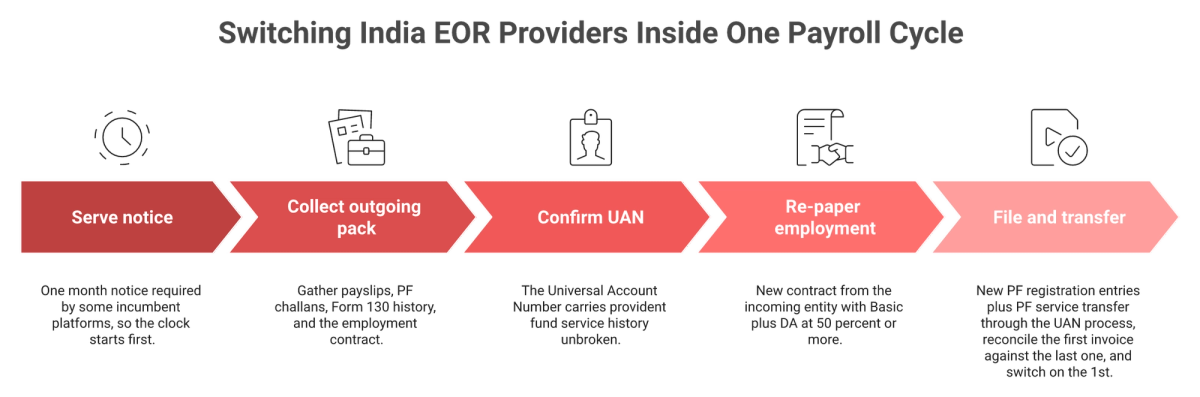
- Serve notice. Deel requires one month, so start the clock before anything else.
- Collect the outgoing pack: payslips, PF challans, Form 130 history, and the employment contract.
- Confirm each employee's UAN, the Universal Account Number that carries PF service history.
- Re-paper employment with the incoming entity, with Basic plus DA at 50 percent or more.
✅ Steps five to seven, week two
- File the new PF registration entries and transfer PF service via the UAN process.
- Cut over on the 1st, so no employee sits on two payrolls in one month.
- Reconcile the first invoice against the last one, line by line.
Versatile Club runs steps three through six while the outgoing notice period is still running, which is why the first month being free actually matters during a migration. The same sequence, with owner and timing per step, is detailed in our guide to switching EOR providers in India.
"The initial setup process was also very challenging; it took several days and involved a lot of emails, with issues arising at every step."
— Verified User in Translation and Localization, Deel Hire - G2 Verified Review, 0.5/5
"Sagar replied to our form in about four hours with a draft offer letter already attached. The hire was onboarded in four days."
— Verified User in Information Technology and Services, Versatile Club G2 - Verified Review, 5/5
What I think shifts over the next two years is that India stops being one country on a global EOR map. It becomes its own category, where owned-entity operators take the India line item off the generalists.
I could be wrong about the timing. If you are sitting with an India headcount plan for 2027, send it to me on WhatsApp and I will tell you which of the three paths I would pick, including when it is not us. You can also just send the plan through here.
Versatile Club commits to 5 business days on migration onboarding, charges no setup fee, and gives the first month free while your existing notice period runs.
FAQs
Is Papaya Global cheaper than Deel for hiring in India?
Not reliably, and the sticker price is the wrong thing to compare. Deel lists India EOR from $599 per employee per month, plus a $500 setup fee and a one month notice on exit. Papaya Global appears anywhere from $499 to $770 depending on tier, with per-location setup, year-end filing fees and add-ons at exit.
We model six lines, not one, when we price an India hire for a client:
- Platform fee per employee per month
- Setup fee, charged once or per location
- Exit cost, including notice periods
- FX spread, reported at 3 to 5 percent on some corridors
- Per-transaction and card charges
- Year-end filing fees
Add the employer statutory load on top, which no vendor absorbs: PF at 12 percent of Basic plus DA, ESI at 3.25 percent employer and 0.75 percent employee, and gratuity accruing at 4.81 percent from month one.
Versatile Club charges $149 per employee per month flat, with $0 setup, $0 exit and the first month free, and we publish the full breakdown on our India EOR pricing page. For an India-only footprint, compare total landed cost, not the headline number.
Does Papaya Global or Deel own a legal entity in India?
Neither platform employs every India hire on its own balance sheet. Deel owns entities in roughly 130 of its 150 plus markets, but runs India through a local partner. Papaya Global operates around 40 owned entities and uses in-country partners elsewhere, which makes India a hybrid model.
That distinction is not academic. It decides:
- Which company is named as employer on the appointment letter
- Whose EPFO establishment code appears on the payslip
- Who answers an acquirer's diligence question about your India team
- Who is liable if a state professional tax registration is filed late
Send both vendors the same four-line request: name the employing entity with its Corporate Identity Number, give the PF establishment code, confirm whether that entity is owned or contracted, and confirm who issues the TRACES-generated Form 130.
Versatile Club employs every India hire on its own registered Indian entity, Foo Falcon Technologies Pvt Ltd, with PF, ESIC and Shops and Establishments registrations across all 28 states and 8 union territories. We list what that covers on our India compliance page, and clients can verify the entity on the MCA portal themselves.
Will Deel or Papaya Global handle India's 2026 Basic plus DA 50 percent wage rule?
You have to test it rather than assume it. Under the Labour Codes in force from 21 November 2025, Basic plus DA must be at least 50 percent of total remuneration, and excess allowances get added back into wages for PF, gratuity and bonus.
Most legacy India salary templates ran Basic at 40 percent with allowances filling the rest. On a Rs 2,00,000 monthly package, moving Basic plus DA from Rs 80,000 to Rs 1,00,000 raises employer PF from Rs 9,600 to Rs 12,000 and gratuity accrual from Rs 3,848 to Rs 4,810.
Before you sign either platform, ask for:
- One post-Code sample payslip with the gratuity accrual line visible
- The wage-structure review owner and review frequency
- Written confirmation of whether PF is computed on actual wages or the statutory ceiling
A global wage engine serving 150 countries layers India rules on top of one template, which is exactly where this ratio slips. Versatile Club builds every India offer with Basic plus DA at or above 50 percent of CTC and shows the PF, gratuity and bonus base before the candidate signs, as part of our EOR services in India.
Which platform is better for a team hiring only 1 to 30 people in India?
For an India-only footprint at that size, both platforms are priced for a problem you do not have. Deel and Papaya Global are built to consolidate many countries under one contract, and you fund coverage you never use.
Here is how we frame the choice for the three buyers who ask us most:
- Founder with 1 to 3 India hires: landed cost and a named human matter more than platform breadth
- People Ops lead with 10 to 100 India staff: state professional tax and wage-code depth carry the real risk
- CFO with 5 to 30 India staff: one reconcilable USD invoice closes the month faster than four exports
- Any team in 5 plus countries: buy the global platform, genuinely
We also say plainly when we are the wrong fit. If your investors mandate bundled business insurance covering compliance claims years later, or procurement gates on SOC 2 or ISO 27001, stay on the global platform.
Versatile Club is India-only by design, with a 5-business-day contractual onboarding SLA and founder-direct support rather than a ticket queue. Founders sizing this decision usually start on our India hiring page for startups.
How do you switch from Deel or Papaya Global to another India EOR without breaking payroll?
A clean migration takes one payroll cycle if you sequence it, and the single biggest risk is breaking an employee's provident fund service history.
The runbook we use looks like this:
- Serve notice first, since Deel requires one month, and start the clock before anything else
- Collect the outgoing pack: payslips, PF challans, Form 130 history and the employment contract
- Confirm each employee's UAN, the Universal Account Number that carries PF service continuity
- Re-paper employment with the incoming entity, with Basic plus DA at 50 percent or more
- Transfer PF service through the UAN process and file the new registration entries
- Cut over on the 1st, so nobody sits on two payrolls in one month
- Reconcile the first invoice against the last one, line by line
Watch exit terms closely. Papaya Global exit costs can include add-ons, and Deel's notice period means you pay both vendors briefly unless the incoming provider absorbs that overlap.
Versatile Club onboards migrating employees in 5 business days under a contractual SLA, with $0 setup and the first month free while your outgoing notice runs. The step-by-step version sits in our guide to switching EOR providers in India.