Table of contents (11)
Switching from Deel to Another EOR: Notice Periods, Data & Employee Continuity
Q1. Will my India team read an EOR switch as instability, and could I lose someone over it?
Yes, employees read a change of legal employer as instability, and badly communicated migrations have caused resignations. What actually changes is narrow: the legal employer, the employment contract, and who issues the payslip. Salary, role, manager, and the provident-fund account under the same UAN (Universal Account Number, the lifetime PF ID) do not change. Tenure holds only if the receiving employer recognises the original joining date in writing.
A People Ops lead messaged me last year at 11pm her time. Her third payslip escalation in two months had reached her CEO. She had already decided to leave her provider. Her actual question was not about vendors. It was, "How do I tell nine people in Bengaluru without one of them quitting?"
⚠️ The fear is about people, not process
That fear is rational, and I will not talk you out of it. An Indian employee hears "your employer is changing" and thinks about PF, gratuity, and Form 16 first.
Those are not admin line items to them. They are the proof that this job is a real job.
A line I keep returning to captures why: Indians may go to work every day in a reasonable facsimile of the West, but they go home every night to India. Statutory benefits are the anchor, which is why India payroll compliance reads as an emotional subject to your team rather than a back-office one.
❌ Migrations do go wrong, and one case is worth reading
In one documented EOR migration, an employee had been enrolled in the client company's own benefits plan instead of the plan run by the EOR, and nobody caught it. That is one incident, not a base rate. It is still the shape of what goes uncaught.
Support quality is the usual early warning. Operators say it plainly:
"The response times for tickets are so slow that it feels like their help desk might as well be a ghost town, and we've had to flag payslip errors twice before they were finally addressed."
— commenter, r/humanresources Reddit Thread
"I know several individuals who have been involved in a comparable arrangement with Deel, and they've now transitioned to a different, smaller EOR due to Deel's high costs."
— commenter, r/developersIndia Reddit Thread
✅ What changes, and what does not
Put this split in front of your team early. It removes about 80 percent of the anxiety in my experience.
| Changes | Does not change |
| Legal employer on the contract | Salary and CTC structure |
| Who issues the payslip and Form 130 | Role, manager, team, tools |
| PF member ID under the same UAN | The UAN itself, and accumulated balance |
| ESI code and insurance policy number | Statutory entitlement to PF, ESI, gratuity |
| Who files monthly challans | The original joining date, if recognised in writing |
⏰ Do this before the paperwork lands
Tell the team first, on a live call, before any document reaches their inbox. A contract arriving with an unfamiliar company name on it is how trust breaks.
Name one person who answers questions, with a phone number. Then put the continuity facts in writing the same day.
I built my company because US founders got burned on first India hires, with slow contracts, mystery FX charges, and compliance surprises months later. Your employee is feeling that same register right now, from the other side of the table, which is the part most India EOR migration guides skip entirely.
Q2. What does leaving Deel actually cost me in notice, fees and overlap?
Notice is contractual, not statutory, so your own agreement governs. My client context records a one-month notice on Deel's India EOR terms, though terms vary by agreement and signature date. Budget four cost lines: any offboarding fee, security deposits that commonly refund 30 to 60 days after exit, one month of dual payment if cycles overlap, and legal review of the new agreement.
💰 Read four clauses before you talk to anyone
Open your MSA and pull these, in this order. This takes 20 minutes and decides your entire calendar.
Notice length. Is it 30 days from written notice, or 30 days from the next billing date? The second version can add three weeks.
Co-termination. Does one employee's exit trigger the whole account, or is each contract separate?
Last billable cycle. Confirm the final payroll month in writing, not in a chat window.
Deposit and refund. Deposits sit as prepaid balances, and refunds trail the last cycle by weeks.
💸 The overlap month is the real cost
Nobody warns you about this line. If your new provider needs onboarding time inside your notice window, you pay both for one cycle.
At $599 per employee per month against a $199 alternative, an overlap month on 15 people is not a rounding error. That is a CFO conversation, not a People Ops one, and it belongs in the same model as your India EOR cost baseline.
| Cost line | What to ask for | Typical timing |
| Offboarding fee | Written confirmation of amount, per employee | At termination |
| Security deposit | Refund date and account it lands in | 30 to 60 days after exit |
| Dual payment overlap | One month of both invoices, modelled | The cutover month |
| Legal review | Fixed fee from counsel, not hourly | Before signing |
⚠️ Exit terms are also a data lever
Money is not the only thing the notice clock controls. The outgoing side has no incentive to move fast on statutory handoff once notice is served.
One operator's account of leaving is worth reading before you sign anything new:
"We have just transitioned away from Deel. Unfortunately, they failed to handle the tax payments that they had deducted from us, which forced us to make another payment directly to the respective country to maintain our compliance."
— commenter, r/Payroll Reddit Thread
"Their fee is $199 per person for Employer of Record (EOR) services, significantly lower than Deel's $599 charge."
— commenter, r/Payroll Reddit Thread
✅ Two moves that save real money
Serve notice only after your export is complete (that sequence is Q4). Then align your last payroll month with a calendar month end, so no employee gets a split payslip they did not expect.
Ask your incoming provider one blunt question: what does it cost me to leave you? Versatile Club charges no setup fee and no exit fee, and its published India EOR pricing holds one flat per-employee rate, because exit cost is exactly what keeps teams stuck on a provider they have already outgrown.
Q3. What kind of change is this legally, and which three mechanisms decide the outcome?
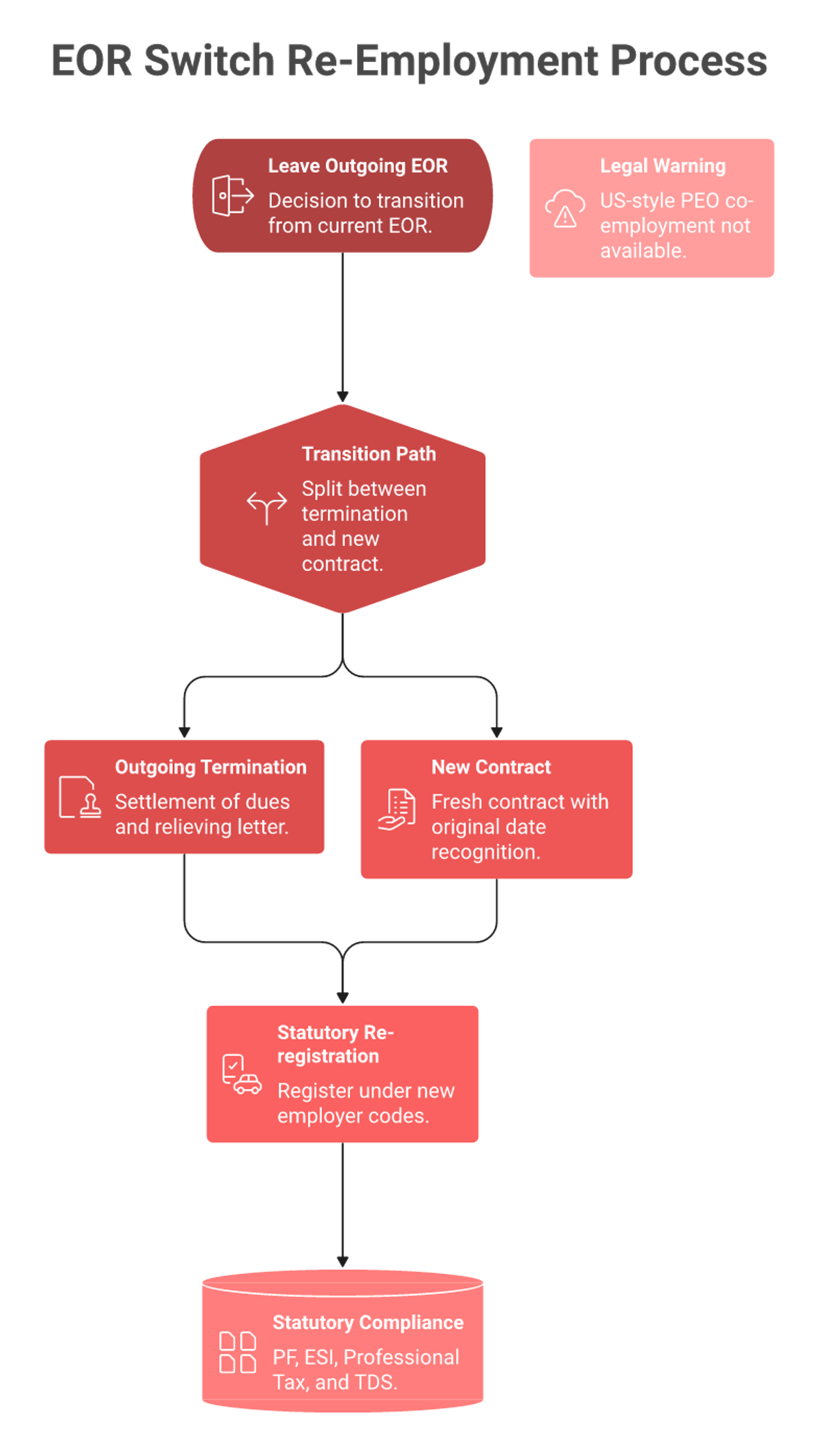
Switching EOR providers is a legal re-employment, not a platform migration. The outgoing employer terminates and settles dues. The new employer issues a fresh contract, then re-registers the employee for PF, ESI, professional tax, and TDS. Three mechanisms decide whether it goes cleanly: the notice period, provident-fund continuity on the existing UAN, and the date from which gratuity accrual is recognised.
📋 Novation, in plain English
A novation means one party is swapped out of a contract and replaced by another. In India, that plays out as termination and rehire, with the original joining date carried across on paper if both sides agree to it.
Your employee signs a new employment contract. Their statutory registrations move to a new employer's codes.
⚠️ One thing to refuse outright
If any provider offers you "PEO co-employment" for India without your own registered subsidiary, walk away from that structure. Traditional US-style co-employment PEO does not legally exist under Indian labour law.
EOR is the compliant pathway when you have no Indian entity. There is no third option dressed up as software, which is the distinction the EOR versus PEO comparison exists to settle.
✅ The three mechanisms, and who controls each
Every one of these is settled before the new provider runs a single payslip. That is the point most migration checklists miss.
| Mechanism | Who controls it | What breaks if it slips |
| Notice period on the outgoing contract | Your MSA, read in week one | Dual-payment overlap, rushed cutover |
| PF continuity on the existing UAN | Outgoing employer's exit-date entry in the EPFO portal | Duplicate member IDs, blocked transfer claim |
| Recognised joining date for gratuity | The receiving employer's contract wording | Tenure resets, and a four-year employee loses four years |
🔍 Why owned registrations change the pace
Here is where my read differs from the standard advice. Most guides treat the provider as a single actor, but many global platforms route India through a local partner entity.
That matters operationally, not morally. When the entity holding the registrations is the company you are talking to, an exit-date correction is an internal task. When it sits with a partner you have never met, it is a chain of requests, which is the structural difference behind every Deel alternative evaluation I sit in on.
Operators discover this structure mid-problem rather than at signing:
"We discovered that our employee in Germany wasn't actually hired through a Deel-owned entity but rather through a third-party company that we had never encountered before."
— commenter, r/humanresources Reddit Thread
⏰ The honest limit
Some migrations still go wrong even when all three mechanisms are handled. I am not going to promise you a clean switch, because the promise is worthless.
What I can give you is a checklist you own rather than a reassurance you have to trust. Sequence these three, and the payroll gap everyone fears rarely happens.
Where my head is right now: the safest migration is the one planned two months out, not the one executed at renewal because notice was about to auto-renew.
Q4. What must I export from Deel before serving notice, and what does DPDP require of the handover?
Export before you serve notice, because access narrows afterwards. Pull monthly payslips and salary registers, PF and ESI challans, TDS challans and quarterly returns, every Form 16 or Form 130 issued, signed contracts and amendments, leave balances, and reimbursement history. Employee records moving between employers is a personal-data transfer, so fix the export scope, the retention period, and a deletion confirmation in writing.
📁 The nine-item export list
Ask for machine-readable files, not PDFs pasted into a shared drive. Your new provider has to load this into a payroll system, and images do not load.
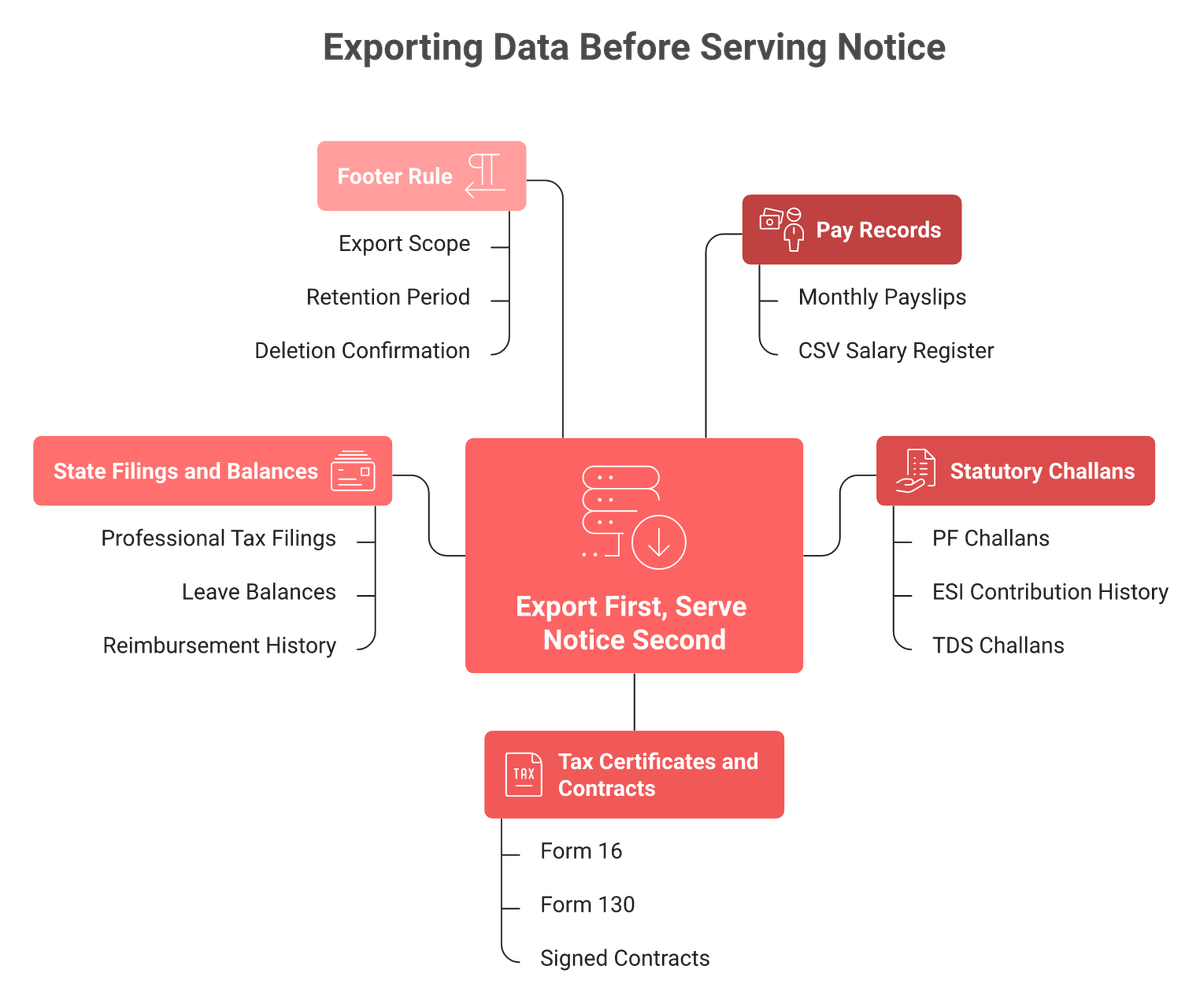
Monthly payslips per employee, PDF plus a CSV salary register
PF challans (ECR receipts) with UAN and member ID per employee, PDF
ESI contribution history with IP numbers, CSV
TDS challans plus quarterly return acknowledgements, PDF
Every Form 16 or Form 130 issued to date, PDF per employee per year
Signed employment contracts and all amendments, PDF
Professional tax filings by state, with registration numbers, PDF
Leave balances and accrual policy, CSV
Reimbursement and bonus history, CSV
⏰ Sequence matters more than speed
Export first. Serve notice second. Once notice is in, you are a departing account, and departing accounts wait.
The platform's own offboarding tracker starts moving the moment termination details are submitted. Get your files out before that clock starts, and hand the complete set to whoever runs your managed payroll next.
Operators who have been through disputes say the same thing about documentation:
"Keep thorough records: It's essential to save copies of any Slack approvals, emails, and HR discussions. This documentation can be invaluable if disputes arise regarding unpaid wages."
— commenter, r/remotework Reddit Thread
"It was pretty much self-serve with very little support or customization."
— commenter, r/humanresources Reddit Thread
⚖️ What DPDP adds to the exit letter
India's Digital Personal Data Protection Rules 2025 were notified on 13 November 2025, with obligations phasing in over 18 months. Employee payroll records are personal data, and both employers act as data fiduciaries (the party deciding how data is used).
Two clauses belong in your exit letter. First, the export scope and format, with a delivery date. Second, a written confirmation of deletion or retention period once the handover is verified. Ask your incoming provider how it handles the same duty across its India statutory compliance stack.
🧾 The friction you should expect
I have watched a simple data request die inside a large company's process. One operator described entering a spending approval that needed twenty names to sign off, with one of them sitting in a procurement department in another country.
Your export request meets a version of that. Build the delay into your plan rather than assuming goodwill.
Versatile Club employs your team through its own registered Indian entity, so PF, ESI, TDS, and professional tax records sit under registrations it controls rather than a partner's. When you eventually leave any provider, ask who physically holds the challans, and how fast they hand them back. That question is the whole reason EOR services in India should be judged on entity ownership before software.
Q5. Does PF, UAN and ESIC coverage carry over when the employer changes?
It carries over, and it is a feature of the Indian statutory system rather than something a provider grants. The employee keeps one UAN (Universal Account Number, the lifetime provident fund ID) across employers. The outgoing employer marks the exit date in the EPFO portal, and the new employer files the transfer against the same UAN, now approved at the source office alone. ESI coverage restarts under the new employer's code.
🔑 One UAN, many member IDs
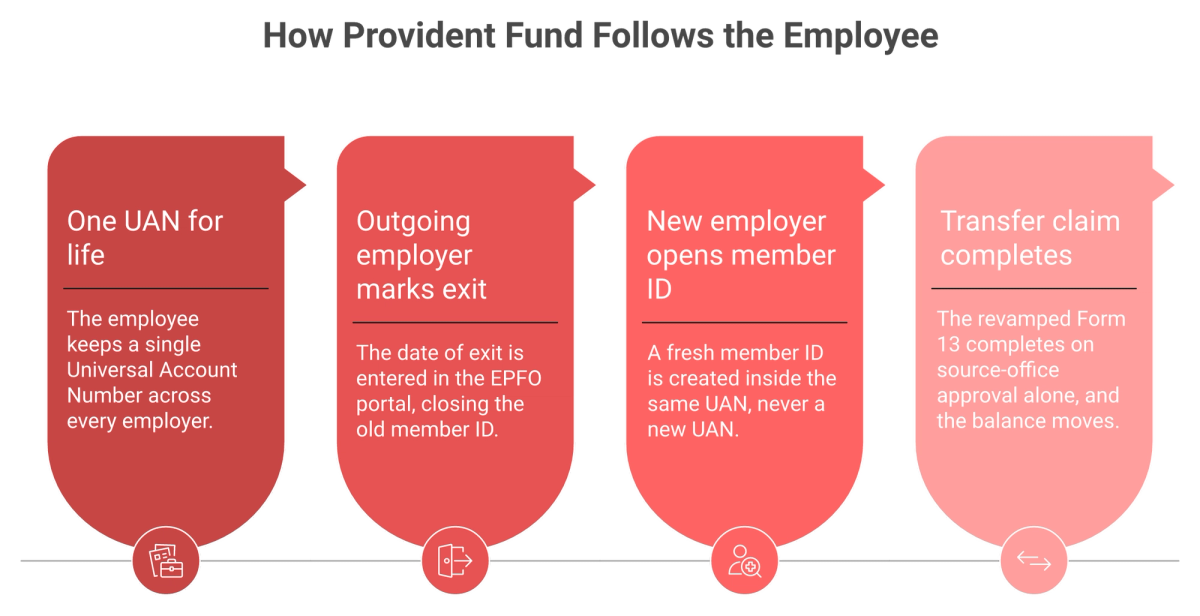
Think of the UAN as the employee's permanent PF passport. Each employer issues a member ID inside it, like a visa stamp.
A switch adds a new stamp. It does not issue a new passport.
The balance sits under the UAN and moves by transfer claim. Since April 2025, EPFO removed destination-office approval on the revamped Form 13, so the transfer completes on source-office approval alone. This is the part of an India EOR provider switch that reassures employees fastest.
⚠️ The one thing that actually breaks this
The failure is almost never the transfer claim. It is the exit date.
If the outgoing employer does not mark the date of exit in the portal, the new member ID opens while the old one still shows active. That looks like two live jobs, and the transfer request stalls.
I watched this play out with a Bengaluru engineer whose old provider marked the exit six weeks late. His contributions kept posting to the closed ID. Cleaning up a duplicate member ID took longer than the entire rest of his migration, and it is the kind of gap a proper India payroll compliance calendar is meant to catch.
✅ Your week-one PF actions
Do these in order, and do them before the last payroll runs.
Collect the UAN and current member ID for every employee, from the payslip or the EPFO member portal.
Ask the outgoing employer, in writing, for the exact date they will mark exit and the reason code they will use.
Confirm the new employer's establishment code and that the same UAN will be linked, not a fresh one.
File the transfer claim in the same month the new member ID opens.
Check each employee's passbook 30 days later, and escalate any ID still showing active.
🏥 ESI is a different animal
ESI (Employees' State Insurance, the state medical and cash benefit scheme) does not transfer the way PF does. The employee gets a new IP number under the new employer's ESIC code, or the existing IP is mapped across.
Contribution rates stay the same, at 3.25 per cent employer and 0.75 per cent employee. The practical risk is a coverage gap in the handover week, which matters if someone has a hospital claim running.
Ask both providers to confirm the ESI coverage end date and start date in writing. Overlap by a day if you can, rather than leaving a seam.
⏰ Why registration ownership changes the pace
Versatile Club files PF, ESI, TDS, and professional tax under its own registrations through Foo Falcon Technologies Private Limited, so an exit-date correction or a UAN linking issue is handled directly on the portal rather than through a partner's queue. That is the operational difference I would test before signing anyone.
Ask the question plainly. Who logs into the EPFO portal for my employees, and how fast can they fix a wrong exit date?
Versatile Club holds its own PF registration and ESIC code, which is why UAN linking and exit-date corrections sit inside one team rather than crossing a vendor boundary. That is not a feature claim. It is just who has the login, and it is the first thing I would probe about any EOR services in India provider.
Q6. Does my India team lose tenure or gratuity if the legal employer changes?
Gratuity does not travel the way provident fund does. It accrues at about 4.81 per cent of Basic plus DA (dearness allowance) from month one, and becomes payable at five years of continuous service with one employer. On a switch, accrued gratuity is normally settled by the outgoing employer and the clock restarts, unless the receiving employer recognises the original joining date in the contract.
📖 Continuous service, defined plainly
Gratuity under the Payment of Gratuity Act, 1972 is a lump sum paid for continuous service with an employer. Continuous service means unbroken employment with that same employer.
Change the legal employer, and the statute sees a new relationship. The five-year clock is the part employees feel.
⚖️ Two paths, and you must pick one on purpose
Path one is settle and restart. The outgoing employer pays accrued gratuity in the Full and Final settlement, and the new clock begins at zero.
Path two is recognised continuity. The new contract records the original joining date, so tenure and the five-year runway carry forward on paper.
| Question | Settle and restart | Recognised joining date |
| Who pays accrued gratuity | Outgoing employer, at exit | Usually still settled at exit |
| Employee's five-year clock | Restarts from the new join date | Continues from the original date |
| Where it must be written | Full and Final statement | Employment contract, not email |
| Employee perception | "I lost four years" | "Nothing changed on paper" |
⚠️ The clause to ask for, word for word
Ask your incoming provider to include a line like this: "The employee's original date of joining, DD-MM-YYYY, is recognised for the purpose of continuous service and benefits computation."
Then ask them to confirm it in the appointment letter, not in a sales thread. A promise in a chat window does not survive an exit two years later, which is why this clause belongs in the same review pass as your India statutory compliance checklist.
🧮 One more thing the Labour Codes changed
The Labour Codes came into force on 21 November 2025, with a redefined wage base and gratuity treatment applying prospectively from that date. Fixed-term employees also gained gratuity access without the five-year wait under the new framework.
That matters here for a specific reason. If the outgoing employer's salary structure never applied the new wage rule, your gratuity accrual figure was probably understated. Reconcile the number before anyone signs a settlement.
❌ What I will not promise you
Nothing about tenure carries across automatically. Any provider telling you otherwise is either being loose with language or has not read the statute.
I could be reading the market too strongly here, but this single clause causes more employee anger than any payroll delay I have seen. It is five lines in a contract, and it decides whether a four-year employee keeps four years.
So put it in front of the receiving provider before you talk about price. Their answer tells you how they will behave on the harder questions later, and it matters more than any line in an India EOR cost comparison.
Q7. How do TDS, the new Form 130 and Form 138, and the Full and Final settlement split across the crossover month?
A mid-year switch means each employee receives two TDS certificates, now Form 130 in place of Form 16, and must combine them in one return. TDS is deposited by the seventh of the following month, so a mid-month cutover needs a day-count split between employers. Confirm in writing which provider files Form 138 for the crossover quarter, and run a formal Full and Final settlement.
🧾 Two certificates, one return
Under the Income-tax Act 2025, Form 16 becomes Form 130, Form 24Q becomes Form 138, and Form 26AS becomes Form 168, effective 1 April 2026. Your employees will hear the old names, so use both in your comms.
Each employer issues its own certificate for the months it paid. The employee files one return that combines both.
That combination is where people get burned. Each employer applies the standard deduction and the slab independently, so combined income can push the employee into a higher bracket and create a shortfall at filing. Whoever runs your managed payroll should flag that to employees before March, not after.
"I have done an internal transfer in my organisation, due to which I received 2 form 16 for the FY."
— u/anonymous poster, r/IndiaTax Reddit Thread
"Key 2026 updates many people have missed: the Income Tax Act 2025 replaced the 1961 act; Form 16 is now Form 130; the new tax regime is the default."
— community post, r/IndiaEOR Reddit Thread
⏰ The seventh-of-month deadline decides your cutover
TDS deducted in a month must be deposited by the seventh of the next month. A cutover on the 18th means both employers deduct in the same month.
Split it by day count, and get both sides to state their figures before payroll runs. Then confirm which provider files Form 138 for that quarter, because a gap here shows up as a mismatch in the employee's Form 168.
Worked split for a 20 September cutover, on a Basic plus DA of Rs 60,000:
Old employer covers 1 to 20 September, so 20 of 30 days, and deducts on Rs 40,000.
New employer covers 21 to 30 September, so 10 of 30 days, and deducts on Rs 20,000.
Both deposit by 7 October, under their own TANs.
The employee sees two entries in Form 168, and both must match the certificates.
💰 Run the Full and Final properly
Treat the exit as a real termination, not a paperwork formality. The settlement clears historical liability so the employee starts clean.
| F&F component | What to verify |
| Notice pay | Paid or waived, in writing |
| Leave encashment | Balance matches the leave register |
| Accrued gratuity | Recomputed on the current wage base |
| PF settlement | Exit date marked, transfer not withdrawal |
| Relieving letter | Issued with the correct last working day |
The Labour Codes also tightened final settlement timing to within two working days of exit. Plan for that, rather than the old 30 to 45 day habit.
✅ Ask for challans, not confirmations
Versatile Club publishes the monthly PF, ESI, TDS, and professional tax filing calendar that a client inherits, because a filed challan is the only artefact that survives fundraising diligence. I ask both sides for challan PDFs, not reassurance emails.
Versatile Club's practice is to hand over challan copies each month rather than a status dashboard, which is the same evidence an auditor asks for later. If you are budgeting the switch, run the numbers against your flat per-employee EOR pricing before the crossover month lands.
Q8. Which state registrations and salary-structure checks have to be redone at the switch?
Professional tax is state-administered, so the new employer re-registers and re-enrols each employee under its own numbers. Maharashtra needs dual PTRC and PTEC with monthly slab filing, and Karnataka needs monthly PT with enrolment within 30 days of joining. Shops and Establishments coverage and the POSH internal committee also change with the employer. Re-check that Basic plus DA is at least half of remuneration.
🗺️ Why professional tax does not port
PF and ESI run on central law. Professional tax (a small state levy on salaried income) runs on state law, with its own registration, slab, and calendar.
So the new employer registers in every state where your team sits. Nothing carries over from the old provider's numbers, which is the first thing to verify before you hire employees in India under a new legal employer.
| State | Registration | Filing cadence | Timing to watch |
| Maharashtra | PTRC and PTEC (dual) | Monthly slab return, annual filing | Both certificates before first payroll |
| Karnataka | PT plus S&E | Monthly | Enrol within 30 days of joining |
| Tamil Nadu | PT plus LWF | Biannual | Half-year cutoff dates |
| Telangana | PTRC enrolment | Monthly | Enrolment before deduction |
| Delhi | No PT, strict S&E | S&E compliance only | Registration and records upkeep |
⚠️ The wage-base shock nobody warns you about
The Labour Codes came into force on 21 November 2025 and redefined wages, with Basic plus DA required to be at least 50 per cent of total remuneration. Excess allowances get added back for statutory computation.
Global salary templates routinely missed this. So the same CTC can produce a higher PF and gratuity figure under the new employer, with no raise involved.
Restructure during the transfer, not after. Ask both providers to restate the identical CTC in Basic plus DA terms, then compare the take-home output side by side.
"PF and ESI are governed by central laws, while professional tax is set at the state level."
— community post, r/IndiaEOR Reddit Thread
"That can be useful when you need help with Indian payroll, local employment contracts, taxes, benefits, state-level compliance, and employee support."
— community post, r/eorfortech Reddit Thread
🛡️ POSH and S&E move with the employer
The POSH Act requires an Internal Committee at the employer level, with an external member. A new legal employer means a new committee and a fresh policy acknowledgement from each employee.
Shops and Establishments registration also sits with the employer, per state. If your new provider does not hold an S&E licence in your employee's state, that employee cannot be onboarded cleanly there.
Versatile Club holds its own PF registration, ESIC code, and Shops and Establishments licences across all 28 states and 8 union territories, so state coverage is a lookup rather than a new application. Ask any provider to name the states they hold licences in, and to show the certificate numbers.
❌ Where a name-the-state test beats a count
I do not trust "1,500 compliance requirements handled" as a claim. Ask instead about Maharashtra's dual PTRC and PTEC, or Tamil Nadu's biannual filing, and listen for specifics.
Versatile Club's read is that counting requirements hides more than it proves, because the failures happen in one state, in one month, on one return. Naming them is the only test I have found that separates operators from decks, and it is the same test I would apply to any Deel alternative on your shortlist.
Q9. What does a sequenced six-week migration look like, week by week?
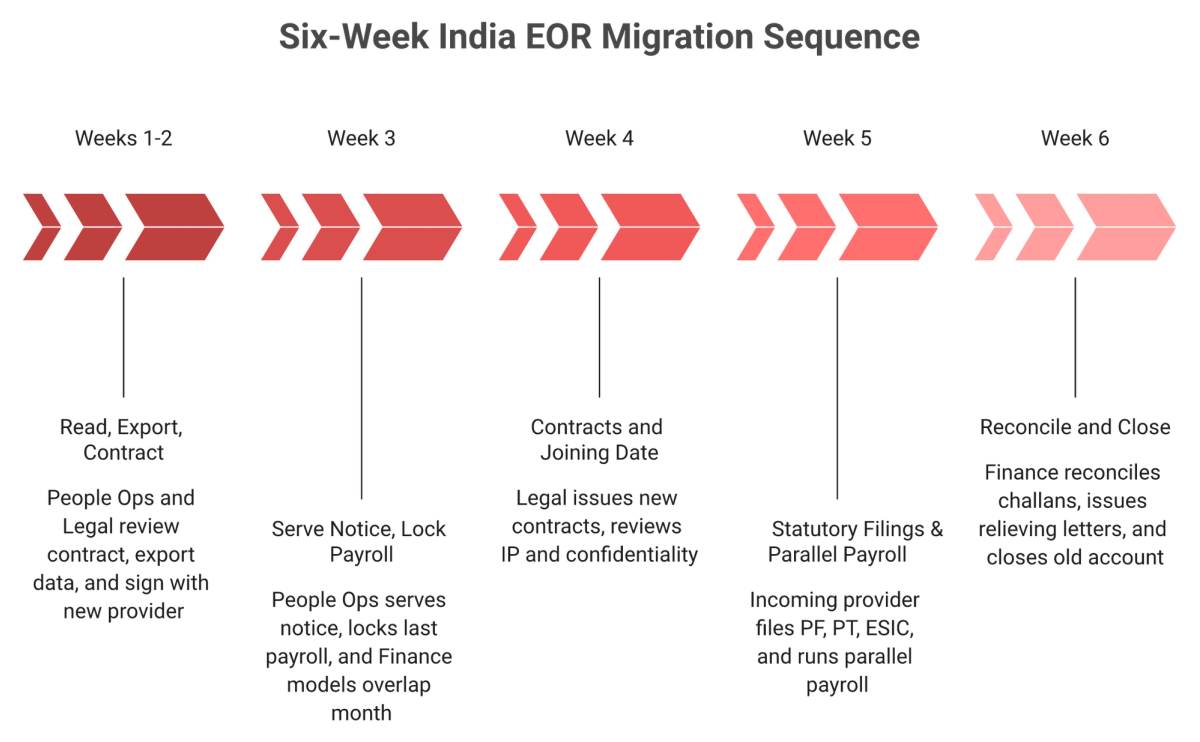
Work backwards from the notice date. Weeks one to two: read the contract, export everything, contract the receiving provider. Week three: serve notice and fix the last payroll date. Week four: sign new contracts with the joining date recognised. Week five: file the PF transfer, complete PT enrolment, and run one parallel cycle. Week six: reconcile challans and close the old account.
⏰ Weeks one and two: read, export, contract
People Ops owns this phase, with legal reviewing in parallel. Nothing irreversible happens yet, which is exactly the point.
Pull the four exit clauses, complete the nine-item data export, and get the new agreement signed. The artefact at the end of week two is a signed contract plus a complete data set sitting in your own drive.
Do not serve notice before both exist. Once you are a departing account, response times change. If you are still comparing destinations at this stage, settle that first on the best EOR services in India shortlist rather than mid-migration.
📮 Week three: serve notice and lock the last payroll
Notice goes out in writing, with the last payroll month named explicitly. Ask the outgoing provider to confirm that date back to you.
Finance owns the next line. Model the overlap month now, because this is the week you find out whether you are paying two invoices.
The artefact is a written acknowledgement of the final payroll cycle and the deposit refund date.
✍️ Week four: contracts and the joining date
New employment contracts go out, each carrying the original joining date if the receiving provider has agreed to recognise it. Employees sign, and the announcement has already happened by now.
Legal checks the IP assignment and confidentiality clauses in the new contract. These do not carry over automatically, and a gap here is worse than a payroll delay.
🔁 Week five: statutory filings and one parallel cycle
The new provider files the PF transfer against the existing UAN, completes state professional tax enrolment, and registers the employee under its ESIC code. Run one parallel payroll cycle before the switch goes live.
Parallel means the new provider calculates the same month independently, and you compare outputs line by line. Net pay, PF, ESI, PT, and TDS should match within rupees, not roughly. This is where an India payroll run either proves itself or shows you the gap.
If they do not match, you have found a problem in a test rather than in a real payslip.
✅ Week six: reconcile and close
Reconcile challans for the crossover month, confirm both providers filed what they said they filed, and get the relieving letters issued. Then close the old account formally, in writing.
Chase the deposit refund on the date you were promised, not 60 days later when someone remembers.
🗓️ The two safest windows
I have seen the same lifecycle repeatedly. A team starts with contractors, moves 12 people onto an EOR when the structure gets real, then migrates again once they know what they need. That last step is usually the EOR versus own entity in India decision, not another vendor change.
Two windows make that second move materially safer:
A month boundary aligned with your notice period, so no employee gets a split payslip.
The financial-year boundary (1 April), which gives each employee one clean tax certificate instead of two.
The honest version is this. A migration planned two months out works. One executed at renewal, because notice was about to auto-renew, is the version that breaks.
This is a manual legal and tax transition with state registrations inside it. Anyone selling you a push-button migration has not filed a Form 13, and the full sequence sits in the India EOR provider switch guide.
Q10. What do I tell the India team, and when?
Tell the team four to six weeks ahead, on a live call, before any paperwork reaches them. Name the single person answering questions. Then put four facts in writing: salary and role unchanged, the PF account continuing on the same UAN, the recognised joining date, and the exact date of the first payslip from the new employer. Say what you cannot promise yet.
📞 Sequence beats messaging
Order matters more than wording here. A contract landing in an inbox before any human explanation is how a good migration turns into a resignation.
Live call first, with the whole India team. Written summary the same day. Individual contracts only after that.
✅ The four facts, in writing
Keep the written note short and specific. Vague reassurance reads as evasion.
Salary, CTC structure, role, manager, and tools stay the same.
The PF account continues under the same UAN, and the balance transfers.
The original joining date is recognised as DD-MM-YYYY, if the receiving provider has agreed to it.
The first payslip from the new employer lands on a named date.
⚠️ The questions they will actually ask
They will not ask about vendor selection. They will ask about paperwork that affects their money and their next job.
Have honest answers ready for these:
| Employee question | The honest answer |
| Will I get two Form 130s this year? | Yes, one per employer, combined in one return |
| Who issues my experience or relieving letter? | The outgoing employer, for that period, in writing |
| Does my health insurance stop? | New policy under the new employer, confirm dates overlap |
| What happens to my leave balance? | Encashed at exit or carried, state which one |
| Does my gratuity restart? | Depends on the recognised joining date, say which applies |
Employees on EOR arrangements are already thinking about exit documentation:
"Who will issue an experience letter in case of an exit/layoff?"
— community poster, r/developersIndia Reddit Thread
"Since the EOR technically employed them, the provider won't grant you access to any information about 'their' employees once you end the service."
— community poster, r/Payroll Reddit Thread
👤 Name a human, not a queue
One person owns questions for the whole migration, with a phone number and working hours. Unowned migrations are where errors hide, which is the same reason a named point of contact matters in day-to-day EOR services.
In one documented case, an employee stayed enrolled in the client's own benefits plan instead of the EOR-administered plan, and nobody caught it. That is not a policy failure. That is nobody owning the checklist.
📝 A template you can send today
Adapt this, then send it the same day as the call.
"Team, we are moving our India employment from [current provider] to [new provider], effective [date]. Your salary, role, manager, and tools do not change. Your PF continues under your existing UAN, and your original joining date of [date] is recognised in the new contract. Your first payslip from the new employer arrives on [date]. [Name] on [number] answers every question until this is done."
Q11. What should I ask the provider I am moving to, including us?
Ask four questions of any receiving provider. Can you run payroll mid-cycle? Will you recognise the transferring employee's original joining date for gratuity in the contract? Do you hold PF, ESIC, and Shops and Establishments registrations in your own name in every state where my team sits? Is the India entity yours or a partner's? Versatile Club employs India teams through its own registered Indian entity, Foo Falcon Technologies Private Limited. Ask us the same four.
🔍 Why these four, and not a feature list
Each question maps to a mechanism that decides your migration. Mid-cycle payroll decides whether your cutover must land on a month boundary. The joining-date clause decides tenure. State registrations decide whether an employee can be onboarded at all. Entity ownership decides how fast anything gets fixed.
Operators who have been through vendor failure ask the entity question first:
"First, find out who is the legal employer. Is it the company's own registered Indian entity or a partner network? This determines control and compliance clarity."
— community poster, r/HireInIndia Reddit Thread
"In partner-led arrangements, liability usually falls on the partner rather than the EOR, which can create risk and inconsistent service."
— community poster, r/managers Reddit Thread
💸 Ask for a sample invoice, not a rate card
A fifth question saves real money. Ask for a sample invoice showing local-currency cost, the FX rate applied, and the billing-currency total on the same line.
Undisclosed FX markup runs roughly 1.5 to 3 per cent of converted pay in industry analysis, and it never appears as a line item. Model it against your published per-employee EOR pricing before you sign anything.
"Our EOR was applying a 2.5% markup on every currency conversion for our eight employees across three countries, and I was completely oblivious for nearly a year."
— community poster, r/startups Reddit Thread
Versatile Club invoices in USD from its single Indian entity, so there is no separate FX leg on the client side to mark up. I still tell buyers to demand the sample invoice from every provider, including us.
📄 Disclosure, then the facts
This guide is published by an India EOR provider, so read the checklist as something to use against me too.
Versatile Club employs your team through its own Indian entity, verifiable by CIN, with PF, ESIC, and Shops and Establishments registrations in its own name across all 28 states and 8 union territories, a five-business-day onboarding SLA written into the service agreement, and no setup or exit fee. The full scope sits on the EOR services in India page, and the statutory calendar sits on India compliance.
❌ The concession you should weigh
Versatile Club launched EOR in 2026, holds no SOC 2 or ISO 27001 certification, and runs no self-serve platform. The entity, the multi-state filings, and the payroll operations came from six years of contract-to-hire work, and the EOR wrapper is new.
If your procurement requires a security certification, we are not your vendor this quarter. You have just learned what vendor risk feels like, so weigh that openly.
Three mechanisms decide this migration: notice, PF continuity on the same UAN, and the recognised joining date. Sequence those, plan two months out, and ask every provider the four questions. What I keep wondering is whether India stops being one country on a global map and becomes its own vendor category. If you are mid-migration right now, message me and tell me which of the four questions your provider dodged.
FAQs
Is switching India EOR providers disruptive to employees?
It is disruptive on paper and manageable in practice, provided the sequence is right. A change of legal employer means new contracts, new statutory registrations, and a new payslip issuer.
What genuinely changes is narrow:
- The legal employer named on the contract
- The PF member ID, though the UAN itself stays the same
- The ESI code and the insurance policy number
- Who files monthly PF, ESI, professional tax, and TDS challans
What does not change is the part employees care about most: salary, CTC structure, role, manager, tools, and the accumulated provident-fund balance.
The disruption people actually feel is informational, not financial. Employees read a change of employer as instability, and a contract landing in an inbox with no prior explanation is how a routine migration turns into a resignation.
Tell the team four to six weeks ahead on a live call, name one person who answers questions, then put the continuity facts in writing the same day. We treat the communication plan as part of the migration, not an afterthought, and the full sequence sits in our guide to a compliant India EOR provider switch.
Does PF and UAN continuity carry over when I switch India EOR providers?
Yes. Provident-fund portability is a feature of the Indian statutory system rather than something a provider grants you.
The employee keeps one UAN (Universal Account Number, the lifetime PF identifier) across every employer. Each employer opens a member ID inside that UAN, and the balance moves by transfer claim.
The sequence looks like this:
- The outgoing employer marks the date of exit in the EPFO portal
- The new employer opens a member ID against the same UAN
- The transfer claim is filed, and since April 2025 the revamped Form 13 completes on source-office approval alone
The failure point is almost never the claim itself. It is a late exit-date entry, which leaves the old member ID showing active, blocks the transfer, and creates a duplicate record that takes weeks to unwind.
So collect every UAN and member ID in week one, get the exit date confirmed in writing, and file the transfer in the same month the new member ID opens. Versatile Club files PF, ESI, TDS, and professional tax under its own registrations, which is why we can correct a portal entry directly rather than escalating through a partner. The monthly filing cadence is published on our India compliance page.
Does my India team lose tenure or gratuity if I switch EOR providers?
Gratuity does not travel the way provident fund does, so this needs a precise answer rather than a reassuring one.
Gratuity accrues at roughly 4.81 per cent of Basic plus dearness allowance from month one, and becomes payable at five years of continuous service with one employer. Change the legal employer and the statute sees a new relationship.
That leaves two paths:
- Settle and restart. The outgoing employer pays accrued gratuity in the Full and Final settlement, and the five-year clock begins again.
- Recognised continuity. The new employment contract records the original joining date, so tenure and the runway carry forward on paper.
Ask your incoming provider for wording like this: the employee's original date of joining, DD-MM-YYYY, is recognised for the purpose of continuous service and benefits computation. Insist on it in the appointment letter, because a promise in a chat window does not survive an exit two years later.
Ask us the same question, in writing, before you sign anything. The Labour Codes that came into force on 21 November 2025 also changed the wage base, so recompute the accrual before settlement, using our India salary calculator as a starting point.
What notice period applies when I cancel Deel's India EOR service?
Notice on an EOR agreement is contractual, not statutory, so your own signed agreement governs. Client context available to us records a one-month notice on Deel's India EOR terms, though terms vary by agreement and by signature date, so read yours before you rely on any published figure.
Four clauses decide your entire calendar:
- Notice length. Thirty days from written notice, or thirty days from the next billing date, which can add three weeks
- Co-termination. Whether one employee's exit triggers the whole account
- Last billable cycle. The final payroll month, confirmed in writing
- Deposit and refund. Prepaid balances commonly refund 30 to 60 days after exit
Then budget the cost line nobody warns you about. If your new provider needs onboarding time inside the notice window, you pay both providers for one overlap month.
Serve notice only after your data export is complete, and align the last payroll month with a calendar month end. Versatile Club charges no setup fee and no exit fee, because exit cost is precisely what keeps teams on a provider they have outgrown. Our full rate structure sits on the pricing page.
What data should I export before serving notice to my current EOR?
Export before you serve notice. Access narrows once you become a departing account, and the outgoing side has no commercial reason to move quickly on a handover.
Ask for machine-readable files, not scanned images, because your next provider has to load this into a payroll system:
- Monthly payslips per employee, plus a CSV salary register
- PF challans with UAN and member ID per employee
- ESI contribution history with IP numbers
- TDS challans and quarterly return acknowledgements
- Every Form 16 or Form 130 issued to date
- Signed employment contracts and all amendments
- Professional tax filings by state, with registration numbers
- Leave balances, accrual policy, and reimbursement history
Treat the handover as a personal-data transfer, because that is what it is. India's Digital Personal Data Protection Rules 2025 were notified on 13 November 2025, with obligations phasing in over eighteen months, so fix the export scope, the retention period, and a written deletion confirmation inside your exit letter.
Versatile Club holds payroll records under its own Indian entity's registrations, so the challans a client asks for come from the team that filed them. That distinction matters most on the way out, as our managed payroll clients discover when they audit.
How do TDS, Form 130, and the Full and Final settlement work across the crossover month?
A mid-year switch produces two TDS certificates for each employee, one per employer, combined into a single income-tax return. Under the Income-tax Act 2025, Form 16 becomes Form 130, Form 24Q becomes Form 138, and Form 26AS becomes Form 168, effective 1 April 2026.
The mechanics that matter:
- TDS deducted in a month must be deposited by the seventh of the following month
- A mid-month cutover needs a day-count split between the two employers
- Confirm in writing which provider files Form 138 for the crossover quarter
- Each employer applies the standard deduction independently, so employees can face a shortfall at filing
Run a formal Full and Final settlement rather than treating the exit as paperwork. It should cover notice pay, leave encashment, accrued gratuity recomputed on the current wage base, PF exit marking, and a relieving letter with the correct last working day. The Labour Codes also tightened final settlement to within two working days of exit.
Versatile Club hands over challan copies each month rather than a status dashboard, because a filed challan is the artefact that survives diligence. The recurring statutory calendar is mapped in our guide to India payroll compliance.
Does Versatile Club charge any setup or exit fee for India EOR?
No. Versatile Club charges no setup fee and no exit fee, and it employs India teams through its own registered Indian entity, Foo Falcon Technologies Private Limited, verifiable by CIN.
What that structure means in practice:
- PF, ESIC, and Shops and Establishments registrations are held in our own name across all 28 states and 8 union territories
- Invoicing is in USD from a single Indian entity, so there is no separate FX leg to mark up
- A five-business-day onboarding SLA is written into the service agreement
We also name the trade-offs, because a company mid-migration has just learned what vendor risk feels like. Versatile Club launched EOR in 2026, holds no SOC 2 or ISO 27001 certification, and runs no self-serve platform. The entity, the multi-state filings, and the payroll operations came from six years of contract-to-hire work in Bengaluru, Hyderabad, and Pune, so the infrastructure is proven while the EOR wrapper is new.
If your procurement requires a security certification as a gate, we are not the right vendor this quarter. If it does not, compare the numbers directly on our Deel alternative page.
How do I migrate an India employee off an EOR to my own entity?
The mechanics mirror an EOR-to-EOR switch, with one difference: you become the legal employer, so every registration lands on you.
The sequence runs like this:
- Incorporate the Indian entity and obtain PAN, TAN, GST, and Shops and Establishments registration
- Obtain your own PF establishment code and ESIC code before the first payroll
- Register for professional tax in every state where employees sit
- Serve notice to the EOR, then issue new contracts recording the original joining date
- File the PF transfer against each employee's existing UAN
- Constitute your POSH internal committee and run one parallel payroll cycle
The timing question is economics rather than law. Entity setup carries formation cost, a compliance calendar, and audit obligations that an EOR absorbs on your behalf, so the crossover usually sits somewhere between fifteen and thirty India employees depending on salary levels.
Model it before you commit, because a captive built at eight heads costs more than it saves. Our EOR versus entity calculator runs that comparison, and the longer-form reasoning sits in our EOR versus entity in India analysis.