Table of contents (12)
India Expansion Options: How to Enter the Market Without Setting Up an Entity
Q1. What are your real options for entering the Indian market?
You have three realistic ways to enter India: set up your own Private Limited entity (weeks to incorporate plus 12 to 18 months of operational overhead and high capex), engage people as independent contractors (fast, but exposed to misclassification), or hire through an Employer of Record, a locally registered company that legally employs your team while you direct the work. For your first 1 to 12 hires, the EOR is usually the bridge that gets you across the river.
🌉 The scene: a founder who just closed a round
A US founder messaged me on WhatsApp on a Friday night. She had closed her Series A that week and needed four engineers in Bengaluru live in 60 days. Her lawyer had quoted a 12 to 18 month runway to stand up a Private Limited entity.
She felt, in her words, like she was "running with scissors." That is the real question behind "india expansion options." It is not "how do I incorporate," it is "how do I get boots on the ground without getting hurt."
🗺️ The three paths, side by side
Most of the time, you do not need to build the Golden Gate Bridge when a simple suspension bridge gets you across. Here is how the three routes actually compare.
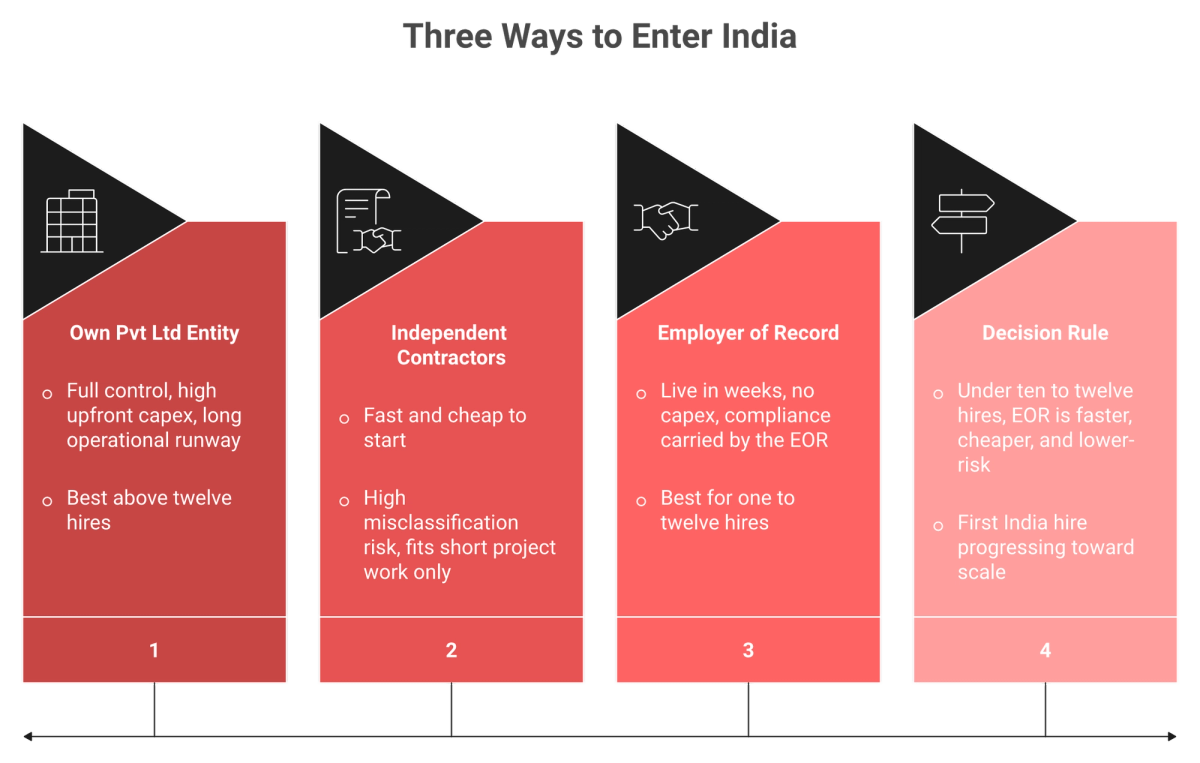
| Route | Setup time | Upfront cost | Compliance risk | Best fit |
|---|---|---|---|---|
| Own Pvt Ltd entity | 12 to 18 months to operate fully | High capex ($50K+) | You own all of it | 12+ hires, long horizon |
| Independent contractor | Days | Low | High (misclassification) | Short project work only |
| Employer of Record | Weeks | Low, no capex | Carried by the EOR | 1 to 12 hires, market entry |
⚠️ Why "just use contractors" is a trap
Contractors feel free and fast. They are neither, once someone works full-time under your direction. I have watched founders treat a full-time engineer as a "contractor" and inherit real back-pay exposure later.
That risk gets its own section below. For now, treat contractor-only as a shortcut that quietly becomes your most expensive line item. If you want to weigh the two side by side, our EOR vs entity calculator puts real numbers against the decision.
🧭 A simple decision rule
Here is how I coach founders on the first call. Under roughly 10 to 12 India hires, an EOR is faster, cheaper, and lower-risk than your own entity. Above that, incorporation starts to earn its keep.
At Versatile, this is the exact bridge we have walked US and UK companies across for six years. We started as a Contract-to-Hire business, so the compliance muscle, the payroll operations, and the state-level registrations were already built before we called it "EOR." India is the only country we run, and that is the point.
Q2. What exactly is an Employer of Record, and why isn't it a "PEO"?
An Employer of Record (EOR) is a company legally registered in India that becomes the on-paper employer of your team. It runs payroll, PF, ESI, TDS, and professional tax under its own registrations while you direct daily work. It is fully legal in India. What is not legal is the US-style co-employment "PEO": traditional PEO co-employment does not exist under Indian labour law, so if you lack an Indian subsidiary, you legally need an EOR, not a PEO.
🧩 The plain-English version
Think of an EOR the way you think of AWS regions. You do not own the data center, but the compute runs in your name and to your spec. An EOR owns the legal employment shell, and your engineer works for you inside it.
The EOR signs the Indian employment contract. You still decide what the person builds, how they work, and whether they stay. Legality here is well established across the India EOR guidance published by providers and practitioners, and our compliance framework reflects it.
🔍 What happens to one real employee
Say you hire a designer in Pune through an EOR. Her offer letter comes from the EOR's Indian entity, not yours.
Her Provident Fund (PF, a retirement contribution), ESI (state health insurance), and TDS (tax deducted at source) all file under the EOR's registrations. You see one clean invoice, handled through managed payroll. She sees a compliant Indian payslip.
🚫 The PEO myth to unlearn
Here is the line the category gets backwards. A PEO (Professional Employer Organization) is a co-employment model from the US, where you and the provider share legal employer status. That co-employment structure does not legally exist under Indian labour law.
So when a vendor tells an entity-less US company they will "run a PEO in India," that is loose language at best. If you do not have your own Indian subsidiary, the compliant answer is an EOR. When you hire through Versatile's EOR, you are employed by Foo Falcon Technologies Pvt Ltd, our own registered Indian company, not a partner shell we rent by the month.
Q3. Why is hiring people as contractors the most expensive mistake?
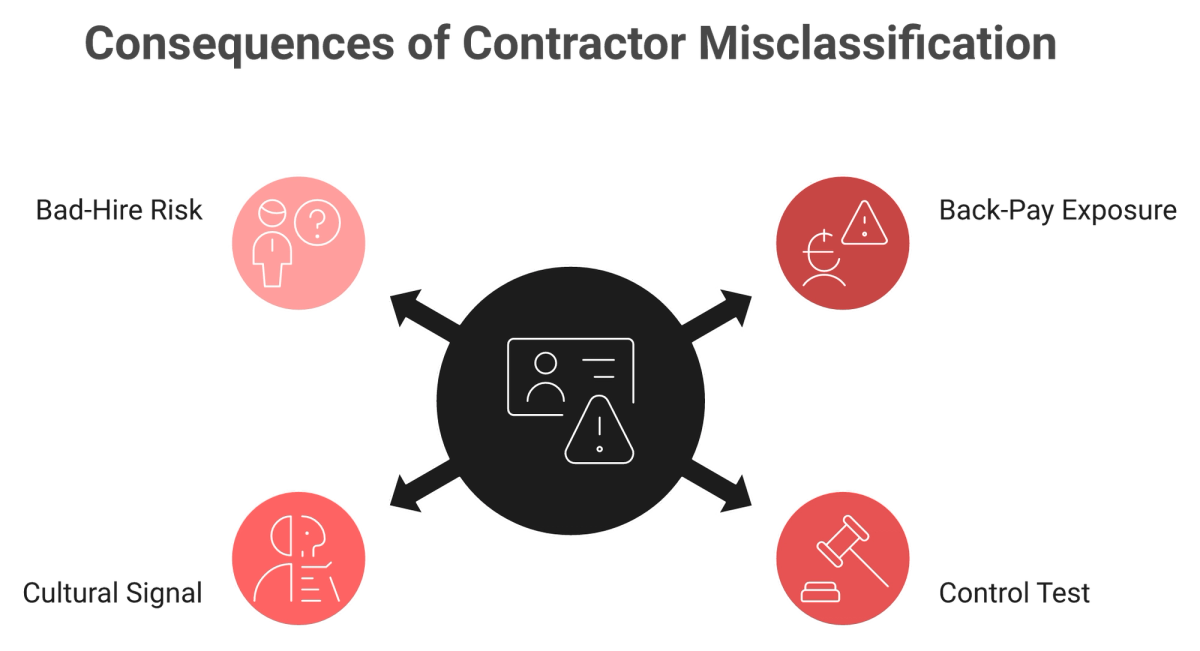
Classifying an Indian worker as a contractor when they function as an employee can trigger $25,000 to $40,000 in back-pay exposure per head: unpaid PF, gratuity, and statutory dues. Indian courts apply a control-and-integration test, and Indian workplace behavior (deep deference to hierarchy) makes "independent contractor" hard to defend. If the person works only for you, on your direction, full-time, they are an employee in substance, whatever the contract label says.
💸 The number that should stop you
I have seen this bill land. Misclassify one full-time engineer as a contractor, and the exposure runs $25,000 to $40,000 per head once you back-pay PF, gratuity, and dues.
Multiply that across a team, and a "cheap" contractor model becomes your most expensive decision. The savings were never real. A compliant Contractor of Record arrangement is one way to close that gap cleanly.
⚠️ The test you cannot contract your way out of
Indian courts do not read your PDF; they read the relationship. The control-and-integration test asks a simple thing: do you control how, when, and where the person works, and are they woven into your team?
If yes, they are an employee in substance. And Indian workplace culture makes this even clearer in practice. India scores 77 on Power Distance versus 40 for the US, so deference to hierarchy runs deep.
One American manager told me an offshore team member asked her, over instant message, for permission to take his dinner break, "because I'm your subordinate." She said it was not necessary. He insisted it was. That level of integration is exactly what a court reads as employment, not contracting.
🔎 The hiring-quality risk hiding underneath
There is a second cost. Nearly 30% of IT-sector resumes in India contain discrepancies, so casual contractor hiring skips the verification a real employer runs. You inherit both the legal risk and the bad hire, which is why our recruitment process screens before anyone signs.
Buyers feel this pain across providers, not just contractors. The complaints below are about generalist EORs getting the basics wrong, which is the same exposure you are trying to escape.
"They very clearly have no idea what they're doing. Within the first week, they changed 5 reps handling my case... they finally notified me of being unable to deliver on their promise... they delayed our employment process by a full month."
Verified User Remote G2 Verified Review
"My pay has been incorrect on at least four occasions... my paycheck was delayed because Multiplier submitted payroll late after I requested a simple verification of hours."
Verified User Multiplier G2 Verified Review
✅ How an EOR closes the exposure
An EOR removes the misclassification question by making the worker a real, compliant employee from day one. The contract, the PF, the gratuity accrual, all of it sits on the record correctly.
This is exactly what our EOR does at Versatile. The employee is on our Indian entity, their statutory filings run under our registrations, and the $25,000 to $40,000 "surprise" never has a door to walk through. You can see the full workflow on our how it works page.
Q4. What Indian statutory obligations does an EOR handle, and why does state-level compliance make it harder than it looks?
A real EOR handles your entire Indian statutory stack: TDS deducted and deposited by the 7th of each month, gratuity accruing from month one at 4.81% of Basic plus DA, EPF, ESI, and Form 16 issued to each employee by 30 May annually. Under the New Labour Code 2025-26, Basic plus DA must be at least 50% of total CTC. And India is not one regime. Professional tax and Shops and Establishments rules differ by state, so a global platform running India as one dropdown cannot file this depth.
📋 Compliance is the floor, not the ceiling
Founders think of compliance as one scary blob. Inside a live payroll cycle, it is a set of specific dates and percentages. Here is the core stack.
| Obligation | Rate / rule | Deadline |
|---|---|---|
| TDS (tax deducted at source) | Per income-tax slab | Deposited by 7th monthly |
| Gratuity (exit benefit) | 4.81% of Basic + DA, accrued from month one | On exit |
| EPF (Provident Fund) | 12% employer + employee | Monthly challan |
| ESI (state health cover) | 3.25% employer / 0.75% employee | Monthly |
| Form 16 (annual tax cert) | Per employee | By 30 May |
💰 The 50% rule that broke old payroll templates
Here is the change most competitor guides mention but do not price. Under the New Labour Code that took effect on 21 November 2025, Basic plus DA must be at least 50% of total CTC.
That reshapes take-home, PF, and gratuity math. A pre-2025 salary structure, the kind that loaded allowances to shrink statutory cost, no longer works. Any EOR you shortlist should hand you a 2026-compliant breakdown, not an old template.
There is a live layer on top. The EPFO Scheme 2026, gazetted 29 June 2026, keeps the mandatory PF contribution capped at ₹1,800 on the ₹15,000 wage ceiling and adds a consolidated Form V filing due within 15 days. A pending Supreme Court matter may lift that ceiling, so budgets should leave room.
🗺️ Why "India" is not one setting
This is where global generalists thin out. Professional tax (PT) is a state subject, and every state files differently.
- Maharashtra: dual registration (PTRC plus PTEC), monthly slab filing, annual returns.
- Karnataka: monthly PT plus Shops and Establishments renewal, enrollment within 30 days of joining.
- Tamil Nadu: biannual PT plus Labour Welfare Fund.
A platform that treats India as one country on a 150-country map cannot run this. Most global EOR providers route India through local partner entities and spread their India expertise thin, which is the core contrast in our Deel alternative breakdown.
✅ Where our depth actually lives
At Versatile, PF, ESI, TDS, and professional tax filings sit under our own registrations, across all 28 states and 8 union territories. India is the only country we operate in, so Maharashtra's PTRC plus PTEC and Karnataka's 30-day enrollment window are never an afterthought. That is not a marketing line; it is what the payroll cycle actually demands every month. If you want it modelled for your team, book a demo.
Q5. Owned entity vs. partner-shell EOR, why does the difference matter?
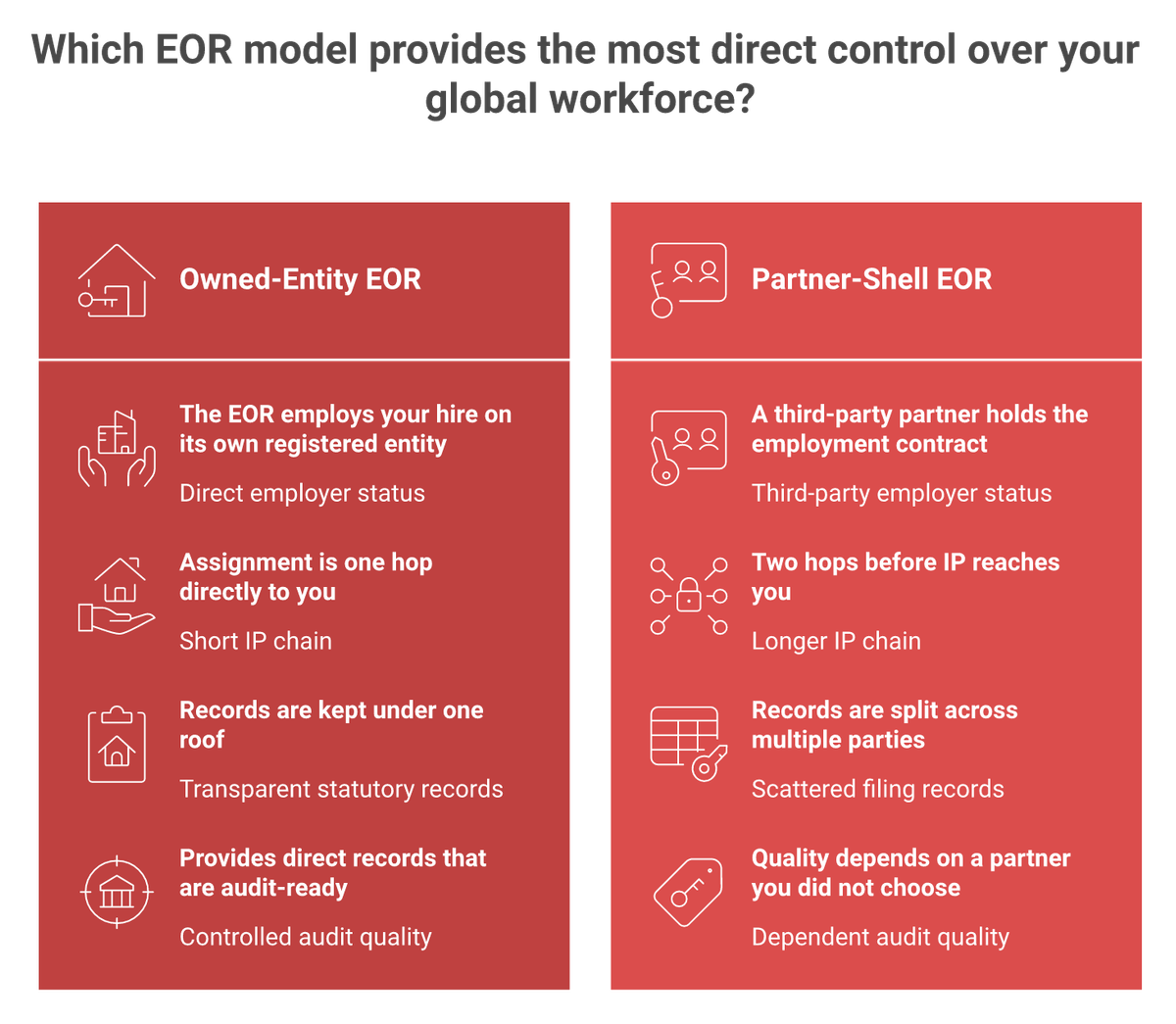
Most global EOR providers, Deel, Remote, and others, do not own an Indian entity. They route you through local partner shells. When employment sits on a partner's books, you inherit a partner's compliance quality and a longer chain for IP assignment. An owned-entity EOR employs your team directly, keeps statutory filings under one roof, and gives you audit-ready IP protection and direct control. Ask any provider one question: do you own your Indian entity, or rent one?
🏠 Rented shell versus owned house
Here is the thesis, plainly. An EOR that owns its Indian entity employs your engineer on its own books. An EOR that rents a partner shell puts a middleman between you and the filing.
That middleman is where quality drifts and IP chains stretch. The distinction sounds academic until a PF transfer or a contract assignment goes sideways, which is why our EOR services in India keep everything in-house.
📊 What actually changes for you
| Dimension | Owned entity | Partner shell |
|---|---|---|
| Who employs your hire | The EOR directly | A third-party partner |
| IP assignment chain | One hop to you | Two hops, longer |
| Filing transparency | Under one roof | Split across parties |
| Audit-readiness | Direct records | Depends on partner |
| Global scale | India only | 90 to 150 countries |
You can hear the partner-shell friction in real reviews.
"The PF transfer for employees after terminating their employment with Velocity was very poor. There was limited help, delayed responses."
Verified User Velocity Global G2 Verified Review
"There are like way too many outsourcing chains in the process and this makes it a terrible support interaction."
Verified User Skuad G2 Verified Review
⚖️ The honest counterpoint
I will not pretend ownership wins every scenario. If you need to hire across 15 countries next quarter, a global aggregator's breadth is genuinely useful, and I would tell you so.
But if India is the market that matters, depth beats breadth. Think AWS: you want a provider deep in your region, not thin across all of them. Our compliance depth is built for exactly that.
At Versatile, your hire is employed by Foo Falcon Technologies Pvt Ltd, our own registered Indian company. We are not a reseller or aggregator, and the filings never leave our roof. That is the one question I would put to every vendor on your shortlist. If you are comparing us head to head, see our Deel alternative breakdown.
Q6. How do the India EOR providers actually compare?
For a US or UK company making its first India hires, the honest split is this: Versatile and Wisemonk are India-native specialists, while Deel, Remote, G-P, Multiplier, and Skuad are global generalists spread across 90 to 150 countries. Generalists win on multi-country scale but report FX markups and ticket-queue support. India-native providers win on statutory depth. The tie-breaker is entity ownership, price transparency, and whether a human, not a chatbot, answers you.
🧭 Specialists versus generalists
The market splits cleanly into two camps. India-native specialists go deep on one country. Global generalists go wide across many.
Neither is wrong. The question is what your India hire actually needs, and our transparent pricing is built to make that call simpler.
📋 The head-to-head
| # | Provider | India model | Pricing signal | Support | Best for |
|---|---|---|---|---|---|
| 1.1 | Versatile Club | India-only, owned entity | $149/employee/mo, no setup or exit fees | Founder on WhatsApp | First India hires, retention-critical |
| 1.2 | Wisemonk | India-native | Published "from $99" only, less transparent | Small team, occasional lag | India-only, price-led |
| 1.3 | Deel | Generalist (150+) | ~$599/mo, FX and transfer fees reported | Chatbot / ticket first | Multi-country scale |
| 1.4 | Remote | Generalist | ~$599/mo | Email, 3-day SLA reported | Broad coverage |
| 1.5 | Multiplier | Generalist | ~$400/mo | Ticket queue, billing complaints | Budget multi-country |
| 1.6 | Velocity Global | Generalist | Premium | Account-manager churn reported | Enterprise breadth |
| 1.7 | Skuad | Generalist | ~$200+/mo | Outsourcing chains, slow | Wide, low-touch |
The generalist support pattern shows up again and again in verified reviews.
"They were dishonest about the level of support provided... Instead they have email support with a 3-day SLA. Responses are unacceptably slow."
Juliette D. Remote G2 Verified Review
"Their communications are inconsistent... they generally seem to only be focused on receiving payments and deposits from us benefitting them financially, not actually supporting our business."
Verified User Multiplier G2 Verified Review
✅ Who each is best (and worst) for
Here is my scenario read. Choose a generalist if multi-country scale is the priority and India is one of many. If you are weighing us against a specialist, our Wisemonk alternative page lays out the differences.
Choose an India-native provider if India depth, FX transparency, and a human answering you are the priority. At Versatile, we lead this list because we live in this category, India-only, owned entity, and a founder who answers WhatsApp instead of routing you to a chatbot. If you need 5+ countries at once, we are honestly not your fit, and I will say so on the first call. Want it modelled for your team? Book a demo.
Q7. Why is a "legal hire on paper" not the same as a "good hire that stays"?
Compliance is the floor, not the ceiling. A perfectly compliant EOR hire is still a failure if the person is not a culture fit or churns in three months, and with nearly 30% of Indian IT resumes containing discrepancies, "legal on paper" says nothing about "good and stays." Culture-fit-first hiring, a 90-day success check-in, and a replacement guarantee solve the problem compliance-first providers ignore entirely.
🧾 What everyone in this category sells
Every EOR pitch sounds the same: we make your India hire compliant. Payroll, PF, ESI, contracts, all handled.
That is real, and it matters. But it is table stakes, not a finish line. The standard read gets this backwards.
⚠️ The problem compliance cannot touch
A compliant hire and a good hire are two different things. You can employ someone flawlessly on paper and still get the wrong person, or watch them leave in 90 days.
The data backs the worry. Nearly 30% of IT-sector resumes in India contain discrepancies, so a clean payslip tells you nothing about whether the person can do the job or will stay. I have seen founders confuse "the paperwork is perfect" with "the hire is safe." They are not the same sentence, which is why our recruitment process screens for fit before a contract exists.
✅ Talent density is the real game
Here is an analogy I use. Hiring cheap-and-fast is like buying ketchup and shoving it in the cupboard because there was space. Convenient today, useless when you need it.
I do not advocate hiring in India because it is cheaper. I advocate it because the talent density is genuinely high, and the point is to find people who are excellent and who stay. That is why Versatile screens on roughly 50 behavioral parameters, assigns a 90-day Success Coach, and backs Contract to Hire placements with a 6-month replacement guarantee. You can test that fit yourself with our culture fit quiz. No competitor I know owns this territory, and I could be early on it, but I think "good hire that stays" beats "legal hire on paper" every time.
Q8. How does compliant onboarding through an EOR actually work, start to finish?
Compliant EOR onboarding runs in five moves: share the offer and CTC, the EOR structures salary to the 50% Basic+DA rule, statutory enrollment (PF, ESI, professional tax within state deadlines), contract and IP assignment signed, and day-one payroll setup. A strong provider commits to this in writing. Versatile's 5-day onboarding SLA is a contractual commitment, not an aspiration.
🛠️ The five moves, in order
You have picked the person. Here is what happens next, step by step, and the full flow lives on our how it works page.
- Share the offer and CTC. You hand the EOR the role, salary, and start date.
- Salary structuring. The EOR builds the breakup so Basic plus DA is at least 50% of CTC, per the New Labour Code.
- Statutory enrollment. PF, ESI, and professional tax registrations happen within each state's deadline (Karnataka, for example, wants enrollment within 30 days).
- Contract and IP. The employee signs the Indian contract with IP assignment flowing to you.
- Payroll setup. Bank details, Form 16 setup, and first-cycle payroll go live through managed payroll.
⏰ Why the "contractual" part matters
Most providers quote onboarding as a hope, not a promise. "Usually a week or two." That vagueness is where start dates slip.
At Versatile, the 5-day onboarding SLA is written into the contract, not an aspiration on a sales deck. We built that from six years of Contract-to-Hire operations, where a missed start date is a real cost, not a footnote. Startups feel that acutely, which is why we built for startups.
💬 The human layer people forget
Onboarding is not just filings. Managing a new India hire across a time zone takes a light touch, especially early.
A few things I have learned the hard way. Recap key points, and send an email straight after any call. Never ask closed yes or no questions; ask "where are we on the schedule?" instead. And when working across the culture gap, give a few hours before acting on what was said in a meeting, because deference can hide a real concern. At Versatile, those onboarding questions come to me on WhatsApp, not a ticket queue, which is the whole point of staying founder-accessible.
Q9. What are the hidden legal risks, Permanent Establishment and DPDP data compliance, and how do you contain them?
Two risks hide behind entity-free hiring. First, Permanent Establishment: a single India hire with authority to conclude contracts can create taxable presence for your parent company. An EOR limits this but does not erase it, so the practical test is whether your hire can bind you contractually. Second, DPDP: since the Digital Personal Data Protection Rules were notified in November 2025, employee personal data you route through an India EOR is regulated. Both belong in your EOR contract.
⚠️ Permanent Establishment, the tax trap
Permanent Establishment (PE) means your company has enough presence in India to be taxed there. People assume an EOR removes this. It reduces it, but it does not switch it off.
Here is the test I use. If your India hire can sign deals or bind your company to contracts, that authority can trigger PE. A pure engineer building product is low-risk. A "country head" closing sales is where I get nervous. Structuring roles safely is part of our EOR services in India.
🔒 DPDP, the data trap most guides skip
DPDP is the Digital Personal Data Protection Act, India's privacy law. Its Rules were notified by MeitY on 13 November 2025, with a staggered rollout.
That matters because your India hire's personal data, payroll, ID, and bank details, is now regulated data. Most India hiring guides ignore this entirely. I think that is a mistake you will hear about in two years, though I could be early on the timing. Our compliance approach treats this as standard, not optional.
✅ The two clauses to add on Monday
You do not need to panic. You need two things in the contract.
- A PE-safe role scope, so your hire does not casually get contract-signing authority they do not need.
- A DPDP-compliant data-processing clause covering how employee data is stored and shared.
At Versatile, our EOR contracts carry a DPDP-compliant data-processing clause as standard, and we structure roles so your first India hire does not accidentally trigger PE. These are exactly the risks a global playbook glosses over because India is one country of 150 on their map. See how the two models diverge in our Deel alternative breakdown.
Q10. When should you stop using an EOR and open your own entity?
For most companies, the tipping point is around 10 to 12 India hires. Below that, an EOR is cheaper, faster, and lower-risk than running your own entity. Above it, incorporation starts to pay off. The smart play is to use an EOR as a migration bridge: build the team first, prove the market, then move employees onto your own entity once you cross the threshold. Watch the pending EPFO wage-ceiling revision, which may shift your payroll math.
🧭 The founder who hit twelve
A US client scaled quietly on our entity. Around the twelfth hire, the founder asked me the question everyone eventually asks. "Do we open our own entity now?"
That number is not random. Across the teams I have watched grow, the answer flips at roughly 10 to 12 India hires. Our EOR vs entity calculator shows you where your own line sits.
🌍 The "Greek interview" migration
One story sticks with me. A client interviewed a candidate they believed lived in London. By the third interview, it turned out he was in Greece.
The point is not geography; it is flexibility. We employed the team on our entity while they proved the market, then migrated all twelve people onto the client's own India entity when they were ready. The bridge did its job, and then they crossed it. That is the model behind our EOR services.
💰 One number to watch first
Before you incorporate, watch one variable. In January 2026, the Supreme Court directed the EPFO to decide on revising the Provident Fund wage ceiling within four months.
If that ceiling rises, your mandatory PF base rises with it, and your payroll model shifts. At Versatile, we have migrated teams off our entity onto their own with no exit fees. The bridge is meant to be crossed, not to trap you on it. If you are close to the threshold, book a demo.
Q11. Why do global "enterprise" expansion tools feel so cold for a first India hire?
Global expansion platforms are built for enterprise scale, which means process, tickets, and CSM rotations, the opposite of what a founder making their first India hire needs. When a $200 decision needs twenty sign-offs, you feel the enterprise coldness. For your first 1 to 12 hires, direct access to a human who knows Indian compliance beats a chatbot and a queue. At Versatile, that human is the founder, on WhatsApp.
🥶 The twenty-signature problem
I once watched a simple approval crawl through twenty names before anything moved. Twenty people, one of them sitting in a procurement department in Guadalajara, all needed to sign off.
That is enterprise coldness in one image. It is fine at 500 employees. It is agony when you are making your first India hire and payroll is Friday. That friction is exactly why we built for startups.
The reviews say it more bluntly than I can.
"Support is the single biggest failure. There is no direct phone line. You either email or use a chatbot, and you can ask both the same question and get two different wrong answers."
Erika D. Rippling G2 Verified Review
"We've had no fewer than six account managers in less than two years. More than once, we've learned of changes to our team by receiving an out-of-office auto-reply."
Verified User Velocity Global G2 Verified Review
💬 A person, not a portal
Here is the alternative, and it is not "24/7 global support," which usually means a queue. It means a real person who knows Indian compliance answering you directly. You can see the model on our how it works page.
At Versatile, that person is me, on WhatsApp. Not a CSM rotation, not a ticket number, and your first month is free. At our scale, founder access is not a perk; it is a structural advantage I would lose the day we tried to act like an enterprise.
Q12. What's the real all-in cost of an India engineer through an EOR, and where's the catch?
A senior software engineer in Bengaluru costs roughly $58K all-in per year versus about $220K in San Francisco, a savings near $162,000 per role. But the catch is hidden cost: many global providers add a 3 to 5% FX markup plus setup and exit fees, and the 50% Basic+DA rule reshapes the statutory base. The honest number holds only with USD invoicing from a single Indian entity, no FX exposure, and no setup or exit fees.
💰 The headline number
Let me put the numbers on the table, because CFOs do not want adjectives.
| Role | Location | All-in annual cost |
|---|---|---|
| Senior software engineer | Bengaluru | ~$58,000 |
| Senior software engineer | San Francisco | ~$220,000 |
| Savings per role | - | ~$162,000/year |
That gap is real. But the headline number is only honest if nothing quietly eats it. Model your own role with our salary calculator.
💸 Where the catch hides
Three things erode the savings. First, FX markup: several global providers add a reported 3 to 5% on currency conversion, which compounds every month.
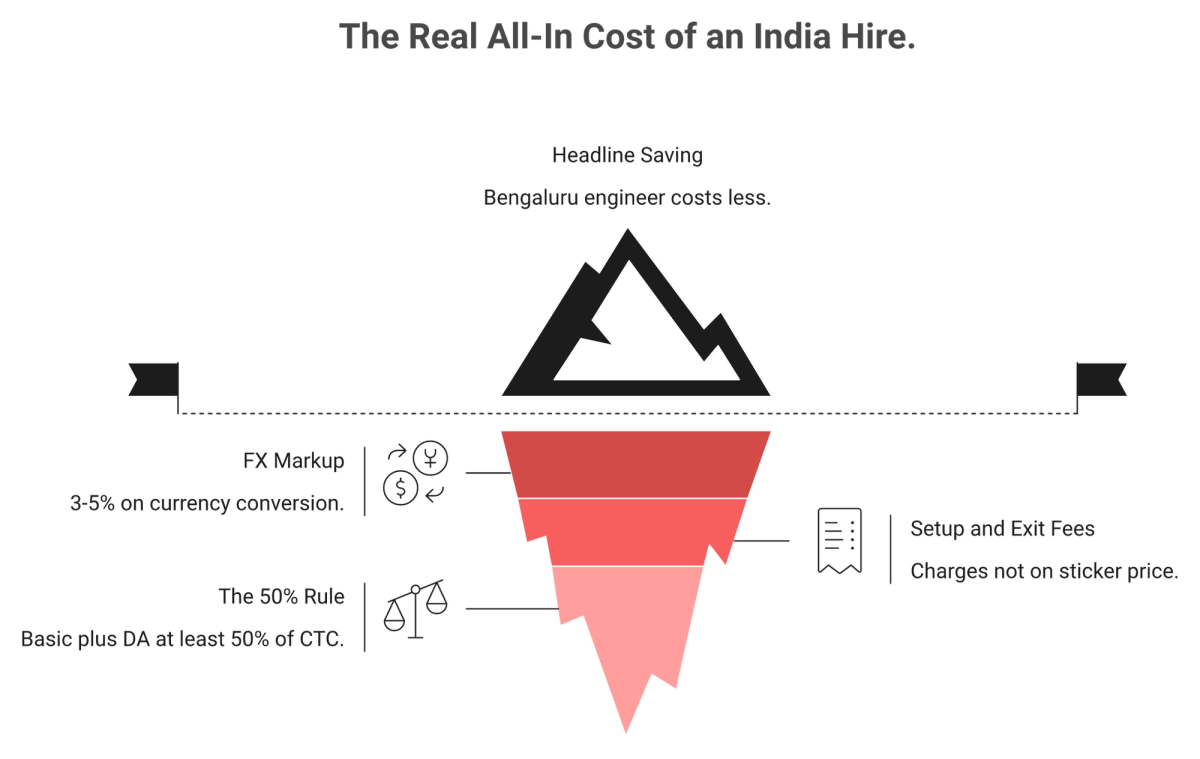
Second, setup and exit fees that do not show on the sticker. Third, the statutory base itself. Under the New Labour Code, Basic plus DA must be at least 50% of CTC, which raises the PF and gratuity base and changes your true cost per head. Our managed payroll builds that in from day one.
✅ The honest close, and one caveat
The Bengaluru number holds only under clean conditions. At Versatile, we invoice in USD direct from our Indian entity, so you carry no FX exposure, no setup fees, and no exit fees, with the first month free. Every number sits on our pricing page.
One caveat I insist on. I do not sell India as "cheaper." The reason to hire here is genuine talent density, academically excellent people, and the cost saving is the bonus, not the pitch. Where my head is right now is this: over the next two years, India stops being one dropdown on a global EOR map and becomes its own specialist category, with owned-entity operators taking that India revenue from the generalists. If you are making that first hire, tell me what you are building, and I will tell you honestly whether an EOR or your own entity fits.
FAQs
What are the real India expansion options if we do not want to set up an entity?
For a US or UK company, there are three realistic India expansion options, and only two work without incorporating.
- Your own Private Limited entity: full control, but 12 to 18 months of operational overhead and high upfront capex before your first hire is live.
- Independent contractors: fast and cheap on day one, but exposed to misclassification once someone works full-time under your direction.
- Employer of Record (EOR): a locally registered company legally employs your team while you direct the work, live in weeks with no capex.
In our experience across US and UK clients, the EOR is the bridge that gets your first 1 to 12 hires across the river. It carries the compliance, runs payroll, and files PF, ESI, TDS, and professional tax under its own registrations.
Above roughly 10 to 12 hires, incorporation starts to earn its keep, and the smart teams use the EOR as a migration bridge first. You can pressure-test the exact threshold for your team using our EOR vs entity calculator before you commit capital.
Why can we not just hire people in India as contractors?
Contractors feel free and fast, but they are neither once the person works full-time under your direction. This is the most expensive India expansion mistake we see.
Indian courts do not read your contract label; they read the relationship through a control-and-integration test. If you control how, when, and where someone works, and they are woven into your team, they are an employee in substance.
- Back-pay exposure: misclassifying one full-time engineer can cost $25,000 to $40,000 per head in unpaid PF, gratuity, and statutory dues.
- Cultural signal: India scores 77 on Power Distance versus 40 for the US, so deep deference to hierarchy makes an "independent contractor" hard to defend.
- Hiring quality: nearly 30% of Indian IT resumes contain discrepancies, so casual contractor hiring skips verification a real employer runs.
An EOR removes the misclassification question by making the worker a compliant employee from day one. That is exactly how our EOR services in India close the exposure, with statutory filings running under our own Indian entity so the surprise bill never has a door to walk through.
What is the difference between an owned-entity EOR and a partner-shell EOR?
This distinction quietly decides your compliance quality and IP protection. Most global generalists do not own an Indian entity; they route you through a local partner shell.
When employment sits on a partner's books, you inherit a partner's compliance standards and a longer chain for intellectual-property assignment.
- Owned entity: the EOR employs your hire directly, filings stay under one roof, and IP assignment is one hop to you.
- Partner shell: a third party employs your hire, filings split across parties, and IP flows through two hops.
- Audit-readiness: owned records are direct; partner records depend on someone you never chose.
We will be honest: if you need 15 countries next quarter, a global aggregator's breadth is genuinely useful. But if India is the market that matters, depth beats breadth, the same way you want a cloud provider deep in your region.
With Versatile, your hire is employed by our own registered Indian company, never a rented shell. You can see how that ownership model works on our how it works page. The one question to ask any vendor is simple: do you own your Indian entity, or rent one?
When should we stop using an EOR and open our own India entity?
For most companies, the tipping point sits around 10 to 12 India hires. Below that, an EOR is cheaper, faster, and lower-risk than running your own entity. Above it, incorporation starts to pay off.
The smart play is to treat the EOR as a migration bridge, not permanent dependency.
- Build first: hire and prove the market on the EOR's entity while overhead stays low.
- Cross when ready: once you pass the threshold, migrate employees onto your own entity.
- Watch the math: in January 2026 the Supreme Court directed the EPFO to decide on revising the PF wage ceiling within four months, which can shift your payroll base.
We have migrated teams off our entity onto their own with no exit fees, because the bridge is meant to be crossed, not to trap you. If you are near the threshold, our EOR services are structured so the handover is clean rather than a lock-in. The decision is about headcount, horizon, and how much operational load your team can carry, not vendor loyalty.
What is the real all-in cost of an India engineer through an EOR, and where is the catch?
A senior software engineer in Bengaluru costs roughly $58K all-in per year versus about $220K in San Francisco, a saving near $162,000 per role. That gap is real, but it holds only if nothing quietly eats it.
Here is where the catch usually hides.
- FX markup: many global providers add a reported 3 to 5% on currency conversion, compounding every month.
- Setup and exit fees: costs that never show on the headline sticker.
- The 50% rule: under the New Labour Code, Basic plus DA must be at least 50% of CTC, which raises the PF and gratuity base and changes your true cost per head.
The honest number holds only with USD invoicing from a single Indian entity, no FX exposure, and no setup or exit fees. That is how we price, and you can see every line on our pricing page. One caveat we insist on: we do not sell India as "cheaper." The real reason to hire here is genuine talent density, and the cost saving is the bonus, not the pitch.