Table of contents (11)
Outsource Payroll in India 2026: Top 11 Companies, Real Costs (₹30-₹150 PEPM) & Compliance Checklist
Q1. What does outsourcing payroll in India actually include in 2026?
Outsourcing payroll in India means a provider runs the monthly salary cycle and executes the statutory work attached to it: EPF filing through the EPFO ECR portal, ESI contributions, TDS under Section 392 of the Income-tax Act 2025, state Professional Tax challans, Labour Welfare Fund payments, gratuity accrual, and full and final settlement on exit. Three different products sell under this one label. Payroll software generates payslips. Managed payroll files on the government portals. An Employer of Record becomes the legal employer for companies with no Indian entity. Versatile Club operates in that third tier, employing people on its own Indian entity with PF, ESIC, and Shops and Establishments registrations across 28 states and 8 union territories.
⭐ Three products, one label
A US founder messaged me on WhatsApp at 11pm her time, three days before payroll, asking why her Bengaluru engineer's PF challan had not landed in her inbox. Her vendor had never filed one. It generated payslips, which is a different job entirely.
That is the confusion this whole market runs on. Here is the honest split.
| Tier | What it does | What it does not do |
| Payroll software (Keka, Zoho Payroll, greytHR, RazorpayX) | Calculates salary, generates payslips, produces challan-ready files | Does not log in and file; liability stays with you |
| Managed payroll | Files EPF, ESI, TDS, and state PT under your registrations | Needs you to already hold an Indian entity |
| Employer of Record | Becomes the legal employer on its own entity | Not available if you want to employ on your own books |
✅ The statutory floor your vendor must actually touch
Monthly work means PF at 12% of Basic plus DA, ESI at 3.25% employer and 0.75% employee, TDS deposited by the 7th, and state PT challans. Gratuity accrues from month one at 4.81% of Basic plus DA.
Quarterly means the TDS return, now Form 138 in place of Form 24Q. Annually means the employee tax certificate, renamed Form 130 from Form 16, generated only from TRACES.
⚠️ One question separates real outsourcing from report generation
Ask the vendor this, in writing: will you log into EPFO, ESIC, and the state PT portals and file on our behalf, and will you return the challan reference number? Report generation without portal filing is partial outsourcing. The statutory default still sits with your company under the EPF Act 1952 and the ESI Act 1948, which is why payroll compliance in India cannot be treated as a software setting.
Buyers feel this gap before they can name it.
"We're a small team at Moonshot and we needed to bring someone on in India, and every option I looked at first was either 'set up your own entity' (no thanks, not for one hire) or some platform that quotes you a great price and then you find out about all the add-ons later."
— Angad S., Founder Versatile Club G2 - Verified Review, 21 June 2026
"The initial documentation and paperwork felt quite detailed and time-consuming at the beginning. However, as we progressed, it became clear that this thoroughness is what ensures proper legal and compliance coverage."
— Verified User in Marketing and Advertising, 3.5 of 5 Wisemonk - G2 Verified Review, 12 February 2026
💰 Where my head is right now
Versatile Club's read is that the tier confusion is not accidental. Software priced per employee per month looks like outsourcing in a spreadsheet, and the difference only surfaces when a notice arrives. I could be reading that too harshly, but six years of running these filings has not given me a gentler explanation.
Versatile Club files under its own registrations, not a partner's, and returns the challan reference for every statutory payment in the monthly client pack. The compliance muscle came from Contract-to-Hire operations across Bengaluru, Hyderabad, and Pune, not from a global playbook.
Q2. What does payroll outsourcing in India really cost, and is ₹30 to ₹150 PEPM real?
Payroll outsourcing in India costs ₹150 to ₹2,500 per employee per month in 2026. Basic processing runs ₹150 to ₹400. Payroll plus statutory filings runs ₹300 to ₹800, where most mid-market buyers land. Managed payroll with HR support runs ₹800 to ₹2,500 and above. The ₹30 to ₹150 band is payroll software, not outsourcing. Managed payroll quoted in dollars benchmarks near $49 per employee per month for companies that already hold an Indian entity, while Employer of Record pricing runs $99 to $599. Versatile Club quotes a single flat fee per employee per month with no salary slabs, no setup fee, and no exit fee.
💸 PEPM, defined once
PEPM means per employee per month. The provider charges a set fee for each person processed in each cycle. At ₹400 PEPM for 50 employees, the service fee is ₹20,000 a month. That figure sits entirely separate from the statutory deductions (PF, ESI, PT, and TDS) that pass through to the government.
⏰ What the bands look like by headcount
| Headcount | Typical monthly fee | Typical PEPM |
| 1 to 25 | ₹8,000 to ₹40,000 | ₹400 to ₹800 |
| 25 to 100 | ₹30,000 to ₹80,000 | ₹300 to ₹600 |
| 100 to 500 | ₹80,000 to ₹2,20,000 | ₹250 to ₹450 |
| 500 plus | Negotiated | ₹150 to ₹300 |
Minimum billing floors of ₹10,000 to ₹25,000 override the small-team math. A six-person company on a ₹400 PEPM quote still pays the floor, which is the first thing to check in any payroll outsourcing services in India proposal.
⚠️ The dollar side, and why the spread is so wide
For US and UK buyers, the comparison looks different. Employer of Record pricing in India sits between $99 and $599 per employee per month. Deel and Remote publish near $599. Multiplier sits near $400. G-P prices as a percentage of salary.
Slab pricing is where the spread hides. A quoted entry rate often applies only to the lowest salary band, and the fee climbs as the engineer's compensation climbs. Versatile Club's structure removes that mechanic: one flat fee regardless of salary, which makes the annual number predictable before you hire the person. The full breakdown sits on our pricing page.
⭐ What buyers say about the gap between quote and invoice
"I find Deel to be absurdly expensive. They charge a high amount of fees for transferring money to my bank account."
— Juan Camilo O., Contractor, 1 of 5 Deel - G2 Verified Review, 27 November 2025
"I dislike how expensive Deel's transaction fees are, especially when moving money from the Deel account to my bank or wherever else it needs to go."
— Maria M., Freelancer, 3 of 5 Deel - G2 Verified Review, 26 September 2025
"Invoicing in USD meant zero exchange rate surprises. The compliance rigour is genuinely impressive, every statutory filing reviewed before submission. Five-day onboarding, zero late payslips."
— Vedant T., Founder, 5 of 5 Versatile Club G2 - Verified Review, 16 June 2026
✅ The number to put in your model
Model the fully loaded figure, not the sticker. Service fee, plus 18% GST where you are billed in India, plus any FX conversion cost, plus the statutory employer load of roughly 12% PF and 3.25% ESI, plus 4.81% gratuity accrual. That total is your real cost per head, and the same inputs drive our EOR vs entity calculator.
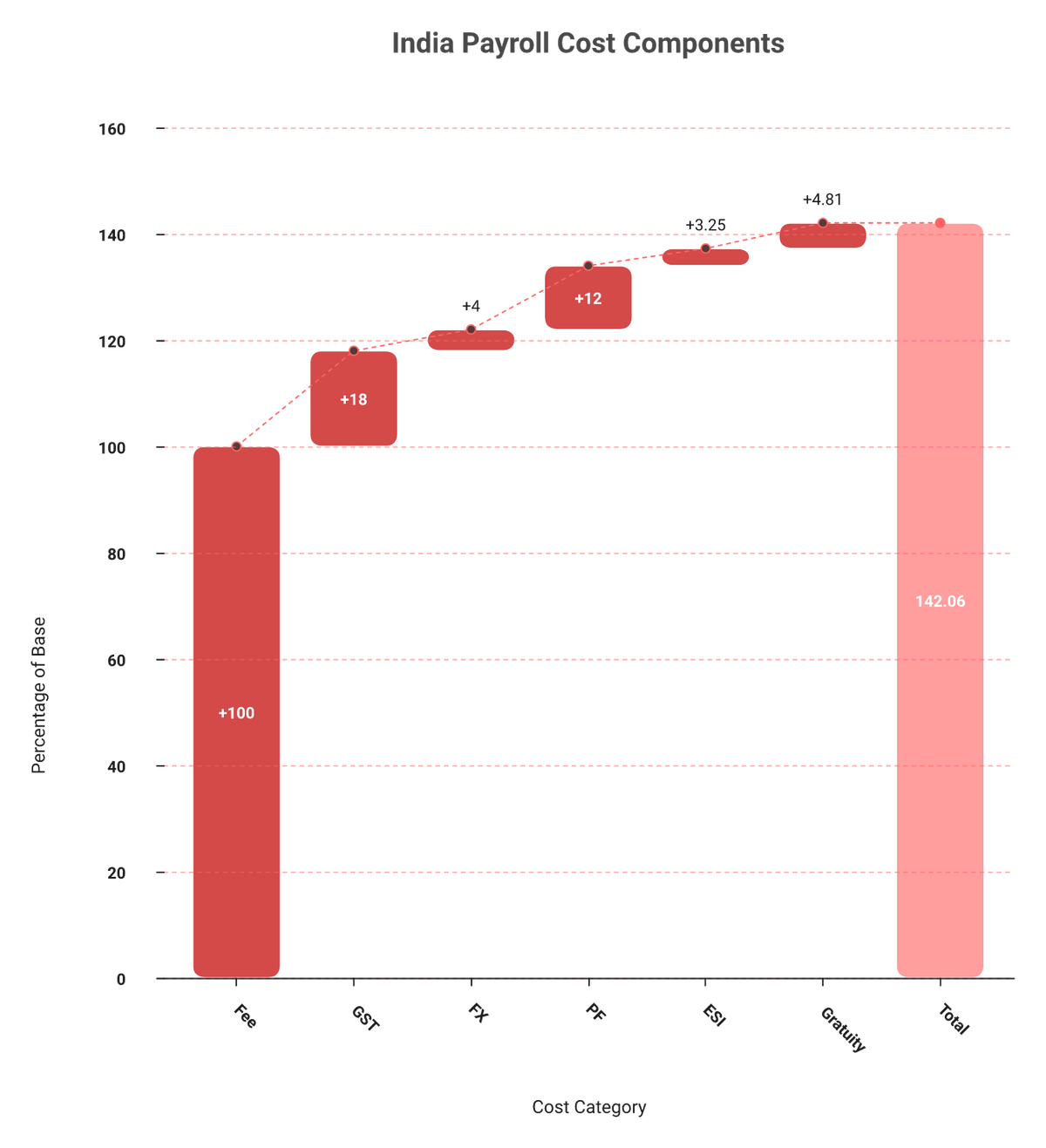
Versatile Club bills one flat per-employee fee in USD from its own Indian entity, with no setup charge, no exit charge, and the first month free. One invoice, one currency, one entity for your controller to reconcile against the general ledger.
Q3. Which are the top 11 payroll outsourcing companies in India for 2026?
The eleven providers worth shortlisting in 2026 are Versatile Club, Wisemonk, ADP India, TopSource Worldwide, Paysquare, TalentPro, Quikchex, PeopleStrong, Keka, Zoho Payroll, and TankhaPay. Versatile Club leads the list for US and UK companies hiring in India without a local entity, because it employs staff on its own Indian entity, invoices in USD from that single entity with no FX markup, and writes a five-business-day onboarding SLA into the service agreement. ADP India suits enterprises that already hold an entity. Keka and Zoho Payroll are payroll software, not outsourcing.
⭐ The criteria, published before the list
Most provider lists on this topic are published by providers who rank themselves first. I am doing the same thing, so here are the five criteria, weighted openly: who holds the PF, ESIC, and S&E registrations (30%), state coverage (25%), price transparency (20%), proof of portal filing (15%), and support model (10%).
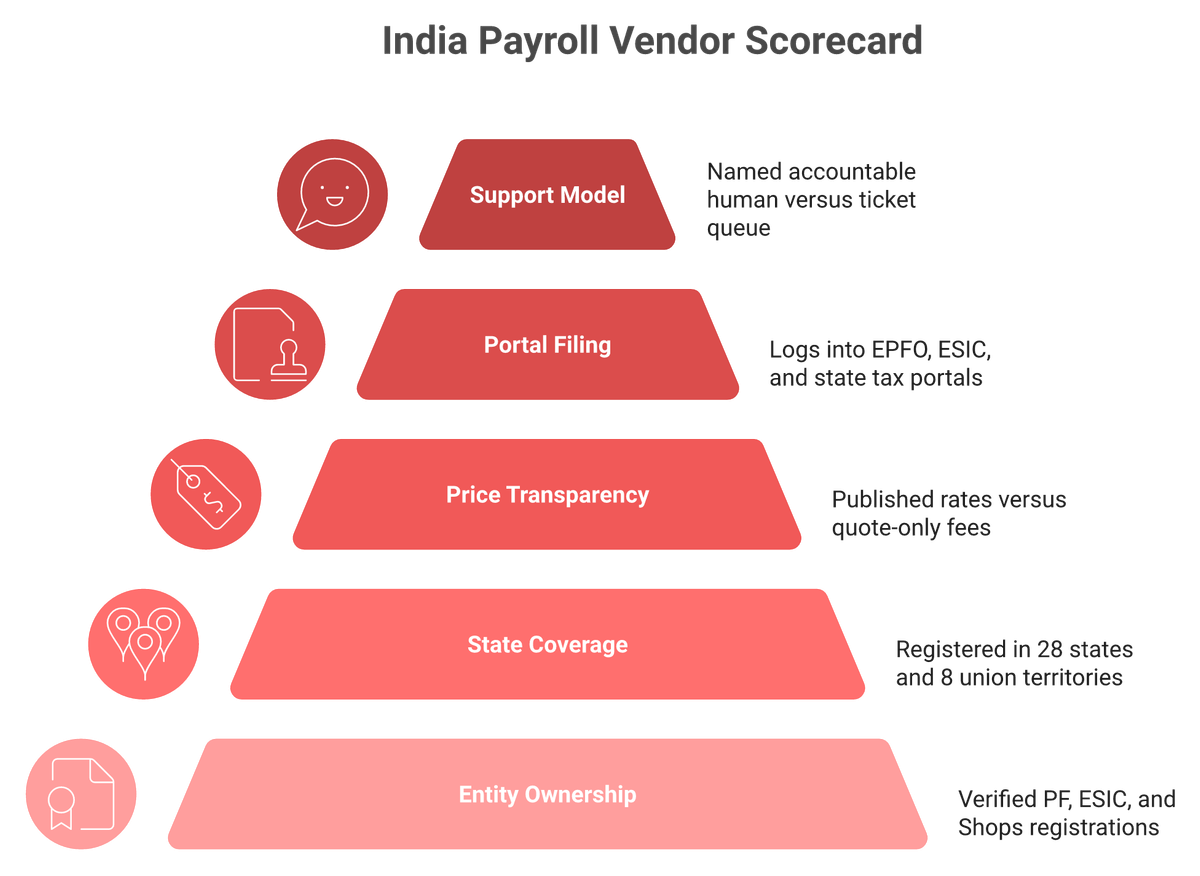
✅ The shortlist
| # | Provider | Model | Published price | Best for |
| 1 | Versatile Club | India-only EOR and C2H, owned entity | Flat $149 per employee per month, $0 setup, $0 exit | US and UK companies, 1 to 30 India hires, no entity |
| 2 | Wisemonk | India-native EOR and managed payroll | $99 to $399, slab based | Buyers who need SOC 2 and ISO 27001 at procurement |
| 3 | ADP India | Enterprise managed payroll | Quote only | 500 plus headcount with an entity |
| 4 | TopSource Worldwide | Managed payroll and EOR | USD bands published | India plus UK dual operations |
| 5 | Paysquare | Managed payroll BPO | Quote only | Mid-market entity holders |
| 6 | TalentPro | Payroll and compliance BPO | Quote only | Multi-state factory and retail payrolls |
| 7 | Quikchex | Payroll plus compliance software | Published tiers | 50 to 300 employees, single country |
| 8 | PeopleStrong | HCM plus payroll | Quote only | Large Indian enterprises |
| 9 | Keka | Payroll software | Published, low PEPM | In-house teams wanting tooling |
| 10 | Zoho Payroll | Payroll software | Published, low PEPM | Small entity holders running payroll themselves |
| 11 | TankhaPay | Payroll plus workforce compliance | ₹150 to ₹2,500 published | Blue-collar and gig-heavy payrolls |
❌ Where each model breaks
Software at the bottom of that table will not file your PTRC challan. Enterprise BPOs will not take a three-person account seriously. Versatile Club is the wrong answer for three documented cases: companies needing EOR in five or more countries, enterprise India teams of 100 plus that require SOC 2 or ISO 27001 as a procurement gate, and B2C consumer hiring. If you are weighing named alternatives instead, the Wisemonk alternative breakdown and the best payroll outsourcing companies in India comparison go deeper per vendor.
⚠️ What reviewers flag on the two India-native options
"I've noticed that their support/query responses can occasionally take a bit longer sometimes, likely due to a relatively small team."
— Verified User in Financial Services, 4 of 5 Wisemonk - G2 Verified Review, 14 June 2025
"Some features feel a bit limited and could use more flexibility. In particular, I'd like to see better options for customization and more detailed reporting."
— Vinay M., HR Operations, 4 of 5 Wisemonk - G2 Verified Review, 18 February 2026
"The dashboard could be a little more self-serve, a couple of times I wanted to pull a report or a doc myself and ended up just messaging my contact instead. They always answered fast, so it wasn't a real problem."
— Angad S., Founder, 5 of 5 Versatile Club G2 - Verified Review, 21 June 2026
Versatile Club sits at position one on one testable fact: the registrations are ours, and we will show you the CIN before you sign. Employer of Record is a 2026 service line here, built on entity and compliance infrastructure proven through six years of Contract-to-Hire placements, and I would rather you know that than discover it.
Q4. Do you need managed payroll or an EOR, and what breaks if you choose wrong?
Managed payroll requires a registered Indian entity with live PF, ESI, TDS, and state Professional Tax accounts. Without an Indian private limited company, managed payroll is legally unavailable, and the route is an Employer of Record, which becomes the direct legal employer of your India hires. Traditional US-style co-employment PEO does not exist under Indian labour law, so a "PEO India" pitch is an EOR under another name. Versatile Club provides Employer of Record employment on its own Indian entity for companies with no local registration, and Contract-to-Hire on the same infrastructure.
✅ The entity test, in one question
Do you hold an Indian Pvt Ltd with active PF and ESIC codes? If yes, managed payroll is open to you. If no, it is not, and no amount of vendor enthusiasm changes that. The PEO services in India explainer covers why the co-employment label does not survive contact with Indian statute.
Paying people as contractors is the third door. It is also the one that quietly accumulates risk.
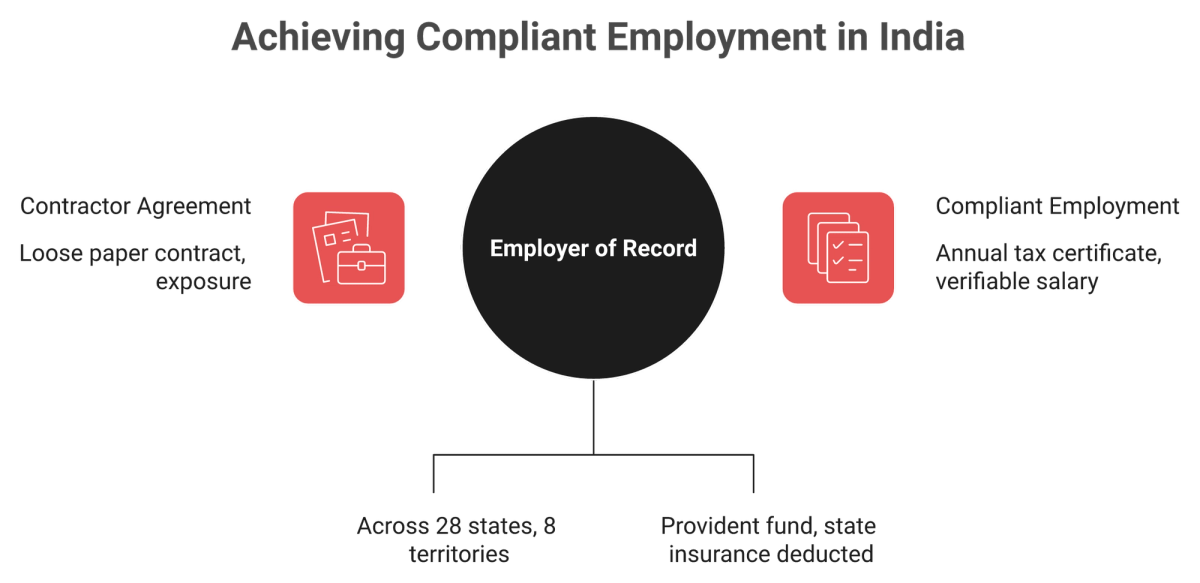
⚠️ How the contractor problem actually surfaces
It almost never surfaces through a government audit first. It surfaces when you hire your first real HR person.
Shamir Gokani, who runs EOR operations for cross-border employers, describes the pattern directly: "when HR people come into an organization and they figure out the hold on a minute there's a little bit of a we could we could be a [risk of misclassification]... they should really not have that person as a contractor they should be an employee because you could have backdated taxes and fines and all the rest of it". The mechanics of fixing it are in our guide on converting a contractor to an employee in India.
⭐ The part nobody models: what it costs your employee
A client had two people relocating back to Romania. One wanted to stay a contractor. He then applied for a mortgage, and was denied. Once he was employed properly through an EOR, the mortgage went through.
Your Bengaluru engineer faces the same wall. Form 16, now Form 130, is what Indian banks ask for. A contractor invoice is not a salary record.
❌ The bridge you do not need to build
The old alternative was incorporation. A subsidiary costs tens of thousands of dollars and six to eighteen months before the first hire, which is a Golden Gate when the job calls for a footbridge. The side-by-side math sits in EOR vs entity in India.
"We looked at setting up a subsidiary and quickly realized it would take 6+ months, cost tens of thousands in legal and registration fees, and require ongoing compliance work we had no expertise in."
— Verified User in Information Technology and Services, 5 of 5 Versatile Club G2 - Verified Review, 23 June 2026
"Local India compliance, FD setup, all of this is complicated to understand to hire a single person. Makes my life as a lean founder extremely easy."
— surbhi m., Founder, 5 of 5 Versatile Club G2 - Verified Review, 15 June 2026
"It took three months to onboard our first 3 individuals. They didn't seem to be able to navigate Visas or variations to employment contracts and this constantly created issues so we had to make a decision to change providers."
— Verified User in Information Technology and Services, 0 of 5 Deel - G2 Verified Review, 13 December 2024
💰 What changed, and what I would watch
What shifted is that India-only EORs now own their entities, so the choice is no longer breadth versus nothing. What I am still unsure about is the crossover point. Versatile Club's own account data points to roughly 20 to 30 India employees before incorporation wins on cost, though I may be reading a small sample too confidently.
Versatile Club employs on its own Indian entity for companies without one, and runs Contract-to-Hire on that same entity, with a five-business-day onboarding SLA written into the contract and PF, ESI, PTRC and PTEC, and TDS by the 7th handled under our registrations. When a client eventually incorporates, the conversion happens inside infrastructure we already hold. If you want that walked through on a call, tell us what you are building.
Q5. What does the 2026 India payroll compliance checklist actually look like?
India payroll compliance in 2026 runs on a fixed calendar. Monthly: EPF at 12% of Basic plus DA filed through the EPFO ECR portal, ESI at 3.25% employer and 0.75% employee, TDS deposited by the 7th, state Professional Tax challans, and Labour Welfare Fund where applicable. Gratuity accrues from month one at 4.81% of Basic plus DA. Quarterly: the TDS return, now Form 138 in place of Form 24Q. Annually: statutory bonus between 8.33% and 20%, the employee tax certificate renamed Form 130, POSH committee compliance, and Shops and Establishments renewals. Versatile Club executes this calendar under its own PF, ESIC, and S&E registrations and returns the challan reference for each filing.
⏰ The monthly cycle, in filing order
| What | Rate or basis | Deadline |
| TDS deposit (Section 392) | Per income tax slab | 7th of the next month |
| EPF via ECR | 12% employer, 12% employee on Basic plus DA | 15th of the next month |
| ESI | 3.25% employer, 0.75% employee (gross up to ₹21,000) | 15th of the next month |
| Professional Tax | State slab, varies | State specific |
| Gratuity accrual | 4.81% of Basic plus DA | Booked monthly, paid on exit |
Sources: EPF Act 1952, ESI Act 1948, Payment of Gratuity Act 1972, and the Income-tax Act 2025. A fuller walkthrough sits in our guide to payroll compliance in India.
✅ The annual and event-driven items people forget
Statutory bonus under the Payment of Bonus Act 1965 runs between 8.33% and 20% of wages for eligible employees. It is a real liability, not a discretionary gift.
Full and final settlement is the other blind spot. On exit, you owe unpaid salary, leave encashment, and gratuity where the service condition is met. Versatile Club books gratuity from month one, so the exit number is never a surprise, and the same discipline shapes how to pay employees in India end to end.
⚠️ The penalty number most pages still get wrong
Several payroll guides still publish damages of 5% to 25% a year under Section 14B of the EPF Act. That figure is outdated. Since the EPFO amendment of June 2024, damages run at 1% per month, which is 12% a year.
Add Section 7Q interest at 12% a year, and the combined burden sits near 24%, capped at the arrears amount. One missed ECR can cost more than a year of service fees.
❌ What late filing looks like from the employee's side
Statutory delay is rarely a quiet accounting event. It lands in someone's bank account, or does not.
"Their payroll is still supported by manual processes, and twice we've had near catastrophic errors. Slow and laborious initial setup."
— Juliette D., HR Leader Remote - G2 Verified Review, 22 April 2026
"Extremely slow speed in resolving HR and payroll issues... On top of that, my salary was not paid on time this month."
— Daryna R., EOR Employee, 0 of 5 Deel - G2 Verified Review, 6 May 2024
💰 The one artifact that proves a filing happened
Versatile Club measures compliance by challan reference, not by status update. A vendor saying "filed" is a claim. A challan number with a date is evidence an auditor will accept.
Ask your provider to attach the ECR challan, the ESI receipt, and the PT challan to the monthly pack. If they cannot produce them, the filing may not have happened.
Versatile Club runs this calendar on its own Indian entity, files under its own PF, ESIC, PTRC, and PTEC registrations, and deposits TDS by the 7th. The monthly client pack carries each challan reference alongside a single USD invoice, so your controller reconciles one document set. The full scope sits on our compliance page.
Q6. How does the New Labour Code's Basic plus DA rule change your payroll cost?
The Code on Wages, 2019 came into force on 21 November 2025 through Ministry of Labour and Employment notification S.O. 5322(E). Under Section 2(y), where excluded allowances exceed one half of total remuneration, the excess is added back into "wages". In practice, Basic plus DA must reach 50% of CTC, which widens the base for both PF and gratuity. On a ₹10 lakh CTC, the gratuity wage base moves from ₹4,00,000 to roughly ₹7,17,490, taking a seven-year gratuity payout from about ₹1,34,610 to ₹2,41,460. Versatile Club restructures salary stacks against Section 2(y) before the first payroll run.
⚠️ What actually changed on 21 November 2025
The old game was simple. Keep Basic low, load the rest into allowances, and your PF and gratuity liability stayed small. Allowance-heavy CTCs of 30% Basic were normal in Indian startups.
Section 2(y) closed that door. The statute now looks past the label on each line item and asks what share of total pay sits outside "wages", per the gazette notification bringing the Code on Wages into force.
💰 The restatement, on a ₹10 lakh CTC
| Line | Old structure | Post Section 2(y) |
| Gratuity wage base | ₹4,00,000 | ₹7,17,490 |
| Gratuity payable at 7 years | ₹1,34,610 | ₹2,41,460 |
| Monthly accrual at 4.81% | On ₹33,333 | On ₹59,790 |
Reported modelling puts the manpower cost increase at roughly 5% to 10% for allowance-heavy structures. Nobody got a raise. The liability simply became visible, and it moves the real cost of hiring in India without touching anyone's take-home.
❌ Why this breaks the global-platform model quietly
A platform running India as one of 150 countries updates a rate table. It does not rebuild your salary structure, because structure is advisory work, not configuration.
Versatile Club's read is that the standard advice gets this backwards. The compliance risk here is not a missed filing. It is eighteen months of under-accrued gratuity surfacing in a Series B diligence pack, which is exactly where I have watched it surface.
✅ The lever almost nobody uses
There is an upside hidden in the restructure. Once you are rebuilding the stack anyway, National Pension System contributions under Section 80CCD become worth modelling.
For higher earners, NPS structuring can reduce tax liability by roughly 20% to 25% through its exempt-exempt-exempt treatment. Software platforms skip this because it needs a human to redesign the CTC, not a toggle. Model your own numbers with the India salary calculator.
⏰ What I would do on Monday
Three steps, in order. First, pull every CTC and calculate the Basic plus DA share. Second, restate gratuity provisioning on the new base, and tell your auditor before they find it. Third, ask your provider for the restated accrual schedule in writing.
Versatile Club's own account data suggests most US-funded India teams were sitting at 30% to 40% Basic before this change, though that sample is small enough that I hold the number loosely.
Versatile Club restructures the salary stack against Section 2(y) at onboarding, then books gratuity at 4.81% of the corrected Basic plus DA from month one. The restated accrual appears in the monthly client pack, so the liability sits on your books as it builds, not after an audit finds it. Walk through the sequence on how it works.
Q7. Why does multi-state Professional Tax break most payroll vendors?
Professional Tax in India is a state levy, with no shared calendar, format, or slab. Maharashtra requires dual registration (PTRC for employees and PTEC for the entity), monthly slab filing, and annual returns. Karnataka runs monthly PT plus Shops and Establishments renewal, with enrolment within 30 days of joining. Tamil Nadu files twice a year, in June and December, alongside Labour Welfare Fund contributions. West Bengal changes rules frequently. Delhi has no Professional Tax but enforces strict S&E compliance. Telangana requires PTRC enrolment with monthly remittance. Versatile Club holds registrations across 28 states and 8 union territories.
⭐ One remote hire, one new state, one new registration
Here is the moment this becomes real. Your Bengaluru engineer refers a friend in Pune. You say yes, because talent is talent, and the offer goes out that week.
You have now entered Maharashtra. That means PTRC and PTEC, two separate registrations, on a monthly slab cycle. The engineer starts in five days. The registration does not.
✅ The six states most US and UK teams touch
| State | Registration type | Cycle | The trap |
| Maharashtra | PTRC plus PTEC | Monthly slab, annual return | Two registrations, often only one gets done |
| Karnataka | PT plus S&E renewal | Monthly | Enrolment within 30 days of joining |
| Tamil Nadu | PT plus LWF | Biannual, June and December | Easy to miss a June window |
| West Bengal | PT | Monthly | Rules and leave rules change often |
| Delhi | S&E only | Renewal based | No PT lulls teams into skipping S&E |
| Telangana | PTRC | Monthly remittance | Deadlines differ from Karnataka's |
Source: respective state Professional Tax and Shops and Establishments Acts, including the Maharashtra Profession Tax portal and the Karnataka Professional Tax portal. City-level detail sits in our pages on payroll outsourcing in Bengaluru and payroll outsourcing in Hyderabad.
⚠️ The parallel US teams already understand
If you run a Series B SaaS company, you have met this problem. It is US multi-state sales tax. One remote seller in a new state creates a nexus, a registration, and a filing cadence nobody planned for.
India's PT works the same way, except the cycles are monthly, and the portals do not talk to each other. Versatile Club carries the registrations in advance, so a new state is a payroll instruction, not a project, which is the whole point of being able to hire in India without an entity.
❌ Where the handoff actually fails
It is rarely the filing itself. It is the instruction about the filing.
Across six years of running multi-state payroll through Contract-to-Hire placements, Versatile Club's protocol is simple: every state-specific payroll instruction gets confirmed in writing, same day, usually on WhatsApp. Verbal confirmation is where a Tamil Nadu June deadline dies.
"Hiring talent in India without a local entity was a compliance minefield, PF, ESI, TDS, professional tax across states. Versatile's Employer of Record India setup eliminated all of that."
— Vedant T., Agency Founder, 5 of 5 Versatile Club G2 - Verified Review, 16 June 2026
"The initial documentation and paperwork felt quite detailed and time-consuming at the beginning. However, as we progressed, it became clear that this thoroughness is what ensures proper legal and compliance coverage."
— Verified User in Marketing and Advertising, 3.5 of 5 Wisemonk - G2 Verified Review, 12 February 2026
That second review is fair, and it applies to us too. India paperwork is heavy at the start. The alternative is paperwork later, with penalties attached.
Versatile Club holds PF, ESIC, and Shops and Establishments registrations across all 28 states and 8 union territories, built through Contract-to-Hire operations in Bengaluru, Hyderabad, and Pune. A hire in a new state runs on the five-business-day onboarding SLA written into the contract, because the registration already exists.
Q8. What hidden fees turn a cheap PEPM quote into a surprise invoice?
Quoted PEPM in India typically understates real cost by 20% to 60%. The usual additions are setup or implementation fees of ₹5,000 to ₹50,000, security deposits, off-cycle payroll run charges, custom report and integration fees, minimum billing floors of ₹10,000 to ₹25,000, a multi-state premium of 15% to 30%, benefits markup, exit or offboarding fees, 18% GST on the service fee, and FX conversion markups of 3% to 5% on cross-border billing. Versatile Club bills a single flat fee per employee per month in USD from its own Indian entity, with no setup fee, no exit fee, and the first month free.
💸 The nine lines that move the number
| Line item | Typical range | When it appears |
| Setup or implementation | ₹5,000 to ₹50,000 | Signature |
| Security deposit | One to two months of fees | Signature |
| Minimum billing floor | ₹10,000 to ₹25,000 monthly | Small teams only |
| Off-cycle payroll run | Per run | Mid-month joiners, corrections |
| Multi-state premium | 15% to 30% | Second state onward |
| Custom reports, integrations | Per build | Month two or three |
| FX conversion markup | 3% to 5% | Every cross-border payment |
| GST on service fee | 18% | Every India-billed invoice |
| Exit or offboarding | Per employee or flat | When you leave |
The 18% service-fee rate comes from the CBIC GST rate schedule. For a line-by-line view of what an EOR invoice should contain, see Employer of Record India cost.
⚠️ The audit that takes fifteen minutes
Do not ask for a quote. Ask for a live sample invoice from a client of similar size and state spread, with the line items visible.
Then ask three questions in writing. Which of these nine lines apply to us? What triggers each one? What does our invoice look like in month thirteen, after the promotional period ends?
❌ What reviewers describe when this goes wrong
"Previously, I was paid directly by my employer without any additional costs. Now, I'm required to pay a monthly fee, which I don't like at all. The initial setup process was also very challenging; it took several days and involved a lot of emails, with issues arising at every step."
— Verified User in Translation and Localization, Contractor, 0.5 of 5 Deel - G2 Verified Review, 31 July 2025
"We had to carefully manage our agreement and had to constantly remind them of the fees agreed so that we weren't over charged. Everything was VERY time consuming."
— Verified User in Information Technology and Services, 0 of 5 Deel - G2 Verified Review, 13 December 2024
"First USD invoice landed clean: no FX markup, no setup fee, no surprises."
— Verified User in Information Technology and Services, Founder, 5 of 5 Versatile Club G2 - Verified Review, 23 June 2026
If the add-on pattern is what pushed you to look elsewhere, the Deel alternative comparison breaks the invoice apart line by line.
💰 Why this exists, and the one markup I refuse
Slab pricing and add-ons are not accidents. They let a vendor publish a low entry number and recover margin on the lines nobody compares.
Versatile Club takes no markup on the employee's salary, and that is deliberate. A percentage on top of someone's pay is an IT-services model wearing EOR clothing, and sophisticated CFOs spot it in one invoice.
✅ The honest trade-off
Versatile Club's structure has a cost. A flat fee regardless of salary means a competitor's lowest slab can look cheaper on a junior hire, and on that single row it genuinely is.
What changes is the full-year picture across a mixed salary band, plus the absence of setup, exit, and FX lines. I think that is the better trade, though a buyer hiring one intern could reasonably disagree.
Versatile Club bills one flat per-employee fee in USD from its own Indian entity, with no setup charge, no exit charge, no FX markup, and no salary markup. The first month is free, which exists so you can test the invoice before the risk is real. The current structure is published on our pricing page.
Q9. How do global platforms compare with India-native payroll providers?
Global platforms (Deel, Remote, G-P, Multiplier, Velocity Global, Papaya, and Skuad) optimise for breadth across 90 to 185 countries, price Employer of Record service between $400 and $599 per employee per month, run India through local partner entities in most cases, and onboard in one to two weeks. India-native operators run on their own Indian registrations, price between $99 and $149, and support through named humans rather than ticket queues. Versatile Club employs on its own Indian entity with PF, ESIC, and Shops and Establishments registrations across 28 states and 8 union territories, and writes a five-business-day onboarding SLA into the service agreement.
⭐ The structural choice each model made
Neither model is careless. They solved different problems.
A platform covering 185 countries cannot hold deep statutory knowledge in each one, so it builds software and rents local entities. That is a reasonable trade if you hire in twelve countries. It is a poor trade if India is the hire, which is the argument we set out in full across the best EOR in India breakdown.
✅ The honest comparison
| Criteria | Global generalists | Wisemonk | Versatile Club |
| Countries | 90 to 185 | India focused | India only |
| India entity | Often a local partner | Own entity | Own entity |
| EOR price per month | $400 to $599 | $99 to $399, slab based | $149 flat |
| Onboarding | 7 to 14 days typical | 24 to 72 hours, not contractual | 5 business days, in the contract |
| Support model | Ticket queue or CSM rotation | Account team | Founder on WhatsApp |
| Security certification | SOC 2, ISO 27001 | SOC 2, ISO 27001 | Not yet certified |
Published rates come from each vendor directly: Deel, Remote, Multiplier, Velocity Global, Papaya Global, Skuad, and Wisemonk. That last row matters. Versatile Club does not hold SOC 2 or ISO 27001 today, and for an enterprise procurement gate that is a genuine blocker.
❌ Where buyers say the generalist model strains
"Customer support and issue ownership need serious improvement. In my experience, contacting support did not lead to effective problem solving. I was redirected multiple times, asked to repeat the same information to different representatives."
— Güneş A., EOR Employee, 1.5 of 5 Deel - G2 Verified Review, 2 October 2025
"They were dishonest about the level of support provided. We specifically explained we required phone-level support for urgent matters, but that is not available. Instead they have email support with a 3-day SLA."
— Juliette D., HR Leader Remote - G2 Verified Review, 22 April 2026
A three-day email SLA is fine for a benefits question. It does not work when a PF challan is due in four hours. If support responsiveness is your switch trigger, the Remote alternative and Multiplier alternatives in India comparisons go vendor by vendor.
⚠️ And where we strain too
Versatile Club gets this wrong sometimes, and the reviews say so plainly.
"The team is really competent, but there were a few time zone misunderstandings that caused slight delays in the initial phase."
— Setu C., Operations Lead, 5 of 5 Versatile Club G2 - Verified Review, 10 June 2026
India to US time zones are a real cost of founder-direct service. A 24-hour ticket desk never sleeps. A person in Bengaluru does.
💰 What I think shifts next
Versatile Club's read is that India stops being one country on a global EOR map and becomes its own category. Owned-entity operators in one country take the India revenue, the way AWS regional depth beat generic hosting.
I hold that loosely. It is a founder's bet, not a forecast with data behind it.
Versatile Club is the wrong answer for buyers needing five or more countries, and recommends a split-vendor setup in those cases. For companies where India is the whole India plan, employment sits on our own entity, with PF, ESI, PTRC, PTEC, and TDS by the 7th filed under our registrations, through our EOR services in India.
Q10. When is outsourcing the wrong call, in-house payroll versus a provider?
Outsourcing stops paying for itself when a company has a full-time India payroll and compliance person, stable single-state headcount, and no cross-border invoicing to reconcile. The comparison needs four lines: loaded salary for a payroll executive plus a compliance consultant, payroll software licence cost, audit and penalty exposure, and leadership time spent on filings. Below roughly 50 single-state employees, a provider is almost always cheaper. Versatile Club's account data points to a crossover near 20 to 30 India employees for companies using Employer of Record service, after which incorporating and running payroll in-house starts to win on cost alone.
💰 The four-line comparison most teams skip
Vendor quotes get compared to zero. That is the error. In-house payroll has a price; it is just spread across people who already work for you.
| Line | 25 employees | 100 employees | 300 employees |
| Payroll executive (loaded) | Part of an HR role | 1 full-time | 2 full-time |
| Compliance consultant or CA | ₹15,000 to ₹40,000 monthly | ₹40,000 plus | In-house counsel |
| Payroll software | ₹30 to ₹150 per employee | Same | Same |
| Penalty exposure | Near 24% a year on arrears | Same rate, larger base | Same rate, larger base |
The penalty line is the one finance teams under-weight. Section 14B damages run at 1% a month, and Section 7Q interest adds 12% a year, per the EPF Act 1952. Run your own version of this with the EOR vs entity calculator.
⏰ The bridge, not the Golden Gate
Here is the frame I use on calls. A provider is a footbridge: light, fast, and removable. An Indian subsidiary is the Golden Gate, which is a fine structure if you plan to carry traffic for twenty years.
A subsidiary costs tens of thousands of dollars and six to eighteen months before the first hire. For three engineers, that is building a warehouse to store a bicycle. The structural options are laid out in India expansion options and, for larger plans, GCC setup in India.
✅ When in-house genuinely wins
Three situations, honestly stated. You already hold an Indian entity with live PF and ESIC codes. Your headcount sits in one or two states, so Professional Tax stays simple. And you have crossed enough scale that a dedicated payroll hire is cheaper than per-head fees.
Versatile Club tells clients when they have reached that point, because the alternative is losing the account to a spreadsheet built in a board meeting. At that stage, managed payroll on your own entity is usually the right next product.
⚠️ What the switch actually costs
Nobody prices the migration. Moving payroll in-house mid-year fragments Form 130, breaks PF UAN continuity if handled badly, and lands the first in-house cycle on someone who has never filed an ECR.
"The initial process took a little getting used to, but the team was quick to guide us through and it became very straightforward."
— Verified User in Venture Capital and Private Equity, Investor, 4.5 of 5 Versatile Club G2 - Verified Review, 22 June 2026
That learning curve exists in both directions. Plan the switch at a financial year boundary, in April, not in October. The mechanics of a clean handover sit in our guide to switching EOR provider in India.
❌ The number I am least sure about
Versatile Club's crossover estimate of 20 to 30 employees comes from our own account base, which is small. Published guidance often puts it near 15. I would treat both as a range, not a line.
Versatile Club runs Employer of Record and Contract-to-Hire on its own Indian entity, which means a client who later incorporates converts inside infrastructure we already hold. The monthly client pack carries each challan reference, so the handover file already exists when you decide to bring payroll in-house.
Q11. How do you vet a payroll vendor before you sign, and verify in the first 90 days?
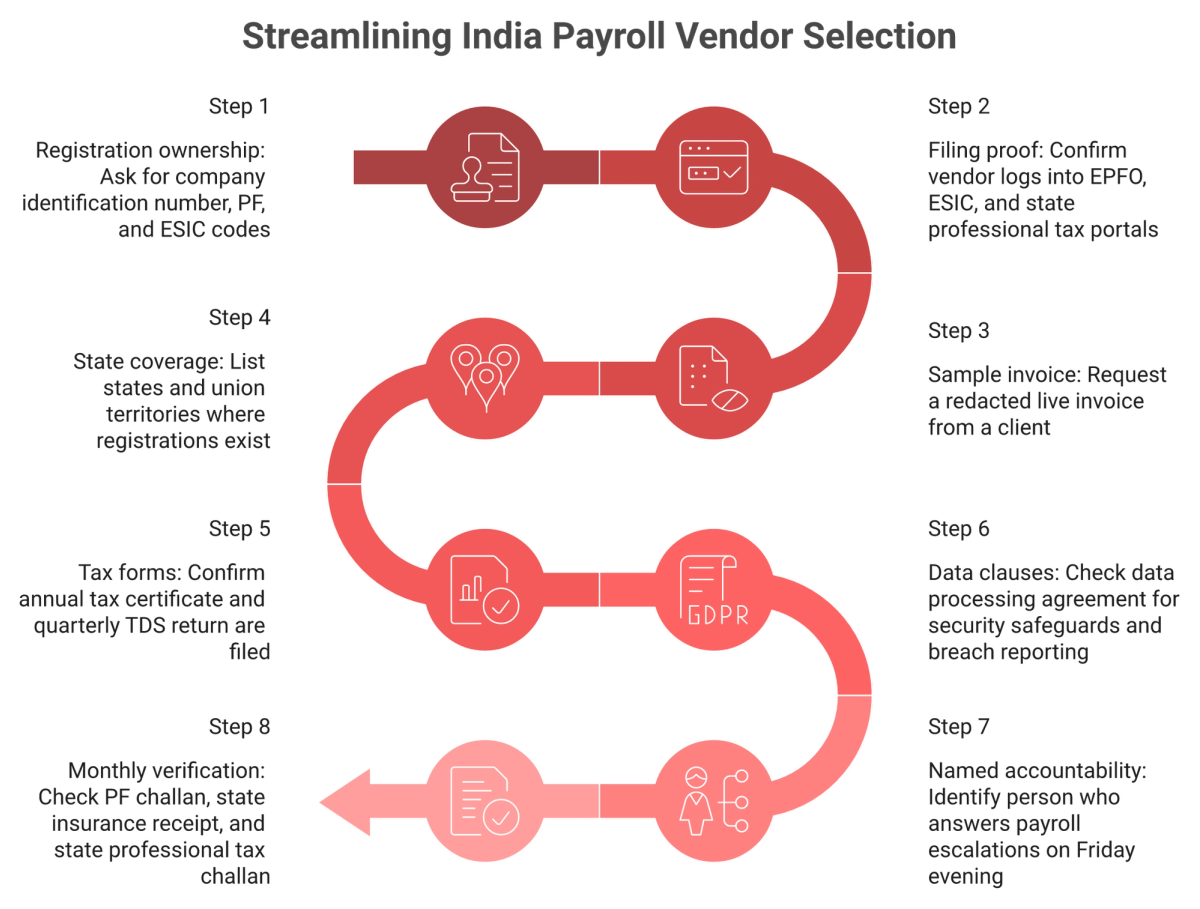
Seven items should be confirmed in writing before signature: who holds the PF, ESIC, and Shops and Establishments registrations, with the company CIN; whether the vendor files on the government portals or only generates reports; a live sample invoice from a comparable client; the states where registrations exist; whether Form 130 is issued and Form 138 filed from TRACES; DPDP Rule 6 and Rule 7 clauses in the data agreement; and the named person accountable when a deadline is four hours away. Versatile Club supplies its CIN, state registration list, and challan-level monthly reporting during evaluation.
✅ The seven questions, in order
Who holds the registrations? Ask for the CIN and the PF and ESIC codes.
Do you log into EPFO, ESIC, and the state PT portals yourself?
Can we see a redacted sample invoice from a client of our size?
Which states and union territories are you registered in?
Do you issue Form 130 by 15 June and file Form 138 quarterly from TRACES?
What DPDP clauses are in your data processing agreement?
Who, by name, answers a payroll escalation on a Friday evening?
Company identity can be checked independently on the MCA company master data portal, which is the fastest way to confirm an entity actually exists. Our own answers to all seven sit on the compliance page.
⚠️ The DPDP clauses to insist on now
The Digital Personal Data Protection Rules, 2025 were notified on 13 November 2025 through MeitY notification G.S.R. 846(E), with a corrigendum on 11 December 2025. The dates matter, because they are staggered.
| Rules | In force from |
| Rules 1, 2, and 17 to 21 | 13 November 2025 |
| Rule 4, Consent Managers | 13 November 2026 |
| Rules 3, 5 to 16, 22, and 23 | 13 May 2027 |
Rule 6 requires encryption or masking, access control, and one year of log retention. Rule 7 requires a detailed report to the Data Protection Board within 72 hours of a breach, under the Digital Personal Data Protection Act, 2023.
❌ Why payroll is the sharp end of this
Payroll holds PAN numbers, bank details, salary, and addresses for every employee. It is the most sensitive dataset most companies process, and the one routed through the most third parties.
"I was required to provide personal identity documents (like a passport), despite offering full corporate documentation for my U.S.-based LLC. This is not standard in B2B cooperation and raises serious privacy concerns."
— Verified User in Translation and Localization, Agency Owner, 0.5 of 5 Deel - G2 Verified Review, 5 May 2025
Versatile Club keeps employee payroll data inside the Indian entity that employs the person, which answers the question global platforms find awkward: which partner, in which country, currently holds your engineer's bank details. The same single-entity logic is why clients can hire employees in India without mapping a partner chain.
⏰ The first 90 days
Verify, do not assume. Each month, check three artifacts: the ECR challan reference, the ESI receipt, and the state PT challan.
Ask open questions, not closed ones. "Where are we on the filing schedule?" surfaces problems. "Are we on schedule?" invites a yes.
"Every payroll or PF question gets a real answer from a real person, usually same day."
— Verified User in Information Technology and Services, Founder, 5 of 5 Versatile Club G2 - Verified Review, 23 June 2026
"Their team was highly responsive, professional, and easy to work with throughout the process. Communication was always clear."
— Mukul S., People Operations, 5 of 5 Versatile Club G2 - Verified Review, 16 June 2026
Versatile Club answers all seven questions on the first call, with the CIN, the state registration list, and a sample monthly pack. If you are weighing India payroll options this quarter, message me on WhatsApp and tell me what you are building. I will tell you honestly if a provider is even the right product for you, or you can pick a 30-minute slot and we will go through your numbers together.
FAQs
How much does it cost to outsource payroll in India in 2026?
Payroll outsourcing in India costs ₹150 to ₹2,500 per employee per month in 2026. The band splits cleanly by scope:
- ₹150 to ₹400: basic processing, payslips, and reports only
- ₹300 to ₹800: payroll plus statutory filings, where most mid-market buyers land
- ₹800 to ₹2,500 and above: managed payroll with HR support
Headcount moves the number too. Teams of 1 to 25 typically pay ₹400 to ₹800 PEPM, while 100 to 500 employees negotiates down to ₹250 to ₹450. Minimum billing floors of ₹10,000 to ₹25,000 a month override the small-team math entirely.
For US and UK buyers pricing in dollars, managed payroll benchmarks near $49 per employee per month for companies that already hold an Indian entity, while Employer of Record pricing runs $99 to $599.
Versatile Club bills a single flat fee per employee per month in USD from its own Indian entity, with no setup fee, no exit fee, and the first month free. We built it that way because slab pricing hides margin in the rows nobody compares. The full breakdown of what sits inside each tier is in our guide to payroll outsourcing services in India.
Is ₹30 to ₹150 PEPM enough to run compliant payroll in India?
No. The ₹30 to ₹150 per employee per month band is payroll software pricing, not outsourcing. Tools in that range calculate salary, generate payslips, and produce challan-ready files. They do not log into the government portals on your behalf.
That distinction decides who carries the liability. Three questions separate the two products:
- Will the vendor file the EPF ECR, ESI contribution, and state Professional Tax challans themselves?
- Will they return the challan reference number as proof?
- Will they handle Form 138 quarterly and issue Form 130 annually from TRACES?
If the answer to any of those is no, the statutory default stays with your company under the EPF Act 1952 and the ESI Act 1948. Section 14B damages now run at 1% per month, and Section 7Q adds 12% interest a year, so one missed ECR can cost more than a year of service fees.
Versatile Club files under its own PF, ESIC, PTRC, and PTEC registrations and attaches each challan reference to the monthly client pack. Across six years of running these cycles, we have found that proof of filing matters more than any dashboard. The full calendar sits in our guide to payroll compliance in India.
Can we outsource India payroll if we do not have an Indian entity?
Not as managed payroll. Managed payroll requires a registered Indian company with live PF, ESI, TDS, and state Professional Tax accounts, because the provider files under your registrations. Without that entity, the route is an Employer of Record, which becomes the legal employer of your India hires on its own registrations.
One trap worth naming: traditional US-style co-employment PEO does not exist under Indian labour law. Any "PEO India" pitch is an EOR wearing a different label.
The third door, paying people as contractors, is where misclassification risk accumulates quietly. It usually surfaces when a company hires its first real HR person, who reviews the arrangements and flags backdated tax exposure. It also hurts the employee, who cannot produce a salary record when applying for a mortgage.
Versatile Club employs on its own Indian entity for companies with no local registration, with PF, ESIC, and Shops and Establishments registrations across all 28 states and 8 union territories, and a five-business-day onboarding SLA written into the service agreement. If you are mapping the entity question against cost, our comparison of EOR versus setting up an entity in India runs the three-year math side by side.
How does the New Labour Code's Basic plus DA rule change payroll cost?
The Code on Wages, 2019 came into force on 21 November 2025 through Ministry of Labour and Employment notification S.O. 5322(E). Under Section 2(y), where excluded allowances exceed one half of total remuneration, the excess is added back into "wages". In practice, Basic plus DA must reach 50% of CTC.
That widens the base for both PF and gratuity without anyone receiving a raise. On a ₹10 lakh CTC:
- Gratuity wage base moves from ₹4,00,000 to roughly ₹7,17,490
- A seven-year gratuity payout moves from about ₹1,34,610 to ₹2,41,460
- Monthly accrual at 4.81% now sits on ₹59,790 instead of ₹33,333
Reported modelling puts the manpower cost increase near 5% to 10% for allowance-heavy structures. The real risk is not a missed filing. It is eighteen months of under-accrued gratuity surfacing in a Series B diligence pack.
Versatile Club restructures the salary stack against Section 2(y) at onboarding, then books gratuity at 4.81% of the corrected Basic plus DA from month one, with the restated accrual shown in the monthly pack. For a broader view of what the Labour Codes do to budgets, see our breakdown of the cost of hiring in India.
How do we verify a payroll provider is actually filing PF, ESI, and PT?
Verify by artifact, not by status update. A vendor saying "filed" is a claim. A challan number with a date is evidence an auditor accepts.
Before signing, get seven items in writing:
- Who holds the PF, ESIC, and Shops and Establishments registrations, with the company CIN
- Whether they file on the portals or only generate reports
- A redacted sample invoice from a client of your size and state spread
- Which states and union territories they are registered in
- Whether they issue Form 130 by 15 June and file Form 138 quarterly from TRACES
- DPDP Rule 6 and Rule 7 clauses in the data processing agreement
- The named person who answers an escalation on a Friday evening
Then, for the first 90 days, check three artifacts monthly: the ECR challan reference, the ESI receipt, and the state PT challan. Ask open questions. "Where are we on the filing schedule?" surfaces problems that "Are we on schedule?" never will.
Versatile Club supplies its CIN, state registration list, and challan-level monthly reporting during evaluation, before any contract is signed. If you are already mid-migration from another provider, our guide on switching EOR provider in India covers PF UAN continuity and Form 130 fragmentation.