Table of contents (10)
PEO Pricing in India: What It Actually Means in the Indian Market, EOR Cost Structure, Hidden Fees, and All-In Per-Employee Math
Q1: Is "PEO Pricing" Even the Right Question for Hiring in India?
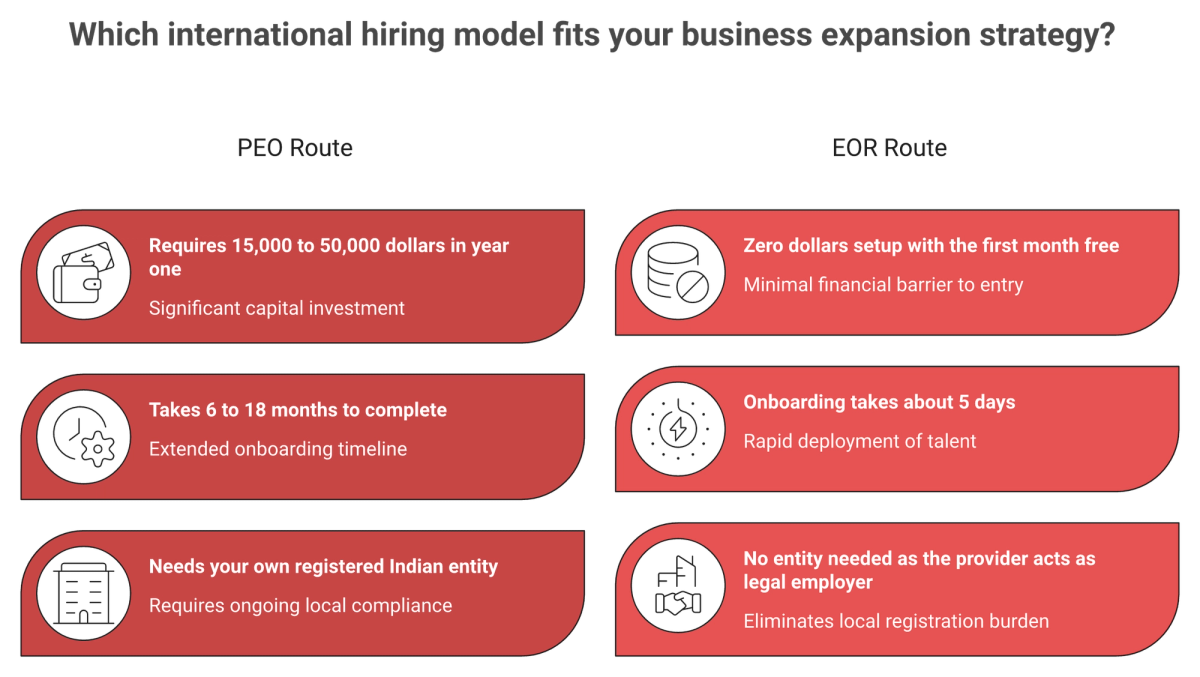
If you do not already own an Indian entity, "PEO pricing" is the wrong number to chase. US-style co-employment PEO has no legal basis under Indian labour law. It applies only if you already have a local subsidiary. Entity-less companies must use an Employer of Record (EOR). True PEO means paying a service fee plus your own entity's setup ($15,000 to $50,000 in year one) and ongoing compliance. EOR bundles all of it into one per-employee fee.
🧭 The keyword that quietly misleads you
A US founder messaged me on WhatsApp at 11pm her time, three days after closing a seed round. She had been googling "PEO pricing India" all afternoon. She wanted to hire two engineers in Bengaluru in 30 days, not in 12 to 18 months.
Here is what the standard read gets backwards. In the US, a PEO co-employs your staff under your existing legal entity. India does not recognise that co-employment structure for a foreign company with no local registration.
⚖️ Why the legal split changes your whole budget
So the real question is not "what does PEO cost." It is "am I actually buying an EOR in India, and what does it cost all-in after FX markups and misclassification risk surface in due diligence."
An EOR becomes the legal employer on your behalf. You manage the person day to day. We handle PF, ESI, TDS, and statutory filings under our own registrations. A PEO arrangement, by contrast, only works once you have spent the time and money to incorporate.
"Every option I looked at first was either 'set up your own entity' (no thanks, not for one hire) or some platform that quotes you a great price and then you find out about all the add-ons later."
Angad S., Founder Versatile G2 Verified Review
💰 Pricing both routes, side by side
Let me lay the two routes next to each other in plain numbers.
| Route | Upfront cost | Time to first hire | Ongoing |
|---|---|---|---|
| EOR (no entity) | $0 setup | 5 days | One per-employee fee, bundled |
| Own entity plus PEO/payroll admin | $15,000 to $50,000 yr 1 | 6 to 18 months | Subsidiary compliance plus admin fee |
For one to ten hires, the EOR route wins on cash and speed almost every time. The entity math only starts to pay back later, which I cover in a dedicated section below. You can model your own crossover point with our EOR vs entity calculator.
At Versatile Club, I will never quote you a PEO arrangement you cannot legally use. No Indian entity means you need an EOR, and that is exactly what our EOR services deliver, through our own registered Indian entity rather than a partner shell.
Q2: Why Is the Sticker Fee a Trap? Flat PEPM vs Percentage-of-Payroll
India EOR service fees run roughly $99 to $700 per employee per month. They are billed either as a flat per-employee fee or as a percentage of payroll. Flat PEPM is predictable and does not penalise high salaries. Percentage-of-payroll quietly grows with every raise and bonus. For tech teams paying above $100,000 equivalent, refuse percentage pricing. Either way, the platform fee is the smallest part of your true cost.
📉 The number on the pricing page is not the bill
PEPM means "per employee per month." It is the headline admin fee, and it is designed to look small.
Here is the thing most pages skip. That admin fee is only 12 to 15 percent of your total India spend. The statutory costs and FX layer sit on top, and they move the real money. Our transparent pricing shows the full picture upfront.
⚖️ Flat fee or percentage: the high-wage trap
Two billing models dominate the category. The model you pick matters more than a $20 difference in sticker price.
| Model | How it is charged | Best for | Watch out |
|---|---|---|---|
| Flat PEPM | Fixed fee per active employee | Salaries above $75k equivalent | Part-timers may count as full heads |
| Percentage of payroll (2 to 6%) | Tied to gross payroll each cycle | Lower-wage, variable teams | Every raise and bonus raises your bill |
A simple rule from running real payroll: above $100,000 average wage, never accept percentage-of-payroll. A $50,000 year-end bonus on a 4 percent model adds up to $2,000 to that month's fee for zero extra work.
"I find Remote super complicated to use, with zero clarity on the process. Also, there are hidden fees everywhere, and I end up paying roughly 30% more than what's stated on the platform."
Javier G. Remote G2 Verified Review
The opacity is structural across global generalists. Wisemonk publishes "from $99" but real per-tier pricing needs a sales call. Deel and Remote sit near $599 per month with their own add-on layers. If you are weighing those options, our Deel alternative breakdown puts the numbers side by side.
"Multiplier offered competitive pricing... They also introduced some new deposits and fees that weren't originally in our contract and ultimately ended up increasing our EOR costs."
Verified User in IT Multiplier G2 Verified Review
✅ Get the all-in number in writing
Before you compare any two quotes, ask each provider for a written all-in PEPM. That number must fold in the service fee, statutory costs, FX, and any one-off charges.
At Versatile Club, we invoice in USD directly from our own Indian entity. No routing through a foreign holding company, no INR conversion, no FX exposure on your end, no setup fee, and the first month is free. That is a structural capability of how we work, not a discount we toggle on.
"Invoicing in USD meant zero exchange rate surprises. Five-day onboarding, zero late payslips. This is what India EOR should look like."
Vedant T., Founder Versatile G2 Verified Review
Q3: What's the Real All-In Per-Employee Math? PF, ESI, Gratuity, Professional Tax, TDS
An India employee's true cost equals gross salary, plus employer PF (12 percent of Basic plus DA, capped at the ₹15,000 wage base), plus ESI (3.25 percent employer, for wages up to ₹21,000), plus gratuity accrual (4.81 percent of Basic plus DA from month one), plus professional tax (state-wise), plus the EOR fee. TDS is deducted from the employee and deposited by the 7th monthly. Stacked up, the $99 fee is a fraction of the real bill.
🧱 The statutory stack, line by line
Two engineers on the same EOR plan can cost you different totals. The reason is the statutory layer, not the admin fee.
Here is what runs under every compliant India payroll, and why deep multi-state compliance matters at every step:
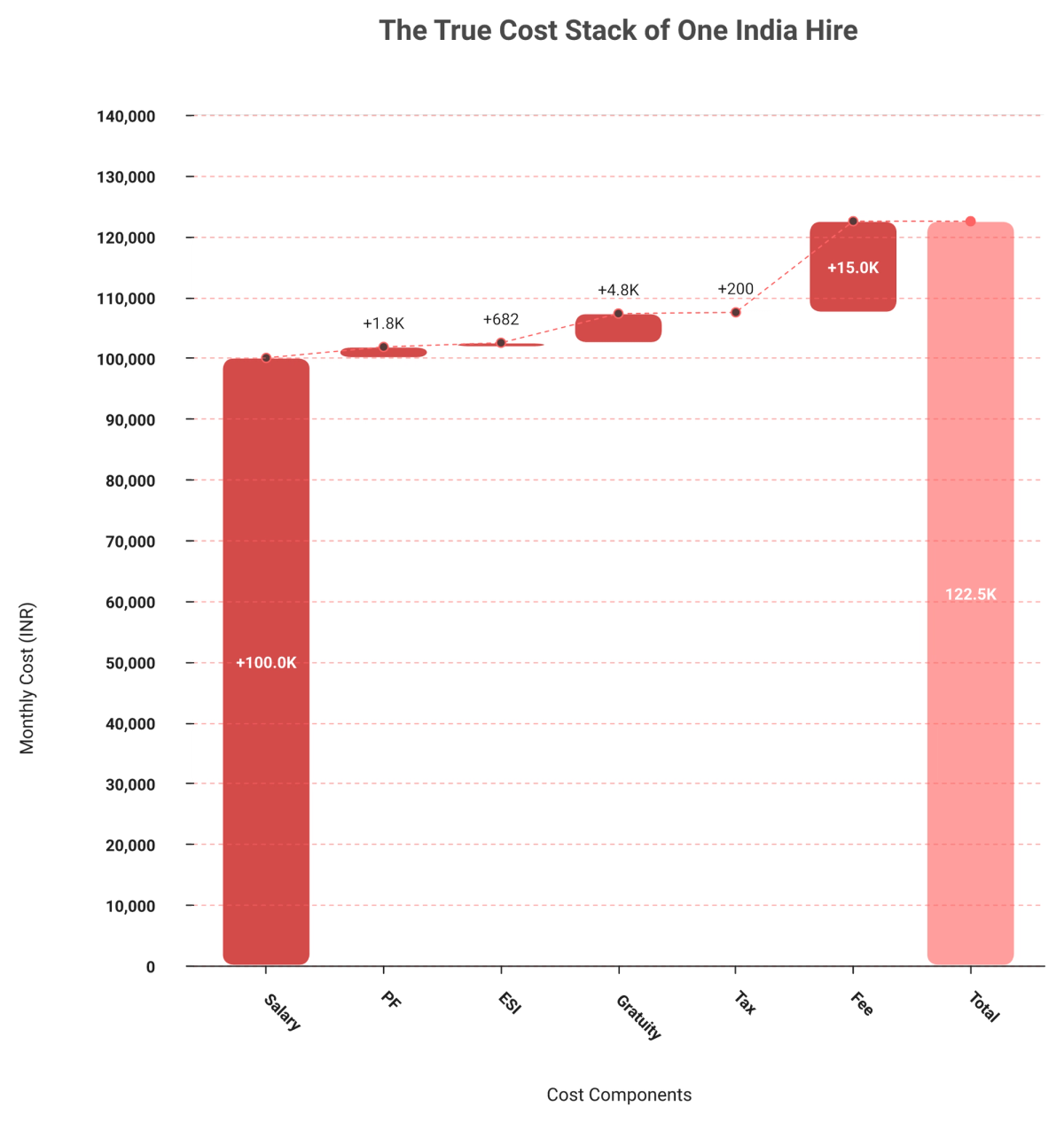
- Provident Fund (PF): 12 percent employer contribution on Basic plus DA. The statutory wage ceiling stays at ₹15,000 per month.
- ESI: 3.25 percent employer share, applicable for gross wages up to ₹21,000 per month.
- Gratuity: accrues from month one at 4.81 percent of Basic plus DA under the Payment of Gratuity Act, 1972.
- Professional tax: state-specific. Maharashtra runs PTRC plus PTEC monthly. Tamil Nadu is biannual. Delhi has none.
- TDS: deducted from the employee per income-tax slab and deposited by the 7th of the next month.
🔢 A worked example at ₹80,000 per month
Let me run one hire so the math is concrete. Assume Basic plus DA is half of CTC under the new wage rule. You can replicate this with our India salary calculator.
| Component | Basis | Monthly (approx) |
|---|---|---|
| Gross salary | ₹80,000 | ₹80,000 |
| Employer PF | 12% of ₹15,000 ceiling | ₹1,800 |
| ESI | Not applicable above ₹21,000 | ₹0 |
| Gratuity accrual | 4.81% of ₹40,000 Basic plus DA | ₹1,924 |
| Professional tax | State slab | ₹200 |
Note what happened with ESI. At ₹80,000 it is zero, but a ₹18,000 support hire triggers the 3.25 percent employer share.
📊 Why the salary band flips your cost 30 to 40 percent
That ESI threshold is the swing factor. Lower-paid roles carry ESI and proportionally heavier statutory weight, so two "same-plan" hires diverge sharply on total cost.
Every rupee of PF, ESI, and TDS in this math is filed under Versatile Club's own registrations across Indian states. You can pull the actual challan, not just trust a line on an invoice. That is the difference between an owned entity and an estimate from a partner shell, and it is built into our managed payroll service.
"Contracts, PF, ESI, TDS, and payroll all handled in one place. The compliance rigour is genuinely impressive, every statutory filing reviewed before submission."
Vedant T., Founder Versatile G2 Verified Review
Q4: Which Hidden Fees Quietly Inflate Your India EOR Bill?
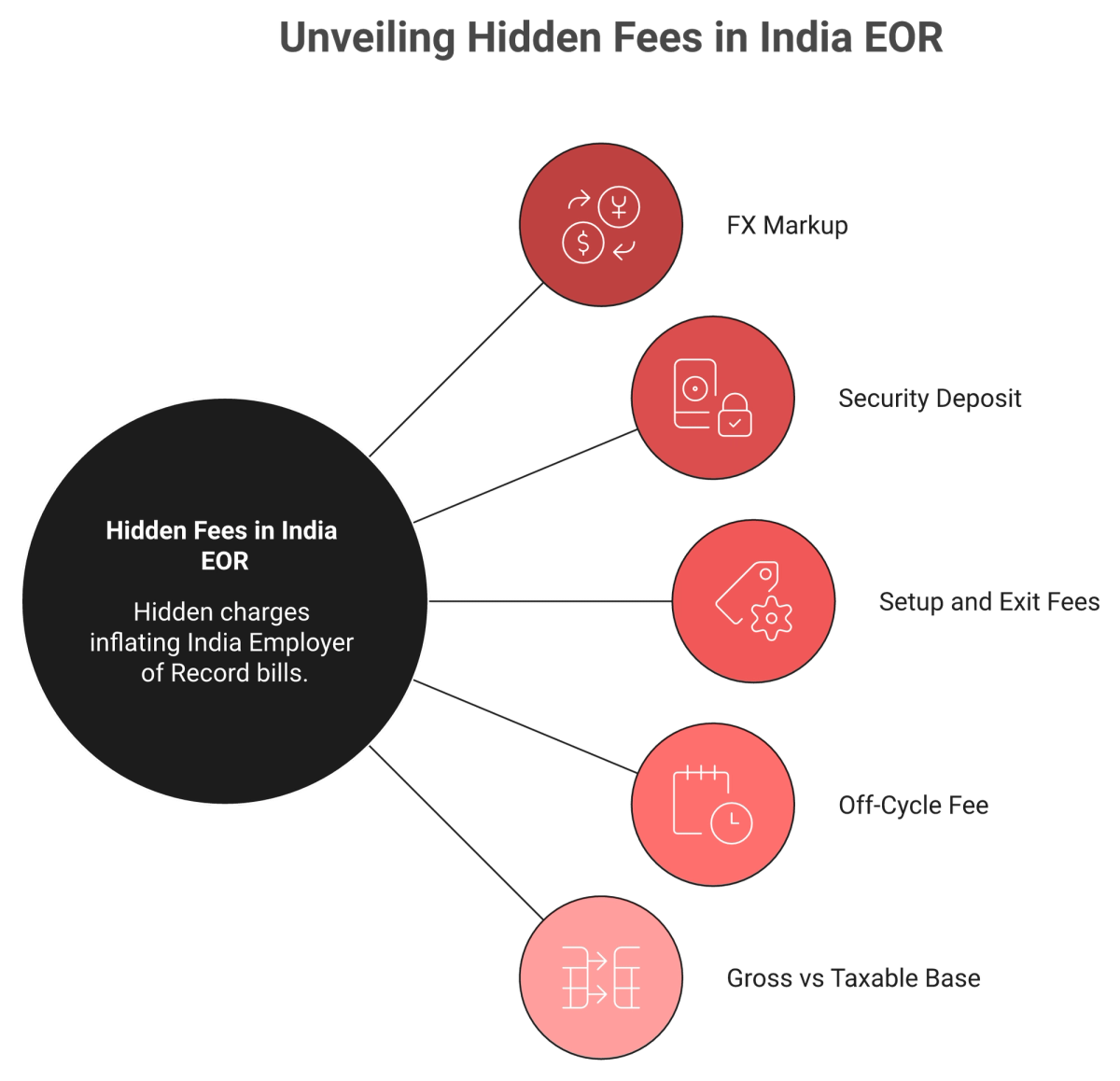
The biggest surprises are not on the pricing page. Watch for FX markups of 3 to 5 percent (sometimes up to 10 percent), upfront deposits of a full month's salary, setup and exit fees, off-cycle payroll charges, and providers billing on gross rather than taxable wages. On a single hire, these can add thousands a year, and they rarely appear in the headline quote.
🧾 The quote you signed is not the invoice you pay
The pain here is specific. You negotiate a clean monthly number, then the real bill arrives wearing extra line items.
I could be slightly off on the exact percentages by provider, since they change. But the categories below are consistent across what surfaces when you actually run these accounts through proper EOR services.
💸 The hidden-fee matrix
| Hidden cost | What it looks like | Reported on |
|---|---|---|
| FX markup | 3 to 5%, sometimes up to 10%, on the conversion | Deel, Remote, generalists |
| Security deposit | Up to 100% of one month's gross, held upfront | Several global EORs |
| Setup / exit fee | One-off onboarding or offboarding charge | Common at incumbents |
| Off-cycle / life-event fee | Charge to run corrections or mid-year changes | Category norm |
| Gross-vs-taxable base | Fee charged on gross, inflating the percentage | Percentage-model PEOs |
The FX line is the quiet one. A 30 percent total overcharge, as one Remote user reported, mostly hides in conversion and "extra" fees.
"There are hidden fees everywhere, and I end up paying roughly 30% more than what's stated on the platform."
Javier G. Remote G2 Verified Review
"They charge extra money for bank transfer with no clarity on the actual amount. They constantly delay the payment."
Verified User in Computer Software Multiplier G2 Verified Review
✅ The questions to ask before you sign
Send every provider this short list and get answers in writing:
- Is there an FX markup, and what is the exact percentage?
- Do you require a security deposit, and is it refundable?
- Are there setup or exit fees?
- Is my fee charged on gross or taxable wages?
- What does an off-cycle payroll run cost?
Silence on any of these is your answer.
At Versatile Club, the counter to this matrix is structural, not promotional: no setup fee, no exit fee, first month free, and USD invoicing with zero FX markup because we bill direct from our owned Indian entity rather than converting from INR through a holding company. Talk to us and you can hold every other quote against ours.
"USD invoice landed clean, no FX markup, no setup fee, no surprises. Every payroll or PF question gets a real answer from a real person, usually same day."
Verified User, US startup Versatile G2 Verified Review
Q5: How Does the New Labour Code 2025-26 Change What You Pay?
Under the New Labour Code (effective 21 November 2025), allowances excluded from "wages" cannot exceed 50 percent of total remuneration. So Basic plus DA effectively becomes at least half of CTC, pushing up the PF and gratuity base. The EPF wage ceiling stays at ₹15,000 per month (notified 29 May 2026). Many global platforms still run old salary stacks and get this wrong, creating exposure that surfaces in due diligence.
📐 What "50 percent" actually means
Let me define the terms first. "CTC" is cost to company, the full salary package. "Basic plus DA" is base pay plus dearness allowance, the part statutory dues are calculated on.
Old India salary stacks pushed Basic down to maybe 30 percent of CTC. That shrank PF and gratuity. The new rule shuts that door. Under the Code on Wages, excluded allowances cannot top 50 percent of total pay. So Basic plus DA lands at half of CTC or more. Staying on top of this is exactly what our compliance coverage is built for.
💰 Why your statutory cost rises
A bigger Basic plus DA base means a bigger base for PF and gratuity. Here is the chain in plain terms.
- PF: 12 percent employer contribution, calculated on Basic plus DA, with the wage ceiling held at ₹15,000 per month.
- Gratuity: accrues at 4.81 percent of Basic plus DA, so a higher Basic lifts accrual.
- Take-home: can dip slightly, since more pay sits in deducted heads.
I could be off on the exact rupee impact per role, since it depends on the package design. But the direction is certain: statutory cost goes up when Basic is restructured correctly. You can model this with our India salary calculator.
Here is what the standard read gets backwards. Founders assume a global platform "handles compliance." In practice, many still run a pre-2025 salary stack and under-calculate PF. That gap is exactly what an acquirer's diligence team finds. If you are comparing options, our Deel alternative page shows where that depth differs.
✅ The one question to ask any provider
Ask for the proposed Basic plus DA split on a sample offer, in writing. If it is below 50 percent of CTC, the provider is behind the Code.
At Versatile Club, we restructured every salary stack to the 50 percent rule already. It is our baseline, not a migration project we hand you mid-payroll. We file PF, ESI, and TDS under our own registrations across Indian states through our India EOR services, so the numbers match the new Code on day one.
Q6: Owned Entity vs Partner Shell: Why Does It Change Your Risk and Price?
Most global EORs, including Deel, Remote, and G-P, hire your India employee through a third-party local partner entity. With an owned entity, PF, ESI, TDS, and professional tax filings sit under one set of registrations you can audit directly. Aggregators give you 150-country reach. An owned India entity gives audit-ready IP protection, direct statutory control, and fewer due-diligence surprises.
🏢 Do you know who legally employs your hire?
Here is a question most founders cannot answer: which legal entity actually employs their Bengaluru engineer? With an aggregator model, it is often a partner company you have never met.
That matters for three things: intellectual property assignment, statutory accountability, and audit trails. When the employer is a partner shell, your IP chain and your challans pass through a third party you do not control. Our EOR services keep all of that under one roof.
⚖️ Owned entity vs partner shell, side by side
| Criteria | Owned Indian entity | Partner-shell aggregator |
|---|---|---|
| Legal employer | One entity you can audit | Third-party local partner |
| Statutory filings | Under one set of registrations | Routed through partner |
| IP assignment | Direct, single chain | Through intermediary |
| Country reach | India only | 90 to 185 countries |
| Best for | India depth, audit-readiness | Multi-country at once |
The partner model is not "bad." It is built for breadth. But breadth has a cost, and it shows up in support and accountability gaps. Our Remote alternative comparison details where those gaps appear.
"The PF transfer for employees after terminating their employment with Velocity was very poor. There was limited help, delayed responses... they charged heavily per employee and the backend HR services they provide is extremely poor."
Verified User, Computer Software Velocity Global G2 Verified Review
"It took three months to onboard our first 3 individuals. They didn't seem to be able to navigate visas or variations to employment contracts."
Verified User, IT and Services Deel G2 Verified Review
🧭 The honest "it depends"
If you need five or more countries at once, an aggregator is the rational pick. I will say that plainly, even though it is not our lane.
If India is your hire and audit-readiness is the priority, an owned entity wins. At Versatile Club, your employee's PF, ESI, TDS, and professional tax filings sit under our own registrations, not a partner shell. You can pull the challan and trace the IP chain to one entity, and our managed payroll makes that traceable every cycle.
"We partnered with Versatile to support our hiring and employment needs in India. Their team was highly responsive, professional, and easy to work with."
Mukul S. Versatile G2 Verified Review
Q7: At What Headcount Does Your Own Entity Beat an EOR?
There is no universal number, but a common tipping point is around 10 to 12 hires. Many founders open an entity once they cross about 12. Others stay on EOR efficiently to 30 or more employees for flexibility, since entity setup takes 12 to 18 months, tens of thousands in legal fees, and ongoing compliance. The honest answer: it depends on growth certainty and your appetite for back-office work.
💸 The "are we overpaying on EOR?" anxiety
Every CFO I speak with hits this question around the eighth or ninth India hire. The EOR fee starts to look like a recurring tax. The instinct is to set up a subsidiary and "save."
That instinct skips the real cost of an entity. One US founder summed up the alternative cleanly. You can pressure-test your own number with our EOR vs entity calculator.
"We looked at setting up a subsidiary and quickly realized it would take 6 months, cost tens of thousands in legal and registration fees, and require ongoing compliance work we had no expertise in."
Verified User, US startup Versatile G2 Verified Review
📊 Two honest scenarios
The break-even is not one number. It is two reasonable views.
| View | Tipping point | Why |
|---|---|---|
| Conservative | About 10 to 12 hires | Per-employee EOR fees overtake amortised entity cost |
| Flexible | 30 or more hires | Avoids 12 to 18 month setup and back-office hiring |
The conservative view assumes stable, predictable growth. The flexible view values optionality, since an entity is hard to unwind if your India plan changes. This is a frequent conversation for our startup clients.
🧭 A simple decision rule
Tie the call to growth certainty, not headcount alone. If you are confident in 12-plus India hires that will stay for years, start the entity process early, because setup is slow. If your roadmap is uncertain, EOR keeps you liquid and reversible.
At Versatile Club, we started in Contract-to-Hire, so we can place, convert, or hand off as you scale. We are not built to trap you on EOR forever. When an entity genuinely makes sense for you, I will tell you, even if it ends our invoice.
Q8: Why Is the Cheapest EOR Often the Most Expensive Decision?
A $99 fee that misses a filing is not cheap. Delayed statutory dues accrue 12 percent annual interest, and misclassification can surface as a roughly $40,000 liability in due diligence. Compliance-first EORs solve the "legal hire on paper" problem but ignore the "good hire that stays" problem. The cheapest provider often costs the most once a wrong hire or a missed filing hits your audit.
⚠️ The claim: cheap is a false economy
Here is my governing belief after six years of India placements. Price is not cost. Price is the sticker. Cost is what you actually pay once risk plays out.
A low EOR fee buys you nothing if the provider misses a PF challan or misclassifies a contractor. Both failures convert a "saving" into a liability your acquirer will price down. Proper contractor of record coverage closes the misclassification gap.
💰 The three hidden cost pillars
Three things quietly inflate the true cost of a cheap EOR.
- Penalty interest: delayed statutory dues accrue 12 percent per year. A missed filing compounds, it does not just sit there.
- Misclassification liability: treating an employee as a contractor can surface as a roughly $40,000 hit in due diligence.
- Churn from culture-blind hiring: a "legal hire on paper" who quits in month four costs you the rehire, the ramp, and the momentum.
The pattern shows up in competitor reviews again and again. Cheap pricing, then breakdowns where it hurts. Our Multiplier alternative and Skuad alternative pages walk through these trade-offs.
"They are very price competitive... Apart from price and onboarding, rest of the service is pathetic. They charge extra money for bank transfer with no clarity... At times there has been delay by a month."
Verified User, Computer Software Multiplier G2 Verified Review
"We agreed to pay $200 USD per person, but they wanted us to pay $400 USD... the last invoices had so many mistakes and extra unjustified amounts."
Reviewer, Skuad user Skuad G2 Verified Review
✅ Reframe price as risk-adjusted cost
Stop comparing sticker fees. Compare the fee plus the probability-weighted cost of a missed filing and a bad hire.
At Versatile Club, compliance is the floor, not the ceiling. We hire culture-fit-first against 50 behavioral parameters, run a 90-day Success Coach, and back C2H placements with a 6-month replacement guarantee. That combination targets the "good hire that stays" problem, not just the "legal hire on paper" one, and it is the heart of our recruitment model.
Q9: What Does Founder-Led Support Actually Change When Something Breaks?
When a payroll question or a management misfire hits at 9pm your time, the difference between a chatbot ticket and a founder on WhatsApp is days versus minutes. Global platforms route you through a customer success manager (CSM) rotation. India-native operators can pick up directly. In high-context Indian work culture, where a misread email can silently freeze a team, that direct line is risk control, not a perk.
👩💻 The situation: a manager going quiet
Picture Sarah, a US People Ops lead managing her first India hire. Things look fine on Slack. Then the engineer goes quiet on a project she thought was clear.
What she does not see is the cultural gap underneath. India scores 77 on Hofstede's Power Distance index, against 40 for the US. "Power Distance" measures how much a team defers to authority. A junior engineer may not push back on a confusing instruction. He just waits. Bridging that gap is part of our HR consulting services.
⚠️ The complication: the silent freeze
So the team does not error loudly. It freezes quietly. Sarah reads the silence as "on track," while the engineer reads her email as "do not proceed without sign-off."
Here is where the support model decides the outcome. On a ticket-queue platform, Sarah files a case and waits. Our Wisemonk alternative page contrasts this directly with founder-led support.
"Support is the single biggest failure. There is no direct phone line. You either email or use a chatbot, and you can ask both the same question and get two different wrong answers."
Erika D. Rippling G2 Verified Review
"Often the CS doesn't seem to have answers... something I was looking for the answer to in 20 minutes becomes a 4 day process."
Verified User, Computer Software Deel G2 Verified Review
✅ The resolution: founder on WhatsApp
A four-day ticket loop, across a 12-hour time gap, can blow a sprint. A two-minute WhatsApp reply unfreezes it the same night.
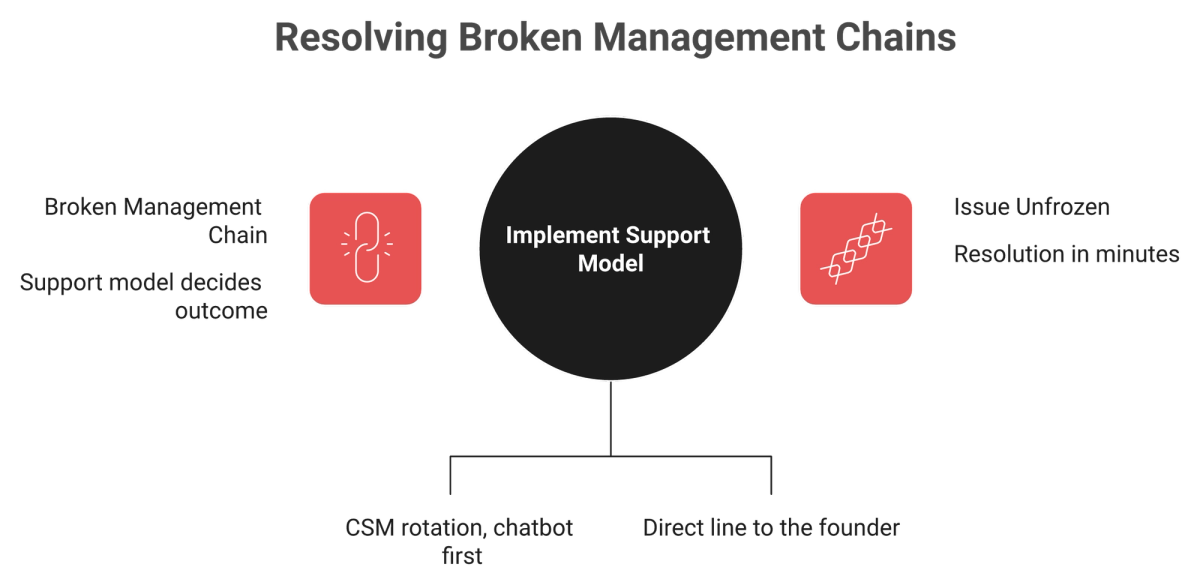
At Versatile Club, I am personally on WhatsApp. Not a CSM rotation, not a chatbot, the founder who built the company. I might be wrong that this scales forever, but at our stage it is the highest-leverage thing I do, because I can read the cultural context Sarah cannot. You can see how we work for a fuller picture.
"Founder is just a call away. Extremely helpful in resolving all our queries. The process is super smooth to setup India EOR."
surbhi m. Versatile G2 Verified Review
"Every payroll or PF question gets a real answer from a real person, usually same day."
Verified User, US startup Versatile G2 Verified Review
Where my head is right now is this. The next two years will separate India EOR support into two camps: those who treat it as a ticket, and those who treat it as a relationship. Which side do you want managing your first Bengaluru hire? Our India EOR services are built around the second camp.
Q10: How Should You Compare India EOR Quotes Without Getting Burned?
Compare on all-in cost, not the headline fee. Ask every provider for a written all-in PEPM, the exact wage base for PF and ESI, the FX markup and deposit terms, setup and exit fees, the Basic plus DA split under the new Labour Code, who legally employs your hire, and the replacement guarantee. If a provider will not put it in writing, that silence is your answer.
🔍 Pull the lens back to all-in cost
By now the pattern is clear. The headline fee is the smallest, most visible number, and the riskiest one to anchor on.
The real comparison is total cost plus risk. That means statutory accuracy, FX, deposits, the legal employer, and what happens when a hire does not work out. The cheapest sticker can hide the priciest outcome. Our pricing page lays the all-in number out plainly.
"Some platform that quotes you a great price and then you find out about all the add-ons later."
Angad S., Founder Versatile G2 Verified Review
"USD invoice landed clean, no FX markup, no setup fee, no surprises."
Verified User, US startup Versatile G2 Verified Review
✅ The Monday-morning checklist
Send this list to every vendor and get answers in writing. The ones who answer fast and clearly are the ones you want.
- All-in PEPM: the full per-employee-per-month cost, statutory dues included, in writing.
- Wage base: the exact figure used for PF and ESI calculation.
- FX and deposit: the markup percentage and any upfront security deposit terms.
- Setup and exit fees: every one-off charge, named.
- Basic plus DA split: confirm it meets the 50 percent rule under the new Labour Code.
- Legal employer: the entity that actually employs your hire, owned or partner shell.
- Replacement guarantee: what happens, and at whose cost, if the hire leaves early.
A provider who dodges any of these is telling you something. Silence on a fee is a fee. You can verify our compliance posture on our compliance page.
💬 Start the conversation
That checklist is exactly the rubric Versatile Club is built to pass: an owned Indian entity, USD invoicing with no FX markup, no setup or exit fees, first month free, the 50 percent Basic split as our baseline, and a 6-month replacement guarantee on Contract-to-Hire placements.
I will leave you with the offer, not a "book a demo" button. Tell me who you are trying to hire in India, the role and the city. I will send back an all-in number, in USD, with nothing hidden, and you can hold every other quote against it. Just reach out whenever you are ready.
The question I am sitting with: as India shifts from "one country on a global map" to its own specialist EOR category, will founders keep buying breadth they do not need, or depth they actually do? If depth is what you need, our EOR services are built for exactly that.
FAQs
Does PEO pricing even apply when hiring in India without a local entity?
Short answer: usually not. US-style PEO co-employment has no legal basis in India unless you already own a registered Indian subsidiary. If you do not, the model you actually need is an Employer of Record (EOR).
- PEO route: requires your own Indian entity, which costs 15,000 to 50,000 dollars in year one plus ongoing compliance.
- EOR route: we become the legal employer on your behalf, with zero setup cost and a hire live in about 5 days.
So when founders google PEO pricing for India, they are usually pricing the wrong model. The real question is what an EOR costs all-in, after FX markups and statutory dues surface.
We never quote a PEO arrangement you cannot legally use. If you have no Indian entity, our India EOR services are the compliant path, delivered through our own registered Indian entity rather than a partner shell. You manage your hire day to day while we run PF, ESI, TDS, and statutory filings under our own registrations.
What is the real all-in per-employee cost of an India EOR?
The headline fee is the smallest part. True cost equals gross salary plus statutory employer contributions plus the EOR fee.
- PF: 12 percent of Basic plus DA, on the 15,000 rupee wage ceiling.
- ESI: 3.25 percent employer share for gross wages up to 21,000 rupees monthly.
- Gratuity: accrues from month one at 4.81 percent of Basic plus DA.
- Professional tax: state-specific, monthly in Maharashtra, none in Delhi.
- TDS: deducted from the employee and deposited by the 7th monthly.
Two hires on the same plan can cost different totals, because the statutory layer, not the admin fee, drives the difference. A lower-paid hire triggers ESI and carries proportionally heavier dues.
The service fee is typically only 12 to 15 percent of your real India spend. We show the full picture upfront on our pricing page, and every rupee is filed under our own registrations, so you can pull the actual challan rather than trust a line on an invoice.
Which hidden fees quietly inflate an India EOR bill?
The biggest surprises are never on the pricing page. The quote you signed is rarely the invoice you pay.
- FX markup: 3 to 5 percent, sometimes up to 10 percent, on currency conversion.
- Security deposit: up to a full month of gross salary, held upfront.
- Setup and exit fees: one-off onboarding or offboarding charges.
- Off-cycle fees: charges to run corrections or mid-year life-event changes.
- Gross-versus-taxable base: percentage fees charged on gross, inflating the real rate.
One Remote user reported paying roughly 30 percent more than the platform stated, mostly hidden in conversion and extra fees. On a single hire, these add thousands a year.
Our counter is structural, not promotional: no setup fee, no exit fee, first month free, and USD invoicing with zero FX markup because we bill direct from our owned Indian entity. Ask any provider these questions in writing, then hold their answers against our EOR services. Silence on a fee is a fee.
At what headcount does opening your own Indian entity beat an EOR?
There is no universal number, but a common tipping point sits around 10 to 12 hires. Some founders stay on EOR efficiently to 30 or more for flexibility.
- Conservative view: around 10 to 12 hires, when per-employee fees overtake amortised entity cost.
- Flexible view: 30 or more hires, since an entity takes 12 to 18 months and tens of thousands in legal fees to set up.
Tie the decision to growth certainty, not headcount alone. If you are confident in 12-plus India hires that will stay for years, start the entity process early, because setup is slow. If your roadmap is uncertain, an EOR keeps you liquid and reversible.
We started in Contract-to-Hire, so we place, convert, or hand off as you scale, and we are not built to trap you on EOR forever. You can pressure-test your own crossover point with our EOR vs entity calculator, and when an entity genuinely makes sense, we will tell you.
How does the New Labour Code 2025-26 change what we pay for an India hire?
The Code shifts the cost base. Allowances excluded from wages cannot exceed 50 percent of total remuneration, so Basic plus DA effectively becomes at least half of CTC.
- Higher PF base: 12 percent now applies to a larger Basic plus DA figure.
- Higher gratuity: 4.81 percent accrual rises with the bigger Basic.
- EPF ceiling: stays at 15,000 rupees per month under current notification.
Old India salary stacks pushed Basic down to around 30 percent of CTC to shrink statutory dues. The Code closes that door. Many global platforms still run a pre-2025 stack and under-calculate PF, and that gap is exactly what an acquirer's due-diligence team finds.
We restructured every salary stack to the 50 percent rule already, so it is our baseline, not a migration project handed to you mid-payroll. You can review our approach on our compliance page and model packages with our salary tools.