Table of contents (13)
- The PEO Myth
- Choosing Your Model
- Monthly Compliance Map
- State-Wise Complexity
- Provider Cost Benchmarks
- Statutory Cost Reset
- Provider Shortlist
- ✅ 1. Versatile Club
- ✅ 2. Wisemonk, and ❌ where the generalists thin out
- PE and Misclassification Risk
- DPDP Vendor Test
- Migration and Switching
- Verification Checklist
PEO Services in India Explained: Compliance Map, Cost Benchmarks, and Top Providers Compared
Q1. Do "PEO services in India" legally exist, or are you shopping for an EOR?
A US founder messaged me on WhatsApp at 11pm her time last quarter. She had a shortlist of four "India PEO vendors," a signed term sheet, and two engineers in Bengaluru waiting on offer letters. Her first question was which PEO to pick. My first answer was that she was not buying a PEO at all.
US-style co-employment PEO does not exist under Indian labour law. Indian statutes contemplate one legal employer per worker, and the four Labour Codes, in force since 21 November 2025, never define co-employment. So "PEO in India" resolves to one of two purchases. With an Indian Private Limited entity holding live EPF, ESIC, TDS, and state professional tax accounts, you are buying managed payroll or ASO-style administration (ASO means administrative services only, where the vendor files but never employs). Without an entity, you need an Employer of Record in India, where the provider is the legal employer on paper.
⭐ Why the myth keeps selling
In the US, a PEO shares employment liability with you. Two companies, one worker, split responsibility. That model has no equivalent in the Code on Social Security, 2020, which assigns the employer's duties to a single establishment.
So the keyword survives for two reasons. US buyers import the ADP and Gusto mental model, and vendors happily sell against the search term. I have sat through six years of discovery calls that open with the wrong noun.
✅ The one question that routes you correctly
Ask yourself one thing: do you have an Indian entity today?
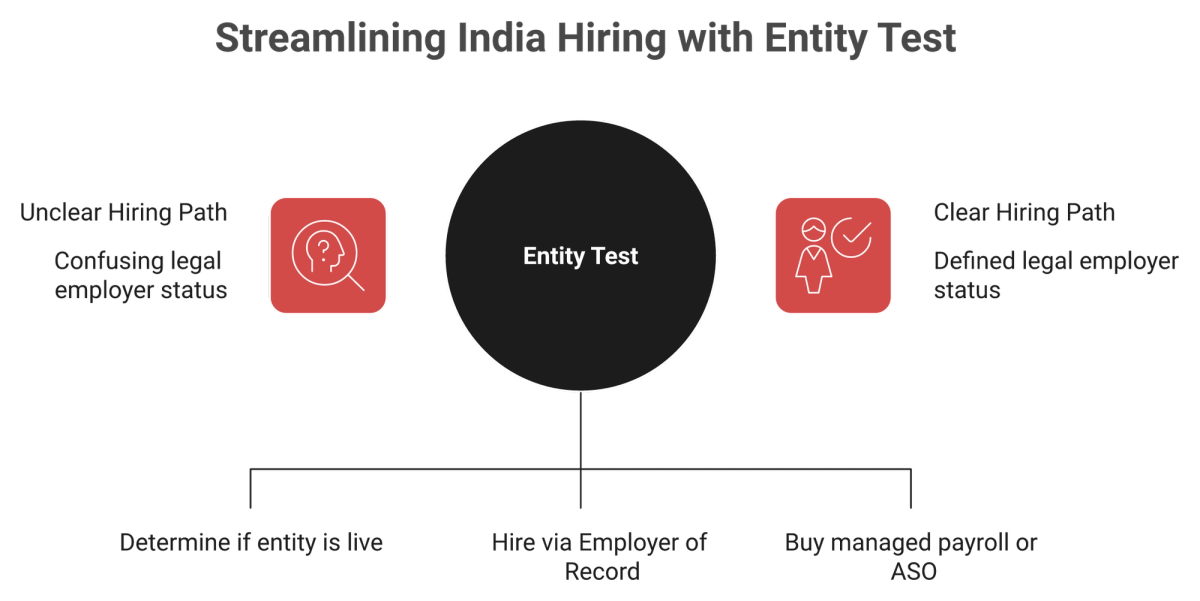
- No entity. You need an EOR. Native India providers run roughly $99 to $149 per employee per month. You skip incorporation entirely. See the full EOR versus PEO breakdown.
- Entity live, with EPF, ESIC, TDS, and PT accounts open. You can buy managed payroll or ASO at around $49 per employee per month. The statutory liability stays on your books.
- Entity being incorporated right now. Run EOR in parallel until the registrations go live. Never create a month with no PF filing.
Versatile Club runs both sides of that fork, which is why the entity question gets asked before the pricing question on every call.
⚠️ Whoever signs the challan owns the liability
Here is the part that matters more than the label. In India there is no co-employment to hide behind. The establishment whose PF code appears on the monthly challan carries the exposure if a filing is wrong or late.
That is why "who is the legal employer" is not a contract detail. It is the whole decision. I would rather a founder spend ten minutes on that question than four weeks comparing dashboards.
Versatile Club is the legal employer through Foo Falcon Technologies Pvt Ltd, a registered Indian company, and the PF, ESI, TDS, and professional tax filings sit under our own registrations. We sell managed payroll at $49 per employee per month on your entity and EOR at $149 if you have none, so answering the category question honestly costs us nothing.
Q2. PEO, ASO, EOR, or your own entity: which model fits your India headcount?
Match on entity status first, headcount second. No entity and 1 to 15 hires: EOR, because the provider becomes the legal employer and you skip $15K to $100K of incorporation cost plus a 3 to 6 month timeline. Entity already live: managed payroll or ASO at around $49 per employee per month, with statutory liability staying on your books. Past 20 to 30 India employees: incorporate and migrate, because per-employee fees now exceed entity maintenance and the 22% concessional corporate rate under Section 115BAA becomes material. Contractors for core engineering roles are not a fourth option. They are deferred exposure.
💰 The four models side by side
| Model | Entity needed | Legal employer | Liability sits with | Onboarding | Monthly cost |
| EOR (Versatile Club) | No | Provider's Indian entity | Provider | 5 business days, contractual | $149 per employee |
| EOR (global generalist) | No | Often a local partner entity | Provider and partner | 7 to 14 days | $400 to $599 per employee |
| Managed payroll / ASO | Yes | You | You | Days, once accounts are live | About $49 per employee |
| Own entity, in-house payroll | Yes | You | You | 3 to 6 months to set up | Salaried team plus tooling |
⚠️ Works if, fails if
EOR works if you have no entity, you need people live this month, and India is 1 to 15 heads. It fails if you need 5 or more countries on one contract, or if SOC 2 and ISO 27001 are hard procurement gates. Those are not categories Versatile Club competes in, and I will say so on the call. Run the numbers yourself with the EOR versus entity calculator.
Managed payroll works if your entity already has EPF, ESIC, TDS, and state PT accounts open. It fails the moment one of those is dormant, because a provider cannot file into an account that does not exist.
Own entity works if headcount justifies permanent infrastructure. Think of it as the difference between a suspension bridge and the Golden Gate. One goes up in days and carries real traffic. The other is worth building only when the traffic is permanent. The trade-offs are mapped in this EOR versus entity comparison for India.
💬 What buyers say about skipping the entity
"WiseMonk's EOR service solved our biggest challenge, which was hiring employees in India without setting up a local entity. They manage employment contracts, statutory compliance, tax structure, and local regulations on our behalf. This reduced legal risk and saved months of setup time and cost."
— Verified User in Marketing and Advertising, Wisemonk - G2 Verified Review (3.5 stars, 12 February 2026)
"Everything was VERY time consuming. It took three months to onboard our first 3 individuals. They didn't seem to be able to navigate Visas or variations to employment contracts."
— Verified User in Information Technology and Services, Deel - G2 Verified Review (0 stars, 13 December 2024)
The first review is the model working. The second is the model working on paper while the calendar slips. Speed is a contract term, not a marketing claim. If Deel is on your shortlist, compare it against this Deel alternative for India.
⏰ The migration trigger nobody volunteers
At 25 employees, EOR at $149 runs about $44,700 a year. That is more than entity setup plus annual maintenance, and incorporation via SPICe+ on the MCA portal also unlocks the 115BAA rate.
Versatile Club will tell a 25-person India team to stop paying EOR fees. Because we run managed payroll on client entities as well as EOR on our own, the advice is not self-harming. We move you from $149 to $49 per employee per month and keep the same filing team on the account.
Q3. What statutory compliance must your provider execute every month?
India payroll compliance is six recurring obligations, not one transfer. EPF runs at 12% of Basic plus DA up to the ₹25,000 wage ceiling set by Notification S.O. 5109(E) dated 17 September 2026, of which 8.33% routes to the pension scheme. EDLI and administrative charges add 0.50% each. ESI is 3.25% employer and 0.75% employee up to ₹21,000 wages. Professional tax follows state slabs, capped at ₹2,500 a year. TDS under Section 192 is deposited by the 7th. Gratuity accrues from month one at about 4.81% of Basic plus DA. The full cycle is documented in this guide to payroll compliance in India.
✅ The monthly map, with the instrument behind each line
| Item | Rate or formula | Deadline | Artefact you should receive | Governing instrument |
| EPF and pension | 12% of Basic plus DA, ceiling ₹25,000 | Monthly ECR | PF challan confirmation | S.O. 5109(E), 17 Sep 2026 |
| ESI | 3.25% employer, 0.75% employee | Monthly | ESI challan | ESI Act 1948 |
| Professional tax | State slabs, max ₹2,500 a year | Monthly or biannual by state | PT payment receipt | State PT Acts |
| TDS | Per slab, Section 192 | By the 7th | Deposit receipt, Form 16 by 30 May | Income Tax Act |
| Gratuity | Wage divided by 26, times 15, per year | Accrued monthly, paid on exit | Accrual statement | Gratuity Act 1972 |
💸 One engineer, costed line by line
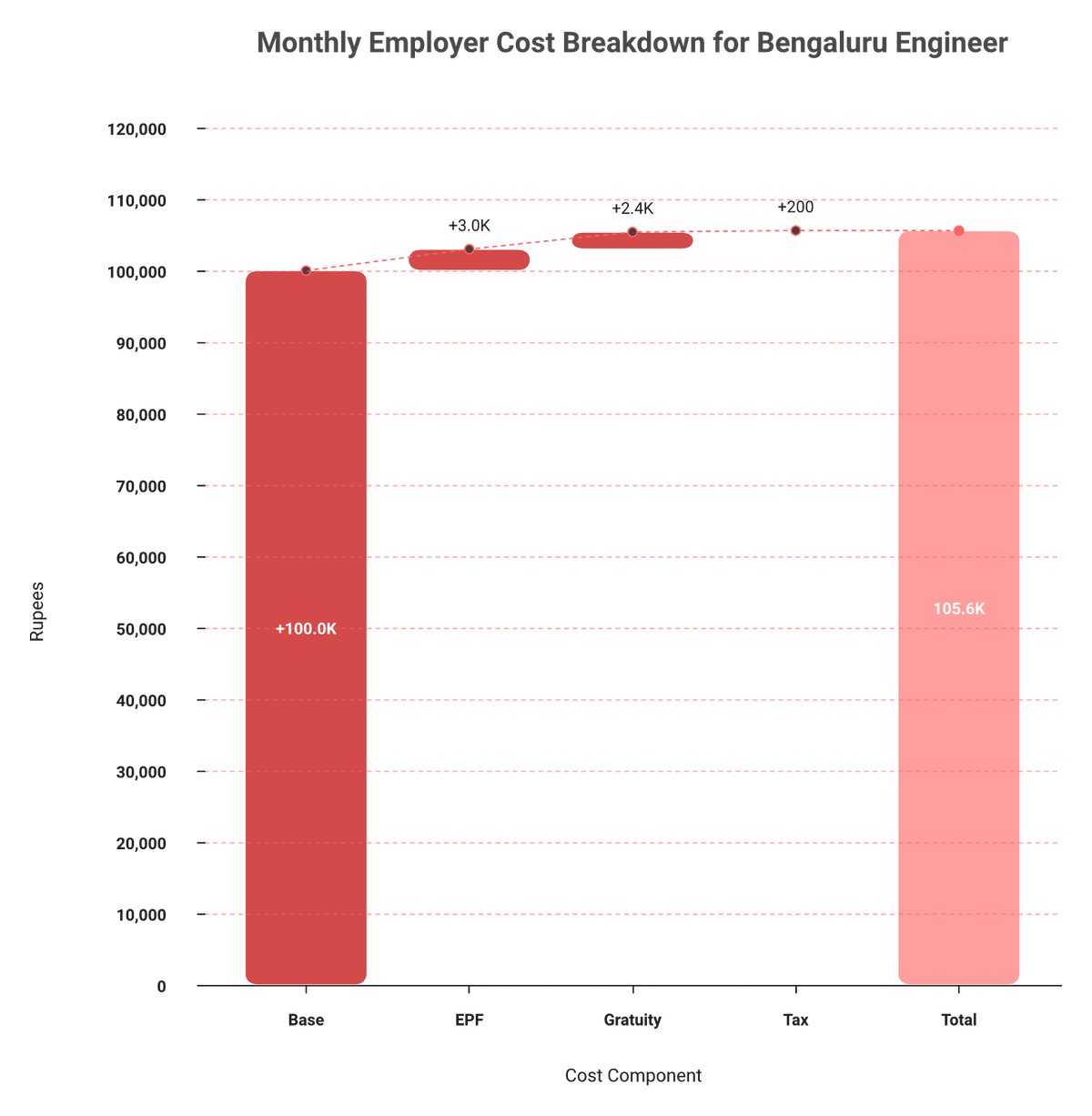
Take a Bengaluru engineer on ₹1,00,000 a month. Under the Labour Codes, Basic plus DA must be at least 50% of total remuneration, so set Basic plus DA at ₹50,000. EPF employer share is capped at the ₹25,000 ceiling, so ₹3,000 a month. Gratuity accrues at roughly ₹2,405. ESI does not apply above ₹21,000 wages. Professional tax in Karnataka is ₹200. Employer cost lands near ₹1,05,605 before the service fee. Model your own roles with the India salary calculator.
⚠️ Two numbers that decide audits
Gratuity paid late carries mandatory 10% simple interest per annum under Section 7(3A). Most vendor pages never mention it.
Second, authorised deductions are capped at 50% of wages earned in that wage period under the Payment of Wages Act, 1936. Recovering an advance faster than that is itself a violation.
⭐ The artefact test
Ask for last month's challan numbers and TDS deposit receipts from any live client, names redacted. A provider that files monthly produces them in an hour. A provider that does not will send you a compliance summary instead.
That is the difference between evidence and assertion, and it is the only vendor test I trust.
Versatile Club returns the artefacts rather than the assertion: a payroll summary, a compliance status report listing what was filed and what is due, PF and ESI challan confirmations, and TDS deposit receipts, every month as a standing deliverable on our own Indian registrations.
Q4. Why does India compliance change state by state, and which states are hardest?
Professional tax and Shops and Establishments rules are state law, not central law. A provider registered in four states cannot legally employ your fifth hire in the fifth state. Maharashtra demands dual PTRC and PTEC registration with monthly slab filing. Karnataka runs monthly PT with S&E renewal and enrolment within 30 days of joining. Tamil Nadu files PT biannually in June and December, plus labour welfare fund. Delhi levies no professional tax but enforces S&E strictly. PT is capped at ₹2,500 a year, so the cost is small and the administrative surface is not.
⭐ The state matrix
| State | PT regime | Filing rhythm | S&E obligation | Operator trap |
| Maharashtra | Dual PTRC and PTEC | Monthly slab, annual return | Registration per establishment | Two registrations, often only one obtained |
| Karnataka | Monthly PT | Monthly | Annual S&E renewal | Enrolment within 30 days of joining |
| Tamil Nadu | Biannual PT | June and December | S&E plus labour welfare fund | Half-yearly cycle missed by monthly processes |
| West Bengal | State slabs | Monthly | S&E registration | Frequent rule changes, state-specific leave math |
| Delhi | None | Not applicable | Strict S&E compliance | Teams assume no PT means no filing |
| Telangana | PTRC enrolment | Monthly remittance | S&E registration | Remittance deadlines separate from PF |
⚠️ Where partner-limited coverage breaks
Your India hire is rarely where you planned. The candidate you want is in Coimbatore, Indore, or Kochi, and remote work made that normal.
Global EOR platforms commonly cover only the top four to six Indian states through local partner entities. That gap stays invisible until the week you make an offer outside a metro. Then the answer is "we cannot employ there yet," and you lose the candidate. This is the same gap that shows up when teams try to hire in India without an entity.
✅ What to verify before you sign
Ask for the registration numbers, not the coverage claim.
- The provider's own PF establishment code and ESIC code, verifiable on the EPFO establishment search
- The Shops and Establishments registration for the state your hire sits in
- Which entity is named as employer on the offer letter
State rules under the four Labour Codes are still landing unevenly, which makes state-level registration a live question rather than a settled one.
💬 Honest hedge on state depth
My read is that state coverage is the most underweighted variable in India EOR buying, and I might be pushing that too hard. Price and dashboards are easier to compare, so they dominate shortlists.
What surfaces in Versatile Club's placements is different. The painful months are never about the platform. They are about a PT slab in a state nobody budgeted for.
Versatile Club holds PF, ESIC, and Shops and Establishments registrations across all 28 states and 8 union territories, built through six years of Contract-to-Hire placements across Bengaluru, Hyderabad, and Pune rather than bought as a coverage claim. A hire in Coimbatore onboards on the same five-day timeline as one in Bengaluru, and how that works is published rather than described on a call.
Q5. What do India PEO and EOR providers actually charge in 2026?
India managed payroll or PEO runs about $49 per employee per month. India-native EOR runs $99 to $149. Global generalists charge roughly four times that: Deel around $599 plus a $500 setup fee, Remote $599 plus $299 setup, Multiplier from $400, Skuad from $199, and G-P about 15% of salary with a $1,500 monthly minimum. Contractor management runs $19 to $49. Then come the fees nobody quotes: setup, security deposit, exit, benefits markup, and a reported 3% to 5% FX markup inside some global invoices. Versatile Club charges $149 per employee per month with no setup fee, no exit fee, first month free, and USD invoicing direct from its Indian entity. The full breakdown sits on the Versatile Club pricing page.
💰 The rate card, side by side
| Provider | Monthly EOR fee | Setup | Exit | India delivery | Invoicing |
| Versatile Club | $149 | $0 | $0 | Own Indian entity, all 28 states | USD, direct from India |
| Wisemonk | $99 to $399 | Varies | Varies | India-native entity | USD |
| Deel | About $599 | $500 | Notice period | Often local partner entity | USD |
| Remote | $599 | $299 | Notice period | Often local partner entity | USD |
| Multiplier | From $400 | $0 | 2 weeks | Partner model | INR default |
| G-P | About 15% of salary, $1,500 minimum | Varies | Varies | Partner model | USD |
Versatile Club publishes that row because quote-gating is how spread survives procurement. For a like-for-like read on the market, see this guide to employer of record cost in India.
💸 Three cost shapes, and why the third hurts
Fees come in three shapes. Flat per employee per month is the easiest to forecast. Percentage of salary scales against you, so a senior engineer costs more to administer than a junior one for identical work.
The third shape is the bundle, such as payroll plus an HR business partner at around $250 a month for up to five employees. Bundles are fine until headcount six, when the price step surprises your close. The same pattern shows up in PEO pricing models.
⚠️ The line items to hunt in a sample invoice
Ask for a live sample invoice, not a quote. Then look for:
- Setup or implementation fee
- Security deposit, often one month of payroll
- Exit or offboarding charge, sometimes billed as notice
- Benefits administration markup
- Off-cycle payroll run charge
- FX conversion spread, which rarely appears as a line at all
Versatile Club's monthly invoice shows gross, deductions, and net per employee, which is what makes the spread question answerable. The same invoice logic applies on managed payroll engagements.
💬 What buyers say about the fees they did not expect
"I find Deel to be absurdly expensive. They charge a high amount of fees for transferring money to my bank account. Additionally, using their card incurs fees for purchases in another currency, which impacts me personally."
— Juan Camilo O., Contractor, Deel - G2 Verified Review (1 star, 27 November 2025)
"I find the pricing of Deel to be quite terrible for me. Previously, I was paid directly by my employer without any additional costs. Now, I'm required to pay a monthly fee, which I don't like at all."
— Verified User in Translation and Localization, Deel - G2 Verified Review (0.5 stars, 31 July 2025)
Both reviewers are talking about charges that never appeared on a pricing page. That is the cost I would stress-test, not the headline number. If Deel is your incumbent, this Deel alternative comparison sets the fees side by side.
Versatile Club's $149 is what a single-country cost structure permits, invoiced in USD from an Indian entity rather than routed through an offshore holding company. A platform amortising 150 country stacks cannot reach it. Rates move, so verify every number above against the vendor's current page before you model it.
Q6. How much did your India employer cost rise in 2026 after the EPF ceiling hike?
Three changes reset India employer cost. Notification S.O. 5109(E) dated 17 September 2026 raised the EPF wage ceiling from ₹15,000 to ₹25,000, moving employer PF at the ceiling from ₹1,800 to ₹3,000 a month, the pension share from ₹1,250 to ₹2,083, and EDLI plus administrative charges from ₹75 to ₹125 each. Life cover under EDLI rises to about ₹10.5 lakh. The pension scheme amendment dated 25 September 2026 makes enrolment automatic and puts the duty on the employer. Since 21 November 2025, Basic plus dearness allowance must be at least 50% of total remuneration under the Code on Wages, 2019.
💰 What moved, and from when
| Cost line | Before | After | Effective |
| Employer PF at ceiling | ₹1,800 | ₹3,000 | 17 Sep 2026 |
| Pension share at ceiling | ₹1,250 | ₹2,083 | 17 Sep 2026 |
| EDLI charge | ₹75 | ₹125 | 17 Sep 2026 |
| Admin charge | ₹75 | ₹125 | 17 Sep 2026 |
| EDLI maximum cover | ₹7 lakh | About ₹10.5 lakh | 17 Sep 2026 |
| Basic plus DA floor | No statutory floor | 50% of remuneration | 21 Nov 2025 |
Versatile Club reran every client payroll against this table in September 2026, including the split-month pro-rata for the half of the month before the 17th. The recurring filing calendar behind it is set out in this guide to payroll compliance in India.
⚠️ Who is actually exposed
Three groups absorb the hit. First, anyone with employees in the ₹15,001 to ₹25,000 wage band, where PF was previously capped low. Second, companies running allowance-heavy salary structures, because the 50% rule folds those allowances back into wages.
Third, anyone who provisioned gratuity on the old base. The fold-back applies from 21 November 2025, not from the date you restructure.
⏰ Five things to do on Monday
- Pull every India employee earning between ₹15,001 and ₹25,000 and revise the PF wage cap from 17 September 2026.
- Check the September 2026 payroll for correct split-month pro-rata.
- Flag any CTC where Basic plus DA sits below 50% of total remuneration.
- Restate gratuity provisioning back to 21 November 2025.
- Check establishment eligibility for the employer incentive of up to ₹3,000 per employee per month, available until 31 July 2027.
Versatile Club runs that same five-step check as a standing item whenever a central rate changes, because the registrations are ours and nobody has to ask a partner entity first. Current coverage is listed on the compliance page, and you can re-cost a role with the salary calculator.
⭐ Where my head is on this
My read is that the ceiling hike matters less than the 50% rule, and I might be weighting that wrongly. The ceiling change is arithmetic you fix once. The wage-definition change touches every offer letter you will ever write.
Versatile Club's experience across multi-state Contract-to-Hire payroll points the same way. The messy months were never the rate changes. They were the structural ones.
Versatile Club structures every Employer of Record offer letter so Basic plus DA clears 50% of CTC at the point of hire, which is why our clients did not spend December 2025 re-issuing contracts. With PF, ESIC, and professional tax registrations held across all 28 states, a central rate change lands the same week in Maharashtra and Tamil Nadu.
Q7. Which India PEO and EOR providers are worth shortlisting in 2026?
Score on five criteria: owned Indian entity, published pricing, states covered, contractual onboarding commitment, and exit terms. Versatile Club leads for US and UK companies making their first 1 to 30 India hires, at $149 per employee per month, with its own Indian entity, registrations across all 28 states, a 5-business-day onboarding SLA written into the service agreement, no setup or exit fee, and founder-direct support. Wisemonk is the strongest India-native alternative at $99 to $399 EOR and $49 managed payroll. Deel, Remote, G-P, Multiplier, Velocity Global, Papaya, and Skuad earn a slot when India is one of many countries on one contract.
⭐ The scoring rubric, weighted
| Criterion | Weight | Why it decides outcomes |
| Owned Indian entity | 30% | Filing liability sits with one accountable company |
| State coverage | 20% | Your hire may be outside the top six states |
| Published pricing | 20% | Quote-gating hides spread and exit fees |
| Contractual SLA | 15% | A target is not a remedy |
| Exit terms | 15% | Migration cost decides total cost |
✅ 1. Versatile Club
India-only Employer of Record and Contract-to-Hire, operating through Foo Falcon Technologies Pvt Ltd. Best for US and UK companies hiring 1 to 30 people in India. Published at $149 per employee per month, zero setup, zero exit, first month free. The delivery sequence is documented on how it works.
Honest limitation, stated before anyone else says it: Versatile Club launched EOR in 2026, so there is no decade of EOR-specific track record. What is proven is the entity, the all-28-state registrations, and six years of multi-state Contract-to-Hire payroll underneath it.
✅ 2. Wisemonk, and ❌ where the generalists thin out
Wisemonk is India-native, SOC 2 and ISO 27001 certified, and carries deep review volume on G2. Watch for a thinner retention story and no published founder-direct support model. A criterion-by-criterion read sits in this Wisemonk alternative comparison.
Deel and Remote bring breadth across 90 to 185 countries and mature platforms. The trade-off in India is partner-dependent delivery, support that routes through a ticket queue, and $599 plus setup. Versatile Club's own documentation says Deel, Remote, G-P, and Omnipresent use local partner entities in India, while Wisemonk's market intelligence tags Deel and Remote as owning entities in major markets. Those two claims conflict, so ask for the registration number and settle it yourself. If Remote is the incumbent, start with this Remote alternative breakdown.
💬 What reviewers flag on the India-native options
"Sometimes the email communication from the wisemonk team is delayed by a day or 2. But overall they seem to be the best for India."
— Bulbul G., Verified User, Wisemonk - G2 Verified Review (4 stars, 19 February 2025)
"What I dislike about Wisemonk is that some features feel a bit limited and could use more flexibility. In particular, I'd like to see better options for customization and more detailed reporting."
— Vinay M., Verified User, Wisemonk - G2 Verified Review (4 stars, 18 February 2026)
"The customer support, it takes forever and most of the times doesn't actually solve anything."
— Ricardo V., Verified User, Payoneer Workforce Management (formerly Skuad) - G2 Verified Review (1 July 2025)
Support latency is the recurring complaint across both tiers, which is why Versatile Club keeps the founder on WhatsApp rather than a shared inbox. You can test that directly through contact us.
Versatile Club sits at position one for a narrow reason: owned entity, published rate, all-28-state registration, and a contractual SLA in one place. Hiring across 12 countries, or buying against a SOC 2 prerequisite for a 100-plus India team? Pick a global platform. I will say so on the call.
Q8. How do you hire in India without triggering PE risk or a misclassification bill?
Two exposures matter. Permanent establishment, or PE, arises when your India activity looks like a fixed place of business, or when someone there concludes contracts for you. That can pull part of your global profit into Indian tax scope under Section 9 of the Income Tax Act, so a properly structured Employer of Record keeps employment on the provider's entity. Misclassification is the more common bill: putting full-time engineers on contractor agreements creates roughly $25K to $40K of backdated tax and penalty exposure per worker. It also costs the employee, who cannot produce the salary record a mortgage underwriter wants. Versatile Club employs India hires on its own entity and issues Form 16 annually.
⚠️ The mortgage moment nobody budgets for
An operator I know had an engineer who chose to stay a contractor after relocating. Cheaper on paper, simpler for the company, fine for a while.
Then he applied for a mortgage. Denied. No formal payroll record, no statutory deductions, nothing a lender recognises as income. Once he was moved onto a proper employment structure, the application cleared. The conversion mechanics are set out in this guide to converting a contractor to an employee in India.
❌ The three behaviours that raise PE risk
Classification is one half of the problem. PE is the other, and it is driven by conduct, not contracts.
- Someone in India negotiating or signing customer contracts for the foreign parent
- A fixed office or dedicated premises controlled by the foreign company
- An India person described externally as the parent's representative or country head
None of these are automatic triggers. They are the facts a tax officer looks at, so write your job descriptions with that in mind and get a local opinion before you appoint a country lead. The structural trade-offs are compared in this read on independent contractor versus EOR.
💬 What workers say about who legally employs them
"I was employed by a Singapore entity that is yet to established in India. So, Wisemonk is the legal entity which I'm currently working under. It removes barriers and helps us work for companies without which it won't be possible."
— Verified User in Financial Services, Wisemonk - G2 Verified Review (4 stars, 16 June 2025)
"Deel treats all users as if they were individual freelancers, even when you're clearly operating as a registered company. I was required to provide personal identity documents (like a passport), despite offering full corporate documentation for my U.S.-based LLC."
— Verified User in Translation and Localization, Deel - G2 Verified Review (0.5 stars, 5 May 2025)
The first review describes the structure working as designed. The second shows what happens when a platform flattens every relationship into one template. Classification is not a settings toggle.
⭐ Where the standard advice gets it backwards
Versatile Club's read is that the contractor question is usually argued as an employer-risk question, and that framing is why founders delay the fix. The tax exposure is real, but it is abstract until a notice arrives.
What surfaces in Versatile Club's placements is more immediate. A contractor invoice is not a salary slip. The person you hired discovers that at a bank counter, not in an audit.
Versatile Club issues India-compliant employment contracts with IP assignment, runs PF, ESI, professional tax, and TDS under its own registrations, and closes exits with a documented full-and-final settlement. Structure reduces exposure. It does not replace a tax opinion from your counsel, and I would never pitch it as one. If you are weighing the alternative, compare it against EOR versus entity setup in India.
Q9. What does DPDP compliance require from your India payroll provider?
Your PEO or EOR is a Data Processor holding Aadhaar, PAN, bank, and salary data for every India employee. The DPDP Act 2023 and the DPDP Rules 2025 commenced on 14 November 2025 under G.S.R. 843(E), with Consent Manager obligations from 14 November 2026 and the substantive notice, consent, breach-reporting, security-safeguard, and cross-border transfer obligations from 14 May 2027. That means breach notification with no materiality threshold, grievance redressal within 90 days, and a minimum one-year retention of processing logs. An ISO 27001 badge is not a DPDP clause. Versatile Club builds DPDP handling into employment and payroll data processes on its own Indian entity, as documented on the compliance page.
❌ Most buyers check the wrong artefact
Here is what usually happens on a vendor call. Someone asks whether the provider is SOC 2 and ISO 27001 certified. The answer is yes, a logo appears on a slide, and the data question is considered closed.
That check is weaker than it looks. Certification tells you a control framework was audited. It does not tell you whether your India payroll data flow sat inside that audit scope, or what the provider must do on day two of a breach.
⚠️ Why certification scope rarely covers payroll flows
Payroll data in India travels further than people expect. It moves between the employer, the provider's payroll system, EPFO and ESIC portals, a bank, and sometimes an insurer.
Certification scope is defined by the provider. A report can legitimately exclude the exact handoff where your employee's Aadhaar number crosses a boundary. Versatile Club processes that data on its own registrations, which at least makes the boundary countable. The same control set applies on managed payroll engagements.
✅ Five clauses to put in the master services agreement
Ask for these in writing, not on a security page.
- Processor role, named. The agreement states the provider acts as Data Processor for employee personal data, under your instructions.
- Breach notification timing. A fixed window for notifying you, with no internal materiality test applied first.
- Processing-log retention. A stated retention period of at least one year, with a commitment to produce logs on request.
- Grievance route. A named contact and a resolution commitment inside 90 days.
- Sub-processor disclosure. A current list, plus notice before any addition. This is where partner-entity models get uncomfortable.
Versatile Club can answer the sub-processor question in one line, because the entity processing the data is Foo Falcon Technologies Pvt Ltd and not a third-party partner. The structure behind that sits in this guide to employer of record in India.
⭐ The faster disqualifier
Versatile Club's read is that the standard procurement advice gets this backwards. Buyers spend an hour on certification matrices and five minutes on the contract, when the contract is the only thing enforceable against a processor in India.
So I use a shortcut. Ask the provider to state its own processing-log retention period from memory. A vendor that has read the Rules answers in seconds. A vendor that has not will offer to send a security whitepaper.
I could be overweighting that test. It has not failed me yet.
⏰ What this means before May 2027
The substantive obligations land on 14 May 2027, which sounds far away and is not. Contract cycles are 12 to 24 months, so the agreement you sign this quarter is the one that has to carry those clauses.
Fix it at signature. Amending a live payroll contract is harder than drafting it right once.
Versatile Club treats DPDP as contract language rather than a security-page claim, and because the processing entity is ours, the processor obligations sit with one named company you can serve notice on. Not a partner entity you never contracted with.
Q10. When should you incorporate, and how do you move payroll without breaking it?
Run EOR for hires 1 to 15 over the first year, incorporate as headcount approaches 20 to 30, then migrate to managed payroll. At $149 per employee per month, 25 employees cost about $44,700 a year, which exceeds entity setup plus annual maintenance, and incorporation unlocks the 22% concessional corporate rate under Section 115BAA. Incorporate via SPICe+ on the MCA portal, register EPF, ESIC, and state professional tax before the first payroll, and keep the EOR running until those registrations are live. Versatile Club charges no exit fee, so the migration decision is not priced against you. Compare the two paths with the EOR versus entity calculator.
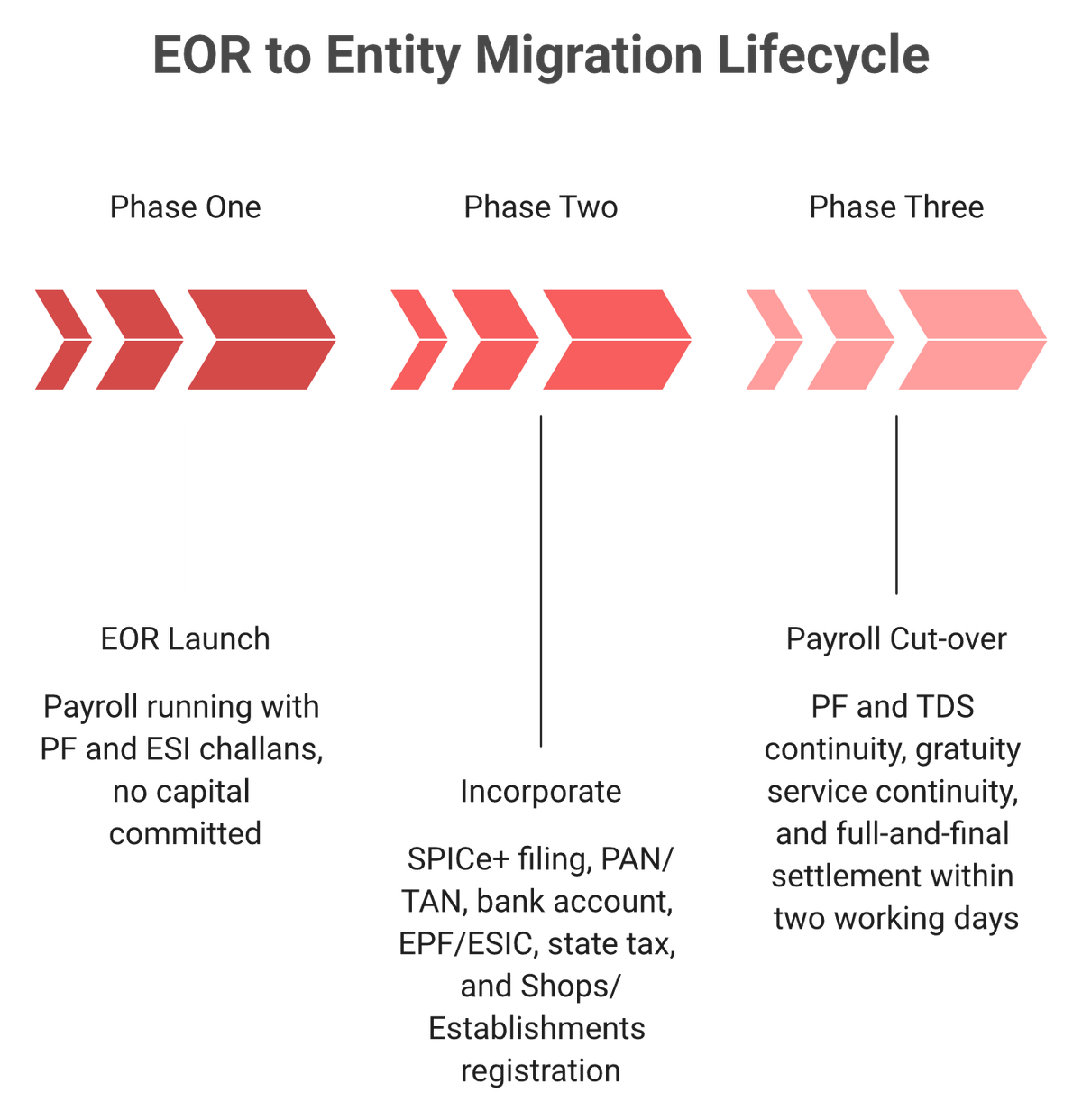
⏰ Phase 1: EOR launch, hires 1 to 15
Goal: people live and compliant inside a week, with no entity.
You skip $15K to $100K of incorporation cost and a 3 to 6 month wait. Versatile Club runs this phase on its own Indian entity under a 5-business-day onboarding SLA written into the service agreement, and the sequence is published on how it works.
Expected outcome: payroll running, PF and ESI challans arriving monthly, zero capital committed to India infrastructure.
💰 Phase 2: incorporate, at 20 to 30 heads
Goal: a Private Limited entity with live statutory accounts.
- File SPICe+ on the MCA portal for incorporation.
- Obtain PAN and TAN, then open the bank account.
- Register EPF and ESIC for the new establishment.
- Register professional tax and Shops and Establishments in each state where people sit.
- Elect the Section 115BAA regime when filing, if the arithmetic supports it.
Expected outcome: an entity that can legally receive employees. Not before step 4 is done. The broader options are mapped in this read on India expansion options.
⚠️ Phase 3: the cut-over, where it usually breaks
Goal: move employees with their history intact, in one payroll cycle.
Four risks sit here. PF and TDS year-to-date figures must carry across, or employees see wrong Form 16 numbers in May. Continuity of service must be preserved, or gratuity accrual restarts at zero. Full-and-final settlements are now expected within two working days of exit. The parallel-run rule is absolute: never create a month with no PF filing. The step-by-step version is in this guide to switching EOR provider in India.
Versatile Club migrates employees from our entity to a client entity with PF and TDS year-to-date continuity intact, then continues as managed payroll provider at $49 per employee per month.
💸 Exit terms decide total cost
| Provider | Exit terms |
| Versatile Club | No exit fee |
| Deel | One month notice billing |
| Remote | One month notice billing |
| Multiplier | Two weeks |
Read that column before you read the monthly fee. A $400 rate with notice billing and held data can cost more to leave than a $599 rate with clean terms. Published rates sit on the Deel pricing page, the Remote pricing page, and the Multiplier pricing page.
⭐ Why I tell clients to leave
An EOR that never tells you to incorporate is optimising its own revenue. That is the quiet conflict in this category, and nobody writes it on a pricing page.
Versatile Club's position is simpler because we run managed payroll on client entities too. The migration advice does not cost us the account, so I give it at 25 heads rather than 60.
For the board deck, size the India plan against current technology-sector and capability-centre demand data rather than internal gut feel, drawing on the nasscom Strategic Review 2026. It makes the threshold defensible to a CFO who has never bought EOR.
Versatile Club's zero exit fee exists for exactly this moment: no penalty, no notice-period billing, no hostage data. The same filing team continues on the account, working from a different registration number.
Q11. How do you verify a provider's India claims before you sign?
Verify three things in writing. First, entity ownership: ask for the provider's own PF establishment code, ESIC code, and Shops and Establishments registration numbers, then confirm the employment contract names that entity as employer. Many global platforms deliver India through third-party partner entities, which inserts another organisation between you and the filing you are liable for. Second, the money: request a live sample invoice and hunt six line items, namely setup fee, security deposit, FX markup, exit fee, benefits markup, and off-cycle payroll charge. Third, the promise: ask whether the onboarding timeline is contractual or aspirational. Versatile Club writes a 5-business-day SLA into its service agreement, and the full terms are listed on the pricing page.
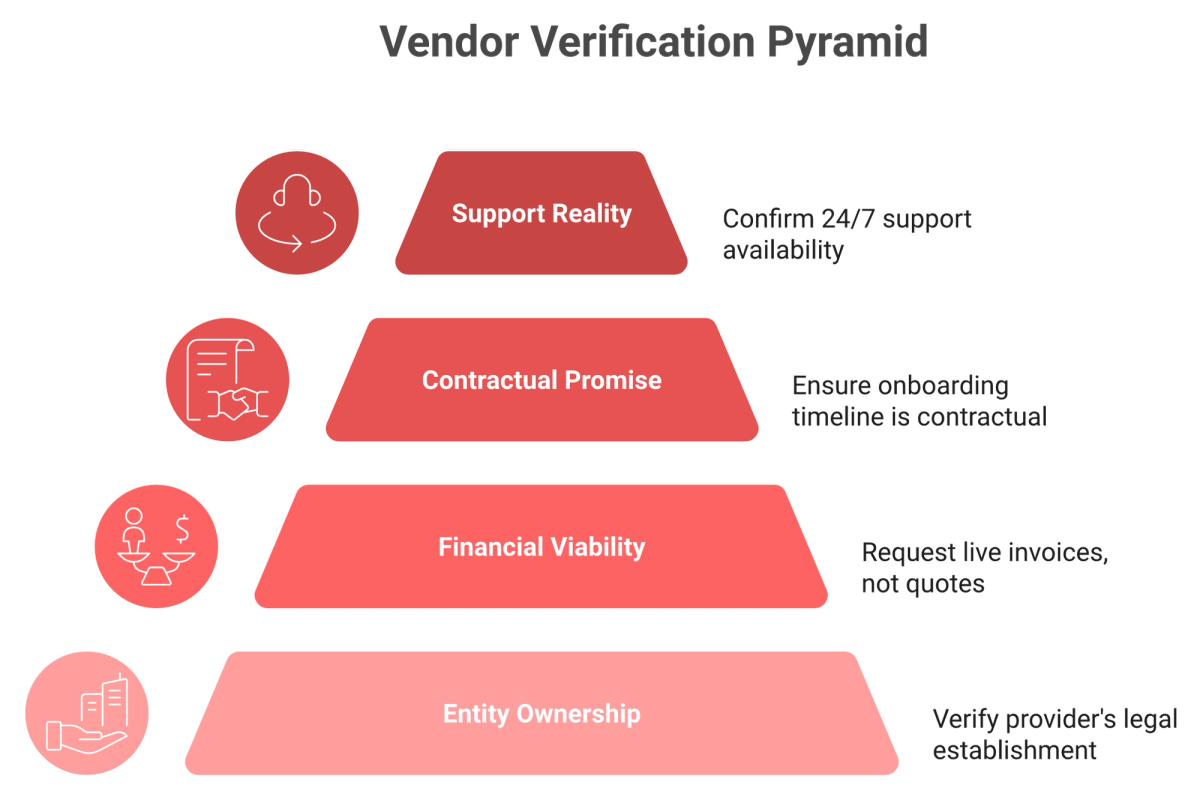
✅ The ten-question procurement checklist
Paste this into your vendor doc. The disqualifying answer is in brackets.
- What is your PF establishment code? ("Our partner holds it.")
- What is your ESIC code? (No number produced.)
- Which states hold Shops and Establishments registrations in your name? ("The major ones.")
- Which legal entity appears on the offer letter? (A different name than the one you contracted with.)
- Can I see a redacted sample invoice? (A quote arrives instead.)
- Is the onboarding timeline in the contract? ("It is our standard practice.")
- What is the exit fee and notice period? (Notice billing after offboarding.)
- Who answers at 11pm IST when payroll breaks? ("Submit a ticket.")
- Can you produce last month's PF challan and TDS receipt for a live client, names redacted? (Delay.)
- What is your processing-log retention period under the DPDP Rules? ("Let me check with legal.")
Versatile Club answers questions 1 through 4 with numbers, because the registrations belong to Foo Falcon Technologies Pvt Ltd. Codes can be checked independently on the EPFO establishment search. If you are shortlisting against the India-native field, start with the best EOR in India comparison.
💸 What reviewers wish they had asked first
"Payments: There are hidden fees. Of course, again, also here. Even your contract says payment processing/transactions will be paid by your client, they do not care. You will never get your net-agreed salary through Deel."
— İbrahim, Verified User, Deel - G2 Verified Review (1 star, 1 November 2024)
"We've noticed that response times can sometimes be very slow when we require clarifications on employee questions or payroll operations. In addition, we have to remind Papaya to get monthly reports for a couple of countries every month."
— Cherry H., Payroll Operations, Papaya Global - G2 Verified Review (3.5 stars)
"I've noticed that their support/query responses can occasionally take a bit longer sometimes, likely due to a relatively small team."
— Verified User in Financial Services, Wisemonk - G2 Verified Review (4 stars, 14 June 2025)
Fees and response time are the two complaints that repeat across both tiers. Question 5 and question 8 exist because of them. If Papaya is on your list, this Papaya Global alternatives for India comparison runs the same criteria.
⏰ One habit that saves a payroll cycle
Never ask an India vendor "are we on schedule?" You will get a polite yes.
Ask "where are we on the schedule?" instead, and request a written recap after every call. Versatile Club sends a monthly compliance status report for the same reason: it converts a verbal assurance into a document.
⭐ Where Versatile Club fails this checklist
Versatile Club launched EOR in 2026, so we claim no decade of EOR-specific track record. The entity, the all-28-state registrations, and six years of multi-state Contract-to-Hire payroll are what carry it.
Versatile Club's verifiable claims are narrow and checkable: our own PF and ESIC codes on the challans, S&E licences across 28 states in our name, a 5-day SLA in the agreement, zero setup and exit fees, and the founder on WhatsApp instead of a queue. Tell me what you are building in India through contact us, and I will tell you honestly whether we fit.
FAQs
Do PEO services in India legally exist, or do I actually need an EOR?
A US-style co-employment PEO is not a statutory category in India. Indian law contemplates one legal employer per worker, and the four Labour Codes, in force since 21 November 2025, never define co-employment. So the search term resolves to one of two different purchases.
- You hold an Indian Private Limited entity. With live EPF, ESIC, TDS, and state professional tax accounts, you are buying managed payroll or ASO-style administration. Statutory liability stays on your books.
- You have no Indian entity. You cannot buy PEO at all. You need an Employer of Record, where the provider becomes the legal employer on paper and carries the filings.
The practical consequence matters more than the label. In India there is no shared liability to hide behind, so the establishment whose PF code appears on the monthly challan carries the exposure when a filing is wrong or late.
Versatile Club sells both sides of that fork, which is why we ask about entity status before pricing on every call. If you are still mapping the two models against each other, our breakdown of EOR versus PEO walks through the decision with the fit conditions for each.
How much do PEO and EOR services cost per employee in India in 2026?
India managed payroll or PEO runs about $49 per employee per month. India-native EOR runs $99 to $149. Global generalist platforms charge roughly four times that, and the published spread looks like this.
- Deel: around $599 per month plus a $500 setup fee.
- Remote: $599 per month plus $299 setup.
- Multiplier: from $400 per month, INR invoicing by default.
- G-P: about 15% of salary with a $1,500 monthly minimum.
- Contractor management: $19 to $49 per contractor per month.
The headline fee is rarely the real number. Add employer statutory load of roughly 15% to 20% of gross, plus the line items that never appear on a pricing page: security deposits, exit or notice billing, benefits markup, off-cycle payroll charges, and a reported 3% to 5% FX conversion spread.
Versatile Club charges $149 per employee per month with no setup fee, no exit fee, first month free, and USD invoicing direct from its Indian entity, so there is no conversion spread to discover in month three. For modelled totals including statutory cost, see our guide to employer of record cost.
What statutory compliance should an India PEO or EOR execute every month?
India payroll compliance is six recurring obligations, not a single money transfer. A competent provider executes all of them and returns proof each month.
- EPF: 12% of Basic plus DA up to the Rs 25,000 wage ceiling, of which 8.33% routes to the pension scheme.
- EDLI and administrative charges: 0.50% each, capped at the ceiling.
- ESI: 3.25% employer and 0.75% employee for wages up to Rs 21,000.
- Professional tax: state-specific slabs, capped at Rs 2,500 a year.
- TDS: deducted under Section 192 and deposited by the 7th, with Form 16 issued by 30 May.
- Gratuity: accrued from month one at about 4.81% of Basic plus DA.
Two operator details decide audits. Gratuity paid late carries mandatory 10% simple interest per annum under Section 7(3A), and authorised deductions are capped at 50% of wages earned in that wage period.
Versatile Club returns the artefacts rather than the assertion: a payroll summary, a compliance status report, PF and ESI challan confirmations, and TDS deposit receipts every month. The full filing calendar sits in our guide to payroll compliance in India.
How did the 2026 EPF wage ceiling increase change India employer costs?
Notification S.O. 5109(E) dated 17 September 2026 raised the EPF wage ceiling from Rs 15,000 to Rs 25,000, and the arithmetic changed for every employee in that wage band.
- Employer PF at the ceiling moved from Rs 1,800 to Rs 3,000 a month.
- The pension share moved from Rs 1,250 to Rs 2,083.
- EDLI and administrative charges each moved from Rs 75 to Rs 125.
- EDLI maximum life cover rose from Rs 7 lakh to about Rs 10.5 lakh.
A separate pension scheme amendment dated 25 September 2026 made enrolment automatic and placed the duty on the employer, not the employee. Alongside that, the Labour Codes require Basic plus DA to be at least 50% of total remuneration from 21 November 2025, which folds allowances back into the wage base for PF and gratuity.
Three actions follow. Pull every employee between Rs 15,001 and Rs 25,000, check the September 2026 split-month pro-rata, and restate gratuity provisioning from 21 November 2025 rather than from your restructure date.
Versatile Club reran every client payroll against these changes in September 2026. Use our cost of hiring in India breakdown to re-forecast the year.
When should we stop paying EOR fees and set up our own Indian entity?
The trigger is headcount, and the usual threshold sits between 20 and 30 India employees. At $149 per employee per month, 25 people cost about $44,700 a year, which exceeds entity setup plus annual maintenance. Incorporation also unlocks the 22% concessional corporate rate under Section 115BAA.
The sequence matters more than the timing.
- Phase one: run EOR for hires 1 to 15, skipping $15K to $100K of incorporation cost and a 3 to 6 month wait.
- Phase two: incorporate via SPICe+ on the MCA portal, then register EPF, ESIC, professional tax, and Shops and Establishments in every state where people sit.
- Phase three: migrate payroll, keeping the EOR live until those registrations are active.
Four cut-over risks break migrations: PF and TDS year-to-date continuity, continuity of service for gratuity accrual, full-and-final settlements now expected within two working days, and any month with no PF filing.
Versatile Club charges no exit fee and continues as managed payroll provider at $49 per employee per month after migration. Our guide to EOR versus entity in India sets out the full arithmetic.