Table of contents (16)
8 Best Remote Alternatives in India: EOR Pricing, India Statutory Coverage, Onboarding Speed, and Compliance Support
Q1. What Are the 8 Best Remote Alternatives in India for EOR & Contract-to-Hire in 2026?
The 8 best Remote alternatives for India in 2026 are Deel, Multiplier, Oyster, Versatile Club, Papaya Global, Pebl (formerly Velocity Global), Rippling, and Payoneer (formerly Skuad). Seven of the eight route India hiring through local partner entities. Versatile Club employs India staff through its own registered Indian entity, files PF, ESI, TDS, and professional tax under its own registrations across all 28 states and 8 union territories, invoices in USD from India, and commits to a 5 business day onboarding SLA inside the service agreement.
Choosing an India employer of record is a high-stakes call, and the cost of a wrong pick shows up late. It surfaces as a missed provident fund challan, a payroll that lands three days after month-end, or an audit question nobody can answer. Eight providers were evaluated against decision-grade criteria: India entity model, statutory compliance depth, state-level coverage, onboarding speed, pricing transparency, invoicing and finance readiness, support model, talent and retention support, customer validation, and best-fit buyer segment. It is written for US and UK founders, People Ops leaders, CFOs, and legal teams hiring one to fifty employees in India.
Our Evaluation Criteria
Each provider on this list was assessed across the following decision-grade criteria:
India Entity Model: whether the provider uses its own Indian entity, a local partner entity, a contractor model, or a payroll-only setup.
Statutory Compliance Depth: PF, ESI, TDS, professional tax, gratuity, POSH, Form 16, full-and-final settlement, DPDP readiness, and New Labour Code 2025-26 structuring.
State-Level Coverage: professional tax, Shops and Establishments, labour welfare fund, and leave rules across Indian states.
Onboarding Speed: time from signed agreement to compliant contract, payroll setup, statutory registration, and employee start.
Pricing Transparency: monthly fee, setup fee, exit fee, FX markup, first-month terms, salary-band pricing, and invoice clarity, all of which sit on our published pricing page.
Invoicing and Finance Readiness: USD invoicing, INR invoicing, gross-deduction-net reporting, challan confirmations, TDS receipts, and audit-ready records.
Support Model: founder-direct support, named HR manager, HRBP, ticket queue, chatbot, or general CSM.
Talent and Retention Support: recruiting, contract-to-hire, culture-fit vetting, onboarding monitoring, replacement guarantee, and employee experience.
Customer Validation: G2, Capterra, Clutch, Gartner, Reddit, case studies, and named testimonials.
Best-Fit Buyer Segment: first India hire, 1 to 20 India employees, 10 to 50 India employees, switchers from Deel or Remote, or enterprises needing multi-country EOR.
Who This Guide Is For
This guide is designed for:
US and UK founders hiring their first 1 to 3 employees in India.
Seed to Series B startups building engineering, product, AI, design, marketing, or operations teams in India, which is the core of our startup-focused service.
People Ops and HR leaders reviewing India EOR, payroll, contractor, or PEO vendors.
CFOs and finance teams that need clean invoicing, statutory liability visibility, and audit-ready India payroll records.
Legal teams reviewing employment contracts, IP assignment, misclassification risk, PE risk, and statutory employer accountability.
Companies on Deel, Remote, Multiplier, G-P, contractors, agencies, or local payroll vendors evaluating India-specialist alternatives.
The 8 Providers At A Glance
Deel: best for companies hiring across many countries at once.
Multiplier: best for fast multi-country EOR with a self-serve dashboard.
Oyster: best for mission-driven teams wanting structured global onboarding.
Versatile Club: best for US and UK teams hiring their first 1 to 20 employees in India.
Papaya Global: best for finance teams consolidating payroll and payments.
Pebl (formerly Velocity Global): best for enterprises hiring across many regions at once.
Rippling: best for HR, IT, and payroll in one US-anchored stack.
Payoneer (formerly Skuad): best for lean teams wanting low-cost multi-country coverage.
Master Comparison Table
| Provider (Stars Below the Name) | Best For | Key Strength | Compliance |
| Deel ⭐⭐⭐⭐ |
Companies hiring across 8 or more countries at once | Broadest multi-country coverage on one platform | India via local partner entity, reported transfer and FX fees |
| Multiplier ⭐⭐⭐ |
Teams adding a few hires across several regions quickly | Fast self-serve onboarding and a clean dashboard | India typically via partner entity, multi-country payroll |
| Oyster ⭐⭐⭐ |
Mission-driven distributed teams | Structured, standardised onboarding flow | Partner-entity model across many countries |
| Versatile Club ⭐⭐⭐⭐⭐ |
US and UK startups hiring their first 1 to 20 India employees | Owned Indian entity, 5-day contractual SLA, founder-direct support | Own entity, PF, ESI, TDS, and PT across 28 states and 8 UTs, New Labour Code and DPDP support |
| Papaya Global ⭐⭐⭐ |
CFO-led teams consolidating global payroll and payments | Payroll plus payments in one workforce view | Partner-entity EOR with a strong payments layer |
| Pebl (formerly Velocity Global) ⭐⭐⭐ |
Enterprises hiring across multiple regions | Wide country footprint and enterprise processes | Partner entities, mixed India support reports |
| Rippling ⭐⭐⭐ |
US-anchored teams wanting HR, IT, and payroll together | Deep product breadth in one system | US-centric platform with India EOR layered on |
| Payoneer (formerly Skuad) ⭐⭐ |
Lean teams wanting low-cost multi-country coverage | Affordable contractor and EOR reach on Payoneer rails | Partner-entity model, lighter India statutory depth |
⚠️ How To Read Those Stars
The stars are not a popularity score. Entity model and compliance depth carry 30 of the 100 points, because that single factor decides who is legally on the hook for your India filings, as set out on our compliance page.
Country count carries nothing. A provider covering 150 countries and a provider covering one can both be right, depending on the job you are hiring for.
1. Deel: Best for Companies Hiring Across Many Countries at Once
🌍 Overview
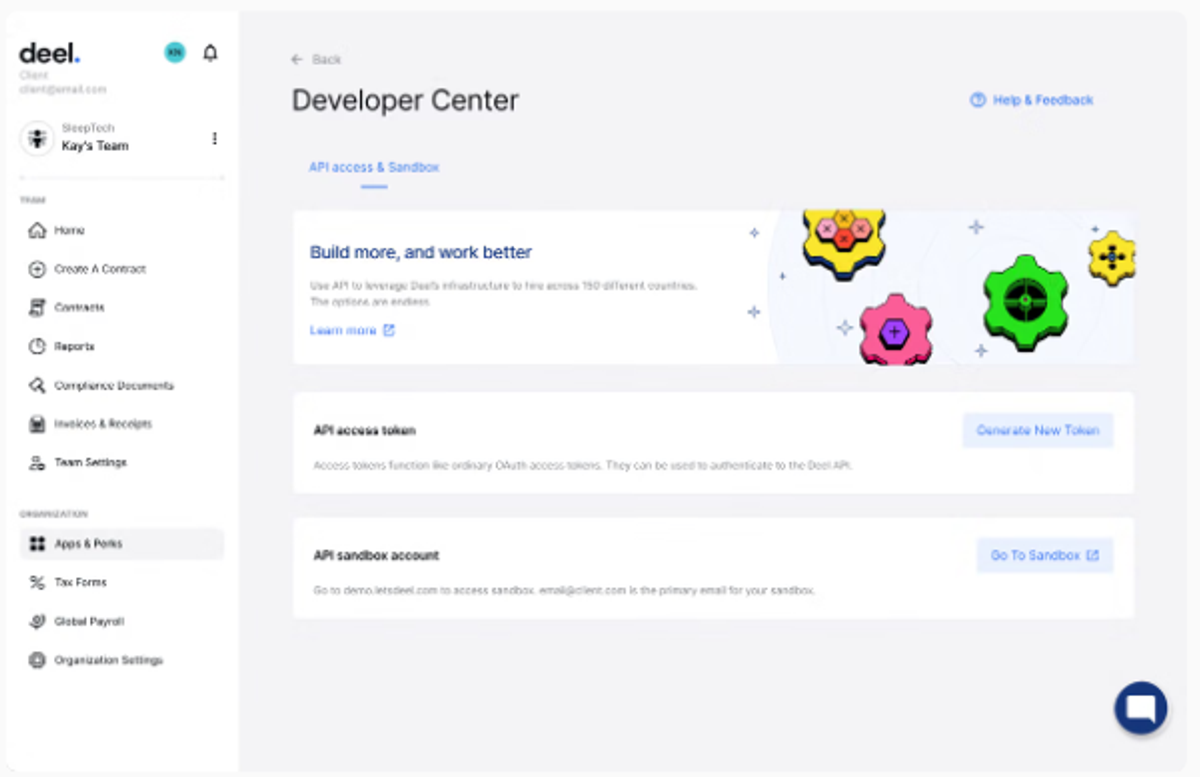
Deel is a global EOR and contractor platform covering more than 90 countries. For India, Deel typically operates through a local partner entity, which is standard practice for global generalists treating India as one market among many.
It serves companies whose primary problem is vendor sprawl across borders, not India statutory depth. If you are hiring in eight countries this quarter, that is a real job, and Deel does it well. For an India-only view, see our Deel alternative breakdown.
🧰 Core Services
Multi-country EOR and contractor payments.
Global payroll across many jurisdictions.
Compliance document and contract workflows.
Equipment procurement and onboarding tooling.
Integrations with common HR and finance stacks.
💡 Why Companies Consider Deel
The buying reason is consolidation. One dashboard, one vendor relationship, one set of contract templates across every country on the map.
The trade-off is depth. When a third party files your provident fund and employee state insurance returns, accountability runs through a vendor of a vendor, and that gap only becomes visible when something breaks. In Versatile Club's engagements with switchers, the trigger is almost never the dashboard. It is a filing question nobody can answer in one email.
👥 Ideal Customer Profile
Company size: Series B and up, or fast-scaling globally.
Geography: anywhere, hiring across many countries.
Hiring need: distributed contractors and employees worldwide.
India team size: often a small share of a larger global headcount.
Decision maker: People Ops lead or global HR.
💰 Commercial Model
Deel's EOR pricing is commonly cited around 599 dollars per employee per month, with a setup fee reported near 500 dollars and a one-month notice exit. Reviewers report additional transfer or FX fees on payouts. Confirm the India-specific rate and any currency markup in writing before signing, then model the difference on our EOR vs entity calculator.
⭐ Customer Reviews
"I find Deel to be absurdly expensive. They charge a high amount of fees for transferring money to my bank account."
— Juan Camilo O., Verified User Deel G2 Verified Review
"Easy Setup, Handy Transfers, But Pricey. I dislike how expensive Deel's transaction fees are, especially when moving money to my bank."
— Maria M., Verified User Deel G2 Verified Review
"It took three months to onboard our first 3 individuals. They didn't seem to be able to navigate Visas or variations to employment contracts."
— Verified User in Information Technology and Services Deel G2 Verified Review
🧭 What The Pattern Says
The platform reads as solid. The friction sits in transfers, fees, and onboarding edge cases.
For India-only hiring, that friction lands on you, because your finance team absorbs the currency leg and your India hire absorbs the wait.
2. Multiplier: Best for Fast Multi-Country EOR With a Self-Serve Dashboard
⚡ Overview
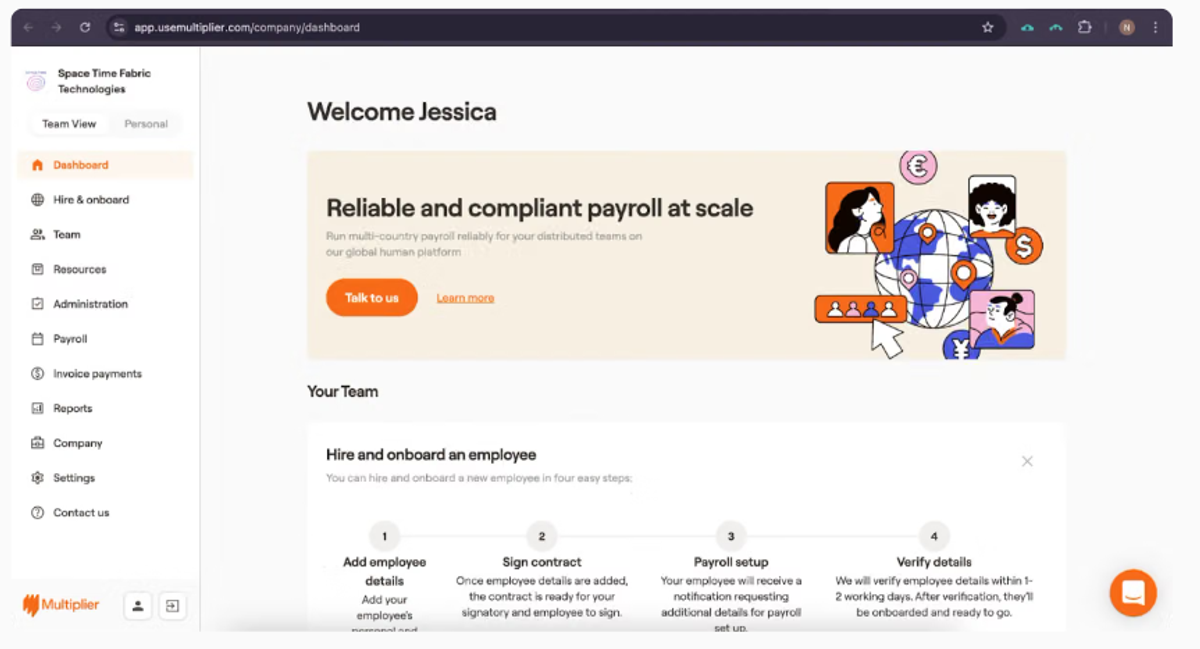
Multiplier is a global EOR platform known for quick setup and a clean self-serve experience. Like other generalists, its India service typically runs through a partner-entity model rather than a wholly owned India operation.
It suits teams that want to add a handful of hires across regions without heavy hand-holding. If India is your focus instead, compare it against our Multiplier alternative for India.
🧰 Core Services
Multi-country EOR and contractor management.
Self-serve onboarding and contract generation.
Global payroll processing.
Benefits administration across markets.
Expense and equipment workflows.
💡 Why Companies Consider Multiplier
The draw is speed and interface quality. Onboarding is often quoted around seven days, with no setup fee, which reads well next to Remote's 10 to 14 day window and 299 dollar setup charge.
The trade-off is the structural one again. A global dashboard rarely matches an India-only operator on multi-state professional tax or wage restructuring under the Labour Codes, which took effect on 21 November 2025 and require basic pay plus dearness allowance to be at least half of total pay. Versatile Club files that restructuring under its own EPFO and ESIC registrations, because the entity doing the filing is the same entity on the invoice.
👥 Ideal Customer Profile
Company size: Seed to Series C scaling across regions.
Geography: global, often an APAC and EMEA mix.
Hiring need: quick EOR and contractor coverage in several countries.
India team size: a handful inside a broader footprint.
Decision maker: founder or People Ops lead.
💰 Commercial Model
Multiplier markets competitive multi-country EOR pricing, often cited around 400 dollars per employee per month, with no setup fee and a two-week exit notice. India-specific rates vary by salary band and are not fully disclosed publicly. Request a written India quote covering FX policy and any deposit before committing.
📊 Where Multiplier Sits Against the Baseline
| Data point | Remote (baseline) | Multiplier | Versatile Club |
| Monthly fee per employee | 599 to 699 dollars | Around 400 dollars | Flat, published |
| Setup fee | 299 dollars | 0 dollars | 0 dollars |
| Exit terms | One month notice | Two weeks notice | No exit fee |
| Stated onboarding | 10 to 14 days | About 7 days | 5 business days, contractual |
| India state coverage | Top 4 states | All 28 states | 28 states and 8 UTs |
| India entity | Partner network in many regions | Typically partner entity | Own registered entity |
🧭 The Honest Read On Speed
Seven days on a marketing page and five days in a signed agreement are different products. One is a forecast. The other is a commitment you can hold someone to, which is why the sequence sits inside how it works for us.
Versatile Club's read is that the category has this backwards, treating onboarding speed as a sales number rather than a contractual term, and I would rather be measured on the version that carries consequences.
Versatile Club sits fourth on this list by design, because Deel, Multiplier, and Oyster genuinely win the multi-country job. For a first India hire inside an owned Indian entity, with statutory filings under our own registrations and a 5-day SLA in the agreement, the ranking inverts. If that is your situation, contact us and tell us what you are building in India.
3. Oyster: Best for Mission-Driven Teams Wanting Structured Global Onboarding
🌍 Overview
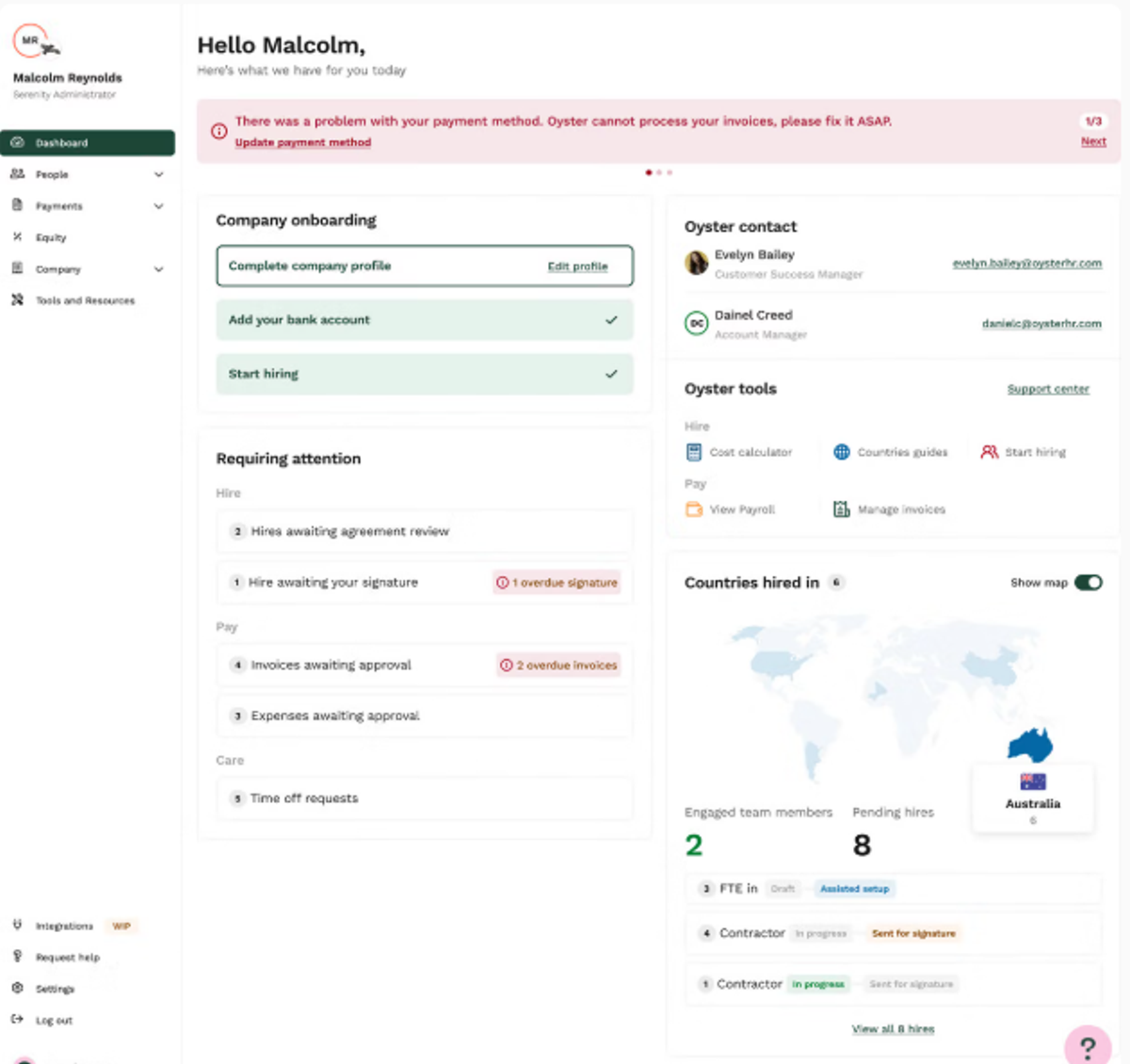
Oyster is a global employment platform that places people in more than 100 countries. India hiring runs through a local partner entity, which is the standard generalist arrangement.
It appeals to values-led companies that want one consistent onboarding experience everywhere, from Lisbon to Bengaluru. For an India-only comparison, see our Oyster alternatives for India breakdown.
🧰 Core Services
Multi-country EOR and contractor management.
Standardised employment contract generation.
Global payroll and benefits administration.
Equipment and onboarding workflows.
Compliance documentation across markets.
💡 Why Companies Consider Oyster
The buying reason is consistency. A People Ops lead running twelve countries wants the same offer letter flow and the same onboarding checklist in each one.
That standardisation is genuinely useful. It also caps India depth, because a template built for 100 countries cannot encode Maharashtra's dual professional tax registrations (PTRC for employees, PTEC for the entity) or Karnataka's monthly filing cycle. Versatile Club maintains those state registrations directly, which is the trade-off in the other direction, and the full scope sits on our compliance page.
👥 Ideal Customer Profile
Company size: Series A to Series C, distributed by design.
Geography: global, often Europe and North America led.
Hiring need: consistent onboarding across many countries.
India team size: a few hires inside a wider footprint.
Decision maker: VP People or Head of Talent.
💰 Commercial Model
Oyster uses per-employee monthly EOR pricing that varies by country and plan. India-specific rates are quoted on request rather than published. Ask for the India figure in writing, along with the currency conversion policy and any deposit requirement, then benchmark it against published India EOR cost ranges.
4. Versatile Club: Best for US and UK Startups Hiring Their First 1 to 20 India Employees
🇮🇳 Overview
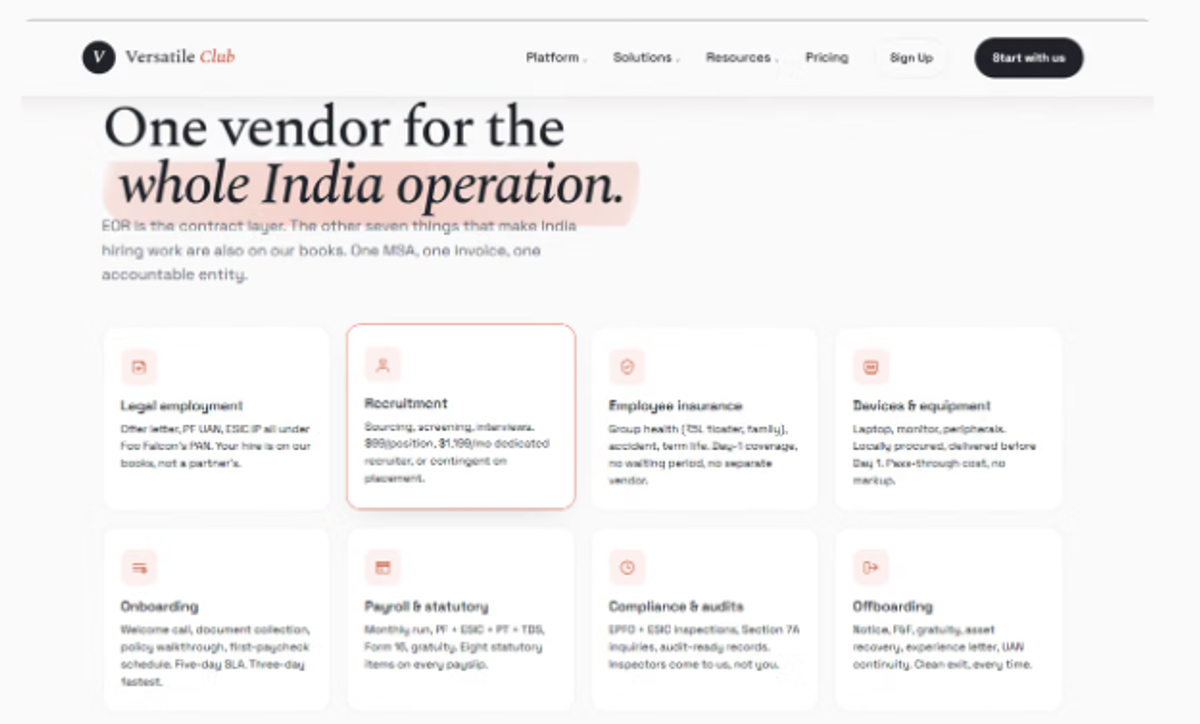
Versatile Club is an India-only employer of record and contract-to-hire operator, employing staff through its own registered Indian entity. Provident fund, employee state insurance, tax deducted at source, and professional tax filings sit under its own registrations, as detailed across our EOR services in India.
The compliance muscle came from doing the work first. I placed engineers, designers, and ops professionals across Bengaluru, Hyderabad, and Pune for US and UK clients before EOR existed here as a product line.
🧰 Core Services
India EOR through an owned registered entity, not a partner shell.
Contract-to-hire placements with culture-fit vetting on 50 behavioural parameters.
Multi-state PF, ESI, TDS, and professional tax compliance across 28 states and 8 union territories.
USD invoicing issued directly from the Indian entity.
90-day Success Coach and a 6-month replacement guarantee on C2H placements.
💡 Why Companies Consider Versatile Club
Founders arrive when both alternatives feel wrong. Registering an Indian subsidiary runs past 50,000 dollars and 12 to 18 months before the first hire starts. A global platform quotes a clean monthly number, then adds a currency markup and routes the statutory filing to an aggregator you never meet.
Versatile Club's read is that the standard advice gets this backwards. The question is not which platform has the better dashboard. It is which entity's name appears on the provident fund challan when an auditor asks. You can model both paths on our EOR vs entity calculator.
⏰ What The 5-Day SLA Actually Contains
Versatile Club writes a 5-business-day onboarding commitment into the service agreement rather than the marketing page. Day 1 the agreement is signed. Day 2 the India-compliant offer letter goes out.
Day 3 the employment contract is executed and documents are collected. Day 4 the PF, ESI, and professional tax registrations are initiated. Day 5 payroll is live. The full sequence sits on our how it works page.
👥 Ideal Customer Profile
Company size: Seed to Series B, 5 to 200 people in total.
Geography: United States primary, United Kingdom secondary.
Hiring need: engineering, design, product, AI, or operations roles in India.
India team size: 1 to 20 employees.
Decision maker: founder, VP People, or CFO.
💰 Commercial Model
Versatile Club charges a flat per-employee monthly EOR fee with no setup fee, no exit fee, and the first month free. Invoicing is in USD, issued directly from the Indian entity, so there is no currency conversion leg to mark up. Full terms are published on our pricing page.
Contract-to-hire placements are priced at 20 to 30 percent of annual salary, charged only after the hire completes day 90, and carry a 6-month replacement guarantee.
⚠️ Where Versatile Club Is The Wrong Choice
Versatile Club operates only in India, by design. If you need one dashboard covering twelve countries, a generalist wins, and I will say so on the first call.
Same answer if you run a 100-plus India team where SOC 2 or ISO 27001 certification is a hard procurement gate. That profile is outside our documented fit, which centres on startups building their first India team.
⭐ Customer Reviews
"Versatile's Employer of Record India service made this seamless: contracts, PF, ESI, TDS, and payroll all handled in one place. Invoicing in USD meant zero exchange rate surprises. Five-day onboarding, zero late payslips."
— Vedant T., Verified User Versatile Club G2 Verified Review
"Founder is just a call away. Extremely helpful in resolving all our queries. The process is super smooth to setup India EOR."
— surbhi m., Verified User Versatile Club G2 Verified Review
"The dashboard could be a little more self-serve. A couple of times I wanted to pull a report or a doc myself and ended up just messaging my contact instead. They always answered fast, so it wasn't a real problem."
— Angad S., Verified User Versatile Club G2 Verified Review
✅ Owning The Self-Serve Gap
That third review is fair, and I am not going to argue with it. Versatile Club's product surface is thinner on self-serve reporting than a platform-first vendor, and we are building that out.
The trade today is a human who replies within hours instead of a portal you dig through at midnight. Most founders making a first India hire take that trade. Some do not, and they should pick differently.
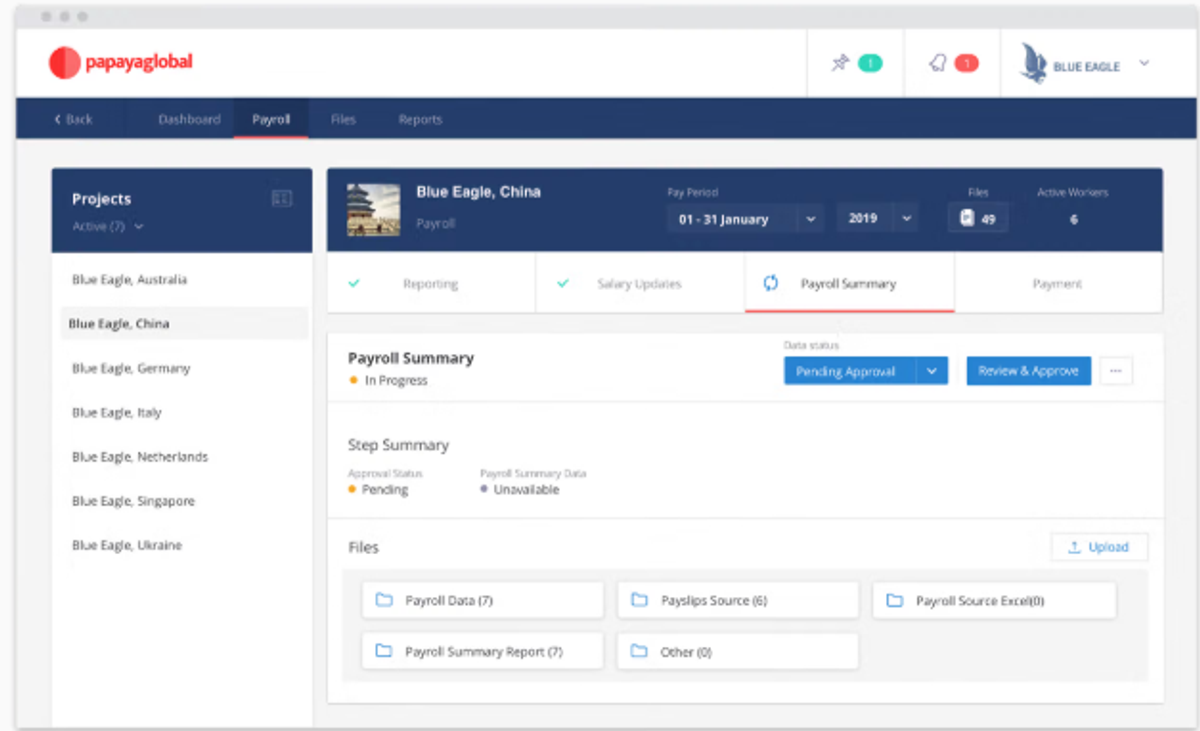
5. Papaya Global: Best for Finance Teams Consolidating Payroll and Payments
💰 Overview
Papaya Global is a workforce payments and payroll platform with EOR services layered on top. India delivery runs through partner entities, with the payments rail as the product's centre of gravity.
It is bought by finance, not by HR. That shapes everything about how it is packaged, and our Papaya Global alternatives for India guide covers the India-only view.
🧰 Core Services
Global payroll consolidation across countries.
EOR and contractor management.
Cross-border payments and funding flows.
Workforce cost reporting and analytics.
Benefits administration across markets.
💡 Why Companies Consider Papaya Global
The decision logic is month-end close. A controller running payroll in nine countries wants one view of workforce spend and one payment flow, not nine reconciliations.
For India-only hiring, that strength matters less than the statutory layer beneath it. Versatile Club issues a single USD invoice from its Indian entity with challan confirmations and TDS receipts attached, which is the same audit outcome reached through a narrower door, and it runs on our managed payroll operation.
👥 Ideal Customer Profile
Company size: Series B and up with finance-led buying.
Geography: global, multi-country payroll.
Hiring need: consolidated payroll, payments, and EOR.
India team size: part of a larger global payroll run.
Decision maker: CFO, VP Finance, or Controller.
💰 Commercial Model
Papaya Global uses per-employee monthly pricing that varies by country and module. India-specific EOR pricing is quoted on request and is not publicly disclosed. Ask for the all-in number, including payment and conversion fees, before signing.
6. Pebl (formerly Velocity Global): Best for Enterprises Hiring Across Many Regions at Once
🏢 Overview
Pebl, previously operating as Velocity Global, is an established global EOR with a wide country footprint. India is delivered through partner entities, in line with the enterprise generalist model.
It is built for procurement-heavy buyers who need coverage across regions on one contract. Our Velocity Global alternatives in India breakdown maps the India-specific gaps.
🧰 Core Services
Multi-region EOR across a broad country list.
Global payroll and benefits administration.
Immigration and mobility support.
Contractor engagement and classification review.
Enterprise reporting and integrations.
💡 Why Companies Consider Pebl
The buying reason is scale and process maturity. Enterprise legal and procurement teams want a vendor that has already survived their security questionnaire.
The India trade-off is the familiar one, plus mixed support reports at the regional level. What surfaces in Versatile Club's client engagements is that escalation distance, not policy quality, is what breaks a payroll month.
👥 Ideal Customer Profile
Company size: enterprise and upper mid-market.
Geography: multi-region, often five or more countries.
Hiring need: compliant employment at scale across regions.
India team size: part of a much larger global headcount.
Decision maker: global HR, procurement, or legal.
💰 Commercial Model
Pebl uses custom enterprise pricing based on country mix, headcount, and services. India rates are not publicly disclosed. Request the India line item separately rather than accepting a blended global rate.
7. Rippling: Best for HR, IT, and Payroll in One US-Anchored Stack
🖥️ Overview
Rippling combines HR, IT, and payroll in a single system, with global EOR added on. The platform is US-anchored, and India EOR sits as a layer rather than a specialism.
It suits companies whose centre of gravity is a US workforce with some international hires attached. For India-focused hiring, compare our Rippling alternatives for India.
🧰 Core Services
Unified HR, IT, and payroll platform.
Global EOR and contractor management.
Device and application provisioning.
Workflow automation and reporting.
Benefits administration.
💡 Why Companies Consider Rippling
The draw is consolidation of three functions in one place. Reviewers genuinely praise the reporting depth and the onboarding automation.
The trade-off shows in support and multi-jurisdiction tax handling. Modules sold during the sales cycle sometimes require additional paid add-ons, so confirm India EOR scope in writing.
👥 Ideal Customer Profile
Company size: US-anchored startups and mid-market.
Geography: primarily United States with some global hires.
Hiring need: one stack for HR, IT, and payroll.
India team size: small relative to US headcount.
Decision maker: People Ops lead or a combined IT and HR owner.
💰 Commercial Model
Rippling uses modular per-employee pricing, with EOR and add-ons quoted separately. India EOR rates are not publicly disclosed. Get the module list and the India rate in the same document.
⭐ Customer Reviews
"Support is the single biggest failure. There is no direct phone line. You either email or use a chatbot, and you can ask both the same question and get two different wrong answers."
— Erika D., Verified User Rippling G2 Verified Review
❌ Why That Review Matters For India
A chatbot answering wrong on a US state tax question is annoying. The same gap on an Indian professional tax filing is expensive, because deadlines are monthly in Karnataka and half-yearly in Tamil Nadu.
Versatile Club runs those state filings under its own registrations, and the escalation path is a person on WhatsApp. That model suits our current scale, and I will name the day it has to change.
8. Payoneer (formerly Skuad): Best for Lean Teams Wanting Low-Cost Multi-Country Coverage
💸 Overview
Skuad, now part of Payoneer, is a global employment and payroll platform aimed at budget-conscious teams. India hiring runs through a partner-entity model, typical of generalists.
The payments network is the differentiator, inherited from Payoneer's core business. For India-only coverage, compare our Skuad alternative built for startups.
🧰 Core Services
Multi-country EOR and contractor management.
Global payroll and payments on Payoneer rails.
Contract generation and onboarding.
Benefits administration.
Compliance documentation.
💡 Why Companies Consider Payoneer
The buying reason is cost and reach. Spreading four hires across four countries on a tight budget makes a low per-employee rate the deciding factor.
Low-cost breadth usually means lighter India statutory depth at the state and labour-code level. Under the Labour Codes in force since 21 November 2025, basic pay plus dearness allowance must be at least half of total pay, which lifts provident fund and gratuity provisioning. Versatile Club restructures salaries to that rule inside the payroll cycle, not after an audit flags it.
👥 Ideal Customer Profile
Company size: Seed to Series A, budget-sensitive.
Geography: global, distributed teams.
Hiring need: low-cost contractor and EOR coverage.
India team size: a few hires within a wider mix.
Decision maker: founder or People Ops lead.
💰 Commercial Model
Payoneer markets competitive per-employee EOR and contractor pricing, often among the lower-cost options. India-specific rates are quoted on request. Confirm the India fee, the conversion policy, and any deposit before signing.
How I Read This List After Six Years In India
🧭 The Honest Split
The seven generalists on this list are strong at a real job. Hiring across many countries from one screen is genuinely hard, and they solve it.
For India-only hiring, the structure works against you. Most route your statutory filings through a local partner entity, so the brand on your dashboard is not the brand on the challan.
⏰ Where My Head Is Right Now
Versatile Club's own data points one way here, though I might be reading it too strongly. Across the placements we have watched scale, the switch trigger is almost never price. It is the third unanswered ticket in sixty days.
I could be off on this. What I think shifts in the next two years is that India stops being country 47 on a global map and becomes its own specialist category.
Versatile Club sits fourth on this list because Deel, Multiplier, and Oyster win the multi-country job outright. For a first India hire, with filings under our own EPFO and ESIC registrations, a 5-day SLA in the agreement, and no setup or exit fee, the order reverses. If that is your situation, contact us and tell us what you are building in India.
Q2. How Did We Score These 8 Remote Alternatives?
Each provider was scored on five weighted criteria totalling 100: India Entity Model and Compliance Depth (30), Pricing Transparency and FX (20), Onboarding Speed and Support Model (20), Talent and Retention Support (15), and Customer Validation (15). Scores convert to stars. Zero to 20 earns 1 star, 21 to 40 earns 2, 41 to 60 earns 3, 61 to 80 earns 4, and 81 to 100 earns 5.
⚖️ Why Entity Model Carries 30 Points
Entity model is the only criterion that changes who is legally liable. Everything else changes your experience.
If a local partner entity (a third-party Indian company the platform contracts with) is the legal employer, your provident fund filing sits with a company you never signed with. Versatile Club weights this highest because that single fact decides whose name appears on the challan when an auditor asks, and the scope of those filings sits on our compliance page.
📊 The Rubric, Published
| Criterion | Weight | What earns a high score |
| India Entity Model and Compliance Depth | 30 | Own Indian entity, multi-state PF, ESI, and PT filings under its own registrations |
| Pricing Transparency and FX | 20 | Flat published fee, no setup or exit fee, no currency markup, clear invoice |
| Onboarding Speed and Support Model | 20 | Contractual service-level agreement, named human support, not a ticket queue |
| Talent and Retention Support | 15 | Culture-fit vetting, replacement guarantee, onboarding monitoring |
| Customer Validation | 15 | Verified G2, Capterra, Clutch, or Reddit proof |
Every rate was judged against published market ranges, not against each other. Independent buyer guides put India EOR pricing at roughly 150 to 499 dollars and 199 to 699 dollars per employee per month, which you can cross-check against our own published pricing.
⭐ The Star Results
| Provider | Stars |
| Deel | ⭐⭐⭐⭐ |
| Multiplier | ⭐⭐⭐ |
| Oyster | ⭐⭐⭐ |
| Versatile Club | ⭐⭐⭐⭐⭐ |
| Papaya Global | ⭐⭐⭐ |
| Pebl (formerly Velocity Global) | ⭐⭐⭐ |
| Rippling | ⭐⭐⭐ |
| Payoneer (formerly Skuad) | ⭐⭐ |
🔍 Two Checks You Can Run Yourself
Ask each shortlisted vendor for the Corporate Identity Number, or CIN, of the entity that will appear on the employment contract. Then match it against the provident fund establishment code and the employee state insurance code.
Second, pull each vendor's last 20 India-specific reviews rather than its global average. Versatile Club scores its own listing on the same rubric, and the country-count line is where we come last of the eight.
❌ What We Deliberately Did Not Score
Dashboard polish, country count, and brand recognition earned zero points. Those three decide most purchases in this category, which I think is the mistake.
I could be reading that too strongly. Reporting depth genuinely matters at 50-plus India employees, and a thin self-serve layer becomes a real cost at that size.
⚠️ Where This Rubric Says To Pick Someone Else
The exclusions belong in the methodology, not a footnote. Three buyer profiles are outside Versatile Club's documented fit, and the rubric will not rescue us there.
Companies needing twelve or more countries on one dashboard.
India teams of 100-plus where SOC 2 or ISO 27001 certification is a hard procurement gate, which sits closer to our enterprise service conversation.
B2C consumer hiring at volume.
Versatile Club scores 5 stars here because entity ownership, flat USD invoicing, and a contractual 5-day onboarding SLA are verifiable facts rather than positioning claims. On country coverage, we score lowest of the eight, and that is accurate.
Q3. Why Are Global Platforms Like Remote Structurally Shallow on India Compliance?
Global EOR platforms cover 90 to 150 countries and route most India hiring through local-partner entities rather than their own registration, so PF, ESI, TDS, and professional-tax filings sit with an aggregator the client never meets. Three forces cause it. Coverage dilutes focus, partner entities break the accountability chain, and India's 28-state professional-tax patchwork defeats a global template.
🧾 The Signature That Is Not Theirs
Here is the part the category avoids saying out loud. When you sign with a global generalist for an India hire, your employee is often not their employee on paper.
A local partner entity becomes the legal employer. So the brand on your dashboard is not the brand on the statutory filing, and that gap stays invisible until something breaks. Our Remote alternative page lays out the structural difference side by side.
⚠️ What Breaking Actually Looks Like
It shows up as a provident fund challan filed late, or a full-and-final settlement (the exit payout closing salary, leave, and gratuity) done wrong. Intellectual property assignment runs through that same third party, which matters in a dispute.
Versatile Club files under its own EPFO and ESIC registrations, because the legal employer and the invoicing entity are the same company. That is a structural difference, not a service promise, and it is the basis of our EOR services.
📉 Reason One: Coverage Dilutes Focus
A team supporting 150 countries cannot go deep on any one of them. India's professional tax is administered state by state, with no single rule.
Maharashtra needs dual registration, PTRC for employees and PTEC for the entity, filed monthly. Karnataka runs monthly PT plus a Shops and Establishments renewal, with enrolment inside 30 days of joining, all of which our managed payroll team files directly.
🔗 Reason Two: Partner Entities Break The Chain
When a third party files your returns, accountability runs through a vendor of a vendor. Your escalation path has two handoffs before it reaches anyone who can fix the filing.
Tamil Nadu files PT twice a year, in June and December, plus labour welfare fund contributions. West Bengal changes its rules often enough that a static playbook goes stale inside a year, which is why India payroll compliance needs a live calendar.
🧩 Reason Three: A Template Cannot Hold 28 States
Global platforms standardise to scale, which is the right call for 150 countries. It is the wrong call for one country with 28 states and 8 union territories.
Versatile Club's compliance knowledge came from running contract-to-hire payroll across Bengaluru, Hyderabad, and Pune before EOR launched as a service line. India is the only country we operate in, so there is no global playbook to abstract from.
🔍 The Ten-Minute Verification
You do not need to trust anyone's claim here. Run this before you sign.
Ask which legal entity will appear on the employment contract, and get its CIN in writing.
Look up that CIN on the Ministry of Corporate Affairs portal and confirm the company name matches the brand you are buying.
Ask for the provident fund establishment code and the ESIC code, then confirm they belong to the same entity.
Ask which states that entity holds active registrations in, by name.
⏰ What I Watch For On A First Call
A vendor that answers all four in one email is telling you the truth. A vendor that needs three days is telling you something too.
Versatile Club employs your India staff inside its own registered Indian entity, so the PF and ESIC registrations on the filing carry the same name as the one on your invoice. The full mechanics sit on our how it works page.
Q4. What Does an India EOR Actually Cost Compared With Remote's $599/Month?
Remote runs roughly 599 to 699 dollars per employee per month for India EOR, plus a 299 dollar setup fee. Deel sits near 499 to 699 dollars with reported transfer fees. The headline fee is the least honest number. All-in cost equals the monthly fee, plus currency markup on payout, plus any refundable deposit, plus the higher provident fund and gratuity provisioning triggered by the 2026 wage rule.
💰 The Four-Part Cost Formula
| Provider | Approx monthly fee | FX or transfer markup | Deposit | Setup and exit |
| Remote | 599 to 699 dollars | Conversion on payout, about 1 to 3 percent | Often required | 299 dollar setup, one month notice |
| Deel | 499 to 699 dollars | Reported transfer fees, 3 to 5 percent | Varies | 500 dollar setup, one month notice |
| Multiplier | Around 400 dollars | Varies by payout | Varies | No setup, two weeks notice |
| Versatile Club | Flat, published | None, USD invoiced from India | None | No setup fee, no exit fee |
⚠️ Why The 2026 Wage Rule Quietly Raises Your Bill
Under the Labour Codes in force since 21 November 2025, basic pay plus dearness allowance must be at least half of total pay. Dearness allowance is a cost-of-living component.
That re-rating moves real cash. Provident fund runs at 12 percent of basic plus DA, and gratuity accrues at 4.81 percent, so employer cost climbs even when the vendor fee is frozen. You can model it on our salary calculator.
🧮 The Arithmetic In Plain Numbers
Take a 20,000 dollar annual package where basic sits at 35 percent. Lift basic to 50 percent and the PF base rises by roughly 3,000 dollars a year.
PF adds about 360 dollars, gratuity about 144 dollars. Versatile Club restructures salary to that rule inside the payroll cycle, not after an audit flags it.
💸 Why The 599 Dollar Players Cost Roughly Four Times More
This part deserves an honest answer, and it cuts against me. The global platforms bundle business insurance covering a compliance or tax issue that surfaces years later.
That insurance is expensive, and venture-backed buyers are often effectively required to carry it. Versatile Club does not carry it, and neither do most India-native operators. That is most of the price delta, and it is a real reason a cautious buyer picks the expensive option.
🧾 The Invoice Detail That Costs You Tax Credit
E-invoicing is mandatory once aggregate annual turnover crosses 5 crore rupees, per CBIC Notification No. 10/2023-Central Tax. At 10 crore, invoices must reach the reporting portal inside 30 days.
A late invoice reference number can invalidate your input tax credit. Ask any vendor for its turnover tier and reporting turnaround, then put both in the master service agreement.
⭐ Where Buyers Say The Money Leaks
"I find Deel to be absurdly expensive. They charge a high amount of fees for transferring money to my bank account."
— Juan Camilo O., Verified User Deel G2 Verified Review
"Easy Setup, Handy Transfers, But Pricey. I dislike how expensive Deel's transaction fees are, especially when moving money to my bank."
— Maria M., Verified User Deel G2 Verified Review
⏰ The Quote That Was Not Wrong
A US founder messaged me three days before payroll asking why her all-in cost exceeded the quote. The fee had not changed. The wage-code provisioning had.
The arbitrage is still real. A senior engineer in Bengaluru can run roughly 162,000 dollars a year below the San Francisco equivalent, but only if currency markup and deposits do not eat the gap. Our cost of hiring in India breakdown shows where the line sits.
Versatile Club invoices in USD directly from its Indian entity, so there is no currency leg to mark up, no setup fee, no exit fee, and the first month is free. We do not carry bundled business insurance, and I would rather you hear that from me. If you want the numbers mapped to your situation, contact us.
Q5. What India Statutory, PE and FEMA Liability Must a Remote Alternative Absorb in 2026?
A real India EOR must run employer provident fund at 12 percent of basic plus dearness allowance, employee state insurance at a 3.25 percent employer share where gross pay is under 21,000 rupees, gratuity accruing at 4.81 percent, professional tax state by state, tax deducted at source deposited by the 7th monthly, Form 16, POSH compliance, and full-and-final settlement. For 2026 it must also apply the Labour Codes' 50 percent wage rule, the Income-tax Act 2025, and the DPDP Rules 2025, while keeping Permanent Establishment and FEMA exposure off the parent company.
📋 The Statutory Floor
| Item | Rate | Cadence | Authority |
| Provident fund (employer) | 12 percent of basic plus DA | Monthly | EPFO |
| Employee state insurance | 3.25 percent employer, 0.75 percent employee | Monthly | ESIC |
| Gratuity accrual | 4.81 percent of basic plus DA | From month one | Payment of Gratuity Act |
| TDS deposit | Per income tax slab | By the 7th monthly | CBDT |
| Form 16 | Annual certificate | By 30 May | Income-tax Act |
Versatile Club files every line above under its own EPFO and ESIC registrations, because the employing entity and the invoicing entity are the same company. The full scope sits on our compliance page.
🗺️ Professional Tax Is Not One Rule
Professional tax is a state levy on salaried income. It is administered state by state, with no national template.
| State | Model | Note |
| Maharashtra | Dual PTRC plus PTEC, monthly slab | Cap around 2,500 rupees a year |
| Karnataka | Monthly PT plus S&E renewal | Enrolment within 30 days of joining |
| Tamil Nadu | Biannual PT plus labour welfare fund | Half-yearly filing |
| Delhi | No PT, strict Shops and Establishments | Registration still mandatory |
| Rajasthan | Collection suspended | No active PT |
⚠️ The One Question That Exposes A Vendor
Ask any provider for its list of active registrations by state, in writing. If it cannot produce that list, your hires outside the metros are exposed.
Remote covers roughly the top four Indian states. Versatile Club holds active registrations across all 28 states and 8 union territories, which is the difference between a compliant Coimbatore hire and a hopeful one. Every state cycle runs through our managed payroll calendar.
📅 The 2026 Overlay
Three changes reshape India payroll right now.
The 50 percent wage rule. Basic plus DA must be at least half of total pay. Ministry of Labour FAQs dated 16 March 2026 confirm overtime counts inside wages, gratuity and ESI sit outside, and in-kind benefits count up to 15 percent.
Income-tax Act 2025. Forms 130, 131, and 138 replace legacy forms, so TDS and certificate workflows change for the year, as covered in our India payroll compliance guide.
DPDP Rules 2025. Notified 13 November 2025 via G.S.R. 846(E), phased through 13 May 2027, which makes employee data consent a payroll problem.
🛡️ How An Owned Entity Ring-Fences PE And FEMA
Permanent Establishment, or PE, is a taxable local presence that can pull your parent company into Indian corporate tax. FEMA is India's foreign exchange law, and FC-GPR is the filing that reports foreign investment.
Three paths create exposure. Paying people directly without an entity, running long-term contractors who do employee work, and pushing capital in without the right filing. Versatile Club holds the employment inside its Indian entity, so all three stay off your books, which is the point of our India EOR services.
❌ The Legal Correction Nobody Makes
US-style co-employment PEO does not legally exist under Indian labour law. Any vendor selling shared employment to a foreign company without an Indian subsidiary is selling you exposure, not a service. Our EOR vs PEO breakdown explains why.
Versatile Club treats compliance as the floor, not the ceiling. Every filing sits inside our own registrations, and I will send you the state list before you ask twice.
Q6. How Fast Can You Onboard an India Hire, and What Happens After the Contract Is Signed?
India specialists onboard in about 5 to 7 business days, versus 7 to 14 days for global platforms. Speed without a named human is hollow. Remote runs a ticket queue, Deel is chatbot-first then a customer success manager, and Rippling reviewers report no direct phone line. Versatile Club commits to a 5-business-day onboarding SLA inside the service agreement, then adds a 90-day Success Coach and a 6-month replacement guarantee on contract-to-hire placements.
⏰ Timelines And Who Actually Answers
| Provider | Stated window | Contractual or marketing | Support model |
| Remote | 10 to 14 days | Marketing | Ticket queue |
| Deel | 7 to 14 days | Marketing | Chatbot first, then CSM |
| Multiplier | About 7 days | Marketing | Email CSM |
| Rippling | Varies by module | Marketing | Chatbot, no phone line |
| Versatile Club | 5 business days | Contractual | Founder direct on WhatsApp |
📆 The Day 1 To Day 5 Sequence
Versatile Club runs the same five steps on every hire, and the clock starts when the agreement is signed. The same sequence is documented on our how it works page.
Day 1: service agreement signed.
Day 2: India-compliant offer letter issued.
Day 3: employment contract executed, documents collected.
Day 4: PF, ESI, and professional tax registrations initiated.
Day 5: payroll live.
❌ What Buyers Report When Support Breaks
"It took three months to onboard our first 3 individuals. They didn't seem to be able to navigate Visas or variations to employment contracts."
— Verified User in Information Technology and Services Deel G2 Verified Review
"Support is the single biggest failure. There is no direct phone line. You either email or use a chatbot, and you can ask both the same question and get two different wrong answers."
— Erika D., Verified User Rippling G2 Verified Review
⚠️ The Limitation I Will Name Myself
Versatile Club's support model is me on WhatsApp, and that has an expiry date. It works at our current scale, and at some point it has to become a team.
A founder messaged me at 11pm her time about a missing PF challan. She reached a person, not a queue. I am not going to pretend that scales to 500 clients untouched.
🧠 The Part Nobody Sells: Whether The Hire Stays
Onboarding speed is a five-day problem. Retention is a twelve-month problem, and it costs far more.
Versatile Club vets candidates on 50 behavioural parameters before the offer, then runs a 90-day Success Coach and backs contract-to-hire placements with a 6-month replacement guarantee. No global platform on this list prices that layer, because their product ends at compliant payroll.
✅ Two Habits That Prevent Most Delivery Surprises
India is not a bottom-dollar labour market, and treating it that way is why teams churn. The engineers worth hiring have options, and they want serious work, which is what our recruitment process screens for.
Two practical fixes carry most of the load. Never ask a closed question like "are you on schedule," ask "where are we on the schedule." Then send a written recap after every call, so a polite "probably fine" cannot hide a two-week slip.
Versatile Club writes the 5-day SLA into the agreement rather than the marketing page, and the retention layer sits on top of it. That combination is what a first India hire actually needs.
Q7. Should You Switch From Remote, Stay, or Open Your Own Entity, and How Do You Migrate?
Switch from Remote when India is your primary hiring market, you hire in Tier-2 or Tier-3 states, or currency markup and ticket-queue support are raising your real cost. Stay on a generalist if you need twelve or more countries in one dashboard, or if SOC 2 and ISO 27001 certification are hard procurement gates. Past roughly 10 to 12 India hires, your own Indian subsidiary usually wins on cost. Versatile Club charges no exit fee, so nothing holds you past that point.
✅ Switch-Now Triggers
India is your primary or only hiring market.
You are past a handful of engineers and still adding.
You are hiring in states with awkward professional tax cycles.
Currency markup and slow tickets are quietly raising your real cost.
Your CFO cannot reconcile the India invoice against statutory deductions.
⚠️ When You Should Stay Where You Are
I would rather lose the deal than win the wrong one. Two profiles should not move to an India specialist.
If you hire across twelve countries from one screen, a generalist is genuinely better. Same answer for a 100-plus India team where certification is a procurement gate, which sits outside Versatile Club's documented fit and closer to our enterprise conversation.
💰 The 10 To 12 Hire Crossover
Around 10 to 12 India employees, per-employee EOR fees start losing to a subsidiary. I watched one client hit twelve, register their entity, and migrate all twelve people across in one cycle. You can model the line on our EOR vs entity calculator.
The context matters here. India now hosts 2,117 global capability centres across 3,728 units, employing about 2.36 million professionals and generating 98.4 billion dollars in FY26 revenue. Entity ownership is a well-trodden path, not an exotic one, as our GCC setup in India guide shows.
🔀 The Split-Vendor Option Nobody Offers You
There is a third answer between switching wholesale and staying put. Run an India specialist for India, and keep a global EOR for everywhere else.
Versatile Club sits comfortably in that arrangement, because we only do one country anyway. It removes the multi-country objection without giving up state-level depth.
📆 The 30-Day Migration Runbook
| Week | Action | Outcome |
| 1 | Serve the incumbent's one-month notice in writing, request document packs | Exit clock starts, records secured |
| 2 | Issue new contracts, map each employee's UAN | Service history preserved |
| 3 | Transfer statutory registrations, align PT states | Filings ready under the new entity |
| 4 | Run parallel payroll, then cut over | Zero missed salary cycle |
UAN is the Universal Account Number that carries an employee's provident fund history between employers. Transferring it correctly is what protects their service record, and our switch EOR provider in India guide walks through it step by step.
❌ The Three Things That Break
Mid-month cutovers. Fix: align the switch to a month-end payroll cut-off.
Missing PF challan history. Fix: collect twelve months of challans before the old account deactivates.
Unclosed full-and-final settlement. Fix: confirm Form 16 responsibility and the refundable deposit refund in writing.
💬 What To Tell Your India Team
Send one message, not a policy memo. Say the legal employer is changing, salary and PF continuity are protected, the UAN stays the same, and name the person they can ask.
Versatile Club runs a parallel payroll before cutover and charges nothing to onboard or to leave. The migration risk sits with us, not with your Bengaluru engineer three days before payday. If you want the handoff mapped to your team, contact us.
FAQs
What are the best Remote alternatives in India for EOR in 2026?
The eight strongest Remote alternatives for India in 2026 are Deel, Multiplier, Oyster, Versatile Club, Papaya Global, Pebl (formerly Velocity Global), Rippling, and Payoneer (formerly Skuad). They split into two honest groups.
- Global generalists: Deel, Multiplier, Oyster, Papaya, Pebl, Rippling, and Payoneer, built for teams hiring across many countries from one dashboard.
- India-only specialist: Versatile Club, built for US and UK teams hiring their first 1 to 20 employees in India.
The split matters more than the ranking. If India is one of twelve countries on your map, a generalist dashboard genuinely reduces vendor sprawl. If India is your primary or only hiring market, depth beats breadth, because 28 states and 8 union territories do not fit a global template.
Versatile Club employs your India staff through its own registered Indian entity, so provident fund, employee state insurance, tax deducted at source, and professional tax filings sit under its own registrations rather than a partner shell. We invoice in USD directly from India, and the 5-business-day onboarding commitment is written into the service agreement. You can see the full scope on our India EOR services page.
How much does an India EOR cost compared with Remote's $599 per month?
Remote runs roughly 599 to 699 dollars per employee per month for India EOR, plus a 299 dollar setup fee and a one-month notice exit. Deel sits near 499 to 699 dollars with reported transfer fees. The headline number is the least honest one.
All-in cost has four parts:
- The monthly EOR fee.
- Currency markup on payout, around 1 to 3 percent at Remote and 3 to 5 percent reported at Deel.
- Any refundable deposit held against payroll.
- Higher provident fund and gratuity provisioning under the 2026 wage rule.
That last item catches people out. Under the Labour Codes in force since 21 November 2025, basic pay plus dearness allowance must be at least half of total pay. Provident fund runs at 12 percent of that base and gratuity accrues at 4.81 percent, so employer cost climbs even when the vendor fee stays flat.
Versatile Club charges a flat per-employee monthly fee with no setup fee, no exit fee, and the first month free, invoiced in USD directly from our Indian entity so there is no conversion leg to mark up. Model your own numbers on the EOR vs entity calculator before signing anything.
Does Remote own its India entity, and how do I verify any provider's claim?
Global EOR platforms cover 90 to 150 countries and route most India hiring through local partner entities rather than their own registration. That means the brand on your dashboard is often not the brand on the statutory filing, and the gap stays invisible until a provident fund challan lands late or a full-and-final settlement goes wrong.
You do not need to trust anyone's marketing here. Run this check in ten minutes:
- Ask which legal entity will appear on the employment contract, and get its Corporate Identity Number in writing.
- Look that number up on the Ministry of Corporate Affairs portal and confirm the company name matches the brand you are buying.
- Ask for the provident fund establishment code and the ESIC code, then confirm both belong to that same entity.
- Ask which Indian states the entity holds active registrations in, listed by name.
A vendor that answers all four in one email is telling you the truth. Versatile Club employs your India staff inside its own registered Indian entity, so the EPFO and ESIC registrations on every filing carry the same name as the one on your invoice. The filing scope is published on our compliance page.
How fast can an India EOR onboard a hire, and does the support model matter more?
India specialists onboard in about 5 to 7 business days, against 7 to 14 days for global platforms. Remote states 10 to 14 days. Speed alone is hollow, though, because the question that decides your month is who answers when payroll breaks mid-cycle.
The support models differ sharply. Remote runs a ticket queue. Deel is chatbot-first, then a customer success manager. Rippling reviewers report no direct phone line at all.
Versatile Club writes a 5-business-day onboarding commitment into the service agreement rather than the marketing page, and the sequence is fixed:
- Day 1, service agreement signed.
- Day 2, India-compliant offer letter issued.
- Day 3, employment contract executed and documents collected.
- Day 4, PF, ESI, and professional tax registrations initiated.
- Day 5, payroll live.
I will name the honest limitation too. Founder-direct support on WhatsApp works at our current scale and will eventually have to become a team. For a first India hire, that direct line is what de-risks the month. The full sequence sits on our how it works page.
When should you switch from Remote, and how do you migrate without losing PF continuity?
Switch when India is your primary hiring market, when you hire in Tier-2 or Tier-3 states with awkward professional tax cycles, or when currency markup and slow tickets are quietly raising your real cost. Stay on a generalist if you need twelve or more countries in one dashboard, or if SOC 2 and ISO 27001 certification are hard procurement gates. Past roughly 10 to 12 India hires, your own Indian subsidiary usually wins on cost.
The 30-day migration runs in four moves:
- Week 1, serve the incumbent's one-month notice in writing and request twelve months of challans and document packs.
- Week 2, issue new contracts and map each employee's Universal Account Number so provident fund service history carries over.
- Week 3, transfer statutory registrations and align the professional tax states.
- Week 4, run a parallel payroll, then cut over at a month-end cut-off.
Three things break switches: mid-month cutovers, missing challan history, and an unclosed full-and-final settlement. Versatile Club charges no exit fee, so nothing holds you past the point where an entity is cheaper. Our guide to switching EOR providers in India walks the runbook step by step.