Table of contents (9)
Remote Pricing: EOR and Contractor Plan Costs, Hidden Fees, Country Variability, and the Negotiation Levers That Move the Number
Q1. What Does Remote.com Actually Cost in 2026, Every Plan, No Asterisks?
A US founder messaged me on WhatsApp last month with one line: "I have eleven Remote.com tabs open and I still cannot tell what I will actually pay." That is the whole problem with branded pricing pages. The sticker is loud, the real number is quiet.
Here is the clean version with no sales call attached.
💰 The full Remote.com price list for 2026
Remote.com's Employer of Record (EOR), the model where a provider legally employs your worker so you skip setting up an entity, costs $599 per employee per month billed annually. Pay monthly and it rises to $699, a 17% premium for flexibility. Contractor Management is $29 per contractor per month, Contractor Management Plus is $99, and Contractor of Record starts around $325.
| Remote.com product | Price (2026) | Billing note |
|---|---|---|
| EOR | $599/employee/mo (annual), $699 (monthly) | Owned and partner entities |
| Global Payroll | $29/employee/mo | For your own entity |
| Contractor Management | $29/contractor/mo | Pay-and-compliance only |
| Contractor Management Plus | $99/contractor/mo | Adds indemnity |
| Contractor of Record | from ~$325/mo | Shifts misclassification liability |
| HRIS | Free | Direct employees |
| Equity / Recruit | Quoted separately | Add-on, not published |
✅ No setup fee, no deposit, and a price that dropped
Remote runs a Fair Price Guarantee with no setup, onboarding, or offboarding fees, and no security deposit. That matters because some rivals hold a one-to-three-month deposit. Remote also cut its EOR headline from $699 to $599 in late 2024, and offers roughly a 15% startup discount.
I will say this plainly, because the category avoids it. A published price list is the floor of respect for a busy buyer, not a favour, which is exactly why our own transparent EOR pricing sits in the open.
⚠️ The number you see is not the number you pay
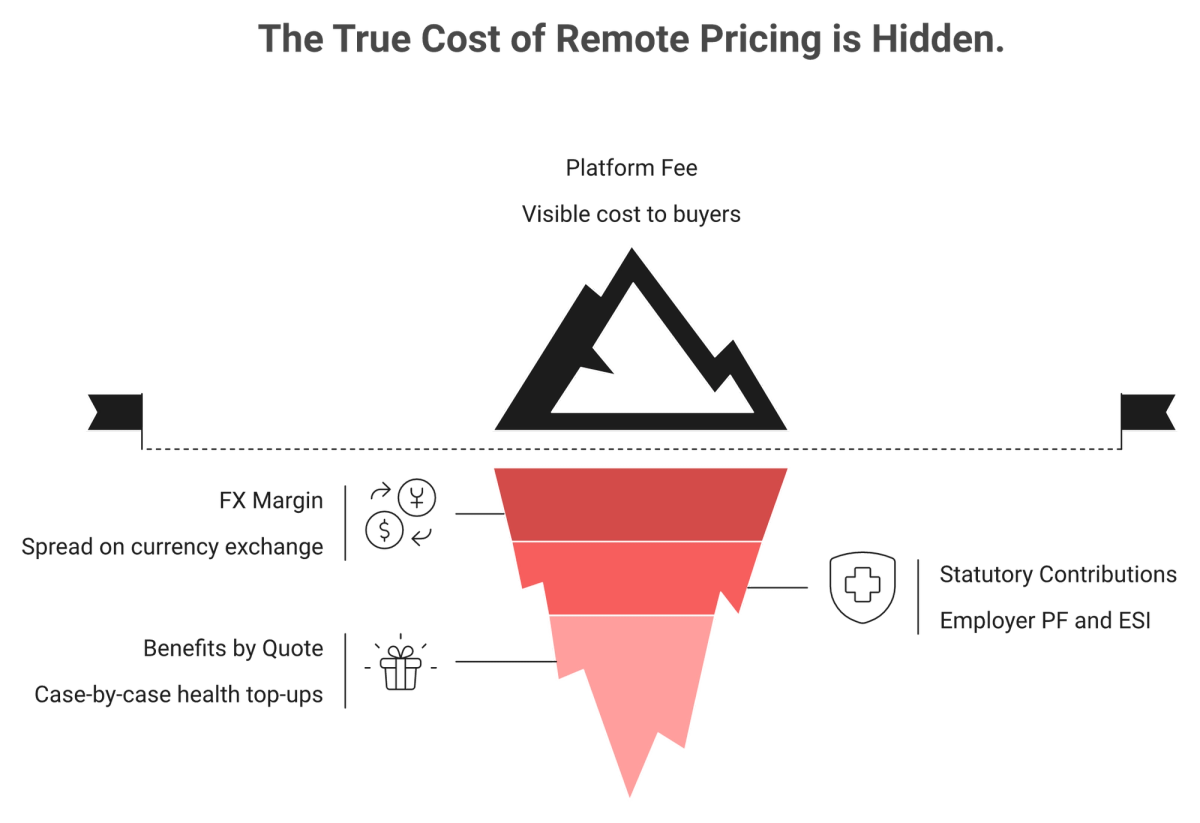
Every figure above is a platform fee only. None of them include salary, employer statutory contributions, or benefits priced per quote. That gap is where most India budgets break, and it is the open loop I will close in the next section.
At Versatile, when I price a US founder's first India hire, the number on the invoice is the number. No discovery call to learn what you owe, no setup fee, no exit fee, and the first month is free. Remote is genuinely strong if you hire across many countries. For India specifically, I think the buyer deserves the all-in figure on day one, which is why founders weighing a Remote alternative start with our EOR services in India.
Q2. Where Do the Hidden Costs Hide, FX Markups, Statutory Pass-Through, and Benefits-by-Quote?
A founder once forwarded me her first Remote invoice with a single question: "Why is this 30% higher than $599?" She was not misreading it. She had simply met the part of the bill the headline never shows.
The $599 platform fee is the smallest line on your invoice. The real cost sits in three layers: employer statutory contributions (often 10% to 35% of gross), any FX margin applied at currency conversion, and benefits priced per quote. Remote markets transparent FX, yet many global platforms add a 2% to 10% spread that can quietly beat the platform fee.
💸 Layer one: the FX margin nobody quotes upfront
FX margin is the gap between the real mid-market exchange rate and the rate your provider actually uses. A 2% markup on a $5,000 monthly salary is about $1,200 a year. That is two months of platform fee, hidden inside a currency conversion you never see itemised.
This is not a theoretical complaint. Buyers feel it on real invoices, which is one reason our managed payroll invoices in clean USD.
"I find Remote super complicated to use at a platform level, with zero clarity on the process. Also, there are hidden fees everywhere, and I end up paying roughly 30% more than what's stated on the platform or advertising."
Javier G. Remote G2 Verified Review
"I find Deel to be absurdly expensive. They charge a high amount of fees for transferring money to my bank account."
Juan Camilo O. Deel G2 Verified Review
⚠️ Layer two: statutory pass-through and benefits-by-quote
In India, the employer adds Provident Fund (PF, the mandatory retirement contribution) at 12% of Basic plus DA, and ESI (state health insurance) split 3.25% employer and 0.75% employee. Benefits like health top-ups are then quoted case by case, so two identical salaries can carry different totals.
Here is where the standard read gets it backwards. People negotiate the $599 hard and ignore the FX line. On a senior India hire, the platform fee is roughly 4% of total monthly outflow. I will rank every lever by dollar impact later, but hold that 4% number.
✅ How we remove the FX layer entirely
At Versatile, we invoice in USD directly from our own Indian entity. The money is not routed through a foreign holding company, and it is not converted from INR with a spread baked in. You get a clean dollar invoice each month with no FX exposure, which is exactly what a CFO closing month-end wants to see.
I could be wrong that FX is the dirtiest trick in cross-border EOR, but six years of invoices say it is the one buyers spot last. You can see how the model removes it on our how it works page.
Q3. Why Does the Same Plan Cost So Differently by Country, and What Does India Add in 2026?
"Why is my India hire's invoice nothing like my Poland hire's, when both say $599?" I get this question almost weekly. The platform fee is flat. The country underneath it is not.
A flat $599 platform fee never means a flat total. Country variability comes from statutory employer costs, and India's stack rises in 2026. The EPFO wage ceiling moves from ₹15,000 to ₹25,000 on 1 April 2026, and the new Labour Codes require Basic plus DA to be at least 50% of wages, lifting the PF and gratuity base even when salary does not move.
📈 The two 2026 rules that quietly raise your bill
The 50% wage rule means at least half of total pay must count as "wages." Since PF, gratuity, and ESI are calculated on that wage base, a higher base means higher employer contributions on the very same salary.
- Employer PF: 12% of Basic plus DA
- Gratuity accrual: 4.81% of Basic plus DA
- ESI: 3.25% employer share, up to the wage ceiling
- EPFO ceiling: ₹15,000 rising to ₹25,000 from 1 April 2026
Stack those, and the statutory layer can swing a budget far more than any fee discount you negotiated. Our compliance coverage is built around exactly these shifts.
💰 A worked example: one Bengaluru engineer
Take a senior engineer on roughly ₹60 lakh CTC. An India-specialist EOR lands that hire near $5,804 a month all-in, and the platform fee is only about 4% of that total. The other 96% is salary, statutory contributions, and benefits, which is exactly the part a global generalist tends to model thinly.
This is the gap I see daily. Global EOR platforms cover 90 to 185 countries and spread India expertise thin. Most route India through a local-partner entity, so the brand on your invoice is not the entity making the PF filing.
✅ Why owned-entity depth changes the math
At Versatile, India is the only country we operate in, through our own registered Indian entity. PF, ESI, TDS, and professional tax across states like Maharashtra (PTRC plus PTEC), Karnataka (monthly PT), and Tamil Nadu (biannual PT) are filed under our own registrations, not a partner's. I file these every month, so I am not reading the 2026 rules off a global playbook. I am pricing your hire against them through our EOR services. Founders who have lived the alternative feel the difference fast.
"Versatile's Employer of Record India service made this seamless: contracts, PF, ESI, TDS, and payroll all handled in one place. The compliance rigour is genuinely impressive, every statutory filing reviewed before submission."
Vedant T. Versatile G2 Verified Review
Q4. EOR Fee vs Contractor Fee, Which Remote Plan Should You Actually Be On?
The cheapest plan is a magnet. A founder sees $29 Contractor Management next to $599 EOR and the math feels obvious. Then a tax notice arrives, and the cheap plan turns out to be the expensive one.
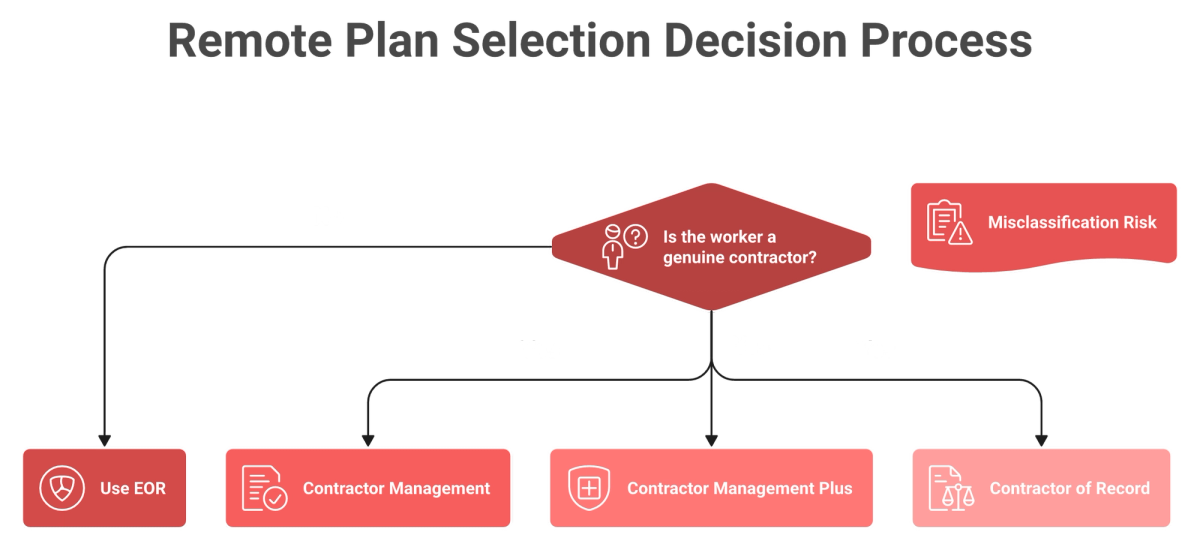
Remote's $29 Contractor Management looks cheaper than $599 EOR, but the cheap plan is only correct if the person is genuinely a contractor. In India, misclassifying a full-time worker as a contractor creates PF and ESI liability plus permanent-establishment (PE) risk, which is the danger that your worker's activity makes your foreign company taxable in India. Contractor Management Plus ($99) adds indemnity, and Contractor of Record (~$325) shifts liability. Pick the plan that matches the relationship, not the lowest number.
🧭 What each Remote plan actually protects
| Plan | Price | What it covers | Liability sits with |
|---|---|---|---|
| Contractor Management | $29/mo | Pay and basic compliance | You |
| Contractor Management Plus | $99/mo | Adds misclassification indemnity | Shared |
| Contractor of Record | ~$325/mo | Provider becomes the contracting party | Provider |
| EOR | $599/mo | Full legal employment | Provider |
⚠️ The misclassification trap, in plain terms
If your "contractor" works full-time hours, takes daily direction, and uses your tools, Indian authorities can treat them as an employee. That triggers back-dated PF, ESI, and tax exposure. And here is a label worth fixing: traditional US-style co-employment PEO does not legally exist under Indian labour law, so for anyone without an India entity, the correct path is EOR, not PEO.
Vetting matters too. Nearly 30% of IT sector resumes in India contain discrepancies, so a $29 plan with no real screening is a quiet risk on top of the legal one. A compliant contractor of record setup removes that exposure.
✅ The honest path from contractor to employee
This is where the standard EOR pitch goes quiet, and where Versatile lives. Our contract to hire model lets you start someone, see the fit, and convert them to a full, compliant India employee without ever parking a true full-timer on a contractor plan. Compliance is the floor. The "good hire who stays" is the ceiling, and that is the problem a $29 line item never solves. Founders tell us the simplicity is the point.
"It let Moonshot hire in India without standing up an entity. They took payroll, contracts, and ongoing compliance off our plate entirely. If you're a founder trying to figure out India EOR and you don't want it to become a second job, this is the one I'd point you to."
Angad S. Versatile G2 Verified Review
Q5. Remote vs Deel vs India-Native Specialists, How Do the Real Numbers Stack Up?
A People Ops lead at a Series A company once put it perfectly on a call: "Both Remote and Deel quoted me $599. So why do my finance projections look nothing alike?" That gap is the whole story. Structure beats sticker, every time.
Remote and Deel both publish Employer of Record (EOR) at $599 per employee per month on annual plans, while India-native specialists run roughly $99 to $349. But the headline rarely decides total cost. Deel applies a reported 3% to 5% FX markup and may require a deposit, Remote uses a partner-plus-owned-entity mix for India, and specialists invoice in USD directly. Compare FX policy and entity ownership, not just the sticker.
📊 The numbers that actually drive total cost
| Factor | Remote | Deel | India-native specialist |
|---|---|---|---|
| EOR sticker | $599/mo (annual) | $599/mo (annual) | ~$99-$349/mo |
| FX policy | Mixed, markets transparent | Reported 3-5% markup | USD direct, mid-market |
| India entity | Partner and owned mix | Partner model | Owned Indian entity |
| Support | Email, ~3-day SLA | Ticket queue | Founder-direct on WhatsApp |
| Onboarding | 10-14 days | 7-14 days | 5-day SLA |
⚠️ Why the entity model is the line that matters
In a partner model, the brand on your invoice is not the entity filing your worker's Provident Fund (PF). That splits accountability, so when a PF challan is late, you chase two parties, not one. Buyers feel this when support thins out, which is why founders comparing a Deel alternative weigh ownership first.
"They were dishonest about the level of support provided. We specifically explained we required phone-level support for urgent matters, instead they have email support with a 3-day SLA."
Juliette D. Remote G2 Verified Review
"Often the CS doesn't seem to have answers, which leads me to emails back and forth on my case, something I was looking for in 20 minutes becomes a 4 day process."
Verified User in Computer Software Deel G2 Verified Review
✅ Where Versatile sits in this picture
I will be straight, because my own brief tells me to be. If you need EOR across five or more countries, a global platform like Remote or Deel is the correct tool, and we are not. Versatile is the India-native contrast: our own registered Indian entity, USD invoicing direct from India, a 5-day contractual onboarding SLA, and me reachable on WhatsApp.
The standard "just buy Deel for everything" read gets India backwards, because the one country that needs the deepest local filing is the one a generalist routes through a partner shell. That is the core of our EOR services in India.
Q6. Which Negotiation Levers Actually Move the Number, and Which Don't?
Most founders open the negotiation by hammering the $599. I get it. It is the only number on the page. It is also the weakest lever you hold.
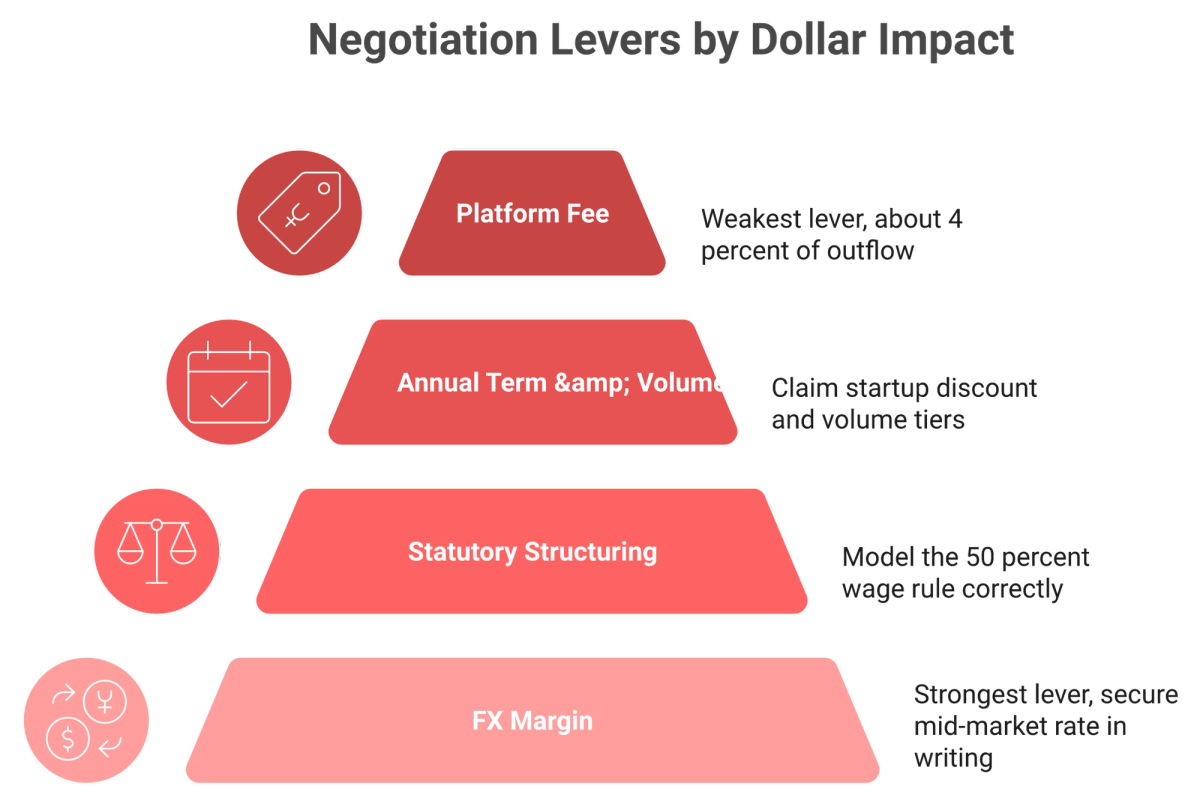
Negotiating the headline fee is the least powerful move you can make. Ranked by dollar impact: first, FX margin, so get the mid-market rate in writing; second, statutory structuring under the 50% wage rule; third, annual term and volume discounts, including Remote's roughly 15% startup discount; fourth, the platform fee itself. On a senior India hire, that fee is about 4% of total monthly outflow.
💰 The strongest lever is the one nobody negotiates
FX margin is the spread between the real mid-market exchange rate and the rate you actually get. A 2% markup on a $5,000 monthly salary is roughly $1,200 a year. That quietly beats any discount you squeeze out of the platform fee. Get the FX policy written into the contract, not promised on a call, the way our managed payroll invoices in clean USD.
⏰ Levers two through four, in plain order
- Structure pay so statutory contributions are modeled correctly under the 50% wage rule, where at least half of pay counts as wages.
- Ask for an annual term and volume tiers once you cross a few hires.
- Claim the startup discount of about 15% where offered.
- Then, last, push on the platform fee itself.
Here is the Monday-morning checklist: demand the FX margin in writing, request a written recap after every pricing call, and ask for the all-in landed cost, not the platform fee. You can model that all-in number with our salary calculator. The arbitrage is real. A Bengaluru engineer can cost far less than a San Francisco one, but I treat that saving as a byproduct, not the pitch. Transparency is the pitch.
At Versatile, the levers most buyers fight for are simply defaults. No setup fee, no exit fee, the first month free, and a clean USD invoice with no FX spread to negotiate away, all visible on our pricing page. I could be wrong that FX is the single biggest lever for everyone, but across six years of invoices, it is the one founders thank me for later.
Q7. At What Headcount Does Building Your Own India Entity Beat Paying Per-Employee?
A US founder asked me this on WhatsApp last quarter: "Am I overpaying by staying on EOR?" Fair question. At some headcount, per-employee fees stop being the cheap option, and your own entity wins.
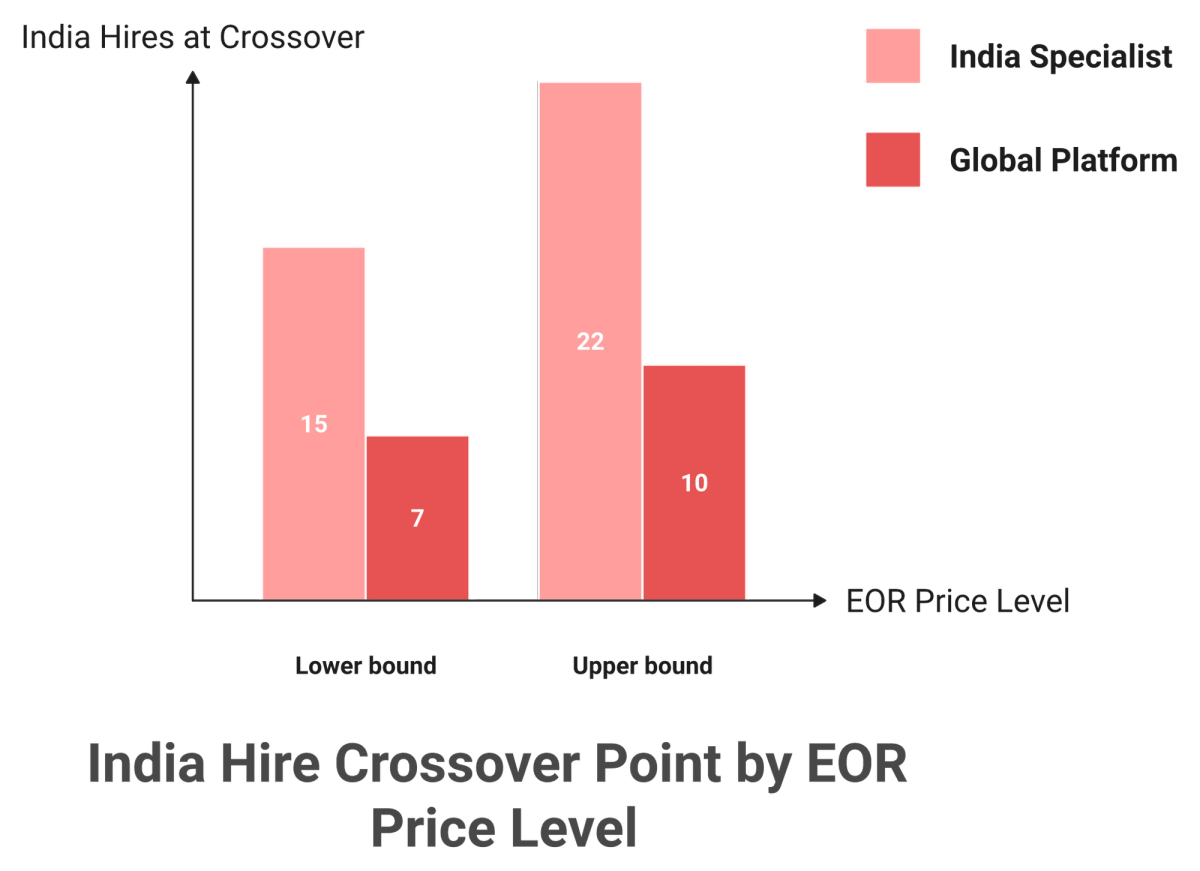
Roughly, a global platform at $599 per employee per month becomes more expensive than your own Indian entity at about 7 to 10 India hires. With an India specialist, that crossover stretches to about 15 to 22. A subsidiary costs $15k to $100k upfront plus ongoing compliance, and takes about six months to stand up. So the math favors EOR while you are small, and favors an entity once headcount and permanence rise.
🧮 The crossover math, walked through
Think of it as two lines on a chart. EOR is a flat per-head fee that scales with headcount. An entity is a big fixed cost upfront, then low marginal cost per hire.
- Global platform ($599/head): crosses your entity cost near 7 to 10 hires.
- India specialist (~$149/head): crosses much later, near 15 to 22 hires.
- Entity setup: $15k to $100k, plus six months and ongoing filings.
The cheaper your per-head fee, the longer EOR stays the smart choice. That is the quiet advantage of a specialist price over a generalist one, and you can run your own numbers in our EOR vs entity calculator.
✅ The honest answer on when to graduate
I will tell a client when to leave me. One US team scaled to about 12 India hires through EOR, then said, "Right, we are ready to open our own entity." That was the correct call, and I helped them migrate rather than lock them in. Founders notice when a vendor tells the truth against its own revenue, which is the spirit of our EOR services.
"Versatile took payroll, contracts, and ongoing compliance off our plate entirely. If you're a founder trying to figure out India EOR and you don't want it to become a second job, this is the one I'd point you to."
Angad S. Versatile G2 Verified Review
At Versatile, the EOR-to-entity migration is part of the model, not a betrayal of it. We hold your India team while you are small, then hand over cleanly when the headcount math flips. No per-head trap, no exit fee, a setup our startup founders rely on.
Q8. What Does 'Audit-Ready' India Hiring Cost You If You Get It Wrong?
The bill for cheap compliance almost never arrives when you make the mistake. It arrives during a funding round, when an investor's lawyer asks for records you cannot produce. I have watched that exact moment freeze a term sheet.
The cheapest plan can be the most expensive if it leaves you exposed. India hiring now carries DPDP Act data-fiduciary duties, permanent-establishment (PE) risk, POSH obligations, and FEMA/FC-GPR rules. A partner-shell EOR that files under someone else's registrations creates split accountability, and the bill lands during diligence.
⚠️ The exposures pricing pages never show you
- DPDP Act 2023: you become a data fiduciary, responsible for employee data consent and security.
- PE risk: the wrong setup can make your foreign company taxable in India.
- POSH: you must constitute an Internal Committee for workplace harassment cases.
- FEMA / FC-GPR: cross-border fund flows need correct filing.
When filings sit under a partner's registrations, you cannot easily produce your own audit trail. That is the moment "running with scissors" turns into a diligence problem, and where our compliance coverage earns its keep.
✅ What audit-ready actually looks like
Audit-ready means every statutory filing is reviewed before submission and traceable to your own entity. Buyers feel the difference when the records hold up under scrutiny.
"The compliance rigour is genuinely impressive, every statutory filing reviewed before submission. When our investors ran diligence, the records held up cleanly."
Vedant T. Versatile G2 Verified Review
Compliance is the low bar, not the prize. A legal hire on paper who quits in month two still costs you the role. At Versatile, filings run under our own Indian entity, reviewed before submission, paired with a 90-day Success Coach and a 6-month replacement guarantee on contract to hire placements. I often send a client references before they ask, because audit-readiness and trust are the same muscle. The goal is not just a compliant hire. It is a good hire who stays, with paperwork that survives the next funding round, the standard we hold across our how it works process.
Q9. So Who Is Remote Pricing Actually Right For, and Who Should Look Elsewhere?
A founder asked me last week, point blank: "Should I just sign with Remote?" My honest answer started with a question back. "Where are your people actually going to sit?" That single answer decides almost everything.
Remote is a strong fit if you hire across many countries and value its owned-entity coverage and no-deposit model. It is a weaker fit if India is your main hiring ground. There, an India-native EOR usually wins on FX transparency, compliance depth, onboarding speed, and direct founder access. Match the provider to where your people actually are.
🧭 The verdict, by who you are
| Buyer | Better fit | Why |
|---|---|---|
| Hiring in 5+ countries | Remote | Owned-entity breadth, no deposit |
| First India hire, India-only team | India-native EOR | FX clarity, multi-state depth, 5-day SLA |
| CFO wanting one clean USD invoice | India-native EOR | USD direct from India, no FX spread |
| Needs SOC 2 / ISO 27001 as procurement gate | Remote or a certified platform | Enterprise compliance checkbox |
I will say the part most vendors will not. If you are building a genuinely global team, Remote is a sound choice, and you should not contort yourself into an India specialist. That is the honest read, and it is also why I sleep fine recommending it. For India-first teams, founders still compare us as a Remote alternative.
💬 Where Versatile actually fits
If India is the country that matters, the math and the experience shift. With Versatile, you are not routed into a customer-success rotation or a ticket queue. You talk to me, the person who built the company, on WhatsApp, the heart of our how it works model and our EOR services in India.
"What stood out was the access. Sagar, the founder, was a message away when I had questions, which is rare at this stage of hiring."
Surbhi M. Versatile G2 Verified Review
Here is the question I am sitting with going into next year. I think India stops being "one country on a global EOR map" and becomes its own specialist category, where owned-entity EORs quietly take the India share from the generalists. I could be wrong on the timing. So tell me what you are building, and where your first or next India hire sits, and I will tell you honestly whether we are the right call or whether Remote is. You can start that conversation through our contact page, weigh the numbers on pricing, see the full scope of our EOR services, or, if you are an early team, our startup offering and a quick demo booking.
FAQs
How much does Remote.com actually cost per employee in 2026?
Remote.com's Employer of Record (EOR) costs $599 per employee per month billed annually, or $699 billed monthly, a 17% premium for the flexibility. The rest of the lineup is published too.
- Contractor Management: $29 per contractor per month
- Contractor Management Plus: $99 per contractor per month
- Contractor of Record: from around $325 per month
- Global Payroll: $29 per employee per month
- HRIS: free for direct employees, with Equity and Recruit quoted separately
Remote also runs a Fair Price Guarantee with no setup, onboarding, or deposit fees, and dropped its EOR headline from $699 to $599 in late 2024. We think a published price list is the floor of respect for a busy buyer, which is why our own transparent pricing sits in the open with no forced discovery call. Remember, every one of these figures is a platform fee only. None include salary, employer statutory contributions, or benefits, so the invoice you actually pay will sit well above the sticker.
Why is my Remote invoice higher than the $599 platform fee?
The $599 platform fee is the smallest line on your invoice. The real cost hides in three layers most pricing pages never show.
- FX margin: the gap between the mid-market rate and the rate you actually get. A 2% markup on a $5,000 monthly salary is roughly $1,200 a year.
- Statutory contributions: in India, employer Provident Fund at 12% of Basic plus DA, plus ESI split 3.25% employer and 0.75% employee.
- Benefits by quote: health top-ups priced case by case, so two identical salaries can carry different totals.
Stack these, and buyers routinely report invoices running 30% above the headline. We remove the FX layer entirely by invoicing in USD directly from our own Indian entity, with no INR conversion and no hidden spread. You can see how that works inside our managed payroll model. The lesson is simple: negotiate the FX policy and the statutory math, not just the platform fee, because that is where the money actually moves.
Should I use Remote's $29 contractor plan or the $599 EOR plan for India?
The $29 Contractor Management plan looks cheaper, but it is only correct if the person is genuinely a contractor. In India, misclassifying a full-time worker as a contractor creates back-dated Provident Fund and ESI liability, plus permanent-establishment risk, which can make your foreign company taxable in India.
- Contractor Management ($29): pay and basic compliance, liability stays with you
- Contractor Management Plus ($99): adds misclassification indemnity
- Contractor of Record (~$325): the provider becomes the contracting party
- EOR ($599): full legal employment, liability sits with the provider
Pick the plan that matches the relationship, not the lowest number. If your worker keeps full-time hours, takes daily direction, and uses your tools, treat them as an employee. Our contract to hire model gives you the honest middle path: start someone, confirm fit, and convert them into a fully compliant India employee without ever parking a true full-timer on a contractor plan.
How does Remote pricing compare to Deel and India-native specialists?
Remote and Deel both publish EOR at $599 per employee per month on annual plans, while India-native specialists run roughly $99 to $349. But structure beats sticker every time.
- FX: Deel applies a reported 3% to 5% markup, while specialists invoice in USD directly at mid-market rates
- Entity model: generalists often route India through a local-partner entity, so the brand on your invoice is not the entity filing your PF
- Support and speed: ticket queues and 7 to 14 day onboarding versus founder-direct access and a 5-day SLA
We will be straight: if you hire across five or more countries, Remote or Deel is the right tool. If India is your main hiring ground, an owned-entity specialist usually wins on FX transparency, compliance depth, and onboarding speed. Founders weighing this often compare us as a Remote alternative for their India hires, where the deepest local filing matters most.
At what headcount does building my own India entity beat paying Remote per employee?
Roughly, a global platform at $599 per employee per month becomes more expensive than your own Indian entity at about 7 to 10 India hires. With an India specialist priced near $149, that crossover stretches to about 15 to 22 hires.
- A subsidiary costs $15k to $100k upfront, plus ongoing compliance
- It takes around six months to stand up before your first hire
- The cheaper your per-head fee, the longer EOR stays the smart choice
So the math favors EOR while you are small and favors an entity once headcount and permanence rise. We tell clients honestly when to graduate; one US team scaled to about 12 hires through EOR, then opened their own entity, and we helped them migrate rather than lock them in. You can run your own numbers with our EOR vs entity calculator and see the real crossover point for your team before committing either way.