Table of contents (15)
8 Best Velocity Global Alternatives in India: EOR Pricing, Managed Service Depth, India Compliance Coverage, and Entity Migration Path
Q1. What Are the 8 Best Velocity Global Alternatives in India in 2026?
The 8 best Velocity Global (Pebl) alternatives for hiring in India in 2026 are Deel, Remote, Multiplier, Versatile Club, Papaya Global, Oyster HR, Rippling, and Globalization Partners. Deel and Remote fit multi-country hiring on one platform. Versatile Club employs through its own registered Indian entity, charges a flat $149 per employee per month with no setup or exit fee, and writes a 5-day onboarding SLA into the contract. Globalization Partners fits enterprise procurement.
A founder messaged me on WhatsApp at 11pm her time. Payroll was three days out. Her engineer's PF challan, the monthly Provident Fund deposit receipt, had not landed in her inbox. Her EOR dashboard looked immaculate.
⚠️ The question behind the search
That is the moment the dashboard stops mattering and the entity behind it starts to. Most teams looking past Velocity Global, now rebranded as Pebl, are not chasing a cheaper logo. They are asking who actually files their engineer's PF and TDS.
Sometimes the answer is an anonymous local partner. You are paying premium platform pricing for someone else's compliance work. If India is the country that matters to you, our EOR services in India answer that question directly.
"We were willing to pay the higher-than-average fees because of the support we received. But in 2022, customer service and responsiveness started going downhill. Our new provider is costing us 60% less."
— Verified User in Translation and Localization, Pebl (formerly Velocity Global) G2 Verified Review
🔁 What the Pebl rebrand changed
Velocity Global now operates as Pebl. India comparison pages list it as Pebl (formerly Velocity Global). Pebl does not publish an India rate on its own site, and third-party comparisons report roughly $399 per employee per month or quote-only.
That opacity is the practical problem. You cannot model a three-year India budget against a number nobody will put in writing. Our published pricing exists precisely so that modelling does not need a sales call.
1.0 How We Scored These Alternatives
Choosing an India EOR is a high-stakes call. The wrong vendor leaves statutory liability, tax exposure, and payroll risk on your books for years. We analyzed and scored eight providers serving US and UK companies hiring in India. Each was assessed on entity model, statutory compliance depth, state-level coverage, onboarding speed, pricing transparency, invoicing readiness, support quality, retention support, and customer validation. This guide is written for US and UK founders, People Ops leaders, CFOs, and legal teams hiring 1 to 50 people in India. The tone is analyst-first. You can see our own process on the how it works page.
📋 The scoring rubric
I will be upfront. Versatile Club publishes this list and is scored on it too. Every provider runs the same five weighted criteria, and you can check the math against public pricing pages and G2.
| Criterion | Weight | What It Measures |
|---|---|---|
| India Entity Model and Compliance Depth | 25 | Own entity or local-partner shell, and whose registration carries PF, ESI, TDS, and professional tax |
| Pricing Transparency and Commercial Model | 20 | Flat fee or salary slabs, setup, exit, and FX markup clarity |
| Managed Service and Support Depth | 20 | Founder-direct, named manager, or ticket queue near a payroll deadline |
| Talent and Retention Support | 20 | Culture-fit screening, replacement guarantee, onboarding monitoring |
| Customer Validation | 15 | Verified review volume and rating quality on G2 and Capterra |
Scores convert to stars. 0 to 20 is 1 star, 21 to 40 is 2 stars, 41 to 60 is 3 stars, 61 to 80 is 4 stars, and 81 to 100 is 5 stars.
🧭 Our evaluation criteria
India Entity Model: own Indian entity, local partner entity, contractor model, or payroll-only setup.
Statutory Compliance Depth: PF, ESI, TDS, professional tax, gratuity, POSH, Form 16, full-and-final settlement, DPDP readiness, and New Labour Code 2025-26 structuring. The full scope sits on our compliance page.
State-Level Coverage: professional tax, Shops and Establishments, labour welfare fund, and leave rules across Indian states.
Onboarding Speed: signed agreement to compliant contract, payroll setup, statutory registration, and employee start.
Pricing Transparency: monthly fee, setup fee, exit fee, FX markup, first-month terms, and invoice clarity.
Invoicing and Finance Readiness: USD invoicing, gross-to-net reporting, challan confirmations, TDS receipts, and audit-ready records.
Support Model: founder-direct, named HR manager, HRBP, ticket queue, or general CSM rotation.
Talent and Retention Support: recruiting, contract-to-hire, culture-fit vetting, onboarding monitoring, and replacement guarantee.
Customer Validation: G2, Capterra, Clutch, Gartner, Reddit, case studies, and named testimonials.
Best-Fit Buyer Segment: first India hire, 1 to 20 employees, 10 to 50 employees, switchers, or multi-country enterprises.
👥 Who this guide is for
US and UK founders hiring their first 1 to 3 employees in India.
Seed to Series B startups building engineering, product, AI, design, marketing, or operations teams in India, which is the audience our startup hiring page is built for.
People Ops and HR leaders reviewing India EOR, payroll, contractor, or PEO vendors.
CFOs and finance teams needing clean invoicing, statutory liability visibility, and audit-ready India payroll records.
Legal teams reviewing employment contracts, IP assignment, misclassification risk, PE risk, and statutory employer accountability.
Companies on Deel, Remote, Multiplier, G-P, contractors, or local payroll vendors evaluating India-specialist alternatives.
🏁 The 8 alternatives, ranked
Deel: Best for companies hiring across many countries who want one global contractor and EOR platform.
Remote: Best for teams that want owned-entity coverage in several core markets with a polished platform.
Multiplier: Best for budget-conscious teams hiring across Asia-Pacific at a mid-range price.
Versatile Club: Best for US and UK startups hiring their first 1 to 20 India employees through an owned entity.
Papaya Global: Best for finance-led teams wanting global payroll and workforce payments in one system.
Oyster HR: Best for distributed-first companies prioritizing a clean employee experience.
Rippling: Best for US companies wanting HR, IT, and payroll in one suite who add global EOR later.
Globalization Partners: Best for larger enterprises needing broad owned-entity coverage with procurement-grade process.
📊 Master comparison table
| Provider | Best For | Key Strength | Compliance |
|---|---|---|---|
| Deel ⭐⭐⭐⭐ | Companies hiring across many countries at once | 150-plus country breadth on one platform | India largely via local partner, broad but shallow on India depth |
| Remote ⭐⭐⭐⭐ | Owned-entity coverage in several core markets | Strong platform and IP protection | Owned entities in core markets, India model varies |
| Multiplier ⭐⭐⭐ | Budget teams hiring across Asia-Pacific | Mid-range pricing with APAC focus | Partner-led India coverage |
| Versatile Club ⭐⭐⭐⭐⭐ | US and UK startups hiring first 1 to 20 India employees | Owned India entity, flat $149, 5-day contractual SLA | Own entity, PF, ESI, TDS, and multi-state PT under its own registrations |
| Papaya Global ⭐⭐⭐ | Finance-led global payroll buyers | Payments plus payroll in one system | Multi-country payroll, India depth not the focus |
| Oyster HR ⭐⭐⭐ | Distributed-first companies | Clean employee experience | Broad coverage, India via partners |
| Rippling ⭐⭐⭐ | US firms wanting HR, IT, and payroll in one suite | Unified US suite | Global EOR add-on, India-based support queue |
| Globalization Partners ⭐⭐⭐⭐ | Enterprises needing broad owned-entity coverage | Enterprise-grade procurement process | Owned entities in many markets, premium model |
I score Wisemonk and Gloroots out of this list on purpose. They are India-native peers, not the global players a Pebl buyer is cross-shopping. If you want that head-to-head, see our Wisemonk alternative breakdown.
1.1 Deel: Best for Companies Hiring Across Many Countries at Once
🌍 Overview
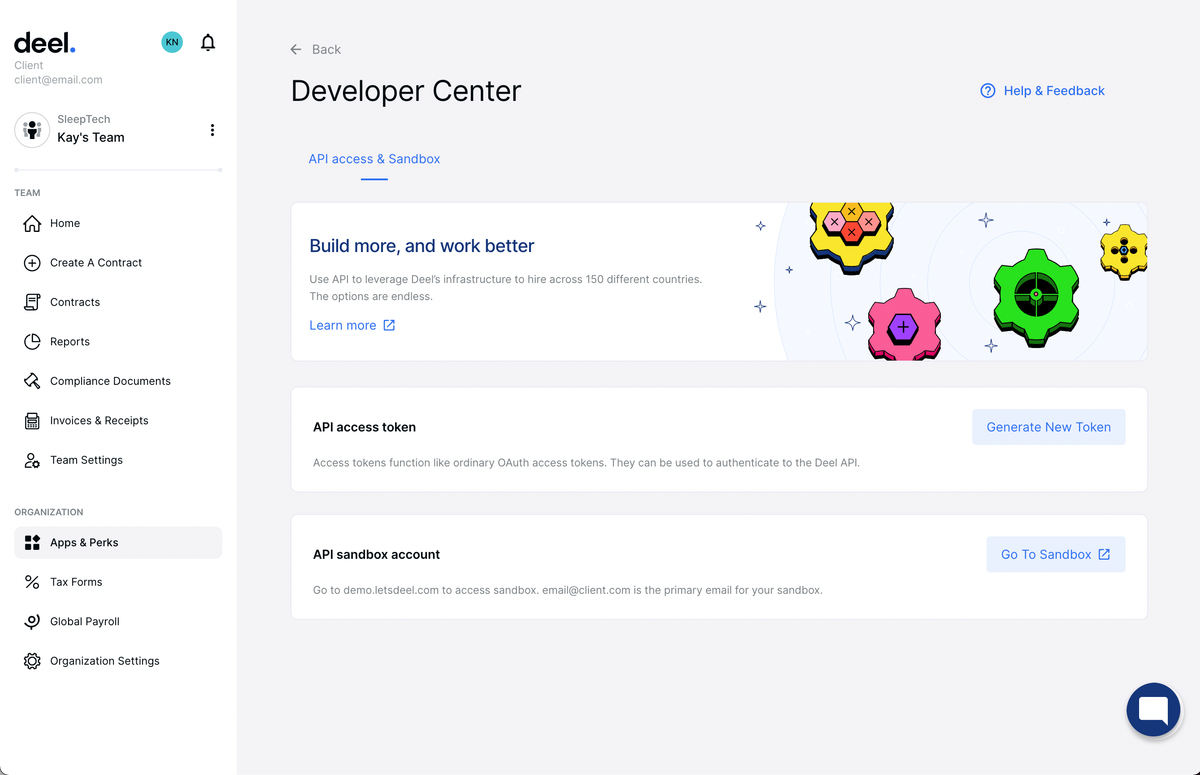
Deel is a global EOR and contractor platform covering 150-plus countries. It is the category's best-known name, and deservedly so if breadth is your problem. For India specifically, Deel typically routes employment through a local partner entity rather than its own. India becomes one country on a very long map. If India is your priority, compare it against our Deel alternative page.
🧩 Core services
Global EOR across 150-plus countries on one platform.
Contractor management and global contractor payments.
Payroll, benefits, and equipment coordination.
Compliance document handling and IP assignment.
💰 Why companies consider Deel
If you are hiring in eight countries this quarter, one login genuinely helps. That consolidation is the real product, not the India depth.
The catch shows up on cost and structure. Deel is commonly cited around $599 per employee per month for EOR, plus a setup fee near $500. Reviewers repeatedly flag transfer and FX charges on top of that.
🎯 Ideal customer profile
Companies hiring across many countries simultaneously.
Teams that prioritize platform breadth over single-country depth.
Buyers comfortable with a ticket-and-CSM support model.
💸 Commercial model
EOR pricing is commonly cited around $599 per employee per month, with contractor plans lower. A setup fee is typically charged. Reviewers report transfer and FX fees on payouts. Confirm current pricing with Deel directly.
💬 Customer reviews
"I find Deel to be absurdly expensive. They charge a high amount of fees for transferring money to my bank account."
— Juan Camilo O., Deel G2 Verified Review
"Often the CS doesn't seem to have answers, which leads to emails back and forth. Something I was looking for in 20 minutes becomes a 4 day process, or needs multiple team members who aren't available except at 3:00am my time."
— Verified User in Computer Software, Deel G2 Verified Review
That 3am detail is structural, not one bad rep. When India is one of 150 countries, the person who knows your engineer's PF rules sits in a timezone that is not yours.
Versatile Club runs India payroll from India, with PF, ESI, TDS, and professional tax filed under its own entity registrations, and the founder reachable on WhatsApp the same day. You can see how that managed payroll workflow runs month to month.
1.2 Remote: Best for Owned-Entity Coverage in Several Core Markets
🌐 Overview
Remote is a global employment platform built around owned entities in its core markets. The product is polished, and IP assignment handling is genuinely strong. Coverage model varies by country, so the India arrangement is worth confirming in writing before you sign. Our Remote alternative page sets out the India-specific comparison.
🧩 Core services
Global EOR and contractor management across many countries.
Payroll, benefits administration, and onboarding workflows.
IP and invention-assignment protection tooling.
Employee self-serve portal and document management.
🧠 Why companies consider Remote
Legal teams like Remote. The IP assignment and contract templates hold up well under counsel review, which shortens procurement.
The trade-off is India specificity. State-level professional tax mechanics differ sharply, and Maharashtra's dual PTRC and PTEC registrations behave nothing like Karnataka's monthly cycle. A global engine tends to abstract that into one India row.
🎯 Ideal customer profile
Teams hiring across several core markets where Remote holds its own entity.
Legal-led buyers prioritizing IP protection and contract quality.
Companies wanting a self-serve employee portal over hands-on service.
💸 Commercial model
Remote EOR pricing is commonly cited around $599 per employee per month, with a setup fee near $299. FX policy on INR conversion is not published as a stated spread. Ask for it in writing against a mid-market reference rate. Confirm current pricing with Remote directly.
⚖️ How the India layer compares
| Factor | Remote | Versatile Club |
|---|---|---|
| India entity model | Owned entities in core markets, India model varies | Own registered Indian entity |
| Monthly fee | Around $599 per employee, commonly cited | $149 per employee, flat |
| Setup and exit | Setup fee near $299 | $0 setup, $0 exit, first month free |
| Onboarding | Typically 10 to 14 days | 5 business days, contractual |
| Support model | Platform and ticket-based | Founder-direct on WhatsApp |
Versatile Club appears in that row on the same terms as everyone else, and a founder review names the experience the table cannot: "Sagar replied to our form in about four hours with a draft offer letter already attached. The hire was onboarded in four days." You can run your own numbers first with the EOR vs entity calculator.
"Sagar replied to our form in about four hours with a draft offer letter already attached. The hire was onboarded in four days."
— Verified User in Information Technology and Services, Versatile Club G2 - Verified Review
1.3 Multiplier: Best for Budget Teams Hiring Across Asia-Pacific
🌏 Overview
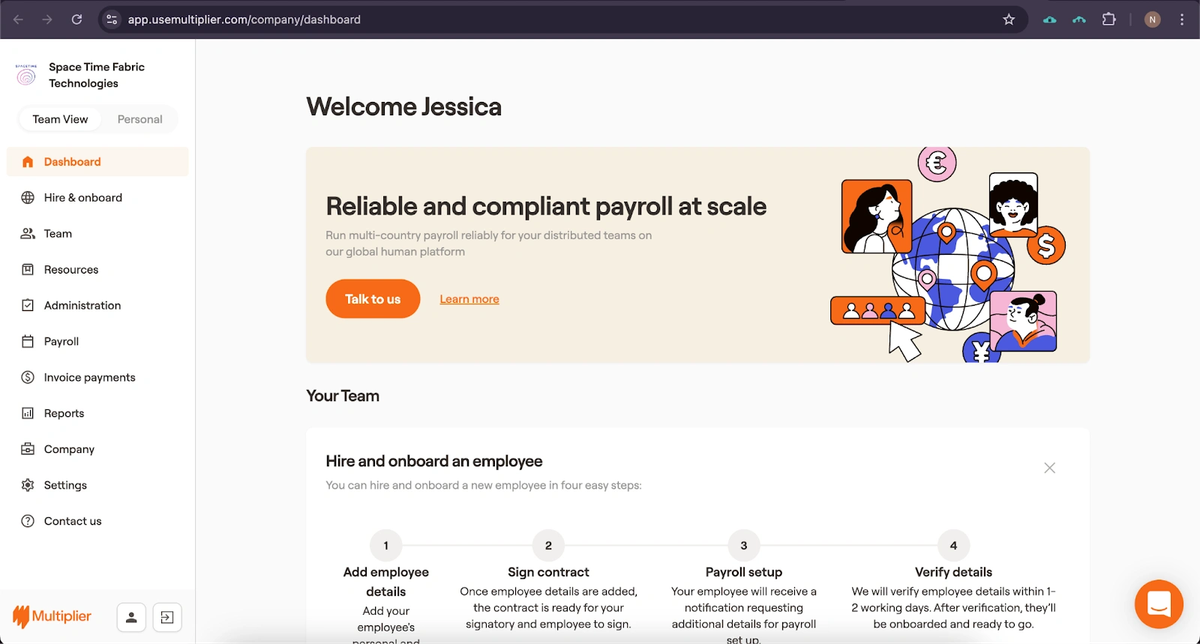
Multiplier is a global employment platform with strong Asia-Pacific coverage. It sits below Deel and Remote on price, which is the main reason it lands on shortlists. In India, coverage runs through a hybrid model that leans on local partners rather than a fully owned entity. Our Multiplier alternative page sets out the India-specific comparison.
That hybrid structure matters more than the sticker. It decides who signs the employment contract and whose registration number appears on your PF challan.
🧩 Core services
Global EOR and contractor management with an Asia-Pacific focus.
Payroll processing and benefits administration across supported countries.
Onboarding workflows, contracts, and document handling.
Expense and time-off management in one platform.
💰 Why companies consider Multiplier
Price is the honest answer. At roughly $400 per employee per month, Multiplier undercuts the $599 platforms while keeping a similar feature surface. For a team hiring across Singapore, Vietnam, and India at once, that saving compounds fast.
The trade-off shows up on India depth. Partner-led coverage means state-level professional tax mechanics get abstracted into one process. Karnataka files monthly, Tamil Nadu files twice a year, and Maharashtra needs both PTRC and PTEC registrations. The full state-by-state scope sits on our compliance page.
🎯 Ideal customer profile
Budget-conscious teams hiring 5 to 30 people across Asia-Pacific.
Companies where India is one market among several, not the priority market.
Buyers comfortable with partner-backed local compliance.
💸 Commercial model
Multiplier EOR pricing is commonly cited around $400 per employee per month, flat. Setup and exit terms vary by contract. FX markup on INR conversion is not published as a stated spread. Confirm current pricing with Multiplier directly.
Versatile Club prices at a flat $149 per employee per month with $0 setup and $0 exit, which makes the India line item easy to model over three years. You can check the published pricing before any call.
1.4 Versatile Club: Best for US and UK Startups Hiring Their First 1 to 20 India Employees
🇮🇳 Overview
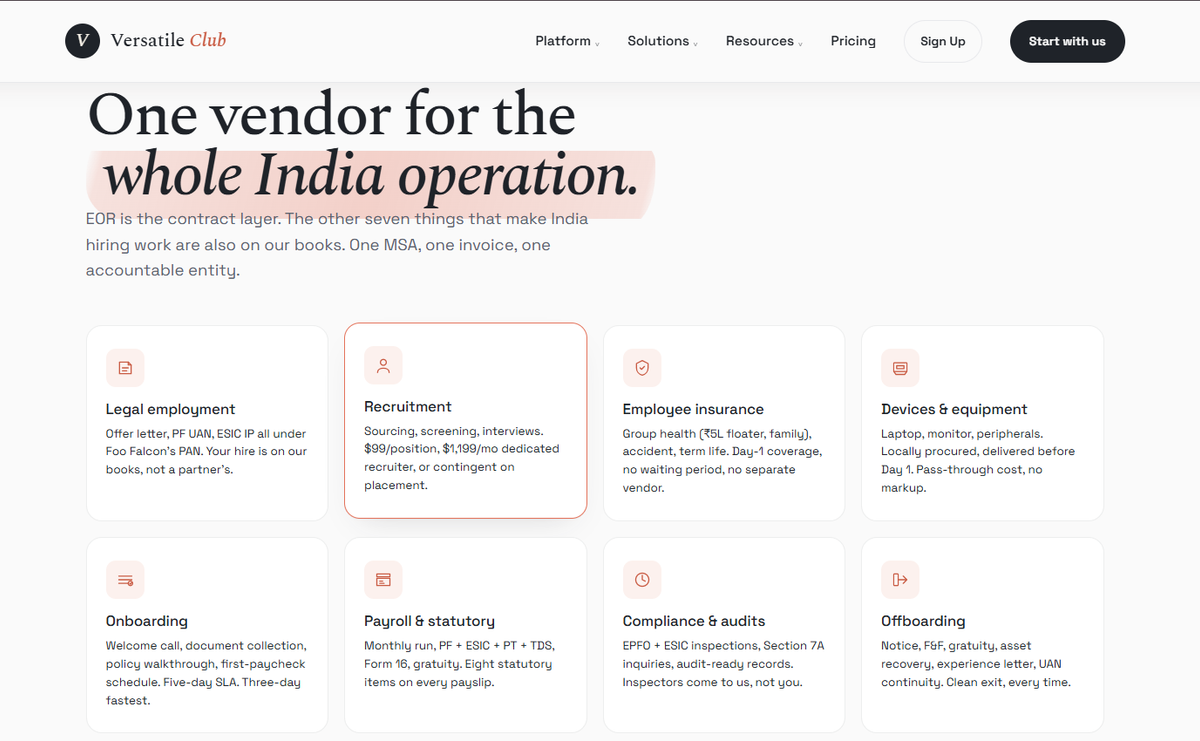
Versatile Club is an India-only Employer of Record in India operating through its own registered Indian entity. We started as a Contract-to-Hire business, placing engineers, designers, and ops staff for US and UK clients across Bengaluru, Hyderabad, and Pune. Six years of running that work built the payroll operations and state registrations. EOR was the next step, where we become the legal employer directly instead of placing and converting.
🧩 Core services
Employer of Record in India through an owned entity, not a partner shell.
Statutory compliance covering PF, ESI, TDS, multi-state professional tax, gratuity, and Form 16.
USD invoicing direct from India, with no setup fee and no exit fee.
Culture-fit-first hiring using 50 behavioral parameters, plus a 90-day Success Coach.
6-month replacement guarantee on placements, and a 5-day contractual onboarding SLA, delivered through our contract-to-hire heritage.
🧾 Why companies consider Versatile Club
Versatile Club files PF, ESI, TDS, and professional tax under its own registration numbers, so accountability never passes to an anonymous aggregator. Most founders I talk to do not want to become a part-time India HR person. They want the hire onboarded, paid, and legal, then they want to forget the back office.
The second reason is money clarity. One USD invoice, no exchange-rate surprise, no add-on discovered at month three. For a CFO closing month-end, that is a five-minute reconcile instead of an email chain.
⏰ What the 5-day SLA actually looks like
Versatile Club runs onboarding as a fixed five-step sequence written into the contract. Day 1, service agreement signed. Day 2, India-compliant offer letter sent. Day 3, employment contract executed and documents collected. Day 4, PF, ESI, and professional tax registrations initiated. Day 5, payroll live. The full walkthrough sits on our how it works page.
I will name the limit honestly. Enterprise procurement reviews with custom security questionnaires take longer than five days, and no SLA survives that.
🎯 Ideal customer profile
US and UK companies hiring 1 to 20 employees in India.
Seed to Series B startups building engineering, product, or ops teams, which is exactly who our startup hiring page is built for.
Founders, People Ops leads, and CFOs who want founder-direct support.
❌ Who should not pick us
Companies needing multi-country EOR across five or more markets in one vendor.
Enterprises with 100-plus India teams gating procurement on SOC 2 or ISO 27001.
B2C consumer hiring at volume.
💸 Commercial model
Flat $149 per employee per month, regardless of salary band. No setup fee, no exit fee, and the first month is free. C2H placements are priced at 20 to 30 percent of annual salary, charged only after the hire completes day 90, with a 6-month replacement guarantee. Model your own numbers with the salary calculator.
💬 Customer reviews
"First payroll ran on time, no scramble. PF, tax, the statutory filings, all the stuff I genuinely did not want to learn, they just handle it and keep it correct every month."
— Angad S., Founder, Versatile Club G2 - Verified Review
"The team is really competent, but there were a few time zone misunderstandings that caused slight delays in the initial phase. That said, once things got going, the whole process was buttery smooth."
— Setu C., Versatile Club G2 - Verified Review
That second review names a real gap. Time zones bite hardest in week one, before the WhatsApp rhythm settles. I would rather publish it than pretend the first week is frictionless.
1.5 Papaya Global: Best for Finance-Led Global Payroll Buyers
💵 Overview
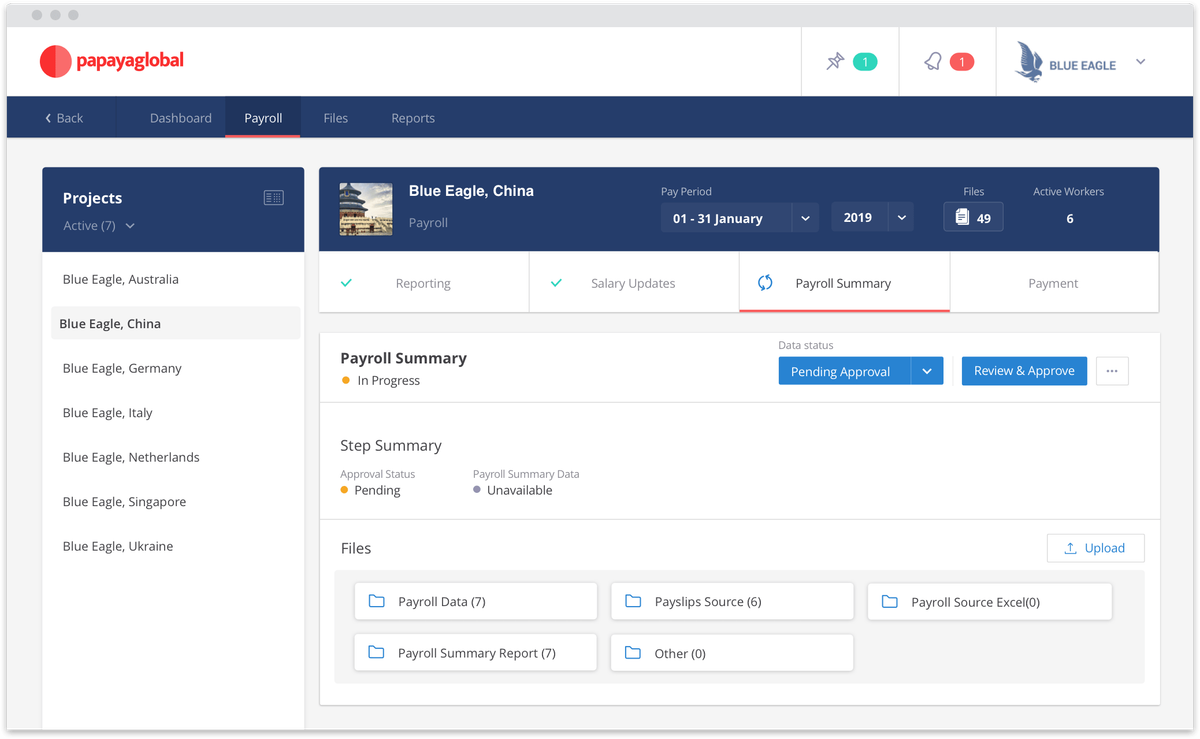
Papaya Global is built for finance teams, not HR teams. It combines global payroll with a payments layer, so money movement and payroll data sit in one system. That consolidation is the product, and it is genuinely useful at 300 employees across 20 countries. For the India-specific view, see our Papaya Global alternatives in India breakdown.
India is one country inside that engine. Depth at the state professional tax level is not the design goal.
🧩 Core services
Global payroll across many countries with unified reporting.
Workforce payments and treasury movement in the same platform.
EOR coverage for countries without a local entity.
Compliance reporting and audit trails for finance teams.
📊 Why companies consider Papaya Global
A controller closing month-end wants one dataset, not eleven payroll files. Papaya answers that better than most EOR-first platforms.
The gap appears when your India headcount is small. You buy an enterprise payroll engine to run four engineers in Bengaluru, and the India-specific work still needs a local specialist behind it, which is where managed payroll in India does the actual filing.
🎯 Ideal customer profile
Finance-led buyers consolidating payroll across 10-plus countries.
Companies with 100-plus global employees and a dedicated payroll owner.
Organizations prioritizing treasury visibility over single-country depth.
💸 Commercial model
Papaya Global does not publish a flat India EOR rate in the sources reviewed. Pricing is quote-based and varies by headcount, country mix, and payroll volume. Ask for the FX conversion policy in writing before signing.
Versatile Club publishes its India rate at a flat $149 per employee per month, which lets a CFO model the line without a sales call.
1.6 Oyster HR: Best for Distributed-First Companies
🌐 Overview
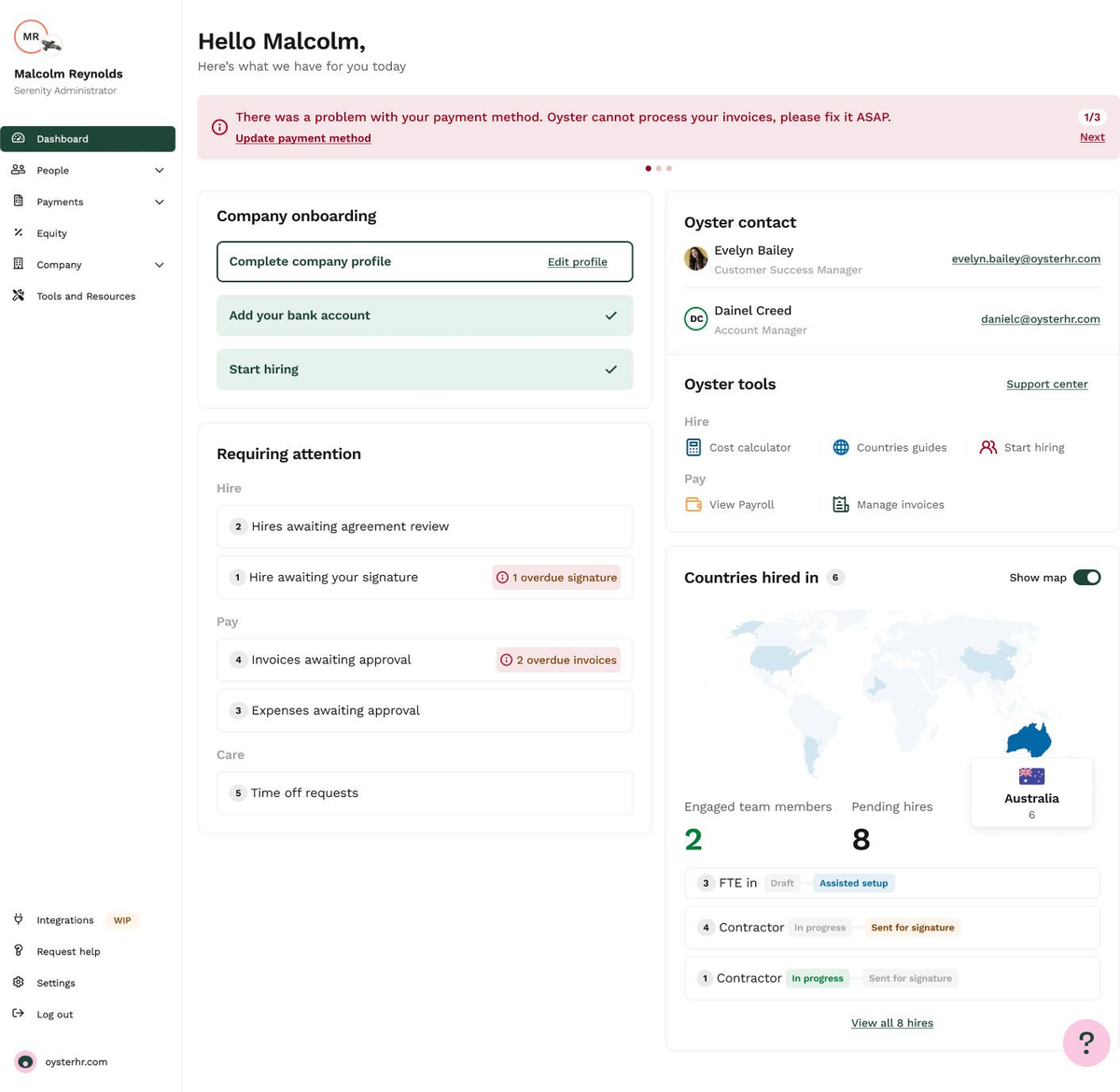
Oyster HR sells the employee experience. Onboarding flows, benefits presentation, and the employee portal are cleaner than most competitors. For remote-first companies that treat candidate experience as a hiring advantage, that polish earns its place. Our Oyster alternatives in India guide covers the India layer specifically.
India coverage runs largely through partners. The employee sees a smooth portal, while the statutory filing happens one layer down.
🧩 Core services
Global EOR and contractor management across many countries.
Benefits administration and localized employee onboarding.
Employee self-serve portal and document management.
Compliance templates and contract localization.
🤝 Why companies consider Oyster HR
Distributed-first companies buy Oyster for consistency. Every hire in every country gets the same onboarding experience, which matters when your employer brand is your recruiting engine.
The India question stays the same one. Ask which entity signs the contract, and which registration number appears on the PF and ESI challans each month.
🎯 Ideal customer profile
Remote-first companies hiring across many countries.
People teams prioritizing employee experience and brand consistency.
Companies with no single dominant hiring country.
💸 Commercial model
Oyster HR EOR pricing for India is not publicly disclosed in the sources reviewed, and is typically quote-based. Setup, exit, and FX terms vary by contract. Confirm current pricing with Oyster directly.
Versatile Club charges no setup fee and no exit fee, and the first month is free, so the commercial terms are checkable before a call.
1.7 Rippling: Best for US Firms Wanting HR, IT, and Payroll in One Suite
🖥️ Overview
Rippling started as a US HR and IT suite, and that heritage still shows. Device management, app provisioning, and payroll sit in one system, which is a real operational win for a US-heavy company. Global EOR came later as an extension. Our Rippling alternatives in India comparison covers what changes at the India layer.
For an India-only hire, you are buying a US suite and switching on one country.
🧩 Core services
US payroll, benefits, and HR administration.
Device and app provisioning tied to employee lifecycle.
Global EOR as an add-on module.
Automated workflows across HR and IT events.
⚙️ Why companies consider Rippling
Vendor consolidation is the driver. If Rippling already runs your US payroll and laptops, adding India inside the same system removes a procurement cycle.
The trade-off is support shape. India questions route into a general support queue rather than to a named person who files your challans. When a PF deadline is 48 hours out, queue position becomes the whole problem.
🎯 Ideal customer profile
US-headquartered companies already running Rippling for domestic HR and IT.
Teams valuing one system of record over country-level depth.
Companies adding one or two India hires to an existing US base.
💸 Commercial model
Rippling global EOR pricing is quote-based and not publicly disclosed for India in the sources reviewed. Module pricing stacks on the core suite. Confirm current pricing with Rippling directly.
Versatile Club assigns founder-direct support on WhatsApp, so a PF or payroll question reaches a named person the same day rather than a queue.
1.8 Globalization Partners: Best for Enterprises Needing Broad Owned-Entity Coverage
🏢 Overview
Globalization Partners (G-P) is the enterprise answer. It holds owned entities across many markets and runs a procurement-grade process, with the security documentation and legal review depth large buyers require. If your legal team needs a 60-page vendor assessment answered, G-P has done it before. Our Globalization Partners alternatives in India guide covers the India-only view.
That process is the value, and it is also the cost.
🧩 Core services
Global EOR through owned entities in many markets.
Enterprise contracting, IP assignment, and legal review support.
Payroll and benefits administration at scale.
Security and compliance documentation for procurement.
🛡️ Why companies consider G-P
Risk committees like owned entities. When a 200-person India team is on the line, the buyer wants a vendor that has passed enterprise security review repeatedly.
The premium is real. G-P pricing is commonly cited around 15 percent of annual salary, which on a high-salary engineering team runs well above per-seat models. Timelines also stretch, because enterprise onboarding follows procurement, not a five-day clock.
🎯 Ideal customer profile
Enterprises with 100-plus employees in a single market, the profile our enterprise hiring page speaks to.
Buyers gating procurement on SOC 2 or ISO 27001 certification.
Legal and risk teams requiring owned-entity coverage across many countries.
💸 Commercial model
G-P EOR pricing is commonly cited around 15 percent of annual salary rather than a flat per-seat fee. Enterprise agreements are quote-based with annual commitments. Confirm current pricing with Globalization Partners directly.
Versatile Club does not compete for that buyer, and I will say so plainly. A 100-plus India team with a SOC 2 procurement gate should shortlist G-P, not us.
⭐ How the eight compare on the India question
| Provider | India entity model | Onboarding | Support shape |
|---|---|---|---|
| Deel | Largely local partner | 7 to 14 days | Ticket and CSM |
| Remote | Owned in core markets, India varies | 10 to 14 days | Platform and ticket |
| Multiplier | Hybrid partner-led | Varies by country | Account-managed |
| Versatile Club | Own registered Indian entity | 5 business days, contractual | Founder-direct on WhatsApp |
| Papaya Global | Payroll-first, partner EOR | Quote-dependent | Finance account team |
| Oyster HR | Partner-led in India | Quote-dependent | Platform and ticket |
| Rippling | EOR add-on module | Quote-dependent | General support queue |
| Globalization Partners | Owned entities, many markets | Procurement-led | Enterprise account team |
Versatile Club sits in that table on the same terms as everyone else, with PF, ESI, TDS, and multi-state professional tax filed under its own registrations across all 28 states and 8 union territories. If you want to test that, ask for the entity CIN and the EPFO establishment code before you sign anything, with any vendor on this list. When you are ready to compare the entity route, run the EOR vs entity calculator.
Q2. What Does an India EOR Really Cost Once You Add Setup, Exit, and FX?
India EOR platform fees run roughly $149 to $699 per employee per month. Three layers inflate the real bill: setup fees of $299 to $500, exit or termination fees, and an FX markup of 0.4 to 5 percent on every rupee conversion. That markup adds around $480 a year on an INR 2,000,000 salary. Versatile Club charges one flat $149 per employee per month, with no setup fee, no exit fee, and the first month free, invoiced in USD directly from its Indian entity.
A CFO at a $12M ARR SaaS company sent me her India invoice during month-end close. Four line items. None of them explained why her cost per engineer had drifted 6 percent in eight months. The answer was not on the invoice at all.
💸 The three layers you do not see
Setup fees are the visible one. Deel is commonly cited near $500, and Remote near $299. You pay before a single payslip runs.
Exit fees are the quiet one. You often pay to leave, not just to join, which turns a vendor switch into a budget conversation. FX markup is the invisible one, because it lives inside an exchange rate you never see quoted. Our breakdown of employer of record cost in India models each layer separately.
📊 All-in cost for one India engineer
| Provider | Monthly fee | Setup fee | 3-year platform cost |
|---|---|---|---|
| Deel | ~$599 | ~$500 | ~$22,064 |
| Remote | ~$599 | ~$299 | ~$21,863 |
| Multiplier | ~$400 | Varies | ~$14,400 |
| Versatile Club | $149 flat | $0 | ~$5,215 (first month free) |
| Pebl (formerly Velocity Global) | ~$399 reported, or quote-only | Not disclosed | ~$14,364 at reported rate |
| Papaya Global, Oyster HR, Rippling | Quote-based | Varies | Not modellable without a quote |
Versatile Club publishes the flat rate precisely so this table can be built without a sales call. FX sits outside every column above. You can check the numbers yourself on our pricing page.
⚠️ The FX arithmetic, worked
Take an engineer on INR 2,000,000 a year, roughly $24,000. A 2 percent conversion spread costs about $480 annually. A 3 percent spread costs about $720. Run your own figures in the salary calculator.
That single hidden layer can exceed the entire difference between two vendors' sticker prices. It also never appears as a line item, so nobody catches it in a quarterly vendor review.
"I find Deel to be absurdly expensive. They charge a high amount of fees for transferring money to my bank account."
— Juan Camilo O., Deel G2 Verified Review
"First USD invoice landed clean: no FX markup, no setup fee, no surprises."
— Verified User in Information Technology and Services, Versatile Club G2 - Verified Review
💰 The number that dwarfs the fee
Here is where I push back on fee obsession. A senior engineer costs roughly $220,000 all-in in San Francisco and roughly $58,000 all-in in Bengaluru. That gap is about $162,000 a year for one role. The full picture sits in our guide to the cost of hiring in India.
Against that, a $450 monthly fee difference is noise. What is not noise is a botched PF filing or a compliance gap that surfaces during diligence.
✅ What to demand before signing
The FX policy in writing, with the INR rate stated against a mid-market reference.
The setup fee and the exit fee, both named in the MSA.
A sample invoice showing gross, deductions, net, and platform fee separately.
Confirmation of whether the first month is chargeable.
Versatile Club took a structural decision here rather than a promise. Invoicing in USD directly from the Indian entity removes the conversion leg entirely, so there is no spread to mark up. That is why the invoice reconciles in minutes, as our managed payroll clients see every month.
Q3. Who Legally Owns the Entity, and Why Does a Partner Shell Change Your Risk?
In an owned-entity model, your provider's own Indian company holds the PF, ESIC, and Shops and Establishments registrations and signs the employment contract. In a partner model, an unnamed third party does. That adds a sub-processor needing its own review under the DPDP Rules 2025, an extra layer between you and any statutory dispute, and no direct accountability for a late filing. Versatile Club employs through its own registered Indian company, so every filing carries its own registration number.
🧾 Two contract chains, drawn simply
In the owned model, the chain is short. You sign with the provider, and the provider's Indian entity signs with the employee. One registration number carries every filing. That is the structure behind our EOR services in India.
In the partner model, the chain adds a link. You sign with the global platform, the platform contracts a local partner, and the partner employs your engineer. You usually never learn the partner's name.
⚠️ Who absorbs a late PF deposit
Provident Fund, the mandatory retirement fund, must be deposited monthly. Late employer payments carry interest at 12 percent a year under the notified social security rules.
Ask a simple question: whose bank account makes that deposit, and whose registration number appears on the challan? Versatile Club answers with a single entity name, because the PF challan and the invoice come from the same company.
🔐 The DPDP test most vendors fail
Employee data is personal data. MeitY notified the Digital Personal Data Protection Rules 2025 through G.S.R. 846(E) on 13 November 2025. Substantive obligations phase in from 13 May 2027, with penalties reaching INR 250 crore.
A partner entity is a sub-processor of your employees' salary, bank, and identity data. If the vendor cannot name that sub-processor, your data map has a blank square in it. Our compliance page sets out what sits under our own registrations.
⚖️ Permanent establishment, in plain terms
Permanent establishment, or PE, is tax-speak for accidentally creating a taxable presence in India. Risk rises when your US managers direct daily work while a thin local structure employs the team. Our comparison of India expansion options lays out where that risk sits in each model.
An owned-entity EOR does not eliminate PE risk. It does give your counsel a real employer to examine, instead of a contract that points at another contract. I would rather my clients' lawyers see the whole chain.
✅ The three documents to demand
The Indian entity's CIN, the corporate identity number on the MCA register.
The EPFO establishment code used for your employees' PF filings.
The named sub-processor list, if any partner touches payroll or data.
One more thing worth saying plainly. US-style co-employment PEO does not legally exist under Indian labour law, so any vendor selling "PEO India" as co-employment is describing something that is not there. Our explainer on EOR vs PEO covers why that distinction matters.
🗂️ How the eight split on this axis
| Model | Providers |
|---|---|
| Owned Indian entity | Versatile Club |
| Owned entities in core markets, India model varies | Remote, Globalization Partners |
| Largely partner-led in India | Deel, Multiplier, Oyster HR, Pebl (formerly Velocity Global) |
| Payroll-first or add-on module | Papaya Global, Rippling |
Versatile Club sends the CIN and the EPFO establishment code before a contract is signed, not after. Every PF, ESI, TDS, and professional-tax filing runs under those numbers. That is the whole difference this section is about.
Q4. What Does India Statutory Compliance Actually Cover in 2026?
India's statutory stack is PF at 12 percent employer contribution on Basic plus DA, against a retained wage ceiling of INR 15,000 a month. ESI runs at 3.25 percent employer and 0.75 percent employee. Gratuity accrues at 4.81 percent from month one, and TDS is deposited by the 7th. Since 21 November 2025, the Labour Codes require Basic plus Dearness Allowance to be at least 50 percent of CTC.
📋 The federal stack, month by month
| Item | Rate | Base | Deadline |
|---|---|---|---|
| Provident Fund (PF) | 12% employer | Basic + DA, ceiling INR 15,000 | 15th monthly |
| ESI | 3.25% employer, 0.75% employee | Gross wages, below threshold | 15th monthly |
| Gratuity accrual | 4.81% | Basic + DA | Accrues from month one |
| TDS | Per income tax slab | Taxable salary | 7th monthly |
| Professional tax | State slabs | Gross salary | Varies by state |
⚠️ The 50 percent wage rule, in rupees
The Ministry of Labour and Employment brought the four Labour Codes into force through gazette notifications dated 21 November 2025, including S.O. 5322(E) for the Code on Wages and S.O. 5319(E) for the Code on Social Security.
Here is the practical effect. On an INR 2,000,000 CTC where Basic was set at 35 percent, restating Basic plus DA to 50 percent raises the PF and gratuity base sharply. Employer cost rises even though the CTC number on the offer letter does not move. Our guide to payroll compliance in India works through the restatement in detail.
⏰ Why late challans are a priced risk
The EPF wage ceiling stays at INR 15,000 a month, and delayed employer payments attract interest at 12 percent a year. That converts a missed deadline into a calculable liability, not an administrative slip.
Versatile Club sends the PF, ESI, and TDS challans as a monthly pack, so the deposit date is visible without anyone asking for it.
🗺️ The state layer global vendors compress
Maharashtra: dual PTRC and PTEC registrations, monthly slab filing, and annual returns.
Karnataka: monthly professional tax, plus Shops and Establishments enrolment within 30 days of joining.
Tamil Nadu: biannual professional tax in June and December, plus labour welfare fund.
West Bengal: frequent rule changes and state-specific leave calculations.
Delhi: no professional tax, but strict Shops and Establishments compliance.
I have watched a single India row on a global dashboard hide all five of those. Versatile Club files across all 28 states and 8 union territories under its own registrations, which is why the state differences stay visible to us. You can see the sequence on our how it works page.
📄 The Form 130 readiness test
Under section 395(4) of the Income-tax Act 2025, TDS and TCS certificates move to Forms 130, 131, 132, and 133. These replace the old Form 16 and Form 16A series. Form 131 falls due within 15 days of each quarterly statement.
Ask any shortlisted vendor to show a sample Form 130 generated from their payroll system for the current tax year. A vendor still saying "we issue Form 16" has not updated its stack.
✅ Six artefacts to demand every month
PF challan with the deposit date visible.
ESI challan with the establishment code.
State professional tax receipt for each state you employ in.
TDS challan and the quarterly statement acknowledgement.
Gross-to-net payroll register per employee.
Post-Labour-Code CTC restatement showing Basic plus DA at 50 percent or above.
Versatile Club files PF, ESI, TDS, and professional tax across all 28 states under its own registrations, and sends that six-item pack monthly without being asked. If a vendor cannot produce those six documents for last month, it cannot produce them for your audit either. Weigh the entity decision with the EOR vs entity calculator.
Q5. Which Alternatives Have Real Managed Service and Retention Depth?
Managed service depth is the work a platform cannot automate. It covers sourcing candidates, background verification at roughly $20 to $50 per candidate, laptop procurement and shipping, NPS-based salary structuring under section 80CCD(2), and answering before payroll cut-off. Pebl (formerly Velocity Global) offers none of these natively in India. Versatile Club bundles recruitment, background verification, equipment coordination, and NPS-aware salary structuring under the same entity that runs payroll.
A People Ops lead once asked me which EOR had the best dashboard. Wrong question. Her actual problem was a laptop stuck in customs and an offer letter expiring on Friday. Our guide on how to equip remote employees in India covers that exact scramble.
🧰 Features versus operations
Platform features are what you see in a demo. Managed service is what happens when a candidate ghosts you, a device fails, or a salary structure needs rebuilding before month-end.
Most global platforms sell the first and outsource the second. That is a legitimate choice, and it is also why India buyers end up with three vendors instead of one. Our recruitment team sits inside the same entity that runs the payroll.
📊 Who actually does the operational work
| Provider | Recruitment | Background verification | Equipment | Support shape |
|---|---|---|---|---|
| Deel | No | Add-on | Coordinated | Ticket and CSM |
| Remote | No | Add-on | Coordinated | Platform and ticket |
| Multiplier | No | Varies | Varies | Account-managed |
| Versatile Club | In-house C2H | In-house | Coordinated | Founder-direct on WhatsApp |
| Papaya Global | No | No | No | Finance account team |
| Oyster HR | No | Add-on | Coordinated | Platform and ticket |
| Rippling | No | Add-on | Strong (device-native) | General support queue |
| Globalization Partners | No | Enterprise process | Coordinated | Enterprise account team |
💰 The NPS structuring most vendors skip
The National Pension System, a government retirement scheme, allows an employer contribution under section 80CCD(2). Structured well, it reduces a senior engineer's tax liability by roughly 20 to 25 percent, with exempt treatment at contribution, growth, and withdrawal.
Versatile Club builds NPS into salary structuring at offer stage, not after the first payslip. A global engine rarely offers that, because it is an India-specific optimisation. You can model a structured offer in the salary calculator.
🤝 The retention beat nobody prices
A US engineering manager once asked his Bengaluru lead whether a slipped date would cause problems. The answer came back: "probably wouldn't." He heard agreement. The lead was politely signalling that the project was already late.
That gap costs money. A wrong or misclassified hire can carry $25,000 to $40,000 in back-pay and statutory exposure, which dwarfs any monthly fee. Our breakdown of independent contractor vs EOR sets out where that exposure sits.
The tactical fix is small. Stop asking closed questions like "are we on schedule." Ask "show me how much work is left," then send a written recap after the call.
💬 What buyers say about support shape
"Often the CS doesn't seem to have answers, which leads to emails back and forth. Something I was looking for in 20 minutes becomes a 4 day process, or needs multiple team members who aren't available except at 3:00am my time."
— Verified User in Computer Software, Deel G2 Verified Review
"Founder is just a call away. Extremely helpful in resolving all our queries. The process is super smooth to setup India EOR."
— surbhi m., Versatile Club G2 - Verified Review
"The dashboard could be a little more self-serve. A couple of times I wanted to pull a report myself and ended up just messaging my contact instead."
— Angad S., Versatile Club G2 - Verified Review
Versatile Club screens on 50 behavioural parameters, assigns a 90-day Success Coach, and backs placements with a 6-month replacement guarantee. I answer on WhatsApp myself, which works at our current scale and will have to change later. I would rather say that than pretend otherwise. You can test the fit-first approach with our culture fit quiz.
Q6. When Should You Move From an EOR to Your Own Indian Entity?
The crossover usually lands between 12 and 20 India employees. That is where the fixed cost of a Private Limited company, a company secretary, an auditor, payroll software, and annual MCA filings falls below cumulative per-seat fees. Entity setup runs two to four months. Below roughly 12 people, staying on an EOR is almost always cheaper, even across three years. Versatile Club charges no exit fee and hands over audit-ready statutory records at migration.
📈 The cost curve, honestly drawn
An EOR is a variable cost. An entity is a fixed cost plus ongoing compliance overhead. The lines cross when headcount makes the fixed base worth carrying. Run the numbers in the EOR vs entity calculator.
Add the FX drag to the EOR side of the model. At a 2 percent spread, that is roughly $480 a year per employee hiding inside the exchange rate.
⚖️ Two operator views worth weighing
One team I watched hit their tipping point at 10 to 12 hires. After twelve, they incorporated, waited out the registrations, and migrated all twelve people across in one cycle. Our comparison of EOR vs entity in India works through both sides of that call.
The other view is the hybrid path. Start hiring immediately through an EOR, then stand up a Global Capability Centre, or GCC, by roughly month six. India now carries about 2.1 million people across more than 1,800 GCCs, so that path is well worn. See our guide to GCC setup in India.
🗂️ The migration sequence, in order
Incorporate the Private Limited company through the MCA portal.
Obtain the new entity's EPFO and ESIC establishment codes.
Transfer employees with continuity of service preserved in the new contracts.
Carry over gratuity accrual, which builds at 4.81 percent of Basic plus DA from month one.
File FC-GPR with the RBI under FEMA within the reporting window for foreign share capital.
Review permanent establishment exposure with counsel once your entity employs the team.
Versatile Club builds statutory records to hand over rather than to hold, so steps 2 and 3 do not require re-onboarding anyone.
⚠️ What lock-in actually looks like
Lock-in rarely announces itself. It shows up as an exit fee, a delay in releasing PF and ESI records, or a demand that employees resign and rejoin. Our walkthrough on how to switch EOR provider in India covers what a clean handover looks like.
That last one is the expensive version. Break continuity of service, and gratuity eligibility resets, which your engineers will notice long before your finance team does.
✅ The clause to insert before you sign
Ask for this language in the MSA, or something close to it:
No exit or termination fee on migration to a client-owned Indian entity.
Release of all PF, ESI, professional tax, and TDS records within 30 days of notice.
Cooperation on employee transfer with continuity of service preserved.
Assistance mapping employees onto the client's new EPFO and ESIC codes.
🧭 When not to incorporate yet
Below roughly 12 people, incorporation usually adds cost without adding control. It also adds a director, an auditor, and annual filings you now own personally.
If your headcount plan is uncertain, or you hire across several states with different professional tax rules, staying longer on an EOR often beats early incorporation. I could be reading the state-complexity factor too strongly, but it has decided the call more than once.
Versatile Club prices the exit at zero and treats the handover as part of the job. The engagements that end in a clean migration tend to send the next founder our way, which is the only referral engine I have ever trusted. Our EOR services are built around that handover, not against it.
Q7. Which Alternative Fits Your Scenario, and What Should You Ask Before Signing?
Hiring across 20-plus countries at once, choose Deel or Remote. Consolidating global payroll under finance, choose Papaya Global. Running a 100-plus India team behind a SOC 2 procurement gate, choose Globalization Partners. Hiring your first 1 to 20 employees in India only, choose an India-native provider with an owned entity, flat pricing, and a contractual onboarding SLA. Versatile Club fits that last scenario and openly does not fit the first three.
🧭 Route yourself in one table
| Your scenario | Shortlist |
|---|---|
| 20-plus countries, one platform | Deel, Remote |
| Budget-led Asia-Pacific hiring | Multiplier |
| Finance-led global payroll consolidation | Papaya Global |
| Remote-first employee experience | Oyster HR |
| Already running Rippling in the US | Rippling |
| 100-plus India team, SOC 2 or ISO 27001 gate | Globalization Partners |
| First 1 to 20 India hires, India-only | Versatile Club |
❌ Where we are the wrong answer
Versatile Club operates only in India, by design. If you need five or more countries under one vendor, a global platform earns its premium, and I will say so on the call.
The same applies to enterprise procurement. A 100-plus India team gating on SOC 2 or ISO 27001 certification should shortlist G-P, not us. Custom security review cycles also run longer than any five-day onboarding promise, which is why our enterprise hiring page sets expectations up front.
✅ The twelve questions for every vendor call
What is your Indian entity's CIN on the MCA register?
What EPFO establishment code will my employees' PF be filed under?
Who is the named sub-processor under the DPDP Rules 2025, if any?
What is your FX policy, stated against a mid-market reference rate?
What is the setup fee, in writing?
What is the exit or termination fee, in writing?
What onboarding SLA appears in the contract, not the website?
Can you show a sample Form 130 from your payroll system?
Can you show three months of PF challans with deposit dates?
Can you produce a post-Labour-Code CTC restatement at Basic plus DA of 50 percent?
Which states do you file professional tax in, and on what cycle?
What are your migration handover terms to my own entity?
A vendor that cannot answer questions 1, 2, and 3 has told you the answer to all twelve. Our compliance page answers most of them before you even ask.
⏰ What a real onboarding clock looks like
Versatile Club runs the same fixed sequence every time. Day 1, agreement signed. Day 2, offer letter out. Day 3, contract executed and documents collected. Day 4, PF, ESI, and professional tax registrations initiated. Day 5, payroll live. The full sequence sits on our how it works page.
"Five-day onboarding, zero late payslips. This is what India EOR should look like."
— Vedant T., Founder, Versatile Club G2 - Verified Review
"We were willing to pay the higher-than-average fees because of the support we received. But in 2022, customer service and responsiveness started going downhill."
— Verified User in Translation and Localization, Pebl (formerly Velocity Global) G2 Verified Review
💬 Tell me what you are building
Versatile Club answers all twelve questions on a first call, and sends the entity CIN and EPFO establishment code in writing before anything is signed. Send me your headcount plan and target states, and I will tell you honestly whether we are the right fit or whether one of the seven above is. You can reach the team through contact us, or start with our India EOR services.
FAQs
Is Velocity Global now Pebl, and what changed for India buyers?
Yes. Velocity Global now operates as Pebl, and India comparison pages list it as Pebl (formerly Velocity Global). The rebrand itself is not the issue for India buyers. The commercial opacity is.
Three things matter when you evaluate the switch:
- No published India rate. Pebl does not publish an India price on its own site. Third-party comparisons report roughly $399 per employee per month, or quote-only.
- Partner-processed local payroll. India work typically routes through a local partner rather than a directly owned Indian entity, which adds a layer between you and any statutory dispute.
- Thin managed-service depth. There is no native recruitment, background verification, equipment procurement, or entity migration path bundled in for India.
The practical problem is budgeting. You cannot model a three-year India cost against a number nobody will put in writing, and finance teams notice that during the first renewal cycle.
Versatile Club takes the opposite approach and publishes a flat $149 per employee per month with no setup fee and no exit fee, so the line item is checkable before any sales call. You can see the full breakdown on our pricing page and compare it against the numbers you have been quoted.
What does an India EOR actually cost once you add setup, exit and FX fees?
The headline monthly fee is the smallest part of the bill. India EOR platform fees run roughly $149 to $699 per employee per month in 2026, and three additional layers inflate the true cost.
- Setup fees. Commonly $299 to $500 with global generalists. Deel is cited near $500 and Remote near $299.
- Exit or termination fees. You often pay to leave, not just to join, which turns a vendor switch into a budget conversation.
- FX markup. A 0.4 to 5 percent spread on every rupee conversion. At 2 percent on an INR 2,000,000 salary, that is roughly $480 a year per employee.
That FX cost never shows up as an invoice line, because it hides inside an exchange rate you never see quoted. It can quietly exceed the entire sticker difference between two vendors.
Versatile Club removed the conversion leg structurally rather than promising not to mark it up, by invoicing in USD directly from its own Indian entity at one flat $149 per employee per month, with the first month free. Model your own three-year picture using our India EOR cost breakdown, then ask every shortlisted vendor for its FX policy in writing against a stated mid-market reference rate.
Which EOR providers actually own their Indian entity instead of using a partner?
Real India compliance starts with one question: who legally owns the employing entity? In an owned-entity model, the provider's own Indian company holds the PF, ESIC and Shops and Establishments registrations and signs the employment contract. In a partner model, an unnamed third party does.
That difference changes three things:
- Liability. Late Provident Fund deposits carry interest at 12 percent a year, and you need to know whose registration number appears on the challan.
- Data protection. A partner is a sub-processor of employee salary, bank and identity data, requiring its own review under the DPDP Rules 2025 notified through G.S.R. 846(E) on 13 November 2025.
- Accountability. A contract that points at another contract gives your counsel nothing concrete to examine.
Across the eight alternatives, Remote and Globalization Partners hold owned entities in core markets with the India model varying, while Deel, Multiplier, Oyster HR and Pebl are largely partner-led in India.
Versatile Club employs through its own registered Indian company, so PF, ESI, TDS and multi-state professional tax filings all carry its own registration numbers. Our compliance page sets out that scope, and we send the entity CIN and EPFO establishment code before anything is signed.
What does India statutory compliance cover in 2026 after the Labour Codes?
India's federal statutory stack is stable, but the 2025-26 changes reset the base it is calculated on.
- Provident Fund: 12 percent employer contribution on Basic plus DA, against a retained wage ceiling of INR 15,000 a month.
- ESI: 3.25 percent employer and 0.75 percent employee.
- Gratuity: accrues at 4.81 percent of Basic plus DA from month one.
- TDS: deducted and deposited by the 7th of each month.
- Professional tax: state slabs, filed on state-specific cycles.
Since 21 November 2025, the four Labour Codes require Basic plus Dearness Allowance to be at least 50 percent of CTC. On an INR 2,000,000 CTC where Basic sat at 35 percent, restating it raises PF and gratuity outflow even though the offer-letter number does not move.
The state layer is where global platforms compress detail. Maharashtra needs dual PTRC and PTEC registrations, Karnataka files professional tax monthly, and Tamil Nadu files twice a year with a labour welfare fund contribution.
Versatile Club files across all 28 states and 8 union territories under its own registrations and sends the monthly challan pack unprompted. Our guide to payroll compliance in India works through the CTC restatement in detail.
When should we move from an EOR to our own Indian entity?
The crossover from an EOR to your own Private Limited company usually lands between 12 and 20 India employees. That is the point where fixed costs, namely a company secretary, an auditor, payroll software and annual MCA filings, fall below cumulative per-seat EOR fees. Entity setup itself runs two to four months.
A few realities shape the decision:
- Below roughly 12 people, per-seat fees stay cheaper than carrying the fixed base, even across three years.
- US-style co-employment PEO does not legally exist under Indian labour law, so the real sequence is EOR first, then your own entity.
- Multi-state hiring delays the crossover, because each state adds professional tax and Shops and Establishments obligations you would now own directly.
The migration sequence matters as much as the timing. Incorporate, obtain new EPFO and ESIC establishment codes, transfer employees with continuity of service preserved, carry over gratuity accrual, file FC-GPR with the RBI under FEMA, then review permanent establishment exposure with counsel.
Versatile Club charges no exit fee and builds statutory records to hand over rather than to hold, so employees move onto your new registrations without re-onboarding. Run your own crossover point with our EOR vs entity calculator.