Table of contents (7)
10 Best EOR Providers in India 2026 - Pricing, Labor-Code Compliance & Real Buyer Verdicts
Q1: What Are the 10 Best EOR Providers in India for 2026?
The 10 best EOR providers for India in 2026 are Versatile Club, Deel, Remote, Multiplier, Globalization Partners, Pebl (formerly Velocity Global), Papaya Global, Payoneer (formerly Skuad), Rippling, and Oyster. Versatile Club ranks first for India-only hiring because it owns its Indian entity and files PF, ESI, TDS, and professional tax under its own registrations. It invoices in USD directly from India and onboards in a contractual five business days. Global platforms win on multi-country breadth.
A US founder messaged me on WhatsApp at 11pm her time. She had closed a seed round nine days earlier. She needed two Bengaluru engineers live on payroll before her next board call.
Her real fear was not pricing. It was a $40,000 misclassification bill surfacing during her Series B audit, plus mystery FX fees she could not explain to her CFO. She had a Deel tab open and a "set up an Indian subsidiary" quote for $50,000 in another.
That is the moment this list is built for. Not "which logo looks safest," but "who keeps me compliant, fast, and out of the audit blast radius." I run Versatile Club as an India-only EOR, so I read these trade-offs every week.
📋 Editorial Introduction
Choosing an India EOR is a high-stakes call because the wrong pick exposes you to misclassification liability, PE tax risk, and payroll errors that surface during due diligence. We analyzed eleven providers serving US and UK companies hiring in India. Each was assessed on compliance depth, entity model, onboarding speed, pricing transparency, customer validation, support quality, and audit readiness. This guide is built for US and UK founders, People Ops leaders, CFOs, and legal teams hiring 1 to 50 employees in India. The tone is analyst-first. The aim is one clear decision, not a vendor pitch.
Our Evaluation Criteria
Each provider was assessed across these decision-grade criteria:
India Entity Model: Own Indian entity, local partner entity, contractor model, or payroll-only setup.
Statutory Compliance Depth: PF, ESI, TDS, professional tax, gratuity, POSH, Form 16, full-and-final settlement, DPDP readiness, and New Labour Code 2025-26 structuring.
State-Level Coverage: Professional tax, Shops and Establishments, labour welfare fund, and leave rules across Indian states.
Onboarding Speed: Time from signed agreement to compliant contract, payroll setup, statutory registration, and employee start.
Pricing Transparency: Monthly fee, setup fee, exit fee, FX markup, first-month terms, salary-band pricing, and invoice clarity.
Invoicing and Finance Readiness: USD invoicing, INR invoicing, gross-to-net reporting, challan confirmations, TDS receipts, and audit-ready documentation.
Support Model: Founder-direct, named HR manager, HRBP, ticket queue, chatbot, or general CSM.
Talent and Retention Support: Recruiting, contract-to-hire, culture-fit vetting, onboarding monitoring, replacement guarantee, and employee experience.
Customer Validation: G2, Capterra, Clutch, Gartner, Reddit, case studies, and third-party proof.
Best-Fit Buyer Segment: First India hire, 1 to 20 employees, 10 to 50 employees, Deel or Remote switchers, existing-entity companies, or multi-country enterprises.
Who This Guide Is For
This guide is designed for:
US and UK founders hiring their first 1 to 3 employees in India.
Seed to Series B startups building engineering, product, AI, design, marketing, or operations teams in India.
People Ops and HR leaders reviewing India EOR, payroll, contractor, or PEO vendors.
CFOs and finance teams that need clean invoicing, statutory liability visibility, and audit-ready India payroll records.
Legal teams reviewing employment contracts, IP assignment, misclassification risk, PE risk, and statutory employer accountability.
Companies currently using Deel, Remote, Multiplier, G-P, contractors, or local payroll vendors and evaluating India-specialist alternatives.
The 10 Best EOR Providers in India, Ranked
Versatile Club: Best for US and UK startups hiring their first 1 to 20 India employees.
Deel: Best for companies hiring across many countries from one platform.
Remote: Best for teams wanting an owned-entity global EOR with strong IP terms.
Multiplier: Best for APAC-focused startups wanting fast, low-cost setup.
Globalization Partners: Best for enterprises needing mature multi-country compliance.
Pebl (formerly Velocity Global): Best for mid-market firms scaling across regions.
Papaya Global: Best for finance teams wanting payroll and payments in one view.
Payoneer (formerly Skuad): Best for contractor-heavy global hiring.
Rippling: Best for companies wanting EOR bundled with IT and HR.
Oyster: Best for distributed teams prioritizing a clean employee experience.
⭐ Master Comparison Table
10 Best EOR Providers in India for 2026
Provider (Stars) | Best For | Key Strength | Compliance |
|---|---|---|---|
Versatile Club ⭐⭐⭐⭐⭐ | US and UK startups hiring first 1 to 20 India employees | Owned Indian entity with founder-direct support | Own entity; all-India PF, ESI, TDS, PT; New Labour Code 2025-26 ready |
Deel ⭐⭐⭐ | Companies hiring across 100+ countries from one platform | Broad multi-country coverage | Local partner entity in India |
Remote ⭐⭐⭐ | Teams wanting owned-entity global EOR with strong IP terms | IP and invention assignment terms | Mix of owned and partner entities; thinner India depth |
Multiplier ⭐⭐⭐ | APAC-focused startups wanting fast setup | Competitive pricing | Partner-assisted India coverage |
Globalization Partners ⭐⭐⭐ | Enterprises needing mature multi-country compliance | Enterprise compliance maturity | Owned entities in many markets; partner-assisted India |
Pebl (Velocity Global) ⭐⭐⭐ | Mid-market firms scaling across regions | Regional local knowledge | Multi-country coverage |
Papaya Global ⭐⭐⭐ | Finance teams wanting payroll and payments in one view | Payroll and payments visibility | Global payroll with partner network |
Payoneer (Skuad) ⭐⭐⭐ | Contractor-heavy global hiring | Worldwide contractor coverage | Partner-network compliance |
Rippling ⭐⭐⭐ | Companies bundling EOR with IT and HR | Integrated IT, HR, and payroll | US-centric core; partner-assisted global EOR |
Oyster ⭐⭐⭐ | Distributed teams prioritizing employee experience | Clean employee experience | Partner-network EOR coverage |
A quick honesty note before the detailed sections. We weighted India Entity Model and Compliance Depth at 30% of the score. That choice favors an India-only owner-operator, which is what Versatile Club is. If you need 5+ countries or enterprise SOC 2 procurement, re-weight and read the global players harder.
1. Versatile Club: Best for US and UK Startups Hiring Their First 1 to 20 India Employees
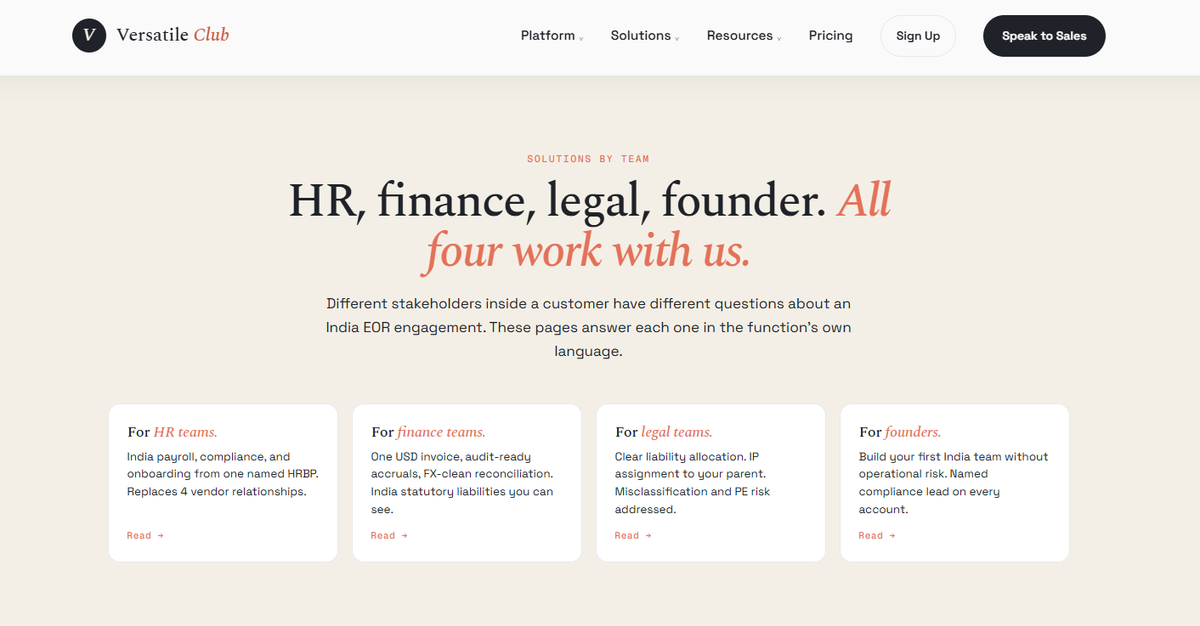
Overview
Versatile Club is an India-only Employer of Record and Contract-to-Hire firm built for US and UK companies. We employ your India hires on our own registered Indian entity. That means payroll, PF, ESI, TDS, and professional tax run under our registrations, not a third party's.
We started in Contract-to-Hire, placing engineers, designers, and ops people across Bengaluru, Hyderabad, and Pune. The compliance muscle came from doing the work, not from a global playbook.
🛠️ Core Services
India EOR on a Versatile-owned entity (no partner shell).
Contract-to-Hire with culture-fit vetting across 50 behavioral parameters.
Multi-state statutory compliance: PF, ESI, TDS, professional tax, gratuity, POSH.
USD invoicing direct from India, with challan and TDS receipt documentation.
90-day Success Coach and a 6-month replacement guarantee on C2H placements.
💡 Why Companies Consider Versatile Club
Founders pick us when speed and compliance both matter and they do not want a ticket queue. The onboarding SLA is a contractual five business days: Day 1 agreement, Day 2 offer, Day 3 contract, Day 4 registrations, Day 5 live payroll.
The second reason is money clarity. We invoice in USD directly, not routed through a foreign holding company and not converted from INR. There is no separate 3 to 5% FX markup line buried in the invoice, which is a real complaint employees raise about some global platforms.
🎯 Ideal Customer Profile
Company size: Seed to Series B, $5M to $50M ARR SMBs.
Geography: US and UK headquarters.
Hiring need: Engineering, product, AI, design, marketing, or ops.
India team size: 1 to 20 employees.
Decision maker: Founder, VP People, or CFO making a first India hire.
💰 Commercial Model
EOR pricing starts at $149 per employee per month, with no setup fees, no exit fees, and the first month free. Contract-to-Hire pricing runs at 20 to 30% of annual salary, billed only after the hire completes day 90. The 6-month replacement guarantee applies to C2H placements.
⚠️ Where We Are Not the Fit
I will name the trade-off plainly. If you need EOR across 5+ countries, we are the wrong call, because India is the only country we operate in by design. The same goes for enterprise buyers who require SOC 2 or ISO 27001 as a procurement gate, and for B2C consumer hiring at scale.
💬 Customer Reviews
No verified customer reviews were available in the provided source set for this provider.
2. Deel: Best for Companies Hiring Across 100+ Countries From One Platform
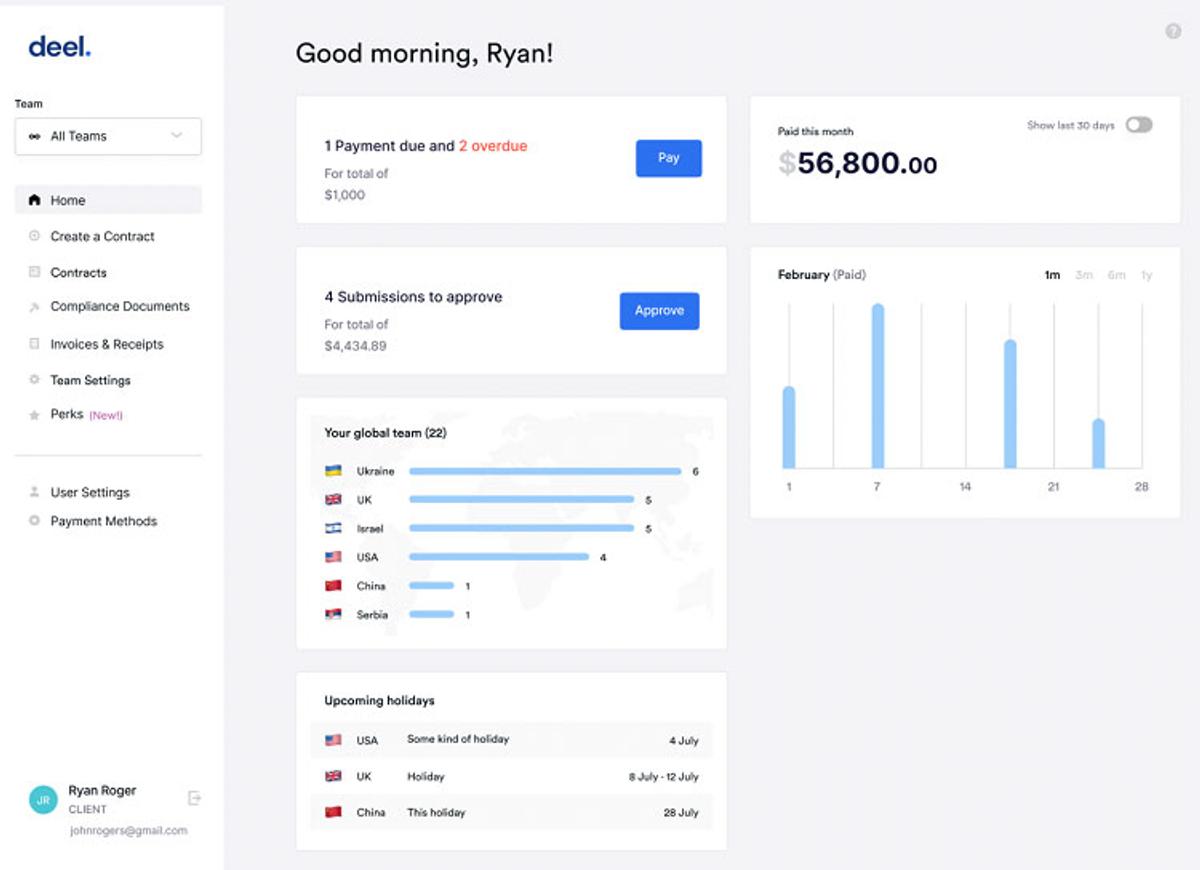
Overview
Deel is a global EOR and contractor-payments platform covering 100+ countries. It serves companies that want one dashboard for hiring, contracts, and payments across many markets. In India, Deel operates through a local partner entity rather than its own.
It is a genuinely strong product for breadth. The trade-off is that India is one of many countries, so India-specific depth is thinner than a specialist's. Teams comparing options often shortlist a focused Deel alternative for India hiring.
🛠️ Core Services
Global EOR across 100+ countries.
Contractor management and multi-currency payments.
Multi-country payroll consolidation.
Compliance document workflows and contract generation.
Integrations across HR and finance tools.
💡 Why Companies Consider Deel
Teams choose Deel when they are hiring in several countries at once and want a single platform. The interface is clean and onboarding for individual contractors is fast.
The friction shows up in support and fees. Reviewers report a chatbot-first support model and transfer costs that surprise both employers and employees. India onboarding typically runs longer than a specialist's five-day cycle.
🎯 Ideal Customer Profile
Company size: Series B and up, or globally distributed teams.
Geography: Multi-country, not India-only.
Hiring need: Contractors and employees across regions.
India team size: Any, but India is one of many markets.
Decision maker: People Ops or Finance managing global headcount.
💰 Commercial Model
Deel EOR pricing is commonly cited around $599 per employee per month. Reviewers report transfer and FX-related fees on top of the headline price. Always confirm the India-specific quote and FX terms in writing before signing.
💬 Customer Reviews
"I find Deel to be absurdly expensive. They charge a high amount of fees for transferring money to my bank account. Additionally, using their card incurs fees for purchases in another currency."
Juan Camilo O. Deel G2 Verified Review
"Often the CS doesn't seem to have answers, which leads me to emails back and forth on my case. Something I was looking for the answer to in 20 minutes becomes a 4 day process, or needs to be consulted with by multiple team members who aren't available except for at 3:00am my time."
Verified User in Computer Software Deel G2 Verified Review
3. Remote: Best for Teams Wanting an Owned-Entity Global EOR With Strong IP Terms
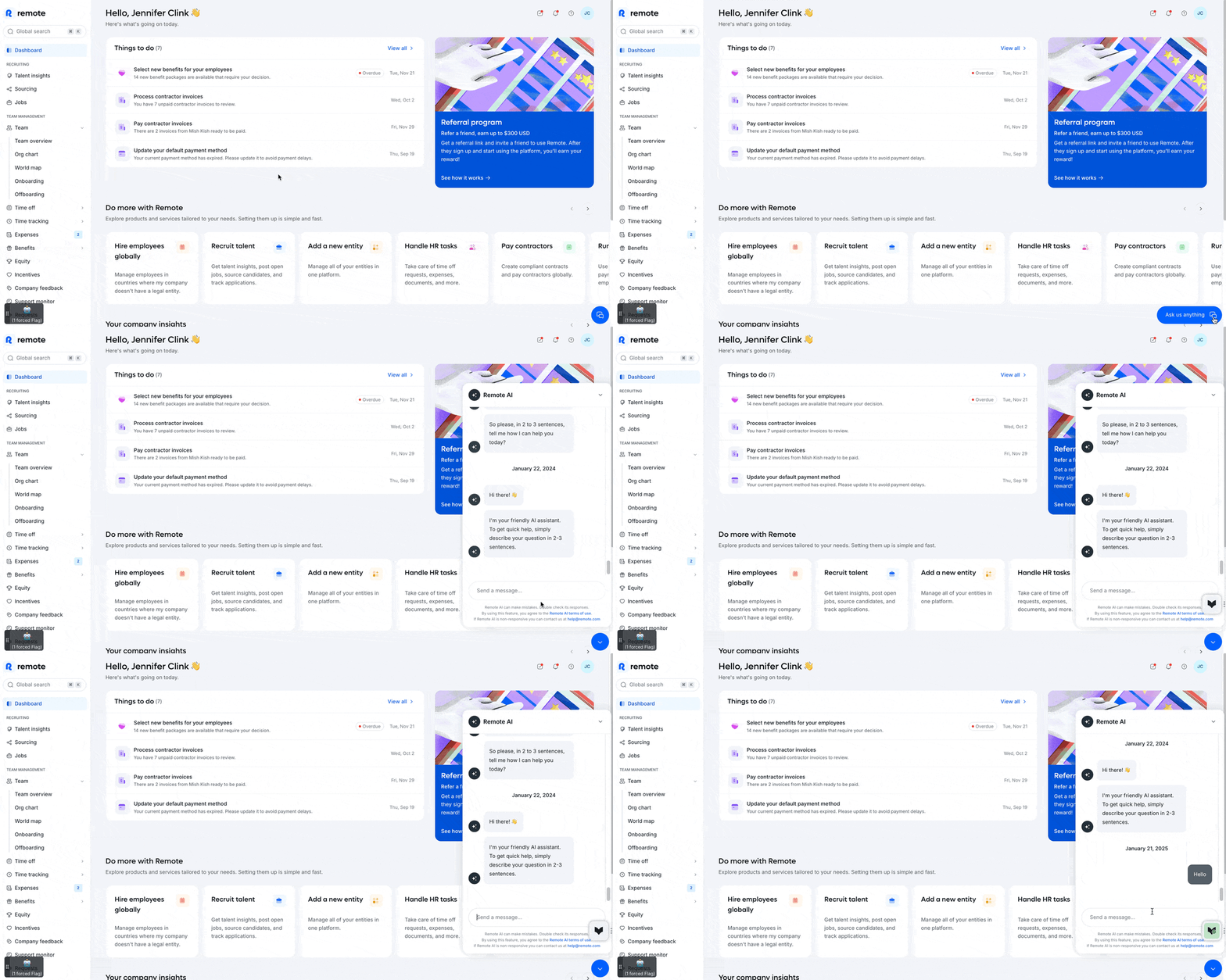
Overview
Remote is a global EOR known for strong IP and invention-assignment terms and an all-in-one platform. It serves companies that want to consolidate HR tools and hire across borders. India compliance depth is lighter than a multi-state India specialist.
It is a solid pick for IP-sensitive teams hiring in several countries. For India-only buyers, the depth gap is worth weighing, and many evaluate a dedicated Remote alternative for that reason.
🛠️ Core Services
Global EOR with owned entities in several markets.
IP and invention-rights assignment.
Contractor management and payments.
Benefits administration across countries.
Consolidated HR platform and reporting.
💡 Why Companies Consider Remote
Buyers like the owned-entity model in core markets and the IP protection terms. The all-in-one structure removes multiple logins and standalone tools.
Support is the recurring complaint. Reviewers describe email support with a multi-day SLA and slow initial setup, which hurts when payroll is time-sensitive.
🎯 Ideal Customer Profile
Company size: Series A and up with multi-country needs.
Geography: Distributed teams across regions.
Hiring need: IP-heavy roles in engineering and product.
India team size: Any, as part of a broader footprint.
Decision maker: People Ops or Legal prioritizing IP terms.
💰 Commercial Model
Remote EOR pricing is commonly cited around $599 per employee per month. Reviewers report fees beyond the advertised rate, so confirm the India quote and any extras in writing. Buyers seeking deeper India coverage often weigh our EOR services against it.
💬 Customer Reviews
"They were dishonest about the level of support provided. We specifically explained we required phone-level support for urgent matters, but that is not available. Instead they have email support with a 3-day SLA. Responses are unacceptably slow. Separately, their payroll is still supported by manual processes, and twice we've had near catastrophic errors."
Juliette D. Remote G2 Verified Review
"I find Remote super complicated to use at a platform level, with zero clarity on the process. Also, there are hidden fees everywhere, and I end up paying roughly 30% more than what's stated on the platform or advertising."
Javier G. Remote G2 Verified Review
4. Multiplier: Best for APAC-Focused Startups Wanting Fast, Low-Cost Setup
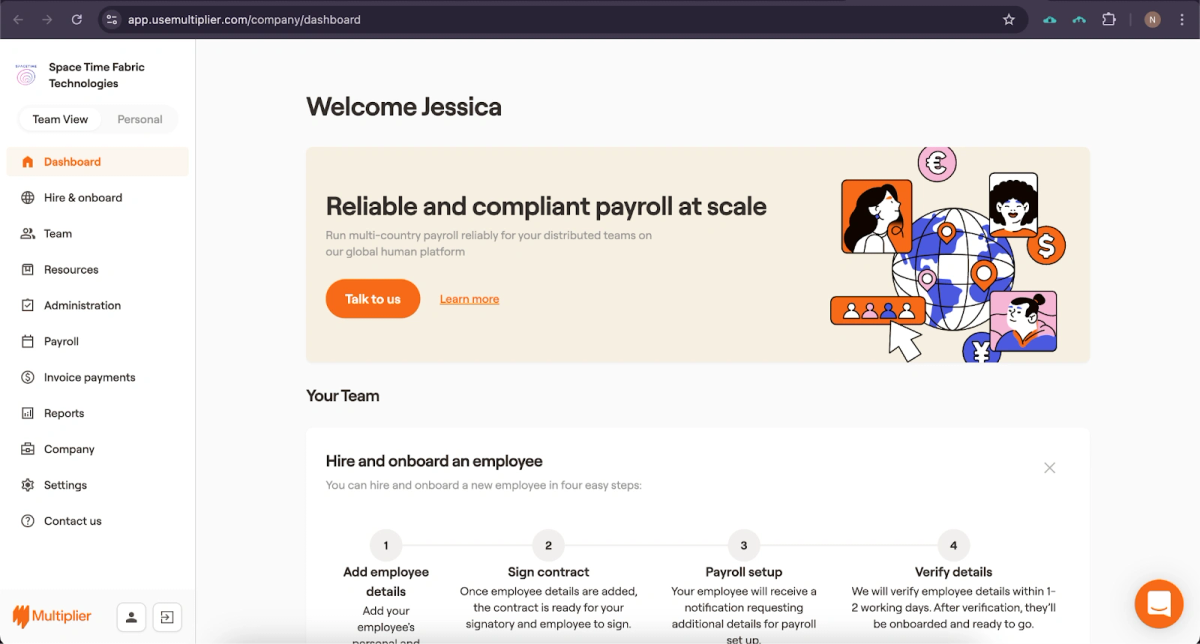
Overview
Multiplier is a global EOR with an Asia-Pacific lean and competitive pricing. It serves startups that want quick onboarding without a big platform fee. India coverage is partner-assisted rather than fully owned.
It is a fair pick for price-sensitive teams testing a new market. The trade-offs show up in payroll accuracy and account-manager churn, which is why some buyers consider a Multiplier alternative for India.
🛠️ Core Services
Global EOR with APAC focus.
Contractor management and payments.
Multi-country payroll.
Benefits administration.
ESOP and equity support in select markets.
💡 Why Companies Consider Multiplier
Founders pick Multiplier for low pricing and easy initial onboarding. For an early India experiment, that combination is attractive.
The recurring complaint is "you get what you pay for." Reviewers report late payroll, unclear bank-transfer fees, and account managers leaving mid-engagement. ⚠️
🎯 Ideal Customer Profile
Company size: Seed to Series A, budget-conscious.
Geography: APAC-heavy hiring.
Hiring need: A few roles across multiple countries.
India team size: 1 to 10 employees.
Decision maker: Founder optimizing for cost.
💰 Commercial Model
Multiplier EOR pricing is commonly cited around $400 per employee per month. Reviewers report extra deposits and bank-transfer fees not always clear upfront. Confirm the full fee schedule and FX terms before signing.
💬 Customer Reviews
"They charge extra money for bank transfer with no clarity on the actual amount. They constantly delay the payment even though the other party have done their due diligence. At time there has been delay by a month."
Verified User in Computer Software Multiplier G2 Verified Review
"I appreciate that Multiplier offered competitive pricing for its employer of record services. The setup process was fairly straightforward. They also introduced some new deposits and fees that weren't originally in our contract and ultimately ended up increasing our EOR costs."
Micah P. Multiplier G2 Verified Review
5. Globalization Partners: Best for Enterprises Needing Mature Multi-Country Compliance
Overview
Globalization Partners (G-P) is one of the oldest global EOR platforms, built for enterprise compliance across many markets. It serves larger companies that value process maturity and legal rigor. India is part of a broad, partner-assisted footprint.
It is a strong enterprise pick when procurement needs a known, mature vendor. For a lean India-only hire, it can feel heavy and expensive.
🛠️ Core Services
Enterprise global EOR.
Multi-country payroll and benefits.
Compliance and legal support.
Contractor management.
Integrations for enterprise HR stacks.
💡 Why Companies Consider G-P
Enterprises choose G-P for compliance maturity and a long operating history. When the buying committee includes legal and procurement, that track record matters.
The trade-off is cost and India-specific depth. As a generalist across many countries, multi-state India nuance is not its core focus, so larger teams sometimes pair it with specialist India compliance support.
🎯 Ideal Customer Profile
Company size: Mid-market to enterprise.
Geography: Many countries at once.
Hiring need: Compliance-heavy roles at scale.
India team size: Part of a large global plan.
Decision maker: Procurement, Legal, and People Ops together.
💰 Commercial Model
G-P typically prices as a percentage of salary or via custom enterprise quote. Public per-seat pricing is not consistently disclosed. Request a written India-specific quote, including any partner-entity fees.
💬 Customer Reviews
No verified customer reviews were available in the provided source set for this provider.
6. Pebl (formerly Velocity Global): Best for Mid-Market Firms Scaling Across Regions
Overview
Pebl, formerly Velocity Global, is a global EOR known for regional local knowledge across many countries. It serves mid-market firms building distributed teams. India is one of many markets it covers.
It works for multi-region scaling when local nuance matters. Reviewers flag onboarding friction and post-employment offboarding gaps.
🛠️ Core Services
Global EOR across many countries.
Local compliance and contracts.
Payroll and benefits administration.
Immigration and right-to-work support.
Account-manager-led onboarding.
💡 Why Companies Consider Pebl
Buyers value the local-knowledge model and account-manager support. For a sales force spread across regions, that reach is useful.
The complaints cluster around manual, email-heavy processes and account-manager turnover. One reviewer flagged poor PF transfer handling after an India employee's exit. ⚠️
🎯 Ideal Customer Profile
Company size: Mid-market.
Geography: Multi-region teams.
Hiring need: Distributed sales and ops roles.
India team size: Part of a regional plan.
Decision maker: People Ops managing several countries.
💰 Commercial Model
Pebl prices via custom quote, often above the market average per reviewer feedback. Public per-seat pricing is not consistently disclosed. Confirm fees, deposits, and refund timelines in writing.
💬 Customer Reviews
"The PF transfer for employees after terminating their employment with Velocity was very poor. There was limited help, delayed responses and you can't get them to talk to you on phone. This is disappointing as they charged heavily per employee."
Verified User in Computer Software Pebl (formerly Velocity Global) G2 Verified Review
"Velocity offers great local knowledge on the countries where they operate. Processes are manual. From the request to onboard to approving quotes, everything happens via email. There is no way of tracking where a process is at."
Verified User in Computer Software Pebl (formerly Velocity Global) G2 Verified Review
7. Papaya Global: Best for Finance Teams Wanting Payroll and Payments in One View
Overview
Papaya Global is a global payroll and payments platform with EOR services. It serves finance-led teams that want detailed cost breakdowns and integrated payments. India sits within its global payroll network.
It is a good fit when the CFO wants payroll visibility in one dashboard. Reviewers note slow support responses and premium pricing, so finance teams often compare it with a focused managed payroll option for India.
🛠️ Core Services
Global payroll and payments.
EOR in select markets.
Cost breakdowns and invoicing in-platform.
Contractor payments.
Finance and HR system integrations.
💡 Why Companies Consider Papaya
Finance teams like the platform's cost visibility and integrated payments. Monthly invoices and detailed breakdowns live in one place.
The trade-offs are support speed and price. Reviewers report needing to chase monthly reports and describe Papaya as significantly overpriced for some single-country hires. ⚠️
🎯 Ideal Customer Profile
Company size: Mid-market to enterprise.
Geography: Multi-country payroll needs.
Hiring need: Finance-led payroll consolidation.
India team size: Part of a global payroll footprint.
Decision maker: CFO or payroll manager.
💰 Commercial Model
Papaya prices via custom quote, positioned at the premium end. Public per-seat EOR pricing is not consistently disclosed. Request a written India quote and confirm support SLAs.
💬 Customer Reviews
"The platform is very user-friendly, especially for accessing all our payroll inputs, outputs, and workers' documents. We've noticed that response times can sometimes be very slow when we require clarifications. We have to remind Papaya to get monthly reports for a couple of countries every month."
Cherry H. Papaya Global G2 Verified Review
"Doing the bare minimum to hire an employee in Italy. We've moved on to another EOR serving us much better, night and day, in terms of service and transparency. Papaya is significantly overpriced."
Verified User Papaya Global G2 Verified Review
8. Payoneer (formerly Skuad): Best for Contractor-Heavy Global Hiring
Overview
Payoneer, which acquired Skuad, is a global hiring and payments platform with broad contractor coverage. It serves companies that lean on contractors more than full-time EOR employees. India is part of its wide partner network.
It works well for contractor-first teams managing many countries. For deep India full-time compliance, a specialist goes further, and some buyers review a Skuad alternative for India hiring.
🛠️ Core Services
Global contractor management.
EOR in select markets.
Cross-border payments.
Compliance document workflows.
Multi-currency payouts.
💡 Why Companies Consider Payoneer
Teams pick Payoneer when contractors dominate their global headcount and payments are the priority. The payments backbone is a real strength.
The trade-off is depth for full-time India employees. Partner-network compliance can mean less control over multi-state statutory nuance, which a Contractor of Record model handles more directly.
🎯 Ideal Customer Profile
Company size: Startups to mid-market.
Geography: Contractor-heavy, many countries.
Hiring need: Contractors with some EOR.
India team size: Mixed contractor and employee.
Decision maker: Ops or Finance managing payouts.
💰 Commercial Model
Skuad EOR pricing has historically been cited from around $199 per employee per month, with contractor pricing separate. Confirm current Payoneer pricing and FX terms in writing, since the offering has shifted post-acquisition.
💬 Customer Reviews
No verified customer reviews were available in the provided source set for this provider.
9. Rippling: Best for Companies Bundling EOR With IT and HR
Overview
Rippling is a US-centric workforce platform that bundles HR, IT, and payroll with global EOR add-ons. It serves companies that want identity, devices, and payroll in one system. Global EOR, including India, is partner-assisted.
It shines when you want one system of record for employees and devices. Reviewers report heavy support and multi-state tax friction.
🛠️ Core Services
HR, IT, and payroll platform.
Device and identity management.
Global EOR add-on.
Benefits administration.
Custom reporting and workflows.
💡 Why Companies Consider Rippling
Buyers choose Rippling to unify HR, IT provisioning, and payroll. For US-heavy teams, that integration saves real admin time.
The complaints are loud on support and tax accuracy. Reviewers describe chatbot-first support, contradictory answers, and multi-state tax errors that created compliance cleanup. ⚠️
🎯 Ideal Customer Profile
Company size: US-centric SMB to mid-market.
Geography: US core with some global hires.
Hiring need: HR plus IT plus payroll in one.
India team size: Small, as an add-on.
Decision maker: IT and People Ops together.
💰 Commercial Model
Rippling prices per module, with EOR quoted separately and often via custom quote. Add-ons can raise the total quickly per reviewer feedback. Confirm the India EOR quote and all module fees in writing.
💬 Customer Reviews
"Support is the single biggest failure. There is no direct phone line. You either email or use a chatbot, and you can ask both the same question and get two different wrong answers. I've tested it."
Erika D. Rippling G2 Verified Review
"I find the entire integrated payroll system very easy to use, even for our most tech-phobic employees. The implementation process for Rippling Spend has been a truly terrible experience. No one can diagnose the issue."
Patrick W. Rippling G2 Verified Review
10. Oyster: Best for Distributed Teams Prioritizing a Clean Employee Experience
Overview
Oyster is a global EOR focused on a smooth employee experience for distributed teams. It serves remote-first companies that value a polished hiring flow. India is covered through its partner-network model.
It is a reasonable pick for remote-first culture and employee-facing polish. For multi-state India statutory depth, a specialist holds the edge, which is why startups often shortlist an India-native option alongside it.
🛠️ Core Services
Global EOR for distributed teams.
Contractor management.
Benefits administration.
Compliance workflows.
Employee-experience tooling.
💡 Why Companies Consider Oyster
Remote-first teams like the clean onboarding flow and employee-facing design. For a globally scattered team, that consistency helps.
The trade-off is India depth. Partner-network EOR means less direct control over PF, ESI, and multi-state professional tax detail.
🎯 Ideal Customer Profile
Company size: Startups to mid-market, remote-first.
Geography: Globally distributed.
Hiring need: Employee-experience-led hiring.
India team size: Part of a global team.
Decision maker: People Ops at a remote-first company.
💰 Commercial Model
Oyster EOR pricing has historically started around $499 per employee per month, with contractor plans separate. Confirm current pricing and any India partner-entity fees in writing.
💬 Customer Reviews
No verified customer reviews were available in the provided source set for this provider.
Where This Leaves You
If you are hiring 1 to 20 people in India and want owned-entity compliance, transparent USD invoicing, and a founder who answers on WhatsApp, Versatile Club is built for exactly that. If you need 5+ countries or enterprise SOC 2 procurement, a global generalist on this list will serve you better, and I would rather tell you that now than during your audit.
Tell me what you are building in India, and I will tell you honestly whether we are the right fit. You can book a demo whenever it suits your timezone.
Q2: How Did We Score These Providers, and Why Should You Trust This List?
We scored every provider on five weighted criteria totaling 100%: India Entity Model and Labour-Code Compliance Depth (30%), Pricing Transparency and Commercial Model (20%), Onboarding Speed and Support Model (20%), Talent and Retention Support (15%), and Customer Validation via G2, Capterra, and Reddit (15%). Scores map to stars: 0 to 20 is 1 star, and 81 to 100 is 5 stars. I also disclose my bias, because most India EOR lists are written by the vendor ranking themselves first.
⚠️ Why Most "Best EOR" Lists Are Quietly Rigged
Here is the part the category avoids saying out loud. Most "best EOR in India" articles are written by an EOR. That vendor always lands at number one.
I run Versatile Club, so I have the same conflict. The honest move is to show the math, then let you re-weight it. A scorecard you can audit beats a ranking you have to trust blindly. You can also run your own numbers with our EOR vs entity calculator.
✅ The Five Criteria, With Weights
I weighted India depth heavily on purpose. For a company hiring 1 to 20 people in India, multi-state statutory compliance matters more than coverage in 90 countries you will never use.
Our Five Weighted Scoring Criteria | ||
Criterion | Weight | What Earns a High Score |
|---|---|---|
India Entity Model and Labour-Code Compliance Depth | 30% | Owns its Indian entity; files PF, ESI, TDS, professional tax under its own registrations; New Labour Code 2025-26 ready |
Pricing Transparency and Commercial Model | 20% | Clear monthly fee, no hidden FX markup, no setup or exit fees, plain invoices |
Onboarding Speed and Support Model | 20% | Fast contractual SLA, named human support, not a chatbot or ticket queue |
Talent and Retention Support | 15% | Culture-fit vetting, replacement guarantee, onboarding monitoring |
Customer Validation | 15% | Verified G2, Capterra, and Reddit signals, not just logos |
💡 Where to Re-Weight This for Your Own Buy
That 15% on Talent and Retention is deliberate. Compliance is a low bar. A legally correct hire who quits in month two still cost you the search, the ramp, and the gap.
I could be wrong for your situation, and I will say so plainly. If you need 100+ India staff and SOC 2 or ISO 27001 as a procurement gate, push Customer Validation higher and read the global players harder. If you need 5+ countries, this scorecard is not built for you. Re-weight it, and the ranking should shift honestly. Our approach is built for the India-only buyer.
Q3: What Is an EOR in India, and Why Doesn't a US-Style PEO Work Here?
An Employer of Record (EOR) in India legally employs your workers on its own Indian entity. It runs payroll, PF, ESI, TDS, and professional tax under its registrations, so you can hire full-time Indian talent without a Private Limited company. Traditional US-style co-employment PEO does not legally exist under Indian labour law. If you lack an Indian entity, EOR is your only compliant route.
🧩 The Simple Version
Think of an EOR as the legal employer on paper, while the person works for you day to day. The EOR signs the contract, files the taxes, and carries the statutory liability. You direct the work and pay one invoice.
We built our India EOR services this way after six years of Contract-to-Hire across Bengaluru, Hyderabad, and Pune. The compliance knowledge came from running real payroll cycles, not from a global playbook.
❌ Why the PEO Model Breaks in India
In the US, a PEO (Professional Employer Organization) shares the employee with you under "co-employment." Two entities legally employ one person.
India does not recognize that structure. Under Indian labour law, one legal employer holds the statutory duties: PF, ESI, gratuity, and the rest. So a US founder asking for a "PEO in India" usually needs an EOR instead. The standard read gets this backwards, and it trips up first-time buyers constantly. For a side-by-side view, our HR outsourcing overview helps clarify the difference.
⏰ When EOR Is Right, and When It Is Not
EOR fits best when you have 1 to 12 India hires and need to move in days, not months. Setting up your own entity takes 12 to 18 months and heavy capital before your first hire.
There is a tipping point, though, and I will get specific on it later. Somewhere around 10 to 12 employees, your own entity often becomes cheaper than per-head EOR fees. A good EOR partner helps you cross that bridge, not stay stuck on it.
Q4: What Does It Truly Cost, and What Must Your EOR Comply With, to Employ in India in 2026?
The true cost of an India hire is the CTC (cost to company) plus employer statutory contributions: Provident Fund at 12% of basic, ESI where it applies, gratuity, and professional tax, all on top of the EOR fee. Under the four Labour Codes effective 21 November 2025, Basic plus DA (dearness allowance) must be at least 50% of CTC, which raises PF-linked costs. The DPDP Rules, notified 13 November 2025, add data-security duties, and a poorly structured presence can trigger Permanent Establishment tax risk.
💰 The Sticker Price Is Not the Real Price
A US founder messaged me on WhatsApp once, three days before payroll, panicking. Her "cheap" global EOR quote had quietly grown by a 3 to 5% FX markup and statutory line items she never saw coming.
Here is the honest math on a 20 lakh per year hire. The numbers shift by state and salary band, but the shape holds. You can model your own figures with our salary calculator.
Fully-Loaded Cost of a 20 Lakh CTC India Hire | ||
Cost Line | Rough Basis | On 20L CTC |
|---|---|---|
Basic + DA (≥ 50% rule) | Min. 50% of CTC | ~10,00,000 |
Provident Fund (employer) | 12% of basic | ~1,20,000 |
Gratuity accrual | 4.81% of Basic + DA | ~48,000 |
ESI (if wage ≤ threshold) | 3.25% employer share | Varies |
Professional tax | State slab | ~2,500/year |
FX markup (global platforms) | 3% to 5% of invoice | ❌ avoidable |
✅ How We Remove the FX Line
We invoice in USD directly from India. The money is not routed through a foreign holding company and not converted from INR with a hidden spread. So the FX markup line above simply does not exist on a Versatile Club invoice.
That single change can save more than the EOR fee itself on a larger team. For a CFO closing month-end on one clean invoice, it also makes the number predictable, which is why finance teams lean on our managed payroll.
📋 The 2025-26 Compliance Matrix Your EOR Must Already Handle
Generalists spread their India expertise across 90+ countries. The depth shows up here, in the details that surface during a Series B audit. Contractor misclassification alone can carry $25,000 to $40,000 in back-pay exposure per head, which is where a clean Contractor of Record setup protects you.
India 2025-26 Compliance Matrix for Employers | |||
Regulation | Source and Date | What Changed | Employer Action |
|---|---|---|---|
Four Labour Codes | MoLE notifications, 21 Nov 2025 | Basic + DA ≥ 50% of wages; 29 laws rationalised | Restructure CTC; recompute PF and gratuity |
Lay-off and FAQ clarity | MoLE FAQs, 16 Mar 2026 | 50% basic + DA flows into gratuity, PF | Update payroll formulas |
DPDP Rules 2025 | MeitY, 13 Nov 2025 | 72-hour breach reporting; itemized consent | Audit how your EOR stores employee data |
EPFO wage ceiling | Gazette S.O. 2702(E), 29 May 2026 | Ceiling fixed at 15,000/month, under review | Budget for a possible rise to 21,000 |
TDS deposit | CBDT rule | Deducted, deposited by 7th monthly | Confirm challans land on time |
💡 What I Would Do on Monday
Ask any vendor for a sample challan and a sample USD invoice before you sign. Real proof beats a "fully compliant" claim every time. We file PF, ESI, and multi-state professional tax, including Maharashtra's dual PTRC and PTEC monthly slabs, under our own registrations, and we will show you the paperwork on a quick call.
Q5: EOR vs. Your Own Indian Entity: When Should You Switch?
Use an EOR when you have 1 to 12 India hires and need to move in days, not months. Setting up your own entity takes 12 to 18 months and heavy capital before your first hire. The practical switching point arrives around 10 to 12 employees, when running your own Private Limited company becomes cheaper than per-head EOR fees. The best EOR makes that move clean, with no setup or exit fees holding you back.
⚖️ The Decision Most Founders Agonize Over
I get this question on WhatsApp almost weekly. "Should I just set up my own Indian subsidiary now?" The honest answer is: probably not yet, and here is why.
An entity is a long, capital-heavy commitment. An EOR is speed and optionality. The two solve different problems at different stages, and our EOR vs entity calculator helps you see where you sit.
💰 EOR vs. Entity, Side by Side
EOR vs. Your Own Indian Entity | ||
Factor | EOR | Your Own Entity |
|---|---|---|
Time to first hire | About 5 business days | 12 to 18 months |
Upfront capital | Low, monthly fee | $50,000+ plus FC-GPR filing |
Compliance burden | Carried by the EOR | Yours: PF, ESI, TDS, ROC, audits |
Flexibility to exit | High | Low; winding down takes months |
Cost at 1 to 10 hires | ✅ Cheaper | ❌ Overkill |
Cost at 12+ hires | ❌ Adds up | ✅ Often cheaper |
FC-GPR (Foreign Currency-Gross Provisional Return) is the FEMA filing you make with the RBI after a foreign parent funds an Indian entity. It is one more reason the entity path is slow, and our compliance team handles equivalent filings for you under an EOR.
⏰ The 10 to 12 Hire Tipping Point
Across the teams I have watched scale, the switch tends to land around 10 to 12 people. One founder put it plainly: after about twelve hires, they said, "Right, we're ready to open our own entity."
That number is not a law, and I could be off by a few heads for your margins. But it is a useful planning anchor for any startup mapping its India roadmap.
Here is the part the category avoids saying. Most EORs quietly want you to never leave, so they price exit friction in. We built our Contract-to-Hire model from a background that means we are used to moving people out cleanly, not trapping them. We charge no setup fees and no exit fees, so migrating to your own entity later is a handoff, not a hostage negotiation.
When you compare vendors, ask one question they rarely volunteer: "What happens, contractually and operationally, when I want to move these employees to my own entity?" The answer tells you whether they see you as a partner or a subscription. Our process is designed for that handoff.
Q6: Why Does "Legally Compliant" Not Mean "A Hire That Stays"?
A compliant EOR puts a legal employee on paper. That says nothing about whether the hire is good or whether they stay. With nearly 30% of Indian IT sector resumes containing discrepancies, screening and culture fit matter as much as payroll. At Versatile Club, we add 50 behavioral parameters, a 90-day Success Coach, and a 6-month replacement guarantee, which closes the gap between a "legal hire" and a "good hire that stays."
❌ The Standard Advice Gets This Backwards
Most lists tell you to pick the most compliant EOR. Compliance is the floor, not the ceiling. Every serious provider clears it.
The real risk sits one layer down. You can have a perfectly compliant employee who was the wrong hire, or who walks in month two. The paperwork was flawless. The outcome was a loss. This is where our recruitment screening earns its keep.
⚠️ The Risk Compliance-First Vendors Ignore
A founder once converted a "clean," fully compliant contractor to full-time, then learned the resume was padded. That is not rare. Background-check data puts resume discrepancies in Indian IT near 30%.
A compliance-first EOR has no answer for this. Its scorecard ends at "payroll filed correctly." The good-hire problem is simply not on its radar, which is why we built a culture fit assessment into the process.
✅ Treating Retention as Part of the Job
We screen for culture fit across 50 behavioral parameters before a placement. A 90-day Success Coach checks in through the fragile first quarter, when most early exits happen. A 6-month replacement guarantee means if a placement does not work, we re-run it. You can see how this works when you hire talent through us.
I might be wrong that every buyer values this. A pure payroll buyer may not. But from what surfaces when you actually run placements for six years, the "legal hire on paper" and the "hire who stays" are two different products, and most of the category only sells the first one.
Q7: How Do You Onboard and Manage an India Hire Without Getting Burned?
A well-run India EOR moves from signed agreement to active payroll in about 5 business days. Global platforms often quote 10 to 14 days. But onboarding speed is only half the job. Managing across a power-distance gap, where India scores 77 versus 40 for the USA, is where US and UK managers stumble. Avoid closed yes-or-no questions, wait a few hours before acting on meeting takeaways, and verify understanding by volunteering clarification.
⏰ The 5-Day Onboarding Sequence
Speed is the most urgent thing a funded founder needs. Here is the contractual SLA (service-level agreement) we run as part of our India EOR, day by day.
Day 1: Service agreement signed.
Day 2: Offer issued to the candidate.
Day 3: Employment contract executed.
Day 4: Statutory registrations completed.
Day 5: Employee live on payroll.
Deel and Remote reviewers report 10 to 14 day cycles and chatbot-first or ticket-queue support. When payroll is three days out, you want a person, not a ticket, which is why founders weigh a Deel alternative built for India.
✅ The Vendor Due-Diligence Checklist
Before you sign anything, ask these five questions:
Do you own the Indian entity, or use a local partner shell?
How do you handle FX, and is there a markup?
Is there a replacement guarantee?
Are there setup or exit fees?
Which states do you hold registrations in?
If transparent pricing matters to you, our pricing answers most of these upfront.
⚠️ The Mistake That Burns US Managers
An American manager once emailed a new India team for their employee IDs and got silence. On the third try, the team's boss replied that he was collecting the information himself. The team had deferred upward, not ignored her.
That is power distance in action. The relationship is the contract, and silence often means "I am being respectful," not "I am stuck."
💡 Three Tactics That Actually Work
Never ask "Are you on schedule?" Ask "Where are we on the schedule?"
Wait a few hours after a meeting; revised information often arrives by email.
Instead of asking "Did you understand?", volunteer extra clarification and watch the response.
I have placed engineers, designers, and ops people across Bengaluru, Hyderabad, and Pune for six years. What I think shifts in the next two years is this: India stops being one country on a global map and becomes its own specialist category. If you are making your first India hire, tell me what you are building on a quick call, and I will tell you honestly whether we fit.
FAQs
Who are the best EOR providers in India for 2026?
We rank the ten best EOR providers in India for 2026 as Versatile Club, Deel, Remote, Multiplier, Globalization Partners, Pebl, Papaya Global, Payoneer, Rippling, and Oyster.
We place Versatile Club first for India-only hiring for three concrete reasons:
- We employ your hires on our own registered Indian entity, not a local partner shell.
- We file PF, ESI, TDS, and multi-state professional tax under our own registrations.
- We invoice in USD directly from India and onboard in a contractual five business days.
The global platforms earn their place on multi-country breadth. If you are hiring across 5 or more countries from one dashboard, a generalist fits better. If India is your focus, depth beats breadth. You can see how the model works on our India EOR services page. We would rather tell you honestly when we are not the right fit than win a deal we cannot serve well.
What is an EOR in India, and why doesn't a US-style PEO work here?
An Employer of Record (EOR) in India legally employs your workers on its own Indian entity. It runs payroll, PF, ESI, TDS, and professional tax under its registrations, so you can hire full-time Indian talent without forming a Private Limited company.
A US-style PEO does not translate. In the US, a PEO shares the employee with you under co-employment, where two entities legally employ one person.
India does not recognize that structure. Under Indian labour law, one legal employer holds the statutory duties. So a US founder asking for a PEO in India almost always needs an EOR instead.
This is the single most common confusion we untangle for first-time buyers. We built our EOR services precisely to carry that statutory liability for you, cleanly and under our own name.
What does it truly cost to employ someone in India in 2026?
The true cost is the CTC (cost to company) plus employer statutory contributions, on top of the EOR fee.
The main employer-side line items are:
- Provident Fund at 12 percent of basic.
- Gratuity accrual at 4.81 percent of Basic plus DA.
- ESI at a 3.25 percent employer share where the wage threshold applies.
- Professional tax, which varies by state slab.
Under the four Labour Codes effective 21 November 2025, Basic plus DA must be at least 50 percent of CTC, which raises PF-linked costs. Global platforms often add a 3 to 5 percent FX markup that buyers miss until the invoice lands.
We remove that FX line by invoicing in USD directly from India. You can model your own numbers with our salary calculator before you commit.
How long does it take to onboard an employee through an India EOR?
A well-run India EOR moves from signed agreement to active payroll in about five business days. Global platforms often quote 10 to 14 days.
Here is the contractual SLA (service-level agreement) we run, day by day:
- Day 1: Service agreement signed.
- Day 2: Offer issued to the candidate.
- Day 3: Employment contract executed.
- Day 4: Statutory registrations completed.
- Day 5: Employee live on payroll.
Speed matters most when a funded founder needs people live before a board call. Deel and Remote reviewers report longer cycles and chatbot-first or ticket-queue support. When payroll is three days out, you want a person, not a ticket. See the full sequence on our how it works page.
EOR vs. your own Indian entity: when should you switch?
Use an EOR when you have 1 to 12 India hires and need to move in days, not months. Setting up your own entity takes 12 to 18 months and heavy capital before your first hire.
The practical switching point lands around 10 to 12 employees, when running your own Private Limited entity becomes cheaper than per-head EOR fees.
The honest caveat is that many EORs price exit friction in because they want you to stay. We charge no setup fees and no exit fees, so migrating to your own entity later is a handoff, not a hostage negotiation.
Ask any vendor what happens, contractually, when you want to move employees to your own entity. Run your own break-even with our EOR vs entity calculator.
Why doesn't a legally compliant hire always mean a hire that stays?
A compliant EOR puts a legal employee on paper. That says nothing about whether the hire is good or whether they stay.
Compliance is the floor, not the ceiling. Every serious provider clears it. The real risk sits one layer down, in fit and retention.
With nearly 30 percent of Indian IT sector resumes containing discrepancies, screening and culture fit matter as much as payroll. A compliance-first EOR has no answer for a padded resume or a month-two exit.
We treat retention as part of the job. We screen across 50 behavioral parameters, assign a 90-day Success Coach, and back placements with a 6-month replacement guarantee. You can test the approach with our culture fit quiz.
How much do global EOR platforms like Deel and Remote cost for India?
Deel and Remote EOR pricing is commonly cited around 599 dollars per employee per month, with Multiplier near 400 dollars. Reviewers frequently report fees beyond the headline rate.
The hidden costs usually show up as:
- A 3 to 5 percent FX markup on conversions.
- Transfer and bank fees that surprise both employers and employees.
- Longer onboarding and ticket-queue support.
The deeper trade-off is India depth. Generalists spread expertise across 90 or more countries and route India through partner entities, so multi-state nuance gets thin.
If you are weighing a switch, we publish transparent figures on our pricing page, and many buyers compare us as a focused Deel alternative for India.
Which EOR is best for a US or UK startup making its first India hire?
For a US or UK startup making its first 1 to 20 India hires, we believe an India-native, owned-entity EOR fits best, and that is exactly who we built Versatile Club for.
The reasons map to what first-time buyers actually fear:
- Misclassification exposure that surfaces in a Series B audit.
- FX surprises a CFO cannot explain.
- Slow onboarding when a hire needs to start now.
We answer each with USD invoicing direct from India, a five-day onboarding SLA, founder-direct support, and a 6-month replacement guarantee.
We are not the fit for 5-plus-country rollouts or enterprises requiring SOC 2 as a procurement gate. If India is your focus, tell us what you are building and book a demo. Startups can also explore our startup hiring page.