Table of contents (12)
Hiring Employees in India: A Founder's Guide to Entity Setup, EOR, and Contractor Pathways
Q1. What are the three legal ways to hire employees in India?
There are three. Engage an independent contractor or C2H worker (live in 24 to 48 hours, $19 to $40 per contractor monthly, with $25,000 to $40,000 misclassification exposure per person). Appoint an Employer of Record that becomes the legal employer under its own PF, ESI, TDS, and professional tax registrations (48 hours to 5 days). Or incorporate a Private Limited company (3 to 6 months, $15,000 to $100,000 all-in). There is no fourth route: US-style co-employment PEO does not legally exist under Indian labour law.
🧭 The question that arrives on WhatsApp every week
A US founder messaged me last quarter with one line: "Can we just put him on our PEO?" She had a signed-off offer for a backend engineer in Hyderabad and a board update due Friday.
The answer was no, and not because of pricing. PEO means co-employment, where two companies share employer liability. Indian law has no such construct. One legal employer holds the PF, ESI, and TDS obligations, and that is the whole decision in front of you. If you are weighing the structures side by side, the PEO services in India breakdown explains why the term travels badly across borders.
⏰ What each route actually costs you in time and money
| Route | Time to first hire | Upfront cost | Recurring cost | Fails if |
|---|---|---|---|---|
| Contractor or C2H | 24 to 48 hours | None | $19 to $40 per contractor monthly | The person is core, managed, and full-time |
| Employer of Record | 48 hours to 5 days | None at most providers | Flat monthly fee per employee | You pass roughly 30 to 50 India employees |
| Private Limited entity | 3 to 6 months | $15,000 to $100,000 | Permanent filing and audit overhead | Speed matters more than control |
Each row is a different legal relationship, not a different vendor tier. Contractors invoice you. An EOR employs the person for you. An entity makes you the employer of record yourself, with everything that follows.
🌉 The suspension bridge and the Golden Gate
I think of it as two kinds of bridge. A suspension bridge goes up fast, carries real weight, and can be taken down when the route changes. The Golden Gate is permanent, expensive, and worth it only once you know the traffic is coming.
Contractor and EOR arrangements are suspension bridges. An Indian subsidiary is the Golden Gate. Founders get hurt when they build the second one for a traffic volume they are still guessing at, or keep using the first one long after 40 people are crossing it daily. The EOR versus entity comparison for India sets out where that line usually falls.
✅ How to pick in the next ten minutes
Three questions settle it most of the time. Is the role core and full-time, or scoped and temporary? Will your India headcount cross 30 inside 24 months? Do you need Indian IP sitting on your own balance sheet for a funding or acquisition reason?
Two yeses on the last two questions point to an entity. Otherwise, start with C2H or EOR and keep the option open. The Code on Social Security 2020 and the MCA SPICe+ incorporation route both still apply the day you change your mind. The EOR vs Entity Calculator runs the arithmetic for your own headcount in under two minutes.
Versatile Club operates only in India, and only across these three pathways: Contract-to-Hire, Employer of Record, and the handover into your own entity. The compliance and payroll infrastructure behind that came from running C2H placements for engineers, designers, and ops people across Bengaluru, Hyderabad, and Pune. So this comparison is the decision we have actually run with clients, not a brochure table.
Q2. Can a foreign company hire employees in India without setting up an entity?
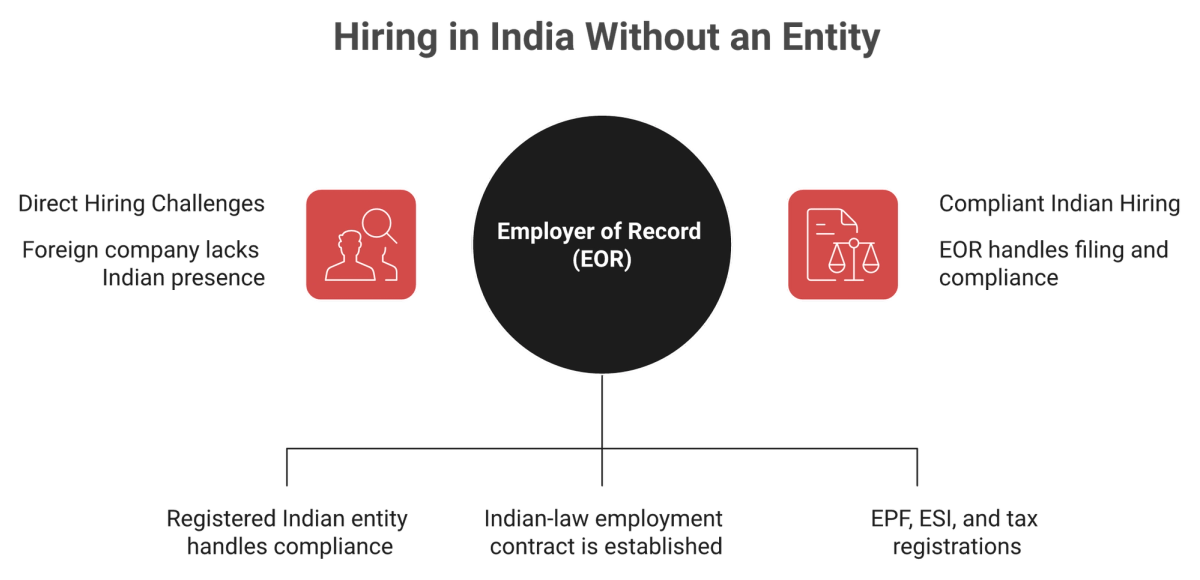
Yes. A foreign company can hire in India without a local entity by appointing an Employer of Record, which becomes the legal employer, issues the Indian-law contract, holds EPF and ESI registrations, and deducts tax at source. The alternative without an entity is a genuine independent contractor engagement, which carries misclassification risk. What you cannot do is put an Indian worker on your US or UK payroll directly, or call the arrangement a PEO.
📄 What the EOR absorbs, and what stays yours
The split is cleaner than most people expect. The EOR takes the legal employment relationship. You keep the work.
The EOR holds the employment contract under Indian law, including the IP assignment clause that moves work product to you.
The EOR runs payroll, deposits TDS, files EPF and ESI returns, and handles state professional tax.
You decide what the person builds, who they report to, their review cycle, and their raise.
You also decide when the relationship ends, though notice and settlement rules apply.
Jargon check, because this trips people up. TDS is tax deducted at source, India's payroll withholding. EPF is the provident fund, a retirement contribution. ESI is state health insurance for lower wage bands. The guide to hiring in India without an entity walks the same split in more operational detail.
❌ Why running India payroll from your US entity does not work
I have watched three companies try this. The pattern is always the same: a US dollar transfer every month, no payslip, no PF account, and a very unhappy employee in year two.
An employer in India must register as an employer to deduct and deposit tax at source under the Income-tax Act 2025 withholding provisions. It must register with EPFO and ESIC where the thresholds apply. A foreign company with no Indian presence cannot hold those registrations. There is no workaround, only delay. If payroll execution is the bottleneck, managed payroll sits on top of registrations that already exist.
⚠️ The second-order risk nobody prices in
Hiring without an entity does not automatically remove tax exposure. If the arrangement looks like you are carrying on business in India, through a fixed place or through someone acting on your behalf, permanent establishment questions follow. A properly structured EOR relationship insulates you because the employment and the employer are both Indian. A loosely structured contractor relationship does not.
That is the real reason I push founders toward EOR for core roles rather than contractor paperwork. It is not a service preference. It is where the liability sits. The independent contractor versus EOR comparison lays out both sides of that liability question.
✅ The verification question worth asking
Ask any provider for the legal name and CIN of the Indian company that will appear on the employment contract, then check it on the MCA portal yourself. It takes four minutes. If the name on the contract is not the name on the website, your hire is employed by a partner you never signed with.
Versatile Club's employees are employed by Foo Falcon Technologies Pvt Ltd, a registered Indian company, with PF, ESI, TDS, and professional tax filed under our own registrations. That is the legal answer to this question in our case: not a partner, not an aggregator, not a paper arrangement that resolves to someone else's numbers. The compliance page lists the registrations behind that statement.
Q3. What does an India employee actually cost once statutory contributions are added?
Budget 13% to 18% above gross, not the 30% or more US founders assume. Employer EPF is 12% of wages, with EDLI at 0.50% and PF administration at 0.50%, all capped at INR 25,000 monthly wages since 17 September 2026. ESI is 3.25% of gross where monthly wages are INR 21,000 or below. Gratuity accrues at roughly 4.81% of wages, and professional tax is state-specific up to INR 2,500 a year. Because Basic plus DA must reach 50% of CTC, that base can no longer be shrunk by loading allowances.
💰 Why every guide you read quotes a different number
I have seen published multipliers of 8.1%, 9% to 13%, 13% to 18%, and 20% to 25%. All of them are arithmetically defensible, which is the problem. Some apply PF to gross instead of to wages. Some bundle private health insurance into a statutory table where it does not belong. Almost none state which notification they are calculating from.
So here is the stack with the authority attached to each line. The cost of hiring in India breakdown carries the same arithmetic across more salary bands.
📊 The employer cost stack, line by line
| Contribution | Employer rate | Basis | Authority |
|---|---|---|---|
| EPF | 12% | Wages (Basic plus DA), capped at INR 25,000 monthly | S.O. 5109(E), 17 September 2026 |
| EDLI | 0.50% | Same wage base | Code on Social Security 2020, Chapter III |
| PF administration | 0.50% | Same wage base | Code on Social Security 2020, Chapter III |
| ESI | 3.25% | Gross, where monthly wages are INR 21,000 or below | Employees' State Insurance Act |
| Gratuity accrual | About 4.81% | Wages | Section 53(2), Code on Social Security 2020 |
| Professional tax | State slabs | State-specific, capped at INR 2,500 a year | State professional tax Acts |
The September 2026 ceiling change moved real money. Minimum employer PF-side outgo per capped employee went from INR 1,950 to INR 3,250 a month, which is about INR 15,600 extra a year per previously capped person. Run your own numbers through the salary calculator before you sign an offer.
⚠️ The 50% rule that quietly raises the base
Under the Labour Codes, where excluded components such as HRA and conveyance exceed half of total remuneration, the excess is treated as wages and added back for PF, gratuity, and bonus. The old trick of a 30% basic with a tall allowance stack no longer reduces anything. The Ministry of Labour and Employment FAQs on the Labour Codes set out the add-back mechanic directly.
My team re-cut every open offer letter the week this landed. The alternative was clients discovering a higher PF base in month three. Payroll compliance in India covers how that flows into the monthly filing cycle.
💸 What this table does not include
Health insurance, laptop and equipment, bonus, and the EOR or payroll fee all sit outside the statutory stack. For a senior engineer, the all-in picture is still roughly $58,000 a year in Bengaluru against about $220,000 in San Francisco. I do not frame that as cheap labour, because it is not why anyone good takes the job. It is a different market for the same scarce skill.
"Honestly I came in skeptical. We're a small team at Moonshot and we needed to bring someone on in India, and every option I looked at first was either 'set up your own entity' (no thanks, not for one hire) or some platform that quotes you a great price and then you find out about all the add-ons later."
— Angad S., Founder, 5 stars, 21 June 2026, Versatile Club G2 - Verified Review
"Invoicing in USD meant zero exchange rate surprises. The compliance rigour is genuinely impressive every statutory filing reviewed before submission."
— Vedant T., Founder, Digital Marketing Agency, 5 stars, 16 June 2026, Versatile Club G2 - Verified Review
"What I dislike about Wisemonk is that some features feel a bit limited and could use more flexibility. In particular, I'd like to see better options for customization and more detailed reporting."
— Vinay M., Payroll User, 4 stars, 18 February 2026, Wisemonk - G2 Verified Review
Versatile Club invoices in USD directly from our Indian entity, so the figure on the invoice is the figure that leaves your account. No FX markup sits in between, unlike the 3% to 5% conversion spreads reported on global platforms that quietly re-price every cost model you build. The pricing page states the flat fee and the fees we do not charge.
Q4. When is a contractor the right call, and when does it become misclassification or PE risk?
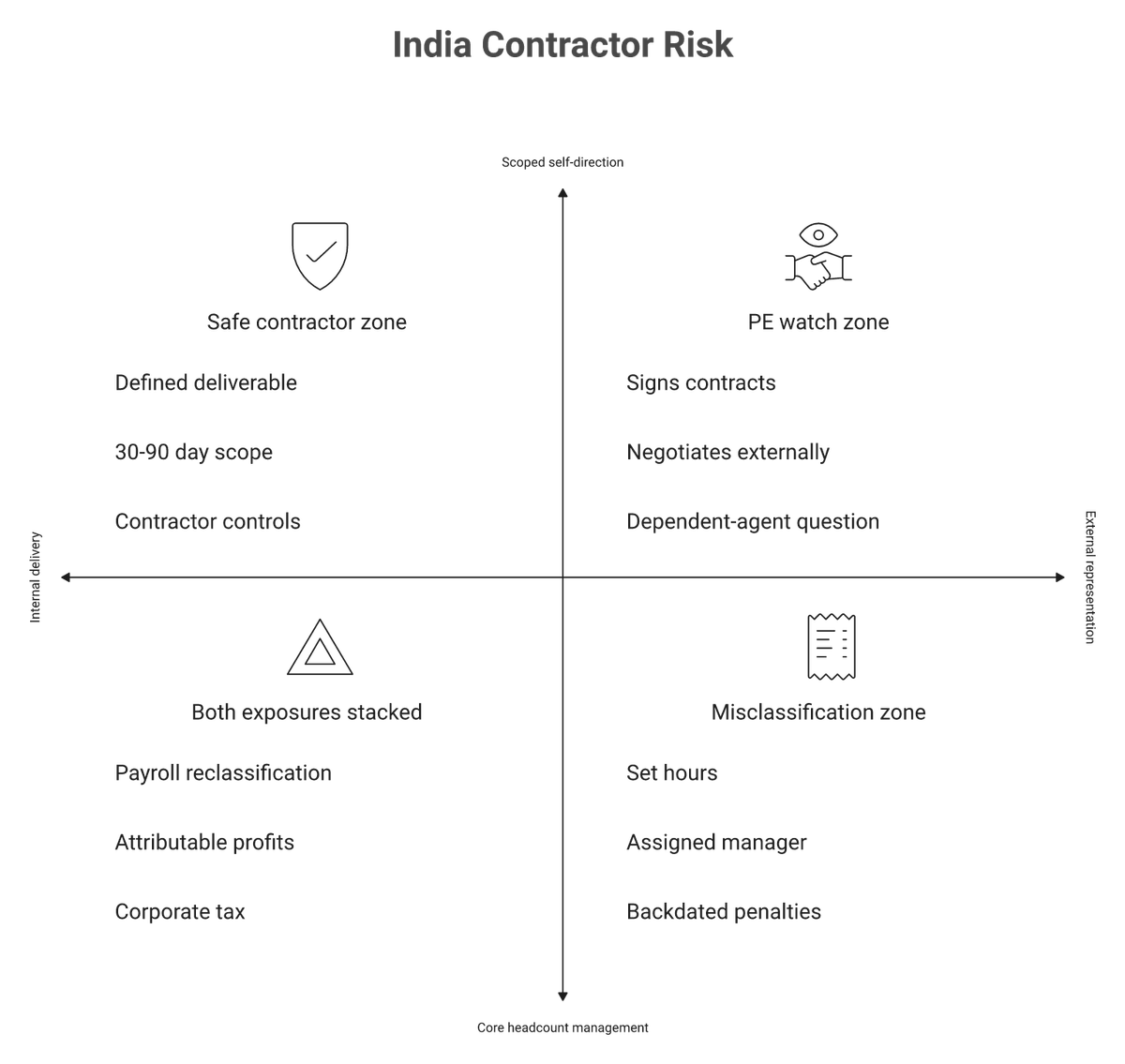
A contractor works for a 30 to 90 day scoped project, a non-core function, or a paid trial. It fails the moment you set hours, assign a manager, and treat the person as core headcount. Indian authorities look at substance, and reclassification brings backdated PF, ESI, and TDS with penalties, typically $25,000 to $40,000 per person. A contractor who negotiates or delivers on your behalf can also create dependent-agent permanent establishment, which puts Indian revenue in scope for Indian corporate tax.
😬 The audit moment, and how it usually arrives
The discovery almost never comes from a tax notice. It comes from your own first real HR hire.
She opens the India folder, finds four "consultants" on monthly invoices, sees that all four have your email domain, a manager, and a standup at 9.30am, and goes quiet. One EOR operator described exactly this pattern in an interview: HR arrives, works out that these people should really be employees, and the conversation turns to backdated taxes and fines. That is the whole risk in one sentence. The contractor to employee conversion guide for India covers the clean-up path.
🏠 The mortgage conversation that ends the debate
Here is the part founders never see coming. Contractor status in India costs you the person, not just the compliance.
The same operator described a relocating employee who wanted to stay a contractor, went to get a mortgage, and was declined. Once employed properly through an EOR, the mortgage was approved. I have had the Indian version of that conversation three times: a strong engineer, a home loan, a bank that wants Form 16 and PF history, and a counter-offer from a company that can provide both.
✅ The works-if and fails-if test
✅ Works if the scope has an end date, the deliverable is defined, and the person controls how and when they do it.
✅ Works if you are running a paid 30 to 90 day trial before committing to a full-time role.
❌ Fails if you set working hours, run performance reviews, or route them through your management chain.
❌ Fails if the role is core engineering or core ops that you intend to keep for years.
⚠️ Watch out if the contractor signs, negotiates, or delivers to customers in your name, because that is where dependent-agent permanent establishment starts.
Where the engagement is genuinely project-scoped, a Contractor of Record arrangement keeps the contracts, invoicing, and withholding in one place.
⚠️ Why PE risk is the expensive half
Misclassification is a payroll bill. Permanent establishment is a corporate tax question. If India concludes you have a business connection there through a fixed place or an agent acting on your behalf, attributable profits come into scope, and so does transfer pricing documentation. The Income-tax Act business connection provisions are the origin of that test.
Where my head is right now: most first-time India hires are nowhere near this line, and most companies at hire number eight are closer than they think. Compliance cost rises in small steps and then all at once. If you are already past that point, Agent of Record in India explains how the contractor layer gets formalised.
"local India compliance, FD setup, all of this is complicated to understand to hire a single person. Makes my life as a lean founder extremely easy."
— surbhi m., Founder, 5 stars, 15 June 2026, Versatile Club G2 - Verified Review
"The initial documentation and paperwork felt quite detailed and time-consuming at the beginning. However, as we progressed, it became clear that this thoroughness is what ensures proper legal and compliance coverage."
— Verified User in Marketing and Advertising, 3.5 stars, 12 February 2026, Wisemonk - G2 Verified Review
Versatile Club runs Contract-to-Hire as a product, not a loophole. The worker sits on our payroll from day one, with PF, ESI, and TDS under our own registrations, you evaluate on real work, and conversion to full-time is a contract amendment rather than a re-hire. The misclassification question gets removed rather than managed. How it works sets out that sequence step by step.
Q5. What does an India EOR actually do for you every month?
An EOR becomes the legal employer and runs the statutory machine: an Indian-law contract with IP assignment, monthly payroll, TDS deposited by the 7th, EPF and ESI returns by the 15th, state professional tax at varying frequencies, gratuity provisioning, POSH committee coverage, and annual Form 130 (replacing Form 16). You keep day-to-day direction of the work. The EOR carries the filing liability under its own registration numbers.
⏰ The month, by date
"We handle compliance" is a sentence anyone can write. A dated calendar is not. Here is the actual cycle for one India employee. The payroll compliance in India guide runs the same calendar across multiple employees.
| When | What gets filed | Authority |
|---|---|---|
| By the 7th | TDS deposited for the previous month | Income-tax Act 2025, Section 392 |
| By the 15th | EPF electronic challan return and contribution | Code on Social Security 2020, Chapter III |
| By the 15th | ESI contribution for covered employees | Employees' State Insurance Act |
| Monthly or biannual | State professional tax, frequency varies | State professional tax Acts |
| Quarterly | TDS statement on Form 138, replacing Form 24Q | Income-tax Act 2025 |
| Annual | Form 130, replacing Form 16, issued to the employee | Income-tax Act 2025 |
| On exit | Full and final settlement, two working days | Code on Wages 2019 |
Jargon check. TDS is payroll tax withholding. ECR is the monthly provident fund return. Form 130 is the new annual tax certificate your employee needs for a home loan.
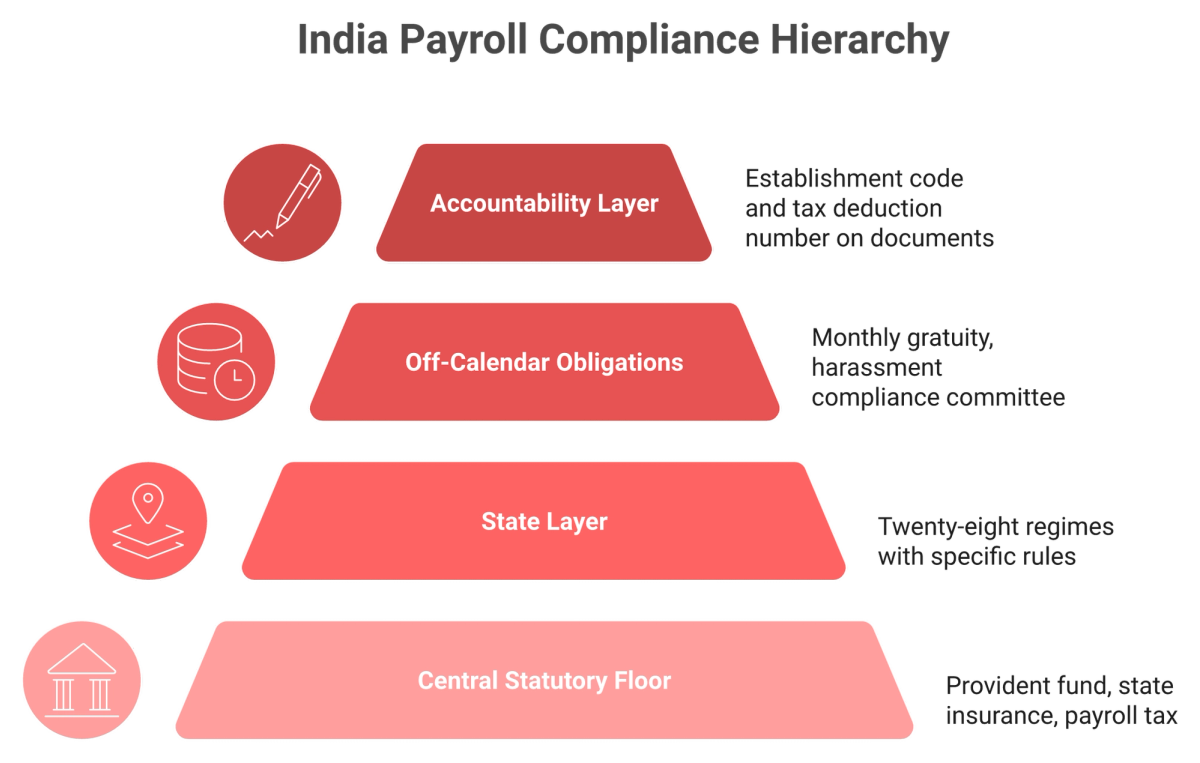
🗺️ Professional tax is not one tax, it is twenty-eight
This is where global playbooks thin out. Professional tax is a state levy, and every state runs it differently.
Maharashtra needs two registrations, PTRC for employees and PTEC for the entity, filed on a monthly slab.
Karnataka runs monthly professional tax alongside an annual Shops and Establishments renewal.
Tamil Nadu files twice a year, with a separate Labour Welfare Fund contribution.
Telangana requires PTRC enrolment before the first payslip.
Delhi has no professional tax at all, but the Shops and Establishments rules are enforced closely.
Versatile Club holds these registrations directly, which is why a hire in Pune and a hire in Bengaluru follow different filing calendars inside the same payroll run. I did not learn that from a compliance deck. I learned it from a late Maharashtra PTEC payment in our second year of Contract-to-Hire operations. City-level detail sits in the Bengaluru payroll outsourcing and Hyderabad payroll outsourcing breakdowns.
✅ The part that is not on any calendar
Two obligations sit outside the monthly rhythm and still belong to the employer. Gratuity accrues from day one, so it must be provisioned monthly even though it pays out years later. POSH requires an Internal Committee, and that applies to the legal employer, not to you in San Francisco.
Versatile Club provisions gratuity at the accrual rate each month rather than treating it as a future surprise. A CFO closing month-end should see that line in the pack, not discover it at exit. Our compliance coverage lists which statutes sit under our registrations.
⚠️ The question that reveals who actually files
Ask a provider for the PF establishment code and the TAN that will appear on your employee's documents. The TAN is the tax deduction account number on their Form 130.
If those numbers belong to a company you have never heard of, your hire is employed by a partner entity. That is not automatically bad, but it changes who you can escalate to in week one of a problem. If you are already mid-contract with one, the guide to switching EOR provider in India covers the handover mechanics.
Versatile Club files PF, ESI, TDS, and professional tax under our own registrations in every state we operate in. We are not a reseller or an aggregator, so when a filing slips there is no partner to chase. It is ours, and it lands on the same WhatsApp thread that day. The managed payroll service runs on the same registrations.
Q6. What changed in Indian employment law for 2025-26, and what does it change on your payroll?
Three changes move money. The Labour Codes force Basic plus DA to at least 50% of CTC, so where excluded components such as HRA and conveyance exceed half of remuneration, the excess is deemed wages and added back for PF, gratuity, and bonus. The EPFO wage ceiling rose from INR 15,000 to INR 25,000 on 17 September 2026, lifting minimum employer PF-side outgo per capped employee from INR 1,950 to INR 3,250 a month. The Income-tax Act 2025 moves withholding to Section 392, with Form 138 replacing Form 24Q and Form 130 replacing Form 16.
📊 What the 50% rule does to a real salary structure
The old trick was a low basic with a tall allowance stack. That reduced PF, gratuity, and bonus at the same time. It no longer works.
| Component | Old structure (INR 20 lakh CTC) | Post-Code structure |
|---|---|---|
| Basic plus DA | 6,00,000 (30%) | 10,00,000 (50%) |
| Allowances | 14,00,000 | 10,00,000 |
| Employer PF base | 6,00,000 | 10,00,000 (capped per employee at the wage ceiling) |
| Gratuity accrual base | 6,00,000 | 10,00,000 |
The Ministry of Labour and Employment FAQs on the Labour Codes set out the add-back mechanic directly. Versatile Club re-cut every open offer letter the week this landed. The alternative was clients finding a higher PF base in month three. Model the effect on your own band with the salary calculator.
💰 The ceiling arithmetic nobody updated
Most India hiring guides still quote the INR 15,000 provident fund ceiling. It moved to INR 25,000 on 17 September 2026, the first revision since 2014, under S.O. 5109(E) notified by the Ministry of Labour and Employment.
Minimum employer PF, EDLI, and admin outgo per capped employee: INR 1,950 rising to INR 3,250 a month.
That is about INR 15,600 a year extra per previously capped person.
Roughly 51 lakh more employees came into mandatory coverage.
If your cost model was built before September, it is wrong by that amount per head. The cost of hiring in India breakdown carries the revised arithmetic.
⚠️ The gratuity mismatch almost nobody models
Here is the one I think is genuinely under-discussed. The Code on Social Security 2020 computes gratuity on deemed wages, including the added-back allowances. The Income-tax Act exempts gratuity only up to a limit calculated on Basic plus DA.
So a payout of INR 13.85 lakh can leave about INR 3.85 lakh taxable, even though the INR 20 lakh ceiling was never breached. Versatile Club flags this in the exit workbook rather than at settlement. I could be reading the severity too strongly, since enforcement patterns are still forming, but the arithmetic itself is not in doubt.
✅ Your Monday morning checklist
Four actions, in order, for anyone with open India offers.
Restructure every unsigned offer so Basic plus DA reaches 50% of CTC.
Re-run employer cost at the INR 25,000 provident fund base.
Ask your provider whether quarterly statements go on Form 138 or legacy Form 24Q.
Update any policy document still citing the EPF Act 1952 or the Payment of Gratuity Act 1972, both now superseded.
Versatile Club configures payroll against the current notification number, not against last year's rate table. Ask us which one, and the answer is a gazette reference rather than a reassurance. The EOR services in India page sets out what that configuration covers.
Q7. Which India EOR should you pick, and what does each actually cost?
India EOR pricing splits three ways. Versatile Club charges $149 per employee per month flat, with no setup fee, no exit fee, a 5-day contractual onboarding SLA, and the first month free, employing through its own Indian entity. Wisemonk starts at $99 and scales to $399 by salary band. Deel and Remote sit near $599 with $299 to $500 setup fees and restricted state coverage. G-P charges roughly 15% of salary with a $1,500 monthly minimum. Most global platforms route India through a local partner entity.
💸 The comparison that matters, side by side
| Provider | Monthly fee | Setup fee | Exit fee | India entity model | Stated onboarding |
|---|---|---|---|---|---|
| Versatile Club | $149 flat | None | None | Owned Indian entity | 5 business days, contractual |
| Wisemonk | $99 to $399 by band | Not published | Not published | Owned Indian entity | 24 to 72 hours, not contractual |
| Deel | About $599 | $299 to $500 | Varies | Local partner entity | 7 to 14 days |
| Remote | About $599 | Not published | None stated | Partner-supported in India | 10 to 14 days |
| G-P | About 15% of salary, $1,500 minimum | Custom | Reported as substantial | Partner model | 5 to 10 days |
| Multiplier | About $400 | None | None | Hybrid | 24 to 72 hours |
Where you want the provider-by-provider long form, the best EOR in India review and the Wisemonk alternative page go deeper on each row.
❌ Where the headline fee stops being the real number
The fee is the part you can see. The cost is usually somewhere else.
Currency conversion spreads of 3% to 5% quietly re-price your whole model.
Security deposits of one to two months tie up cash you planned to spend on salary.
Benefits administration markups sit on top of the actual premium.
Exit charges appear when you are least able to negotiate.
"I find Deel to be absurdly expensive. They charge a high amount of fees for transferring money to my bank account."
— Juan Camilo O., Contractor, 1 star, 27 November 2025, Deel - G2 Verified Review
"I've noticed that their support/query responses can occasionally take a bit longer sometimes, likely due to a relatively small team."
— Verified User in Financial Services, 4 stars, 14 June 2025, Wisemonk - G2 Verified Review
"First USD invoice landed clean: no FX markup, no setup fee, no surprises."
— Verified User in Information Technology and Services, Founder, 5 stars, 23 June 2026, Versatile Club G2 - Verified Review
The employer of record India cost breakdown itemises each of those hidden lines against a sample invoice.
✅ Three questions that expose a stale payroll
Price comparisons are easy to game. These are not.
Which gazette notification is your PF ceiling currently configured against?
Are quarterly TDS statements filed on Form 138 or still on Form 24Q?
What is the CIN of the legal employer, so I can verify it on the MCA portal?
Versatile Club answers all three in writing during procurement. A provider that needs a week on question one is telling you the filing risk still sits with you.
⚠️ When Versatile Club is the wrong choice
This is the honest part. Versatile Club operates only in India, by design.
If you are hiring across five or more countries, buy a global platform and accept thinner India depth. If procurement requires SOC 2 Type II and ISO 27001 as a gate, Wisemonk carries both certifications and we do not. If your salaries sit at the low end of the band, Wisemonk's $99 entry price is genuinely cheaper than our flat fee. Buyers comparing the global options directly should read the Deel versus Remote for India analysis.
Versatile Club holds row one here on structure, not on sentiment: no setup fee, no exit fee, first month free, and a 5-day SLA written into the contract against an owned Indian entity. Everything else in that table is a trade you should make with your eyes open. How it works shows the onboarding sequence behind that SLA.
Q8. Should you set up a Private Limited entity in India instead?
Incorporate when you cross roughly 30 to 50 India employees, need intellectual property on your own balance sheet, or are committing to a Global Capability Centre. Expect 3 to 6 months to a functioning entity and 12 to 18 months to full GCC operations, with $750 to $1,500 in SPICe+ filing fees, $5,000 to $15,000 basic incorporation cost, and $15,000 to $100,000 or more all-in legal setup. Below that headcount, per-employee EOR fees stay cheaper than permanent compliance overhead.
🏗️ What incorporation permanently adds
The setup cost gets quoted often. The standing obligations rarely do. Once the entity exists, these never stop.
SPICe+ filing with the MCA, plus digital signature certificates for directors.
FC-GPR reporting under FEMA within 30 days of share allotment for foreign investment.
GSTIN registration where applicable, with monthly returns.
PTRC and PTEC registrations in every state you employ in.
Annual statutory audit, secretarial compliance, and board filings.
Corporate tax at 22% under Section 115BAA for companies opting into the concessional regime.
I have watched two founders treat incorporation as a one-time project. It is a standing function, closer to running payroll in six US states than to a single filing. The India expansion options comparison sets each structure beside the others.
💰 The breakeven, modelled
Here is the arithmetic, labelled as modelled rather than measured. Assume a flat $149 per employee per month and entity compliance overhead of $12,000 to $25,000 a year once running.
| India headcount | Annual EOR fees | Annual entity overhead | Which is cheaper |
|---|---|---|---|
| 10 | About $17,900 | $12,000 to $25,000 plus setup | EOR, clearly |
| 30 | About $53,600 | $12,000 to $25,000 plus setup | Close, depends on setup amortisation |
| 50 | About $89,400 | $12,000 to $25,000 | Entity, clearly |
The crossover usually lands between 25 and 40 heads. It arrives earlier if you need the entity for IP or contracting reasons anyway, and later if your team is spread across many states. Run it against your own numbers in the EOR vs Entity Calculator.
🗺️ The GCC question underneath this one
Most hiring guides treat the first hire as the end of the story. It is usually the start of a longer arc. India now hosts 2,117 Global Capability Centres across 3,728 units, generating about $98.4 billion in revenue, according to the Zinnov and NASSCOM GCC Landscape in India 2026 report.
If your end state is a 100-person India centre, the entity is not optional, only early or late. Versatile Club's read is that the standard advice gets the sequencing backwards: start on EOR and incorporate on evidence, rather than incorporating on ambition and hiring on hope. The GCC setup in India guide maps that arc in full.
✅ Design the handover before you need it
Whatever you choose now, make the next step a transfer and not a restart. Three things should move cleanly when you incorporate.
Employment records and signed contracts, novated to the new entity.
Provident fund accounts, so the employee keeps their UAN history and service continuity.
Gratuity provisioning, carried over rather than reset to zero.
Versatile Club charges no exit fee, which is the point of this section. When your headcount makes an entity the cheaper structure, we transfer records, PF accounts, and gratuity provisioning across and stop invoicing. A provider with an exit charge has a financial reason to tell you the threshold is higher than it really is. Talk to us about where your headcount actually sits.
Q9. What has to be registered and verified before your first India payroll runs?
Before the first payslip you need PAN, Aadhaar linkage, a UAN with EPF Form 11, ESIC Form 1 where the employee is within the wage ceiling, state professional tax enrolment, a signed Indian-law contract with IP assignment, and a bank mandate. Background verification must be preceded by written consent under the DPDP Rules 2025, which phase in to full obligations by 13 May 2027. Verification matters here: nearly 30% of Indian IT-sector resumes contain discrepancies, and UAN history is the fastest cross-check against employment inflation.
📋 The checklist, with owners and deadlines
Here is the actual sequence. Jargon first: PAN is the tax identity number, UAN is the universal account number that follows an employee's provident fund across jobs, and ESIC is the state health insurance body.
| Step | What it is | Who owns it | When |
|---|---|---|---|
| 1 | PAN and Aadhaar details collected and linked | Employee, verified by employer | Before contract |
| 2 | Indian-law employment contract with IP assignment | Legal employer | Before start date |
| 3 | EPF Form 11 and UAN generation or transfer | Legal employer | Within first month |
| 4 | ESIC Form 1, where monthly wages are INR 21,000 or below | Legal employer | Within 10 days of joining |
| 5 | State professional tax enrolment | Legal employer | Before first payslip |
| 6 | Bank mandate and payroll setup | Employee and employer | Before cutoff |
Versatile Club completes this inside the 5-day onboarding SLA because the registrations already exist. The Contract-to-Hire business built that state-level compliance muscle before the EOR product launched, so new clients are not waiting on us to register anything. The how it works page sets out that sequence day by day.
⚠️ The DPDP consent step people skip
Background verification touches personal data. Under the DPDP Rules 2025, notified on 14 November 2025, that needs a clear consent notice first.
The notice must state what data you collect, why, and how the person withdraws consent.
A contact point for data queries must be named in the offer pack.
Breaches are reportable to the Data Protection Board, with a 72-hour window for details.
Penalties for security failures run to INR 250 crore, with full obligations due by 13 May 2027, per the Ministry of Electronics and Information Technology announcement.
Versatile Club captures written consent before any check runs, not alongside it. Order matters legally, and it is a two-minute change to your offer template. Our compliance coverage lists the statutes that sit behind the onboarding pack.
✅ Why UAN history beats a document check
This is my favourite verification trick, and it costs nothing. Documents can be purchased. Provident fund contribution records cannot.
A UAN shows every employer who has contributed, with dates. If a candidate claims three years somewhere and the UAN shows seven months, you have your answer before the reference call. In Versatile Club's placements across Bengaluru, Hyderabad, and Pune, that single cross-check catches more inflation than education verification does. Where sourcing is also in scope, our recruitment service runs the same verification order.
"I find the pricing of Deel to be quite terrible for me. The initial setup process was also very challenging; it took several days and involved a lot of emails, with issues arising at every step."
— Verified User in Translation and Localization, Contractor, 0.5 stars, 31 July 2025, Deel - G2 Verified Review
"Their team was highly responsive, professional, and easy to work with throughout the process. Communication was always clear, and the team was proactive in addressing questions."
— Mukul S., Hiring Lead, 5 stars, 16 June 2026, Versatile Club G2 - Verified Review
Versatile Club runs this checklist under its own PF establishment code, ESIC number, and state professional tax registrations. There is no partner handoff in the middle, which is why the consent notice, the UAN check, and the first payslip all sit on one timeline. The EOR services in India page documents what sits under those registrations.
Q10. How fast can you realistically get your first India hire productive?
Paperwork is not the constraint. A contractor can be live in 24 to 48 hours, an EOR contract in 48 hours to 5 days, and an entity in 3 to 6 months. Indian notice periods run 30 to 90 days, so an offer signed in week one usually means a start date in month two or three. Global platforms add 7 to 14 days of contract turnaround on top, which is why an onboarding SLA belongs in the contract rather than the pitch deck.
⏰ The timeline, week by week
Most founders plan backwards from a board date and forget one line. Here is the honest version for a first EOR hire.
| Stage | Realistic duration |
|---|---|
| Search and interviews | 2 to 5 weeks |
| Offer, negotiation, and acceptance | 3 to 7 days |
| EOR contract and onboarding | 5 business days with Versatile Club, 7 to 14 days on global platforms |
| Candidate notice period | 30 to 90 days |
| First payroll cycle | Next monthly cutoff |
| Fully productive | Add 2 to 4 weeks after start |
Versatile Club's 5-day SLA sits in the agreement you sign. On hire number one, that matters less than it sounds, because the notice period dominates everything. If speed is the whole requirement, Contract-to-Hire starts the clock before the structure decision is settled.
❌ Where vendor timelines quietly stop counting
Provider marketing measures from "documents received" to "contract issued." Your calendar measures from "we decided to hire" to "code is shipping." Those are different numbers.
Two things eat the gap. Counter-offers are normal in Indian tech, so a candidate may renegotiate during notice. Document collection stalls when a candidate is mid-exit at a slow employer. Buyers benchmarking the global options on turnaround should read the Deel alternative and Remote alternative breakdowns.
"The team is really competent, but there were a few time zone misunderstandings that caused slight delays in the initial phase. That said, once things got going, the whole process was buttery smooth."
— Setu C., Operations Lead, 5 stars, 10 June 2026, Versatile Club G2 - Verified Review
"Sometimes the email communication from the wisemonk team is delayed by a day or 2. But overall they seem to be the best for India."
— Bulbul G., Employee, 4 stars, 19 February 2025, Wisemonk - G2 Verified Review
"They consistently failed to meet committed deadlines, had terrible communication, and frequently cancelled meetings at the last minute."
— Verified User in Computer Software, Founder, 0 stars, 13 December 2025, Deel - G2 Verified Review
✅ What to do with this on Monday
Three moves compress the timeline more than any provider choice.
Start the search before the structure decision is final, since EOR onboarding is days and search is weeks.
Ask for the contractual SLA in writing, not the marketing number.
Collect PAN, UAN, and bank details during notice rather than after the start date.
Versatile Club's read is that speed claims only matter at hire six and beyond. By then you are competing with a second offer, and the company that produces a contract first usually wins. I have watched that decide two placements this year.
Versatile Club writes the 5 business day onboarding commitment into the client agreement rather than publishing it as a brochure range. A non-contractual "24 to 72 hours" and a contractual five days are different promises, and only one of them has a remedy attached. Teams at seed to Series B feel that difference first.
Q11. How do you keep an India hire, and what happens when one leaves?
India has no at-will employment. Termination needs contractual notice or pay in lieu, and where retrenchment provisions apply the employee is owed compensation plus statutory notice, with government approval required above certain establishment thresholds. Full and final settlement is due within two working days of the last working day under the Labour Codes, which is a payroll process change most guides still state wrongly. Retention is cheaper: a paid mini-project before commitment, written recaps after verbal decisions, and a structured first 90 days with a named owner.
😕 The hire who cleared verification and still left
The failure I see most often is not a bad hire. It is a good hire placed into no onboarding at all.
Month one is enthusiastic. Month three is quiet. Month four brings a resignation and a counter-offer story. Nothing in the compliance stack catches this, because compliance is the floor, not the ceiling.
✅ Four tactics that actually hold
Each of these is cheap, and each one addresses a specific failure mode.
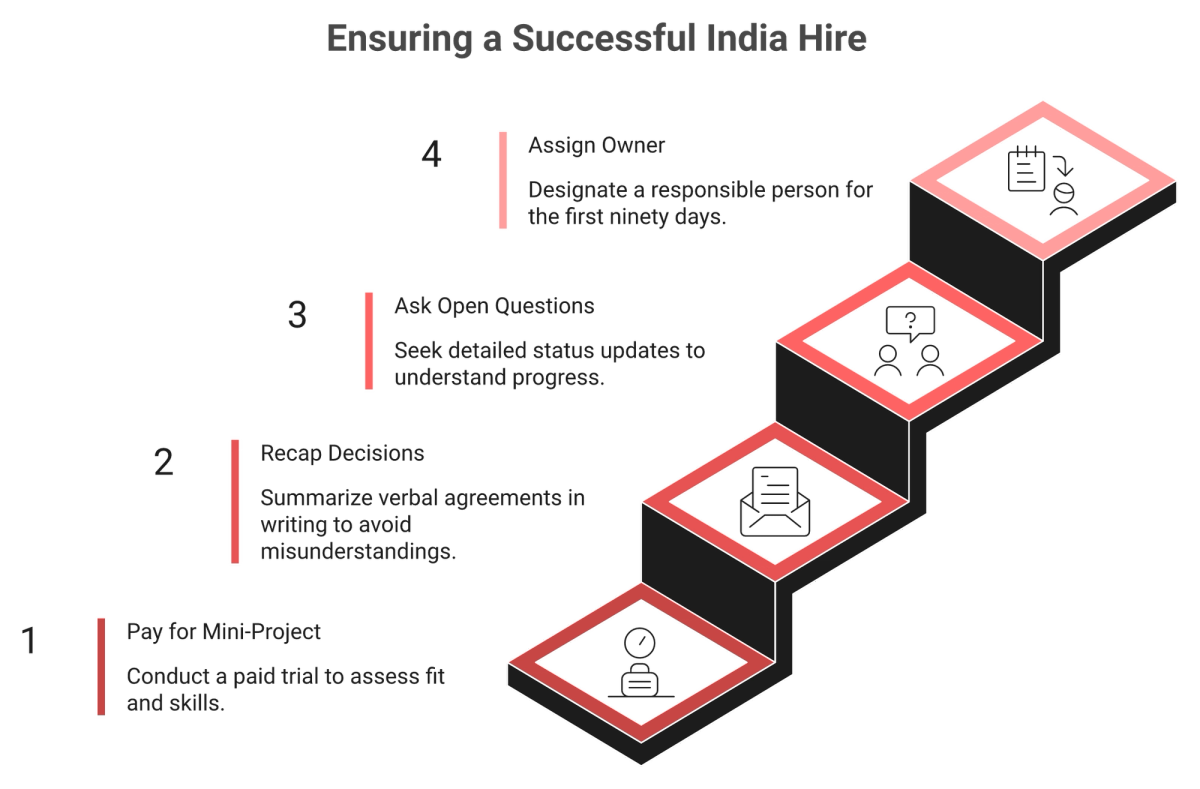
Run a paid one to two week mini-project before committing, usually around $1,500. Nobody should work for free, and nothing reveals fit faster than real work.
Recap every verbal decision in email within the hour. Across cultures, agreement in a call often means "I heard you," not "I agree."
Ask open status questions. "Where are we on the schedule?" surfaces far more than "Are you on track?"
Give the first 90 days a named owner, with weekly checkpoints and a written 30, 60, 90 expectation.
Versatile Club screens on 50 behavioural parameters before any technical round, and assigns a 90-day Success Coach to each placement. Culture fit gets measured rather than sensed. The culture fit quiz shows the shape of those parameters.
💰 Exit mechanics, by the numbers
When someone does leave, the clock is short and the arithmetic is fixed.
| Item | Rule |
|---|---|
| Notice period | As per contract, commonly 30 to 90 days, or pay in lieu |
| Retrenchment compensation | Where applicable, plus statutory notice, under the Industrial Relations Code 2020 |
| Full and final settlement | Within two working days of last working day, under the Code on Wages 2019 |
| Gratuity | Payable after five years of continuous service |
| Form 130 | Issued for the part-year of employment, per the Income-tax Act 2025 |
Versatile Club runs the settlement inside that two-day window because the payroll, the provident fund account, and the gratuity provision all sit under our own registrations. There is no partner to wait on. Paying employees in India covers the settlement run in more detail.
"WiseMonk is one of the primary reason I chose to stay with the company that I got offer from rather than jumping around for counter offers because of the friendly and informative approach."
— Verified User in Financial Services, Employee, 4 stars, 16 June 2025, Wisemonk - G2 Verified Review
"For us, it was important to hire people who understood both craft and pace and Versatile made that process feel much simpler."
— Ibrahim A., Design Hiring Manager, 4.5 stars, 16 June 2026, Versatile Club G2 - Verified Review
"I appreciated how personal the process felt, and the team took the time to understand me and my background."
— Verified User, Candidate, 5 stars, 24 June 2026, Versatile Club G2 - Verified Review
Versatile Club carries a 6-month replacement guarantee on Contract-to-Hire placements. That changes our incentives, not just yours: place for speed over fit, and we pay for the re-hire. The HR consulting services page covers the onboarding layer that sits around it.
Q12. How should you sequence C2H, EOR, and entity from 1 to 50 hires?
Treat the pathways as stages, not alternatives. Months 0 to 3: contractor or Contract-to-Hire to validate the role and the person. Months 3 to 24: EOR for 1 to 30 full-time employees, removing misclassification and permanent establishment risk without entity overhead. Month 24, or 30-plus employees: incorporate. India now hosts 2,117 Global Capability Centres across 3,728 units generating about $98.4 billion, so design each stage so the next one is a transfer of records rather than a restart.
🪜 The ladder, and what actually triggers each rung
Founders usually assume headcount triggers the move. In practice, three other things trigger it first.
| Stage | Typical window | Real trigger to move up |
|---|---|---|
| Contractor or C2H | Months 0 to 3 | The role becomes core and managed |
| EOR | Months 3 to 24 | Headcount passes roughly 25 to 40 |
| Own entity or GCC | Month 24 onward | IP, contracting, or local revenue needs |
Versatile Club runs all three rungs: Contract-to-Hire placement, Employer of Record under our own Indian entity, and the records handover when you incorporate. The sequence is the product, not any single rung. The EOR versus GCC in India comparison sets out the end state.
⚠️ What I got wrong, once
Early on I pushed a client toward an entity at 22 people because the fee maths looked favourable. It was the wrong call.
They spent four months on incorporation, FC-GPR filing, and state registrations while hiring stalled. The fee saving was real. The hiring pause cost more. Versatile Club's data points toward waiting for a non-financial trigger before incorporating, though with one sample like that I hold the view loosely. The captive centre setup guide shows what that four-month window actually contains.
🔭 Where this goes next
My honest prediction for the next two years is narrow specialisation. India stops being one country on a 150-country map and becomes its own category, where owned-entity operators take the India line from global generalists.
The GCC numbers point the same way. Growth of 32% in GCC units since FY2021, reported in the Zinnov and NASSCOM GCC Landscape in India 2026, means more companies are ending up at the entity stage, not fewer. That makes the quality of the handover more important than the price of the monthly fee. Larger India teams should start at the enterprise page instead.
"The process was straightforward, the Support team was easy to work with, and the candidates' quality met our expectations. The initial process took a little getting used to, but the team was quick to guide us through."
— Verified User in Venture Capital and Private Equity, Investor, 4.5 stars, 22 June 2026, Versatile Club G2 - Verified Review
"If you need to hire in India and want an India EOR that actually responds to emails, this is the one. We're already lining up our second hire through them."
— Verified User in Information Technology and Services, Founder, 5 stars, 23 June 2026, Versatile Club G2 - Verified Review
✅ Start where the evidence is, not where the ambition is
If you are at zero India hires, start with one. Validate the role, then decide the structure. If you are at twelve, model the entity now and move when a non-financial trigger appears.
Versatile Club keeps Sagar Chainani on WhatsApp for client communication rather than a CSM rotation or a ticket queue. That is sustainable at our current scale and will eventually have to change, which is an honest reason to have the conversation now rather than later. Tell me what you are building in India, and I will tell you which rung you actually need. Pick a time and bring your headcount plan.
FAQs
Can a foreign company hire employees in India without setting up an entity?
Yes. A foreign company can employ people in India without a local entity by appointing an Employer of Record, which becomes the legal employer on paper while you keep day-to-day direction of the work.
The EOR carries the parts you cannot hold without an Indian presence:
- An Indian-law employment contract, including the IP assignment clause that moves work product to you
- EPF and ESI registrations, plus monthly returns under its own establishment code
- Tax deducted at source, deposited by the 7th of the following month
- State professional tax enrolment and filing in every state where you employ
The second route without an entity is a genuine independent contractor engagement, which works for scoped project work and fails for core managed roles. What you cannot do is pay an Indian worker directly from your US or UK payroll, because a foreign company with no Indian presence cannot hold the registrations required to withhold and deposit tax.
Versatile Club employs India hires through its own registered Indian entity rather than a partner shell, which is why the consent notice, the UAN check, and the first payslip all sit on one timeline. We explain the full mechanism in our guide to hiring in India without an entity.
What does an employee in India actually cost after statutory contributions?
Budget roughly 13% to 18% above gross salary. Published guides quote anywhere from 8.1% to 25%, usually because some apply provident fund to gross instead of to wages, and others fold private insurance into a statutory table where it does not belong.
The employer stack breaks down as follows:
- EPF: 12% of wages, capped at INR 25,000 monthly wages since 17 September 2026
- EDLI: 0.50% on the same wage base
- PF administration: 0.50% on the same wage base
- ESI: 3.25% of gross, where monthly wages are INR 21,000 or below
- Gratuity: accrual of about 4.81% of wages, provisioned monthly
- Professional tax: state-specific, capped at INR 2,500 a year
The September 2026 ceiling change matters. Minimum employer PF-side outgo per capped employee moved from INR 1,950 to INR 3,250 a month, which is about INR 15,600 extra a year per previously capped person.
Health insurance, equipment, bonus, and the provider fee sit outside that stack. Versatile Club invoices in USD directly from its Indian entity, so no conversion spread sits between the quoted figure and the amount leaving your account. Our full model lives in the cost of hiring in India breakdown.
When does hiring an Indian contractor become misclassification or permanent establishment risk?
A contractor arrangement holds when the scope has an end date, the deliverable is defined, and the person controls how and when they work. It breaks the moment you set working hours, assign a manager, run performance reviews, and treat the person as core headcount.
Two separate exposures follow:
- Misclassification: Indian authorities look at substance, not the contract label. Reclassification brings backdated EPF, ESI, and TDS with penalties, commonly $25,000 to $40,000 per person.
- Permanent establishment: a contractor who signs, negotiates, or delivers to customers in your name can create dependent-agent PE, pulling attributable profits into Indian corporate tax and triggering transfer pricing documentation.
There is a quieter cost too. Contractors in India struggle to get mortgages and home loans because banks want Form 16 history and provident fund records, so your strongest engineer eventually takes a salaried counter-offer.
Versatile Club runs Contract-to-Hire with the worker on its own payroll from day one, with EPF, ESI, and TDS under its own registrations, so conversion to full-time is a contract amendment rather than a re-hire. If you already have people on invoices, start with our guide to converting a contractor to an employee in India.
How has the 50% wage rule changed salary structures and payroll in India?
Under the Labour Codes, wages means Basic pay, dearness allowance, and retaining allowance. Where excluded components such as HRA, conveyance, and overtime exceed half of total remuneration, the excess is deemed wages and added back for provident fund, gratuity, and bonus.
In practice, that means Basic plus DA has to reach at least 50% of CTC. On a INR 20 lakh package, a structure that used to run a INR 6,00,000 Basic now runs INR 10,00,000, which lifts both the provident fund and the gratuity accrual base.
Three payroll consequences follow:
- The old trick of a low basic with a tall allowance stack no longer reduces statutory liability
- Gratuity is computed on deemed wages, while the tax exemption is capped on Basic plus DA, so part of a payout can become taxable even below the INR 20 lakh ceiling
- Quarterly withholding statements move to Form 138, and the annual certificate becomes Form 130 in place of Form 16
Versatile Club re-cut every open offer letter the week the rule landed, because the alternative was clients discovering a higher provident fund base in month three. Our payroll compliance in India guide walks the monthly filing calendar that sits behind it.
When should we move from an India EOR to our own Private Limited entity?
The crossover usually lands between 25 and 40 India employees. Below that, per-employee EOR fees stay cheaper than permanent compliance overhead. Above it, the fixed cost of running a subsidiary wins.
Incorporation takes 3 to 6 months to a functioning entity and 12 to 18 months to full Global Capability Centre operations, with $750 to $1,500 in SPICe+ filing fees, $5,000 to $15,000 in basic incorporation cost, and $15,000 to $100,000 or more all-in once legal and advisory work is counted.
What rarely gets quoted is the standing overhead that never stops:
- FC-GPR reporting under FEMA within 30 days of share allotment
- GSTIN registration and monthly returns where applicable
- PTRC and PTEC registrations in every state you employ in
- Annual statutory audit, secretarial compliance, and board filings
Headcount is often not the real trigger. Intellectual property on your own balance sheet, local contracting, or Indian revenue usually force the decision first.
Versatile Club charges no exit fee and transfers employment records, provident fund accounts, and gratuity provisioning when you incorporate. Run the arithmetic for your own team using our EOR versus entity in India comparison.