Table of contents (9)
How to Set Up a Captive Center in India: A 90-Day to 12-Month Decision Framework Across Models, Cities, Costs, and Compliance
Q1. Should you set up a captive center in India, or start on EOR and convert later?
Start on an Employer of Record (a company that legally employs your India staff on its own books) if you are under 30 India employees and still validating. Incorporate a Private Limited subsidiary once you cross 30 to 50 heads, or when you need direct IP ownership. Versatile Club employs India hires on its own registered entity, Foo Falcon Technologies Pvt Ltd, under a five business day onboarding SLA written into the contract, with no setup fee and no exit fee.
⚠️ The sequence most companies get backwards
The old path was serial. You spent $15,000 to $100,000 on legal and corporate structuring, waited three to six months for incorporation, bank account, and registrations, then started recruiting.
By month seven, your hiring plan was stale and your best candidate had taken a counter offer. The entity existed. The team did not.
⏰ What changed in the last two years
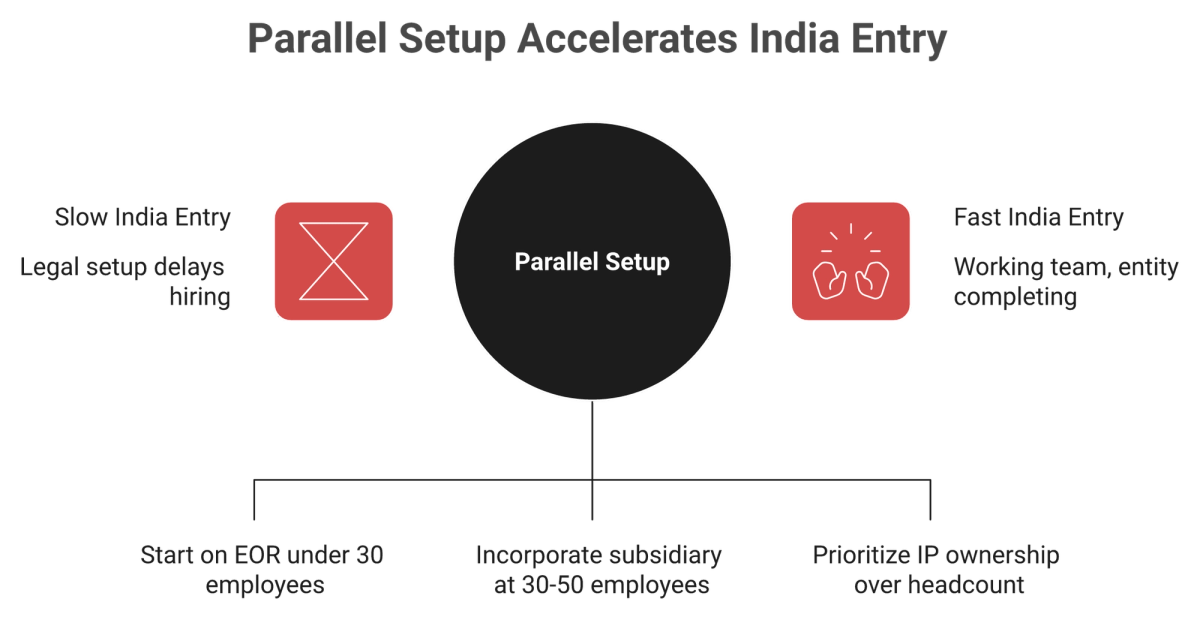
Two things shifted. EORs that own their Indian entity became common, so the employment layer no longer waits for your incorporation. And the 2025 to 2026 Labour Codes plus the EPF wage ceiling revision of 17 September 2026 made statutory cost modelling harder to guess at from a spreadsheet.
That second point matters more than it sounds. You now want real payroll data before you commit capital to an entity.
📊 The headcount thresholds I actually use
| India headcount | Recommended path | Why it breaks otherwise |
| 1 to 10 | EOR only | Entity overhead exceeds payroll value |
| 10 to 30 | EOR, entity planning in parallel | Incorporation runs without blocking hiring |
| 30 to 50 | Incorporate, run both briefly | Per head EOR fees start to exceed compliance cost |
| 50+ | Wholly owned subsidiary | IP ownership and safe harbour election matter |
If you want to pressure test those thresholds against your own numbers, the EOR versus entity calculator runs the same comparison line by line.
💬 What buyers report
"We looked at setting up a subsidiary and quickly realized it would take 6+ months, cost tens of thousands in legal and registration fees, and require ongoing compliance work we had no expertise in. Sagar replied to our form in about four hours with a draft offer letter already attached. The hire was onboarded in four days."
— Verified User in Information Technology and Services, Founder, Versatile Club G2 - Verified Review, 23 June 2026
"The initial documentation and paperwork felt quite detailed and time-consuming at the beginning. However, as we progressed, it became clear that this thoroughness is what ensures proper legal and compliance coverage."
— Verified User in Marketing and Advertising, Buyer, Wisemonk - G2 Verified Review, 12 February 2026
✅ Where my own read differs from the standard advice
Most guides treat the subsidiary as the goal and the EOR as a compromise. Versatile Club's experience across six years of Contract to Hire placements in Bengaluru, Hyderabad, and Pune points the other way. The entity is a financing decision, and financing decisions improve with data.
I could be reading that too strongly for companies with heavy IP concentration in India. If your core product gets built there from day one, incorporate earlier.
Versatile Club employs on Foo Falcon Technologies Pvt Ltd, not a partner shell. Conversion to your own subsidiary becomes a documented novation of employment contracts, with service continuity preserved for gratuity, rather than a renegotiation with a local vendor you never met.
Q2. What are the captive operating models, and which one fits your headcount?
Six models exist. EOR based offshore development centre (live in days, per employee monthly fee). Virtual captive, where a vendor runs a dedicated team on its payroll. Build Operate Transfer, or BOT, at 12 to 24 months before legal transfer. Wholly owned Private Limited, with SPICe+ incorporation in two to four weeks and operational readiness in three to six months. A GIFT City Global In-house Centre under the IFSCA Regulations 2020, carrying a ten year tax holiday. And a full enterprise captive at 12 to 18 months and $500,000 to $3 million.
📋 The six models, side by side
| Model | Time to first output | Year one cost | Fits when | Breaks when |
| EOR based ODC (Versatile Club) | 5 business days, contractual | Per employee monthly, no setup or exit fee | 1 to 30 heads, validating | You need 5+ countries |
| Virtual captive | 4 to 8 weeks | Vendor margin on salary | Fixed scope, short horizon | You want direct management |
| BOT | 12 to 24 months to transfer | Roughly $0.3M to $1M | 50+ heads, committed | Transfer valuation unresolved |
| Wholly owned Pvt Ltd | 3 to 6 months | $5,000 to $100,000+ setup | IP ownership needed | Below 30 heads |
| GIFT City GIC | 4 to 8 months | Entity plus IFSCA compliance | Financial services mandate | Talent sits in Bengaluru |
| Full enterprise captive | 12 to 18 months | $500K to $3M | 150+ heads | Headcount plan is a guess |
The trade offs between these routes are unpacked further in our breakdown of EOR versus GCC in India.
🧩 The nano captive pattern nobody plans for
Most model comparisons assume you are building for 500 people. Very few companies are. Between 50 and 150 heads, the pattern that works is senior heavy, orchestration focused, and asset light: no owned real estate, managed seats instead, and leadership hired before individual contributors.
Everest Group and Nasscom framed the 2026 shift as orchestration replacing delivery. In practice that means your captive's value comes from coordinating work, not absorbing ticket volume.
❌ Where each model quietly fails
- BOT fails on exit, not entry. The transfer price gets negotiated years after you sign, usually from a weak position.
- Virtual captive fails on attrition, because the engineers are the vendor's employees and the vendor's retention problem.
- GIFT City fails on geography. The tax holiday is real, but the talent you want is often not in Gandhinagar.
- A wholly owned Pvt Ltd below 30 heads fails on arithmetic. Statutory audit, company secretary, and transfer pricing documentation cost more than the fees you avoided.
⚠️ One term to stop using
PEO, meaning professional employer organisation co employment, does not exist under Indian labour law. There is no legal co employment structure in India. The employer is one legal entity, which is either your subsidiary or the EOR's entity. We cover why in detail in our guide to PEO services in India.
I see this term in RFPs weekly. It creates procurement confusion that costs real weeks.
Versatile Club occupies row one of that table deliberately. It is the only model listed that produces output before the entity exists, with filings for provident fund, employee state insurance, and professional tax running under Versatile Club's own registrations, plus no setup fee, no exit fee, and the first month free.
Q3. What does the 90-day to 12-month setup roadmap look like, deadline by deadline?
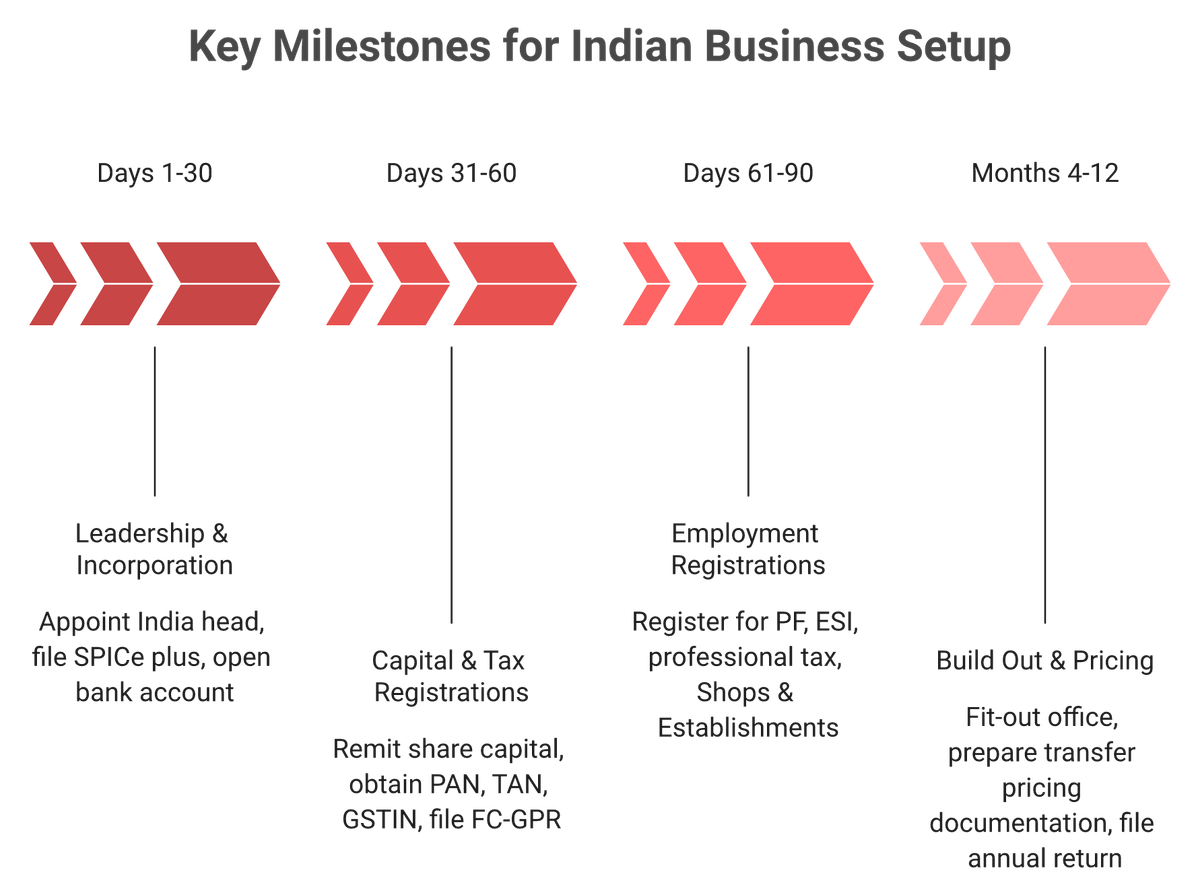
IT, ITeS, R&D, and most business services permit 100% foreign ownership under the automatic route, with no prior government approval. Days 1 to 30: appoint the India head, file SPICe+ with digital signature certificates, open the authorised dealer bank account. Days 31 to 60: remit capital, file Form FC-GPR within 30 days of share allotment, obtain PAN, TAN, and GSTIN. Days 61 to 90: register for provident fund, employee state insurance, professional tax, and Shops and Establishments before the first hire. INC-20A follows within 180 days.
🗓️ Phase one, days 1 to 30
- Hire the India head first. Governance, bank signatory authority, and HQ alignment all route through that role.
- Reserve the name and file SPICe+, the Ministry of Corporate Affairs integrated incorporation form. Two to four weeks is normal.
- Open the bank account with an authorised dealer bank, meaning a bank permitted to handle foreign exchange. This is the real bottleneck, not incorporation.
⏰ Phase two, days 31 to 60
- Remit share capital from the parent.
- File Form FC-GPR on the RBI FIRMS portal within 30 days of allotting shares. Miss it and you are in compounding territory under FEMA.
- Obtain PAN and TAN for tax, then GSTIN for goods and services tax.
✅ Phase three, days 61 to 90
- Register under the Employees' Provident Funds Act and the Employees' State Insurance Act.
- Register for professional tax in your state, and under that state's Shops and Establishments Act. Karnataka runs a monthly professional tax cycle. Maharashtra needs two registrations, PTRC and PTEC. Tamil Nadu files twice a year.
- File INC-20A, the declaration that the company has received its subscription money, within 180 days.
- Appoint the statutory auditor and file ADT-1.
The state by state detail behind step 8 sits in our reference on payroll compliance in India.
💰 Months 4 to 12
- Complete fit-out or sign managed seats.
- Prepare transfer pricing documentation before the first intercompany invoice, not after.
- File the annual Foreign Liabilities and Assets return by 15 July, as required on the RBI FIRMS portal.
⚠️ Why I call this a dual clock
Setup guides give you decision gates. Compliance calendars give you deadlines. Nobody overlays them, so teams discover the FC-GPR window after the capital has already landed.
Run both clocks on one sheet. Your decision gates are 90 day, six month, and 12 month. Your filing clocks are 30 day, 60 day, 180 day, and annual. The mismatch is where penalties live.
🧾 The two mistakes I see most
First, recruiting before the bank account clears, then having nowhere to pay salaries from. Second, treating transfer pricing as a year end accounting task when it is a day one pricing decision.
Versatile Club's clients run these clocks in parallel rather than in series. Engineers onboard on Versatile Club's Indian entity in week one while incorporation proceeds, with provident fund, employee state insurance, and TDS deposited by the 7th each month under Versatile Club's own compliance registrations, so month six arrives with a working team instead of a dormant company.
Q4. What does a captive center in India actually cost in year one?
Year one runs $750 to $1,500 in SPICe+ government and filing fees, $5,000 to $15,000 for basic entity formation, and up to $100,000 or more with cross border structuring and transfer pricing work. Add fit-out or managed seat costs, then salaries and statutory loading. A full captive with 50 or more heads lands between $500,000 and $3 million. Against that, a senior engineer costs roughly $58,000 all in in Bengaluru versus about $220,000 in San Francisco.
💰 The one time costs
| Line item | Year one range |
| SPICe+ government and filing fees | $750 to $1,500 |
| Basic entity formation (legal) | $5,000 to $15,000 |
| Complex cross border structuring plus transfer pricing | $15,000 to $100,000+ |
| Managed seat or fit-out, per seat per month | Varies by city tier |
| Full captive, 50+ heads, real estate and IT | $500,000 to $3,000,000 |
For the comparison against a people only model, see our analysis of the cost of hiring in India.
⚠️ The statutory loading line that just changed
This is where most cost models are now wrong. The EPF statutory wage ceiling rose from ₹15,000 to ₹25,000 effective 17 September 2026. Employer provident fund pension share moved to ₹2,083 and employer provident fund to ₹917 per covered employee, with EDLI and administration charges at ₹125 each, per the EPFO computation guidance.
The Labour Codes also require basic pay plus dearness allowance to be at least 50% of total cost to company. That lifts provident fund and gratuity bases together. Gratuity accrues at 4.81% of basic plus DA.
📉 The recurring stack
- Employer provident fund: 12% of basic plus DA, now against a ₹25,000 ceiling.
- Employee state insurance: 3.25% employer, 0.75% employee, for wages under the threshold, per ESIC.
- Gratuity accrual: 4.81% monthly.
- Corporate tax: 22% under Section 115BAA for eligible domestic companies, against the standard 30%, per the Income Tax Department.
- Secretarial, audit, and transfer pricing compliance, every year, regardless of headcount.
💬 What buyers report about invoicing
"Versatile's Employer of Record India service made this seamless contracts, PF, ESI, TDS, and payroll all handled in one place. Invoicing in USD meant zero exchange rate surprises."
— Vedant T., Founder, Versatile Club G2 - Verified Review, 16 June 2026
"I find Deel to be absurdly expensive. They charge a high amount of fees for transferring money to my bank account."
— Juan Camilo O., Contractor, Deel - G2 Verified Review, 27 November 2025
✅ How I would model it on Monday
Build two columns. Column one, captive: one time setup, annual compliance, salaries at the new statutory loading, plus seat cost. Column two, EOR: salaries plus a flat per employee fee, no setup, no exit. Our pricing page shows exactly what sits in that second column.
Cross over usually lands between 30 and 50 heads. Below that, the compliance overhead rarely pays for itself.
Versatile Club invoices in USD from a single Indian entity, with no FX markup, no setup fee, and no exit fee. One reviewer at a lean agency cited zero exchange rate surprises, which is the contrast against the 3% to 5% conversion markups buyers report on global platforms, including the fee behaviour documented on Deel's own pricing page.
Q5. Which Indian city should your captive center be in?
India now hosts 2,117 Global Capability Centres across 3,728 centres, employing 2.36 million professionals and generating USD 98.4 billion in revenue. Bengaluru holds roughly a third of them and about 37% of GCC talent, which makes it the default for specialised engineering and leadership hiring. Tier 2 cities, including Pune, Coimbatore, Jaipur, Vadodara, Mysuru, and Indore, run 20% to 40% cheaper on real estate and operations, with lower attrition. Tier 2 breaks down when you need rare AI research or chip design talent, per the Zinnov and Nasscom India GCC Landscape.
💰 The pain: you are picking a city off a cost sheet
Most city decisions I see start with a rent comparison. Rent is maybe 15% of your per head cost. Salary, attrition, and notice period behaviour are the other 85%.
That gap is where budgets break. A Tier 2 saving of 30% on rent disappears after two replacement cycles in a specialised role. Our breakdown of the cost of hiring in India runs that arithmetic in full.
📊 How the main options compare
| City | Talent depth | Cost position | Fits when | Breaks when |
| Bengaluru | Deepest, roughly 37% of GCC talent | Highest salaries | Product engineering, AI, leadership hires | Counter offers inflate your band |
| Hyderabad | Strong, large multinational presence | 10% to 15% below Bengaluru | Platform, data, and support engineering | Niche research roles are thin |
| Pune | Strong, engineering and automotive | 15% to 20% below Bengaluru | Embedded, QA, and backend teams | Senior AI leadership is scarce |
| NCR (Gurugram, Noida) | Broad, finance and consulting heavy | Comparable to Bengaluru | Finance operations, analytics, GTM support | Attrition in BPO adjacent roles |
| Tier 2 (Coimbatore, Jaipur, Indore, Mysuru) | Narrower, improving | 20% to 40% cheaper | Support, ops, mid level engineering | You need a specialist in month one |
City level payroll mechanics differ too, which we cover for payroll outsourcing in Bengaluru and payroll outsourcing in Hyderabad.
⏰ What state incentives actually move
Karnataka's GCC Policy 2024 targets USD 50 billion in revenue and 350,000 new jobs by 2029, with a clear push to locate outside Bengaluru, as published by the Government of Karnataka. Those incentives are real, but they land as capital subsidy and reimbursement, not as faster hiring.
I treat incentives as a tiebreaker, never as the reason. If two cities can staff your roles, let the subsidy decide. If only one can, the subsidy is noise.
✅ The attrition weighted way I model it
Versatile Club has placed engineers, designers, and operations professionals across Bengaluru, Hyderabad, and Pune through Contract to Hire, and the pattern in that placement data is consistent. Replacement cost, not rent, decides which city is cheapest over 24 months.
Here is the simple version. Take the salary band, add statutory loading, then add one replacement cycle at 30% of annual salary for every role you expect to refill. Run that for Bengaluru and your Tier 2 option. The answer flips more often than people expect, and the salary calculator gives you the band to start from.
⚠️ Where I hold this loosely
Versatile Club's view is that Tier 2 works well for support, operations, and mid level engineering. For frontier AI work, the talent is still clustered, and I would not fight that. When that frontier work is the mandate, our guide to hiring AI and ML engineers in India is the better starting point.
I could be understating how fast Tier 2 is catching up. Coimbatore and Indore have shifted noticeably in two years, and my read lags the market by a quarter or two.
🧭 A practical sequencing rule
Start where your India head already has a network. That one factor outperforms every cost table, because the first ten hires come through referral, not job boards.
Then expand to a second city once you cross 50 heads, and only if the role mix justifies it.
Versatile Club's city guidance is attrition weighted because the placements run across Bengaluru, Hyderabad, and Pune on its own entity, with provident fund, employee state insurance, and state professional tax registrations already in place. That means you can test a city with two hires before committing to a lease there.
Q6. What statutory registrations and 2026 payroll rules does a captive carry from day one?
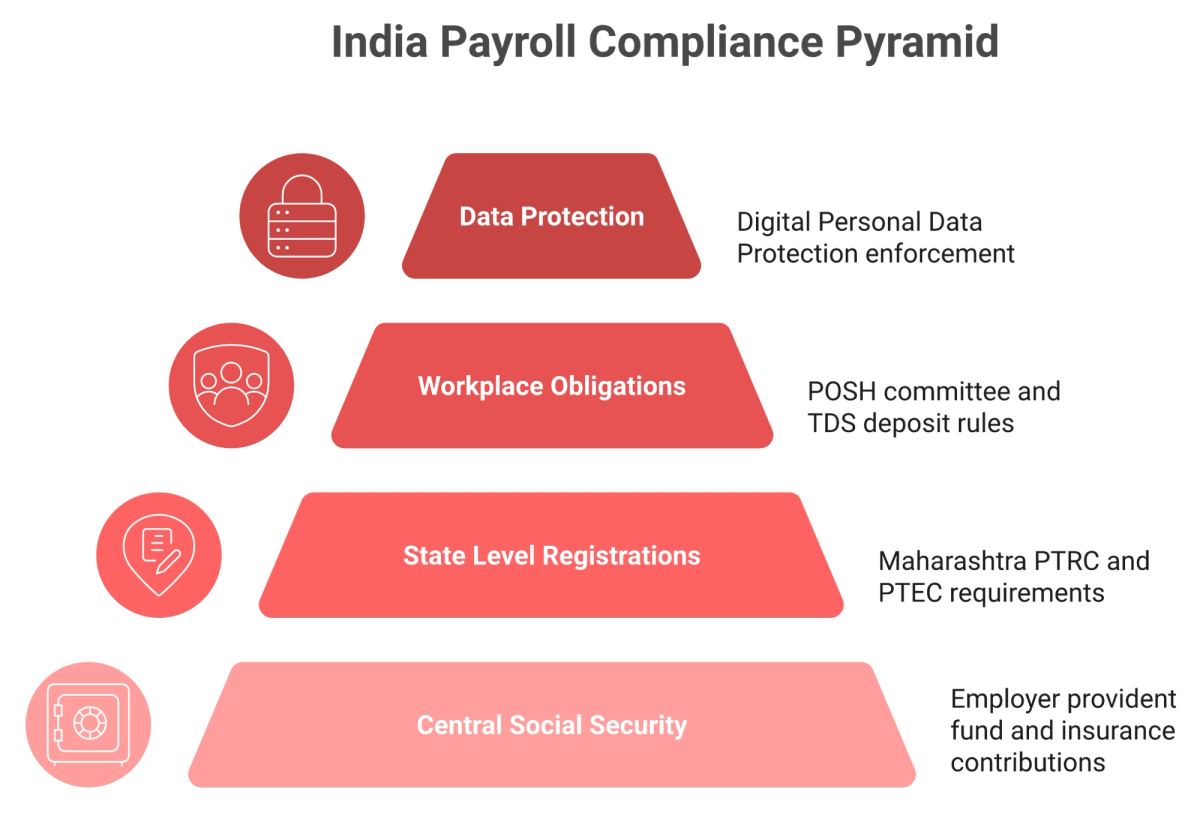
The EPF statutory wage ceiling rose from ₹15,000 to ₹25,000 effective 17 September 2026, per Ministry of Labour and Employment Notification S.O. 5109(E). Employer pension share moved to ₹2,083, employer provident fund to ₹917, and both EDLI and administration charges to ₹125 each. The Labour Codes require basic pay plus dearness allowance to be at least 50% of total cost to company, which lifts provident fund and gratuity bases together. A captive also carries EPF, ESIC, professional tax, and Shops and Establishments registration before the first hire, a POSH internal committee at ten or more employees, and Digital Personal Data Protection obligations enforceable from 13 May 2027 under the MeitY DPDP Rules, 2025.
⚠️ The number that just invalidated most cost models
Every India cost model built before September 2026 used ₹15,000, or the widely predicted ₹21,000. Both are now wrong.
An EPS amendment notified on 25 September 2026 also auto enrols existing provident fund members earning up to ₹25,000 into the pension scheme, without any member application. There is an offset worth checking: the PMVBRY scheme can return up to ₹3,000 per employee per month for eligible new hires, as set out in the EPFO FAQs on the revised wage ceiling.
📋 Registrations you need before the first payroll
- Employees' Provident Fund registration, 12% employer contribution on basic plus DA.
- ESIC registration, 3.25% employer and 0.75% employee on covered wages, per ESIC.
- Professional tax, which is a state level tax on salaried income.
- Shops and Establishments registration under your state's own Act.
- POSH internal committee, mandatory at ten or more employees, with the annual report due by 31 January.
- TDS deposit by the 7th of each month, and Form 16 issued to employees by 30 May, per the Income Tax Department.
The full filing calendar behind these six items sits in our reference on payroll compliance in India.
🗺️ Why state level detail is the whole job
- Maharashtra needs two registrations, PTRC for employees and PTEC for the entity.
- Karnataka runs a monthly professional tax cycle, plus Shops and Establishments renewal.
- Tamil Nadu files professional tax twice a year, and adds Labour Welfare Fund.
- Delhi has no professional tax, but enforces Shops and Establishments strictly.
- West Bengal changes rules often enough that last year's calendar is unreliable.
Versatile Club holds provident fund, ESIC, and Shops and Establishments registrations on its own Indian entity, and runs these filings directly rather than through a partner. A global platform that treats India as one country of 150 rarely carries this state by state detail, which is the gap our compliance page documents registration by registration.
💬 What buyers report about the filings
"The compliance side is the real reason I'd recommend them though. PF, tax, the statutory filings, all the stuff I genuinely did not want to learn, they just handle it and keep it correct every month."
— Angad S., Founder, Versatile Club G2 - Verified Review, 21 June 2026
"The initial documentation and paperwork felt quite detailed and time-consuming at the beginning."
— Verified User in Marketing and Advertising, Buyer, Wisemonk - G2 Verified Review, 12 February 2026
✅ What to do on Monday
Pull your India salary structures and check two things. Does basic plus DA clear 50% of CTC? Is provident fund computed against ₹25,000 rather than ₹15,000?
Then list anyone in the ₹15,001 to ₹25,000 band, confirm their universal account numbers are linked, and reissue offer letter CTC templates with the new loading.
Versatile Club re-cut client salary structures against the ₹25,000 ceiling inside the same payroll cycle, because the filings sit under our own registrations rather than a vendor's. Clients received a revised CTC breakup instead of a forwarded notification asking them to advise. The same mechanics apply to our managed payroll clients.
Q7. How do you contain permanent establishment, transfer pricing and GST exposure?
Rule 89(2) of the Income-tax Rules, 2026, which replaced Rule 10TD, accepts a declared operating margin of 15.5% of operating expense for IT and ITeS captives with operating revenue up to ₹2,000 crore, per the Central Board of Direct Taxes. The election runs in blocks of three tax years from 2026 to 2027, and comparability adjustments are barred. Services billed to the parent qualify as zero rated export of services when payment arrives in convertible foreign exchange, and a Letter of Undertaking in Form RFD-11 lets you export without paying IGST upfront, as provided on the GST portal.
🧩 Permanent establishment, in plain terms
Permanent establishment means your foreign parent is treated as having a taxable presence in India. If that happens, Indian tax authorities can tax part of the parent's profit, not just the captive's.
The trigger is usually not an office. It is conduct. If your India team negotiates or concludes customer contracts, you have handed them the argument. Our comparison of EOR versus entity in India maps where that exposure starts.
✅ The containment rules that actually work
- Keep the captive's mandate to services provided to the parent, billed on a cost plus basis.
- Do not give India based staff authority to sign customer contracts.
- Document the mandate in an intercompany services agreement before the first invoice.
- Keep pricing consistent with whatever margin basis you elected.
💰 Safe harbour, and the part competitors skip
Safe harbour means the tax department accepts your declared margin without arguing about comparables. Three mechanics get left out of most guides.
First, the ₹2,000 crore ceiling is tested on operating revenue. Second, the election locks for three years, so a loss making year inside the block still carries the margin. Third, Rule 89 bars comparability adjustments, which removes the usual negotiation lever.
📉 The arithmetic nobody runs
A benchmarking study plus transfer pricing documentation can cost more than the tax difference at small scale. At 20 engineers, I have seen the study cost exceed the margin delta it was meant to optimise.
Elect safe harbour and move on. Revisit it when the block expires, or when revenue approaches the ceiling. If you are still weighing the structure itself, the EOR versus entity calculator puts both paths side by side.
⚠️ GST, the quiet one
Your captive's services to the parent are exports, and exports are zero rated. That only holds if payment arrives in convertible foreign exchange and the recipient sits outside India.
File Form RFD-11, the Letter of Undertaking, at the start of each financial year. Without it, you pay IGST and then chase a refund, which ties up working capital for months. Corporate tax, separately, can sit at 22% under Section 115BAA for eligible domestic companies, against the standard 30%, per the Income Tax Department.
🧭 How I think about this before the entity exists
Versatile Club's read is that most of this risk is created by the entity, not managed by it. Before incorporation, there is no intercompany transaction to benchmark and no permanent establishment question to argue.
I will hedge that. Once your India team owns product roadmap decisions, the entity becomes the right answer regardless of tax friction.
📌 Your Monday checklist
- Model safe harbour against a benchmarking study before the first intercompany invoice.
- Draft the intercompany services agreement now, not at year end.
- File RFD-11 for the current financial year.
- Write a one page rule on who may sign customer contracts, and keep India off that list.
Versatile Club removes this layer at the pre entity stage, because clients buy a service from an Indian company and receive one USD invoice from Versatile Club's own entity under its EOR services in India. There is no transfer pricing file to maintain and no intercompany margin to defend while you are still under 30 heads.
Q8. How does the EOR-to-captive conversion work, and what does exiting cost?
Conversion means novating employment contracts to your new entity, with continuity of service preserved so gratuity does not reset, assigning IP and assets, and filing Form FC-TRS within 60 days where shares change hands, per the RBI FIRMS portal. Build Operate Transfer exits add a transfer valuation that gets negotiated years after signing, which is why the exit clause matters more than the monthly rate. Versatile Club charges no setup fee and no exit fee, and the first month is free.
📉 The situation: month 14, 28 engineers
A VP People I worked with had 28 engineers live on an EOR and board approval to incorporate. She assumed conversion meant new offer letters and a start date.
It did not. Her provider's agreement had a per employee transfer fee and a 90 day notice clause. The fee was roughly two months of platform cost per head. The mechanics of moving providers cleanly are covered in our guide to switching EOR provider in India.
⚠️ The complication nobody prices at signing
Exit terms get negotiated when you have the least leverage. Your people are employed by someone else, your entity is new, and your timeline is already approved.
That is the moment a transfer fee or a BOT valuation lands. With BOT, the vendor has operated your centre for 12 to 24 months and holds all the operating knowledge.
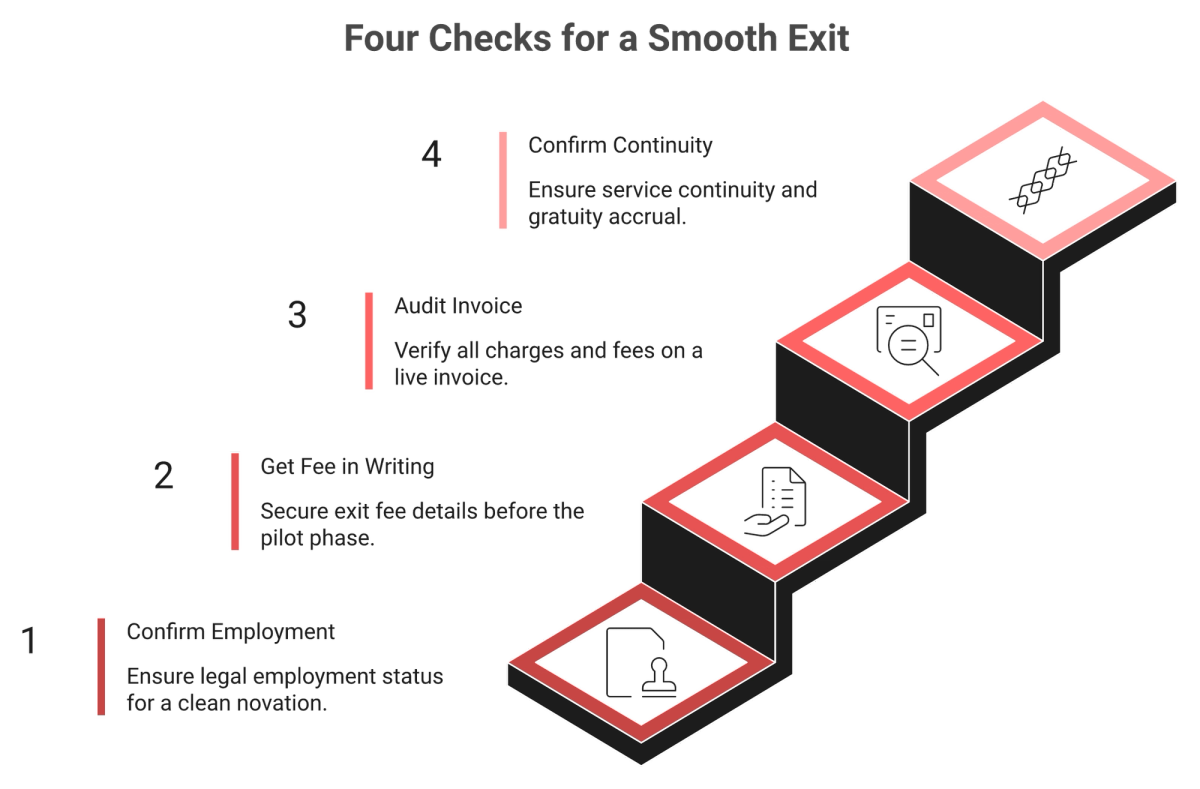
✅ The resolution: four checks before you sign anything
- Confirm who legally employs the worker. An owned entity novates cleanly. A partner shell means renegotiating with a company you never contracted with.
- Get the exit fee in writing, per employee and in total.
- Ask for a live sample invoice, not a quote. Check it for setup fees, security deposits, FX markup, benefits markup, and exit charges.
- Confirm service continuity language, so gratuity accrual at 4.81% of basic plus DA carries across.
For a line by line view of what sits on that invoice, see our pricing page and the published rates on Deel's own pricing page and Remote's pricing page.
💬 What buyers report about hidden exit friction
"We had to carefully manage our agreement and had to constantly remind them of the fees agreed so that we weren't over charged. Everything was VERY time consuming. It took three months to onboard our first 3 individuals."
— Verified User in Information Technology and Services, Buyer, Deel - G2 Verified Review, 13 December 2024
"Founder is just a call away. Extremely helpful in resolving all our queries. The process is super smooth to setup India EOR."
— surbhi m., Founder, Versatile Club G2 - Verified Review, 15 June 2026
💸 What conversion actually costs
| Line item | Typical range | Notes |
| EOR transfer or exit fee | Zero to two months per employee | Versatile Club charges none |
| BOT transfer valuation | Negotiated, often 0.5x to 1.5x annual run cost | Set the formula at signing |
| Legal: novation and IP assignment | $3,000 to $10,000 | Scales with headcount |
| FC-TRS filing | Statutory, 60 day window | Penalty exposure if missed |
🧭 My honest position on lock in
Versatile Club's conversion economics are deliberately boring, and that is a commercial choice. An EOR that earns money from exit fees has no reason to help you graduate to your own entity.
I will name the trade off. Versatile Club operates only in India, so if you need five or more countries on one contract, a global platform fits better. If India is the only country on your plan, the how it works page shows the onboarding sequence end to end.
Versatile Club employs on Foo Falcon Technologies Pvt Ltd, so conversion is a documented novation from one Indian entity to another, with no setup fee, no exit fee, and provident fund service continuity preserved in the paperwork.
Q9. How do you staff, govern and retain the captive once it is live?
Hire the India head before any engineer. Governance, bank signatory authority, and alignment with headquarters all route through that role. Then run the three phase arc: set the base with clear performance indicators and regional support, standardise end to end processes, then create value through automation and AI. Versatile Club screens candidates on 50 behavioural parameters before technical rounds, assigns a 90 day Success Coach, and backs Contract to Hire placements with a 6 month replacement guarantee.
👤 The hire that decides everything
A US founder I worked with wanted four engineers in Bengaluru before hiring a leader. Cheaper, faster, less overhead. That was the logic.
Nine months later, three had left. Nobody local owned performance conversations, so the team reported to a timezone instead of a person. Our guide to hiring employees in India sets out the sequencing that avoids this.
⚠️ Why the country head comes first
The India head does four things nobody else can. They sign as a director or authorised signatory. They carry local employment decisions. They set the hiring bar. They translate between headquarters and the floor. Leadership searches of this kind run through our recruitment practice.
One practitioner who built a support centre in India described the sequence as three distinct phases. Phase one set the base, with task transition, team structures, and performance indicators. Phase two standardised end to end processing across regions. Phase three created value through automation and AI integration, a pattern consistent with the Zinnov and Nasscom India GCC Landscape.
⏰ The three phase arc, with realistic timing
| Phase | Months | What the team actually does | Failure signal |
| Set the base | 0 to 6 | Task transition, KPIs, local leadership in place | Work still routes through HQ for approvals |
| Standardise | 6 to 18 | End to end process ownership, documented runbooks | Every exception escalates overseas |
| Create value | 18+ | Automation, AI integration, product influence | Senior engineers resign for scope, not salary |
If you are still choosing between this arc and a lighter structure, our comparison of EOR versus GCC in India covers the governance trade offs.
❌ The framing mistake that costs you your best people
India is a talent arbitrage, not a labour arbitrage. If you frame the captive as a back office cost centre, your strongest engineers leave for the centre next door that offers product ownership.
That is the uncomfortable part. Counter offers in Bengaluru land weekly, and scope beats a 15% raise more often than salary models predict. The salary calculator is useful here, but only for the band, not the retention decision.
🧭 Communication discipline that prevents silent slippage
Two habits have changed outcomes more than any tool I have used. First, never ask closed questions in status calls. "Are we on schedule?" invites a polite yes. "Where are we on the schedule, and what is left?" invites a real answer.
Second, recap every operational call in writing within the hour. Across the Contract to Hire placements Versatile Club has run in Bengaluru, Hyderabad, and Pune, written recaps have been the cheapest fix for high context versus low context gaps.
💬 What buyers say about support depth
"Founder is just a call away. Extremely helpful in resolving all our queries. The process is super smooth to setup India EOR."
— surbhi m., Founder, Versatile Club G2 - Verified Review, 15 June 2026
"I've noticed that their support/query responses can occasionally take a bit longer sometimes, likely due to a relatively small team."
— Verified User in Financial Services, Buyer, Wisemonk - G2 Verified Review, 14 June 2025
✅ Where I hold my own view loosely
Versatile Club's placement data points to culture fit screening predicting retention better than technical scores alone. I might be reading that too strongly, because the sample sits in the tens, not the hundreds. The culture fit quiz is the same screen we run before technical rounds.
What I am confident about is the inverse. Hiring purely on technical scores has produced the fastest exits I have seen.
Versatile Club screens on 50 behavioural parameters before technical rounds, assigns a 90 day Success Coach, and carries a 6 month replacement guarantee on Contract to Hire placements. Sagar Chainani stays on WhatsApp rather than routing you through a customer success rotation, because compliance is the floor and retention is the actual deliverable. If that is the model you want, talk to us about your India team or see how it works.
FAQs
How long does it take to set up a captive center in India?
A wholly owned captive takes 6 to 12 months end to end. Incorporation itself is the fast part, usually 2 to 4 weeks through SPICe+, the integrated filing form at the Ministry of Corporate Affairs. The remaining months go to the bank account, capital remittance, statutory registrations, fit-out, and the first hiring cohort.
- Days 1 to 30: appoint the India head, file SPICe+ with digital signature certificates, open the authorised dealer bank account.
- Days 31 to 60: remit capital, file Form FC-GPR within 30 days of share allotment, obtain PAN, TAN, and GSTIN.
- Days 61 to 90: register for provident fund, employee state insurance, professional tax, and Shops and Establishments before the first hire.
- Months 4 to 12: fit-out, transfer pricing documentation, and the first audit cycle.
In our experience the bank account clearing KYC is the real bottleneck, not the MCA filing. A full enterprise captive with owned real estate and 50 plus heads runs 12 to 18 months instead.
Versatile Club onboards India employees on its own registered entity under a five business day SLA written into the contract, which is why our clients run the hiring clock and the incorporation clock in parallel rather than in sequence. The trade offs are laid out in our comparison of EOR versus entity in India.
Can a foreign company own 100% of a captive center in India?
Yes. IT, ITeS, research and development, and most business services permit 100% foreign ownership under the automatic route, which means no prior government approval is required before you incorporate and fund the entity.
The filings still apply. Three obligations catch first time entrants:
- Form FC-GPR on the Reserve Bank of India FIRMS portal within 30 days of allotting shares to the parent.
- Form FC-TRS within 60 days where shares later change hands.
- Annual FLA return, the Foreign Liabilities and Assets filing, due by 15 July each year.
Missing the FC-GPR window puts you into compounding territory under FEMA, and compounding applications take months to resolve. Appoint the authorised dealer bank and a company secretary before the capital lands, then diarise the 30 day clock from the allotment date, not the remittance date.
Sector caps do exist elsewhere, so confirm your activity code before assuming the automatic route applies. Defence, insurance, and multi brand retail sit under different rules.
Versatile Club works with companies that have no Indian entity at all, employing their India staff on its own registered entity while the subsidiary paperwork proceeds. If you want hiring to start before incorporation completes, see how we hire in India without an entity.
What does a captive center in India cost in the first year?
Year one costs split into three layers, and most published estimates only cover the first.
- Setup: $750 to $1,500 in SPICe+ government and filing fees, plus $5,000 to $15,000 for basic entity formation. Cross border structuring with transfer pricing documentation pushes this to $100,000 or more.
- Infrastructure: managed seats or fit-out, priced per seat per month and varying sharply by city tier. A full captive with 50 plus heads, owned real estate, and IT lands between $500,000 and $3 million.
- People and statutory loading: salaries plus 12% employer provident fund on basic plus dearness allowance, 3.25% employee state insurance, and 4.81% gratuity accrual.
The statutory line changed in September 2026. The EPF wage ceiling moved from ₹15,000 to ₹25,000, taking employer pension share to ₹2,083 and employer provident fund to ₹917 per covered employee. Any model built on the old ceiling now understates cost.
Against all of that, a senior engineer costs roughly $58,000 all in in Bengaluru versus about $220,000 in San Francisco.
Versatile Club invoices in USD from a single Indian entity with no FX markup, no setup fee, and no exit fee, which makes the comparison easier to model. Our breakdown of the cost of hiring in India runs both columns side by side.
What is the safe harbour margin for a captive center in India?
Rule 89(2) of the Income-tax Rules, 2026, which replaced Rule 10TD of the 1962 rules, accepts a declared operating margin of 15.5% of operating expense for information technology services. That covers software development, ITeS, knowledge process outsourcing, and software related contract research, where operating revenue does not exceed ₹2,000 crore. Data centre services sit at 15%.
Three mechanics get skipped in most guides:
- The revenue ceiling is tested on operating revenue, not profit.
- The election locks for a block of three tax years from 2026 to 2027, so a weak year inside the block still carries the declared margin.
- Rule 89 bars comparability adjustments, which removes the usual negotiation lever with the tax officer.
Safe harbour means the department accepts your margin without arguing about comparable companies. At 20 engineers, a benchmarking study plus documentation often costs more than the tax difference it was meant to optimise, so electing safe harbour and moving on is usually the better call.
Elect before you raise the first intercompany invoice, not at year end. Also keep the captive's mandate to services billed to the parent, because the moment India based staff negotiate customer contracts, permanent establishment becomes arguable.
Versatile Club removes this layer entirely before incorporation, since clients buy a service from an Indian company and receive one USD invoice. Our comparison of EOR versus GCC in India covers where that changes.
How do you convert from an EOR to your own captive entity in India?
Conversion is a novation, not a rehire. You move each employment contract from the EOR's entity to your new Indian entity, preserving continuity of service so gratuity accrual at 4.81% of basic plus dearness allowance does not reset. Assets and intellectual property get assigned separately, and Form FC-TRS goes to the RBI within 60 days where shares change hands.
Four checks protect the exit, and all four belong in the original agreement rather than the conversion conversation:
- Confirm who legally employs the worker. An owned entity novates cleanly. A partner shell means renegotiating with a company you never contracted with.
- Get the exit fee in writing, per employee and in total.
- Request a live sample invoice, not a quote, and check it for setup fees, security deposits, FX markup, benefits markup, and exit charges.
- Confirm service continuity language in the employment contracts.
Build Operate Transfer arrangements add a transfer valuation negotiated 12 to 24 months after signing, usually when the vendor holds all the operating knowledge and you hold an approved board timeline. Set the valuation formula at signing.
Versatile Club charges no setup fee and no exit fee, and employs on its own entity, so conversion runs from one Indian entity to another with documented continuity. If you are mid contract elsewhere, our guide to switching EOR provider in India covers the mechanics.