Table of contents (12)
Employer of Record in India: A 2026 Playbook for PF, ESI, TDS & Multi-State Compliance Without Setting Up an Entity
Q1: What Is an Employer of Record in India, and Why Does It Exist?
An Employer of Record (EOR) in India is a locally registered company that becomes the legal employer of your hire on paper, while you direct their daily work. It runs payroll and files PF, ESI, TDS, and professional tax under its own registrations. That lets a US or UK company hire compliantly in days, not the 12 to 18 months an entity takes.
The moment that creates the search
Last quarter, a US founder messaged me on WhatsApp at 11 PM his time. He had a brilliant backend engineer in Pune, a signed offer in spirit, and no way to pay her legally. He was three days from losing her to a competitor.
That is the real trigger. Not curiosity. A candidate who will walk if you cannot put her on payroll this week.
What an EOR actually does (in plain English)
Think of an EOR as a legal stand-in employer. Your engineer works for you every day. On government records, she works for the EOR's Indian entity.
The EOR owns four things you cannot easily do from abroad:
- ✅ Payroll and statutory filings. PF (retirement fund), ESI (state health insurance), and TDS (tax deducted at source) under the EOR's own registrations.
- ✅ A compliant employment contract. Built to Indian labour law, not a US template.
- ✅ Onboarding and benefits. UAN (a portable PF account number), insurance, and payslips.
- ✅ Liability. The EOR carries the compliance risk, not you.
When an EOR is the right call, and when it is not
Here is where I will hedge. An EOR is not always the answer.
From what surfaces when you actually run this, an EOR fits beautifully for 1 to 25 India hires, fast. It is the wrong tool if you need 100+ engineers and a procurement team demanding SOC 2 as a gate. That is a captive entity conversation, and I will say so plainly.
At Versatile, India is the only country we operate in. We treat EOR as permanent infrastructure for your India team, not a temporary hack you rip out later. Most global platforms treat India as one country among 150. That difference shows up in every payroll cycle.
Q2: EOR, PEO, or Your Own Entity: Which Structure Should You Choose in 2026?
An EOR is the legal employer and needs no entity from you. A PEO (Professional Employer Organisation) co-employs but requires you to already own an Indian entity. Incorporation gives full control but costs roughly ₹30 lakh+ and 12 to 18 weeks. For 1 to 15 hires, the EOR wins on speed and cost.
Why founders confuse these three
I get this question weekly. People read "PEO" and "EOR" as synonyms. They are not.
A PEO shares HR duties with you, but you stay the legal employer, so you need your own registered company first. An EOR replaces the legal employer entirely. That single distinction decides whether you can hire next week or next year.
The decision table
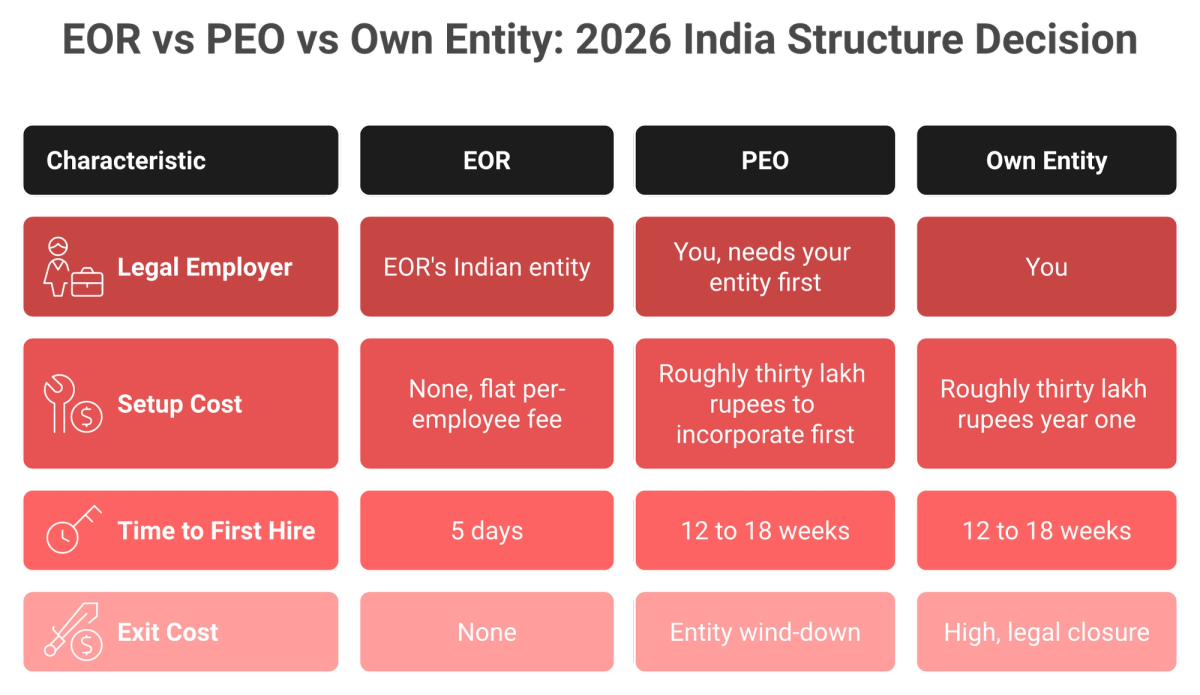
| Structure | Who is the legal employer? | Setup cost | Time to first hire | Exit cost |
|---|---|---|---|---|
| EOR | The EOR's Indian entity | None (flat per-employee fee) | 5 days (our SLA) | None, with us |
| PEO | You (needs your entity first) | ₹30 lakh+ to incorporate first | 12 to 18 weeks | Entity wind-down |
| Own entity | You | ₹30 lakh+ year one | 12 to 18 weeks | High (legal closure) |
The break-even nobody tells you
Here is the math operators actually care about. ⚠️ Entity setup is not just the ₹30 lakh. It is the ongoing CFO, the auditor retainer, the ROC filings, and the months before your first hire is productive.
The break-even versus an entity usually lands around 25 to 35 India employees, in my experience placing teams across Bengaluru, Hyderabad, and Pune. Below that, an EOR is cheaper and faster, full stop.
💰 And there is a clean bridge play. Use an EOR to hire your first 20 to 30 people, prove the India team works, then transition to a Global Capability Centre (your own captive subsidiary) once headcount justifies it. Wisemonk and Deel both support this path; we do too, without exit fees.
"We use Multi Country Payrolls to manage payroll for our employees across different countries and relocation management."
Verified User in Computer Software Deel G2 Verified Review
That breadth is real and useful for many countries. For an India-only team, the trade-off is depth.
Q3: What Does an EOR in India Actually Cost (and Where Are the Hidden Fees)?
India-native EORs run roughly $99 to $399 per employee per month; global platforms like Deel and Remote start near $599. But the sticker price hides the real cost: statutory contributions on top of salary, 3 to 5% FX markups when money routes through foreign holding companies, security deposits, and exit fees. Total cost of employment is the number that matters.
The headline price is not the price
When a CFO at a $20M ARR SMB asks me "what does it cost," I never answer with the monthly fee alone. That is the trap.
The real cost has three layers: the EOR fee, the statutory load, and the leakage.
Layer by layer
- 💰 EOR fee. Versatile is $149/employee/month. Wisemonk ranges $99 to $399, Deel and Remote near $599, Multiplier around $400, G-P near 15% of salary.
- 💸 Statutory load. PF at 12% of Basic+DA and ESI at 3.25% employer share sit on top of gross salary, not inside the fee.
- ⚠️ Hidden leakage. This is the one that burns people.
Where the leakage hides
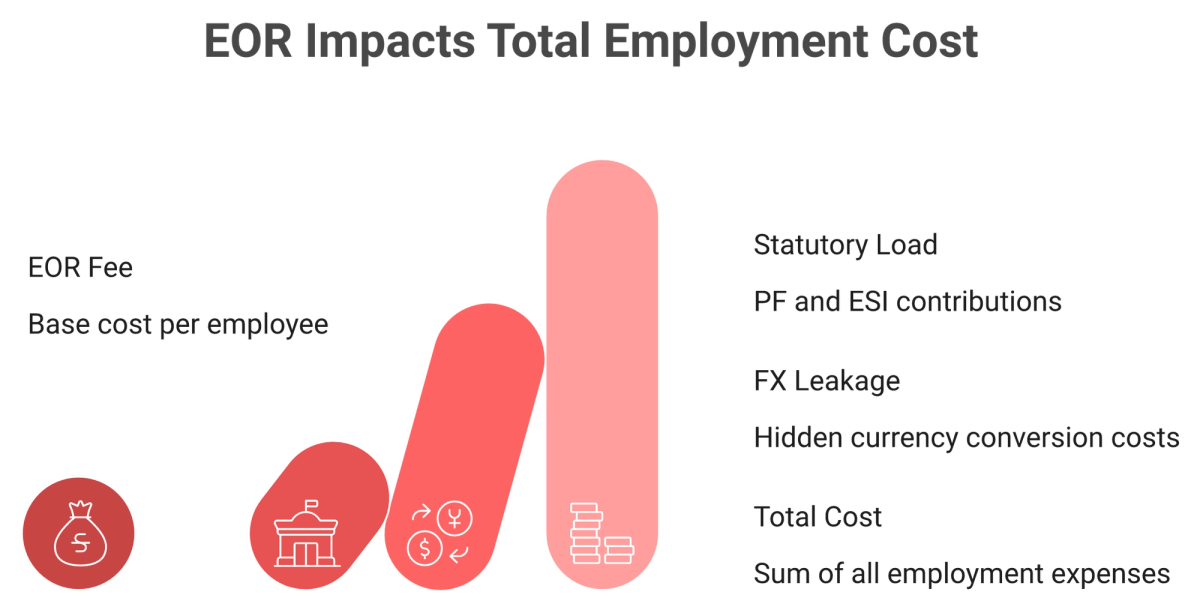
Global platforms often route your USD through a foreign holding company before it reaches India. Each hop adds a 3 to 5% FX markup. Employees feel it too.
"I dislike how expensive Deel's transaction fees are, especially when moving money from the Deel account to my bank or wherever else it needs to go."
Maria M. Deel G2 Verified Review
"Convenient payments but costly and complicated setup. I find the pricing of Deel to be quite terrible for me."
Verified User in Translation and Localization Deel G2 Verified Review
These are not edge cases. They are the most common complaint in the file I keep on competitors.
At Versatile, we invoice in USD directly from our Indian entity, so there is no foreign hop and no FX markup. We also charge no setup fee, no exit fee, and the first month is free, which you can verify on our India EOR pricing page. I would rather lose a deal on transparency than win one on a hidden line item. To model your own numbers, our employee cost calculator breaks the load down line by line.
Q4: How Do PF, ESI, TDS, and Gratuity Actually Work in India?
Provident Fund is 12% employer plus 12% employee on Basic+DA. ESI is 3.25% employer plus 0.75% employee for staff earning under ₹21,000/month. TDS is withheld monthly and filed quarterly on Form 24Q. Gratuity must accrue from month one at 4.81% of Basic+DA. A compliant EOR runs all four under its own EPFO, ESIC, and TAN registrations.
The four statutory pillars
Let me translate these from acronyms into what they cost you every month.
| Statutory item | What it is | 2026 rate | Who pays |
|---|---|---|---|
| PF (Provident Fund) | Retirement savings via EPFO | 12% + 12% of Basic+DA | Both |
| ESI | State health insurance | 3.25% employer + 0.75% employee | Both (under ₹21k/mo) |
| TDS | Income tax deducted at source | Per slab, filed on Form 24Q | Withheld from employee |
| Gratuity | Long-service payout | 4.81% of Basic+DA, accrued monthly | Employer |
The gratuity trap that surfaces in due diligence
Here is the one that gets People Ops leaders in trouble. ⚠️ Gratuity must be accrued from month one, even though it is only paid after five years of service.
Many generalist EORs do not accrue it properly on the books. Then Series B or C diligence opens the payroll file, finds an unfunded liability, and the deal stalls while you scramble to fix it.
I have watched a clean funding round wobble over exactly this. It is avoidable, and our gratuity calculator shows the accrual you should be funding from day one.
Why "under our own registrations" matters
When I say we file under Versatile's own EPFO, ESIC, and TAN numbers, I mean it literally. Your engineer's PF lands in a government account tied to our registered entity, not a partner shell we rent by the month.
That distinction is the difference between a clean audit trail and a frantic migration later. From having run multi-state PF, ESI, and PT compliance across three cities, I will say the standard global read gets this backwards: they optimise for country count, not filing ownership.
"WiseMonk's EOR service solved our biggest challenge, which was hiring employees in India without setting up a local entity. They manage employment contracts, statutory compliance, tax structure, and local regulations on our behalf."
Verified User in Marketing and Advertising Wisemonk G2 Verified Review
Wisemonk does this well, to be fair. The gap I see is on the retention and support side, which I will cover in later sections.
Q5: What Does the 2026 New Labour Code (50% Wage Rule) Change About Your Payroll?
Under the Code on Wages, 2019 (in force 21 November 2025), Basic plus Dearness Allowance (DA) must equal at least 50% of total CTC (Cost to Company). Because PF and gratuity are calculated on Basic+DA, this raises mandatory contributions and forces salary restructuring. Offer letters built on the old 30 to 35% basic split are now non-compliant.
The rule, stated plainly
This is the single biggest India payroll change in a decade. The four Labour Codes went live on 21 November 2025.
The core mechanic is simple. Your wages (Basic + DA) must be half of total pay or more. You can no longer hide salary in allowances to shrink PF.
What it does to your numbers
Here is a worked example I run for founders weekly.
- ⚠️ Old structure: ₹10 lakh CTC, basic set at 30% (₹3 lakh). PF was calculated on ₹3 lakh.
- ✅ New structure: basic must be ₹5 lakh minimum. PF and gratuity now sit on a far larger base.
The result is higher PF outflow, higher gratuity accrual at 4.81% of Basic+DA, and a smaller take-home unless you re-architect the whole package. Our salary calculator models the new split in seconds.
What to do on Monday
If your India offer letters still use a 30% basic split, they are out of date.
From having run payroll across Bengaluru, Hyderabad, and Pune, my advice is blunt: ask your EOR for a restructured CTC quote that already bakes in the 50% rule. Do not wait for an audit to find it.
At Versatile, we flag this loudly and early, before the first payslip. I would rather have an awkward CTC conversation in week one than a compliance surprise in month six. Compliance, to me, is a fear-to-trust pipeline, not a checklist, which is why our compliance calculation engine applies the rule automatically.
"What I dislike about Wisemonk is that some features feel a bit limited and could use more flexibility. In particular, I'd like to see better options for customization and more detailed reporting."
Vinay M. Wisemonk G2 Verified Review
Reporting flexibility matters more under the new code, because you need to show the basic split clearly to every employee.
Q6: How Does Multi-State Professional Tax Compliance Differ Across India?
Professional tax (PT) is a state-level tax on income, so rules differ by location. Maharashtra needs dual PTRC and PTEC registration with monthly slab filings. Karnataka requires enrollment within 30 days of joining. Tamil Nadu runs a biannual June and December cycle. Delhi levies no PT at all. PT is capped at ₹2,500 per year per employee.
Why this breaks global platforms
Most global EORs treat PT as a footnote. "₹200 a month, handled." That abstraction is where trouble starts.
PT is not one tax. It is up to 28 different state rulebooks, each with its own registration, slab, and filing rhythm.
The state-by-state reality
| State | PT rule | Filing rhythm |
|---|---|---|
| Maharashtra | Dual PTRC + PTEC registration | Monthly slab filing |
| Karnataka | Enroll within 30 days of joining | Monthly |
| Tamil Nadu | Half-yearly assessment | Biannual (June, Dec) |
| West Bengal | Frequent rule changes | Monthly/annual |
| Delhi | ✅ No PT levied | None |
The lived version of this
When you hire one engineer in Pune, one in Bengaluru, and one in Chennai, you are now filing under three separate state regimes. Miss the Karnataka 30-day enrollment window, and you face penalties. Our Pune payroll team and our Bangalore payroll team track these windows as a daily job.
I think of this the way a Series B SaaS CFO thinks about US multi-state sales tax. It looks trivial until you are in five states, and then it is a real operational load.
From running this across cities for six years, here is my point of view: the standard global read gets this backwards. They optimise for how many countries they cover, not how deeply they handle one. India rewards depth.
At Versatile, we hold Shops and Establishments and PT registrations across states, so the matrix is our daily job, not a surprise. That is the core of our India EOR service. I could be off on edge-case municipalities, but on the major states, this is muscle memory for us.
Q7: Which 2026 Compliances Do Founders Forget: DPDP, Form 130, PE Risk, POSH, and GST?
Beyond payroll, five 2026 obligations catch founders off guard. The DPDP Rules, 2025 (notified 13 November 2025) require explicit consent for background checks. Form 16 becomes Form 130 from 1 April 2026. A sloppy EOR setup can trigger Permanent Establishment (PE) tax risk. POSH committees are mandatory at 10+ employees. Statutory bonus and GST e-invoicing apply on the money side.
Pillar 1: DPDP and background checks
The Digital Personal Data Protection (DPDP) Rules were notified on 13 November 2025. They govern how you handle an employee's personal data.
In practice, you now need explicit consent before running a background check. Breach reporting runs on a 72-hour clock. Your EOR holds this data, so its consent architecture is your liability too.
Pillar 2: Form 16 becomes Form 130
This one is quiet but real. From 1 April 2026, the annual salary tax certificate (Form 16) is renumbered Form 130 under the Income-tax Act, 2025.
If your payroll documents still say "Form 16" for Tax Year 2026-27, they are out of date. Employee comms need updating before year-end filing, and our income tax calculator already reflects the new forms.
Pillar 3: Permanent Establishment risk
Permanent Establishment (PE) is a tax concept. If your foreign company is seen as "doing business" in India through your hire, India can tax your global profits.
A properly structured EOR is your buffer here. The EOR is the employer, so your foreign entity stays at arm's length. A partner-shell setup with sloppy contracts weakens that buffer, so it is worth running our permanent establishment risk quiz before you hire.
Pillar 4: POSH, bonus, and GST
Three more land on the desk:
- ⚠️ POSH. A Prevention of Sexual Harassment committee is mandatory once you cross 10 employees.
- 💰 Statutory bonus. Owed to eligible employees under the Payment of Bonus Act.
- 💸 GST e-invoicing. Applies on the invoicing side once turnover thresholds are crossed.
"The PF transfer for employees after terminating their employment with Velocity was very poor. There was limited help, delayed responses, and you can't get them to talk to you on phone."
Verified User in Computer Software Velocity Global G2 Verified Review
Exit compliance is where shallow India depth shows. PF transfer is a statutory step, not a courtesy.
Q8: How Do You Pay an India Team in USD Without FEMA Trouble or FX Leakage?
Cross-border payroll into India is governed by FEMA (the Foreign Exchange Management Act), with inbound investment often routed through FC-GPR filings to the RBI. Global platforms frequently route your USD through a foreign holding company, adding a 3 to 5% FX markup before money reaches India. Invoicing in USD directly from an Indian entity keeps the conversion onshore.
FEMA, in plain English
FEMA is the rulebook for money crossing India's border. FC-GPR is the filing you make to the Reserve Bank of India (RBI) when foreign money buys into an Indian entity.
You do not need to master this. But your EOR does, because every payroll run touches it, which is exactly what our guide to paying employees in India walks through.
Where the 3 to 5% leaks out
Here is the pattern I see in CFO conversations. Global platforms collect your USD in a foreign holding company. Then they convert and send it to India.
Each conversion hop adds an FX markup of roughly 3 to 5%. On a $500K annual India payroll, that is $15K to $25K vanishing into spread. Employees feel it too, as the reviews show.
"Convenient payments but costly and complicated setup. I find the pricing of Deel to be quite terrible for me."
Verified User in Translation and Localization Deel G2 Verified Review
"Easy Setup, Handy Transfers, But Pricey. I dislike how expensive Deel's transaction fees are."
Maria M. Deel G2 Verified Review
The onshore fix
At Versatile, we invoice in USD directly from our Indian entity. The conversion happens once, onshore, with a clean FEMA trail. This is built into our India EOR for USA companies and our India EOR for UK companies.
For a CFO closing month-end, that means one USD invoice, no mystery spread, and an audit trail that holds up in diligence. I think the next two years push India from "a country on the global map" toward owned-entity specialists who keep the money onshore. That is where my head is right now.
Q9: Why Do Founders Get Burned by Global EOR Platforms in India?
Global generalists treat India as one country among 150, often leaning on third-party local partners rather than an owned entity. That surfaces compliance gaps months later, slows contract execution, and routes support through chatbots and a rotating account-manager queue. Founders frequently discover the liability gaps only during Series B or C due diligence, when it is expensive to fix.
The 11 PM WhatsApp message
A US founder once messaged me at 11 PM her time. Her Bengaluru engineer's PF challan (the monthly contribution receipt) had not landed, and her global platform's chatbot kept looping her.
Three days to payroll. No human to call. That is "Burned Founder Syndrome," and I hear a version of it most weeks.
The pattern, agitated
Here is what actually breaks, in order:
- ❌ Partner-shell gaps. Your India compliance runs through a rented local entity, not the platform's own. Ownership is fuzzy.
- ❌ Slow contracts. Onboarding drags from "a week" into a month of email ping-pong.
- ❌ Ticket-queue support. You repeat your problem to a fifth rep at 3 AM India time.
"Often the CS doesn't seem to have answers, which leads me to emails back and forth on my case. Something I was looking for the answer to in 20 minutes becomes a 4 day process."
Verified User in Computer Software Deel G2 Verified Review
"It took three months to onboard our first 3 individuals. They didn't seem to be able to navigate Visas or variations to employment contracts."
Verified User in IT and Services Deel G2 Verified Review
The audit trap
The worst version is silent. The platform under-accrues gratuity or misses a state PT filing. Nobody notices.
Then Series B diligence opens the file and finds an unfunded liability. I have watched founders scramble through a frantic EOR migration mid-raise. The fix is not a better chatbot. It is an owned entity and a human who answers, which is exactly how our India EOR service is built. At Versatile, that human is me, on WhatsApp, and you can book a consultation with us directly.
Q10: Wisemonk vs Deel vs Versatile: How Do India-Native and Global EORs Compare?
Global platforms like Deel and Remote win on country breadth. India-native specialists win on depth. For an India-only team, the criteria that matter are entity ownership, FX transparency, onboarding speed, support model, and whether the EOR optimises for retention or just payroll. On those axes, India-native depth usually beats global breadth.
The decision criteria that actually matter
I will be fair here. Deel is genuinely excellent if you hire across 90+ countries. The trade-off is India depth and support, which is why many teams look at Deel alternatives in India.
The comparison
| Criteria | Versatile | Wisemonk | Deel / Remote |
|---|---|---|---|
| Entity model | ✅ Owned Indian entity | ✅ India-native | ❌ Often local partner |
| Pricing/mo | $149 | $99 to $399 | ~$599 |
| Onboarding | ✅ 5-day SLA | 24 to 72 hrs | ❌ 7 to 14 days |
| Support | ✅ Founder on WhatsApp | Team support | ❌ Ticket queue |
| Retention | ✅ 90-day Coach, 6-mo guarantee | ❌ No guarantee | ❌ Payroll only |
Honest trade-offs and reviews
Wisemonk does India well and holds SOC 2 and ISO 27001. ❌ Where I see the gap is retention: no replacement guarantee and no structured 90-day coaching, which is the core of our retention-first EOR model. For a side-by-side, see our Wisemonk vs Versatile Club breakdown.
"I've noticed that their support/query responses can occasionally take a bit longer sometimes, likely due to a relatively small team."
Verified User in Financial Services Wisemonk G2 Verified Review
"Frustrating Onboarding and a Difficult, Error-Prone Portal. My contract had the wrong start date and other errors."
Verified User Velocity Global G2 Verified Review
When NOT to choose us
I will name our Anti-ICP plainly. ⚠️ If you need EOR across 5+ countries, pick a generalist. If you are an enterprise 100+ India team requiring SOC 2 as a hard procurement gate, or a B2C consumer hirer, we are not your fit. India-only is a feature for most of my clients, but it is a real boundary, and our EOR vs entity guide helps you decide.
Q11: What Does a Compliant 5-Day Onboarding and Clean Exit Actually Look Like?
A clean onboarding runs in five working days. Day 1, the agreement is signed, and PAN, Aadhaar, and right-to-work are verified. Days 2 and 3, UAN, PF Form 11, and ESI Form 1 are filed. Day 4, CTC is structured to the 50% rule. Day 5, payroll goes live. Exit is equally disciplined, with full-and-final settlement inside statutory timelines.
The 5-day sequence
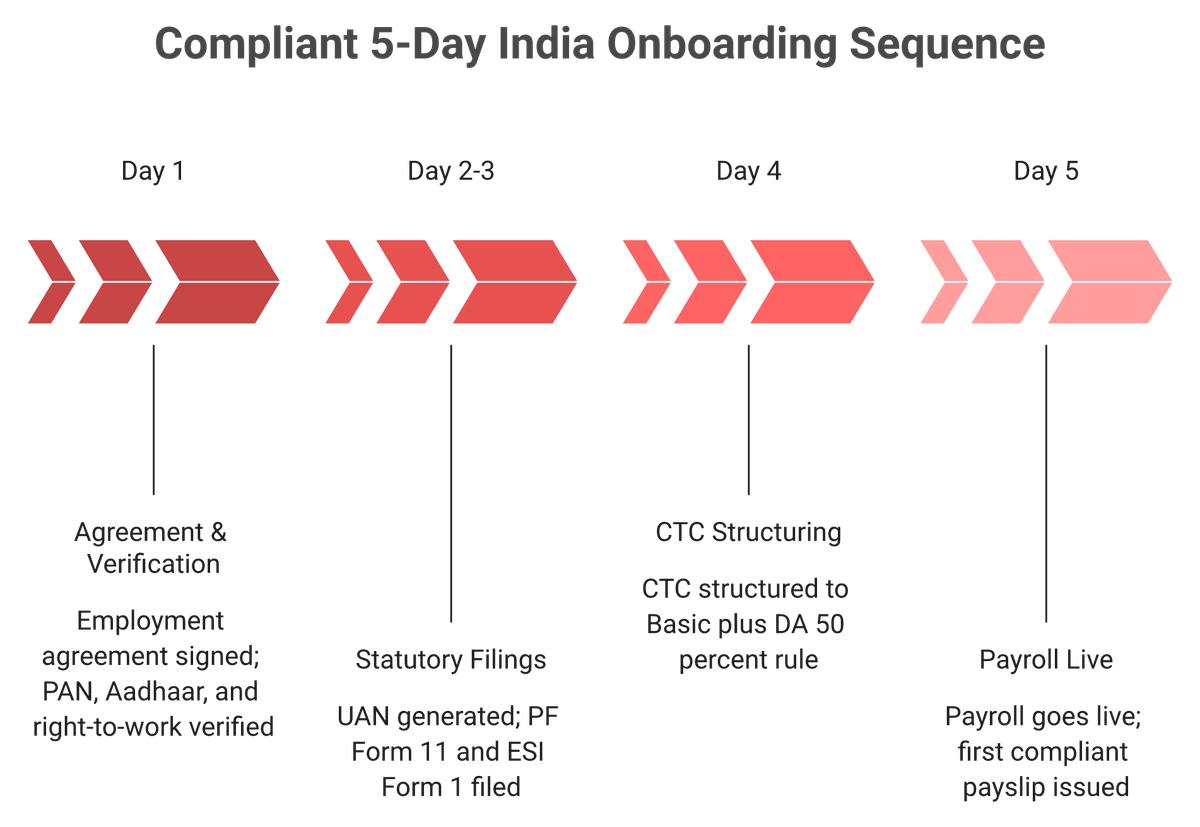
By the end of this, you will know exactly what happens each day. Most platforms quote 7 to 14 days; our SLA is contractual at five, and you can see how to hire in India without an entity step by step.
- ⏰ Day 1. Employment agreement signed. PAN (tax ID), Aadhaar (national ID), and right-to-work verified.
- Day 2 to 3. UAN (portable PF number) generated. PF Form 11 and ESI Form 1 filed.
- Day 4. CTC structured to the Basic+DA 50% rule, so PF and gratuity are correct from payslip one.
- ✅ Day 5. Payroll goes live. Employee sees a compliant first payslip.
Why exit matters as much as entry
Onboarding gets the attention. Offboarding causes the lawsuits.
A clean exit means full-and-final settlement (F&F), gratuity payout if due, PF transfer, and relieving letters, all inside statutory windows. The Velocity review I cited earlier shows what happens when PF transfer is treated as optional. It is not, and our India payroll outsourcing handles exits to the same standard as entries.
"The PF transfer for employees after terminating their employment was very poor. There was limited help, delayed responses."
Verified User in Computer Software Velocity Global G2 Verified Review
At Versatile, the 90-day Success Coach starts at onboarding, and a 6-month replacement guarantee backs our contract staffing in India placements. No exit fees, ever.
Q12: Beyond Compliance: How Do You Make an India Hire Actually Stay?
A legally compliant hire who quits in four months is the most expensive hire you will make. The real KPI of an EOR is retention, not payroll. That means culture-fit-first hiring, a dedicated coach in the first 90 days, ESOP workarounds so EOR staff share upside, and NPS structuring that can cut a senior engineer's tax by 20 to 25%.
The contrarian claim
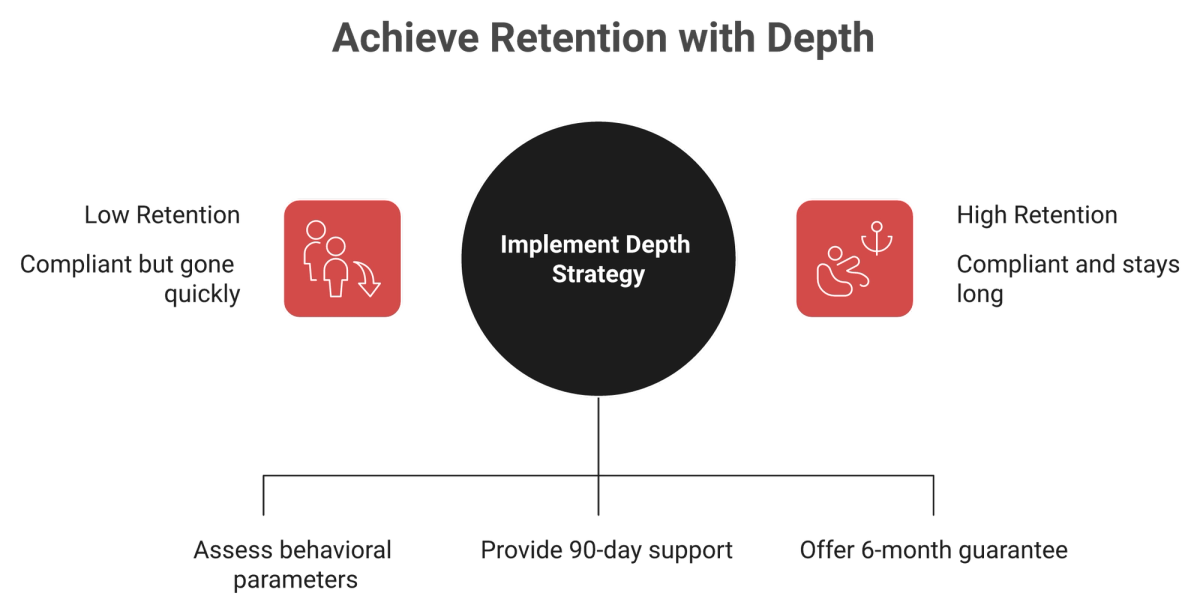
Most of the category sells "compliant hires on paper." I think the standard read gets this backwards.
Compliance is the floor, not the ceiling. A hire who is perfectly compliant and gone by month four cost you recruiting, ramp, and momentum. Retention is the metric that actually moves your India team forward.
Two levers most EORs ignore
- 💰 ESOP access. EOR employees often miss equity. We structure workarounds so your India engineers share in upside, which changes how long they stay.
- 💸 NPS tax structuring. The National Pension System under Section 80CCD can cut a high-earner's tax by 20 to 25%, lifting take-home without raising your CTC.
These are not exotic. They are just work that payroll-only platforms skip, and our NPS tax benefits guide shows the structuring in detail.
How we approach retention
We hire culture-fit-first, using 50 behavioral parameters, because the "good hire that stays" is a different problem from the "legal hire on paper." A 90-day Success Coach owns the first three months actively, which is the backbone of our EOR for SaaS startups in India.
"WiseMonk is one of the primary reasons I chose to stay with the company that I got an offer from rather than jumping around for counter offers."
Verified User in Financial Services Wisemonk G2 Verified Review
That review proves the point: support quality drives retention. Here is the question I am sitting with. Over the next two years, I think India stops being "one country on the global map" and becomes its own specialist category, where owned-entity EORs win on retention, not country count. If you are making your first India hire this quarter, message me on WhatsApp and tell me who you are trying to keep. I would rather talk about the person than the payroll.
FAQs
What is an Employer of Record in India, and when do US or UK companies need one?
An Employer of Record (EOR) in India is a locally registered company that becomes the legal employer of your hire on paper, while you direct their daily work. It runs payroll and files PF, ESI, TDS, and professional tax under its own registrations.
We see US and UK founders reach for an EOR in one specific moment: a great candidate is ready, but there is no legal way to pay them this week. Setting up your own entity takes 12 to 18 months and roughly thirty lakh rupees in year one, which is too slow.
An EOR fits best when you want to:
- Hire 1 to 25 people in India fast, without incorporating.
- Stay compliant across multi-state PF, ESI, and professional tax.
- Insulate your foreign company from Permanent Establishment tax risk.
It is the wrong tool if you need 100-plus engineers with SOC 2 as a hard procurement gate. We explain the full structure on our Employer of Record India page, and we treat EOR as permanent India infrastructure, not a temporary hack you rip out later.
How much does an Employer of Record in India actually cost, including hidden fees?
India-native EORs typically run $99 to $399 per employee per month, while global platforms like Deel and Remote start near $599. We charge a flat $149 per employee per month, with no setup fee, no exit fee, and the first month free.
The sticker price is never the full cost. Three layers matter:
- The EOR fee itself.
- The statutory load: PF at 12 percent of Basic plus DA and ESI at 3.25 percent employer share, both sitting on top of gross salary.
- Hidden leakage: 3 to 5 percent FX markups when money routes through a foreign holding company before reaching India.
On a $500K annual India payroll, that FX spread alone can quietly cost $15K to $25K. We invoice in USD directly from our Indian entity, so the conversion happens once, onshore, with a clean trail. CFOs closing month-end get one USD invoice and no mystery line items. You can model your own numbers on our employee cost calculator before committing to any provider.
EOR versus setting up your own entity in India: which should we choose in 2026?
An EOR needs no entity from you and can put your first hire on payroll in days. Incorporating your own Indian entity gives full control but costs roughly thirty lakh rupees and 12 to 18 weeks before anyone is productive.
The decision usually comes down to headcount and timeline:
- For 1 to 15 hires, an EOR wins on speed and cost.
- The break-even versus a captive entity typically lands around 25 to 35 India employees.
- Below that line, the ongoing CFO, auditor, and ROC filing costs make an entity hard to justify.
There is also a clean bridge play we run often: use an EOR to hire your first 20 to 30 people, prove the India team works, then transition to your own Global Capability Centre once headcount justifies it. We support that handoff without exit fees. We break down the full math on our EOR vs entity India page, so you can see exactly where the crossover sits for your team size and growth plan.
How do PF, ESI, TDS, and gratuity work in India payroll for 2026?
These four statutory items define your real cost of employment in India, and a compliant EOR runs all of them under its own EPFO, ESIC, and TAN registrations.
- Provident Fund (PF): 12 percent employer plus 12 percent employee on Basic plus DA.
- ESI: 3.25 percent employer plus 0.75 percent employee for staff earning under twenty-one thousand rupees monthly.
- TDS: income tax withheld monthly and filed quarterly on Form 24Q.
- Gratuity: must accrue from month one at 4.81 percent of Basic plus DA.
Gratuity is the trap we see most. It must be accrued from day one even though it pays out after five years. Many generalist EORs do not fund it on the books, and that unfunded liability surfaces during Series B or C diligence, stalling deals.
The 2026 New Labour Code adds pressure by requiring Basic plus DA to be at least 50 percent of CTC, which lifts PF and gratuity outflow. Our India payroll outsourcing handles all four under our own registrations, keeping your audit trail clean from the first payslip.
How do we make an India hire actually stay, beyond just staying compliant?
A legally compliant hire who quits in four months is the most expensive hire you will make. We believe the real KPI of an EOR is retention, not payroll. Compliance is the floor, not the ceiling.
Two levers most payroll-only platforms ignore make the biggest difference:
- ESOP access: EOR employees often miss equity, so we structure workarounds that let your India engineers share in upside.
- NPS structuring: the National Pension System under Section 80CCD can cut a senior engineer's tax by 20 to 25 percent, lifting take-home without raising your CTC.
We also hire culture-fit-first using 50 behavioral parameters, because a hire who stays is a different problem from a hire who is merely legal on paper. A 90-day Success Coach owns the first three months actively, and a 6-month replacement guarantee backs our placements.
This retention-first approach is the heart of how we operate as an India-only specialist. You can see the full model on our retention-first EOR India page, then tell us who you are trying to keep.