Table of contents (10)
Agent of Record in India: How It Works for Contractor Engagement, the Providers, and When to Use Over EOR
Q1. What exactly is an Agent of Record (AOR) in India?
An Agent of Record (AOR) in India is a third party that engages, contracts, and pays your independent contractors compliantly. It handles classification checks, compliant agreements, invoicing and bulk payments, and tax documentation, while keeping the relationship a genuine contractor arrangement rather than employment. An AOR is to contractors what an EOR is to employees, and using one does not by itself make a worker an employee under Indian law.
Think of it as the contractor-side counterpart to an EOR
An Employer of Record (EOR) becomes the legal employer of your full-time staff. An Agent of Record in India does not employ anyone. It sits between you and a genuinely independent contractor, owning the paperwork and the payment rail.
That single distinction shapes everything else. The EOR carries payroll, Provident Fund (PF, the retirement savings deduction), and Employees' State Insurance (ESI, the medical cover deduction). The AOR carries compliant contracts and clean invoicing instead.
The four things a real AOR actually does
A working AOR in India covers four jobs, not one. I have watched founders assume it is "just a payment rail," then discover the other three the hard way.
Classification checks: confirming the person is genuinely a contractor, not an employee in disguise.
Compliant contracts: an independent-contractor agreement that holds up under Indian scrutiny.
Invoicing and bulk payments: collecting invoices, running monthly payouts, and deducting tax at source.
Tax documentation: maintaining records for Tax Deducted at Source (TDS) and Goods and Services Tax (GST).
There is one caveat people miss. To raise a valid invoice, your contractor has to be incorporated or otherwise recognised as a business in their own right. A salaried individual with no registration cannot simply bill you, and a good AOR flags that on day one.
A concrete Bengaluru example
Say you want a backend engineer in Bengaluru on a six-month project. On day one, the AOR verifies the engineer's business registration and Permanent Account Number (PAN, the tax ID). It issues the contractor agreement, sets the monthly invoice cycle, and confirms how funds will reach India.
You direct the deliverable. The AOR owns the contracting and payment mechanics. That division of labour is the whole point.
At Versatile we run this rail through our own registered Indian entity, so the contractor's payments and tax documentation sit under our registrations, not a partner shell's. From what surfaces when you actually operate this, the question buyers should ask first is simple: whose name is on the compliance, ours or a third party's?
Q2. How does an AOR work for contractor engagement in India, step by step?
An AOR engages your India contractor on its own paper, runs background verification, issues a compliant independent-contractor agreement, and collects PAN. It then handles monthly invoicing, payment, and statutory withholding. TDS is deducted and deposited by the 7th of the following month, and cross-border funds move through FEMA-compliant rails. You direct the deliverable; the AOR owns the contracting and payment mechanics.
The six-step engagement lifecycle
The process looks simple from the outside. Inside, each step closes a specific risk. Here is the sequence we run, and that any competent AOR should run too.
Scope and independence check: define the deliverable and confirm the person is genuinely self-directed, not managed like staff.
Background verification (BGV): validate identity, education, and prior work before any contract is signed.
Compliant contract and PAN collection: issue the independent-contractor agreement and capture the tax ID.
Monthly invoice: the contractor bills, the AOR validates the invoice against the scope.
TDS deducted and deposited by the 7th: tax at source is withheld and paid to the government by the 7th of the next month.
FEMA-compliant remittance: funds move cross-border under Foreign Exchange Management Act (FEMA) rules.
Why background verification is not optional in India
Step two is where founders get casual, and it costs them. Nearly 30% of IT-sector resumes in India contain discrepancies, so background verification is a tactical necessity, not a nice-to-have.
I have seen a polished resume collapse on a simple employment check. Skipping BGV to save three days is how you inherit someone else's fabricated history.
What you do versus what the AOR does
The split is clean once you see it. You own the work. The AOR owns the rail.
| You handle | The AOR handles |
|---|---|
| Scoping the deliverable | Contracting on its own paper |
| Directing project outcomes | BGV, PAN collection, invoicing |
| Approving the monthly invoice | TDS deduction and deposit by the 7th |
| Deciding the engagement length | FEMA-compliant cross-border remittance |
Our contractual onboarding SLA at Versatile is 5 days, and because resume fraud runs near 30% in Indian IT, we keep BGV inside the flow rather than as a paid add-on. The 7th-of-the-month TDS deadline is the kind of operating detail that separates a real operator from a dashboard. Miss it, and interest at 1.5% per month starts running.
Q3. Is an AOR real legal protection, or just a glorified payment rail?
An AOR is real protection on the contracting and payment layer, but it is not a shield against misclassification if you control how the work is done. Indian law applies a control test: if you direct not just what work is done but the manner in which it is done, the person is an employee regardless of the AOR contract. The protection is procedural compliance, not a license to treat an employee as a contractor.
The standard read gets this backwards
Most buyers assume the AOR contract is the protection. Sign the paper, the thinking goes, and the misclassification risk disappears. That belief is comforting, and it is wrong.
The contract protects the rail, not the relationship. If you manage a contractor like an employee, the document underneath does not save you. I might be blunt here, but I would rather you hear it from me than from a tax officer.
The control test is what India actually looks at
Indian law leans on a control-and-supervision test. The classic articulation is that the test "is the existence of the right of the employer to supervise and control the work done by the employee not only in the matter of directing what work the employee is to do but also the manner in which he shall do his work."
Read that twice. It is not just what work, it is the manner in which the work is done. Control the how, and you have an employee.
The flip side defines a real contractor. An independent contractor "is charged with work and has to produce a particular result," but the manner in which the result is achieved is left to them. No control over the manner, no employment relationship.
So where does the protection actually live
The AOR protects you on procedure. Clean contracts, correct withholding, valid invoicing, FEMA-compliant payments. That layer is genuine, and it is not trivial.
But compliance is the floor, not the ceiling. The real protection lives in keeping the relationship genuinely independent, which is a thing you do, not a thing you buy. You can pressure-test your own exposure with our misclassification quiz before you sign anyone.
This is why so many founders feel like they are, as one put it, "running with scissors" unless they hire an army of experts. We tell every founder the same thing on WhatsApp at Versatile: the AOR paper is the floor. If you control the how, no contract saves you, so we help you qualify the independence before we sign through a quick consultation.
Q4. What does contractor misclassification actually cost you in India?
Getting it wrong in India can cost roughly $25,000 to $40,000 per head in back-pay exposure, plus retroactive PF, ESI, gratuity, and TDS liabilities once a contractor is deemed an employee. Since the four Labour Codes took effect on 21 November 2025, a standardized wages definition pushes Basic plus Dearness Allowance toward at least 50% of total pay for statutory calculations, widening the base on which those retroactive dues are computed.
The headline number, and why it is real
The exposure is not theoretical. A single misclassified contractor reclassified as an employee can carry $25,000 to $40,000 in back-pay and statutory dues per head. That figure compounds the longer the misclassification ran.
For a CFO at a $5M to $50M ARR company, three or four such heads is a material line item. This is the number I open with when a finance leader asks me why an AOR matters.
What retroactively attaches when a contractor becomes an employee
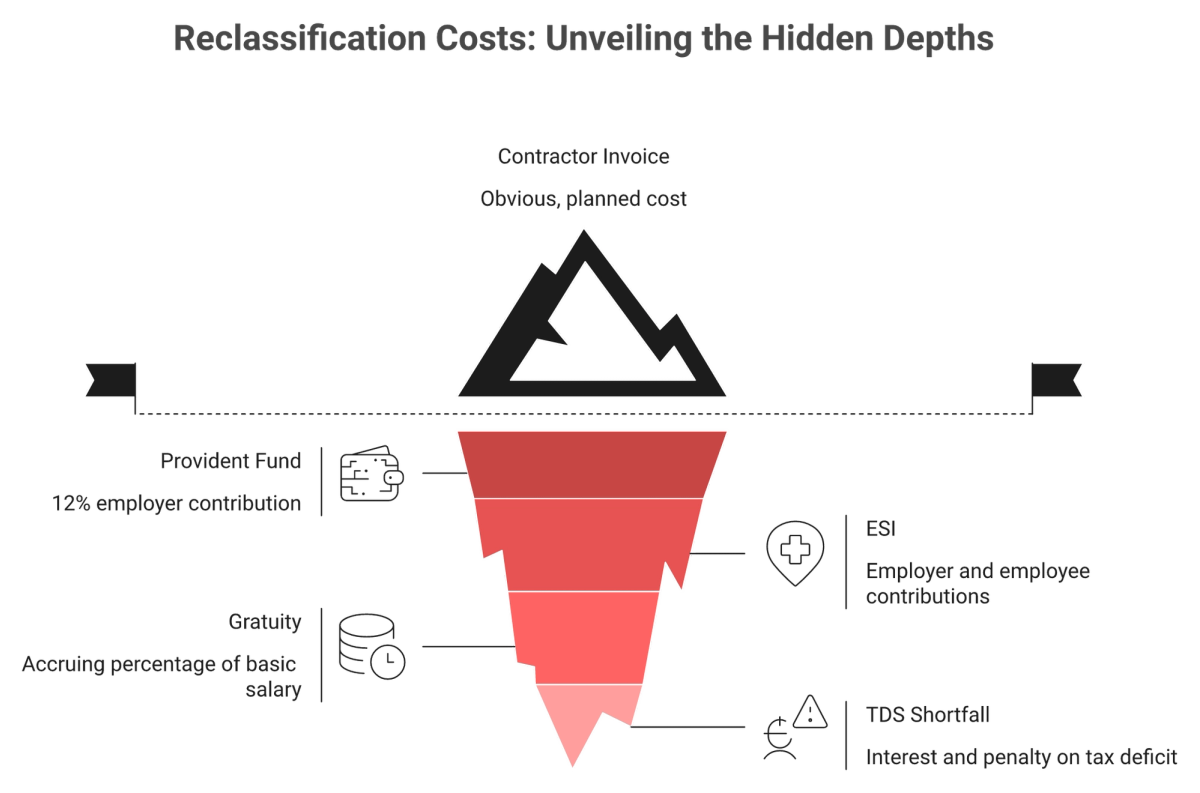
Once a worker is deemed an employee, the liabilities are not forward-looking. They reach back. Here is the rough shape of the exposure.
| Liability | What attaches retroactively |
|---|---|
| Provident Fund (PF) | 12% employer contribution on the wage base |
| Employees' State Insurance (ESI) | 3.25% employer, 0.75% employee split |
| Gratuity | Accrual of about 4.81% of Basic plus DA per year |
| TDS shortfall | Unpaid tax at source, plus interest and penalty |
Each of these is owed from the start of the engagement, not the date of the ruling. That is what turns a quiet contractor arrangement into a five-figure problem. You can model a clean baseline with our employee cost calculator before you commit.
The new math after 21 November 2025
The Labour Codes changed the base these dues sit on. Under Section 2(y) of the Code on Wages, if your excluded allowances exceed 50% of total remuneration, the excess is added back into "wages" for statutory calculation.
In practice, Basic plus DA effectively becomes at least 50% of total pay for PF, ESI, and gratuity math. I want to be precise here, because the category often overstates it. This is a deeming provision, not a rule that dictates how you design CTC. The effect is the same, though: a bigger wage base means bigger retroactive dues if you misclassify.
We run PF, ESI, TDS, and professional tax across all 28 states under our own registrations at Versatile, so we can show you the exposure math line by line, not hand it off to a partner. To see the structural difference between renting an entity and owning one, compare our EOR versus entity breakdown or talk it through on our India EOR service page.
Q5. AOR vs EOR in India: when should you use which?
Use an AOR when the worker is a genuinely independent, self-directed contractor on project-based work you do not control day to day. Use an EOR when you need a full-time employee, control how the work is done, want to offer benefits, or the engagement is long-term. The deciding factors are control, duration, benefits, and Permanent Establishment risk, not just cost. AOR is the suspension bridge; EOR is the Golden Gate.
The bridge analogy I use with every founder
A founder messaged me last month, three weeks from her first India hire, stuck on this exact call. I gave her the picture I always use.
Most of the time you do not have to build the Golden Gate (a full entity or EOR) when a simple suspension bridge (an AOR contractor arrangement) gets you across the river. The trick is knowing which river you are crossing. If you are weighing the structural costs, our EOR versus entity comparison lays out the math.
The four factors that actually decide it
Price is the loudest factor and the least important. These four matter more.

| Factor | Lean AOR (contractor) | Lean EOR (employee) |
|---|---|---|
| Control | You set outcomes, not the "how" | You direct daily work and method |
| Duration | Short, project-based | Long-term, open-ended |
| Benefits | None statutory (can roll comp into invoice) | Full PF, ESI, gratuity, leave |
| PE risk | Lower if kept arm's-length | Managed inside the entity |
Notice the benefits row. Contractors cannot partake in the regular regime of employee benefits, but the contracting firm can roll additional compensation into the monthly invoice. That is a real workaround, not a loophole. You can manage that side cleanly through our contractor payments rail.
Why the contractor often becomes an employee anyway
Here is the part the category avoids saying. An AOR is usually a transition, not a destination. I have watched it happen across our placements again and again.
A People Ops leader joins, audits the team, and realizes a long-tenured "contractor" is really an employee in disguise. Now there is misclassification risk, and the right move is conversion to employment. You can pressure-test that exposure with our misclassification quiz.
There is also a human reason contractors push to convert. A contractor in India finds it exceedingly difficult to get a mortgage, because to the bank, they are still a temp in theory. I have seen relocations fall apart over exactly this.
Where Versatile fits this decision
"It let Moonshot hire in India without standing up an entity, which would've been overkill for our size. They took payroll, contracts, and ongoing compliance off our plate entirely."
Angad S., Founder Versatile G2 Verified Review
Our Contract-to-Hire model at Versatile is built for this exact transition. Start someone as a contractor through our AOR rail, then convert to EOR employment under the same Versatile entity when control or duration tips the scale. You do not re-paper the relationship with a new vendor; it stays under our registrations the whole way.
Q6. What does an AOR NOT solve in India?
An AOR does not solve everything. It does not handle FC-GPR or FDI reporting, which is a FEMA filing for equity, not contractor invoices. It does not eliminate Permanent Establishment risk if you grant signing authority. And it does not give contractors statutory employee benefits like PF, ESI, or gratuity. Knowing these limits is what separates a confident buyer from one running with scissors.
Three things buyers wrongly expect an AOR to cover
The category sells the upside and stays quiet on the boundaries. I would rather draw the line clearly, because surprises here are expensive.
FC-GPR and FDI reporting. This is a Foreign Exchange Management Act (FEMA) filing for equity you allot to a foreign investor.
PE attribution. An AOR reduces this risk but does not erase it. More on that in the next section.
Statutory employee benefits. Contractors do not get PF, ESI, or gratuity by default.
FC-GPR is about equity, not contractor invoices
This one trips up nearly every first-time founder. Form FC-GPR must be filed within 30 days of allotting capital instruments to a person resident outside India, through an Authorised Dealer Category-I bank.
That filing covers equity, not the money you send a contractor every month. Paying a Bengaluru developer is an operating expense. Issuing shares to your US parent is a capital event. An AOR handles the first and has nothing to do with the second, which is closer to company registration in India territory.
Benefits: the honest workaround
Contractors cannot join the employee benefits regime. But the contracting firm can always roll additional compensation into the monthly invoice to cover the gap.
I tell finance leaders this plainly. If you want to "give" a contractor something like a benefit, you price it into the invoice. You do not get to call it PF, and you do not get the tax treatment of PF. When you do want real statutory benefits, that is an EOR service question, not an AOR one.
Where I land on naming the limits
The standard read treats an AOR as a do-everything button. From what surfaces when you actually run multi-state compliance, that framing sets buyers up to fail.
We at Versatile will tell you plainly what our Agent of Record rail does not cover, including FC-GPR if you take an equity stake, so nothing surprises your finance team at year-end. I would rather lose a deal on honesty than win one on a half-truth. That is not a slogan; it is just cheaper for everyone.
Q7. Can engaging an India contractor create Permanent Establishment (PE) risk?
Yes. Under DTAA Article 5, an India contractor who habitually concludes contracts on your behalf can trigger Dependent-Agent PE. On-site services beyond roughly 90 to 183 days can create Service PE, making your company taxable in India. An AOR reduces this by interposing its own entity and keeping the contractor at arm's length, but it does not eliminate PE risk if you grant signing authority or treat the contractor as a fixed extension of your team.
What PE actually means for a US or UK founder
Permanent Establishment (PE) is the tax concept that decides whether your foreign company becomes taxable in India. This is where global playbooks quietly fail founders, because they treat India as one country among 150.
India runs heightened scrutiny on foreign companies operating through agents, consultants, and digital presence. The risk is not abstract. It is one of the most litigated tax issues in India right now, and you can gauge your own exposure with our Permanent Establishment risk quiz.
The two PE traps that catch contractor arrangements
Two flavors of PE matter when you engage an India contractor. Both come from Article 5 of the Double Taxation Avoidance Agreement (DTAA), the treaty that splits taxing rights between countries.
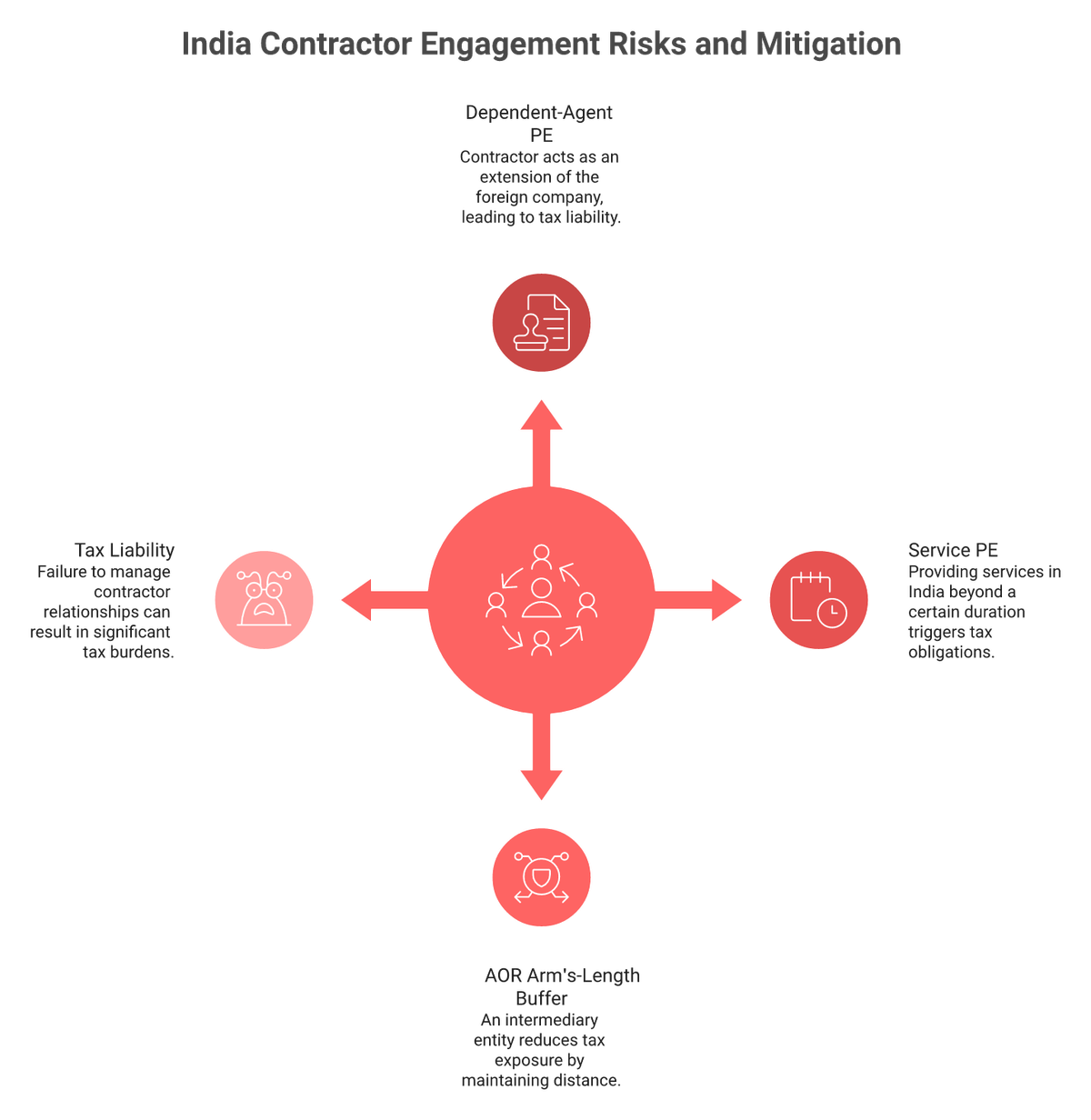
Dependent-Agent PE. Triggered when your India contractor habitually concludes contracts on your behalf, or works almost exclusively for you.
Service PE. Triggered when services are furnished in India beyond a threshold, often in the 90 to 183 day range under the relevant treaty.
A common mistake is handing a "permanent agent" the authority to sign deals locally. That single act can create a taxable presence you never intended.
How an AOR helps, and where it stops
An AOR interposes its own Indian entity between you and the worker. That arm's-length structure lowers PE exposure, because the contractor is not your direct, dependent agent.
But it is not a force field. If you grant signing authority or treat the contractor as a fixed limb of your team, PE risk comes back. I could be conservative here, but on tax I would rather be conservative than clever. For founders weighing scale, our guide to hiring in India without an entity walks through the safer path.
The one rule we never bend
We never let a contractor we engage at Versatile carry signing authority for a client. That single discipline is one of the biggest PE protections we operate, and it is a conversation we have before onboarding, not after. If you want it walked through directly, book a consultation.
From six years of running cross-border engagements, the founders who get burned are the ones who let a "contractor" become the face of the company in India. Keep the authority in your hands, document the arm's-length scope, and the suspension bridge holds.
Q8. How do TDS, GST, FEMA, and DPDP apply to AOR contractor payments?
Contractor payments via an AOR attract TDS under Section 194C (1% for individuals or HUF, 2% for others; thresholds ₹30,000 per payment or ₹1,00,000 aggregate) or Section 194J for professional services (10%), deposited by the 7th of the following month, with 20% applying when no PAN exists. The Income-tax Act 2025 (Section 393) now explicitly covers manpower supply as "work." Foreign remittance follows FEMA rails, and DPDP Rules 2025 make the AOR a data processor with security and contract duties.
The TDS table no competitor publishes
Tax Deducted at Source (TDS) is the tax withheld before the contractor is paid. The section you use depends on the kind of work, and the rate changes with it.
| Section | Applies to | Rate | Threshold |
|---|---|---|---|
| 194C | Contractual work, manpower supply | 1% (Ind/HUF), 2% (others) | ₹30,000 single / ₹1,00,000 aggregate |
| 194J | Professional or technical services | 10% (2% technical) | ₹50,000 |
| No PAN | Any contractor without a tax ID | 20% flat | - |
The deadline is the operating detail people miss. TDS is deducted and deposited by the 7th of the following month. Miss it, and interest runs at 1.5% per month. The Income-tax Act 2025 also closed an old gap by treating manpower supply explicitly as "work" under Section 393. Our India GST and IT compliance rail keeps this correct every cycle.
GST, FEMA, and the data piece nobody mentions
Three more layers ride alongside TDS. Each one is easy to overlook until it bites.
GST and invoicing. A contractor billing above the GST threshold must charge it; the AOR validates the invoice.
FEMA remittance. Cross-border funds move through compliant rails, not a personal wallet transfer.
DPDP duties. The Digital Personal Data Protection (DPDP) Rules 2025 were notified on 16 November 2025, with phased compliance and penalties up to ₹250 crore for security failures.
Under DPDP, your AOR becomes a data processor handling your contractors' personal data. That means a real data-processing clause, not a handshake. I almost never see this raised on competitor pages, and it is a live obligation now. We build it into our compliant contracts by default.
Why "USD invoice" is the trust signal here
"Versatile's Employer of Record India service made this seamless, contracts, PF, ESI, TDS, and payroll all handled in one place. Invoicing in USD meant zero exchange rate surprises."
Vedant T., Founder Versatile G2 Verified Review
Compare that to the fee experience buyers report on global platforms.
"I find Deel to be absurdly expensive. They charge a high amount of fees for transferring money to my bank account."
Juan Camilo O., Verified User Deel G2 Verified Review
We invoice you in USD directly from our Indian entity at Versatile, with no FX markup and no partner-shell hop, and we deposit TDS by the 7th every month. That is why your month-end close is not waiting on someone else's books. If you want to model the all-in cost, use our employee cost calculator.
Q9. Who are the AOR / EOR providers for India, and how do they compare on price and entity model?
India contractor and EOR providers split into three groups: India-native specialists, global generalists, and broad payment rails. Pricing runs roughly $19 to $49 per contractor per month, but the headline rate hides FX markups of 1% to 5%, plus setup and exit fees. The biggest structural difference is the entity model. Most global providers route India through local partner entities, while a few operate their own Indian entity, and that decides who actually holds your contractors' PF, ESI, TDS, and professional-tax filings.
The three groups, and where the money really goes
I get this question every week, usually framed as "is Deel fine for India?" My honest answer is: it depends on what you are optimizing for. Here is how the field actually sorts. If you want a head-to-head view, our Versatile versus Deel comparison goes deeper.
| Provider | Entity model | FX markup | Contractor pricing | India depth |
|---|---|---|---|---|
| Versatile | Owns its Indian entity | None (USD from India) | EOR $149/mo; C2H 20-30% of salary | India-only specialist |
| Wisemonk | India-native | ~1% over settlement | ~$19/contractor/mo | India-native |
| Deel | Local partner entity | 3-5% reported | ~$49/contractor/mo | One of 150 countries |
| Velocity Global (Pebl) | Local partner entity | Bundled in fee | Premium tier | Multi-country |
Numbers move, so treat them as directional and verify at quote time. The pattern under them does not move. You can sanity-check the all-in math with our India EOR pricing breakdown.
The aggregate vulnerability nobody markets
Here is the structural point the category avoids. Most global EOR and AOR providers use local partner entities in India. We do not at Versatile.
That matters because of whose name is on the filing. With a partner-shell model, your contractors' PF, ESI, TDS, and professional-tax filings sit under a third party's registrations. With an owned Indian entity, they sit under ours. When an audit lands, that difference is the whole game.
The other quiet cost is FX. A "low" base fee with a 3% to 5% currency markup can cost more than a higher base fee with no markup. Buyers feel this directly.
"I find Deel to be absurdly expensive. They charge a high amount of fees for transferring money to my bank account."
Juan Camilo O., Verified User Deel G2 Verified Review
Support is the third gap. Global generalists lean on ticket queues, and it shows.
"There is no direct phone line. You either email or use a chatbot, and you can ask both the same question and get two different wrong answers."
Erika D., Verified User Rippling G2 Verified Review
To be fair, India-native players earn real praise too, and I will name it.
"It feels like working with a partner rather than just a payment or compliance vendor."
Verified User, Marketing and Advertising Wisemonk G2 Verified Review
Where I think this goes
What I think shifts in the next two years is simple. India stops being one country on a global map and becomes its own specialist category. Owned-entity operators eat the generalists' India revenue, because audit-readiness and FX honesty beat breadth for buyers who only hire in India. If you are comparing options, our Deel alternatives for India page lays out the field.
Q10. What should you look for when choosing an India AOR partner?
Choose an India AOR on six things, not just price: whether they own their Indian entity or rent a partner shell; FX and fee transparency; built-in background verification; a clean conversion path from contractor to EOR employee; how you actually get support; and what guarantees back the placement. The right partner makes the contractor-to-employee transition smooth instead of a re-papering scramble.
The six-point checklist I would use as a buyer
If I were hiring my first person in India tomorrow, this is the rubric I would run. Each item maps to a real failure I have watched happen.
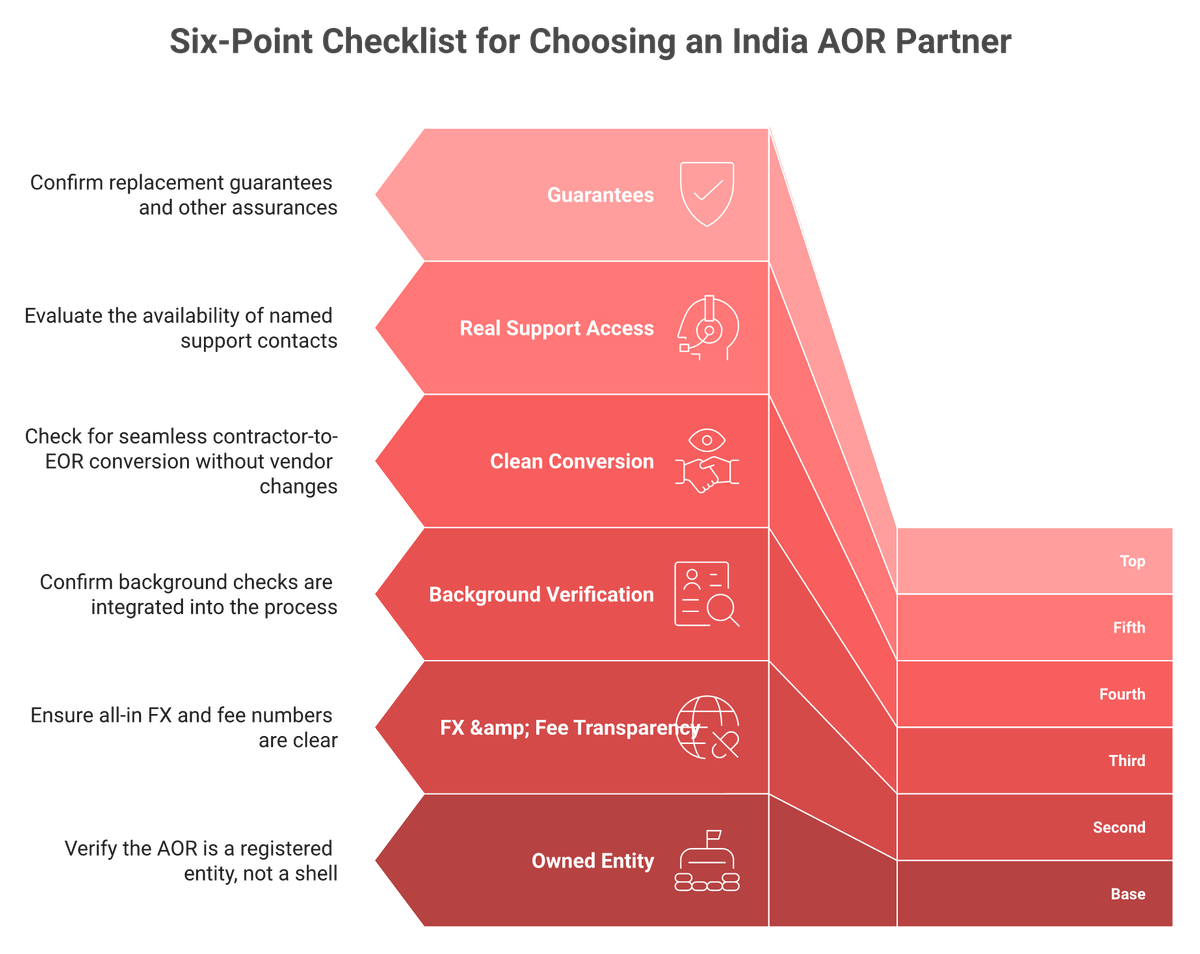
Owned entity, not a partner shell. Ask whose registrations hold the PF, ESI, and TDS filings.
FX and fee transparency. Get the all-in number, including currency markup, setup, and exit fees.
Background verification inside the flow. With ~30% of India IT resumes showing discrepancies, background verification is not optional.
A clean contractor-to-EOR conversion. You will likely convert; make sure it does not mean switching vendors.
How you reach support. A founder or a named person beats a ticket queue at 3am.
Guarantees that back the hire. A replacement guarantee tells you they believe in the placement.
The story behind why these matter
A client once thought they were interviewing someone based in London. It was only after the third interview that they realized the person was actually based in Greece. They came to us, and we employed that person properly through our contractor engagement rail.
That is the felt reality of cross-border hiring. The map and the territory drift apart, and you want a partner who can re-anchor the engagement on real ground, fast. Our guide to hiring in India without an entity covers the playbook.
How buyers describe getting this right
The checklist is not theory. It shows up in how founders talk about the experience.
"Founder is just a call away. Extremely helpful in resolving all our queries. The process is super smooth to setup India EOR."
surbhi m., Founder Versatile G2 Verified Review
"Versatile made onboarding feel easy. The team's responsive, clear, and great to work with. A few time zone misunderstandings caused slight delays in the initial phase."
Setu C., Verified User Versatile G2 Verified Review
I include that second quote on purpose. We are not perfect on time zones, and I would rather you know that than be sold a flawless story.
What I am sitting with
This checklist is, frankly, how we built Versatile: an owned Indian entity, USD-from-India transparency, BGV inside the flow, a clean Contract-to-Hire to EOR conversion, a 6-month replacement guarantee, and me on WhatsApp.
A fair caveat: if you need five or more countries, or you are an enterprise that requires SOC 2 or ISO 27001 as a procurement gate, a global generalist may fit you better. We are India-only by design.
So here is the question I keep turning over. If India is the only country you are hiring in, why would you buy a 150-country tool to do it? Tell me what you are building, and I will tell you honestly whether we are the right fit. You can book a consultation whenever you are ready.
FAQs
What is an Agent of Record (AOR) in India?
We define an Agent of Record (AOR) in India as a third party that engages, contracts, and pays your independent contractors compliantly. It is the contractor-side counterpart to an Employer of Record, and using one does not by itself convert a contractor into an employee under Indian law.
A working AOR covers four jobs, not just payments:
- Classification checks that confirm genuine contractor status.
- Compliant contracts that hold up under Indian scrutiny.
- Invoicing and bulk payments, including tax at source.
- Tax documentation for TDS and GST.
One caveat trips up first-timers: to raise a valid invoice, the contractor must be incorporated or otherwise recognised as a business. When we run our Agent of Record in India rail, we operate through our own registered Indian entity, so the contractor's payments and tax documentation sit under our registrations, not a partner shell's. That ownership is the difference buyers feel during an audit, when the question becomes whose name is actually on the filing. For genuinely independent, project-based work, an AOR is the cleanest, fastest way to engage India talent without standing up an entity.
How is an AOR different from an Employer of Record (EOR) in India?
We get this question on almost every first call. The short version: an EOR becomes the legal employer of your full-time staff, while an AOR engages genuinely independent contractors. The deciding factors are control, duration, benefits, and Permanent Establishment risk, not just price.
- Control: Lean AOR if you set outcomes, lean EOR if you direct the daily how.
- Duration: AOR for short, project-based work; EOR for long-term roles.
- Benefits: EOR carries PF, ESI, gratuity, and leave; contractors do not get these by default.
- PE risk: Lower with an arm's-length AOR, managed inside the entity with an EOR.
In practice, an AOR is often a transition, not a destination. A long-tenured contractor frequently needs converting to employment as misclassification risk grows. We built our contractor engagement model to convert cleanly into EOR employment under the same Versatile Club entity, so you never re-paper the relationship with a new vendor. You can also weigh the structural trade-offs in our EOR versus entity breakdown before deciding which path fits your India hire.
Does an AOR protect us from contractor misclassification in India?
We tell every founder the same thing: an AOR is real protection on the contracting and payment layer, but it is not a shield if you control how the work is done. Indian law applies a control test. If you direct not just what work is done, but the manner in which it is done, the person is an employee regardless of the AOR contract.
So the protection is procedural compliance, not a license to treat an employee as a contractor. The AOR gives you:
- Clean, compliant contracts.
- Correct tax withholding and valid invoicing.
- FEMA-compliant cross-border payments.
What it cannot do is rescue you if you manage a contractor like staff. Compliance is the floor, not the ceiling. The real protection lives in keeping the relationship genuinely independent, which is something you do, not something you buy. Before we sign anyone, we help qualify that independence, and you can pressure-test your own exposure with our misclassification quiz. If control is unavoidable for the role, the honest answer is usually employment through an EOR rather than a contractor arrangement.
What does contractor misclassification actually cost in India?
We open this conversation with a number, because finance leaders read in numbers. Getting it wrong in India can cost roughly $25,000 to $40,000 per head in back-pay exposure, plus retroactive statutory dues once a contractor is deemed an employee.
When reclassification happens, the liabilities reach back to the start of the engagement, not the ruling date:
- Provident Fund at 12% employer contribution on the wage base.
- ESI at a 3.25% employer and 0.75% employee split.
- Gratuity accruing at about 4.81% of Basic plus DA per year.
- TDS shortfall, plus interest and penalty.
Since the four Labour Codes took effect on 21 November 2025, a standardized wages definition pushes Basic plus Dearness Allowance toward at least 50% of total pay for statutory math. A bigger wage base means bigger retroactive dues. We run PF, ESI, TDS, and professional tax across all 28 states under our own registrations, so we can show the exposure line by line. You can model a clean baseline first with our employee cost calculator before committing to any engagement structure.
Can engaging an India contractor create Permanent Establishment (PE) risk?
Yes, and we treat this conservatively because it is one of India's most litigated tax issues. Permanent Establishment (PE) decides whether your foreign company becomes taxable in India, and contractor arrangements can trigger it in two ways under Article 5 of the relevant tax treaty.
- Dependent-Agent PE: triggered when your contractor habitually concludes contracts on your behalf, or works almost exclusively for you.
- Service PE: triggered when services are furnished in India beyond a threshold, often in the 90 to 183 day range.
An AOR reduces PE exposure by interposing its own Indian entity and keeping the contractor at arm's length. It is not a force field, though. If you grant signing authority or treat the contractor as a fixed limb of your team, the risk comes back. The single biggest discipline we hold is that we never let a contractor we engage carry signing authority for a client. You can gauge your own situation with our Permanent Establishment risk quiz, then talk it through before you onboard anyone in India.
How do TDS, GST, FEMA, and DPDP apply to AOR contractor payments?
We keep these four layers inside the payment cycle so nothing surprises your finance team. Tax Deducted at Source (TDS) is withheld before the contractor is paid, and the rate depends on the work.
- Section 194C: 1% for individuals or HUF, 2% for others, on contractual work and manpower supply.
- Section 194J: 10% for professional or technical services.
- No PAN: a flat 20% applies when the contractor has no tax ID.
TDS is deposited by the 7th of the following month, with interest at 1.5% per month for delays. The Income-tax Act 2025 also treats manpower supply explicitly as work under Section 393. Alongside that sit GST on qualifying invoices, FEMA-compliant cross-border remittance, and Digital Personal Data Protection (DPDP) Rules 2025 duties that make the AOR a data processor. We build these obligations into our India GST and IT compliance rail, and we invoice in USD directly from our Indian entity with no FX markup, so your month-end close is not waiting on someone else's books.
Who are the AOR and EOR providers for India and how do they compare?
We see providers split into three groups: India-native specialists, global generalists, and broad payment rails. Contractor pricing runs roughly $19 to $49 per month, but the headline rate hides FX markups of 1% to 5%, plus setup and exit fees.
The biggest structural difference is the entity model:
- Owned Indian entity: your contractors' PF, ESI, TDS, and professional-tax filings sit under one set of registrations.
- Local partner shell: those filings sit under a third party, which matters most when an audit lands.
Global generalists offer breadth across many countries but often route India through partner entities with ticket-queue support and FX markups buyers feel directly. India-native players earn real praise for partnership and clarity. We operate Versatile Club as an India-only specialist through our own entity, with USD invoicing direct from India, no setup or exit fees, and a first month free. You can run a head-to-head with our Deel alternatives for India page and sanity-check the all-in math against current India EOR pricing before shortlisting.
What should we look for when choosing an India AOR partner?
We would judge an India AOR on six things, not just price. Each maps to a real failure we have watched happen.
- Owned entity, not a partner shell: ask whose registrations hold the PF, ESI, and TDS filings.
- FX and fee transparency: get the all-in number, including currency markup and setup or exit fees.
- Background verification inside the flow: with around 30% of India IT resumes showing discrepancies, BGV is not optional.
- A clean contractor-to-EOR conversion: you will likely convert, so it should not mean switching vendors.
- How you reach support: a founder or named person beats a ticket queue at 3am.
- Guarantees that back the hire: a replacement guarantee signals real confidence.
This checklist is, frankly, how we built Versatile Club: an owned Indian entity, USD-from-India transparency, BGV inside the flow, a clean conversion path, and a 6-month replacement guarantee. One fair caveat: if you need five or more countries, a global generalist may suit you better, because we are India-only by design. If India is your focus, book a consultation and we will tell you honestly whether we fit.