Table of contents (10)
- Understanding the Core Differences
- The AI Developer Path
- The Data Scientist Path
- Key Comparison: AI Developer vs. Data Scientist
- Hybrid Roles: The Blurred Line
- Choosing the Right Path for You
- Building Your Skills: A Practical Starting Point
- The Future of Both Roles
- Frequently Asked Questions
- Conclusion
AI Developer or Data Scientist? Which Career Path is Right for You?
Understanding the Core Differences
The distinction between an AI developer and a data scientist is often misunderstood because both roles work with algorithms and machine learning models. However, their focus areas, responsibilities, and daily workflows differ significantly.
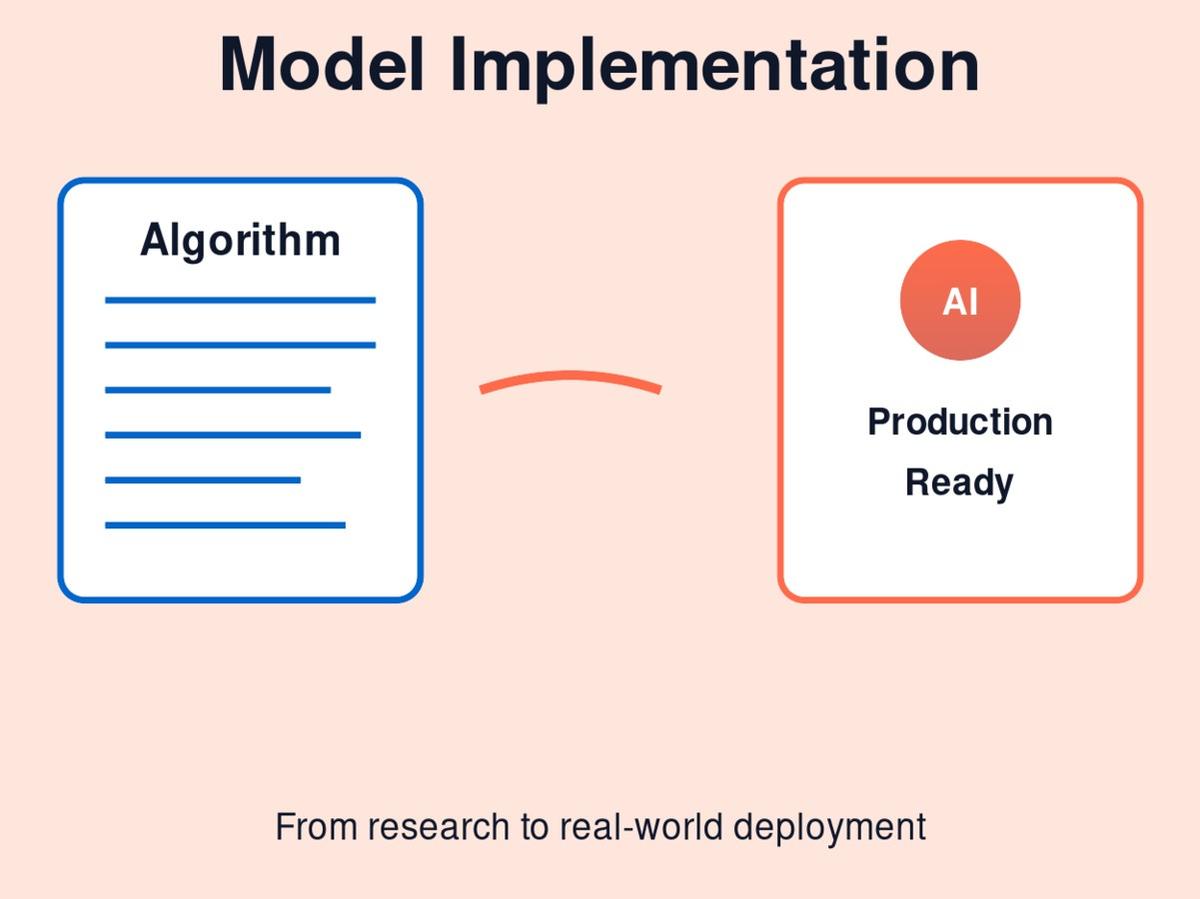
An AI developer is primarily an engineer who translates machine learning models into production-ready applications. They focus on taking theoretical models created by data scientists and turning them into scalable, robust software systems that end users interact with. Their mindset is anchored in software engineering best practices: clean code, version control, testing, and system architecture.
A data scientist, by contrast, is fundamentally a researcher and analyst. They spend their time extracting insights from raw data, building predictive models, and answering specific business questions. Their focus is on the "what" and "why" of data patterns, not on whether those patterns can be efficiently deployed at scale.
Think of it this way: a data scientist discovers that a new machine learning model can predict customer churn with 92% accuracy. An AI developer then takes that model and integrates it into the company's customer retention platform, ensuring it processes 10,000 requests per second with minimal latency.
The AI Developer Path
Role and Core Responsibilities
AI developers specialize in architecting and implementing AI systems that solve real-world problems. Their responsibilities span the entire lifecycle of AI application development.
Model Implementation and Integration: AI developers take pre-trained or newly built machine learning models and embed them into larger software systems. This might involve converting a Python-based model into a production-grade API, containerizing it for cloud deployment, or optimizing it for edge devices. They select appropriate frameworks (TensorFlow, PyTorch) and languages to match the deployment environment.
System Architecture and Scalability: Building an AI application that works well for one prediction is vastly different from building one that handles millions of concurrent requests. AI developers design systems that can scale horizontally, implement caching strategies, manage version control for models, and ensure high availability. They work closely with DevOps engineers to automate deployment pipelines.
Performance Optimization: AI developers continuously optimize models for speed and resource efficiency. They implement techniques like model pruning, quantization, and distillation to reduce latency and memory footprint. They monitor deployed models in production and catch performance regressions before they impact users.
Cross-functional Collaboration: AI developers bridge the gap between data science teams and product teams. They translate business requirements into technical specifications, provide feedback to data scientists on model performance in production, and help product managers understand the capabilities and limitations of AI systems.
Essential Skills for AI Developers
Programming Languages and Frameworks: Mastery of Python is non-negotiable. AI developers should also be comfortable with Java or Go for systems that require high performance. Proficiency with TensorFlow, PyTorch, or ONNX Runtime is crucial for model deployment.
Software Engineering Fundamentals: Deep knowledge of software design patterns, SOLID principles, and system architecture is essential. AI developers must write testable, maintainable code that other engineers can review and modify. Version control (Git), CI/CD pipelines, and containerization (Docker, Kubernetes) are everyday tools.
Database and Data Pipeline Knowledge: Understanding SQL, NoSQL databases, and data streaming platforms (Kafka, Spark) helps AI developers design systems that efficiently ingest, process, and serve data to AI models. Many AI systems are only as good as the data pipelines feeding them.
Cloud Platform Expertise: Most AI applications run on cloud infrastructure. Familiarity with AWS (SageMaker, EC2), Google Cloud (Vertex AI), or Azure (Machine Learning) is increasingly expected.
Mathematics for Implementation: While AI developers don't need to derive algorithms from first principles, they must understand enough linear algebra, calculus, and probability to debug model issues and make informed optimization decisions.
Career Progression and Salary Expectations
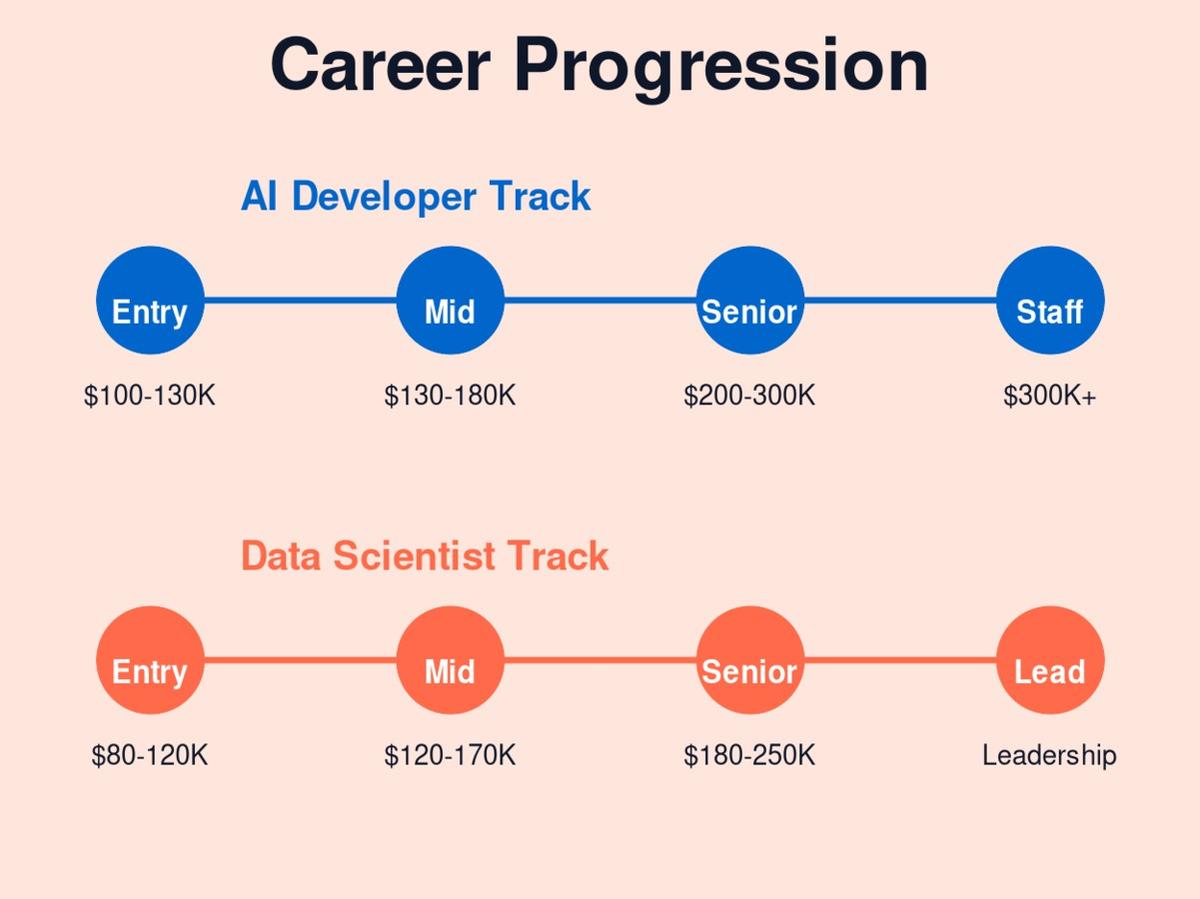
Entry-level AI developers (0-2 years) typically earn $100,000-$130,000 USD annually, though this varies by location and company. Mid-level positions (3-5 years) command $130,000-$180,000, and senior/staff roles can exceed $250,000 with equity and bonuses. The trajectory is similar to senior software engineers, with advancement based on architectural contributions and team leadership.
Opportunities exist across industries: autonomous vehicles, healthcare tech, e-commerce recommendation systems, fintech, and enterprise software all employ AI developers. The role has strong job security, with demand consistently outpacing supply.
The Data Scientist Path
Role and Core Responsibilities
Data scientists are investigators who uncover hidden patterns in data and build models that inform business strategy. Their work is less about production systems and more about discovery and experimentation.
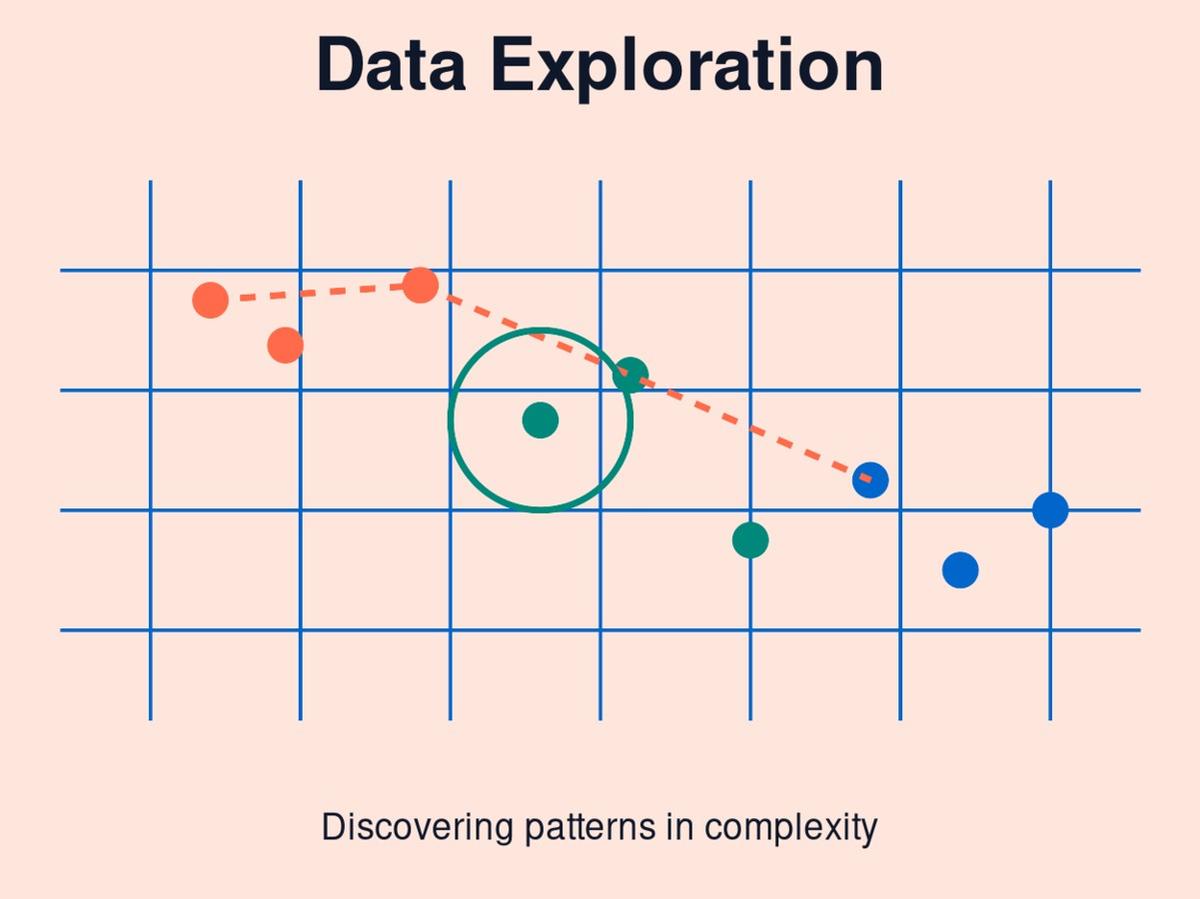
Data Exploration and Analysis: Data scientists spend significant time understanding datasets. They ask questions like: What patterns exist in customer behavior? Which variables predict product success? Where are we losing revenue? This phase involves statistical exploration, visualization, and hypothesis generation. They might spend weeks exploring data before identifying a promising direction.
Predictive Modeling: Using techniques like regression, classification, clustering, and deep learning, data scientists build models that predict future outcomes or classify new data. This process is highly iterative: build a model, evaluate it, understand failures, try a different approach, repeat. Most of their code is exploratory and doesn't ship to production.
Statistical Experimentation: Data scientists design and run experiments to validate hypotheses. They conduct A/B tests, propensity score matching, and controlled experiments to determine whether a proposed strategy actually works. They understand concepts like statistical significance, power analysis, and multiple hypothesis correction.
Communication and Storytelling: A critical but often underappreciated responsibility is translating technical findings into business language. Data scientists create dashboards, write reports, and present findings to non-technical stakeholders. The goal is to enable better decisions, not to publish academic papers.
Business Problem Framing: Experienced data scientists spend significant time understanding business context. They work with product managers and executives to define the right problem to solve. A poorly framed problem leads to technically correct but strategically useless results.
Essential Skills for Data Scientists
Programming Languages: Python is the de facto standard, with R used in companies with strong statistics traditions. SQL proficiency is essential for accessing and transforming data. Some data scientists also learn Scala or Java, though this is less common.
Statistics and Experimental Design: Deep understanding of probability theory, statistical inference, and experimental design is fundamental. Data scientists must know the assumptions underlying their models and when those assumptions are violated. They should understand concepts like bias-variance tradeoff, overfitting, and confounding variables.
Machine Learning Theory and Practice: Comprehensive knowledge of supervised learning (regression, classification), unsupervised learning (clustering, dimensionality reduction), and increasingly, deep learning. Data scientists must know when to use which algorithm and why.
Data Wrangling and Preparation: In practice, data scientists spend an estimated 60-80% of their time on data cleaning, transformation, and feature engineering. They work with missing values, inconsistent formats, and real-world messiness. Tools like pandas, dplyr, or Spark are used daily.
Data Visualization and Communication: Proficiency with visualization tools (Matplotlib, ggplot2, Tableau, Looker) and the ability to tell compelling stories with data. This skill often differentiates exceptional data scientists from average ones.
Domain Knowledge: Successful data scientists develop deep expertise in their domain (e.g., finance, healthcare, e-commerce). Understanding the business context, regulatory constraints, and practical limitations of the industry is invaluable.
Career Progression and Salary Expectations
Entry-level data scientists (0-2 years) typically earn $80,000-$120,000 USD annually in the US market, though this varies by location and company. Mid-level positions (3-5 years) range from $120,000-$170,000. Senior data scientists and analytics leaders can earn $180,000-$250,000+. While entry-level salaries are slightly lower than AI developers, the ceiling is comparable, especially for senior and leadership roles.
However, data science has a broader career surface area. Data scientists can move into product management, executive analytics roles, data engineering, or specialized fields like applied AI research. The flexibility of the role attracts people from diverse educational backgrounds.
Key Comparison: AI Developer vs. Data Scientist
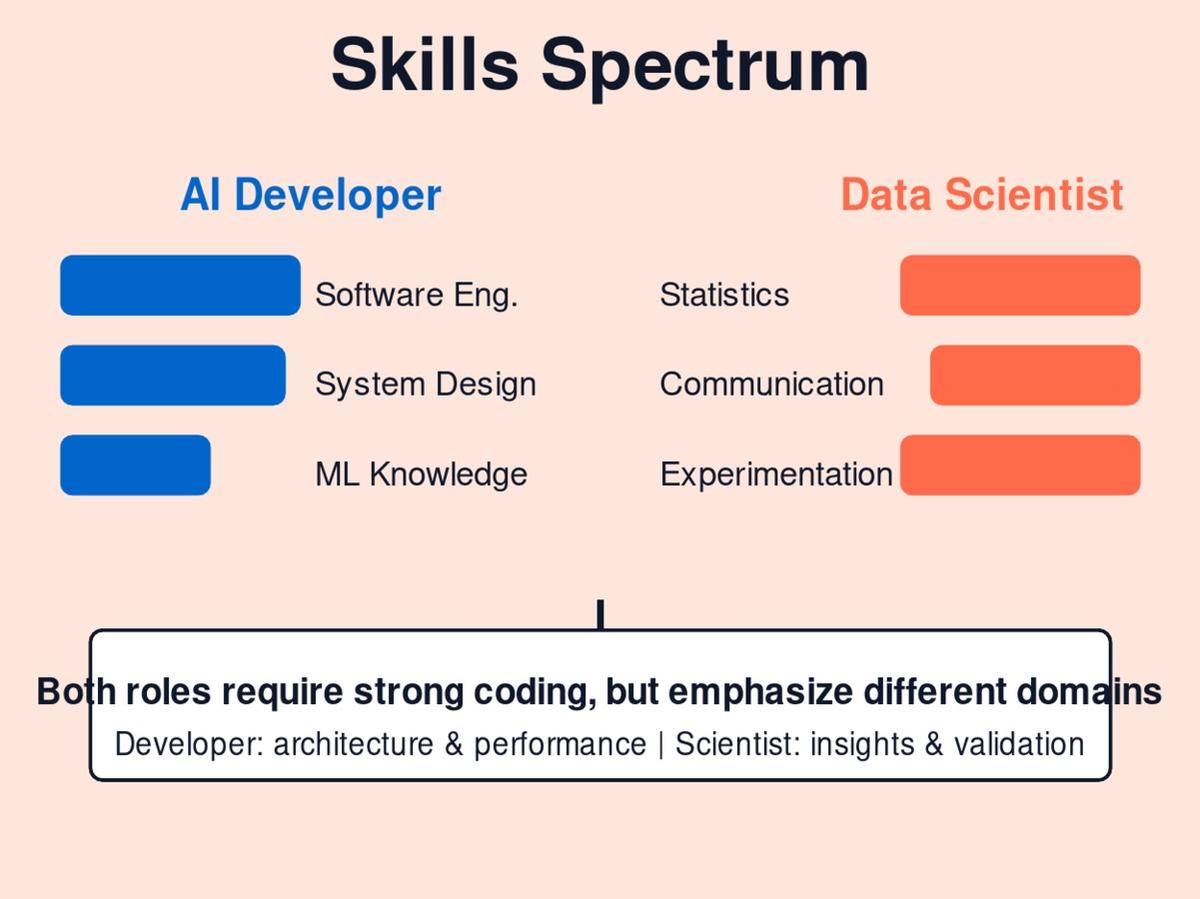
| Dimension | AI Developer | Data Scientist |
|---|---|---|
| Primary Focus | Building production systems and applications | Extracting insights and building predictive models |
| Tools & Languages | Python, Java, TensorFlow, PyTorch, Kubernetes | Python, R, SQL, Jupyter, statistical packages |
| Output | Deployed models, APIs, production systems | Reports, dashboards, experimental results |
| Time on Code | High - writes production-quality code daily | Medium - much time on data exploration and communication |
| Skill Emphasis | Software engineering, system architecture | Statistics, experimentation, communication |
| Collaboration | Works closely with DevOps, product, QA teams | Works with business stakeholders, sometimes isolated |
| Problem-Solving Style | Systematic, follows engineering best practices | Exploratory, hypothesis-driven |
| Career Trajectory | Software engineer → Senior engineer → Staff/Principal engineer | Individual contributor → Lead data scientist → Chief analytics officer or Head of ML |
Hybrid Roles: The Blurred Line
In practice, the boundaries between these roles often blur. Some companies hire "ML engineers" who have skills spanning both domains. In startups, a single person might do both data science and AI development. Many organizations have:
ML Engineers: Engineers with strong data science foundations who focus on end-to-end machine learning systems from data pipeline to production inference.
Analytics Engineers: Data professionals who combine SQL, Python, and visualization to build data products and dashboards.
MLOps Engineers: Specialists focused on the operational aspects of machine learning: monitoring, retraining pipelines, model governance.
AI Researchers: Academics and researchers who advance the state of the art in machine learning algorithms. Often deeper in statistics and theory, lighter on production engineering.
Understanding these hybrid roles is important because they're increasingly common. Your first job might give you exposure to multiple areas, helping you find your true calling.
Choosing the Right Path for You
Consider Your Natural Strengths
Choose AI Developer if you:
- Find satisfaction in building systems that work reliably at scale
- Enjoy thinking about architecture, performance optimization, and edge cases
- Prefer well-defined problems with measurable solutions
- Like the clarity of code reviews and testing frameworks
- Want to work cross-functionally with product and operations teams
Choose Data Scientist if you:
- Love exploring data and discovering hidden patterns
- Enjoy the scientific method: forming hypotheses, testing, and iteration
- Are comfortable with ambiguity and complex business questions
- Like communicating insights to non-technical audiences
- Prefer depth in statistics and theoretical understanding
Consider Your Interests and Time Investment
AI development requires strong foundational knowledge of software engineering. If you're just starting your career, you'll need to invest 1-2 years building your engineering chops (design patterns, testing, distributed systems) before you can be truly effective.
Data science is more accessible to people from diverse backgrounds. If you have strong statistics, math, or domain expertise, you can be productive in data science roles relatively quickly.
Consider Practical Factors
Job Availability: Both roles have strong demand, but the distribution varies by location and company size. Large tech companies hire many AI developers. Consulting firms and enterprises hire data scientists. Startups often need both.
Growth Rate: AI development roles are growing faster as companies prioritize model deployment and MLOps. Data science roles are growing steadily but not as explosively.
Ease of Entry: Entry into data science is easier if you're coming from non-CS backgrounds (mathematics, physics, economics). Entry into AI development is more structured through traditional computer science paths.
Geographic Flexibility: Both roles offer remote work opportunities, though AI development roles might be slightly more location-flexible since they align with traditional software engineering.
Building Your Skills: A Practical Starting Point
For Aspiring AI Developers
Start with a strong foundation in computer science fundamentals. Take courses on data structures, algorithms, and system design. Learn Python deeply. Then layer on machine learning knowledge through structured programs like:
- Fast.ai or Stanford's CS224N for NLP
- DeepLearning.AI for deep learning fundamentals
- Hands-on projects building APIs and deploying models to cloud platforms
Practice is essential. Build side projects that go from notebook to production. Learn Docker, CI/CD, and cloud platforms. Contribute to open-source ML projects to learn industry best practices.
For Aspiring Data Scientists
A strong statistics foundation is crucial. Take courses in probability theory, statistical inference, and experimental design. Learn Python and SQL thoroughly. Develop domain expertise in an industry of interest.
Build a portfolio of real projects using public datasets. Kaggle competitions are useful for learning, but real-world projects (with messy data and ambiguous goals) are more valuable for building practical skills. Focus on communication: write blog posts explaining your analysis, create compelling visualizations, practice presenting findings clearly.
The Future of Both Roles
The distinction between AI developers and data scientists will likely sharpen in the coming years. AutoML tools are raising the floor for data science, allowing business analysts to build predictive models without extensive coding. Meanwhile, the infrastructure complexity of production ML systems is rising, making AI development more specialized and engineering-focused.
Both roles will remain high-demand for the foreseeable future. The broader category of "machine learning" is genuinely splitting into specialized disciplines, much like how "software engineering" split into frontend, backend, DevOps, and security engineering.
If you enjoy building systems, choose AI development. If you enjoy discovering insights, choose data science. The most successful people in either field are those who chose based on genuine interest, not market hype.
Frequently Asked Questions
Do I need a PhD to become an AI developer or data scientist?
No, neither role requires a PhD. For AI development, a CS degree is helpful but not mandatory; many successful AI developers come from bootcamps or self-taught backgrounds. For data science, advanced degrees (Masters in Statistics or related fields) are more common but still not required. What matters most is portfolio and demonstrated capability. Many successful data scientists have degrees in math, physics, or economics.
What's the typical timeline to become hireable in each role?
For AI development, expect 1-2 years of focused learning if you start from zero technical background. If you already have software engineering experience, transition to AI development takes 3-6 months of focused ML study. For data science, 6-12 months of focused learning is typical if you have strong math/statistics foundations. Bootcamps can compress this, but depth of learning suffers. Real-world portfolio projects matter more than credentials.
Can I transition between AI developer and data scientist roles?
Yes, but it requires picking up new skills. A strong AI developer can transition to data science by deepening their statistics and experimental design knowledge. A data scientist can transition to AI development by strengthening their software engineering and system design fundamentals. The transition takes 6-12 months for most people. The skills overlap significantly enough that neither transition feels like starting from zero.
Which role has better job security and income potential?
Both roles have strong job security and comparable income potential. AI development roles currently have slightly higher entry-level salaries and faster-growing demand. Data science roles offer more flexibility and have clearer paths to leadership positions like Chief Analytics Officer. Income potential at senior levels (10+ years) is similar for both, ranging from $250k-$500k+. Choose based on interest, not salary—you'll be better at work you enjoy.
What if I want to do both—become a full-stack ML person?
Some people build skills in both areas, becoming "full-stack ML engineers" who can move from data exploration to production deployment. This is increasingly valued in smaller companies and startups. However, it's a broader skill set that takes longer to develop (3-5 years of focused work). Most people in large organizations eventually specialize in one area because the depth gets very deep. Consider full-stack skills if you like variety and work in smaller, resource-constrained settings.
Conclusion
Both AI developer and data scientist roles offer rich, rewarding careers in technology. The choice between them should be based on your natural strengths, learning style, and what kind of work energizes you. AI developers build the systems; data scientists explore the data. Both are essential to modern AI applications.
The job market will remain strong for both roles for years to come. What matters most is starting your learning journey now, building a portfolio of real work, and following the path that aligns with how your mind works.
Whether you choose to build models or deploy them, your career in AI and data science can be deeply fulfilling and financially rewarding. The most important thing is to make a choice and commit to becoming genuinely excellent at it.
If you're planning to hire AI developers or data scientists for your team (especially from India's thriving tech talent pool), Versatile is an India-native EOR that helps companies like yours build remote teams quickly. We handle compliance, payments, and HR so you can focus on finding the right talent. If you decide India is your answer for building this capability, let's talk. You can reach out via WhatsApp or schedule a quick call—no sales pitch, just a conversation.