Table of contents (9)
How to Switch EOR Providers in India: Employee Transition, Statutory Continuity, and Timing
Q1: When Should You Actually Switch Your India EOR Provider?
You should switch your India EOR when the basics break: payroll lands late, statutory filings cannot be verified, nobody answers the Basic plus DA 50% wage question, and support routes you through a ticket queue instead of a person. The loudest signal is a funding round. Investors want audit-ready India payroll, and a global generalist treating India as one country among 150 rarely delivers that depth.
⚠️ The trigger moment nobody names out loud
I once got a WhatsApp message from a US founder at 11pm her time, three days before payroll. Her Bengaluru engineer's PF challan had not landed, and her provider's chatbot kept looping her. That is the real trigger. Not a strategy deck, a Tuesday night panic.
Most switch conversations start there. Payroll slips once. Then a compliance question goes unanswered. Then you realize you cannot actually see your own filings.
💸 What "running with scissors" looks like
A People Ops leader I worked with called her old setup "running with scissors." She meant she needed an army of experts just to cross every t on the arrangement. From what surfaces when you actually run this, that feeling is the signal, not the paperwork.
The standard read says wait until the contract renews. I think that gets it backwards. The cost of a bad India EOR is not the monthly fee, it is the audit risk sitting quietly under every payslip. This is exactly why our EOR services in India put statutory accuracy first.
❌ The enterprise coldness tax
Here is a scene from outside our industry that fits perfectly. A manager once described entering a single spend request into a corporate procurement system. Twenty names had to sign off before he could start, including people he had never heard of, sitting in a procurement office in Guadalajara, Mexico.
That is what enterprise coldness feels like. When your EOR runs like that, you are not a client, you are a ticket number.
Buyers switching away from global generalists say the same thing again and again:
"They very clearly have no idea what they're doing. Within the first week, they changed 5 reps handling my case. They also subleased our contract to a 3rd party without letting me know."
Verified User, Remote G2 Verified Review
"We specifically explained we required phone level support for urgent matters, but that is not available. Instead they have email support with a 3 day SLA. Twice we've had near catastrophic errors."
Juliette D., Remote G2 Verified Review
✅ Switch or conversation? A 4 point self check
Run this before you sign anything new:
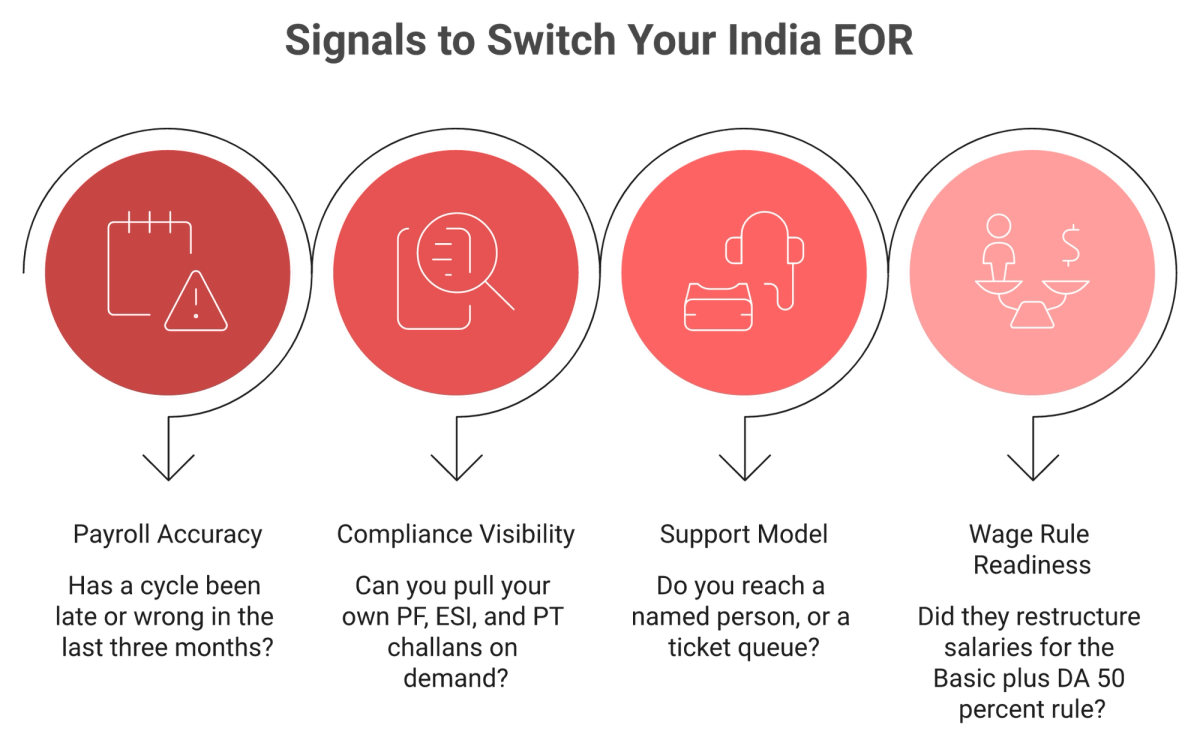
Payroll accuracy: Has a payroll cycle been late or wrong in the last three months?
Compliance visibility: Can you pull your own PF, ESI, and PT challans on demand?
Support model: Do you reach a named person, or a ticket queue?
Wage rule readiness: Did they proactively restructure salaries for the Basic plus DA 50% rule?
Two or more "no" answers, and it is a switch, not a conversation.
At Versatile Club, this is exactly the gap we built around. We operate India only through our own registered Indian entity, and the person who built the company, me, is on WhatsApp. Not a CSM rotation. Not a ticketing system. When a PF challan is late, you message a human who can actually fix it that night, which is the whole point of how it works for us.
Q2: Does Switching EOR Providers Reset Tenure, Notice Period, and Leave for Your Team?
Legally, yes, but it is fixable. Because the EOR is the legal employer, moving providers ends the old employment contract and starts a new one. That resets the service date, notice period, and leave accrual unless you protect them. A recognition of prior service clause in the new agreement carries the original joining date, notice terms, and leave balance forward. This clause is the single most important thing to negotiate before you sign.
📄 Why the reset happens at all
An EOR arrangement works like this. Your provider's Indian entity is the legal employer on paper. Your team member's contract is with that entity, not with you.
So when you switch, the old entity releases the employee and a new entity hires them. On paper, that is a fresh start. The joining date, the notice period, the earned leave balance, all of it can reset to zero.
⭐ The clause that fixes it
The fix is contractual, not statutory. You write a recognition of prior service clause into the new EOR agreement. It says the new employer honors the original date of joining for all service linked benefits.
That one clause preserves three things at once:
Service date: protects gratuity vesting and seniority.
Notice period: keeps the longer, earned notice instead of a probation reset.
Leave balance: carries earned and unused leave into the new contract.
I could be slightly off on edge cases here, but across the placements we have run through our EOR services, this clause is where switches quietly succeed or fail.
💬 Why employees care so deeply
There is an old line about India that explains the emotional weight. People may go to work every day in a reasonable facsimile of the West, but they go home every night to India. Service tenure, gratuity, PF, these are not abstract HR line items to your team. They are family security.
Get the clause wrong, and your best engineer feels like the company just erased four years of their life. That is a retention event, not a paperwork event.
Reviews of generalists show how badly this can go when continuity is treated casually:
"Remote is terrible at drafting employment contracts. I had to send mine back multiple times for corrections, including the employment start date not being a valid date."
Verified User, Remote G2 Verified Review
"The PF transfer for employees after terminating their employment was very poor. There was limited help, delayed responses and you can't get them to talk to you on phone."
Verified User, Velocity Global G2 Verified Review
At Versatile Club, we write the recognition of prior service clause directly into the new contract. Because we are the legal employer under our own registrations, there is no partner shell to renegotiate it through. The date your engineer joined stays the date that counts, and our compliance team owns that continuity end to end.
Q3: What Happens to Gratuity, PF, and ESI, and the 5 Year Clock, When You Change EORs?
PF follows the employee through their Universal Account Number, the PF ID tied to the person, not the employer. Per EPFO's 15 January 2025 circular, Aadhaar seeded UANs auto transfer on the new employer's first reconciled contribution. ESI continues if the new EOR re registers under its code the same month. Gratuity is the risk item: it vests only at five completed years under Section 4 of the Payment of Gratuity Act, 1972.
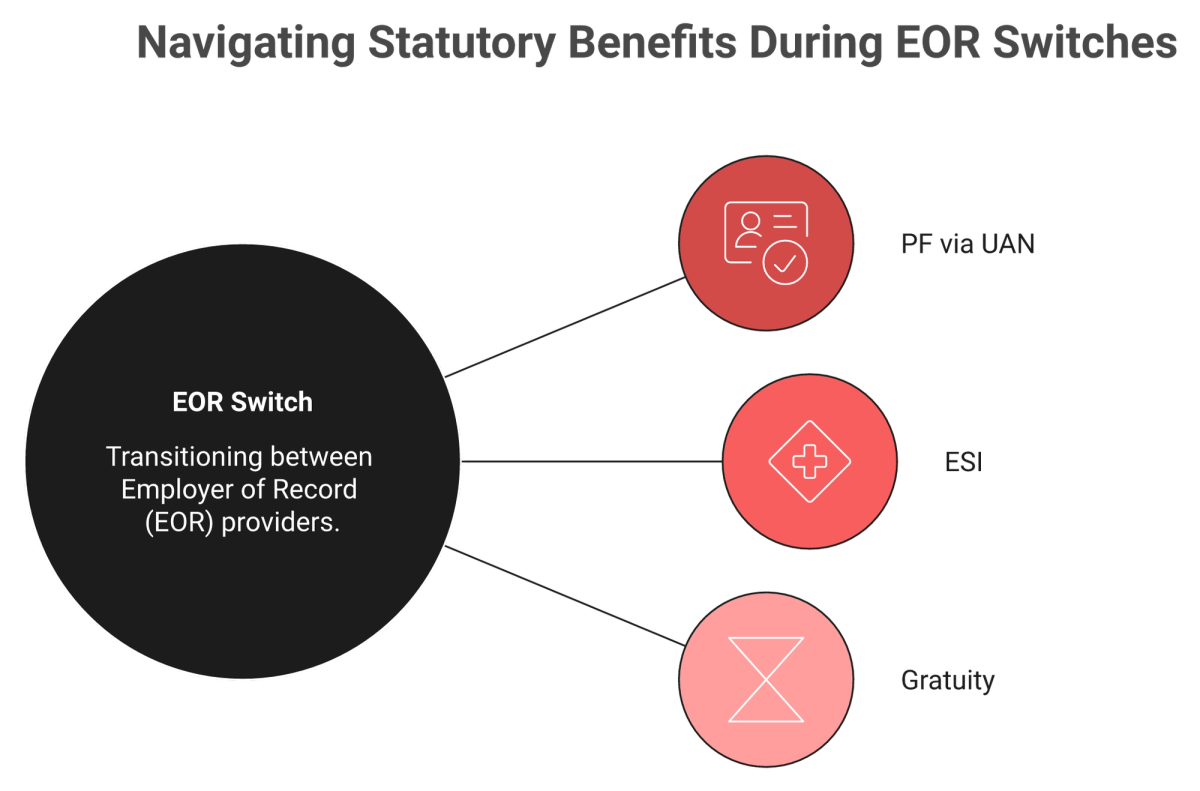
✅ PF and ESI: mostly automatic now
Provident Fund is the easy one. It is linked to the UAN, which belongs to the employee for life. Since the EPFO circular of 15 January 2025, an Aadhaar seeded UAN transfers automatically when the new employer files its first contribution.
ESI (Employees' State Insurance, India's medical cover for lower wage workers) is nearly as clean. The new EOR just re registers the employee under its ESI code in the same month the old one stops, so cover never lapses. Our managed payroll handles this re registration inside the same cycle.
⏰ Gratuity: the item that can actually cost money
Gratuity is where switches go wrong. Under Section 4 of the Payment of Gratuity Act, 1972, it vests only after five completed years of continuous service with the same employer. The formula is (last Basic plus DA) times 15/26 times completed years, capped at ₹20,00,000.
A switch resets that five year clock unless your recognition of prior service clause carries the date forward. Anyone at 4 years 9 months is the highest risk cohort. Mistime the move, and they lose gratuity entirely.
| Benefit | Auto carries? | Required action | Primary source |
|---|---|---|---|
| PF (UAN) | Yes | Confirm Aadhaar seeded UAN | EPFO 15 Jan 2025 circular |
| ESI | Only if re registered same month | New EOR registers under its code | ESI Act, 1948 |
| Gratuity | No | Prior service clause plus timing | Gratuity Act 1972, S.4 |
💰 The 50% wage rule that inflates the number
Here is what most global generalists miss. The New Labour Code 2025-26 requires Basic plus DA to be at least 50% of total CTC. That raises the wage base, which raises both PF and gratuity liabilities.
I might be wrong on how fast every state enforces this, but the direction is clear: a higher Basic means a bigger gratuity number to settle or transfer at switch. The three ways to handle it are settle now, transfer the liability, or hold a client funded reserve.
The Wisemonk model educates buyers heavily on these traps. That is a smart compliance fear to trust pipeline. From actually running this, though, I think education is the floor. Managing the number correctly under the 50% rule is the ceiling, which is why buyers compare us as a Wisemonk alternative.
Generalist reviews show the accuracy gap this creates:
"Too many payroll errors. Unacceptable time to resolve Remote's errors. RRSP contribution errors 3 payrolls in a row."
Verified User, Remote G2 Verified Review
At Versatile Club, PF, ESI, TDS, and professional tax filings run under our own registrations across all 28 states and 8 union territories. We restructure the salary stack to the 50% floor at onboarding, before payroll goes live, not after an audit flags it. You can model the difference with our EOR vs entity calculator.
Q4: How Do You Migrate Employee Data Between EORs Without Breaking the DPDP Act?
Moving your team's data, PAN, Aadhaar, bank details, salary history, between two EORs is a transfer between two Data Fiduciaries. It is now regulated under the DPDP Rules, 2025, notified as G.S.R. 846(E) on 13 November 2025, under the DPDP Act, 2023. Before any spreadsheet moves, you need a lawful basis or fresh consent, a data processing agreement between the two EORs, and a 72 hour breach reporting protocol.
⚠️ The step everyone treats as an email attachment
Most switch guides describe the data handover as "share the roster with the new provider." That framing is now a compliance risk. A Data Fiduciary, under DPDP the entity that decides how personal data is used, has real obligations when it ships employee data to another fiduciary.
Your outgoing EOR and your incoming EOR are both fiduciaries. The transfer between them is regulated processing, full stop.
✅ A DPDP compliant migration runbook
Run these five steps in order before a single record moves:
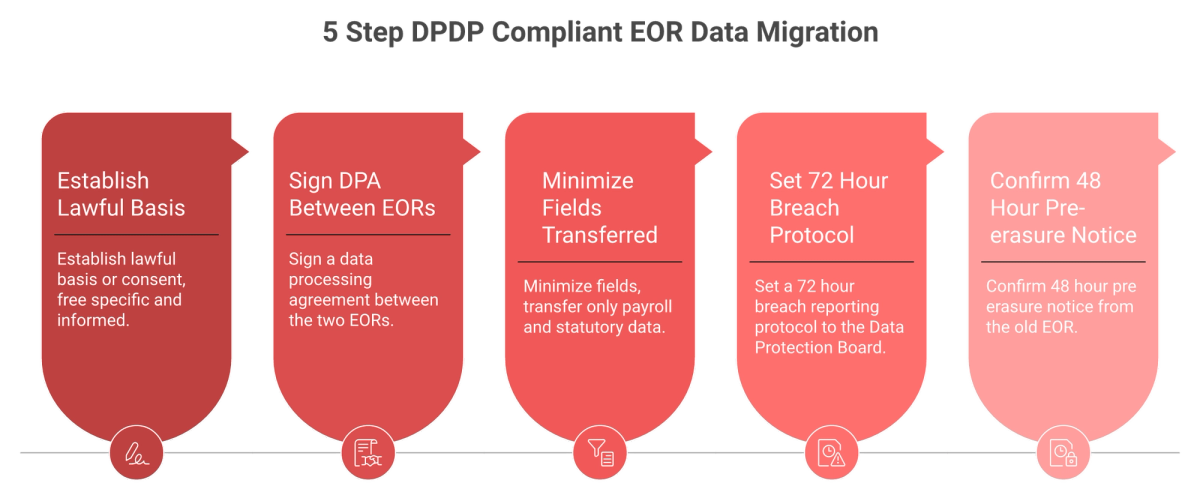
Establish lawful basis or consent. Consent under DPDP must be free, specific, and informed.
Sign a DPA between the two EORs. The data processing agreement fixes who is responsible for what.
Minimize the fields transferred. Send only what payroll and statutory filing actually need.
Set the 72 hour breach protocol. Any breach is reportable to the Data Protection Board within 72 hours.
Confirm 48 hour pre erasure notice. The old EOR must flag data before deletion, per the Rules.
📄 Why this is a differentiator, not just paperwork
The standard read says compliance slows the switch down. I think that gets it backwards. A documented, auditable transfer is exactly what makes you audit ready for your next funding round.
Here is the cross domain parallel I use with US founders. Handling India employee data casually is like emailing customer credit card numbers in a spreadsheet. Technically it moves the data. It also creates a liability you will explain to a regulator later.
Generalist buyers already flag over collection and opaque data handling as pain points:
"It asks for way too much personal information, doesn't explain why I need to share it. When I provided valid documents, they got rejected for no reason, then I was asked for more and more."
Alice T., Remote G2 Verified Review
"The most concerning issue is the Know Your Customer (KYC) policy. They enforce a self face scan under dubious security pretexts and who knows where that data ends up."
Verified User, Remote G2 Verified Review
At Versatile Club, we treat migration as a documented, auditable transfer because we are the fiduciary of record, not a partner shell holding your data at arm's length. Ask any EOR for their DPA and breach protocol before you move a single record. We hand ours over on day one, and you can walk through it with us on a quick book a demo call.
Q5: How Long Does an India EOR Switch Take, and How Do You Avoid a Payroll Gap?
A clean India EOR switch runs 1 to 2 weeks when your documents are ready, and 6 to 12 weeks for larger teams or those bound by lock in and notice clauses. A zero gap cutover means the old contract ends and the new one begins the next working day, so no payroll cycle is missed. At Versatile Club, onboarding runs on a committed 5 day SLA: agreement Day 1, offer Day 2, contract Day 3, statutory registrations Day 4, and payroll live Day 5.
⏰ Why timelines vary so much
The 1 to 2 week end assumes your paperwork is ready and nobody is stuck in a lock in. The 6 to 12 week end shows up when three things drag: a long notice period on the outgoing contract, a big roster, or slow document collection.
Notice period is the usual culprit. If your current EOR needs 60 days' notice to release employees, your timeline is 60 days minimum, no matter how fast the new provider moves.
✅ The cutover rule that prevents a payroll gap
Sequencing is everything. The old contract must end on the last day of a pay cycle, and the new one must start the very next working day. Overlap by one day if you must, but never leave a gap. Our managed payroll team plans this cutover date by date.
Get this wrong, and your engineer misses a salary run. From actually running these migrations, a missed payroll is the fastest way to lose trust with a team you just inherited.
Here is a real example. A US client interviewed someone they thought was in London. After three rounds, they learned he was in Greece. We employed him there, they later added a team, and then we simply migrated all twelve people across in one clean cutover. Bulk moves work when the sequencing is disciplined.
⚠️ Where global generalists slow down
Onboarding drift is a documented pain with the generalists:
"It took three months to onboard our first 3 individuals. They didn't seem to be able to navigate Visas or variations to employment contracts."
Verified User, Deel G2 Verified Review
"My onboarding took 28 days. We have started on October 4th and today is November 1st. Each time you log in to Deel, there is another surprise."
Ibrahim, Deel G2 Verified Review
💰 The 5 day SLA, day by day
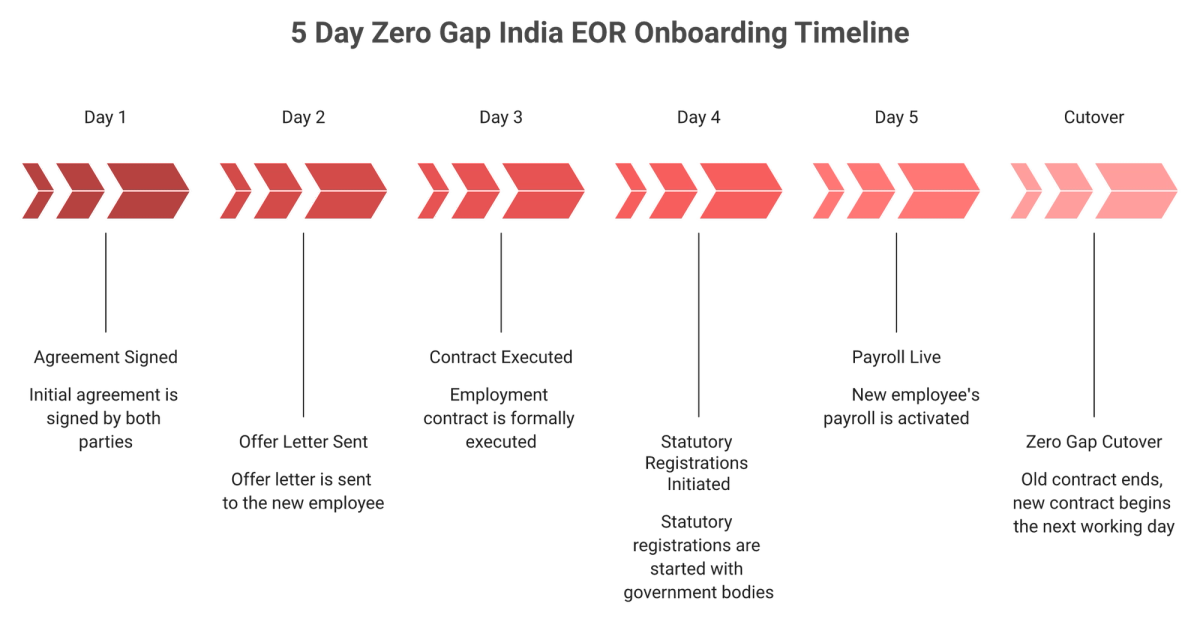
| Day | Milestone |
|---|---|
| Day 1 | Agreement signed |
| Day 2 | Offer letter sent |
| Day 3 | Contract executed |
| Day 4 | Statutory registrations initiated |
| Day 5 | Payroll live |
I want to be honest about the trade off. The 5 day SLA covers onboarding onto our side. Your outgoing provider's notice period sits outside our control, so plan the switch date around that first. You can see the full flow on how it works.
At Versatile Club, the 5 day SLA is contractual, not a marketing number. Clients feel it in the first week:
"As a founder at a digital marketing agency, five day onboarding, zero late payslips. This is what India EOR should look like."
Vedant T., Versatile Club G2 Verified Review
That speed is only credible because we run real multi state payroll ourselves. A global platform juggling 150 countries cannot commit to a day by day India cutover the way our EOR services in India can.
Q6: Versatile vs Wisemonk vs Global Generalists: Which India EOR Should You Switch To?
Choose on India depth, not just price. Versatile Club owns its Indian entity, invoices in USD at the published mid market rate with no markup, and adds culture fit hiring plus a 6 month replacement guarantee. Wisemonk offers real India depth from around $99 a month but a thinner retention story and opaque per band pricing. Global generalists like Deel and Remote fit only if you need 150 country breadth and accept a partner entity model and a 2 to 10% FX markup.
💰 The comparison that actually matters
Most buyers compare on sticker price. I think that gets it backwards. The right axis is India depth, because a cheap provider that misses the Basic plus DA 50% wage rule costs you far more at audit. You can sanity check the numbers with our EOR vs entity calculator.
| Factor | Versatile Club | Wisemonk | Global generalists |
|---|---|---|---|
| India entity | ✅ Owned | ✅ Owned | ❌ Partner shell |
| FX on invoice | ✅ Published mid market | ⚠️ Varies | ❌ 2 to 10% markup |
| Support model | ✅ Founder on WhatsApp | ⚠️ Small team, some delays | ❌ Ticket queue |
| Replacement guarantee | ✅ 6 months | ❌ None | ❌ None |
| Global breadth | ❌ India only | ❌ India only | ✅ 90 to 185 countries |
⚠️ The FX markup nobody puts on the invoice
Global generalists often quietly add a currency markup. Buyers notice it on payday:
"I find Deel to be absurdly expensive. They charge a high amount of fees for transferring money to my bank account."
Juan Camilo O., Deel G2 Verified Review
Wisemonk earns genuine praise for India depth, and I respect that. But the retention and support story has gaps buyers mention:
"I've noticed that their support query responses can occasionally take a bit longer sometimes, likely due to a relatively small team."
Verified User, Wisemonk G2 Verified Review
✅ Choose X if
Choose Versatile Club if you are going deep in India, want no FX markup, and value a founder who answers directly.
Choose Wisemonk if you want India depth and a low price anchor, and can live with a self serve support rhythm.
Choose a generalist if you need to hire across five or more countries from one dashboard.
If you are weighing us specifically against Wisemonk, we break the differences down on our Wisemonk alternative page, and against the generalists on our Deel alternative page.
❌ Where we are honestly not the fit
I will name our Anti ICP plainly. If you need global multi country EOR, or you are a 100 plus India team that requires SOC 2 or ISO 27001 as a procurement gate, we are not your provider. India only is a design choice, not a gap, but it is worth saying out loud.
At Versatile Club, the differentiators are lived, not slogans. We publish the FX rate on every invoice, run founder on WhatsApp support, and back placements with a 6 month replacement guarantee through our EOR services. Clients feel the ownership model directly:
"Founder is just a call away. Extremely helpful in resolving all our queries. The process is super smooth to setup India EOR."
surbhi m., Versatile Club G2 Verified Review
Q7: How Are Employee Taxes and Form 16 Handled in the Switch Year?
In the financial year you switch, each employee gets two Form 16s, one from the outgoing EOR and one from the incoming EOR, and consolidates them when filing. Form 16 is the annual TDS certificate every Indian employer issues. There is no extra tax liability if both providers deduct and deposit TDS (Tax Deducted at Source) correctly by the 7th of each month, and the old EOR completes a clean full and final settlement.
📄 Why two Form 16s show up
When you switch mid year, two different legal employers pay your engineer. Each one deducts TDS and files it under its own TAN, the employer's tax deduction ID. So each issues its own Form 16 at year end.
That looks alarming to employees, but it is normal. They simply add both Form 16s together when filing their return. The total tax stays the same.
⏰ The deadlines that keep it clean
Two dates matter here:
TDS deposit: deducted and deposited by the 7th of each month, per income tax slab.
Form 16 issuance: issued to each employee by 30 May, annually.
Miss the monthly TDS deposit, and the employee's Form 26AS, the government's consolidated tax statement, will not reconcile. That is the mismatch that triggers filing headaches, which is why payroll compliance in India hinges on those dates.
✅ The full and final settlement checklist
The outgoing EOR must close cleanly. From what surfaces when you actually run this, a sloppy full and final settlement is where employees get short changed. Confirm the old EOR has:
Paid all pending salary and reimbursements.
Settled leave encashment.
Deposited final TDS and issued the correct Form 16.
Deposited the last PF contribution against the UAN.
💬 Why this reassurance matters
I might be off on rare edge cases, but the standard fear here is double taxation, and it is misplaced. Two Form 16s do not mean paying tax twice. They mean two records of tax already paid.
The cross domain parallel I use with US founders is simple. It is like changing jobs mid year in the US and getting two W-2s. Nobody panics about that, and the India version works the same way.
Buyers who left generalists often cite exactly this kind of documentation mess:
"Delayed salary, delayed HR documents processing, poor support. Extremely slow speed in resolving HR and payroll issues."
Daryna R., Deel G2 Verified Review
At Versatile Club, we deposit TDS under our own TAN and complete full and final settlements cleanly, so your team's two Form 16s and their Form 26AS reconcile without a filing scramble. That accuracy is the part clients quietly count on:
"PF, tax, the statutory filings, all the stuff I genuinely did not want to learn, they just handle it and keep it correct every month."
Angad S., Versatile Club G2 Verified Review
Q8: What Should You Demand From a New EOR Before You Sign?
Never sign until you have seen a real India invoice that breaks down the FX conversion rate and statutory accruals line by line. Demand five things: a sample invoice showing the FX rate, a signed recognition of prior service clause, proof of the provider's own PF, ESI, and TDS registrations, a data processing agreement, and a written migration timeline. If a provider hesitates on the sample invoice, that hesitation is your answer.
💸 Start with the sample invoice
Most buyers sign on a polished proposal PDF and discover the real costs on invoice one. I tell every founder the same thing: ask for an actual India invoice before you sign anything. Our pricing shows exactly what those line items look like.
A real invoice shows the FX rate applied and the statutory accruals, PF at 12%, ESI split 3.25% employer and 0.75% employee, and gratuity accruing at 4.81% of Basic plus DA. If those numbers are hidden or vague, walk.
✅ The five item pre signature checklist
Run this before you commit budget:
Sample invoice with FX rate shown. Red flag if they stall or send a "typical estimate."
Recognition of prior service clause. Protects tenure, gratuity, and notice.
Proof of own PF, ESI, and TDS registrations. Confirms an owned entity, not a partner shell.
Data processing agreement. Required under the DPDP Rules, 2025, for the data migration.
Written migration timeline. A date by date plan, not "a couple of weeks."
⚠️ Why the hidden fee test works
The FX markup is where generalists quietly pad margin. Buyers feel it and say so:
"There are hidden fees. Of course, again, also here. You will never get your net agreed salary through Deel."
Ibrahim, Deel G2 Verified Review
"We had to carefully manage our agreement and had to constantly remind them of the fees agreed so that we weren't over charged."
Verified User, Deel G2 Verified Review
💬 The cross domain parallel I trust
Buying an EOR without seeing an invoice is like signing an ad contract without seeing the CPM. The headline rate means nothing until you see the line items. Operators know this instinctively in ad spend, and it applies here too.
At Versatile Club, "See a Sample Invoice" is our standard first step, not a hurdle. We publish the FX rate on every invoice at the mid market rate, charge no setup or exit fees, and give the first month free. You can request one on a quick book a demo call. Clients notice the difference on invoice one:
"USD invoice landed clean, no FX markup, no setup fee, no surprises. Every payroll or PF question gets a real answer from a real person, usually same day."
Verified User, Versatile Club G2 Verified Review
Q9: Ready to Switch? How a Zero Gap India Migration Runs With Versatile Club
A zero gap switch means the old contract ends and the new one begins the next working day, with no missed payroll cycle. With Versatile Club, that runs on a 5 day onboarding SLA, no setup or exit fees, your first month free, and a 6 month replacement guarantee, all under our own Indian entity with USD invoicing at the published mid market rate. Start by telling us what your team looks like today.
💸 From payroll panic to a person who answers
Think back to that 11pm WhatsApp message I mentioned at the start. A late PF challan, a chatbot loop, and a founder who cannot sleep. That is the "before."
The "after" is quieter. Payroll runs on time, statutory filings are correct, and when you have a question, a real person answers, usually the same day. The bridge between the two is a disciplined migration, not a bigger platform, which is exactly what our EOR services in India deliver.
⏰ What the first five days actually look like
Here is the felt sense of a switch, not the brochure version. You send us your roster. We draft compliant contracts with the recognition of prior service clause built in, so tenure and gratuity carry forward.
Then the 5 day SLA takes over: agreement, offer, contract, statutory registrations, and payroll live. We time the cutover so the old contract ends and ours begins the next working day. No salary run gets skipped, because our managed payroll team sequences it precisely.
I will keep the honest caveat here too. Your outgoing provider's notice period sits outside the 5 days, so we plan the switch date around it first.
✅ The risk reversal stack
I know switching feels risky. So we removed the parts that usually make it scary:
No setup fees, no exit fees. You are never locked in by cost.
First month free. You feel the service before you fully commit.
6 month replacement guarantee. On C2H placements, if the fit is wrong, we replace.
Published FX rate. Mid market, on every invoice, always verifiable.
There is an old framing I like. You do not have to build the Golden Gate Bridge, a full Indian subsidiary at $50K and 12 to 18 months, when a simple suspension bridge, an owned entity EOR, gets you across the same river. Our pricing is built around that simplicity, and you can model it against the alternative with our EOR vs entity calculator.
💬 What switchers actually feel afterward
The relief is consistent across clients who came from messier setups:
"We used Versatile to hire our first employee in India after months of putting it off. The hire was onboarded in four days. USD invoice landed clean, no FX markup, no setup fee, no surprises."
Verified User, Versatile Club G2 Verified Review
"We've been using Versatile Club for our international hires, and honestly, it's been super smooth. It makes scaling a remote team way less stressful."
Setu C., Versatile Club G2 Verified Review
⭐ Where my head is on the next two years
Here is the question I am sitting with. I think India stops being "one country on the global EOR map" and becomes its own specialist category. Owned entity operators who live in India start eating the generalists' India revenue.
I could be wrong on the timing. But every switch conversation I have lately points the same way: buyers want depth in one country, not a shallow footprint in 150. That conviction shapes our whole how it works model.
So tell me what you are building. Message me, Sagar, on WhatsApp with your team size and your target switch date, and I will map the cutover with you. Not a demo booking. A real conversation about your India team, which you can also start on a quick book a demo call.
FAQs
When should we switch our India EOR provider?
We tell founders to switch when the basics break. The clearest signals are late payroll, statutory filings you cannot verify, and support that routes you through a ticket queue instead of a person.
Run a quick four point check before deciding:
- Payroll accuracy: Has a cycle been late or wrong in the last three months?
- Compliance visibility: Can you pull your own PF, ESI, and PT challans on demand?
- Support model: Do you reach a named person, or a queue?
- Wage rule readiness: Did they restructure salaries for the Basic plus DA 50% rule?
Two or more no answers, and it is a switch, not a conversation. A funding round is another common trigger, because investors want audit ready India payroll. We built our EOR services in India around that gap, with statutory accuracy first and founder on WhatsApp support instead of a ticketing system.
Does switching an EOR reset tenure, notice period, and leave for our India team?
Legally yes, but it is fixable. Because the EOR is the legal employer, moving providers ends the old employment contract and starts a new one. That resets the service date, notice period, and leave accrual unless you protect them.
The fix is contractual, not statutory. You write a recognition of prior service clause into the new agreement, which carries the original joining date forward. That single clause preserves three things at once:
- Service date: protects gratuity vesting and seniority.
- Notice period: keeps the longer earned notice instead of a probation reset.
- Leave balance: carries earned and unused leave into the new contract.
Employees care deeply here, because tenure, gratuity, and PF are family security, not abstract HR line items. Get the clause wrong and your best engineer feels the company erased years of their life. When we run a migration through our EOR services, we write this clause directly into the new contract, so the date your engineer joined stays the date that counts.
What happens to gratuity, PF, and ESI when we change EORs?
Each benefit behaves differently, so we handle them separately.
- PF: Follows the employee through the Universal Account Number. Since the EPFO circular of 15 January 2025, an Aadhaar seeded UAN auto transfers on the new employer's first reconciled contribution.
- ESI: Continues without a lapse if the new EOR re registers the employee under its code in the same month the old one stops.
- Gratuity: The risk item. It vests only after five completed years of continuous service, so a switch resets that clock unless the prior service clause carries the joining date forward.
The New Labour Code 2025-26 raises the stakes, because Basic plus DA must be at least 50% of CTC. That higher wage base inflates both PF and gratuity liabilities you settle or transfer at switch. We run PF, ESI, TDS, and professional tax under our own registrations and keep everything audit ready through our compliance function, restructuring salaries to the 50% floor at onboarding rather than after an audit flags it.
How do we migrate employee data between EORs without breaking the DPDP Act?
Moving PAN, Aadhaar, bank details, and salary history between two EORs is a transfer between two Data Fiduciaries. It is regulated under the DPDP Rules 2025, notified as G.S.R. 846(E) on 13 November 2025, under the DPDP Act 2023.
Before any spreadsheet moves, run this runbook in order:
- Lawful basis or consent: Consent must be free, specific, and informed.
- Sign a DPA: The data processing agreement fixes who is responsible for what.
- Minimize fields: Send only what payroll and statutory filing need.
- 72 hour breach protocol: Any breach is reportable to the Data Protection Board within 72 hours.
- 48 hour pre erasure notice: The old EOR must flag data before deletion.
We treat migration as a documented, auditable transfer because we are the fiduciary of record, not a partner shell holding your data at arm's length. Ask any provider for their DPA and breach protocol before you move a record, and see how we handle it on our how it works page.
How long does an India EOR switch take, and how do we avoid a payroll gap?
A clean India EOR switch runs 1 to 2 weeks when your documents are ready, and 6 to 12 weeks for larger teams or those bound by lock in and notice clauses. Notice period is usually the constraint, because if your current EOR needs 60 days to release employees, your timeline is at least 60 days.
A zero gap cutover is the goal. That means the old contract ends on the last day of a pay cycle, and the new one starts the very next working day, so no salary run gets skipped. Overlap by one day if you must, but never leave a gap.
Our onboarding runs on a committed 5 day SLA:
- Day 1 agreement, Day 2 offer, Day 3 contract.
- Day 4 statutory registrations, Day 5 payroll live.
The honest caveat is that your outgoing provider's notice period sits outside those 5 days, so we plan the switch date around it first. Our managed payroll team sequences the cutover so the transition never breaks a cycle.
Versatile vs Wisemonk vs global generalists: which India EOR should we switch to?
We tell buyers to choose on India depth, not just sticker price, because a cheap provider that misses the Basic plus DA 50% rule costs more at audit.
- Versatile Club: Owns its Indian entity, invoices in USD at the published mid market rate with no markup, and adds a 6 month replacement guarantee.
- Wisemonk: Real India depth from around $99 a month, but a thinner retention story and a smaller support team.
- Global generalists: Fit only if you need 90 to 185 country breadth, and accept a partner entity model plus a 2 to 10% FX markup.
We are honest about our Anti ICP too. If you need multi country EOR, or you are a 100 plus India team that requires SOC 2 or ISO 27001 as a procurement gate, we are not your provider. India only is a design choice, not a gap. If you are weighing us against the direct competitor, see our Wisemonk alternative breakdown.
How are employee taxes and Form 16 handled in the year we switch?
In the financial year you switch, each employee receives two Form 16s, one from the outgoing EOR and one from the incoming EOR, and consolidates them when filing. Form 16 is the annual TDS certificate every Indian employer issues.
There is no extra tax liability if both providers handle the basics correctly:
- TDS deposit: Deducted and deposited by the 7th of each month.
- Form 16 issuance: Issued to each employee by 30 May annually.
- Clean full and final settlement: The old EOR settles salary, leave encashment, final TDS, and the last PF contribution.
The common fear is double taxation, and it is misplaced. Two Form 16s do not mean paying tax twice, they mean two records of tax already paid, much like getting two W-2s after a mid year job change in the US. We deposit TDS under our own TAN and close full and final settlements cleanly, so your team's two Form 16s and their Form 26AS reconcile without a filing scramble, which is part of our broader managed payroll discipline.
What should we demand from a new EOR before we sign?
Never sign until you have seen a real India invoice that breaks down the FX conversion rate and statutory accruals line by line. If a provider hesitates on the sample invoice, that hesitation is your answer.
Demand these five things:
- Sample invoice with FX rate shown: A red flag if they send a typical estimate instead.
- Recognition of prior service clause: Protects tenure, gratuity, and notice.
- Proof of own PF, ESI, and TDS registrations: Confirms an owned entity, not a partner shell.
- Data processing agreement: Required under the DPDP Rules 2025.
- Written migration timeline: A date by date plan, not a vague couple of weeks.
A real invoice shows PF at 12%, the ESI split of 3.25% employer and 0.75% employee, and gratuity accruing at 4.81% of Basic plus DA. We publish the FX rate on every invoice at the mid market rate, charge no setup or exit fees, and give the first month free. You can see exactly what those line items look like on our pricing page.