Table of contents (12)
How to Pay Employees in India in 2026: The Complete Compliance, Payroll, and EOR Playbook for Global Employers
Q1: Can you legally pay an Indian employee in USD, or does it have to be INR?
Wages for work performed in India must be paid in Indian rupees into an Indian bank account. The Payment of Wages Act, 1936 allows cash, cheque, or a direct bank credit once the employee authorises it in writing, and caps total statutory deductions at 50% of wages earned in that wage period. You can send USD across the border, but it has to land with a legal Indian employer that converts it, disburses INR, deducts TDS, PF, and ESI, and files under its own registrations. Versatile Club invoices in USD from one owned Indian entity, so the currency conversion happens once, inside that entity, rather than across a chain of intermediaries.
🧾 The wire-transfer mental model, and what it costs
A US founder once messaged me on WhatsApp at 11pm her time. She had paid her Bengaluru engineer by international transfer for four months and wanted to know why he had no Form 16.
The answer was simple, and bad. There was no Indian employer in the chain, so there was no TDS trail, no PF challan, no UAN, and no salary certificate. Her "payroll" was a series of gifts, legally speaking.
⚠️ What breaks when there is no Indian employer
- No PF record. No Universal Account Number means no retirement corpus and no transferable service history.
- No Form 130. The annual salary certificate (the form that replaced Form 16 under the Income Tax Act 2025) cannot be issued by a company with no Indian TAN.
- No credit footprint. Indian banks underwrite home loans off payslips and Form 16 or Form 130. A worker paid by foreign transfer looks self-employed to a lender.
That last one is not theoretical. In an operator interview I keep coming back to, a worker who insisted on staying a contractor was refused a mortgage, then approved after he moved onto a formal employer's payroll. This is also why most buyers eventually look at converting a contractor to an employee in India rather than extending the agreement again.
💸 The three legal routing shapes
There are only three honest ways for the money to travel.
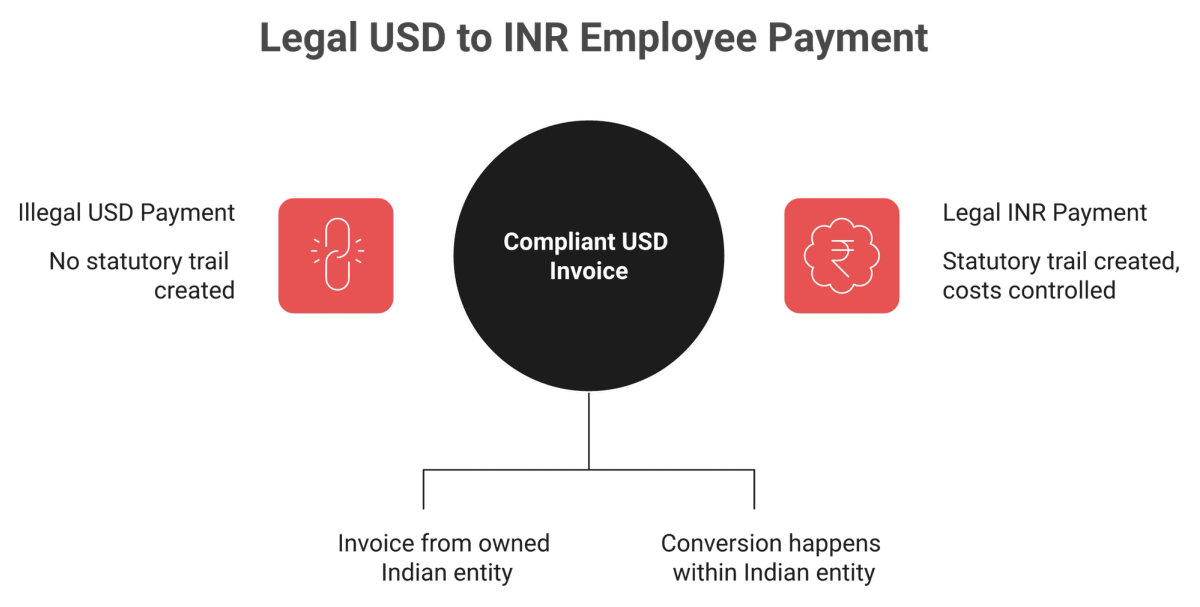
1. Own Indian subsidiary. You remit funds to your Pvt Ltd as capital or intercompany payment, then your entity runs INR payroll through NEFT, RTGS, or IMPS. The practical trade-offs are laid out in our EOR versus entity comparison for India.
2. Employer of Record. You pay the EOR in USD. The EOR is the legal employer and disburses INR. Versatile Club runs this route from Foo Falcon Technologies Pvt Ltd, with PF, ESI, TDS, and professional tax filed under its own registrations through our EOR services in India.
3. Genuine contractor. A contractor may invoice in USD and receive foreign inward remittance against that invoice. This is only defensible when the work is genuinely scoped and independent, a line we unpack in independent contractor versus EOR.
💰 Where the money leaks
SWIFT transfers carry a wire fee of roughly $25 to $50, plus the spread. Global generalist platforms route payroll through intermediate holdings, and reported FX markups of 3% to 5% sit inside that chain.
On a $30,000 monthly India payroll, a 3% to 5% markup is $10,800 to $18,000 a year. Versatile Club's read is that most buyers negotiate the monthly fee hard and never price this line at all, which is backwards.
🤝 What this means on Monday
Versatile Club invoices in USD directly from its own registered Indian entity, not routed through a foreign holding company and not converted from INR on your side. One dollar invoice a month, and the INR disbursement plus the PF, ESI, TDS, and PT filings sit under our registrations. The conversion risk stays on our side of the border, where the entity is.
Q2: What are the four ways to pay employees in India, and which fits your stage?
There are four routes. Incorporate a Private Limited company, which takes roughly 3 to 6 months and $15,000 to $100,000 all in, and makes sense above about 25 to 30 heads. Use an Employer of Record, which becomes the legal employer in days with no entity of your own. Engage independent contractors, defensible only for genuinely scoped, deliverable-based work. Or run managed payroll at around $49 per employee per month, which is legally possible only if you already hold an Indian subsidiary with live PF, ESIC, TDS, and state professional tax accounts.
🌉 The suspension bridge and the Golden Gate
Think of it as two kinds of bridge. An EOR is a suspension bridge, light and fast, standing up in days. Your own subsidiary is the Golden Gate, permanent and expensive, and it takes 3 to 6 months before the first payroll runs, as the MCA incorporation process requires.
Most Seed to Series B companies hiring one to twenty people in India need the suspension bridge first. The mistake I see is founders building the Golden Gate for three engineers. If you want to pressure-test the arithmetic yourself, run it through the EOR versus entity calculator.
📊 The four models side by side
| Model | Entity needed | Time to first payroll | Typical cost | PE exposure | Best fit |
| Versatile Club EOR and C2H | None | 5 business days, contractual SLA | $149 per employee per month flat, $0 setup, $0 exit | Low, employment sits on our entity | 1 to 25 India hires |
| Global EOR generalist | None | 7 to 14 days | $400 to $599 per employee per month | Low, often via partner entity | Teams across 5 or more countries |
| Own Pvt Ltd plus managed payroll | Yes | 3 to 6 months | $15,000 to $100,000 setup, then about $49 per employee per month | Explicit and managed | 25 or more India hires |
| Independent contractors | None | Days | Invoice value | High if roles are core | Scoped project work only |
⚖️ The real break-even is not money
Six years of Contract-to-Hire placements across Bengaluru, Hyderabad, and Pune taught me that the break-even is rarely arithmetic. It is whether anyone inside your company will own a monthly EPFO electronic challan filing by the 15th.
If the answer is nobody, the subsidiary math stops mattering. Versatile Club's data points one way here, though I might be reading it too strongly: companies that incorporate early usually end up outsourcing the filings anyway, which is the pattern behind most payroll outsourcing services in India engagements.
💬 What buyers say about each route
"Wisemonk's EOR service solved our biggest challenge, which was hiring employees in India without setting up a local entity. They manage employment contracts, statutory compliance, tax structure, and local regulations on our behalf. This reduced legal risk and saved months of setup time and cost."
— Verified User in Marketing and Advertising, Marketing and Advertising Wisemonk - G2 Verified Review (3.5 stars, 12 February 2026)
"I was employed by a Singapore entity that is yet to established in India. So, Wisemonk is the legal entity which I'm currently working under. It removes barriers and helps us work for companies without which it won't be possible."
— Verified User in Financial Services, Financial Services Wisemonk - G2 Verified Review (4 stars, 16 June 2025)
The generalist route is where onboarding timelines slip.
"Slow and laborious initial setup. We are still waiting on answers to key questions for implementation... Instead they have email support with a 3-day SLA."
— Juliette D., People Ops Remote - G2 Verified Review (0.5 stars, 22 April 2026)
If that pattern matches your shortlist, the Remote alternatives in India breakdown covers who actually holds the Indian entity in each case.
🧭 Where Versatile Club sits
Versatile Club occupies the EOR and Contract-to-Hire row at $149 per employee per month flat, with $0 setup, $0 exit, the first month free, and a 5 business day onboarding SLA written into the agreement. The entity and registrations behind it are not new. The EOR service line launched in 2026 on compliance infrastructure proven through six years of C2H payroll.
Q3: Which deductions are mandatory in 2026, and what changed on 17 September?
Six deductions are mandatory: EPF at 12% employer and 12% employee on Basic plus DA; ESI at 3.25% employer and 0.75% employee below the Rs 21,000 wage ceiling; salary TDS, now under Section 392 of the Income Tax Act 2025, deposited by the 7th; professional tax on state slabs capped at Rs 2,500 a year; labour welfare fund in some states; and gratuity accruing from month one at 4.81% of Basic plus DA. Gazette notification S.O. 5109(E) of 17 September 2026 raised the EPF wage ceiling from Rs 15,000 to Rs 25,000, pulling roughly 51 lakh more employees into mandatory coverage. ESIC's ceiling did not move.
📌 The change most pages have not caught up with
The Union Cabinet approved the enhancement on 16 September 2026, and the Ministry of Labour and Employment notified it with effect from 17 September 2026, superseding S.O. 2702(E).
Employer statutory cost at the ceiling moves from Rs 1,950 to Rs 3,250 a month. The five year outlay is estimated at Rs 56,696 crore. Versatile Club re-ran every active employee's Basic plus DA against the new Rs 25,000 line in the week the gazette landed, generated the missing UANs, and pro-rated the September electronic challan filings.
⏰ The 2026 rate and deadline table
| Deduction | Rate | Base | Authority | Due |
| EPF | 12% employer, 12% employee | Basic plus DA, ceiling Rs 25,000 | EPFO | 15th |
| ESI | 3.25% employer, 0.75% employee | Gross up to Rs 21,000 | ESIC | 15th |
| TDS on salary | Per slab, Section 392 | Taxable salary | Income Tax Department | 7th |
| Professional tax | State slabs, max Rs 2,500 a year | Gross | State authority | Monthly or biannual |
| Labour welfare fund | State rate | Headcount | State board | Per state cycle |
| Gratuity | 4.81% accrual | Basic plus DA | Payment of Gratuity Act, 1972 | On exit |
🔍 What it does to a real salary
Take an engineer at Rs 22,000 Basic plus DA. Before 17 September, PF was voluntary above the Rs 15,000 line and many employers capped the contribution. Now the employee is inside mandatory coverage.
Employer PF on Rs 22,000 is Rs 2,640 a month, up from Rs 1,800 if you had been contributing at the old ceiling. That is Rs 10,080 a year per person in the Rs 15,001 to Rs 25,000 band, which changes the cost of hiring in India for junior and support roles more than for senior engineers.
⭐ Two details that catch foreign employers
- International workers have no PF ceiling. An expatriate on Indian payroll contributes on full Basic plus DA, with no Rs 25,000 cap, under the EPFO international worker provisions.
- ESIC stayed at Rs 21,000. The two ceilings are now far apart, so a single wage number no longer tells you both answers.
Versatile Club measures statutory load as a percentage of gross each month, not once a year at budget time, because a mid-year gazette can move it. This September it did, and the full filing picture sits in our payroll compliance in India guide.
🧮 Who absorbs the change
Versatile Club absorbed the ceiling change inside the same $149 flat fee, with no re-pricing letter and no compliance surcharge. Because PF, ESI, TDS, and professional tax are filed under our own registrations, the UAN generation and the pro-rated challan correction were our work, not a client ticket. The published terms sit on our pricing page.
Q4: How should you structure an Indian salary under the 50% Basic plus DA rule?
Under the four Labour Codes notified on 21 November 2025, with Central Rules notified in May 2026, Basic plus DA must be at least 50% of CTC. That single rule raises PF, gratuity, and bonus liability for anyone who used allowance-heavy structures to suppress them. Build from the floor up: Basic plus DA at 50%, then HRA, then employer NPS under Section 80CCD(2), which can cut a senior engineer's tax liability by 20% to 25% at no extra employer cost. Let the employee pick the old or new regime through a declaration. Structure legally first, optimise second.
🧱 Why allowance-heavy structures are now a liability
The old trick was to keep Basic at 25% or 30% of CTC and pile the rest into special allowance. PF, gratuity, and bonus all sit on Basic plus DA, so a low Basic meant a low statutory bill.
The Code on Wages ended that. The definition of "wages" now forces Basic plus DA to at least half of total pay, so the liability follows automatically.
📐 A worked structure at Rs 24 LPA
| Component | Monthly | Share of CTC | Why |
| Basic plus DA | Rs 1,00,000 | 50% | Statutory floor under the Code on Wages |
| HRA | Rs 50,000 | 25% | Exemption against actual rent paid |
| Employer NPS, 80CCD(2) | Rs 10,000 | 5% | Deductible to the employee, no extra employer cost |
| Employer PF | Rs 3,000 | 1.5% | 12% at the Rs 25,000 ceiling |
| Gratuity accrual | Rs 4,810 | 2.4% | 4.81% of Basic plus DA |
| Special allowance | Rs 32,190 | 16.1% | Balancing figure |
| Total CTC | Rs 2,00,000 | 100% | Rs 24 LPA |
ESI does not apply here, because gross sits well above the Rs 21,000 wage ceiling. You can model variants of this structure in the salary calculator.
🎯 The lever foreign employers miss
Employer NPS under Section 80CCD(2) is the most under-used line in Indian salary design. It is deductible for the employee, costs the employer nothing extra inside the same CTC, and carries favourable treatment at maturity under the National Pension System framework.
Across the offers Versatile Club has structured, the same Rs 24 LPA lands 6% to 8% differently in take-home depending on how Basic, HRA, and employer NPS are set. I could be slightly off on the top of that range, but the direction is consistent.
💬 Where structuring flexibility shows up in reviews
Buyers notice when a provider's structure cannot flex.
"What I dislike about Wisemonk is that some features feel a bit limited and could use more flexibility. In particular, I'd like to see better options for customization and more detailed reporting."
— Vinay M., Payroll and HR Operations Wisemonk - G2 Verified Review (4 stars, 18 February 2026)
"The initial documentation and paperwork felt quite detailed and time-consuming at the beginning. However, as we progressed, it became clear that this thoroughness is what ensures proper legal and compliance coverage."
— Verified User in Marketing and Advertising, Marketing and Advertising Wisemonk - G2 Verified Review (3.5 stars, 12 February 2026)
That trade-off is real. Front-loaded paperwork is how a compliant structure gets built, and skipping it is what creates the retrospective fix. Buyers comparing India-native options side by side will find the same tension mapped in Wisemonk alternatives in India.
✅ Fix it at offer stage, not at payroll stage
Versatile Club builds the CTC structure with you before the offer goes out, not after the first payroll run. Repairing an allowance-heavy structure later means re-opening PF and gratuity accruals for every month already paid, and that conversation is always more expensive than the first one. If you want that structuring done before your next offer letter, tell us who you are hiring.
Q5: What does one India employee actually cost you per month, all in?
Budget 13% to 16% above gross before any vendor fee. That covers employer EPF at 12% of Basic plus DA, gratuity accrual at 4.81%, ESI at 3.25% where wages fall under Rs 21,000, plus professional tax and labour welfare fund. On top sits the service layer: roughly $49 per employee per month for managed payroll if you own an entity, $99 to $599 for an Employer of Record, or about 15% of salary with a $1,500 monthly floor at G-P. Then the line nobody quotes, a 3% to 5% FX markup plus $25 to $50 per wire. Versatile Club prices its India EOR at $149 per employee per month flat, with no setup fee and no exit fee.
🧮 The statutory stack on one real engineer
Take an engineer at Rs 18 LPA, so Rs 1,50,000 a month, with Basic plus DA at the 50% floor of Rs 75,000.
| Cost line | Monthly | Basis |
| Gross salary | Rs 1,50,000 | Rs 18 LPA |
| Employer EPF | Rs 3,000 | 12% at the Rs 25,000 ceiling |
| Gratuity accrual | Rs 3,608 | 4.81% of Basic plus DA |
| ESI | Rs 0 | Gross above Rs 21,000 |
| Professional tax | Rs 200 | State slab, capped Rs 2,500 a year |
| Statutory load | Rs 6,808 | About 4.5% of gross |
⚠️ Why the 13% to 16% range still holds
At Rs 18 LPA, the statutory load looks small, because PF stops at the ceiling and ESI drops out entirely. Run the same model at Rs 4,00,000 a year and the load climbs past 15%, since PF and gratuity both bite on a larger share of pay.
Versatile Club measures this per employee, per month, against actual Basic plus DA rather than a blended average. A single blended percentage is where CFO models go wrong, which is why we break the full stack out in cost of hiring in India.
💸 The vendor and FX layer
| Provider | Monthly fee | Setup | Other |
| Versatile Club | $149 flat | $0 | $0 exit, first month free |
| Wisemonk | $99 to $399 by slab | Varies | India-native entity |
| Deel | About $599 | About $500 | Global coverage |
| Remote | About $599 | About $299 | Global coverage |
| G-P | About 15% of salary | Varies | $1,500 monthly floor |
| Managed payroll | About $49 | Varies | Requires your own Pvt Ltd |
Published rate cards for the two largest generalists sit on Deel's pricing page and Remote's pricing page, and Versatile Club's own flat line sits on our pricing page. On a $30,000 monthly India payroll, a 3% to 5% FX markup is $10,800 to $18,000 a year. That is often larger than the fee difference buyers spend weeks negotiating.
⭐ The live-invoice audit
Before signing anything, ask every shortlisted provider for a live sample invoice from a current client, redacted. Then hunt five line items: setup fee, security deposit, FX markup, benefits markup, and exit fee.
Versatile Club's read is that the standard advice gets this backwards. Buyers price the sticker and discover the invoice later, a pattern we document in employer of record India cost.
💬 What buyers report about cost and accuracy
"It's expensive, it doesn't integrate with anything that I need, it doesn't have basic US payroll functionality. Truly a mess of a product."
— Verified User in Accounting, Accounting Remote - G2 Verified Review (0 stars, 15 April 2026)
"It did not handle multi-state taxes well at all. We are a non-profit and it was constantly making mistakes... It killed the autopayment for payroll causing a paycheck to be sent late to all employees."
— Verified User, Non-profit Operations Rippling - G2 Verified Review (0.5 stars, 2026)
"I've noticed that their support/query responses can occasionally take a bit longer sometimes, likely due to a relatively small team."
— Verified User in Financial Services, Financial Services Wisemonk - G2 Verified Review (4 stars, 14 June 2025)
If multi-state accuracy is your sticking point, the Rippling alternatives in India comparison maps who files what.
✅ What stays fixed
Versatile Club charges $149 per employee per month, flat, with no slab jumps as headcount grows, no setup fee, no exit fee, no benefits markup, and no salary markup. I will not claim the lowest sticker in this market. I will claim an invoice that reads the same in month 14 as it did in month 1.
Q6: What does the monthly, quarterly, and annual payroll calendar look like?
Monthly: TDS (tax deducted at source) deposited by the 7th; the EPF electronic challan cum return, or ECR, filed and paid by the 15th; ESI by the 15th; professional tax on the state cycle, with Karnataka monthly, Maharashtra monthly under dual PTRC and PTEC registration, and Tamil Nadu biannual in June and December. Quarterly: salary TDS returns now go on Form 138, which replaced Form 24Q under the Income Tax Act 2025, effective 1 April 2026. Annually: the salary certificate is Form 130, which replaced Form 16. Versatile Club runs this calendar on its own Indian entity across all 28 states and 8 union territories.
⏰ The monthly grid
| Date | Obligation | Authority | What happens if you miss it |
| 7th | Deposit salary TDS under Section 392 | Income Tax Department | Interest at 1.5% a month |
| 15th | File and pay EPF ECR | EPFO | Interest plus Section 14B damages |
| 15th | Pay ESI contribution | ESIC | Interest at 12% a year |
| Per state | Professional tax remittance | State tax authority | State penalty, registration risk |
| Per state | Labour welfare fund | State board | State penalty |
The filing portals themselves are run by EPFO and ESIC, and both reject late challans rather than queuing them.
📄 The annual and quarterly grid
| Period | Form | Purpose |
| Quarterly | Form 138 | Salary TDS return, replaced Form 24Q |
| Annual | Form 130 | Salary certificate, replaced Form 16 |
| Annual | Form 12BA | Perquisite statement |
| Annual | PT annual return | State professional tax reconciliation |
🗺️ Where foreign-run payroll actually breaks
Three things break it, and none of them are the salary calculation.
1. The 7th. TDS is due before most US month-end close cycles finish. If approval sits with a controller in a different timezone, the deposit slips.
2. State variance. Professional tax is not one rule. Versatile Club holds registrations across these cycles, and the differences are concrete:
- Maharashtra: dual PTRC and PTEC registration, monthly slab filing, annual return.
- Karnataka: monthly PT with Shops and Establishments renewal, enrolment within 30 days of joining.
- Tamil Nadu: biannual PT in June and December, plus labour welfare fund.
- West Bengal: frequent rule changes and state-specific leave calculation.
- Delhi: no professional tax, but strict Shops and Establishments compliance.
- Telangana: PTRC enrolment required, with monthly remittance deadlines.
City-level detail for the two largest hiring hubs sits in payroll outsourcing in Bengaluru and payroll outsourcing in Hyderabad.
3. Form masters. Payroll software configured for Form 24Q will fail portal validation on a Form 138 filing. Update the masters before the next quarter closes, not during it.
⚠️ The one penalty people underestimate
EPF lateness does not just attract interest. Section 14B damages attach on top, assessed as a percentage of the arrear based on the delay period, under the Employees' Provident Funds and Miscellaneous Provisions Act, 1952.
In our C2H operations across Bengaluru, Hyderabad, and Pune, Versatile Club treats the 15th as a hard internal cut-off two days early. I have never regretted the buffer, and the wider checklist sits in payroll compliance in India.
🧾 Who holds the calendar
Versatile Club runs this calendar as the Employer of Record, with the professional tax and Shops and Establishments registrations already in place from six years of Contract-to-Hire operations. You receive one consolidated USD invoice each month. The filing deadlines, the challans, and the portal work sit with us.
Q7: Why does paying Indian staff as contractors blow up, and when is it defensible?
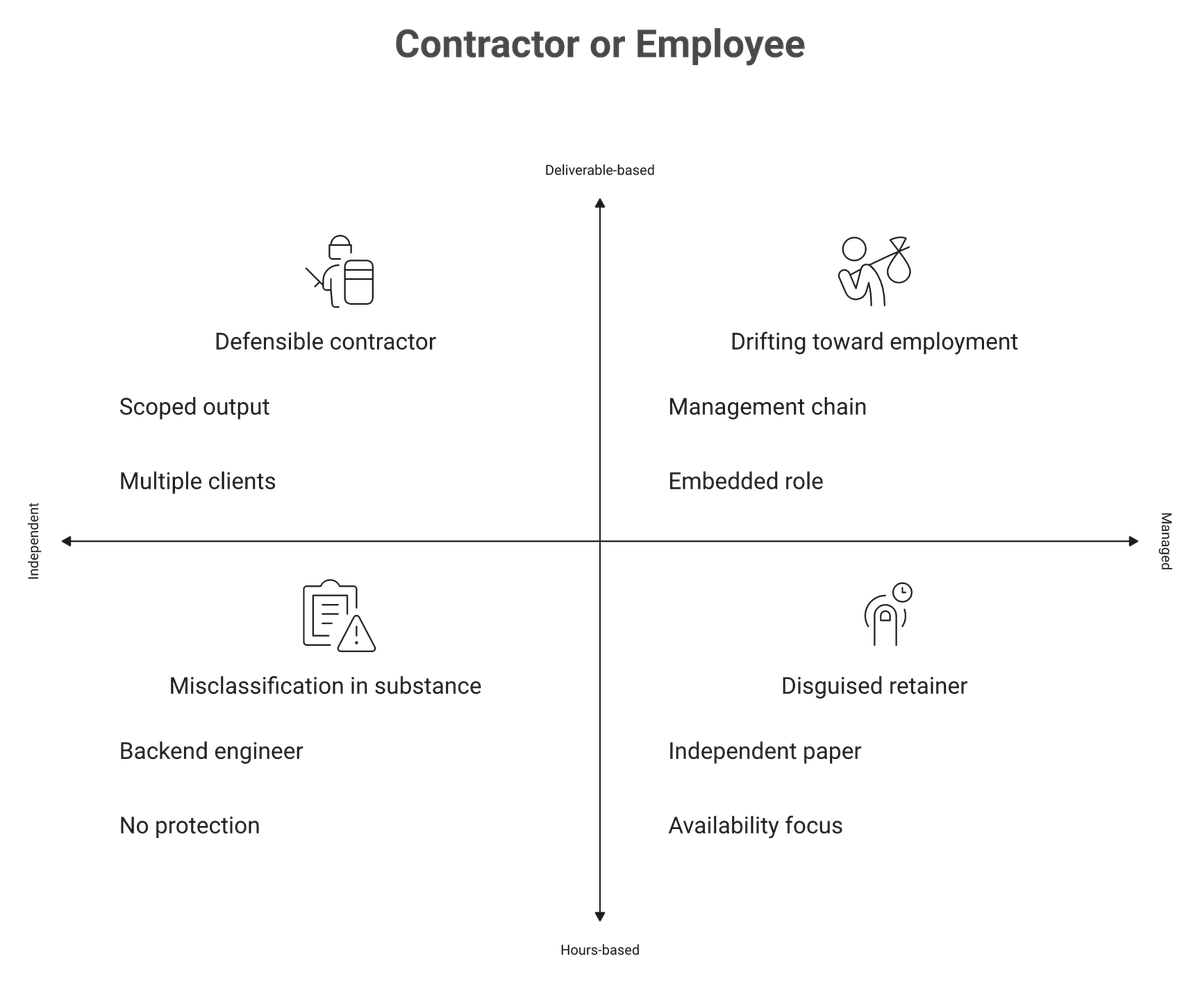
Contracting a full-time engineer who works your hours, on your tools, under your manager is misclassification in substance, regardless of what the agreement says. Indian law tests the reality of the relationship, not its label, under the Code on Social Security, 2020. Exposure includes backdated PF and ESI, TDS shortfall with interest, gratuity accrual, and penalties, commonly $25,000 to $40,000 per person by the time it surfaces. It usually surfaces in diligence, or when a new HR hire reads the contracts. Contracting is defensible for genuinely scoped, time-bound, deliverable-based work with multiple clients. Versatile Club employs India hires on its own entity from day one, which removes the question entirely.
🔎 The situation: four contractors and a new HR lead
Picture a Series A company with four India engineers on contractor agreements. Everything works. Payments clear, standups happen, nobody complains.
Then the company hires its first People Ops lead. She reads the four agreements in week two and goes quiet.
⚠️ The complication: what she found
Each contractor had a fixed monthly fee, a company laptop, a reporting manager, and a 9:30am standup. One had worked there 26 months.
As one EOR operator put it in an interview I keep returning to, HR leads reach the same conclusion fast: these people should be employees, and backdated taxes and fines are already sitting there. Nothing had gone wrong yet. That is the trap. Nothing goes wrong until diligence, a resignation, or a complaint. The clean-up path is mapped in convert contractor to employee in India.
🧍 The cost the employer never sees
The worker carries a cost too, and it is worse than the tax exposure.
A contractor has no Universal Account Number, so no provident fund corpus builds. There is no Form 130, so Indian lenders read him as self-employed. In one operator account, a worker insisting on contractor status was refused a mortgage, then approved after moving onto a formal employer's payroll.
Versatile Club's read is that the standard advice gets this backwards. The reason to convert is not only your audit exposure. Compliance is the floor, not the ceiling, and the trade-offs sit side by side in independent contractor versus EOR.
✅ When contracting is genuinely correct
Use this three-part test. All three must be true.
- Scoped output. Payment is tied to a deliverable, not to hours or attendance.
- Independence. No reporting manager, no fixed working hours, no company-issued equipment.
- Multiple clients. The person genuinely sells services to others.
Fail any one, and you are employing someone. Your third backend engineer fails all three. Where the work genuinely is independent, our Contractor of Record model keeps the paperwork clean.
💬 What it looks like from the worker's side
"Wisemonk is helping solve the challenge of finding the right job opportunities efficiently and seamlessly... Additionally, their HR and payroll services simplify day to day employment management, saving time and reducing administrative hassles."
— Verified User in Financial Services, Financial Services Wisemonk - G2 Verified Review (4 stars, 14 June 2025)
"Remote employs me so I can work for my company remotely."
— Verified User, Employee on EOR payroll Remote - G2 Verified Review (0 stars, 26 January 2026)
Both reviewers describe the same structural fact. A legal employer existed, so employment records existed.
🤝 The resolution
Versatile Club's Contract-to-Hire model exists for exactly this gap. We employ the person on our Indian entity from day one, with a real payslip, a real UAN, and a real Form 130, and you convert them to your own entity later without a backdated-liability clean-up.
Q8: Does paying Indian employees create Permanent Establishment or FEMA exposure?
Paying an Indian employee does not automatically create a Permanent Establishment, but how you do it can. Risk rises when India-based staff conclude contracts, negotiate pricing, or operate a fixed place of business in your name, which is business connection under Indian income tax law rather than a payroll question. A properly structured Employer of Record keeps employment on the provider's entity and commercial activity offshore. If you incorporate instead, FEMA adds a layer: inbound equity must be reported on Form FC-GPR within 30 days of share allotment, per the RBI Master Direction on reporting under FEMA, 1999. Versatile Club employs India hires on its own registered Indian entity, not a local partner shell.
🎯 The thesis, stated plainly
PE risk is a function of what your India people do, not where the money comes from. Three triggers matter, and payroll is not one of them.
1. Agency PE. Someone in India habitually concludes contracts or negotiates terms that bind your company.
2. Fixed place PE. You maintain an office, a signed lease, or a branded premises in India.
3. Service PE. Your India staff deliver services to your customers in India under your name.
⚖️ Risk by model
| Model | Employment nexus | Typical PE exposure | What raises it |
| Versatile Club EOR | Versatile Club's Indian entity | Low | Giving India staff contract-signing authority |
| Global EOR via partner entity | Partner's Indian entity | Low, with two contractual chains | Same, plus less visibility into the partner |
| Direct contractors | None | Highest | Sales or negotiation roles, long tenure |
| Own Pvt Ltd | Your subsidiary | Explicit and managed | Transfer pricing and cost-plus documentation |
This is a general framework, not legal advice for your facts. Treaty positions under the India US and India UK double taxation avoidance agreements turn on specifics, so have counsel read the role descriptions before you hire. If a captive is already on the table, compare it against EOR versus GCC in India first.
💰 The FEMA layer most founders meet late
If you take the subsidiary route, money movement becomes its own compliance track. Salary still has to be paid in Indian rupees, regardless of structure.
Two filings matter at the start:
- Form FC-GPR. Report inbound equity within 30 days of allotting shares to the foreign parent.
- Annual return on foreign liabilities and assets. Due by 15 July each year once you hold foreign investment.
⚠️ Where the quiet damage happens
The anxiety I hear from finance leaders is rarely about the fee. It is about cash traps, elongated audits, and lost credits, the things that surface months after a structure is chosen.
Versatile Club's data points one way here, though I might be reading it too strongly. The clients who escalate PE questions early almost never have a problem later. The ones who treat it as a procurement checkbox are the ones calling counsel in year two. Our compliance coverage page lists exactly which registrations sit with us.
🤝 What I put in writing
The most common CFO question on WhatsApp is not cost. It is whether this creates a tax presence in India. The honest answer is role-dependent, and I say so before onboarding rather than after.
Versatile Club employs your India hires on Foo Falcon Technologies Pvt Ltd, so the employment nexus sits with our own entity. Deel, Remote, G-P, and Omnipresent typically run India through local partner entities. One contractual chain for your counsel to review, not two. Buyers weighing that difference usually start with the Deel alternative comparison, then book time through a 30-minute call.
Q9: What non-payroll obligations attach the moment you employ someone in India?
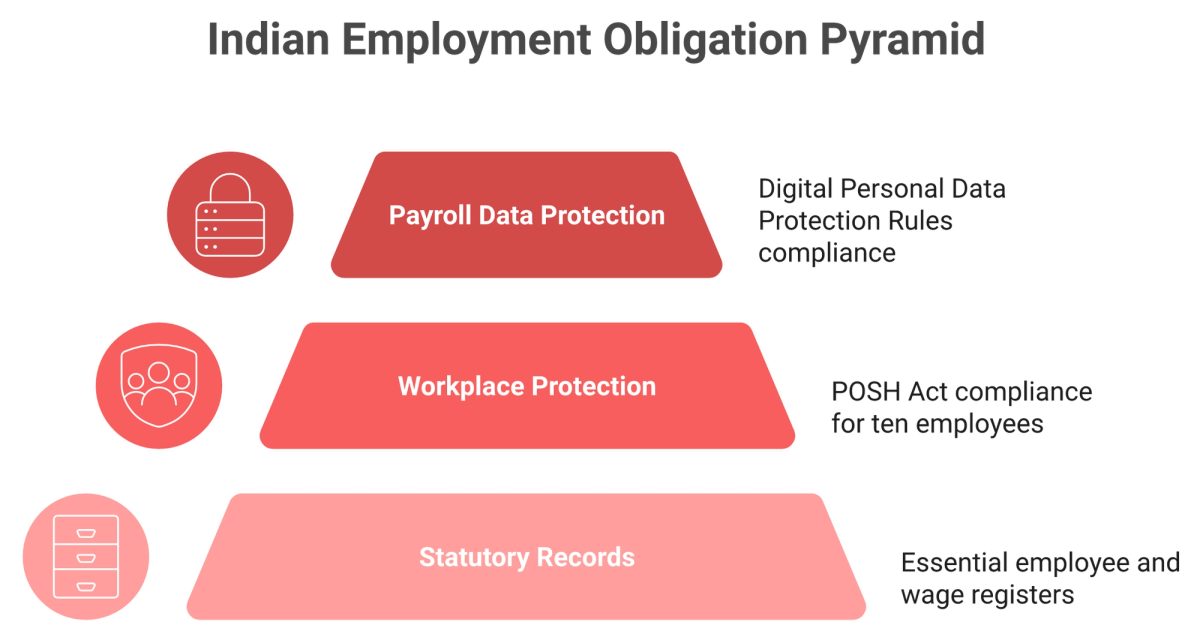
Employing in India triggers three duties beyond paying. Payroll data falls under the Digital Personal Data Protection Rules 2025, notified as G.S.R. 846(E) on 13 November 2025. Rules 1, 2, and 17 to 21 are already live, Consent Manager obligations start 14 November 2026, and the substantive Rules commence 14 May 2027, with penalties up to Rs 250 crore for a security safeguard failure. The POSH Act, which covers prevention of sexual harassment at work, requires an Internal Committee once you reach ten employees. The Labour Codes mandate digital registers, itemised payslips, and defined retention periods. Versatile Club holds employee payroll data inside its own Indian entity rather than passing it through partner processors.
📅 The DPDP dates that actually change your quarter
Every competitor page says "DPDP applies." Almost none says which rules are live now. That distinction is the only part that changes what you do this quarter.
| Rule set | Commences | What to do |
| Rules 1, 2, 17 to 21 | 13 November 2025 | Data Protection Board constitution and procedure, already in force |
| Rule 4 (Consent Managers) | 14 November 2026 | Register or select a Consent Manager if you rely on one |
| Rules 3, 5 to 16, 22, 23 | 14 May 2027 | Notices, consent architecture, security safeguards, breach reporting |
🗂️ What payroll data this actually covers
A payroll file is dense with personal data, which the Act calls digital personal data.
- Identity. PAN, Aadhaar number, date of birth, and address.
- Financial. Bank account, IFSC code, salary history, and loan deductions.
- Statutory. UAN (Universal Account Number), ESIC number, and nominee details.
- Downstream processors. Payroll software, insurance brokers, and background check vendors.
Versatile Club maps this flow per client, naming every processor that touches the file. The map is short when there is one entity in the chain, which is one reason buyers reviewing employer of record in India options ask who actually holds the data.
👥 POSH, registers, and the quiet obligations
The POSH Act threshold is ten employees at a workplace. At that point an Internal Committee must exist, with a presiding officer who is a woman, at least two employee members, and one external member from an NGO or a person familiar with the issues, under Section 4 of the Sexual Harassment of Women at Workplace Act, 2013.
Annual reporting follows. The committee files an annual report with the district officer, and the employer discloses the number of cases in its board report. The full registration and filing scope sits on our compliance page.
⚠️ The records an audit asks for first
Under the Labour Codes and their Central Rules notified by the Ministry of Labour and Employment, registers and payslips moved to a maintained digital format rather than loose spreadsheets.
Keep these ready at all times:
- Employee register with designation, wages, and date of joining.
- Wage register showing Basic, DA, allowances, and deductions per month.
- Itemised payslips issued every cycle, not on request.
- Attendance and leave records matching the payslip arithmetic.
In our C2H operations across Bengaluru, Hyderabad, and Pune, Versatile Club has found that the register gap, not the calculation, is what delays an inspection response. Clean arithmetic with missing registers still reads as non-compliant, which is the recurring failure in India payroll compliance reviews.
💡 Where my head is on the 2027 date
Versatile Club's read is that treating 14 May 2027 as a deadline is a mistake. Consent notices and breach workflows take two quarters to build properly, and payroll vendors will all be requoting contracts in the same window.
I could be early on this, but I would rather map the data flow in a quiet quarter than a crowded one.
🤝 Who holds the file
Versatile Club keeps payroll data inside one Indian entity rather than passing it through a chain of partner processors, which keeps your DPDP data flow map to a single named processor. Because employees sit on our entity, the POSH Internal Committee obligation and the statutory registers run under our registrations too, whether you use EOR services in India or managed payroll.
Q10: What happens on the way out, with F and F, gratuity, and the two-working-day rule?
Under the Industrial Relations Code, full and final settlement is due within two working days of exit, not with the next payroll run. That settlement includes unpaid salary, encashed leave per state rules, and gratuity where five years of continuous service are complete. Gratuity is last drawn monthly wage divided by 26, multiplied by 15, multiplied by completed years of service, under the Payment of Gratuity Act, 1972. Statutory deductions still cap at 50% of wages, so recovering notice period shortfalls from the final payment has a hard ceiling. Versatile Club accrues gratuity at 4.81% of Basic plus DA from month one, so the exit number is known before anyone resigns.
🧮 A worked settlement
Take an engineer resigning on 10 November, with Basic plus DA of Rs 75,000 a month, six completed years of service, and twelve unused leave days.
| Line | Calculation | Amount |
| Salary, 1 to 10 November | Rs 1,50,000 x 10/30 | Rs 50,000 |
| Leave encashment | (Rs 75,000 / 26) x 12 | Rs 34,615 |
| Gratuity | (Rs 75,000 / 26) x 15 x 6 | Rs 2,59,615 |
| Less TDS and dues | Capped at 50% of wages | As applicable |
| Settlement payable | Within 2 working days | Rs 3,44,230 |
⏰ Why two days breaks a US close cycle
A resignation on the 10th means cash out the door by the 12th. Most US finance teams approve India payments on a monthly cadence, tied to month-end close.
Versatile Club pre-computes gratuity and leave liability every month, so the final figure is already sitting in the file on the day someone resigns. The settlement becomes a transfer, not a scramble, and the same discipline is what makes switching an EOR provider in India survivable mid-year.
🧾 What you cannot claw back
Three things catch employers out at exit.
- Notice period recovery is capped. Total statutory deductions cannot exceed 50% of wages earned in the wage period, under the Payment of Wages Act, 1936.
- Gratuity cannot be withheld for ordinary resignation, only in the narrow cases the statute allows.
- PF is the employee's choice. They may withdraw after two months of unemployment, or transfer the UAN to the next employer through the EPFO member portal. Service continuity matters here, because it protects the gratuity clock on future employment.
💬 Where settlement accuracy shows up in reviews
"Communication is clear, documentation is organized, and timelines are generally well-maintained. It feels like working with a partner rather than just a payment or compliance vendor."
— Verified User in Marketing and Advertising, Marketing and Advertising Wisemonk - G2 Verified Review (3.5 stars, 12 February 2026)
"Their payroll is still supported by manual processes, and twice we've had near catastrophic errors."
— Juliette D., People Ops Remote - G2 Verified Review (0.5 stars, 22 April 2026)
Manual process risk concentrates at exit. A normal month has thirty days of slack. A settlement has two.
⚠️ The honest trade-off
Versatile Club's data points one way here, though I might be reading it too strongly. Clients who ask for the gratuity accrual report monthly almost never miss the two-day window. Clients who only look at exit time usually need an extra day, which means a technical breach.
✅ What exit costs with us
Versatile Club charges no exit fee, so offboarding costs you the settlement itself and nothing else. Because gratuity and leave accrue on our books every month, the two working day settlement runs off numbers we already hold rather than a reconstruction. The fee structure behind that sits on our pricing page.
Q11: India payroll and EOR providers compared: who should actually run this?
Split the market in two. India-native operators, including Versatile Club and Wisemonk, own Indian entities, price flat between $99 and $149 per employee per month, cover all 28 states, and assign a named human. Global generalists, including Deel, Remote, G-P, Multiplier, Velocity Global, Papaya, Rippling, and Skuad, cover 90 to 185 countries, charge roughly $599 a month or about 15% of salary with a $1,500 floor, run India through local partner entities, and support buyers through a ticket queue. Versatile Club operates in India only, through Foo Falcon Technologies Pvt Ltd, with a 5 business day onboarding SLA written into the agreement.
📊 The comparison that matters
| Provider | India entity | Pricing shape | Onboarding | Support model |
| Versatile Club | Owned, Foo Falcon Technologies Pvt Ltd | $149 flat, $0 setup, $0 exit, first month free | 5 business days, contractual | Founder on WhatsApp |
| Wisemonk | Owned Indian entity | $99 to $399 by slab | 24 to 72 hours, not contractual | Account team |
| Deel | Local partner entity | About $599 plus about $500 setup | 7 to 14 days | Ticket queue |
| Remote | Local partner entity | About $599 plus about $299 setup | 10 to 14 days | Email, reported 3 day SLA |
| G-P | Local partner entity | About 15% of salary, $1,500 floor | 1 to 2 weeks | Ticket queue |
| Multiplier | Local partner entity | About $400 | 1 to 2 weeks | Ticket queue |
Published rate cards for each generalist sit on Remote's pricing page and Multiplier's pricing page, and the India-specific shortlists sit in best EOR in India.
⚖️ The structural trade-off, stated honestly
Breadth and depth pull against each other. A platform covering 185 countries cannot hold the same India detail as an operator covering one.
That detail is specific, not abstract. It is Maharashtra's dual PTRC and PTEC registration, Karnataka's 30 day enrolment window, and Tamil Nadu's June and December filing. Versatile Club holds those registrations because India is the only country we work in, and the model-by-model map sits in India expansion options.
❌ When a generalist is the right call
I will say the unpopular part. Choose a global generalist when:
- You are hiring in five or more countries and want one dashboard.
- Your procurement process requires SOC 2 or ISO 27001 certification as a gate.
- Your India team will exceed 100 people with enterprise-grade vendor workflows.
Versatile Club is not the right fit for those three cases, and saying otherwise would waste your quarter. For India-only shortlists, the head-to-head sits in Wisemonk alternatives in India and Multiplier alternatives in India.
💬 What buyers say about support depth
"What I like best about Wisemonk is that it combines employee, time, and payroll management into one simple and efficient system, making daily operations smoother and more accurate."
— Vinay M., Payroll and HR Operations Wisemonk - G2 Verified Review (4 stars, 18 February 2026)
"At times when wisemonk team doesn't have information about what I asked, reaching out to the respective company and then getting the information, was a bit time consuming."
— Verified User in Financial Services, Financial Services Wisemonk - G2 Verified Review (4 stars, 16 June 2025)
"I find the communication with the team frustrating. It's impossible to speak to a human... They don't follow up when they say they will and provide unreliable information."
— Verified User, HR Operations Remote - G2 Verified Review (0 stars, 26 January 2026)
Also worth naming: US style co-employment PEO does not legally exist under Indian labour law. If a vendor sells you "PEO India" without an entity, ask which entity employs the person, a point we unpack in EOR versus PEO.
🤝 Where Versatile Club lands
Versatile Club is India only by design, with one owned entity, $149 flat, a 5 day onboarding SLA in the agreement, and Sagar Chainani on WhatsApp instead of a CSM rotation. Wisemonk's $99 entry sticker is lower than ours, and I will not claim cheapest. The EOR line launched in 2026 on compliance infrastructure proven through six years of Contract-to-Hire payroll.
Q12: What should you do in your first 30 days, and how do you move to your own entity later?
Week 1: choose the model and structure the offer at Basic plus DA of at least 50% of CTC. Week 2: collect PAN, Aadhaar, bank details, and the Form 12BB declaration, generate the UAN, and check whether the Rs 25,000 EPF ceiling now captures the role. Week 3: run a parallel dry payroll and audit a live sample invoice for setup, FX, benefits, and exit line items. Week 4: pay salary by the 7th and file the EPF electronic challan by the 15th. Versatile Club completes offer structuring, onboarding, UAN generation, state registrations, and the first payroll run inside a 5 business day contractual SLA.
🗓️ The 30 day grid
| Week | Action | Output |
| 1 | Pick the model, structure CTC at the 50% floor | Signed offer letter |
| 2 | Collect PAN, Aadhaar, bank, Form 12BB, generate UAN | Complete statutory file |
| 3 | Parallel dry payroll, live invoice audit | Verified net pay and fee lines |
| 4 | TDS by the 7th, ECR by the 15th | First compliant payroll cycle |
⚠️ The dry run nobody schedules
Run week three twice. Compute the payslip, then have someone else recompute it without seeing your sheet.
Across the first payroll runs Versatile Club has executed for US clients, the error is almost never the salary. It is a wrong IFSC code, a missing UAN, or a professional tax slab applied from the wrong state. You can sanity-check the net pay against the salary calculator before the cycle locks.
🔄 Moving to your own entity later
The migration is not a re-hire. Done badly, it resets service clocks and costs employees their gratuity continuity.
Sequence it like this:
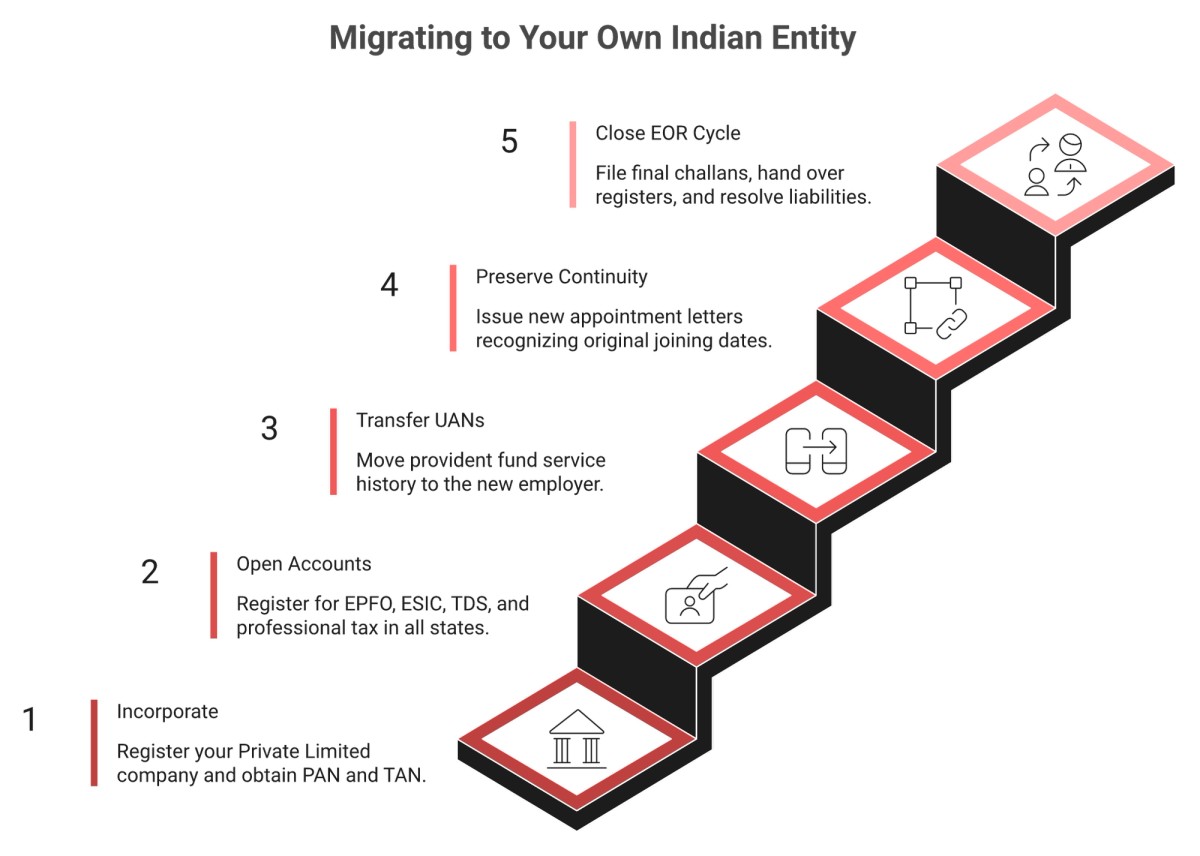
- Incorporate the Private Limited company through the MCA portal and obtain PAN and TAN.
- Open statutory accounts: EPFO, ESIC, TDS, and professional tax registration in each state where you employ people.
- Transfer UANs so provident fund service history carries over.
- Preserve service continuity in the new appointment letters, recognising the original date of joining.
- Close the EOR cycle cleanly, with final challans filed and registers handed over.
Before you commit capital to that path, model it against staying on EOR using the EOR versus entity calculator.
✅ The two protocols I enforce
Versatile Club runs every payroll cycle on two communication rules, and both came from watching cross-border teams misread each other.
- Written recap after every call. Send an email repeating the key points immediately afterwards, so nobody relies on a shared memory of a Zoom call.
- Open questions, not closed ones. Ask "where are we on the payroll file" rather than "are we on track." A yes is not information.
High context communication is where India payroll quietly goes wrong. A polite "that probably will not be a problem" can mean the opposite, and the gap only shows up on the 7th.
💡 Where I think this goes
What shifts in the next two years is that India stops being one country on a global EOR map and becomes its own specialist category. Owned entity operators working in a single country will take India revenue from the generalists.
Versatile Club's bet is on that depth, and I could be wrong about the pace. The direction feels settled.
🤝 Start small, test the invoice
Versatile Club compresses the first run into five business days under a contractual SLA, with the first month free, so you can test the invoice and the response time before any money is committed. Tell me who you are trying to hire in India, and I will tell you which of the four models you actually need. The sequence is laid out on how it works, and you can start the conversation on our contact page or book a 30-minute call.
FAQs
Can we pay our Indian employees in USD from our US or UK bank account?
No. Wages for work performed in India must be paid in Indian rupees into an Indian bank account. The Payment of Wages Act, 1936 permits cash, cheque, or a direct bank credit once the employee authorises it in writing, and it caps total statutory deductions at 50% of wages earned in that wage period.
You can still send USD across the border. It simply has to land with a legal Indian employer that converts it, disburses INR, and files under its own registrations.
- No Indian employer means no records. No TDS trail, no PF challan, no UAN, and no annual salary certificate.
- The employee pays for it. Without payslips and Form 130, Indian lenders read that person as self-employed, which blocks home loans.
- Contractors are the exception. A genuinely independent contractor may invoice in USD and receive foreign inward remittance against that invoice.
Versatile Club invoices in USD directly from its own registered Indian entity, so the currency conversion happens once, inside the entity, rather than across a chain of intermediaries. We explain the structural difference in our guide to hiring in India without an entity.
What changed with the EPF wage ceiling in September 2026, and who does it affect?
Gazette notification S.O. 5109(E), issued with effect from 17 September 2026, raised the EPF wage ceiling from Rs 15,000 to Rs 25,000 per month, superseding S.O. 2702(E). Roughly 51 lakh additional employees moved into mandatory provident fund coverage.
The arithmetic matters for anyone paying junior or support roles in India.
- Employer cost at the ceiling rose from Rs 1,950 to Rs 3,250 a month.
- An engineer at Rs 22,000 Basic plus DA now attracts employer PF of Rs 2,640 a month, against Rs 1,800 if you had capped at the old ceiling.
- ESIC did not move. Its wage ceiling stays at Rs 21,000, so one wage figure no longer answers both questions.
- International workers have no ceiling at all and contribute on full Basic plus DA.
Versatile Club re-ran every active employee's Basic plus DA against the new Rs 25,000 line in the week the gazette landed, generated the missing UANs, and pro-rated the September electronic challan filings. Most pages ranking for this topic still quote Rs 15,000, which is why we maintain a live view of payroll compliance in India.
What does one India employee actually cost per month, including hidden fees?
Budget 13% to 16% above gross before any vendor fee. That covers employer EPF at 12% of Basic plus DA, gratuity accrual at 4.81%, ESI at 3.25% where wages fall under Rs 21,000, plus professional tax and labour welfare fund.
Then there are two layers buyers routinely miss.
- The service fee. Roughly $49 per employee per month for managed payroll if you own an entity, $99 to $599 for an Employer of Record, or about 15% of salary with a $1,500 monthly floor at the enterprise generalists.
- The FX markup. A reported 3% to 5% conversion spread plus $25 to $50 per wire. On a $30,000 monthly payroll, that is $10,800 to $18,000 a year of cost that never appears on a pricing page.
Before signing anything, ask every shortlisted provider for a redacted live invoice from a current client and hunt five line items: setup fee, security deposit, FX markup, benefits markup, and exit fee.
Versatile Club prices its India EOR at $149 per employee per month flat, with no setup fee, no exit fee, no benefits markup, and no salary markup. We break the full stack down in cost of hiring in India.
Does paying employees in India create Permanent Establishment risk for our company?
Paying an Indian employee does not automatically create a Permanent Establishment, but how you do it can. The test turns on what your India people do, not on where the money originates.
Three triggers matter, and payroll is not one of them.
- Agency PE. Someone in India habitually concludes contracts or negotiates terms that bind your company.
- Fixed place PE. You maintain an office, a signed lease, or branded premises in India.
- Service PE. Your India staff deliver services to your customers in India under your name.
A properly structured Employer of Record keeps employment on the provider's entity while commercial activity stays offshore. Direct contractor arrangements with sales or negotiation authority carry the highest exposure. If you incorporate instead, FEMA adds its own track: inbound equity must be reported on Form FC-GPR within 30 days of share allotment.
This is a general framework, not legal advice for your facts, and treaty positions under the India US and India UK agreements turn on specifics, so have counsel read the role descriptions first.
Versatile Club employs India hires on Foo Falcon Technologies Pvt Ltd, its own registered Indian entity, so your counsel reviews one contractual chain rather than two. The model-by-model view sits in EOR versus entity in India.
When is hiring an Indian contractor defensible, and when is it misclassification?
Contracting a full-time engineer who works your hours, on your tools, under your manager is misclassification in substance, regardless of what the agreement says. Indian law tests the reality of the relationship, not its label.
Exposure includes backdated PF and ESI, TDS shortfall with interest, gratuity accrual, and penalties, commonly $25,000 to $40,000 per person by the time it surfaces. It usually surfaces during diligence, or when a new People Ops hire reads the contracts.
Use a three-part test, and all three must be true:
- Scoped output. Payment is tied to a deliverable, not to hours or attendance.
- Independence. No reporting manager, no fixed working hours, and no company-issued equipment.
- Multiple clients. The person genuinely sells services to others.
Fail any one, and you are employing someone. Your third backend engineer fails all three.
The worker carries a cost too. Without a UAN there is no provident fund corpus, and without Form 130 Indian lenders treat them as self-employed.
Versatile Club's Contract-to-Hire model employs the person on its own Indian entity from day one, so there is no backdated liability to clean up later. The conversion path is mapped in convert contractor to employee in India.