Table of contents (17)
Top 10 PEO Service Providers in India for 2026: Pricing, Compliance & Selection Guide
Q1. What are the 10 best PEO service providers in India for 2026?
The 10 best PEO service providers in India for 2026 are Versatile Club, Deel, Remote, Globalization Partners, Multiplier, Rippling, Papaya Global, Payoneer (formerly Skuad), Pebl (formerly Velocity Global), and ADP India. Versatile Club employs India hires through its own registered Indian entity, Foo Falcon Technologies Pvt Ltd, and files their PF, ESI, TDS, and professional tax under those registrations. Pricing is $49 per employee per month for managed payroll and $149 flat per employee per month for EOR services in India, with no setup fee, no exit fee, and a five business day onboarding SLA written into the contract.
Choosing a PEO or EOR partner in India is not a software purchase. It is a decision about who legally employs your people, whose login files their returns, and whose name appears on the challan if an inspector asks. Twenty-plus providers were reviewed for this guide, and ten made the list. Each was assessed on entity model, statutory compliance depth, state coverage, onboarding speed, pricing transparency, invoicing and finance readiness, support model, talent and retention support, customer validation, and best-fit buyer segment. This guide is written for US and UK founders, People Ops leaders, CFOs, and legal teams hiring between one and fifty employees in India.
Our Evaluation Criteria
Each provider included in this list was assessed across the following decision-grade criteria:
India Entity Model: Whether the provider uses its own Indian entity, a local partner entity, a contractor model, or a payroll-only setup.
Statutory Compliance Depth: PF, ESI, TDS, professional tax, gratuity, POSH, Form 16, full-and-final settlement, DPDP readiness, and New Labour Code 2025-26 structuring.
State-Level Coverage: Ability to handle professional tax, Shops and Establishments, labour welfare fund, and leave rules across Indian states.
Onboarding Speed: Time from signed agreement to compliant employment contract, payroll setup, statutory registration, and employee start.
Pricing Transparency: Monthly fee, setup fee, exit fee, FX markup, first-month terms, salary-band pricing, and invoice clarity.
Invoicing and Finance Readiness: USD invoicing, INR invoicing, gross-deduction-net reporting, challan confirmations, TDS receipts, and audit-ready documentation.
Support Model: Founder-direct support, named HR manager, HRBP, ticket queue, chatbot, or general CSM model.
Talent and Retention Support: Recruiting, contract-to-hire, culture-fit vetting, onboarding monitoring, replacement guarantee, and employee experience support.
Customer Validation: G2, Capterra, Clutch, Gartner, Reddit, case studies, named testimonials, customer logos, and third-party proof.
Best-Fit Buyer Segment: First India hire, 1 to 20 India employees, 10 to 50 India employees, companies switching from Deel or Remote, companies with an existing India entity, or enterprises needing multi-country EOR.
Who This Guide Is For
This guide is designed for:
US and UK founders hiring their first 1 to 3 employees in India.
Seed to Series B startups building engineering, product, AI, design, marketing, or operations teams in India.
People Ops and HR leaders reviewing India EOR, payroll, contractor, or PEO vendors.
CFOs and finance teams that need clean invoicing, statutory liability visibility, and audit-ready India payroll records.
Legal teams reviewing employment contracts, IP assignment, misclassification risk, PE risk, and statutory employer accountability.
Companies currently using Deel, Remote, Multiplier, G-P, contractors, agencies, or local payroll vendors and evaluating India-specialist alternatives.
📋 The Ranked List at a Glance
Versatile Club: Best for US and UK companies hiring their first 1 to 20 India employees through an owned Indian entity.
Deel: Best for companies that need one contract covering many countries at once.
Remote: Best for teams that want an owned global entity network and in-house IP assignment.
Globalization Partners (G-P): Best for enterprise procurement teams that need established security certifications.
Multiplier: Best for APAC-heavy hiring where INR invoicing is acceptable.
Rippling: Best for companies that want device provisioning and IT onboarding in the same system.
Papaya Global: Best for finance teams consolidating payroll data across many payroll vendors.
Payoneer (formerly Skuad): Best for fast contractor-to-employee conversions at a flat fee.
Pebl (formerly Velocity Global): Best for large, custom-scoped international employment programmes.
ADP India: Best for companies that already own an Indian entity and want payroll outsourcing only.
💰 Master Comparison Table
| Provider | Best For | Key Strength | Compliance |
| Versatile Club ⭐⭐⭐⭐⭐ |
US and UK startups hiring their first 1 to 20 India employees | Owned Indian entity with USD invoicing direct from India | Own entity, PF, ESI, TDS, and PT filings under its own registrations across 28 states and 8 UTs |
| Deel ⭐⭐⭐⭐ |
Companies hiring across 10 or more countries in one contract | Breadth of country coverage in a single platform | India typically routed through a local partner entity, published coverage concentrated in the top six states |
| Remote ⭐⭐⭐⭐ |
Teams wanting an owned global entity network | In-house IP assignment and contractor-to-employee conversion | Owned global entity network, India coverage published for roughly the top four states |
| Globalization Partners (G-P) ⭐⭐⭐ |
Enterprise procurement with certification gates | Mature security and certification posture | Owned global entities, enterprise audit documentation |
| Multiplier ⭐⭐⭐⭐ |
APAC-heavy hiring with INR billing accepted | All-India state coverage claim at a mid-market fee | Local partner entity model in India, INR default invoicing |
| Rippling ⭐⭐⭐⭐ |
Companies bundling IT and device provisioning with payroll | Device and app provisioning inside onboarding | Owned entity model, India statutory depth thinner than India-only specialists |
| Papaya Global ⭐⭐⭐ |
Finance teams consolidating global payroll data | Payroll data aggregation and reporting | Aggregator network, compliance executed by local providers |
| Payoneer (formerly Skuad) ⭐⭐⭐ |
Fast contractor-to-employee conversion at a flat fee | Flat per-employee pricing with 48 to 72 hour onboarding | Hybrid partner model, APAC concentration |
| Pebl (formerly Velocity Global) ⭐⭐⭐ |
Custom-scoped enterprise employment programmes | Bespoke scoping and advisory support | Partner and owned hybrid, custom compliance scoping |
| ADP India ⭐⭐⭐ |
Companies with an existing Indian entity needing payroll only | Long-running India payroll bureau operations | Payroll-only on your entity, your registrations and your filings |
1. Versatile Club: Best for US and UK Companies Hiring Their First 1 to 20 India Employees
🏢 Overview
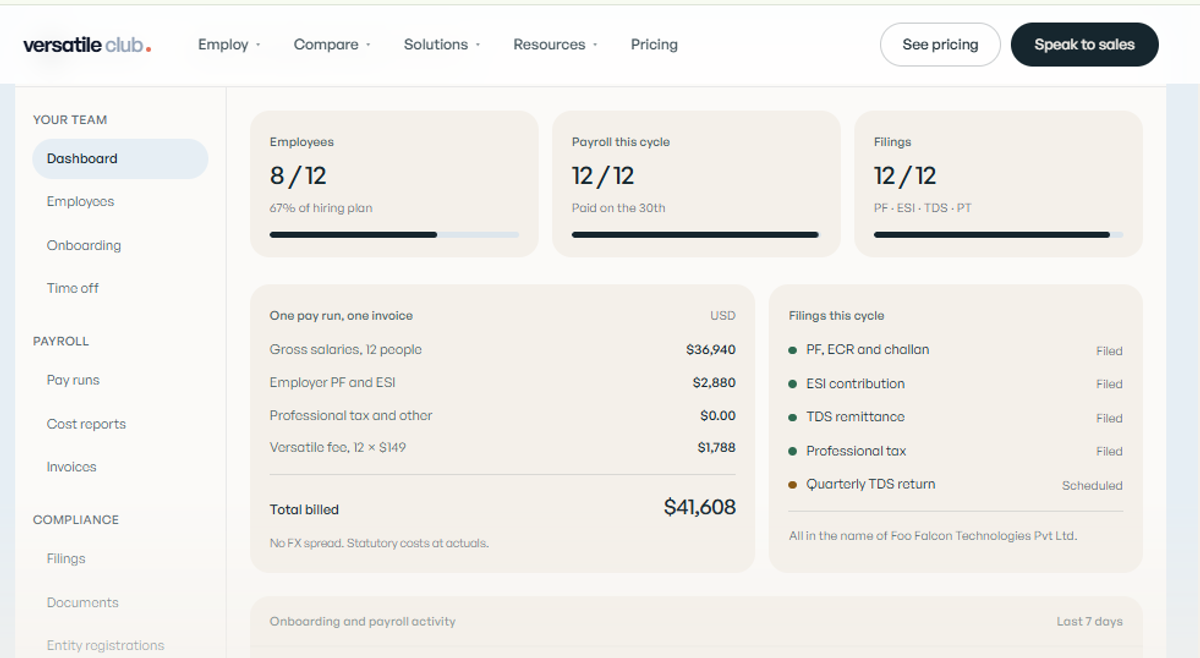
Versatile Club is an India-only Employer of Record and Contract-to-Hire provider built for US and UK companies. It sits in the India-native specialist category rather than the multi-country generalist category. India is the only country it operates in, by design.
Versatile Club employs your India hires through Foo Falcon Technologies Pvt Ltd, its own registered Indian company. That matters because the legal employer is the entity on the contract, not the brand on the invoice. Most global platforms place India hires with a local partner entity instead.
🛠️ Core Services
Employer of Record for India, with the employment contract issued by its own Indian entity.
Contract-to-Hire placements, charged at 20 to 30 percent of annual salary and billed only after the hire completes day 90.
Managed payroll for companies that already own an Indian Private Limited company.
Offshore team building across Bengaluru, Hyderabad, and Pune.
Statutory filing execution covering PF, ESI, TDS by the 7th, professional tax, gratuity accrual, Form 16, and full-and-final settlement.
⭐ Why Companies Consider Versatile Club
The buying reason is usually narrow. A founder wants one engineer in Bengaluru next month, does not want to spend 50,000 dollars and a year on a subsidiary, and does not want to pay 599 dollars a month for a platform that treats India as country number 97.
The second reason is finance hygiene. Versatile Club issues one USD invoice from its Indian entity at the mid-market rate, so there is no 3 to 5 percent conversion markup buried in the total. CFOs closing month-end on a single reconcilable line item tend to notice that before they notice anything else.
👥 Ideal Customer Profile
US and UK companies, Seed to Series B, hiring 1 to 20 people in India.
First India hire scenarios where no Indian entity exists.
Engineering, design, product, AI, and operations roles.
Decision maker is the founder, the Head of People, or the CFO.
Companies switching from Deel, Remote, or a contractor arrangement.
💸 Commercial Model
EOR: 149 dollars per employee per month, flat, with no salary-band tiering.
Managed payroll on your own Indian entity: 49 dollars per employee per month.
Setup fee: zero. Exit fee: zero. First month free.
FX policy: mid-market rate, no markup, invoiced in USD from India.
Contract-to-Hire: 20 to 30 percent of annual salary, charged after day 90, with a six-month replacement guarantee.
Every one of these figures is published on the Versatile Club pricing page rather than quoted on request.
⏰ Onboarding and Support
Versatile Club commits to a five business day onboarding SLA in the contract, measured from signed agreement to compliant employment contract and payroll setup. Several competitors quote faster numbers, but as marketing claims rather than contractual terms. I would rather put five days in writing than 48 hours in a pitch deck. The full sequence is documented on the how it works page.
Support runs through me directly on WhatsApp, not a ticket queue or a CSM rotation. New hires also get a 90-day Success Coach, which came out of our Contract-to-Hire business, where we were accountable for whether the placement actually worked.
💬 Customer Reviews
"Sagar replied to our form in about four hours with a draft offer letter already attached. The hire was onboarded in four days. First USD invoice landed clean: no FX markup, no setup fee, no surprises."
— Verified User in Information Technology and Services, Versatile Club G2 - Verified Review
"The dashboard could be a little more self-serve. A couple of times I wanted to pull a report or a doc myself and ended up just messaging my contact instead. They always answered fast, so it wasn't a real problem, but I'd love to click around and find things on my own."
— Angad S., Founder, Versatile Club G2 - Verified Review
"We worked with Versatile to hire in India and support our design staffing needs without getting pulled into the complexity of contracts, payroll, compliance, and HR operations."
— Ibrahim A., Versatile Club G2 - Verified Review
⚠️ Where Versatile Club Is the Wrong Choice
Versatile Club is not the answer if you need one agreement covering five or more countries. It is also not the answer if your procurement team gates vendors on SOC 2 Type II or ISO 27001 today, or if you are hiring B2C consumer staff at volume.
Enterprise procurement workflows with heavy customisation also run longer than the five day SLA. Naming that is more useful to you than pretending otherwise, and the compliance page sets out exactly what is covered and what is not.
2. Deel: Best for Companies That Need One Contract Covering Many Countries
🏢 Overview
Deel is a multi-country employment platform covering 150-plus countries through a mix of owned entities and local partners. India is one market inside that footprint. For buyers hiring across several countries at once, that breadth is the product.
Deel is the default name in most EOR shortlists, which is exactly why it deserves a factual look rather than a reflex. The platform is strong. The India execution layer is where buyers should ask harder questions.
🛠️ Core Services
Employer of Record across 150-plus countries.
Contractor management and global contractor payments.
Global payroll consolidation and reporting.
Immigration and visa support services.
Equipment provisioning and offboarding workflows.
⭐ Why Companies Consider Deel
The decision logic is vendor consolidation. A People Ops lead hiring in India, Poland, Brazil, and the Philippines does not want four vendors, four invoices, and four compliance conversations. Deel collapses that into one contract and one dashboard.
The trade-off is depth per country. India statutory work is typically executed through a local partner entity, and Deel's published India state coverage concentrates on roughly the top six states. If your hire sits in Maharashtra with its dual PTRC and PTEC registrations, ask which entity holds the registration and who uploads the return, a question covered in detail in our guide to payroll compliance in India.
👥 Ideal Customer Profile
Companies hiring in 5 or more countries simultaneously.
Series B and later, with a dedicated People Ops or Global HR function.
Teams that value one dashboard over per-country depth.
Buyers who need contractor and employee management in one system.
Decision maker is typically VP People or Global HR Operations.
💸 Commercial Model
Deel's India EOR pricing sits at roughly 599 dollars per employee per month, with a setup fee of around 500 dollars and a one month notice period on exit, per Deel's own pricing page. Contractor management is billed separately per contractor. Reviewers and operators consistently report a 3 to 5 percent FX conversion markup that does not appear as its own invoice line.
Ask for a live sample invoice before signing, not a quote. The markup only becomes visible when you compare the conversion rate on the invoice against the RBI reference rate for that date. Our breakdown of employer of record cost in India models the same comparison line by line.
⏰ Onboarding and Support
Deel's India onboarding typically runs 7 to 14 days from signed agreement to employee start. Support is chatbot-first, escalating into a ticket queue and then a CSM. For routine payroll months, that works. For a PF challan question three days before payday, buyers report friction.
💬 Customer Reviews
"I find Deel easy to use, which is an important aspect as it enables me to navigate the platform without any hassle. I find Deel to be absurdly expensive. They charge a high amount of fees for transferring money to my bank account."
— Juan Camilo O., Contractor, Deel - G2 Verified Review, 27 November 2025
"Customer support and issue ownership need serious improvement. In my experience, contacting support did not lead to effective problem solving. I was redirected multiple times, asked to repeat the same information to different representatives, and spent a considerable amount of time in meetings without reaching a clear resolution."
— Güneş A., Deel - G2 Verified Review, 2 October 2025
"I appreciate the ease of setup with Deel; it took me only a few minutes, making the process straightforward. I dislike how expensive Deel's transaction fees are, especially when moving money from the Deel account to my bank."
— Maria M., Freelancer, Deel - G2 Verified Review, 26 September 2025
🔄 How Does Versatile Compare to Deel?
Versatile Club covers one country, India, through its own registered Indian entity, Foo Falcon Technologies Pvt Ltd, and that scope stops at the Indian border. If you are hiring in eight countries this quarter, Deel does something Versatile Club cannot, and its country footprint plus immigration support is genuinely the stronger product for that job.
Unlike Deel, Versatile Club employs India hires on an entity it owns rather than a local partner entity, publishes a flat 149 dollars per employee per month with no setup fee and no exit fee, invoices in USD from India at the mid-market rate with no conversion markup, and writes a five business day onboarding SLA into the contract. Deel does not state a contractual onboarding SLA on its own site. For companies where India depth and invoice clarity matter more than country count, that combination is the difference.
Looking beyond Deel? Our roundup of Deel alternatives in India compares it against the rest of the India EOR market.
3. Remote: Best for Teams Wanting an Owned Global Entity Network
🏢 Overview
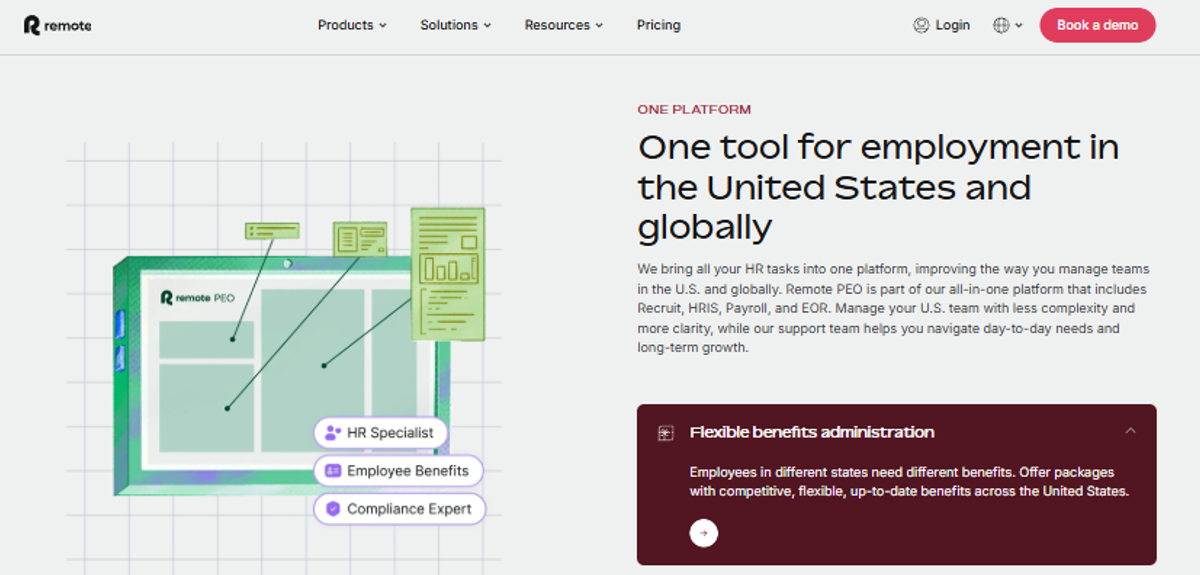
Remote is a multi-country employment platform that runs most of its markets through entities it owns rather than partners. It covers 85-plus countries, with India as one of them. The pitch to buyers is control of the employment chain.
Remote also sells contractor management, global payroll, and in-house IP assignment paperwork. For companies worried about who owns code written abroad, that last piece is usually the hook.
🛠️ Core Services
Employer of Record across its owned entity network.
Contractor management and contractor-to-employee conversion.
Global payroll and benefits administration.
In-house IP and invention assignment documentation.
Equipment and offboarding support.
⭐ Why Companies Consider Remote
The decision logic is usually legal comfort. A General Counsel reviewing a first India hire wants the IP assignment airtight and the entity chain short. Remote answers both questions in one document set.
Published India state coverage is the limit worth probing. Remote's India footprint concentrates on roughly the top four states, which matters if your hire sits in West Bengal or Tamil Nadu. Both states have their own professional tax and labour welfare fund rules, filed separately.
👥 Ideal Customer Profile
Companies hiring across 3 or more countries.
Series A and later, with legal review in the buying loop.
Teams converting existing contractors into employees.
India team size of 1 to 10, as part of a wider footprint.
Decision maker is typically Legal, People Ops, or Finance.
💸 Commercial Model
Remote's EOR pricing sits at roughly 599 dollars per employee per month, with a setup fee of around 299 dollars, per Remote's own pricing page. Contractor management is billed at about 29 dollars per contractor per month. Exit requires one month of notice.
Onboarding runs 10 to 14 days from signed agreement to employee start. Support is email-based, and reviewers report a three day response SLA rather than phone escalation. Our side-by-side on Deel vs Remote for India hiring sets both support models against each other.
💬 Customer Reviews
"They were dishonest about the level of support provided. We specifically explained we required phone-level support for urgent matters, but that is not available. Instead they have email support with a 3-day SLA. Separately, their payroll is still supported by manual processes, and twice we've had near catastrophic errors."
— Juliette D., HR Leader, Remote - G2 Verified Review, 22 April 2026
"My salary has always been paid on time via Remote. Remote is terrible at drafting employment contracts. I had to send mine back multiple times for corrections, including ridiculous things like the employment start date not being a valid date."
— Justin W., EOR Employee, Remote - G2 Verified Review
🔄 How Does Versatile Compare to Remote?
Versatile Club covers India only, employing hires through its own registered Indian entity, Foo Falcon Technologies Pvt Ltd, and that scope stops at one country. Remote operates an owned entity network across more than 85 countries, which is genuinely useful if your hiring plan spans several markets at once.
Unlike Remote, Versatile Club writes a five business day onboarding SLA into the contract, invoices in USD directly from its Indian entity at the mid-market rate, and holds PF, ESI, and professional tax registrations across all 28 states and 8 union territories rather than a concentrated set. Remote does not state a contractual onboarding SLA on its own site. For companies where India filing depth matters more than country count, that combination is the difference.
Looking beyond Remote? Our roundup of Remote alternatives in India compares it against the rest of the India EOR market.
4. Globalization Partners (G-P): Best for Enterprise Procurement With Certification Gates
🏢 Overview
Globalization Partners, now branded G-P, is one of the oldest names in global employment. It operates owned entities across 180-plus countries and sells primarily to enterprise buyers. India sits inside a standardised global service model.
G-P is built for procurement teams, not founders. The documentation, security posture, and audit trail are the product as much as the payroll is.
🛠️ Core Services
Employer of Record across owned global entities.
Global payroll and statutory benefits administration.
Employment contract generation by country.
Compliance advisory and country guides.
Enterprise reporting and audit documentation.
⭐ Why Companies Consider G-P
The buying reason is risk committee approval. When a 500-person company needs a vendor that will clear security review, G-P usually clears it. That is a real and specific value, and it is the same reason enterprise buyers often shortlist the largest names first.
The cost structure is where mid-market buyers stall. G-P prices India EOR at roughly 15 percent of salary, with a monthly minimum near 1,500 dollars per employee. For a 30,000 dollar Bengaluru engineer, that minimum changes the whole model.
👥 Ideal Customer Profile
Enterprise companies, 250 employees and above.
Buyers with formal security and procurement review.
Hiring across 10 or more countries.
India team of any size inside a global programme.
Decision maker is typically Global HR or Procurement.
💸 Commercial Model
G-P charges approximately 15 percent of employee salary for EOR, with a monthly minimum of around 1,500 dollars per employee, per G-P's own pricing page. Setup and termination fees are substantial and quoted per engagement. Onboarding typically runs 5 to 10 days. Run the same salary through our EOR vs entity calculator to see where a percentage-of-salary model crosses over.
💬 Customer Reviews
No verified customer reviews were available in the provided source set for this provider.
🔄 How Does Versatile Compare to G-P?
Versatile Club covers India only, through its own registered Indian entity, Foo Falcon Technologies Pvt Ltd, and does not operate outside India. G-P holds the enterprise security certifications and country breadth that Versatile Club does not, and for a procurement team with a certification gate, that is the deciding factor.
Unlike G-P, Versatile Club publishes a flat 149 dollars per employee per month with no salary-percentage component, charges no setup fee and no exit fee, and commits to a five business day onboarding SLA in the contract. G-P does not publish its India EOR price on its own site. For companies where a 30,000 dollar salary should not trigger a 1,500 dollar monthly minimum, that combination is the difference.
Looking beyond G-P? Our roundup of Globalization Partners alternatives in India compares it against the rest of the India EOR market.
5. Multiplier: Best for APAC-Heavy Hiring With INR Billing Accepted
🏢 Overview
Multiplier is a global employment platform with strong APAC positioning and a mid-market price point. It covers 150-plus countries and claims coverage across all 28 Indian states. India is one of its more active markets.
The platform sits between the premium generalists and the India-only specialists on price. That middle position is both its appeal and its constraint.
🛠️ Core Services
Employer of Record across 150-plus countries.
Contractor onboarding and payments.
Global payroll processing.
Benefits administration by country.
Expense and timesheet management.
⭐ Why Companies Consider Multiplier
The decision logic is price against breadth. At roughly 400 dollars per employee per month, Multiplier undercuts Deel and Remote while still offering multi-country coverage. For a Series A company hiring in India, Singapore, and the Philippines, that maths works.
Two details matter for India buyers. India execution runs through a local partner entity, and invoicing defaults to INR rather than USD. A CFO closing month-end in dollars will carry the conversion risk themselves, which is one of the hidden lines in our cost of hiring in India breakdown.
👥 Ideal Customer Profile
Seed to Series B companies hiring across APAC.
India team size of 1 to 15.
Buyers comfortable with INR invoicing.
Teams wanting multi-country coverage below 500 dollars per month.
Decision maker is typically the founder or Head of People.
💸 Commercial Model
Multiplier prices India EOR at roughly 400 dollars per employee per month, with contractor management at about 40 dollars per contractor, per Multiplier's own pricing page. There is no setup fee, and exit requires two weeks of notice. Onboarding runs around 7 days, with INR as the default invoicing currency.
💬 Customer Reviews
No verified customer reviews were available in the provided source set for this provider.
🔄 How Does Versatile Compare to Multiplier?
Versatile Club employs India hires through its own registered Indian entity, Foo Falcon Technologies Pvt Ltd, and operates in India only. Multiplier covers more than 150 countries, which is a real advantage if your hiring map extends beyond India this year.
Unlike Multiplier, Versatile Club holds the Indian entity itself rather than working through a local partner entity, invoices in USD from India at the mid-market rate instead of defaulting to INR, and publishes a flat 149 dollars per employee per month with a five business day contractual onboarding SLA. Multiplier does not state a contractual onboarding SLA on its own site. For companies where USD invoicing and direct filing matter more than country count, that combination is the difference.
Looking beyond Multiplier? Our roundup of Multiplier alternatives in India compares it against the rest of the India EOR market.
6. Rippling: Best for Companies Bundling IT and Device Provisioning
🏢 Overview
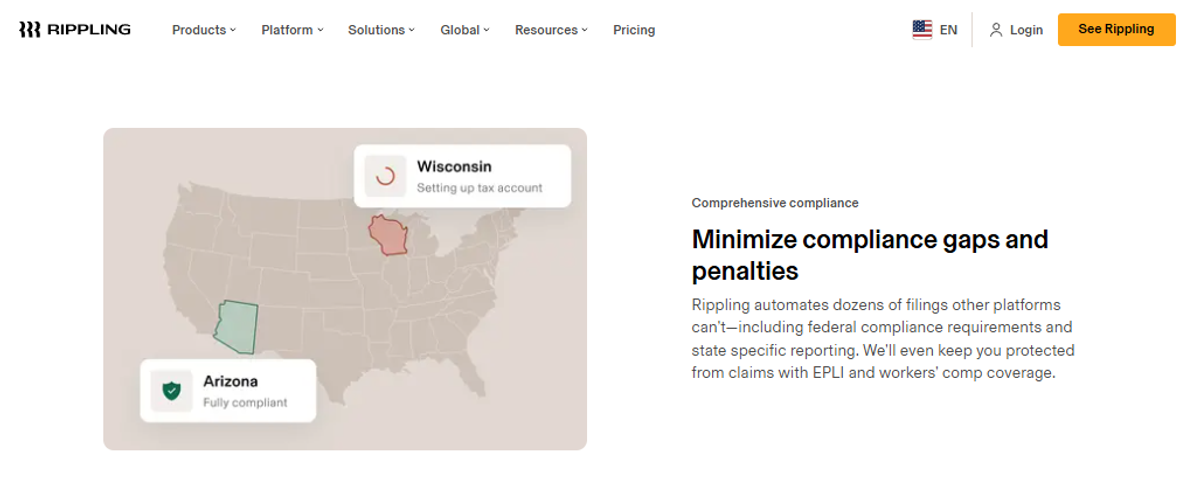
Rippling began as a US HR and IT platform and expanded into global EOR. Its distinguishing feature is unified onboarding: payroll, apps, and laptops provisioned from one workflow. India is available as an EOR market.
For companies that already run Rippling in the US, adding India inside the same system is an obvious move. The question is depth, not convenience.
🛠️ Core Services
Employer of Record for international hires.
US payroll, benefits, and HRIS.
Device procurement, shipping, and management.
App provisioning and identity management.
Contractor payments.
⭐ Why Companies Consider Rippling
The buying reason is consolidation of tooling, not India expertise. An IT lead who can ship a MacBook and provision Okta access in the same flow as the offer letter saves real days. For teams solving only the hardware half, our guide on how to equip remote employees in India covers the alternative path.
Where buyers report friction is accuracy on complex multi-jurisdiction payroll. That pattern matters in India, where professional tax rules differ by state and change often. Maharashtra alone requires two separate registrations, PTRC for employees and PTEC for the entity.
👥 Ideal Customer Profile
Existing Rippling customers in the US.
Companies hiring 1 to 10 people internationally.
Teams that value device and app provisioning.
IT-led buying processes.
Decision maker is typically IT Ops or People Ops.
💸 Commercial Model
Rippling prices international EOR at roughly 500 to 600 dollars per employee per month, with contractor payments at about 29 dollars per contractor, per Rippling's own pricing page. EOR pricing is typically quoted rather than published per country.
💬 Customer Reviews
"The idea that it is a one stop shop to house all things people for an organization is great. It did not handle multi-state taxes well at all. We are a non-profit and it was constantly making mistakes. It also killed the autopayment for payroll causing a paycheck to be sent late to all employees."
— Liz J., Non-Profit Operations Lead, Rippling - G2 Verified Review
"The only thing I have enjoyed about Rippling is the HR Ticketing app I was able to customize. Of course, we only get one with our plan, and it's probably going to cost a ridiculous amount of money for more."
— Erika D., HR Manager, Rippling - G2 Verified Review, 22 May 2026
🔄 How Does Versatile Compare to Rippling?
Versatile Club covers India only, employing hires through its own registered Indian entity, Foo Falcon Technologies Pvt Ltd, with no device or app provisioning layer. Rippling does device procurement and identity management in the same workflow as onboarding, which Versatile Club does not offer.
Unlike Rippling, Versatile Club publishes a flat 149 dollars per employee per month, charges no setup fee and no exit fee, and files PF, ESI, TDS, and professional tax under its own Indian registrations across 28 states and 8 union territories. Rippling does not publish its India EOR price on its own site. For companies where state-level filing accuracy matters more than laptop logistics, that combination is the difference.
Looking beyond Rippling? Our roundup of Rippling alternatives for India compares it against the rest of the India EOR market.
7. Papaya Global: Best for Finance Teams Consolidating Global Payroll Data
🏢 Overview
Papaya Global is a workforce payments and payroll data platform covering 160-plus countries. Its strength is reporting across many payroll vendors in one view. India compliance is executed through its local provider network.
Papaya is a finance tool first and an employment vendor second. That distinction shapes who it suits.
🛠️ Core Services
Global payroll consolidation and reporting.
Employer of Record through partner and owned entities.
Cross-border workforce payments.
Cost analytics and headcount reporting.
Contractor payments.
⭐ Why Companies Consider Papaya Global
The buying reason is visibility. A Controller managing payroll across 12 countries wants one dataset, not 12 spreadsheets. Papaya builds exactly that.
One buyer in the source set switched away specifically because Papaya was not functioning as an EOR for them. If you need a legal employer in India rather than a payroll data layer, confirm which service you are actually buying, and our explainer on EOR vs PEO sets out the difference in statutory terms.
👥 Ideal Customer Profile
Companies with payroll in 8 or more countries.
Finance-led buying processes.
Established entities needing consolidated reporting.
India team size of 5 to 50 inside a global programme.
Decision maker is typically the Controller or VP Finance.
💸 Commercial Model
Papaya Global prices EOR at roughly 599 to 650 dollars per employee per month, with contractor payments at about 30 dollars per contractor, per Papaya Global's own pricing page. Onboarding typically runs 3 to 7 days.
💬 Customer Reviews
"System integration is very helpful and makes the process much easier and more efficient. We've noticed that response times can sometimes be very slow when we require clarifications on employee questions or payroll operations. In addition, we have to remind Papaya to get monthly reports for a couple of countries every month."
— Cherry H., Payroll Manager, Papaya Global - G2 Verified Review, 30 July 2025
"Papaya held our deposit return over a month past the due date we agreed on. Papaya missed invoicing us for a month, causing audit issues and requiring escalation to their CFO."
— Verified User in Civic & Social Organization, Papaya Global - G2 Verified Review, 10 January 2023
🔄 How Does Versatile Compare to Papaya Global?
Versatile Club is the legal employer for its India hires through its own registered Indian entity, Foo Falcon Technologies Pvt Ltd, and does not operate outside India. Papaya Global's payroll analytics across 160-plus countries is reporting infrastructure Versatile Club does not build.
Unlike Papaya Global, Versatile Club employs India staff directly rather than through a local provider network, publishes a flat 149 dollars per employee per month, and invoices in USD from India with gross, deduction, and net reporting plus challan confirmations each month. Papaya Global does not publish a contractual onboarding SLA on its own site. For companies where a single accountable Indian employer matters more than multi-country dashboards, that combination is the difference.
Looking beyond Papaya Global? Our roundup of Papaya Global alternatives in India compares it against the rest of the India EOR market.
8. Payoneer (Formerly Skuad): Best for Fast Contractor-to-Employee Conversion
🏢 Overview
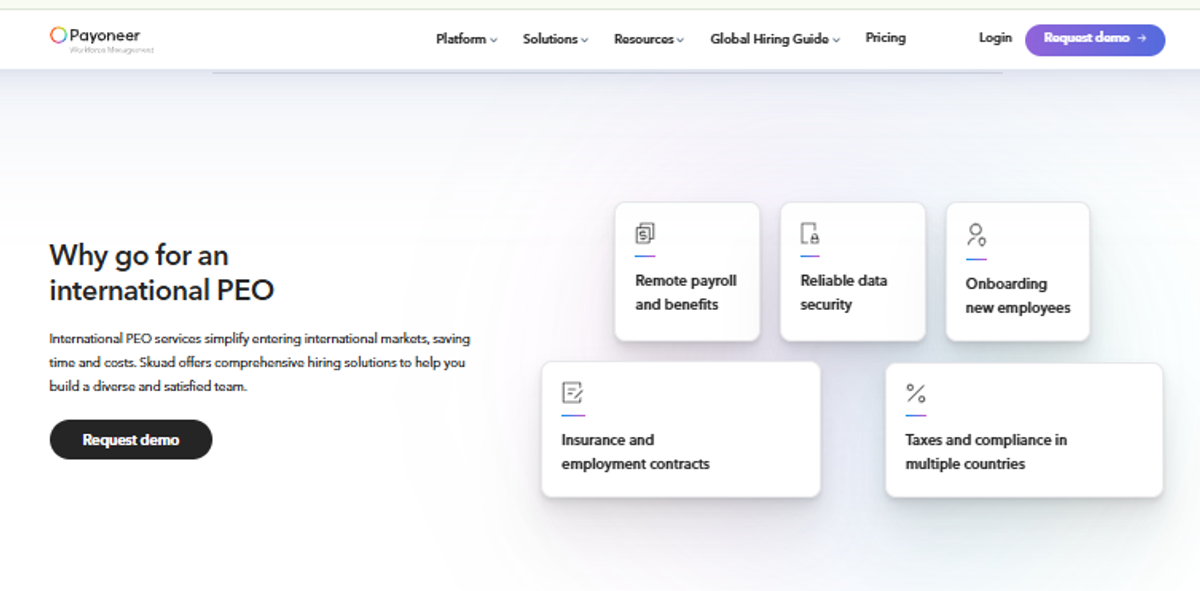
Skuad, now part of Payoneer, is a global employment platform with APAC concentration and a flat per-employee fee. It covers 160-plus countries through a hybrid of owned and partner entities. India is a core market for it.
The flat 199 dollar price point sits well below the premium generalists. That is the main reason it appears on shortlists.
🛠️ Core Services
Employer of Record at a flat monthly fee.
Contractor onboarding and payments.
Global payroll processing.
Benefits administration by country.
Cross-border payouts through Payoneer rails.
⭐ Why Companies Consider Payoneer
The decision logic is speed and price together. Reported onboarding runs 48 to 72 hours, and the flat fee removes salary-band surprises. For converting an existing India contractor to an employee quickly, that is a clean fit.
The trade-off is the hybrid entity model. In markets where Payoneer uses a partner, you inherit a second layer between you and the filing. Ask which model applies to India before you sign, and compare it against the independent contractor versus EOR trade-offs you are already carrying.
👥 Ideal Customer Profile
Companies converting contractors to employees.
Seed to Series B, hiring across APAC.
India team size of 1 to 20.
Buyers prioritising speed and flat pricing.
Decision maker is typically the founder or People Ops lead.
💸 Commercial Model
Payoneer, formerly Skuad, prices EOR at roughly 199 dollars per employee per month as a flat fee, per Skuad's own pricing page. Reported onboarding is 48 to 72 hours. Setup and exit terms are quoted per engagement.
💬 Customer Reviews
No verified customer reviews were available in the provided source set for this provider.
🔄 How Does Versatile Compare to Payoneer?
Versatile Club operates in India only, employing hires through its own registered Indian entity, Foo Falcon Technologies Pvt Ltd. Payoneer, formerly Skuad, covers more than 160 countries and reports faster headline onboarding than Versatile Club's five day commitment.
Unlike Payoneer, Versatile Club holds the Indian entity itself rather than using a hybrid partner model, puts its five business day onboarding SLA in the contract rather than quoting a marketing turnaround, and invoices in USD from India at the mid-market rate with no conversion markup. Payoneer does not state a contractual onboarding SLA on its own site. For companies where a written SLA matters more than a quoted turnaround, that combination is the difference.
Looking beyond Payoneer? Our roundup of Skuad alternatives in India compares it against the rest of the India EOR market.
9. Pebl (Formerly Velocity Global): Best for Custom-Scoped Enterprise Programmes
🏢 Overview
Pebl, formerly Velocity Global, serves larger international employment programmes with custom scoping. It operates a mix of owned and partner entities across 185-plus countries. Pricing is quoted rather than published.
Pebl works best where the requirement is unusual: equity-heavy packages, complex relocations, or regulated industries.
🛠️ Core Services
Employer of Record with custom scoping.
Global payroll and benefits.
Immigration and relocation support.
Equity and advisory support for international packages.
Contractor engagement.
⭐ Why Companies Consider Pebl
The buying reason is advisory depth on complex cases. A People Ops leader moving an employee between countries with equity attached needs a human to scope it. Pebl does that work.
Buyer reports in the source set point to portal usability and onboarding accuracy as the weak points. Contract start date errors and leave-logging problems came up directly.
👥 Ideal Customer Profile
Mid-market and enterprise companies.
Programmes spanning 10 or more countries.
Complex cases involving relocation or equity.
India team inside a wider global footprint.
Decision maker is typically Global Mobility or HR leadership.
💸 Commercial Model
Pricing is not publicly disclosed. Pebl, formerly Velocity Global, quotes custom enterprise pricing per engagement on its own pricing page. Reported onboarding runs 3 to 7 days.
💬 Customer Reviews
"Using most of Velocity Global's services is straightforward and user-friendly. Reimbursements for equipment and other expenses are processed quickly, the company consistently keeps us informed with updates, and the staff is generally proactive and kind."
— Ana A., EOR Employee, Pebl (formerly Velocity Global) - G2 Verified Review
"I encountered many frustrations with the onboarding, and continue to find the portal difficult to use. My contract had the wrong start date and other errors. The way annual leave is recorded is strange, it automatically logs weekend days, so this has incorrectly logged my leave."
— Verified User in Non-Profit Organization Management, Pebl (formerly Velocity Global) - G2 Verified Review, 30 April 2026
🔄 How Does Versatile Compare to Pebl?
Versatile Club covers India only, through its own registered Indian entity, Foo Falcon Technologies Pvt Ltd, and does not offer global mobility or relocation advisory. Pebl, formerly Velocity Global, scopes complex multi-country and relocation cases that fall outside Versatile Club's remit.
Unlike Pebl, Versatile Club publishes its price at a flat 149 dollars per employee per month with no setup fee and no exit fee, commits to a five business day onboarding SLA in the contract, and files PF, ESI, TDS, and professional tax under its own Indian registrations. Pebl does not publish its India EOR price on its own site. For companies where a published price and a written SLA matter more than custom scoping, that combination is the difference.
Looking beyond Pebl? Our roundup of Velocity Global alternatives in India compares it against the rest of the India EOR market.
10. ADP India: Best for Companies That Already Own an Indian Entity
🏢 Overview
ADP India is a payroll outsourcing bureau, not an EOR. It runs payroll on your Indian entity, using your registrations. This is PEO in the sense Indian law actually allows: you stay the legal employer.
ADP has operated India payroll at scale for years. For companies that have already incorporated, it is a serious option, and it competes with the wider field of payroll outsourcing companies in India.
🛠️ Core Services
Managed payroll processing on your Indian entity.
Statutory computation for PF, ESI, TDS, and professional tax.
Form 16 generation and year-end reporting.
Payroll reporting and reconciliation files.
Compliance calendar support.
⭐ Why Companies Consider ADP India
The buying reason is scale and process maturity. A finance team with 40 India employees and an existing Private Limited company wants an established bureau, not a startup vendor.
The limit is structural. ADP India cannot employ anyone for you. If you have no Indian entity, this route is unavailable, and you need an employer of record in India instead.
👥 Ideal Customer Profile
Companies with an existing Indian Private Limited company.
India team size of 20 and above.
Finance-led buying with internal HR support.
Buyers needing payroll processing, not legal employment.
Decision maker is typically the India Finance Controller.
💸 Commercial Model
Pricing is not publicly disclosed. ADP India quotes per engagement based on headcount and scope, with scope defined on ADP India's own payroll services page.
💬 Customer Reviews
No verified customer reviews were available in the provided source set for this provider.
🔄 How Does Versatile Compare to ADP India?
Versatile Club employs India hires through its own registered Indian entity, Foo Falcon Technologies Pvt Ltd, so it can act as the legal employer where the client has no Indian company. ADP India brings longer-running payroll bureau operations and scale that Versatile Club does not match.
Unlike ADP India, Versatile Club can be the employer of record itself rather than processing payroll on your entity, publishes managed payroll at 49 dollars per employee per month and EOR at a flat 149 dollars, and commits to a five business day onboarding SLA in the contract. ADP India does not publish its India payroll price on its own site. For companies where no Indian entity exists yet, that combination is the difference.
Versatile Club appears first on this list because the filings sit under its own Indian registrations, not a partner's. PF, ESI, TDS by the 7th, and state professional tax run through Foo Falcon Technologies Pvt Ltd, with one USD invoice from India and the five business day onboarding SLA written into the contract. Which of these ten you pick depends mostly on your headcount and whether you hold an Indian entity yet, and you can tell us what you are building if you want a second opinion on the shortlist.
Q2. How were these PEO providers scored and ranked?
Each provider was scored on five weighted criteria: India Entity Model and Statutory Filing Depth (25%), Pricing Transparency and Commercial Model (20%), Onboarding Speed and Support Model (20%), Talent and Retention Support (20%), and Customer Validation from G2, Capterra, and Clutch (15%). Scores convert to stars in 20-point bands. Versatile Club scores 5 stars. Deel, Remote, Multiplier, and Rippling score 4. G-P, Papaya Global, Payoneer, Pebl, and ADP India score 3.
📊 Why Entity Model Carries the Heaviest Weight
Entity model gets 25 percent because it decides who is legally accountable when something breaks. A provider working through a local partner entity adds a layer between you and the EPFO filing. That layer shows up as delay when you need a correction.
It also narrows reach. Published India state coverage for the global platforms concentrates on the top four to six states. Versatile Club holds PF, ESI, and professional tax registrations across all 28 states and 8 union territories, which is the practical test of whether a provider can hire in Kochi as easily as in Bengaluru. The full registration list sits on our compliance page.
⚠️ A Contradiction Worth Disclosing
The source material on entity ownership conflicts, and I would rather name that than smooth it over. One competitive analysis credits Deel and Remote with owning local entities in major markets. Versatile Club's own operating experience points the other way for India specifically, where partner entities are the norm among global platforms.
I could be reading my own evidence too strongly here. So the practical instruction is simple: ask for the CIN of the entity that will employ your hire, then check it on the MCA company master data portal yourself. Our guide to the best EOR services in India runs the same test across every provider.
💰 The Scorecard
| Provider | Weighted Score | Stars |
| Versatile Club | 93 | ⭐⭐⭐⭐⭐ |
| Deel | 72 | ⭐⭐⭐⭐ |
| Remote | 68 | ⭐⭐⭐⭐ |
| Multiplier | 66 | ⭐⭐⭐⭐ |
| Rippling | 64 | ⭐⭐⭐⭐ |
| Globalization Partners | 60 | ⭐⭐⭐ |
| Payoneer (formerly Skuad) | 58 | ⭐⭐⭐ |
| Papaya Global | 56 | ⭐⭐⭐ |
| Pebl (formerly Velocity Global) | 52 | ⭐⭐⭐ |
| ADP India | 50 | ⭐⭐⭐ |
✅ Our Own Line, Scored Openly
Versatile Club scores 25 out of 25 on entity model, because hires are employed by Foo Falcon Technologies Pvt Ltd and filings run under its own registrations. Pricing transparency scores 20 out of 20, since every figure in this guide is published on our pricing page rather than quoted. Onboarding scores 18 out of 20 against the five business day contractual SLA.
Customer validation is where Versatile Club loses points, at 10 out of 15. We are smaller and newer than Deel, and the review volume reflects that honestly. Compliance is the floor, not the ceiling, which is why a full fifth of the weight sits on retention support, the thing no EOR comparison table measures, and why our contract-to-hire model carries a replacement guarantee at all.
💬 What the Review Data Actually Shows
"Sagar replied to our form in about four hours with a draft offer letter already attached. The hire was onboarded in four days."
— Verified User in Information Technology and Services, Versatile Club G2 - Verified Review, 23 June 2026
"The dashboard could be a little more self-serve. A couple of times I wanted to pull a report or a doc myself and ended up just messaging my contact instead."
— Angad S., Founder, Versatile Club G2 - Verified Review, 21 June 2026
"Customer support and issue ownership need serious improvement. I was redirected multiple times, asked to repeat the same information to different representatives."
— Güneş A., Deel - G2 Verified Review, 2 October 2025
Versatile Club publishes its own scorecard line, including the 10 out of 15 on customer validation, because a self-inclusive ranking that hides its weak column is not a ranking. The 93 comes from the entity, the registrations, and the contractual SLA, not from a thumb on the scale.
Q3. Can you buy a PEO in India without an Indian entity, and when should you switch to one?
No. Indian law recognises one legal employer per worker and does not define co-employment, so a PEO operates payroll and statutory filings under your own entity's registrations. With a live Private Limited company holding EPF, ESIC, TDS, and state professional tax accounts, you can buy PEO or managed payroll at roughly 49 dollars per employee per month. Without one, you need an Employer of Record, where the provider's entity is the legal employer, at 99 to 149 dollars per month from India-native providers.
🧩 Why Co-Employment Does Not Travel
In the United States, a PEO shares employer status with you. Two parties, one worker, split liability. India has no equivalent statute.
The EPF and Miscellaneous Provisions Act 1952 and the ESI Act 1948 both attach obligations to a single establishment with its own code. There is no second slot for a co-employer. So "PEO India" sold to a company with no Indian company is a category error, not a product, a distinction we unpack further in EOR vs PEO.
✅ The One Question That Decides It
Ask yourself whether you hold an Indian Private Limited company with an active EPF establishment code. Half the inbound WhatsApp messages I get say PEO and mean EOR, and this is the question I send back.
Yes, entity exists: buy PEO or managed payroll. Your registrations, your filings, a vendor running the cycle.
No entity: buy EOR. The provider's entity employs the person and carries the statutory liability.
Versatile Club publishes both: 49 dollars per employee per month for managed payroll on your entity, and 149 dollars flat for EOR services in India on Foo Falcon Technologies Pvt Ltd. The recommendation we give does not meaningfully change our revenue, which is deliberate.
⏰ The Old Way, and What It Cost
The standard advice used to be incorporate first, hire second. That meant 15,000 to 100,000 dollars in setup, legal, and registration costs, plus three to six months before your first engineer could start. For one hire, that maths never worked, as our EOR vs entity comparison for India sets out in detail.
The alternative was worse. Companies put full-time India engineers on contractor agreements and carried misclassification exposure quietly for years.
🌉 What Changed, and the Headcount Trigger
EOR providers that own their Indian entity changed the sequence. You can hire in India without an entity now and incorporate later, when the volume justifies it.
Think of it as a suspension bridge against the Golden Gate. The bridge gets you across in days, at a flat monthly fee. The Golden Gate is permanent, expensive, and correct only once traffic justifies the span.
Phase 1, 1 to 15 hires: run on EOR at 99 to 149 dollars per employee per month.
Phase 2, around 20 to 30 hires: incorporate a Private Limited company through the MCA SPICe+ (INC-32) route.
Phase 3: migrate employees to PEO or managed payroll at roughly 49 dollars, and elect the 22 percent corporate tax rate under Section 115BAA of the Income Tax Act.
⚠️ When Staying on EOR Is the Right Answer
Below 20 India employees, incorporation usually costs more than it saves. Add the ongoing load: board filings, statutory audit, annual ROC returns, and a company secretary. That overhead does not shrink with headcount.
Versatile Club tells clients to move to the 49 dollar managed payroll line the moment their headcount crosses that threshold, and charges no exit fee when they do. Both sides of the fork run on the same Indian entity and the same filing team, so the migration does not mean re-papering contracts with a new vendor.
Q4. What does a PEO in India actually cost after the Rs 25,000 EPF ceiling?
The management fee is the smaller half. India-native PEO runs about 49 dollars per employee per month and native EOR 99 to 149 dollars, against 599 dollars plus 299 to 500 dollars setup from global generalists. On top sits a statutory load of roughly 13 to 18 percent of gross: EPF at 12 percent of Basic plus DA, ESI at 3.25 percent employer below threshold, and gratuity accruing at 4.81 percent from month one. Since the EPF wage ceiling moved to Rs 25,000, employer PF at the ceiling is Rs 3,250 a month, up from Rs 1,950.
💸 The Statutory Rate Table, Dated
| Item | Rate | Base and status |
| EPF, employer | 12% plus admin and EDLI charges, about 13% all-in | Basic plus DA, wage ceiling Rs 25,000 per S.O. 5109(E) dated 17 September 2026, notified by the Ministry of Labour and Employment |
| ESI, employer | 3.25% | Gross wages up to the Rs 21,000 ceiling, unchanged per ESIC contribution rules |
| ESI, employee | 0.75% | Same ceiling |
| Gratuity | 4.81% accrued monthly | Basic plus DA, payable after 5 years of continuous service under the Payment of Gratuity Act 1972 |
| Deduction cap | 50% of wages | Payment of Wages Act 1936 limit on authorised deductions |
The ESI ceiling staying at Rs 21,000 matters more than it looks. Most engineering hires sit above it, so ESI does not apply and private group health cover becomes a real line in your model.
💰 A Worked Example: One Bengaluru Engineer
Take an engineer on Rs 1,800,000 CTC, which is Rs 150,000 a month. Under the Code on Wages definition, Basic plus DA must be at least 50 percent of total pay, so Rs 75,000. Run your own numbers through the India salary calculator before you model headcount.
Employer PF at the ceiling: Rs 3,250 per month (previously Rs 1,950).
Gratuity accrual at 4.81 percent of Rs 75,000: Rs 3,608 per month.
ESI: not applicable above the Rs 21,000 gross ceiling.
Statutory total: about Rs 6,858 per month, before insurance.
The ceiling change adds Rs 1,300 per employee per month in that band. Across a 10-person India team, that is Rs 156,000 a year that most published cost guides have not repriced yet. Our cost of hiring in India breakdown models the same stack at other salary bands.
⚠️ The Six Lines to Check on a Live Invoice
Request a live sample invoice during procurement, not a quote. A quote shows you the fee. An invoice shows you the whole bill.
Setup fee, which runs 299 to 500 dollars on the global platforms.
Security deposit, and when it is returned.
FX conversion rate, compared against the RBI reference rate for that date.
Benefits markup on insurance premiums.
Exit or notice fee, usually one month.
Whether statutory contributions pass through at cost or carry a margin.
A reported 3 to 5 percent markup on a 599 dollar invoice is a second management fee that nobody line-items. That is the one I would check first.
📉 Three-Year Cost of Ownership, Modelled
| Line, per employee | India-native EOR | Global generalist |
| Monthly fee | 149 dollars | 599 dollars |
| Setup | 0 dollars | 299 to 500 dollars |
| 36-month fees | 5,364 dollars | 21,564 dollars |
| FX markup on a 30,000 dollar salary | 0 dollars | 900 to 1,500 dollars a year |
Versatile Club invoices in USD directly from its Indian entity at the mid-market rate, with no setup fee, no exit fee, and the first month free. We will send a redacted live invoice during evaluation, with the management fee and each statutory contribution itemised separately, and the sequence is documented on our how it works page. The proposal number is the ledger number.
Q5. Whose entity employs your hire, and whose login files the return?
Ask for the CIN (Corporate Identity Number) of the employing entity, verify it on the MCA portal, then ask whose EPF establishment code appears on the challan and whose login uploads the professional tax return. Compute-only providers calculate the liability and leave the filing with you. Partner routing also narrows state reach. Deel publishes roughly the top six states and Remote the top four, against 28 states and 8 union territories for direct owned-entity providers.
✅ The Three Questions to Ask Before You Sign
Run these in order, and ask for documents rather than assurances.
What is the CIN of the entity that will employ this person? Check it yourself on MCA21 company master data. It takes two minutes.
Whose EPF establishment code appears on the monthly challan? Search the EPFO establishment database for that code. If it belongs to a third party, you now have two vendors, not one.
Who signs the employment contract, and who uploads the professional tax return? These are different questions. Some providers do the first and not the second.
Versatile Club employs India hires through Foo Falcon Technologies Pvt Ltd, a registered Indian company, and the PF, ESI, TDS, and professional tax filings run under its own registrations. I can send the CIN before you send an NDA, and the full registration set is listed on our India compliance page.
📍 The State Matrix Nobody Publishes
Professional tax, Shops and Establishments registration, and labour welfare fund are state instruments, not central ones. A claim of pan-India coverage is a claim to audit, not accept.
| State | Professional tax cycle | S&E and LWF note |
| Maharashtra | Dual registration: PTRC for employees, PTEC for the entity | Monthly slab filing |
| Karnataka | Monthly PT | S&E registration renewal within 30 days |
| Tamil Nadu | Biannual PT | Separate LWF contribution |
| Telangana | PTRC enrolment required | Monthly filing |
| West Bengal | Monthly PT | Rules change often, so verify current forms |
| Delhi | No professional tax | S&E compliance still enforced |
Versatile Club holds these registrations across all 28 states and 8 union territories, built through Contract-to-Hire operations before the EOR product existed. The state-level knowledge came from filing in those states, not from a country guide, and our payroll compliance in India guide sets out each cycle in full.
⚠️ A Contradiction I Will Not Smooth Over
The published evidence on entity ownership conflicts. Some competitive analyses credit Deel and Remote with owned entities in major markets. Operator accounts, including Versatile Club's own, report partner entities in India specifically.
Both can be true at once, because entity strategy varies by country. So verify per country, not per brand. Ask the India question about India, which is the same test we apply across the best EOR providers in India.
📂 What Partner Routing Costs You in an Audit
When an EPFO inspector or a statutory auditor asks for records, the question is whose register holds them. With a partner in the chain, your provider has to request documents from a third party before answering you.
That latency is the real cost. A CFO closing year-end does not want a two-week wait for a challan copy. Versatile Club produces challan confirmations and TDS receipts from its own filings each month, which is why the monthly client pack exists.
💸 Compute Versus File
This distinction decides who does the work on Monday morning. Compute-only means the vendor sends you a number. Filing means the vendor logs in and submits.
Ask the question in those words: does your team upload the PTRC return, or do we? Versatile Club files under its own state registrations, so the upload sits with us rather than with your India contractor or a local CA. That is the same division of labour our managed payroll service runs for companies that already hold an Indian entity.
Versatile Club's employing entity is Foo Falcon Technologies Pvt Ltd, and the 28-state registration set predates the EOR line. The compliance operations, payroll runs, and state registrations came first, through C2H placements in Bengaluru, Hyderabad, and Pune, rather than as a localisation layer added to a global platform.
Q6. Which contract and compliance clauses must be in the agreement before you sign?
Four clauses decide your exposure. Appointment letters in OSH Code format for every hire, since all four labour codes commenced on 21 November 2025. A wage structure holding excluded allowances within 50 percent of total pay under the Code on Wages definition. DPDP security and breach-notification terms, because your provider processes PAN, Aadhaar, and bank data under rules notified as G.S.R. 846(E). And employment, not contractor, status for core roles. This is general information, not legal advice, so have counsel review the final agreement.
📜 Clause One: Labour Code Documentation
All four labour codes took effect on 21 November 2025, through notifications S.O. 5319(E) to S.O. 5322(E), announced by the Ministry of Labour and Employment. Twenty-nine central acts were consolidated into four.
The practical change is paperwork. Appointment letters are now mandatory for every worker. Registration and returns consolidate, and employers maintain a defined register set, as set out in the MoLE Compliance Handbook for Employers under the Four Labour Codes. Ask your provider to show you a sample appointment letter in the new format before you sign.
💰 Clause Two: The Wage Definition
The Code on Wages defines wages so that excluded allowances cannot exceed 50 percent of total pay. If they do, the excess is added back into the wage base.
That lifts PF, gratuity, and bonus calculations at once. Versatile Club accrues gratuity at 4.81 percent of Basic plus DA from month one and itemises it on the monthly invoice, so the liability lands as a cost line instead of an unbooked provision found during diligence. Model the effect on a real package with our salary calculator.
🔒 Clause Three: DPDP Terms With a Date
Your payroll provider holds PAN, Aadhaar, bank details, and salary data. Under the DPDP Rules 2025, notified as G.S.R. 846(E) on 13 November 2025 by the Ministry of Electronics and Information Technology, it is a Data Processor acting for you.
The clock is phased. Consent manager rules apply from November 2026, and the substantive rules follow in May 2027. Penalties reach Rs 250 crore for a failure of security safeguards.
Ask for three things in the master service agreement: reasonable security safeguards, a breach notification timeline to you, and deletion obligations on exit. Versatile Club signs these terms as the processor of record because the data sits inside its own Indian entity, not with a partner, and the same terms apply across our EOR services.
⚠️ Clause Four: Employment, Not Contractor
Classifying a full-time India engineer as a contractor to skip employment infrastructure creates backdated exposure, commonly in the 25,000 to 40,000 dollar range per worker once PF, ESI, gratuity, and interest are reconstructed. Sustained control over a contractor can also feed permanent establishment arguments under the Income Tax Act and the applicable tax treaty. Our comparison of independent contractor versus EOR sets out where each model holds up.
There is a human cost too, and I think it gets ignored. A client once had an engineer who chose contractor status, then applied for a mortgage and was denied. No formal payslip trail, no loan. He moved onto a proper employment contract and the mortgage went through.
🧯 The Scissors Test
One operator put it plainly: you are running with scissors if you do not have experts crossing every t on the arrangement. That is the honest state of cross-border employment paperwork.
Contractor status is genuinely correct for short, scoped, outcome-based work with real independence. It is wrong for a full-time engineer on your standup, using your laptop, reporting to your manager, and converting a contractor to an employee in India is the fix when the line has already been crossed.
Versatile Club issues the appointment letter from its own Indian entity, files TDS by the 7th of each month, and itemises PF, ESI, professional tax, and gratuity accrual on one USD invoice. The appointment letter your hire signs is not countersigned by a partner entity you have never met.
Q7. Which provider fits your situation, and how do you switch without breaking PF and TDS continuity?
Pick by constraint. No Indian entity and under 15 hires: India-native EOR at 149 dollars flat. Entity live with active EPF and professional tax accounts: managed payroll at 49 dollars. Hiring across six or more countries at once: a global generalist, despite the price. To switch providers, fix the cut-over at a month boundary, extract the year-to-date register before giving notice, reconcile PF and ESI, confirm TDS projections, transfer state registrations, then run one parallel month.
🧭 Four Scenarios, Four Answers
| Your situation | What to buy | Why |
| First India hire, no entity | India-native EOR | Skips 15,000 to 100,000 dollars of incorporation and a 3 to 6 month wait |
| Entity live, 20-plus India staff | Managed payroll or PEO | Your registrations already exist, so you only need execution |
| Hiring in 6-plus countries now | Global generalist | One contract beats six vendors, even at 599 dollars |
| Procurement requires SOC 2 Type II | A certified provider | The gate is the gate, so do not fight it |
Versatile Club appears in the first two rows at published prices, 149 dollars flat for EOR and 49 dollars for managed payroll, and does not appear in the last two. That is the honest read.
⏰ The Six-Step Cut-Over Checklist
PF, ESI, and TDS year-to-date records do not reset when your contract changes. Form 16 may split across two employers in one financial year, which confuses employees badly if nobody warns them.
Fix the cut-over on a month boundary, never mid-month.
Extract the full year-to-date payroll register before you give notice.
Reconcile PF and ESI contributions, and confirm UAN continuity for each employee through the EPFO member portal.
Confirm TDS projections under Section 192 of the Income Tax Act so annual deductions do not double count.
Transfer or re-register state professional tax and S&E obligations.
Run one parallel month, comparing both outputs line by line.
Versatile Club charges no exit fee, so this checklist works as well for leaving us as for joining us. The month-boundary rule exists because mid-month transfers are where UAN mismatches and duplicate challans happen, a sequence we break down further in our guide to switching EOR provider in India.
❌ Where Versatile Club Is the Wrong Choice
Versatile Club operates only in India. If your plan needs one agreement across twelve countries, we are not the answer, and I will say so on the first call.
Three more disqualifiers, named plainly: enterprise India teams above 100 people that gate vendors on SOC 2 Type II or ISO 27001 today, B2C consumer hiring at volume, and heavily customised enterprise procurement workflows that run longer than the five business day SLA.
💬 What Switching Actually Sounds Like
"It took three months to onboard our first 3 individuals. They didn't seem to be able to navigate Visas or variations to employment contracts and this constantly created issues so we had to make a decision to change providers."
— Verified User in Information Technology and Services, Deel - G2 Verified Review, 13 December 2024
"Slow and laborious initial setup. We are still waiting on answers to key questions for implementation."
— Juliette D., HR Leader, Remote - G2 Verified Review, 22 April 2026
"The team is really competent, but there were a few time zone misunderstandings that caused slight delays in the initial phase. That said, once things got going, the whole process was buttery smooth."
— Setu C., Versatile Club G2 - Verified Review, 10 June 2026
Versatile Club is the right fit when India is the hiring market and the roles are engineering, design, or operations you intend to keep. Tell me what you are building and which state your hire sits in, and I will tell you whether the answer is us or someone else on this list, either on a quick call or over WhatsApp.
FAQs
Can you use a PEO in India without having an Indian entity?
No. Indian law recognises one legal employer per worker and has no statutory concept of co-employment, so the US-style PEO arrangement does not translate. A PEO in India is payroll and HR outsourcing that runs under your own entity's registrations.
The test is simple. Ask yourself whether you hold an Indian Private Limited company with an active EPF establishment code, an ESIC number, a TDS account, and state professional tax registrations.
- Entity live: you can buy PEO or managed payroll, typically around 49 dollars per employee per month. Your registrations, your filings, a vendor running the monthly cycle.
- No entity: you need an Employer of Record, where the provider's own Indian company becomes the legal employer, usually 99 to 149 dollars per employee per month from India-native providers.
Versatile Club publishes both lines, which means the routing advice we give does not materially change our revenue. That is deliberate. Half the enquiries that reach me say PEO and mean EOR, and the entity question settles it in one exchange. If you want the statutory reasoning laid out in full, our breakdown of EOR versus PEO walks through the single-employer rule and what each model actually covers.
How much do PEO services in India actually cost in 2026?
The management fee is the smaller half of the bill. India-native PEO or managed payroll runs about 49 dollars per employee per month, India-native EOR sits at 99 to 149 dollars, and global generalists charge roughly 599 dollars plus 299 to 500 dollars in setup fees.
On top of the fee sits the statutory load, broadly 13 to 18 percent of gross:
- EPF: 12 percent of Basic plus DA, around 13 percent once admin and EDLI charges are added. With the wage ceiling now at Rs 25,000, employer PF at the ceiling is Rs 3,250 a month, up from Rs 1,950.
- ESI: 3.25 percent employer and 0.75 percent employee, only below the Rs 21,000 gross ceiling, so most engineering hires need private group cover instead.
- Gratuity: 4.81 percent of Basic plus DA, accruing from month one.
Versatile Club itemises the management fee and each statutory contribution separately on one USD invoice, at the mid-market rate, with no setup fee and no exit fee. Ask every shortlisted vendor for a redacted live invoice rather than a quote, because setup charges, security deposits, and a reported 3 to 5 percent FX markup only surface there. Our cost of hiring in India guide models the same stack across salary bands.
Which PEO service providers are best for US and UK companies hiring in India?
The ten we assessed are Versatile Club, Deel, Remote, Globalization Partners, Multiplier, Rippling, Papaya Global, Payoneer (formerly Skuad), Pebl (formerly Velocity Global), and ADP India. Fit depends on one variable more than any other: how many countries you are hiring in.
- India only, first 1 to 20 hires: an India-native provider with its own Indian entity.
- Six or more countries at once: a global generalist, despite the price, because one contract beats six vendors.
- Existing Indian entity, 20-plus staff: managed payroll or a payroll bureau on your own registrations.
- Procurement gated on SOC 2 Type II or ISO 27001: a certified provider, since the gate is the gate.
Versatile Club employs India hires through Foo Falcon Technologies Pvt Ltd, its own registered Indian company, with PF, ESI, TDS, and professional tax filed under those registrations across all 28 states and 8 union territories. We score ourselves at 10 out of 15 on customer validation, because we are smaller and newer than Deel and the review volume reflects that. For a wider view of the India-native field, our roundup of the best PEO providers in India sets out the same criteria vendor by vendor.
How do you verify that a PEO provider really files your Indian statutory returns?
Ask three questions and request documents rather than assurances. Most buyers accept a coverage claim at face value, which is where the risk hides.
- What is the CIN of the entity that will employ this person? Verify it yourself on the MCA company master data portal. It takes two minutes.
- Whose EPF establishment code appears on the monthly challan? If it belongs to a third party, you now have two vendors in the chain, not one.
- Who uploads the professional tax return? Compute-only providers calculate the liability and leave the filing with you or your local chartered accountant.
State coverage deserves the same scrutiny, because professional tax, Shops and Establishments registration, and labour welfare fund are state instruments. Maharashtra needs dual PTRC and PTEC registration, Karnataka runs a monthly cycle with S and E renewal inside 30 days, Tamil Nadu files biannually, and Delhi has no professional tax at all.
Versatile Club holds these registrations across all 28 states and 8 union territories, built through Contract-to-Hire operations before the EOR line existed, and produces challan confirmations and TDS receipts from its own filings each month. Our guide to payroll compliance in India lists each state cycle in full.
How do you switch India PEO or payroll providers without breaking PF and TDS continuity?
Treat it as a payroll cut-over, not a contract change. PF, ESI, and TDS year-to-date records do not reset when the vendor does, and Form 16 may split across two employers inside one financial year, which unsettles employees badly if nobody warns them.
Six steps, in this order:
- Fix the cut-over on a month boundary, never mid-month.
- Extract the full year-to-date payroll register before you give notice.
- Reconcile PF and ESI contributions, and confirm UAN continuity for every employee.
- Confirm TDS projections under Section 192 so annual deductions do not double count.
- Transfer or re-register state professional tax and Shops and Establishments obligations.
- Run one parallel month and compare both outputs line by line.
The month-boundary rule exists because mid-month transfers are where UAN mismatches and duplicate challans appear. Versatile Club charges no exit fee, which means this checklist works just as well for leaving us as for joining us, and both our EOR and managed payroll lines run on the same Indian entity and the same filing team. Our step-by-step guide to switching EOR provider in India covers the document handover in detail.