Table of contents (11)
Independent Contractor vs EOR: The Cost Difference, the Misclassification Risk, and When Each Fits
Q1: Independent Contractor vs EOR: Which Should You Actually Use in India?
Use an independent contractor in India only for genuinely independent, short, project-scoped work. The moment a hire is core, full-time, exclusive, or ongoing past a few months, an Employer of Record (EOR) is cheaper than it looks once you price in the $25,000 to $40,000 per-head misclassification back-pay exposure and Permanent Establishment tax risk a contractor quietly carries. Contractor is the fast bridge. EOR is the load-bearing structure.
The Verdict, in One Line
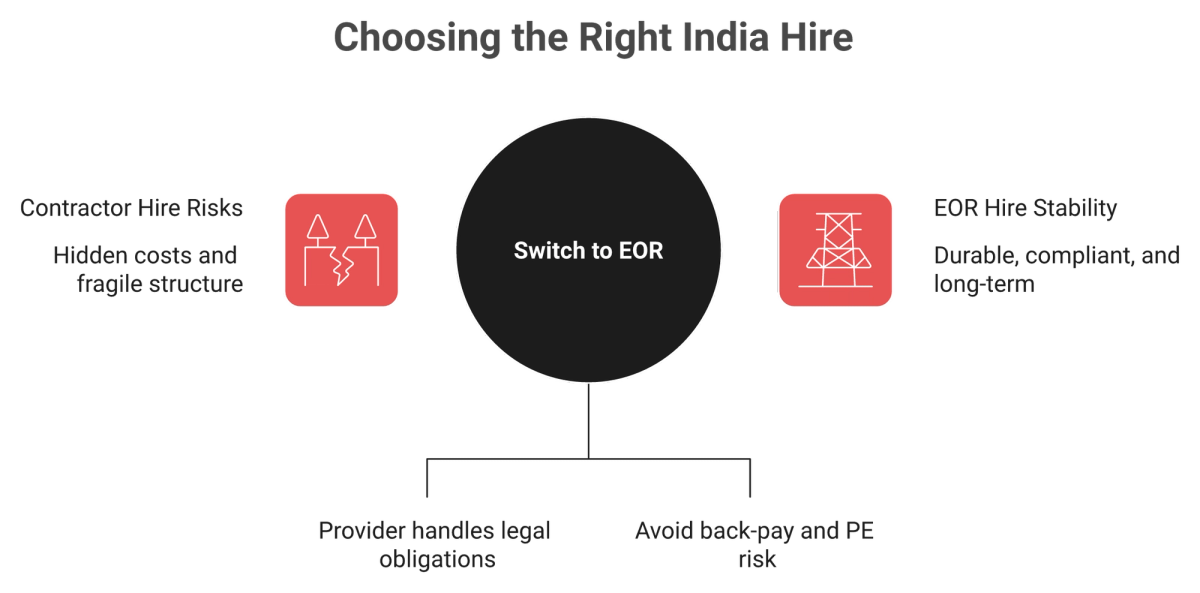
Think of it as a bridge problem. A contractor is a simple footbridge. It gets one person across a gap, fast, for a short trip.
An EOR in India is a load-bearing structure. It carries weight, every day, for years, without cracking. The decision turns on three things: cost, risk, and fit.
Most founders get this backwards. They read "contractor" as cheap and "EOR" as expensive. The real math is the opposite once you weigh the downside.
The Trigger Moment You're Probably In
I see two scenes on repeat. In the first, you just closed a round. You need three engineers in Bengaluru live in 30 to 60 days.
Setting up your own Indian entity takes 12 to 18 months and real capital, so you reach for a contractor. In the second scene, your legal or finance counsel just flagged an existing contractor as risky. Now you are deciding whether to fix it before an audit does.
Both scenes share one quiet fear. You want to move fast without getting burned.
What Actually Flips the Decision
The number that flips it is back-pay. Misclassify one core contractor in India, and the exposure runs roughly $25,000 to $40,000 per head in back-dated provident fund, ESI, gratuity, and wages. That is before the tax bill.
A controlled, full-time contractor can also create a Permanent Establishment (PE), which is a taxable presence for your foreign company in India. Suddenly the "cheaper" option is the one with the open-ended liability. You can pressure-test your own exposure with our misclassification quiz.
After six years placing engineers, designers, and ops talent across Bengaluru, Hyderabad, and Pune through Versatile Club's Contract-to-Hire and EOR model, the pattern is consistent. The contractor looks cheaper until the relationship gets real.
How to Read the Rest of This Guide
I will not hand you a vendor pitch dressed as advice. Here is the path.
Cost: a rupee-and-dollar breakdown of what each model truly costs once fully loaded.
Risk: when a contractor gets reclassified, and the two separate bills that follow.
Fit: a plain decision tree for when each model wins, and when to switch.
I might be wrong on edge cases. A solo designer doing one logo is a real contractor, full stop. But for the core, ongoing hire most funded teams actually need, the EOR carries the load the contractor cannot.
Q2: Contractor, Direct Employee, or EOR: What Are the Three Models and How Do They Differ at a Glance?
You have three ways to engage India talent. A contractor invoices you as a vendor and runs their own taxes. A direct employee sits on your own Indian entity, which takes 12 to 18 months and heavy capital to build. An Employer of Record (EOR) legally employs the worker on its entity, running PF, ESI, TDS, and professional tax under its own registrations, so you get a real employee without the entity. "PEO India" is mostly an SEO label, because co-employment does not legally exist in India.
The Three Models in Plain English
Start with the concept. An independent contractor is a vendor. You buy a deliverable, they handle their own tax and benefits, and they invoice you.
A direct employee sits on a legal entity you own in India. To get there, you incorporate, register with the EPFO and ESIC, and open state filings. That path runs 12 to 18 months and ties up real capital, which is why most teams weigh EOR vs entity first.
An EOR is the middle road. It legally employs the worker on its own entity while the person works for you day to day.
A Concrete Bengaluru Example
Picture one senior engineer in Bengaluru. As a contractor, she sends you a monthly invoice, and you pay it. Simple, until control or exclusivity makes her look like staff.
As your direct employee, she joins your Indian subsidiary, which you spent a year building. As an EOR hire, she is employed by the EOR's entity, paid compliantly, and managed by you. If you want to model this, our guide on how to hire in India without an entity walks through it.
How They Differ at a Glance
| Axis | Contractor | Direct Employee | EOR |
|---|---|---|---|
| Setup speed | Days | 12 to 18 months | About 5 days |
| Compliance owner | The worker | You | The EOR |
| IP ownership | Only via written assignment | Vests in employer by default | Vests in employer by default |
| Misclassification risk | High | None | Near zero |
| Best fit | Short, independent projects | Large, permanent India teams | First 1 to 10 core hires |
Why "PEO India" Is the Wrong Word
Here is where I take a clear position. The standard read gets this backwards.
Traditional US-style co-employment, the "PEO" model, does not legally exist under Indian labour law. Many global players still use "PEO" as a keyword while actually delivering EOR. That confuses founders who think they are buying something India recognises, which is why we explain the real PEO India picture plainly.
A "Contractor of Record" is a related term you will see, where a provider formalises a contractor relationship. It manages contractor risk but does not make the person an employee, as our Contractor of Record page details.
When you hire through Versatile Club's EOR, the worker is employed by Foo Falcon Technologies Pvt Ltd, our own registered Indian entity, not a partner shell. That single fact decides who carries the compliance weight.
Q3: What Does Each Model Actually Cost Once You Load It Fully (in INR and USD)?
A contractor invoice looks 20 to 40% cheaper on the surface, because it hides nothing but the rate. An EOR's landed cost adds employer PF (12% of Basic plus DA), ESI, gratuity accrual (4.81% of Basic plus DA), and a platform fee, but it is fully predictable and audit-ready. Under the 2025-26 Labour Codes, Basic plus DA must be at least 50% of CTC, which raises that statutory load but removes every nasty surprise later.
The Headline Number Versus the Real Number
Here is what surfaces when you actually run payroll. A contractor sends one invoice, and that is your cost. An EOR cost sits higher on paper because it shows the full employer load you would otherwise owe later.
That visibility is the point. The contractor hides the liability. The EOR prices it in, and you can see the full picture in our cost of hiring in India breakdown.
Building the EOR Statutory Stack
The employer load in India is not vague. It stacks from named statutory items, each with its own rule.
Provident fund: 12% employer contribution on Basic plus DA.
ESI: a 3.25% employer and 0.75% employee split where applicable.
Gratuity: accrues from month one at 4.81% of Basic plus DA.
TDS: deducted and deposited by the 7th of the following month, per the income-tax slab.
Worked Comparison for One Mid-Senior Hire
| Cost line | Contractor | EOR employee |
|---|---|---|
| Headline pay or invoice | 100 | 100 |
| Employer PF (12% of Basic+DA) | - | Included |
| Gratuity accrual (4.81%) | - | Included |
| ESI (where applicable) | - | Included |
| Platform or service fee | - | Flat monthly |
| Hidden back-pay risk | $25k to $40k per head | None |
The contractor row looks lighter until the last line. That last line is the one that wakes founders up.
The 50% Rule Changes the Math
Under the Code on Wages, Basic plus DA must be at least 50% of total CTC. Many India salary structures used to lean on allowances to shrink the PF and gratuity base.
That lever is gone. For most employers, the change lifts statutory cost by roughly 5 to 15%. An EOR absorbs that re-papering. A DIY contractor setup does not even see it coming.
Why "Cheaper" Is the Wrong Lens
I will be blunt here, because the category oversells it. We never advocate going to India because it is cheaper. You go to India for highly academically intelligent people who do excellent work.
That said, the savings are real. A senior engineer in Bengaluru can run about $162,000 a year less than the San Francisco equivalent. Versatile Club invoices you in USD directly from our Indian entity, not routed through a foreign holding company and not converted from INR, so the number on your invoice is the number you budgeted. You can see exact figures on our India EOR pricing page. Some global platforms add a reported 3 to 5% FX markup on top.
Q4: When Does a Contractor Get Reclassified, and Who Owns the IP and Liability?
In India the working relationship overrides the contract label. If you control how and when a worker works, demand exclusivity, integrate them into your team, or use them for core business activity, regulators can reclassify them as your employee. The Industrial Relations Code bars contractors for core work outright. IP is the quiet trap: with an employee, work product vests in the employer by default, but with a contractor, IP only transfers if a written assignment says so.
The Control Test, in Plain Words
The legal test is older than any EOR platform, and it is brutally practical. Courts look at the right of the employer to supervise and control the work done, not only in the matter of directing what work the employee is to do but also the manner in which he shall do his work.
Read that twice. If you direct the "how," not just the "what," you are acting like an employer. A nine-to-five schedule, a company laptop, and daily standups all point the same way. The contract label does not save you.
The Triggers That Surface in an Audit
Reclassification rarely hangs on one fact. Auditors stack signals.
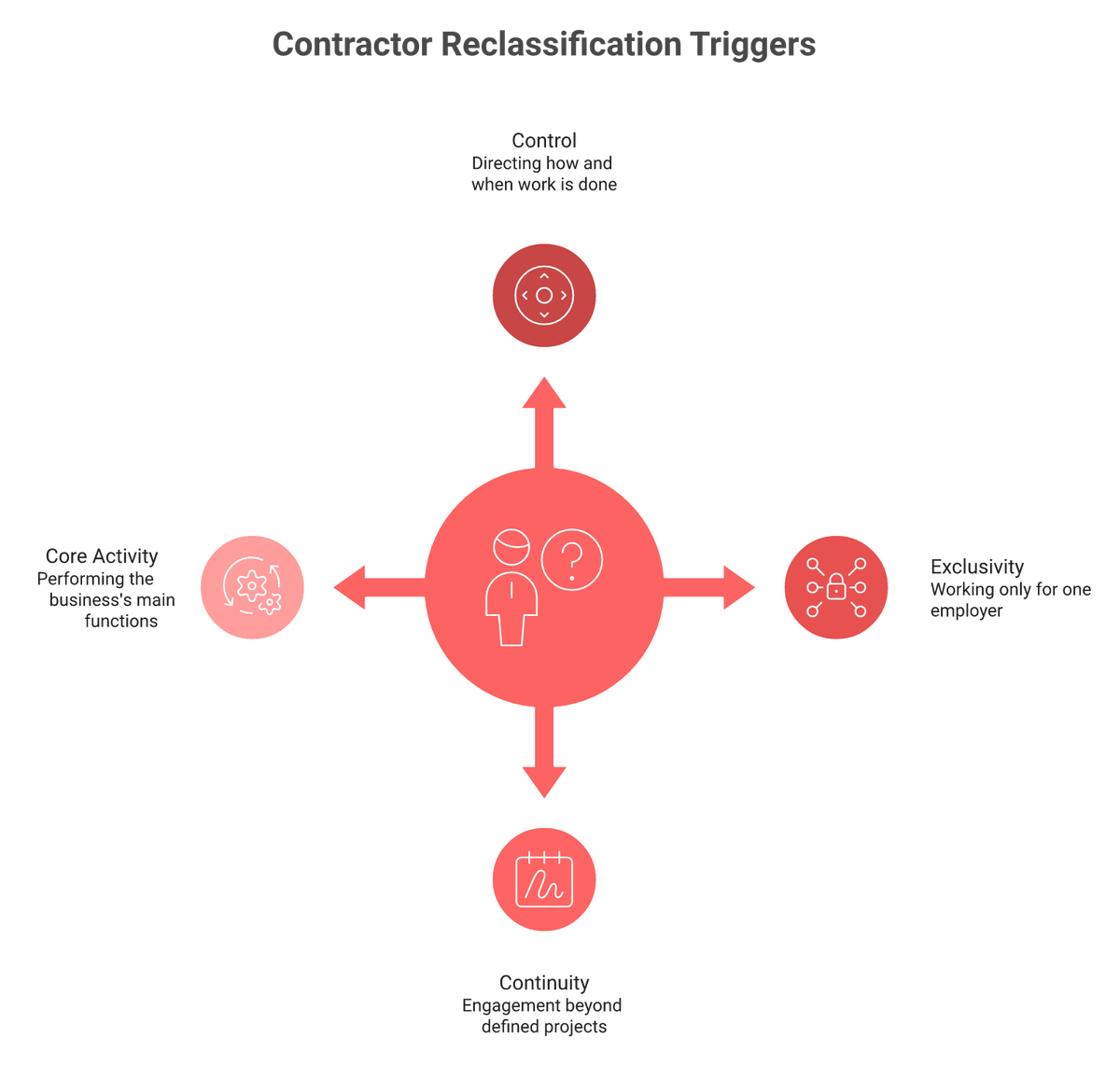
Exclusivity: the person works only for you, month after month.
Continuity: the engagement runs well past a defined project.
Integration: they sit inside your team, tools, and reporting lines.
Core activity: they do the work your business actually sells.
That last one is decisive in India. The Industrial Relations Code generally bars independent contractors for a company's core business activities, and the principal employer carries liability under the Contract Labour Act. Our Agent of Record page explains where that line sits.
The IP Gap Most Founders Miss
Here is the part that bites later. For an employee, work product generally vests in the employer by default.
For a contractor, IP transfers only if a written assignment clause says so, signed and specific. No clause, and the engineer who built your core feature may hold rights to it. I have watched diligence stall on exactly this gap during a funding round. Compliant contractor contracts close that gap before it opens.
Why the Label Is Not a Shield
The standard read says a tight contractor agreement protects you. From what surfaces when you actually run these relationships, it does not.
An Agent-of-Record or contractor agreement will not stop reclassification or back-pay if the substance is employment. The facts win, not the paperwork.
So run a Monday self-audit. List every India contractor, then mark anyone who is exclusive, long-running, integrated, or doing core work. Those are your exposure.
Because every Versatile Club EOR hire is a real employee of our entity with IP vesting by default, there is no contractor relationship left to reclassify and no IP-assignment gap to patch.
Q5: What Happens If You Get Misclassification Wrong: the Real Penalty Math?
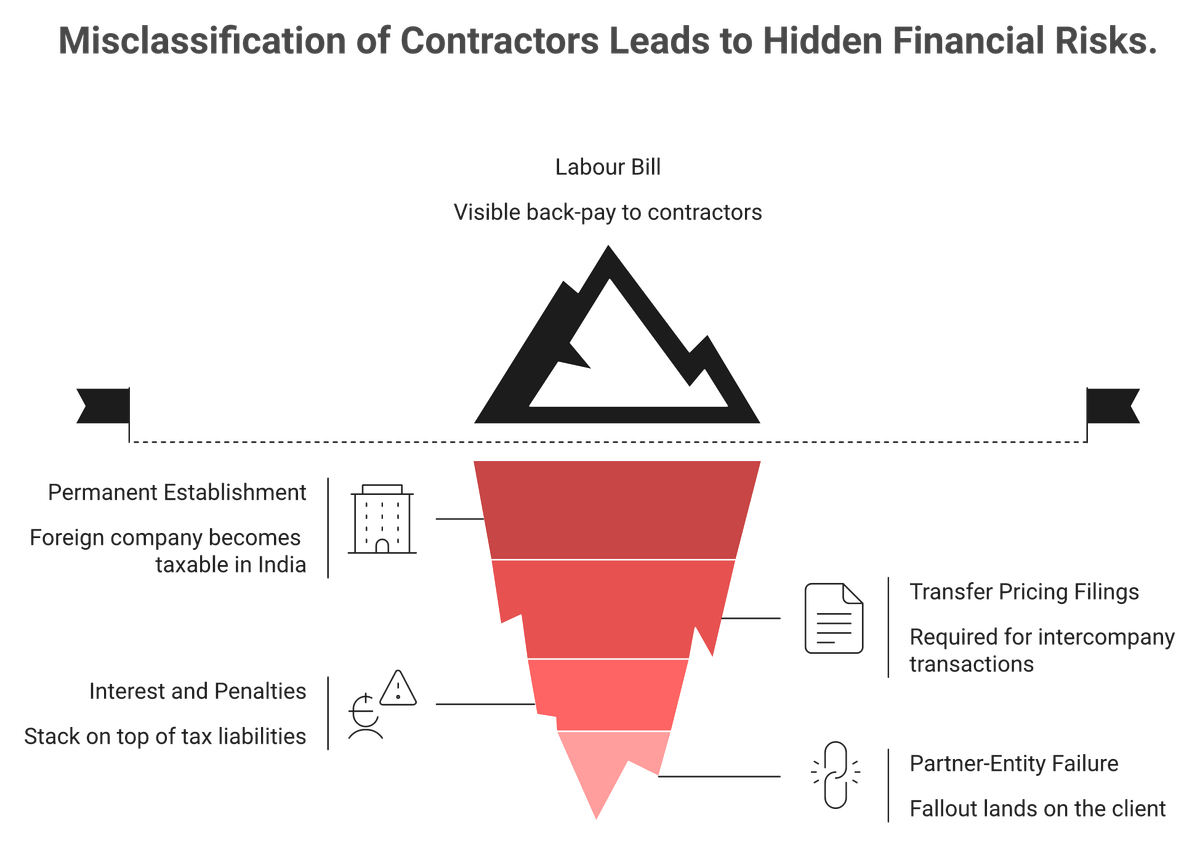
Misclassification in India is two bills, not one. The labour bill is back-dated PF, ESI, gratuity, and back wages, roughly $25,000 to $40,000 per head. The bigger, quieter bill is tax: a controlled, full-time contractor can create a Permanent Establishment (a taxable presence) under DTAA Article 5, making your foreign company taxable in India with transfer-pricing filings and penalties on top.
The First Bill: Back-Dated Labour Liability
Here is the bill most founders see coming, late. When a contractor is reclassified as an employee, the dues are back-dated to day one.
That means provident fund, ESI, gratuity, and unpaid statutory wages, with interest. Across a single core hire, that lands near $25,000 to $40,000 per head. You can gauge your own exposure with our misclassification quiz. Multiply by a small team, and it eats a funding tranche.
The Second Bill Nobody Mentions
Now the bill the category quietly skips. A full-time contractor you control, who works only for you, can trigger a Permanent Establishment for your company in India.
A Permanent Establishment, or PE, is a taxable footprint that pulls your foreign company into Indian corporate tax. Under most tax treaties, a dependent agent with authority to conclude contracts is a classic trigger. That brings transfer-pricing filings, interest, and penalties. Our PE risk quiz shows where you stand.
The Penalty Math at a Glance
| Exposure | What triggers it | What it costs |
|---|---|---|
| Labour bill | Reclassified contractor | $25k to $40k back-pay per head |
| PE tax bill | Control plus contract authority | Corporate tax, transfer pricing, penalties |
| Compounding risk | Partner-entity filing failure | IP and PE fallout lands on the client |
Why This Is a Uniquely India Problem
The standard read treats misclassification as a labour issue alone. From what surfaces when you actually run cross-border payroll, that read gets it backwards.
In India, the same facts open a tax front at the same time. Global comparison pages rarely connect the two, because their writers have not sat through an Indian assessment. I could be off on the exact rupee figure for your case, but the shape is consistent: two bills, two regulators, one set of facts.
There is also a hidden third-party angle. Most global EOR providers run India through local partner entities. If that partner fails a statutory filing, the IP and PE fallout can land on you, the client, which is why an EOR versus entity decision matters.
Where Versatile Club Fits
Versatile Club owns its Indian entity end to end. So the back-pay bill and the PE bill both sit with us, not you, and there is no partner shell to fail a filing. Our Employer of Record in India service is built on that owned-entity model.
The reviews founders leave reflect that this is mostly a sleep-at-night purchase, not a feature race.
"Versatile's Employer of Record India service made this seamless: contracts, PF, ESI, TDS, and payroll all handled in one place. The compliance rigour is genuinely impressive, every statutory filing reviewed before submission."
Vedant T., Founder Versatile Club G2 Verified Review
"They manage employment contracts, statutory compliance, tax structure, and local regulations on our behalf. This reduced legal risk and saved months of setup time and cost."
Verified User in Marketing and Advertising Wisemonk G2 Verified Review
Q6: How Do the 2025-26 Labour Codes, EPFO, and DPDP Changes Shift This Decision?
The Four Labour Codes went live on 21 November 2025 and changed the math. Basic plus DA must now be at least 50% of CTC, which raises PF, ESI, and gratuity by 5 to 15%. Full-and-final settlements must clear within 48 hours of exit, and the EPFO now allows only summary-level ECR downloads from 11 March 2026. Layered with the DPDP Act, the direction of travel is clear: informal contractor arrangements are getting riskier, not safer.
The Most Material Change: the 50% Rule
Lead with the one that moves money. Under the Code on Wages, Basic plus dearness allowance (DA) must be at least 50% of total CTC.
Indian salary structures used to lean on allowances to shrink the statutory base. That lever is now capped. For most employers, PF, ESI, and gratuity costs rise by an estimated 5 to 15%. You can model the impact with our employee cost calculator.
The Mechanics That Catch Teams Off Guard
A few operational changes bite in the first payroll cycle. They are small on paper and loud in practice.
Full-and-final settlement: dues must clear within 48 hours of exit.
EPFO downloads: only summary-level ECR (the monthly PF filing) since 11 March 2026.
TDS: still deducted and deposited by the 7th of the next month.
If you run this yourself, each rule is a new place to slip. An EOR absorbs the re-papering before it reaches you, the way our payroll compliance calculation does each cycle.
The Compliance Tailwind You Cannot Ignore
Then there is the data layer. The DPDP Act, India's data-protection law, adds consent and handling duties around employee data.
State professional tax (PT) makes it heavier. Maharashtra needs dual PTRC and PTEC registration with monthly slabs. Karnataka needs monthly PT plus a Shops and Establishments renewal, with enrollment within 30 days of joining. Our India payroll team handles this across states.
Here is my read, and I might be early on it. India is shifting from "a country on the global map" to a specialist compliance category. Informal contractor setups are the thing regulators are tightening, not loosening.
Where Versatile Club Fits
We already file PF, ESI, TDS, and professional tax across all 28 states under our own registrations. So when the Codes shifted in 2025-26, the re-papering was our problem to solve, not yours, through our EOR services in India.
That is the quiet value of owned-entity depth. A global generalist treating India as one of 150 countries simply does not carry this much state-level muscle.
Q7: Beyond Compliance: Why Does the "Good Hire That Stays" Beat the "Legal Hire on Paper"?
Both a contractor and an EOR can be made legal on paper. Neither guarantees the hire is good or that they stay. The expensive failure in India hiring is not the audit. It is the senior engineer who leaves in month four, taking your context with them. Compliance is the floor. Culture-fit hiring, structured onboarding, and a replacement guarantee are what protect the real spend.
Compliance Is a Low Bar
Here is the take the category avoids. Compliance is table stakes, not the prize.
Every serious EOR can run a legal payslip. That solves the "legal hire on paper" problem. It does nothing for the "good hire who stays" problem, which is the one that actually costs you, and which our retention-first EOR model is built around.
A Scene From the Real Work
A few years back, a client interviewed someone they believed was in London. Only after the third round did they learn the person was based in Greece.
They came to us, and we employed that person properly. The lesson stuck. Hiring fast without a real fit check creates expensive surprises, not bargains. Screening matters even more in India because resume noise is real. Industry reporting suggests nearly 30% of IT-sector resumes in India contain discrepancies, so background verification earns its place. A legal payslip cannot fix a bad match.
Why Culture Fit Is Not Soft
There is a hard, structural reason here. India scores about 77 on Hofstede's Power Distance index, against roughly 40 for the United States.
High power distance means juniors may not flag problems upward. They tell you everything is fine while a project quietly burns. If you screen only for skills, you miss the person who will actually push back and stay.
So we screen on 50 behavioral parameters, not just a CV. We assign a 90-day Success Coach, and we back placements with a 6-month replacement guarantee. Versatile Club exists because a legal hire who quits in month four still cost you the quarter, which is why we lead with our culture-fit screening.
What to Do Monday Morning
I might be wrong on your specific role. But across the placements we have converted to full-time over six years, one filter holds.
Read the cover letter and the first reply for whether the person can turn a fuzzy brief into a clear deliverable. We spend under thirty seconds per application on the first pass, and that signal decides most of it.
"Versatile made that process feel much simpler. It was important to hire people who understood both craft and pace."
Ibrahim A. Versatile Club G2 Verified Review
"I've noticed that their support query responses can occasionally take a bit longer sometimes, likely due to a relatively small team."
Verified User in Financial Services Wisemonk G2 Verified Review
Q8: India-Native EOR vs Global Generalist: Does Where the Entity Lives Matter?
Global EOR platforms cover 90 to 150 countries and spread their India expertise thin, usually operating through local partner entities. An India-native EOR owns its entity, files under its own registrations, and matches India compliance at a depth generalists structurally cannot. For an India-only hire, that difference shows up as FX markups, slower onboarding, and partner-entity risk you inherit.
The Structural Shallowness Problem
Think of it like AWS regions. Depth in one region beats a thin presence in fifty.
A platform covering 150 countries cannot carry deep India muscle in every one. Most route India through a local partner entity, which means you are one filing failure away from inheriting the fallout. Our Deel alternatives for India page unpacks this trade-off.
How the Options Compare
Versatile Club is listed first because this is the India-native category. For global, multi-country needs, a generalist is the right call, and I will say so plainly.
| Provider | Monthly price | Onboarding | India entity model |
|---|---|---|---|
| Versatile Club | $149 / employee | 5-day SLA | Owned Indian entity |
| Wisemonk | $99 to $399 | 24 to 72 hrs | India-native |
| Deel | About $599 | 7 to 14 days | Often partner entity |
| Remote | About $599 | 10 to 14 days | Weaker India depth |
Read it honestly. Wisemonk is fast and India-native, with a $99 anchor and SOC 2 plus ISO 27001. Their retention story is thinner, with no published 6-month replacement guarantee or structured 90-day coach. Deel offers huge global breadth. Its India runs shallow, with a reported 3 to 5% FX markup, which is why teams check our Wisemonk alternatives and Versatile vs Deel comparisons.
When a Generalist Is Actually Right
This is my Anti-ICP, said out loud. Some buyers should not pick us.
You need 5-plus countries on one contract.
You run a 100-plus India team that requires SOC 2 or ISO 27001 as a procurement gate.
You are a B2C consumer company with very different hiring needs.
For those, a generalist or a larger India-native player fits better. Forcing our model there would be the wrong advice.
Where Versatile Club Fits
We are India-only by design. One owned entity, USD invoicing without FX markup, a 5-day contractual onboarding SLA, and the founder on WhatsApp instead of a ticket queue, all detailed on our India EOR for USA page.
The reviews show the contrast in lived terms.
"USD invoice landed clean: no FX markup, no setup fee, no surprises. Every payroll or PF question gets a real answer from a real person, usually same day."
Verified User in Information Technology and Services Versatile Club G2 Verified Review
"I find Deel to be absurdly expensive. They charge a high amount of fees for transferring money to my bank account."
Juan Camilo O. Deel G2 Verified Review
"It took three months to onboard our first 3 individuals. They didn't seem to be able to navigate Visas or variations to employment contracts."
Verified User in IT and Services Deel G2 Verified Review
Q9: When Does Each Model Actually Fit, and What's the Headcount Tipping Point?
Use a contractor for genuinely independent, sub-six-month, project-scoped work where you control the outcome but not the method. Switch to an EOR the moment the role is core, ongoing, exclusive, or full-time, which is usually your first one to ten India hires. Consider your own entity only around 10 to 12 hires, when the fixed setup cost finally amortises. Most companies overstay the contractor model by about a year.
When a Contractor Genuinely Fits
Some work really is contractor work. The fit is narrow but real.
The engagement is short, under about six months.
The scope is a defined project with a clear deliverable.
You control the outcome, not the daily method.
The person works for other clients too.
A logo redesign, a one-off audit, or a fixed migration all qualify. Pay the invoice and move on, ideally through compliant contractor payments.
When to Switch to an EOR
The signal to switch is integration. The moment a role is core, ongoing, exclusive, or full-time, the contractor model turns into a liability.
That switch point usually lands across your first one to ten India hires. You are not big enough for an entity, but you are too exposed for a contractor, which is exactly where our EOR services in India fit.
If you are between your first and tenth India hire, Versatile Club's Contract-to-Hire to EOR path lets you start fast and convert to full employment without the entity you do not yet need.
The Decision Tree
| Question | Yes | No |
|---|---|---|
| Short, defined project? | Contractor | Keep going |
| Core, ongoing, exclusive? | EOR | Contractor may fit |
| 10 to 12 plus India hires? | Consider own entity | Stay on EOR |
The Honest "It Depends"
Here is the contested ground. The tipping point for your own entity is roughly 10 to 12 hires.
Across teams I have watched, founders hit about a dozen heads and then say, "right, we are ready to open." Below that, an entity's $50,000-plus cost and 12-to-18-month timeline rarely pays back, so weigh the EOR versus entity math first.
The switch is often emotional, not just legal. One client had a contractor who went to get a mortgage, and the bank said no because he was not salaried. That human moment, not an audit, is what finally moved them to convert him.
I could be off by a hire or two for your situation. But most companies overstay the contractor model by about a year, and the cost of that delay is risk, not savings. Our EOR vs entity calculator shows where you stand.
Q10: How Do You Convert an Existing Contractor to a Compliant EOR Employee?
Converting a contractor to an EOR employee is a five-step move. Confirm the role is genuinely employment, agree a CTC that satisfies the 50% Basic plus DA rule, sign the EOR employment contract, transfer the worker onto the EOR's payroll with PF, ESI, and TDS enrolment, then close the old contractor invoicing cleanly. Done right, the worker keeps working without a gap, and your back-pay and PE exposure stops accruing from day one.
When Legal Flags Your Contractor
This section starts where many founders actually land. Your legal or finance counsel reviewed an India contractor and called it risky.
Now you are deciding whether to fix it before an audit does. The good news is that conversion is a known, fast sequence, not a crisis, and our Employer of Record in India team runs it routinely.
The Five-Step Conversion Sequence
Here is the order that keeps the worker paid and you protected.
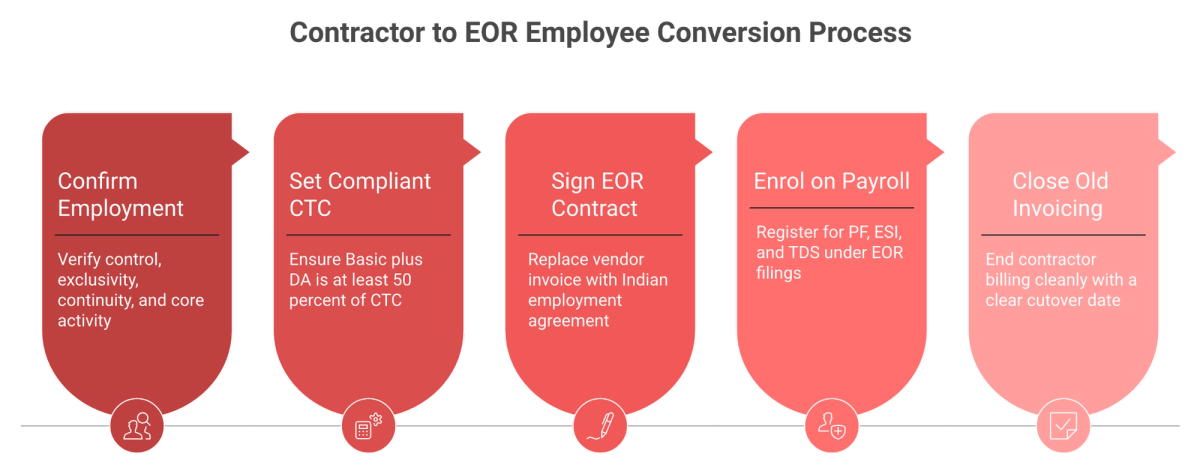
Confirm employment. Check control, exclusivity, continuity, and core-activity. If those say employee, treat them as one.
Set a compliant CTC. Structure pay so Basic plus dearness allowance (DA) is at least 50% of total CTC.
Sign the EOR contract. A proper Indian employment agreement replaces the old vendor invoice arrangement.
Enrol on payroll. Register the worker for provident fund, ESI, and TDS under the EOR's filings.
Close the old invoicing. End the contractor billing cleanly, with a clear cutover date.
The 50% rule matters most at step two. Get the structure wrong, and you under-fund PF and gratuity from the start, which is why our India payroll team re-papers comp first.
What Stops Accruing Once You Convert
The payoff is immediate and measurable. From the cutover date, the worker is a real employee, not a reclassification risk.
Back-pay exposure stops growing.
Permanent Establishment (PE) risk from a controlled contractor falls away.
The worker gains a payslip, PF, and the ability to get that mortgage.
Versatile Club converts a flagged contractor to a compliant employee on our entity in about five business days, with no setup or exit fees, and comp re-papered to satisfy the 50% rule. You can model the loaded number first with our employee cost calculator. From what surfaces when you actually run these cutovers, the worker rarely feels a gap, which is the whole point.
I will name one trade-off honestly. Heavy enterprise procurement customisation takes longer than the 5-day SLA. For a single flagged contractor, though, five days is the realistic clock, and our hire without an entity guide walks through it.
Q11: How Do You Move Fast Without Getting Burned: Your Monday-Morning Action Plan?
Start by auditing every India contractor against three questions. Do you control how they work? Are they exclusive to you? Are they doing core work? Any "yes" means reclassification and PE risk you should neutralise now. For new hires that are core or ongoing, default to an EOR you can stand up in days, then revisit your own entity only when you cross roughly a dozen heads.
The Three-Question Self-Audit
Do this before your next standup. Open a sheet, list every India contractor, and ask three things.
Do you control how and when they work, not just what they deliver?
Do they work only for you, month after month?
Are they doing the core work your business sells?
Any "yes" is a flag. Two or three is exposure you should fix this quarter, not next year, and our misclassification quiz scores it for you.
The Default Move for New Hires
For new core or ongoing roles, stop reaching for the contractor shortcut. Default to an EOR you can stand up in days, and convert to your own entity only when you pass roughly a dozen hires.
This is where risk reversal matters. With Versatile Club, your first month is free, there are no setup or exit fees, onboarding runs on a 5-day contractual SLA, and Contract-to-Hire placements carry a 6-month replacement guarantee. You can see the full numbers on our India EOR pricing page. You are not locking in. You are testing the load before you trust the bridge, which is the heart of our retention-first EOR model.
Where My Head Is, and an Invitation
Here is the prediction I am sitting with. Over the next two years, India stops being one country on a global EOR map and becomes its own specialist category.
Owned-entity EORs that go deep in one country will take the India revenue generalists treat as a side line. I might be early, but the regulatory tightening of 2025-26 points that way.
So I will not end with "book a demo." If you are scaling India headcount in the next 60 days, message Versatile Club directly. You will reach me, Sagar, on WhatsApp, not a ticket queue, and we can talk through what you are actually building.
FAQs
What is the real difference between an independent contractor and an EOR in India?
The difference comes down to who carries the compliance weight. An independent contractor is a vendor who invoices you, handles their own tax and benefits, and works for multiple clients. An Employer of Record (EOR) legally employs the worker on its own Indian entity, running provident fund, ESI, TDS, and professional tax under its own registrations while you manage the person day to day.
- Contractor: fast to start, but you control the outcome, not the method.
- EOR: a real employee, with IP vesting in the employer by default and near-zero misclassification risk.
- Own entity: the long-term path, which takes 12 to 18 months and heavy capital.
Most founders read contractor as cheap and EOR as expensive, but the math flips once you price in hidden liability. A controlled, full-time contractor can trigger back-pay and Permanent Establishment exposure that a contractor invoice quietly hides. The contractor looks lighter until the relationship gets real and ongoing.
If you are weighing the two for a core hire, our Employer of Record in India service shows how the owned-entity model removes that exposure from day one.
When should I use a contractor instead of an EOR for my India hire?
Use a contractor only when the work is genuinely independent. The fit is narrow but real, and it hinges on scope, duration, and control.
- The engagement is short, usually under about six months.
- The scope is a defined project with a clear deliverable.
- You control the outcome, not the daily method.
- The person works for other clients too, not just you.
A logo redesign, a one-off audit, or a fixed data migration all qualify. You pay the invoice and move on without creating an employment relationship.
The moment a role becomes core, ongoing, exclusive, or full-time, the contractor model turns into a liability rather than a saving. That switch point usually lands across your first one to ten India hires, where you are too exposed for a contractor but not yet big enough for your own entity.
If you are in that band, our Contract-to-Hire path lets you start fast and convert to compliant employment without the entity you do not yet need. You can pressure-test a specific role using our misclassification quiz before you decide.
What does misclassification actually cost if I get it wrong in India?
Misclassification in India is two separate bills, not one. The first is the labour bill, and the second is the one most comparison pages skip entirely.
- Labour liability: back-dated provident fund, ESI, gratuity, and unpaid wages, landing near $25,000 to $40,000 per head with interest.
- Permanent Establishment (PE) tax: a controlled, full-time contractor can create a taxable presence for your foreign company, bringing corporate tax, transfer-pricing filings, and penalties.
The PE exposure is uniquely dangerous because the same set of facts opens two regulatory fronts at once. A dependent agent with authority to act for you is a classic trigger, and global comparison content rarely connects the labour and tax sides.
There is also a hidden third-party angle. Many global providers run India through local partner entities, so if that partner fails a statutory filing, the fallout can land on you, the client.
You can gauge your own exposure with our PE risk quiz, and our India EOR service moves both bills off your books by owning the entity end to end.
How much does each model really cost once fully loaded in INR and USD?
A contractor invoice looks 20 to 40% cheaper on the surface because it hides everything but the rate. An EOR's landed cost sits higher on paper because it prices in the full employer load you would otherwise owe later.
- Provident fund: 12% employer contribution on Basic plus DA.
- ESI: a 3.25% employer and 0.75% employee split where applicable.
- Gratuity: accrues from month one at 4.81% of Basic plus DA.
- TDS: deducted and deposited by the 7th of the following month.
That visibility is the entire point. The contractor hides the liability, while the EOR makes it predictable and audit-ready. Under the 2025-26 Labour Codes, Basic plus DA must be at least 50% of CTC, which lifts statutory cost by roughly 5 to 15% but removes nasty surprises later.
We never tell founders to choose India just because it is cheaper; you go for highly capable people who do excellent work. That said, a senior engineer in Bengaluru can run about $162,000 a year less than the San Francisco equivalent. Model your own number with our cost of hiring in India guide and employee cost calculator.
When does a contractor get reclassified as an employee in India?
In India, the substance of the working relationship overrides the contract label. The legal test is practical: if you direct the how, not just the what, you are acting like an employer no matter what the agreement says.
Auditors stack signals rather than relying on one fact:
- Exclusivity: the person works only for you, month after month.
- Continuity: the engagement runs well past a defined project.
- Integration: they sit inside your team, tools, and reporting lines.
- Core activity: they do the work your business actually sells.
That last factor is decisive. The Industrial Relations Code generally bars independent contractors for a company's core business activities, and the principal employer carries liability under the Contract Labour Act.
IP is the quiet trap here. For an employee, work product vests in the employer by default; for a contractor, IP transfers only if a written assignment clause says so. We have watched diligence stall on exactly this gap during a funding round. Compliant contractor contracts close that gap, and our Agent of Record page explains where the line sits.
How do the 2025-26 Labour Codes change the contractor versus EOR decision?
The Four Labour Codes went live on 21 November 2025 and changed the math directly. The most material shift is the wage-structure rule, which removes a lever Indian payroll long relied on.
- The 50% rule: Basic plus DA must now be at least 50% of total CTC, lifting PF, ESI, and gratuity costs by an estimated 5 to 15%.
- Faster settlements: full-and-final dues must clear within 48 hours of exit.
- EPFO downloads: only summary-level ECR filings are available since 11 March 2026.
Layered with the DPDP Act, India's data-protection law, the direction of travel is clear. Informal contractor arrangements are getting riskier, not safer, and state professional tax adds further multi-state complexity across Maharashtra, Karnataka, and others.
Our read is that India is shifting from one country on a global map to a specialist compliance category. When the Codes changed, the re-papering was our problem to solve, not our clients'. We already file PF, ESI, TDS, and professional tax across all states under our own registrations through our EOR services in India, and our India payroll team handles the state-level detail.
How do I convert an existing contractor into a compliant EOR employee?
Converting a contractor to an EOR employee is a known, fast sequence, not a crisis. It usually starts when legal or finance flags an India contractor as risky, and you want to fix it before an audit does.
The move runs in five steps:
- Confirm the role is genuinely employment using control, exclusivity, continuity, and core-activity tests.
- Set a compliant CTC so Basic plus DA is at least 50% of total pay.
- Sign the EOR employment contract to replace the vendor invoice arrangement.
- Enrol the worker on payroll for PF, ESI, and TDS under the EOR's filings.
- Close the old contractor invoicing cleanly with a clear cutover date.
Done right, the worker keeps working without a gap, and your back-pay and Permanent Establishment exposure stops accruing from the cutover date. The person also gains a payslip, PF, and the ability to qualify for a mortgage.
We convert a flagged contractor to a compliant employee on our entity in about five business days, with no setup or exit fees and comp re-papered to the 50% rule. See how our hire in India without an entity model handles the cutover.
Is an India-native EOR better than a global generalist for India-only hiring?
For India-only hiring, an India-native EOR generally beats a global generalist. Think of it like cloud regions: depth in one region beats a thin presence in fifty.
Global platforms cover 90 to 150 countries and cannot carry deep India muscle in each one, so most route India through a local partner entity. That leaves you one filing failure away from inheriting the fallout. An India-native EOR owns its entity and files under its own registrations.
- Cost: generalists may add a reported 3 to 5% FX markup; native players often invoice in USD without it.
- Speed: native onboarding can run in days, against weeks for some generalists.
- Risk: an owned entity removes partner-shell exposure.
We will be honest about the exceptions. If you need five-plus countries on one contract, or run a 100-plus India team requiring SOC 2 or ISO 27001 as a procurement gate, a generalist may fit better. Forcing our model there would be poor advice.
For a focused India build, our India EOR for USA service and Deel alternatives for India page lay out the trade-offs plainly.