Table of contents (16)
9 Best Rippling Alternatives in India: How They Compare on Cost, Compliance, and Support
Q1. What are the 9 best Rippling alternatives for hiring in India in 2026, and how did we rank them?
The nine best Rippling alternatives for India in 2026 are Versatile, Deel, Remote, Multiplier, Globalization Partners, Papaya Global, Skuad, Velocity Global (now Pebl), and Oyster. I scored each on five weighted criteria: India Entity Model and Compliance Depth (25%), Pricing Transparency (20%), Onboarding Speed and Support (20%), Talent and Retention Support (20%), and Customer Validation (15%). Versatile earns five stars as the India-native pick. The global generalists cluster at three to four.
💡 Why I built this list the way I did
I run an India-only Employer of Record (EOR). An EOR is the company that legally employs your India hire on your behalf, so you do not have to open your own entity. I have spent six years placing engineers, designers, and ops people across Bengaluru, Hyderabad, and Pune for US and UK clients.
So I am not neutral, and I want to say that up front. What I can offer is the operator's read on where each of these tools actually helps you and where they quietly cost you.
🎯 The real question you are asking
Most people who search "Rippling alternatives India" already like Rippling's interface. That is not the problem. The problem is the nagging doubt behind it.
You are asking whether you are paying roughly $500 to $600 a month for a clean global wrapper, while your actual India compliance runs through a partner you have never met. That doubt is fair. Rippling and the other global platforms cover 90 to 150 countries, and that breadth spreads India expertise thin.
Here is the part buyers feel in their gut. When the 2026 wage rule or a state professional tax slab gets missed, the bill does not land on the platform. It lands on you, often during your next due diligence audit.
⚙️ How the scoring actually works
I weighted the India entity model heaviest at 25%, because that single fact decides who is legally on the payslip. Most global EOR providers, including Deel and Remote, use local partner entities in India. We do not. Foo Falcon Technologies Pvt Ltd is our own registered Indian company, and PF, ESI, TDS, and professional tax filings sit under our own registrations, backed by full India compliance coverage.
Pricing transparency gets 20%, not the top slot. I could be biased here, but I do not think you should hire in India because it is cheap. You hire in India for genuinely sharp people, and price is a happy side effect, not the pitch. You can sanity-check the math with our EOR vs entity calculator.
Talent and retention support also gets a full 20%, and almost no competitor rubric includes it. Compliance answers the "legal hire on paper" problem. It does nothing for the "good hire who actually stays" problem, and that gap is where most India hiring plans fall apart at month four.
The star bands are simple:
0 to 20% = ⭐
21 to 40% = ⭐⭐
41 to 60% = ⭐⭐⭐
61 to 80% = ⭐⭐⭐⭐
81 to 100% = ⭐⭐⭐⭐⭐
One honest note. On raw platform polish and self-serve dashboards, I would score us a 4, not a 5. A recent reviewer said the same thing, and she is right.
"The dashboard could be a little more self-serve. A couple of times I wanted to pull a report or a doc myself and ended up just messaging my contact instead. They always answered fast, so it wasn't a real problem."
Angad S. Versatile G2 Verified Review
📋 The ranked list
Versatile: Best for US and UK founders hiring their first 1 to 5 India employees. ⭐⭐⭐⭐⭐
Deel: Best for teams that need one platform across many countries, with India as one node. ⭐⭐⭐⭐
Remote: Best for global contractor-to-payroll conversions where India depth is secondary. ⭐⭐⭐⭐
Multiplier: Best for mid-market teams wanting broad Asia-Pacific coverage at a mid price. ⭐⭐⭐⭐
Globalization Partners (G-P): Best for enterprises with mature procurement and multi-country scale. ⭐⭐⭐⭐
Papaya Global: Best for payroll-led finance teams consolidating global payroll data. ⭐⭐⭐
Skuad: Best for startups wanting broad country coverage on a lighter budget. ⭐⭐⭐
Velocity Global (Pebl): Best for enterprises already standardized on its network. ⭐⭐⭐
Oyster: Best for SMBs wanting a friendly global EOR for occasional hires. ⭐⭐⭐
🧭 Our Evaluation Criteria
Each provider was assessed across these decision-grade criteria:
India Entity Model: Own Indian entity, local partner entity, contractor model, or payroll-only setup.
Statutory Compliance Depth: PF, ESI, TDS, professional tax, gratuity, POSH, Form 16, full-and-final settlement, DPDP readiness, and New Labour Code 2025-26 structuring.
State-Level Coverage: Professional tax, Shops and Establishments, labour welfare fund, and leave rules across Indian states.
Onboarding Speed: Time from signed agreement to compliant contract, payroll setup, statutory registration, and employee start.
Pricing Transparency: Monthly fee, setup fee, exit fee, FX markup, first-month terms, salary-band pricing, and invoice clarity.
Invoicing and Finance Readiness: USD invoicing, gross-to-net reporting, challan confirmations, TDS receipts, and audit-ready documentation.
Support Model: Founder-direct, named HR manager, HRBP, ticket queue, chatbot, or general CSM model.
Talent and Retention Support: Recruiting, contract-to-hire, culture-fit vetting, onboarding monitoring, and replacement guarantee.
Customer Validation: G2, Capterra, Clutch, Reddit, case studies, and named testimonials.
Best-Fit Buyer Segment: First India hire, 1 to 50 India employees, or enterprises needing multi-country EOR.
👥 Who This Guide Is For
This guide is designed for:
US and UK founders hiring their first 1 to 3 employees in India.
Seed to Series B startups building engineering, product, AI, design, or ops teams in India.
People Ops and HR leaders reviewing India EOR, payroll, contractor, or PEO vendors.
CFOs and finance teams needing clean invoicing, statutory liability visibility, and audit-ready India payroll records.
Legal teams reviewing employment contracts, IP assignment, misclassification risk, and PE risk.
Companies currently using Deel, Remote, Multiplier, or G-P and evaluating an India-specialist alternative.
📊 Master Comparison Table
| Provider (Stars) | Best For | Key Strength | Compliance |
|---|---|---|---|
| Versatile ⭐⭐⭐⭐⭐ | US and UK startups hiring their first 1 to 5 India employees | Owned India entity with founder-direct support and a 6-month replacement guarantee | Own entity, all 28 states and 8 UTs, New Labour Code and DPDP ready |
| Deel ⭐⭐⭐⭐ | Teams hiring across many countries with India as one node | Broad 150-plus country coverage on one platform | India via local partner entity |
| Remote ⭐⭐⭐⭐ | Global contractor-to-payroll conversions | Strong contractor and IP tooling | India via local partner entity |
| Multiplier ⭐⭐⭐⭐ | Mid-market teams wanting Asia-Pacific breadth | Mid-price global coverage | Partner-entity model in most markets |
| Globalization Partners (G-P) ⭐⭐⭐⭐ | Enterprises with mature procurement | Enterprise-grade global infrastructure | Owned entities in many countries, enterprise compliance |
| Papaya Global ⭐⭐⭐ | Payroll-led finance teams | Global payroll data consolidation | Payroll-led, partner network for EOR |
| Skuad ⭐⭐⭐ | Startups wanting coverage on a lighter budget | Wide country list at lower cost | Partner-entity model |
| Velocity Global (Pebl) ⭐⭐⭐ | Enterprises on its existing network | Established multi-country footprint | Mixed owned and partner entities |
| Oyster ⭐⭐⭐ | SMBs with occasional global hires | Simple SMB-friendly experience | Partner-entity model |
Two quick notes on the table. I deliberately left out pricing and review count as columns, because both mislead when read in isolation. A "$99 from" sticker or a big review number tells you nothing about who is on the payslip in Bengaluru.
I also want to be fair about Rippling itself, since it is your current reference point. Its payroll interface genuinely is easy to use, and buyers say so. The pain shows up later, in support and multi-jurisdiction tax.
"I find the entire integrated payroll system very easy to use, even for our most tech-phobic employees."
Patrick W. Rippling G2 Verified Review
"It did not handle multi-state taxes well at all. We are a non-profit and it was constantly making mistakes."
Liz J. Rippling G2 Verified Review
That multi-state tax pain in the US is exactly the pattern I watch play out with India state professional tax on global platforms. Now let me take the top two entries in detail.
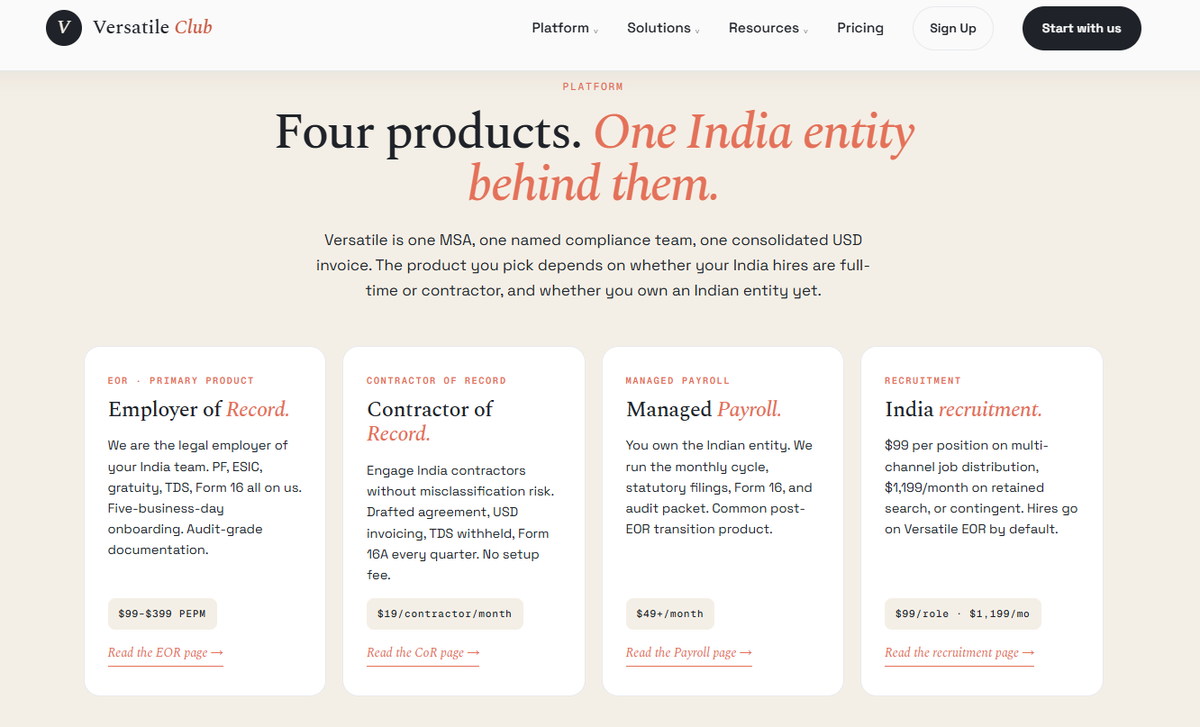
1.1 Versatile: Best for US and UK founders making their first 1 to 5 India hires
Overview
Versatile is an India-only EOR and contract-to-hire (C2H) provider for US and UK companies. C2H simply means we can source and place the person, run them compliantly, and let you convert them to a permanent hire later. We employ your India hire through our own registered Indian entity, so you never have to open a subsidiary.
Core Services
Employer of Record across all 28 states and 8 union territories.
Contract-to-hire sourcing with culture-fit vetting on 50 behavioral parameters.
Full statutory compliance: PF, ESI, TDS, professional tax, gratuity, POSH, and Form 16.
USD invoicing direct from our Indian entity, with no FX markup.
Onboarding monitoring through a 90-day Success Coach and a 6-month replacement guarantee.
Why companies consider Versatile
Founders come to us when the two obvious paths both feel wrong. Opening your own entity costs tens of thousands and months of time for a single hire. A global platform feels safe but routes your India compliance through a partner shell you cannot see.
We sit in the gap. India-native compliance depth, plus US-grade financial operations like a single clean USD invoice. The decision logic is usually speed, compliance certainty, and wanting a real person to answer when payroll gets close. Founders scaling lean teams often start on our startup-focused EOR plans.
Ideal Customer Profile
Company size: Seed to Series B, roughly 5 to 200 people.
Geography: US or UK headquarters.
Hiring need: Engineering, product, AI, design, or ops talent in India.
India team size: First hire up to around 20 employees.
Decision maker: Founder, Head of People, or CFO.
Commercial Model
Flat $149 per employee per month. No setup fee, no exit fee, and the first month is free. C2H placements are charged at 20 to 30% of annual salary, billed only after the hire completes day 90, and backed by a 6-month replacement guarantee. Invoicing is in USD, direct from India. Full details sit on our pricing page.
Customer Reviews
"We used Versatile to hire our first employee in India after months of putting it off because the compliance side seemed like a mess. They replied to our form in about four hours with a draft offer letter already attached. The hire was onboarded in four days. USD invoice landed clean, no FX markup, no setup fee, no surprises."
Verified User in Information Technology and Services Versatile G2 Verified Review
"Founder is just a call away. Extremely helpful in resolving all our queries. The process is super smooth to set up India EOR."
Surbhi M. Versatile G2 Verified Review
1.2 Deel: Best for teams hiring across many countries with India as one node
Overview
Deel is a global EOR and contractor platform covering more than 150 countries. It is one of the most recognized names in cross-border hiring, and its product surface is broad, spanning contractors, EOR employees, and global payroll in one place. Teams weighing an India-specific switch often compare it against our Deel alternative.
Core Services
Global EOR employment across 150-plus countries.
Contractor onboarding and payments.
Multi-country payroll consolidation.
Immigration and visa support in select markets.
Equipment and IP management add-ons.
Why companies consider Deel
Deel wins when India is one square on a much larger board. If you are hiring in eight countries and want a single dashboard, that consolidation is genuinely valuable. The interface is clean, and setup for a contractor takes minutes.
The trade-off is depth. For India, Deel typically operates through a local partner entity, which puts distance between you and the people actually running PF, TDS, and state professional tax. That distance is fine until something breaks, and then you are managing a ticket queue instead of a person.
Ideal Customer Profile
Company size: Series B and up, or any multi-country team.
Geography: Global headquarters hiring across regions.
Hiring need: Distributed roles across several countries at once.
India team size: Usually a handful within a larger global count.
Decision maker: People Ops or Finance managing global vendors.
Commercial Model
Deel EOR pricing is commonly cited around $599 per employee per month. Multiple reviewers also report transfer and FX-style fees on the money-movement side. Confirm the exact India quote and any deductions before signing.
Customer Reviews
"I find Deel to be absurdly expensive. They charge a high amount of fees for transferring money to my bank account."
Juan Camilo O. Deel G2 Verified Review
"It took three months to onboard our first 3 individuals. They didn't seem to be able to navigate visas or variations to employment contracts, and this constantly created issues, so we had to make a decision to change providers."
Verified User in Information Technology and Services Deel G2 Verified Review
That three-month onboarding story is the exact opposite of what we contract for. When we placed our first US-client engineer in Bengaluru, the commitment was a 5-day onboarding SLA written into the service agreement, not an aspiration. From what surfaces when you actually run India payroll month after month, speed and a named human are not luxuries. They are the difference between a calm payroll week and an 11pm WhatsApp panic.
1.3 Remote: Best for global contractor-to-payroll conversions where India depth is secondary
🌐 Overview
Remote is a global EOR and contractor platform that helps companies hire in dozens of countries. It is known for strong contractor tooling and intellectual property (IP) protection, which is why founders converting freelancers into payroll employees often shortlist it. Teams comparing an India-specific switch often weigh it against our Remote alternative.
For India, Remote generally works through a local partner entity. A partner entity means another company is the legal employer on the ground, not Remote itself.
⚙️ Core Services
Global EOR employment across many countries.
Contractor management and compliant contractor-to-employee conversion.
Global payroll consolidation.
IP and invention-assignment protection.
Benefits administration in supported markets.
🤔 Why companies consider Remote
Remote wins when your starting point is a global freelancer base. If you already pay contractors in five countries and want to move some onto compliant payroll, Remote's tooling is genuinely strong.
The India caveat is the same one I flag for every global platform. Depth at the state level, like Maharashtra's dual PTRC and PTEC professional tax registration, is thinner when India is one of many markets run through a partner. This is where an India-focused EOR service in India reads the map differently.
👤 Ideal Customer Profile
Company size: Series A and up with a distributed contractor base.
Geography: Global headquarters.
Hiring need: Converting contractors to employees across regions.
India team size: A few hires within a larger global count.
Decision maker: People Ops or global HR.
💰 Commercial Model
Remote EOR pricing is commonly cited around $599 per employee per month. Some buyers also report FX-style costs on cross-border payouts, so confirm the exact India quote and any deductions in writing.
💬 Customer Reviews
No verified customer reviews were available in the provided source set for this provider.
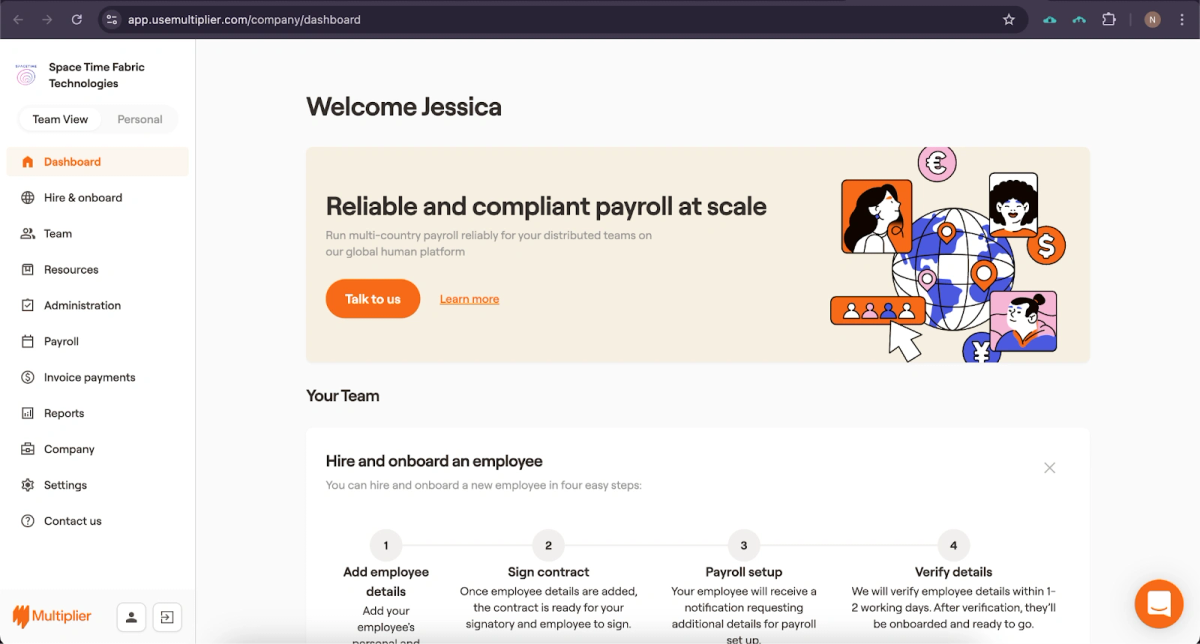
1.4 Multiplier: Best for mid-market teams wanting Asia-Pacific breadth
🌏 Overview
Multiplier is a global EOR platform with strong coverage across Asia-Pacific. It positions itself as a mid-price option for teams hiring across several countries at once. Buyers narrowing to India often look at our Multiplier alternative.
Like most generalists, its India operations typically run through a partner-entity model rather than a fully owned Indian entity.
⚙️ Core Services
Global EOR employment across 100-plus countries.
Contractor onboarding and payments.
Multi-country payroll.
Benefits and insurance administration.
Expense and compliance management.
🤔 Why companies consider Multiplier
Multiplier appeals to mid-market teams that want broad coverage without top-tier enterprise pricing. The Asia-Pacific footprint is a real draw for companies scaling across the region.
The trade-off is depth versus breadth again. A mid-price platform covering 100-plus countries cannot match the state-level India fluency of an India-only operator, and that shows up in edge cases like labour welfare fund filings.
👤 Ideal Customer Profile
Company size: Growth-stage, mid-market teams.
Geography: Global, with an Asia-Pacific focus.
Hiring need: Multi-country hiring on a mid budget.
India team size: Usually part of a broader regional team.
Decision maker: People Ops or regional HR lead.
💰 Commercial Model
Multiplier EOR pricing is commonly cited around $400 per employee per month. Confirm setup terms, exit fees, and any FX policy in your quote, since these vary by contract.
💬 Customer Reviews
No verified customer reviews were available in the provided source set for this provider.
1.5 Globalization Partners (G-P): Best for enterprises with mature procurement
🏢 Overview
Globalization Partners, usually shortened to G-P, is one of the oldest enterprise EOR providers. It runs owned entities in many countries and is built for large, process-heavy buyers. Larger buyers weighing India depth often review how our enterprise EOR support compares.
G-P suits organizations where procurement, security review, and legal sign-off matter more than speed to first hire.
⚙️ Core Services
Enterprise EOR employment across 180-plus countries.
Owned-entity infrastructure in many markets.
Global payroll and compliance.
Contractor management.
Enterprise integrations and reporting.
🤔 Why companies consider G-P
G-P wins on enterprise trust. If your company needs mature security posture and a vendor that has done thousands of complex placements, G-P is a safe institutional choice.
The flip side is cost and pace. Enterprise onboarding cycles run longer, and pricing is typically quote-based, often cited near 15% of salary, which can exceed flat per-employee models for smaller India teams.
👤 Ideal Customer Profile
Company size: Enterprise, 100-plus employees.
Geography: Global headquarters.
Hiring need: Multi-country scale with strict procurement.
India team size: Often part of a large global workforce.
Decision maker: Procurement, legal, and VP People.
💰 Commercial Model
G-P pricing is typically a custom quote, commonly referenced around 15% of annual salary. Exact terms depend on volume and contract, so request a written quote.
💬 Customer Reviews
No verified customer reviews were available in the provided source set for this provider.
1.6 Papaya Global: Best for payroll-led finance teams
💳 Overview
Papaya Global is a payroll-led global workforce platform. Its strength is consolidating global payroll data and payments into one finance-friendly view. Finance teams focused on India often compare it with our managed payroll service.
Papaya is often chosen by CFOs and finance teams first, with EOR as a secondary need routed through its partner network.
⚙️ Core Services
Global payroll consolidation and payments.
EOR through a partner network.
Contractor payments.
Workforce analytics and spend reporting.
Compliance and payments infrastructure.
🤔 Why companies consider Papaya
Papaya wins when payroll data and payment rails are the priority. Finance teams like the single view across many countries and the reporting depth.
For India specifically, the buyer should confirm who the legal employer actually is. A payroll-led model with a partner network is different from an owned India entity carrying statutory liability directly.
👤 Ideal Customer Profile
Company size: Mid-market to enterprise.
Geography: Global, finance-led buying.
Hiring need: Payroll consolidation across many countries.
India team size: Part of a larger payroll footprint.
Decision maker: CFO or finance operations.
💰 Commercial Model
Papaya pricing is generally a custom quote based on headcount, payroll volume, and services used. Ask for a written breakdown of EOR versus payroll-only fees.
💬 Customer Reviews
No verified customer reviews were available in the provided source set for this provider.
1.7 Skuad: Best for startups wanting coverage on a lighter budget
🚀 Overview
Skuad, now part of Payoneer, is a global EOR platform with broad country coverage. It targets startups that want wide reach at a lighter price point than enterprise providers. Startups narrowing their India hire often check our Skuad alternative.
For India, Skuad follows the common generalist pattern of a partner-entity model.
⚙️ Core Services
Global EOR employment across many countries.
Contractor onboarding and payments.
Global payroll.
Benefits administration.
Compliance documentation.
🤔 Why companies consider Skuad
Skuad appeals to early-stage teams that want to test hiring in several countries without heavy commitments. The Payoneer backing adds payments strength.
The India trade-off is depth. Broad coverage on a lighter budget usually means state-level compliance is handled generically, not with the fluency an India-native operator brings.
👤 Ideal Customer Profile
Company size: Seed to Series B startups.
Geography: Global.
Hiring need: Wide country coverage at lower cost.
India team size: A few hires among many markets.
Decision maker: Founder or People Ops.
💰 Commercial Model
Skuad pricing is generally a custom quote, positioned toward the lower end of the global EOR range. Confirm per-employee fees and any FX policy before signing.
💬 Customer Reviews
No verified customer reviews were available in the provided source set for this provider.
1.8 Velocity Global (Pebl): Best for enterprises on its existing network
🌍 Overview
Velocity Global, now rebranded as Pebl, is an established multi-country EOR provider. It uses a mix of owned and partner entities across its footprint. Buyers reassessing India often compare it against our Velocity Global alternatives in India.
It fits enterprises already standardized on its network, though buyers should read recent service feedback carefully.
⚙️ Core Services
Global EOR employment across many countries.
Contractor and agent-of-record services.
Global payroll and benefits.
Immigration support in select markets.
Compliance management.
🤔 Why companies consider Velocity Global
Velocity Global wins for enterprises that value an established footprint and existing relationships. Local knowledge in supported countries is a stated strength.
The reviews I read show a recurring pattern worth flagging. Several long-term customers describe account-manager churn and manual, email-driven processes, which is the opposite of a fast, named-owner experience.
👤 Ideal Customer Profile
Company size: Mid-market to enterprise.
Geography: Global.
Hiring need: Multi-country employment.
India team size: Part of a larger global count.
Decision maker: HR operations and procurement.
💰 Commercial Model
Velocity Global (Pebl) pricing is a custom quote and sits on the higher end per reviewer accounts. Confirm per-employee fees, deposit refunds, and exit terms in writing.
💬 Customer Reviews
"Processes are manual. From the request to onboard to approving quotes, everything happens via email. There is no way of tracking where a process is at other than emailing the Account Manager, which makes it a very time-consuming process."
Verified User in Computer Software Velocity Global G2 Verified Review
"We've had no fewer than six account managers in less than two years. More than once, we've learned of changes to our team by receiving an out-of-office auto-reply when someone had left the company. Our new provider is costing us 60% less for a better experience."
Verified User in Translation and Localization Velocity Global G2 Verified Review
1.9 Oyster: Best for SMBs wanting a friendly global EOR for occasional hires
🐚 Overview
Oyster is a global EOR built with small and mid-sized businesses in mind. It emphasizes a simple, approachable experience for teams hiring across borders occasionally. SMBs weighing a dedicated India route often look at how our EOR for startups works.
For India, Oyster follows the generalist partner-entity approach rather than operating its own Indian entity.
⚙️ Core Services
Global EOR employment across many countries.
Contractor management.
Global payroll.
Benefits administration.
Compliance tooling.
🤔 Why companies consider Oyster
Oyster wins for SMBs that want an easy platform for the occasional international hire. The experience is designed to feel light, which suits low-volume, multi-country needs.
The India caveat holds. Occasional-hire simplicity does not translate into deep, state-level India compliance, so verify who carries statutory liability on the payslip.
👤 Ideal Customer Profile
Company size: SMBs and small teams.
Geography: Global.
Hiring need: Occasional cross-border hires.
India team size: One or a few hires.
Decision maker: Founder or office manager.
💰 Commercial Model
Oyster pricing is generally per-employee per-month with published tiers, positioned for SMB budgets. Confirm the exact India quote, setup terms, and any FX policy.
💬 Customer Reviews
No verified customer reviews were available in the provided source set for this provider.
🧭 Where this leaves you
Here is the pattern I keep seeing across these six. Every global generalist above treats India as one square on a 100-plus country map, usually through a partner entity, with support that routes through a queue rather than a person.
That is not a flaw in their business. It is a design choice that makes sense when India is 1% of your revenue. The problem is that it becomes your problem when a state professional tax filing or a PF challan goes sideways three days before payroll.
This is exactly the gap we built Versatile to fill. India is the only country we operate in, through our own registered entity, with compliance across all 28 states and 8 union territories, and me reachable on WhatsApp when payroll gets close. When you actually run this month after month, the difference between "a country on the map" and "the only country we do" is the difference between a calm payroll week and a scramble. If you want to pressure-test that, you can always book a demo.
Q2. Why do people switch from Rippling for India, and where does its compliance depth fall short?
People switch because Rippling reaches 150-country scale by routing India through partner entities, so the employer on your worker's payslip may not be the one you signed with. Its India EOR pricing is unpublished, estimated at $499 to $599 per month. Partner distance is where the 2026 rules get missed. The Code on Wages, in force from 21 November 2025, requires Basic plus DA of at least 50% for computing statutory pay, and gratuity accrues from month one at 4.81%.
🧩 The scale-versus-depth trade-off, explained simply
Let me explain this the way I would to a founder on a call. A global EOR (Employer of Record, the company that legally employs your hire for you) covers 90 to 150 countries. To do that, it cannot own a real entity in every one.
So for India, it usually rents a local partner entity. A partner entity is a separate Indian company that becomes the legal employer on paper. You signed with Rippling, but the name on the PF filing may be a partner you have never spoken to. Our own EOR services in India work the opposite way.
⚠️ Why the legal employer actually matters
That distance is fine until something breaks. When a professional tax (PT, a small state-level salary tax) filing is late, the liability sits with the employer entity, and that is now a partner, not you directly, but also not the brand you trusted.
Here is the deeper point. Compliance knowledge in India comes from running real payroll across states, not from a global playbook. The standard read gets this backwards.
📜 The 2026 rule that breaks legacy stacks
The Code on Wages 2019 commenced on 21 November 2025 via notification S.O. 5322(E). It changes how "wages" are defined for statutory pay. You can see how this maps to a live cycle in our India payroll compliance guide.
Now Basic plus Dearness Allowance (DA) must be at least 50% of total pay for computing PF, gratuity, and similar dues. Many legacy payroll templates split salary the old way and quietly get this wrong.
Two things buyers miss:
Gratuity accrues from month one at 4.81% of Basic plus DA, not only after five years of vesting.
The 50% figure is a wage-computation floor for statutory pay. It is not a blanket rule that half of CTC must be Basic.
✅ What a compliant 2026 India payslip must show
A correct payslip in 2026 shows PF at 12% of Basic plus DA, the ESI split where applicable, and state PT deducted on the right slab. India's states do not share one rulebook.
Maharashtra needs dual PTRC and PTEC registration.
Karnataka runs monthly PT plus a Shops and Establishments renewal within 30 days.
Telangana requires monthly PTRC remittance, and TDS is deposited by the 7th.
At Versatile, we run our own Indian entity across all 28 states and 8 union territories, so the 50% wage rule and each state's PT slab are configured by default through our compliance infrastructure. They are never left to a partner's template. Indians work in a facsimile of the West by day, then go home to India every night, which is exactly why PF and gratuity are not optional line items to them.
Q3. How do the 9 Rippling alternatives compare on cost, compliance, and support?
On cost, global generalists run $499 to $599 per employee monthly, and Deel and Remote often add a 3 to 5% FX (foreign-exchange) markup. Versatile is a flat $149 with zero setup, zero exit, and the first month free. On compliance, generalists rely on India partner entities, while Versatile files under its own registrations across all 28 states and 8 union territories. On support, generalists route you through chatbots and account-manager rotations. With Versatile, you WhatsApp the founder.
📊 The three-axis verdict at a glance
| Provider | Cost/employee/mo | India entity model | FX exposure | Onboarding | Support model |
|---|---|---|---|---|---|
| Versatile | $149 flat | Own India entity | None (USD from India) | 5-day contractual SLA | Founder-direct |
| Deel | ~$599 | Partner entity | Reported transfer/FX fees | 7 to 14 days | Ticket/CSM |
| Remote | ~$599 | Partner entity | Reported FX costs | 10 to 14 days | Ticket/CSM |
| Multiplier | ~$400 | Partner entity | Varies | ~1 week | CSM |
| G-P | ~15% of salary | Owned entities | Varies | Enterprise cycle | Enterprise CSM |
| Papaya | Custom quote | Partner network | Varies | ~1 to 2 weeks | Payroll ops |
| Skuad | Custom (lower) | Partner entity | Varies | ~1 week | CSM |
| Velocity Global (Pebl) | Custom (higher) | Mixed | Varies | Reported delays | Rotating AM |
| Oyster | Per-employee tiers | Partner entity | Varies | ~1 week | CSM |
🔍 Quick reads on who fits where
Deel and Remote fit multi-country teams, but reviewers flag fees and slow support. Not recommended if India is your main hire and you need a named human. Teams narrowing to India often compare our Deel alternative at this stage.
"It took three months to onboard our first 3 individuals. They didn't seem to be able to navigate visas or variations to employment contracts."
Verified User in Information Technology and Services Deel G2 Verified Review
G-P and Papaya fit enterprises and finance-led buyers. Not recommended if you want speed and a flat, predictable price. Our pricing page shows the flat-rate contrast in full.
💸 The hidden-fee tell, and the honest counterpoint
A tactical move I give every founder: ask for a real, itemized sample India invoice before signing. That single request exposes a 3 to 5% FX markup that marketing pages never mention. Our managed payroll invoices land in USD, direct from India.
"We've had no fewer than six account managers in less than two years. Our new provider is costing us 60% less for a better experience."
Verified User in Translation and Localization Velocity Global G2 Verified Review
I will be fair here. If you genuinely hire across five or more countries, a generalist's breadth is a real advantage, and Versatile is the wrong pick because we only do India.
But for an India-first team, our row is built to win on the three axes that matter. Flat $149, our own entity, USD invoicing with no FX surprise, and me on WhatsApp. A recent client put the support difference plainly.
"The USD invoice landed clean, no FX markup, no setup fee, no surprises. What I didn't expect was how good the ongoing support would be. Every payroll or PF question gets a real answer from a real person, usually same day."
Verified User in Information Technology and Services Versatile G2 Verified Review
Q4. What should you actually check before choosing a Rippling alternative for India?
Ask four questions before you sign. One: who is the legal employer on the payslip, you, the vendor's own entity, or an unnamed partner? Two: can I see a real, itemized USD India invoice with no hidden 3 to 5% FX markup? Three: is the onboarding timeline a contractual SLA (service-level agreement, a written promise), or just an aspiration? Four: what happens after the hire, is there a replacement guarantee if they leave?
✅ The four questions and what each one exposes
Each question is a probe. It surfaces a specific weakness the sales deck hides.
Who is the legal employer? A partner-entity answer means distance between you and your India compliance. An owned-entity answer means one accountable party.
Show me a sample invoice. A clean itemized invoice kills the 3 to 5% FX markup surprise before it hits your month-end close.
Is the SLA contractual? "24 to 48 hours" on a webpage is marketing. A timeline written into the service agreement is enforceable.
What is the post-hire plan? Ask about DPDP data handling and a replacement guarantee. Compliance does not stop at onboarding.
You can pressure-test the first question against how our EOR model works end to end.
⚠️ Why the data question is non-negotiable now
Confirm the vendor's DPDP process. The Digital Personal Data Protection Rules 2025 were notified via G.S.R. 846(E) on 13 November 2025, and your EOR holds your employees' personal data.
Ask specifically about the 72-hour breach-notification process to the Data Protection Board. If the vendor cannot explain it, that is your answer.
🗣️ One communication tip once the hire is live
India scores higher on Power Distance than the US, meaning junior staff rarely push back or flag problems openly. So do not ask closed yes-or-no questions on status calls.
Ask "Where are we on the schedule?" instead of "Is it done?" Then recap every call in writing right after. It removes ambiguity for everyone.
Hold every vendor to the bar we set at Versatile: our own entity as legal employer, a sample invoice on request, a 5-day contractual onboarding SLA, and a 6-month replacement guarantee on our contract-to-hire placements. Founders tell me the accessibility is what actually lands.
"Founder is just a call away. Extremely helpful in resolving all our queries. The process is super smooth to set up India EOR."
Surbhi M. Versatile G2 Verified Review
Q5. What is the real cost of getting India employment wrong, misclassification and back-pay risk?
Misclassifying an India worker as a contractor can create $25,000 to $40,000 of back-pay exposure per head. It surfaces most painfully during your next funding round's due-diligence audit (the deep legal check investors run before wiring money). The tell is behavioral. When an offshore hire asks permission to take a dinner break because "I'm your subordinate," you have an employee, not a contractor. An employee needs proper legal employment through an EOR, plus DPDP-compliant handling of their data.
⚠️ The behavioral tell most founders miss
Here is a moment that stuck with me. A US founder paid a Bengaluru engineer as a contractor for a year, cleanly on paper.
Then the engineer asked permission to take a dinner break, calling himself a subordinate. That is not contractor behavior. That is an employee, and Indian law reads control and dependence, not the label on the invoice. The line between the two is exactly why the independent contractor versus EOR distinction matters.
💸 Why the audit is where it detonates
The risk is quiet until money moves. During due diligence, investors' lawyers reclassify that "contractor" and stack up the unpaid dues.
That is where the $25,000 to $40,000 per head appears. It is PF (Provident Fund, retirement contribution), gratuity, and other statutory pay you never funded, plus interest and penalties. Our compliance coverage is designed to keep those dues funded from month one.
Two more liabilities ride on top:
PE risk: a long-term controlled worker can create Permanent Establishment, meaning India can tax your company's profits.
DPDP duties: you hold that person's personal data, and the DPDP Rules 2025 were notified via G.S.R. 846(E) on 13 November 2025, with breach-reporting obligations.
✅ What proper employment removes from the ledger
Proper EOR employment closes all of it at once. A real registered Indian entity becomes the legal employer, funds PF and gratuity monthly, and files the taxes.
At Versatile, our owned Indian entity is the employer of record, so the audit becomes a non-event, not an inference someone has to defend. Compliance is the floor for us, not the ceiling. I will be honest that EOR is newer for us than contract-to-hire, and six years of running real contract-to-hire payroll across states is exactly what taught us where these landmines sit. If you want to see how the model runs end to end, our EOR services in India lay it out.
Q6. When should you stay on Rippling, or open your own India entity instead?
Stay on Rippling if India is one small node in a truly global, many-country workforce, and unified US-first tooling matters more than India depth. Consider your own Indian entity once you cross roughly 10 to 12 hires and plan to stay. That is where a subsidiary's fixed cost pays off. And do not hire in India because it is cheap. Go for genuinely sharp talent. The roughly $162,000 saved per role is a byproduct, not the pitch.
🧭 The two times a specialist is the wrong call
I would rather lose your business than sell you the wrong thing. Two scenarios make Versatile the wrong pick.
First, if you hire across many countries and want one dashboard, a generalist wins on breadth. Second, once you cross 10 to 12 India hires and plan to stay long-term, your own entity starts to pay for itself. You can model that crossover with our EOR vs entity calculator.
🌉 The bridge you actually need
Think of it like crossing a river. Most of the time you do not need to build the Golden Gate when a simple suspension bridge gets you across.
An EOR is the suspension bridge for your first handful of hires. Your own subsidiary is the Golden Gate, and it costs $50,000-plus and 12 to 18 months before your first hire lands. The full trade-off sits in our EOR versus entity in India breakdown.
💰 The contrarian bit about "cheap"
Here is where the standard read gets it backwards. Do not go to India to save money. If cheap is the plan, it will not work.
Go for highly capable people. The cost saving, roughly $162,000 a year comparing a $58,000 Bengaluru salary to a $220,000 San Francisco one, is the side effect. You can sanity-check those numbers with our salary calculator. One caveat from experience: nearly 30% of Indian IT resumes carry discrepancies, so background verification (BGV) is mandatory, not optional.
One myth to kill. US-style co-employment PEO does not legally exist under Indian labour law, so do not shop for it. When you outgrow our EOR, we migrate your team to your own entity cleanly, the same way we once moved a 12-person team over after starting with a single hire. Our process is built for that hand-off.
Q7. Which Rippling alternative is right for your situation?
If you are a US or UK founder making your first 1 to 3 India hires and want depth over breadth, choose an India-native EOR like Versatile. If India is one of many countries on a unified global stack, a generalist like Deel or G-P fits. If you have crossed 10 to 12 India hires and plan to stay, start scoping your own entity. Match the tool to the situation, not the logo.
🎯 The scenario map
There is no single best provider. There is only the best fit for where you are right now.
| Your situation | Best fit | Why |
|---|---|---|
| First 1 to 3 India hires, want depth | Versatile | Own entity, founder support, 6-month replacement guarantee |
| Many countries, one dashboard | Deel or G-P | Breadth beats India depth here |
| Finance-led, payroll consolidation | Papaya | Global payroll data in one view |
| 10 to 12-plus India hires, staying | Your own entity | Fixed cost finally pays off |
🤝 Why the first-India-hire buyer starts with us
For that first hire, the risk is not just legal. It is the "good hire who stays" versus the "legal hire on paper" problem, and compliance alone does not solve it. This is why our startup-focused EOR pairs compliance with retention.
That is why our model adds a 90-day Success Coach and a 6-month replacement guarantee on C2H placements. And when you message us, you reach me, not a rotating account manager or a chatbot. Founders keep telling me that is what makes the difference.
"I came in skeptical. Versatile was the one that actually made it simple. As a founder that's exactly what I want, I want the person hired and paid and legal, and then I want to forget about the back office."
Angad S. Versatile G2 Verified Review
Here is the question I am sitting with as I build this. I think India stops being "one country on the global EOR map" in the next two years and becomes its own specialist category. If you are making that first India hire, tell me what you are building, and I will tell you honestly whether we are the right bridge or not. You can start that conversation on our contact page or book a demo.
FAQs
What are the best Rippling alternatives for hiring in India in 2026?
We rank nine strong options for India hiring, scored on entity model, pricing transparency, onboarding speed, retention support, and customer validation.
- Versatile: best for US and UK founders making their first 1 to 5 India hires.
- Deel and Remote: best when India is one node in a many-country team.
- Multiplier: mid-price Asia-Pacific breadth.
- Globalization Partners and Papaya: enterprise and finance-led buyers.
- Skuad, Velocity Global (Pebl), and Oyster: broad coverage for varied budgets.
The core split is scale versus depth. Generalists cover 90 to 150 countries but usually run India through a partner entity, which puts distance between you and PF, TDS, and state professional tax filings.
We take the opposite approach with our own registered Indian entity across all 28 states and 8 union territories. If you want the full breakdown, see our EOR services in India. The right pick depends on whether India is your main hire or one country among many.
How much do Rippling alternatives cost for India EOR?
Pricing varies widely, and the sticker rarely tells the full story.
- Deel and Remote: commonly cited around $599 per employee per month.
- Multiplier: around $400 per employee per month.
- Globalization Partners: typically a quote near 15% of annual salary.
- Papaya, Skuad, Velocity Global, and Oyster: mostly custom quotes.
- Versatile: a flat $149 per employee per month, with no setup fee, no exit fee, and the first month free.
The hidden cost is FX. Several buyers report a 3 to 5% foreign-exchange markup on cross-border payouts, which quietly inflates the true monthly figure.
Our tactical advice is simple: ask any vendor for a real, itemized USD India invoice before signing. That single request exposes markups the marketing page never mentions. You can compare structures on our pricing page, where the flat rate and USD invoicing direct from India are laid out in full.
Why does India compliance depth matter when choosing a Rippling alternative?
India is not one rulebook. It is a stack of central and state obligations that change frequently, and shallow templates miss them.
- The Code on Wages, in force from 21 November 2025, requires Basic plus DA of at least 50% for computing statutory pay.
- Gratuity accrues from month one at 4.81% of Basic plus DA.
- State professional tax differs sharply: Maharashtra needs dual PTRC and PTEC, Karnataka runs monthly PT plus a Shops and Establishments renewal, and Telangana requires monthly PTRC remittance.
When a global platform routes India through a partner entity, that partner distance is where these rules get missed. The liability, however, lands on you, often during a funding round's due-diligence audit.
We run our own entity, so the 50% wage rule and each state's PT slab are configured by default rather than left to a partner's template. Our compliance coverage details how we handle this across all 28 states and 8 union territories.
Is Deel or Remote better than Versatile for hiring in India?
It depends on your footprint, and we are honest about where each wins.
- Choose Deel or Remote if you hire across many countries and want one dashboard. Their breadth across 150-plus countries is a genuine advantage.
- Choose Versatile if India is your main hire and you want depth, a flat price, and a named human when payroll gets close.
For India specifically, Deel and Remote typically operate through a local partner entity, with support routed through tickets or a rotating CSM. Reviewers flag both fees and onboarding delays.
We employ through our own Indian entity, invoice in USD with no FX markup, commit to a 5-day contractual onboarding SLA, and back C2H placements with a 6-month replacement guarantee. If you are weighing this switch, our Deel alternative page breaks down the India-specific trade-offs. The honest rule is to match the tool to the situation, not the logo.
What is the real cost of misclassifying an India worker as a contractor?
Misclassification can create $25,000 to $40,000 of back-pay exposure per head, and it usually surfaces during a due-diligence audit before an investor wires money.
The tell is behavioral. When an offshore contractor asks permission for a dinner break because they see you as their employer, Indian law reads control and dependence, not the invoice label.
- Back-pay: unpaid PF, gratuity, and other statutory dues, plus interest and penalties.
- PE risk: a long-term controlled worker can create Permanent Establishment, exposing company profits to Indian tax.
- DPDP duties: the DPDP Rules 2025 (notified 13 November 2025) add data-handling and breach-reporting obligations.
Proper EOR employment closes all of this. A real registered Indian entity becomes the legal employer and funds statutory dues monthly. See how the independent contractor versus EOR choice changes your risk ledger.
When should we open our own India entity instead of using an EOR?
An EOR is the fast bridge for early hires. Your own subsidiary is the heavier, permanent structure, and it only pays off at scale.
- Stay on an EOR for your first handful of India hires, since setting up an entity costs $50,000-plus and 12 to 18 months.
- Scope your own entity once you cross roughly 10 to 12 India hires and plan to stay long-term.
One myth to kill: US-style co-employment PEO does not legally exist under Indian labour law, so do not shop for it.
Do not hire in India just because it is cheap either. Go for genuinely sharp talent, and the roughly $162,000 saved per role becomes a byproduct, not the pitch.
When you outgrow an EOR, we migrate your team to your own entity cleanly. You can model the crossover with our EOR vs entity calculator before you commit.
What should we check before signing with a Rippling alternative for India?
Ask four questions before you sign, because each one exposes a specific weakness the sales deck hides.
- Who is the legal employer? You, the vendor's own entity, or an unnamed partner.
- Can I see a sample invoice? A real, itemized USD invoice with no hidden 3 to 5% FX markup.
- Is the SLA contractual? A written timeline in the agreement, not a webpage aspiration.
- What happens after the hire? Ask about DPDP data handling and a replacement guarantee.
On the data question, confirm the vendor's 72-hour breach-notification process under the DPDP Rules 2025.
We answer all four cleanly: our own entity as legal employer, a sample invoice on request, a 5-day contractual SLA, and a 6-month replacement guarantee on our contract-to-hire placements. Hold every vendor to that same bar.
Which Rippling alternative is right for our situation?
There is no single best provider, only the best fit for where you are right now.
- First 1 to 3 India hires, want depth: an India-native EOR like Versatile.
- Many countries, one dashboard: a generalist like Deel or G-P.
- Finance-led payroll consolidation: Papaya.
- Past 10 to 12 India hires, staying: your own entity.
For a first India hire, compliance alone does not solve the real problem. The gap is the difference between a legal hire on paper and a good hire who actually stays.
That is why our model pairs compliance with a 90-day Success Coach and a 6-month replacement guarantee, and why you reach the founder directly rather than a rotating account manager. If you are making that first hire, our EOR for startups is built exactly for this moment. Tell us what you are building and we will say honestly whether we fit.